Ever since the epidemic began people have started to suffer mental health issues. In fact, according to Harvard Business Review, recent studies have shown that 42% of employees globally have experienced a decline in mental health since the commencement of Covid. This is not a surprise given that governments have routinely locked-down populations to ensure safety and contain the spread of the virus. For change practitioners driving change initiatives within this context, it is hard to ignore these facts.
However, a lot of change practitioners are advised to steer clear of any mental health issues since they are not health practitioners and not qualified to deal with mental health issues. This may be true. However, just because change practitioners cannot advise on dealing with individuals with mental health issues, this does not mean that their approaches cannot take mental health into consideration. In fact, if a significant portion of the employee population have experienced reduced mental health, this needs to be taken into account and not ignored. Ignoring the facts can mean unsuccessful change outcomes.
So how can change practitioners take into account mental health issues affecting employees so that they are still able to drive successful initiatives?
Common mental health issues
Firstly, let’s look closer at common mental health issues impacting employees during the pandemic.
Anxiety and Depression
A recent report found that a quarter of 10-24-year-olds in the United States (Centers for Disease Control and Prevention) said that they had seriously considered suicide. Other surveys consistently show significant increases in anxiety and depressive disorders and correspond with pandemic trends.
Symptoms of anxiety can range from insomnia, panic attacks, feeling of apprehension, or impending doom, and breathlessness. Anxiety symptoms can also be less physically pronounced such as sweating, dry mouth, dizziness, nausea, difficulty concentrating, and irritability. Symptoms of depression can include difficulty finding joy and difficulty in engaging in normal activities, low energy, declined appetite, hopelessness, and that everything seems an effort.
Languishing
For a section of the population, it may be that they are not feeling severe enough to be diagnosed as being depressed or anxious in a clinical sense. However, it does not mean that their mental health states are optimal. The New York Times labelled this ‘feeling blah’ as ‘languishing’ and that it could be the dominant emotion of 2021. Languishing is the in-between level of the optimal level of mental health and suffering from mental health illness.
People were not feeling burnt out of depressed per se. However, there’s less of the usual excitement, hope and joy in their usual daily lives. Recently I visited my medical practitioner and he commented that of his patients most are suffering various medical conditions and that there are definitely a lot more reports of mental health concerns. People who experience this may not even report it nor even notice it. First comes fewer social interactions, then comes increasing solitude and even isolation.
Incorporating mental health concerns in change delivery tactics
Acknowledgement
The first step to take in incorporating people’s mental health concerns in change delivery is to openly acknowledge this. A lot of corporate communications functions would much prefer to not touch anything that is even remotely negative. However, acknowledging what people are going through builds trust and connection. Ignoring the elephant in the room will not help to engage employees. It is not that this needs to be the front-and-centre of the communication messaging. However, mentioning that there may be employees suffering from mental health issues can be the first step in building improved connections and confront the stigma.
This is especially important if you are driving an initiative that will have a significant impact on employees. If you are requiring employees to undergo significant impact whilst they may be battling with mental health issues, then addressing it head-on is critical.
Role model and sharing of experiences
The initiative sponsor and various change champions can be leveraged to share their personal experiences in dealing with mental health concerns. This helps to de-stigmatize mental health in the workplace and open up the discussion of people’s challenges. During forums, town halls, or even in articles or newsletters, the sponsor can share his/her own experiences in dealing with mental health issues. The trick is to be candid and open. This helps to foster trust with the employees.
Picking up on cues when engaging with individual stakeholders
When working with various stakeholders it helps to establish routine of ‘checking-in’ to sense-check the mental status of everyone prior to starting the meeting. This helps to level-set everyone’s mental status prior to diving into work discussions and helps everyone to understand how others are doing, thereby creating connectivity and inclusiveness.
If you pick up particular cues that the stakeholder may be suffering from mental health issues check-in individually with them to see if they are doing ok. Then, connect them to any company resources available such as employee assistance programs.
Map out the initiatives that impact them – prioritise and sequence.
Mapping out the various initiatives that impact the stakeholder group is one of the most strategic tactics in this list. It means taking an end-user perspective and plotting out all the various initiatives and changes that impact them. Taking this end-user, and design thinking approach, we are not just concerned about the particular initiative that we are driving, but all the various initiatives that the person is/will be experiencing.
During times of change fatigue, it may be that proactive intervention may be required to better prioritise and sequence the change rollout to manage the capacity of the impacted stakeholders. To read up on how to do this refer to the following article:
Different employee groups may be experiencing different needs and challenges. Those with children and that are dealing with childcare challenges during the working day may be experiencing different mental health challenges than those who are singles. Singles may be more inclined to feel isolated and disconnected with limited social support.
By creating different segments, you can position communication messages to better target those audience groups. These are some ideas of potential change tactics for different employee groups:
Employees with children and/or dependents – Offering flexibility in selecting time slots for training sessions, or record any town hall sessions in case they were interrupted during the session
Fully remote workers – Scheduling engagement sessions that involve facilitated discussions on personal experiences in the broader sense beyond just the initiative itself
Non-remote workers – Organising virtual sessions for non-remote workers to connect with remote workers to foster greater connection
Managers – Organise engagement sessions with managers that include content on dealing with employees on mental health issues as a part of the overall manager engagement session content
Measure
As a part of the overall change tactic of successfully implementing the initiative, it makes sense to measure and track employee sentiments. A typical change readiness assessment survey may be supplemented by items on employee mental health. This will help to proactively assess the extent of the mental health challenge for employees and how they may impact the extent to which the initiative could be successful. Survey findings may be socialised with leaders to derive subsequent strategies to tackle the issues.
Surveys do not need to be long and exhaustive. A common digital practice for applications is short, and sharp pulse ratings that only have a few items. Having frequent pulse surveys also helps to assess the development of the issues at hand and to what extent employee sentiments are as anticipated.
There is a particular kind of knowing look that passes between two experienced change managers when someone in a meeting says, “We just need to communicate it better.” You have seen it. You may have perfected it. It says: here we go again. No matter the industry, the country, or the size of the organisation, seasoned change managers share a remarkable set of experiences that unite them across every project they have ever worked on. These moments are equal parts frustrating and funny, and they are the unofficial initiation rites of the profession.
This article is for those practitioners who have accumulated enough project scars to nod along knowingly. It is also a useful mirror for anyone newer to the field wondering whether the challenges they face are unique to their organisation, or simply part of the territory. Spoiler: it is the territory. Here are 10 signs you are a seasoned change manager.
Sign 1: You have been brought in after the approach is already set, and asked to “fix” the stakeholder engagement.
You receive a call. The project has been running for six months. The business case was signed off, the solution was designed, the vendor was selected, and the go-live date is locked in. Now, with a few months to spare, the project manager has noticed that the affected teams are not exactly enthusiastic. Could you come in and, you know, get people on board?
This scenario is so common it almost qualifies as a project phase in its own right. Research from Prosci consistently identifies “active and visible sponsorship” and “early change management integration” as two of the top contributors to change success. When change management is bolted on after the key decisions are made, the practitioner is not managing change, they are managing reaction. The stakeholders are not resistant because they are difficult; they are resistant because nobody asked them anything until the answer was already decided.
The seasoned change manager takes this in stride. You quickly assess what can still be influenced, identify the loudest voices in the room, and find the small but genuine opportunities for co-design that remain. You have learned to extract value from constrained circumstances. That said, you also make a mental note to have the “involve us at the beginning” conversation very clearly on the next engagement.
Sign 2: You get funny looks when you mention change activities beyond communications and training.
You are presenting your change plan to the project steering committee. You walk through the stakeholder engagement strategy, the change impact assessment, the resistance management approach, the coaching plan for people leaders, the readiness assessments, and the benefits realisation tracking. Somewhere around the third slide, you notice the expressions. A slight furrowing of brows. A quick sideways glance between the project director and the business lead. Finally someone says, helpfully: “So… when are you doing the training?”
This is one of the most persistent misconceptions in the profession. Many stakeholders still equate change management with communications and a training course. In fairness, those are the most visible outputs of the work, and the ones that directly touch the workforce. But as the Prosci ADKAR model makes clear, awareness and knowledge (which communications and training primarily address) are only two of five building blocks required for individual change adoption. Without desire, ability, and reinforcement, even the most polished training programme will not produce sustained behaviour change.
The seasoned change manager has developed a short, compelling explanation for why the full suite of activities matters. You have learned to connect each activity to a business outcome the steering committee actually cares about. And you have developed a thick skin for the meetings where you come back with a pruned-down plan because “we do not have budget for all of that.”
Sign 3: You feel like the permanent go-between with the project team and the difficult stakeholders.
On one side, you have the project team, who are focused on delivery milestones, technical requirements, and keeping the Gantt chart green. On the other side, you have stakeholders in the business who have real concerns, competing priorities, and a historical reason or two to be sceptical about how IT-led projects tend to turn out. And somehow, inexplicably, you are the person standing in the middle trying to translate between the two worlds.
This bridging role is actually one of the most valuable things a change manager does, even when it is exhausting. Research on high-performing teams consistently shows that communication flow between groups, not just within them, is a critical predictor of project outcomes. The change manager who maintains trusted relationships on both sides of that divide is providing an organisational function that nobody else is formally positioned to perform.
The challenge is avoiding the trap of becoming the unofficial complaint receptacle for both sides. Seasoned practitioners learn to be clear about their role: you facilitate dialogue, surface genuine concerns, and feed them into project decision-making. You are not there to absorb the frustrations of the project team about stakeholder behaviour, nor to commiserate with stakeholders about how the project is being run. You stay useful by staying neutral enough to be trusted by both sides.
Sign 4: You dread manually filling in rows of XLS data for stakeholder matrices and change impact assessments.
The spreadsheet. That great monument to change management effort. You have a stakeholder matrix with 47 rows, a change impact assessment with colour-coded severity ratings that mean slightly different things depending on who last edited the file, and a combined change plan that has been through eleven versions and still has someone’s tracked changes from March lurking in it. Every update requires a half-day of manual reconciliation across three documents, and you are never quite sure if the version on the shared drive is the same one the project sponsor has open on their laptop.
This is precisely the pain point that purpose-built tools like The Change Compass were designed to address. Rather than maintaining disconnected spreadsheets, platforms built for change management allow you to capture stakeholder data, impact assessments, and change portfolio views in one place, with real-time visibility for everyone who needs it. The shift from manual spreadsheet management to structured data entry does not just save time; it also produces more consistent, comparable data across projects, which becomes genuinely valuable when you are managing a portfolio of simultaneous changes.
Until that shift happens on your project, you develop a personal set of hacks: a master template you have refined over years, a clear versioning convention, and a personal rule that you never open the spreadsheet in a meeting on a shared screen without checking it first. Hard-won wisdom, all of it.
Sign 5: Corporate communications persistently rewrites your project communications.
You spend a week crafting a plain-language change communication. It is clear, direct, and human. It explains what is changing, why it is changing, what it means for people, and what they need to do next. You send it to corporate communications for sign-off. It comes back with the subject line changed to something with an acronym, three paragraphs of organisational context that nobody asked for, a reference to the CEO’s strategic priorities from the annual report, and the actual information buried on page two.
There is a real tension here that is worth understanding rather than simply resenting. Corporate communications teams are typically managing brand consistency, legal considerations, executive voice, and a broader messaging calendar that your project sits within. Their instinct to frame every communication in organisational strategy terms is not arbitrary; it reflects a legitimate concern about mixed messages. The problem is that project-level change communications have a different job to do. They need to answer the employee’s immediate question: “What does this mean for me?” Strategic framing, while appropriate in a town hall, often obscures that answer in a targeted update.
The most effective change managers build a working relationship with the communications team early in the project, establish a shared understanding of what different communication types are trying to achieve, and create a review process that preserves the core employee-facing message while allowing the corporate voice to be woven in where it genuinely helps. It takes negotiation, patience, and occasionally a willingness to let go of your favourite sentence. But it is far better than sending communications that read like an internal press release.
Sign 6: You sit through project meetings full of data while the change metrics get skipped entirely.
The project status meeting has a packed agenda. The project manager runs through the RAG ratings, the budget burn, the milestone tracker, the risk register, and the issues log. Then someone glances at the clock and says, “We are a bit over time, can we take the change update offline?” This happens so routinely that you have started positioning your agenda item strategically, just before a topic the project director actually cares about.
The underlying issue is that change metrics, when they exist at all, are often qualitative and subjective in a meeting full of quantitative project data. Stakeholder sentiment, readiness ratings, and engagement scores can feel like soft impressions compared to a milestone completion percentage. This is exactly where tools like The Change Compass make a practical difference: when change data is structured, tracked over time, and displayed visually, it earns a place in the conversation alongside traditional project metrics. A readiness trend line carries more weight in a steering committee than a verbal summary of how you think people are feeling.
Seasoned change managers learn to present their metrics in the language of project governance: red, amber, green; trend over time; risks tied to go-live. When you frame change readiness as a delivery risk, it stops being a soft people topic and starts being a project concern that the committee is already primed to take seriously.
Sign 7: You are the unofficial “dumbing down” translator for project messages.
The technical lead has prepared a briefing for the affected business units. It is thorough, precise, and explains the system migration in detail that would delight an IT architect. It also uses seven acronyms, assumes knowledge of the legacy system’s configuration, and contains a diagram that requires a legend to decipher. You are handed this document forty-eight hours before the briefing session with the request: “Can you make this accessible?”
Translation work is genuinely one of the highest-value things a change manager does, and it is chronically underappreciated. Harvard Business Review has written extensively about the cost of technical communication failures in organisations, noting that when employees cannot understand what is being asked of them, adoption slows and errors increase. The change manager who can take complex technical content and render it in plain language that answers “what does this actually mean for my day-to-day work?” is performing a function that is essential to the success of the project.
Over time, you also develop a secondary skill: helping technical teams understand why this translation matters, and coaching them to communicate more plainly from the outset. Not every technical expert will welcome this feedback, but the ones who do become significantly more effective in business-facing roles. You have learned to frame it not as “your communication is too complicated” but as “your audience needs this information in a slightly different format to act on it.” Subtle, but it lands better.
Sign 8: You struggle to get meaningful time with the project sponsor.
The project sponsor is enthusiastic, senior, and almost completely unavailable. They agreed to be the sponsor because they believe in the initiative; they simply did not factor in that sponsorship in a change management context requires an ongoing time commitment. Their EA protects their diary with the intensity of a border collie. Your standing fortnightly meeting gets bumped more often than it runs. And when you do get in front of them, they have about twelve minutes before the next call starts.
Prosci’s research has consistently ranked active and visible sponsorship as the single most important contributor to change success across more than two decades of benchmarking studies. The sponsor’s visible support, their willingness to communicate directly with the workforce, and their ability to remove organisational barriers are not nice-to-haves; they are the engine of adoption. When the sponsor is absent or disengaged, the change manager is left advocating for a change they cannot personally authorise, which is an awkward position to sustain over months.
Experienced change managers learn to make the most of limited access. You prepare concise, decision-ready briefings that the sponsor can consume in under five minutes. You identify the two or three moments in the project lifecycle where their personal visibility will have the highest impact, and you request targeted time for those specifically rather than a general standing meeting. You also find ways to keep them informed asynchronously, so that when you do get time together, it is used for decisions and actions, not catch-up.
Sign 9: You find out late about other changes that are impacting your stakeholders.
You are three weeks out from go-live when someone casually mentions in a hallway conversation that the finance team, who are a key group in your change impact assessment, are also in the middle of a major system migration that goes live the same week. Or that HR is rolling out a new performance management framework this quarter, and the same frontline managers you are counting on to coach their teams through your change are already stretched thin with that programme’s requirements. Nobody told you. Nobody thought to.
This is the organisational change saturation problem, and it is one of the most underacknowledged risks in portfolio management. McKinsey research on transformation has highlighted that organisations frequently underestimate the cumulative load that multiple concurrent changes place on employees, particularly middle managers who are expected to lead and absorb change simultaneously. When projects operate in silos, there is no mechanism for surfacing this load until it becomes a crisis.
The seasoned change manager develops informal intelligence networks across the organisation specifically to catch these collisions early. You build relationships with peers on other projects, check in with HR business partners about what else is running, and ask the change impact question not just about your project but about the broader landscape your stakeholders are navigating. It takes time and relationship capital, but it is almost always worth it.
Sign 10: You have had actual nightmares about a resistant stakeholder blocking your plans.
You know the one. Every change manager has at least one. The stakeholder who was never quite on board, who asked pointed questions in every meeting, who had a well-developed set of objections to every proposed approach, and who somehow always managed to loop in their executive at the most inconvenient possible moment. You replayed certain conversations in your head on the drive home. You may have, on more than one occasion, jolted awake at 2am because your sleeping brain had conjured a new angle they might use to derail the steering committee presentation.
Here is something that experience teaches you, even if it is hard to see in the moment: the resistant stakeholder is often the most important person in the room. Their objections, frustrating as they are to manage, frequently surface risks that the project team has not adequately considered. Research on organisational decision-making consistently shows that dissenting voices, when engaged constructively rather than managed away, improve the quality of decisions. The resistant stakeholder who becomes a genuine partner in shaping the change approach is worth ten passive supporters.
That does not mean every resistant stakeholder is engaging in good faith, or that every objection deserves to reshape the project plan. It does mean that the experienced change manager approaches resistance with curiosity before they reach for the mitigation strategies. What is the underlying concern? What would need to be true for this person to shift from sceptic to advocate? Sometimes the answer is genuinely satisfying. And sometimes you just have to accept that not everyone will come along, document the risk, and keep moving. Either way, the nightmares do get less frequent with experience.
What these shared experiences tell us about the profession
There is something genuinely useful in recognising how universal these experiences are. It means the challenges you face are not signs that you are working in a uniquely dysfunctional organisation, or that you are doing something wrong. They are structural features of how change management sits within most organisations today: positioned late, resourced lightly, misunderstood frequently, and still somehow expected to produce results. The fact that experienced practitioners navigate these constraints and deliver meaningful outcomes anyway is a testament to the skill and persistence the role demands.
The profession is maturing. The conversation is shifting from “do we need a change manager?” to “how do we build change capability across the organisation?” Tools are improving, data literacy among change practitioners is growing, and the case for early, structured, and well-resourced change management is better evidenced than it has ever been. The experiences described in this article are, for many practitioners, already becoming less common as organisations develop more sophisticated approaches. But for now, if you recognised yourself in at least six of these ten signs, welcome to the club. The war stories are good, and the community is warm.
Frequently asked questions
Why is change management so often brought in late on projects? Change management is still frequently treated as a delivery support function rather than a strategic one, which means it gets resourced at the same time as other delivery activities rather than at project initiation. This is changing as organisations build more mature programme governance, but it remains the norm rather than the exception in many sectors. The practical fix is to build change management into project initiation checklists and funding models so it cannot be bolted on as an afterthought.
Is stakeholder resistance always a bad sign? Not at all. Resistance often signals that people are engaged enough with the change to have formed an opinion about it, which is a better position to work from than passive indifference. Experienced change managers treat resistance as information: it tells you where the genuine concerns are, who the informal influencers are, and what the change still needs to address to earn broader acceptance. Resistance that is acknowledged and worked through productively tends to produce more durable adoption than smooth, unchallenged rollouts.
How do you get a disengaged project sponsor to play an active role? The most effective approach is to make sponsorship actions as specific and low-friction as possible. Rather than asking a sponsor to “be more visible,” identify the three or four concrete moments during the project where their personal involvement will have the highest impact, prepare the materials for them, and make the ask specific. Most sponsors want the project to succeed; they just need help understanding what the role requires in practice, and support in fitting it around an already-demanding schedule.
What is the best way to demonstrate the value of change management to a sceptical project team? Connect your activities to outcomes the project team is already measured on. Change readiness before go-live reduces post-implementation support tickets. Effective stakeholder engagement reduces last-minute escalations to the steering committee. Strong manager coaching reduces the time to productivity for affected teams. When you frame change management activities in terms of project risks avoided and delivery outcomes improved, they stop being soft people work and start being hard project value. Data helps enormously here, which is why tracking and reporting change metrics with the same discipline applied to project metrics is worth the investment.
Ask any senior change practitioner what they wish they had, and a single view of change sits near the top of the list. Not another dashboard, not another status report, but a genuine, consolidated picture of every change impacting a given group of people at any point in time. The ability to see cumulative change load, identify collision points, and make resourcing decisions based on evidence rather than instinct is, as many practitioners describe it, the “nirvana” of the profession. And yet, despite widespread agreement on its value, most organisations are nowhere near achieving it.
The gap between aspiration and reality is significant. Research from Prosci’s change management maturity model consistently shows that the majority of organisations operate at the lower end of the maturity spectrum, managing change reactively and in silos rather than as a coordinated, enterprise-wide capability. Individual project teams may run their own impact assessments, but those assessments rarely speak to each other. The result is a fragmented picture of change where no single person or team has a reliable view of what employees are actually absorbing.
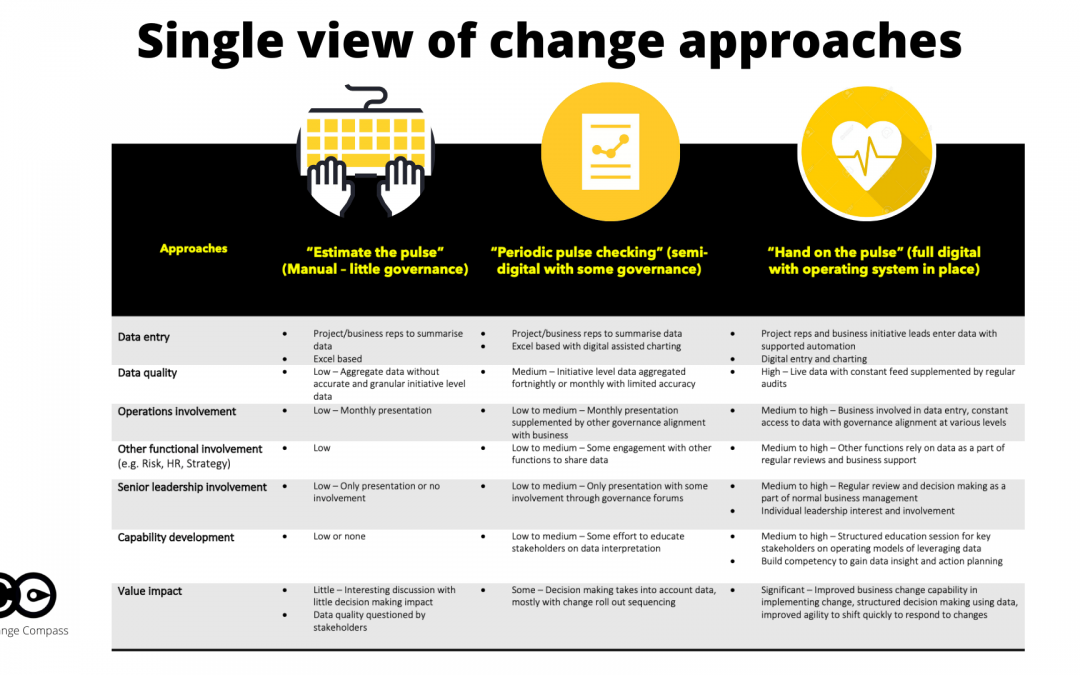
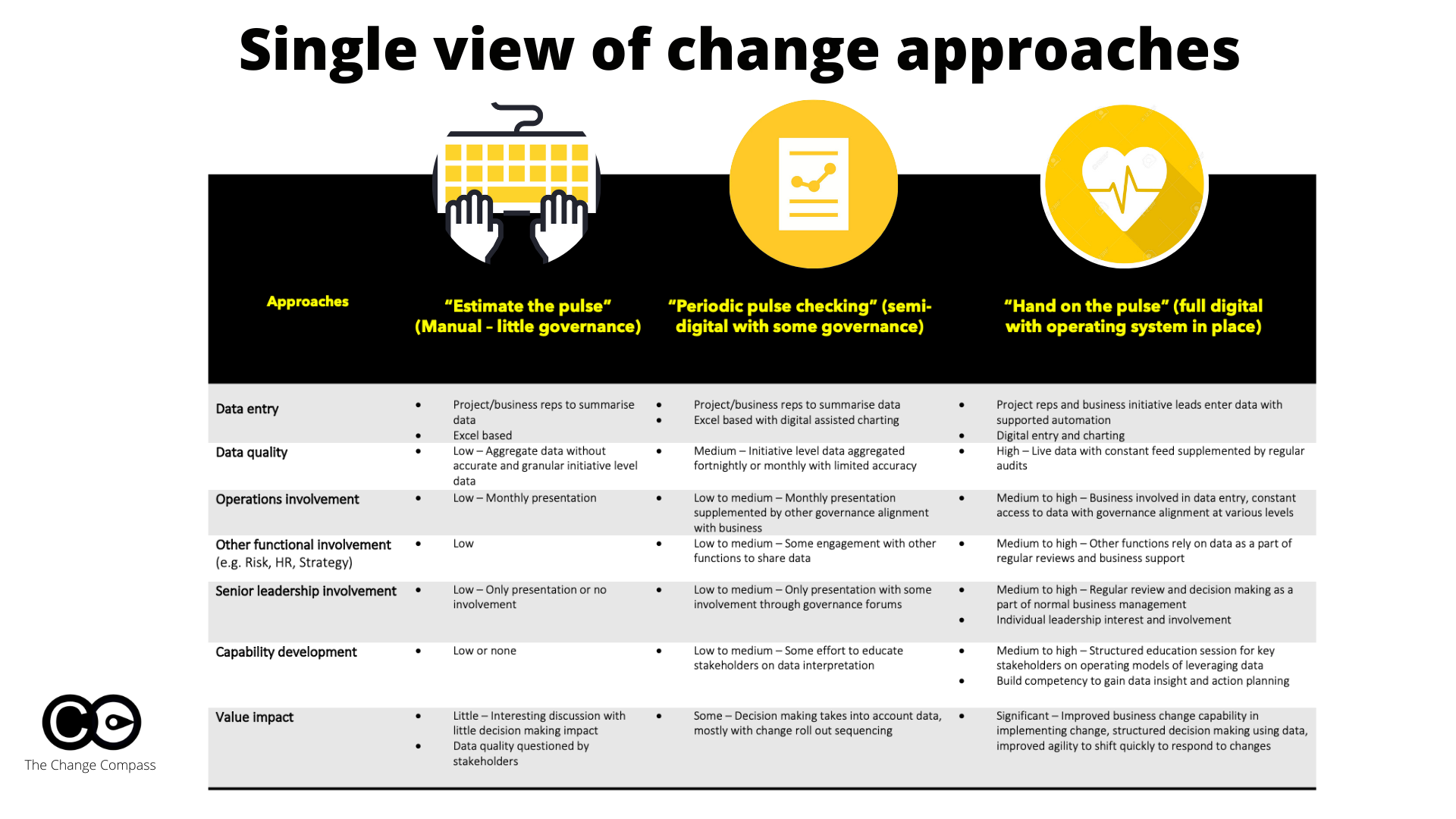
What makes this problem particularly stubborn is that it is not primarily a technology problem. It is a practice problem. Organisations know they should consolidate their change data, but the question of how to do it, and at what level of rigour, is rarely answered clearly. This article defines three distinct approaches to building a single view of change, examines what each delivers and where each falls short, and makes the case for why the most sophisticated approach is not a luxury reserved for large enterprises with mature change functions. It is the standard every organisation should be working toward.
A single view of change is not a project list. It is not a programme register or a governance report showing which initiatives are on track. It is a structured representation of the change impacts landing on specific groups of people, at specific points in time, across all active programmes simultaneously. The emphasis is on people, not projects. The question it answers is not “what are we delivering?” but “what are our people being asked to absorb, and when?”
This distinction matters enormously in practice. A project-centric view tells you that three major technology implementations are running concurrently. A people-centric single view of change tells you that the customer service team in the eastern region is simultaneously absorbing a new CRM system, a restructure of their reporting lines, and a revised performance framework, all within the same eight-week window. Those are very different pieces of information, and only the second is useful for making decisions about change sequencing, communication timing, and adoption risk.
Building this kind of view requires agreement on a common data model: which change types you are tracking, how you classify impact severity, which employee groups or business units form the unit of analysis, and over what time horizon the view is maintained. Without that foundation, you end up with a patchwork of inconsistent assessments that cannot be meaningfully aggregated. The three approaches described below represent different levels of rigour in establishing and maintaining that foundation, and each reflects a different level of organisational commitment to change as a managed capability.
Approach 1 – Estimating the pulse: quick wins and limitations
The first approach is the most common starting point, and it is worth being clear that it is a starting point rather than a destination. In this approach, a change practitioner, portfolio office, or PMO collects high-level information about active and planned initiatives and produces a heatmap showing estimated change load across different employee groups over time. The word “estimated” is key. The impacts are not derived from rigorous assessment at the project level. They are approximated, often by a single analyst working from project plans and conversations with project managers.
The appeal of this approach is real. It is fast to stand up, requires no significant technology investment, and can be produced using a spreadsheet or a basic visualisation tool. For an organisation that has never had any consolidated view of change before, even an imperfect heatmap represents a step forward. It gives executive sponsors a rough sense of where the change load is heaviest, and it can prompt useful conversations about sequencing that would not otherwise happen.
The limitations, however, are substantial. Because the data is estimated rather than grounded in structured impact assessments, the view is only as reliable as the individual who produced it, and it degrades quickly as the change portfolio evolves. Projects accelerate, stall, or get descoped, and the heatmap becomes stale within weeks. There is also no systematic mechanism for keeping it current, which means it tends to be produced for a specific governance purpose, presented once, and then quietly retired until the next time someone asks for it. Decisions made on the basis of this view carry significant risk because the underlying data has not been verified at the project level and cannot be easily interrogated.
Approach 2 – Periodic pulse checking: building rhythm and structure
The second approach introduces a degree of structure and rhythm that the first lacks. Rather than producing an ad hoc heatmap when required, organisations operating at this level maintain a regular cadence, typically monthly, of collecting and updating change impact data from projects across the portfolio. Project teams are asked to document their impacts using a consistent template, and the outputs are consolidated into a single view that is reported to governance forums on a scheduled basis.
This approach represents a meaningful improvement. The data is more grounded because it comes directly from project teams rather than being estimated centrally. The regular cadence means the view is updated more frequently and is therefore more reliable. Governance bodies begin to develop a habit of reviewing the single view as part of their standard portfolio reporting, which normalises the conversation about change load and creates accountability for managing it.
In many organisations, this level of practice already represents a significant cultural shift. McKinsey research on large-scale transformations has consistently highlighted that poor coordination between concurrent change initiatives is one of the primary contributors to failed adoption and employee fatigue. A periodic pulse-checking approach at least surfaces these coordination risks in a structured way, even if it does not fully resolve them.
The limitations of this approach centre on its episodic nature. Monthly data collection means that the view is always somewhat out of date. More critically, the single view produced in this approach tends to inform reporting rather than drive decisions. It tells governance what is happening but does not integrate deeply enough into project planning, resourcing, or change sequencing decisions to actually change outcomes. There is also a data quality problem: when project teams are asked to self-report their impacts using a template, the quality of those assessments varies considerably depending on the maturity of the project’s change capability. Without a mechanism to validate or interrogate the data, the consolidated view can reflect widely different standards of rigour across the portfolio.
Approach 3 – Hand on the pulse: the embedded operating system
The third approach is qualitatively different from the first two, and it is the approach that every organisation should be working toward. Rather than treating the single view of change as a reporting artefact that is produced periodically and presented to governance, this approach embeds change data as a live, continuously maintained input into business operations and decision-making. The single view is not a report. It is an operating system.
In practical terms, this means that change impact data is maintained in real time, or close to it, and is structured in a way that allows it to be sliced, queried, and acted upon at multiple levels of the organisation. Business leaders can view the change load on their teams at any point. Change practitioners can identify emerging collision points and intervene before they become adoption failures. Portfolio offices can use the data to make evidence-based decisions about sequencing, resourcing, and prioritisation. And because the data is maintained continuously rather than refreshed monthly, it reflects the actual state of the change portfolio, not a snapshot from three weeks ago.
The defining characteristic of this approach is that change data is integral to governance rather than supplementary to it. Decisions about which projects get approved, which get deferred, and how implementation timelines are structured are made with explicit reference to the impact those decisions will have on the people being asked to absorb the change. Gartner’s research on change management effectiveness has found that organisations which integrate change capacity data into portfolio governance are significantly better positioned to sustain adoption and realise intended benefits from transformation programmes.
This approach also requires, and builds, a fundamentally different relationship between change practitioners and the business. Change is not something that happens to the organisation from the outside and is then managed reactively. It is a dimension of business performance that is actively monitored, managed, and optimised, in the same way that financial or operational performance is managed. That shift in mindset is as important as the tools and processes that support it.
Why organisations need to move toward approach 3
The case for moving beyond the first two approaches is not primarily about best practice compliance. It is about business outcomes. The accumulation of uncoordinated change is one of the most underappreciated risks in large organisations today. When too much change lands on the same people in the same window, adoption rates fall, productivity drops, and the benefits that justified the investment in each individual programme are not realised. This is not a theoretical risk. Harvard Business Review research on change fatigue has documented that employees experiencing high cumulative change load are significantly more likely to resist new initiatives, disengage from their roles, and leave the organisation.
The first two approaches provide some visibility into this risk, but they do not provide the granularity or timeliness needed to actively manage it. A heatmap produced six weeks ago, based on estimated impacts, does not give a business leader the confidence to make a high-stakes decision about whether to accelerate a technology rollout or defer it by a quarter. A live, data-driven single view of change does.
There is also a structural argument for approach 3 that relates to agility. Organisations that aspire to manage change as an agile capability, responding quickly to market shifts and internal priorities while maintaining employee wellbeing and productivity, cannot do so if their view of change is episodic and imprecise. Agility in change management requires the same real-time data foundations that agility in operations or product development does. Without a continuously maintained single view of change, decisions about sequencing and resourcing default to seniority and politics rather than evidence, and the organisation’s change capacity is chronically misallocated.
The maturity journey from approach 1 to approach 3
It would be unrealistic to suggest that every organisation can or should immediately adopt the hand-on-the-pulse approach. The journey from approach 1 to approach 3 is a genuine maturity progression, and it requires investment in data practices, governance structures, technology, and change practitioner capability. For most organisations, the progression is sequential, and each step builds the foundations that the next one requires.
Moving from approach 1 to approach 2 typically requires establishing a consistent impact assessment methodology that project teams can apply, creating a regular cadence for data collection and consolidation, and securing a governance forum that is willing to receive and act on the single view as part of its standard agenda. These are cultural as much as procedural changes. They require the PMO or change function to build credibility with the business by demonstrating that the data is reliable and the insights are actionable.
Moving from approach 2 to approach 3 is a more significant step. It requires a technology platform that can maintain and present change data in real time, a data governance model that ensures consistent quality across project submissions, and a set of business processes that use the single view as a live input rather than a periodic report. It also requires a change in how the organisation thinks about the role of the change function, from a support service that produces documentation to a strategic capability that manages change as a business resource.
The organisations that have successfully made this transition share a common pattern: they invested in the methodology before the technology. They established what data they needed, how it would be defined and collected, and how it would be used in decisions, before they invested in the platform to make it scalable. Organisations that invest in technology first, without a clear data model and governance framework behind it, typically find that the platform becomes another source of inconsistent data rather than a reliable operating system.
How The Change Compass enables the hand-on-the-pulse approach
The Change Compass is a digital change management platform purpose-built to support organisations in achieving and sustaining the third approach. Rather than requiring change practitioners to manually consolidate impact data from spreadsheets and project templates, the platform provides a structured environment where change data is captured, maintained, and visualised in real time across the full portfolio. Business leaders can see the change load on their teams at any point in time. Change practitioners can identify emerging pressure points and model the impact of sequencing decisions before they are made. Governance bodies receive a live, evidence-based picture of change capacity rather than a retrospective report.
Critically, the platform is designed to support the methodology as much as the technology, providing the data structures, impact assessment frameworks, and reporting templates that organisations need to build a consistent, high-quality single view of change. For organisations earlier in their maturity journey, it can also support the transition from approach 1 or 2, helping teams establish the data disciplines that make approach 3 achievable over time.
Frequently asked questions
What is a single view of change and why does it matter?
A single view of change is a consolidated, real-time representation of all the changes impacting a given group of employees at any point in time, across every active programme and initiative in the organisation. It matters because without it, organisations cannot reliably assess cumulative change load, identify collision points between concurrent initiatives, or make evidence-based decisions about sequencing and resourcing. Change practitioners who lack this view are managing complexity without the data they need to do so effectively.
How is a change heatmap different from a single view of change?
A change heatmap is typically a visual representation of change activity across the organisation, showing which groups are most heavily impacted during a given period. A single view of change is broader and more dynamic: it encompasses not just the visual output but the underlying data model, collection processes, governance structures, and decision-making integration that make the view reliable and actionable. A heatmap is often the product of approach 1, and while it is a useful starting point, it is not the same as the fully embedded single view that approach 3 delivers.
How long does it typically take to move from approach 1 to approach 3?
The timeline varies considerably depending on the size and complexity of the organisation, the maturity of the existing change function, and the level of executive sponsorship for the capability investment. In organisations that move deliberately and invest in methodology before technology, a transition from approach 1 to approach 2 might take six to twelve months, and from approach 2 to approach 3 a further twelve to twenty-four months. However, organisations that adopt a fit-for-purpose digital platform early in the journey can accelerate this considerably by building the right data disciplines from the outset.
Can smaller organisations achieve approach 3, or is it only realistic for large enterprises?
Approach 3 is achievable for organisations of all sizes, and in some respects it is easier for smaller organisations because the data volumes are more manageable and the governance structures simpler. The core requirements, a consistent impact assessment methodology, a live data environment, and governance integration, scale down as well as up. Smaller organisations that invest in the right platform and establish the right disciplines can often reach approach 3 faster than large enterprises, precisely because they do not carry the same legacy of siloed project governance and fragmented change data.
Effective communication is the lifeblood of any successful change endeavour within an organization. It serves as the conduit through which ideas are conveyed, strategies are articulated, and employees are engaged. However, the delicate balance between providing sufficient information and avoiding overload is often difficult to strike. Moreover, how communication is crafted can significantly impact its effectiveness in driving change.
Exploring the Elements of Failure
Delving into the nuances of change communication reveals several common pitfalls that can impede its effectiveness:
Maintaining a Positive or Neutral Tone: In many corporate settings, there is a pervasive tendency to maintain a positive or neutral tone in communication. While this may seem prudent to foster optimism and prevent undue concern, it can inadvertently obscure the gravity of the situation necessitating change. Employees may fail to grasp the urgency or magnitude of the challenges at hand if they are shielded from the realities driving the need for change. Striking the right balance requires a nuanced approach that acknowledges both the imperative for change and the potential benefits it offers. By providing a candid assessment of the current state while articulating a compelling vision for the future, organizations can inspire action and commitment among their workforce.
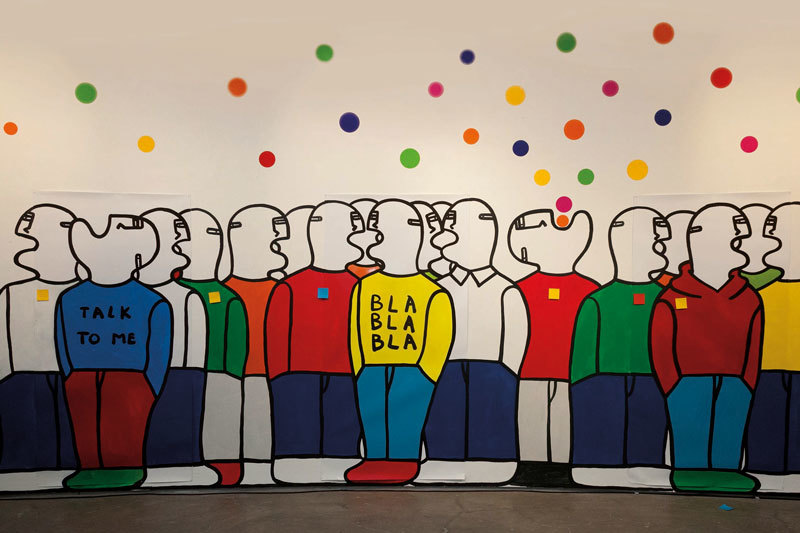
Impersonal Corporate Speak: The language employed in corporate communications often reflects a detached, impersonal demeanor. This formality, while intended to convey professionalism, can alienate employees and hinder their ability to connect with the message. Particularly in the context of change initiatives, where emotions and uncertainties abound, a more humanized approach is essential.Leaders must endeavor to communicate in a manner that resonates with their audience, conveying authenticity and empathy. By infusing their messages with personal anecdotes, genuine concerns, and relatable language, they can establish rapport and engender trust among employees.
Focus on Reason Over Emotions: Traditional corporate communication tends to prioritize logic and reason over emotional appeal. While facts and figures are undoubtedly important, they often fail to evoke the deeper emotional responses necessary to galvanize action. Employees are more likely to embrace change when they are emotionally invested in its success.Leaders should not shy away from tapping into the emotional dimension of change, sharing personal stories, aspirations, and concerns. By fostering a sense of shared purpose and rallying around common values, organizations can cultivate a culture of resilience and adaptability.
I hear you nod. So what is wrong with these practices if they have been the norm for decades and is adopted as common practice by most organisations?
OK let’s go through these one by one.
Illustrating the Importance of Emotional Engagement:
Drawing from personal experiences underscores the profound impact that emotional engagement can have on driving change: Recalling my tenure at Intel, a pivotal moment arose when rival AMD posed a significant threat to our market dominance. Leaders initiated candid discussions, rallying employees around the emotional stakes of the challenge. This emotional appeal galvanized teams across functions, leading to a remarkable turnaround in our fortunes.
Reimagining Change Communications
In light of the evolving organizational landscape, characterized by rapid technological advancements and shifting cultural norms, there is a pressing need to reimagine change communications: John Kotter, in his book “Change: How Organizations Achieve Hard-to-Imagine Results in Uncertain and Volatile Times,” highlights the imperative for organizations to adapt their communication strategies to meet the demands of the modern era. This entails embracing a more dynamic, inclusive approach that values authenticity, transparency, and emotional resonance.
Change communication is not a static endeavor but rather an ongoing evolution that must adapt to the ever-changing needs and expectations of employees. By challenging conventional norms and embracing innovative approaches, organizations can foster a culture of open dialogue, trust, and collaboration that fuels meaningful change and sustainable growth.
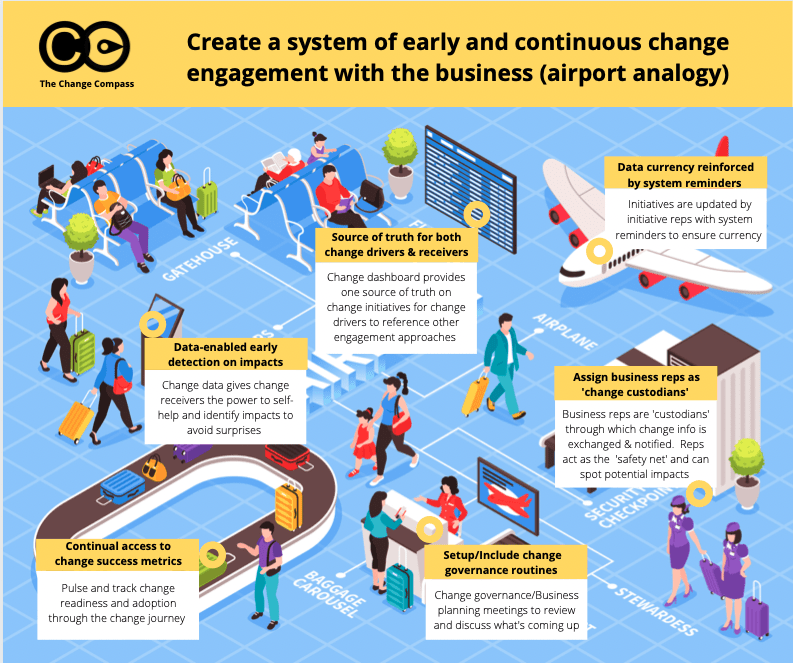
Change is akin to navigating through the skies; it requires careful planning, clear communication, and the ability to adapt to shifting conditions. In the same way that a well-orchestrated airport ensures the safe and efficient movement of passengers and cargo, organizations must design a robust system for change management to achieve success in today’s dynamic business environment. As we explore the intricacies of designing such a system, we’ll draw parallels to the meticulous planning and execution required in airport operations.
Data Currency: Reinforced by System Reminders
Imagine an airport where flight schedules are constantly updated to reflect changes in departure times, gate assignments, and weather conditions. Similarly, our change management system employs reminders to ensure that change initiatives are regularly updated by initiative representatives. This emphasis on data currency mirrors the real-time updates necessary for smooth operations in an airport, enhancing agility and equipping stakeholders with the latest insights to drive informed decision-making.
Source of Truth for Both Change Drivers & Receivers
Just as an air traffic control tower serves as the central hub for coordinating flight information, our change dashboard serves as a centralized source of truth for all stakeholders. This dashboard provides change drivers and receivers with comprehensive insights into ongoing initiatives, fostering transparency and alignment across the organization. Much like how clear communication among air traffic controllers, pilots, and ground staff is essential to avoid chaos in an airport, our centralized repository facilitates collaboration and empowers stakeholders to navigate the change journey with confidence.
Data-Enabled Early Detection on Impacts
Modern aircraft are equipped with advanced sensors to detect potential issues early and prevent disruptions during flights. Similarly, our change management system leverages data to anticipate and mitigate impacts before they escalate. By providing stakeholders with the tools to self-assess and identify potential disruptions, surprises are minimized, and proactive measures can be taken to ensure a seamless transition. This proactive approach mirrors the preventive measures taken in aviation to maintain safety and efficiency in flight operations.
Assigning Business Reps as “Change Custodians”
In an airport, ground staff play a crucial role in ensuring the smooth flow of operations and addressing potential issues as they arise. Similarly, designating business representatives as change custodians facilitates the exchange of critical information and ensures that potential impacts are identified and addressed in a timely manner. By acting as the frontline support for change initiatives, these representatives serve as the linchpin of change maturity, fostering a culture of accountability and ownership throughout the organization.
Continual Access to Change Success Metrics
Much like pilots rely on instruments to gauge their progress and make informed decisions during flights, stakeholders require access to real-time metrics to assess change readiness and adoption. Pulse checks and regular tracking throughout the change journey provide stakeholders with the insights needed to course-correct and adapt as necessary. Additionally, change governance routines, akin to strategic planning meetings in aviation, provide a forum for reviewing upcoming changes and fostering alignment with organizational goals.
Designing a system for change maturity requires careful planning, clear communication, and a commitment to continuous improvement, much like orchestrating the intricate operations of an airport. By embracing the airport analogy and drawing inspiration from its principles, organizations can navigate the complexities of change with confidence and achieve sustainable success in today’s ever-evolving business landscape.
Please click the below to download the infographic.