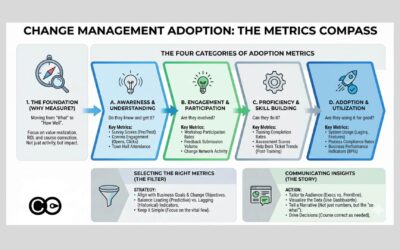
Prosci’s 12th Edition Best Practices in Change Management research found that 76% of change practitioners who measure adoption met or exceeded their project objectives. Among those who did not measure, only 24% achieved the same result, a three-to-one difference in...
Latest Blogs •
How to measure change adoption
How can understanding the change adoption curve benefit organizations? Understanding the change adoption curve benefits organizations by identifying how different individuals or groups respond to change. By recognizing these stages—innovators, early adopters, early...
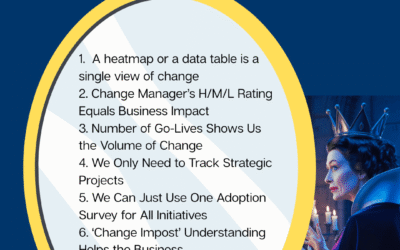
Change management heat map explained: what it tells you, what it hides, and what to do instead
Every change leader has seen the heat map. It sits in the deck, a grid of red, amber and green cells showing which business units are being hit hardest over the next 12 months. The leadership team glances at the red cells, nods gravely, and the meeting moves on....
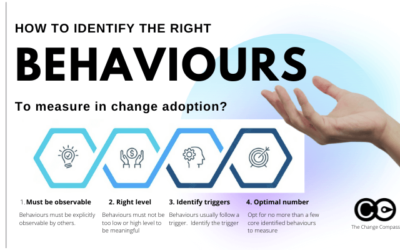
Measuring behaviours in change adoption – Infographic
Measuring behaviours as a part of change adoption is a key part of effective change management, ensuring the full achievement of initiative benefits and helping practitioners understand whether impacted stakeholders are truly moving toward the future state. Behaviour...
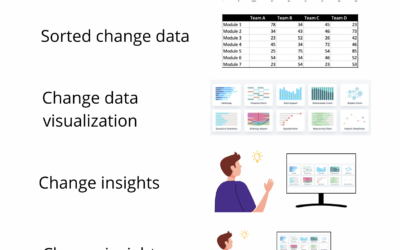
From change management data to business impact – Infographic
There are many steps in getting from collecting change management data to making business impact. Data does not equal business impact.Is the data you’re showing presented in the right graphics, timelines or templates and contain the right key information for the right...
Enterprise change management strategy: repositioning from tactical support to strategic powerhouse
Here is a paradox that plays out in large organisations with uncomfortable regularity. The more complex and frequent the change environment becomes, the more pressure falls on the enterprise change management function to deliver results. And yet, precisely when that...
Change management in the digital age: why the old toolkit is no longer enough
The numbers tell a story that most change leaders already sense. IBM's 2025 CEO study, surveying 2,000 executives globally, found that only around 25% of AI initiatives deliver expected ROI, and just 16% have scaled enterprise-wide. Investment in AI is accelerating at...
Rethinking Change Management Maturity—Why Traditional Capability-Building Falls Short
The Traditional Path: Learning-Focused Change Management For decades, the prevailing wisdom in organisational change management has been to build capability through education and training. Senior leaders and managers are sent to workshops, seminars, and e-learning...
Building change portfolio literacy in senior leaders: the missing link in enterprise transformation
Ask a senior leader whether they have adequate sponsorship for each of their change programmes, and most will say yes. Ask them how much cumulative change load their front-line teams are carrying across the full portfolio right...
Managing multiple changes: seven assumptions that are costing your organisation
Managing multiple changes simultaneously is not an edge case in enterprise transformation. It is the norm. Most large organisations are running ten, twenty, or more concurrent change initiatives at any point in time. The assumptions that change practitioners rely on...
This is what change maturity looks like, and it wasn’t achieved through capability sessions
Section 1: What Change Maturity Looks Like - And How Data Made It Real Shifting from Capability Sessions to Data-Driven Change For years, the default approach to improving organisational change maturity has been through capability sessions: workshops, training...
Change Management’s Data Revolution: How to Measure What Matters (Before It’s Too Late)
As digital acceleration and stakeholder scrutiny intensify, change leaders can no longer rely on gut feelings or generic feedback. The discipline is undergoing a seismic shift—from qualitative storytelling to quantifiable impact. Here’s why measurement is now the...