Most organisations approach change management assessment the same way: a readiness survey circulated two weeks before go-live, a handful of traffic-light ratings, and a report that arrives too late to influence any decisions. It is a ritual that satisfies governance requirements while doing almost nothing to improve outcomes.
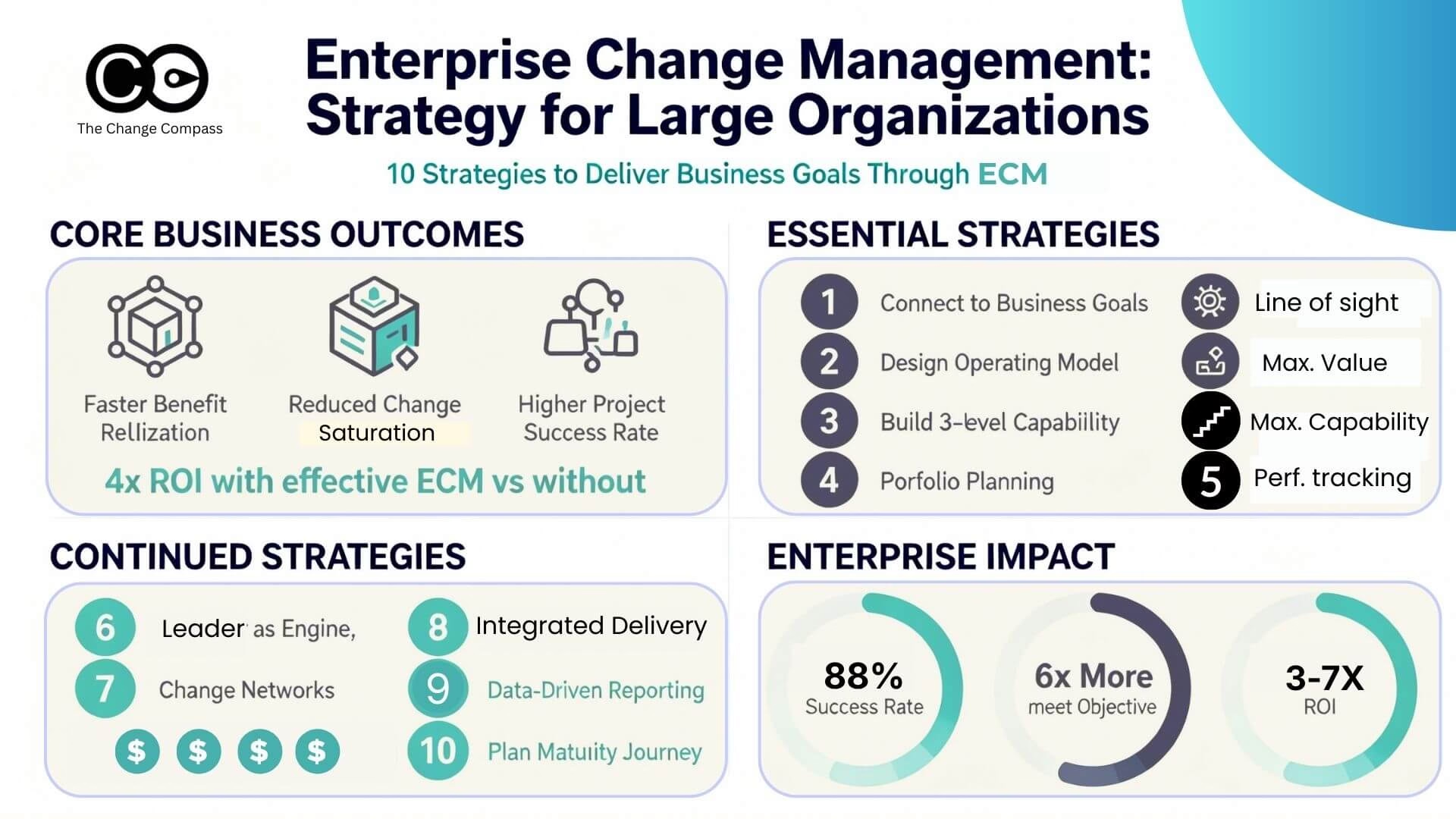
The cost of this gap is significant. McKinsey’s research on organisational transformations found that only 26% of transformations succeed at both improving performance and sustaining those improvements over time. Meanwhile, Prosci’s benchmarking data shows that 88% of projects with excellent change management met or exceeded their objectives, compared to just 13% with poor change management. The difference between these two realities is not effort or intent; it is the quality of assessment that informs strategy before execution begins.
A rigorous change management assessment does more than check a box. It identifies where cumulative change load will overwhelm specific teams, where leadership sponsorship is insufficient, and where the organisation’s capacity for change falls short of what the portfolio demands. This guide presents a practical framework for conducting assessments that actually shape decisions.
Why most change management assessments miss the mark
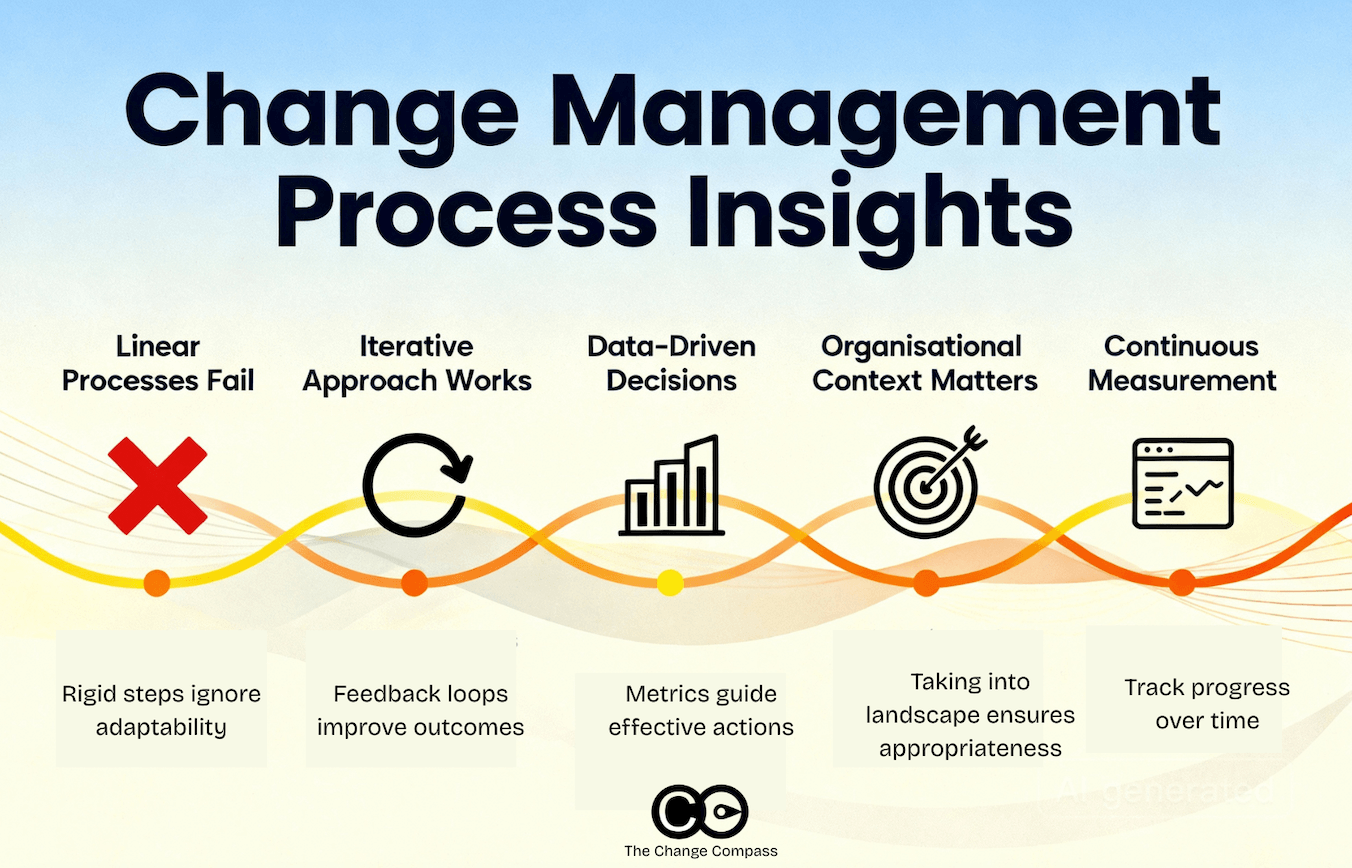
The fundamental problem with conventional change assessments is scope. Most organisations assess readiness for a single initiative in isolation, asking whether stakeholders are aware of the change and whether training has been scheduled. This approach ignores three critical dimensions that determine whether change will succeed or fail.
Cumulative load across concurrent changes
The average employee now experiences ten planned change programmes a year, according to McKinsey’s latest research, a fivefold increase from a decade ago. Assessing each initiative separately means no one has visibility of the total burden falling on the same teams, the same managers, and the same frontline staff. A team that could comfortably absorb one system migration may collapse under the weight of a simultaneous restructure, a compliance programme, and a new performance management process.
Capacity versus readiness
Readiness asks: “Are people prepared for this specific change?” Capacity asks: “Can this part of the organisation absorb more change right now?” These are fundamentally different questions. An organisation can be perfectly ready for a new CRM rollout, with trained users and enthusiastic sponsors, yet still fail because the same people are simultaneously absorbing three other initiatives that have drained their discretionary effort.
Assessment as decision input, not documentation
Too many assessments produce reports that sit in SharePoint. A well-designed change management assessment should directly influence investment decisions, sequencing choices, and resource allocation. If your assessment does not change any decisions, it is not an assessment; it is a compliance exercise.
Three types of change management assessment
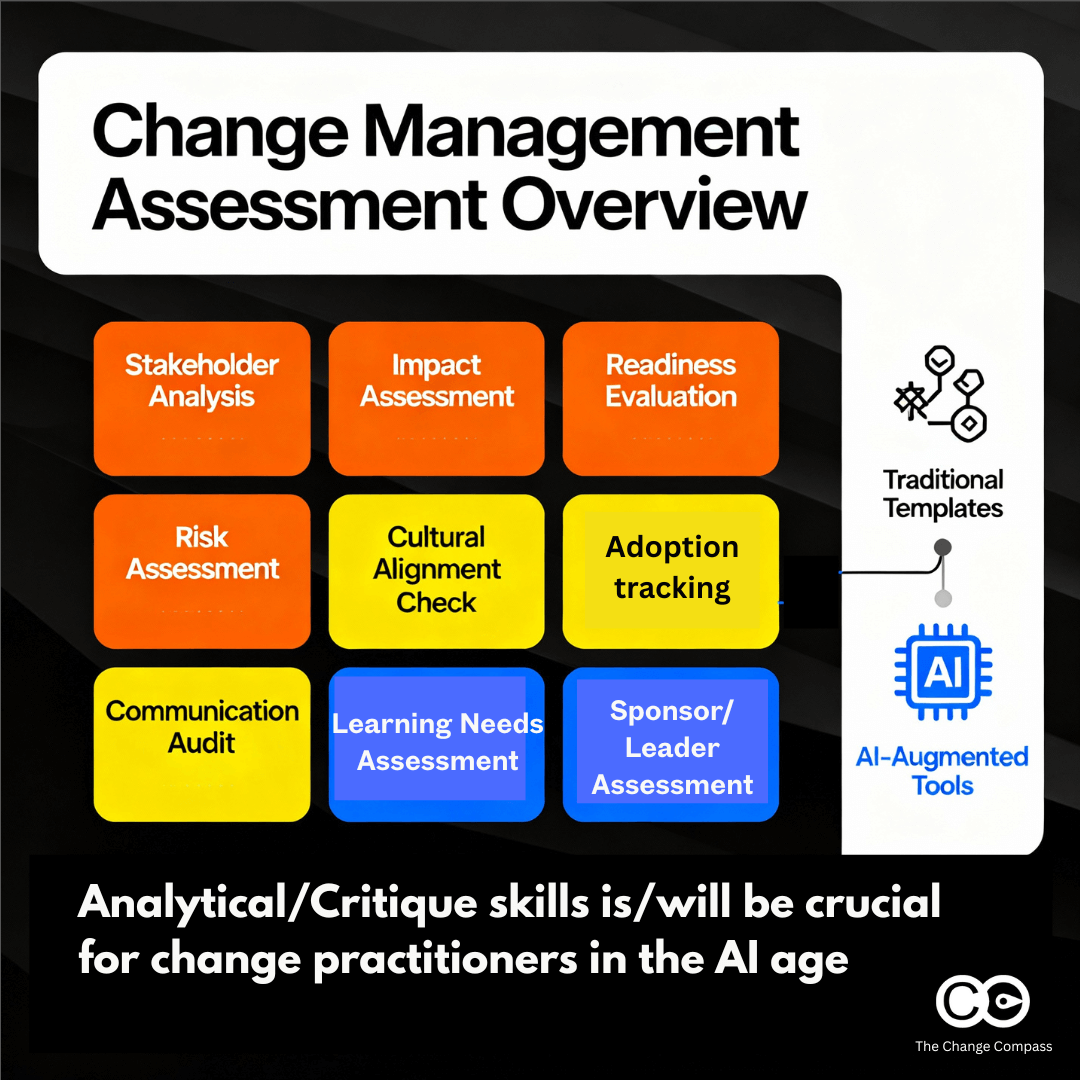
Before building a framework, it helps to distinguish the three assessment types that serve different purposes at different points in the change lifecycle.
Readiness assessment
A readiness assessment evaluates whether a specific group of stakeholders is prepared for a particular change. It typically examines awareness levels, training completion, leadership alignment, and infrastructure readiness. This is the most common type, and it is necessary but insufficient on its own.
Impact assessment
An impact assessment maps the effects of change across the organisation: which teams are affected, what processes will change, what behaviours need to shift, and how significantly. A strong impact assessment looks at degree of change (not just whether a team is “in scope”), timing overlaps, and cumulative load when multiple initiatives converge on the same groups.
Maturity assessment
A maturity assessment evaluates the organisation’s overall change management capability: governance structures, leadership behaviours, measurement practices, and integration with project delivery. This is the most strategic of the three and informs long-term capability building. For a deeper exploration of maturity models, see our guide to change management maturity.
The most effective organisations use all three in combination, applying each at the right moment in the change lifecycle.
A practical five-step change management assessment framework
This framework moves assessment from a one-off checklist to a dynamic capability that continuously informs decisions across the change portfolio.
Step 1: Scope the change portfolio
Before assessing individual initiatives, map the full portfolio of changes in flight or planned for the next 12 months. For each initiative, capture:
- Nature of the change (technology, process, structure, culture)
- Affected business units, roles, and geographies
- Timeline and key milestones
- Expected degree of disruption (minor adjustment vs fundamental shift)
This portfolio view is the foundation for everything that follows. Without it, you are assessing puzzle pieces without seeing the picture on the box.
Step 2: Map cumulative impact across stakeholder groups
With the portfolio mapped, overlay all changes onto the stakeholder groups they affect. The goal is to answer one question: which groups face the highest cumulative change load, and when?
Key indicators to track:
- Number of concurrent initiatives per team or role
- Degree of behavioural change required (not just system changes)
- Timing clusters where multiple changes converge
- Dependencies between initiatives that create sequencing risks
This step often reveals surprises. A finance team that appears lightly affected by any single project may be drowning under six initiatives that each require modest but simultaneous effort. Moving beyond simple heatmaps to multi-dimensional impact views is critical for this analysis.
Step 3: Assess change capacity versus change load
Capacity assessment examines the organisation’s ability to absorb change at a given point in time. This is distinct from readiness because it accounts for everything happening concurrently, not just the initiative being assessed.
Evaluate capacity across four dimensions:
- Leadership bandwidth: Do sponsors have the time and attention to actively support this change alongside their other commitments?
- Team absorption capacity: Are affected teams already operating at or beyond capacity due to other changes or operational pressures?
- Support infrastructure: Are there enough change practitioners, trainers, and communication resources to support the portfolio?
- Cultural resilience: Does the organisation have a track record of successful change, or is there accumulated change fatigue?
Where change load exceeds capacity, the response is not to push harder. It is to sequence, defer, or redesign.
Step 4: Evaluate leadership readiness and sponsor alignment
Prosci’s research consistently identifies active and visible sponsorship as the single greatest contributor to change success. Yet sponsor assessment is often treated as a formality.
A genuine sponsor assessment examines:
- Whether the sponsor understands the specific behavioural changes required (not just the project deliverables)
- Whether the sponsor has allocated time to visibly champion the change
- Whether the sponsor coalition is aligned, with no conflicting messages from peer leaders
- Whether sponsors at each level of the hierarchy are prepared to reinforce the change within their teams
If sponsor alignment is weak, no amount of communication or training will compensate. This step should produce a clear, honest evaluation that the project team can act on.
Step 5: Design measurement baselines
An assessment without a baseline is a snapshot that cannot be tracked. For each dimension assessed, establish a measurable starting point against which progress can be measured.
Effective baselines include:
- Current awareness and understanding levels (via pulse surveys)
- Current adoption rates for similar past changes (as a benchmark)
- Current team workload and capacity indicators
- Current sponsor engagement scores
These baselines feed directly into your measurement framework for tracking change outcomes and ensure assessment is not a one-off event but the start of a continuous feedback loop.
Using assessment data to drive decisions
The value of a change management assessment is entirely determined by what decisions it influences. Assessment data should feed into four decision points:
Sequencing decisions: When cumulative load on a team exceeds capacity, the data should trigger a conversation about deferring, phasing, or redesigning one or more initiatives. This is not a failure of the change team; it is a mature organisational response to resource constraints.
Investment decisions: Assessment data can reveal where additional investment in change support, whether dedicated practitioners, additional training resources, or extended timelines, will yield the highest return. WTW’s 2023 research found that companies taking a proactive, data-driven approach to change management drove nearly three times more revenue than those with below-average change effectiveness.
Design decisions: Impact assessment data can reshape how a change is designed. If the assessment reveals that a particular team faces an unsustainable load in Q3, the project team can redesign the rollout to phase that team’s transition to Q4 instead.
Governance decisions: Mature organisations embed assessment criteria into their project governance frameworks, ensuring no initiative proceeds past a gate review without a validated change management assessment. This transforms assessment from optional to structural.
How digital change analytics accelerate assessment
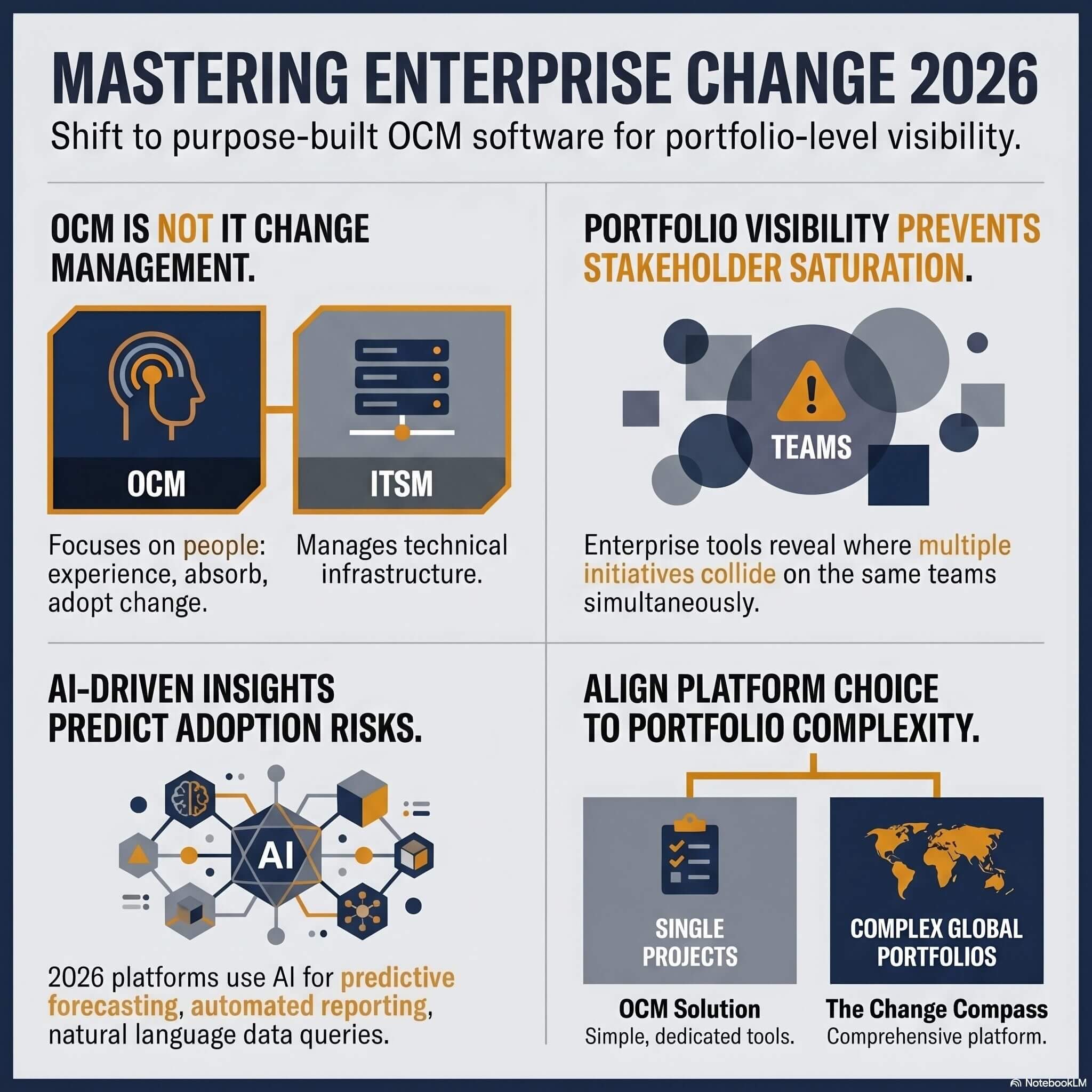
Portfolio-level assessment across dozens of concurrent initiatives is extraordinarily difficult to manage with spreadsheets and manual surveys. The data is too dynamic, the interdependencies too complex, and the stakeholder landscape too fluid.
Digital change management platforms such as The Change Compass enable organisations to map cumulative impact across the entire change portfolio in real time, visualise capacity constraints before they become crises, and generate the kind of multi-dimensional analysis that manual methods simply cannot achieve at scale. For organisations managing complex, concurrent transformations, this kind of tooling shifts assessment from periodic reporting to continuous, decision-ready intelligence.
For a practical assessment template to get started, contact our team to request a downloadable change management assessment framework tailored to your portfolio.
A change management assessment should be the most influential artefact your change team produces. When done well, it surfaces the risks that no one else is tracking, the cumulative load that no single project team can see, and the capacity constraints that will determine whether the portfolio succeeds or stalls. Stop assessing readiness for individual changes in isolation. Start assessing the organisation’s capacity to absorb the full weight of what is being asked of it. That shift, from initiative-level readiness to portfolio-level capacity, is the difference between assessment as documentation and assessment as strategy.
Frequently asked questions
What is a change management assessment? A change management assessment is a structured evaluation of an organisation’s readiness, capacity, and capability to absorb planned changes. It typically examines stakeholder impact, leadership alignment, cumulative change load, and support infrastructure. The most effective assessments go beyond single-initiative readiness to evaluate the full change portfolio.
How often should you conduct a change management assessment? For organisations managing multiple concurrent changes, assessment should be continuous rather than periodic. At minimum, reassess at each major project gate, quarterly for portfolio-level capacity, and whenever the change portfolio shifts significantly due to new initiatives, deferrals, or scope changes.
What is the difference between a readiness assessment and an impact assessment? A readiness assessment evaluates whether stakeholders are prepared for a specific change (awareness, training, support). An impact assessment maps the effects of change across the organisation, examining which groups are affected, how significantly, and where multiple changes overlap. Readiness tells you if people are prepared; impact tells you what they need to be prepared for.
How do you assess change capacity across an organisation? Change capacity assessment examines leadership bandwidth, team absorption limits, support infrastructure availability, and cultural resilience. The key is to evaluate these dimensions against the cumulative load of all concurrent changes, not just one initiative. Where load exceeds capacity, the appropriate response is to sequence, defer, or redesign.
What metrics should a change management assessment include? Effective assessments measure cumulative change load per stakeholder group, sponsor alignment scores, leadership bandwidth indicators, team capacity utilisation, and baseline awareness and adoption levels. These metrics should be tracked over time against established baselines to show progress and identify emerging risks.
How does change management assessment differ from change management maturity assessment? A change management assessment evaluates readiness and capacity for specific changes or a portfolio of changes. A maturity assessment evaluates the organisation’s overall change management capability, including governance, methodology, leadership behaviours, and measurement practices. Assessment is tactical and ongoing; maturity evaluation is strategic and periodic.
References
- The correlation between change management and project success, Prosci
- The science behind successful organisational transformations, McKinsey & Company
- Successful change management pivotal to achieving higher revenue growth, WTW, 2023
- Gartner HR research finds just 32% of business leaders report achieving healthy change adoption, Gartner, 2025
- Post ID: 21422
- Suggested title: The complete guide to change management assessments in 2026
- Suggested meta description: Learn a 5-step change management assessment framework that evaluates portfolio-level capacity, not just readiness. Move from compliance to strategy.
- Focus keyphrase: change management assessment
- Tags: change management assessment, change readiness assessment, impact assessment, change capacity, portfolio change management, organisational change, change management framework, assessment methodology
- Preserve existing 3 images at logical positions in the body