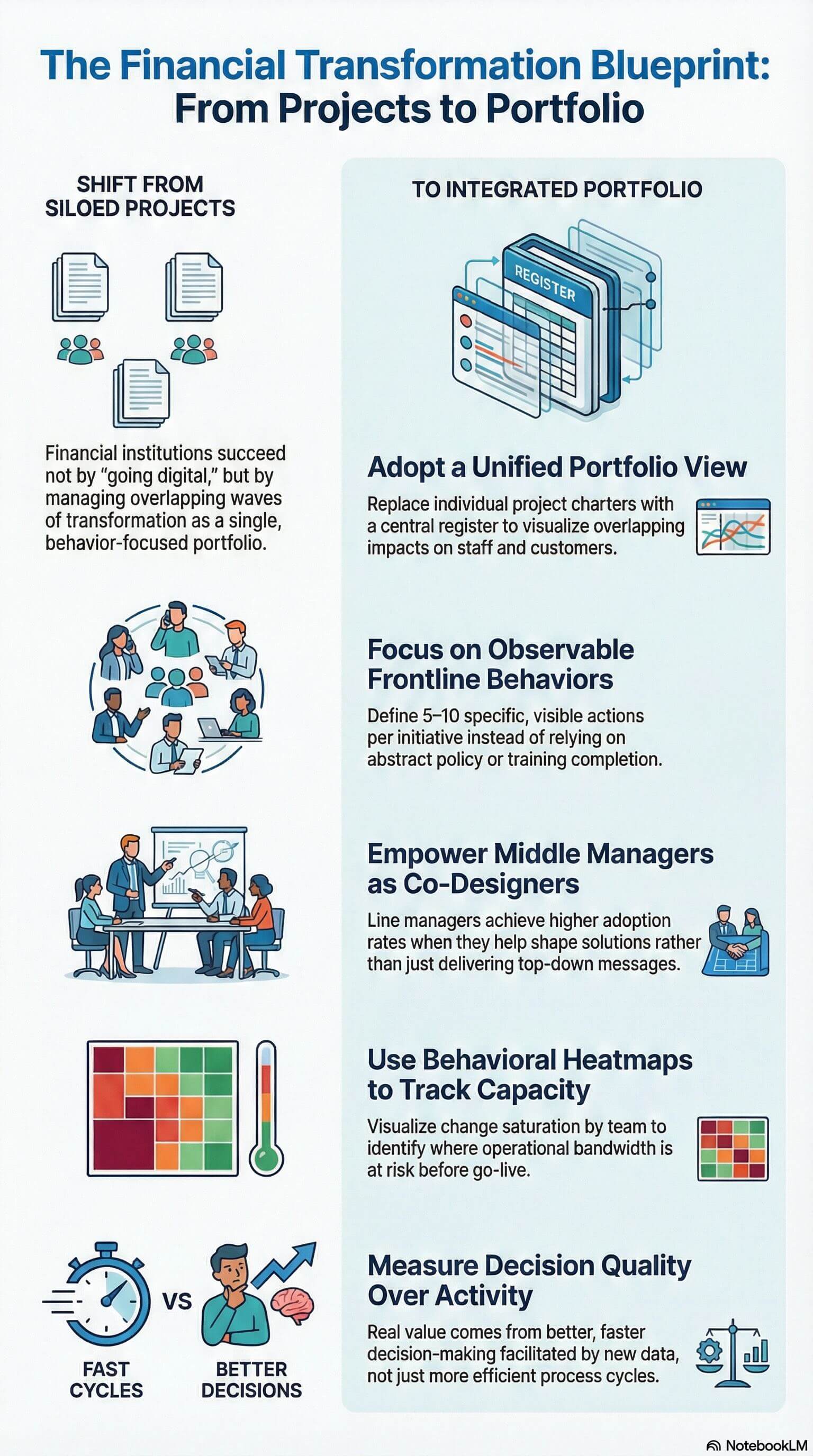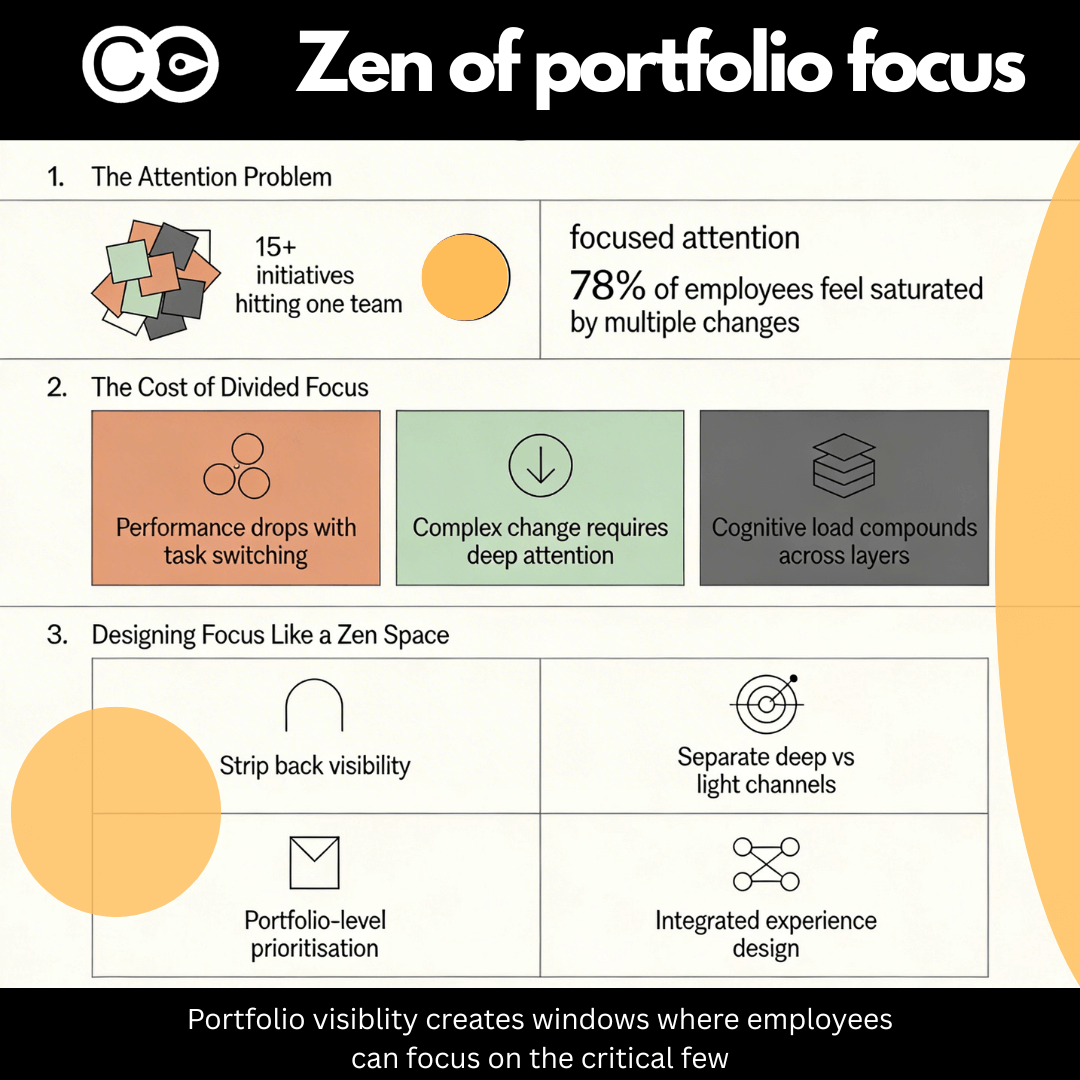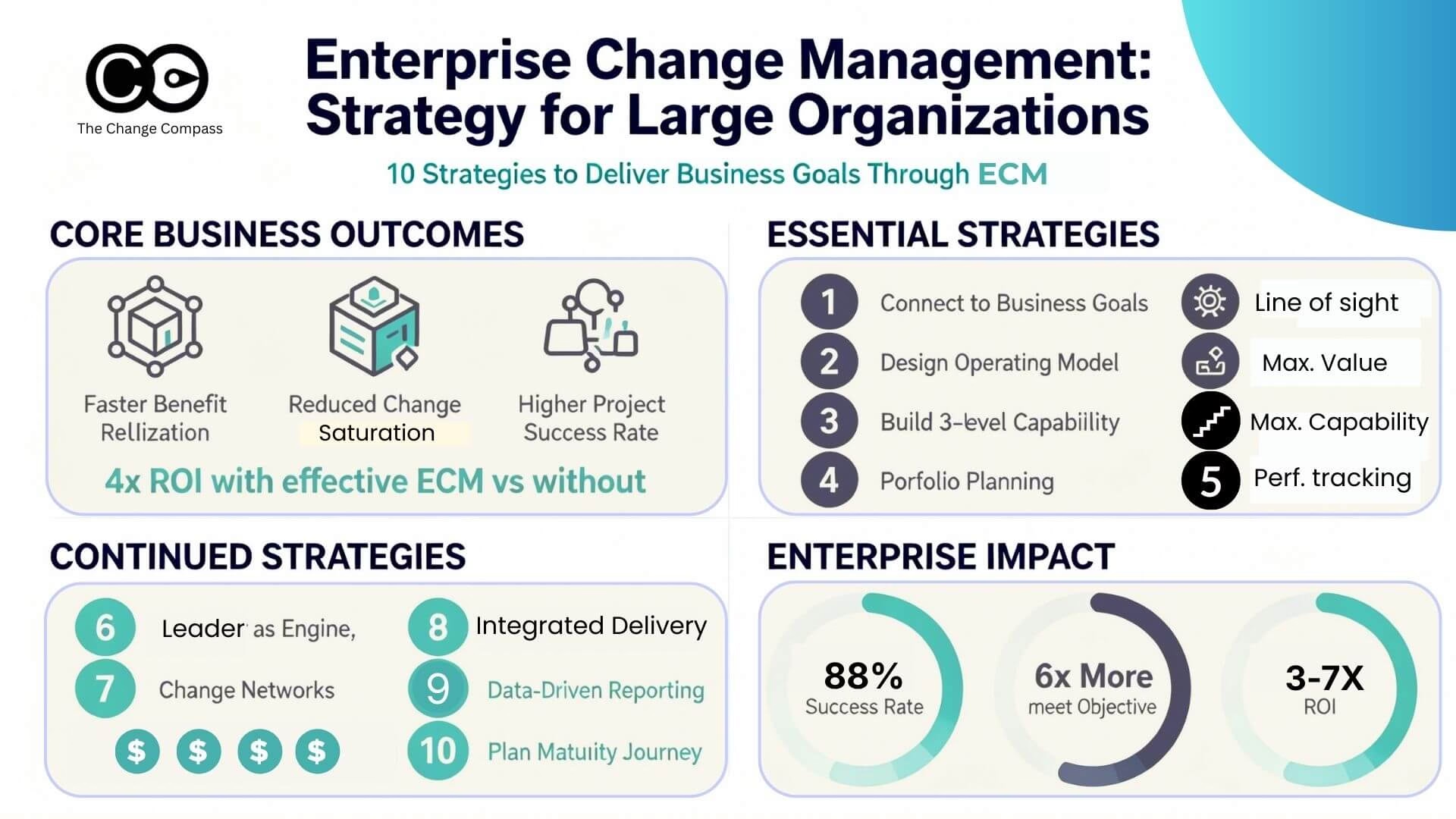


Enterprise change management has evolved from a tactical support function into a strategic discipline that directly determines whether large organizations successfully execute complex transformations and realize value from major investments. Rather than focusing narrowly on training and communications for individual projects, effective enterprise change management operates as an integrated business partner aligned with organizational strategy, optimizing multiple concurrent initiatives across the portfolio, and building organizational capability to navigate change as a core competency. The 10 strategies outlined in this guide provide a practical roadmap for large organizations to design and operate enterprise change management as a value driver that delivers faster benefit realization, prevents change saturation, and increases project success rates by six times compared to organizations without structured enterprise change capability.
Understanding Enterprise Change Management in Modern Organizations
Enterprise change management differs fundamentally from project-level change management in both scope and strategic integration. While project-level change management focuses on helping teams transition to new tools and processes within a specific initiative, ECM operates at the enterprise level to coordinate and optimize multiple concurrent change initiatives across the entire organization. This distinction is critical: ECM aligns all change initiatives with strategic goals, manages cumulative organizational capacity, and builds sustainable change competency that compounds over time.
The scope of ECM encompasses three interconnected levels of capability development:
- Individual level: Building practical skills in leaders and employees to navigate change, explain strategy, support teams, and use new ways of working
- Project level: Applying consistent change processes across major initiatives, integrating change activities into delivery plans, and measuring adoption
- Enterprise level: Establishing standards, templates, governance structures, and metrics that ensure change is approached consistently across the portfolio
In large organizations managing multiple strategic initiatives simultaneously, ECM provides the connective tissue between strategy, projects, and day-to-day operations. Rather than treating each initiative in isolation, ECM looks across the enterprise to understand who is impacted, when, and by what level of change, and then shapes how the organization responds to maximize value and minimize disruption.
The Business Case for Enterprise Change Management
Before examining strategies, it is important to understand the compelling business rationale for investing in enterprise change management. Organizations with effective change management capabilities achieve substantially different outcomes than those without structured approaches.
Return on investment represents the most significant financial differentiator.
Organizations with effective change management achieve an average ROI of 143 percent compared to just 35 percent without, creating a four-fold difference in returns. When calculated as a ratio, change management typically delivers 3 to 7 dollars in benefits for every dollar invested. These returns manifest through faster benefit realization, higher adoption rates, fewer failed projects, and reduced implementation costs.
Project success rates are dramatically influenced by change management capability.
Projects with excellent change management practices are 6 to 7 times more likely to meet project objectives than those with poor change management. Organizations that measure change effectiveness systematically achieve a 51 percent success rate, compared to just 13 percent for those that do not track change metrics.
Productivity impact during transitions is measurable and significant.
Organizations with effective change management typically experience productivity dips of only 15 percent during transitions, compared to 45 to 65 percent in organizations without structured change management. This difference directly translates to revenue impact during implementation periods.
Change saturation prevention protects organizational capacity.
When organizations exceed their change capacity threshold without portfolio-level coordination, consequences cascade across multiple performance dimensions. Research shows that organizations applying appropriate change management during periods of high change increased adoption by 72 percent and decreased employee turnover by almost 10 percent, generating savings averaging $72,000 per company per year in training programs alone.
Understanding this business case provides essential context for why the strategies outlined below matter. Enterprise change management is not a discretionary function but an investment that demonstrably improves organizational performance.
10 Strategies for Enterprise Change Management: Delivering Business Goals in Large Organizations
Strategy 1: Connect Enterprise Change Management Directly to Business Goals
A strong ECM strategy starts by explicitly linking change work to the organization’s strategic objectives. Rather than launching generic capability initiatives or responding only to project requests, the ECM function prioritizes its effort around where change will most influence revenue growth, cost efficiency, risk reduction, customer experience, or regulatory compliance outcomes.
This strategic alignment serves multiple purposes. It focuses limited ECM resources on the initiatives that matter most to the business. It demonstrates clear line of sight from change investment to corporate goals, which supports executive sponsorship and funding. It ensures that ECM advice on sequencing, timing, and investment is grounded in business priorities rather than change management principles alone.
Practical implementation steps include:
- Map each strategic objective to a set of initiatives, key impacted groups, required behaviour shifts and services provided
- Define 3 to 5 “enterprise outcomes” for ECM (such as faster benefit realization, fewer change-related incidents, higher adoption scores) and track them year-on-year
- Use strategy language in ECM artefacts, roadmaps, reports, and dashboards so executives see clear line of sight from ECM work to corporate goals
- Present ECM’s annual plan in the same forums and language as other strategic functions, positioning it as a strategic enabler rather than a project support service
Strategy 2: Design an Enterprise Change Management Operating Model That Fits Your Context
The way ECM is structured makes a significant difference to its impact and scalability. Research and practice show that large organizations typically succeed with one of three core operating models: centralized, federated, or hybrid ECM.
Centralized ECM establishes a single enterprise change team that sets standards, runs portfolio oversight, and supplies practitioners into priority initiatives. This approach works well where strategy and funding are tightly controlled at the centre, and where the organization requires consistency across geographies or business units. The advantage is strong governance and consistent methodology; the risk is inflexibility in local contexts and potential bottlenecks if the central team becomes stretched.
Federated ECM empowers business-unit change teams to work to a common framework but tailor approaches locally. This model suits diversified organizations or those with strong regional autonomy. The advantage is local responsiveness and cultural fit; the risk is potential inconsistency and difficulty maintaining enterprise-wide visibility and standards.
Hybrid ECM establishes a small central team that owns methods, tools, governance, and enterprise-level analytics, while embedded practitioners sit in key portfolios or divisions. This model is common in complex, matrixed enterprises and organizations managing multiple concurrent transformations. The advantage is both consistency and responsiveness; the risk is complexity in defining roles and decision-making authority.
When designing the operating model, clarify:
- Who owns ECM strategy, standards, and governance
- How change practitioners are allocated and funded across the portfolio
- Where key decisions are made on priorities, sequencing, and risk mitigation
- How the ECM function interfaces with PMOs, strategy, and business operations
Strategy 3: Build Capability Across Individual, Project, and Enterprise Levels
Sustainable ECM capability rests on deliberate development across all three levels of the organization. Too many organizations invest only in individual capability (training) or only at the project level (methodologies) without embedding organizational standards and governance. This results in uneven capability, lack of consistency, and difficulty scaling.
Individual capability building ensures leaders and employees have practical skills to navigate change. This includes explaining why change is happening and how it connects to strategy, supporting teams through transition periods, and using new tools and processes effectively. Effective approaches include targeted coaching, practical playbooks, and self-help resources that enable leaders to act without always requiring a specialist.
Project-level capability applies a consistent change process across major initiatives. Prosci’s 3-phase process (Prepare, Manage, Sustain) and similar frameworks provide structure that improves predictability and effectiveness. Integration with delivery planning is essential, so change activities (communications, training, resistance management, adoption measurement) are built into delivery schedules rather than running separately.
Enterprise-level capability establishes standards, templates, tools, and governance so change is approached consistently across the portfolio. This level includes maturity assessments using frameworks like the CMI or Prosci models, defining the organization’s current state and desired progression. Strong enterprise capability means that regardless of which business unit or initiative is delivering change, standards and support are consistent.
A practical maturity roadmap typically involves:
- Stage 1 (Ad Hoc): Establish basics with common language, simple framework, and small central team
- Stage 2 (Repeatable): Build consistency through standard tools, regular reporting, and PMO integration
- Stage 3 (Defined): Scale through business-unit change teams, champion networks, and clear metrics
- Stage 4 (Managed): Embed through organizational integration and leadership expectations
- Stage 5 (Optimized): Achieve full integration with strategy and performance management
Strategy 4: Use Portfolio-Level Planning to Avoid Change Collisions and Saturation
One of the highest-value strategies for large organizations is introducing portfolio-level visibility of all in-flight and upcoming changes. Portfolio change planning differs fundamentally from project change planning: rather than optimizing one project at a time, ECM helps the organization optimize the entire portfolio against capacity, risk, and benefit outcomes.
The impact of portfolio-level planning is substantial. Organizations with effective portfolio management reduce the likelihood of change saturation, avoid costly collisions where multiple initiatives hit the same teams simultaneously, and increase the odds that high-priority initiatives actually land and stick. Portfolio visibility also informs critical business decisions about sequencing and timing of major initiatives.
Practical implementation steps include:
- Create a single view of change across the enterprise showing initiative name, impacted audiences, timing, and impact level using simple heatmaps or dashboards
- Identify “hot spots” where multiple changes hit the same teams or customers in the same period, and work with portfolio and PMO partners to reschedule or reduce load
- Establish portfolio governance forums where investment and sequencing decisions explicitly consider both financial and people-side capacity constraints
- Use portfolio data to advise on optimal sequencing of initiatives, typically spacing major changes to allow adoption and benefits realization between waves
Portfolio-level change planning transforms ECM from a project support service into a strategic advisor on organizational capacity and risk.
Strategy 5: Anchor Enterprise Change Management in Benefits Realization and Performance Tracking
Enterprise change strategy should be framed fundamentally as a way to protect and accelerate benefits, not simply as a mechanism to support adoption. Benefits realization management significantly improves alignment of projects with strategic objectives and provides data that drives future portfolio decisions.
Benefit realization management operates in stages. Before change, organizations establish clear baselines for the metrics they expect to improve (cycle time, cost, error rates, customer satisfaction, revenue, etc.). During change, teams track adoption and intermediate indicators. After go-live, systematic measurement determines whether the organization actually achieved promised benefits.
The discipline of benefits management drives several strategic advantages. First, it forces clarity about what success actually means for each initiative, moving beyond “adoption” to genuine business impact. Second, it enables organizations to calculate true ROI and demonstrate value to stakeholders. Third, it provides feedback for continuous improvement: when benefits fall short, measurement reveals whether the issue was weak adoption, flawed design, or external factors.
Practical implementation includes:
- For each major initiative, define 3 to 5 measurable business benefits (for example cost to serve, error reduction, revenue per customer, service time) and link them to specific behaviour and process changes
- Assign owners for each benefit on the business side and clarify how and when benefits will be measured post-go-live
- Establish a simple benefits and adoption dashboard that surfaces progress across initiatives and highlights where ECM focus is needed to close gaps
- Report on benefits progress in regular forums so benefit realization becomes a key topic in performance discussions
When ECM consistently reports in business-outcome terms (for example “this change is at 80 percent of targeted benefit due to low usage in X function”), it becomes a natural partner in performance discussions and strategic planning.
Strategy 6: Make Leaders and Sponsorship the Engine of Enterprise Change
Leadership behaviour is one of the strongest predictors of successful change. An effective ECM strategy treats leaders as both the primary audience and the primary channel through which change cascades through the organization.
Executive sponsors set the tone for how the organization approaches change through the signals they send about priority, urgency, and willingness to adapt themselves. Line leaders translate strategic intent into local action and model new behaviours for their teams. Middle managers often become the critical influencers who determine whether change lands effectively at the frontline.
An enterprise strategy focused on leadership excellence includes:
- Clear expectations of sponsors and line leaders (setting direction, modeling change, communicating consistently, removing barriers to adoption) integrated into leadership frameworks and performance conversations
- Practical, brief, role-specific resources: talking points for key milestones, stakeholder maps, coaching guides, and short “how to lead this change” sessions
- Use of data on adoption, sentiment, and performance to give leaders concrete feedback on how their areas are responding and where they need to lean in
- Development programs for emerging change leaders so the organization builds internal bench strength for future transformations
This leadership focus supports organizational goals by improving alignment, speeding decision-making, maintaining trust and engagement during transformation, and building internal change leadership capability that compounds over time.
Strategy 7: Build Scalable Change Networks and Communities
To execute change at enterprise scale, ECM needs leverage beyond the central team. Change champion networks and communities of practice are proven mechanisms to extend reach, build local ownership, and create feedback loops that surface emerging issues.
Change champions are practitioners embedded in business units who interpret change locally, provide peer support, and serve as feedback channels to the centre. Communities of practice bring together change practitioners across the organization to share approaches, lessons learned, and tools. Done well, these networks help the organization adapt more quickly while reducing reliance on a small central change team.
Practical elements of a scalable network model include:
- Identify and train champions with clear role definitions, and provide them with resources, community, and feedback
- Create a change community of practice that meets regularly to share approaches, tools, lessons, and data
- Use networks not only for communications but as insight channels to capture emerging risks, adoption blockers, and improvement ideas from the frontline
- Document and share best practices so successful approaches from one part of the organization can be adapted by others
Effective change networks create organizational resilience and reduce bottlenecks that can occur when all change leadership is concentrated in a small central team.
Strategy 8: Integrate Enterprise Change Management with Project, Product, and Agile Delivery
Change strategy should be tightly aligned with how the organization actually delivers work: traditional waterfall projects, product-based development, agile teams, or hybrid approaches. When ECM is bolted on as an afterthought late in project delivery, it slows progress and creates rework. When integrated from the start, it accelerates delivery while reducing adoption risk.
Integration practices that work across delivery models include:
- Include change leads in portfolio shaping and discovery so that people-side impacts inform scope, design, and release planning
- Use lightweight, iterative change approaches that match agile and product ways of working, including frequent stakeholder touchpoints, short feedback cycles, and gradual feature rollouts
- Align artefacts so business cases, delivery plans, and release schedules carry clear sections on change impacts, adoption plans, and success measures
- Make adoption and benefits realization criteria part of project definition of done, not separate activities that happen after deployment
This integration helps the organization deliver strategic initiatives faster while maintaining adoption and risk control.
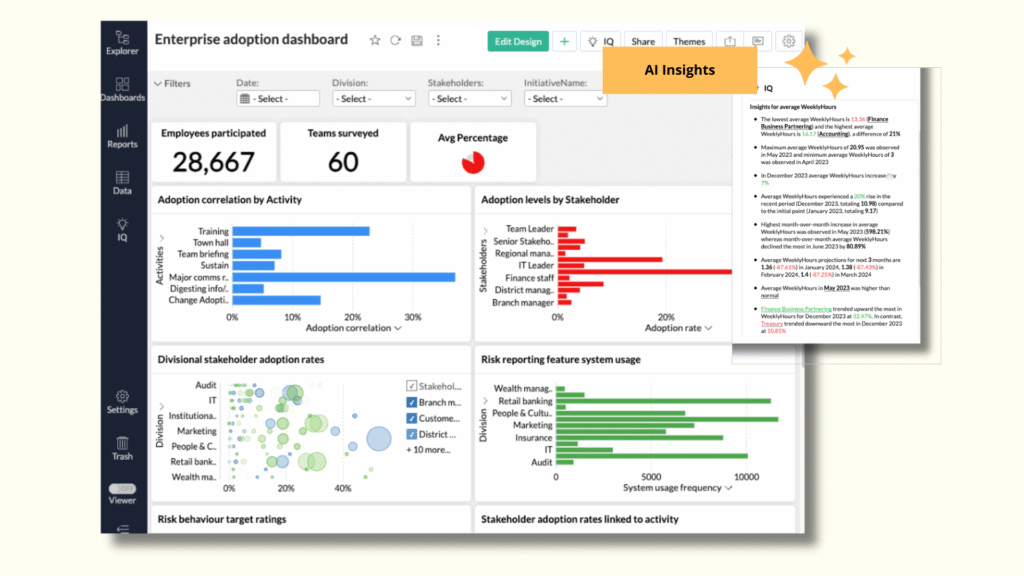
Strategy 9: Use Data and Reporting as a Core Enterprise Change Management Product
For large organizations, one of the most powerful strategies is making “change intelligence” a standard management product. Rather than only delivering plans and training, ECM produces regular, simple, visual reports that show how change is landing across the enterprise.
When ECM operates as an intelligence function, it changes how executives perceive and use change management. Instead of seeing ECM as a cost, they see it as a source of insight into organizational performance and capacity.
Examples of high-value ECM reporting include:
- Heatmaps showing change load by function, geography, or customer segment, with flagging of saturation risk
- Adoption, sentiment, and readiness trends for key initiatives, with early warning of adoption gaps
- Links between change activity and operational KPIs (incident volumes, processing time, customer satisfaction, etc.), demonstrating ECM’s contribution to business outcomes
- Portfolio status showing which initiatives are on track for benefit realization and which require intervention
Research shows that organizations which measure and act on change-related metrics have much higher rates of project success and benefit realization. For executives, this positions ECM as a source of management insight, not just delivery support.
Strategy 10: Plan Enterprise Change Management Maturity as a Progressive Journey
Finally, effective ECM strategy treats capability building as a staged journey rather than a one-off rollout. Both CMI and Prosci maturity models describe five levels, from ad hoc to fully embedded organizational competency. Understanding these levels and planning progression provides essential context for resource investment and expectation setting.
Level 1 (Ad Hoc): The organization has no formal change management approach. Changes are managed reactively without structured methodology, and no dedicated change resources exist.
Level 2 (Repeatable): Senior leadership sponsors some changes but no formal company-wide program exists to train leaders. Some projects apply structured change approaches, but methodology is not standardized.
Level 3 (Defined): Standardized change management methodology is defined and applied across projects. Training and tools become available to project leaders. Managers develop coaching capability for frontline employees.
Level 4 (Managed): Change management competencies are actively built at every organizational level. Formalized change management practices ensure consistency, and organizational awareness of change management significance increases substantially.
Level 5 (Optimized): Change management is fully embedded in organizational culture and strategy. The organization operates with agility, with continuous improvement in change capability.
A practical maturity roadmap for a large organization often looks like:
- Stage 1: Establish basics with a common language, simple framework, and small central team supporting priority programs
- Stage 2: Build consistency through standard tools, regular reporting, and integration with PMO and portfolio processes
- Stage 3: Scale and embed through business-unit change teams, champion networks, leadership expectations, and strong metrics
- Stage 4-5: Optimize through data-driven planning, predictive analytics about change load and adoption, and ECM fully integrated into strategy and performance management cycles
This staged approach lets the organization grow ECM in line with its strategy, resources, and appetite, always anchored on supporting business goals rather than pursuing capability development for its own sake.
How Traditional ECM Functions Support the Strategic Framework
The established ECM functions you encounter in mature organizations (communities of practice, change leadership training, change methodologies, self-help resources, and portfolio dashboards) remain important, but they are most effective when explicitly connected to the strategies above rather than operating as standalone initiatives.
Community of practice supports Strategy 7 (building scalable networks) and Strategy 10 (progressing maturity). When designed well, communities become vehicles for sharing lessons, building peer support, and creating organizational learning that compounds over time.
Change leadership training and coaching forms the core of Strategy 6 (leaders as the engine). Rather than generic training, effective programs are specific to role, focused on practical skill development, and connected to organizational strategy.
Change methodology and framework underpins Strategy 3 (building three-level capability) and provides consistency across Strategy 4 (portfolio planning) and Strategy 8 (agile integration). A clear methodology helps teams understand expected activities and provides a common language across the organization.
Intranet self-help resources for leaders expands reach of Strategy 6 and supports day-to-day execution. Rather than requiring leaders to attend training, self-help resources provide just-in-time support that fits busy schedules.
Single view of change with traffic light indicators becomes a key artefact for Strategy 4 (portfolio planning) and Strategy 9 (data and reporting). Portfolio dashboards provide essential visibility that enables both operational decision-making and strategic advisory.
When these elements are designed and governed as part of an integrated enterprise strategy, ECM clearly supports the organization’s business goals instead of sitting on the margins as supplementary project support.
Demonstrating and Sustaining ECM Value
For ECM functions to truly demonstrate value to the organisation, survive cost-cutting periods and secure sustained investment, they must deliberately reposition themselves as strategic partners rather than support services. Over the years we have observed that even supposedly ‘mature’ ECM teams have ended up on the chopping block when resources are tight and cost efficiency is the focus for organisations. This is not necessarily because the work they are doing is not valuable, but that executives do not see the work as ‘essential’ and ‘high value’. Executives and decision makers need to ‘experience’ the value on an ongoing basis and can see that the ECM team’s work is crucial in business decision making, planning and overall organisational performance and effectiveness.
Anchor value in measurement. Move beyond anecdotal feedback and isolated project metrics to disciplined, data-driven approaches that capture the full spectrum of change activity, impact, and readiness. Organizations that measure change effectiveness systematically demonstrate value that executives recognize and fund.
Focus on business outcomes, not activities. The most compelling business cases emphasize what change management contributes to organizational performance, benefit realization, and competitive position, rather than counting communication sessions delivered or people trained.
Integrate with strategic planning. ECM functions that are involved early in strategic and operational planning cycles can model change implications, forecast resource requirements, and assess organizational readiness. This integration makes change management indispensable to strategic decision-making.
Develop advisory expertise. Build the capability to provide strategic advice about which changes sequencing will succeed, which pose highest risk, and where organizational capacity constraints exist. This elevates ECM from implementation support to strategic partnership.
Report continuously on impact. Establish regular reporting cadences that update senior leadership on change portfolio performance, adoption progress, benefit realization against targets, and operational impact. Sustained visibility of ECM’s contribution maintains stakeholder awareness and support.
Enterprise change management has evolved from a tactical support function into a strategic discipline that fundamentally affects an organization’s ability to execute strategy, realize value from capital investments, and maintain competitive position. The 10 strategies outlined in this guide provide a practical roadmap for large organizations to design and operate ECM as a value driver that supports business goals.
The most effective ECM strategies operate as an integrated system rather than as disconnected initiatives. Connecting ECM to business goals (Strategy 1), designing a sustainable operating model (Strategy 2), and building capability at all three levels (Strategy 3) provide the foundation. Portfolio planning (Strategy 4) and benefits realization tracking (Strategy 5) ensure that ECM focus translates into business outcomes. Leadership engagement (Strategy 6), scalable networks (Strategy 7), and integration with delivery (Strategy 8) ensure that change capability permeates the organization. Data-driven reporting (Strategy 9) demonstrates continuous value. And progressive maturity planning (Strategy 10) ensures the organization grows ECM capability in line with strategy and resources.
Large organizations that implement these strategies gain measurable competitive advantage through higher project success rates, faster benefit realization, reduced change saturation, and more engaged employees. For organizations managing increasingly complex transformation portfolios in competitive markets, enterprise change management is not a discretionary function but a core strategic capability that determines organizational success.
FAQ
What is enterprise change management?
Enterprise change management coordinates multiple concurrent initiatives across an organization, aligning them with strategic goals, managing capacity to prevent saturation, and maximizing benefit realization.
How does ECM differ from project change management?
Project change management supports individual initiatives. ECM operates at portfolio level, optimizing timing, resources, and impacts across all changes simultaneously.
What ROI does enterprise change management deliver?
ECM delivers 3-7X ROI ($3-$7 return per $1 invested) through faster benefits, avoided failures, and higher adoption rates.
What success rates can organizations expect with ECM?
Projects with excellent ECM achieve 88% success (vs 13% without) and are 6X more likely to meet objectives.
How do you prevent change saturation in large organizations?
Use portfolio-level visibility showing all concurrent changes by audience/timing, then sequence initiatives to protect capacity using heatmaps and governance forums.
What are the top ECM strategies for large organizations?
- Connect ECM to business goals
- Portfolio planning to avoid collisions
- Benefits realization tracking
- Leadership enablement
- Data-driven reporting
What ECM operating models work best?
Hybrid model: Central team owns standards/governance, embedded practitioners execute locally. Balances consistency with responsiveness.
How to measure ECM success?
Track 3 levels: Organizational outcomes (ROI, benefits), Individual adoption (usage rates), Change process effectiveness (completion rates).
How long to build ECM maturity?
2-5 years: Year 1 = basics/standards, Year 2 = consistency/tools, Year 3+ = scale/embed across enterprise.
Why invest in ECM during cost pressures?
ECM demonstrates direct business value through portfolio optimization, risk reduction, and ROI tracking, making it indispensable rather than discretionary.