Banks now take more than a year, on average, to fully implement a single regulatory change, and most are running several at once while modernising the technology underneath them (CUBE, Cost of Compliance Report 2025). Change management in financial services is the discipline of delivering transformation, regulatory change and legacy modernisation concurrently, inside a risk and compliance culture, by measuring adoption, operational performance and compliance risk while the change is still rolling out. This article is for transformation, change and operational risk leaders in banking, insurance, superannuation and asset management who are accountable for outcomes that boards and regulators will test. It argues that the sector’s real constraint is not appetite for change but visibility: most institutions cannot see whether a programme is landing until after go-live, when fixing it is slowest and most expensive. By the end you will be able to place your organisation on a three-level change maturity scale, make the case for agile delivery that risk and compliance will sign off, and define the five measures that replace narrative with evidence in a board pack.
Why financial services change is different
Financial services change is different because three loads land on the same people at once: continuous regulatory change, ageing technology, and a cap on how much risk any experiment may carry. Other sectors face one or two of these. Banks, insurers and super funds face all three, and each makes the others harder.
Regulatory change never finishes
Regulation in financial services does not arrive in waves with pauses between them. APRA’s Prudential Standard CPS 230 on operational risk management came into force on 1 July 2025 for authorised deposit-taking institutions, general and life insurers, private health insurers and superannuation trustees, with existing service provider contracts brought into line by the earlier of renewal or 1 July 2026 (APRA). The EU’s Digital Operational Resilience Act began applying on 17 January 2025 across 20 types of financial entity (EIOPA). In the same period CUBE logged 157 new laws and rules on AI in financial services, almost double the previous year, and 60 percent of the 2,000 compliance and risk officers it surveyed expect regulatory change costs to rise again (CUBE).
The practical effect is a permanent queue. A change team finishing one compliance programme usually inherits the next before the first has bedded in.
Legacy technology absorbs the change capacity
The second load is technology. Accenture’s 2026 banking trends report found that about 70 percent of bank IT budgets are consumed by maintenance of technical debt, and that software costs have grown by an average of 8 percent a year since 2017, outpacing revenue growth (Accenture). That leaves a small slice of investment for the modernisation that customers, regulators and shareholders are all asking for.
For change leaders the consequence is less about money than about people. Modernisation programmes often depend on the same product owners, operations teams and subject matter experts who are already carrying regulatory deadlines. Every new programme draws on a shared pool of attention that nobody is measuring.
Concurrent programmes compete for the same frontline
The third load is concurrency. A branch manager, claims assessor or relationship banker may in a single quarter absorb a CPS 230 control uplift, a new lending platform, a policy rewrite and a restructure. Each programme tracks its own readiness. Nobody tracks the total. This is the heart of the saturation problem, covered in more detail in managing change saturation, and the mix of change types behind it is mapped in financial services transformation: eight core types.
Unlike a retailer or a manufacturer, a financial institution cannot treat a failed compliance transformation as a project miss. It carries regulatory penalties, remediation costs, customer trust and sometimes shareholder value, so the standard for evidence is higher.
The regulatory pressure cooker
Regulatory pressure shapes financial services transformation because it consumes most of the change budget and sets the sequencing of everything else. Boston Consulting Group found that banks spend 40 to 60 percent of their change budget on regulatory compliance, and that a significant part of that spend is inefficient because of sequential, waterfall delivery (BCG, When Agile Meets Regulatory Compliance, 2017). The share is the most-quoted quantification of the problem, and the 2025 data suggests the underlying dynamic has not eased.
The tension for transformation leaders
This creates a first tension that every transformation leader in the sector recognises. How do you fund modernisation when the majority of resources go to compliance? How do you hold momentum for a digital programme when a new directive resets priorities every few months? And how do you judge success when the regulatory requirement was met on time but the behaviour change that makes the control real never happened?
CUBE’s survey shows the scale of the execution gap. Fully implementing a regulatory change takes more than a year on average, 21 percent of respondents rate their regulatory change management as somewhat or highly ineffective, and only 16 percent report potential regulatory change directly to their executive team or board (CUBE via Wealth Briefing).
Compliance completion is not compliance behaviour
Institutions at lower maturity often stumble because they lack integrated visibility into how regulatory changes cascade through the transformation portfolio. They can complete a compliance programme on schedule and still have no view of downstream operational impact, adoption or whether the risk was actually remediated. A control that exists on paper but is bypassed by a manual workaround is the usual failure, and it tends to surface in an audit or an incident, not in a project status report.
More mature organisations build change tracking into their compliance processes. They separate two questions: did we deliver the control, and did people change how they work because of it? The second question is the one regulators increasingly ask, and the one the governance model for financial services is designed to answer.
The agility paradox: Risk as guardrail, not gate
Agile change management can work in a regulated bank or insurer when risk and compliance are built into every increment of delivery rather than applied as a final approval gate. The same environment that demands caution also demands speed, because regulation itself has become iterative and complex.
Why sequential projects fail against moving rules
MiFID II began as an 80-page level 1 text and expanded to more than 5,000 pages at implementation level (BCG). Sequential approaches assume the requirement is certain before build starts, and in this sector it rarely is. BCG estimated that properly governed agile delivery could reduce IT spending on compliance projects by 20 to 30 percent while improving on-time delivery.
Many boards remain sceptical, and the scepticism is not irrational. A technology firm can run experiments at speed. A fintech can pivot. A bank cannot without regulatory comfort, compliance sign-off and governance endorsement. Ironically, the rigidity designed to protect stability often produces slower time-to-market, higher cost and strategic misalignment when external conditions shift.
Making agile acceptable to the second line
The way through is to reimagine risk management, not to abandon it. Agile risk management means agile-specific risk assessments and continuous monitoring that embed compliance checks at every step, rather than at the end. In practice that means:
Risk, compliance and the business sit in the same cross-functional team from sprint zero.
Control objectives are written as acceptance criteria for each increment, so evidence is produced as work is done.
Release decisions use agreed risk thresholds rather than a single end-of-project sign-off.
Change impacts on frontline teams are assessed per release, not once at the start. The agile change management in the AI era article covers how to keep this practical.
This turns risk management from a gate into a guardrail.
From second line of defence to design partner
It also requires a cultural shift for risk and compliance functions. They must move from a second-line mindset in which they audit and approve to a design-partner mindset in which they collaborate from day one. Institutions with higher change maturity consistently do this better, because they have embedded risk and compliance perspectives into change governance from the start rather than at the approval stage.
The cultural challenge: Risk-aversion meets innovation
Risk-averse culture is the hidden barrier in financial services transformation because the same instincts that protect customer deposits also make experimentation feel dangerous. Conservative decision-making, extensive approval chains and multiple layers of governance evolved for good reasons. They have also built institutional muscles that resist testing.
Accountability has become personal
That culture is now reinforced by regulation. Australia’s Financial Accountability Regime applies to authorised deposit-taking institutions from 15 March 2024 and to insurers and superannuation trustees from 15 March 2025, and it is designed to improve risk and governance cultures through a strengthened accountability framework for entities and their senior executives (APRA; ASIC). When an executive is personally accountable for a change outcome, appetite for visible experimentation understandably drops.
A technically excellent transformation can stall because the institution’s cultural immune system rejects change it perceives as risky. Conversely, a transformation that wins buy-in by positioning itself as low risk may lack the ambition to change anything.
Risk-aware innovation
Leading institutions create controlled experimentation frameworks, sometimes called risk-aware innovation. The pattern is consistent:
Test in a sandbox or limited cohort with defined exposure.
Set explicit guardrails and monitoring before launch.
Agree in advance what degree of failure is acceptable in pursuit of learning.
State the trade-off openly: a marginal increase in risk here to capture an opportunity there, with the mitigation named.
The transparency matters as much as the sandbox. Regulators and boards are far more comfortable with a measured, documented risk than with an undisclosed one.
Treat resistance as data, not as a communications problem
This is also where maturity differences show most clearly. Lower-maturity organisations treat cultural resistance as an engagement problem to communicate away. Mature organisations read it as a signal of misalignment between stated strategy and actual incentives, governance structures and decision rights. They use change data, such as adoption patterns, sentiment and participation, as diagnostic tools to surface those tensions and address them directly.
Change maturity: The predictor most programmes ignore
Change maturity is a stronger predictor of transformation success in financial services than budget, sponsorship or project management rigour, because it determines whether anyone can see and correct problems while the work is under way. Institutions sit on a spectrum, and the CUBE data shows why tooling alone does not move them along it: 98 percent of respondents have some automation in regulatory change management, yet 21 percent still rate their process as ineffective (CUBE). The distinguishing factor is how change data is used, not whether it exists.
The three levels
Level 1, project-centric. Change is an overlay during a project. A team is assembled, engagement campaigns run, and the team disperses at go-live. Nobody tracks whether changes stick, adoption plateaus or benefits are realised.
Level 2, governance-integrated. Change is part of project governance and practitioners are trained. Measurement is qualitative: surveys for adoption, workshop attendance for engagement, spot checks for compliance. Leaders cannot reliably tell a programme that looks on track from one that is failing without anyone saying so.
Level 3, data-driven operations. Change is a continuous operating discipline. Adoption metrics reflect behaviour, not logins. Operational performance is tracked against baseline, compliance risk is forward-looking, and financial impact is checked against business case assumptions in real time.
What Level 3 looks like in practice
The most mature institutions integrate these streams into one view that supports diagnosis, not just description. If adoption in a division is 65 percent, the question is why: a training gap, a process design flaw, misaligned incentives, cultural resistance or weak leadership communication? Each has a different fix, and a leader armed with diagnostic data can intervene precisely.
They also distinguish the expected J-curve dip, where performance falls before it improves as teams learn new processes, from structural degradation that needs action. Their capability often goes unrecognised externally. Peers see the results and attribute them to better technology or luck, when the cause is a deliberate investment in making change visible. The foundations are laid out in why change maturity matters and how to build it.
A worked example: One control uplift at three levels
Take an illustrative case: a mid-sized insurer uplifting its operational risk controls and service provider management to meet CPS 230. At Level 1, the project team documents the new controls, runs briefings for process owners and closes the programme at the regulatory date. Whether claims or procurement teams actually follow the new steps is discovered at the next internal audit. At Level 2, the team adds a readiness survey and a training completion report, which is better, but both measure intent and attendance, not behaviour.
At Level 3, the insurer tracks the control in use: how many contract renewals went through the new due diligence step, which teams still approve suppliers through the old email route, and how long the new step adds to cycle time. When one division lags, the data shows whether the cause is workload, unclear ownership or a poorly designed form. The programme closes with evidence that the control operates, which is what a supervisor will ask to see.
What boards and regulators need: Evidence, not narrative
Senior leaders and boards in financial services need operational evidence of risk and impact, not change management frameworks or engagement scores. They want to know whether the transformation is on schedule, where adoption is stalling, what the effect on operational performance is, whether compliance is at risk and what return the investment is producing. Only 16 percent of compliance and risk leaders report potential regulatory change directly to their executive team or board (CUBE via Wealth Briefing), which suggests much of this information is not reaching the people who need it.
Five measures that replace narrative
Operational leaders in the sector think in a distinct vocabulary. These are the five measures to put in front of them:
Regulatory risk. Which processes remain misaligned with requirements, what is the remediation timeline, and what is the forward-looking exposure as systems and processes change?
Operational performance. How steep is the J-curve, how long will it last, and which signals mean intervene?
Adoption velocity. Not only whether people use the new system but at what pace and proficiency, which groups lag, and which steps are bypassed with manual workarounds.
Financial impact. Cost savings, revenue from faster time-to-market and reduced rework, tracked in real time against the business case.
Risk incident frequency. Whether the transformation is introducing new operational risk: error rates, compliance incidents, early warnings of instability.
Why the data usually does not exist
Most programmes track adoption at process level but not operational performance at transaction or customer level. They record compliance status historically, not as a forward-looking view. They report milestones, not business impact. Without the data, leaders decide on narrative and intuition, and cannot tell a programme that is tracking well but communicated poorly from one that appears on track while masking emerging operational risk. In financial services, discovering the second case at go-live rather than during implementation is exponentially more costly.
How change management software supports transformation
Change management software supports financial services transformation by turning adoption, readiness, impact and compliance exposure into a continuous, shared data set that leaders can act on before go-live. Rather than relying on periodic surveys, workshops and engagement tracking, platforms instrument the transformation to capture continuous signals. Their relevance has grown as regimes like CPS 230, which requires entities to identify, assess and manage operational risks with effective controls, monitoring and remediation (APRA), expect evidence of oversight rather than assertions of it.
What effective platforms capture
Change management metrics and success measurement. Dashboards that track whether transformations deliver intended outcomes, moving from activity metrics (people trained, workshops held) to outcome metrics tied to adoption velocity and business impact.
Change monitoring and readiness assessment. Continuous readiness for change by department, team and role, so support goes where it is needed before go-live rather than after problems appear.
Change tracking and analysis. Operational, financial and compliance position of each change, integrated with operational data to indicate what is driving adoption patterns and which interventions will work.
Performance metrics and analytics. Correlation of adoption with operational performance, compliance risk and financial outcomes, answering questions such as whether 75 percent adoption in a division is sufficient.
Strategy alignment and initiative orchestration. Connecting individual initiatives to the wider strategy so leaders see how concurrent changes interact, compound or conflict. This matters in a sector juggling dozens of regulatory and technology changes simultaneously.
Assessment and challenge identification. Early surfacing of skills gaps, process misalignments, governance mismatches and resistance, while leaders can still act.
Embedding change data in the operating rhythm
The decisive difference among mature organisations is that they do not treat this as optional project reporting. Change measures feed monthly leadership reviews. Alerts fire when adoption thresholds are breached. Compliance risk is assessed continuously, and financial impact is tracked against projections with course correction when they diverge. IAG’s change governance team describes this kind of data-led approach in a large insurer.
When a regulatory change rolls out, leaders see whether behaviour is really changing or whether people are working around it. When agile teams experiment, leaders see whether the risk envelope is holding. When a cultural programme runs, they track sentiment and behavioural adoption instead of waiting for a survey that arrives months after the decisions were made. The software is valuable not because it is clever but because it makes visible what was previously invisible.
Building credibility with regulators
This data infrastructure has a second function in the sector: it builds credibility with regulators. When a supervisor asks about a major transformation, the question underneath is whether leadership has genuine visibility of operational risk and compliance impact. Real-time transformation metrics show leadership is monitoring and managing the change, not hoping it works. In a regime where accountable executives are named, that evidence matters to the individuals as much as to the institution.
A digital tool for change visibility
For organisations ready to move from project reporting to this kind of operating discipline, purpose-built platforms such as Change Compass provide the integrated view of change impact, load and adoption across a portfolio, so that decisions about sequencing, capacity and intervention rest on evidence. The benchmark for the sector is no longer a well-run project; it is a transformation portfolio managed with the same rigour as financial or operational performance.
Systems thinking: Five data streams in one operating model
The shift from reporting to operating discipline rests on integrating five streams of data rather than collecting them in parallel. Adoption data goes beyond login frequency to whether processes are followed correctly and deliver the intended outcome. Operational data tracks speed, accuracy, error rates and compliance breaches against baseline as the change lands. Risk data gives forward-looking signals about exposure, process gaps and vulnerabilities the transformation itself introduces. Financial data compares actual cost and revenue impact with the business case. Sentiment and engagement data provides early warning of resistance or leadership misalignment.
On their own each stream describes. Together they explain. The organisations that perform best embed this combined view into how decisions get made, in monthly reviews, investment committees and risk forums, instead of keeping it as a parallel reporting activity run by the change team.
Setting the industry standard
Institutions at the top of this maturity range have stopped trying to choose between risk-aversion and innovation. They designed transformation so that risk management, compliance oversight and governance run inside the rhythm of change rather than in sequence after it. They treat controlled experimentation as a core capability, not an exception to risk doctrine, and they regard every transformation as partly a data problem: the work is to understand change in real time, at the granularity and speed senior leaders and supervisors expect.
The practical lesson for any leader in a regulated sector is that maturity is built through systems and decision infrastructure, not through more training sessions or a longer methodology document.
Frequently asked questions
Why is change management harder in financial services than in other industries?
Financial services runs transformation and regulatory change at the same time, inside a risk and compliance culture built for control. A single regulatory change takes more than a year to implement on average, and regimes such as APRA CPS 230, DORA and the Financial Accountability Regime add personal accountability for senior executives. A failed change can mean regulatory penalties and lost customer trust, not only lost money.
How much of a bank’s change budget goes on regulatory compliance?
Boston Consulting Group found that banks spend roughly 40 to 60 percent of their change budget on regulatory compliance. Much of that is inefficient when delivered through sequential, waterfall projects. The same analysis found agile approaches, properly governed, could cut IT spending on compliance projects by 20 to 30 percent while improving on-time delivery.
Can agile work in a regulated bank or insurer?
Yes, if risk and compliance are built into delivery rather than added as a final approval gate. Cross-functional teams that include risk, compliance and the business can release in small increments while controls are tested at every step. This turns risk management from a gate into a guardrail and keeps the audit trail regulators expect.
What should financial services leaders measure to know a transformation is working?
Track outcomes, not activity. The five measures that matter are adoption velocity (correct use of the new process, not logins), forward-looking regulatory risk, operational performance against baseline, financial impact against the business case, and new risk incidents introduced by the change. Linking them in one view lets leaders diagnose why a division is lagging and intervene precisely.
What are the levels of change maturity in financial services?
There are three broad levels. At the project-centric level, change management is an overlay that disbands when the project ends. At the governance-integrated level, change is part of project governance but measured mainly through surveys. At the data-driven level, change is a continuous operating discipline with real-time visibility of adoption, compliance risk, operational performance and financial return.
Building the transformation financial services needs
Delivering on time and on budget is no longer enough in this sector. The programmes that earn their place are the ones that move adoption at pace, hold operational performance through the transition, manage compliance ahead of the deadline, show a return against the business case and leave the organisation better prepared for the next round. That is an operating discipline more than a project skill, and it depends on a view of the whole portfolio, not one programme at a time.
Start with an honest placement on the three maturity levels, then pick the one measure from the five above that your board cannot currently see. Make that visible first, and use it to build the case for the rest. Institutions that do this are better able to hold regulatory deadlines, concurrent modernisation and a cautious culture in the same plan, because they can show where each is landing while there is still time to adjust.
Enterprise change management represents a fundamental evolution beyond traditional project-based change approaches. Rather than treating change as a series of isolated initiatives, enterprise change management (ECM) establishes systematic change capability across the entire organisation. According to Prosci’s research, ECM is defined as “the systematic deployment of change management skills, tools and processes throughout an organisation”. Beyond this limited interpretation, ECM is about embedding a system of change capabilities across the organisation to achieve business results.
This strategic approach transforms how organisations build, deploy, and sustain change capability. Unlike project-level change management that focuses on specific initiatives, ECM creates an organisational competency that enables rapid, effective response to changing business conditions whilst maintaining operational performance.
The core distinction lies in scope and integration. Traditional change management applies methodologies to individual projects or departments. Enterprise change management, however, embeds change capability into the organisational fabric itself, creating what researchers describe as “a strategic capability that enables the organisation to be agile, change ready and responsive to marketplace changes”.
The three levels of enterprise change capability
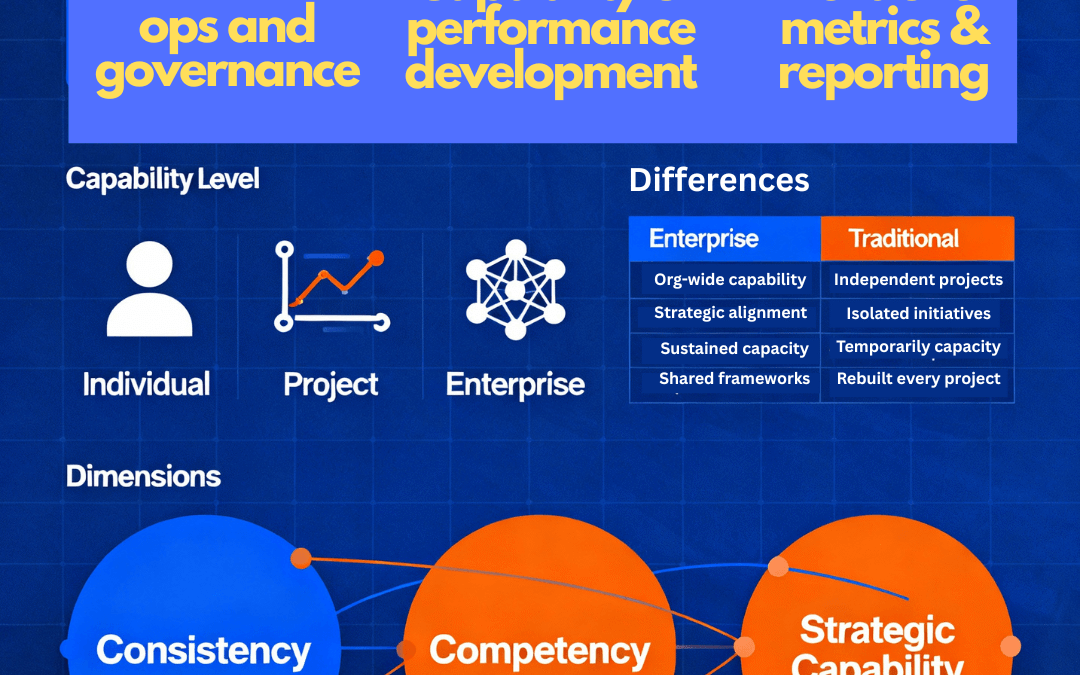
ECM operates across three integrated levels, each requiring different capabilities and governance structures. Research shows that organisations achieve sustainable transformation when they address all three levels systematically.
Individual level focuses on building personal change competency throughout the workforce. This means employees at all levels develop skills in navigating uncertainty, adapting to new processes, and contributing positively to transformation efforts. The goal is creating a change-ready workforce rather than relying on external change resources for each initiative.
Project level applies structured change management to specific initiatives whilst connecting them to broader organisational capabilities. Rather than treating each project as completely distinct, mature organisations leverage shared frameworks, common language, and integrated measurement systems that compound effectiveness across initiatives.
Enterprise level represents the systematic integration of change capability into organisational strategy, culture, and operations. At this level, change management becomes a core business competency that enables strategic agility and competitive advantage.
How enterprise change management differs from traditional approaches
The differences between traditional project-based change management and enterprise approaches are substantial and measurable. Traditional change management focuses on specific projects or departments, often operating in isolation with limited coordination across initiatives. The Project Management Office (PMO) may coordinate initiatives from a project resourcing or technical release perspective, but not from a people change perspective.
Scope of influence represents the most significant difference. Project-level change management targets only those directly impacted by a specific initiative, using output-based indicators like training completion rates or survey participation. Enterprise change management, however, builds organisational capability that scales across multiple initiatives simultaneously.
Strategic integration distinguishes mature ECM approaches from tactical project applications. Research from APMG International shows that ECM aligns all change initiatives with strategic goals, ensuring consistency and reducing confusion whilst increasing efficiency. This contrasts with project-specific approaches where different initiatives may define value differently, creating inconsistent outcomes.
Sustainability and learning transfer become possible only through enterprise approaches. Traditional project-based change management typically loses capability when projects end, requiring organisations to rebuild change capacity repeatedly. ECM creates persistent organisational learning that compounds across initiatives.
The research is clear about the performance implications. According to studies of enterprise versus traditional approaches, organisations implementing ECM report significantly higher success rates because “being a model that surrounds and sustains individual projects by ‘wrapping’ them into an organisation-wide view, ECM enables that aspect of change that is sometimes missing in other approaches: growth of the change capability itself”.
The three dimensions of enterprise change management
Effective ECM requires development across three interconnected dimensions, each contributing to overall organisational change capability.
Consistency involves applying common change management methods across all projects and initiatives. This creates organisational efficiency by eliminating the need to repeatedly train people on different methodologies, using the same language to avoid confusion and more effective from a capability development perspective. More importantly, consistency enables coordination across concurrent changes, reducing conflicts and competing demands on stakeholders.
Competency focuses on building and strengthening change management skills at every organisational level. This goes beyond training programs to encompass leadership competency from supervisors to senior executives. Research shows that sustainable ECM requires “a leadership competency at all levels of the organisation”, not just designated change professionals.
Strategic capability elevates change management to a key competency within business strategy itself. At this level, change management becomes integral to how the organisation plans, makes decisions, and executes strategic initiatives. This represents the most mature form of ECM, where change capability enables competitive advantage.
Why enterprise change management matters now
Today’s business environment demands more sophisticated approaches to managing change. Research indicates that organisations face unprecedented volumes of concurrent transformation initiatives, with 73% reporting being near, at, or beyond the point of change saturation. Traditional project-by-project approaches cannot effectively manage this complexity.
The velocity of change has also increased dramatically. Markets demand faster response to competitive threats and opportunities. Organisations with mature ECM capability can “respond more quickly to market dynamics because they don’t need to build change capacity from scratch for each new initiative”. They already have the frameworks, skills, and governance structures needed for rapid, effective transformation.
The financial implications are substantial. Organisations with effective ECM report higher success rates, faster implementation timelines, and sustained adoption of new capabilities. As the Change Management Institute’s research demonstrates, building enterprise-wide change maturity enables organisations to achieve “level 3 or 4 of change management maturity, characterised by consistent approaches, embedded processes, application-focused learning, coaching support, and leadership-led change”.
Enterprise change management frameworks and processes
The Change Management Institute’s integrated approach
The Change Management Institute (CMI) has developed one of the most comprehensive frameworks for building enterprise change capability through their integrated approach to organisational change maturity. The CMI framework recognises that sustainable enterprise change management requires systematic development across three core domains that work together synergistically.
Project Change Management represents the foundation level, focusing on building consistent change management capability at the individual project level. This domain ensures organisations can effectively manage the people side of change for specific initiatives whilst building transferable skills and methodologies that scale across the enterprise.
Business Change Readiness addresses the organisational capability to anticipate, prepare for, and respond to change demands. This domain focuses on developing the cultural readiness, resource allocation, and strategic alignment necessary for sustained transformation capability.
Strategic Change Leadership represents the most mature level, where change management becomes integrated into strategic planning, decision-making, and organisational culture. At this level, change capability enables competitive advantage and strategic agility.
The CMI framework differs significantly from project-specific approaches because it explicitly builds organisational capability that persists beyond individual initiatives. Research shows that organisations achieving maturity across all three domains can respond more quickly to market dynamics because they don’t need to rebuild change capacity for each new initiative.
The CMI Change Practice Framework: a structured process approach
The Change Management Institute’s Change Practice Framework provides a practical process model for implementing enterprise change management through four integrated dimensions: Define, Analyse, Co-design, and Refine. This circular, iterative process ensures continuous improvement and adaptation whilst maintaining focus on sustainable outcomes.
Define establishes the vision for change, benefits mapping, change approach and roadmap, desired outcomes, and target timeframes. At the enterprise level, this phase ensures alignment between individual changes and broader organisational strategy whilst considering change portfolio impacts and resource allocation.
Analyse encompasses change impacts assessment, success indicators development, stakeholder identification, change maturity evaluation, change capability assessment, change readiness analysis, and determining the degree and scale of change required. This comprehensive analysis enables organisations to understand not just what needs to change, but the organisational capacity and capability required for success.
Co-design and Engage focuses on developing communication and engagement strategies, co-designed solutions, organisational redesign approaches, new ways of working, implementation planning, and risk mitigation strategies. The co-design approach ensures stakeholder involvement and ownership whilst building internal capability for future changes.
Align and Refine includes leadership coaching, tracking success criteria, real-time problem solving, testing and refining approaches, and organisational realignment activities. This phase ensures sustainable adoption whilst capturing learning that enhances future change capability.
Competency-based framework implementation
The CMI Change Manager Competency Models provide the foundation for building individual and organisational capability across three progressive levels: Foundation, Specialist, and Master. These models identify specific behavioural competencies required for success at each level, creating clear development pathways for building enterprise change capability.
Foundation level competencies focus on understanding change principles, supporting change implementation, and developing basic skills in impact assessment, communication, and project management. Foundation practitioners provide essential support whilst building capabilities that prepare them for more complex roles.
Specialist level competencies encompass strategic thinking, coaching for change, advanced influencing skills, and the ability to assess and respond to complex organisational dynamics. Specialist practitioners can lead change initiatives whilst contributing to broader organisational change capability development.
Master level competencies include advanced strategic thinking, organisational diagnosis, change leadership across multiple initiatives, and the ability to develop change capability in others. Master practitioners drive enterprise-wide change capability whilst influencing organisational culture and strategic decision-making.
The competency models address eleven core skill areas that span technical change management capabilities and interpersonal effectiveness skills. Research shows that organisations using competency-based approaches to building change capability achieve higher success rates and sustained adoption because they develop comprehensive capability rather than focusing solely on tools and processes.
Maturity-based progression framework
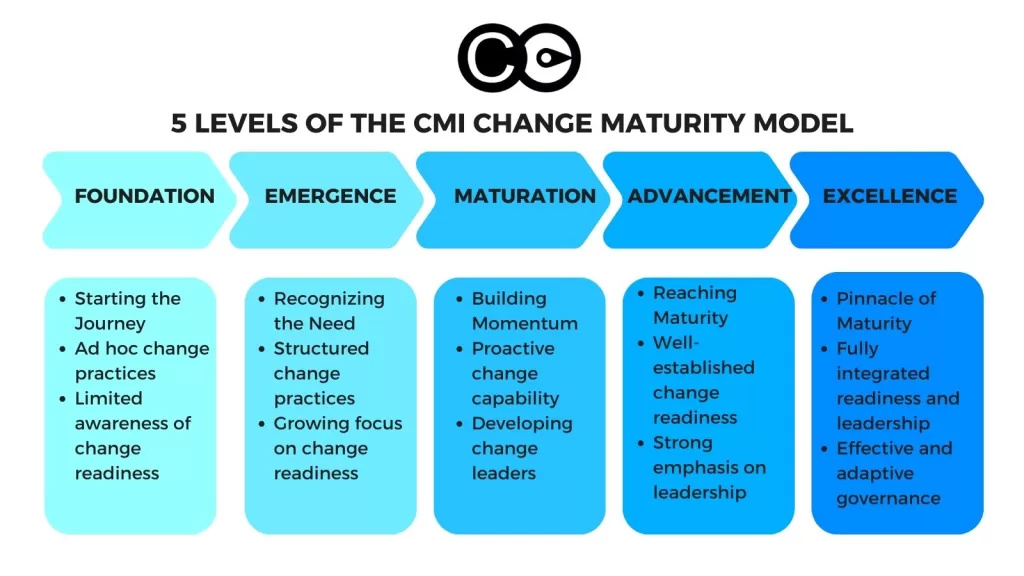
Enterprise change management requires systematic progression through defined maturity levels. The CMI framework aligns with broader industry recognition that organisations must develop through predictable stages to achieve sustainable change capability.
Level 1 maturity represents ad-hoc or absent change management where organisations apply change approaches reactively and inconsistently. Most organisations begin at this level, with change management applied only when projects encounter resistance or difficulties.
Level 2 maturity involves isolated project applications where change management is recognised as valuable but applied inconsistently across initiatives. Organisations at this level may achieve project-specific success but don’t build enterprise capability.
Level 3 maturity represents the beginning of enterprise approaches, with defined processes and consistent application across projects. Organisations at this level have established change management methodologies and are building internal capability systematically.
Level 4 maturity involves organisational standards where change management is embedded in project governance and business processes. Organisations achieve consistent application whilst building change leadership capability across multiple levels.
Level 5 maturity represents organisational competency where change management becomes part of organisational culture and strategic capability. At this level, change management enables sustained competitive advantage and strategic agility.
Integrating frameworks for enterprise implementation
Successful enterprise change management requires integration across multiple framework elements rather than applying individual components in isolation. The most effective implementations combine the CMI maturity progression with competency development and structured process application.
Governance integration connects change portfolio management with strategic planning cycles, ensuring change investments align with business priorities whilst maintaining organisational change capacity. This requires governance structures that can coordinate across multiple concurrent initiatives whilst building sustainable capability.
Learning integration ensures insights from individual changes enhance organisational capability rather than remaining project-specific knowledge. Mature organisations establish learning systems that capture and transfer change capability across initiatives and business units.
Cultural integration embeds change management principles into organisational culture, making change capability a shared competency rather than specialist expertise. This requires leadership development, communication strategies, and recognition systems that reinforce change-positive behaviours and capabilities.
Research demonstrates that organisations implementing integrated approaches achieve significantly higher success rates than those focusing on individual framework components. The integration enables compound benefits where each change initiative strengthens organisational capability for subsequent transformations.
Implementing enterprise change management: measurement, networks, and business integration
Successful enterprise change management requires structured measurement approaches that go beyond traditional project metrics. Unlike project-level success indicators such as training completion rates or survey scores, enterprise measurement focuses on organisational capability development, portfolio-level performance, and strategic impact on business outcomes.
Leading indicators of enterprise change capability include change readiness assessments across business units, change leadership competency scores, and business operational performance linked to change impacts. These predictive measures enable organisations to identify capability gaps before they impact transformation outcomes. Research shows that organisations tracking leading indicators achieve significantly higher success rates because they can address capability deficits proactively rather than reactively.
Portfolio-level metrics provide visibility into the collective impact of change initiatives rather than individual project success. These include change portfolio health scores, resource utilisation across concurrent changes, and stakeholder engagement effectiveness across multiple initiatives. Advanced organisations track change saturation levels, ensuring they don’t exceed organisational capacity to absorb transformation.
Business performance integration represents the most strategic measurement approach, connecting change management effectiveness directly to operational and financial outcomes. This includes metrics such as productivity maintenance during transformation, revenue impact from improved adoption rates, and competitive advantage gained through superior change capability. Academic research demonstrates that organisations integrating change metrics with business performance measurement achieve compound benefits from their transformation investments.
The key insight is that enterprise measurement requires different analytical frameworks than project-level assessment. Enterprise metrics focus on building sustainable capability rather than achieving specific deliverables, creating compound value that increases over successive transformations.
Building enterprise change champion networks
Enterprise change management success depends heavily on distributed leadership through structured change champion networks. Unlike traditional approaches that rely on designated change professionals, enterprise approaches develop change capability throughout the organisational structure, creating what researchers describe as “embedded change capacity”.
Strategic network design requires careful consideration of organisational structure, culture, and change demands. The most effective networks combine formal authority relationships with informal influence patterns, ensuring change champions have both positional credibility and peer respect across different organisational layers. Research shows that well-designed champion networks increase adoption rates by 15-25 percentage points.
Bi-directional communication channels enable both top-down strategic alignment and bottom-up insight gathering. Champion networks serve as early warning systems for emerging resistance, resource constraints, and implementation challenges. They also provide channels for sharing success stories and best practices across business units, creating organisational learning that compounds across initiatives.
Competency development within networks ensures change champions have the skills needed for success whilst building organisational capability for future changes. This includes training in change principles, coaching techniques, communication strategies, and problem-solving approaches. The Change Management Institute’s research emphasises that sustainable champion networks require structured competency development rather than relying solely on enthusiasm and goodwill.
Successful champion networks become self-reinforcing systems that strengthen with use. Each change initiative provides opportunities for champions to develop skills, build relationships, and enhance credibility, creating increasing capability for subsequent transformations.
Integrating change management with business operations
The most mature enterprise change management approaches seamlessly integrate change capability with standard business operations rather than treating change as separate organisational function. This integration creates sustainable capability whilst reducing the administrative overhead associated with parallel change management processes.
Business planning integration ensures change capacity planning becomes part of standard strategic and operational planning cycles. This includes assessing change demands during annual planning, allocating change resources based on business priorities, and sequencing initiatives to optimise organisational capacity utilisation. Research demonstrates that organisations integrating change planning with business planning achieve 20-30% better resource efficiency compared to separate planning approaches.
Performance management integration embeds change-related objectives and competencies into standard performance evaluation and development processes. This includes change leadership expectations for managers, change collaboration requirements for individual contributors, and change capability development objectives across all roles. Integration ensures change capability development receives ongoing attention rather than episodic focus during transformation initiatives.
Governance structure integration connects change portfolio management with strategic decision-making processes, ensuring change investments align with business priorities whilst maintaining organisational capacity for transformation. This requires governance bodies with authority to sequence changes, allocate resources, and escalate systemic issues that individual projects cannot resolve.
Real-world success through data-driven enterprise change management
Leading organisations are achieving measurable business value through a structured data-driven approaches to enterprise change management. The Change Compass platform exemplifies this evolution, enabling organisations to embed change management within general business management rather than treating it as separate organisational function. Case Study 4.
A major global financial services corporation transformed their approach to change management by integrating change metrics with standard business reporting. Within one year, they achieved remarkable results: leadership began prioritising change management as part of strategic oversight, business leaders increasingly requested proactive change support, and the organisation developed consistent change management practices across previously disconnected business units. Case Study 4.
The transformation occurred through strategic data integration rather than additional bureaucracy. By partnering with their Business Intelligence team and utilising Change Compass data capabilities, the corporation embedded change management insights into routine business tracking, making change visibility part of standard leadership decision-making processes.
The shift from “push” to “pull” model represents a fundamental change in how organisations approach change support. Rather than change teams offering services that business leaders may or may not utilise, leaders began actively seeking change management support as they recognised its impact on business performance. This cultural shift enhanced change management maturity across the enterprise whilst improving transformation outcomes. Case Study 2.
Enhanced decision-making through integrated reporting enabled leaders to understand the connection between change management effectiveness and business performance. By combining operational metrics with change management insights, executives could make more informed decisions about resource allocation, timing, and implementation approaches. The results included measurable improvements in project delivery timelines, reduced implementation costs, and sustained adoption of new capabilities.
Capability development through data insights became possible when organisations could track change management effectiveness over time and identify patterns that enhanced future performance. Rather than relying on subjective assessments or anecdotal evidence, mature organisations use data analytics to understand which change approaches work best in their specific context, enabling continuous improvement in change capability. Case Study 3.
The strategic value of integrated change management platforms
Modern enterprise change management requires sophisticated technology tools that can integrate with existing business systems whilst providing change-specific analytics and insights to augment what is currently missing. The Change Compass platform demonstrates how organisations can achieve enterprise change management maturity through strategic technology implementation rather than organisational restructuring.
Data integration capabilities enable organisations to connect change management metrics with business performance indicators, creating comprehensive dashboards that support strategic decision-making. This integration provides leaders with real-time visibility into change portfolio health, resource utilisation, and business impact, enabling proactive management rather than reactive problem-solving.
Predictive analytics for change planning help organisations anticipate change capacity requirements, identify potential resource conflicts, and optimise transformation sequencing. By analysing historical change data alongside business planning information, organisations can make more informed decisions about when to launch initiatives, how to allocate resources, and where to focus capability development efforts.
Competency tracking and development becomes systematic when organisations can monitor change management skills across the enterprise whilst identifying development needs and tracking progress over time. This creates targeted capability building that addresses specific organisational gaps rather than generic training approaches.
Building your enterprise change management capability
Enterprise change management represents one of the most significant opportunities for competitive advantage in today’s rapidly changing business environment. Organisations that build systematic change capability position themselves to respond more quickly to market dynamics, implement strategic initiatives more effectively, and sustain transformation outcomes over time.
The evidence is compelling: enterprise change management delivers measurable ROI through improved project success rates, reduced implementation costs, faster time-to-value, and sustained adoption of new capabilities. More importantly, organisations with mature change capability can pursue strategic opportunities that competitors cannot effectively implement.
The Change Compass platform empowers organisations to accelerate their journey toward enterprise change management maturity through data-driven insights, integrated measurement, and systematic capability development. The Change Compass enables transformation through strategic enhancement of existing processes and systems.
Leading organisations are already experiencing the benefits: enhanced leadership decision-making through integrated change and business metrics, improved resource efficiency through portfolio-level visibility, and sustained capability development through systematic tracking and analytics. These results create compound value that increases with each transformation initiative.
The opportunity for competitive advantage through superior change capability has never been greater. Market conditions demand rapid response to changing customer needs, competitive threats, and regulatory requirements. Organisations with enterprise change management capability can adapt faster, implement more effectively, and sustain transformation outcomes that create lasting competitive advantage.
Ready to transform your organisation’s change capability and start delivering measurable business value through enterprise change management? Discover how The Change Compass can help you build the data-driven change capability your organisation needs to thrive in today’s dynamic business environment.
Performance metrics are the compass that guides change practitioners through complex transformation initiatives. Yet despite their critical importance, many organisations unknowingly employ flawed metrics that provide misleading insights and potentially sabotage their change efforts. A closer look reveals some of the danger of conventional change management performance metrics and offers a strategic approach to measurement that truly drives success.
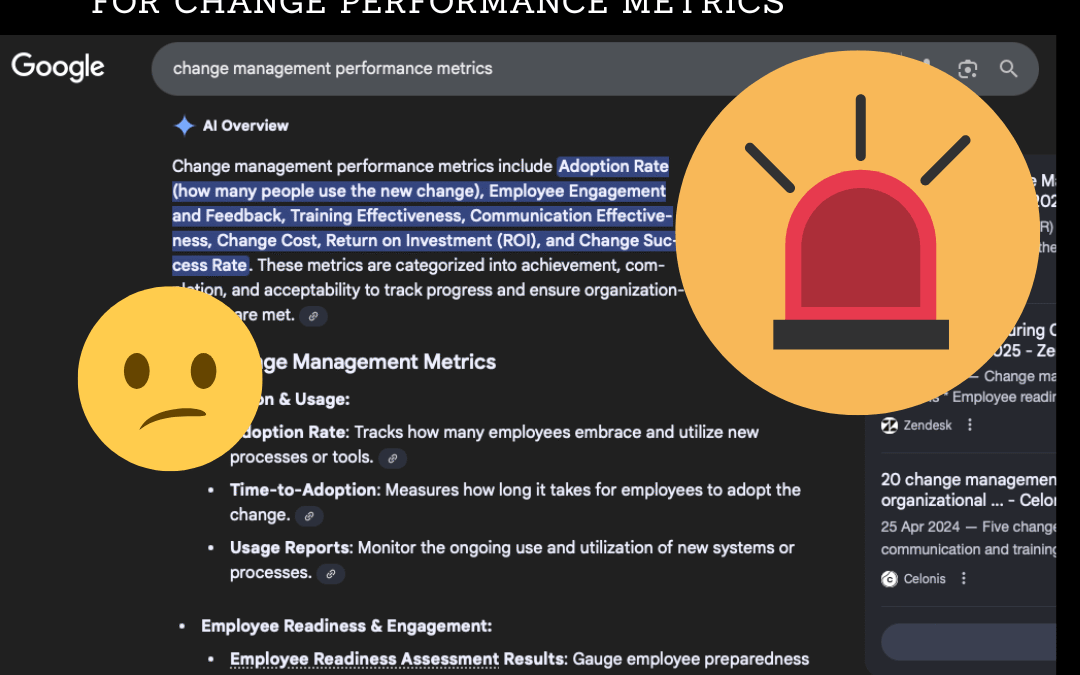
In fact, a quick Google search revealed a list of recommended change management performance metrics. However, some of these are potentially dangerous to incorporate without a closer understanding of the type of change being implemented, the change environment, stakeholder needs and overall change approach required. Let’s go through some of these ‘hidden dangers’ in this article.
The Measurement Imperative in Change Management
Change management has long been criticised as being too “soft” to measure effectively. This perception persists despite overwhelming evidence that data-driven approaches significantly enhance change outcomes. Research consistently demonstrates that organisations measuring change management performance are more likely to meet or exceed project objectives.
The resistance to measurement often stems from change practitioners’ preference for people-focused approaches over numerical analysis. In today’s data-rich environment, where artificial intelligence and predictive analytics are reshaping business operations, change management must embrace measurement to remain relevant and demonstrate value.
Modern organisations rely on data across all functions – from finance and operations to risk management and procurement. Without data, these departments cannot function effectively or determine whether they are achieving their targets. The same principle applies to change management: effective measurement enables practitioners to track progress, identify issues early, and make informed adjustments to their strategies.
The Problem with Traditional Adoption and Usage Metrics
Adoption and usage represent the ultimate goal of any change initiative, yet this seemingly straightforward metric harbours significant complexities. Most organisations measure adoption superficially—tracking whether people are using new systems or processes without examining the quality or effectiveness of that usage.
True adoption requires achieving full benefit realisation, which depends on several interconnected outcomes:
• Accurate impact assessment that understands how change affects specific stakeholder groups • Effective engagement strategies tailored to different audiences • Continuous tracking and reinforcement mechanisms • Clear definition of required behaviours for success
Generic change approaches might achieve some adoption at best, but to get full adoption there is a series of outcomes you need to have achieved. The behaviours need to be clear, specific and actionable, yet many organisations fail to establish these precise behavioural indicators.
Furthermore, adoption measurements often ignore the temporal dimension. Early adoption rates may appear promising, but without sustained reinforcement and measurement, initial enthusiasm frequently wanes. Effective adoption metrics must track behaviour change over extended periods and identify the specific interventions needed to maintain momentum.
Employee Readiness and Engagement: Beyond Surface-Level Satisfaction
Employee readiness and engagement form the cornerstone of successful change initiatives, yet these areas suffer from widespread measurement inadequacies. Most change practitioners focus extensively on these metrics, but their approaches often lack the sophistication required for meaningful insights.
The Critical Role of Impact Assessment
Accurate impact assessment serves as the foundation for effective readiness and engagement measurement. Any inaccuracy in understanding how change affects specific stakeholder groups inevitably leads to insufficient preparation and engagement strategies. This fundamental flaw cascades through the entire change process, undermining subsequent measurement efforts.
Impact assessment requires deep analysis of how change affects different roles, departments, and individual circumstances. Generic assessments fail to capture these nuances, leading to one-size-fits-all engagement strategies that satisfy no one effectively.
Participation Versus Meaningful Involvement
Employee participation metrics suffer from significant limitations related to change type and context. The key lies in measuring relevant participation rather than absolute participation rates:
For compliance-driven changes: • Focus on communication effectiveness and readiness preparation • Track understanding levels and procedure adherence • Monitor feedback on implementation challenges
For transformational changes: • Emphasise co-creation opportunities and stakeholder input • Measure feedback integration and stakeholder influence on change design • Track collaborative problem-solving activities
Maximum participation might seem desirable, but the nature of the change determines appropriate participation levels. Significant restructuring initiatives or regulatory compliance changes naturally limit meaningful participation opportunities compared to voluntary improvement projects.
The Satisfaction Survey Trap
Employee satisfaction surveys present particular challenges for change measurement. The purpose of satisfaction surveys requires careful definition:
• Are you seeking feedback on training content quality? • Is the focus on communication channels effectiveness? • Are you measuring leadership session impact? • Do you want to assess overall transformation experience?
Without specific focus, satisfaction surveys generate ambiguous data that provides limited actionable insight. More problematically, satisfaction may not align with change necessity. Employees might express dissatisfaction with change approaches that are nonetheless essential for regulatory compliance or competitive survival. In these situations, satisfaction becomes irrelevant, and measurement should focus on understanding effectiveness and identifying improvement opportunities within necessary constraints.
Training and Communication: Moving Beyond Binary Effectiveness
Training and communication effectiveness represent the most commonly measured aspects of change management, yet this narrow focus creates dangerous blind spots. Whilst these elements are undoubtedly important delivery vehicles, they represent only partial components of comprehensive change strategies.
The Capability Development Ecosystem
Training effectiveness measurement often conflates learning with capability development. Effective capability building requires diverse interventions beyond traditional training:
• Coaching and personalised support sessions • Structured feedback mechanisms • Sandbox practice environments for skill development • Team discussions and peer learning opportunities • Mentoring relationships and knowledge transfer
Modern capability development leverages technology-enhanced approaches that traditional training metrics fail to capture:
• Gamified content delivery and interactive learning modules • Micro-learning sequences and just-in-time training • Multimedia integration with videos, simulations, and virtual reality • Avatar-based instruction and AI-powered tutoring systems • Adaptive learning pathways that personalise content delivery
Measuring effectiveness in these environments requires sophisticated metrics that track engagement, retention, application, and long-term behaviour change across multiple learning modalities.
Communication Beyond Hit Rates
Communication effectiveness measurement typically focuses on reach metrics—how many people viewed content or attended sessions. These “hit rate” measurements provide limited insight into actual communication effectiveness, which depends on:
• Comprehension levels and message clarity • Information retention and recall accuracy • Perceived relevance to individual roles • Action generation and behaviour change
Advanced communication measurement utilises sophisticated analytics available through modern platforms:
Microsoft Viva Engage and Teams Analytics: • User engagement patterns and interaction frequency • Device usage behaviours across different communication channels • Community reach statistics and network analysis • Conversation quality indicators and response rates
A/B Testing Methodologies: • Test different messages or formats with smaller audience segments • Identify the most effective approaches before broader deployment • Transform communication from educated guesswork into data-driven optimisation • Measure conversion rates and action completion across message variants
Financial Performance: Beyond Cost-Focused ROI
Financial metrics in change management suffer from fundamental conceptual limitations that undermine their utility for strategic decision-making. The predominant focus on return on investment (ROI) and cost management treats change as an expense rather than a value creation opportunity.
Traditional ROI calculations examine financial benefits of change management spending against change outcomes. Whilst this approach provides some insight, it fundamentally limits change management to a cost-minimisation function rather than recognising its potential for:
• Enhanced organisational agility and adaptability • Improved employee engagement and retention rates • Reduced future change resistance and implementation time • Accelerated innovation adoption and competitive positioning • Strengthened stakeholder relationships and trust building
More sophisticated financial measurement approaches assess change management’s contribution to organisational capability building, risk mitigation, and strategic option creation. These broader value considerations provide more accurate assessment of change management’s true organisational impact.
The Resistance Metrics Minefield
Resistance metrics represent perhaps the most problematic area in change management measurement. The conventional approach of monitoring resistance levels and aiming for minimal resistance creates dangerous dynamics that undermine change effectiveness.
Resistance monitoring often leads to labelling stakeholders as “resistant” and focusing efforts on reducing negative feedback. This approach fundamentally misunderstands resistance as a natural and potentially valuable component of change processes.
Transforming Resistance into Feedback
Rather than minimising resistance, effective change management should encourage comprehensive feedback from all stakeholder groups. The goal shifts from resistance reduction to feedback optimisation:
Feedback Quality Indicators: • Specificity of concerns raised and solutions suggested • Constructive nature of criticism and improvement ideas • Stakeholder willingness to engage in problem-solving discussions • Implementation feasibility of suggested modifications
Implementation Tracking: • Percentage of feedback items addressed in change plans • Time from feedback receipt to response or action • Stakeholder perception of influence on change processes • Communication quality regarding feedback disposition
Effective resistance can highlight legitimate concerns, identify implementation risks, and strengthen final solutions through stakeholder input. The question becomes: What specific aspects of change generate concern, and how can legitimate resistance improve change outcomes?
Compliance and Adherence: The Missing Reinforcement Link
Compliance and adherence metrics represent critical but often overlooked components of change measurement. These metrics assess how effectively employees follow new policies and procedures—the ultimate test of change success.
The challenge lies in measurement timing and responsibility allocation:
Common Gaps: • Change teams fail to design compliance measurement into their change processes • Assessment is left for post-implementation periods when project teams have moved on • Timing gaps create measurement blind spots precisely when reinforcement is most critical • Lack of clear ownership for ongoing compliance monitoring
Effective Measurement Approaches: • Digital systems providing automated compliance tracking • Leadership follow-up protocols and structured audit processes • Operational integration rather than separate evaluation activities • Real-time dashboards showing compliance trends and exceptions
The key is embedding measurement into operational processes rather than treating it as a separate evaluation activity. This integration ensures continuous monitoring and rapid identification of compliance issues before they become systemic problems.
Establishing Effective Change Management Metrics
Developing effective change management metrics requires systematic approach that addresses the limitations of traditional measurement while leveraging modern technological capabilities.
The Three-Level Performance Framework
Leading organisations utilise comprehensive measurement frameworks that address multiple performance levels simultaneously:
Change Management Performance: • Completion of change management plans and milestone delivery • Activation of core roles like sponsors and change champions • Progress against planned activities and timeline adherence • Quality of change management deliverables and stakeholder feedback
Individual Performance (using frameworks like ADKAR): • Awareness levels and understanding of change rationale • Desire for change and motivation to participate • Knowledge acquisition through training and communication • Ability to implement required behaviours and skills • Reinforcement mechanisms and behaviour sustainability
Organisational Performance: • Achievement of intended business outcomes and strategic objectives • Financial performance improvements and cost reductions • Operational efficiency gains and process improvements • Customer satisfaction improvements and market position
This approach recognises the interdependent nature of change success across organisational, individual, and change management performance dimensions.
Leveraging Modern Technology for Enhanced Measurement
Contemporary change management measurement can exploit advanced technologies that were unavailable to previous generations of practitioners:
AI-Powered Analytics: • Sentiment analysis processing large volumes of text feedback • Pattern detection identifying predictive indicators of change success • Automated insights generation from multiple data sources • Real-time risk assessment and early warning systems
Predictive Capabilities: • Forecasting change outcomes based on early indicators • Proactive intervention before problems become critical • Historical pattern analysis for correlation identification • Capacity planning and resource optimisation
Real-Time Monitoring: • Continuous dashboards and automated reporting systems • Immediate identification of emerging issues • Rapid response to developing challenges • Data-driven optimisation throughout change processes
Building Measurement Into Change Strategy
Effective change measurement requires integration into change strategy from the earliest planning stages rather than being added as an afterthought. This integration ensures measurement serves strategic purposes rather than merely satisfying reporting requirements.
Defining Success Before Beginning
Successful change measurement begins with clear definition of desired outcomes and success criteria:
Primary Sponsor Requirements: • Articulate specific, measurable objectives aligned with organisational benefits • Connect change outcomes to strategic goals and performance indicators • Define acceptable risk levels and tolerance thresholds • Establish timeline expectations and milestone definitions
Stakeholder Engagement: • Include leaders, subject matter experts, and project managers in success definition • Ensure shared understanding across all stakeholder groups • Align measurement focus on outcomes that matter to everyone • Avoid narrow technical achievements without business relevance
Selecting Appropriate Metrics for Context
Different types of change require different measurement approaches:
Regulatory Compliance Changes: • Focus on adherence rates and audit readiness • Track training completion and competency verification • Monitor risk mitigation and control effectiveness • Measure timeline compliance and regulatory approval
Cultural Transformation Initiatives: • Emphasise behaviour change and value demonstration • Track engagement levels and participation quality • Monitor leadership modelling and reinforcement • Measure employee sentiment and satisfaction trends
Technology Implementation Projects: • Focus on system usage rates and functionality adoption • Track user proficiency and support requirement reduction • Monitor performance improvements and efficiency gains • Measure integration success and data quality
Measurement complexity should align with change complexity and organisational capability. Simple changes in mature organisations might require only basic metrics, whilst complex transformations in change-inexperienced organisations demand comprehensive measurement frameworks.
Future Directions in Change Management Measurement
The future of change management measurement lies in sophisticated integration of human insight with technological capability. Several key trends are reshaping measurement approaches:
Predictive Change Management: • Historical data enables forecasting of change outcomes • Proactive optimisation of change approaches before issues arise • Real-time adjustment based on predictive indicators • Continuous learning from measurement data across initiatives
Integrated Organisational Systems: • Connection to broader business performance metrics • Direct demonstration of change impact on customer satisfaction • Integration with financial and operational reporting systems • Holistic view of organisational health and capability
Continuous Change Capability: • Measurement of organisational change capacity and resilience • Tracking of adaptation speed and learning effectiveness • Building change capability as core organisational competency • Supporting ongoing transformation rather than discrete projects
The evolution toward continuous change requires measurement systems that support ongoing transformation rather than discrete project evaluation. These systems must track organisational change capability, adaptation speed, and resilience development as essential business capabilities.
Measuring What Matters
Change management performance metrics represent both opportunity and risk for organisations pursuing transformation. Traditional measurement approaches harbour significant limitations that can mislead practitioners and undermine change success. However, sophisticated measurement systems that leverage modern technology and address these limitations can dramatically enhance change effectiveness.
The path forward requires abandoning simplistic metrics that provide false comfort in favour of comprehensive measurement frameworks that capture the complexity of organisational change. Key principles for effective measurement include:
Strategic Focus: • Serve genuine business purposes rather than administrative requirements • Enable better decisions and drive continuous improvement • Demonstrate measurable value of professional change management • Connect change outcomes to organisational success metrics
Technological Integration: • Leverage AI and machine learning for enhanced analytical precision • Utilise real-time monitoring and predictive capabilities • Integrate with broader organisational data systems • Automate routine measurement while preserving human insight
Comprehensive Approach: • Address multiple performance levels simultaneously • Balance quantitative metrics with qualitative insights • Include temporal dimensions and sustainability factors • Measure capability building alongside immediate outcomes
Most importantly, effective change measurement must serve strategic purposes rather than administrative requirements. Metrics should enable better decisions, drive continuous improvement, and demonstrate the value that professional change management brings to organisational success.
The organisations that master sophisticated change measurement will possess significant competitive advantages in an era of accelerating change. They will anticipate challenges before they emerge, optimise interventions in real-time, and build organisational capabilities that enable sustained transformation success. The question is not whether to measure change management performance, but whether to measure it effectively enough to create lasting competitive advantage.
Data Foundations and the Limits of Traditional Reporting
Change and transformation leaders are increasingly tasked with supporting decision making through robust, actionable reporting. Despite the rise of specialist tools, teams still lean heavily on Excel and Power BI because of their familiarity, ease and widespread adoption. However, as the pace and scale of organisational change accelerate, these choices reveal critical limitations, especially in supporting nuanced organisational insights.
Why High, Medium, Low Reporting Falls Short
Many change teams default to tracking change impact and volume using simple “high, medium, low” traffic light metrics. While this method offers speed and clarity for basic reporting, it fails to capture context, regional nuance, or the real intensity of change across diverse teams. This coarse approach risks obscuring important details, leaving senior leaders without the depth needed to target interventions or accurately forecast operational risks.
Change practitioners are often short on time and choosing whatever is easier and faster often becomes the default choice, i.e. Excel. This short-sighted approach focuses on quickly generating an output to try and meeting stakeholder needs without thinking strategically what makes sense at an organisational level, and the value of change data to drive strategy and manage implementation risks.
Data Capture: Getting the Inputs Right
Excel’s flexibility lets teams start capturing change data quickly, but often at the expense of structure. When fields and templates vary, information can’t be standardized or consistently compared. Manual entry introduces duplication, missing values, and divergent interpretations of change categories. Power BI requires disciplined and structured underlying data to function well; without careful source management, output dashboards reflect input chaos rather than clarity. Therefore, when pairing Excel with Power BI chart generation, often a BI (business intelligence) specialist is required to help configure and structure the chart outputs in Power BI.
Tips for effective data capture:
Establish clear data templates and definitions before rolling out change tracking.
Centralize where possible to avoid data silos and redundant records.
Assign responsibilities for maintaining quality and completeness at the point of entry.
Data Cleansing and Auditing: Maintaining Integrity
Excel and Power BI users are frequently responsible for manual data validation. The process is time-consuming, highly error-prone, and often fails to catch hidden inconsistencies, especially as data volumes grow. Excel’s lack of built-in auditing makes it tough to track changes or attribute ownership, increasing risks for compliance and reliability.
Best practices for cleansing and auditing:
Automate as much validation as possible, using scripts or built-in platform features.
Use a single master source rather than local versions to simplify updates.
Develop version control and change logs to support traceability and confidence in reporting.
Visualization, Dashboarding, and Interpretation Challenges in Change Reporting
After establishing robust data foundations, the next hurdle for senior change practitioners is translating raw information into clear, actionable insights. While Excel and Power BI each provide capabilities for visualizing change data, both bring unique challenges that can limit their effectiveness in supporting strategic decision making.
Visualization and Dashboard Design
Excel’s charting options are familiar and flexible for simple visualizations, but quickly become unwieldy as complexity grows. Static pivot charts and tables, combined with manual refreshing, reduce the potential for interactive analysis. Power BI offers more engaging, dynamic visuals and interactive dashboards, yet users frequently run into formatting frustrations, such as limited customization, bulky interfaces, and difficulties aligning visuals to precise narrative goals.
Some specific visualization and dashboard challenges include:
Difficulty representing complex, multidimensional change metrics within simplistic dashboards, e.g. impact by stakeholder by location by business unit by type of change.
Limited ability in both tools to customize visual details such as consistent colour themes or layered insights without significant effort.
Dashboard performance degradation with very large or complex datasets, reducing responsiveness and usability.
Interpreting Data and Supporting Decision Making
Effective dashboards must not only display data properly but also guide users toward meaningful interpretation. Both Excel and Power BI outputs can suffer when change teams focus too heavily on volume metrics or simple aggregated scores (like high/medium/low, or counting activities such as communication sent) without contextualizing underlying drivers. This can mislead executives into overgeneralized conclusions or missed risks.
Challenges include:
Dashboards overwhelmed by numbers without narrative or highlight indicators.
Difficulty embedding qualitative insights alongside quantitative data in either tool.
Sparse real-time feedback loops; often snapshots lag behind ongoing operational realities.
Tips and Tricks for Effective Visualization and Insights
Limit dashboard visuals to key metrics that align tightly with decision priorities; avoid clutter.
Use conditional formatting or custom visuals (in Power BI) to draw attention to anomalies or trends.
Build interactive filters and drill-downs to enable users to explore data layers progressively.
Combine quantitative data with qualitative notes or commentary fields to bring context to numbers.
Schedule regular dashboard updates and ensure data pipelines feed timely, validated information.
Once the foundation of reliable data capture and cleansing is set, the next major hurdle for senior change practitioners is transforming raw change data into clear, actionable insights. Excel and Power BI both offer visualization and dashboarding capabilities, yet each presents challenges that can limit their effectiveness in supporting strategic decision-making.
Visualization and dashboard design challenges
Excel’s charting features are familiar and flexible for simple visuals but quickly become cumbersome as complexity grows. Its static pivot charts and manual refresh cycles limit interactive exploration. Power BI adds interactive and dynamic visualizations but users often encounter limitations such as restricted formatting options, bulky interfaces, and considerable effort required to tailor visuals to convey precise change narratives.
Specific challenges include:
Struggling to represent complex, multi-dimensional change metrics adequately within simplistic dashboards.
Limited ability to apply consistent colour schemes or layered insights without advanced customization.
Performance degradation in dashboards when datasets become large or complex, impacting responsiveness and user experience.
Data interpretation and decision-making support
A dashboard’s true value comes from guiding users towards meaningful interpretation rather than just presentation of numbers. Both Excel and Power BI outputs may fall short if change teams rely excessively on aggregated volume metrics or high/medium/low scales without embedding context or deeper qualitative insight. This risks executives making generalized conclusions or overlooking subtle risks.
Key challenges include:
Dashboards overrun with numbers lacking narrative or prioritized highlights.
Difficulty integrating qualitative insights alongside quantitative data within either platform.
Reporting often static or delayed, providing snapshots that lag behind real-time operational realities.
Tips and tricks for more effective visualization and insight generation
Restrict dashboards to key metrics closely aligned with leadership priorities to avoid clutter.
Leverage conditional formatting or Power BI’s custom visuals to highlight trends, outliers or emerging risks.
Incorporate interactive filters and drill-downs allowing users to progressively explore data layers themselves.
Pair quantitative dashboards with qualitative commentary fields or summary narratives to provide context.
Implement disciplined refresh schedules ensuring data pipelines are timely and validated for ongoing accuracy.
Practical advice for change teams and when to consider dedicated change management tools
Change teams vary widely in size, maturity, and complexity of their reporting needs. For less mature or smaller teams just starting out, Excel often remains the most accessible and cost-effective platform for capturing and communicating change-related data. However, as organisational demands grow in complexity and leadership expects richer insights to support timely decisions, purpose-built change management tools become increasingly valuable.
Excel as a starting point
For teams in the early stages of developing change reporting capabilities, Excel offers several advantages:
Familiar user interface widely known across organisations.
Low entry cost with flexible options for data input, simple visualizations, and ad hoc analysis.
Easy to distribute offline or via basic file-sharing when centralised platforms are unavailable.
However, small teams should be mindful of Excel’s limitations and implement these best practices:
Design standardised templates with clear field definitions to improve consistency.
Concentrate on key metrics and avoid overly complex sheets to reduce error risk.
Apply version control discipline and regular data audits to maintain data accuracy.
Plan for future scalability by documenting data sources and formulas for easier migration.
Progressing to Power BI and beyond
As reporting needs mature, teams can leverage Power BI to create more dynamic, interactive dashboards for leadership. The platform offers:
Integration with multiple data sources, enabling holistic organisational views.
Rich visualizations and real-time data refresh capabilities.
Role-based access control improving collaboration and data governance.
Yet Power BI demands some specialist skills and governance protocols:
Teams should invest in upskilling or partnering internally to build and maintain reports.
Establish rigorous data governance to avoid “data swamp” issues.
Define clear escalation paths for dashboard issues to maintain reliability and trust.
When to adopt purpose-built change management platforms
For organisations undergoing complex change or those needing to embed change reporting deeply in strategic decision making, specialist tools like The Change Compass provide clear advantages:
Tailored data models specific to change management, capturing impact, readiness, resistance, and other essential dimensions.
Automated data capture integrations from multiple enterprise systems reducing manual effort and errors.
Advanced analytics and visualizations designed to support executive decision making with predictive insights and scenario planning, leveraging AI capabilities.
Ease of creating/editing chart and dashboards to match stakeholder needs, e.g. The Change Compass has 50+ visuals to cater for the most discerning stakeholder
Collaboration features aligned to change team workflows.
Built-in auditing, compliance, and performance monitoring focused on change initiatives.
Purpose-built platforms significantly reduce the effort required to turn change data into trusted, actionable insights, freeing change leaders to focus on driving transformation rather than managing reporting challenges.
Summary advice for change teams
Stage
Recommended tools
Focus areas
Starting out
Excel
Standardise templates, focus on core metrics, enforce data discipline
Purpose-built enterprise platforms (e.g. The Change Compass)
Integrate systems, leverage tailored analytics, support operations and executive decisions
Selecting the right reporting approach depends on organisational scale, available skills, and leadership needs. Recognising when traditional tools have reached their limits and investing in specialist change management platforms ensures reporting evolves as a strategic asset rather than a bottleneck.
This staged approach supports both incremental improvements and long-term transformation in how change teams provide decision support through high-quality, actionable reporting.
Practical advice for change teams and when to consider dedicated change management tools
Change teams vary widely in size, maturity, and complexity of their reporting needs. For less mature or smaller teams just starting out, Excel often remains the most accessible and cost-effective platform for capturing and communicating change-related data. However, as organisational demands grow in complexity and leadership expects richer insights to support timely decisions, purpose-built change management tools become increasingly valuable.
Excel as a starting point
For teams in the early stages of developing change reporting capabilities, Excel offers several advantages:
Familiar user interface widely known across organisations.
Low entry cost with flexible options for data input, simple visualizations, and ad hoc analysis.
Easy to distribute offline or via basic file-sharing when centralised platforms are unavailable.
However, small teams should be mindful of Excel’s limitations and implement these best practices:
Design standardised templates with clear field definitions to improve consistency.
Concentrate on key metrics and avoid overly complex sheets to reduce error risk.
Apply version control discipline and regular data audits to maintain data accuracy.
Plan for future scalability by documenting data sources and formulas for easier migration.
Progressing to Power BI and beyond
As reporting needs mature, teams can leverage Power BI to create more dynamic, interactive dashboards for leadership. The platform offers:
Integration with multiple data sources, enabling holistic organisational views.
Rich visualizations and real-time data refresh capabilities.
Role-based access control improving collaboration and data governance.
Yet Power BI demands some specialist skills and governance protocols:
Teams should invest in upskilling or partnering internally to build and maintain reports.
Establish rigorous data governance to avoid “data swamp” issues.
Define clear escalation paths for dashboard issues to maintain reliability and trust.
When to adopt purpose-built change management platforms
For organisations with complex change environments or those needing to embed change reporting deeply in strategic decision making, specialist tools like The Change Compass provide clear advantages:
Tailored data models specific to change management, capturing impact, readiness, resistance, and other essential dimensions.
Automated data capture integrations from multiple enterprise systems reducing manual effort and errors.
Advanced analytics and visualizations designed to support executive decision making with predictive insights.
Collaboration features aligned to change team workflows.
Built-in auditing, compliance, and performance monitoring focused on change initiatives.
Purpose-built platforms significantly reduce the effort required to turn change data into trusted, actionable insights, freeing change leaders to focus on driving transformation rather than managing reporting challenges.
Selecting the right reporting approach depends on organisational scale, available skills, and leadership needs. Recognising when traditional tools have reached their limits and investing in specialist change management platforms ensures reporting evolves as a strategic asset rather than a bottleneck.
This staged approach supports both incremental improvements and long-term transformation in how change teams provide decision support through high-quality, actionable reporting. With greater maturity, change teams also start to invest in various facets of data management, from data governance, data cleansing and data insights to provide a significant lift in perceived value by senior business stakeholders.
Understanding the real distinction between traditional, project-focused change management and the practice of enterprise change management (ECM) opens the door to a structured approach to genuine organisational agility and resilience. While project-based approaches often provide short-term benefits, ECM elevates change to an ongoing strategic capability, ensuring the entire organisation moves in concert rather than as a collection of isolated initiatives.
Rethinking the project lens
Traditionally, change management has surfaced in response to specific projects or change initiatives such as rolling out new technology platforms, redesigning new processes, digital transformation or introducing new products. These efforts share familiar hallmarks:
Project teams focus their energy on preparing the change process for affected employees, ensuring communications are clear, training is tailored, and stakeholder concerns are addressed swiftly. Metrics such as training completion rates or engagement scores offer a sense of progress, and feedback loops close as soon as “go-live” is achieved.
Project-centric change targets only those directly impacted by the initiative.
Coordination and collaboration between projects may be limited or absent.
Yet, this approach can quickly run into problems as the scale and frequency of the pace of change grows. And let’s face it, which sizeable organisation isn’t going through multiple changes at the same time? What appears to be a tightly managed process locally can, at an organisational level, lead to fragmentation, duplicated effort, and staff exhaustion – sometimes described as “change fatigue”. Diverse teams may be asked to adapt to multiple new systems, processes or behaviours in rapid succession, often with little integration or prioritisation.
Making sense of change saturation
Change fatigue is not a product of resistance to ‘doing things differently’ – it’s a predictable response when staff face overlapping initiatives with inadequate support or context. Portfolio-level visibility is rare in project-centric models, so team members may juggle competing demands with limited clarity on which changes matter most.
People become disengaged when the rationale for change is unclear or inconsistent.
Fragmented delivery means lessons learnt in one project aren’t transferred to others.
Resource conflicts emerge, exacerbating the pace and stress of simultaneous transitions.
Such issues underscore why organisations are searching for a more holistic way to approach change. Rather than reactively managing each initiative, ECM creates a deliberate structure for balancing effort, building capability, and driving lasting value in support of organisational strategy.
ECM is not a “set and forget” solution, nor a suite of templates for project managers to file away. It’s a disciplined, repeatable practice, and an approach that blends governance, data, collaboration and technology so that change becomes woven into daily operations. The core aim is for organisational change to transform from a series of disruptions to a united strategic capability aligned with strategic objectives and goals at various levels of the organisation.
Anchoring change in strategy and purpose
ECM starts with a clear connection to strategy. Initiatives are not pursued simply because they fit a project schedule – they are selected, sequenced and resourced to deliver against longer-term organisational goals and values. This strategic alignment requires regular, portfolio-wide reviews and a strong sense of interdependencies.
Change activity is mapped against broader business priorities for successful change management.
Leadership and employee engagement is visible and continuous throughout cycles of change.
Decisions are made with an understanding of cumulative change impact on staff and operations.
Governance and portfolio management
One of the defining features of ECM is the elevation of governance from discrete project steering groups to enterprise-wide oversight. This means all change activity – from small tweaks to major transformations – is managed within a portfolio framework. Coordinated governance offers leaders:
Real-time visibility of all initiatives, reducing risk of overlapping or conflicting changes;
The ability to sequence work to avoid bottlenecks or overload;
Standard tools for collecting outcomes, learning, and scaling success.
This portfolio approach doesn’t stifle innovation or agility – it enables them. With the big (and ‘medium’) picture in hand, leadership can make timely adjustments, redirect resources where needed, and capitalise on synergies between concurrent change efforts.
Consistent methodology and language
To embed ECM, organisations need a consistent approach to how change is defined, planned, and delivered. This includes shared terminology, frameworks, capability building and tools. A common language ensures that teams across functions understand what’s expected and how to measure success.
Shared frameworks reduce confusion and speed up onboarding new projects.
Common metrics allow lessons learnt from one area to influence others.
Continuous capability development ensures capability is refreshed as the organisation evolves (and capability does not just refer to training).
Cultivating organisational capability
ECM demands proactive investment in building change expertise at all levels, including the enterprise level. Unlike traditional approaches centred in specialist teams, ECM diffuses capability throughout the organisation. Everyone – from the executive team to frontline employee change champions – can access the knowledge, resources, and support necessary to champion change in their own environment.
The benefit of this diffusion is that change management doesn’t become a bottleneck or a specialist bottling plant; rather, it becomes part of the organisational DNA, supporting sustainable transitions even as pressure for change intensifies.
Capability-building programs help embed change management skills into routine business operations.
Peer communities foster exchange of techniques, stories and practical tools.
Capability-building programs help embed change into routine business operations.
Integrating change with core functions
Real value arises when change management links arms with other core business functions – risk, finance, HR, operations, technology:
Risk management: Proactive identification and management of people-related and operational risks ensure less disruption and faster remediation.
Human resources: Structured alignment of talent, training and role transitions supports staff through periods of uncertainty.
Finance: Budgets reflect strategic priorities and benefit targets, allowing responsive reallocation as circumstances shift.
Operations: Rollouts are coordinated with and catered to day-to-day workflow, minimising friction and confusion.
This interconnected approach elevates change from a project concern to a constant enabler, strengthening business readiness and agility.
Data, measurement and digital enablement
ECM takes measurement seriously, moving beyond output metrics to focus on outcomes and behaviour. Reporting and analytics track adoption rates, operational impact, readiness levels, and risk hotspots across all initiatives in progress.
Dashboards provide visibility for boards, executive teams and change leaders.
Analytics highlight trends over time, support decision-making, and provide evidence for resource allocation, including data on impact, capacity, readiness and adoption
Stakeholder feedback is collected continuously and drives refinement of practices.
Digital platforms make this easier – centralising data, automating routine assessments, and allowing fast recognition of leading and lagging indicators in change efforts. However, technology is an enabler not a replacement for skilled analysis and strategic judgement.
Continuous improvement and learning loops
ECM embeds cycles of review, adjustment and learning. Change accelerates, but so too does the speed of feedback, reflection, and correction. Leaders and teams benefit from:
Structured periodic reviews such as portfolio level PI planning (program increment planning);
Real-time lessons learned loops;
Identification and scaling of success stories;
Open channels for feedback and honest discussion.
These activities foster resilience, build trust, and demystify the process of change, turning every initiative – successful or otherwise – into an opportunity for deeper organisational learning.
Overcoming obstacles in enterprise change management
Establishing ECM is a long-term commitment and not without its challenges. Common obstacles include:
Leadership inertia or lack of sustained sponsorship;
Underinvestment in resources and capability growth;
Cultural resistance – where staff view working with change data as a burden rather than an opportunity;
Conflicting priorities between business units;
Difficulty standardising reporting or aligning diverse teams.
Overcoming these barriers requires persistent engagement, investment in technology and skills, and a strong focus on communication. Leadership needs to be visible, responsive, and ready to recalibrate as conditions change.
Implementing enterprise change management: A practical roadmap
Organisations seeking to build ECM need a clear game plan. Here’s a practical roadmap synthesised from best practice:
Vision and Alignment Begin with a shared understanding of why ECM matters and the results it is supposed to deliver. Shape the vision in conversation across the business, not from the top down.
Assessment of Current State Map change activity in flight, assess capability gaps, and audit readiness. Involve a range of stakeholders in the diagnosis phase to surface risks and opportunities, including readiness assessments where applicable.
Strategic Planning and Design Create a blueprint for integrated governance, methodology, and reporting lines. Define responsibilities, success measures and timing with input from relevant business units.
Capability-Building Investment Establish ongoing programs for training, coaching, and skill development. Make capability-building an expected part of career pathways and leadership routines.
Technology Selection and Integration Choose digital tools that fit scale, and goals. Integrate with other business systems where it makes sense for seamless reporting.
Delivery and Implementation Roll out ECM frameworks in parallel with major projects and business-as-usual activities. Regularly review progress, and support teams with tailored resources.
Evaluation, Review and Improvement Set up mechanisms for real-time feedback and course correction. Celebrate success, learn from setbacks, and continually update strategies as the business evolves.
Demonstrating the value of ECM requires robust evidence that change capability translates into real organisational outcomes. Key measures include key performance indicators related to adoption rates: How quickly and thoroughly staff take up new behaviours, systems or processes.
Adoption rates: How quickly and thoroughly staff take up new behaviours, systems or processes.
Readiness indices: Staff sense of preparedness and confidence ahead of change launches.
Business impact: Direct and indirect effects of change on performance, service delivery, quality, and customer satisfaction.
Resource allocation and utilisation: Efficiency in people, budget, and technology deployment over time.
Lessons learnt and continuous improvement: Degree of learning captured and applied to future projects.
Using a dashboard approach, organisations can compare progress between regions or functions, surface best practices, and allocate resources based on what works.
Enterprise change in action
ECM comes to life best through real examples. Consider an organisation embarking on major tech transformation. Early stages are plagued with confusion over responsibilities, inconsistent reporting, and pockets of resistance. By shifting to an ECM approach, the organisation sets up a central governance board, standardises its methodology, introduces regular engagement forums, and builds ongoing feedback loops.
The pace of adoption increases as staff gain clarity.
Risks are flagged earlier, allowing for timely intervention.
Costs are controlled through better prioritisation.
Change becomes less disruptive, more predictable, and ultimately more valuable.
In another scenario, a business grapples with multi-site process rollouts. ECM allows for custom pacing, local adaptation with centralised oversight, and regular calibration of resource needs. Staff feel more engaged and less overwhelmed, while leadership gains better transparency over outcomes.
Frequently Asked Questions
Why is ECM worth the investment?
ECM isn’t a luxury – it’s an organising principle for sustainable performance. It helps prevent costly failures and delays, reduces risk, and builds shared capability that fuels growth in an increasingly volatile world.
How does ECM drive transformation success?
By connecting change activity directly to broader strategy, creating clear frameworks and governance, and embedding skills at every level, ECM supports smooth, coordinated transitions – turning vision into reality with measurable benefit.
What analytical tools and technology support ECM?
Dashboards, portfolio level charts, and centralised analytics platforms provide transparency, drive accountability, and highlight the most impactful interventions. These tools work best when paired with regular dialogue and active review. Starting with simple excel sheets may make sense, but in the longer term have significant limitations.
How do organisations diffuse change leadership beyond core teams?
Training programs, peer communities, and open communication mean staff across every function can act as change advocates, spreading best practice without relying on a small group of specialists.
Final reflections
Enterprise change management represents a profound shift away from treating change as a series of one-off events towards establishing enduring, organization-wide capabilities in organizational change management. Through strategic alignment, integrated governance, continuous development, and robust measurement, ECM helps businesses thrive amid complexity and uncertainty, significantly improving the change implementation process.
The journey toward ECM takes sustained commitment, but the benefits – a culture that welcomes new ideas, adapts faster, and builds lasting value – are worth the effort. For those determined to succeed, ECM stands not just as a methodology, but the bedrock of a truly adaptive organisation.
What this also means is that the change and transformation team or practice increases its influence and contribution to the business goals in a direct way. Senior leaders and key stakeholders will see very clearly the value and contribution of the change management team and how it drives forward the business agenda. Gone are the days where change practice is seen as a nice-to-have with little contribution to business objectives.