Most organisations that struggle with large-scale change don’t have a capability problem. They have a structural problem. The change practitioners are skilled. The methodology is sound. But the way the change function is organised means it can never move fast enough, influence broadly enough, or demonstrate enough value to earn a permanent seat at the table.
Getting the change management org structure right is one of the most consequential decisions a Head of Transformation or Chief People Officer can make. Done well, it multiplies the impact of every programme in flight. Done poorly, it turns your best change practitioners into glorified project administrators, perpetually reactive and forever underfunded.
This article lays out the structural choices available to enterprise change functions, the factors that determine which model works best, and a practical framework for designing a change management org structure that scales.
Why structure matters more than headcount
The instinct when change initiatives fail is to add more people. Hire another change manager. Bring in contractors. Scale up the programme team. But headcount without the right structure is like adding more lanes to a congested motorway , it doesn’t resolve the underlying problem, it just adds more traffic.
Prosci’s longitudinal research on change management best practices consistently shows that organisations with a dedicated, structured change function are seven times more likely to achieve their change objectives than those relying on ad hoc change support. Yet most large organisations still deploy change management as a project-level add-on rather than an enterprise capability.
The structural question is fundamental: where does change management live, who does it report to, how are resources allocated, and how does it interface with the project management and strategy functions? These decisions shape every other outcome.
The three primary structural models
There is no single right answer to how a change function should be organised. Prosci’s own guidance on the Change Management Office makes clear that the optimal structure depends on organisational culture, strategic priorities, and the maturity of the change capability. That said, most enterprise change functions fall into one of three models.
Centralised model: the change management office
In a centralised structure, change management capability sits in a single, dedicated team , typically called a Change Management Office (CMO) or Centre of Excellence (CoE). This team owns methodology, standards, tools, and resource deployment across the organisation.
The centralised model works best when:
The organisation is running a significant number of concurrent transformation programmes
Leadership wants consistent methodology and quality assurance across all change activity
There is a strong sponsor at the executive level (typically CHRO, COO, or CEO direct report)
The organisation is early in its change maturity journey and needs to build capability systematically
The main risk is that a centralised CMO can become a bottleneck, or worse, a bureaucratic layer that slows programmes down rather than accelerating them.
Federated model: embedded change resources
In a federated structure, change management practitioners are distributed across business units, portfolios, or programmes. Each area maintains its own change capability, with loose coordination at the enterprise level.
This model suits organisations where:
Business units operate with high autonomy and have distinct change contexts
There is already a reasonable level of change maturity across the organisation
Portfolio complexity is high and requires deep contextual knowledge in each area
Speed of deployment matters more than consistency of approach
The risk with a federated model is fragmentation. Without a shared methodology, it becomes difficult to report on change capacity, manage cumulative change load, or build organisational learning across programmes.
Hybrid model: a hub-and-spoke structure
The hybrid model is the most common in mature enterprise organisations , and for good reason. It combines a small central team responsible for methodology, governance, and strategic oversight with embedded change practitioners in each business unit or major programme.
The central hub sets the standards. The spokes execute them, with enough autonomy to adapt to local context.
This model is increasingly favoured by Prosci’s research, which notes that the most effective location for the enterprise CMO is increasingly the Strategy, Transformation and Planning office , rather than HR, as was historically the case , reflecting the shift of change management from a people support function to a strategic business enabler.
Key roles in an enterprise change management structure
Regardless of which structural model you adopt, mature enterprise change functions typically include the following roles. The exact titles will vary by organisation; the functions they perform are consistent.
Head of Change / Director of Organisational Change Management
This is the senior leadership role accountable for the overall change capability. They are responsible for:
Setting strategy for the change function and building its maturity
Engaging executive sponsors and senior leaders
Overseeing portfolio-level change risk and capacity
Championing the value of change management internally
In many organisations, this role is being elevated from Head of Change to Chief Transformation Officer or equivalent, reflecting the growing strategic importance of the function.
Change managers / change leads
These are the practitioners who own change delivery at the programme or project level. Their responsibilities include:
Developing and executing change management plans for specific initiatives
Conducting stakeholder analyses and change impact assessments
Designing and delivering communications and engagement activities
Monitoring adoption and reporting on change progress
Senior change managers typically work across multiple programmes or are allocated to the highest-complexity transformations.
Change analysts
Change analysts provide the data and analytical backbone of the change function. Their work includes:
Maintaining change portfolio data and tracking cumulative change load
Analysing change impact data across the employee population
Producing reporting for programme boards and executive leadership
Supporting the development of measurement frameworks
As change management becomes more data-driven, the change analyst role is increasing in prominence and seniority.
Change champions / change network coordinators
These are typically not full-time change roles, but rather a network of business representatives who support adoption at the ground level. A well-run change champion network can significantly extend the reach of a small central team. The CMO typically designs and manages the champion programme; the champions themselves remain in their business unit roles.
How to determine the right team size
One of the most common questions organisations ask is: how many change practitioners do we need? The honest answer is that there is no universal ratio, but there are sensible parameters.
A useful starting point is to map your change portfolio , the number of concurrent programmes with significant people impact , and assess the complexity and scale of each. As a general guide:
Small, low-complexity programmes: 0.2,0.3 FTE change support
Alongside programme-level resourcing, enterprise functions typically maintain a small strategic overhead for methodology, governance, and capability building , typically 1,2 FTE depending on organisation size.
One critical input to this calculation is cumulative change load. McKinsey research on transformation success consistently highlights that organisations running multiple transformations concurrently face compounding risk , not just from each individual programme, but from the combined demand placed on the employee population. Structural visibility of this cumulative load is one of the most valuable things an enterprise change function can provide.
Reporting line: where should the change function sit?
Where the change function reports has a significant effect on its influence, scope, and budget. The most common reporting lines and their trade-offs are:
Reporting to HR / People & Culture: Provides strong integration with people processes (talent, learning, engagement) but can result in a perception that change management is a “soft” function focused primarily on communication rather than business outcomes.
Reporting to the PMO: Enables tight integration with project governance, budget cycles, and programme reporting. The risk is that change becomes subordinate to project delivery rather than a co-equal discipline.
Reporting to Strategy / Transformation: Positions change as a strategic function with executive visibility. This is the model Prosci’s research increasingly identifies as most effective, as it places change capability at the point where strategic decisions are made.
Reporting directly to the CEO / COO: Common in organisations undergoing significant enterprise transformation. Provides the highest level of authority but requires a senior, commercially credible leader to hold the role.
The role of digital tools in scaling your change function
One of the practical challenges all change functions face is scale. A team of five or six change practitioners cannot manually track the change portfolio, analyse cumulative impact, maintain stakeholder data, and produce meaningful reporting across twenty or thirty concurrent programmes.
This is where a digital change management platform becomes operationally important. Tools like Change Compass allow change functions to centralise change portfolio data, automate impact reporting, and provide leadership with real-time visibility of change load across the organisation , without adding headcount. For enterprise change functions operating a hub-and-spoke model, a shared digital platform also creates consistency between the central team and embedded practitioners.
The Change Compass platform supports everything from individual change impact assessments through to portfolio-level analytics, enabling the change function to make the case for resources and demonstrate measurable value to the business.
A five-step framework for designing your change management org structure
If you are building or redesigning a change function, here is a practical sequence to follow:
Map your change portfolio , Catalogue all programmes currently in flight or planned for the next 18 months. Assess the complexity, scale, and people impact of each. This gives you a baseline for resource requirements.
Assess your change maturity , A centralised, method-heavy CMO is rarely the right starting point for an organisation with low change maturity. Build a structure that is achievable now and scalable as maturity grows.
Choose your structural model , Based on your portfolio size, maturity, and culture, select from centralised, federated, or hybrid. Most enterprise organisations above a certain scale will land on a hybrid hub-and-spoke model.
Define the reporting line , Engage senior leadership to determine where the change function sits. The reporting line determines influence; be explicit about this rather than accepting a default.
Define roles, not just headcount , Specify the function each role performs, not just the title. A Head of Change and two change managers with clearly defined accountabilities will outperform a team of ten with ambiguous responsibilities.
Common structural pitfalls to avoid
Even well-intentioned change functions fall into recurring structural traps:
Embedding change too deep in HR: The function loses commercial credibility and access to early strategic conversations.
Making the CMO the gatekeeper for all change activity: This creates a bottleneck and frustrates programme teams. The CMO’s job is to set standards and build capability, not approve every change plan.
Understaffing the analytical function: Without data, the change function cannot demonstrate value or make the case for its own resourcing.
Treating the champion network as a substitute for professional change management: Champions extend reach , they do not replace it.
Failing to document the charter: Without a clear, documented mandate, the change function’s scope will be contested constantly.
The change management org structure you design will either amplify or constrain everything your practitioners do. Getting it right requires more than drawing an org chart. It requires a clear view of your change portfolio, an honest assessment of your maturity, a deliberate choice about where the function sits in the business, and well-defined roles that reflect the actual work.
For organisations serious about building enterprise change capability, the structural conversation is not a one-time exercise , it evolves as the business grows, the portfolio expands, and maturity deepens. The organisations that treat change capability as a permanent strategic asset, structured and resourced accordingly, are the ones that consistently outperform on the delivery of major transformations.
Frequently asked questions
What is change management org structure?
Change management org structure refers to how an organisation’s change management capability is formally organised , including the team configuration, reporting lines, roles, and accountability arrangements. A well-designed structure ensures that change practitioners have the authority, resources, and visibility needed to support major transformation programmes effectively.
What are the main models for structuring a change management function?
The three primary models are centralised (a single CMO or CoE), federated (change practitioners distributed across business units), and hybrid hub-and-spoke (a small central team with embedded practitioners across the portfolio). Most large enterprises use a hybrid model, balancing consistency of methodology with the contextual agility that embedded roles provide.
Where should the change management function report?
Prosci’s research increasingly points to Strategy, Transformation and Planning as the most effective location, ahead of HR and the PMO. The right reporting line depends on your organisation’s structure, but the key principle is that the change function needs proximity to where strategic decisions are made, not just where people processes are managed.
How many change managers does an enterprise need?
There is no universal ratio, but a useful starting framework is 0.2,0.3 FTE for small/low-complexity programmes, 0.5,1.0 FTE for medium programmes, and 1.5,3.0+ FTE for large enterprise transformations. The total portfolio of concurrent programmes drives the overall requirement, with additional capacity for governance and capability building at the central level.
What is the difference between a Change Management Office and a Centre of Excellence?
A Change Management Office (CMO) typically refers to a team that provides operational change management support and resources to programmes. A Centre of Excellence (CoE) tends to focus more on methodology, capability building, standards, and thought leadership , often with a smaller core team that influences rather than delivers change activity. In practice, the terms are often used interchangeably.
How does change management org structure affect programme outcomes?
Significantly. Prosci research shows that organisations with effective change management are seven times more likely to meet their change objectives. Structure determines whether change management is deployed early, resourced adequately, and given the authority to influence programme design , or whether it is bolted on late as a communications exercise.
Change and transformation initiatives rarely fail for lack of strategy or technical expertise – they falter when leaders underestimate the emotional dimension of change. For seasoned professionals driving organization-wide transformation, understanding how to engage the hearts and minds of employees is the difference between short-lived compliance and deep, sustainable commitment.
The Power of Emotions in Motivating Change
To motivate significant change, it is essential to go beyond the rational case and touch the hearts of employees by appealing to what truly matters to them and what they feel strongly about. Research consistently shows emotionally intelligent leaders are more successful at driving change. One study notes that leaders with high EI are more likely to drive successful change initiatives than those with lower emotional awareness. Leaders who understand their own emotions and those of their teams can inspire, align, and energize people far more effectively than leaders relying solely on logic and process.
Why Emotional Resonance Is Essential
People are moved to action by what they care about. Logic justifies, but emotion compels action. Employees must see the personal significance of change – how it relates to their values, goals, and hopes.
Emotions shape perception of risk and opportunity. Change often triggers uncertainty and ambiguity, which are interpreted emotionally before logically.
Emotional connection breeds trust and reduces resistance. Employees are more open to change when they feel understood and valued by leaders they trust.
Infusing the Change Journey with a Range of Emotions
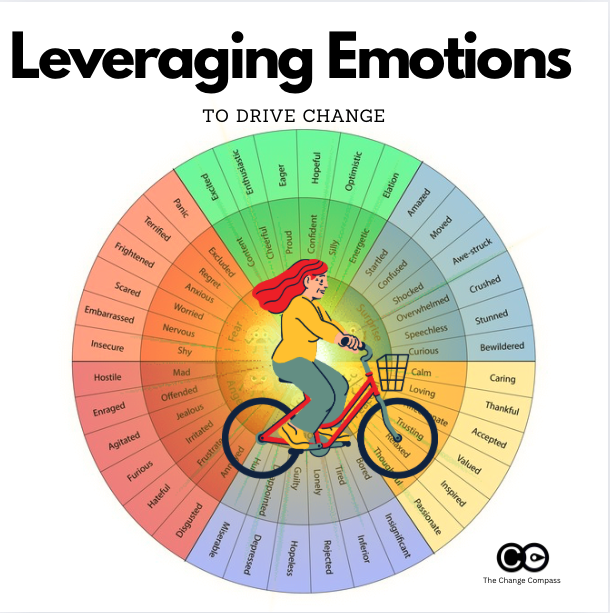
Rather than viewing negative emotions as obstacles and positive emotions as side effects, the most effective leaders intentionally inject a spectrum of emotions across the change journey to drive engagement and build resilience.
Key emotions to strategically leverage include:
Excitement: To create early momentum and interest.
Curiosity: To encourage exploration, learning, and openness to new ideas.
Hope: To sustain long-term belief in the value and attainability of change.
Contentment and Relief: To mark progress, celebrate milestones, and reduce fatigue.
Amusement and Awe: To humanize the process, provide psychological relief, and highlight significant achievements or breakthroughs.
Each phase of change management – from initial awareness to adoption and reinforcement – presents opportunities to leverage different emotions that collectively build engagement and adaptability.
Example Applications
Kick-off communications: Stir excitement and curiosity by spotlighting new opportunities, challenges, and the bigger “why.”
Development stages: Use hope and inclusion, showing progress and involving teams in solution-finding.
Launch and transition: Celebrate success, recognize effort, and use amusement (e.g., gamified elements) to keep spirits high amidst disruption.
Emotions as a Strategic Lever for Change Leaders
Transformational leaders understand that orchestrating change means intentionally managing and harnessing emotions, not suppressing or ignoring them. By tuning into emotional undercurrents, leaders can:
Detect subtle signs of resistance or fatigue early.
Celebrate emotional wins, not just operational ones.
Adapt messages and interventions to journey stages and emotional climate.
Model openness, normalizing emotional conversations within professional spaces.
Emotional intelligence is thus not a “soft” skill, but a strategic lever – “a must-have asset for those leading change initiatives,” as highlighted in leading change management research.
Managing and Addressing Negative Emotions to Sustain Change
Leading successful organizational transformation requires more than amplifying positive emotions; it necessitates the proactive recognition and management of negative emotions that naturally surface during times of change. For senior change and transformation professionals, skilfully navigating this emotional terrain is fundamental to minimizing resistance, reducing risk, and supporting sustainable behaviour change.
Negative Emotions: Predictable, Powerful, and Manageable
Significant change – even when ultimately beneficial – disrupts established routines, identity, and psychological safety. Anxiety, fear, stress, anger, guilt, disappointment, and similar emotions are not anomalies; they are predictable responses rooted in uncertainty and perceived loss. Ignoring or dismissing these emotions increases the likelihood of disengagement, resistance, or project failure.
Why Negative Emotions Matter
Change is experienced subjectively. Even positive shifts generate discomfort as people relinquish familiarity and control.
Unaddressed negative emotions magnify resistance. If left unmanaged, anxiety and fear can evolve into cynicism, mistrust, or apathy.
Negative emotions can serve as signals. They often highlight real obstacles (lack of understanding, perceived injustice, capacity constraints) that demand attention.
Core Approaches to Managing Negative Emotions
Surface and Validate Emotions Early
Encourage open dialogue about fears, frustrations, and uncertainties.
Normalize emotional reactions by acknowledging that these are shared and expected responses to change.
Create Psychological Safety
Foster an environment where employees feel safe expressing concern and doubt without fear of retribution.
Equip managers with tools and language to hold empathetic conversations and demonstrate genuine care.
Targeted Communication and Transparency
Address the why behind change – and spell out the risks of staying the same as well as the intended benefits.
Clarify what is not changing to provide anchors of stability.
Share updates honestly; trust is maintained by admitting what is unknown or still evolving.
Provide Resources for Coping and Adjustment
Offer training and practical support to build the competence and confidence needed to adapt.
Promote peer support networks and employee assistance programs focused on emotional well-being.
Monitor and Respond to Hot Spots
Use quantitative (pulse surveys, sentiment analysis) and qualitative (focus groups, direct feedback) methods to identify departments or groups experiencing heightened stress, anger, or disengagement.
Intervene promptly: tailor strategies (coaching, workload adjustment, additional support) to the specific root causes surfaced.
Practical Example: Driving Compliance Change
Consider a regulatory compliance initiative requiring strict behavioural shifts. Some employees may react with resistance, resentment, or guilt over past practices. The leader’s role is to:
Clearly communicate the rationale (“why this matters”), using real-world consequences rather than just abstract directives.
Create opportunities for employees to voice concerns, ask questions, and seek clarification.
Provide a safe pathway for adaptation – acknowledging initial frustration while offering positive reinforcement and practical support as new behaviours are adopted.
Recognize and celebrate progress, even when small, helping shift the emotional story from “mandated pain” to “shared achievement” over time.
Leveraging Negative Emotions as Catalysts
At times, driving behaviour change may involve activating negative emotions briefly to disrupt complacency and spur action. For example:
Highlighting risks and consequences can use fear productively to achieve urgency.
Allowing discomfort during difficult reflections (e.g., on ethical or compliance gaps) to motivate honest self-appraisal and commitment to new standards.
However, expert leaders then quickly pivot towards hope, support, and a shared vision, ensuring negative emotions serve as catalysts rather than chronic obstacles.
The Role of Senior Leaders: Empathy, Agency, and Boundaries
Senior leaders modelling vulnerability and self-regulation are essential. They:
Empathize openly with teams facing anxiety, stress, or loss.
Set clear boundaries for expected behaviours while also communicating flexibility in adaptation paths.
Use their own emotional intelligence to intervene early – elevating what’s working and constructively addressing blocks.
Measuring and Managing Emotional Impact
Regularly track employee sentiment to spot growing pockets of overwhelm or anger.
Use behavioural markers (e.g., engagement levels, change adoption rates, incident reports) to triangulate emotional health.
Deploy targeted interventions – adjusting timelines, providing additional resources, or recalibrating expectations – to mitigate chronic negative emotional load.
As discussed, negative emotions are not inherently “bad.” When surfaced, addressed, and used purposefully, they become signals and even agents of necessary transformation.
Monitoring Emotional Signals, Using Data, and Modulating Change for Sustainable Success
Delivering transformation at scale isn’t just a matter of visionary leadership and responsive management – it requires robust, ongoing mechanisms to listen to, measure, and respond to the emotional currents within your organization. In a world where the pace, complexity, and uncertainty of change are unrelenting, senior change and transformation professionals must treat emotional management as an integrated, data-driven discipline.
Systematically Monitoring Employee Sentiment
Modern change leadership goes beyond intuition and anecdotal evidence. To ensure lasting adoption and minimize emotional fatigue, organizations must deliberately monitor employee sentiment throughout the change journey. This involves using both qualitative and quantitative approaches:
Quantitative Tools
Pulse Surveys: These regular, short surveys quickly capture shifting moods and concerns. Questions can focus on confidence in the change, perceived impact, stress levels, and sense of involvement.
Sentiment Analysis: Analysing words and phrases in internal communications (e.g., survey responses, emails, chat forums) can provide a broader, real-time picture of organizational mood.
Engagement Metrics: Analysing participation rates in change-related forums, training modules, and events offers clues to energy, buy-in, and resistance.
Qualitative Signals
Focus Groups and Open Forums: Small-group discussions allow deeper exploration of emotional drivers, uncovering underlying issues not surfaced in surveys.
Leader Check-Ins: Regular, open conversations between managers and team members provide space for direct feedback, concerns, and suggestions.
Observation of Behaviours: Changes in productivity, absenteeism, collaboration, or informal communication patterns can signal rising stress or disengagement.
These monitoring tools aren’t just diagnostic; they are intervention triggers, providing data to adjust the pace, content, and support structure of your change efforts.
Using Data to Manage Change Stress and Adapt Strategy
The volume, velocity, and cumulative impact of simultaneous change initiatives (often called “change saturation”) are major contributors to employee stress and emotional overload. Without hard data, leaders risk pushing teams past breaking point or missing signs of silent disengagement. With data, leaders can:
Identify At-Risk Groups: Data might reveal a specific business unit showing sharp increases in stress or declines in engagement, warranting targeted support or pacing adjustments.
Monitor Change Readiness: By tracking readiness markers (self-assessed confidence, perceived adequacy of training, clarity of roles), leaders spot where additional communication or upskilling is needed.
Triangulate Qualitative and Quantitative Insights: Married together, these data sources validate concerns and prevent rash conclusions from isolated anecdotes.
Practical actions could include:
Staggering change roll-outs for overloaded teams.
Providing extra resources or temporary relief for units under strain.
Adjusting expectations or timelines when signs of emotional burnout emerge.
Moderating the Volume of Change
It is now well-established that organizations don’t fail from “change incapacity” but from unmanaged change saturation. Leaders must make strategic decisions about how much change the organization, and specific groups, can absorb at once. This means:
Maintaining a Change Portfolio View: Map all concurrent changes affecting each employee group to avoid overlap and collision.
Pausing or Sequencing Initiatives: Delay less urgent projects if sentiment or adoption data suggest people are stretched too thin.
Prioritizing High-Impact Efforts: Focus energy on the few changes that truly matter, reducing “noise” and amplifying clarity.
Deliberate modulation of change volume – supported by real-time emotional and performance feedback – ensures that energy and positivity are not drowned out by chronic overwhelm.
Leveraging Emotional Intelligence – The Leader’s Ongoing Responsibility
Great change leaders constantly model emotional transparency, empathy, and resilience. But they also harness data and employee signals to:
Acknowledge All Emotions: Routinely communicate about both positive and negative experiences, recognizing the reality of stress, pride, frustration, and hope within the journey.
Elevate Successes and Learnings: Celebrate milestones publicly and use stories of difficulty overcome to build confidence and shared identity.
Recalibrate Quickly: Show willingness to adjust approach based on feedback, which builds psychological safety and trust.
In this way, leaders shape not just the process but the collective emotional journey – moving the organization from mere compliance to ownership and advocacy.
Behavioural Signals: Tracking Readiness and Adoption
Emotional monitoring must be paired with vigilant observation of behavioural adoption. The ultimate goal is not just feeling better about change, but actually embedding new ways of working. Leaders should:
Track participation rates in new processes, training, or systems.
Observe peer-to-peer advocacy – do employees champion the change organically?
Routinely assess performance metrics and qualitative feedback for signs of embedded change or reversion to old habits.
Where behavioural adoption lags, revisit the emotional journey – are people experiencing unresolved anxiety, lack of hope, insufficient relief, or overly prolonged stress?
The Emotional Science of Lasting Change
Seasoned change and transformation professionals know that successful change is as much an emotional journey as it is a strategic or operational one. Organizations that put emotional monitoring, data-driven adaptation, and emotionally intelligent leadership at the core of their change efforts improve not just adoption rates, but employee well-being and long-term resilience.
By appealing to what matters most, systematically addressing and harnessing the full spectrum of emotions, leveraging both human insight and hard data, and moderating the pace and load of change, leaders create a climate where people aren’t just surviving change – they’re thriving through it.
This is the new mandate for transformational leadership: bring science and heart together, and make emotions a central lever of lasting change.
Change management is often seen as a ‘soft’ discipline that is more an ‘art’ than science. However, successful change management, like managing a business, relies on having the right data to understand if the journey is going in the right direction toward change adoption. The data can inform whether the objectives will be achieved or not.
Data science has emerged to be one of the most sought-after skills in the marketplace at the moment. This is not a surprise because data is what powers and drives our digital economy. Data has the power to make or break companies. Companies that leverages data can significant improve customer experiences, improve efficiency, improve revenue, etc. In fact all facets of how a company is run can benefit from data science. In this article, we explore practical data science techniques that organizations can use to improve change outcomes and achieve their goals more effectively.
Improved decision making
One of the significant benefits of using data science in change management is the ability to make informed decisions. Data science techniques, such as predictive analytics and statistical analysis, allow organizations to extract insights from data that would be almost impossible to detect or analyse manually. This enables organizations to make data-driven decisions that are supported by empirical evidence rather than intuition or guesswork.
Increased Efficiency
Data science can help streamline the change management process and make it more efficient. By automating repetitive tasks, such as data collection, cleaning, and analysis, organizations can free up resources and focus on more critical aspects of change management. Moreover, data science can provide real-time updates and feedback, making it easier for organizations to track progress, identify bottlenecks, and adjust the change management plan accordingly.
Improved Accuracy
Data science techniques can improve the accuracy of change management efforts by removing bias and subjectivity from decision-making processes. By relying on empirical evidence, data science enables organizations to make decisions based on objective facts rather than personal opinions or biases. This can help reduce the risk of errors and ensure that change management efforts are based on the most accurate and reliable data available.
Better Risk Management
Data science can help organizations identify potential risks and develop contingency plans to mitigate those risks. Predictive analytics can be used to forecast the impact of change management efforts and identify potential risks that may arise during the transition. For example, change impacts across multiple initiatives against seasonal operations workload peaks and troughs.
Enhanced Communication
Data science can help facilitate better communication and collaboration between stakeholders involved in the change management process. By presenting data in a visual format, such as graphs, charts, and maps, data science can make complex information more accessible and understandable to all stakeholders. This can help ensure that everyone involved in the change management process has a clear understanding of the goals, objectives, and progress of the transition.
Key data science approaches in change management
Conduct a Data Audit
Before embarking on any change management initiative, it’s essential to conduct a data audit to ensure that the data being used is accurate, complete, and consistent. For example, data related to the current status or the baseline, before change takes place. A data audit involves identifying data sources, reviewing data quality, and creating a data inventory. This can help organizations identify gaps in data and ensure that data is available to support the change management process. This includes any impacted stakeholder status or operational data.
During a data audit, change managers should ask themselves the following questions:
What data sources from change leaders and key stakeholders do we need to support the change management process?
Is the data we are using accurate and reliable?
Are there any gaps in our data inventory?
What data do we need to collect to support our change management initiatives, including measurable impact data?
Using Predictive Analytics
Predictive analytics is a valuable data science technique that can be used to forecast the impact of change management initiatives. Predictive analytics involves using historical data to build models that can predict the future impact of change management initiatives. This can help organizations identify potential risks and develop proactive strategies to mitigate those risks.
Change managers can use predictive analytics to answer the following questions:
What is the expected impact of our change management initiatives?
What are the potential risks associated with our change management initiatives?
What proactive strategies can we implement to mitigate those risks?
How can we use predictive analytics to optimize the change management process?
Leveraging Business Intelligence
Business intelligence is a data science technique that involves using tools and techniques to transform raw data into actionable insights. Business intelligence tools can help organizations identify trends, patterns, and insights that can inform the change management process. This can help organizations make informed decisions, improve communication, and increase the efficiency of change management initiatives.
Change managers can use business intelligence to answer the following questions:
What insights can we gain from our data?
What trends and patterns are emerging from our data?
How can we use business intelligence to improve communication and collaboration among stakeholders?
How can we use business intelligence to increase the efficiency of change management initiatives?
Using Data Visualization
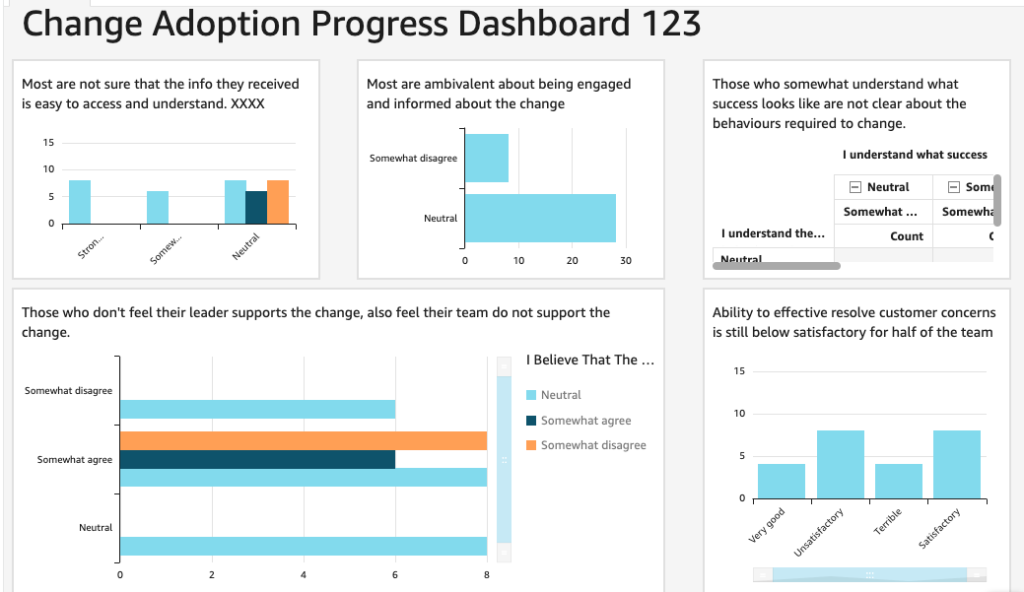
Data visualization is a valuable data science technique that involves presenting data in a visual format such as graphs, charts, and maps. Data visualization can help organizations communicate complex information more effectively and make it easier for stakeholders to understand the goals, objectives, and progress of change management initiatives. This can improve communication and increase stakeholder engagement in the change management process.
Change managers can use data visualization to answer the following questions:
How can we present our data in a way that is easy to understand?
How can we use data visualization to communicate progress and results to stakeholders?
How can we use data visualization to identify trends and patterns in our data?
How can we use data visualization to increase stakeholder engagement in the change management process?
Monitoring and Evaluating Progress
Monitoring and evaluating progress is a critical part of the change management process. Data science techniques, such as statistical analysis and data mining, can be used to monitor progress and evaluate the effectiveness of change management initiatives. This can help organizations identify areas for improvement, adjust the change management plan, and ensure that change management initiatives are achieving the desired outcomes.
Change managers can use monitoring and evaluation techniques to answer the following questions:
How can we measure the effectiveness of our change management initiatives? (e.g. employee engagement, customer satisfaction, business outcomes, etc.) And what method do we use to collect the data? E.g. surveys or focus groups?
What data do we need to collect to evaluate the change initiative progress?
How can we use statistical analysis and data mining to identify areas for improvement?
How can we use monitoring of ongoing support or continuous improvement?
The outlined approaches are some of the key ways in which we can use data science to manage the change process. Change practitioners should invest in their data science capability and adopt data science techniques to drive effective change management success. Stakeholders will take more notice of change management status and they may also better understand the value of managing change. Most importantly, data helps to achieve change objectives.