In the realm of organizational change management, the concept of a Single View of Change (SVOC) has become a focal point for experienced change practitioners. This approach aims to provide a comprehensive perspective on the myriad changes occurring within an organization, thereby facilitating informed decision-making among stakeholders. However, while the SVOC is often lauded for its potential to deliver a holistic picture of change impacts, its practical implementation raises several critical questions.
The Allure of a Single View of Change
The SVOC is designed to offer change practitioners a unified lens through which to view all organizational changes—be they strategic, operational, or cultural. By consolidating information about various changes, practitioners hope to present stakeholders with a clear and coherent narrative that captures the overall impact on the organization. This is particularly valuable in environments characterized by rapid change, where stakeholders may struggle to keep track of multiple initiatives.
Concept Illustration: The Change Landscape
Imagine an organization as a bustling city. Each building represents a different initiative or project, while the streets symbolize the pathways through which information flows. In this analogy, the SVOC acts as an aerial view of the city—providing insights into how each building interacts with others and how traffic (information) moves between them. This perspective allows stakeholders to see not just individual projects but also their collective impact on the organization.
Understanding Stakeholder Challenges
Change practitioners must develop an acute ability to read their stakeholders’ business challenges and tailor their communications accordingly. This involves:
Tailoring Data Presentations
Adjusting the types of data shared based on stakeholder roles and responsibilities is crucial. For example:
A project manager might need detailed timelines and resource allocations for specific initiatives.
A finance officer may require cost-benefit analyses and benefit realisation forecast linked to adoption rates related to ongoing changes.
Customising Visuals
Selecting visuals that resonate with specific stakeholder concerns while remaining aligned with overarching organizational goals is essential for effective communication. Using storytelling techniques in presentations can help convey complex information more effectively:
Contextualize Data: Start with a narrative that outlines why changes are necessary.
Visualize Impact: Use graphs or infographics to illustrate projected outcomes.
Call-to-Action: Conclude with specific actions required from stakeholders based on insights presented.
By framing data within a narrative context, practitioners can foster greater engagement and understanding among stakeholders.
Trial and error
A lot of your stakeholder may not know what they want. They are not change management experts so they may not be able to tell you exactly what the outputs look like. Often they may tell you at a high level the type of data they are after, but not the specifics.
You need to be able to carefully balance giving them something that will hit the mark, as a ‘test’ (since you may not hit the mark the first time). A bit of trial and error is required in this process as you continually test with your stakeholders what resonates and what gets their attention and drives action.
This can cause a lot of frustration and anxiety for change practitioners. After all, you are doing your very best to deliver something that is requested. But again, your audience does not know exactly what they want. There is an element of you guiding them, but also the other element of directly giving them what they are looking for.
Do note that if you don’t hit the mark too many times you may lose their interest, and therefore the opportunity to present change management data. This means that you may only have a small window of opportunity. Digital tools can help you with selecting the right visuals for the right stakeholders.
Facilitating Governance Forums
Creating spaces where stakeholders can discuss insights derived from change data allows for collaborative decision-making:
Regular Business Meetings: Schedule governance forums where stakeholders review progress on key initiatives.
Interactive Discussions: Encourage open dialogue about challenges faced during implementation.
Action-Oriented Outcomes: Ensure meetings conclude with clear action items based on insights shared.
Addressing Change Fatigue
One significant challenge in managing change is addressing change fatigue, which occurs when employees feel overwhelmed by constant organizational shifts. Symptoms include:
Apathy
Burnout
Increased resistance
To combat this phenomenon, organizations must implement strategies that foster resilience among employees:
Engagement Initiatives
Actively involving employees in the change process allows them to voice concerns and contribute solutions:
Feedback Mechanisms: Implement regular surveys or focus groups where employees can share their thoughts on ongoing changes.
Recognition Programs: Celebrate small wins related to change initiatives to maintain morale.
Transparent Communication
Maintaining open lines of communication regarding what changes are occurring and why they matter helps mitigate feelings of uncertainty among employees:
Regular Updates: Provide frequent updates through newsletters or town hall meetings.
Clear Messaging: Ensure messaging is consistent across all channels to avoid confusion.
Learning and Support
Providing resources that equip employees with the skills needed to navigate changes effectively is vital for reducing resistance:
Skill Development Workshops: Offer training sessions focused on new processes or technologies being implemented.
Mentorship Programs: Pair employees with mentors who have successfully navigated similar changes in the past.
The concept of a Single View of Change holds considerable promise for enhancing stakeholder understanding in dynamic organizational environments. However, its successful implementation hinges on recognizing the diverse needs of stakeholders and tailoring communications accordingly. By leveraging technology and fostering an environment conducive to engagement and support, change practitioners can create a more effective framework for managing organizational change. In summary, while striving for an SVOC may seem aspirational, it is essential for change practitioners to remain pragmatic about its execution—balancing ambition with realism to meet stakeholder needs effectively.
As organizations continue evolving in response to market demands and internal dynamics, understanding how best to communicate change becomes paramount. The Single View of Change offers a powerful toolset; however, it requires thoughtful consideration regarding stakeholder needs, technological integration, and ongoing adaptability in communication strategies. By embracing these principles, organizations not only enhance their capacity for effective change management but also cultivate resilience among their workforce—ultimately positioning themselves for sustained success in an ever-changing landscape.
As a change management practitioner, your mission is to guide organisations through change, building their ability to manage transitions effectively and sustainably. A major part of this work often involves helping organisations develop their “change maturity” — the capacity to continuously and successfully deliver change. Many experienced change practitioners focus on moving organisations along this maturity curve, seeing it as a vital part of creating a culture that embraces and sustains transformation.
However, in this pursuit, there’s a potential risk: becoming too fixated on achieving “change maturity” can cloud your judgment about what the organisation really needs. You may find yourself caught up in the desire to build structured change processes, educate stakeholders on every change theory, or create complex frameworks to assess and elevate change capability. While these elements are important, an over-reliance on them can impede progress. In some cases, your organisation might be more capable of managing change than you think, but your approach could be holding them back.
There are several common areas where change practitioners may become too focused on change maturity — and how this focus can actually hinder their ability to support successful, meaningful change. We’ll delve into how overemphasising change terminology, processes, structures, and risk-averse approaches can become obstacles to progress. By understanding and addressing these potential pitfalls, you can better align your support with the unique needs and readiness of your organisation, enabling a smoother, more effective path to support successful change.
Are You Too Quick to Label Your Organisation as Change Immature?
One of the first traps experienced change practitioners might fall into is quickly labeling their organisation as “change immature.” It’s tempting to assess an organisation’s change capability through the lens of formal change frameworks and models, but by doing so, you may be discounting their informal ability to adapt to change.
In other words, is your ‘label’ placed on the organisation a potential self-fulfilling prophecy? For example, if you see the organisation as mildly change mature, your approach and lens may all be geared around this label and expectation.
Organisations that have not formally defined their change management processes or have not made concerted efforts to assess their change maturity might seem “immature” on the surface. But that doesn’t mean they lack the inherent capacity to change. In many cases, businesses have evolved and navigated transitions without formal change models in place, relying on their leadership, adaptability, and problem-solving capabilities.
Example: Mislabeling the Organisation’s Maturity
Consider a large, successful organisation with a history of navigating mergers, market shifts, and product innovation. While this company may have never formalised a change management function or assessed its change maturity, its survival and success prove that it has navigated complex changes in the past. You, as the change practitioner, might arrive and see that the business lacks a formal change methodology like Prosci or Kotter, so you label them as immature. As a result, you might start recommending a highly cautious, structured approach to “bring them up to speed.”
However, this label can lead to unnecessary delays. Rather than imposing new structures or over-engineering the process, it could be more effective to build on the organisation’s existing ways of working. The business may already have the right instincts, and simply needs to refine its approach to handle more formalised, larger-scale change efforts.
This cautious approach of assuming immaturity often leads to missed opportunities for progress. It slows down the pace of change and leaves businesses feeling that they are incapable of handling large-scale change without significant external help.
Change Terminology and Concepts: Over-Education vs. Practical Implementation
Another common pitfall is becoming too focused on educating stakeholders about change management concepts and frameworks, rather than focusing on practical implementation. It’s easy for experienced change practitioners to get caught up in explaining the intricacies of change theories, but the reality is that many stakeholders may not need or want this level of detail.
Stakeholders, especially those in senior leadership positions, are often more interested in results than in the underlying change management theories. Spending too much time educating them on ADKAR, Kotter’s 8-step process, or Lewin’s model can divert attention from the critical issue: how to implement the change in their specific organisational context.
Using and coaching your stakeholders on implementing change without change methodology is a skill, but one that can be critical.
Example: Change Concepts vs. Actionable Strategies
Imagine working on a digital transformation project where the leadership team is eager to see results. Instead of diving straight into how the change will be implemented, you spend the first few weeks educating the leaders on the theory behind change management, explaining why each stage of the ADKAR model is important and why a structured approach is necessary. While these concepts are valuable, the leadership team is left feeling overwhelmed by jargon and disconnected from the practicalities of the change they need to deliver.
A more effective approach in this situation might be to focus on practical, actionable strategies that are action-based learning. Instead of over-explaining change concepts, walk stakeholders through the steps they need to take, provide them with tools to manage resistance, and give them clear, real-time metrics on progress. In many cases, stakeholders don’t need an in-depth lesson on change theory—they need guidance on how to lead change within their teams, how to prepare and engage effectively, and how to overcome resistance.
Even if you don’t focus on education, and instead label them as change immature. This in itself can be dangerous and unhelpful. As a result you don’t implement the right approaches to support the change required to achieve their business goals.
While it’s essential to help stakeholders understand the principles behind change, overemphasis on theoretical knowledge can take the focus away from delivering the change itself.
Processes and Structures: Building New or Leveraging Existing?
One of the hallmarks of a maturing change organisation is the establishment of formal structures and processes to support change. Communities of practice, change champion networks, formalised governance bodies, and change management offices all play vital roles in building long-term change capability. However, there’s a risk of becoming too focused on building these structures rather than finding ways to work within the current framework of the organisation.
When faced with the task of improving change capability, many practitioners instinctively begin to build new structures from scratch. However, this can add complexity and create parallel processes that the business may not be equipped to handle. Sometimes, rather than introducing new structures, the better approach is to refine and optimise existing business processes and forums to embed change more naturally.
Example: Building New Structures vs. Leveraging Existing Ones
Consider an organisation that already has strong cross-functional governance in place for operational projects. Instead of introducing a new change champion network, you could work with the existing project governance structures to ensure change management principles are integrated into these meetings. By adapting existing forums to include change discussions, you avoid creating extra layers of complexity and leverage routines that are already familiar to the business.
The challenge is to balance the need for formal change structures with the desire to minimise disruption to current workflows. Often, the most effective approach is to enhance existing structures rather than building entirely new ones. This also helps to prevent the perception that change management is an “additional burden” rather than an integrated part of business operations.
‘Babying’ Your Stakeholders: Are You Doing the Change for Them?
As a change practitioner, it’s natural to want to help stakeholders navigate the complexities of change. But there’s a fine line between supporting your stakeholders and doing the change for them. When you step in to handle every aspect of the change process, you risk undermining your stakeholders’ ability to build their own change capability.
The goal of change management is to empower the business to manage change independently. If you are too involved in managing the change, you can inadvertently create dependency, where stakeholders rely on you to handle resistance, communications, or decision-making. This not only stifles their growth but also prevents the organisation from building a sustainable, internal capacity for change.
Example: Over-Involvement vs. Coaching for Capability Building
Suppose you’re leading a change initiative in a large organisation, and you find yourself handling most of the communications, solving problems that arise, and managing resistance from teams. While you may feel that you’re helping, the reality is that your stakeholders are becoming overly dependent on you to manage the change.
A more effective approach is to take a coaching stance. Rather than doing the change for them, help your stakeholders learn how to anticipate resistance, communicate effectively, and manage change within their teams. Offer guidance and support, but resist the temptation to take over. When you empower stakeholders to lead the change themselves, you help them build the confidence and skills they need to manage future changes more independently.
The key is to recognise when your involvement is crossing the line from support into doing the change for them. The more you can coach and mentor your stakeholders, the more resilient and capable the organisation will become.
Setting the Bar Too Low for Your Organisation
The COVID-19 pandemic demonstrated something profound about people and organisations: they are capable of changing far more quickly than we might have thought. Practically overnight, organisations adapted to remote working, adopted new technologies, and restructured their operations. This rapid adaptation showed that many organisations have far more resilience and capacity for change than we often give them credit for.
But in the post-pandemic world, are you still setting the bar too low for your organisation? Are you approaching change cautiously because you assume the business is not capable of rapid adaptation? If so, you may be underestimating their ability to handle larger-scale change or more ambitious transformation initiatives.
Example: Underestimating Organisational Capacity
Imagine working with an organisation that wants to implement a large-scale digital transformation. You might assume that because the business has not undertaken such a significant change before, they will need to move cautiously, taking small steps toward change maturity. However, given the right leadership support, clear communication, and resources, the organisation might be able to implement the transformation far more quickly and effectively than anticipated.
The key is to challenge your assumptions about the organisation’s capacity for change. Instead of setting the bar too low and taking overly cautious steps, consider where you can stretch the organisation’s potential. Businesses often have far more adaptability and resilience than we might assume, and by aiming higher, you can help them achieve more ambitious outcomes. Again, COVID was a clear demonstration of what can be possible.
Caution vs. Progress: Finding the Right Balance
One of the biggest challenges for change practitioners is finding the right balance between caution and progress. In many cases, particularly with organisations that are newer to structured change management, a cautious approach may feel like the safest route. But taking overly cautious steps can prevent the organisation from achieving the level of change it needs to succeed.
The other side of the equation is pushing too hard, too fast. While organisations may have a greater capacity for change than we give them credit for, they also need time to adapt and build their change capability. The trick is to strike the right balance between ambitious progress and thoughtful pacing, especially iterative paced learning.
Example: Caution vs. Ambition in Portfolio-Level Change
Consider an organisation that is managing a portfolio of change initiatives. One approach is to take small, incremental steps to build change capability, slowly rolling out new processes and frameworks. While this approach may feel safe, it can prevent the business from keeping up with the volume and pace of change it needs to manage.
A more ambitious approach might involve embedding change management principles directly into business planning, governance, and decision-making. By integrating change management into existing processes, the organisation can manage a high volume of change more effectively without creating new silos or delays. This approach pushes the organisation to operate at a higher level, while still allowing time for adaptation and learning.
Adjusting Your Lens on Change Maturity
While change maturity is an important goal for any organisation, becoming too fixated on achieving it can inadvertently cloud your judgment and therefore negatively impact outcomes. Overemphasising change models, frameworks, and cautious steps can slow down the pace of change and underestimate the organisation’s capacity to evolve. As a change management practitioner, your role is not just to assess change maturity but to empower the organisation to grow and adapt.
By adjusting your lens and focusing on the organisation’s immediate needs and strengths, you can support more effective, sustainable change. This means balancing formal change processes with practical implementation, empowering stakeholders to lead the change themselves, and setting higher expectations for what the organisation can achieve.
The goal is not just to build change maturity, but to help the organisation experience navigating change in a way gives them confidence and meets their business goals.
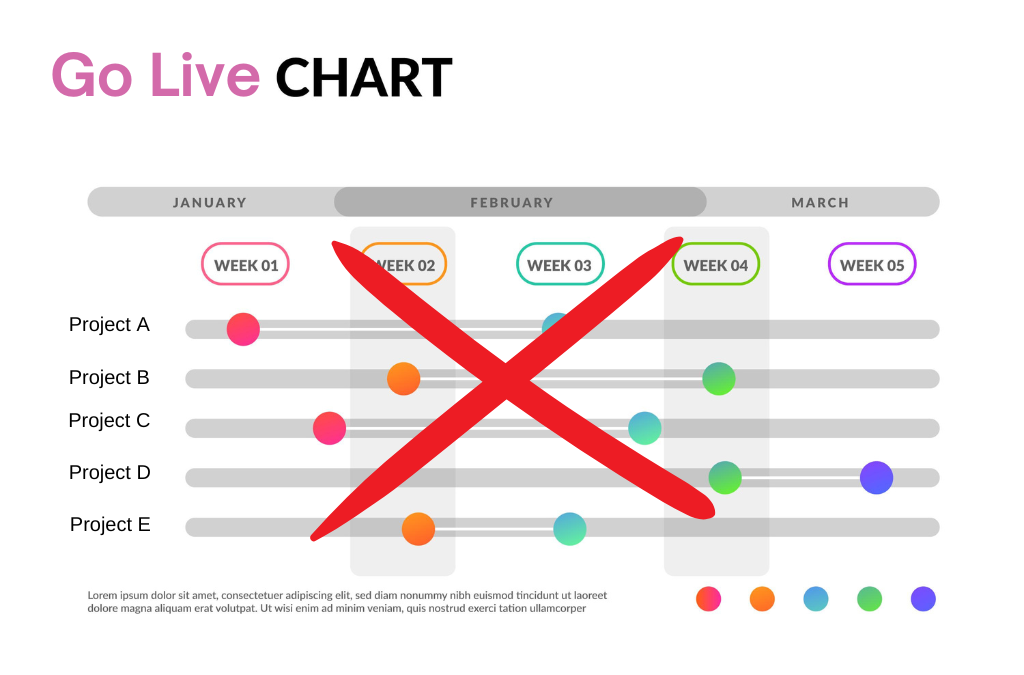
In the world of change management, Go Lives are often seen as significant milestones. For many project teams, these events represent the culmination of months or even years of hard work, signaling that a new system, process, or initiative is officially being launched. It’s common for stakeholders to view Go Lives as a key indicator of the success of a change initiative. However, while Go Lives are undeniably important, relying on them as the primary measure of change impact can be misleading and potentially harmful to the overall change effort.
Go Lives are just one piece of the puzzle. Focusing too heavily on these milestones can lead to an incomplete understanding of the change process, neglecting crucial activities that occur both before and after Go Live. Let’s outline the risks associated with using Go Lives to report on change management impacts and offers best practices for a more holistic approach.
Go Lives: A Double-Edged Sword
Go Lives are naturally a focal point for project teams. They represent a clear, tangible goal, and the success of a Go Live can boost morale, validate the efforts of the team, and provide a sense of accomplishment. From a project delivery perspective, Go Lives are critical. They signal that the project has reached a level of maturity where it is ready to be released to the broader organization. In terms of resourcing and business readiness, Go Lives ensure that everything is in place for the new system or process to function as intended.
However, the very attributes that make Go Lives attractive can also make them problematic as indicators of change impact. The simplicity and clarity of a Go Live event can lead stakeholders to overestimate its significance, from a impacted business perspective. The focus on Go Lives can overshadow the complex and often subtle changes that occur before and after the event. While a successful Go Live is necessary for change, it is not sufficient to guarantee that the change will be successful in the long term.
The Pre-Go Live Journey: Laying the Foundation for Change
A significant portion of the change management journey occurs long before the Go Live date. During this pre-Go Live phase, various engagement and readiness activities take place that are critical to shaping the overall impact of the change. These activities include town hall meetings, where leaders communicate the vision and rationale behind the change, and briefing sessions that provide detailed information about what the change will entail.
Training and learning sessions are also a crucial component of the pre-Go Live phase. These sessions help employees acquire the necessary skills and knowledge to adapt to the new system or process. Discussions, feedback loops, and iterative improvements based on stakeholder input further refine the change initiative, ensuring it is better aligned with the needs of the organization.
These pre-Go Live activities are where much of the groundwork for successful change is laid. They build awareness, generate buy-in, and prepare employees for what is to come. Without these efforts, the Go Live event would likely be met with confusion, resistance, or outright failure. Therefore, it is essential to recognize that the impact of change is already being felt during this phase, even if it is not yet fully visible.
Post-Go Live Reality: The Real Work Begins
While the Go Live event marks a significant milestone, it is by no means the end of the change journey. In fact, for many employees, Go Live is just the beginning. It is in the post-Go Live phase that the true impact of the change becomes apparent. This is when employees start using the new system or process in their daily work, and the real test of the change’s effectiveness begins.
During this phase, the focus shifts from preparation to adoption. Employees must not only apply what they have learned but also adapt to any unforeseen challenges that arise. This period can be fraught with difficulties, as initial enthusiasm can give way to frustration if the change does not meet expectations or if adequate support is not provided.
Moreover, the post-Go Live phase is when the long-term sustainability of the change is determined. Continuous reinforcement, feedback, and support are needed to ensure that the change sticks and becomes embedded in the organization’s culture. Without these ongoing efforts, the change initiative may falter, even if the Go Live event was deemed a success.
The Risk of Misleading Stakeholders
One of the most significant dangers of focusing too heavily on Go Lives is the risk of misleading stakeholders. When stakeholders are led to believe that the Go Live event is the primary indicator of change impact, they may not fully appreciate the importance of the activities that occur before and after this milestone. This narrow focus can lead to a number of issues.
Firstly, stakeholders may prioritize the Go Live date to the exclusion of other critical activities. This can result in insufficient attention being paid to pre-Go Live engagement and readiness efforts or to post-Go Live adoption and support. As a consequence, the overall change initiative may suffer, as the necessary foundations for successful change have not been properly established.
Secondly, stakeholders may develop unrealistic expectations about the impact of the change. If they believe that the Go Live event will immediately deliver all the promised benefits, they may be disappointed when these benefits take longer to materialize. This can erode confidence in the change initiative and reduce support for future changes.
Finally, a narrow focus on Go Lives can create a false sense of security. If the Go Live event is successful, stakeholders may assume that the change is fully implemented and no further action is required. This can lead to complacency and a lack of ongoing support, which are essential for ensuring the long-term success of the change.
Best Practices for Reporting Change Management Impact
To avoid the pitfalls associated with relying on Go Lives as indicators of change impact, change management practitioners should adopt a more holistic approach to reporting. This involves considering the full scope of the change journey, from the earliest engagement activities to the ongoing support provided after Go Live. Here are some best practices for reporting on change management impact:
Integrate Pre-Go Live Metrics:
Track and report on engagement activities, such as attendance at town hall meetings, participation in training sessions, and feedback from employees.
Monitor changes in employee sentiment and readiness levels throughout the pre-Go Live phase.
Report on aggregate pan-initiative change initiative impost on business units, pre-Go Live
Emphasize Post-Go Live Support:
Develop metrics to measure the effectiveness of post-Go Live support, such as the number of help desk inquiries, employee satisfaction with the new system, and the rate of adoption.
Highlight the importance of continuous feedback loops to identify and address any issues that arise after Go Live.
Communicate the need for ongoing reinforcement and support to stakeholders, emphasizing that change is an ongoing process
Report on post-Go Live adoption time impost expected across initiatives
Provide a Balanced View of Change Impact:
Ensure that stakeholders understand that Go Live is just one part of the change journey and that significant impacts occur both before and after this event.
Use a combination of quantitative and qualitative data to provide a comprehensive view of change impact.
Regularly update stakeholders on progress throughout the entire change journey, not just at the time of Go Live.
Manage Expectations:
Clearly communicate to stakeholders that the full impact of the change may not be immediately visible at the time of Go Live.
Set realistic expectations about the timeline for realizing the benefits of the change.
Prepare stakeholders for potential challenges in the post-Go Live phase and emphasize the importance of ongoing support.
While Go Lives are important milestones in the change management process, they should not be used as the sole indicator of change impact. The journey to successful change is complex, involving critical activities before, during, and after the Go Live event. By adopting a more holistic approach to reporting on change management impact, practitioners can provide stakeholders with a more accurate understanding of the change journey, manage expectations more effectively, and ensure the long-term success of the change initiative.
The key takeaway is that change management is not just about delivering a project; it’s about guiding an organization through a journey of transformation. Go Lives are just one step in this journey, and it is the responsibility of leaders to ensure that every step is given the attention it deserves.
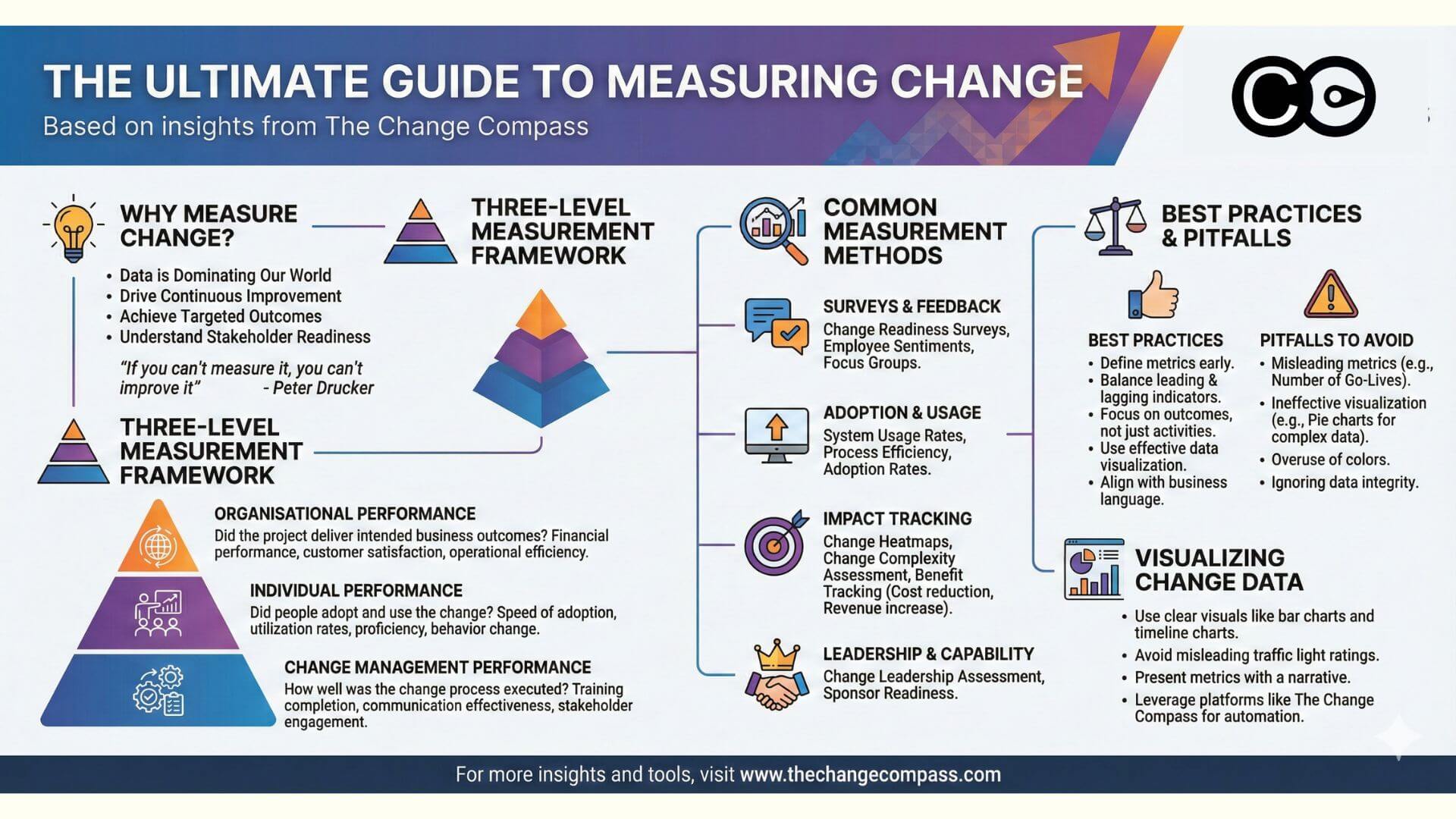
Measuring change management is the practice of capturing whether an organisation’s change activities are landing as intended across a portfolio of initiatives. It covers three distinct layers: project-level metrics that show whether individual initiatives are on track, business-level metrics that show whether the outcomes promised in the business case are being achieved, and enterprise-level metrics that show whether the organisation as a whole is becoming more capable of absorbing change. A complete framework reports on all three. Without measurement at each layer, change management becomes a series of activities with no defensible link to business value.
Most organisations can tell you how many people attended the training and how many emails the project sent. Far fewer can show that the change they paid for is happening in daily work. That gap is now visible at the top of the house: Prosci’s 2026 analysis of ERP programmes found that activity measures such as training completion and communications sent say little about whether people can actually use the new system, and that organisations with poor metrics succeeded less often than those with no formal metrics at all.
This guide is for the senior change, HR and transformation leaders who have to answer the question “is it working?” in a steering committee, not a workshop. It argues for one layered measurement system instead of a pile of surveys, sets out the six project-level methods most teams already use (and where each one breaks), walks through the measures that belong at project, business and enterprise level, and gives you a five-step framework and a reporting cadence. It is also the hub for our measurement cluster: each sub-topic gets a short answer here and a link down to the guide that covers it in full.
Change can be measured because behaviour, readiness, capacity and benefits all leave evidence in data your organisation already collects; the real question is which of that evidence you choose to look at, and whether it measures activity or outcomes.
A lot of change practitioners are comfortable saying that change management is about attitudes, behaviours and feelings, and therefore cannot be measured. That “soft” framing extends into areas such as leadership and employee engagement, where tracking is certainly harder. But harder to measure and less black and white is not the same as less worth measuring. The old maxim that you cannot improve what you do not measure, often attributed to Peter Drucker, applies as much to how people move through a change as it does to inventory or cash.
Data is already changing everything around us
The reason so much industry change happens now is that data has become a central part of how the world runs. We rely on the internet for information, and the data collected through our digital interactions drives decisions about us. A home assistant such as Amazon’s Alexa recognises our voices and answers what we ask. Street cameras can identify us. Our Google usage shapes the advertisements and product promotions we see, and our Facebook usage builds a detailed picture of our preferences and lifestyles, so that we are targeted with what the platform’s algorithms think we will value.
So if our world is surrounded by data, why are we not measuring it when managing change? To answer that, it helps to look at what is, and is not, being measured today.
Activity metrics versus outcome metrics
The most common weakness in change reporting is a dashboard built from activity metrics. Training completion, newsletter opens and workshop attendance are easy to collect, which is why they dominate. They tell you what the change team did, not what the workforce did as a result.
Prosci’s current guidance is to measure what it calls the human factors of return on investment: speed of adoption, ultimate utilisation (whether the people who should use the new process actually do) and proficiency (how well they perform afterwards). It also recommends three to five metrics per initiative, each with a purpose, an owner and a threshold that triggers action. Our guide to five metrics leaders actually use goes deep on that short list. As a working rule:
Activity metrics (sessions run, emails sent, pages viewed) manage the change team’s own workload.
Outcome metrics (speed of adoption, proficiency, sustained use, benefit delivered) show whether the change is landing.
Report both, but never let the first stand in for the second in front of a steering committee.
Six common ways to measure change at project level
Most projects measure change with a mix of six methods: readiness surveys, training evaluations, communications metrics, sentiment or culture surveys, change heatmaps and benefit tracking. Each is useful, and each has a known blind spot that the three-level model later in this guide is designed to cover.
1. Change readiness surveys: What do they actually measure?
Change readiness surveys are short pulse assessments, usually a handful of Likert-scale questions plus a free-text box, sent at pre-launch, mid-execution and post-launch. They benchmark how prepared each stakeholder group feels. They work best when combined with behavioural observation, and when repeated at set points so scores are comparable over time.
In practice, readiness surveys are online surveys sent by a project owner to understand how stakeholder groups feel about the change at different points in the project, in the form of a Likert scale or free text. Most results are summarised into a quantitative scale showing the degree to which a group is ready for change. A simple survey built in SurveyMonkey or Microsoft Forms is enough to start measuring stakeholder readiness. ChangeTracking is a more comprehensive online tool that measures the change journey and the readiness of stakeholder groups throughout an initiative. For the full method, including how to go beyond the survey, read our guide to measuring change readiness with data, not just surveys.
2. Training evaluation surveys: How do you prove training return?
Training evaluations capture participant satisfaction across categories such as content, instructor effectiveness and usefulness. They are the cheapest measure to collect and the weakest proof of change, because satisfaction is not capability and capability is not behaviour.
These evaluations are normally based on participant satisfaction across those categories. In a face-to-face format they are often paper-based to lift the completion rate. For online or virtual training, ratings are completed by the learner at the end of, or shortly after, the session. To turn training from a satisfaction exercise into evidence, add a knowledge check at the end and an on-the-job application check a few weeks later (covered under learning tracking below).
3. Communications metrics: Which ones matter most?
The most useful communications metrics show reach and attention rather than volume. The simplest is the “hit rate”, the number of users in the audience who view the article, material or page, tracked alongside the time of day and week they viewed it.
This is easy to track using Google Analytics, which reports views per page as well as viewership by time of day, day of week, audience demographics and location. Treat reach as a floor, not a finish line: a message that was opened has not necessarily been understood, and a message that was understood has not necessarily changed anyone’s behaviour. Pair readership data with a short comprehension check in your pulse survey.
4. Employee sentiment and culture surveys: What reveals resistance early?
Organisation-wide sentiment and culture surveys are a catch-all yardstick: they reveal broad trends in how people feel, and can surface resistance early, but they are rarely specific to any one initiative.
Some organisations measure employee sentiment or culture across the year, and there are often questions linked to change. These surveys tend to be short and Likert-based, with few open-ended questions for qualitative feedback. Because they go across the entire organisation, they cannot isolate the effect of a particular programme. The stakes of the underlying engagement are real, though: Gallup estimates that low engagement cost the world economy roughly US$10 trillion in lost productivity, about 9% of global GDP. Use the annual survey as a trend signal, and add two or three change-specific pulse questions for each major initiative so the signal is attributable.
5. Change heatmaps: When do they fail, and what works better?
A change heatmap shows how much change each business unit is absorbing, and it starts useful discussions about capacity. Its weakness is that it is usually rated by one or two people, so it carries their judgement and is hard to defend in a decision forum.
Some organisations build heatmaps in Excel to map the extent to which different business units are affected by change. The artefact speaks to the amount of change and often leads to discussion of the capacity the business has to handle and digest it. The problem with most heatmaps is that they are categorised and rated by the creator of the artefact (or a limited number of people making judgements), and are therefore subject to bias. Data based on one person’s opinion also tends not to carry much weight in a decision-making forum. The case for moving to quantified impact over time is made in The death of the change heatmap.
6. Change benefit tracking: How do you track post-launch value?
Benefit tracking measures whether the targeted outcome of the change has actually happened. It is the only one of the six methods that connects directly to the business case, which is why it deserves the most rigour.
Beyond typical change management measures, there are initiative-specific measures that focus on the actual outcome and benefit of the change, with the goal of determining the extent to which the change has taken place. Examples include:
System usage rates
Cost reduction
Revenue increase
Transaction speed
Process efficiency
Speed of decision making
Customer satisfaction rate
Employee productivity rate
Incidents of process violation
Define each benefit, its baseline, its owner and its measurement date before launch. The change management ROI guide shows how to turn these benefits into a business case executives accept.
Measuring change leadership and change maturity
Two measures sit outside any single initiative: change leadership assessment, which looks at the people who drive change, and change maturity assessment, which looks at the organisation’s overall capability to manage it. Both are used at business and enterprise level rather than inside one project.
Change leadership assessment
Change leadership is measured by assessing how well the sponsors, influencers and change agents around an initiative carry out their roles. The evidence is strong that this is worth the effort: in Prosci’s 12th edition benchmarking data, projects with extremely effective sponsors met their objectives 79% of the time, against 27% for projects with extremely ineffective sponsors.
David Miller of Changefirst wrote about three types of change leader:
The sponsor, whose role is to drive the initiative to success from beginning to end. This involves competencies in rallying and motivating people, building a strong network of sponsors and communicating clearly to different stakeholder groups.
The influencer, whose role is to use their network and influence to market the change and build the traction required for success. Changefirst identifies four types of influencer:
Advocates, who are great at promoting the benefits of the change.
Connectors, who link people across parts of the organisation to support the change.
Controllers, who control access to information and people, and can include administrators and operations staff.
Experts, who are viewed by others in the organisation as technically credible.
The change agent, who is tasked with supporting the overall change in various ways, including promotional activities, engaging different parts of the organisation on the change and influencing up, down and sideways across the organisation to drive a successful outcome.
There is no single industry standard tool for assessing change leadership competencies and capabilities. Changefirst and various smaller consulting firms offer change leadership assessments. One of the most comprehensive is ChangeTracking’s Change Capacity Assessment, a self-assessment organised around four broad categories: Goal Attainment, Flexibility, Decision Making and Relationship Building. Both Prosci and Changefirst also offer sponsor competency assessments.
Pagon and Banutal (2008) called out the key competencies critical in change leadership:
Goal attainment
Assessing organisational culture and climate
Change implementation
Motivating and influencing others
Adaptability
Stakeholder management
Collaboration
Building organisational capacity and capability for change
Manoeuvring around organisational politics
A practical way to use the list is as a short self-assessment and 360 for sponsors and champions at the start of a major programme, then to target support at the two or three competencies where the gap is widest.
Change maturity assessment
Change maturity assessment measures how well the organisation manages change as a repeatable capability, across dimensions such as project change management and change leadership, so that capability gaps can be found and closed in a structured way.
Two major change maturity assessment models are widely used in the market: one from Prosci and one from the Change Management Institute. To read more, see our article A New Guide for Improving Change Management Maturity, where we outline how to improve change maturity across business units. At enterprise level, maturity is lifted through programmes, networks and shared tools, which we cover in the enterprise section below.
The three-level model: Project, business and enterprise measures
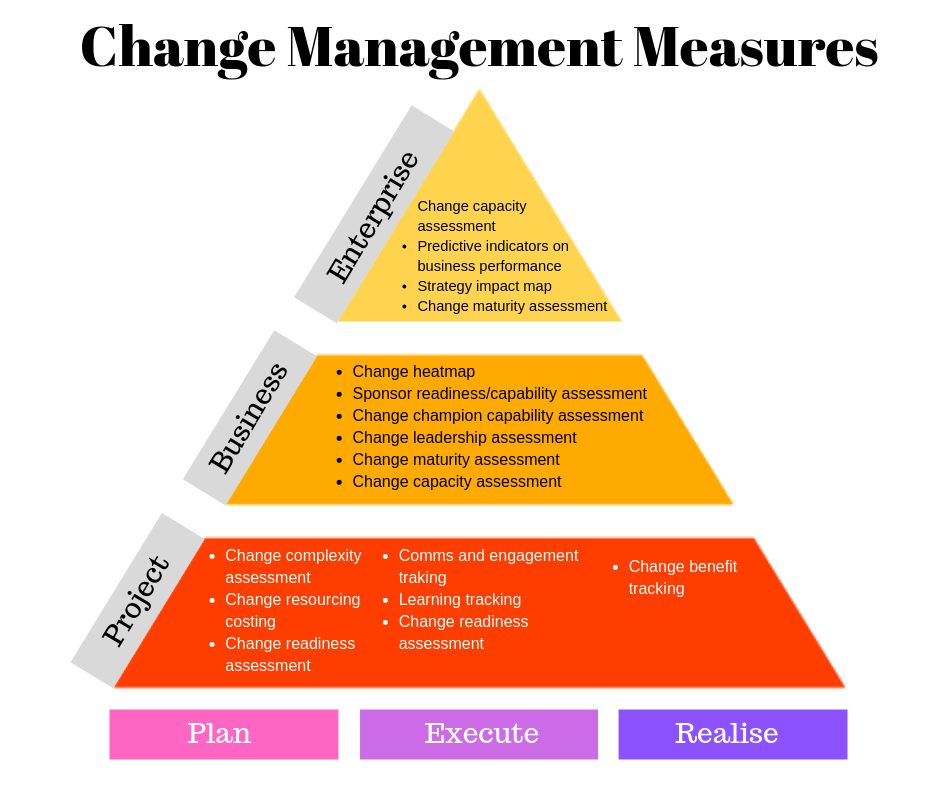
A comprehensive model of change management measures organises every metric on two axes: the phase of the initiative lifecycle (Plan, Execute, Realise) and the organisational level the metric speaks to (project, business, enterprise). Each layer answers a different question for a different audience, which is why reporting the same metric to all three audiences is the reason so many change dashboards are ignored.
In the diagram, change management measures are plotted along two axes: the different phases of the initiative lifecycle, and the organisational levels of project, business and enterprise into which the measures fall. A project manager needs to know whether stakeholders are ready ahead of go-live. A business unit head needs to know whether a team has room for another change this quarter. A CEO needs to know whether the portfolio of change is pointed at the strategy.
Project-level measures
Project-level measurement answers whether one initiative is on track to land: it measures complexity and cost during planning, readiness, engagement and learning during execution, and benefits after go-live.
‘Plan’ phase
In this phase the team is discovering and scoping the project and the change, so details are not clear at the start. Later in the phase the scope sharpens and the team starts planning the activities needed to implement the change. Measurement here is about sizing:
Change complexity assessment. Evaluates how complex the project is: how many people could be affected, the size of the impact, how many business units are involved, and whether multiple systems and processes are touched.
Change resourcing costing. During planning, the cost of the change management stream is established. This includes contractors, communication campaigns, learning costs, travel and administration, to name a few.
Change readiness assessment. Usually conducted before and during the change. The same set of questions is asked of each stakeholder group to assess readiness. A baseline taken after launch cannot show movement, so the first reading belongs here.
‘Execute’ phase
The execute phase is one of the most critical parts of the project. Activities are in full flight and the team is iterating on the change to achieve project goals. Four measures carry most of the weight:
Communication and engagement tracking. Effective engagement of stakeholders is critical. Stakeholder interviews, surveys and communication readership rates are all ways of tracking engagement.
Learning tracking. Measuring learning tracks the extent to which new competencies and skills have been acquired through learning interventions. Typical measures include course tests or quizzes in addition to course evaluations. On-the-job performance can also be used to track learning outcomes and the extent to which learning has been applied at work.
Change readiness assessment. It continues to be critical during execution. Re-measure at fixed points: at kick-off, 30 to 60 days before go-live and at go-live, using the same questions for each group.
Sponsor activity. A short check of visible communication, barrier removal and reinforcement is among the cheapest measures to run, and the Prosci data above shows how much sponsor effectiveness matters.
‘Realise’ phase
In this phase the change has gone live and most project activities have been completed. It is anticipated that the change occurs and that benefits can now be tracked and measured.
Change benefit tracking measures and tracks the extent to which the targeted benefits and outcomes have been achieved. Some of these measures are hard quantitative measures; others are soft measures that are more behavioural, such as process compliance, workarounds and incident rates.
Business-level measures
Business-level measurement shows whether a part of the organisation has the right ability, capacity and readiness for the change, and whether the changes landing on it are being adopted.
Adoption. Adoption is where change management is either proved or exposed. Gartner HR research published in July 2025 found that just 32% of business leaders reported that the last change they led achieved healthy change adoption by employees. Good adoption measurement draws on more than one source: system data on usage and feature depth, process compliance, error and rework rates, team leader observation and customer feedback, tracked over time rather than as a single post-launch snapshot. Two companion guides carry the detail: how to measure change adoption covers the method, including the shape of the adoption curve, and the change adoption metrics framework lists which metrics suit system implementations, compliance programmes and restructures.
Change heatmaps. Heatmaps help to visualise which part of the business is most affected by one project or by several, and to compare relative impact across businesses. As the number of initiatives increases, so does the complexity of change, and organisations need to graduate from spreadsheets to more capable data visualisation tools to support data-based decisions. To read more about why a heatmap is not the only way to understand business change impact, go to The death of the change heatmap.
Sponsor readiness and capability assessment. A critical tool for identifying capability gaps in the sponsor so that support can be provided. A strong and effective sponsor can make or break an initiative, so early engagement and support are essential. Both Prosci and Changefirst offer sponsor competency assessments.
Change champion capability assessment. Change champions and change agents are critical nodes for driving and supporting change in the organisational network. Many champions are appointed for one initiative only. A business-focused champion network means capability can be developed over time and used across multiple initiatives, and assessing and supporting champion capability translates directly into better change outcomes.
Change leadership and change maturity assessment. Covered in the previous section.
Change capacity assessment. Where significant change is happening concurrently, careful planning and sequencing of change against existing capacity is critical.
Change capacity and saturation in more detail
Capacity is the business-level measure most often guessed rather than measured. Three aspects should be called out in the measurement process:
Different parts of the business have different capacity for change. Areas with better change capability, and perhaps better change leadership, are often able to receive and digest more change than businesses without the same capability.
Some businesses are far more time-sensitive and so their capacity needs to be measured with more granularity. Call centre staff capacity, for example, is often measured in minutes. To plan effectively for their capacity, the impacts of change need to be quantified in a precise, time-bound way so resourcing can be planned in advance, in hours per role rather than “high, medium, low”.
Change tolerance or saturation level needs careful measurement in combination with operational feedback. Say that last month a part of the business experienced significant change impact across several initiatives at once, and the operational indicators showed an impact on customer satisfaction and productivity, with staff reporting that there was too much change to handle. The change tolerance level may have been exceeded. With the right measurement of change impact levels for that part of the business, the lesson can be used to plan for the same volume of change next time.
Enterprise-level measurement compares change across business units and initiatives to show whether the total load and direction of change match strategic intent, and whether the organisation is getting better at absorbing it.
At enterprise level, many of the business-unit measures still apply. The focus shifts to comparing across business units, to make sense of what each part of the business is going through and whether the overall picture is aligned with the organisation’s intentions and strategic direction. Typical questions include:
Is it surprising that one part of the business is undergoing significant change while another is not?
Is there a reason one business unit is focused on a few very large changes while others carry a larger set of changes with smaller impacts?
Is the overall pace of change right for the strategic intent? Does it need to speed up or slow down?
What process governs, reports and makes decisions on enterprise-level change prioritisation, sequencing and benefit realisation?
Is one business unit managing change more effectively, faster and with greater outcomes? How can other business units adopt its internal best practices?
Does one business unit’s capacity limit mean the organisation cannot execute a critical strategy in the allocated time? If so, how do you create more capacity? Options include more resources such as staff, additional initiative funding, more time, or more talent to lead initiatives.
Change maturity assessment at enterprise level
At enterprise level the concern is the overall change maturity of the organisation. The question is how to implement enterprise-level interventions that build maturity through programmes, networks and exchanges, such as:
Enterprise change capability programmes
Enterprise change analytics and measurement tools
Enterprise change methodology
An enterprise network of change champions
Strategy impact mapping
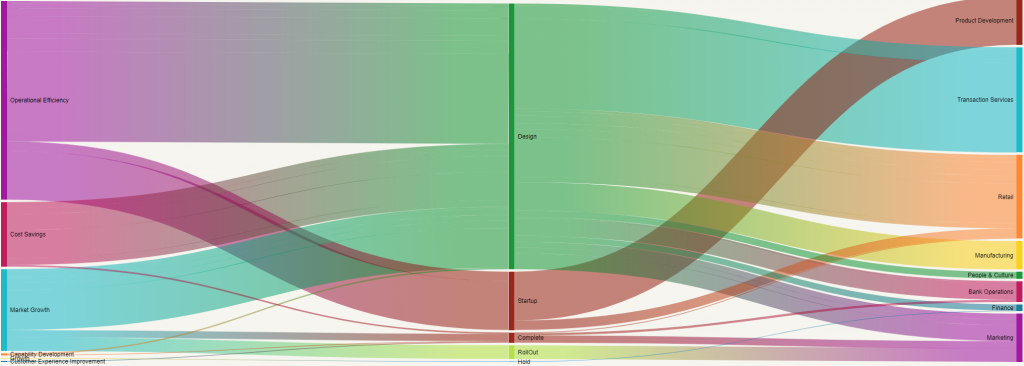
Change management need not focus only on project execution or business-unit capability. It can also demonstrate value at enterprise level by focusing on strategy execution, which by definition is change. A strategy impact map visualises how different strategies exert impact on business units, so stakeholders can see which initiatives within which strategic intent affect which business units. In the example below, each of the organisation’s strategies is displayed with its initiatives branching out. The width of each initiative reflects the level of impact it has on the business over a pre-determined period, so the width of each strategy also shows its overall relative impact.
This data visualisation can be valuable for business leaders and strategic planning functions because it shows how the implementation of different strategies is affecting business units. It helps planners understand strategy implementation impacts, potential risks and opportunities, and balance the pace of change against strategy goals at various points in time.
Predictive indicators on business performance
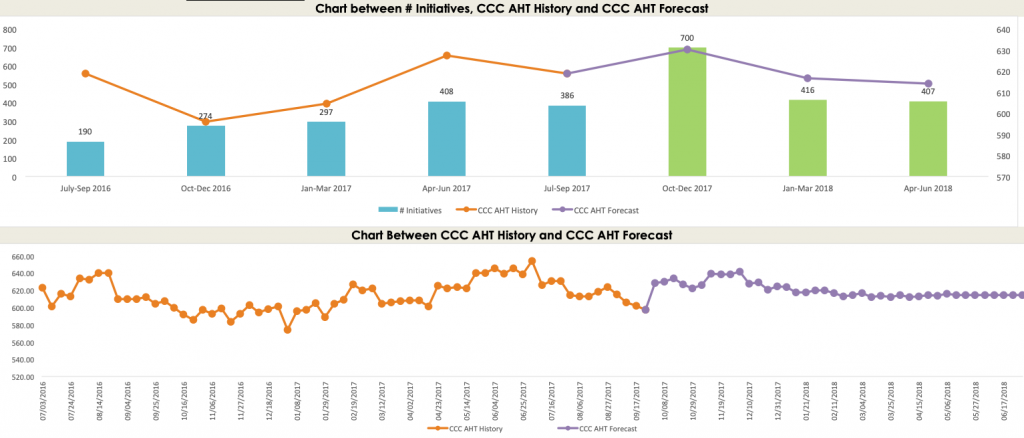
We started this guide by noting that data is all around us and that we should use it to manage change better. With quantitative data on change impact, it is possible to test for correlations with operational business indicators such as customer satisfaction and service availability. Where a significant correlation exists, predictive reporting can forecast the trend of those performance indicators given planned change impacts.
In the graph below, historical data is used to establish correlations and forecast future impact on business indicators. The example focuses on the customer contact centre, with average handling time as the key business indicator. If heavy change periods consistently coincide with longer handling times, the business can adjust sequencing before the next peak.
This type of predictive performance forecasting is extremely valuable for organisations undergoing significant change that want to understand how it may affect business performance. By demonstrating the impact on business indicators, it puts the importance of managing change at the front and centre of the decision-making table. At The Change Compass we are developing this type of measurement and reporting function. It is the frontier for change management: being established as a business-driving function rather than a standard back-office one.
Building the measurement system: A five-step framework
A measurement system is a short list of defined metrics, a baseline, a reporting rhythm and an owner for each number; without all four, the data does not change any decision. The five steps below cover the full lifecycle, from pre-change baseline through to sustained adoption tracking, and reflect the approach used by experienced change practitioners and data-driven change teams.
Establish a change measurement framework. Define what you are measuring and why before selecting metrics. A framework should cover three kinds of metric: activity metrics (what the change team is doing), readiness metrics (how prepared people are) and adoption metrics (whether people have actually changed their behaviour). Choose a short list across the three levels, three to five per initiative plus a few portfolio measures.
Set a baseline before the change. Measure the current state before the change is implemented. Without a baseline it is impossible to demonstrate the impact of the change management effort or to identify where readiness is lowest.
Track readiness at key milestones. Conduct readiness assessments at defined points, typically at the start of the programme, 30 to 60 days before go-live and at go-live. Assessments should cover awareness, understanding, capability and commitment for each affected stakeholder group.
Measure adoption after go-live. Track adoption in the weeks and months after go-live. Key indicators include system usage rates, process compliance, error rates, workaround behaviour and performance recovery back to baseline.
Report and act on the data. Use measurement to drive decisions, not just to report status. When adoption lags in a specific group, use the data to identify the barrier and target an intervention.
Cadence and governance
Match the cadence to the decision. Readiness is measured at milestones; adoption weekly, then monthly after go-live; capacity and change load monthly or quarterly alongside planning forums. Name who owns each metric, who reviews it and what happens when a threshold is crossed. Every chart on a dashboard should have a question, a threshold and an owner. Our guide to designing a change adoption dashboard shows how to build the view itself.
Data integrity before you present
A single visible error in a change dashboard is enough for a steering committee to discount the rest. Reconcile counts to source systems, state the sample size and response rate for any survey, keep definitions stable between reporting periods and flag where a figure is an estimate. It is better to show fewer metrics you can defend than many you cannot.
Telling the story
Numbers move decisions when they are framed against something leaders already care about: a milestone, a benefit, a risk. Lead with the decision you need, show the two or three numbers that justify it, and keep the detail one click away. A number plus an action (“adoption in the claims team is 20 points behind, and the barrier is the approval step”) is a briefing; a number alone is a report. Our follow-on guide, measuring change management outcomes, extends this reporting approach.
Where digital tools fit
Manual measurement stops scaling when the number of concurrent initiatives grows: survey results sit in one place, impact assessments in a spreadsheet and adoption data in a third system, and nobody can see the portfolio. Survey tools such as SurveyMonkey and Microsoft Forms, and web analytics such as Google Analytics, remain useful for the project-level methods above. A purpose-built change intelligence platform such as Change Compass brings impact, capacity and adoption data into one model, so the business and enterprise measures (load by business unit, saturation, predictive links to operational indicators) become routine reporting rather than a quarterly analysis project.
Which guide to read for which question
This page is the map; the guides below are the depth. Each answers one question completely, and between them they cover every sub-topic summarised above.
The best measurement systems begin with a single question that a senior leader is already asking, such as “will this go-live hold our service levels?” or “which division cannot take another change this quarter?”. Pick the three to five numbers that would answer it, set a baseline this week, and put the first reading in front of the sponsor within a month. A small set of metrics with owners and thresholds beats a comprehensive scorecard that nobody acts on.
From there, extend upward. Add business-level capacity and adoption views once the project metrics are stable, then portfolio and strategy views as the enterprise starts asking comparative questions. Change can be measured, and the methods in this guide show operational and strategic ways in which measurement demonstrates real value. Most corporate functions cannot exist without data and analytics. Human Resources relies on people and pay data. Marketing cannot function without measurement of channel and campaign effectiveness. For Information Technology, almost everything is measured, from system usage to cost to efficiency. It is time to use data to visualise change, plan better and make business decisions with the same standing.
Frequently asked questions
What is change management measurement?
Change management measurement is the practice of tracking whether change activities are producing the intended behaviour and business results. It works at three levels: project metrics (readiness, engagement, learning), business metrics (adoption, capacity, benefits) and enterprise metrics (portfolio load, strategy impact, maturity). Reporting on all three lets you link change effort to the outcomes in the business case.
What are the most important change management metrics to track?
Focus on adoption rates, readiness scores, communication engagement and benefit realisation, tailored to the project phase and the business unit’s capacity. Prosci recommends three to five metrics per initiative, each with a purpose, an owner and an action threshold, with a handful of portfolio measures added on top.
How do you measure change readiness effectively?
Combine pulse surveys with behavioural indicators and sponsor assessments, and repeat the same questions at fixed milestones so results are comparable. Balance frequency with depth so that the results are actionable. Read our guide to measuring change readiness with data, not just surveys for the full method.
Why replace change heatmaps with other visuals?
Heatmaps introduce subjectivity bias because they are usually rated by one or two people. Timeline charts and capacity dashboards built from quantified impact give clearer, more defensible data for decisions. See The death of the change heatmap.
What role does AI play in change measurement?
AI supports sentiment analysis of free-text feedback, predictive capacity planning and automated risk detection across initiatives, and some platforms offer natural-language queries for instant answers. Its value depends on the quality of the underlying data: it speeds up analysis of well-defined metrics, but it cannot compensate for a missing baseline or unclear definitions.
What enterprise-level change metrics matter most?
Strategy impact mapping, cross-business capacity analysis and predictive performance forecasting that links change volume to operational outcomes. Together they show whether the pace and direction of change match strategic intent, and whether the organisation is getting better at absorbing it.
How often should change be measured?
Match the cadence to the decision. Readiness is usually checked at the start, before go-live and at go-live. Adoption is tracked weekly or fortnightly in the first months after launch, then monthly. Portfolio measures such as change load and capacity are reviewed monthly or quarterly alongside planning and governance forums.
References
Miller, D. (2011). Successful Change: How to implement change through people. Changefirst Ltd.
Pagon, M. and Banutal, A. (2008). Leadership Competencies for Successful Change Management. Study report, University of Maribor.
This guide focuses on the complete measurement framework, design, run, and report change measurement end-to-end. Three closely related guides on this site each cover a distinct angle, pick the one that matches what you need now:
The role of change managers has been left out of the various agile methodologies. This is even though most fully acknowledge the importance of change management in the success of initiatives. Does this mean that the agile teams should and can take on the role of change managers? While most of you reading this article may have change practitioners in the organisations, there are plenty of organisations that run agile teams without change managers in the team.
Is it that in agile environments, change management responsibilities are distributed across team members rather than centralised in a single role? After all the agile team is self-organising and has shared accountability?
For organisations that do not have change managers in agile teams, they are still able to deliver valuable and continuous changes. The difference is in how effective the agile team is in delivering a solution where:
A range of stakeholders are continuously engaged effectively and therefore have high levels of readiness
Stakeholders’ readiness for the pace and design of agile is taken into account and various education/engagement sessions are designed as required
They’re able to identify the various behavioural changes required in fully adopting the change
Stakeholders continuously track and reinforce adoption
The team is aware of the change landscape of impacted stakeholders and can work with them respectively to design and deliver in a way that maximises adoption in a targeted way
It is quite difficult for a small agile team to have all these skillsets. You can equally place the same argument for Business Analysts. Even if the team does not have this role, they could equally undertake a lot of the tasks that a Business Analyst would typically undertake in an agile project, however, maybe not at the same level of professionalism and rigor.
In a small agile team of cross-functional specialists, by design each member is a specialist in his/her functional domain, whether it is testing, software development, operations, etc. It would be rare for a domain specialist to have such a breadth of skillsets to include a range of change management skills. Of course, this is not impossible, but difficult for a team to possess.
An agile team is by design focused on delivering. By design, the agile team is laser-focused on its iteration work and delivering to the schedule at the right quality. It does not have a lot of capacity to devote itself to working with a wide range of stakeholders as a result. The change manager, on the other hand, is by design focused on the world of the stakeholders as well as what the agile team is delivering and designing a series of steps for the changes to take place or a people and organisational perspective.
Moreover, beyond project change management skills, organisations that have a myriad of self-organising agile teams require greater air-traffic control at a portfolio and enterprise level. Whilst this may be fulfilled from a portfolio management perspective, attention should also be paid to change portfolio management. Within a fast-paced change environment, the capacity stakeholders across the organisation have for the changes, and the overall prioritisation and sequencing for these changes are paramount.
Without this, changes may fall off the radar, superseded by other competing changes delivered by other agile teams. Alternatively, change saturation fatigue may be a result. In fact, there is increasing evidence that this is prevalent across organisations. Stakeholders’ capacity for change is limited and must be managed effectively to ensure the right changes are adopted.
If change management so critical to agile changes let’s delve into the essential role that change managers play within agile teams, breaking down their contributions across the four typical phases of an agile initiative: Define, Build, Test, and Deploy.
Define Phase
During the Define phase, agile teams lay the groundwork for the project by identifying objectives, scope, and initial requirements. For change managers, this phase is critical for assessing the scope and complexity of the change and determining the necessary resources and support structures.
Key Activities for Change Managers in the Define Phase:
1. Assessing Change Size and Complexity: Change managers evaluate the magnitude of the change and its potential impact on various parts of the organization. This assessment helps in tailoring change management strategies to address specific needs.
2. Resource Planning: Identifying the required business and change support resources is essential. This includes assembling a team of change champions, communication specialists, and trainers who will help facilitate the change.
3. Strategic Planning: Developing a comprehensive plan that outlines key activities and tactics to engage stakeholders and drive successful change. This plan acts as a roadmap for the entire change management process.
Build Phase
In the Build phase, agile teams start developing the solution. Change managers intensify their efforts to understand the potential impacts of the change and begin engaging stakeholders.
Key Activities for Change Managers in the Build Phase:
1. Detailed Stakeholder Assessments: Conducting thorough assessments to identify how different stakeholders will be affected by the change. Understanding these impacts is crucial for tailoring communication and training efforts.
2. Initiating Stakeholder Engagement: Early engagement with stakeholders to communicate the vision, goals, and expected outcomes of the change. This engagement helps in building awareness and buy-in from the outset.
3. Scenario Planning: Since the exact nature of the change may not be fully defined, change managers work with various scenarios to anticipate potential challenges and opportunities. This flexibility allows for adaptive communication and engagement strategies.
Test Phase
The Test phase is where agile teams validate the solution through testing and feedback. For change managers, this phase is pivotal for ensuring stakeholders are prepared for the upcoming changes.
Key Activities for Change Managers in the Test Phase:
1. Collaborating on Testing Processes: Working closely with agile teams to determine how stakeholders can be involved in testing. This may include business testers, change champions, or end-users who provide valuable feedback.
2. Designing Communication Content and Learning Interventions: Developing and rolling out communication materials and training programs to prepare stakeholders for the change. These interventions are tailored based on feedback from testing.
3. Engaging Stakeholders Through Various Channels: Utilizing demos, team briefings, and other engagement channels to keep stakeholders informed and involved throughout the testing process.
Deploy Phase
The Deploy phase marks the transition of the solution into the live environment. Change managers play a crucial role in ensuring a smooth transition and full adoption of the change.
Key Activities for Change Managers in the Deploy Phase:
1. Ensuring Readiness: Before deployment, change managers gather evidence that stakeholders are ready for the change. This involves assessing training completion, communication effectiveness, and overall preparedness.
2. Executing Engagement Strategies: During deployment, change managers leverage various engagement channels to support the transition. This includes continued communication, support hotlines, and face-to-face interactions to address any concerns.
3. Monitoring and Feedback: Establishing performance metrics to monitor the adoption and effectiveness of the change. Feedback is collected and analyzed to make necessary adjustments and integrate the change into business-as-usual operations.
Key Differences in Change Management for Agile Teams
While the core principles of change management remain consistent, their application within agile teams introduces unique challenges and opportunities. Here are some key differences:
Proactive Integration in Cross-Functional Teams
Change managers actively contribute to the progress of agile teams by embedding themselves within the cross-functional team structure. This close collaboration ensures that change management activities are aligned with the development process, allowing for more effective and timely interventions.
Flexibility and Adaptation
In agile environments, the content and nature of changes may evolve throughout the project lifecycle. Change managers must remain flexible, working with scenarios and adaptable communication strategies to respond to shifting requirements and stakeholder needs.
Continuous Feedback and Engagement
Ongoing stakeholder engagement and continuous feedback are cornerstones of effective change management in agile teams. Regular check-ins, feedback loops, and open communication channels help to identify and address concerns early, ensuring smoother transitions and higher adoption rates.
Iterative Planning and Adjustment
The iterative nature of agile projects necessitates continuous review and adjustment of change management plans. Change managers must be prepared to tweak strategies, update communication materials, and refine training programs based on real-time feedback and evolving project dynamics.
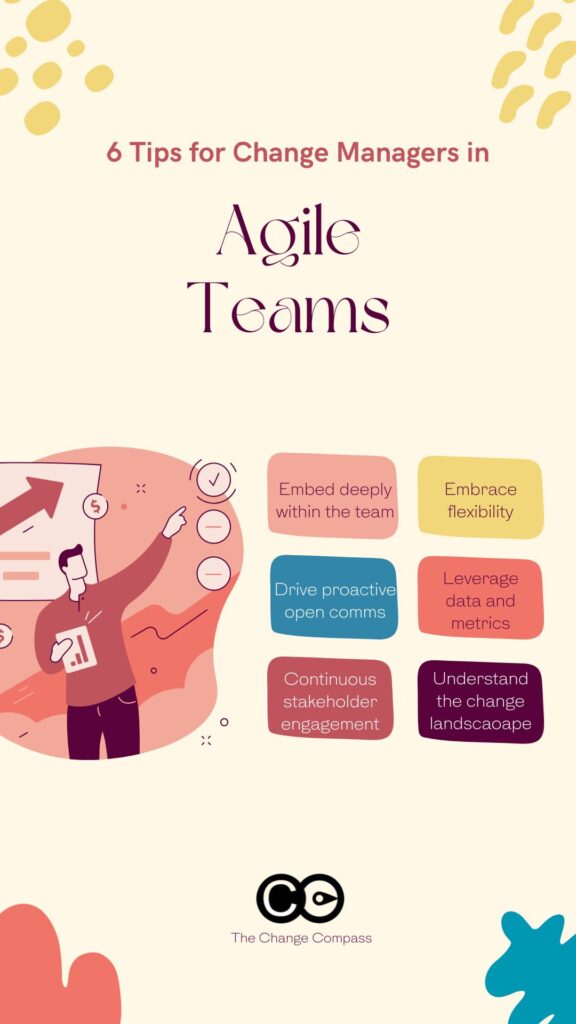
Practical Tips for Change Managers in Agile Teams
1. Embed Yourself in the Team: Become an integral part of the agile team to gain a deeper understanding of the project dynamics and build strong relationships with team members.
2. Embrace Flexibility: Be prepared to pivot and adapt your change management strategies as the project evolves. Flexibility is key to staying relevant and effective. Come up with scenarios such as communication materials and engagement tactics as needed.
3. Drive Proactive Open Communication: Create an environment where stakeholders feel comfortable sharing feedback and concerns. This openness will help you address issues promptly and maintain trust. Note that stakeholders may need learning interventions to truly understand and adjust to agile ways of working.
4. Leverage Data and Metrics: Use data and performance metrics to monitor the effectiveness of your change management efforts. Data does not just apply to the rest of the agile team. Change management data is no less valuable. This will help you make informed decisions and demonstrate the value of your work. To read more about how to measure change check out our practical guide here.
5. Continuous Stakeholder Engagement: Engage with stakeholders early and often. Building strong relationships and maintaining regular communication will increase the likelihood of successful change adoption.
6. Understand the Change Landscape: Since the change manager’s role is to adopt a people lens, it is critical to see from the impacted stakeholder’s perspective the range of changes they are or will be going through. Change that is designed in a vacuum will not be successful.
Change managers play a pivotal role in the success of agile teams, ensuring that changes are effectively adopted and integrated into the organization. By understanding the unique dynamics of agile projects and adopting flexible, proactive, and iterative approaches, change managers can significantly enhance the readiness and adoption of changes. Their efforts not only support the agile team but also drive the overall success of the organization in navigating an increasingly intense landscape of changes.