Most of us are still in lockdown or partial lockdown with Covid. At the same time, many countries are in the process of lifting restrictions and resuming normal business and social activities. In the US President Trump pushes to reopen the economy and phase out the coronavirus task force. In Italy the restriction have just been lifted. Here in Australia the government is planning a gradual return to business.
What is going to happen after we return to work? What would the new world look like post Covid or transitioning away from Covid?
As change practitioners we have a unique role to play in helping to support change and help the organization to adjust to the new norms. We are impacted like everyone else and yet we need to lead others to transition through the change. We are after all change leaders.
Here are some of the likely realities of the post-Covid world after we return to ‘the norm’ after the Covid lockdown:
1. Continued virtual working
It is likely that organizations will be cautious and phase the gradual ‘return to work’ process so as to avoid any potential of re-infection. Some are already in the 1 week in 1 week out arrangement to reduce the number of employee on the same floor. Others may selectively organise the return to work on a group by group or team by team manner, again to control the density level of employees per area.
Employees at Google and Facebook were told that they could continue to work from home until next year. For Amazon employees it is until October. There is also quite a number of large financial services firms that will continue virtual working.
As a result, the days of virtual working will not go away any time soon. As significant numbers of employees continue to work from home, so will the need to continually engage our stakeholders virtually. This includes engaging impacted stakeholders, designing effective leadership communication, sensing change readiness, and measuring change embedment. Do all of these virtually.
There is research to suggest that video conferencing over an extended period of time is cognitively very taxing for people. The attentiveness and focus required to go through a whole day of video conference meetings can add toll to the health and well-being of employees. Supporting employees to build effective virtual working habits is critical.
2. Employees who want to remain WFH
There are those who are stressed working from home and struggle with looking after kids and juggling meetings. They as a result cannot wait to return to the office when schools are closed.
However, there are also those who have enjoyed working virtually immensely.
Catherine lives in the mountains 2 hour away from the office. Every day that she works from home she is saving 4 hours per day in commuting time. She gets to spend more time with her husband and her cat and she can easily open the door onto her balcony, overlooking the forest during her virtual meetings. She gets to cook more and can move around the house as needed so that she is not disturbed by her husband, who is also working from home.
Mark is also quite reluctant to return back to the office. He is finding that he is significantly more productive as there is no one approaching him to chat about the weekend, and all the various chit chat that happens within an office environment. He gets to focus on his deliverables without the office noises. Between meetings Mark can fit in his workouts at the park or at home. He definitely feels that he has a much better work-life balance.
3. Cost cutting and Zero based budget
New articles abound that we are entering an unprecedented period of economic depression, the worst since the second world war for Europe and worse than the financial meltdown in 2008 for the US. What this means is that most business will be impacted in a major way. Many businesses have already closed shop whilst others are belt-tightening or planning to in order to manoeuvre the uncertain future that is post Covid.
There are those businesses that have had most of their revenue wiped out, including retail, entertainment and food & beverage industries. There are also ramifications for businesses that support other businesses that are impacted by Covid, such as manufacturing or aerospace.
Companies may resort to a zero-based budget approach of prioritising the basics of cost management in order to survive. According to Wikipedia zero-based budget (ZBB) “is a method of budgeting in which all expenses must be justified and approved for each new period”. This is essentially a reset of cost to careful consider the most critical cost required to sustain the business. In this system, costs are grouped and measured against previous results and current expectations, enabling management to allocate funds by current need instead of by historical expenditures.
As change practitioners we need to prepare for rounds of cost containment or cutting of the initiatives that we are involved in. Expenditure will be tightly controlled. We need to consider ways in which we can continue to carry out change work with minimum additional expenditure.
4. Eventual reduction of commercial real estate utilisation
During Covid organizations have learnt that virtual working does work, even for those who have not experimented with this way of working. In order to save cost, companies will naturally plan to reduce any floor space requirement for those who are soon facing property rental lease renewal. Over time, we will start to see a reduction of commercial property requirement from businesses as organizations down size their office space footage and leverage more on virtual working.
So it looks like virtual working is likely here to stay. As change practitioners we need to continually develop and refine our change approaches in engaging our stakeholders virtually. There are various digital tools that can help fortunately. Some tools are designed to measure team engagement using machine learning. Others allow the expression of mood and responses without having to put this into verbal communication. Leverage these tools going forward (as cost permits) to engage effectively in a virtual world.
5. Disruption of initiatives/Re-planning
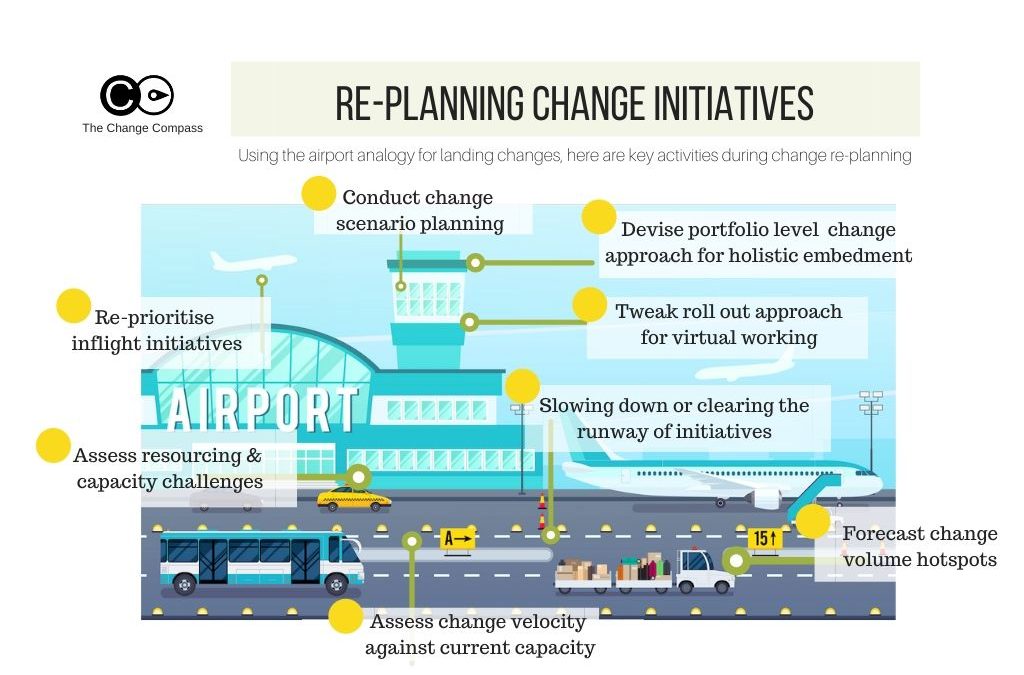
We need to be prepared for a series of disruptions whether it be ways of working, having to re-adjust change approaches, tightening expenditure, or having our change initiatives altered. Some initiatives will get pushed back, cancelled or moved forward. New initiatives or even restructuring exercises may emerge on top of existing initiatives. We may be asked to deliver more with less resources.
How do we manage our existing portfolio of change initiatives within this environment? We need to be agile and flexible to anticipate and work with various initiative changes. It could be that business capacity constantly shifts as a result of staff moving back to the office, or that teams become restructured therefore disrupting the initiative roll out.
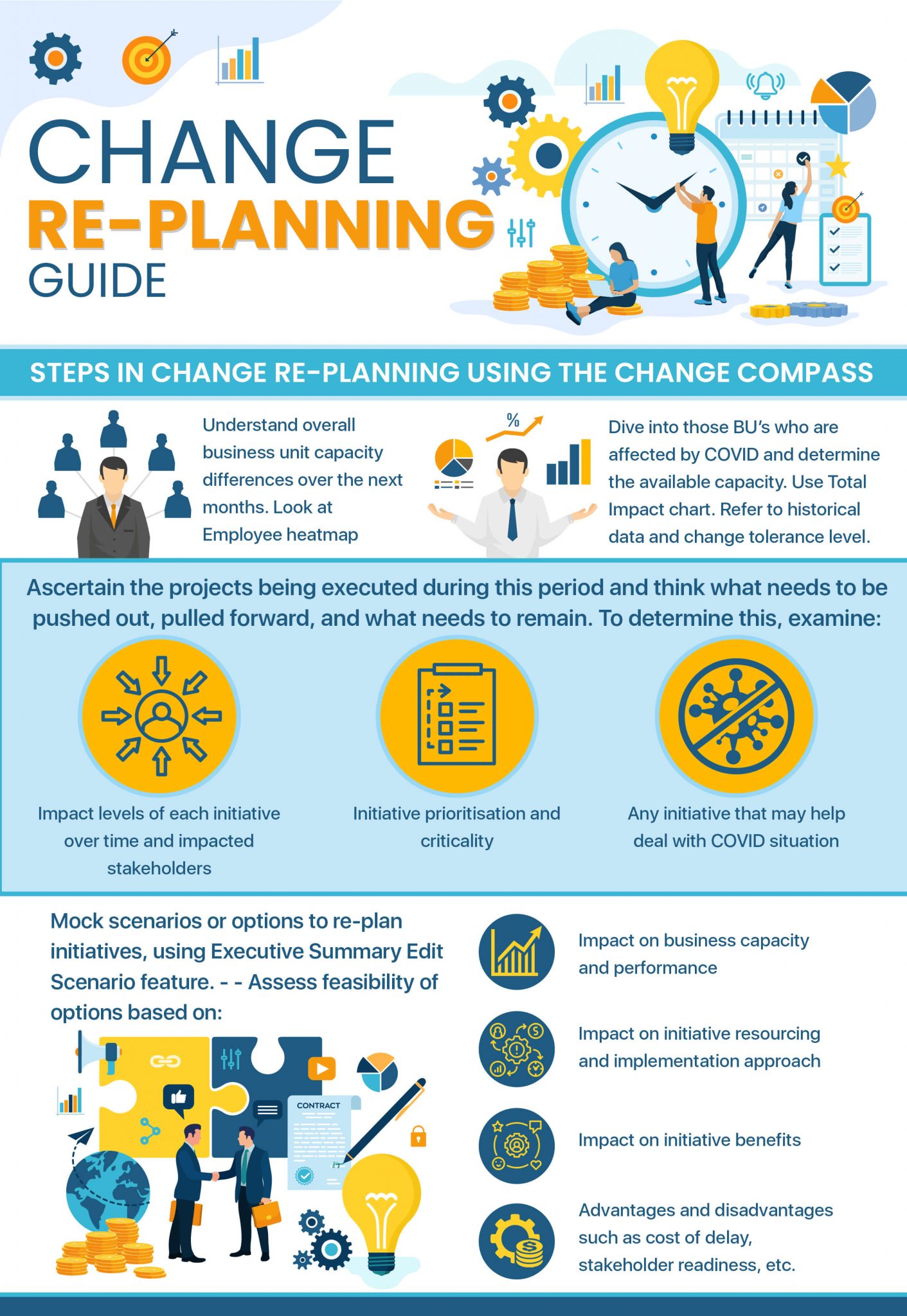
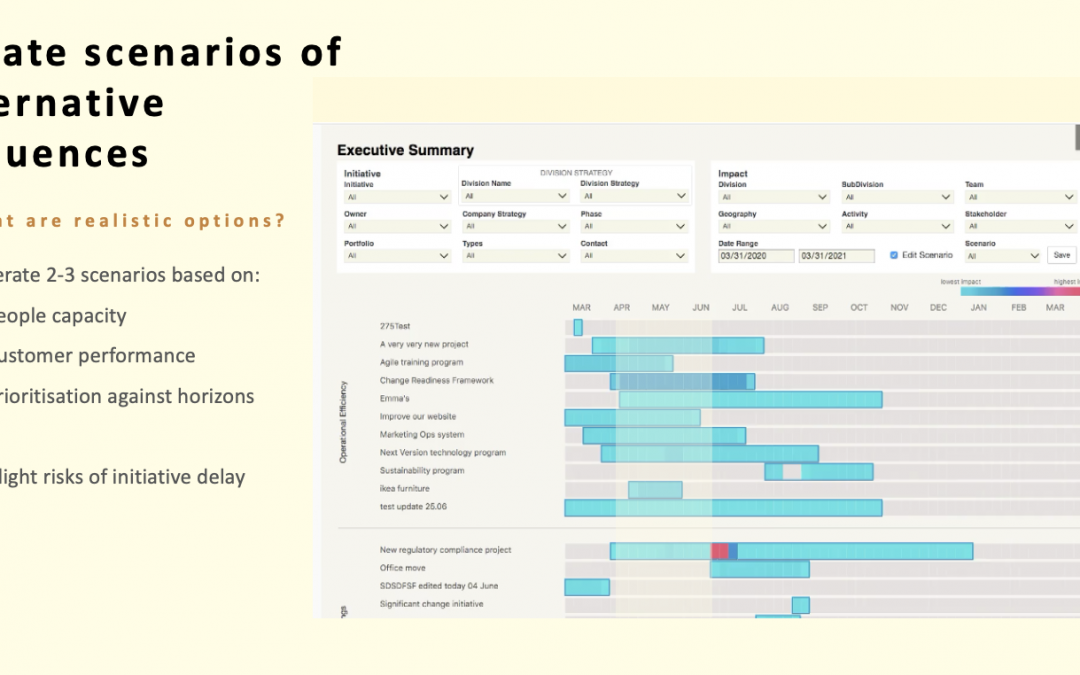
Utilise visual management to analyse and foresee implications of shifting initiatives. The Change Compass has a scenario planning feature that allows you to visualise the picture of new scenarios when various initiative timelines are shifted. For more details please listen to our webinar on re-planning during Covid.
Key considerations when shifting initiatives include:
Subsequent implications on business capacity (will we create another peak change volume later in the year?)
Potential dependencies of projects in the sequence of the roll out
Overlap with any planned business black-out periods or periods of high work volumes (such as customer contact volumes)
Implications on benefit realisation in relation to business targets
Business readiness due to transition back to the office
Initiative resources and bandwidth available to carry out any shifts in implementation timeline
Communication implications of the shifted initiatives that will be delivered to the same stakeholder group
Change programmes rarely unfold exactly as planned. Strategies shift, budgets are cut, key sponsors move on, and external forces – from economic downturns to global disruptions – render original plans obsolete before they have even been fully executed. The COVID-19 pandemic made this reality impossible to ignore: organisations that had invested months in detailed change roadmaps found themselves ripping those plans apart and starting again almost overnight. Yet the experience also revealed something equally important – the organisations that responded most effectively were not those that simply abandoned their plans, but those that had a disciplined process for re-planning.
Effective change re-planning is not the same as crisis management or improvisation. It is a structured reassessment of the assumptions, sequencing, capacity, and stakeholder landscape that underpinned the original plan – followed by deliberate decisions about what to pause, what to accelerate, what to restructure, and what to abandon altogether. Prosci research consistently shows that projects with excellent change management are six times more likely to meet objectives than those with poor change management. Re-planning, done well, is an extension of that discipline – it is change management applied to the change portfolio itself.
This guide draws on frameworks and lessons developed during periods of significant disruption – including the COVID-19 period – but is designed to be relevant whenever an organisation faces a significant shift in its operating environment. Whether you are navigating a merger, a regulatory overhaul, a leadership transition, or a broad economic reset, the principles and steps outlined here will help your change team re-establish direction, rebuild stakeholder confidence, and deliver outcomes that matter in the new context. Platforms like The Change Compass can play a pivotal role in making these re-planning decisions data-driven rather than reactive.
Not every bump in the road warrants a full re-plan. Change leaders need to distinguish between minor schedule slippage – which can be managed through normal programme governance – and the kind of fundamental environmental shift that makes the original plan structurally unsound. The latter is what demands a proper re-planning process. Common triggers include a significant reduction in available change capacity (through redundancies, restructures, or budget cuts), a material change in the strategic priorities of the business, the loss of a key sponsor or executive champion, a regulatory change that alters the compliance timeline, or a broad external disruption that affects the organisation’s ability to absorb change.
According to Gartner research on change management, one of the most common failure modes in organisational change is persisting with an outdated plan rather than acknowledging that the operating context has fundamentally shifted. Leaders can be reluctant to admit that original assumptions no longer hold, partly because re-planning feels like an admission of failure. In reality, the ability to recognise when a re-plan is needed – and to act on that recognition quickly – is a mark of mature change leadership. The question is not whether a re-plan is warranted, but whether the organisation has the processes and data to execute it well.
Core principles of effective change re-planning
Before diving into the process steps, it is worth articulating the principles that should guide any re-planning effort. The first is that re-planning must be grounded in reality, not aspiration. This sounds obvious, but many re-plans simply compress the original timeline or reduce scope without genuinely interrogating whether the underlying conditions for successful change are in place. A re-plan that ignores reduced stakeholder readiness or depleted change capacity is likely to fail for the same reasons the original plan was struggling.
The second principle is that re-planning is a collaborative process, not a top-down directive. The change teams, business leads, and affected employees who will implement the revised plan need to be meaningfully involved in shaping it. John Kotter’s foundational research on transformation, published in Harvard Business Review, identified the failure to build a sufficiently broad guiding coalition as one of the primary reasons change efforts fail – and that principle applies equally to re-planning efforts. The third principle is that re-planning decisions should be informed by data wherever possible. Gut feel and political momentum are not reliable guides when hard choices need to be made about which programmes to pause and which to prioritise. This is where change portfolio data becomes especially valuable.
The re-planning process: a step-by-step approach
The first step in any re-planning process is to conduct a rapid but thorough stocktake of the current state of the change portfolio. This means documenting every active change initiative – its current status, its scheduled milestones, its resource requirements, its dependencies, and its strategic rationale. The goal is to create a complete picture of what is in flight before making any decisions about what to change. Without this baseline, re-planning decisions are likely to be made in silos, with individual programme leads optimising for their own initiatives rather than the health of the overall portfolio.
The second step is to reassess the organisation’s actual change capacity in the new environment. Capacity is not just about the number of change practitioners available – it encompasses the bandwidth of leaders to sponsor and communicate change, the readiness of frontline employees to absorb new ways of working, and the availability of the operational time needed to support training, transition, and embedding activities. Many organisations dramatically overestimate their change capacity under normal conditions; in a disrupted environment, that gap between assumed and actual capacity can be even more pronounced.
The third step is to revalidate the strategic case for each initiative in the portfolio against the new operating context. Some initiatives that were critical six months ago may now be lower priority given a shift in strategy. Others that were on hold may have become urgent. This is fundamentally a strategic conversation – one that needs to involve senior leaders, not just the change team – but it should be structured around clear criteria: strategic alignment, employee impact, dependency risk, and return on investment. Once the portfolio has been assessed against these criteria, the change team can move to the fourth step: sequencing and scheduling the revised portfolio in a way that matches available capacity and minimises change fatigue.
Re-engaging stakeholders during a re-plan
One of the most critical – and most often underestimated – elements of change re-planning is the stakeholder re-engagement process. When a plan changes significantly, stakeholders who had been aligned with the original direction can quickly become disengaged, confused, or actively resistant. Sponsoring executives who made commitments based on the original timeline may feel exposed. Middle managers who had begun communicating the change to their teams may feel embarrassed. Employees who had started preparing for new ways of working may feel that the goalposts have shifted again.
Effective stakeholder re-engagement during a re-plan requires honest, timely communication that acknowledges what has changed and why, rather than attempting to paper over the disruption. McKinsey research on organisational transformation has consistently found that transparent communication – even when the news is difficult – is more effective at maintaining trust than managing information carefully to avoid alarm. Stakeholders who understand the genuine reasons for a re-plan are far better positioned to support it than those who sense something has changed but have not been told what or why.
Re-engagement also needs to be targeted. Different stakeholder groups have different concerns and different information needs. Senior sponsors need to understand the revised strategic rationale and their renewed commitments. Middle managers need practical guidance on what to tell their teams. Frontline employees need clarity about what is changing for them and what is not. The Change Compass platform can support this process by providing change impact data that makes stakeholder conversations more concrete and evidence-based – moving them away from abstract debates about priority towards a shared view of impact and timing.
Rebuilding change capacity after disruption
Disruption typically erodes change capacity in ways that are not immediately visible. Change practitioners may have been redeployed to crisis response activities. Leaders who were previously available for change sponsorship may be consumed by operational demands. Employees who had been building momentum around a particular change may have lost confidence or motivation in the intervening period. Before the revised change portfolio can be delivered effectively, this depleted capacity needs to be recognised and addressed.
Rebuilding capacity starts with an honest assessment of what has been lost and what can realistically be restored in the available timeframe. This may involve re-scoping the change team’s responsibilities to focus on the highest-priority initiatives, investing in renewed leader capability building, or redesigning employee-facing change activities to be more targeted and less time-intensive. It is also important to recognise that change fatigue – the cumulative exhaustion that results from prolonged exposure to change – can significantly reduce the organisation’s receptivity to new initiatives, even well-designed ones. Prosci’s research on change fatigue highlights that addressing it requires not just better pacing of change, but also explicit acknowledgement of the burden that change places on people and genuine efforts to reduce unnecessary complexity.
Using data to inform re-planning decisions
One of the greatest challenges in change re-planning is the tendency for decisions to be driven by politics and advocacy rather than evidence. In a portfolio of twenty or thirty change initiatives, every programme lead will argue that their initiative is critical and cannot be deferred. Without objective data, re-planning conversations can become exhausting negotiations in which the loudest voice or the most senior sponsor wins, regardless of the actual merits of the case. A data-informed approach changes this dynamic significantly.
The most useful data for re-planning decisions includes: the volume and timing of change impacts by employee group, the cumulative change load being experienced by different parts of the business, the dependencies between initiatives that create sequencing constraints, the current state of stakeholder readiness and sponsor commitment, and the degree to which each initiative is tracking against its original milestones and outcomes. When this data is available in a consolidated, visual format – rather than scattered across dozens of project status reports – it becomes far easier to have productive conversations about sequencing, prioritisation, and trade-offs. This is precisely what a well-configured change portfolio platform enables.
How The Change Compass supports change re-planning
The Change Compass is designed specifically to give change leaders the portfolio-level visibility they need to make confident re-planning decisions. Rather than managing change in individual project silos, The Change Compass aggregates data across the entire change portfolio – showing, in a single view, how much change different employee groups are experiencing, where the highest-risk collision points are, and how the portfolio as a whole is tracking against organisational capacity.
During a re-plan, this kind of portfolio view is invaluable. It allows change leaders to move quickly from gut feel to evidence when deciding which programmes to pause, which to sequence earlier, and which to redesign. It also makes the conversation with senior stakeholders much more credible: rather than asking executives to make difficult trade-off decisions based on anecdote, change leaders can present a data-rich picture of what is happening across the business and what the likely consequences of different re-planning scenarios would be. The result is faster, better-informed decisions and a revised plan that has a much stronger chance of being successfully executed.
Beyond the re-planning exercise itself, The Change Compass provides ongoing monitoring capability that allows organisations to detect early warning signs of future disruption – changes in programme status, emerging capacity constraints, or shifts in stakeholder sentiment – before they escalate into the kind of crisis that demands a full re-plan. In this way, the platform supports not just reactive re-planning but a more proactive approach to change portfolio management that reduces the frequency and severity of disruption in the first place.
Frequently asked questions
How do we know when a re-plan is truly necessary versus simply managing normal programme variance?
A re-plan is warranted when the original assumptions underpinning the change portfolio are no longer valid – not just when timelines slip or budgets are under pressure. The key indicators are a significant shift in strategic priorities, a material reduction in change capacity, the loss of critical sponsorship, or an external disruption that fundamentally alters the organisation’s ability to absorb change. If any of these conditions apply, a structured re-plan is almost certainly needed. Normal programme variance, by contrast, can usually be managed through existing governance mechanisms without requiring a portfolio-level reassessment.
How long should a change re-planning process take?
The duration depends on the size and complexity of the change portfolio, but most organisations can complete the core re-planning steps – stocktake, capacity reassessment, strategic revalidation, and revised sequencing – within two to four weeks if the process is properly resourced and led. The risk of taking longer is that uncertainty persists in the organisation, eroding stakeholder confidence and creating a vacuum that rumour and anxiety will fill. It is better to move quickly to a revised plan, even if that plan is not perfect, than to delay in pursuit of an ideal solution that takes months to produce.
What is the most common mistake organisations make when re-planning change initiatives?
The most common mistake is treating the re-plan as a purely technical exercise – adjusting timelines and resources – without addressing the human and organisational dimensions of the disruption. Stakeholders who have been left without clear communication about why the plan has changed, and what the new plan means for them, will not re-engage effectively regardless of how well the portfolio has been resequenced. Equally common is the mistake of re-planning in a silo, with the change team making decisions that should involve senior leaders and business owners. A re-plan that lacks genuine executive ownership is likely to encounter the same sponsorship gaps that can undermine the original programme.
Can change re-planning be done effectively without a dedicated change portfolio tool?
It is possible to conduct a re-plan using spreadsheets and manual reporting, but the limitations of that approach become acute when the portfolio is large and complex. Without a consolidated data view, it is very difficult to assess cumulative change load across employee groups, identify dependency conflicts, or model the likely impact of different re-planning scenarios. As a result, re-planning decisions are more likely to be based on advocacy than evidence, and the revised plan is more likely to recreate the capacity and sequencing problems that caused the original plan to struggle. A purpose-built platform like The Change Compass significantly reduces these risks by making portfolio data visible, comparable, and actionable.
Change Saturation is a concept that describes our capacity for change as limited … like a cup. We have a limited amount of capacity for change. When there is too much change going on the cup spills over and there is ‘change saturation’. When this happens with too much change then there is stress in the impacted stakeholder groups.
It could be that there is intense increase in workload or work complexity. Performance could drop as a result. When frontline staff experience change saturation it could be that they don’t have the capacity to support all the customer enquires leading to longer customer wait times. Customer satisfaction levels could be impacted. Employee satisfaction could also be impacted.
What causes it?
There are 3 causes for change saturation
1. There are too many initiatives going on at the same time. The totality of changes across multiple initiatives leads to the cup being overfilled. This is the reality of corporate life. There aren’t many organizations that are only executing one initiative at any one time. However, it also depends on the level of impact within each initiative and not just the number of initiatives in total. If every initiative has very little impact it could be smaller in total than a very large complex change initiative with very high impact. It will take a lot of peanuts to fill up a jar, versus a few large biscuits.
2. The change initiatives are occurring too fast. We have all been through highly agile initiatives that have short sprints, that pivot quickly and implement the change quickly as well. Often due to discoveries and learnings along the way there are project delays as the project figures out how to get itself on track. However, the original go-live date has not been changed so as to meet senior stakeholder expectations and to manage project cost. What this means is that the impacted business suddenly has much less time to get ready for the change compared to the original timeline. This condensed timeline to go through and embed the changes leads to increased change saturation.
3. Business circumstances have lead to the cup being overfilled. In the case of COVID19, most businesses are going through challenging times. Some are struggling to cope with increased customer volumes, whilst others have lost significant business and can no longer operate. During these times businesses revert to survival mode, or their business continuity plan. The top focus remains to delivery its core services with all other priorities to take a back seat. The very nature of this environment means that a large part of the organisation is under immense pressure to perform. The cup is saturated even before any additional planned initiatives. To read more about Planning for change during COVID19 click here.
How to measure it
Every part of the organization may have a different level of change saturation. This is because different teams play different functional roles by definition. As a result one department may be impacted by the same change differently compared to another.
Therefore it is important to be able to measure the change saturation point for a part of the business if we are aiming to manage it. Change saturation should not just be a point of discussion just based on feelings and perceptions.
How do we measure the change saturation point for one part of the business? Measuring change saturation is not purely a science but more of an art.
Take for example, you have been working closely with the call centre team and have monitored their business performance across different initiatives over the past few months. Last month you noticed that they had reached a point where there were more initiatives being implemented than previously.
On top of this you noticed that some of their performance metrics that may be linked to change saturation were negatively affected. These included increased call waiting time, decreased customer satisfaction, increased staff turnover, and challenges for planners to schedule sufficient resources to cover shifts and undergo allocated initiative activities such as training. Team leaders also provided feedback that there was too much change going on and managing workload was challenging.
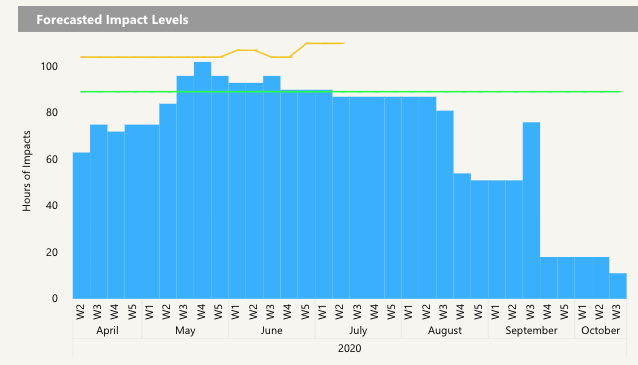
You can then calculate this change saturation by assigning a weighting to each change initiative in terms of its change impacts on the business. Then adding the various change impacts for last month will give you a total factor of change saturation. Last month your assessment, together with the call centre business, is that there was definite change saturation. So, if you see this level of change approaching in your planning coming up, then this would be a red signal for you to start to work with your stakeholders on managing this upcoming Change saturation.
Here is an example of measuring change saturation with The Change Compass.
The green line depicts change saturation for this department
It is important to note that some businesses may be calling out that they have change saturation simply to lower the expectation bar. By lowering the bar expected to undergo change volume, it is then easier for them to meet their performance targets. This is why it is important to measure change saturation. Anyone can claim that their cup is overflowing with change without data to support.
How to manage it
There are 2 main ways to manage change saturation. Either you reduce the change saturation level or you increase the change capacity (increasing the size of the cup).
Short term – Reduce change saturation
1. Stop all change initiative roll out during COVID19. If your organization is undergoing significant challenges and it was deemed that the cup is already overflowing in terms of capacity, then work with your business to determine how long of a period would there need to be a hold of any change implementation. This decision may be reviewed on a monthly basis or fortnightly basis to enable careful monitoring of the development COVID19 impact on the organisation.
2. Delay the roll-out of change initiatives to reduce change saturation. Work with your stakeholders to re-prioritise certain initiatives and push out others to better manage the change saturation. During COVID19 your organization may have a significantly reduced level of change tolerance, whether its because everyone is adjusting to working from home or its ‘all hands on deck’ in serving the customer. Work with your stakeholders to understand what initiatives are critical in order to meet any shorter or medium-term business objectives or deemed a priority by senior managers. Then determine the roadmap of implementation taking into account business change capacity.
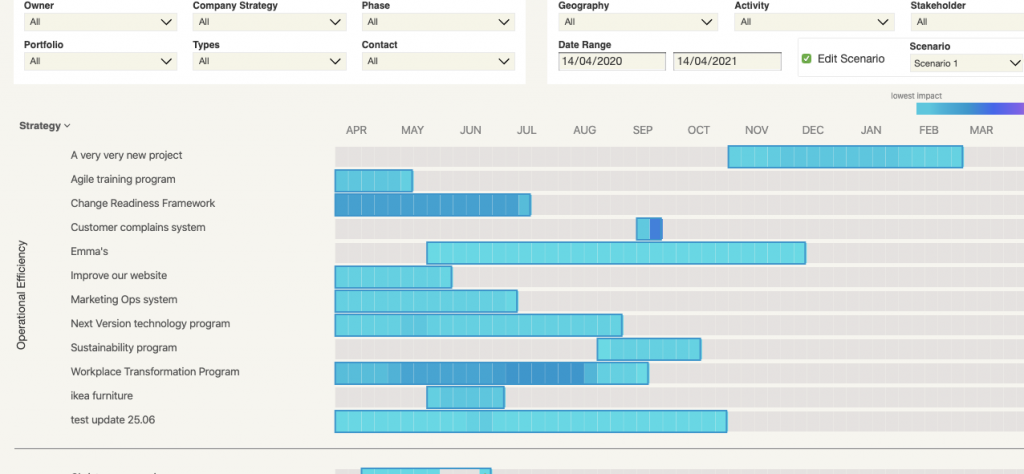
3. Use a scenario approach to model the period in which COVID19 may be impacting your organisation and therefore model the recommended change implementation sequences. This approach requires that you have a good awareness of the existing planned initiatives across the business. You may need to adopt a logic-based approach to assess the change saturation points if you have not collected historical data. Here is an example of a scenario planning feature from The Change Compass where you can visually model likely scenarios of change roll-out sequences.
Initiatives may be dragged around to model different change scenarios
Long term – Build change capacity and resilience
1. Hire more people. For some parts of the organisation where there the change saturation is on frontline consultants servicing the customer. It may be possible to increase change capacity to some extent by hiring more staff to serve the customer. However, this depends how effective the organization is in quickly hire and onboard frontline consultants to reach ‘time to performance’. For other parts of the organisation where the subject matter experts may be in short demand because of COVID19, leveraging potential business substitutes where available may be an option. This approach may be used in conjunction with other recommendations to reduce change saturation.
2. Improve the change capability of leaders. One of the most important levers in building change capacity and resilience is the effectiveness of leaders. We have all seen how some leaders who are engaging, open, actively make way for the change, and address any obstacles, have led teams to undergo significant change journeys. Other leaders may be undergoing the same change journey but somehow have not had the same success. Instead, they could be plagued with change resistance and stagnation due to the ability of its leader. Change leadership development of leaders is a long term play and not a quick win by any means.
3. Work on change maturity. Organisations that have higher change maturity have more capacity for change and are more resilient to constant changes. Change maturity measures such as change leadership capability, business change readiness and project change implementation maturity. This is also a long term play, requiring significant focus and time investment.
When COVID-19 hit in early 2020, most organisations did not simply pause their change programmes and wait for things to return to normal. They found themselves simultaneously managing a global health crisis, shifting their entire workforce to remote working, and trying to determine which of their existing change initiatives still made sense, which needed to be redesigned, and which needed to be stopped entirely. A Gartner survey from mid-2020 found that 52% of organisations were operating at reduced capacity, and yet the volume of change being pushed onto employees had not reduced proportionally. The result was a collision between business necessity and human bandwidth that most change portfolios were simply not designed to absorb.
This is precisely where the change practitioner’s role shifts from operational to genuinely strategic. Rather than waiting for project sponsors to hand down revised timelines and updated communications plans, practitioners who understood change portfolio dynamics could step forward and help the business make better decisions about how to sequence, pace, and resource change work across a radically different operating environment. The webinar below explores these dimensions in depth, covering how to re-plan a portfolio of changes, how to work within constrained business capacity, how to adapt change delivery for remote and distributed teams, and how to plan for multiple change scenarios when the future is deeply uncertain.
The practitioner’s strategic role in portfolio re-planning
For too long, the dominant model of change management has positioned practitioners as delivery specialists: people who produce stakeholder maps, run communications, design training, and report on adoption. That model was already under pressure before COVID. The pandemic simply made its limitations impossible to ignore. When every project timeline becomes uncertain and every business unit suddenly has 60% less capacity to engage with change, the skill that matters most is not the ability to write a good communications plan. It is the ability to look across an entire portfolio of change and help the organisation make sound decisions about what to do, in what order, with what level of investment.
This is a fundamentally different kind of contribution, and it requires practitioners to have a solid understanding of how change load accumulates across an organisation. The concept is straightforward: every change initiative, regardless of its individual importance, consumes a finite portion of the organisation’s attention, energy, and time. When multiple projects compete for the same pool of business capacity, performance suffers across all of them. During COVID, that pool shrank dramatically and quickly, but in most organisations the project portfolio did not shrink with it. Practitioners who could quantify that gap, and advise leadership on how to close it, became indispensable. Those who continued to work project-by-project, in isolation, became invisible.
How to help your business re-plan a portfolio of changes
Re-planning a change portfolio is not simply a matter of pushing project dates out by three to six months. Done well, it is an exercise in triage: understanding which changes are genuinely time-critical, which can be deferred without material harm, which need to be redesigned to fit the new environment, and which should be paused or cancelled. The practitioner’s role in this process is to bring both a methodology and a perspective that the programme office or project management function typically lacks.
A practical starting point is to map the current portfolio against two dimensions: the strategic importance of each initiative, and the change capacity required from key business areas over the next six to twelve months. This kind of mapping does not need to be exhaustive to be useful. Even a rough assessment of which business groups are most heavily loaded, and which projects draw most heavily on those groups, will reveal collisions that no individual project manager can see from within their own initiative. McKinsey’s work on driving organisational behaviour change during the pandemic highlighted that the ability to move quickly and deliberately on prioritisation, rather than attempting to run all programmes simultaneously, was a key differentiator between organisations that managed the crisis well and those that struggled.
From there, the practitioner can facilitate structured conversations with business leaders about sequencing trade-offs. This is not advocacy for any particular project. It is the provision of an honest picture of cumulative impact, presented in terms that business leaders can act on. Tools like The Change Compass are built specifically to support this kind of portfolio-level visibility, helping change teams map impact by business area, role type, and time period so that over-loading becomes visible before it becomes a problem.
Fitting project timelines to changed business capacity
One of the most common mistakes organisations make when disruption hits is treating timeline adjustment as a purely project management decision. Project managers look at resource availability, dependencies, and critical path. What they rarely look at is the capacity of the receiving organisation – the managers, team leaders, and frontline employees who need to understand, adopt, and embed each change in their daily work. These are different variables, and conflating them produces timelines that look achievable on paper but fail in practice.
The practitioner’s job is to introduce business capacity as an explicit variable in timeline decisions. This means translating the organisation’s operational reality into change schedule inputs. During COVID, that meant accounting for the fact that team leaders were spending significantly more time on welfare conversations, performance management, and operational coordination than they had been before the crisis. It meant recognising that customer-facing staff had little bandwidth for system training when call volumes had doubled. It meant understanding that the HR and finance functions that typically sponsor change initiatives were themselves under enormous pressure managing redundancies, remote work policies, and government support schemes.
Gartner research released in October 2020 warned that employee change fatigue had doubled during the year, and that the capacity of employees to absorb change without experiencing burnout or disengagement had declined sharply. Practitioners who used that kind of evidence to make the case for realistic pacing were performing a genuinely valuable service, even when the message was uncomfortable for sponsors who wanted to maintain pre-COVID delivery schedules.
Adapting the change approach for remote and hybrid environments
Moving a change programme from a face-to-face delivery model to a fully virtual one requires more than replacing physical workshops with video calls. The underlying assumptions of most change methodologies were built around proximity: the ability to have informal conversations in corridors, to read the room in a workshop, to build trust through repeated in-person contact, and to create the social pressure of public commitment in a group setting. None of those mechanisms transfer directly to a distributed environment, and practitioners who tried to run their standard approach over video quickly discovered this.
The most effective adaptation is not to replicate the face-to-face model online but to redesign the approach around what digital channels do well. Asynchronous communication – recorded messages, written updates, self-paced learning modules – can actually reach more people more consistently than a single town hall ever could. Short, focused digital interventions are often more respectful of people’s time than a two-hour workshop, particularly when employees are juggling home and work demands simultaneously. Harvard Business Review’s 2020 guide to managing newly remote workers emphasised the importance of structured, regular communication with clear purpose, rather than replicating the cadence and format of in-person interaction. The same principle applies to change delivery.
There is also a coaching dimension that becomes more important, not less, when the organisation is distributed. Managers and team leaders are the most important channel for change adoption at the local level. In a remote environment, their ability to understand and communicate the reason for a change, to role-model new behaviours, and to support their teams through the transition is the primary mechanism by which change lands. Investing in manager capability and manager-specific change toolkits is not a luxury in a remote environment; it is the foundation of effective delivery.
Stakeholder engagement strategies for distributed teams
Stakeholder engagement has always been one of the most relationship-intensive aspects of change management. Building the trust and understanding that allows a sponsor to advocate effectively for a change, or a resistant middle manager to become a credible champion, typically takes time and repeated contact. The shift to remote working compressed those opportunities and changed the texture of professional relationships in ways that practitioners needed to actively compensate for.
The first adjustment is frequency and intentionality. In a physical office, a change practitioner might have had a dozen informal conversations with key stakeholders in a single week without ever scheduling them formally. In a remote environment, those conversations need to be deliberately created. This does not mean filling people’s calendars with unnecessary meetings. It means being strategic about which relationships need active maintenance, and finding lightweight but regular ways to keep those connections alive – a brief check-in, a shared resource, a direct question by message. Prosci’s guidance on remote change team engagement highlighted four specific practices: clear role definition, structured communication rhythms, explicit acknowledgment of the unique pressures of remote work, and the creation of virtual spaces for informal connection among change network members.
The second adjustment is to broaden who counts as a stakeholder. In a remote environment, the formal hierarchy often matters less than informal influence networks. The team leader who keeps her people grounded during uncertainty, the subject matter expert who others trust to interpret what a new system actually means for their day-to-day work, the person in operations who has been with the organisation for fifteen years and whose scepticism will either sink or validate a change – these people have always mattered, but in a distributed environment their influence becomes even more pronounced because the organisation’s informal communication channels are less visible and harder to monitor. Identifying and engaging these voices early is not optional when the grapevine is operating entirely through private chat channels.
Planning for change scenarios and anticipating ongoing uncertainty
One of the most disorienting aspects of the COVID period for change practitioners was the instability of assumptions. Timelines were set and then revised. Lockdowns were announced and then extended or lifted. Business conditions changed with a speed that made twelve-month change plans feel like fiction. The traditional change management approach of building a plan, socialising it, and executing against it was simply not fit for purpose in that environment.
Scenario-based planning offers a more robust alternative. Rather than building a single change plan and then scrambling to update it when conditions shift, the practitioner designs the change approach around a set of plausible futures and defines in advance what the change programme will look like under each. At its simplest, this might mean developing three variants: a base case, a more constrained case assuming ongoing disruption, and an accelerated case if conditions improve faster than expected. The value is not that any one of these scenarios will prove exactly right. The value is that the organisation has already thought through the implications and can move quickly rather than starting from scratch each time circumstances change.
Scenario planning also changes the conversation with leadership. Instead of presenting a single plan for approval and then returning to ask for more time when things change, the practitioner presents a portfolio of responses and asks leadership to make an explicit choice about which approach to activate given current conditions. That is a more honest and more sophisticated conversation, and it positions the practitioner as a strategic partner rather than a project delivery resource.
Lessons that outlast COVID: what to embed permanently
The practices that helped organisations navigate the COVID period are not simply emergency measures to be discarded once the crisis passes. Several of them represent genuine improvements on the pre-COVID default, and organisations that have embedded them permanently are better positioned for the ongoing volatility that characterises the post-pandemic environment. McKinsey’s research on reimagining the post-pandemic organisation found that the companies recovering most strongly were those that had used the disruption to accelerate structural and cultural shifts rather than simply restore their prior operating model.
Portfolio-level change management is the most important of these. The discipline of mapping cumulative change impact, having explicit conversations about capacity and sequencing, and treating the organisation’s attention as a finite and precious resource – none of this was invented during COVID, but COVID made the case for it in a way that no consulting paper ever could. Organisations that now have regular portfolio review processes, supported by data on change load and business capacity, are far less likely to pile change on top of change in the way that produced so much burnout and failure in the years before the pandemic.
The shift to hybrid change delivery is similarly durable. The assumption that change management requires physical presence was never fully justified, and the COVID period produced ample evidence that well-designed digital approaches can match or exceed the reach and effectiveness of face-to-face delivery for many change types. Retaining the best of both, rather than defaulting back to the old model, is both practical and strategic. Similarly, the emphasis on manager capability as the primary adoption lever – rather than communications campaigns or formal training alone – reflects a more sophisticated understanding of how change actually happens in organisations, and it deserves to become permanent practice regardless of what the working environment looks like.
Frequently asked questions
What is change portfolio management and why does it matter during a crisis?
Change portfolio management is the practice of viewing all active change initiatives across an organisation as a collective whole, rather than managing each project in isolation. During a crisis, it matters because available business capacity shrinks rapidly while the need for change does not, and only a portfolio view reveals where collisions and overloads are occurring before they derail individual projects and exhaust the workforce.
How do you engage stakeholders effectively when the whole organisation is working remotely?
Effective remote stakeholder engagement requires deliberate scheduling of conversations that would previously have happened informally, a broader definition of who counts as a key influencer, and a communication approach that uses asynchronous channels alongside live interaction. Structured rhythms of contact, clear role expectations for change network members, and investment in manager capability as the primary local adoption lever are the most consistently effective practices.
What is scenario-based change planning and how do practitioners use it?
Scenario-based change planning involves designing the change approach around a set of plausible future conditions rather than a single assumed trajectory. Practitioners typically develop two to three variants of their change plan, each calibrated to a different set of business conditions, and agree with leadership in advance which triggers would lead to activating each variant. This reduces reaction time when circumstances shift and positions the change team as strategically prepared rather than perpetually catching up.
What change management practices from COVID should organisations keep permanently?
The most valuable practices to retain are portfolio-level change governance, the use of digital and asynchronous channels alongside face-to-face delivery, scenario-based planning for change scheduling, and a strong emphasis on building manager capability as the primary adoption mechanism. Organisations that embed these practices into their standard change operating model are better equipped for the ongoing disruption and uncertainty that characterise the current business environment, well beyond the COVID period.
We use cookies to improve your experience and understand site use. Marketing cookies stay off until you accept, and in the EU, UK and Switzerland analytics does too. Cookie Policy.
Strictly necessary
Required for the site to work: security, load balancing, and remembering your choices. These cannot be switched off.
Always active
Analytics
Google Analytics and similar, so we can see which pages are useful and where visitors get stuck. Aggregated, never sold.
Marketing
Used to measure campaigns and show relevant content on other platforms such as LinkedIn.