So you’ve climbed the change management career ladder. You’ve not only managed complex projects, but are starting to help the business manage the change landscape. Like most organisations, the business you are supporting is implementing various changes to stay competitive and relevant in this fast-changing world.
Like most others, you’ve produced manual change heatmaps to help them visualize how much change there is going on. They’re seeing which parts of the business has more change than others. They can now see the ‘hot spots’ where there could be too much change. Month in and month out you continue to produce the same reports for them. They start to get bored and ask … “Is there more to the change landscape than just looking at the question of ‘too much’ or ‘too little’?”
This is a very valid question indeed!
Across our change management industry, it seems that producing change heatmaps and being focused singularly on one question is the norm. We all know that change is complex. Change is evolving. Change is multi-dimensional. Change is more than just answering one question. Is there more?
YES 🙂
Beyond just asking a singular, one-dimensional question of “is there too much change”. How do we graduate from this and progress to the next few stages of adding further value to the organization? Here are 5 ways to do this.
1. Focus on understanding what the change story is versus asking a singular question.
What is happening or going to happen to the business? Is the business focused in a disciplined way on a small set of changes that will create very large impacts? Are these due to significant operating model transformations that are necessary to take the business to the next level? Are these multi-year transformation programs? How do these translate to behavior, process and system impacts? Would we need to phase a series of changes to drive the behaviour changes?
Or is the business undergoing less transformational but a larger set of smaller changes to be more competitive in delivering better customer experiences, more efficient and effective operations at a lower cost? And therefore, are the people impacts more about connecting across the breadth of changes. Are the challenges on connecting the dots across a wide set of changes, versus a smaller core of large ones?
2. Collect other data to tell the story. Data has more weighting than opinions and assertions in the business decision making table. Change data regarding impact, timing, types of changes, number of people impacted, etc., will go a long way to tell the story of what the business will be experiencing. Make the data visual. Visual storytelling using data is becoming the norm in digital businesses nowadays. To graduate from manual spreadsheets of change heatmap, focus on digital change storytelling with data.
3. How is the change impacting various stakeholders such as customers, partners and subject-matter-experts?
A significant percentage of organisations state that they are focused on the customer. Does the business understand the nature of change impact on a particular type of customer at any given time? Without understanding this how could the customer experience be effectively managed? Producing data visualization of how the customer is impacted, at what time, and in what way, will go a long way to lead the business in understanding how best to manage the customer experience during change.
Similar data visualization can also be produced for other stakeholder groups such as partners, subject matter experts, and other groups.
This is an example of ‘Total Impact’ chart from The Change Compass where you can see the impact on stakeholders across time.
4. What is the pace of change?
Is the overall pace of the planned execution of the strategy going to meet the organisation’s targets? When we look at the lifecycle of the changes being planned including the time it takes to embed the changes to realize the benefits, is the pace fast enough? Alternatively, could it be that the business is over-zealous in driving change to the detriment of its people and customers? Is the question not that there is too much change, but that the pace is going too fast and we are not realistically factoring the time required to embed and land the benefits required?
One real example. A business has been focused on adopting agile ways of working. It has also been applying this to grow its business. As a result, the business has commenced a series of experiments to try and find ways to drive business growth. However, because there weren’t specifically defined targets from a planning perspective, the planned experiments kept getting delayed. As a result, the change pipeline became slow. Therefore, overall growth targets were not met.
This is an example of ‘Timeline Chart’ from The Change Compass where you can decipher the impacts of initiatives across time.
5. Focus on what the execution of the organisation’s strategy will look like and if it makes sense.
In planning the execution of the strategy, the strategy team rarely looks at the totality of change from an impact perspective. This is not due to a lack of trying but mainly due to lack of access to change data. Armed with change data, it is possible to understand to what extent different strategies are impacting different parts of the business, and whether these make logical sense or not.
Is there a diverse set of strategies that the company is implementing? Do these have wide-ranging impacts on various parts of the business or are certain businesses more impacted than others? How do we ensure that the ‘why’ of the change and how we are communicating initiatives are clearly linked to the same strategy across initiatives? From a prioritization perspective are there certain initiatives are that more core to the strategy? How do we ensure that these are given more ‘run-way’ to roll out the changes than others? And again how do we ensure that these are highlighted and clearly communicated to impacted stakeholder groups?
This is an example of a strategy implementation chart that visually illustrates the impact that each strategy has on the business and the various initiatives that are linked to the strategy.
Outlined here are just some of the ways in which you can ‘graduate’ from just focusing on change heatmaps as the only way to help the business visualize change. There are other ways in which change management can add value to the organization and we will continue to outline other ways in which this may be achieved. Stay tuned!
It all begins with an idea. Maybe you want to launch a business. Maybe you want to turn a hobby into something more. Or maybe you have a creative project to share with the world. Whatever it is, the way you tell your story online can make all the difference.
Don’t worry about sounding professional. Sound like you. There are over 1.5 billion websites out there, but your story is what’s going to separate this one from the rest. If you read the words back and don’t hear your own voice in your head, that’s a good sign you still have more work to do.
Be clear, be confident and don’t overthink it. The beauty of your story is that it’s going to continue to evolve and your site can evolve with it. Your goal should be to make it feel right for right now. Later will take care of itself. It always does.
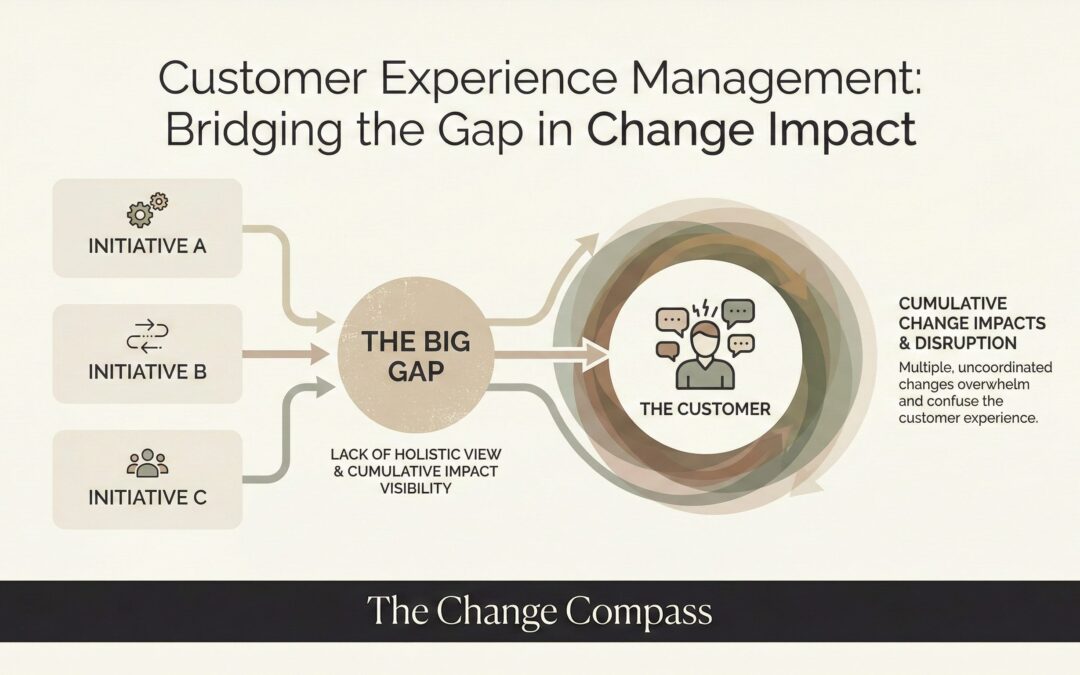
Customer experience management dominates strategic conversations across banking, utilities, telecoms, and retail. Companies invest heavily in CRM systems, digital channels, and customer journey mapping. Yet a fundamental gap persists: the lack of integrated visibility into how company-wide change initiatives shape customer perceptions.
This guide reveals why traditional approaches fall short, quantifies the risks of disconnected change efforts, and provides a practical roadmap for creating a true single view of the customer through change impact integration.
What Prevents Companies from Achieving a Single View of the Customer?
Recent research confirms persistent challenges in customer experience management. A 2024 Forrester study found 48% of enterprises still struggle with unified customer data across channels and departments. Similarly, Gartner reports 52% cite building cohesive new experiences as their top barrier.
The core issue lies beyond siloed CRM data. Companies lack visibility into the cumulative impact of concurrent initiatives—product changes, pricing adjustments, IT rollouts, regulatory communications—that collectively define customer reality.
Why Traditional CRM Approaches Fall Short
CRM systems excel at marketing automation, sales tracking, and contact centre efficiency. However, they capture only transactional interactions, missing the broader context of organisational change.
Traditional CRM Focus Limitations
Marketing campaign data
Sales conversion metrics
Service interaction logs
Customer segmentation profiles
These systems overlook how product updates, pricing shifts, or compliance communications alter customer perceptions between tracked touchpoints.
The Missing Piece: Change Impact Tracking
The critical gap involves mapping all customer-impacting initiatives into a unified view. This includes marketing campaigns plus operational changes affecting service delivery.
Change Initiatives Shaping Customer Experience
Product lifecycle changes (end-of-life, new features)
Pricing and billing adjustments
IT system rollouts impacting service access
Regulatory compliance communications
Employee training initiatives influencing service quality
Partner or supplier changes affecting delivery
Without this integrated picture, companies cannot anticipate cumulative customer confusion or frustration.
Traditional CRM vs Change Impact Data vs Integrated CX View
Data Source
Focus
Customer Insight
Strategic Value
CRM Systems
Marketing, sales, service transactions
Individual touchpoints
Tactical optimisation
Change Impact Data
Company initiatives affecting customers
Planned experience shifts
Risk anticipation
Integrated View
Combined datasets
Holistic customer reality
Strategic CX orchestration
This table illustrates why isolated CRM investments yield incomplete results.
Risks of Disconnected Change Initiatives
Without integrated change visibility, companies create conflicting customer signals that erode trust and satisfaction. Real-world examples illustrate the consequences.
Common Customer Confusion Scenarios
One department ends a credit card product while sales teams push aggressive uptake targets
IT rollout disrupts online banking while marketing promotes digital-first convenience
Pricing changes coincide with loyalty program promotions, confusing value messaging
Regulatory communications clash with personalised marketing campaigns
These disconnects compound across multiple initiatives, overwhelming customers.
Financial Impact of Poor CX Coordination
The stakes are substantial. Recent studies quantify the cost:
Forrester 2024: Companies lose $1,200+ per negative customer experience
Gartner 2025: 42% of telecom households report negative experiences from conflicting communications
McKinsey: Utilities face 28% churn risk from uncoordinated service disruptions
Cumulative impact across customer bases represents millions in lost revenue annually.
The Solution: Integrated Customer Change Impact Management
Create a unified view combining CRM data with change impact analytics for holistic CX orchestration.
Core Components of Integrated CX Visibility
Centralised Change Repository: Track all customer-impacting initiatives across departments
Customer Segmentation Mapping: Align change impacts with specific personas and journeys
Timing & Volume Analysis: Visualise change saturation by customer segment over time
Impact Correlation Engine: Link initiatives to expected CX outcomes and risks
Strategy Alignment Dashboard: Compare planned changes against customer experience goals
5 Strategic Benefits
Anticipate cumulative customer confusion before rollout
Optimise change sequencing to minimise disruption peaks
Align departmental initiatives with unified CX strategy
Quantify ROI from coordinated vs siloed change efforts
Enable proactive service recovery planning
Customer Change Impact Matrix Example
Customer Segment
Product Change
Pricing Shift
IT Rollout
Regulatory Comm.
Total Impact Score
Premium Banking
Medium
High
Low
Medium
High
Mass Market
Low
High
High
Low
High
Digital Native
High
Low
High
Low
High
This matrix reveals saturation risks by segment.
Implementation Roadmap for Integrated CX Change Management
Phase 1: Foundation (0-3 Months)
Inventory all customer-impacting initiatives across departments
Map initiatives to customer segments and journey touchpoints
Establish cross-functional CX governance council
Build baseline change impact repository
Phase 2: Integration (3-6 Months)
Connect change data with existing CRM/customer systems
Deploy change saturation dashboards by segment
Implement automated conflict detection alerts
Launch pilot optimisation for high-risk periods
Phase 3: Optimisation (6-12 Months)
Embed CX alignment reviews in initiative approval processes
Scale predictive impact modelling across portfolio
Establish continuous improvement feedback loops
Benchmark against industry CX leaders
Governance and Success Factors
Essential Governance Elements
Executive sponsorship with direct profit/loss accountability
Cross-departmental representation in change review forums
Standardised change impact assessment templates
Monthly portfolio saturation reporting to leadership
Critical Success Metrics
Reduction in customer confusion complaints (25% target)
Improved Net Promoter Score during change periods
30% faster issue resolution through proactive planning
Higher departmental collaboration scores
Frequently Asked Questions (FAQ)
What is the biggest gap in customer experience management? Lack of integrated visibility into how company-wide change initiatives collectively shape customer perceptions and experiences.
Why do CRM systems alone fail to deliver unified CX? CRM captures transactions but misses operational changes like product updates, pricing shifts, and IT rollouts that define customer reality.
How much do poor CX experiences cost companies? Recent studies show $1,200+ lost per negative experience, with millions annually across customer bases in banking and utilities.
What does integrated CX change management look like? Centralised change repositories, customer segmentation mapping, saturation dashboards, and strategy alignment analytics working together.
How do you identify customer change saturation risks? Use impact matrices showing concurrent initiatives by segment, highlighting high-risk periods needing sequencing adjustments.
What is the first step toward CX change integration? Conduct an inventory of all customer-impacting initiatives across departments to establish baseline visibility.