Change Management is full of concepts and frameworks that are outdated and not based on empirical research. It seems that in the business world, we are very comfortable with concepts that sound like they make sense intuitively. If the concept is simple and interesting then we’re in. We don’t require them to have any scientific proof and research is often not required.
Let’s take one example. The Kubler-Ross model is one of the most popular models that outlines the 5 stages of grief a psychiatrist in the book ‘On Death and Dying’. The 5 stages are denial, anger, bargaining, depression, and acceptance. However, there is a lack of empirical research supporting these 5 stages, and in fact, research suggests other expressions of grief.
Moreover, we’ve somehow applied this model to change management assuming that it is relevant. Whilst dying is a change process, this context cannot be generalised across all other changes such as implementing a new system, a new product, or a new policy. Moreover, there is no research supporting this. We all know that there are lots of people who do not go through these phases during lots of change processes. And certainly, it would be hard to imagine someone going through these phases after buying a new desirable iPhone from a previous older model.
Now, if there are so many popular concepts that are not backed up by research what should we use that is based on proven evidence? Self-determination theory (SDT) by Edward Deci and Richard Bryan should be one that the change management community adopts. It is a broad-based theory about human motivation that focuses on people’s inherent growth tendencies and innate psychological needs. There has been significant research supporting this theory since the 1970s and more research is underway.
What is the self-determination theory about motivation?
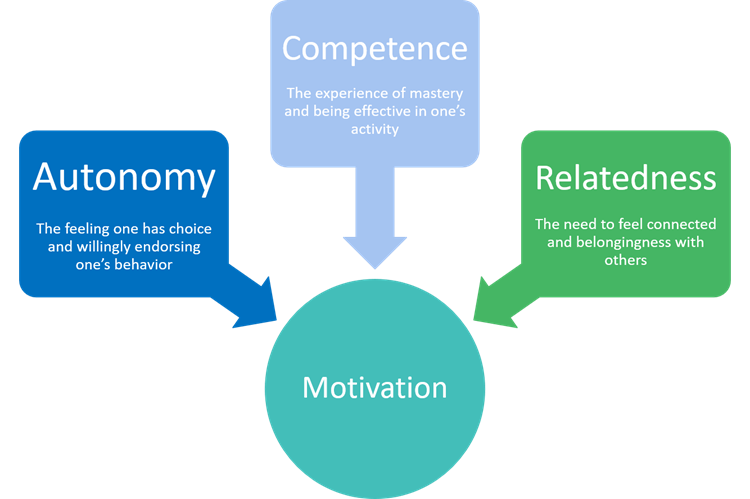
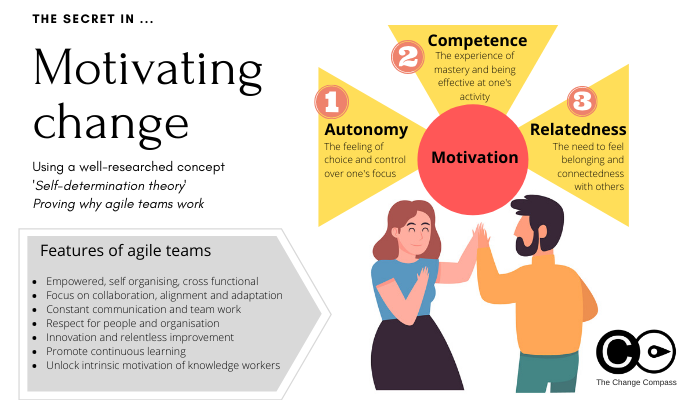
The theory states that there are 3 innate human needs that if met will provide motivation, motivation to undertake tasks, to develop, and to undergo change. These 3 elements are:
1) Competence
The experience of mastery and being effective at one’s activity. When people feel that they have the skills required to be successful they are much more likely to take on tasks that will help them achieve their goals
2) Relatedness
The need to feel belonging and connectedness to others.
3) Autonomy
The feeling of choice and control over one’s focus.
Each of the three elements contributes to motivation, by having the right level of skills and confidence, by wanting to be connected to others, and by feeling in control over one’s focus or task.
Some implications of these 3 elements on how we manage change include:
1) Simply conducting training may not address someone’s level of competence. The outcome is that they need to feel confident. This means that there should be a holistic focus on a range of learning interventions to promote and support confidence, such as managerial acknowledgment, catering to individual learning styles, supportive learning environment/community after training sessions, etc.
2) Change activities should not be implemented for individuals in isolation from others. For example, if learning is utilized, the change approach should be designed to provide visibility on how others are undergoing the change process, and where they are sharing their experiences. This is why change champions are so important since effective champions promote and build a supportive community
3) Especially for more significant changes, it is important to design into the change process a sense of autonomy for those impacted. This may seem contradictory to how most companies implement change, i.e. one that is characterized by one common set of activities for all employees. What this important to emphasise according to SDT is to build in employee involvement so that they feel that they are shaping and developing the change versus being negatively impacted by it with no choice whatsoever.
There are 2 types of motivations:
1) Controlled Motivation
• “The carrot and the stick” approach to motivating someone • Seduced into the behaviour • Coerced into the behavior, often with the threat of punishment • Experience of tension and anxiety
Employees who work in a controlled motivation environment usually have negative emotions and their confidence and well-being also suffer. Also, in this environment, employees usually take the shortest path to reach the desired outcome. This may or may not have the best consequences for the company. If the company is trying to stipulate a set of behaviors, these may be avoided or blind-sighted to get to the ultimate ‘measure’.
2) Autonomous motivation:
• Experience of volition and choice about the work that one is doing • If the person enjoys the work and finds it interesting, then the autonomous motivation level increases • If the values of the work are consistent with the values of the individual this also increases motivation • If the person endorses the work, then he or she will also be more motivated to undertake the work
Organisations want more autonomous individuals that are aligned their work. Why?
Because research has found that autonomous workers are:
• More creative • Better problem solvers and be able to think outside of the box • Better performance • More positive emotions • Better psychological and physical wellbeing
So how do we promote a change environment that develops autonomous workers?
• Take the perspectives of the workers and their mindset, and be clear about what moves them, what bugs them, what they get excited or bored about, their core values and interests, etc.
• Providing them with choice and the ability to participate in the change and the decision-making process where possible. This will encourage their buy-in and engagement.
• Support them with exploring different ideas and trying new ways of approaching the work differently. This approach is also very consistent with agile ways of working, encouraging innovation, and a ‘safe to fail’ environment.
• Encouraging them to be self-starters and self-initiated.
• Provide them with a strong and meaningful rationale of the ‘why’ of the purpose of the change so that they understand the reasons behind the change.
Edward Deci goes on further to state “Don’t ask how you can motivate others, ask how you can create the conditions for them to motivate themselves”.
From activity-driven to design-driven
One of the biggest implications of SDT is that next time you design your change intervention you should focus away from key standard change management activities such as communications and training. Instead, focus on creating and designing an environment from which people can motivate themselves.
This is a fundamental shift for a lot of change practitioners and requires a depth of understanding about how the organisation functions and what will move its dial. It is not about implementing 1 or 2 core activities, it is about implementing a range of interventions to shape the environment to support change.
Some practical ways in which you can design an environment to promote change motivation:
1) Workshops for participants to brainstorm and discuss ways in which they can undergo the change journey;
2) Share stories of how other employees have experienced change personally; Use different mediums in which to communicate the change, to appeal to different people preferences (e.g. video, online, face-to-face, posters, etc.);
3) Leverage key influencers to influence the community. Provide a sandbox or other platforms (such as an online platform, showcase room, etc.) from which employees may experience and play with the new environment;
4) Break up the change journey into small steps and milestones and acknowledge each progression;
5) Encourage community discussions about the change;
The challenge in building change environments
When we start to design a holistic environment for change, more often than not we are designing this for a set of changes and not just one initiative. In this complex, continuously changing environment, we need to be able to keep tabs on what the changing environment looks like and how it is evolving amongst the various change initiatives.
As different change environment interventions ramp up, we need to be able to visualise how these interventions and activities are impacting the employees and their environment. This includes being able to visualise the pace, scale, nature, and multiplicity of the changes across various parts of the organisation. Using data visualisation tools such as The Change Compass is valuable for organisations within agile environments.
Using the insights and core concepts from the self-determination theory will serve significant value for the change management community. Not only are its concepts well-researched and proven by research but there is a range of directly applicable implications for the change practitioner. No longer do we have to work with frameworks that are fashionable but lack the rigor of empirical research. The challenge now is how we adopt this within our change approach and ‘change the way we approach to change’.
Elevate Your Change Management with The Change Compass: Weekly Demo
Embark on a transformative journey towards unparalleled change management insights and performance enhancement with The Change Compass. Join our weekly demo and discover how a single view of change can revolutionize your approach to business performance.
Move over older concepts and motivation theories such as Lewin’s, Bridges and Kubler-Ross models that are dated and not based on years of rigorous research….. It’s time we started to focus on well-researched and evidence-backed models that explain people’s behaviours in change. Of course there is no single approach that may provide the best results in the motivation of a group of employees. However, this framework provides valuable insights of the types of motivation for individual employees that lead to employee commitment to organizational change.
Change management practitioners often grapple with the challenge of employee motivation to embrace change. A powerful framework that can guide this process is Self-Determination Theory (SDT), which emphasizes the importance of intrinsic motivation (versus eternal factors) and the fulfilment of basic hierarchy of needs of people within the work environment. This theory of human motivation takes into account critical tiers of human needs of employee development or professional development that leads to the outcome of employee engagement. By understanding and applying SDT, practitioners can create environments that foster genuine motivation for change.
Understanding Self-Determination Theory
SDT identifies three core psychological needs essential for motivation:
Autonomy: The need to feel in control of one’s actions and decisions as one of the basic needs that leads to employee satisfaction and a positive work environment. When individuals perceive they have a choice, they are more likely to engage willingly in change initiatives.
Competence: This refers to the desire to feel effective and capable at the individual level that leads to employee performance. Providing opportunities for skill development, career development, performance reviews and positive feedback can enhance individuals’ sense of competence, making them more motivated to pursue change.
Relatedness: The need to feel connected and understood by others also leads to job satisfaction. Building supportive relationships and social connections foster a sense of belonging, which can significantly enhance motivation. This is a basic condition of human nature that focuses on intrinsic factors rather than external factors of needs theory that lead to job enrichment.
By addressing these needs, change management practitioners can cultivate an environment where individuals are intrinsically motivated to engage in and sustain change.
Applications in Change Management
Foster Autonomy: Encourage team members to take ownership of their roles in the change process with targeted performance goals. Allow them to set personal goals related to the change initiative and choose how they want to achieve those goals forms a solid foundation. This autonomy can lead to greater commitment and enthusiasm.
Build Competence: Offer training sessions and resources that help individuals develop the skills necessary for the change. Celebrate small wins to reinforce their capabilities, which boosts confidence and motivation.
Enhance Relatedness: Create opportunities for collaboration and open communication among team members. Establishing peer support systems or mentorship programs can help individuals feel connected, fostering a supportive environment conducive to change.
Linking SDT with Agile Teams
In Agile environments, where adaptability and collaboration are crucial, SDT aligns perfectly with team dynamics:
Empowered Teams: Agile practices emphasize self-organizing teams, which inherently supports autonomy. Team members are encouraged to make decisions collectively, enhancing their sense of ownership over the process.
Continuous Feedback: Agile methodologies promote regular feedback loops, which not only help build competence but also reinforce a culture of learning and growth.
Collaboration: Agile teams thrive on collaboration, fulfilling the need for relatedness. Daily stand-ups, retrospectives, and pair programming foster connections among team members, enhancing their commitment to shared goals.
Motivating change is not just about implementing new processes; it’s about understanding what drives people. By leveraging Self-Determination Theory, change management practitioners can create an environment that nurtures autonomy, competence, and relatedness. This approach not only facilitates smoother transitions but also cultivates a culture of intrinsic motivation—essential for sustaining long-term change. Embracing these principles within Agile frameworks further enhances team dynamics, making the journey toward change both effective and empowering.
Click here to download the infographic on ‘Self-Determination Theory’ of motivation. Stay tuned for our up-coming article on this.
There are many facets of driving agile changes. Agile changes are featured by such as developing minimum viable product and not investing too much initially, developing a series of iterations to gradually improve the product, engaging stakeholders early and frequently to ensure the outcomes meet business needs, developing working product/solutions from which feedback may be sought to feed iterative improvements prior to final release.
With so many facets of implementing agile changes, what is
the most important part of driving agile changes? What is the core concept that must be done right
without which the change would not be considered ‘agile’?
One of the most critical parts of agile change is the
concept of developing a hypothesis that can be tested. The outcome must be clear in terms of whether
the solution developed meets the business needs or not.
Why hypothesis?
In waterfall methods of delivering projects, the focus is on
spending significant focus understanding and detailing features and ‘requirements’
from the business. From these, the
solution is then designed and developed.
The problem with this approach is:
Significant resources and investment may be
required to sufficiently develop the solution depending on the complexity
involved
It may also take a long period of time to
involve various stakeholders and investigate solution design options before a final
product can be developed. A series of
design decisions also need to be made, each step taking time to undergo
The business may not know what they want and
they would need to provide ‘requirement’s that may or may not meet their
needs. For example, prior to the launch
of iphones, touch screen phones were not popular and were not seen as the
design of future phones
The risk can be significant if the solution developed
does not meet business needs. Millions
of dollars of project investment could have been wasted if this is the case.
On the other hand, what is the advantage of a hypothesis based approach?
Does not spend a lot of time creating a
sophisticated solution or product.
Instead, a simplified version is developed which captures the core of
business need. This is then tested, and then
the results can then feed into further improvements required. In this way, the process allows organisations
to fail early and cheaply in order to eventually come up with the winning
solution
Instead of focusing on detailed planning which
is based on a series of assumptions which may not have been tested to be valid,
the focus is on deriving a solution that CAN be tested and validated or
invalidated. This is especially important
when the solution is new and has not been implemented previously in the
organisation
The hypothesis approach is a scientific approach
where the focus is on proven results based on data. In the same way a laboratory technician would
conduct a series of experiments to test the properties of a chemical solution to
further understand it, in the same way the project team would conduct a series
of ‘experiments’ (or iterations) to gradually test and from testing results,
improve the solution
Tests are always based on ‘real’ data and real
scenarios therefore there is a much greater chance that the final solution will
meet business needs
The importance of a hypothesis-approach for organisational agility
The survival and growth of a company are dependent on its ability to go into different products, different territories or different customer groups to expand its offering. In order to do this, the company needs to ultimately launch various products or services that do not exist currently or that have not been launched in certain new areas/segments.
Therefore, the ability of the organisation to continuously develop, launch and learn from new products and services is critical for its success. Each product launch is a new hypothesis that is to be tested. And with each testing, a set of learning is achieved which will improve its next product launch. In this way, this is how companies become agile and develop the ability to flex and change based on its ability to generate hypotheses.
For digital businesses developing hypothesis is a core way of operating. A hypothesis can be as small as testing the wording of the website using A/B Testing to see which wording is more engaging for website visitors. A/B Testing is where a certain number of visitor traffic is channeled into one version of the website versus another version. And the results of visitor interactions can be used to validate which version is more engaging.
Change management hypothesis testing
To truly adopt a hypothesis-based approach to change management one needs to adopt change hypothesis testing. What is change hypothesis testing I hear you ask? It is basically developing a series of small change experiments to test assumptions. Change experiments are important because they help to inform what change tactics or approaches work or do not work.
Some examples of change experiments include:
Wording of campaign phrases or positioning
Email click-through rate based on details such
as who email is from, time of delivery, etc.
Effectiveness of training exercises
Employee awareness after town hall messages
Website effectiveness
Impact assessment approach effectiveness
Campaign medium effectiveness such as freebies,
posters, etc.
However, it is critical to ensure that hypothesis to be tested is not time nor resource intensive. The experiment must also be tested using feedback data. The hypothesis cannot be proven or disproved unless it is backed by hard data and not just opinions.
Change management is a broad and diverse discipline with many facets. Just like other essential business domains such as Finance, Marketing, Human Resources, or Management, it encompasses a variety of sub-components. In Finance, for instance, there are sub-disciplines like accounting, tax, budgeting, and investment. Similarly, Human Resources boasts sub-disciplines like employee relations, remuneration, organizational development, business partnering, and learning and development.
Within the vast landscape of change management, various sub-disciplines unfold, each playing a crucial role in orchestrating successful transformations. These include change leadership, learning and development, change impact assessment, organizational design, communications, and change portfolio management. Furthermore, multiple functions across the organizational spectrum claim proficiency in change management, including Human Resources, Project Management, Strategy, and Operations Management.
Navigating this complexity requires a keen understanding of the interconnected nature of these sub-disciplines and the functions that contribute to change management. It’s akin to the intricate workings of Finance, Marketing, and Human Resources, where each component plays a vital role in the overall success of the discipline.
So, where do we begin in this expansive landscape? Let’s unveil the secrets to understanding the core of change management, starting with the often-overlooked, yet crucial, aspect of change impact. To delve deeper into this topic, access our infographic ‘Why lots of functions think they are all experts in managing change’.
Change impact
With so many components to grasp, where does one start in the expansive landscape of change management? And which component holds greater significance? While it’s tempting to label all components as important depending on the nature and context of the change, effective change management begins with a crystal-clear understanding of what is changing. To achieve this understanding, one must unravel the intricate web of change impact on various stakeholder groups, both internal and external to the organization. It is only after a deep understanding of the impact that planning for effective change management can take place.
In many instances, generic change approaches such as training and communications are employed without a detailed understanding of the nature of the change’s impact on stakeholders. The result? Change interventions that miss the mark, leading to resistance and a lack of support.
But how do we gauge this elusive concept of change ‘impact’? How do we understand change ‘impact’? There are many ways to do this.
1. Perception of the change
How does the impacted stakeholder group perceive the change’s impact on them? For example, if implementing a new system in an environment where users are comfortable with the existing one, the perception may be one of skepticism and negativity. Imagine introducing a new project management tool to a team accustomed to their existing system. If the current tool meets their needs seamlessly, the perception of the new system may be met with skepticism, especially if the ‘why’ behind the change isn’t effectively communicated.
The perception of the change is about the mindsets, attitudes, and expectations of people. These are not easily quantifiable and will require a deep understanding of that particular stakeholder group and the history of how they have transitioned through different changes.
The perception of the change can also be positive or negative. Positive perceptions of change could be the result of a perception or expectation of benefit, for example, the system may be easier to use, saves time, or accomplish significant tasks that are not possible with the existing system. Negative perception could result if the benefit case is not clear or, worse, perceived to be adding more time, more complexity, and providing less value.
Typical ways to understand the perception of stakeholders may involve surveys, interviews, and focus groups.
2. Severity of impact
Another dimension crucial in understanding change is the severity of its impact. Does the change demand significant investment and resources, akin to a major restructuring exercise? Or is the impact more modest, involving minor process tweaks and requiring only email notifications for those affected?
Measuring the severity of impact is often done using a Likert scale, with 1 denoting a small impact, 3 indicating a medium impact, and 5 signifying a very high impact.
It’s important to note that when employing a scale to assess change impact, a 5-point scale is recommended over a 10-point or 3-point scale. A 10-point scale might be too intricate for individuals to navigate, leading to challenges in distinguishing between, for instance, 6/10 and 7/10, where the material difference may be minimal. Conversely, a 3-point scale tends to oversimplify the analysis, as organizations typically contend with multiple changes, and categorizing all impacts into three broad categories may lack the necessary granularity to differentiate impact levels meaningfully.
3. Capacity of impact
Another crucial aspect of understanding change is assessing how it impacts the capacity of stakeholders to digest and transition through the change. Consider, for instance, the effort and activities required for managers of a business unit to be sufficiently briefed about a new system, enabling them to guide their teams through the process. What are the learning requirements, and what support is necessary?
For changes that are more complex, and demanding significant effort and involvement in the change process, it’s essential to identify these activities and evaluate their impact on the stakeholder group. Common change and transition activities influencing stakeholder capacity include:
Town halls or briefing sessions
Workshops and focus groups
Involvement of subject-matter-experts
Watching videos or reading emails about the initiative
Team meetings to discuss the change
Learning and development sessions
Practice and gradual familiarity required
Providing feedback about the change
Attending any celebration or other events related to the initiative
Additionally, assessing the capacity of impacted stakeholders involves considering what else is happening during the change implementation period. Are there other changes or notable work tasks occurring concurrently? For example, is the change happening during a peak customer period or a major annual work cycle, such as the end of the financial year or audit? Understanding these contextual factors is crucial, as they can significantly impact the capacity of stakeholders.
In large organizations, where multiple changes are often underway simultaneously, navigating these capacity and bandwidth challenges is a skill in itself. Anticipating these challenges ahead of time and planning strategically is key. Explore our suite of articles on change portfolio management to gain insights into effectively managing multiple changes.
4. Time Impact
Considering the impact of change on stakeholder capacity extends to the element of time. Every aspect of change, from shifts in mindset to learning a new system, digesting emails and information packs, attending sessions and meetings, to practicing how to operate the new system, contributes to the temporal dimension of change impact.
Quantifying the time impact of various change aspects on different stakeholder groups allows for estimating the time ranges of impact. This quantification is especially valuable for teams that are highly time-sensitive, such as call centre teams or Finance teams during month-end or year-end periods, when they are deeply engaged in consolidating finances. Similarly, teams like Customer Complaints and Resolutions may experience heightened activity during end-of-year periods with increased customer volumes.
How do we put these into use?
How do we translate these insights into action? Change impact assessment is the critical process of evaluating the nature of change impacts on various stakeholder groups. By utilizing the methods outlined above to assess the impact of change, the change impact assessment generates a detailed set of information from which we can formulate the change approach. It is only after understanding the ‘what’ of the change that we can design the ‘how’ to transition stakeholders through the change.
The completed change impact assessment should be socialized and verified with those impacted. Without this verification process, there’s a risk that those affected may not agree with the captured change impacts, or there could be other impacts missed in the assessment.
At The Change Compass, we offer a cloud-based tool where organizations can input and visualize change impact information. By visualizing the data, we can assess risks and opportunities, including:
Identifying groups that may need additional support due to the complexity or volume of the change
Comparing different stakeholder groups to determine the most critical to the initiative’s success and the extent of their capacity impact, especially in terms of time
Plotting change saturation points for different parts of the business, assessing the extent to which changes exceed these points. Based on this assessment, we determine risk mitigation strategies such as re-prioritization, providing additional resources, or adjusting the change implementation timeline
Evaluating the extent to which impacts (across initiatives) on different parts of the business align with strategic goals. Are the largest impacts on parts of the business as expected according to the strategy? Is the organization’s implementation more focused on operational efficiency or growth, and does this align with the strategic intent?
In conclusion, understanding the core of change management requires a nuanced exploration of change impact, encompassing perception, severity, capacity, and time. By delving into these facets, organizations can chart a path to successful change, avoiding generic approaches that lead to resistance. The Change Compass provides the tools to unlock the full potential of change, ensuring that initiatives align with strategic goals and receive the support they need.
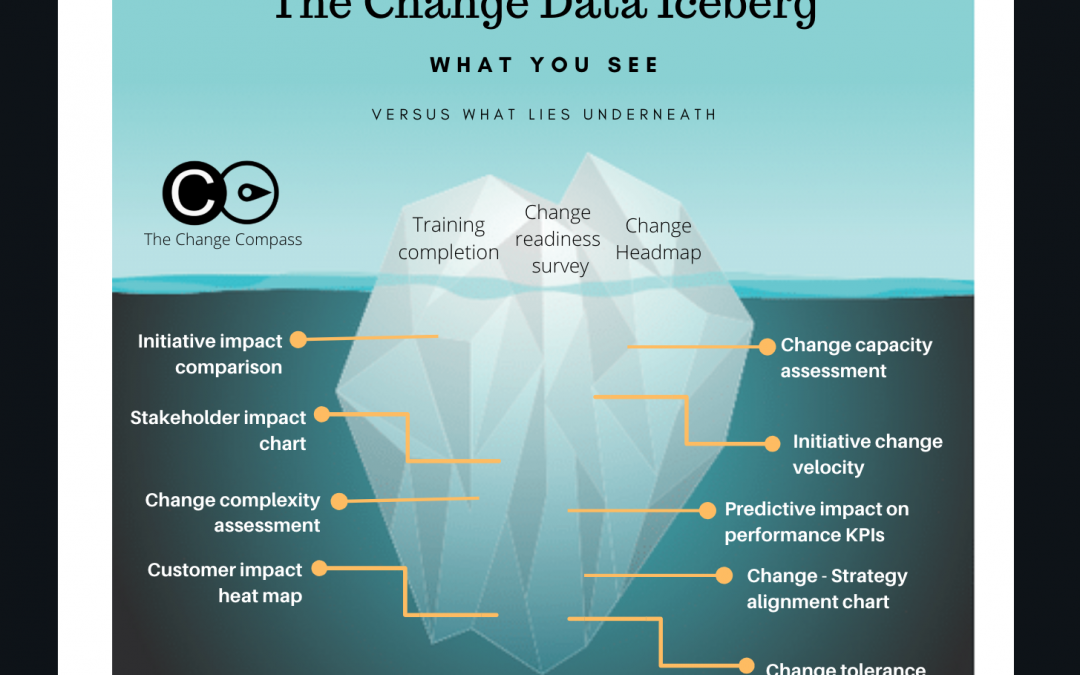
Most organisations that attempt to measure change management effectiveness measure the same narrow set of indicators: training completion rates, attendance at awareness sessions, results from pulse surveys, and the familiar heatmap showing which teams are affected by which programmes. These measures are not worthless. But they represent only the visible surface of what change data can actually tell you. Below the waterline lies a much richer dataset that most organisations have never systematically collected or analysed — and that contains the information actually needed to manage change at scale.
The change data iceberg is a useful way to visualise this gap. What sits above the surface is visible, easy to collect, and widely reported. What sits below is harder to surface, requires more deliberate effort to measure, and is substantially more predictive of change outcomes. Organisations that restrict their change measurement to surface-level indicators are managing their change portfolio with a partial view of reality. Those that invest in the deeper data layers develop a genuine predictive capability — the ability to identify where change is at risk before the symptoms become visible.
What sits above the waterline: visible change data
The change data that most organisations measure sits at the surface of the iceberg. These are the indicators that are easiest to collect, most familiar to stakeholders, and most often reported in programme status updates. They include training completion rates — the percentage of affected employees who have completed required training modules or attended scheduled sessions. They include attendance at change events: town halls, briefings, workshops. They include the outputs of awareness communications: email open rates, intranet page views, video completion rates. And they include change heatmaps — visual representations of which teams or roles are affected by which programmes at which points in time.
These surface-level indicators serve a legitimate purpose. They tell programme teams whether the basic mechanics of change delivery are functioning — whether people are showing up, whether communications are being received, whether the logistics of the training programme are on track. They provide a useful accountability layer for change delivery activity.
Their limitation is that they measure inputs and activities, not outcomes. A team can achieve 100 percent training completion and still not adopt the new process. Employees can attend every briefing session and still not understand how the change affects their role. Communications can reach every inbox and still not generate the comprehension and engagement that behavioural change requires. Surface-level change data tells you that the change programme did things. It does not tell you whether those things worked.
The middle layers: readiness and comprehension data
The first level below the surface of the iceberg contains data about employee readiness and comprehension — whether people understand what is changing, what it means for their role, and whether they feel equipped to perform in the new environment. This data is more difficult to collect than surface indicators because it requires asking people about their subjective state rather than recording objective activity data. But it is substantially more predictive of change outcomes.
Readiness data can be collected through structured pulse surveys aligned to change programme milestones, through facilitated team discussions with a consistent set of probing questions, or through manager-reported assessments that capture the team-level picture through the lens of the person best placed to observe it. The most useful readiness indicators ask about specific, concrete dimensions: does the employee understand what their role will look like after the change? Do they know where to go if they encounter problems during the transition? Do they feel the organisation has prepared them adequately for the new requirements?
Comprehension data is distinct from awareness data. Awareness means someone has received information about the change. Comprehension means they understand it well enough to act on it. The gap between the two is consistently underestimated by change teams who focus on information delivery rather than understanding verification. Prosci’s ADKAR model makes this distinction explicit: awareness and knowledge are separate stages, and organisations that conflate them systematically overestimate their change readiness.
Deeper layers: adoption and capability data
Further below the surface lies adoption data — evidence of whether employees are actually performing in the new way that the change requires. This is arguably the most important category of change data because it directly measures the outcome the organisation is trying to achieve. Yet it is among the least systematically collected, partly because it requires coordination between the change programme and the operational systems that can provide the relevant signals.
Adoption data takes different forms depending on the type of change. For a system implementation, it might include login rates, feature usage rates, and the number of workaround behaviours being observed (employees using the old system in parallel with the new one). For a process change, it might include error rates in the new process, the time taken to complete tasks under the new approach versus the old, and the frequency with which exceptions are being raised. For a structural reorganisation, it might include the degree to which new reporting lines are being respected in practice versus in name.
Below adoption data sits capability data — evidence of whether employees have genuinely developed the skills and knowledge needed to perform in the new environment at the required level of proficiency. Training completion tells you someone sat through a programme. Capability data tells you whether they can do the job. Assessment scores are one indicator, but the most reliable capability data comes from observed performance in real work contexts rather than training environments.
The deepest layer: change load and capacity data
At the deepest level of the iceberg sits data that most organisations do not collect at all: the aggregate change load on specific employee groups, measured across the entire change portfolio rather than within individual programmes. This is the data that reveals whether a team is being asked to absorb more change than its adaptive capacity can handle — and it is invisible to any measurement system that operates at the programme level.
Change load data requires a portfolio-level view. It involves aggregating the impacts of all concurrent programmes on a given team or role group and comparing that aggregate load against historical data or research-derived benchmarks for what constitutes sustainable change demand. Without this data, organisations routinely overload specific employee groups — inadvertently, because no one is looking at the cumulative picture.
Gartner research on change fatigue found that employees who experience high change fatigue are significantly less likely to intend to stay with their organisation and substantially less likely to successfully adopt change. The mechanism is straightforward: each change demands cognitive and emotional resources from the same finite pool. When that pool is depleted by simultaneous changes, employees enter a state of change fatigue where their capacity to absorb new demands is severely limited — and even well-designed, well-supported changes land poorly.
Measuring change load requires structured data collection about the nature, timing, and intensity of impacts associated with each programme, aggregated by team or role group across the portfolio. This is not a trivial undertaking, but it is what separates organisations with genuine change measurement maturity from those that are measuring activity and calling it measurement.
Why organisations stay at the surface
Given the predictive value of the deeper data layers, it is worth asking why most organisations restrict their change measurement to surface indicators. Several factors contribute. The first is convenience: surface data is easy to collect and exists within systems that change programmes already manage. Training platforms produce completion data automatically. Email systems produce open rate data. No additional investment or coordination is required.
The second factor is the programme incentive structure. Change programmes are typically resourced and governed to deliver activities rather than outcomes. When a change programme is judged on whether training was delivered on time and whether communications were sent, there is limited incentive to collect data that might reveal the activities were insufficient. Deeper change data creates accountability that surface data does not.
The third factor is the portfolio measurement gap. Even organisations that have invested in programme-level change measurement often lack the infrastructure to aggregate data across programmes. Impact assessments sit within individual programme documentation rather than in a shared data layer that allows portfolio-level analysis. Change load data requires a cross-programme view that no single programme team can produce unilaterally.
This is precisely the problem that change management platforms are designed to address. Tools like The Change Compass create a shared data infrastructure that aggregates change impact data across the portfolio, enabling the deeper measurement layers — change load, capacity, and cumulative impact by employee group — that are invisible to programme-level measurement systems. By making the full iceberg visible rather than just the surface, these platforms give change leaders and executives the data they need to make informed decisions about pacing, sequencing, and resourcing.
Building a change measurement framework
Moving from surface measurement to full-iceberg measurement is a progressive journey rather than a single investment. Organisations that attempt to implement comprehensive change measurement all at once typically struggle with data quality, stakeholder buy-in, and analytical capacity. A more effective approach is to build the measurement capability incrementally, starting with the surface indicators that already exist and adding deeper layers as capability and confidence develop.
The first step is to standardise the surface data that already exists. Many organisations collect training completion data, but the definitions vary across programmes — different standards for what counts as complete, different timeframes for reporting, different denominators for calculating rates. Standardising these basics creates a consistent baseline and builds the data governance habits that will be needed for deeper measurement.
The second step is to add structured readiness and comprehension measurement at key milestones. A consistent pulse survey deployed to affected employee groups at go-live and at 30- and 90-day post-implementation points provides early adoption data while the programme still has the resources and attention to respond to what the data reveals.
The third step is to connect change measurement to operational data. Adoption indicators that draw on system usage, process performance, or error rates provide a more objective picture than self-reported readiness data alone. This requires coordination between the change programme and the operational or IT teams that own the relevant data sources, but the resulting measurement is substantially more credible.
The fourth step is to establish portfolio-level change load tracking. This requires a consistent approach to impact assessment across all programmes — a shared taxonomy for categorising the nature and intensity of change impacts — and an aggregation mechanism that makes the cumulative picture visible to someone with the authority to act on it. Research on organisational decision-making quality consistently finds that the availability of comprehensive, timely data is the primary enabler of good portfolio-level decisions. Without it, the deepest drivers of change programme failure — change fatigue, inadequate capacity, accumulation effects — remain invisible until they manifest as resistance, attrition, or implementation failure.
Frequently asked questions
What is the change data iceberg?
The change data iceberg is a model for understanding the full range of data available to change management practitioners. The visible surface of the iceberg represents the data most organisations already collect: training completion rates, communication metrics, change heatmaps, and attendance data. Below the waterline lie richer data layers — readiness and comprehension data, adoption and capability indicators, and portfolio-level change load data — that are more predictive of change outcomes but require more deliberate investment to collect and analyse.
Why is training completion rate insufficient as a change measurement?
Training completion rate measures whether an employee attended or completed a training programme. It does not measure whether they understood the content, whether they can apply it in their role, or whether they have adopted the new process or behaviour the change requires. It is an input measure, not an outcome measure. Organisations that rely primarily on completion rates consistently overestimate their change readiness because they are measuring activity rather than the comprehension and capability that activity is intended to produce.
What is change load data and why does it matter?
Change load data is a measure of the aggregate change being experienced by a specific team or role group across all concurrent change programmes at a given point in time. It matters because individual employees have finite adaptive capacity, and when the cumulative demand from multiple simultaneous changes exceeds that capacity, even well-designed changes land poorly. Change load data is only visible at the portfolio level — no single programme can produce it, because each programme only sees its own impacts. Organisations that lack portfolio-level change load data routinely overload specific employee groups without realising it.
How can organisations start measuring deeper change data?
The most practical starting point is to standardise existing surface measurements to create a consistent baseline, then add structured readiness pulse surveys at key programme milestones. From there, organisations can progressively add operational adoption indicators by connecting change measurement to system usage and process performance data. Portfolio-level change load tracking requires a shared data infrastructure across programmes, which is most effectively supported by a dedicated change management platform that aggregates impact data across the portfolio.
We use cookies to improve your experience and understand site use. Marketing cookies stay off until you accept, and in the EU, UK and Switzerland analytics does too. Cookie Policy.
Strictly necessary
Required for the site to work: security, load balancing, and remembering your choices. These cannot be switched off.
Always active
Analytics
Google Analytics and similar, so we can see which pages are useful and where visitors get stuck. Aggregated, never sold.
Marketing
Used to measure campaigns and show relevant content on other platforms such as LinkedIn.