Effective change governance is one of the least well-defined areas of organisational change management. Most organisations have a reasonable understanding of who is responsible for delivering change — programme managers, change managers, project teams — but far less clarity about who is accountable for the quality of the overall change portfolio, who makes the decisions that cut across individual programmes, and what the relationship between these roles should be in practice.
This ambiguity is not a trivial problem. In large organisations running dozens of change initiatives simultaneously, the absence of clear governance roles means that the decisions that most need to be made — about sequencing, capacity, methodology, and prioritisation across the portfolio — either do not get made at all or get made inconsistently by people who lack the authority or information to make them well. Understanding the distinct governance roles in change management, and how they need to interact, is the foundation for building a change portfolio that is managed rather than merely delivered.
The executive sponsor
The executive sponsor is the most senior leader with direct accountability for a specific change programme’s outcomes. Sponsorship is frequently misunderstood as an endorsement role — appearing at launch events, sending the initial communication, approving the budget. Effective sponsorship is considerably more active than this. Prosci’s research on change management best practices consistently identifies active and visible sponsorship as the single most important factor in change programme success, and defines it as a set of behaviours rather than a position.
Active sponsorship means the executive is visibly advocating for the change with their own peers and direct reports throughout the programme — not just at launch. It means they are the primary source of the business rationale for the change, able to explain in their own words why it is necessary and what the consequences of not changing would be. It means they are accessible to the change team when issues escalate and willing to make or influence decisions that the change team cannot make unilaterally. And it means they are modelling the target behaviours themselves, not exempting their own team from the changes being asked of others.
The most common sponsorship failure is abdication: the executive approves the programme, delegates implementation to the project team, and re-engages only when the programme is in crisis. By this point, the window for effective sponsorship intervention has usually passed. Change teams that manage sponsorship proactively — providing sponsors with a clear picture of what is needed from them at each stage, and flagging early when they are not providing it — consistently achieve better outcomes than those that treat sponsorship as a given.
The portfolio governance body
The portfolio governance body — whether this is a Change Committee, a Transformation Steering Group, or a subset of the executive team — is the entity responsible for decisions that cut across individual programmes. It holds the cross-portfolio view: the aggregate change load on different parts of the business, the cumulative demand on shared resources, the sequencing and prioritisation of competing initiatives, and the consistency of methodology and standards across the portfolio.
The decisions that appropriately sit with this body are those that no individual programme sponsor can make alone, because they require a view across the full portfolio and the authority to make trade-offs between competing programmes. These include decisions about whether to defer or descope a programme because the affected teams are already at capacity; decisions about whether to invest in additional change resources because the portfolio is systematically under-resourced; and decisions about methodology standards that should apply across all programmes to ensure consistency of employee experience.
Many organisations either lack a formal portfolio governance body for change, or have one that operates as a reporting forum rather than a decision-making body. The difference is critical. A governance body that receives programme status reports and asks questions is a review body. A governance body that makes explicit decisions about sequencing, resourcing, and standards is a governance body. The distinction determines whether the body has real influence over change outcomes or is simply a recipient of information.
The change management lead
The change management lead — whether this is a Head of Change, a Chief Change Officer, or a Change Practice Lead — is the senior practitioner responsible for the quality of change management practice across the portfolio. This is not the same as being responsible for the delivery of individual programmes. The change management lead sets and maintains the methodology standards that apply across programmes, develops the capability of the change management community, provides expert guidance to programme change managers, and serves as the primary liaison between the portfolio governance body and the change management practice.
In smaller organisations, this role may not exist formally — the most senior change manager may perform these functions alongside programme-level responsibilities. In larger organisations with significant change portfolios, the role benefits from being separate, giving the incumbent the time and organisational positioning needed to maintain the portfolio-level view rather than being absorbed by individual programme demands.
A critical function of the change management lead is to surface the aggregate data that informs portfolio governance decisions. Individual programme teams see only their own change impacts. The change management lead needs the cross-programme data — the cumulative change load on specific employee groups, the adoption outcomes of recent programmes, the readiness indicators across the portfolio — to provide the governance body with the information it needs to make informed decisions. Tools like The Change Compass provide exactly this portfolio-level visibility, aggregating impact data from individual programmes into the cross-portfolio picture the governance function requires.
The programme change manager
The programme change manager is responsible for the design and delivery of change management activity within a specific programme. This includes impact assessment, stakeholder engagement planning, communication design, training design and delivery, resistance identification and management, and adoption tracking. The programme change manager is typically embedded in the programme team and works closely with the project manager and programme sponsor.
The effectiveness of the programme change manager depends significantly on their position within the programme structure. Change managers who are brought in after design is complete and decisions have been made find themselves in implementation mode from the outset, without the influence over design choices that would allow them to reduce adoption risk at the source. Change managers who are involved from the earliest stages of programme design can shape the approach in ways that improve adoption from the start — identifying which employee groups need the most support, flagging design choices that will create unnecessary friction, and ensuring that the go-live plan is realistic given the absorption capacity of the affected teams.
The relationship between the programme change manager and the change management lead is an important one. The programme change manager needs to operate within the methodology standards set by the practice, report adoption and readiness data into the portfolio picture, and escalate issues that have cross-portfolio implications. The change management lead needs to provide the programme change manager with the portfolio context they cannot see from within a single programme — particularly the change load data for the teams they are affecting.
The people manager
The people manager — the direct manager of employees who are affected by change — is not typically considered a formal governance role, but they are one of the most consequential actors in how change lands at the individual level. Prosci’s research on the manager’s role in change found that employees who rated their manager as effective at supporting change were five times more likely to report successful personal adoption. This makes the people manager the most powerful actor in the change system below the executive sponsor.
People managers mediate the change experience of their team members in a way that no programme team can replicate at scale. They translate the what of a change into the what does this mean for you and how we will navigate this together. They are the primary channel through which employees raise concerns, ask questions, and receive the reassurance or honest acknowledgement that they need to move forward. They are also the primary source of informal cultural signals about whether the organisation is serious about the change or whether it will pass if you wait long enough.
Effective change governance treats people manager enablement as a distinct governance responsibility rather than a communication deliverable. This means equipping managers with the information they need before formal announcements, providing them with guidance on how to handle the questions their teams are likely to ask, and creating mechanisms for managers to raise issues from their teams that need to be heard at the programme or portfolio level.
How the roles connect
The governance roles described above form a connected system rather than a hierarchy of command. The executive sponsor provides the authority and business context that the programme requires. The portfolio governance body provides the cross-programme decision-making that individual sponsors cannot provide alone. The change management lead maintains the standards and portfolio visibility that makes informed governance possible. The programme change manager translates that framework into effective delivery within each initiative. And the people manager translates programme delivery into the individual change experience of each employee.
Where these connections are weak — where sponsors are disengaged, where the governance body lacks decision-making authority, where the change management lead lacks portfolio visibility, where people managers are uninformed or unsupported — the impact on change outcomes is significant. The weakest link in the governance chain determines the ceiling of programme effectiveness more than the strength of any other element.
Organisations that invest in clarifying these roles, defining the accountability boundaries between them, and building the data infrastructure that allows each role to perform its function effectively — knowing what they need to know to make the decisions they are responsible for — consistently outperform those that treat governance as an afterthought to programme delivery.
Frequently asked questions
What is the difference between a change sponsor and a change governance body?
The executive sponsor is accountable for the outcomes of a specific change programme and provides the business authority, rationale, and visible commitment that the programme requires. The portfolio governance body is responsible for decisions that cut across multiple programmes — about sequencing, prioritisation, resourcing, and methodology standards — that no individual programme sponsor can make alone. Both roles are necessary; they operate at different scopes.
Why is active sponsorship more important than formal sponsorship?
Formal sponsorship means holding the sponsor title and attending key milestones. Active sponsorship means consistently demonstrating the behaviours that signal genuine commitment to the change — advocating for it with peers, modelling target behaviours, making difficult decisions when required, and remaining accessible to the change team throughout the programme. Research consistently finds that active sponsorship is the most reliable predictor of successful change adoption, while formal sponsorship with minimal engagement has little effect on outcomes.
How does the portfolio governance body differ from a project steering committee?
A project steering committee governs a specific programme: it receives status reports, approves scope changes, and escalates risks within that programme’s boundaries. A portfolio governance body governs the change portfolio as a whole: it makes decisions about the sequencing of multiple programmes, the aggregate change load on specific employee groups, the allocation of shared resources, and the consistency of change methodology across the portfolio. The two bodies serve different purposes and should not be conflated.
What is the role of the people manager in change governance?
The people manager is the most consequential actor at the individual change experience level. They translate programme communications into meaningful context for their team, surface concerns and questions that the programme team needs to hear, and model the organisational signals about whether the change is real or optional. Research shows employees with effective change managers are five times more likely to successfully adopt change. Effective governance treats people manager enablement as a core accountability, not a communication task.
References
Prosci, “Active and Visible Sponsorship”
Prosci, “Change Management and the Role of Managers”
A single view of change: How a bank protected customers and unlocked new value
Managing change in the financial sector is always a complex task, but the lessons from one leading bank stand as a powerful example of how clarity, collaboration, and customer-centric thinking can turn potential problems into value creation. In this case, one proactive step—leveraging an integrated view of change—became the catalyst for protecting both customer relationships and business performance.
The hidden challenge: Overlapping changes with a high-value customer segment
Every large bank is engaged in a continual cycle of transformation. New products launch. Systems are upgraded. Regulatory and compliance requirements evolve. Yet, as the pace of change accelerates, the risks of unintended consequences also grow. That risk isn’t always technological. Sometimes, it’s about the customer.
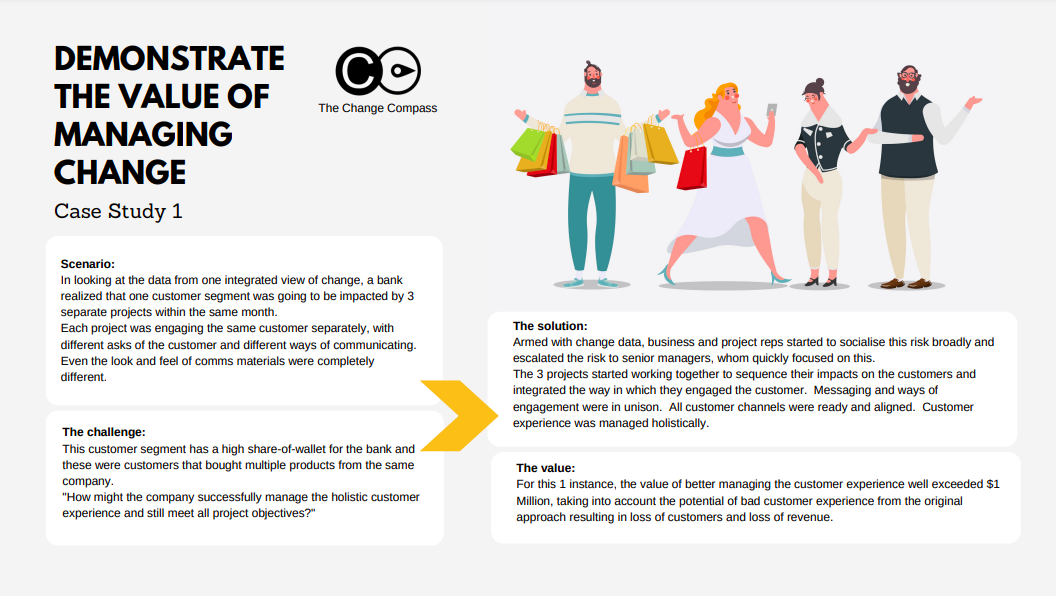
The story began when the bank reviewed its change data using The Change Compass, a platform designed to give leaders a holistic, quantitative view across all active and upcoming initiatives. It quickly became apparent that one valuable customer segment would be impacted not once, but three times in the space of a single month. Each encounter was driven by a different project team. Each project was planning separate communications and customer asks, with little alignment or coordination.
At first glance, these projects appeared to be unrelated. Yet, all three were targeting customers with the highest share-of-wallet, meaning they owned multiple products and had longstanding loyalty to the company. These were not just any customers—these were the “crown jewel” group whose satisfaction and retention were critical to the bank’s revenue and brand.
Why customer experience is so easily overlooked in transformation
When large organisations manage dozens or even hundreds of projects, it is common for teams to operate in functional silos. Each project has its own objectives, stakeholders, and deadlines. While project teams may conduct their own customer research, they might not have real-time awareness of what other groups are doing at the same time.
In this case, the data revealed a classic example of accidental customer overload:
Three projects, each reaching out separately to the same customer group
Different communication styles, messaging, and even visual branding
Conflicting asks of the customer within a short window
High risk that customers would receive mixed messages through multiple channels
The cumulative risk was clear. When customers are bombarded with uncoordinated service changes, requests, or notifications, confusion and frustration grow. Worse still is the potential for customers to feel undervalued, as though their loyalty is being taken for granted. For a segment with high share-of-wallet, this can lead to disengagement, product attrition, and ultimately significant loss in revenue.
Using change data to drive immediate management focus
Recognizing the risk, project and business representatives did not keep the issue at a working team level. Armed with hard data from The Change Compass, they were able to socialise and escalate the issue quickly to senior leaders. The evidence showed not just that there would be customer overlap, but exactly who would be affected and when. Visualizations made the potential for negative experience tangible and urgent.
The result was swift. Senior managers prioritised this risk and asked the three project teams to connect, align, and rethink their plans with the customer at the centre.
Turning competing projects into a single customer journey
The solution the teams developed together was both pragmatic and creative. Instead of three siloed interventions, the projects worked collaboratively to:
Sequence the timing of their customer impacts so that communications and asks happen in a coordinated, logical order
Integrate and harmonise their messaging so that customers would see one brand, one bank, regardless of which internal team was driving the change
Create unified communication which was consistent across all channels, ensuring readiness among staff as well as consistency in digital and direct outreach
All relevant customer channels were engaged. Contact centers were readied to provide clear and timely information for the anticipated queries. Branch staff received integrated briefing materials. Online resources were updated so that customer queries could be addressed seamlessly, regardless of which change had prompted the interaction.
Managing the customer experience for maximum value
The most important shift, however, was psychological. The three separate project teams stopped thinking only about their project outcomes and focused instead on the holistic customer experience. Their collaboration ensured that every customer’s journey through these parallel changes felt seamless and considered, not piecemeal or haphazard.
The data-driven approach did more than avoid complaints. It delivered quantifiable business value. The potential cost of poor experience was significant: for this high-value customer segment, confusion could have led to attrition and a loss of cross-sell opportunities. Through better management, the estimated value preserved for the business exceeded one million dollars, mainly by protecting loyalty, retention, and associated revenue.
Keys to success: Visibility, collaboration, and leadership engagement
There are several important lessons from this case that any change leader can apply:
An integrated view of change is essential. Only by adopting a platform that provides a holistic perspective can you spot issues that cut across project and functional boundaries.
Data is the great enabler for smart escalation and storytelling. When you can visualise and quantify the risk, you arm frontline teams with what they need to secure executive focus and intervention.
Silos are broken down when the customer is placed at the centre. Teams that are used to working independently quickly find common purpose when they are guided by a shared commitment to customer experience.
Solutions are not always complex. Sometimes coordinating timing and messaging, and making sure every channel is informed and ready, produces remarkable value with existing resources.
Key benefits achieved through using Change Compass
Protection of NPS (net promoter score) and CSAT (customer satisfaction) by 10-20+ points for affected segments
Improved customer experience that reduces churn by 2-5% in the months following a change-heavy period (equating to $1Mil+ annually)
Protection of revenue leakage of 5-10% from lost cross sell/upsell opportunities (from fragmented project delivery impacts) equating to $1-2Mil per annum
Through unified and sequenced activities change adoption is shown to increase by 60-80% (according to Deloitte study)
Creating a culture of proactive change management
Importantly, this was not a one-off intervention. By practicing this cross-project alignment, the bank reinforced a culture of proactive, customer-driven change management. Teams learned to ask new questions. Who else is communicating with this customer segment? What is the experience like from their perspective, not just ours? Where could joint planning enhance value for both customer and company?
The executive team also gained confidence that they were not missing hidden risks by focusing only on vertical project updates. Instead, they built strength in horizontal oversight, preventing accidental overload or misalignment for their most important clients.
Looking forward: Embedding these practices for lasting advantage
The value of these lessons goes well beyond any one episode. As the pace and scale of transformation accelerate in the banking sector and beyond, organisations must move from reactive to proactive change management. A single, data-driven view across all initiatives is no longer “nice to have”—it is a competitive necessity.
With The Change Compass, this bank gained the ability not just to detect emerging risks, but to act on them collaboratively, protect revenue, and continually strengthen the trust of its best customers.
Protecting what matters most in a changing world
Change is inevitable, but negative consequences do not have to be. The experience of this bank highlights how the right tools and mindset can help any company deliver more value through transformation. By seeing the whole picture, collaborating across boundaries, and acting in the interests of their customers, leaders set themselves up not just for project success, but for enduring business growth.
If your organisation is ready to manage the complexities of change with confidence, while ensuring the customer always comes first, discover what The Change Compass makes possible. With data-powered insight, alignment, and a relentless commitment to experience, your next change story could be your most successful yet.
Most change management frameworks claim to be human-centred. They use words like “empathy”, “engagement”, and “co-design” in their principles. But look at how change is actually delivered in most large organisations, and what you find is something closer to process management with human-sounding vocabulary. Impact assessments measure disruption to workflows, not to people’s sense of identity and agency. Readiness surveys ask whether training has been completed, not whether people actually understand the why. Stakeholder engagement plans focus on who needs to be communicated to, rather than who needs to be listened to.
Human-centred design (HCD) is a discipline that offers change practitioners something genuinely different: a set of specific methods for grounding design decisions in direct observation of human experience, rather than in assumptions about what people need. Originally developed in product and service design, HCD has a growing body of application in organisational transformation. The organisations that use it well do not just talk about putting people first. They have a structured approach to finding out what that actually means for the specific people affected by a specific change.
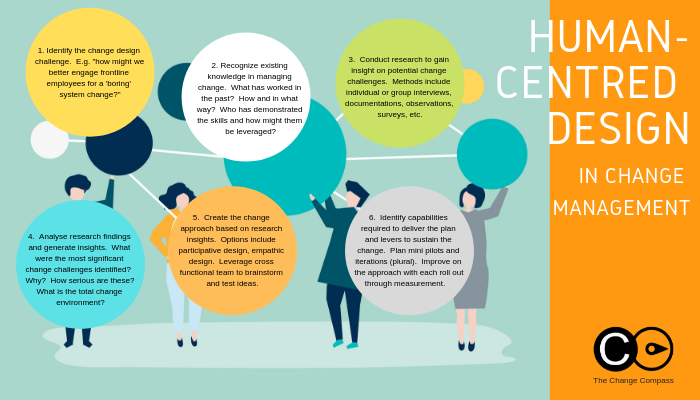
This article outlines six steps for applying human-centred design in change management practice, drawing on established methods from the design discipline and grounding them in the realities of large-scale organisational change.
Why change management needs a different approach to understanding people
The dominant change management frameworks, including Kotter’s 8-step model and Prosci’s ADKAR, were developed at a time when the primary challenge of organisational change was execution: getting people to comply with decisions that had already been made. They are essentially communication and adoption frameworks, designed to move people from resistance to acceptance. They are good at what they were designed for. But they were not designed to help change practitioners understand how a proposed change intersects with the lived experience of the people it affects.
Human-centred design starts from a different premise. Rather than asking “how do we get people to adopt this change?”, it asks “what is this change like for the people experiencing it, and how should that shape what we design?” IDEO’s foundational work on design thinking established three lenses for this inquiry: desirability (what do people actually want?), viability (what is sustainable for the organisation?), and feasibility (what is technically possible?). Most change management prioritises the second and third while treating the first as a secondary concern. HCD reverses that order, treating desirability as the starting point.
Research published in Harvard Business Review on design thinking applied to change management found that organisations using design methods to develop change interventions reported substantially higher employee satisfaction with the change process and stronger sustained adoption compared to those using conventional change approaches. The difference was not in the quality of communication or training, but in whether the design of the change itself was based on genuine understanding of the employee experience.
Step 1: Define the human problem, not just the business problem
Every change programme starts with a business problem: a process inefficiency to fix, a system to replace, a structure to reorganise. Human-centred design adds a second problem statement alongside the business one: what is the human problem that this change creates, and what would a good outcome actually look like for the people experiencing it?
This is not a rhetorical exercise. It requires a specific framing discipline. Business problem statements typically describe the current state in terms of costs, risks, or performance gaps. Human problem statements describe the experience of the people involved: the friction they feel, the workarounds they have built, the things they value that are at risk. A technology replacement programme might have a business problem statement about reducing maintenance costs for a legacy system. The corresponding human problem statement might be: “Experienced staff have built deep expertise in the current system over years, and they are uncertain how that expertise will be valued when the system changes.”
Articulating both problem statements at the outset ensures that the change design is accountable to both dimensions throughout the programme, not just the business case.
Step 2: Conduct discovery research with affected people
The most common form of “discovery” in change management is a stakeholder interview or workshop. These are valuable, but they have a significant limitation: people tend to describe what they think rather than what they do. Human-centred design uses observational research methods that reveal the gap between the two.
Key discovery methods for change practitioners
Three methods are particularly useful in the change management context:
Contextual inquiry: Spending time observing people doing their actual work in their actual environment, rather than asking them to describe it in a meeting room. This surfaces the workarounds, informal processes, and tacit knowledge that people rely on and rarely mention explicitly.
Experience journeys: Mapping the end-to-end experience of completing a key task or process from the employee’s perspective, including the emotional highs and lows. This identifies the moments that matter most and the points where a change is most likely to cause disruption.
Empathy interviews: In-depth conversations focused on stories and experiences rather than opinions and preferences. The goal is to understand the context behind what people value, not just what they say they want.
The output of discovery research is not a report. It is a set of specific, grounded insights about the human experience that will shape the design decisions to follow. McKinsey’s research on the business value of design found that companies in the top quartile for design thinking practices significantly outperformed industry benchmarks, partly because they invested in understanding users before designing solutions rather than after.
Step 3: Build a rich picture of the affected experience
The output of discovery research needs to be synthesised into a shared understanding that the change team can use to make decisions. In HCD, this synthesis step produces artefacts that represent the human experience in a tangible, accessible form. Three artefacts are particularly useful in change management:
Personas represent distinct groups of affected employees, characterised not just by their role but by their relationship to the change. A useful change persona goes beyond job title to describe what the person values, what they are worried about, what their daily work actually looks like, and what would make this change feel acceptable or even positive to them.
As-is journey maps document the current experience of key processes or workflows that the change will affect. They reveal the pain points, moments of pride, and critical dependencies that the change design needs to account for.
Insight statements distil the most important discoveries from the research into clear, actionable observations. A good insight statement describes a tension or unmet need, not just a preference: “Long-serving staff have deep system knowledge that is not documented anywhere. When the system changes, this knowledge disappears unless it is deliberately captured and transferred.”
These artefacts serve a practical function throughout the programme: they give the change team a shared reference point for evaluating whether proposed approaches are genuinely responsive to the human experience, rather than just technically correct.
Step 4: Co-design change interventions with the people affected
Co-design is perhaps the most misunderstood element of human-centred design when applied in organisational settings. It does not mean consulting employees on decisions that have already been made, which is the form most change “engagement” actually takes. It means involving employees in generating and testing potential solutions before they are finalised.
In practice, co-design workshops for change management might involve employees in designing how a new process should work (not just what it should achieve), what training would actually be useful to them (not just what the compliance function requires), or how communication should be structured so that it feels relevant rather than generic.
What co-design is not
A common concern from programme managers is that co-design creates false expectations, giving employees the impression that they have more control over the change than they actually do. This concern is legitimate but manageable. The solution is to be explicit about what is and is not within scope for co-design. The decision to implement a new system is typically not negotiable. The way the transition is managed, how training is structured, and how the support model is designed often are. Being clear about this boundary at the outset of co-design activities prevents the expectation gap that programme managers worry about.
The Design Council’s Double Diamond framework provides a useful structure for co-design in change contexts: diverge broadly to understand the problem space, converge on key insights, diverge again to generate potential solutions, then converge on the most promising approach to develop and test. This structure prevents co-design from becoming an open-ended conversation with no clear output.
Step 5: Prototype and test before rolling out
One of the most powerful habits from design practice that change management has largely not adopted is rapid prototyping: testing a low-fidelity version of a proposed approach with a small group before investing in full-scale delivery.
In change management, prototyping might look like running a draft training module with a small group of employees before finalising the curriculum, testing a communication format with a pilot audience before distributing it organisation-wide, or running a new support model in one business unit before scaling it. The goal is to identify problems early, when fixing them is cheap, rather than discovering them at full deployment when they are expensive.
This approach requires a shift in mindset from many programme managers, who see a “test” as a delay to the schedule. The reframe is that a pilot is not a delay to full delivery but rather a risk mitigation step that reduces the likelihood of a costly full-scale failure. Prosci’s research on change management effectiveness consistently shows that programmes with strong employee engagement and iterative design significantly outperform those that move directly from design to full delivery without any testing phase.
Step 6: Build feedback loops into implementation
The sixth step is the one most commonly skipped: building structured feedback loops into the implementation that allow the change design to be continuously refined based on how it is actually landing.
Most change programmes collect feedback through post-implementation surveys. This is too late to be useful. By the time a survey is designed, distributed, analysed, and reported, the programme has typically moved on to its next phase, and the findings sit in a report that influences the next programme rather than the current one.
Feedback loops in a human-centred approach are more frequent and more immediate: short pulse checks after key milestones, rapid feedback sessions with frontline managers, direct observation of how employees are using new tools or processes in the first weeks after go-live. The purpose is not to measure satisfaction but to identify friction quickly enough to respond to it. When a change manager has access to this kind of real-time signal, they can escalate issues to the programme team before they compound, rather than documenting them for a lessons-learned report.
Digital tools that support human-centred change design
Applying human-centred design at scale requires supporting infrastructure. Managing discovery insights, persona libraries, journey maps, and feedback data across a complex portfolio is difficult to do in documents and spreadsheets. Platforms like The Change Compass help change practitioners track the cumulative impact of change on specific employee groups, providing the portfolio-level visibility needed to understand whether the aggregate load on any particular group has reached a level that would undermine even well-designed change interventions. This is particularly relevant in organisations running multiple concurrent programmes, where individual team-level human-centred design cannot account for the combined effect across the portfolio.
Moving from human-centred language to human-centred practice
The six steps above are not a new change management framework. They are a set of methods that complement existing frameworks by grounding them in direct evidence about the human experience. A change manager who conducts genuine discovery research, builds accurate personas, co-designs interventions with affected employees, prototypes before scaling, and maintains real-time feedback loops is not doing something fundamentally different from change management. They are doing it with better information.
The most accessible starting point is step two: before the next change programme you are supporting moves into communication planning, spend two or three days observing the people most affected by it doing their actual work. What you learn will change how you approach every subsequent step. That is the practical test of what it means to be genuinely human-centred, rather than just human-sounding.
Frequently asked questions
What is human-centred design in change management?
Human-centred design in change management is the application of design research methods, including contextual inquiry, journey mapping, and co-design, to ground change interventions in direct understanding of the employee experience rather than assumptions about what people need. It differs from conventional change management by treating discovery of the human experience as a prerequisite for designing the change approach, rather than as an input to communication planning.
How is HCD different from stakeholder engagement?
Conventional stakeholder engagement focuses on informing people about a change and managing their reactions. Human-centred design goes further by using structured research methods to understand the lived experience of affected employees before and during the change. The difference is between managing people’s response to decisions already made and designing the change itself based on what you learn about people’s needs and experience.
What is co-design in change management?
Co-design involves bringing affected employees into the process of designing change interventions, such as training approaches, support models, and communication formats, before they are finalised. It is distinct from consultation, where people are asked to comment on decisions already made. Effective co-design is bounded: it is clear which elements of the change are open for co-design and which are fixed, preventing the expectation management issues that programme managers often worry about.
Can human-centred design work within tight timelines?
Yes, though it requires prioritisation. Even two or three days of contextual observation with a small group of affected employees will yield more actionable insight than a week of stakeholder interviews. Rapid prototyping and pulse-check feedback loops are inherently faster than traditional survey-and-report cycles. The methods scale to fit the time available, and even lightweight application is significantly more effective than designing change based purely on assumptions.
How do you measure whether a human-centred design approach worked?
The primary measures are adoption quality and sustained behaviour change, rather than awareness or training completion. Secondary indicators include the speed at which issues are surfaced and resolved during implementation, the volume and nature of escalations, and employee sentiment data collected at more frequent intervals than end-of-programme surveys. A human-centred approach should produce fewer surprises during implementation because the discovery phase has already surfaced most of the likely friction points.
Most organisations today are not managing one change. They are managing many, often simultaneously, and often with little visibility across the full portfolio. A new enterprise resource planning system goes live at the same time as a restructure is announced, while a cultural transformation programme runs in the background and a regulatory compliance initiative demands attention from the same frontline teams. Each initiative is rational on its own terms, yet together they create a pressure that is qualitatively different from anything a single project produces. The result is not simply “more work” — it is a compound effect that erodes employee capacity, dilutes leadership attention, and undermines the very outcomes each programme was designed to achieve.
Research from Prosci consistently shows that change saturation is one of the leading causes of failed transformation. When employees face too many changes at once, their ability to absorb and adopt each one falls sharply. Yet the instinct of most organisations is to treat each initiative as a standalone effort, with its own project team, its own communications plan, and its own timeline. Without a coordinated, portfolio-level view, the combined load on people is never measured, never debated, and never managed until it is too late.
This article explores why successfully landing multiple concurrent changes requires a fundamentally different approach from managing a single programme. It covers how to build shared portfolio visibility, how to sequence and prioritise competing initiatives, how to manage employee capacity across the portfolio, and how to coordinate stakeholder engagement so that no group is overwhelmed by noise from multiple directions at once.
Why multi-initiative environments are fundamentally different
A single well-managed change initiative operates within a relatively bounded system. The project team can focus all its energy on one set of stakeholders, one set of impacts, and one adoption curve. Communication channels can be dedicated, training can be sequenced logically, and resistance can be addressed without competing messages muddying the waters. The complexity is real, but it is contained.
When multiple initiatives run concurrently, that containment disappears. The same managers who are sponsoring a technology rollout are also being asked to lead their teams through a restructure, absorb a new performance framework, and champion a wellbeing programme. The same frontline workers who are learning new systems are also navigating new reporting lines and new processes. Complexity no longer adds, it multiplies. According to McKinsey, organisations undergoing multiple simultaneous transformations are significantly more likely to see fatigue-driven failure than those managing change in a more deliberate sequence.
The difference is not merely one of volume but of interference. Initiatives collide at the points where they share resources, whether people, budget, or leadership attention. A change that would succeed in isolation can fail simply because the surrounding environment is too noisy for the message to land. Understanding this interference effect is the starting point for managing a multi-initiative portfolio effectively.
The hidden cost of change collision
Change collision occurs when two or more initiatives create competing or contradictory demands on the same people at the same time. It is often invisible at the portfolio level because each project team reports its own progress in isolation. From where the project manager sits, training attendance is adequate and communications are going out on schedule. From where the employee sits, they have received five “change is coming” emails in a fortnight, attended three workshops in a month, and still cannot tell which of the changes they are supposed to prioritise.
The costs of this collision accumulate quietly. Adoption rates fall, not because the changes are poorly designed, but because there is insufficient mental bandwidth to embed them. Managers become change messengers rather than change leaders because they are juggling too many narratives at once. And the projects that do land often do so at significantly higher cost, with more rework, more helpdesk calls, and more re-training cycles than were originally budgeted. Research published in the Harvard Business Review highlights that the failure rate of large-scale change programmes remains stubbornly high, and that organisational fatigue from concurrent initiatives is a primary contributing factor.
There is also a reputational cost. When employees see change after change fail to stick, they develop a learned scepticism. The next initiative, even one that is genuinely well-designed and important, faces an audience that has been conditioned by experience to treat it as noise. Reversing that cynicism is far harder than preventing it in the first place.
Building a shared portfolio view across initiatives
The most immediate practical step an organisation can take is to create a single, shared view of all active change initiatives. This sounds straightforward, but in practice it requires a deliberate effort to break down the silos that typically form around individual programmes. Each project team has an incentive to manage its own plan and protect its own timeline. A portfolio view requires someone, or some function, with the authority and the data to see across all of them.
A meaningful portfolio view does more than list the active initiatives. It maps them against the parts of the organisation that will be affected, showing which business units, which teams, and which roles are being asked to change, and how much. It surfaces the concentration points, those areas of the organisation where multiple changes are landing at once, so that decisions can be made about whether to proceed, stagger, or sequence. Without this visibility, prioritisation decisions are made by each project team independently, always in favour of their own timeline.
Gartner’s research on organisational change management underscores that organisations with a centralised change portfolio function consistently outperform those without one on measures of adoption, speed to benefit realisation, and employee engagement during transformation. The portfolio function does not need to be large. What it needs is data, access, and the authority to raise a flag when the cumulative load on any part of the organisation exceeds a sustainable threshold.
Sequencing and prioritising concurrent changes
Once an organisation has a clear view of its change portfolio, the question becomes how to sequence and prioritise the initiatives within it. Not every change can go first, and not every change needs to. Some initiatives are foundational, in that they create the conditions that make other changes easier to absorb. A technology platform migration, for instance, may need to precede any process redesign that depends on it. A leadership development programme may need to be running before a cultural transformation can gain traction in teams.
Sequencing decisions should be driven by a combination of strategic priority, dependency mapping, and change readiness assessment. Strategic priority establishes which changes matter most to the organisation’s direction. Dependency mapping identifies which changes unlock or block others. Change readiness assessment, conducted at the team or business unit level, identifies which parts of the organisation have the capacity and the willingness to absorb change now, and which need time to consolidate before the next wave arrives.
Prioritisation is often the harder conversation because it requires some initiatives to be deferred or descoped. That can feel like failure to the sponsoring executive whose project is moved to a later tranche. The role of the portfolio function, and of senior leadership, is to frame deferral not as failure but as deliberate pacing, a decision that gives each initiative the best possible conditions for success rather than racing them all to the start line simultaneously and watching each one underperform.
Managing employee capacity across the portfolio
Employee capacity is the most constrained resource in any change portfolio, and it is routinely underestimated. When organisations calculate the cost of a change initiative, they typically account for project team time, technology investment, and training hours. They rarely account for the cognitive and emotional load that change places on the employees who must absorb it. That load is real, it accumulates, and it has a direct effect on performance both during and after the transition period.
Measuring change load requires moving beyond project timelines and looking at the actual experience of the people being asked to change. How many different changes is a given team currently navigating? How much of their working day is being consumed by change-related activities, whether training, new process adoption, system learning, or change communications? At what point does the cumulative demand tip from manageable into overwhelming? These questions cannot be answered by any single project team in isolation; they require a portfolio-level view of the human impact of all active initiatives combined.
Practical approaches to capacity management include change impact heat-maps that visualise load by team and by time period, regular check-ins with change champions embedded in business units, and formal go or no-go decisions before each major tranche of activity that include a capacity assessment as a mandatory input. Where overload is identified, the response should be one of three things: defer the lower-priority initiative, reduce the scope of the current wave, or increase the support resources available to the affected teams. What should not happen is proceeding regardless and hoping that employees will somehow absorb more than they sustainably can.
Coordinating stakeholder engagement across programmes
Stakeholder engagement in a multi-initiative environment requires a level of coordination that most organisations do not build into their programme governance. When each project team manages its own stakeholder engagement plan independently, the result is a stakeholder experience that feels fragmented at best and contradictory at worst. Senior leaders receive multiple briefings from multiple projects, each framed around its own rationale. Middle managers are asked to communicate multiple narratives to their teams, often without a coherent thread connecting them. Frontline employees receive a stream of messages that they cannot easily relate to a single, clear organisational direction.
Coordinated stakeholder engagement means establishing shared communication channels, a common narrative architecture, and a single calendar that tracks when each stakeholder group is being engaged by which initiative. The common narrative matters because employees need to understand how the changes they are experiencing fit together. Each initiative has its own rationale, but if those rationales are presented in isolation, they sound like a series of unrelated demands rather than a coherent transformation journey. Senior leaders play a critical role here: when the CEO or executive team can speak to the portfolio as a whole, explaining how each initiative connects to the organisation’s direction, the individual changes land in a context that makes them feel purposeful rather than arbitrary.
Engagement fatigue is a real risk. When managers are repeatedly pulled into workshops, briefings, and steering committees across multiple projects, the time cost becomes prohibitive and engagement quality declines. Consolidating engagement activities, combining project updates into joint forums, aligning project milestones to a common rhythm of business meetings, and empowering a single point of contact in each business unit to interface with the portfolio function can significantly reduce this burden while improving the quality of two-way dialogue.
How The Change Compass supports multi-initiative management
The Change Compass is a data-driven change management platform designed specifically to address the challenges of multi-initiative environments. Rather than treating each change in isolation, The Change Compass provides a centralised view of all active initiatives across the organisation, mapping the impact of each one against the business units, teams, and roles that will be affected. This portfolio-level visibility is not available from any single project management tool or change plan, because it requires aggregating and comparing data across all concurrent programmes simultaneously.
The platform enables change leaders and portfolio managers to identify where change load is concentrated, which teams are being asked to absorb too much too quickly, and where sequencing decisions need to be revisited. It supports data-driven conversations at the executive level about prioritisation, because the analysis is grounded in actual impact data rather than competing project team advocacy. For organisations managing three, five, or ten concurrent initiatives, this kind of evidence-based portfolio governance is the difference between landing changes successfully and watching adoption rates disappoint across the board.
The Change Compass also supports the coordination of stakeholder engagement by providing a shared view of the engagement calendar across projects. Change practitioners can see at a glance where communications are clustering, where stakeholder groups are being approached by multiple initiatives simultaneously, and where engagement windows are available that have not yet been claimed. This enables the kind of deliberate, considered pacing that multi-initiative environments demand but that is impossible to achieve without shared, real-time data.
Frequently asked questions
How many concurrent change initiatives is too many?
There is no universal threshold because it depends on the size of the organisation, the scale and complexity of each initiative, the change maturity of the workforce, and how the initiatives are sequenced and supported. What matters more than the number is the load placed on specific parts of the organisation. A large corporate function with strong change capability may be able to absorb four or five concurrent changes effectively. A smaller team with limited change experience may be overwhelmed by two. The answer lies in measuring actual impact and capacity at the team level rather than applying a blanket limit to the portfolio.
What is the difference between change portfolio management and project portfolio management?
Project portfolio management focuses on the delivery of projects, tracking timelines, budgets, dependencies, and resource allocation from a delivery perspective. Change portfolio management focuses on the human experience of those projects, measuring the combined impact on the people who must adopt the changes being delivered. Both are necessary, but they answer different questions. Project portfolio management asks “are we delivering on time and on budget?” Change portfolio management asks “are the people affected able to absorb what we are delivering, and are they actually changing their behaviour?” An organisation can score well on the first question and fail entirely on the second.
How do you make the case to executives for delaying a change initiative?
The most effective case is a data-driven one. Rather than presenting a subjective concern about “change fatigue,” present the portfolio heat-map showing the current load on the affected teams, the adoption rates from recent changes in the same part of the organisation, and the projected cost of a failed or partial adoption compared with the cost of a short deferral. Executives respond to business cases, and the business case for sequencing is compelling when it is grounded in evidence. Framing the deferral as a decision to protect the return on investment of the initiative, rather than as a sign that the organisation cannot cope, also tends to land more effectively with executive audiences.
Can change management be centralised without creating bureaucracy?
Yes, if the central function operates as an enabler rather than a gatekeeper. The goal of a change portfolio function is to give decision-makers better information, not to add approval layers to every project. In practice, this means providing shared tools, common impact assessment frameworks, and aggregated data that individual project teams do not have to generate themselves. When project teams see the portfolio function as reducing their burden rather than adding to it, adoption of the shared approach is much faster. The function earns its place by making each project more likely to succeed, not by controlling what projects can do.
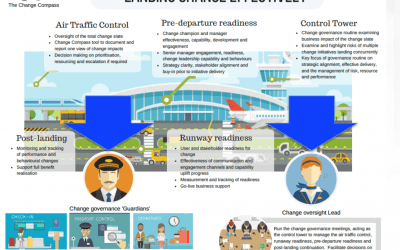
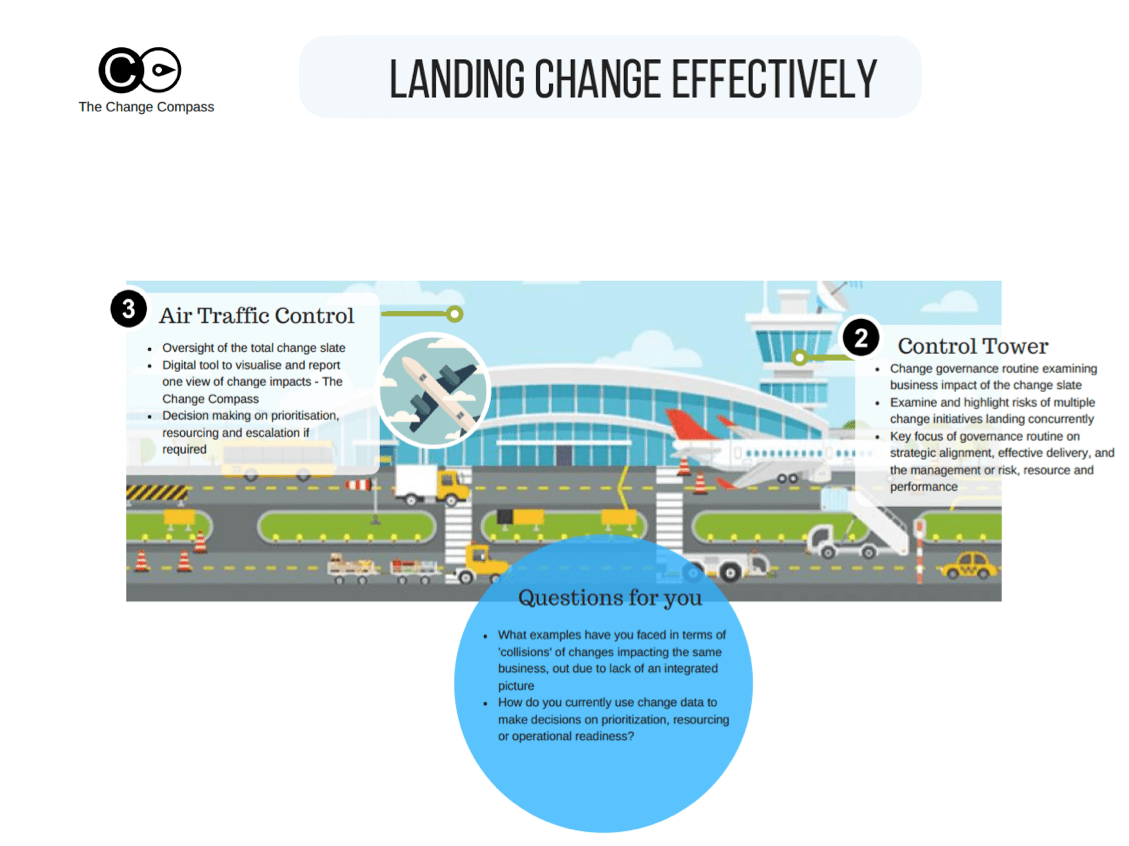
Picture a busy international airport on a Friday afternoon. Dozens of aircraft are airborne simultaneously, each on a different flight path, each carrying its own cargo, crew, and schedule. Without the air traffic control tower, those aircraft would have no shared awareness of one another. Pilots would make independent decisions based on incomplete information, and the risk of collision, delay, and catastrophic failure would be overwhelming. The control tower does not fly any of the planes. Instead, it holds the picture of the whole sky, coordinates safe separation, sequences landings, and ensures that each aircraft reaches the runway in the right order and at the right time.
Organisations undergoing significant transformation face a remarkably similar challenge. At any given moment, a large enterprise may be running dozens of concurrent change initiatives, from technology implementations and process redesigns to cultural transformation programmes and regulatory compliance projects. Each of those initiatives has its own sponsor, its own timeline, and its own demands on the same finite pool of people, attention, and goodwill. Without a centralised change governance function that holds the picture of the whole portfolio, those initiatives collide in the day-to-day experience of employees, creating the change fatigue, adoption failure, and disengagement that derail even the best-designed programmes.
The control tower metaphor offers change leaders something more than a vivid image. It provides a practical framework for thinking about what a mature change portfolio governance capability actually does, who must sit inside it, and what instruments it needs to do its job. This article unpacks that framework in full, drawing on research from across the change management discipline, and explains how The Change Compass provides the instrument panel that makes a change control tower operationally effective.
What the control tower metaphor reveals about change management
The air traffic control metaphor is useful precisely because it reframes the problem of change portfolio management in operational rather than strategic terms. Strategic conversations about change portfolios tend to stay at the level of investment decisions, programme charters, and governance structures. Those conversations are necessary, but they do not address the lived reality of change saturation, where the same team is simultaneously asked to adopt a new ERP system, shift to a new operating model, comply with revised regulatory requirements, and absorb the implications of a restructure. The control tower metaphor brings the conversation down to the operational level, where the real damage occurs.
In aviation, air traffic control is not an optional enhancement to safe flying. It is a fundamental infrastructure requirement. No responsible aviation authority would permit commercial aircraft to operate in shared airspace without it. The metaphor invites us to apply the same logic to organisational change: coordinated oversight of the change portfolio is not a nice-to-have governance layer, it is a prerequisite for safe operation. Research from Prosci consistently finds that active and visible executive sponsorship and structured change management are among the strongest predictors of change success, and a centralised portfolio view is foundational to both. According to Prosci’s research on change management ROI, projects with excellent change management are six times more likely to meet their objectives than those with poor change management.
The metaphor also clarifies the appropriate scope of central authority. Air traffic control does not decide where aircraft are going or how they are configured. It controls the airspace. A change governance function similarly does not own the content of individual programmes. It owns the sequencing, the separation, and the overall picture of load on the organisation. This is a politically important distinction in most enterprises, where programme sponsors guard their autonomy jealously. The control tower model gives the central function a clearly bounded but genuinely authoritative mandate.
The consequences of change without a control tower
The consequences of operating a complex change portfolio without centralised oversight are well documented. McKinsey research has found that roughly 70 per cent of large-scale transformation programmes fail to achieve their intended outcomes, and a significant proportion of that failure is attributable not to poor programme design but to organisational overload and implementation clashes. When multiple programmes compete for the same people and the same window of implementation activity, the cumulative impact on employees far exceeds what any single programme’s impact assessment would predict. Each programme looks manageable in isolation. Together, they become unmanageable. The McKinsey research on transformation success points directly to the importance of employee energy and capacity as a critical resource that must be actively managed.
Without a control tower, several characteristic failure patterns emerge. Initiatives collide in the calendar, with multiple go-lives scheduled in the same quarter for the same business unit. Communication fatigue sets in as employees receive disconnected messages from different programme teams with no coherent narrative about what is changing and why. Change champions and business leads are pulled in multiple directions, diluting their effectiveness on every programme. Adoption rates fall across the board, not because any single programme is badly managed, but because the cumulative cognitive and emotional load on employees is simply too great. Gartner research on employee change fatigue found that as of recent years, the average employee has experienced ten or more planned organisational changes in the preceding three years, and that the willingness to support change has declined sharply as a result. The full analysis is available in Gartner’s organisational change management research.
These patterns are not random. They are the predictable result of operating a complex system without coordination infrastructure. Just as aircraft without air traffic control would converge on the same runway approaches at the same time, change initiatives without portfolio oversight converge on the same people at the same time. The result is not a smooth set of parallel landings, it is a queue of frustrated pilots and a set of very unhappy passengers.
Core functions of the change control tower
A change control tower performs five core functions that map directly onto the responsibilities of an aviation air traffic control operation. The first is situational awareness: the control tower must hold an accurate, real-time picture of every change initiative currently in flight, its phase, its affected population, its implementation timeline, and its resource demands. Without this picture, all other functions are impossible. The second function is separation: just as aircraft must be kept at safe distances from one another, change initiatives must be sequenced so that they do not simultaneously saturate the same teams or the same business units.
The third function is prioritisation and sequencing. When multiple programmes want to land in the same window, the control tower must make authoritative decisions about which goes first, which holds, and which is rerouted. This requires both a clear set of prioritisation criteria and the organisational authority to enforce them. The fourth function is load management. The control tower must track the cumulative change load on each part of the organisation, just as an airport manages the overall throughput of its runways. When load approaches a threshold that risks adoption failure, the control tower must intervene. The fifth function is communication: the control tower is the source of the single, integrated narrative about what is changing across the organisation, ensuring that employees receive coherent and sequenced messages rather than a cacophony of competing programme communications.
These five functions require both structural authority and analytical capability. The control tower cannot perform them through goodwill and informal influence alone. It needs mandate, data, and tools. An article in the Harvard Business Review on making change happen notes that successful transformation requires building the organisational muscle for change management as a discipline, not treating it as a project-by-project ad hoc activity. The control tower model is precisely the institutionalisation of that muscle at the portfolio level.
Air traffic separation: sequencing change initiatives safely
Air traffic separation is the most operationally specific of the control tower’s responsibilities, and it has a direct and precise analogue in change portfolio management. In aviation, separation standards define the minimum safe distance between aircraft, measured in time, altitude, and lateral position. These standards are not arbitrary. They are calculated based on the performance characteristics of the aircraft involved, the turbulence wake that large aircraft generate, and the capacity of the runway system to absorb sequential arrivals. The separation standard for a heavy jet following another heavy jet is substantially greater than for a light aircraft, because the wake turbulence risk is commensurately greater.
In change management, separation standards should be calculated based on the profile of each initiative and the characteristics of the affected populations. A large-scale ERP implementation that touches every operational process in a business unit generates a change wake, in the form of process uncertainty, skill gaps, and employee anxiety, that substantially affects the organisation’s capacity to absorb the next wave of change. Scheduling a major operating model redesign into the same business unit within months of the ERP go-live is the change management equivalent of landing a heavy jet in the wake of another: the turbulence risk is very high. The change control tower must establish sequencing rules that account for this wake effect, building in recovery time between major implementations for each affected population.
The practical implication is that separation decisions require quantitative data about change load and recovery capacity, not just qualitative judgements from programme teams. Programme teams have an inherent optimism bias about their timelines and their ability to land change successfully. The control tower must apply a portfolio-level lens that corrects for this bias, using data on historical adoption rates, engagement levels, and change saturation indicators to set realistic separation standards for each part of the organisation.
Real-time visibility as the foundation of control tower capability
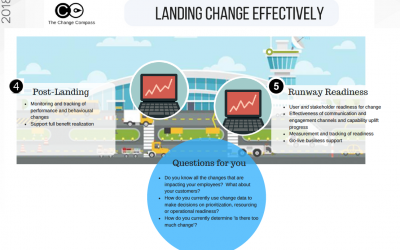
An air traffic control tower that cannot see its aircraft is not a control tower. It is a building. Visibility is not one feature of the system, it is the foundational prerequisite for every other function. In a modern radar-equipped tower, controllers have a real-time picture of every aircraft in their airspace: its position, altitude, speed, call sign, and intended flight path. This picture is continuously updated as conditions change. Decisions are made based on current data, not on the flight plans filed three days ago.
The equivalent requirement for a change control tower is a live, integrated view of the entire change portfolio, updated as programmes progress and conditions evolve. This is where most organisations fall short. Change portfolio data is typically fragmented across programme management tools, risk registers, HR systems, and the personal spreadsheets of individual change practitioners. The picture that governance bodies receive is assembled manually, with significant time lag, and reflects the state of programmes as reported by programme teams rather than as observed independently. By the time the data reaches the governance forum, it may be weeks out of date and filtered through layers of optimism bias.
Real-time visibility requires a dedicated platform that aggregates change portfolio data, calculates cumulative impact by business unit and team, and presents the result in a format that enables fast, informed decision-making. It requires that change data be entered and maintained by programme teams in a consistent format, so that the portfolio view reflects comparable data across initiatives rather than apples and oranges. And it requires that the platform surface not just what is planned but what is actually happening, drawing on pulse survey data, adoption metrics, and engagement indicators to give the control tower a live read on how the organisation is actually experiencing the change load.
Who sits in the control tower? Governance roles and authority
In aviation, air traffic controllers are trained specialists with clearly defined authority. They do not advise pilots, they instruct them. The captain of the aircraft retains authority over the safety of the aircraft once airborne, but within the airspace, the controller’s sequencing and separation instructions are binding. This clear delineation of authority is what makes the system work. A control tower that can only recommend and cannot compel is a fundamentally different, and far less effective, kind of institution.
The governance structure of a change control tower must reflect this lesson. At the senior level, the control tower requires a portfolio change authority with genuine decision-making power over sequencing, prioritisation, and load management. This authority must sit at a level in the organisation that can override individual programme sponsors when portfolio-level considerations require it. In most large enterprises, this means positioning the change portfolio governance function at the executive leadership team level or with a direct reporting line to it, rather than burying it within a project management office that lacks the authority to make binding decisions about programme timelines.
Below the senior governance level, the control tower requires dedicated change portfolio analysts who maintain the visibility picture, identify emerging conflicts and risks, and prepare the analysis that governance decision-makers need. These roles are distinct from programme-level change managers, who are embedded in individual initiatives and naturally focused on their programme’s success. The control tower analysts maintain the portfolio view, which requires a different orientation and a different set of analytical skills. They are the equivalent of the radar operators who track the full picture of the airspace, rather than the pilots who are focused on flying their own aircraft.
How The Change Compass serves as the change control tower
The Change Compass is purpose-built to serve as the instrument panel of the change control tower. Just as a radar system gives air traffic controllers the real-time positional data they need to maintain separation and sequence landings, The Change Compass gives change governance functions the portfolio-level data they need to manage change load, identify conflicts, and make informed sequencing decisions.
The platform aggregates change data from across the portfolio into a single, visual representation of the change landscape. Programme teams input their initiative data, including affected populations, implementation phases, change activity volumes, and go-live dates, and The Change Compass automatically calculates the cumulative change load on each business unit and team across the portfolio. This gives the control tower an integrated view that no individual programme team can provide, because no programme team has visibility of the full portfolio. Where load exceeds safe thresholds for a particular population, the platform flags the risk, giving the governance function the early warning it needs to intervene before the collision occurs rather than after.
Beyond the aggregated load view, The Change Compass supports the sequencing function of the control tower by enabling scenario planning. Governance decision-makers can model the impact of moving a go-live date, splitting a rollout into phases, or deprioritising an initiative, and see immediately how each decision changes the change load profile across the organisation. This transforms sequencing decisions from instinctive judgements into evidence-based choices, grounded in data about where the organisation has capacity and where it is already saturated. For organisations managing complex, multi-year transformation portfolios, this analytical capability is the difference between a control tower that can genuinely manage the airspace and one that can merely observe it.
Frequently asked questions
What is a change control tower in an organisational context?
A change control tower is a centralised governance function that holds an integrated, real-time view of all concurrent change initiatives across the organisation. Drawing on the air traffic control metaphor, it coordinates the sequencing and separation of change initiatives to prevent overload on any single part of the organisation, manages cumulative change capacity, and maintains the single authoritative picture of the change portfolio. It does not manage individual programmes, but it does have the authority to make binding decisions about sequencing, prioritisation, and load management at the portfolio level.
How does the air traffic control metaphor apply to change portfolio management?
The metaphor maps closely onto the realities of change portfolio management. Aircraft in shared airspace correspond to change initiatives operating across the same organisation. The control tower corresponds to the central change governance function. Air traffic separation standards correspond to sequencing rules that prevent change initiatives from saturating the same populations simultaneously. The radar system corresponds to a portfolio data platform that gives the governance function real-time visibility. And the landing sequence corresponds to the prioritised, phased implementation plan that the governance function manages across the full portfolio.
What authority does a change control tower need to be effective?
A change control tower requires genuine decision-making authority, not merely advisory influence. It must be positioned at or near the executive leadership level to be capable of overriding individual programme sponsors when portfolio-level considerations require a change to sequencing or timing. Without this authority, the control tower can identify conflicts and risks but cannot resolve them, which limits its effectiveness to reporting rather than governing. The analogy with aviation is instructive: an advisory body that can only recommend separation adjustments to pilots, rather than instruct them, would not constitute safe air traffic management.
How does The Change Compass support change control tower governance?
The Change Compass functions as the instrument panel of the change control tower, providing the real-time portfolio data that governance decision-makers need. It aggregates change initiative data from across the portfolio, calculates cumulative change load by business unit and team, flags overload risks before they materialise, and supports scenario planning so that sequencing decisions can be tested against data before they are made. It replaces the fragmented, manually assembled spreadsheets that most governance functions rely on with an integrated, continuously updated view of the full change landscape, enabling the control tower to operate with the kind of situational awareness that makes safe, effective portfolio management possible.
McKinsey and Company. (2023). The People Power of Transformations. Retrieved from https://www.mckinsey.com/capabilities/people-and-organizational-performance/our-insights/the-people-power-of-transformations
We use cookies to improve your experience and understand site use. Marketing cookies stay off until you accept, and in the EU, UK and Switzerland analytics does too. Cookie Policy.
Strictly necessary
Required for the site to work: security, load balancing, and remembering your choices. These cannot be switched off.
Always active
Analytics
Google Analytics and similar, so we can see which pages are useful and where visitors get stuck. Aggregated, never sold.
Marketing
Used to measure campaigns and show relevant content on other platforms such as LinkedIn.