

Most change teams are about to get very good at producing work that is confidently wrong. Generative AI can now draft a stakeholder impact assessment, a comms plan, or a readiness narrative in minutes, and the output looks polished enough to send. But polish is not correctness. An AI-drafted impact assessment can merge two stakeholder groups that experience a change very differently, understate the load on a team already carrying two other go-lives, and invent a training assumption no one ever agreed, all inside fluent prose that signals “this is fine”. Catching that takes a specific set of skills, and they are not the ones most teams are building.
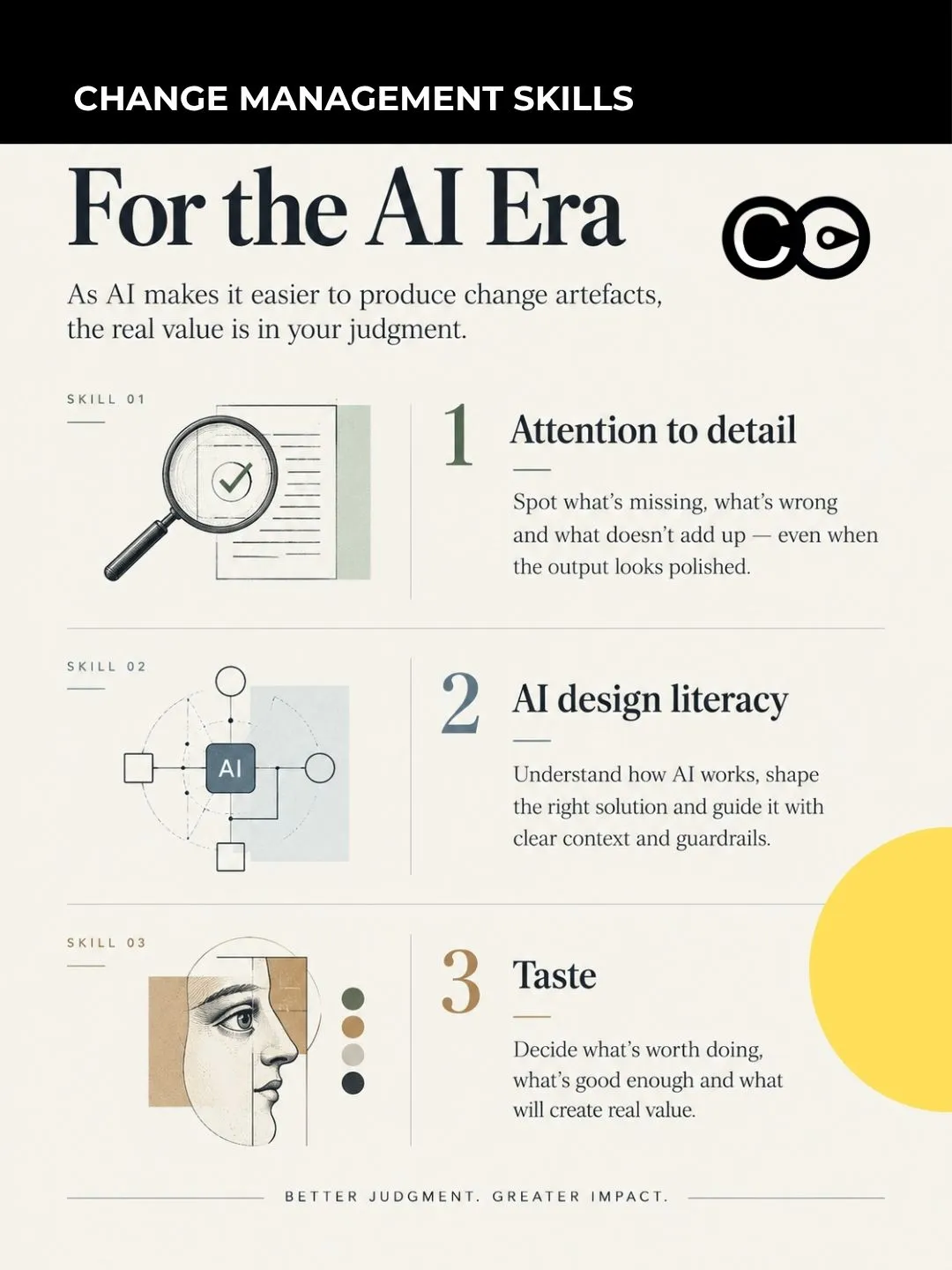
This article is for the leaders deciding which capabilities to develop across their change teams, and for practitioners deciding what to get better at themselves. The argument is straightforward: as AI drives the cost of producing change artefacts toward zero, value moves to the judgment that decides what to produce, whether it is right, and whether it is good enough to use. Three skills carry that judgment, and none of them is prompt engineering. They are attention to detail, the ability to read and shape how an AI solution is designed, and taste. Much of the commentary on AI and change work focuses on whether the job survives or on the operating model shifting from stage gates to a continuous flow of data, and we have covered both elsewhere. This piece is about the concrete skills to prepare your team around, and what to do to build each one.
Why the AI era rewards different change management skills
For most of the history of the profession, a large part of a change manager’s value came from production. Someone had to write the impact assessment, build the stakeholder map, draft the comms, assemble the training plan, and pull the readiness survey together. Those artefacts took real time, and the people who produced them well were valued for it. Generative AI has collapsed the cost of that production. A first draft of almost any change artefact is now minutes away.
When the cost of producing something falls to near zero, the value moves elsewhere. It moves to the judgment about what to produce, whether the output is actually correct, and whether it is good enough to put in front of the project team and stakeholders who will rely on it. The scarce skills are no longer the ones that fill a blank page. They are the ones that decide what belongs on the page and catch what does not.
The evidence that this shift is real, and that most organisations are handling it badly, is now hard to ignore. An MIT report on the state of AI in business in 2025 found that 95 per cent of enterprise generative AI pilots delivered no measurable impact on profit or loss, a gap the authors called the “GenAI divide”. Their explanation is instructive for change professionals: generic tools work for individuals because they are flexible, but they stall inside organisations because they do not learn from or adapt to the way the work is actually done. The failure is rarely the model. It is the design around the model, and the human judgment applied to its output.
There is a second, less obvious warning in the research. A randomised controlled trial by METR in 2025 had experienced developers complete real tasks with and without AI assistance. The developers believed AI made them roughly 20 per cent faster. Measured against the clock, AI made them 19 per cent slower. The gap between how productive people feel with AI and how productive they actually are is one of the defining risks of this period, and it is exactly the kind of gap that the three skills below are built to close.
Skill one: Attention to detail
Attention to detail has always mattered in change work. A wrong go-live date in a comms pack, a stakeholder left off a map, a training cohort double-counted: these have always caused real damage. What is new is that AI both raises the stakes and removes the natural friction that used to catch these errors.
It raises the stakes because AI produces errors that look nothing like human errors. A tired analyst produces work that is visibly rough, and the roughness signals “check this”. AI produces work that is uniformly polished, which signals “this is fine” even when it is not. The confident tone is not evidence of correctness. It is a property of the tool.
It removes the friction because the effort of producing the artefact used to force a slow read. When you wrote the impact assessment yourself, you engaged with every line. When you accept a draft, you can skim. This is where the research on automation bias becomes directly relevant. A 2025 review of automation bias in human and AI collaboration describes the well-documented tendency to over-rely on automated output and discount information that contradicts it, and notes that this tendency weakens the very reasoning and verification habits that catch mistakes. The same review points to a practical finding that should shape how you work: deliberately increasing the effort you put into verification measurably reduces the chance of accepting a wrong recommendation. Passive review does not protect you. Active checking does.
Where AI output tends to go wrong in change work
Knowing the general failure modes lets you check the right things rather than re-reading everything with equal suspicion. In change artefacts specifically, AI-generated content tends to fail in recognisable ways:
- It flattens groups that should be kept distinct, merging stakeholders who actually experience a change very differently.
- It underweights cumulative load, treating each initiative in isolation and missing the fact that a team is already saturated.
- It invents plausible specifics, such as a training duration, an adoption target, or a milestone date, that no one ever agreed.
- It reproduces generic best practice that is technically true but disconnected from your organisation’s real constraints.
- It states correlations and assumptions with the same confidence as verified facts.
How to build the habit
Attention to detail in the AI era is not a personality trait you either have or lack. It is a discipline you can install:
- Read AI output against a source of truth, not on its own terms. Keep the actual stakeholder register, the portfolio load view, and the agreed plan open beside the draft.
- Check the specifics first. Dates, numbers, named groups, and commitments are where invented detail hides.
- Ask what the draft is assuming without saying so. If an assumption is load-bearing and unstated, surface it and confirm it.
- Treat fluency as neutral. A well-written paragraph is neither more nor less likely to be correct than a clumsy one.
This is also where the state of your data decides how far the skill can take you. Verification is far faster and far more rigorous when your change data lives in structured form, because the AI’s claims can be tested against real fields rather than your memory of them. But structured is only half of it. The data also has to be integrated. If impact severity sits in one team’s spreadsheet, stakeholder groups in another’s slide deck, capacity in a third’s project plan, and adoption in a survey tool no one has opened in a month, then neither you nor any AI has a single reliable picture to check against. What a change team needs is structured and integrated change data across the whole portfolio, held in a form an AI can actually ingest and reason over: consistent fields, shared definitions, and one place where impact, capacity, stakeholder load, and adoption live together. That foundation is what makes fast verification possible, and it is also the precondition for the second skill, because you cannot design or judge an AI capability well if the data underneath it is scattered and inconsistent.
Skill two: Reading and shaping how the AI solution is designed
Here is the skill that is least discussed and, over the next few years, probably the most valuable. Change managers do not need to become engineers. They do need enough literacy in how AI solutions are designed to reason about them, ask sharp questions, and shape the adoption approach around the design rather than around a vendor’s marketing. When an AI capability is introduced into a change function or a wider transformation, the practitioner who understands its architecture will make far better decisions than the one who treats it as a magic box.
A handful of design concepts do most of the work. You do not need to implement any of them. You need to be able to hold a competent conversation about each.
- Agent design. Increasingly, AI does not just answer a question. It takes a sequence of steps toward a goal: reading data, drafting, checking, and acting. Understanding that an “agent” is a designed sequence, with defined inputs, permitted actions, and stopping points, lets you ask where the human sits in that sequence and what happens when a step goes wrong.
- Gating. A gate is a checkpoint where the system pauses for a human decision before it proceeds, or where it refuses to act unless its confidence is high enough. Good AI design in a high-stakes area like change puts gates in the right places. The practitioner’s job is to know which decisions should never be fully automated and to insist a gate sits there.
- Continuous learning loops. A system that captures outcomes and corrections and feeds them back improves over time. A system that does not stays generic. The MIT finding above is a learning-loop failure at heart: the tools that failed were the ones that never adapted to the organisation. When you evaluate an AI capability, ask how it learns from what actually happened, and whether anyone is responsible for closing that loop.
- Data structure and AI access. An AI is only as useful as the data it can read and the permissions it is given. Structured data, where impact severity, stakeholder groups, and adoption are captured as consistent fields, is something an AI can reason over. Prose buried in slide decks and inboxes is not. Equally, what the AI is allowed to see, and what it must not, is a design decision with real privacy and governance consequences.
None of this requires you to write code. It requires you to ask better questions than “does it use AI?” Questions like: what data does this read, and is that data structured enough to be reliable? Where are the human gates, and are they in the right places? How does this improve, and who owns that? What is this system allowed to access, and what should it never touch? These are change and governance questions dressed in technical language, and they are squarely the practitioner’s territory.
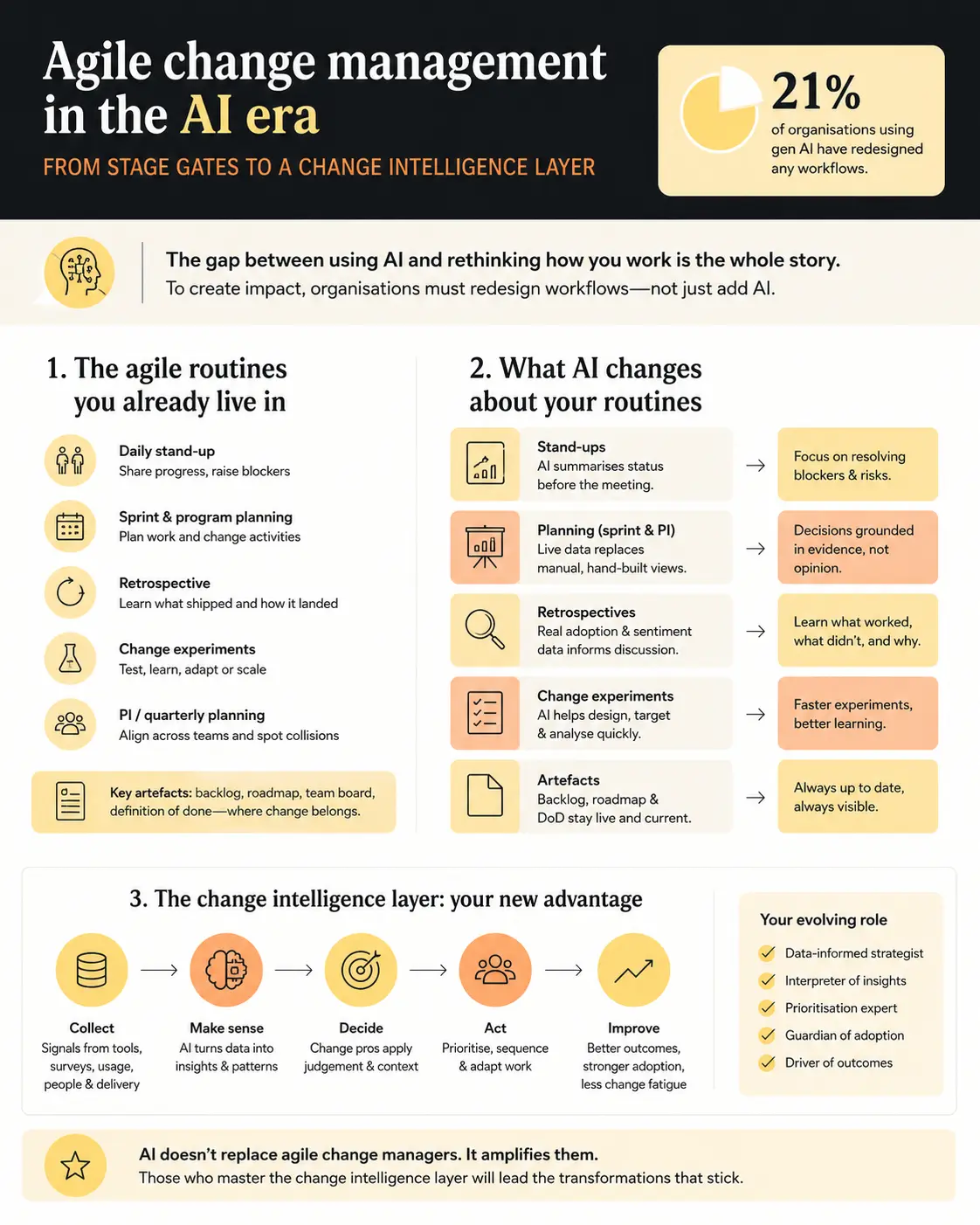
This is also where generic tools reveal their limits. As we argued in why generic AI tools fall short of an enterprise change intelligence platform, an AI with no access to your organisation’s structured change data can only give you faster generic summaries. The upgrade is not a cleverer model. It is the structured foundation underneath it. The companion argument, that the change manager increasingly becomes the steward and strategist of that data foundation, is developed in our piece on agile change management and the change intelligence layer; rather than repeat it here, the point for this article is simpler. You cannot steward or shape something you cannot reason about, which is why this design literacy is now a core skill rather than a nice-to-have.
Prosci’s own research reflects the same gap from the adoption side. In its early findings on AI in change management, it reports that a lack of AI literacy is a leading barrier to adoption, and that organisations increasingly expect adoption and value to be measured with real-time data throughout the life cycle rather than at the end. Both of those expectations land on the practitioner who understands how the system is built.
Skill three: Taste
The third skill is the hardest to name and the easiest to underrate. Call it taste. It is the judgment that decides, among many possible outputs that are all technically acceptable, which one is actually right for this audience, this moment, and this organisation. It shows up in design, and it shows up just as much in expression.
Taste has become a serious topic precisely because AI has made production abundant. When anyone can generate a hundred versions of a comms plan, a stakeholder deck, or a readiness narrative, the constraint is no longer making them. It is choosing well. A 2026 Forbes piece by Marcus Collins argued that when AI can make almost anything, taste becomes the last defensible advantage, a view echoed across a growing body of writing describing a shift from a creation economy to a “taste economy”, where value comes from editing and selection rather than raw output. For change professionals, this is not abstract. Taste is what separates a change story that lands from one that is accurate but inert.
Taste in design
In design terms, taste is the ability to look at three AI-generated options for a stakeholder heatmap, a change roadmap, or an adoption dashboard and know which one communicates and which one merely decorates. AI will happily produce a visually busy chart that technically contains the right data and completely fails to make the point. Taste is knowing that a single clear view beats a dense one, that the severity of an impact should be visible at a glance, and that a stakeholder skimming between meetings has thirty seconds, not thirty minutes. It is the editorial instinct for structure, hierarchy, and emphasis applied to the artefacts change managers actually use.
Taste in expression
Expression is where taste matters most and where AI most often falls short. The default register of generative AI is fluent, even, and generic. It has no ear for your organisation’s language, no sense of what will reassure a nervous middle manager versus what will convince a hard-nosed executive, and no instinct for what to leave unsaid. A change practitioner with taste knows when to cut three paragraphs to one sentence, when a plain declarative line will do more than a polished one, and when the AI’s confident phrasing needs to be softened because the reality on the ground is genuinely uncertain.
This connects to something we have written about at length. Change teams often present data at an awareness level when it needs to be decision-forcing, and they speak in their own idiom rather than the language of the business. Our article on why change teams need to speak executive language makes the case in full. Taste is the faculty that does this translation well. AI can draft the words. Only judgment tells you whether they are the right words for this reader.
The uncomfortable truth about taste is that it cannot be prompted into existence. It is built the slow way, through repeated exposure, deliberate attention, and genuine engagement with the craft over years. That is precisely why it is defensible. A practitioner who has run twenty transformations has a calibrated sense of what good looks like that no one can shortcut, and in an era of infinite cheap production, that calibration is worth more, not less.
How the three skills reinforce each other
These are not three separate competencies to develop in parallel. They form a chain. Design literacy tells you where an AI system is likely to be weak and where its output needs the hardest scrutiny. Attention to detail is how you apply that scrutiny, checking specifics against a real source of truth rather than trusting fluent prose. Taste is the final judgment that turns a corrected, verified draft into something genuinely fit to put in front of the project team, the stakeholders it affects, and, when it needs to go up, a sponsor.
Consider the impact assessment from the opening. Design literacy tells you the AI has no reliable access to cross-initiative load data, so its view of capacity is probably shallow. Attention to detail catches the merged stakeholder group and the invented training assumption. Taste decides that the corrected assessment, while accurate, buries its most important finding on page four, and moves it to the front where the project team and stakeholders will actually see it. Remove any one of the three and the artefact fails in a different way: unexamined, uncorrected, or accurate but ignored.
This is also why the old debate about whether AI replaces change managers misses the point. As we explored in what practitioners need to know about the future of the profession, the work does not disappear. It moves up a level, from producing artefacts to designing, verifying, and exercising judgment over them. The three skills here are the concrete content of that move.
How digital change tools support these skills
Two of the three skills depend heavily on your underlying data. Attention to detail is far faster when an AI’s claims can be checked against structured fields rather than your memory, and design literacy only translates into value when there is a real, structured data foundation for AI to read. This is where a dedicated change platform earns its place. Tools such as Change Compass capture impact, capacity, stakeholder load, and adoption as consistent, structured, and integrated data across the whole portfolio, which gives both you and any AI a single reliable source of truth to reason from rather than a scatter of disconnected files. The point is not that the tool replaces judgment. It is that good structured data makes your judgment faster and your checking more rigorous.
Where to start
If you want to build these skills, do not begin with a course on prompting. Begin with the habits that compound. Pick your next AI-assisted change artefact and read it against a real source of truth, checking every date, number, and named group before you trust a word of it. The next time an AI capability is proposed for your function, ask the four design questions: what data does it read, where are the human gates, how does it learn, and what can it access. And treat every artefact you send as a judgment call, not a transfer: decide what to cut, what to emphasise, and what to say plainly.
Attention to detail, design literacy, and taste are not the skills the AI era makes obsolete. They are the skills it makes decisive. Production has become cheap, and in a world of cheap production, the practitioners who thrive will be the ones who can tell the difference between output that looks right and work that is right.
Frequently asked questions
What change management skills matter most in the AI era?
The skills that separate valuable practitioners from fast producers of low-quality work are attention to detail, the ability to reason about how AI solutions are designed, and taste in both design and expression. These matter because AI has made producing change artefacts cheap, which moves value to judgment, verification, and selection rather than raw output.
Do change managers need technical AI skills?
Not in the sense of building or coding AI. Practitioners do need enough literacy to reason about how an AI solution is designed, including where human approval gates sit, how the system learns from real outcomes, what structured data it can read, and what it is allowed to access. These are governance and change questions expressed in technical language.
Why is attention to detail more important with AI, not less?
Because AI produces errors that look polished and confident, which removes the natural signals that used to prompt a careful review. Research on automation bias shows people tend to over-trust automated output and skim rather than verify. Deliberately increasing verification effort is one of the few things proven to reduce the chance of accepting a wrong answer.
What does “taste” mean for a change practitioner?
Taste is the judgment that chooses the right output among many acceptable ones. In design it is knowing which chart communicates rather than decorates. In expression it is knowing what to cut, what to emphasise, and how to speak in language that lands with a specific audience. AI can generate options, but taste decides which one is fit to use.
Can these AI-era skills be learned quickly?
Attention to detail and design literacy can be built through deliberate habits and asking better questions, and they improve relatively fast. Taste is slower, built through years of exposure and reflection, which is exactly why it is a durable advantage that AI cannot replicate for you.
References
- MIT NANDA, The GenAI Divide: State of AI in Business 2025
- Fortune, MIT report: 95% of generative AI pilots at companies are failing (2025)
- METR, Measuring the Impact of Early-2025 AI on Experienced Open-Source Developer Productivity (2025)
- AI & Society, Exploring automation bias in human-AI collaboration: a review and implications for explainable AI (2025)
- Marcus Collins, Forbes, When AI Can Make Anything, Taste Is The Last Defensible Advantage (2026)
- The VC Corner, Why Taste Is the New Moat
- Prosci, AI in Change Management: Early Findings
- Prosci, 8 Ways AI-Driven Change is Different