

Most change impact assessments describe an initiative that no longer exists by the time anyone reads them. The scope shifted after sprint two, the vendor changed the rollout order after sprint four, and the stakeholder group nobody flagged in the original assessment found out about the change from a colleague. None of this is a failure of the practitioner who wrote the assessment. It is a failure of the assumption underneath it: that impact can be captured once, at the start, and will still be true months later.
That assumption made sense when initiatives moved in long, sequential phases. It breaks down against the way organisations now deliver change: in sprints, in pilots, in staged rollouts, with scope that is deliberately expected to move as teams learn. This article is for change managers running that pace of delivery and for the leaders funding it, and it argues for a specific shift: impact assessment needs to become a continuous practice embedded in every iteration, not a document produced once and filed. It also sets out what that looks like in practice, how to keep it lightweight enough to survive inside an agile cadence without losing rigour, and how the data an organisation collects this way can compound into an asset that makes every future initiative faster to assess and safer to run. By the end, you should be able to name the trigger points that call for a fresh look at impact inside your own delivery cycle, and see where AI-based recommendations can carry some of that continuous workload for you.
The one-off impact assessment can no longer keep pace
For most of the discipline’s history, impact assessment has been an event. It happens once, early, usually as a gate before a steering committee will fund the next phase. A change manager interviews stakeholders, maps affected processes and roles, scores severity, and produces a document. That document becomes the reference point for the rest of the initiative, updated occasionally if something goes badly wrong, but rarely revisited on a schedule.
Iterations are shrinking, but the model hasn’t moved
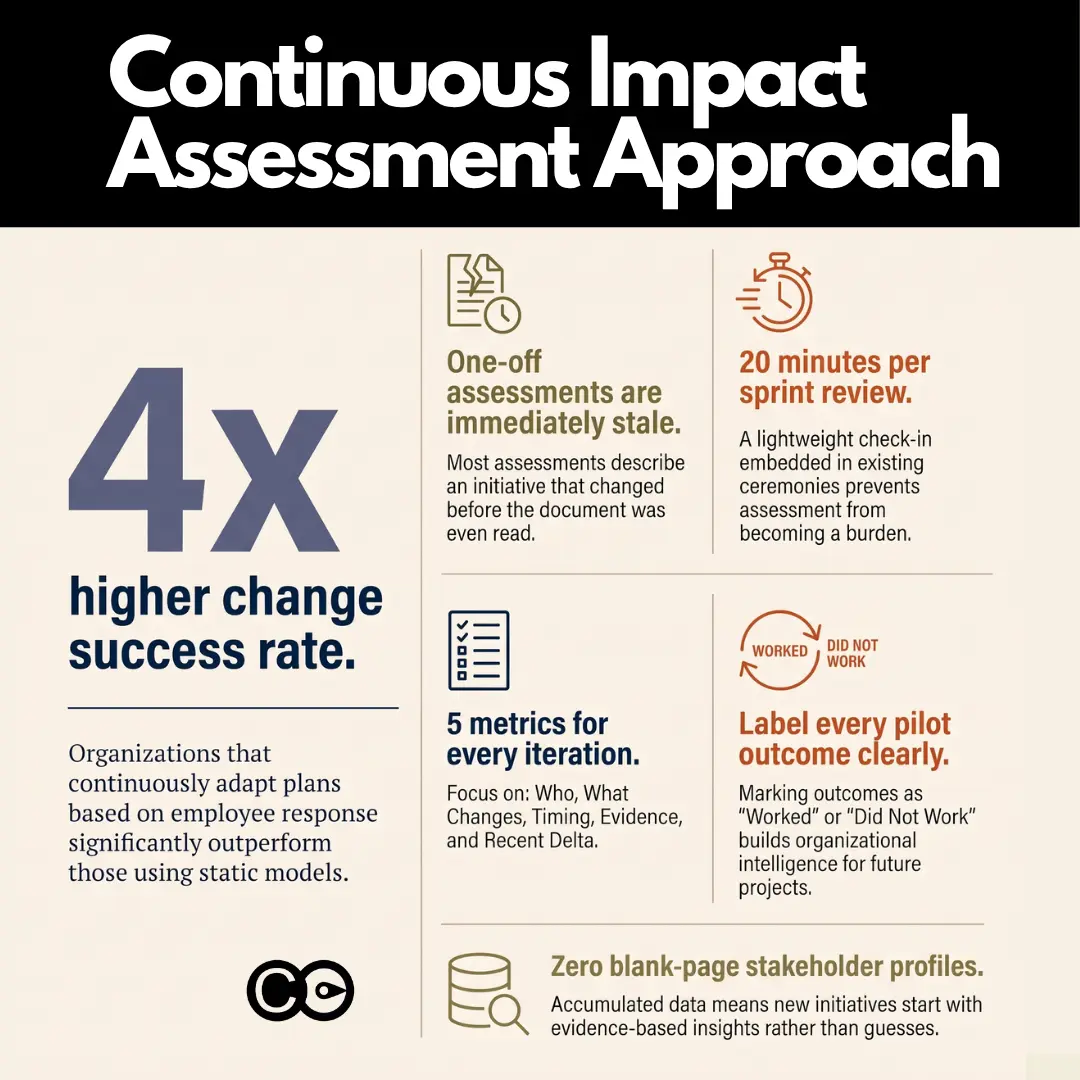
The initiatives that document is meant to describe no longer move the way the model assumes. Gartner’s July 2025 survey of 313 senior change leaders found that organisations which continuously or regularly adapt their change plans based on employee response are four times more likely to achieve change success than those running a static, set-once plan, a gap wide enough that it should worry anyone still treating impact assessment as a one-time gate rather than a standing practice (Gartner, Top Change Management Trends for CHROs in the Age of AI, 2026). Harvard Business Impact’s 2025 Global Leadership Development Study found something similar from the leadership side: 71% of senior leaders now say the ability to lead through constant change is critical, up from 58% just a year earlier, and the organisations coping best are the ones that have shifted from being merely change-ready to being change-seeking, building feedback loops into how they operate rather than reacting after the fact (Harvard Business Impact, Readiness Reimagined, 2025).
Put those two findings together and the direction is clear. The pace of iteration has moved past what an event-based impact assessment can track, and the organisations pulling ahead are the ones treating reassessment as routine rather than exceptional.
Part of why that pace keeps accelerating is that the software itself now ships faster. AI-assisted development tools have compressed build and release cycles that used to take months into weeks, so the systems and workflows a change initiative touches can shift shape multiple times within a single project timeline, not just at a handful of scheduled milestones. An impact assessment written against last month’s build is increasingly an impact assessment written against a system that no longer exists.
What’s actually breaking
The breakage is specific, and it repeats across organisations running agile delivery alongside a traditional change function:
- Scope drift outpaces the document. A backlog re-prioritised after two sprints changes who is affected and when, but the impact assessment was written against the original backlog.
- New stakeholder groups surface mid-flight. Pilots routinely reveal an affected team nobody named at kickoff, because nobody could have named them until the pilot ran.
- Severity changes, not just scope. An impact rated low at the design stage can become high once a pilot shows the workaround does not hold at scale, and the reverse also happens, where a feared impact turns out to be manageable.
- The steering committee sees a stale picture. Executives making resourcing decisions are working from the assessment as it stood at the last gate, not as the initiative stands today.
None of these are edge cases. They are what iterative delivery is designed to produce, because the entire point of running in short cycles is to let scope and approach change in response to what teams learn. An impact assessment process that cannot absorb that change without a full re-run is not built for the environment it is now operating in.
Take a claims-processing rollout run over six two-week sprints. The original impact assessment, written before sprint one, rated the change as low-severity for regional claims handlers because the plan called for a simple interface update. By sprint three, user testing showed the interface change also broke an informal workaround handlers relied on for complex claims, a workaround nobody had documented because it was never part of the official process. The severity rating that mattered was no longer the one written down. It was the one nobody had gone back to check.
What continuous impact assessment looks like in practice
Continuous does not mean assessing everything, all the time, from scratch. It means building a small number of trigger points into the delivery cadence itself, so that impact gets a fresh look exactly when the initiative has moved enough to justify one, rather than on a fixed calendar or not at all.
Useful triggers to build into your own cadence:
- End of every sprint or iteration where scope, sequencing, or the rollout approach changed
- Any point a pilot or experiment produces a result that contradicts the original assumption
- Introduction of a new stakeholder group, system, or dependency not in the original assessment
- A change in go-live date, geography, or business unit sequencing
- A shift in the delivery team’s confidence in the approach, even without a formal scope change
A minimum viable reassessment
A full impact assessment at every one of these trigger points would defeat the purpose, so the practical version is smaller and faster: a short, structured check against the original assessment, asking what changed, who is newly affected or no longer affected, and whether severity has moved. This can run in twenty minutes as part of a sprint review rather than as a standing project in its own right. The goal is not to reproduce the original document’s depth every time. It is to catch drift before it compounds into a surprise at go-live.
Building the cadence into the iteration itself
The mechanical part matters less than where it sits. If reassessment is a separate task someone has to remember to schedule, it gets skipped under delivery pressure, which is exactly when it is most needed. It works better folded into an artefact the team already reviews every cycle, such as the sprint review or the same retrospective where the delivery team looks at what did and did not go to plan. Change impact becomes one more question asked at a moment that already exists, not an additional meeting competing for calendar space.
A worked example
Back to the claims-processing rollout. If the reassessment trigger had been built into the sprint review from the start, the workaround issue would have surfaced in the sprint three review, not in a support-ticket spike two weeks after go-live. The twenty-minute check would have asked three questions against the original assessment: has anything changed in scope or approach, has any new group or workflow surfaced, and has severity moved for anyone already on the list. The answer to the second question, an undocumented workaround now at risk, is exactly the kind of finding a full upfront assessment cannot catch, because it did not exist to be found until the team was far enough into delivery to see it.
Lighter documentation, not lighter rigour
Agile ways of working come with a reasonable expectation that documentation gets lighter. Long-form artefacts written to justify a decision months later have limited value in an environment where the plan itself is expected to change. But lighter documentation is not the same claim as lighter rigour, and the two get conflated more often than they should.
Agile governance research is explicit on this point: good agile governance is lightweight and principle-based, not documentation-free, and organisations that treat “agile” as licence to skip structured checks tend to rediscover why those checks existed in the first place, usually at a worse moment than if they had kept them. Prosci’s research into applying ADKAR-style change frameworks inside iterative and hybrid delivery describes the same trade-off from the practitioner side: teams adapt by delivering guidance in shorter, more frequent, more targeted bursts and by starting reinforcement earlier, not by dropping the underlying discipline of identifying who is affected and how (Prosci, Aligning the ADKAR Model With Sequential, Iterative and Hybrid Change).
In other words, the expectation on a continuous impact assessment process is actually higher than on the old event-based one, not lower. You are being asked to identify every facet of impact accurately, on a tighter cycle, with less paperwork to hide gaps in. What “light but complete” needs to cover, every time:
- Who is affected, by role or team, not just by business unit
- What specifically changes in their day-to-day work, not a generic severity label
- When the impact lands relative to the current iteration, not the original project timeline
- What evidence supports the assessment, so a reviewer can tell a considered judgement from a guess
- What changed since the last check, so the delta is visible without re-reading the whole history
A one-page structured update that hits all five of those beats a comprehensive document that only gets written once. The format shrinks. The standard for accuracy does not.
Every iteration is a data point: Closing the project-level learning loop
Each sprint, pilot, or experiment is also a small trial of how people respond to a specific kind of change. Treated deliberately, that generates evidence a project can use as it goes, rather than only in a retrospective after the fact. The loop looks like this:
- Capture the intervention. Record what communication, training, or engagement activity accompanied this iteration, not just what shipped.
- Capture the response. Note readiness signals, adoption behaviour, or resistance that showed up during and after the iteration, ideally from more than one source (usage data, manager feedback, pulse checks).
- Label the outcome. Did the approach work as intended, partly work, or not work? This step gets skipped constantly because it feels like paperwork, but unlabelled outcomes cannot be learned from later.
- Feed it forward. Use the labelled outcome to adjust the plan for the next iteration, not just to inform a report someone reads after go-live.
The discipline here is closer to how a legal case gets argued than how a status report gets written: define the actual question the iteration is testing, look at the evidence for it on its own terms, and be willing to read the result against your own assumption rather than around it. That habit of testing a specific claim against specific evidence, one piece at a time, is worth deliberately building into how a change team reviews readiness and adoption decisions, not just how it runs an initial impact assessment (see our analytical rigour in change management piece for the full method). Skipping the labelling step is the single most common reason organisations run dozens of pilots and learn less than they should from any of them.
From project learning to portfolio intelligence
A learning loop inside one project is useful. The bigger opportunity is what happens when that same discipline runs across every initiative in the portfolio, because most of what a single project learns about stakeholder response, engagement effectiveness, and adoption patterns is directly relevant to the next initiative touching the same team.
This is where most organisations fall short today, not because the value is unclear but because the plumbing does not exist. Kyndryl’s 2026 People Readiness Report found that fewer than a third of organisations have a fully established change management programme, even as the majority have already scaled AI deployment across multiple functions, meaning most companies are running more change than their change practice can systematically learn from (Kyndryl, 2026 People Readiness Report). Separately, Gartner’s HR research found only 32% of business leaders report achieving healthy change adoption by employees, a figure that is hard to shift when every initiative starts its adoption assessment from a blank page instead of the organisation’s own accumulated evidence (Gartner, Just 32% of Business Leaders Report Achieving Healthy Change Adoption, 2025).
What should roll up from project level to portfolio level, if the plumbing exists:
- Stakeholder profiles. Which teams have absorbed heavy change recently, and how they tend to respond to different engagement approaches, carried forward rather than rediscovered on every new initiative.
- Engagement effectiveness patterns. Which interventions actually moved readiness for a given type of change, tested across enough initiatives to trust the pattern rather than one project’s anecdote.
- Readiness and adoption trends. Whether readiness typically lags or leads adoption for a given change type, and how far in advance that gives a team warning.
- Severity calibration. Whether initial severity ratings for a given kind of change tend to run high or low against what the pilot data eventually shows, so future assessments start closer to accurate.
This is the same argument we make in more depth on why continuous change intelligence, not stage-gated reporting, is what an agile operating model actually needs at the portfolio level (see agile change management in the AI era). None of it requires a new methodology. It requires treating the outputs of every impact assessment and every outcome label as structured data that outlives the project, sitting in a shared reference practitioners can draw on rather than in eleven separate spreadsheets that get archived and forgotten (we cover why a readiness assessment built on real signals beats a one-off survey in a companion piece).
Consider what that looks like for the regional claims handlers from the earlier example. Once their reaction to the interface change is captured and labelled, it becomes evidence available to the next initiative that touches the same team, whether that is a different system change or an unrelated process update landing six months later. Instead of a new change manager starting from a blank stakeholder profile, they start from a record showing this group is sensitive to workarounds not covered in official documentation, and that a short user-testing pass in sprint two catches issues a document-review-only assessment misses. That is the difference between a portfolio that learns and a portfolio that just accumulates completed projects.
Where AI-based recommendations fit
A continuous model creates a genuine workload problem. Reassessing at every trigger point, labelling every outcome, and rolling every pattern up to portfolio level is more work than most change functions can sustain by hand on top of everything else in the role, which is exactly the gap this future is likely to expose if the practice stays entirely manual.
This is the practical role for AI in the model this article has described: not doing impact assessment instead of a practitioner, but continuously watching for the trigger points and surfacing a recommendation before someone has to remember to look. The Change Compass, built as a change intelligence platform, works this way inside a live initiative: as the plan changes, activities move, or a milestone approaches, it re-evaluates the current recommendation, flags when a previous approval no longer matches the updated plan, and shows the evidence behind the update so a practitioner can approve it in one action or dig into the assumption it is challenging. When an outcome is confirmed or corrected after go-live, that label feeds back into the same evidence base the next recommendation draws on, which is how the portfolio-level learning described above actually accumulates instead of staying a good intention.
Where to start
You do not need a new methodology to start running impact assessment as a continuous practice. You need three decisions: which moments in your existing delivery cadence will trigger a reassessment, what the minimum viable version of that reassessment captures, and where the labelled outcome from each iteration goes once it is captured. Start with one active initiative, pick the sprint review as your trigger point, and run the five-point check from this article for a single cycle. The habit is more valuable than the tooling around it, and the tooling only pays off once the habit exists to feed it. The teams pulling ahead on change outcomes are not the ones with the most detailed original assessment. They are the ones who never let their assessment go stale.
Frequently asked questions
What is continuous impact assessment?
Continuous impact assessment is the practice of reassessing who is affected by a change and how, at defined trigger points throughout delivery, rather than once at project kickoff. It replaces a single upfront document with a running, lightweight update cycle tied to the same cadence the delivery team already uses.
How often should teams reassess change impact in agile delivery?
Rather than a fixed calendar, reassess at trigger points: end of any sprint where scope or sequencing changed, after a pilot produces an unexpected result, when a new stakeholder group or system surfaces, or when the go-live timeline shifts. For most teams this lands roughly every one to two sprints.
Does agile change management still need formal impact assessment?
Yes, and arguably more than a traditional approach does. Agile ways of working reduce documentation volume, but the underlying obligation to identify every facet of impact accurately does not shrink. What changes is the format: shorter, more frequent, evidence-backed updates rather than one long document.
How do experiment or pilot learnings feed a continuous improvement loop?
Each iteration’s intervention and response should be captured and explicitly labelled as worked, partly worked, or did not work, then used to adjust the next iteration’s plan. Skipping the labelling step is the most common reason pilots generate activity without generating learning.
What role does AI play in continuous impact assessment?
AI-based recommendations can continuously monitor an initiative for the conditions that should trigger a fresh look at impact, surface the evidence behind a suggested update, and carry outcome labels forward into a shared evidence base other initiatives can draw on. This keeps the continuous model sustainable for a change team that cannot manually re-check every initiative every week.
References
- Gartner: Gartner Identifies the Top Change Management Trends for CHROs in the Age of AI (2026)
- Harvard Business Impact: Readiness Reimagined, How to Build a Change-Seeking Culture (2025)
- Prosci: Aligning the ADKAR Model With Sequential, Iterative and Hybrid Change
- Kyndryl: 2026 People Readiness Report
- Gartner: Gartner HR Research Finds Just 32% of Business Leaders Report Achieving Healthy Change Adoption by Employees (2025)