

When two organisations merge, the deal team models one balance sheet, one synergy target, and one integration timeline. What the frontline actually inherits is two of everything: two sets of in-flight projects, two rollout calendars, two waves of system replacements, and two lists of “priority” initiatives that were already stretching people thin before anyone signed. The change that goes wrong after a deal is rarely a single badly run project. It is the collision of two change portfolios that nobody was holding in a combined view until integration was already underway.
This matters right now because dealmaking has not slowed. Companies spend trillions of dollars on acquisitions every year, and those integrations land on workforces across North America, Europe and Asia Pacific alike, all of them asked to keep the business running while they absorb someone else’s operating model. The pattern is global, and no market is exempt: PwC’s M&A outlook for Australia, for instance, describes resilient deal activity and rising inbound acquisition, the same dynamic playing out in dozens of other markets. Wherever the deal is signed, the strategy work gets the attention. The change work, done well, is what determines whether the synergies survive contact with the workforce.
This article is about a specific failure mode in change management for mergers and acquisitions: the doubling of change load across two organisations, and the practices that stop it from doubling the risk. It is not a generic post-merger integration overview, and it is not about restructuring and redundancy. It is about combining two live change portfolios so the value in the deal is not quietly eroded by disruption in the first year.
The failure nobody owns: Two change portfolios, one frontline
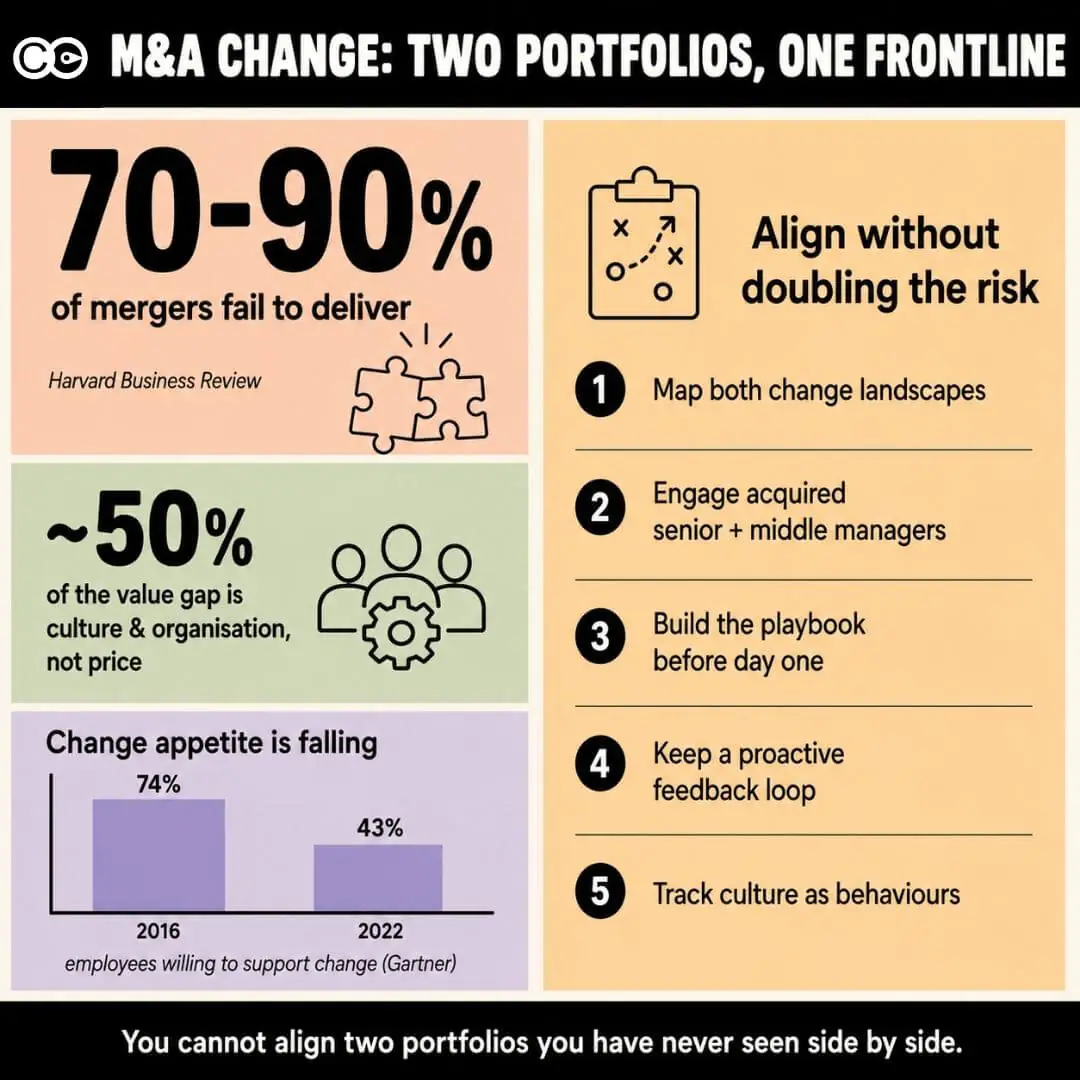
The headline statistic on mergers is grim and durable. Harvard Business Review’s New M&A Playbook put the failure rate at between 70 and 90 per cent, a range that has held across decades of research even as deal structuring has become more sophisticated. The reasons are less about price than most executives assume. McKinsey’s work on organisational culture in mergers finds that organisational issues, cultural differences and clashing operating models account on average for almost half of the shortfall between what a merger promised and what it delivered.
Sit with that. Half the value gap is people and organisation, not finance. And yet the accountability for that half is usually the most diffuse in the whole deal. The strategy team owns the thesis. The finance team owns synergies. Legal owns the close. But the question of what happens when both organisations’ change agendas land on the same people, in the same weeks, has no clear owner until the integration management office is stood up, which is often too late to prevent the first wave of disruption.
Why the deal model misses it
Diligence is built to find risk in the target: contracts, liabilities, customer concentration, systems. It is not built to find the interaction risk between the two organisations’ change workloads. A target might look perfectly healthy on its own, with a manageable set of initiatives and a workforce that is coping. The acquirer might look the same. The risk only becomes visible when you overlay the two calendars and see that the acquirer’s finance system migration hits the same quarter as the target’s restructure, on teams that are about to be merged and re-badged.
This is the same class of problem covered in our guide to change conflict detection, but with a sharper edge. In a single organisation, initiative clashes are hard enough to spot. In a merger, you are trying to detect clashes across two organisations that have never shared a planning system, a taxonomy, or a governance forum, and that may still be legally prohibited from sharing detailed operational data before close.
The doubling-the-risk trap
Here is the trap that gives this article its title. Leaders instinctively assume that combining two organisations combines two change agendas additively: portfolio A plus portfolio B. In practice the risk is not additive, it is multiplicative, because the two portfolios compound on a workforce whose capacity to absorb change is already under strain.
The evidence on that strain is stark. Gartner research reported in Harvard Business Review found that the proportion of employees willing to support enterprise change fell from 74 per cent in 2016 to just 43 per cent in 2022, while the average worker went from experiencing two major planned changes a year to ten. Change fatigue at those levels cuts an employee’s intent to stay by as much as 42 per cent and their performance by as much as 27 per cent. Now drop a merger on top of a workforce already at those numbers, and add a second organisation’s worth of change on top of that. The two portfolios do not just add up. They tip people over a threshold where adoption stalls, attrition rises, and the operational performance the deal was supposed to improve goes backwards.
Map the change landscape of both organisations before day one
You cannot manage a combined change load you have never measured. The first discipline of good change management for mergers and acquisitions is to build a shared, honest picture of what change is already live in both organisations, and when it peaks, before the two calendars collide.
Build a combined change portfolio view
The practical task is to construct a single view that lists every material initiative in both organisations, mapped to the business areas, functions and frontline teams each one touches. This is deliberately broader than the deal’s own integration workstreams. It has to include the “business as usual” change that will keep running regardless of the merger: the system upgrade the target had already committed to, the operating model refresh the acquirer started last year, the regulatory change both are subject to.
Getting this view is harder in a merger than in a single organisation because the two sides start with different taxonomies and, often, no dedicated tooling at all. A shared method for describing initiatives, impacts and affected populations is what makes the two portfolios comparable. Our buyer’s guide to change portfolio management tools walks through what separates a genuine portfolio view from a project tracker, which matters here because a merger is exactly the moment a spreadsheet stops coping.
A workable combined view captures, for every initiative:
- The functions and frontline teams affected, in both organisations
- The go-live or peak-activity window
- The size and nature of the behaviour change required
- Which initiative “owns” a team’s attention in any given month
- Whether the initiative continues, pauses, merges or stops as a result of the deal
Find the peak work volume periods that will collide
The single most useful output of the combined view is a timeline of peak work volume periods across both organisations. Change does not land evenly. It clusters around go-lives, end-of-financial-year, peak trading, regulatory deadlines and reporting cycles. When you overlay both organisations’ peaks, you will almost always find months where two or three heavy initiatives are scheduled to hit the same soon-to-be-merged team at once.
Those collision points are where the risk doubles, and they are also where you have the most leverage. Resequencing one initiative by six weeks, or holding a non-urgent rollout until after a peak trading period, costs almost nothing compared to the productivity and attrition cost of pushing a fatigued team past its limit. This is the merger-specific application of measuring change saturation: you are looking for the weeks where combined saturation crosses the threshold, and treating those as hard planning constraints rather than problems to be discovered after the fact. Pair that with a proper change readiness assessment of the acquired teams, measured with data rather than sentiment, and you have an evidence base for sequencing that a steering committee can actually act on.
Engage the acquired organisation’s leaders, not just its executives
Most integration communication plans are built around executives. The chief executive of the acquired business is retained or farewelled, the top team is confirmed, and a cascade is assumed. The assumption is where it breaks. The people who determine whether change actually lands are the senior and middle managers of the acquired organisation, and they are routinely under-engaged during the exact period when their influence matters most.
Middle managers are the load-bearing layer of any integration. They translate the deal narrative into what it means for a specific team, they hold the relationships that keep good people from leaving, and they absorb the ambiguity that would otherwise flow straight to the frontline. In a merger they are also the most exposed: uncertain about their own roles, asked to reassure teams they cannot yet give answers to, and often the last to be briefed. Engaging them properly is not a courtesy, it is risk management.
Doing it well means treating the acquired organisation’s managers as partners in the integration rather than recipients of it. In practice that means:
- Briefing senior and middle managers before, not after, their teams hear news that affects them
- Giving managers the context and language to answer the questions they will be asked, including permission to say “we don’t know yet”
- Involving acquired-side managers in the design of changes that affect their teams, not just the delivery
- Naming which managers own which parts of the integration on their side, so accountability is not all on the acquirer
- Protecting a portion of their time, because a manager cannot lead their team through change while also running the business at full capacity and sitting on integration workstreams
The organisations that get this right treat retention of the acquired middle layer as a leading indicator. If capable managers on the target side start leaving in the first six months, the deal is in trouble regardless of what the synergy tracker says.
Build the integration playbook before day one, not after
The strongest predictor of a controlled integration is that the playbook existed before close. Both Bain and Deloitte are emphatic on this point: integration planning should start during diligence, and day one should be treated as a readiness milestone reached through structured preparation, not a starting gun. As Bain frames it in its ten steps to successful M&A integration, day one is not the day you transform the company, it is the day you prove control. The best day one is uneventful: nothing breaks, no customer is surprised, and the organisation feels leadership is in command.
Reaching that requires a structured integration playbook owned by a body with authority and representation from both sides. Bain’s model of a dedicated integration management office, running to a weekly rhythm with a value tree, a KPI pack, an issue log and a risk heat map, is the mechanism. For the change dimension specifically, the equivalent is an integration committee with functional representatives from both organisations, so that every material function, HR, technology, operations, finance, customer, has a named owner on each side who is accountable for the change in their area.
A change-focused integration playbook, ready well before day one, should include:
- The combined portfolio and saturation view, with collision points flagged and a resequencing plan for the worst of them
- A day-one readiness checklist per function, defining what “in control” means in concrete, testable terms
- A 30, 60 and 90 day plan that tracks adoption and disruption, not just task completion
- A decision log and escalation path, so cross-organisation clashes are resolved at the committee rather than fought out on the frontline
- A clear scope of what continues, pauses, merges or stops on day one, agreed by both sides in advance
- Owned communication and feedback rhythms (covered in the next section) built into the calendar from the start
The committee structure matters as much as the document. A playbook written entirely by the acquirer, imposed on the target, recreates the cultural clash that McKinsey identifies as a leading cause of failure. Functional representatives from both sides give the plan legitimacy and surface the operational realities that an outside acquirer simply cannot see.
Keep the feedback loop open: Town halls, briefings, and honest updates
A playbook built before day one is a hypothesis. What makes it survive contact with reality is a proactive feedback mechanism that runs continuously through the integration, so that the plan adjusts to what is actually happening rather than what was assumed months earlier.
The instinct in a merger is to control information tightly and communicate in set-piece announcements. That instinct is understandable and, past the legal necessities of the close, actively harmful. In an information vacuum people assume the worst, and the best people, the ones with options, leave first. The antidote is a predictable, two-way rhythm of engagement that treats employees as adults who can handle uncertainty better than silence.
That rhythm should be designed, not improvised, and it should run on a known cadence so people know when the next update is coming even if the answer is “no change yet”. A practical feedback and engagement structure looks like:
- Regular all-hands town halls on a fixed schedule, mixing genuine updates with unscripted question time, and repeated across time zones so distributed and remote teams in every region are not an afterthought
- Functional briefing sessions run by the integration committee representatives, translating the enterprise message into what it means for each team
- Manager cascades with supporting material, so the acquired organisation’s managers can brief their own people first-hand
- Lightweight pulse checks that measure sentiment, confidence and perceived workload frequently enough to catch problems while they are still small
- A visible feedback loop, where the organisation shows what it heard and what it changed in response, because feedback that disappears trains people to stop giving it
The purpose of all of this is not communication for its own sake. It is early warning. A middle manager voicing frustration in a briefing, or a pulse check showing confidence dropping in one integrated business unit, is a signal to act before disruption shows up in operational metrics. Minimising disruption is a function of how fast you notice and respond, and that speed depends entirely on keeping the feedback channel open and trusted.
Track cultural change through behaviours, not values statements
Culture is the part of integration that executives say matters most and measure least. McKinsey found that 95 per cent of executives describe cultural fit as critical to integration success, while a quarter cite the lack of cultural cohesion as the primary reason integration efforts fail. The gap between how important culture is and how rigorously it is managed is where a great many deals quietly come apart.
The reason culture is so often mismanaged in mergers is that it gets treated as an abstraction, a matter of values posters and all-hands slogans, rather than as observable behaviour. You cannot track “we value collaboration”. You can track whether decisions that used to require three approvals now require one, whether cross-organisation teams are actually meeting, or whether the acquired organisation’s people are still being cc’d out of decisions six months in.
The discipline is to define the small number of behaviours and ways of working that the combined organisation genuinely needs, and then measure whether they are showing up. Focus on the vital few, not an exhaustive culture map. A workable approach to assessing and tracking cultural change:
- Name the top behaviours the integrated organisation depends on, ideally five or fewer, stated as concrete actions rather than values
- Baseline them early, in both organisations, so you know where each side is starting from and where the real gaps are
- Track them at intervals, using a mix of pulse data, observable indicators and manager assessment, on the same cadence as the rest of the integration
- Feed the results back into the integration committee, so culture is a standing agenda item with an owner, not a survey that gets filed
- Act on the outliers, where one business unit or function is clearly diverging, before divergence hardens into a permanent us-and-them split
Behaviour-based cultural tracking also gives you an honest read on whether the engagement, feedback and playbook work described above is landing. If the target behaviours are not shifting, no amount of positive town-hall sentiment means the integration is working.
How digital change tools support the combined view
Everything above depends on holding two organisations’ change activity in a single, current picture, and keeping it visible to the people making sequencing and engagement decisions. That is difficult to sustain in spreadsheets, and it is precisely difficult at the moment a merger creates the most complexity. A digital change management platform such as Change Compass is built to hold a combined portfolio view, surface saturation and collision points across business units, and give an integration committee a shared, data-based source of truth rather than two competing versions of reality. The tooling does not replace the disciplines in this article, but it makes them practical to run at merger scale and speed.
Where the risk actually compounds
The through-line of change management for mergers and acquisitions is that the danger is not in either organisation’s change agenda on its own. It is in the combination: two portfolios landing on shared teams, at overlapping peaks, on a workforce whose tolerance for change is already low. Deals fail on that compounding far more often than they fail on price.
The organisations that beat the odds do the unglamorous work early. They build a combined view of both change landscapes before day one. They engage the acquired organisation’s senior and middle managers as partners, not audiences. They stand up an integration committee with representation from both sides and a playbook ready before close. They keep a proactive feedback loop running through the whole integration. And they track culture as behaviour, not sentiment. None of it is exotic. All of it is easier to skip than to do, which is exactly why so few do it, and why the ones who do capture the value everyone else leaves on the table. Start with the combined view. You cannot align two portfolios you have never seen side by side.
Frequently asked questions
What is change management in mergers and acquisitions?
Change management for mergers and acquisitions is the practice of guiding people, behaviours and change workload through the integration of two organisations so the deal’s value is realised rather than eroded by disruption. It focuses on combining two live change portfolios, engaging both organisations’ leaders, and managing the cumulative load on shared teams, which is distinct from the strategy and financial work of the deal itself.
Why do most mergers and acquisitions fail?
Research summarised by Harvard Business Review puts the M&A failure rate at 70 to 90 per cent, and McKinsey attributes almost half of the gap between expected and realised value to organisational issues such as culture, operating-model clashes and poor integration. Price and diligence matter, but the people and change dimension is where most deals underdeliver.
When should change management start in an M&A deal?
It should start during diligence, well before legal close. Integration specialists including Bain and Deloitte treat day one as a readiness milestone reached through structured pre-close preparation, not a starting point. Building the combined change portfolio view and the integration playbook before day one is the strongest predictor of a controlled integration.
How do you manage change fatigue during a merger?
Map the peak work volume periods across both organisations, identify where initiatives collide on shared teams, and resequence or pause non-urgent changes at those collision points. Because employee willingness to support change has fallen sharply and the average worker already faces around ten major changes a year, treating combined saturation thresholds as hard planning constraints is essential to keeping teams functioning.
How do you measure cultural integration after a merger?
Define the small number of behaviours and ways of working the combined organisation needs, baseline them in both organisations early, and track them at regular intervals using pulse data, observable indicators and manager assessment. Measuring specific behaviours rather than abstract values gives an honest read on whether the two cultures are genuinely converging.
References
- Christensen, C. et al., The Big Idea: The New M&A Playbook, Harvard Business Review, 2011 (seminal source for the 70-90% failure range, still widely cited)
- McKinsey & Company, Organizational culture in mergers: Addressing the unseen forces
- Gartner research reported in Employees Are Losing Patience with Change Initiatives, Harvard Business Review, 2023
- Bain & Company, The 10 Steps to Successful M&A Integration
- Bain & Company, Post-Merger Integration (PMI) consulting
- PwC Australia, Australian M&A outlook and industry insights