

Every lawyer I have engaged over the course of my career has done the same disconcerting thing in the first meeting: they refused to accept my version of the problem. I would arrive with a situation already framed, a conclusion half-formed, and a preferred outcome. They would put all of that to one side and start somewhere much slower. What exactly is the question here? What are its parts? What does the evidence actually say about each part, one piece at a time, before we decide anything?
That habit used to frustrate me. Now I think it is the single most transferable skill I have watched a professional practise, and it is the one change and transformation practitioners most need to borrow. This article is for change managers, transformation leads and the executives who sponsor them. The argument is simple: lawyers are trained to decompose a complex problem into its elements and test each element against the evidence, and change practitioners can apply that same discipline far more widely than they currently do. By the end you will have a diagnostic method you can use across the change lifecycle, and a clear view of where artificial intelligence genuinely helps you apply it. Analytical thinking is now the skill employers rank above almost every other, and change work is overdue a more rigorous relationship with it.
Why analytical rigour is suddenly the skill that matters
The timing is not incidental. In its Future of Jobs Report 2025, the World Economic Forum found analytical thinking to be the most sought-after core skill among employers worldwide, with roughly seven in ten companies treating it as essential. Independent coverage of the same research confirmed that analytical thinking again topped the list ahead of resilience, flexibility and leadership.
For a profession that has spent two decades defending its value, this should land as good news and as a warning. Change management has always claimed to be evidence-led. In practice, a lot of change work still runs on assertion: a readiness rating that reflects the mood in the room, a stakeholder plan built from an org chart rather than from data, an intervention chosen because it worked somewhere else. As generative tools make it trivial to produce confident-looking change artefacts at speed, the differentiator stops being production and becomes judgement. The practitioner who can take a messy transformation problem apart and reason about it cleanly will be worth far more than the one who can generate a plausible plan in thirty seconds. That analytical capability sits alongside the other under-discussed skills we have written about in the change management skill set for the AI era.
How a lawyer takes a problem apart
Watch a good litigator work and you see a repeatable method, not improvisation. Law schools teach a version of it under the acronym IRAC: Issue, Rule, Application, Conclusion. The American Bar Association describes IRAC as the structure that underpins nearly all legal analysis, and its logic maps almost perfectly onto change diagnosis. Three moves inside it are worth stealing outright.
Define the actual problem, not the presenting one
The first thing a lawyer does is resist the framing you hand them. The client who says “I have a contract problem” might actually have an evidence problem, or a jurisdiction problem, or no viable claim at all. Precision about the real question comes before any analysis, because the wrong question produces a confidently wrong answer.
Change practitioners skip this more often than they admit. A sponsor says “we have an adoption problem” and the team leaps to training and communications. But low adoption might be a capability problem, a workload problem, a conflicting-incentives problem, or a symptom of three other initiatives hitting the same team in the same month. Naming the wrong problem wastes the entire intervention. McKinsey’s long-running research on transformation found that fewer than one in three transformations succeed at both improving performance and sustaining it, and a recurring cause is effort aimed at the wrong target: activity mistaken for outcome, symptoms mistaken for causes.
Break the question into its elements
Once the issue is defined, a lawyer decomposes it into the elements that must each be satisfied. To prove negligence you need duty, breach, causation and damage. Each is a separate sub-question with its own evidentiary test. You cannot wave at the whole and declare it proven; you work element by element.
This is the move change work borrows least often outside of impact assessment. “Is this organisation ready?” is not one question. It is a bundle: does leadership visibly sponsor the change, do affected teams have the capacity to absorb it on top of everything else, do people have the capability, is the operating environment stable enough, are the incentives aligned? Treated as a single gut-feel rating, readiness tells you almost nothing. Decomposed into elements, each with its own evidence, it becomes a diagnosis you can act on.
Test each element against the evidence, one piece at a time
The part I find most instructive is the pace. A lawyer does not evaluate all the evidence at once and form an impression. They take each element and ask what the documents, the timeline and the testimony actually establish about that specific point, considering the contrary reading before settling. Weak evidence on one element is not averaged away by strong evidence on another. It is flagged as the exposure it is.
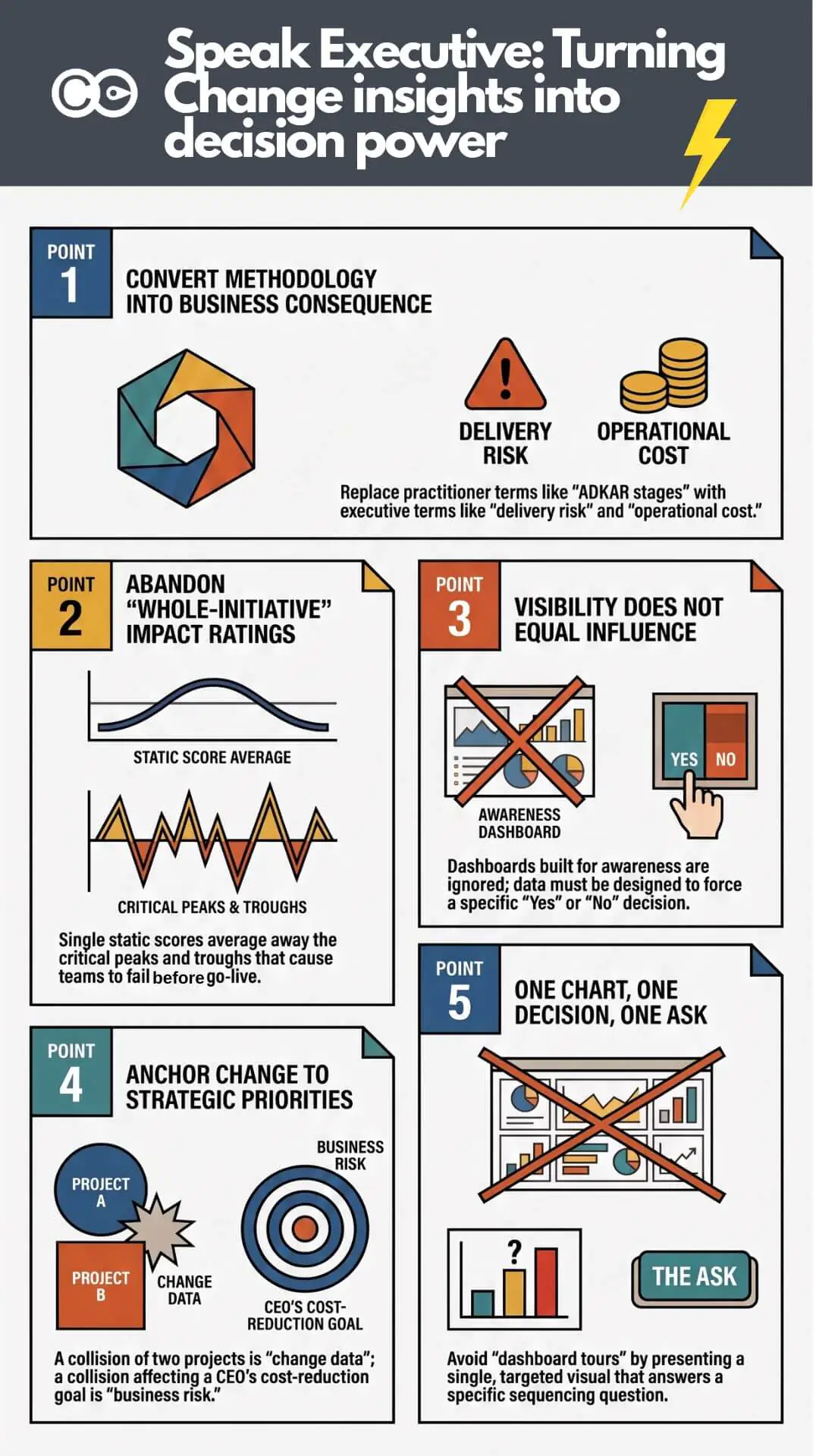
Change diagnosis tends to do the opposite. We blend everything into a single traffic-light status and lose the detail that mattered. A whole initiative rated amber hides the fact that one business unit is deep red and another is green. Rigour means resisting the premature average and looking at the evidence for each element on its own terms.
Where change practitioners already reason like this
To be fair to the profession, there is one area where change managers already apply genuine analytical discipline: the change impact assessment. Done properly, an impact assessment is exactly the lawyer’s method in disguise. You take a change, break it into the specific shifts it imposes (process, system, role, structure, behaviour), and assess each against the affected groups. You do not declare “this is a big change” and move on; you itemise what changes for whom.
That itemising instinct is the strength to build on. If you can decompose a change into its impacts, you already have the muscle to decompose readiness, stakeholder engagement, intervention choice and adoption the same way. The tragedy is that the rigour usually stops once the impact assessment is filed. The rest of the lifecycle reverts to intuition. Our guide to conducting a change readiness assessment with data rather than surveys alone is really an argument for extending the impact-assessment discipline into the readiness question.
Where the rigour runs out, and how to restore it
Here is where I want to be specific, because “be more analytical” is useless advice on its own. There are four diagnostic decisions across the change lifecycle where practitioners routinely substitute assertion for evidence, and each can be rebuilt element by element.
- Change readiness. Instead of a single readiness score, break it into sponsorship, capacity, capability, environment and incentives. Attach evidence to each: sponsorship measured by leaders’ visible actions and diary time, not their stated commitment; capacity measured by how much other change the same people are already carrying.
- Stakeholder engagement. Instead of an influence-interest grid drawn from memory, decompose engagement into who is actually affected, how heavily, when, and whether their behaviour is shifting. An org chart tells you who exists. It does not tell you who is overloaded or disengaging.
- Intervention choice. Instead of reaching for the familiar training-and-comms package, ask which specific element of the problem each intervention addresses, and what evidence says it will move that element. A communication campaign does not fix a capacity problem.
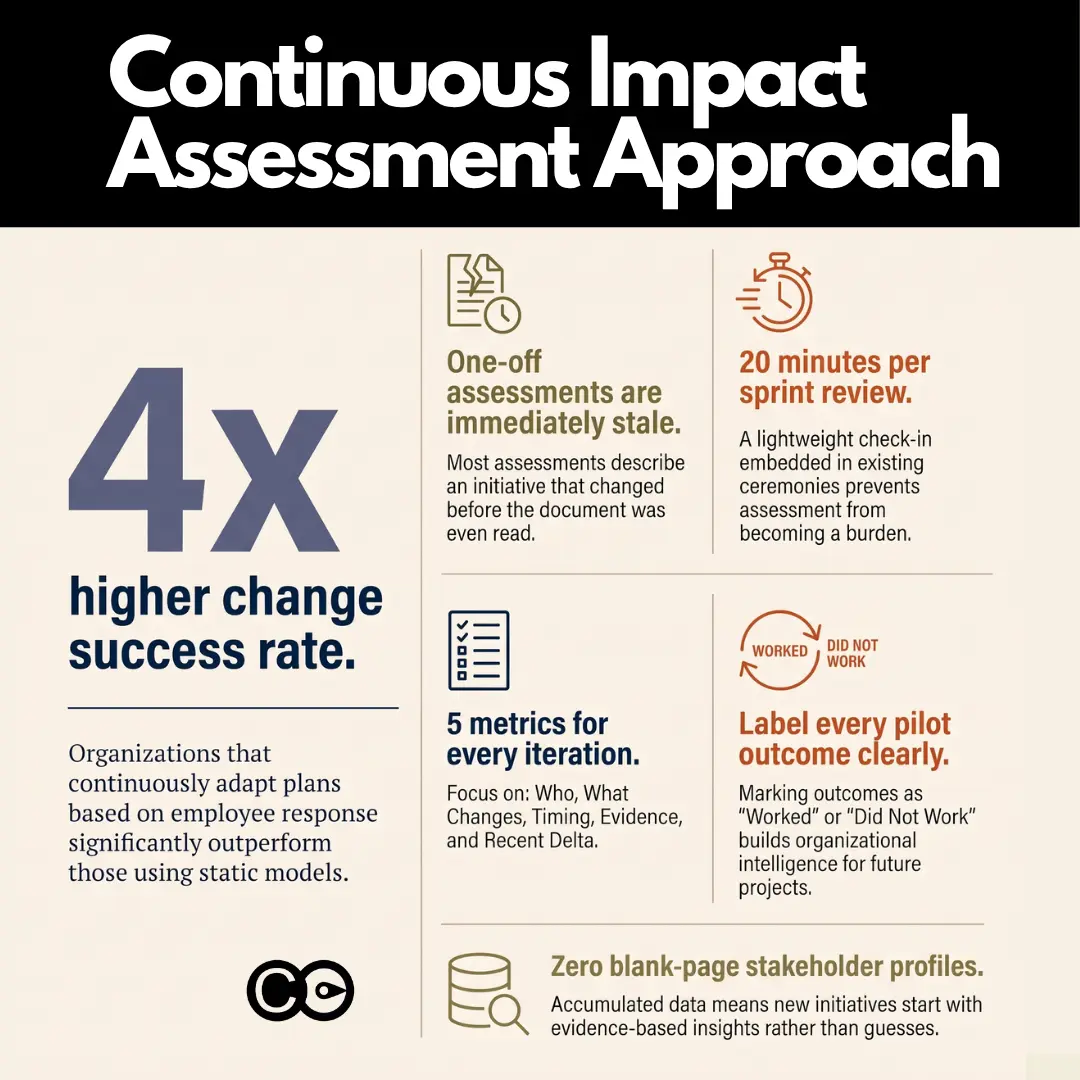
- Measuring success and adoption. Instead of declaring victory at go-live, define in advance what evidence would show the change has actually been adopted and sustained, and track it. Organisations that tracked defined metrics through implementation succeeded far more often than those that did not.
The unifying idea is that each of these is a bundle of elements masquerading as a single judgement. Pull them apart, demand evidence for each, and refuse the premature average.
The premature average is the enemy
If there is one anti-pattern to name, it is the single blended rating. A lawyer would never tell a court “the case is roughly 70 per cent strong”. They would say the duty element is clearly met, breach is contested, and causation is the exposure. Change reporting is full of roughly-70-per-cent statements: one amber dot for an initiative that is thriving in one division and failing in another, one readiness percentage that averages a committed executive with an exhausted frontline. The average feels responsible. It is actually where the signal goes to die.
Consider the contrary reading
The other habit worth importing is the lawyer’s discipline of arguing the other side. Before concluding, they test how the evidence reads against them. Change teams, invested in the change succeeding, rarely do this. Ask deliberately: what would I expect to see if this initiative were in trouble, and do I see it? Framing the disconfirming question is how you catch the missed impact before it lands, which is the whole premise behind detecting change conflicts across initiatives before they derail delivery.
A worked example: The adoption problem that was not
A few years ago I watched a transformation team wrestle with what everyone called an adoption problem. A new system had gone live across a large operations function, usage was well below target, and the reflex was predictable: more training, more communications, a fresh round of floor-walking. The presenting problem had been accepted whole, and the intervention followed automatically from it.
Run the lawyer’s method over the same facts and it comes apart. State the real question: not “how do we lift adoption” but “why are trained, informed people not using the system”. Decompose it: is it a capability gap, a workload gap, an incentive conflict, or a design issue in the system itself? Attach evidence to each, separately. Training completion was high, which weakened the capability explanation. Usage was lowest precisely in the teams carrying two other major changes that quarter, which pointed hard at capacity. And the frontline consistently reported that the new workflow took longer than the one it replaced, which is an incentive-and-design problem no communications campaign can touch.
The disconfirming question sealed it: if this were genuinely a training-and-awareness problem, usage would be uniformly low, but it was not, it tracked capacity almost exactly. The diagnosis was never adoption in the abstract. It was that overloaded teams were rationally protecting their time from a tool that cost them more than it gave. The evidence had been available the whole time. What was missing was the discipline to look at it element by element instead of averaging it into a single red number and reaching for the usual response.
A diagnostic method you can use today
Pulling this together, here is a five-step routine you can run on any change decision, borrowed wholesale from how a lawyer approaches a brief.
- State the real question in one sentence. Not the presenting complaint. The actual decision you are trying to make. Write it down and pressure-test it before going further.
- Decompose it into elements. List the specific sub-questions that must each be answered for the whole to hold. Readiness becomes five elements; adoption becomes a set of observable behaviours.
- Attach evidence to each element separately. For every element, note what evidence you have, how strong it is, and where it is thin. Resist blending.
- Argue the contrary case. For your emerging conclusion, ask what you would expect to see if you were wrong, and check whether you see it.
- Conclude at the element level, then aggregate transparently. State which elements are solid and which are exposures, and only then form an overall view, keeping the weak elements visible rather than averaged away.
None of this requires a law degree. It requires the willingness to slow down at the point where change work usually speeds up, and to treat a diagnosis as something you build from evidence rather than something you assert from experience.
What AI changes: Rigour at a scale a human cannot reach
There is a natural objection to everything above: this level of rigour is expensive. Decomposing every decision into elements and hunting evidence for each is exactly the painstaking work a busy practitioner does not have time for. This is where the current wave of technology earns its place, and it is worth being precise about what it actually does rather than gesturing at “AI”.
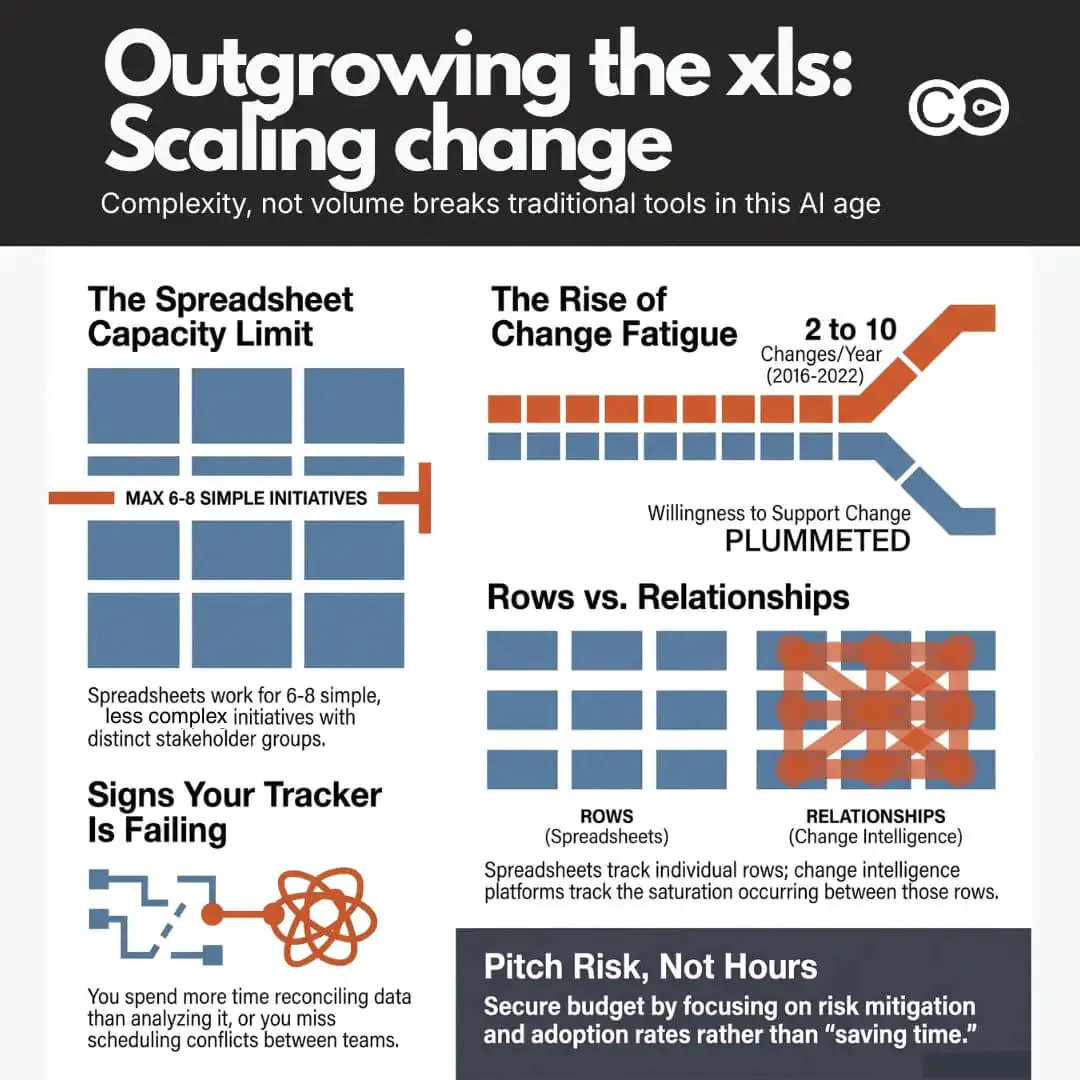
The value is not that a model can write a readiness report. It is that a system holding your organisation’s own change history can do three things a human analyst cannot do at scale. It can draw on the historical record, showing how similar changes actually played out for similar teams in your organisation, so a readiness judgement rests on precedent rather than optimism. It can benchmark against what has worked and what has not, so an intervention is chosen against evidence of effectiveness rather than habit. And it can aggregate evidence across an entire portfolio continuously, surfacing the overloaded team or the colliding initiatives that no manual process would catch in time.
This mirrors legal practice more than it might seem. Precedent is the lawyer’s benchmark data. A litigator reasons from what courts have actually done in comparable cases, not from first principles each time. A change intelligence system gives practitioners their own version of precedent: a searchable, structured record of how change has landed before. The rigour is still yours. The technology removes the excuse that there was no time to be rigorous. It is also why generic tools fall short here: a model with no access to your organisation’s structured change data has no precedent to reason from, a point we have made at length about why generic AI cannot substitute for a purpose-built change intelligence platform.
Where a change intelligence platform fits
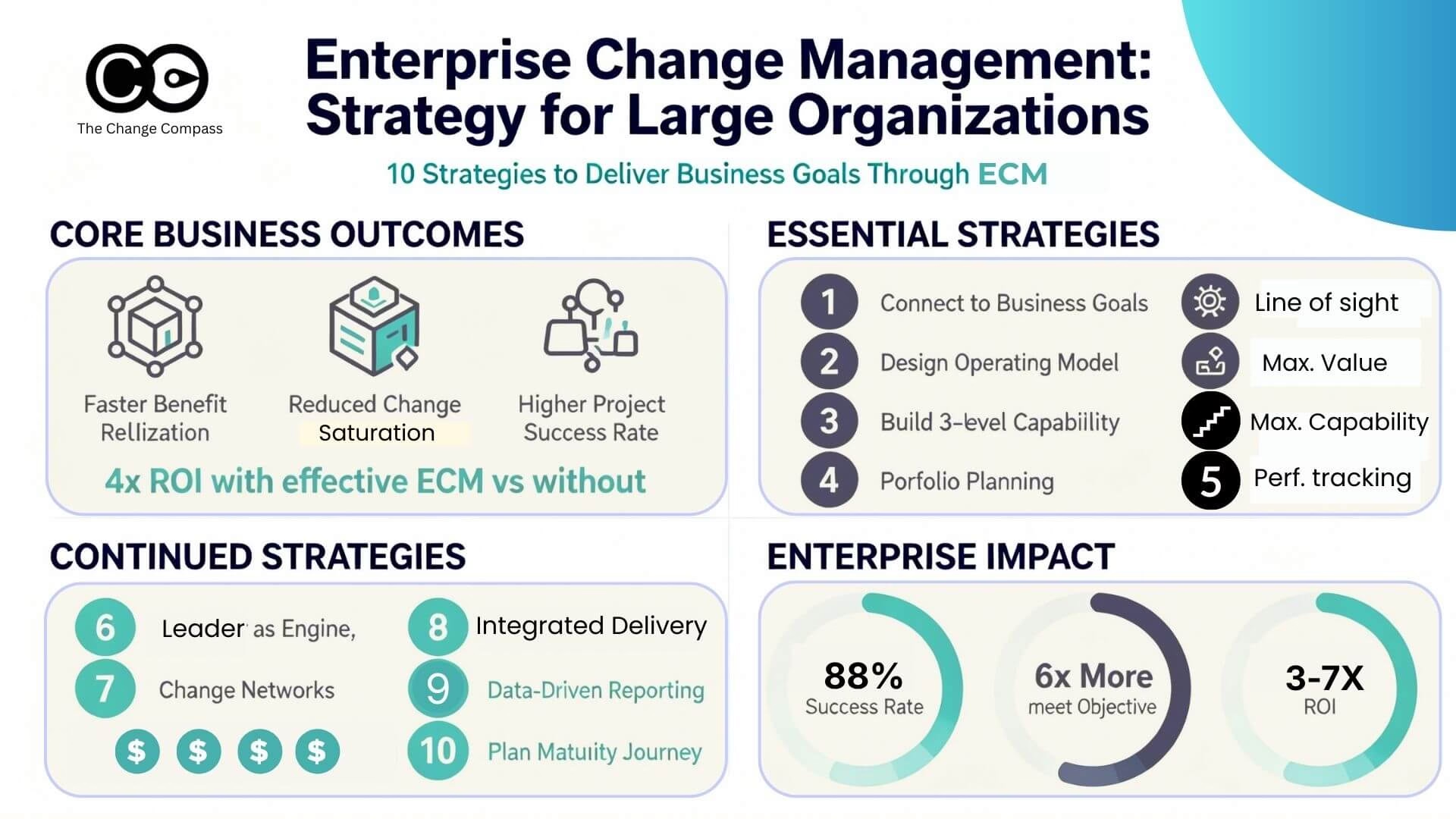
This is the problem Change Compass exists to solve. As a change intelligence platform, it holds the structured record of change across an organisation and shows both sides of the equation: your teams’ capacity to deliver change, and the business’s capacity to receive it. That two-sided view is exactly the decomposition this article argues for, made continuous and visible rather than assembled by hand for a single assessment. It lets a practitioner reason from evidence about readiness, collisions, engagement and adoption across the whole portfolio, and translate that evidence into terms an executive will act on. The discipline is the lawyer’s; the platform is what makes it sustainable at enterprise scale.
Where to start
If you take one thing from how lawyers work, make it this: never accept the problem as it was handed to you, and never let a single rating stand in for evidence you have not examined. Pick the next significant change decision on your desk, whatever it is, and run the five-step routine on it before you act. State the real question. Break it into elements. Find the evidence for each, separately. Argue the other side. Conclude transparently, with the exposures still showing. It will feel slower the first time and faster every time after, because you will stop solving the wrong problem. Analytical thinking is the skill the market is now paying for, and change is the domain that stands to gain the most from practising it properly.
Frequently asked questions
What are analytical skills in change management?
Analytical skills in change management are the ability to break a complex change problem into its component parts, attach evidence to each part, and reason to a conclusion rather than assert one. In practice this means decomposing questions like readiness or adoption into specific, evidenced elements instead of relying on a single intuitive rating.
Why is analytical thinking considered a critical skill for change practitioners?
The World Economic Forum’s Future of Jobs Report 2025 ranks analytical thinking as the most sought-after core skill among employers globally. As AI makes it easy to produce change artefacts quickly, the differentiating skill shifts from producing plans to judging them, which depends on rigorous analysis.
How can change managers apply legal reasoning to their work?
Borrow the lawyer’s sequence: define the real question precisely, decompose it into elements that each need to be satisfied, test each element against the evidence one at a time, argue the contrary case, and conclude at the element level before aggregating. This applies to readiness, stakeholder engagement, intervention choice and adoption, not just impact assessment.
Does AI replace analytical skills in change management?
No. AI removes the time constraint that stops practitioners being rigorous, by drawing on an organisation’s historical change records and benchmark data at a scale no individual could manage. The judgement about what the evidence means remains human. Generic AI without access to your organisation’s own change data has no precedent to reason from.
What is the most common analytical mistake in change diagnosis?
The premature average: collapsing many distinct elements into a single blended status, such as one amber rating for an initiative thriving in one division and failing in another. It feels responsible but hides the exact signal that matters. Rigorous diagnosis keeps the weak elements visible rather than averaging them away.
References
- World Economic Forum, The Future of Jobs Report 2025: analytical thinking ranked the most sought-after core skill, essential for roughly seven in ten employers.
- FM Magazine (AICPA & CIMA), Analytical thinking remains top core skill for employers, February 2025.
- American Bar Association, Legal Reasoning? It’s All about IRAC: the Issue, Rule, Application, Conclusion method of legal analysis.
- McKinsey & Company, The science behind successful organizational transformations: fewer than one in three transformations succeed at improving and sustaining performance.
- McKinsey & Company, The data-driven enterprise of 2025: the shift to evidence-based decision-making as standard practice across the organisation.