

Most change plans are built the same way. Someone maps out the training, the communications, the workshops and the go-live support needed for the change, then trims that same list down as it moves up the organisation chart. Frontline staff get the full programme. People leaders get a condensed version. Executives get a briefing deck and a project update in the steering committee.
We recently analysed activity data spanning tens of thousands of initiative impacts, looking specifically at what kind of change activity each stakeholder group actually receives, not just how much. The pattern that emerged does not support the “same plan, smaller portion” model at all. Executives, people leaders, specialists, frontline staff and external partners are not getting a scaled version of the same experience. They are getting fundamentally different kinds of support, and in some cases, that difference looks less like intentional design and more like an oversight with real consequences for adoption.
This matters because most change practitioners already sense that different stakeholders need different treatment. What the data adds is specificity: which groups are getting trained but rarely reinforced, which are getting plenty of activity labelled “engagement” that is actually one-way, and which group is getting almost nothing at all. One of those findings, in particular, points to a structural gap that is easy to miss and expensive to leave unaddressed.
The assumption behind most stakeholder plans
Ask a change manager how their plan differs by stakeholder group and most will describe a cascade: senior leaders get briefed first, then the message and the supporting materials flow down through people leaders to frontline teams, getting shorter and more operational at each step. This is a reasonable model for communication. It is a poor model for change activity more broadly, because communication is only one of several distinct things a change plan can offer a stakeholder group: training, two-way engagement, go-live support, and post-launch reinforcement are different interventions with different purposes, and they do not scale down uniformly.
The cascade model implicitly assumes that what changes between stakeholder groups is depth and detail. What the data shows is that what actually changes is the type of activity a group receives, and that type is not always the right one for what that group needs to do differently.
What the data shows about activity mix by stakeholder group
Looking across many initiatives and pooling activity records by stakeholder archetype (frontline staff, people leaders, specialists, executives, and external partners), a clear and consistent pattern emerges in which activity types each group is most likely to receive.
- Frontline teams are the group most likely to get formal training, and increasingly, some form of post-launch reinforcement once the change has gone live. Communication and training dominate their experience, with meaningful support extending after go-live in a substantial share of cases.
- People leaders sit in an unusual position. They receive training at a moderate rate, but reinforcement after go-live and hands-on engagement both drop away sharply compared to frontline staff. Their plan is front-loaded and largely stops there.
- Specialists and subject matter experts get a more balanced mix: solid training, and the highest rate of interactive, workshop-style engagement of any internal group, consistent with their role in shaping how a change actually gets implemented.
- Executives are rarely formally trained. Instead, their change experience is dominated by activities tagged as engagement, briefings, updates and consultation, which makes sense given their role is to endorse and champion rather than execute.
- External partners and vendors stand out for the wrong reason. They receive almost no interactive engagement of any kind. When they do appear in a change plan, it is overwhelmingly as a one-way communication or compliance touchpoint.
Not all “engagement” is the same
That word, engagement, is doing a lot of work in the paragraph above, and it is worth pausing on before drawing conclusions. A stakeholder plan can log a one-hour information session and a half-day co-design workshop under the same activity type, even though one is a broadcast with a Q&A bolted on and the other is a genuinely two-way exercise where the group shapes the outcome. Prosci’s research on the link between change management and employee engagement is explicit that ownership and commitment come from dialogue, not from being informed, however well that information is delivered.
This raises a question worth asking of any plan before assuming a stakeholder group is well engaged: is the mix within “engagement” itself skewed toward download-driven, one-way formats such as briefings, webinars and FYI sessions, or does it include enough two-way formats such as workshops, focus groups and structured consultation to actually shape the group’s understanding and buy-in? A plan can look well-engaged on paper, with a healthy count of engagement activities against a stakeholder group, and still be almost entirely one-way in practice. That distinction does not always show up in a simple activity count, but it tends to show up very clearly in adoption outcomes.
None of the pattern above, on its own, is surprising once you see it laid out. What is more interesting, and more useful for a business manager building a change plan, is what happens when you add a second dimension: not just what kind of activity each group gets, but how long their exposure to the change actually runs.
The duration gap nobody talks about
When you measure how long each stakeholder group stays actively involved in a change, from their first touchpoint to their last, a second pattern appears that activity type alone does not reveal.
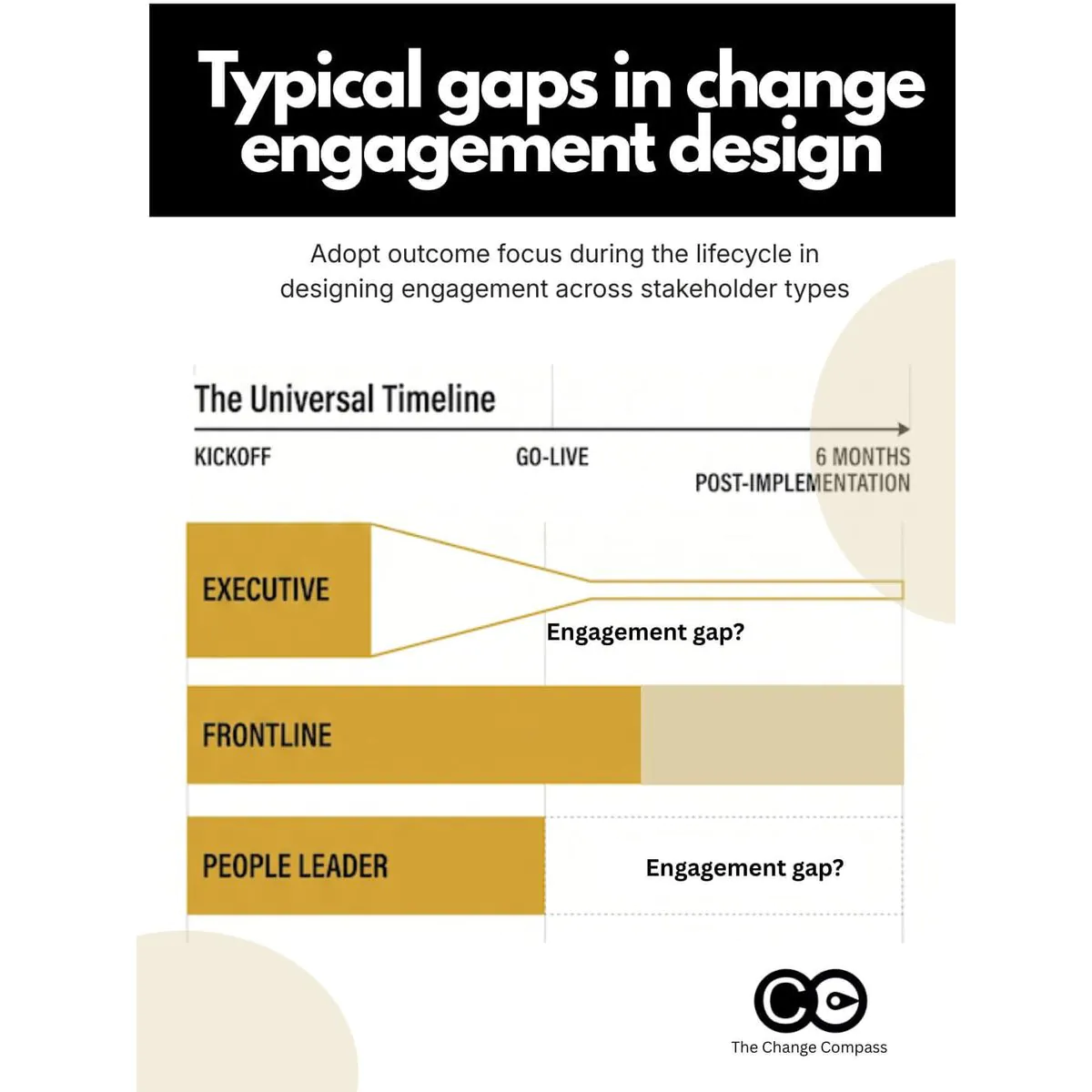
Frontline teams typically stay engaged with a change over many months. Their involvement runs from initial communication through training, go-live support and, where it exists, post-launch reinforcement. Executives, by contrast, are typically involved for a much shorter window, often a fraction of the total length of the programme. Their engagement tends to cluster early, around approval and launch, and then tapers off well before the change has actually landed with the people who have to use it.
This is the finding that should change how a manager thinks about sponsorship. It is not that executives are under-engaged in absolute terms. It is that their engagement window is short relative to the change itself, and it often ends long before frontline adoption is complete.
Why a short sponsorship window is a bigger risk than it looks
What the research says sponsorship should look like
There is a substantial body of change management research on the importance of visible, ongoing executive sponsorship, and it consistently ranks it as one of the single strongest predictors of whether a change actually succeeds. Prosci’s long-running Best Practices research has identified active and visible sponsorship as the top contributor to change success for over two decades, most recently by roughly a three-to-one margin over the next most important factor, and found that an effective sponsor can lift a project’s chances of achieving its intended benefits from around 25 percent to as high as 85 percent.
Crucially, that research is explicit that sponsorship has to be sustained, not a single kickoff appearance. The distinction the research draws is between passive sponsorship, where an executive signs off once and steps back, and active sponsorship, where they remain visibly involved and continue to reinforce the “why” as the change progresses. That distinction is not a minor nuance. It is effectively the entire finding: the value of a sponsor comes from their continued presence, not from the initial endorsement that most plans already capture well.
What the duration data shows instead
Put the duration data next to that research and a specific, practical risk comes into focus. If your data shows executive engagement clustering in the first third of a programme and dropping off well before frontline teams reach the training and reinforcement stages, you are very likely losing visible sponsorship at exactly the point in the timeline when adoption research says it matters most: when frontline teams are being asked to actually change how they work, often months after the executive briefing that kicked things off.
It is entirely understandable, and often appropriate, for the intensity of a sponsor’s involvement to reduce as a programme moves past launch. Nobody expects an executive to sit in weekly working sessions six months into a rollout. The issue is not that involvement tapers, it is whether that taper is a deliberate design choice or simply the default outcome of a plan that never scheduled anything for a sponsor beyond the kickoff and the steering committee. A sponsor’s later-stage presence does not need to be frequent to be effective, but it does need to be designed: a standing slot in deployment reviews, a named checkpoint in planning and reporting cycles, a scheduled moment to speak at a reinforcement milestone. The difference between a sponsor who fades out by accident and one whose involvement is intentionally lighter but still present at the right moments is entirely a matter of whether anyone planned for it.
This is also a point where the data itself deserves a caveat. Change managers are not always capturing sponsor involvement at a level of detail that would show up in an activity log, a sponsor might be reviewing deployment dashboards, fielding escalations, or advocating in leadership forums that never get recorded as a formal change activity against their name. Some of the apparent drop-off in the data may reflect a visibility gap in how sponsor involvement is tracked, rather than an actual absence of sponsorship. That possibility does not weaken the underlying point. If anything, it strengthens it: an organisation that cannot see how its sponsors are actually spending their time on a change cannot deliberately design that involvement either, and the fix, better capture of what sponsors are doing and when, is the same fix either way.
The practical response is not simply more executive time. It is a small number of deliberately placed, and deliberately tracked, touchpoints, timed to coincide with frontline milestones rather than clustered around approval and launch. A short video message when training begins. A visible appearance at a go-live event. A named slot in the deployment review cadence. A mention in a leadership forum when the reinforcement phase starts. None of this requires the executive to be trained or to attend workshops. It requires their visibility to be timed to match the parts of the change that are actually happening on the ground, which is exactly the kind of portfolio-level timing view that becomes much easier to plan for once you can see where multiple initiatives are competing for the same stakeholders’ attention at once, and it is also the starting point for building the kind of change portfolio literacy in senior leaders that makes a sponsor’s occasional appearances land as informed rather than performative.
Middle managers are being asked to reinforce a change they were never reinforced on themselves
The second finding worth a business manager’s attention concerns people leaders, and it is arguably the more actionable of the two because it sits entirely within the organisation’s own control.
The gap in the data
Across the initiatives analysed, people leaders receive noticeably less post-launch reinforcement and less two-way engagement than frontline staff, despite the fact that people leaders are usually the ones expected to reinforce the change with their own teams once training has finished. In practice, this means many change plans train a manager once, early, and then expect that manager to coach, reinforce and answer questions for their team for months afterward, without giving that manager any equivalent ongoing support themselves. Picture a typical rollout: the manager attends a one-hour briefing in week two, then spends the next six months fielding questions from their team about a system or process they were only ever shown once, with no scheduled check-in of their own to ask what is actually going wrong on the ground.
Why this particular gap is expensive
This is not just a theoretical gap. McKinsey’s research on middle managers has found that managers already spend close to half their working time on non-managerial, administrative work, leaving less than a third of their time for people leadership of any kind, change-related or otherwise. Asking a manager who is already stretched thin to be the primary reinforcement mechanism for a change, without reinforcing that manager first, is asking a lot of a role that has very little slack to give.
There is also a well-established link between reinforcement and whether training actually sticks. McKinsey’s work on improving training effectiveness points to structured follow-up and ongoing reinforcement as the difference between training that changes behaviour and training that is quickly forgotten. If that is true for frontline staff, who at least receive some reinforcement in many of the plans we looked at, it is likely just as true, or more true, for the people leaders receiving almost none. The uncomfortable implication is that the group most responsible for making a change stick day to day is, on average, the group least equipped by the plan itself to do so.
A quick audit worth running on your own change plan:
- Does your plan give people leaders any support after their own training finishes, or does their involvement effectively end once they have been briefed?
- Are people leaders expected to answer frontline questions about the change without a channel to ask questions themselves?
- Is there a manager-specific check-in scheduled at the same point frontline reinforcement activities happen, or does the plan assume managers will simply absorb and relay information indefinitely?
- If a people leader is struggling to reinforce the change with their team, would anyone in the change programme actually know?
If the honest answer to most of these is no, the gap is not unique to your organisation. It shows up consistently in the data, and it is one of the more fixable findings in this analysis because it does not require new stakeholder groups or new activity types, only redirecting a small amount of existing reinforcement effort toward the managers who are meant to be delivering it onward.
The stakeholder group that gets almost nothing
The starkest finding in the data concerns external partners and vendors. Across the initiatives analysed, this group receives virtually no interactive engagement activity of any kind. When partners do appear in a change plan, it is almost always as a recipient of one-way communication or a compliance-style touchpoint, not as a group that gets consulted, tested with, or given the chance to flag problems before go-live.
Some of this may be a data problem rather than a design problem. Partners and vendors sit outside the organisation’s own systems, so their involvement is less likely to be logged with the same discipline as an internal stakeholder group’s, even when real consultation is happening informally through account managers or delivery leads. It is worth treating a near-empty partner engagement record as a prompt to check which is actually true: are partners genuinely being left out of two-way engagement, or is the organisation simply not capturing the full picture of how they are involved? Both are worth fixing, but they call for different responses, one is a planning gap and the other is a data-capture gap.
This matters more than it might first appear either way, because partners and vendors are frequently the group with the most direct visibility into whether a change will actually work operationally. A partner delivering a service that depends on a new internal process is often the first to know if that process has a gap, but if the plan never engages them beyond a notification email, or never records that engagement even when it happens, that knowledge has no reliable route back into the programme until something breaks in production.
For a business manager reviewing a change plan, the practical prompt here is simple: look at your stakeholder map and identify who is receiving communication only, with no engagement activity at all. If external partners, vendors or other groups outside the direct organisational hierarchy consistently fall into that category, treat it as a specific risk to close, whether the fix is adding real consultation or simply starting to record the consultation that already happens.
A simple way to check whether your own plan actually differentiates by group
The most useful thing a business manager can do with this data is not memorise specific figures, but adopt a habit of checking their own plans against the same four questions for every stakeholder group involved in a change:
- What type of activity is this group actually getting, not what volume? A shortened version of the frontline training deck is not the same thing as genuine engagement, and a single briefing is not the same thing as sponsorship.
- Within “engagement”, what is the actual mix? Count how much is workshop-style, two-way and consultative versus how much is download-driven, a briefing, a webinar, an information session with no real exchange. A healthy activity count can still hide a one-way plan.
- How long does this group’s involvement actually run, from first touch to last, relative to the total length of the change? A group whose involvement ends in week three of a twelve-month programme is effectively disengaged for three quarters of the change, regardless of how well that first three weeks went.
- Is anyone checking in on this group after their initial activity, or does the plan assume the first touchpoint is sufficient? This question alone tends to surface the people leader and partner gaps described above faster than any other single check.
Running a real change plan through these four questions, group by group, typically takes less time than a single planning meeting, and it tends to surface the same recurring issues in the data: engagement that is one-way in practice despite looking healthy on paper, sponsorship windows that are too short or simply undocumented, and reinforcement that never reaches the managers expected to deliver it.
Where digital tools help close these gaps
Most of the gaps described here are not visible from inside a single project plan. They only become obvious when you can see activity type, duration and stakeholder group laid out together, across a whole portfolio of initiatives rather than one at a time. This is where a dedicated change management platform like Change Compass earns its place: rather than manually cross-referencing spreadsheets to work out whether your people leaders are getting reinforcement or whether your executive sponsor’s engagement window is long enough, a proper single view of change makes stakeholder-level gaps visible at a glance, before they show up as an adoption problem months later.
Making it work in practice
The pattern in the data is consistent enough to be a useful starting assumption for any change plan: frontline teams tend to be trained but not always sustained, people leaders tend to be briefed but rarely reinforced, executives tend to be engaged early but not always for long enough or in a documented way, and external partners tend to be informed but rarely genuinely consulted, or at least rarely recorded as being consulted. None of these are inevitable. They are simply what happens by default when a plan is built once and then scaled down by volume rather than redesigned by purpose for each stakeholder group.
The fix does not require more resources across the board. It requires being deliberate about which of the four activity types, training, engagement, reinforcement and communication, each stakeholder group actually needs, being honest about how much of that engagement is genuinely two-way, and checking that involvement lasts as long as the change itself demands. Start with your next executive sponsor and ask a genuinely different question than usual: not “have they been briefed”, but “will they still be visible, in a way we can actually see, when frontline teams need them most”.
Frequently asked questions
Why shouldn’t a change plan just be scaled down for different stakeholder groups?
Because different stakeholder groups need different kinds of support, not just less of the same kind. A shortened training module works for a group that needs to learn a new task, but it does nothing for a group that needs to be consulted, or one that needs ongoing reinforcement after go-live. Scaling down volume without changing the type of activity tends to leave real gaps in engagement and reinforcement.
How long should executive sponsorship actually last during a change programme?
Sponsorship should remain visible for roughly as long as the change is actively landing with the people affected by it, not just through approval and launch. Research consistently links active, ongoing sponsorship, rather than a single early appearance, to significantly higher rates of achieving intended business benefits.
Why do people leaders often get overlooked in change plans?
People leaders are usually treated as a communication channel to their teams rather than as a stakeholder group with their own change needs. Because they are expected to reinforce the change for others, a plan that trains them once and then leaves them without ongoing support is asking them to sustain something they were never given the tools to sustain themselves.
Should external partners and vendors be included in change engagement activities?
Yes, particularly where they have direct visibility into how a change performs operationally. Limiting partners to one-way communication, or simply failing to record the consultation that does happen, removes an early warning channel that could otherwise surface implementation problems before they affect customers or operations.
Is every activity labelled “engagement” equally valuable?
No. Engagement activity types typically span a spectrum from download-driven formats such as briefings and information sessions, which are essentially one-way, through to genuinely two-way formats such as workshops, focus groups and structured consultation. A stakeholder group can show a healthy volume of engagement activity while still receiving very little real, two-way input into the change.
What is the simplest way to spot these gaps in an existing change plan?
Map each stakeholder group against four questions: what type of activity they are actually receiving, how much of any “engagement” activity is genuinely two-way versus one-way, how long their involvement runs relative to the total programme, and whether anyone follows up with them after their first touchpoint. Groups that fail more than one of these checks are the ones most likely to be under-supported.
References
- Prosci: Primary Sponsor’s Role and Importance
- Prosci: The Link Between Change Management and Employee Engagement
- McKinsey: Activating middle managers through capability building
- McKinsey: Getting more from your training programs
- Gartner: Just 32% of business leaders report achieving healthy change adoption by employees