In the world of scaled agile, “Release on Demand” is a concept that has profound implications for agile teams and their project approaches. It guides teams on how to release and deliver value when stakeholders and customers are truly ready to receive it. However, a crucial, often-overlooked factor in this concept is the role of change management. While Release on Demand has primarily been framed as a technical approach within the Scaled Agile Framework (SAFe), the readiness of people—including end-users, stakeholders, customers, and partners—forms an equally vital part of determining the demand for release.
As change management practitioners, understanding and actively shaping “Release on Demand” can significantly impact project outcomes. In this article, we’ll explore how change management can enhance this core SAFe concept through strategic timing, prioritisation, and thoughtful execution of each release. We’ll also discuss how to structure governance cadences to ensure operational and people readiness, going beyond the technical lens.
Understanding Release on Demand in SAFe
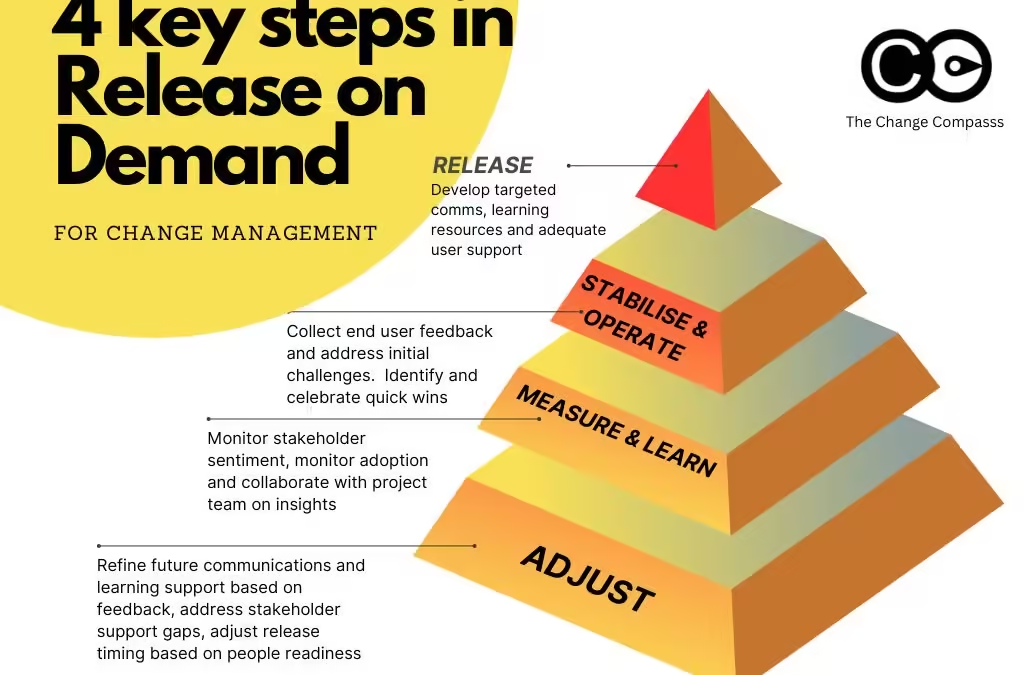
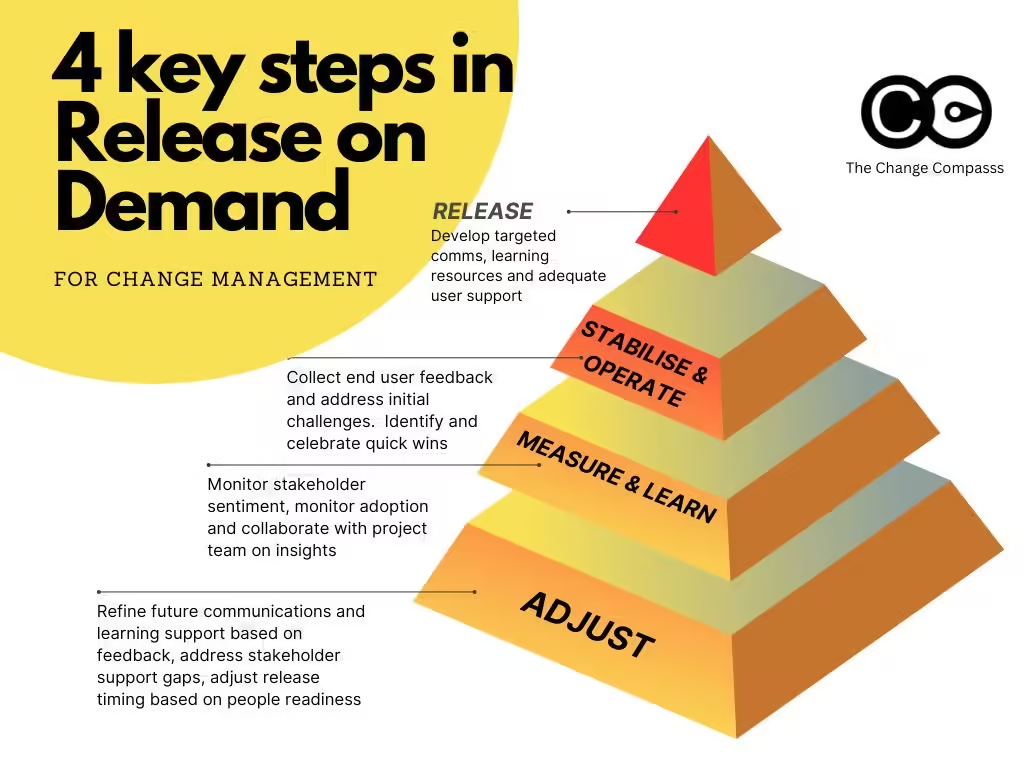
Within SAFe, Release on Demand means that project outputs or new functionality are delivered when the organisation, teams, and stakeholders are ready to adopt and benefit from it. It enables flexible delivery rather than a rigid release schedule. The four key activities for Release on Demand are:
Release – Delivering the product or change to users.
Stabilise and Operate – Ensuring the release is operationally sound and running smoothly.
Measure and Learn – Assessing the release’s impact and learning from the results.
Adjust – Making necessary improvements based on insights gained.
The goal of these activities is to minimise risk, gather user feedback, and optimise the release to maximise impact. While these steps seem straightforward, they demand thoughtful change management to ensure all stakeholders are prepared to support, use, and benefit from the release. Let’s delve deeper into how a change management approach can strengthen each of these activities.
People Readiness as the Core Demand Factor
The “demand” for a release is often misunderstood as being purely about project or market readiness. However, the reality is that it depends on multiple factors, including how ready people are to adopt the change. For any release to succeed, people readiness is crucial and requires focus on:
End-User Readiness: Ensuring that end-users are prepared for the new tools, processes, or functionalities. This could mean conducting user training, crafting support resources, and managing expectations.
Stakeholder Readiness: Stakeholders at all levels need to understand the change, its rationale, and its anticipated impact. This may involve regular briefings, updates, and even individual consultations.
Customer and Partner Readiness: For customer-facing or partner-facing releases, it’s essential to gauge external readiness as well. A clear communication plan and alignment of goals with partners or clients can smooth the path for a successful launch.
These readiness efforts form a significant part of the “demand” in Release on Demand and reflect the reality that people’s capacity to adapt often determines when a release will be genuinely effective.
The Broader Change Landscape
People readiness isn’t only determined by a single project or team but by the broader change landscape within an organisation. Multiple changes or ongoing initiatives can either enhance or inhibit readiness for a new release. For instance, if an organisation is already undergoing a significant digital transformation, adding another change may lead to overload and resistance.
Change practitioners should map the change landscape to identify concurrent changes and evaluate how these may impact readiness for Release on Demand. By assessing the timing and impact of other changes, change managers can:
Avoid change fatigue by spacing out initiatives.
Synchronize related changes to reduce redundancy.
Communicate the overall strategic direction to help stakeholders and users understand how individual changes fit into the bigger picture.
By accounting for these interdependencies, change management can improve people readiness and ensure the Release on Demand aligns with the organisation’s capacity to handle it.
Applying the Four Key Steps in Release on Demand
Let’s explore how change management activities can amplify each of the four Release on Demand steps:
1. Release: The release phase requires both technical and people preparation. Beyond deploying the technical elements, change management practitioners should:
Develop targeted communication plans to inform all affected stakeholders.
Offer targeted training sessions or resources that build users’ confidence and competence.
Ensure adequate support is in place for the transition, including help desks or peer mentoring.
2. Stabilise and Operate: After a release, it’s crucial to monitor adoption and support operational stability. The change team can:
Collect feedback from end-users and support staff on initial challenges and address these promptly.
Identify and celebrate quick wins that demonstrate the release’s value.
Work closely with operations teams to resolve any unforeseen issues that may inhibit adoption or cause frustration.
3. Measure and Learn: This step goes beyond tracking technical metrics and should also capture change-specific insights. Change management can contribute by:
Conducting surveys, interviews, or focus groups to gauge user and stakeholder sentiment.
Monitoring adoption rates and identifying any training gaps or knowledge shortfalls.
Collaborating with product or project teams to share insights that may refine or prioritisation subsequent releases.
4. Adjust: Based on insights gained from the Measure and Learn phase, change managers can advise on necessary adjustments. These might include:
Refining future communication and training plans based on user feedback.
Addressing any gaps in stakeholder support or sponsorship.
Adjusting the timing of subsequent releases to better align with people readiness.
The iterative nature of these four steps aligns well with agile methodologies, allowing change managers to continuously refine and enhance their approach.
The Critical Role of Sequencing, Prioritisation, and Timing
FFor change management practitioners, Release on Demand isn’t just about executing steps—it’s about doing so in the right sequence and at the right time. The impact of a release depends significantly on when it occurs, who is prepared for it, and how well each group’s readiness aligns with the release cadence and continuous integration.
Here are some tips to help change managers get the timing right:
Analyze stakeholder engagement levels: Regularly assess how engaged and ready stakeholders are, tailoring messaging and interventions based on their feedback and sentiment.
Prioritisation change activities based on impact: Not all releases will have the same impact, so change teams should focus resources on those that require the most user readiness efforts.
Create phased rollouts: If full-scale readiness across the board isn’t achievable, a phased rollout can provide users with time to adapt, while allowing the change team to address any emergent issues in stages.
By managing the release cadence thoughtfully, change managers can avoid the disruptions caused by hasty releases and ensure the deployment feels both manageable and meaningful for users.
Release governance in SAFe is often perceived as a predominantly technical or project-focused process. However, effective governance should encompass business operations and people readiness as well. Change management plays a pivotal role in designing governance cadences that account for these critical aspects.
To integrate change governance within release governance, change practitioners should:
Establish clear communication channels with project teams and product owners to ensure people readiness factors are consistently part of release discussions.
Implement a readiness checklist that includes technical, operational, and people readiness criteria. This checklist should be reviewed and signed off by relevant stakeholders before any release.
Maintain a cadence of review and feedback sessions where project teams, change managers, and stakeholders discuss readiness progress, key risks, and post-release outcomes.
This approach ensures that each release is evaluated from multiple perspectives, minimising disruption and maximising its potential for success.
The above is from Scaledagileframework.com
Developing a Change Cadence that Complements Agile Delivery
SAFe’s principle of “develop on cadence; release on demand” is central to effective agile delivery. For change management practitioners, developing a strong change cadence is equally important. This cadence, or rhythm of activities, aligns with the agile teams’ development cadence and helps build stakeholder momentum, maintain engagement, and reduce surprises.
Here’s how to develop a cadence that works in tandem with agile teams:
Planning Cadence: Hold regular planning sessions to align change activities with upcoming releases and identify readiness gaps. This could be quarterly for major releases or bi-weekly for smaller, iterative releases.
Execution Cadence: Establish a reliable cycle for change interventions, such as training, communication, and stakeholder meetings. This cadence helps stakeholders build expectations and fosters a predictable rhythm in change activities.
Feedback Cadence: Collect feedback at consistent intervals, aligning it with release intervals or sprint reviews. Consistent feedback keeps the change process agile and responsive to evolving needs.
A well-defined change cadence not only prepares users effectively but also reinforces trust and transparency in the change process.
Release on Demand may have originated as a technical concept within SAFe, but its success is deeply tied to how well people, stakeholders, and users are prepared for each release. For change management practitioners, Release on Demand is an opportunity to enhance the broader release process by prioritizing people readiness, orchestrating thoughtful sequencing, and establishing governance that prioritisations user success as much as project outcomes.
By proactively engaging in each of the four stages of Release on Demand—Release, Stabilise and Operate, Measure and Learn, and Adjust—change management can ensure releases are not just technically ready but fully integrated into the people and business context they serve. Embracing this role allows change managers to become essential partners in agile delivery, maximising the impact of each release for end-users, the organisation, and the overall success of the project.
When a change impact assessment is done well, it is one of the most powerful tools in a change practitioner’s kit. It tells you who is affected, how significantly, and in what ways. It helps prioritise your change management effort. It gives project teams a clear line of sight between their decisions and the effect those decisions will have on real people doing real jobs.
When it is done poorly , which is more common , it becomes a box-ticking exercise. Practitioners list every system or process change, assign a red-amber-green rating based on gut feel, and produce a document that sits in SharePoint and is never referenced again.
The gap between those two outcomes is almost entirely down to methodology. This article provides a structured, ten-step approach to conducting a change impact assessment that is genuinely useful, defensible under scrutiny, and designed to inform decisions rather than document assumptions.
Why most change impact assessments fall short
The fundamental problem with most impact assessments is that they conflate activity with impact. Practitioners document what is changing , processes, systems, job roles, reporting lines , but stop short of translating those changes into what they actually mean for the people who will have to live with them.
Prosci’s research on change impact makes this distinction clearly: organisational-level change must be translated to the individual level to be actionable. A system migration is not an impact. The fact that a team of forty finance analysts will need to rebuild their core workflows and learn three new interfaces within six weeks while continuing to close the monthly books , that is an impact.
The second common failure is breadth without depth. Many impact assessments aim to cover every group in the organisation but spend only minutes thinking about each one. A more useful approach is to identify the most affected groups early, assess them in depth, and treat others at a proportionate level of detail.
McKinsey’s 2024 analysis of transformation programmes found that well-informed leaders who focus their change effort on the genuinely high-impact areas are able to achieve 70-80% transformation success rates , the inverse of the commonly quoted failure statistic. Focused, accurate impact assessment is a significant part of what enables that focus.
The ten dimensions of change impact
Before running a change impact assessment, it helps to have a consistent taxonomy of impact types. Prosci identifies ten aspects of change impact that provide a comprehensive lens for any assessment:
Processes , which workflows, procedures, or operating methods are changing
Systems and technology , which tools, platforms, or data sources are affected
Job roles , which roles are being created, modified, or eliminated
Critical behaviours , what people will need to do differently day-to-day
Mindsets and beliefs , what assumptions or ways of thinking need to shift
Reporting structure , how accountability and authority relationships are changing
Performance reviews , how success will be measured and rewarded differently
Compensation , whether pay, incentives, or benefits are affected
Location , whether where or how work is performed is changing
Tools and equipment , what physical or digital tools people need to learn or adopt
Not every dimension will be relevant to every change. The value of this taxonomy is in ensuring you don’t miss a category that, if overlooked, can derail adoption. Compensation and performance review impacts, for instance, are frequently underestimated in their effect on employee resistance.
A ten-step change impact assessment methodology
Here is a structured process for conducting a change impact assessment that is rigorous, scalable, and produces outputs that are actually used.
Step 1: Define the scope and objectives
Before gathering any data, be clear about what the assessment is and is not intended to cover. Key decisions include:
Which groups or roles are in scope
Which change dimensions are most relevant to this particular initiative
What decisions the assessment will inform (resource allocation, sequencing, communication targeting, training design)
Who will use the outputs and in what format
Skipping this step results in assessments that are technically complete but operationally useless.
Step 2: Map the affected stakeholder groups
Create a stakeholder map that identifies every group, role, or team that will experience some form of change. This is broader than just the primary users of a new system , it includes managers, support functions, customers, suppliers, and any team that interfaces with the affected area.
For each group, note the estimated size (headcount), geographic spread, and any known sensitivities or constraints.
Step 3: Gather change information from the project team
Meet with project workstream leads to understand what is actually changing in their area. Use the ten-dimension taxonomy as your interview guide. Capture not just the functional changes but the timelines, dependencies, and any known risks.
At this stage you are collecting raw information about what is changing, not yet assessing impact.
Step 4: Assess impact severity for each group
For each stakeholder group, assess the severity of impact across the relevant dimensions. A simple but effective scale is:
High impact: Significant change to daily work; requires new skills, new processes, or major behaviour change; high potential for resistance or confusion
Medium impact: Moderate change; some adjustment required but within existing capability; manageable with good communication and targeted support
Low impact: Minor change; easily adapted to with basic information; unlikely to generate resistance
Be specific about why a rating has been assigned. “High , because the new system replaces a manual process this team has used for eight years and requires retraining in a four-week window” is defensible. “High” on its own is not.
Step 5: Assess change volume and cumulative load
A single change impact assessment looks at one initiative in isolation. But your employees are not living with one initiative in isolation , they are living with everything that is being asked of them at once.
For each stakeholder group, assess the cumulative change load by mapping other major initiatives that are running concurrently. This step is where a digital change management platform becomes particularly valuable: tools like Change Compass allow you to visualise the total change burden on any group across the portfolio, rather than calculating it manually for each assessment.
A group might have a medium impact score on your initiative but a very high cumulative load score when all concurrent changes are considered. This distinction materially affects your sequencing and resourcing decisions.
Step 6: Identify critical risk groups
Based on impact severity and cumulative load, identify the three to five stakeholder groups that represent the highest change risk. These are the groups where under-investment in change support is most likely to compromise adoption.
For each critical risk group, document:
The specific nature of the impact
The key risks (resistance, capability gap, burnout)
The support they will need (type, timing, delivery channel)
Step 7: Identify change enablers and constraints
Not all impacts are negative. Some changes create genuine opportunities , new skills, better tools, clearer roles. Identifying these is not spin; it is important information for communication design and resistance management.
Equally important are constraints: groups who are already at capacity, upcoming business-critical events that will compete for attention (financial year-end, major product launches), and any political sensitivities around role changes.
Step 8: Build the change impact heat map
Consolidate your assessment data into a change impact heat map , a structured visual that shows, at a glance, which groups are most affected, across which dimensions, and at what level of severity.
This is not just a reporting tool. It is a planning tool that drives decisions about communication targeting, training sequencing, change champion placement, and leadership engagement priorities.
Step 9: Validate with stakeholders
Present your impact assessment findings to key stakeholders , the project team, business owners, and representative managers from the most affected groups , before finalising it. This validation step serves two purposes: it catches errors and assumptions, and it begins the process of building stakeholder ownership of the change.
Expect to revise your assessment based on this feedback. Impact assessments that do not go through a validation step are consistently less accurate.
Step 10: Maintain and update throughout the programme
A change impact assessment is a living document, not a one-time deliverable. As programme scope evolves, decisions are made, and timelines shift, the assessment needs to be updated. Build regular review points into the programme governance cycle, and track whether actual adoption patterns are consistent with your impact predictions.
Practical examples across industries
Change impact assessments look somewhat different in different contexts, but the methodology translates across industries.
Financial services , core banking platform replacement: The most severely impacted groups were typically not IT (who are experienced in platform transitions) but the mid-tier operational teams whose daily work was entirely platform-dependent. The assessment identified that branch operations staff faced both high impact and high cumulative load, and this finding drove a decision to phase the rollout to delay the branches’ go-live date.
Healthcare , electronic medical records implementation: Impact assessment revealed that senior clinicians had the lowest formal training time allocated but the highest behaviour change required (fundamental changes to clinical documentation practices). Rebalancing training allocation based on the assessment findings was credited with avoiding a major adoption failure at go-live.
Government , enterprise resource planning implementation: The assessment identified that the finance team faced impacts across seven of the ten dimensions simultaneously, including role changes, new performance metrics, and a compressed transition period coinciding with budget cycle. This finding led to additional dedicated change support being resourced for that group.
Using Change Compass to automate impact analysis
One of the significant efficiency gains available to change teams is automating the data collection and consolidation steps of a change impact assessment. Rather than maintaining manual spreadsheets and heat maps across a portfolio, platforms like Change Compass allow change data to be captured, updated, and visualised in real time , with portfolio-level roll-ups that show cumulative impact across all programmes for any given stakeholder group.
This capability is particularly valuable for enterprise change functions running ten or more concurrent programmes, where manual tracking is simply not viable at the required level of rigour. The weekly demo is a practical way to see this in action across a live dataset.
A change impact assessment done at this level of rigour is not an overhead. It is the analytical foundation for every subsequent change decision , what to communicate, who to train, when to deploy change champions, where leadership engagement is critical, and how to sequence the work.
The ten-step framework in this article scales from small programme teams to large enterprise change functions. The key discipline is maintaining the distinction between activity (what is changing) and impact (what that means for the people who have to change) , because that distinction is where the real planning value lives.
Frequently asked questions
What is a change impact assessment?
A change impact assessment is a structured analysis of how a programme or project will affect different groups of people in an organisation , their processes, roles, behaviours, systems, and working environment. Its purpose is to inform change management planning by identifying which groups need the most support, and in what ways.
How do you conduct a change impact assessment?
The most effective approach involves defining scope, mapping all affected stakeholder groups, gathering change information from the project team, rating impact severity across each group and change dimension, assessing cumulative load from other concurrent initiatives, and validating findings with key stakeholders. The result is a change impact heat map that drives communication, training, and engagement decisions.
How is a change impact assessment different from a risk assessment?
A risk assessment identifies what could go wrong with the project. A change impact assessment identifies how the project will affect people. The two complement each other: high impact scores on the change assessment should inform and escalate risk assessments, particularly where cumulative load or stakeholder capacity constraints create delivery risk.
Who should be involved in a change impact assessment?
The change practitioner typically leads the assessment, but the inputs come from project workstream leads, business area managers, HR partners, and , critically , representatives of the affected stakeholder groups. Assessments built entirely from the project team’s perspective without validation from the business tend to underestimate the true degree of disruption.
How often should a change impact assessment be updated?
At minimum, at each major project milestone or whenever scope changes materially. In practice, good change practitioners review their impact assessment every four to six weeks during active delivery, and update it whenever adoption data reveals that actual impact is different from what was predicted.
The numbers tell a story that most change leaders already sense. IBM’s 2025 CEO study, surveying 2,000 executives globally, found that only around 25% of AI initiatives deliver expected ROI, and just 16% have scaled enterprise-wide. Investment in AI is accelerating at double-digit rates. The returns are not keeping pace. The gap is not technical. It is human. And it will not be closed by change management practices designed for a different era.
Change management in the digital age faces a challenge that goes beyond scale or speed. The tools, assumptions, and governance models that served change functions well through the ERP rollouts and restructures of the 2000s and 2010s were designed for discrete, definable transformations with identifiable endpoints. Digital transformation, AI adoption, and the automation of work do not have endpoints. They are ongoing conditions. Managing them as projects produces predictable results: partial adoption, underrealised value, and change fatigue that compounds with each successive initiative.
The organisations navigating digital transformation most effectively are not those with the biggest change budgets. They are those that have genuinely updated their change management model for the digital context, treating change capability itself as a strategic asset rather than a delivery function.
The digital transformation gap that change management must close
The scale of underperformance in digital transformation is well documented. Deloitte’s research on digital transformation value identifies three failure patterns that recur across industries: technology deployed without corresponding work redesign, adoption treated as a training problem rather than a behaviour change problem, and benefits realisation measured at go-live rather than at the point where new ways of working are actually embedded.
All three failure patterns are change management failures, not technology failures.
The IBM CEO data reinforces this. In 2026, twice as many workers across age groups say they would embrace greater AI use by their employers rather than resist it. Employee sentiment toward AI is broadly positive. The adoption gap is not about resistance. It is about the absence of the structural, managerial, and environmental conditions that convert positive sentiment into actual behaviour change. This is precisely the domain of change management. And precisely the area where traditional change management approaches are most underpowered.
What makes change management in the digital age different
Three structural characteristics distinguish digital transformation from the changes that traditional change management frameworks were built for.
There is no go-live
Classic change management models, whether ADKAR, Kotter’s 8 steps, or the Prosci methodology, are structured around a transition: a defined current state, a defined future state, and a change journey between them. Digital transformation does not conform to this structure. AI capabilities in use today are materially different from those available 18 months ago, and will be different again 18 months from now. The “future state” keeps moving.
This means that what organisations actually need to build is not a capacity to manage a specific digital change, but an adaptive organisational capability to absorb continuous digital evolution. That is a fundamentally different capability to develop and a fundamentally different change management challenge to address.
The impact is highly fragmented by role
A major ERP implementation affects large groups of employees in broadly similar ways: new system, new processes, new reporting lines. Digital transformation and AI adoption affect different roles in radically different ways. A finance analyst’s experience of AI adoption has almost nothing in common with a customer service representative’s. A supply chain planner and a legal counsel may both be in the same AI transformation programme but need entirely different support.
Generic change communications and enterprise-wide training programmes do not work well in this environment. Effective change management in the digital age requires function-level and role-level customisation at a depth that most change functions have not previously needed to operate at.
Middle management is both the opportunity and the obstacle
Gartner’s 2025 CHRO research found that 78% of CHROs agree workflows and roles will need to change to realise the value of AI investments. The people who must actually make those workflow and role changes happen are middle managers. They translate digital strategy into day-to-day practice. They also face the most immediate personal disruption from the changes they are asked to enable.
Change management approaches that treat managers primarily as a communication channel, rather than as a group with their own adoption challenge and their own need for specific support, consistently underperform. The manager layer is where digital transformation succeeds or stalls.
Data and measurement in the digital age
One of the defining features of digital transformation is the availability of adoption data. Most digital platforms generate detailed usage data. Organisations now have, or can have, precise information about which employees are using new systems and tools, how frequently, in what ways, and with what outcomes.
Traditional change management largely operated without this data. Communications were sent, training was attended, and surveys were occasionally administered. Whether behaviour had actually changed in meaningful ways was often a matter of judgement rather than evidence.
The digital age removes this ambiguity for organisations willing to use the data available. Key metrics that effective change functions track in digital transformation include:
Active usage rates by role group and function (not just platform access)
Time savings realised in specific processes, compared against baseline
Quality or output measures for AI-assisted work versus previous work
Support ticket and workaround patterns, which indicate where adoption is failing
Manager-reported team behaviour change, gathered through structured check-ins
The risk with digital adoption data is conflating access with adoption. A person who logs into a platform once a week is not the same as a person who has genuinely changed how they work. Effective measurement tracks the second thing, not the first.
Automation and what it means for the change management function itself
The digital age is also changing how change management work is done, not just what it is managing. Change functions are beginning to automate significant portions of the administrative and analytical work that previously consumed change practitioner time: impact assessment compilation, status reporting, communication scheduling, data aggregation across programmes.
This shift has two implications worth examining.
The first is a productivity gain. Change practitioners who are no longer spending days compiling portfolio heat maps in spreadsheets have time to do the work that requires human judgment: stakeholder conversations, resistance diagnosis, sponsor coaching, and the nuanced facilitation that data analysis cannot replace.
The second is a capability shift. The change practitioner of the digital age needs to be comfortable working with data and platforms in ways that were optional for practitioners in earlier generations. Interpreting adoption dashboards, working with automated workflow tools, and communicating findings in data-fluent ways are becoming baseline expectations rather than specialist skills.
Building a digital-age change management capability
For change leaders building or rebuilding their function’s capability for the digital context, the practical work happens in four areas.
Updating the impact methodology. Traditional impact assessment categories, such as process, role, technology, and structure, need to be extended to capture AI-specific dimensions: the degree to which a role’s core tasks are being automated or augmented, the learning curve associated with AI-enabled ways of working, and the interaction effects when multiple digital changes land simultaneously on the same employee group.
Investing in role-level differentiation. The days of enterprise-wide change communications being the primary engagement mechanism are over for major digital transformations. Effective change functions in the digital age develop function-specific change plans, with tailored messaging, use-case-specific training, and peer champion networks built around specific communities of practice rather than the whole organisation.
Building adaptive governance. Digital transformation moves faster than traditional programme governance. Change plans written at programme initiation will be outdated within months as capabilities evolve and adoption data comes in. The governance model needs to support continuous plan adaptation: regular portfolio reviews, rolling 90-day action planning, and the authority to reallocate resources based on adoption evidence rather than original project plans.
Using digital platforms for portfolio visibility. Managing the cumulative digital change burden on employee groups requires portfolio-level visibility that manual approaches cannot reliably provide. Platforms such as The Change Compass aggregate impact data across programmes, track adoption by function and role group, and enable the continuous monitoring that adaptive change governance requires. This is not a luxury for large change functions. It is the infrastructure that makes portfolio-level decision-making possible.
Where to start
For change leaders whose organisations are in the middle of active digital transformation programmes with traditional change management in place, the most useful first step is a diagnostic of the current approach against the digital age requirements.
The diagnostic questions are practical:
Are you measuring actual behaviour change or platform access?
Do you have function-specific change plans, or enterprise-wide plans applied uniformly?
How are you managing the cumulative digital change load on specific employee groups?
What is your process for adapting the change approach as adoption data comes in?
Are your managers being supported as a group with their own adoption challenge, or managed primarily as a change communication channel?
Most change functions running traditional approaches through digital programmes will find significant gaps in these areas. The gap that typically generates the fastest improvement when closed is measurement: moving from activity metrics to adoption metrics creates the feedback loop that enables everything else to improve.
Frequently asked questions
What is change management in the digital age?
Change management in the digital age refers to applying change management principles and practices to the specific challenges of digital transformation, AI adoption, and the automation of work. It extends traditional change management to address the absence of a fixed endpoint, the highly fragmented role-level impact of digital change, and the availability of adoption data that enables evidence-based course correction throughout the change journey.
Why do digital transformation programmes fail to deliver expected value?
The primary causes are change-related, not technical. Workflows are not redesigned to take advantage of new digital capabilities, middle managers are not supported as a group with their own adoption challenge, measurement focuses on system access rather than behaviour change, and change plans are not adapted as adoption evidence accumulates. IBM research found that only around 25% of AI initiatives deliver expected ROI, largely for these reasons.
How is digital transformation different from managing a standard technology change?
Digital transformation differs in three important ways: there is no defined future state because digital capabilities evolve continuously; the impact on different roles is highly fragmented, requiring function-level rather than enterprise-wide approaches; and the adoption data available through digital platforms enables a measurement-led approach that traditional change management rarely applied.
What metrics should you track in digital transformation change management?
The most informative metrics go beyond platform access to measure actual behaviour change: active usage rates by role group, time savings realised in specific processes, quality of AI-assisted output versus previous output, support ticket patterns indicating where adoption is failing, and manager-reported team behaviour change. These give a more honest picture of adoption progress than usage statistics alone.
How do you manage the cumulative digital change load on employees?
Managing cumulative load requires portfolio visibility: knowing what digital changes are landing on which employee groups at what time, and aggregating impact to identify when load is approaching the point where adoption quality begins to deteriorate. Portfolio change management platforms enable this aggregation and provide the early warning signals that allow sequencing adjustments before saturation becomes visible in adoption data.
References
IBM. CEO Study: CEOs Double Down on AI While Navigating Enterprise Hurdles (2025). https://newsroom.ibm.com/2025-05-06-ibm-study-ceos-double-down-on-ai-while-navigating-enterprise-hurdles
IBM Institute for Business Value. 5 Trends for 2026. https://www.ibm.com/downloads/documents/us-en/1443d5df79cf4c92
Deloitte Insights. Unleashing Value from Digital Transformation: Paths and Pitfalls. https://www.deloitte.com/us/en/insights/topics/digital-transformation/digital-transformation-value-roi.html
Gartner. Gartner Says CHROs’ Top Priorities for 2026 Center Around Realising AI Value and Driving Performance (October 2025). https://www.gartner.com/en/newsroom/press-releases/2025-10-02-gartner-says-chros-top-priorities-for-2026-center-around-realizing-ai-value-and-driving-performance-amid-uncertainty
AIHR. 15 Important Change Management Metrics To Track in 2026. https://www.aihr.com/blog/change-management-metrics/
As digital acceleration and stakeholder scrutiny intensify, change leaders can no longer rely on gut feelings or generic feedback. The discipline is undergoing a seismic shift—from qualitative storytelling to quantifiable impact. Here’s why measurement is now the backbone of successful change, and how to avoid becoming another cautionary tale.
🔍 Why Measurement Is No Longer Optional
1. Executives Demand ROI—Not Just Happy Sheets
Gone are the days when a well-crafted communication plan sufficed. Today’s leaders expect change teams to demonstrate their impact with hard evidence. The Change Management Institute’s Competency Model sets a global benchmark for what effective change looks like, emphasising clusters of behaviours and skills that drive real results at every level—Foundation, Specialist, and Master. For example, the “Facilitating Change” competency requires practitioners to correctly assess readiness, build targeted plans, and conduct regular reviews—each step lending itself to clear, actionable measurement.
Action Step: Map your change KPIs directly to the behavioural competencies outlined by the Change Management Institute. If your goal is to build readiness, track metrics such as pre- and post-training confidence scores, participation rates in workshops, and the frequency of feedback loops. For communication effectiveness, measure open rates, click-throughs, and qualitative feedback from impacted teams.
2. The Agile Imperative: Iterate or Stagnate
Agile methodologies are reshaping change management. Teams using iterative feedback loops—such as regular check-ins and rapid data reviews—report faster adoption and more sustainable results. The Competency Model encourages change professionals to adapt approaches based on real-time data, ensuring that interventions remain relevant and effective.
3. AI and Analytics: From Guesswork to Precision
AI tools now predict resistance risks, automate sentiment analysis, and personalise communications. For instance, machine learning models can be used to flag teams likely to struggle with a new CRM system based on historical adoption patterns.
📊 Change Management’s Data Evolution vs. Other Disciplines
Week 4: Measure proficiency gains and correlate with productivity data.
Step 3: Visualise Progress Use tools like Miro, Power BI or Change Automator to create:
Adoption Roadmaps: Colour-coded timelines showing team readiness.
Sentiment Heatmaps: Identify departments needing extra support.
From Data to Action: The New Rules of Change Management You Can’t Afford to Ignore
Yesterday’s change playbooks are gathering dust. Today, the most effective change leaders are embracing cutting-edge tools and mindsets—think AI-driven insights, hyper-personalisation, and visual storytelling. These aren’t just buzzwords; they’re practical shifts you can harness right now to drive measurable, people-focused results.
1️. AI-Powered Insights: Predict, Don’t Just React
Why It Matters: AI is rapidly moving from the IT department into the heart of change management. Modern AI tools can analyse vast amounts of communication and performance data to identify patterns that signal potential resistance or readiness for change. By leveraging predictive analytics, change teams can proactively address issues—such as resistance hotspots or engagement gaps—before they escalate and derail a project.
Instead of waiting for problems to surface, AI-powered dashboards and sentiment analysis provide real-time feedback, allowing change practitioners to tailor communications, adjust training, and allocate resources where they’re needed most. This proactive approach not only streamlines decision-making but also accelerates adoption and supports more sustainable outcomes.
How to Apply Today:
Use AI-based sentiment analysis tools to monitor employee feedback and flag emerging concerns.
Segment audiences and personalise communications based on data-driven insights, ensuring the right message reaches the right people at the right time.
Automate routine change management tasks, freeing up your team to focus on strategic interventions and stakeholder engagement.
Real-World Example: A financial services organisation used Change Automator to map employee sentiment across a portfolio of digital projects. By visualising hotspots, they reallocated resources to struggling teams, lifting overall adoption.
2️. Employee-Centric Design: Make Change Personal
Why It Matters: Generic change comms are out. Employees expect tailored, relevant experiences—mirroring what they get as consumers.
How to Apply Today:
Map the Employee Journey: Use journey mapping tools to chart every touchpoint, from initial announcement to post-launch support.
Co-Create Solutions: Run design sprints with front-line staff change champions to surface real pain points and co-design fixes.
Micro-Target Messaging: Swap “all-staff” emails for role-specific updates—e.g., “Here’s how the new system changes your workflow, Sarah.”
Practical Tip: Start with a single pilot group. Test different message formats (video, infographic, FAQ) and measure which drives the most engagement. Scale up what works.
3️. Visual Storytelling: Make Data Unmissable
Why It Matters: Humans process visuals significantly faster than text. Yet, too many change reports are buried in spreadsheets. Visual dashboards, infographics, and storyboards make progress—and problems—impossible to ignore.
How to Apply Today:
Build a Change Portfolio Dashboard: Use tools such as Change Compass to show every initiative’s impact, readiness, adoption and risk on one screen.
Create “Before & After” Maps: Visually chart how roles, processes, or systems are changing—helping staff see what’s coming and why it matters.
Share Wins Visually: Celebrate milestones with progress bars, leaderboards, or “heat maps” of adoption.
4️. Change Portfolio Management: See the Forest, Not Just the Trees
Why It Matters: With overlapping projects, employees often face “initiative overload.” To read more about this check out The Change Compass blogs on Change Portfolio Management.
How to Apply Today:
Map All Changes: List every active and upcoming initiative in a single portfolio view.
Spot Clashes Early: Use visual tools to identify timing conflicts or resource bottlenecks.
Balance the Load: Adjust rollout schedules to avoid overwhelming any one team.
Action Step: Hold a monthly “change portfolio review” with business leaders. Use your dashboard to make data-driven decisions about sequencing and support.
One-off surveys and end-of-project reviews often miss the mark. Today’s leading organisations are moving towards ongoing, real-time feedback to spot issues early, adapt quickly, and keep change on track. Continuous feedback loops allow you to capture employee sentiment, adoption barriers, and training gaps as they arise—making your change program more responsive and resilient.
How to Apply Today:
Run regular pulse checks: Use short, targeted surveys after key milestones or training sessions to gauge understanding and readiness.
Empower rapid response: Assign change champions or team leads to monitor feedback and act on it quickly—whether that means clarifying communications, offering extra coaching, or removing roadblocks.
Close the loop: Always share back what you’ve learned and what actions you’re taking as a result. This builds trust and shows that feedback leads to real improvements.
Practical Tip: Set up a simple feedback calendar—weekly or fortnightly—so your team knows when to expect check-ins. Use tools like Microsoft Forms, The Change Compass, or even a quick stand-up meeting to keep the feedback flowing.
🏆 Quick Reference: Emerging Trends & How to Action Them
Build dashboards, use infographics, share visual wins
Portfolio Management
Map all changes, review monthly, balance the load
Continuous Feedback
Run pulse checks, act fast, close the loop
Stop Guessing, Start Measuring: Your 7-Step Blueprint for Change Management Success
You’ve seen why measurement is now mission-critical and how the smartest organisations are using data, AI, and design thinking to get ahead. But how do you actually put this into practice—without getting bogged down in theory or drowning in dashboards? Here’s a hands-on, step-by-step playbook you can use right now to make your change program measurable, actionable, and impossible to ignore.
1️. Get Crystal Clear on What Success Looks Like
Problem: Vague goals (“increase engagement”, “improve adoption”) lead to fuzzy results. If you can’t measure it, you can’t manage it.
Action:
Work with sponsors and business owners to define outcomes in hard numbers.
Instead of “increase system usage”, set: “90% of frontline staff log into the new CRM daily within 3 weeks.”
For behaviour change: “Reduce manual workarounds by 70% in 3 months.”
Align these metrics to broader business KPIs.
If your company’s focus is customer satisfaction, link your change metrics to NPS or customer complaint rates.
2️. Map Your Change Portfolio—See the Whole Picture
Problem: Change fatigue and initiative overload are real. Siloed projects compete for attention, causing confusion and burnout.
Action:
List every change initiative impacting your people in the next 6–12 months.
Use a simple spreadsheet or an automated tool like The Change Compass to visualise overlaps and pinch points.
Create a high level “heat map” of change impacts by team, location, or role.
Colour-code by intensity.
Share this map with leaders to adjust timing and resource allocation.
Example: A retail chain in NSW used a portfolio map to delay a payroll system upgrade, avoiding clashing with a major sales transformation—saving weeks of disruption.
3️. Baseline Before You Begin—Don’t Skip This Step
Problem: You can’t prove improvement if you don’t know where you started.
Action:
Run a short, targeted survey or use existing data to capture current state.
For a new process: measure error rates, time to complete, or customer complaints.
For behaviour change: use a quick pulse survey (“How confident are you using the current system?”)
Document baseline metrics and share with your team.
Visual: Bar chart showing “before” metrics—e.g., average call handling time pre-change.
4️. Build a Real-Time Measurement Plan—Not Just End-of-Project Reports
Problem: Annual surveys and after-action reviews are too slow for today’s pace.
Action:
Set up a dashboard (even a simple one in Excel or Power BI) tracking your key metrics.
Schedule weekly or fortnightly check-ins to review progress.
Automate data collection where possible (e.g., system usage logs, sentiment surveys).
Visual: Screenshot of a simple dashboard tracking adoption, sentiment, and productivity.
5️. Act Fast on What the Data Tells You
Problem: Collecting data is pointless if you don’t act on it.
Action:
Assign a “data owner” for each metric—someone responsible for monitoring and responding (your change champions may come in handy here)
If adoption lags, run targeted workshops or peer coaching.
If sentiment drops, hold listening sessions and tweak communications.
Always close the loop: tell people what you’re changing based on their feedback.
Pro Tip: Use the “You Said, We Did” format in your updates to build trust.
6️. Celebrate, Iterate, and Scale What Works
Problem: Wins often go unnoticed, and lessons aren’t shared.
Action:
Visually celebrate milestones—use leaderboards, digital badges, or progress bars.
Document what worked and what didn’t in short, shareable case studies.
Scale successful tactics to other teams or projects.
Visual: Photo of a “Change Champions” digital wall or leaderboard.
7️. Keep the Feedback Loop Alive—Continuous Improvement
Problem: Change is never truly “done”—but measurement often stops too soon.
Action:
Continue pulse checks for at least 3–6 months post-launch.
Use insights to inform future projects and refine your change playbook.
Share lessons learned across your change portfolio—don’t let knowledge get siloed.
📋 Quick Checklist: Your Measurement-Driven Change Program
☑️ Define clear, outcome-based metrics ☑️ Map your change portfolio and impacts ☑️ Baseline before starting ☑️ Set up real-time dashboards ☑️ Assign data owners and act quickly ☑️ Celebrate and scale what works ☑️ Keep measuring and improving
🏁 Ready to Lead the Data-Driven Change Revolution?
Don’t just talk about change—prove it, measure it, and make it stick. Start with one project, apply these steps, and watch your credibility (and results) rise. For more practical tools, checklists, and templates, visit The Change Compass Knowledge Hub and subscribe for monthly insights tailored to Australian change leaders.
What’s the first metric you’ll measure on your next change? Share your thoughts below or connect for a discussion on resolving your change measurement problems.
Organisational transformations are essential for staying competitive in today’s fast-paced world, but they often come with challenges that can derail progress. One of the most pressing issues is change overload—when employees and stakeholders are overwhelmed by the sheer volume or pace of changes being implemented. This can lead to burnout, disengagement, resistance, and ultimately, failure to achieve transformation goals.
Artificial intelligence (AI) offers a powerful solution to combat change overload. By leveraging AI tools and strategies, organisations can streamline processes, personalise communication, optimise workflows, and make data-driven decisions that reduce stress and improve adoption rates. This guide provides actionable steps to harness AI effectively in managing large-scale transformations while preventing change fatigue.
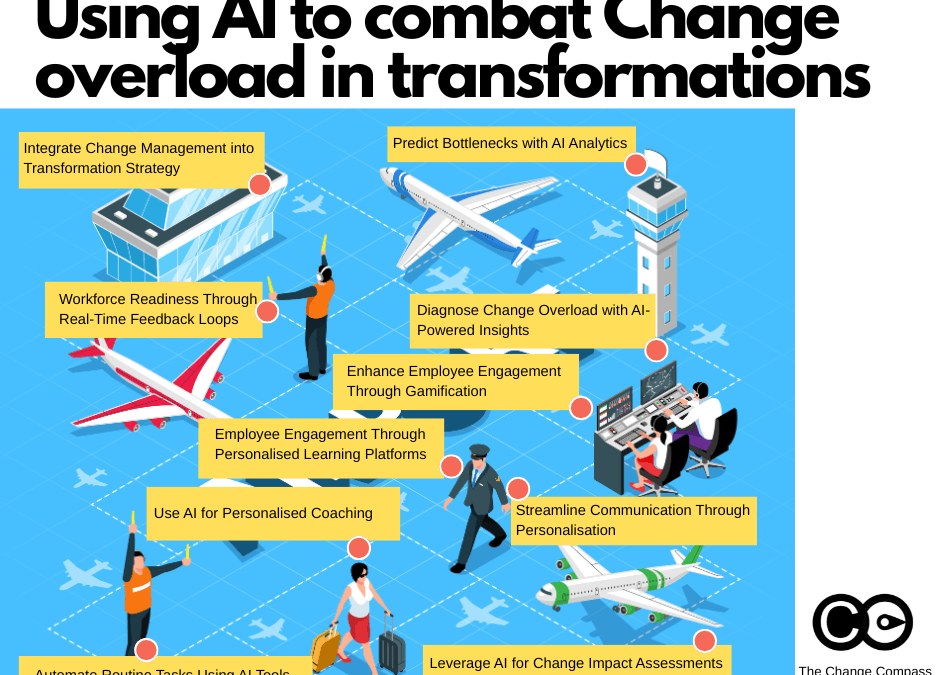
1. Diagnose Change Overload with AI-Powered Insights
Before addressing change overload, you need to identify where it exists and how it impacts your organisation. AI-powered analytics tools can provide real-time data on employee sentiment, workload distribution, and engagement levels—helping you pinpoint areas of concern before they escalate.
How to Apply This:
Use Sentiment Analysis Tools: Platforms like Microsoft Viva Insights or Qualtrics EmployeeXM can analyse employee feedback from surveys, emails, or chat platforms to detect patterns of stress or disengagement. For example:
If sentiment analysis reveals a spike in negative feedback during a specific project phase, it may indicate that employees are overwhelmed by unclear communication or unrealistic deadlines.
Monitor Workload Distribution: Tools such as Workday or Asana’s workload management feature can highlight individuals or teams carrying disproportionate workloads. This allows leaders to redistribute tasks more equitably.
Track Change Saturation Metrics: Use metrics like the number of concurrent projects per team or the average time spent on change-related activities per week may be a start. AI dashboards can automatically calculate these metrics and flag when thresholds are exceeded.
Visualise Change Saturation: Tools such as The Change Compass can help to easily capture change impacts across initiatives and turn these into data visualisation to support decision making. Embedded AI tools help to interpret the data and call out key risk areas and recommendations.
🔍 Example: A retail organisation undergoing digital transformation used AI sentiment analysis to discover that frontline employees felt excluded from decision-making processes. Leaders adjusted their communication approach to involve key frontline change champions which improved morale and reduced resistance.
2. Streamline Communication Through Personalisation
One-size-fits-all communication often adds to change fatigue by overwhelming employees with ineffective or irrelevant information. AI can help tailor messages based on individual roles, preferences, and needs—ensuring that employees only receive what’s most relevant to them.
How to Apply This:
Leverage Natural Language Processing (NLP): Tools like IBM Watson can analyse employee communication styles and suggest tone adjustments for clearer messaging.
Segment Audiences Automatically: Use platforms like Poppulo or Dynamic Signal to categorise employees by role, department, or location and deliver targeted updates accordingly. For instance:
IT teams might receive detailed technical updates about new systems being implemented, while frontline staff get simplified instructions on how the changes will impact their day-to-day tasks.
Automate Feedback Loops: Chatbots powered by AI (e.g., Tidio or Drift) can collect ongoing feedback from employees about the clarity and usefulness of communications during transformation initiatives.
💡 Pro Tip: Combine AI-driven personalisation with human oversight to ensure messages remain empathetic and aligned with organisational culture.
3. Predict Bottlenecks with AI Analytics
One of AI’s greatest strengths is its ability to analyse historical data and predict future outcomes—a capability that’s invaluable for managing change timelines and resource allocation effectively. Predictive analytics can help you anticipate bottlenecks before they occur and adjust your strategy in real time. For example, there could be cyclical periods of the year where the change volume tends to be higher. From our research at The Change Compass, we’ve seen that across different industries, October-November, and February-March tend to be high change volume periods.
How to Apply This:
Forecast Employee Capacity: If you already have the data you can use tools like Tableau or Power BI to predict when teams will be overstretched based on upcoming project timelines and historical workload data. Alternatively, utilise The Change Compass’ forecasting capabilities to predict trends.
Identify High-Risk Areas: Predictive models can flag departments or teams likely to experience resistance based on past behaviours or current engagement levels.
Scenario Planning: Use AI simulations (such as those offered by AnyLogic) to test different implementation strategies for your transformation initiative. The Change Compass also has a scenario planning feature to help you model changes before making the decision.
📊 Example: A financial services firm used predictive analytics during its digital transformation to identify that Q4 was historically the busiest period for its customer service team. By rescheduling non-critical training sessions for later Q1, they reduced employee stress and maintained service quality.
4. Enhance Employee Engagement Through Personalised Learning Platforms
Engaged employees are more likely to embrace change rather than resist it. AI-powered learning platforms offer personalised training pathways that equip employees with the skills they need for new roles or technologies introduced during transformation.
How to Apply This:
Create Adaptive Learning Journeys: Platforms like Degreed or EdCast use AI algorithms to recommend training modules based on an employee’s current skill set and career aspirations.
Gamify Learning Experiences: Incorporate gamification elements such as badges or leaderboards into your training programs using tools like Kahoot! or Quizizz.
Monitor Training Effectiveness: Use analytics within learning management systems (LMS) like Cornerstone OnDemand to track completion rates, quiz scores, and time spent on modules.
🎯 Action Step: Pair training initiatives with clear career progression opportunities tied directly to the transformation goals—for example, offering certifications for mastering new software systems being implemented.
5. Automate Routine Tasks Using AI Tools
Repetitive tasks drain employees’ energy and time—resources that could be better spent on strategic initiatives during transformations. Automation powered by AI can alleviate this burden by handling routine tasks efficiently. This not only reduces workload but also empowers employees to focus on higher-value activities that drive transformation success.
Note that this approach is assuming the organisation has the appetite to leverage AI and automation to reduce workload.
How to Apply This:
Automate Administrative Tasks: Tools like UiPath or Zapier can automate workflows such as data entry, meeting scheduling, or report generation. For example:
Automating the creation of weekly project status reports allows project managers to spend more time addressing risks and engaging with stakeholders.
Streamline Onboarding Processes: Implement chatbots like Leena AI or Talla that guide employees through onboarding steps during organisational changes. These tools can answer FAQs, provide training schedules, and even send reminders for task completion.
Enable Self-Service Options: Deploy virtual assistants (e.g., Google Dialogflow) that allow employees to access FAQs about new policies, systems, or procedures without waiting for human support.
💡 Pro Tip: When automating tasks, ensure transparency with employees about what is being automated and why. This helps build trust and prevents fears about job security.
6. Foster Workforce Readiness Through Real-Time Feedback Loops
Continuous feedback is essential during transformations—it helps leaders course-correct quickly while keeping employees informed and engaged. However, traditional feedback mechanisms like annual surveys are often too slow to capture real-time issues. AI tools enable organisations to collect and analyse feedback at scale in real time, creating a more agile approach to managing change fatigue.
How to Apply This:
Deploy Pulse Surveys: Platforms like Culture Amp or Peakon use AI algorithms to analyse survey responses instantly and provide actionable insights. For example:
If a pulse survey reveals low morale in a specific department, leaders can intervene immediately with targeted support or communication efforts.
Monitor Collaboration Metrics: Tools such as Slack Insights or Microsoft Teams Analytics track engagement levels within collaboration platforms. If metrics show a drop in activity or participation, it could indicate disengagement or confusion about transformation goals.
Close Feedback Loops Quickly: Use automated workflows triggered by feedback results. For instance:
If employees flag a lack of clarity about a new system rollout, an automated workflow can schedule additional training sessions or send out simplified guides.
📌 Key Insight: Real-time feedback not only identifies issues early but also demonstrates that leadership values employee input—a critical factor in building trust during change.
7. Leverage AI for Change Impact Assessments
One of the most overlooked aspects of managing change is understanding its cumulative impact across the organisation. Many organisations fail to consider how multiple simultaneous changes affect employee capacity and morale. AI tools can help conduct comprehensive change impact assessments by analysing data across projects, teams, and timelines.
How to Apply This:
Map Change Dependencies: Use AI-powered tools like The Change Compass to visualise how different initiatives overlap and interact. For example:
If two major IT upgrades are scheduled for the same quarter, the tool can flag potential conflicts and recommend rescheduling one of them as well as locating the right timing.
It could also be a series of smaller initiatives all being executed at the same time, again leading to the risk that key messages may not be absorbed by impacted employees
Analyse Historical Data: Predict how similar changes have impacted the organisation in the past using predictive analytics tools mentioned previously.
Simulate Scenarios: Run simulations to test different implementation strategies (e.g., phased vs big-bang rollouts) and predict their impact on employee workload and engagement.
🔍 Example: A global logistics company used AI-driven impact assessments to identify that rolling out a new CRM system during peak holiday season would overwhelm its sales team. By postponing the rollout until after the busy period, they avoided unnecessary stress and ensured smoother adoption.
8. Enhance Employee Engagement Through Gamification
AI can make transformation initiatives more engaging by incorporating gamification elements into training programs, communication strategies, and performance tracking systems. Gamification taps into employees’ intrinsic motivation by rewarding participation and progress—making change feel less daunting and more rewarding.
How to Apply This:
Gamify Training Programs: Use platforms like Kahoot! or Quizizz to create interactive quizzes and challenges related to new systems or processes being introduced.
Incentivise Participation: Offer digital badges, points, or leaderboards for completing key milestones in transformation initiatives (e.g., attending training sessions or adopting new tools).
Track Progress Automatically: AI-powered LMS platforms like Degreed can track employee progress in real time and provide personalised recommendations for next steps.
🎯 Action Step: Pair gamification efforts with tangible rewards such as gift cards or extra leave days for top performers.
💡 Pro Tip: Ensure gamification efforts are inclusive—design challenges that appeal to all personality types, not just competitive individuals.
9. Use AI for Personalised Coaching
AI-powered coaching platforms are revolutionising how organisations support their employees during transformations. These tools provide personalised guidance tailored to each employee’s role, skills, and career aspirations—helping them navigate change more effectively while feeling supported.
How to Apply This:
Deploy Virtual Coaches: Platforms like BetterUp or CoachHub use AI algorithms to match employees with virtual coaches who provide tailored advice on navigating change.
Provide Role-Specific Guidance: Use AI tools that offer customised recommendations based on an employee’s role within the organisation. For instance:
A sales representative might receive tips on leveraging new CRM features, while a manager gets guidance on leading their team through uncertainty.
Monitor Coaching Effectiveness: Track metrics such as employee satisfaction scores or performance improvements after coaching sessions.
🔍 Example: A tech company implementing agile methodologies used an AI coaching platform to train managers on fostering collaboration within cross-functional teams. The result was a smoother transition with fewer bottlenecks.
10. Integrate Change Management into Your Digital Transformation Strategy
AI should not operate in isolation; it must be embedded into your broader change management framework for maximum impact. This includes aligning AI initiatives with existing change management methodologies.
How to Apply This:
Centralise Data Sources: Use platforms like The Change Compass to consolidate insights from various data sources into a single dashboard, think data sources such as system usage, performance KPIs and employee survey results. It also enables you to capture your change data and deliverables according to your preferred methodology and populate data with generative AI.
Align Metrics Across Teams: Ensure KPIs related to change readiness (e.g., adoption rates) are consistent across departments.
Train Leaders on AI Capabilities: Equip managers with basic knowledge of how AI works so they can champion its use within their teams.
🌟 Final Thought: The integration of AI into change management isn’t just about technology—it’s about creating a culture of adaptability where data-driven decisions empower people at every level of the organisation.
Call-to-Action: Start Your Journey Towards Smarter Change Management
The challenges of large-scale transformations don’t have to result in burnout or disengagement when you harness the power of artificial intelligence effectively. Begin by assessing your current change portfolio environment—what tools are you already using? Where are the gaps? Then explore how AI solutions can fill those gaps while aligning with your organisational goals.
Ready to take the next step? Dive deeper into strategies for agile change portfolio management here and discover how data-driven insights can revolutionise your approach today!