Most large organisations are now somewhere in the process of deploying AI across their operations. Many are discovering, often painfully, that the change management challenge of AI adoption is categorically different from the change management challenges they have navigated before.
The difference is not scale, though AI initiatives are often large. It is speed, depth, and ambiguity. AI changes how work is done, not just which tools people use. It shifts decision-making processes, redistributes responsibilities, and in some cases eliminates roles entirely. And it keeps changing: the capabilities that are state of the art today are different from those of 12 months ago. Managing AI transformation through standard change management frameworks, built for discrete, definable changes, often produces poor results.
McKinsey’s research on change management in the age of gen AI is direct on this point: for CEOs, the charge is clear to plan for a company-wide reconfiguration today so that humans and AI together can achieve extraordinary outcomes tomorrow. And critically, McKinsey notes that upskilling as part of AI transformation is not a training rollout. It is a change management effort.
That reframing from AI deployment as technology change to AI adoption as organisational transformation is where effective AI change management begins.
The adoption gap in AI transformation
The gap between AI investment and AI value is widening in most organisations. Gartner research from 2025 found that business units which redesign how work gets done, rather than simply deploying AI tools and encouraging employees to use them, are twice as likely to exceed revenue goals. Yet most organisations are doing the latter.
This distinction between deploying AI and redesigning work is the core of effective AI change management. When AI is implemented as a tool overlay on existing processes, adoption is partial, benefits are modest, and resistance is higher. When AI implementation is accompanied by genuine redesign of workflows, decision rights, and performance expectations, adoption is deeper and the value is substantially larger.
The research confirms the cost of the gap. MIT Sloan Management Review’s analysis of gen AI scaling found that organisations face a predictable midcycle enthusiasm dip that kills adoption momentum, function-specific resistance that generic communications cannot address, and cultural resistance to working differently. Novo Nordisk’s experience, scaling from a few hundred AI users in January 2024 to more than 20,000 by February 2025, succeeded specifically because they combined champion networks, targeted function-level enablement, and adaptive governance rather than a one-size change communication approach.
Why AI change management is different from standard change management
Standard change management frameworks, whether ADKAR, Kotter, or Prosci, were designed for changes with defined endpoints: a new system goes live, a restructure is announced, a policy changes. The change effort has a start, a middle, and a completion point. Communication and training are planned around a timeline. Success is measured at a defined moment.
AI transformation does not work this way. Several characteristics make it distinct.
The change has no fixed endpoint
AI capabilities are evolving continuously. The change management challenge is not “help people adopt this AI tool.” It is “build the organisational capacity to continuously adopt AI as capabilities evolve.” This is a fundamentally different proposition. It requires building adaptive learning capacity into the organisation, not managing a one-time transition.
Employee relationship with AI is ambivalent, not uniformly resistant
Standard change management wisdom treats resistance as the primary barrier. With AI, the picture is more complex. MIT Sloan research found that employee hope about AI handling certain tasks remains high at 78 to 85% across adoption stages, while fear stays relatively low at 21 to 32%. The challenge is not primarily resistance, it is the gap between positive sentiment and sustained behaviour change in how work is actually done.
The impact is role-specific to an unusual degree
AI affects different roles in fundamentally different ways. A finance analyst and a customer service representative may both be in the same organisation’s AI transformation programme, but the change each needs to make is almost entirely different. Communication and training approaches that work for one will not work for the other. AI change management requires function-level and role-level customisation at a depth that generic programme change management rarely reaches.
Middle management is the critical adoption layer
Gartner’s CHRO research identifies a July 2025 survey finding that 78% of CHROs agree workflows and roles will need to change to get the most out of AI investments. But the barrier to this redesign is not typically executive resistance. It is middle management. Managers whose teams are being asked to work differently face the most immediate and personal disruption from AI adoption. They are simultaneously the key enablers of change at the team level and the group most likely to passively resist if the change management approach does not specifically address their experience.
What effective AI change management looks like
The organisations navigating AI transformation most effectively share several characteristics in their change approach.
They start with work redesign, not tool deployment. Before employees are asked to use AI tools, the question is asked: how should this work actually be done differently with AI available? This question is answered at the process and role level, not the general level. The answer shapes both the change management plan and the training design.
They build internal AI champion networks. The Novo Nordisk model, and many similar examples across industries, shows that peer-led adoption in function-specific contexts substantially outperforms top-down communications. Champions are typically senior individual contributors who understand the function’s work in detail and can translate AI capability into specific, credible use cases for their colleagues.
They manage the midcycle dip actively. AI adoption typically follows a predictable curve: initial enthusiasm, early experimentation, midcycle frustration as the limitations of current tools become apparent, and then either deeper adoption (for organisations that support people through the dip) or abandonment (for those that do not). Effective AI change management plans for the midcycle dip explicitly. It is not a sign of programme failure; it is a predictable stage that requires specific interventions.
They track adoption at role and function level, not just platform usage metrics. Platform usage (how many people opened the tool, how many queries were submitted) is a leading indicator at best and can be deeply misleading. A person can use an AI tool regularly without changing how they work in any meaningful way. Effective AI change management tracks whether the work is actually changing: are decisions being made differently, are time savings being realised, are outputs improving?
They redesign performance frameworks to reflect AI-enabled work. If employees are being asked to do their jobs differently using AI, but their performance frameworks still measure the old way of working, the rational behaviour is to use AI superficially while continuing to work in ways that the performance system recognises and rewards. Aligning performance expectations with AI-enabled ways of working is one of the most powerful and most neglected levers in AI change management.
The change management challenge specific to AI in large enterprises
For enterprise change leaders, AI transformation introduces portfolio complexity that adds to the standard adoption challenge. Most large organisations are running multiple AI initiatives simultaneously: different functions, different vendors, different use cases. The change management challenge is not just managing each initiative, it is managing the cumulative AI-related change burden on employees who are being asked to adopt AI across several areas of their work simultaneously.
Gartner research found that organisations continuously adapting their change plans based on employee responses are four times more likely to achieve change success. For AI transformation, this adaptive approach is even more important than usual, because the feedback loops are faster. AI tools change rapidly. Employee experience of those tools shifts as capabilities evolve. A change management plan set at programme initiation and not revisited will be misaligned with reality within months.
Using digital platforms in AI change management
The irony of AI change management is that it is one of the highest-complexity change management challenges organisations face, at a moment when most change functions are still operating with manually-compiled data and periodic reporting cycles. Digital change management platforms, such as The Change Compass, enable the continuous adoption tracking and portfolio-level visibility that AI transformation requires: seeing where adoption is progressing by function, identifying which employee groups are experiencing midcycle dips, and generating the data needed to adapt the change approach in real time rather than at fixed review points.
For AI transformation specifically, the combination of role-level adoption tracking and portfolio-level load management is particularly valuable. The change function can see not just whether AI adoption is progressing, but how AI change load interacts with other concurrent changes affecting the same employee groups.
What the research says about AI adoption failure
It is worth being clear about the evidence. A May 2025 Gartner survey of 506 CIOs and technology leaders found that 72% of CIOs report their organisations are breaking even or losing money on AI investments. The primary reasons cited are not technical: they are change-related. People are not working differently. Workflows have not been redesigned. The cultural conditions for AI adoption have not been established.
This is not a technology problem. It is a change management problem of a kind that only becomes soluble when AI transformation is explicitly treated as an organisational change challenge requiring deliberate, sustained change management investment.
Building AI change management capability in your organisation
For change leaders building the case internally for dedicated AI change management investment, the most useful starting point is a portfolio scan: how many AI initiatives are currently active across the organisation, which employee groups are they targeting, what is the cumulative AI-related change load, and what change management support is currently in place for each?
In most large organisations, this scan reveals a significant gap: a large number of AI initiatives, often with substantial investment in technology and training, and limited or no dedicated change management beyond communications. This gap is where the value is. Closing it, by bringing the same rigour to AI adoption management that mature change functions bring to major technology implementations, is the highest-return investment most enterprise change functions can make in 2026.
Frequently asked questions
What is AI change management?
AI change management is the application of organisational change management principles and practices to the challenge of adopting artificial intelligence tools, platforms, and AI-driven ways of working. It goes beyond technology deployment to address the behavioural, cultural, and structural changes required for AI to deliver its intended value.
Why do so many AI transformation initiatives fail to deliver expected value?
The primary causes are change-related, not technical. Workflows are not redesigned to use AI effectively, middle managers are not equipped to lead AI adoption at team level, performance frameworks still incentivise old ways of working, and adoption tracking focuses on platform usage rather than actual behaviour change. Gartner data shows 72% of CIOs report breaking even or losing money on AI investments, largely for these reasons.
How is AI change management different from managing other technology changes?
AI transformation differs in three important ways: there is no fixed endpoint because AI capabilities evolve continuously; the impact is highly role-specific, requiring function-level customisation that generic programmes cannot achieve; and the adoption challenge involves sustained behaviour change in how work is done, not just familiarity with a new tool.
What is the role of middle managers in AI adoption?
Middle managers are the most critical adoption layer. They translate the organisation’s AI strategy into day-to-day working practice for their teams. They are also the group most likely to face personal disruption from AI-driven work redesign. AI change management approaches that specifically address the manager experience, building their capability to lead AI adoption rather than treating them as a communication channel, substantially improve adoption outcomes.
How do you measure AI adoption effectively?
Effective measurement goes beyond platform usage metrics to track whether work is actually changing. This includes time savings realised in specific processes, quality of AI-assisted outputs compared to previous outputs, changes in decision-making patterns, and whether employees in target roles report working differently. Portfolio-level dashboards that aggregate this data by function and role group enable the adaptive approach that drives four times higher change success.
What is an AI champion network?
An AI champion network is a group of senior individual contributors in specific functions who serve as peer advocates and enablers for AI adoption within their teams. Champions are effective because they can translate general AI capability into specific, credible use cases relevant to their colleagues’ actual work, and because peer advocacy is significantly more influential than top-down communications for this type of behaviour change.
References
McKinsey. Reconfiguring Work: Change Management in the Age of Gen AI. https://www.mckinsey.com/capabilities/quantumblack/our-insights/reconfiguring-work-change-management-in-the-age-of-gen-ai
Gartner. Gartner Identifies the Top Change Management Trends for CHROs in the Age of AI (March 2026). https://www.gartner.com/en/newsroom/press-releases/2026-3-16-gartner-identifies-top-change-management-trends-for-chros-in-age-of-ai
Gartner. Gartner Says CHROs’ Top Priorities for 2026 Center Around Realizing AI Value (October 2025). https://www.gartner.com/en/newsroom/press-releases/2025-10-02-gartner-says-chros-top-priorities-for-2026-center-around-realizing-ai-value-and-driving-performance-amid-uncertainty
MIT Sloan Management Review. How to Scale GenAI in the Workplace. https://sloanreview.mit.edu/article/how-to-scale-genai-in-the-workplace/
MIT Sloan Management Review. Three Things to Know About Implementing Workplace AI Tools. https://sloanreview.mit.edu/article/three-things-to-know-about-implementing-workplace-ai-tools/
Air traffic control is one of the most sophisticated and high-stakes management systems in the world. Ensuring the safety of thousands of flights daily requires rigorous coordination, precise timing, and a structured yet adaptable approach. When failures occur, they often result in catastrophic consequences, as seen in the tragic January 2025 midair collision between an army helicopter and a passenger jet in Washington, D.C. airspace.
Think about the last time you took a flight. You probably didn’t worry about how the pilot knew where to go, how to land safely, or how to avoid other planes in the sky. That’s because air traffic control is a well-oiled machine, built on a foundation of real-time data, clear protocols, and experienced professionals making split-second decisions. Now, imagine if air traffic controllers had to work with outdated information, or if pilots had to rely on intuition rather than hard facts. Chaos, right?
The same principles that apply to managing air traffic also hold valuable lessons for change and transformation management within organisations. Large-scale transformations involve multiple initiatives running in parallel, conflicting priorities, and significant risks. Without a structured, centralised approach, organisations risk failure, reduced value realisation, and employee fatigue.
The same logic applies to organisational change and transformation. Leaders are often trying to land multiple initiatives at once, each with its own trajectory, speed, and impact. Without real-time, accurate data, it’s all too easy for change initiatives to collide, stall, or overwhelm employees. Just as the aviation industry depends on continuous data updates to prevent disasters, businesses must embrace data-driven decision-making to ensure their transformation efforts succeed.
Here we’ll explore what air traffic control can teach us about using data effectively in change management. If you’ve ever felt like your organisation’s transformation efforts are flying blind, chaotic and uncoordinated, this one’s for you.
Lesson 1: The Danger of Overloading Critical Roles
The D.C. Midair Collision: A Case of Role Overload
In January 2025, a tragic midair collision occurred in Washington, D.C. airspace between an army helicopter and a passenger jet, claiming 67 lives. Investigations revealed multiple contributing factors, including inadequate pilot training, fatigue, insufficient maintenance, and ignored safety protocols. This incident underscored the dangers of overstretched resources, outdated processes, and poor data visibility—lessons that extend beyond aviation and into how organisations manage complex, high-stakes operations like change and transformation.
Additionally, the air traffic controller on duty was handling both helicopter and airplane traffic simultaneously, leading to a critical lapse in coordination. This split focus contributed to poor coordination and a lack of real-time situational awareness, ultimately leading to disaster. This is aligned with findings from various research that providing adequate resources is important in driving change and transformation.
Parallels in Change and Transformation Management
Organisations often suffer from similar overload issues when managing change. Many initiatives—ranging from business-as-usual (BAU) efforts to large-scale transformations—compete for attention, resources, and stakeholder engagement. Without a structured approach, teams end up working in silos, unaware of competing priorities or overlapping impacts.
There are some who argue that change is the new norm, so employees just need to get on the program and learn to adapt. It may be easy to say this, but successful organisations have learnt how to do this, versus ignoring the issue. After all, managing capacity and resources is a normal part of any effective operations management and strategy execution. Within a change context, the effects are just more pronounced given the timelines and the need to balance both business-as-usual and changes.
Key Takeaways:
Centralised Oversight: Organisations need a structured governance model—whether through a Transformation Office, PMO, or Change Centre of Excellence—to track all initiatives and prevent “collisions.”
Clear Role Definition: Initiative owners and sponsors should have a clear understanding of their responsibilities, engagement processes, and decision-making frameworks.
Avoiding Initiative Overload: Employees experience “change fatigue” when multiple transformations run concurrently without proper coordination. Leaders must balance initiative rollout to ensure sustainable adoption.
Lesson 2: Providing Initiative Owners with Data-Driven Decision Autonomy
The UPS ‘Continuous Descent Arrivals’ System
UPS has been testing a data-driven approach to landings called ‘Continuous Descent Arrivals’ (source: Wall Street Journal article: Managing Air Traffic Control). Instead of relying solely on air traffic controllers to direct landing schedules, pilots have access to a full dashboard of real-time data, allowing them to determine their optimal landing times while still following a structured governance protocol. While CDA is effective during light traffic conditions, implementing it during heavy traffic poses technical challenges. Air traffic controllers must ensure safe separation between aircraft while optimising descent paths.
Applying This to Agile Change Management
In agile organisations, multiple initiatives are constantly iterating, requiring a balance between flexibility and coordination. Rather than centralised bottleneck approvals, initiative owners should be empowered to make informed, autonomous decisions—provided they follow structured governance (and when there is less risk of multiple releases and impacts on the business).
Key Takeaways:
Real-Time Data Sharing: Just as pilots rely on up-to-date flight data, organisations must have a transparent system where initiative owners can see enterprise-wide transformation impacts and adjust accordingly.
Governance Without Bureaucracy: Pre-set governance protocols should allow for self-service decision-making without stifling agility.
Last-Minute Adjustments with Predictability: Agile initiatives should have the flexibility to adjust their release schedules as long as they adhere to predefined impact management processes.
Lesson 3: Resourcing Air Traffic Control for Organisational Change
Lack of Air Traffic Controllers: A Root Cause of the D.C. Accident
The D.C. accident highlighted that understaffing was a critical factor. Insufficient air traffic controllers led to delayed decision-making and unsafe airspace conditions.
The Importance of Resource Allocation in Change and Transformation
Many organisations lack a dedicated team overseeing enterprise-wide change. Instead, initiatives operate independently, often leading to inefficiencies, redundancies, and conflicts. According to McKinsey, companies that effectively prioritise and allocate resources to transformation initiatives can generate 40% more value compared to their peers.
Key Takeaways:
Dedicated Transformation Governance Teams: Whether in the form of a PMO, Transformation Office, or Change Centre of Excellence, a central function should be responsible for initiative alignment.
Prioritisation Frameworks: Not all initiatives should receive equal attention. Organisations must establish structured prioritisation mechanisms based on value, risk, and strategic alignment.
Investment in Change Capacity: Just as air traffic controllers are indispensable to aviation safety, organisations must invest in skilled change professionals to ensure seamless initiative execution.
Lesson 4: Proactive Risk Management to Prevent Initiative Collisions
The Risk of Unchecked Initiative Timelines
Just as midair collisions can occur due to inadequate tracking of aircraft positions, organisational change initiatives can “crash” when timelines and impacts are not actively managed. Without a real-time view of concurrent changes, organisations risk:
Conflicting Business Priorities: Competing transformations may pull resources in different directions, leading to delays and reduced impact.
Change Saturation: Employees struggle to absorb too many changes at once, leading to disengagement and lower adoption.
Operational Disruptions: Poorly sequenced initiatives can create unintended consequences, disrupting critical business functions.
Establishing a Proactive “Air Traffic Control” for Change
Enterprise Change Heatmaps: Organisations should maintain a real-time dashboard of ongoing and upcoming changes to anticipate and mitigate risks.
Stakeholder Impact Assessments: Before launching initiatives, leaders must assess cumulative impacts on employees and customers.
Strategic Sequencing: Similar to how air traffic controllers ensure safe landing schedules, organisations must deliberately pace their change initiatives.
The Role of Data in Change and Transformation: Lessons from Air Traffic Control
You Need a Single Source of Truth—No More Guesswork
Aviation Example: The Power of Integrated Data Systems
In aviation, pilots and controllers don’t work off scattered spreadsheets or conflicting reports. They use a unified system that integrates radar, satellite tracking, and aircraft GPS, providing a single, comprehensive view of air traffic. With this system, pilots and controllers can see exactly where each aircraft is and make informed decisions to keep everyone safe.
Application in Change Management: Why Fragmented Data is a Recipe for Disaster
Now, compare this to how many organisations manage change. Different business units track initiatives in separate spreadsheets, using inconsistent reporting standards. Transformation offices, HR, finance, and IT often operate in silos, each with their own version of the truth. When leaders don’t have a clear, real-time picture of what’s happening across the organisation, it’s like trying to land a plane in thick fog—without instruments.
Key Takeaways:
Create a Centralised Change Management Platform: Just like air traffic control relies on a single system, organisations need a centralised platform where all change initiatives are tracked in real time.
Standardise Data Collection and Reporting: Everyone involved in change initiatives should follow the same data standards to ensure consistency and accuracy.
Increase Visibility Across Business Units: Leaders need an enterprise-wide view of all change efforts to avoid conflicts and align priorities.
Real-Time Data Enables Agile, Confident Decision-Making
UPS has a fascinating system for managing landings, known as ‘Continuous Descent Arrivals.’ Instead of waiting for air traffic controllers to dictate their landing time, pilots receive real-time data about their approach, runway conditions, and surrounding traffic. This allows them to determine the best landing time themselves—within a structured framework. The result? More efficient landings, less fuel waste, and greater overall safety.
Application in Change Management: The Danger of Outdated Reports
Too often, business leaders make transformation decisions based on data that’s weeks—or even months—old. By the time they realise a problem, the initiative has already veered off course. When leaders lack real-time data, they either act too late or overcorrect, causing further disruptions.
Key Takeaways:
Use Live Dashboards for Initiative Management: Just as pilots rely on real-time flight data, change leaders should have constantly updated dashboards showing initiative progress, risks, and dependencies.
Empower Initiative Owners with Data-Driven Autonomy: When given up-to-date information, initiative owners can make faster, smarter adjustments—without waiting for top-down approvals.
Leverage Predictive Analytics to Anticipate Challenges: AI-driven insights can flag potential risks, such as change saturation or conflicting priorities, before they become full-blown issues.
Modern aircraft are equipped with automatic dependent surveillance-broadcast (ADS-B) systems, which allow them to communicate real-time flight data with each other. If two planes are on a collision course, these systems warn pilots, giving them time to adjust. It’s a proactive approach to risk management—problems are detected and resolved before they escalate.
Application in Change Management: Avoiding Crashes Between Initiatives
In organisations, multiple change initiatives often roll out simultaneously, each demanding employee attention, resources, and operational bandwidth. Without real-time risk monitoring, it’s easy to overwhelm employees or create operational bottlenecks. Many organisations don’t realise there’s an issue until productivity starts dropping or employees push back against the sheer volume of change.
Key Takeaways:
Invest in Impact Assessment Tools: Before launching an initiative, leaders should evaluate its potential impact on employees and the business.
Run Scenario Planning Exercises: Like pilots in flight simulators, organisations should model different change scenarios to prepare for potential challenges.
Set Up Early Warning Systems: AI-driven analytics can detect overlapping initiatives, allowing leaders to intervene before issues arise.
The High Cost of Inaccurate or Delayed Data
Aviation Example: The D.C. Midair Collision
The tragic January 2025 midair collision in Washington, D.C. was, in part, the result of outdated and incomplete data. A single air traffic controller was responsible for both helicopter and airplane traffic, leading to a dangerous lapse in coordination. Miscommunication about airspace restrictions only made matters worse, resulting in an avoidable catastrophe.
Poor Data Leads to Costly Mistakes
The corporate equivalent of this is when transformation teams work with old or incomplete data. Decisions based on last quarter’s reports can lead to wasted resources, poorly sequenced initiatives, and employee burnout. The consequences might not be as immediately tragic as an aviation disaster, but the financial, momentum and cultural costs can be devastating.
Key Takeaways:
Prioritise Frequent Data Updates: Change leaders must ensure initiative data is refreshed regularly to reflect real-time realities.
Collaborate Across Functions to Maintain Accuracy: Transformation leaders, HR, finance, and IT should work together to ensure all change impact data is reliable.
Automate Reporting Where Possible: AI and automation can reduce human error and provide real-time insights without manual effort.
Balancing Automation with Human Judgment
Aviation Example: Autopilot vs. Pilot Oversight
While modern planes rely heavily on autopilot, pilots are still in control. They use automation as a support system, but ultimately, human judgment is the final safeguard. It’s the perfect balance—automation enhances efficiency, while human oversight ensures safety.
Some leaders may find the process of collecting and analyzing data cumbersome, time-consuming, and even unnecessary—especially when they’re focused on quick execution. Gathering accurate, real-time data requires investment in tools, training, and disciplined processes, which can feel like an administrative burden rather than a value driver.
However, the benefits far outweigh the effort. A well-structured data system provides clarity on initiative progress, prevents conflicting priorities, enhances decision-making, and ensures resources are allocated effectively. Without it, organisations risk initiative overload, employee burnout, wasted budgets, and ultimately, failed transformations. Just like in aviation, where poor data can lead to fatal accidents, a lack of real-time insights in change management can result in costly missteps that derail business success.
Moreover, having an integrated process whereby data regularly feeds into decision making, as a normal business-as-usual process, builds the overall capability of the organisation to be a lot more agile and be able to change with confidence.
Navigating Change with Data-Driven Precision
Aviation has shown us what happens when decision-makers lack real-time, accurate data—mistakes happen, and consequences can be severe. In organisational change, the same principles apply. By embracing real-time data, predictive analytics, and structured governance, companies can navigate change more effectively, preventing initiative overload, reducing resistance, and maximising impact.
Ultimately, the goal is simple: Ensure your change initiatives don’t crash and burn. And just like in aviation, data is the key to a smooth landing.
If you would like to chat more about how to utilise a digital/AI solution that will equip you will insightful data to make critical business decisions in your air traffic control of your changes, reach out to us here.
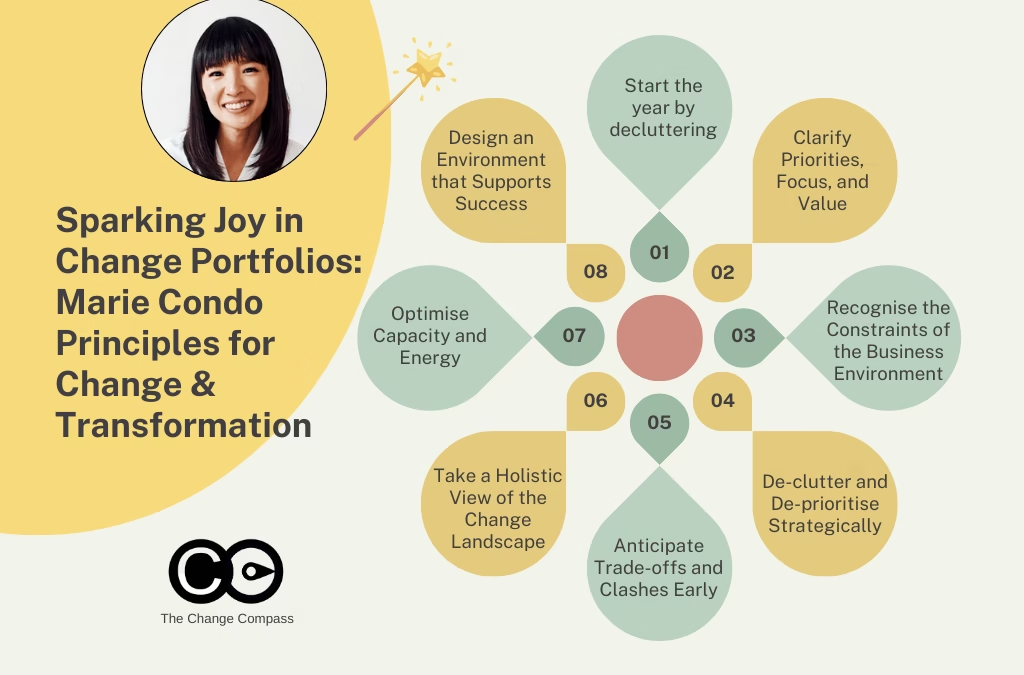
As the new year begins, it’s a natural time to reflect, refocus, and set the stage for success. For senior change and transformation professionals, this is an opportune moment to assess the upcoming portfolio of initiatives. Taking inspiration from Marie Kondo’s principles of decluttering and creating joy, we can apply these ideas to optimise our change portfolios and ensure they are designed for impact, sustainability, and value.
1. Start the Year by Decluttering
Just as Marie Kondo advises starting with a clean slate by letting go of unnecessary items, the new year offers the perfect chance to reassess the change portfolio. Decluttering is not just about removing excess; it’s about making deliberate, strategic decisions to create space for what truly matters. Many organisations find themselves burdened by legacy projects, overlapping initiatives, and unnecessary complexity. These elements consume valuable resources and dilute focus, ultimately jeopardising the success of the portfolio as a whole.
To start the decluttering process, take time to systematically review all initiatives. Begin by cataloging everything currently in progress or planned for the upcoming year. This exercise will reveal the true scope of commitments and help identify initiatives that may no longer align with the organisation’s strategic priorities. From there, engage with key stakeholders to challenge assumptions and uncover opportunities to streamline. By proactively identifying what can be paused, combined, or retired, you free up capacity for the initiatives that deliver the greatest value.
Your next PI (Program Increment) Planning will be a great opportunity to do this. As you work with other teams to assess scheduling and alignment, use this opportunity to align with stakeholder to cull and re-prioritise as required. It may be a good idea to do this prior to the PI Planning session to ensure the session is tight and focused.
Decluttering is not just about removing initiatives; it’s about creating space for the initiatives that truly matter. This exercise can involve:
Conducting a Portfolio Audit: List all current and planned initiatives. Categorize them by strategic importance, urgency, and expected impact.
Engaging Stakeholders: Facilitate discussions with leaders and project owners to challenge the status quo. Ask critical questions: Does this initiative serve a pressing need? Can its objectives be achieved through another project?
Identifying Redundancies: Often, multiple initiatives address overlapping goals. Combining efforts can streamline resources and improve focus.
2. Clarify Priorities, Focus, and Value
One of the key principles of joyful organisation is clarity. In the context of change management, clarity means ensuring that every initiative in the portfolio has a clearly defined purpose, aligns with organizational priorities, and delivers measurable value. Without this clarity, portfolios risk becoming overcrowded and unfocused, leading to wasted resources and frustrated teams.
Take a step back to evaluate each initiative against the organisation’s strategic goals. This process should involve critical questions such as: Does this initiative support our long-term vision? What specific problems does it solve? How does it fit into the broader transformation journey? Answering these questions will help identify initiatives that lack focus or fail to deliver meaningful value.
Clarity also requires a shared understanding across the organisation. Leaders, teams, and stakeholders must be aligned on what matters most. Misaligned priorities can lead to confusion, duplication of efforts, and competing demands on resources. By fostering open communication and establishing clear criteria for decision-making, you can ensure that everyone is working toward the same goals.
Creating clarity requires tools and structured processes:
Use Priority Matrices: Tools like the Eisenhower Matrix or impact-effort grids can help categorise initiatives based on their urgency and value. To read more about the Eisenhower Matrix visit this Forbes article
Define Metrics of Success: For each initiative, identify clear KPIs that demonstrate its contribution to the organisation’s goals. This helps maintain focus and provides a benchmark for future evaluations.
Communicate Priorities Clearly: Ensure that leadership and teams are aligned on what matters most. A shared understanding of priorities reduces the risk of misaligned efforts.
3. Recognise the Constraints of the Business Environment
Unlike a personal decluttering exercise, most organisations cannot afford to focus on just a few initiatives due to the fast-paced and ever-changing nature of the business world. New market demands, technological advancements, and regulatory changes often force organisations to pivot or expand their priorities mid-year. This makes it critical to design a change landscape that can accommodate both planned and emergent needs.
A well-structured portfolio balances transformational initiatives with business-as-usual (BAU) activities, ensuring that both long-term and short-term goals are addressed. However, achieving this balance requires careful planning and the ability to adapt. Organisations must be prepared to reassess priorities and make adjustments without derailing progress.
Designing the change landscape involves creating a comprehensive view of all initiatives, their interdependencies, and their impact on resources. This view should be regularly updated to reflect changes in the business environment. Scenario planning can also be invaluable, allowing organisations to explore potential outcomes and identify strategies for adapting to new challenges.
The optimal change landscape for your impacted stakeholders is one that is not cluttered, but one that is tight, focused and considered. It is not just about avoiding change saturation. It is about designing the right energy, focus, momentum and capacity.
Designing the change landscape involves:
Mapping the Portfolio: Visualise all initiatives, their timelines, and dependencies. Tools like Gantt charts or Kanban boards can help create a comprehensive view
Scenario Planning: Consider different scenarios based on potential changes in the business environment. How will the portfolio adapt if priorities shift mid-year?
Building Flexibility: Design the portfolio to accommodate adjustments without derailing progress. This might mean reserving resources for unforeseen priorities or having contingency plans for high-risk initiatives.
To do all these can be taxing. Check out The Change Compass for a view of your initiative impacts on people in terms of capacity and involvement. It also allows you to design and visualise different scenarios of different initiative sequences. You can easily see the forecasted capacity of various teams and be able to leverage AI insights on key risks.
4. De-clutter and De-prioritise Strategically
It’s common for certain initiatives to linger in the portfolio simply because they are pet projects of influential leaders. While these may have merit, it’s essential to make deliberate choices about what stays and what goes. Without these hard decisions, portfolios can become bloated, stretching resources too thin and compromising the success of high-priority initiatives.
Facilitating open conversations with stakeholders is key to successful de-prioritisation. This requires a combination of diplomacy and data-driven insights. By presenting clear evidence of an initiative’s impact (or lack thereof), you can shift the conversation from emotion to evidence. It’s also important to address the organisational culture around failure and closure. Retiring an initiative should be seen as a strategic decision rather than a failure.
Strategies for effective de-prioritization include:
Data-Driven Decision Making: Use data to demonstrate the potential ROI of each initiative. This helps shift conversations from emotion to evidence.
Transparent Communication: Be honest about why certain initiatives are being deprioritised. Transparency builds trust and reduces resistance.
Celebrate Closure: For initiatives that are retired, acknowledge the effort invested and celebrate the learnings. This reinforces a culture of continuous improvement.
5. Anticipate Trade-offs and Clashes Early
One of the most common pitfalls in change management is waiting until conflicts arise before addressing them. Portfolio clashes, resource shortages, and stakeholder fatigue can often be predicted well in advance. However, many organisations fail to have the necessary conversations early enough, leading to last-minute crises that disrupt progress. Having conversations too late means your initiative stakeholders are already invested given the significant effort and resources put in. This means it makes it even harder to change committed timelines, even when there are significant risks.
Proactively anticipating trade-offs requires a combination of foresight, tools, and collaborative discussions. Change impact assessments, capacity planning, and regular portfolio reviews are invaluable in identifying potential bottlenecks and saturation points. Additionally, creating forums for open dialogue allows stakeholders to surface concerns and explore solutions before issues escalate.
By anticipating challenges ahead of time, you create a smoother path for change initiatives to succeed. Key practices include:
Regular Portfolio Reviews: Establish a cadence for reviewing the portfolio. These reviews should assess progress, identify emerging risks, and recalibrate priorities as needed.
Engaging Cross-Functional Teams: Include representatives from impacted teams in decision-making. Their insights can help identify potential clashes that might be overlooked.
Scenario Analysis: Model different scenarios to understand how changes in one initiative might ripple across the portfolio. This foresight enables proactive adjustments.
6. Take a Holistic View of the Change Landscape
Change portfolios often focus on big-ticket initiatives, but employees experience all changes—big or small—as part of the same landscape. Every new tool, process, or initiative adds to the cognitive and emotional load of employees. Failing to account for this cumulative impact can lead to burnout, disengagement, and resistance to change.
Taking a holistic view means looking beyond the high-profile initiatives to include BAU initiatives, operational changes, and even cultural events like town halls or roadshows. All these elements compete for employees’ time and energy. By considering the full scope of activities, you can create a more realistic and empathetic plan that supports employee well-being.
Everything that takes time, focus, or mental energy should be part of the portfolio view. This holistic approach ensures realistic planning and reduces the risk of burnout. Practical steps include:
Creating a Change Calendar: Map all change-related activities, including BAU tasks and cultural events, to understand their cumulative impact on employees.
Conducting Employee Impact Assessments: Gather feedback from employees to understand how various initiatives affect their workload and well-being.
Prioritizing Communication: Ensure employees have a clear understanding of what’s coming and how it fits into the broader organisational goals.
7. Optimise Capacity and Energy
While most portfolios focus on deliverables, the real enabler of success is the energy and capacity of those who drive and experience change. Key considerations include:
Assessing the available capacity in impacted teams.
Designing sequences of change that maximize energy levels (e.g., scheduling major initiatives after quieter periods).
Factoring in recovery time after high-stress periods or significant releases.
By aligning the portfolio to the energy rhythms of the organisation, you increase the likelihood of successful adoption and sustained change. Specific strategies include:
Workload Balancing: Ensure no team or individual is overburdened. Distribute responsibilities equitably and provide support where needed.
Energy Mapping: Identify periods of high energy and focus within the organisation. Schedule demanding initiatives during these times to maximise success.
Encouraging Breaks: Build in time for reflection and recovery. Whether it’s a pause after a major release or regular team check-ins, these moments are crucial for maintaining momentum.
8. Design an Environment that Supports Success
Finally, creating the right environment for change is essential. Just as Marie Kondo encourages designing spaces that spark joy, change professionals should design portfolios that:
Foster collaboration and open communication.
Provide the necessary tools, resources, and support for employees.
Build a culture of adaptability and resilience.
‘Joy’ for the organisation is one that is balanced with achieving business objects and optimal people experience during change and transformation
A well-designed change environment creates the conditions for initiatives to thrive and for employees to embrace new ways of working. Consider:
Investing in Change Capability: Provide training and resources to build change management skills across the organisation.
Creating Feedback Loops: Establish mechanisms for continuous feedback and improvement. This ensures the portfolio remains aligned with evolving needs.
Celebrating Successes: Recognise and reward achievements, both big and small. Celebrating progress reinforces a positive change culture.
Applying Marie Kondo’s principles to change portfolio management allows organisations to focus on what truly matters, let go of what doesn’t, and create a change landscape that sparks energy and engagement. By decluttering, prioritising, and designing for capacity, senior change professionals can position their organisations for success in the year ahead. Take this opportunity to curate a portfolio that not only drives transformation but also brings clarity, purpose, and joy to the journey.
Remember, a well-organised change portfolio is not just about achieving organisational goals—it’s about creating an environment where people thrive, adapt, and contribute their best. Let this be the year your change portfolio truly sparks joy.
Change managers are not just facilitators of change transition; they are strategic partners who must understand and navigate complex organisational landscapes. One key skill that is often under-emphasised in this role is analytical capability. By adopting a strategic consultant’s mindset and employing robust analytical skills, change managers can significantly enhance their effectiveness throughout the project lifecycle. Let’s explore how change managers can leverage analytical skills at each phase of the project lifecycle, emphasising frameworks like MECE and TOSCA to drive successful change initiatives.
The Importance of an Analytical Lens
Change management involves facilitating transitions while ensuring that stakeholders are engaged and informed. However, to do this effectively, change managers must analyse complex data sets, identify patterns, and make informed decisions based on evidence. This analytical lens can be applied through every stage of the project lifecycle: commencement, planning, execution, monitoring, and closure.
Gone are the days when change practitioners are making recommendations ‘from experience’ or based on stakeholder input or feedback. For complex transformation, stakeholders now (especially senior stakeholders) demand a more rigorous, data-driven approach to drive toward solid change outcomes.
1. Project Commencement Phase
At the project commencement phase, the groundwork is laid for the entire change initiative. Change managers need to scan the organizational environment through the lens of impacted stakeholders, gathering relevant information and data.
Example: Consider a company planning to implement a new customer relationship management (CRM) system. The change manager should begin by analysing the existing state of customer interactions, assessing how the change will impact various departments such as sales, marketing, and customer service. This involves conducting stakeholder interviews, reviewing existing performance metrics, and gathering feedback from employees.
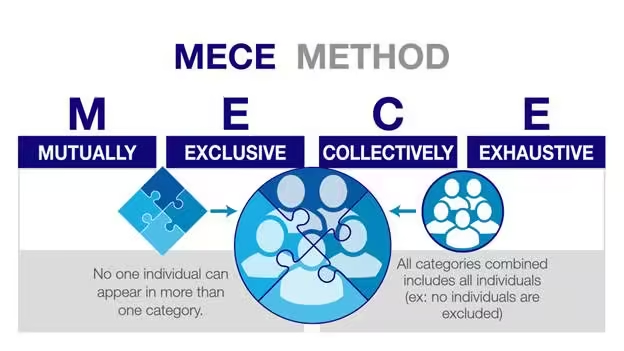
Using a MECE (Mutually Exclusive, Collectively Exhaustive) framework, the change manager can categorize stakeholder concerns into distinct groups—such as operational efficiency, user experience, and integration with existing systems—ensuring that all relevant factors are considered. By identifying these categories, the change manager can articulate a clear vision and define the desired end state that resonates with all stakeholders.
The above is from Caseinterview.com
Hypothesis: Sales Team Will Resist the New CRM System Due to Lack of Training and User-Friendliness
Step 1: Identify the Hypothesis
Hypothesis: The sales team will resist the new CRM system because they believe it is not user-friendly and they fear insufficient training.
Step 2: Break Down the Hypothesis into MECE Categories
To validate this hypothesis, we’ll break it down into specific categories that are mutually exclusive and collectively exhaustive. We’ll analyse the reasons behind the resistance in detail.
Categories:
User Experience Issues
Complexity of the Interface
Navigation Difficulties
Feature Overload
Training and Support Concerns
Insufficient Training Programs
Lack of Resources for Ongoing Support
Variability in Learning Styles
Change Management Resistance
Fear of Change in Workflow
Previous Negative Experiences with Technology
Concerns About Impact on Performance Metrics
Step 3: Gather Data for Each Category
Next, we need to collect data for each category to understand the underlying reasons and validate or refute our hypothesis.
Category 1: User Experience Issues
Data Collection:
Conduct usability testing sessions with sales team members.
Administer a survey focusing on user interface preferences and pain points.
Expected Findings:
High rates of confusion navigating the new interface.
Feedback indicating that certain features are not intuitive.
Category 2: Training and Support Concerns
Data Collection:
Survey the sales team about their current training needs and preferences.
Review existing training materials and resources provided.
Expected Findings:
Many team members express a need for more hands-on training sessions.
A lack of available resources for ongoing support after the initial rollout.
Category 3: Change Management Resistance
Data Collection:
Conduct focus groups to discuss fears and concerns regarding the new system.
Analyse historical data on previous technology implementations and employee feedback.
Expected Findings:
Employees voice concerns about how the CRM will change their current workflows.
Negative sentiments stemming from past technology rollouts that were poorly managed.
Step 4: Analyse Data Within Each Category
Now that we have gathered the data, let’s analyse the findings within each MECE category.
Analysis of Findings:
User Experience Issues:
Complexity of the Interface: Usability tests reveal that 70% of sales team members struggle to complete certain tasks in the CRM.
Navigation Difficulties: Survey responses show that 80% find one step of the navigation counterintuitive, leading to frustration.
Training and Support Concerns:
Insufficient Training Programs: Surveys indicate that only 40% of employees feel adequately trained to use this part of the new system.
Lack of Resources for Ongoing Support: Focus groups reveal that team members are unsure where to seek help after the initial training.
Change Management Resistance:
Fear of Change in Workflow: Focus group discussions highlight that 60% of participants fear their productivity will decrease with the new system, at least during the post Go Live period.
Previous Negative Experiences: Historical data shows that past technology rollouts had mediocre adoption rates due to insufficient support, reinforcing current fears.
Step 5: Develop Actionable Recommendations
Based on the analysis of each category, we can create targeted recommendations to address the concerns raised.
Recommendations:
User Experience Issues:
Conduct additional usability testing with iterative feedback loops to refine the CRM interface before full rollout.
Simplify the navigation structure based on user feedback, focusing on the most frequently used features.
Training and Support Concerns:
Develop a comprehensive training program that includes hands-on workshops, tutorials, and easy-to-access online resources.
Establish a dedicated support team to provide ongoing assistance, ensuring team members know whom to contact with questions.
Change Management Resistance:
Implement a change management strategy that includes regular communication about the benefits of the new system, addressing fears and expectations.
Share success stories from pilot programs or early adopters to demonstrate positive outcomes from using the CRM.
By following this detailed step-by-step analysis using the MECE framework, the change manager can thoroughly investigate the hypothesis regarding the sales team’s resistance to the new CRM system. This structured approach ensures that all relevant factors are considered, enabling the development of targeted strategies that address the specific concerns of stakeholders. Ultimately, this increases the likelihood of successful change adoption and enhances overall organizational effectiveness.
Data-Driven Decision Making:
At this stage, change managers should work closely with the project sponsor and project manager to determine effective positioning. A data-driven approach allows the change manager to form a hypothesis about how the change will impact stakeholders. For instance, if data suggests that the sales team is particularly resistant to change, the manager might hypothesize that this resistance stems from a lack of understanding about how the new CRM will enhance their workflow.
2. Planning Phase
Once the project is initiated, the planning phase requires detailed strategy development. Here, analytical skills are essential for conducting stakeholder analysis and impact assessments.
Example: In our CRM implementation scenario, the change manager must analyse the data collected during the commencement phase to identify the specific impacts on different departments. This involves grouping and sorting the data to prioritize which departments require more extensive support during the transition.
Using the TOSCA (Target, Objectives, Strategy, Constraints, Actions) framework provides a structured approach to guide the change management process for the CRM implementation. This framework helps clarify the overall vision and specific steps needed to achieve successful adoption. Below is a detailed exploration of each component:
1. Target
Definition: The target is the overarching goal of the change initiative, articulating the desired end state that the organization aims to achieve.
Application in CRM Implementation:
Target: Improve customer satisfaction and sales efficiency.
This target encapsulates the broader vision for the CRM system. By focusing on enhancing customer satisfaction, the organization aims to create better experiences for clients, which is crucial for retention and loyalty. Improving sales efficiency implies streamlining processes that enable sales teams to work more effectively, allowing them to close deals faster and serve customers better.
2. Objectives
Definition: Objectives are specific, measurable outcomes that the organization intends to achieve within a defined timeframe.
Application in CRM Implementation:
Objectives: Increase customer retention by 20% within a year.
This objective provides a clear metric for success, enabling the organization to track progress over time. By setting a 20% increase in customer retention as a target, the change manager can align training, support, engagement and system adoption with this goal. This objective also allows for measurable evaluation of the CRM’s impact on customer relationships and retention efforts.
3. Strategy
Definition: The strategy outlines the high-level approach the organization will take to achieve the objectives. It serves as a roadmap for implementation.
Application in CRM Implementation:
Strategy: Implement phased training sessions for each department, with tailored support based on the unique impacts identified.
This strategy emphasizes a thoughtful and structured approach to training, recognizing that different departments may face distinct challenges and needs when adapting to the new CRM. By rolling out training in phases, the organization can focus on one department at a time, ensuring that each team receives the specific support they require. Tailoring the training content based on the unique impacts identified earlier in the MECE analysis helps maximize engagement and effectiveness, addressing concerns about usability and fostering greater adoption of the CRM.
4. Constraints
Definition: Constraints are the limitations or challenges that may impact the successful implementation of the strategy. Recognizing these upfront allows for better planning and risk management.
Application in CRM Implementation:
Constraints: Limited budget and time restrictions.
Acknowledging these constraints is critical for the change manager. A limited budget may affect the types of training resources that can be utilized, such as hiring external trainers or investing in advanced learning technologies. Time restrictions might necessitate a more rapid rollout of the CRM system, which could impact the depth of training provided. By recognizing these constraints, the change manager can plan more effectively and prioritize key areas that will deliver the most value within the available resources.
5. Actions
Definition: Actions are the specific steps that will be taken to implement the strategy and achieve the objectives.
Application in CRM Implementation:
Actions: Develop a communication plan that includes regular updates and feedback mechanisms.
This action focuses on the importance of communication throughout the change process. A well-structured communication plan ensures that all stakeholders, particularly the sales team, are kept informed about the implementation timeline, training opportunities, and how their feedback will be incorporated into the process. Regular updates foster transparency and help build trust, while feedback mechanisms (such as surveys or suggestion boxes) allow team members to voice concerns and share their experiences. This two-way communication is essential for addressing issues promptly and reinforcing a culture of collaboration and continuous improvement.
By applying these frameworks, change managers can make informed recommendations that align with organizational objectives. This structured approach helps ensure that all relevant factors are accounted for and that stakeholders feel included in the planning process.
3. Execution Phase
As the project moves into the execution phase, the change manager must remain agile, continually collecting organizational data to confirm or reject the hypotheses formed during the planning stage.
Example: In an agile setting, where iterative processes are key, the change manager should implement mechanisms for ongoing feedback. For instance, after each sprint of CRM implementation, the manager can gather data from users to assess how well the system is being received. Surveys, usage analytics, and focus groups can provide rich insights into user experiences and pain points.
This ongoing data collection allows change managers to adjust their strategies in real-time. If feedback indicates that certain features of the CRM are causing confusion, the change manager can pivot to provide additional training or resources targeted specifically at those areas. This iterative feedback loop is akin to the work of strategic consultants, who continuously assess and refine their approaches based on empirical evidence.
Example in Practice: Imagine a situation where the sales team reports difficulties with the new CRM interface, leading to decreased productivity. The change manager can analyse usage data and user feedback to pinpoint specific issues. This data-driven insight can guide the development of targeted training sessions focusing on the problematic features, thus addressing concerns proactively and fostering user adoption.
4. Monitoring Phase
Monitoring the change initiative is crucial for ensuring long-term success. Change managers need to analyse performance metrics to evaluate the effectiveness of the implementation and its impact on the organization.
Example: For the CRM project, key performance indicators (KPIs) such as sales conversion rates, customer satisfaction scores, and employee engagement levels should be monitored. By employing data visualization tools, change managers can easily communicate these metrics to stakeholders, making it clear how the change initiative is progressing.
A fact-based approach to analysing these metrics helps in making informed decisions about any necessary adjustments. If, for instance, customer satisfaction scores are declining despite an increase in sales, the change manager may need to investigate further. This might involve conducting interviews with customers or analysing customer feedback to identify specific areas for improvement.
Suppose the organization observes a drop in customer satisfaction scores following the CRM implementation. The change manager could work with other stakeholders to conduct a root cause analysis using customer feedback and service interaction data to identify patterns, such as longer response times or unresolved issues. By addressing these specific problems, the change manager can refine the CRM processes and enhance overall service quality.
5. Closure Phase
The closure phase involves reflecting on the outcomes of the change initiative and drawing lessons for future projects. This is where the analytical skills of change managers can shine in assessing the overall impact of the change.
Example: After the CRM system has been fully implemented, the change manager should conduct a comprehensive review of the project along with the project team (retro). This involves analysing both qualitative and quantitative data to evaluate whether the initial objectives were met. Surveys can be distributed to employees to gather feedback on their experiences, while sales data can be analysed to determine the financial impact of the new system.
Using frameworks like MECE can help in categorizing the lessons learned. For instance, feedback could be sorted into categories such as user experience, operational efficiency, and overall satisfaction, allowing the change manager to develop clear recommendations for future initiatives.
Lessons Learned: If the analysis shows that certain departments adapted more successfully than others, the change manager could investigate the factors contributing to this variance. For example, departments that received more personalized support and training may have demonstrated higher adoption rates. This insight can inform strategies for future change initiatives, emphasizing the importance of tailored support based on departmental needs.
Building Relationships with Senior Leaders
In addition to the technical aspects of change management, the ability to communicate effectively with senior leaders is crucial. Seasoned change managers must clearly understand organizational objectives and be able to articulate how the change initiative contributes to these goals.
Example: During discussions with senior leadership, a change manager along with the rest of the project team can present data showing how the CRM system has improved customer retention rates and increased sales. By positioning this information in an easily understandable and rigorous manner, the change manager demonstrates the value of the initiative and its alignment with broader organizational objectives.
Effective communication ensures that leaders remain engaged and supportive throughout the change process, increasing the likelihood of success. By continuously linking the change initiative to organizational goals, change managers can build trust and credibility with stakeholders at all levels.
Leveraging Analytical Frameworks
Throughout the project lifecycle, incorporating structured analytical frameworks can enhance the decision-making process. Here are two key frameworks that change managers can leverage:
MECE Framework
MECE (Mutually Exclusive, Collectively Exhaustive) helps in breaking down complex information into manageable parts without overlap. By ensuring that all categories are covered without redundancy, change managers can identify all relevant factors affecting the change initiative.
TOSCA Framework
TOSCA (Target, Objectives, Strategy, Constraints, Actions) provides a comprehensive roadmap for change initiatives. By clearly defining each component, change managers can develop coherent strategies that align with organizational goals. This framework not only clarifies the change strategy but also ensures that all team members understand their roles in achieving the objectives.
Continuous Learning and Adaptation
Change management is not a static process; it requires continuous learning and adaptation. As organizations evolve, change managers must stay attuned to emerging trends and best practices in the field. This involves seeking feedback, conducting post-project evaluations, and staying updated on analytical tools and methodologies.
Change managers can attend workshops, participate in industry conferences, and engage with professional networks to enhance their analytical skills and learn from peers. By sharing experiences and insights, change managers can refine their approaches and incorporate new strategies that drive successful change.
The Transformative Power of Analytical Skills
The role of a change manager is multifaceted and requires a broad range of skills. However, one skill that stands out as particularly critical is the ability to think analytically. By adopting a strategic consultant’s mindset and applying analytical skills at each phase of the project lifecycle, change managers can significantly enhance their effectiveness.
From project commencement to closure, employing frameworks like MECE and TOSCA allows change managers to approach challenges in a structured way, making informed decisions that drive successful change. Continuous data collection, stakeholder engagement, and effective communication with senior leaders are essential components of this analytical approach.
In an era where organizations must adapt quickly to change, the ability to analyse complex data sets and derive actionable insights will distinguish successful change managers from the rest. Emphasizing this critical skill not only positions change managers as strategic partners within their organizations but also ensures that change initiatives lead to lasting, positive transformations.
As change practitioners, let us elevate our analytical capabilities and drive impactful change with confidence and clarity. By embracing this essential skill, we can navigate the complexities of organizational change and lead our teams toward a successful future.
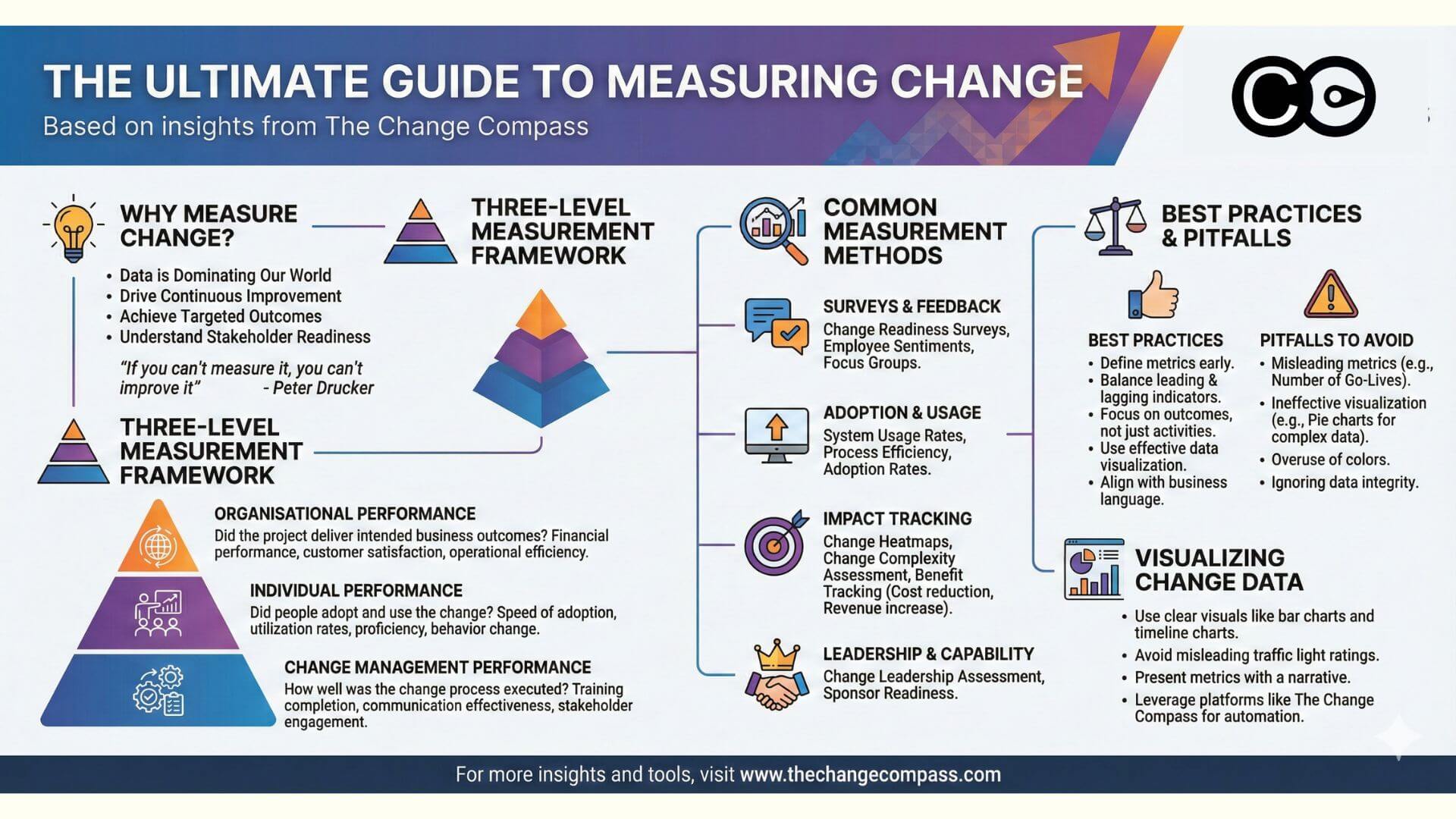
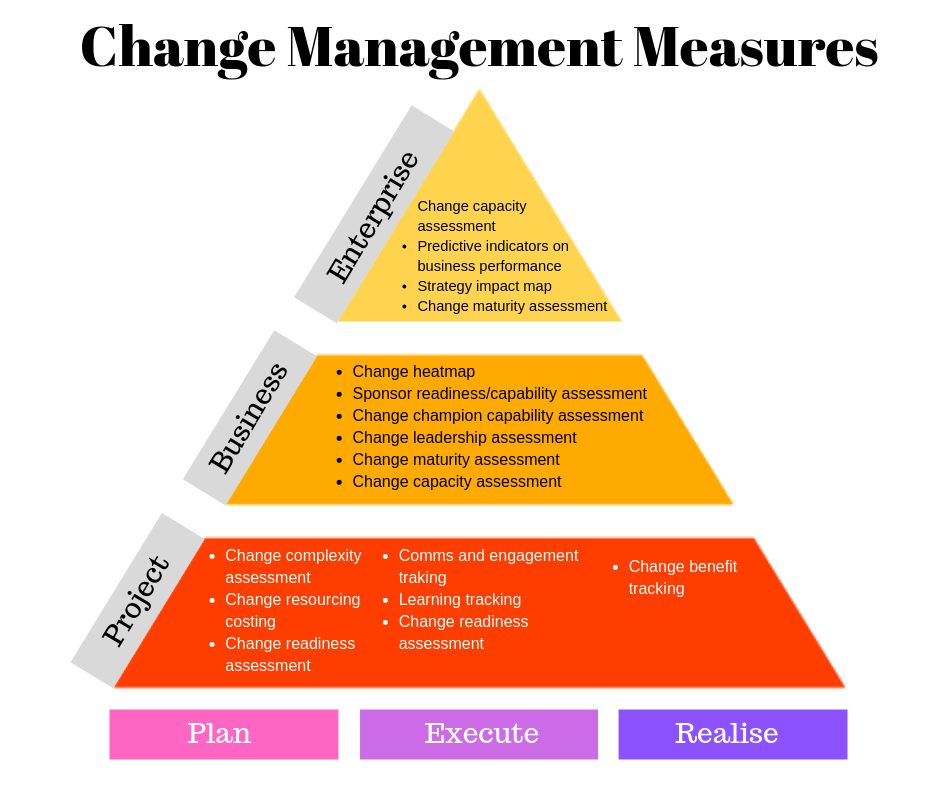
Measuring change management is the practice of capturing whether an organisation’s change activities are landing as intended across a portfolio of initiatives. It covers three distinct layers: project-level metrics that show whether individual initiatives are on track, business-level metrics that show whether the outcomes promised in the business case are being achieved, and enterprise-level metrics that show whether the organisation as a whole is becoming more capable of absorbing change. A complete framework reports on all three. Without measurement at each layer, change management becomes a series of activities with no defensible link to business value.
Most organisations can tell you how many people attended the training and how many emails the project sent. Far fewer can show that the change they paid for is happening in daily work. That gap is now visible at the top of the house: Prosci’s 2026 analysis of ERP programmes found that activity measures such as training completion and communications sent say little about whether people can actually use the new system, and that organisations with poor metrics succeeded less often than those with no formal metrics at all.
This guide is for the senior change, HR and transformation leaders who have to answer the question “is it working?” in a steering committee, not a workshop. It argues for one layered measurement system instead of a pile of surveys, sets out the six project-level methods most teams already use (and where each one breaks), walks through the measures that belong at project, business and enterprise level, and gives you a five-step framework and a reporting cadence. It is also the hub for our measurement cluster: each sub-topic gets a short answer here and a link down to the guide that covers it in full.
Change can be measured because behaviour, readiness, capacity and benefits all leave evidence in data your organisation already collects; the real question is which of that evidence you choose to look at, and whether it measures activity or outcomes.
A lot of change practitioners are comfortable saying that change management is about attitudes, behaviours and feelings, and therefore cannot be measured. That “soft” framing extends into areas such as leadership and employee engagement, where tracking is certainly harder. But harder to measure and less black and white is not the same as less worth measuring. The old maxim that you cannot improve what you do not measure, often attributed to Peter Drucker, applies as much to how people move through a change as it does to inventory or cash.
Data is already changing everything around us
The reason so much industry change happens now is that data has become a central part of how the world runs. We rely on the internet for information, and the data collected through our digital interactions drives decisions about us. A home assistant such as Amazon’s Alexa recognises our voices and answers what we ask. Street cameras can identify us. Our Google usage shapes the advertisements and product promotions we see, and our Facebook usage builds a detailed picture of our preferences and lifestyles, so that we are targeted with what the platform’s algorithms think we will value.
So if our world is surrounded by data, why are we not measuring it when managing change? To answer that, it helps to look at what is, and is not, being measured today.
Activity metrics versus outcome metrics
The most common weakness in change reporting is a dashboard built from activity metrics. Training completion, newsletter opens and workshop attendance are easy to collect, which is why they dominate. They tell you what the change team did, not what the workforce did as a result.
Prosci’s current guidance is to measure what it calls the human factors of return on investment: speed of adoption, ultimate utilisation (whether the people who should use the new process actually do) and proficiency (how well they perform afterwards). It also recommends three to five metrics per initiative, each with a purpose, an owner and a threshold that triggers action. Our guide to five metrics leaders actually use goes deep on that short list. As a working rule:
Activity metrics (sessions run, emails sent, pages viewed) manage the change team’s own workload.
Outcome metrics (speed of adoption, proficiency, sustained use, benefit delivered) show whether the change is landing.
Report both, but never let the first stand in for the second in front of a steering committee.
Six common ways to measure change at project level
Most projects measure change with a mix of six methods: readiness surveys, training evaluations, communications metrics, sentiment or culture surveys, change heatmaps and benefit tracking. Each is useful, and each has a known blind spot that the three-level model later in this guide is designed to cover.
1. Change readiness surveys: What do they actually measure?
Change readiness surveys are short pulse assessments, usually a handful of Likert-scale questions plus a free-text box, sent at pre-launch, mid-execution and post-launch. They benchmark how prepared each stakeholder group feels. They work best when combined with behavioural observation, and when repeated at set points so scores are comparable over time.
In practice, readiness surveys are online surveys sent by a project owner to understand how stakeholder groups feel about the change at different points in the project, in the form of a Likert scale or free text. Most results are summarised into a quantitative scale showing the degree to which a group is ready for change. A simple survey built in SurveyMonkey or Microsoft Forms is enough to start measuring stakeholder readiness. ChangeTracking is a more comprehensive online tool that measures the change journey and the readiness of stakeholder groups throughout an initiative. For the full method, including how to go beyond the survey, read our guide to measuring change readiness with data, not just surveys.
2. Training evaluation surveys: How do you prove training return?
Training evaluations capture participant satisfaction across categories such as content, instructor effectiveness and usefulness. They are the cheapest measure to collect and the weakest proof of change, because satisfaction is not capability and capability is not behaviour.
These evaluations are normally based on participant satisfaction across those categories. In a face-to-face format they are often paper-based to lift the completion rate. For online or virtual training, ratings are completed by the learner at the end of, or shortly after, the session. To turn training from a satisfaction exercise into evidence, add a knowledge check at the end and an on-the-job application check a few weeks later (covered under learning tracking below).
3. Communications metrics: Which ones matter most?
The most useful communications metrics show reach and attention rather than volume. The simplest is the “hit rate”, the number of users in the audience who view the article, material or page, tracked alongside the time of day and week they viewed it.
This is easy to track using Google Analytics, which reports views per page as well as viewership by time of day, day of week, audience demographics and location. Treat reach as a floor, not a finish line: a message that was opened has not necessarily been understood, and a message that was understood has not necessarily changed anyone’s behaviour. Pair readership data with a short comprehension check in your pulse survey.
4. Employee sentiment and culture surveys: What reveals resistance early?
Organisation-wide sentiment and culture surveys are a catch-all yardstick: they reveal broad trends in how people feel, and can surface resistance early, but they are rarely specific to any one initiative.
Some organisations measure employee sentiment or culture across the year, and there are often questions linked to change. These surveys tend to be short and Likert-based, with few open-ended questions for qualitative feedback. Because they go across the entire organisation, they cannot isolate the effect of a particular programme. The stakes of the underlying engagement are real, though: Gallup estimates that low engagement cost the world economy roughly US$10 trillion in lost productivity, about 9% of global GDP. Use the annual survey as a trend signal, and add two or three change-specific pulse questions for each major initiative so the signal is attributable.
5. Change heatmaps: When do they fail, and what works better?
A change heatmap shows how much change each business unit is absorbing, and it starts useful discussions about capacity. Its weakness is that it is usually rated by one or two people, so it carries their judgement and is hard to defend in a decision forum.
Some organisations build heatmaps in Excel to map the extent to which different business units are affected by change. The artefact speaks to the amount of change and often leads to discussion of the capacity the business has to handle and digest it. The problem with most heatmaps is that they are categorised and rated by the creator of the artefact (or a limited number of people making judgements), and are therefore subject to bias. Data based on one person’s opinion also tends not to carry much weight in a decision-making forum. The case for moving to quantified impact over time is made in The death of the change heatmap.
6. Change benefit tracking: How do you track post-launch value?
Benefit tracking measures whether the targeted outcome of the change has actually happened. It is the only one of the six methods that connects directly to the business case, which is why it deserves the most rigour.
Beyond typical change management measures, there are initiative-specific measures that focus on the actual outcome and benefit of the change, with the goal of determining the extent to which the change has taken place. Examples include:
System usage rates
Cost reduction
Revenue increase
Transaction speed
Process efficiency
Speed of decision making
Customer satisfaction rate
Employee productivity rate
Incidents of process violation
Define each benefit, its baseline, its owner and its measurement date before launch. The change management ROI guide shows how to turn these benefits into a business case executives accept.
Measuring change leadership and change maturity
Two measures sit outside any single initiative: change leadership assessment, which looks at the people who drive change, and change maturity assessment, which looks at the organisation’s overall capability to manage it. Both are used at business and enterprise level rather than inside one project.
Change leadership assessment
Change leadership is measured by assessing how well the sponsors, influencers and change agents around an initiative carry out their roles. The evidence is strong that this is worth the effort: in Prosci’s 12th edition benchmarking data, projects with extremely effective sponsors met their objectives 79% of the time, against 27% for projects with extremely ineffective sponsors.
David Miller of Changefirst wrote about three types of change leader:
The sponsor, whose role is to drive the initiative to success from beginning to end. This involves competencies in rallying and motivating people, building a strong network of sponsors and communicating clearly to different stakeholder groups.
The influencer, whose role is to use their network and influence to market the change and build the traction required for success. Changefirst identifies four types of influencer:
Advocates, who are great at promoting the benefits of the change.
Connectors, who link people across parts of the organisation to support the change.
Controllers, who control access to information and people, and can include administrators and operations staff.
Experts, who are viewed by others in the organisation as technically credible.
The change agent, who is tasked with supporting the overall change in various ways, including promotional activities, engaging different parts of the organisation on the change and influencing up, down and sideways across the organisation to drive a successful outcome.
There is no single industry standard tool for assessing change leadership competencies and capabilities. Changefirst and various smaller consulting firms offer change leadership assessments. One of the most comprehensive is ChangeTracking’s Change Capacity Assessment, a self-assessment organised around four broad categories: Goal Attainment, Flexibility, Decision Making and Relationship Building. Both Prosci and Changefirst also offer sponsor competency assessments.
Pagon and Banutal (2008) called out the key competencies critical in change leadership:
Goal attainment
Assessing organisational culture and climate
Change implementation
Motivating and influencing others
Adaptability
Stakeholder management
Collaboration
Building organisational capacity and capability for change
Manoeuvring around organisational politics
A practical way to use the list is as a short self-assessment and 360 for sponsors and champions at the start of a major programme, then to target support at the two or three competencies where the gap is widest.
Change maturity assessment
Change maturity assessment measures how well the organisation manages change as a repeatable capability, across dimensions such as project change management and change leadership, so that capability gaps can be found and closed in a structured way.
Two major change maturity assessment models are widely used in the market: one from Prosci and one from the Change Management Institute. To read more, see our article A New Guide for Improving Change Management Maturity, where we outline how to improve change maturity across business units. At enterprise level, maturity is lifted through programmes, networks and shared tools, which we cover in the enterprise section below.
The three-level model: Project, business and enterprise measures
A comprehensive model of change management measures organises every metric on two axes: the phase of the initiative lifecycle (Plan, Execute, Realise) and the organisational level the metric speaks to (project, business, enterprise). Each layer answers a different question for a different audience, which is why reporting the same metric to all three audiences is the reason so many change dashboards are ignored.
In the diagram, change management measures are plotted along two axes: the different phases of the initiative lifecycle, and the organisational levels of project, business and enterprise into which the measures fall. A project manager needs to know whether stakeholders are ready ahead of go-live. A business unit head needs to know whether a team has room for another change this quarter. A CEO needs to know whether the portfolio of change is pointed at the strategy.
Project-level measures
Project-level measurement answers whether one initiative is on track to land: it measures complexity and cost during planning, readiness, engagement and learning during execution, and benefits after go-live.
‘Plan’ phase
In this phase the team is discovering and scoping the project and the change, so details are not clear at the start. Later in the phase the scope sharpens and the team starts planning the activities needed to implement the change. Measurement here is about sizing:
Change complexity assessment. Evaluates how complex the project is: how many people could be affected, the size of the impact, how many business units are involved, and whether multiple systems and processes are touched.
Change resourcing costing. During planning, the cost of the change management stream is established. This includes contractors, communication campaigns, learning costs, travel and administration, to name a few.
Change readiness assessment. Usually conducted before and during the change. The same set of questions is asked of each stakeholder group to assess readiness. A baseline taken after launch cannot show movement, so the first reading belongs here.
‘Execute’ phase
The execute phase is one of the most critical parts of the project. Activities are in full flight and the team is iterating on the change to achieve project goals. Four measures carry most of the weight:
Communication and engagement tracking. Effective engagement of stakeholders is critical. Stakeholder interviews, surveys and communication readership rates are all ways of tracking engagement.
Learning tracking. Measuring learning tracks the extent to which new competencies and skills have been acquired through learning interventions. Typical measures include course tests or quizzes in addition to course evaluations. On-the-job performance can also be used to track learning outcomes and the extent to which learning has been applied at work.
Change readiness assessment. It continues to be critical during execution. Re-measure at fixed points: at kick-off, 30 to 60 days before go-live and at go-live, using the same questions for each group.
Sponsor activity. A short check of visible communication, barrier removal and reinforcement is among the cheapest measures to run, and the Prosci data above shows how much sponsor effectiveness matters.
‘Realise’ phase
In this phase the change has gone live and most project activities have been completed. It is anticipated that the change occurs and that benefits can now be tracked and measured.
Change benefit tracking measures and tracks the extent to which the targeted benefits and outcomes have been achieved. Some of these measures are hard quantitative measures; others are soft measures that are more behavioural, such as process compliance, workarounds and incident rates.
Business-level measures
Business-level measurement shows whether a part of the organisation has the right ability, capacity and readiness for the change, and whether the changes landing on it are being adopted.
Adoption. Adoption is where change management is either proved or exposed. Gartner HR research published in July 2025 found that just 32% of business leaders reported that the last change they led achieved healthy change adoption by employees. Good adoption measurement draws on more than one source: system data on usage and feature depth, process compliance, error and rework rates, team leader observation and customer feedback, tracked over time rather than as a single post-launch snapshot. Two companion guides carry the detail: how to measure change adoption covers the method, including the shape of the adoption curve, and the change adoption metrics framework lists which metrics suit system implementations, compliance programmes and restructures.
Change heatmaps. Heatmaps help to visualise which part of the business is most affected by one project or by several, and to compare relative impact across businesses. As the number of initiatives increases, so does the complexity of change, and organisations need to graduate from spreadsheets to more capable data visualisation tools to support data-based decisions. To read more about why a heatmap is not the only way to understand business change impact, go to The death of the change heatmap.
Sponsor readiness and capability assessment. A critical tool for identifying capability gaps in the sponsor so that support can be provided. A strong and effective sponsor can make or break an initiative, so early engagement and support are essential. Both Prosci and Changefirst offer sponsor competency assessments.
Change champion capability assessment. Change champions and change agents are critical nodes for driving and supporting change in the organisational network. Many champions are appointed for one initiative only. A business-focused champion network means capability can be developed over time and used across multiple initiatives, and assessing and supporting champion capability translates directly into better change outcomes.
Change leadership and change maturity assessment. Covered in the previous section.
Change capacity assessment. Where significant change is happening concurrently, careful planning and sequencing of change against existing capacity is critical.
Change capacity and saturation in more detail
Capacity is the business-level measure most often guessed rather than measured. Three aspects should be called out in the measurement process:
Different parts of the business have different capacity for change. Areas with better change capability, and perhaps better change leadership, are often able to receive and digest more change than businesses without the same capability.
Some businesses are far more time-sensitive and so their capacity needs to be measured with more granularity. Call centre staff capacity, for example, is often measured in minutes. To plan effectively for their capacity, the impacts of change need to be quantified in a precise, time-bound way so resourcing can be planned in advance, in hours per role rather than “high, medium, low”.
Change tolerance or saturation level needs careful measurement in combination with operational feedback. Say that last month a part of the business experienced significant change impact across several initiatives at once, and the operational indicators showed an impact on customer satisfaction and productivity, with staff reporting that there was too much change to handle. The change tolerance level may have been exceeded. With the right measurement of change impact levels for that part of the business, the lesson can be used to plan for the same volume of change next time.
Enterprise-level measurement compares change across business units and initiatives to show whether the total load and direction of change match strategic intent, and whether the organisation is getting better at absorbing it.
At enterprise level, many of the business-unit measures still apply. The focus shifts to comparing across business units, to make sense of what each part of the business is going through and whether the overall picture is aligned with the organisation’s intentions and strategic direction. Typical questions include:
Is it surprising that one part of the business is undergoing significant change while another is not?
Is there a reason one business unit is focused on a few very large changes while others carry a larger set of changes with smaller impacts?
Is the overall pace of change right for the strategic intent? Does it need to speed up or slow down?
What process governs, reports and makes decisions on enterprise-level change prioritisation, sequencing and benefit realisation?
Is one business unit managing change more effectively, faster and with greater outcomes? How can other business units adopt its internal best practices?
Does one business unit’s capacity limit mean the organisation cannot execute a critical strategy in the allocated time? If so, how do you create more capacity? Options include more resources such as staff, additional initiative funding, more time, or more talent to lead initiatives.
Change maturity assessment at enterprise level
At enterprise level the concern is the overall change maturity of the organisation. The question is how to implement enterprise-level interventions that build maturity through programmes, networks and exchanges, such as:
Enterprise change capability programmes
Enterprise change analytics and measurement tools
Enterprise change methodology
An enterprise network of change champions
Strategy impact mapping
Change management need not focus only on project execution or business-unit capability. It can also demonstrate value at enterprise level by focusing on strategy execution, which by definition is change. A strategy impact map visualises how different strategies exert impact on business units, so stakeholders can see which initiatives within which strategic intent affect which business units. In the example below, each of the organisation’s strategies is displayed with its initiatives branching out. The width of each initiative reflects the level of impact it has on the business over a pre-determined period, so the width of each strategy also shows its overall relative impact.
This data visualisation can be valuable for business leaders and strategic planning functions because it shows how the implementation of different strategies is affecting business units. It helps planners understand strategy implementation impacts, potential risks and opportunities, and balance the pace of change against strategy goals at various points in time.
Predictive indicators on business performance
We started this guide by noting that data is all around us and that we should use it to manage change better. With quantitative data on change impact, it is possible to test for correlations with operational business indicators such as customer satisfaction and service availability. Where a significant correlation exists, predictive reporting can forecast the trend of those performance indicators given planned change impacts.
In the graph below, historical data is used to establish correlations and forecast future impact on business indicators. The example focuses on the customer contact centre, with average handling time as the key business indicator. If heavy change periods consistently coincide with longer handling times, the business can adjust sequencing before the next peak.
This type of predictive performance forecasting is extremely valuable for organisations undergoing significant change that want to understand how it may affect business performance. By demonstrating the impact on business indicators, it puts the importance of managing change at the front and centre of the decision-making table. At The Change Compass we are developing this type of measurement and reporting function. It is the frontier for change management: being established as a business-driving function rather than a standard back-office one.
Building the measurement system: A five-step framework
A measurement system is a short list of defined metrics, a baseline, a reporting rhythm and an owner for each number; without all four, the data does not change any decision. The five steps below cover the full lifecycle, from pre-change baseline through to sustained adoption tracking, and reflect the approach used by experienced change practitioners and data-driven change teams.
Establish a change measurement framework. Define what you are measuring and why before selecting metrics. A framework should cover three kinds of metric: activity metrics (what the change team is doing), readiness metrics (how prepared people are) and adoption metrics (whether people have actually changed their behaviour). Choose a short list across the three levels, three to five per initiative plus a few portfolio measures.
Set a baseline before the change. Measure the current state before the change is implemented. Without a baseline it is impossible to demonstrate the impact of the change management effort or to identify where readiness is lowest.
Track readiness at key milestones. Conduct readiness assessments at defined points, typically at the start of the programme, 30 to 60 days before go-live and at go-live. Assessments should cover awareness, understanding, capability and commitment for each affected stakeholder group.
Measure adoption after go-live. Track adoption in the weeks and months after go-live. Key indicators include system usage rates, process compliance, error rates, workaround behaviour and performance recovery back to baseline.
Report and act on the data. Use measurement to drive decisions, not just to report status. When adoption lags in a specific group, use the data to identify the barrier and target an intervention.
Cadence and governance
Match the cadence to the decision. Readiness is measured at milestones; adoption weekly, then monthly after go-live; capacity and change load monthly or quarterly alongside planning forums. Name who owns each metric, who reviews it and what happens when a threshold is crossed. Every chart on a dashboard should have a question, a threshold and an owner. Our guide to designing a change adoption dashboard shows how to build the view itself.
Data integrity before you present
A single visible error in a change dashboard is enough for a steering committee to discount the rest. Reconcile counts to source systems, state the sample size and response rate for any survey, keep definitions stable between reporting periods and flag where a figure is an estimate. It is better to show fewer metrics you can defend than many you cannot.
Telling the story
Numbers move decisions when they are framed against something leaders already care about: a milestone, a benefit, a risk. Lead with the decision you need, show the two or three numbers that justify it, and keep the detail one click away. A number plus an action (“adoption in the claims team is 20 points behind, and the barrier is the approval step”) is a briefing; a number alone is a report. Our follow-on guide, measuring change management outcomes, extends this reporting approach.
Where digital tools fit
Manual measurement stops scaling when the number of concurrent initiatives grows: survey results sit in one place, impact assessments in a spreadsheet and adoption data in a third system, and nobody can see the portfolio. Survey tools such as SurveyMonkey and Microsoft Forms, and web analytics such as Google Analytics, remain useful for the project-level methods above. A purpose-built change intelligence platform such as Change Compass brings impact, capacity and adoption data into one model, so the business and enterprise measures (load by business unit, saturation, predictive links to operational indicators) become routine reporting rather than a quarterly analysis project.
Which guide to read for which question
This page is the map; the guides below are the depth. Each answers one question completely, and between them they cover every sub-topic summarised above.
The best measurement systems begin with a single question that a senior leader is already asking, such as “will this go-live hold our service levels?” or “which division cannot take another change this quarter?”. Pick the three to five numbers that would answer it, set a baseline this week, and put the first reading in front of the sponsor within a month. A small set of metrics with owners and thresholds beats a comprehensive scorecard that nobody acts on.
From there, extend upward. Add business-level capacity and adoption views once the project metrics are stable, then portfolio and strategy views as the enterprise starts asking comparative questions. Change can be measured, and the methods in this guide show operational and strategic ways in which measurement demonstrates real value. Most corporate functions cannot exist without data and analytics. Human Resources relies on people and pay data. Marketing cannot function without measurement of channel and campaign effectiveness. For Information Technology, almost everything is measured, from system usage to cost to efficiency. It is time to use data to visualise change, plan better and make business decisions with the same standing.
Frequently asked questions
What is change management measurement?
Change management measurement is the practice of tracking whether change activities are producing the intended behaviour and business results. It works at three levels: project metrics (readiness, engagement, learning), business metrics (adoption, capacity, benefits) and enterprise metrics (portfolio load, strategy impact, maturity). Reporting on all three lets you link change effort to the outcomes in the business case.
What are the most important change management metrics to track?
Focus on adoption rates, readiness scores, communication engagement and benefit realisation, tailored to the project phase and the business unit’s capacity. Prosci recommends three to five metrics per initiative, each with a purpose, an owner and an action threshold, with a handful of portfolio measures added on top.
How do you measure change readiness effectively?
Combine pulse surveys with behavioural indicators and sponsor assessments, and repeat the same questions at fixed milestones so results are comparable. Balance frequency with depth so that the results are actionable. Read our guide to measuring change readiness with data, not just surveys for the full method.
Why replace change heatmaps with other visuals?
Heatmaps introduce subjectivity bias because they are usually rated by one or two people. Timeline charts and capacity dashboards built from quantified impact give clearer, more defensible data for decisions. See The death of the change heatmap.
What role does AI play in change measurement?
AI supports sentiment analysis of free-text feedback, predictive capacity planning and automated risk detection across initiatives, and some platforms offer natural-language queries for instant answers. Its value depends on the quality of the underlying data: it speeds up analysis of well-defined metrics, but it cannot compensate for a missing baseline or unclear definitions.
What enterprise-level change metrics matter most?
Strategy impact mapping, cross-business capacity analysis and predictive performance forecasting that links change volume to operational outcomes. Together they show whether the pace and direction of change match strategic intent, and whether the organisation is getting better at absorbing it.
How often should change be measured?
Match the cadence to the decision. Readiness is usually checked at the start, before go-live and at go-live. Adoption is tracked weekly or fortnightly in the first months after launch, then monthly. Portfolio measures such as change load and capacity are reviewed monthly or quarterly alongside planning and governance forums.
References
Miller, D. (2011). Successful Change: How to implement change through people. Changefirst Ltd.
Pagon, M. and Banutal, A. (2008). Leadership Competencies for Successful Change Management. Study report, University of Maribor.
This guide focuses on the complete measurement framework, design, run, and report change measurement end-to-end. Three closely related guides on this site each cover a distinct angle, pick the one that matches what you need now: