Delivering constant changes is a requirement in implementing agile change management. With each iteration, a change is being designed and released as a part of ongoing agile development and project implementation. However, there is little mention in change management literature of how to go about delivering change constantly and be able to achieve optimum change adoption.
Continuous delivery pipeline
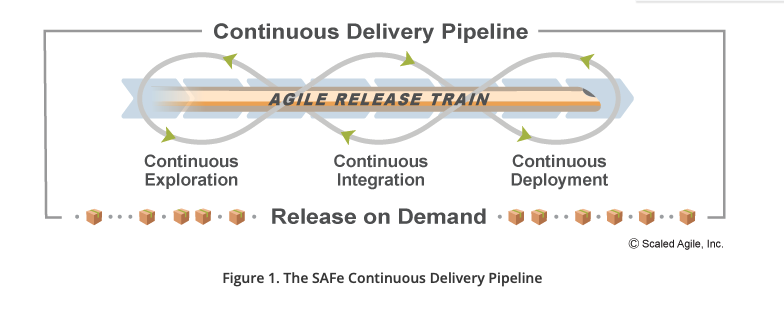
The concept of a ‘continuous delivery pipeline’ is a core part of the agile methodology. It refers to having a structured pipeline of continuous changes being released as required by the organisation. The pipeline contains a set of features and changes to be worked on, and the resulting prioritised changes are released when and as needed.
The three components of a continuous delivery pipeline that forms an agile release train include:
Continuous exploration – This is about defining and scoping what needs to be built using human centred design approaches to design the problem that needs to be solved from the user perspective
Continuous integration – This step involves taking those prioritised features from the backlog and investigating further to understand what development work is required to turn them into solutions for the user.
Continuous deployment – This is about turning the completed changes from the staging environment into production, meaning the live product that is ready to be used by the user. After the technical part of the solution is ready to be released, the business then determines when is a good time for this release to go ahead.
The ‘technical side’ of the agile team is fairly well defined in terms of the roles and responsibilities of each member, including project manager, developer, QA/testing, business analyst, business owner, etc. However, the role of the change manager is much less defined and black and white. This does not mean that there is no role for the change manager though. It just means that the agile literature has not well defined the details for the role of the change manager in an agile team. ‘Agile change management’ still has some work to do to make itself better known to other agile team members.
So how does the change manager get ready to deliver a series of constant changes?
Delivering a series of constant changes is no easy feat. The main issue is that most businesses are not designed to face multiple changes, and nor are they designed to face a series of continual changes either.
Change approaches are primarily written for working on one change at a time, and not in a setting where there are continual releases of changes going on. On the other hand, how many organisations do you know that are only facing one change? Or that only deals with one change within a month? This type of stable change environment may have been the norm years ago when the business environment was much more predictable and stable. Hence, using a waterfall project approach was appropriate at the time. Fast-forwarding to the 2020s most organisations are juggling with constant and multiple changes as the norm.
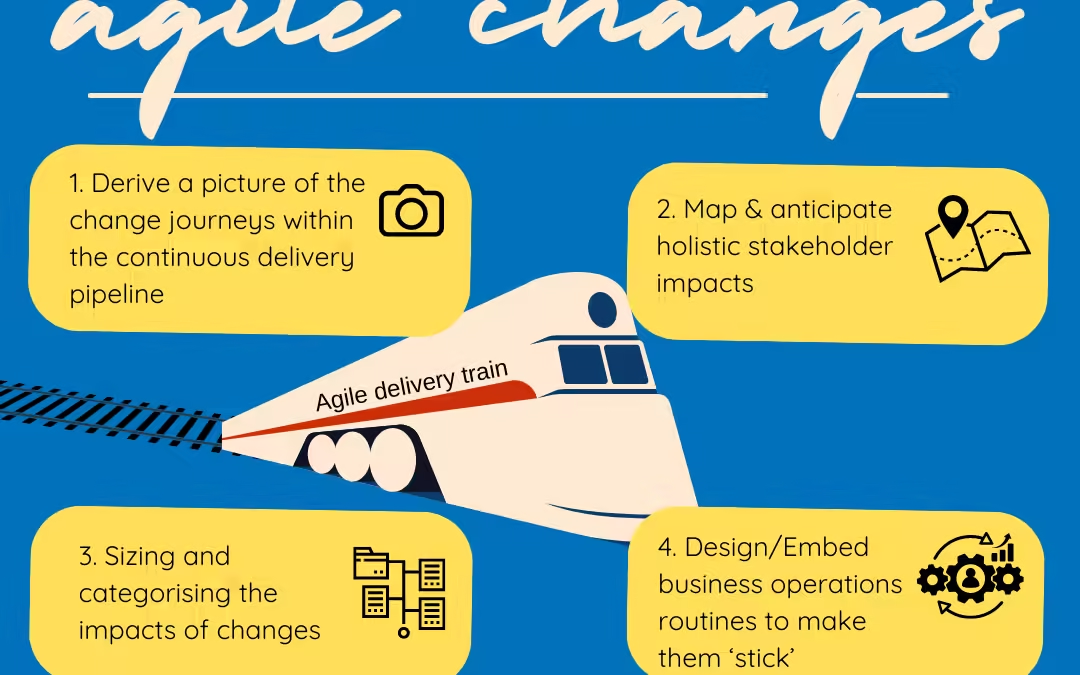
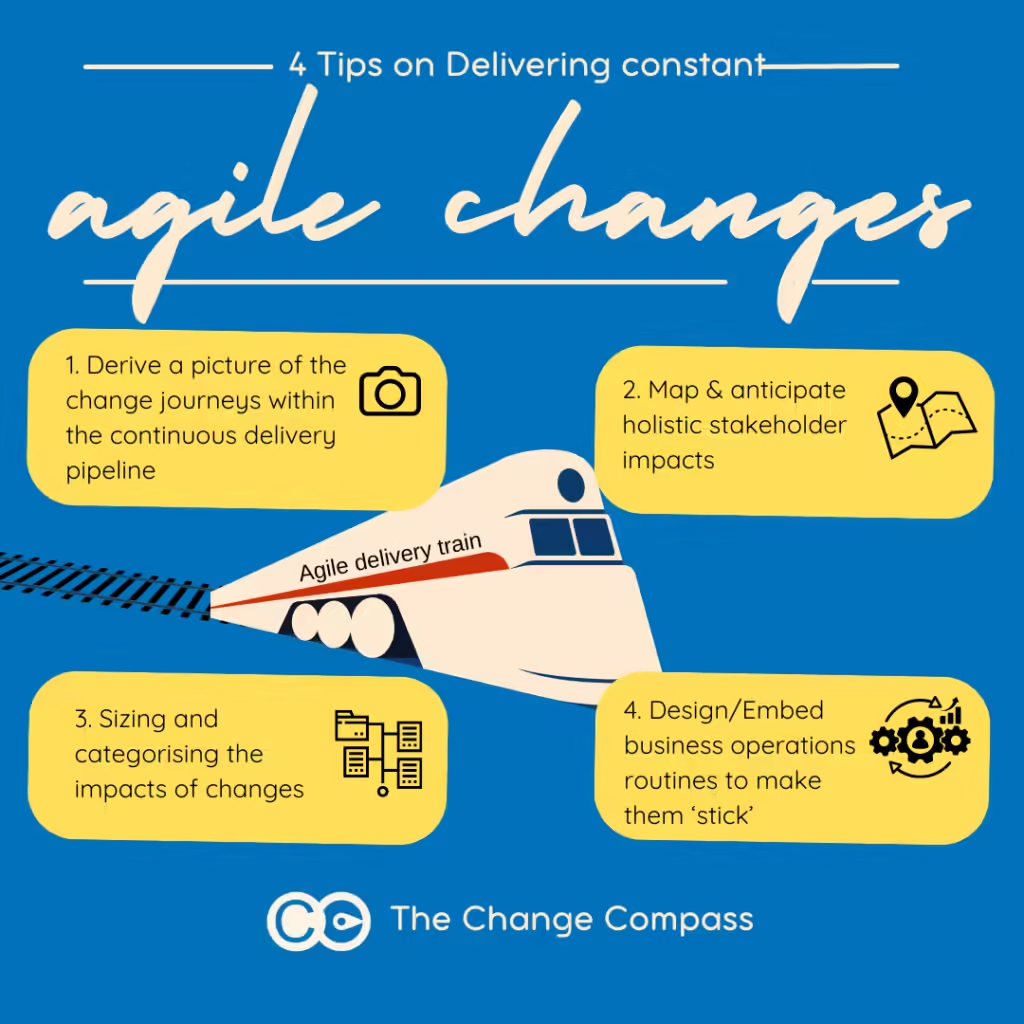
1. Derive a picture of the changes within the continuous delivery pipeline.
Deriving a clear picture of what changes look like within a project is critical. Without this, you will not be able to clearly communicate to your stakeholders what changes are coming down the pipeline.
To create this picture, use a human-centred approach and illustrate what the user will go through throughout the change journey. This is similar to a user journey map. However, a change-focused picture goes beyond just what the user will be going through. It also includes not just person-based changes, but also process, policy, system, governance, reporting and other changes. Outlining these changes will complete the whole picture of what each change release may look like.
A key problem in creating a picture of the changes early on is that the project team may not even know what the solution looks like. And without particular details of every change release and solution design, it may be hard to create this picture.
The recommended approach is to focus on what the outcome could look like versus focusing on various technical or process solutions. This means you may even need to make particular assumptions in defining what these changes look like. For example:
Release 1: Ability to turn recorded customer conversations into text. With this feature, there will be new risk and privacy processes and governance be put in place in the monitoring and storage of customer data.
Release 2: Ability to search for customer conversation history and flag follow up actions required. Specialist roles may be required to audit customer conversation text. Behaviour shifts in proactively checking on customer history and knowing what to look for in trends is critical.
Release 3: Ability to use analytics to predict customer turnover and use this to minimise customer turnover. Significant capability uplift is required to ensure that consultants are able to know how to use analytics to help minimise customer turnover. Analytics capability uplift is also required at operations management, supervisor and team leader levels.
2. Map holistic stakeholder impacts.
In order to implement constant ongoing changes, it is critical to understand holistically what the stakeholders are undergoing across all types of changes and other BAU impacts. Without taking these into account it is not possible to truly understand the capacity of stakeholders and when changes will best ‘stick’ when released.
Some of the items that should be inventoried and mapped include:
Impacts from the current project that you are working on
Other project impacts that affect the stakeholder at the same time as your project, including any benefit realization periods post project implementation
BAU-led initiatives that could include business improvement or quality, and may not classified as ‘funded projects’ per se
Key high work volume periods such as end of financial year, holiday season, etc.
Audits, planning or reviews where additional work volumes are forecasted
It does take investment and effort to collect all these types of data and most change managers do not bother to do this. However, it is not possible to implement a successful change when you do not understand what other changes or work priorities your stakeholders are undergoing during the change process.
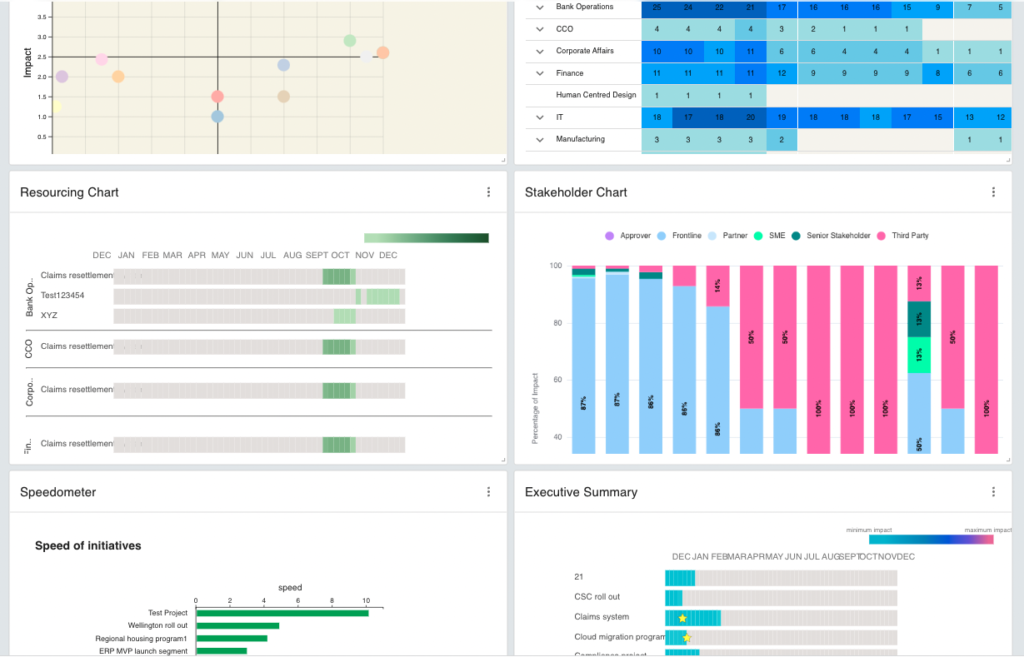
It is also important to note that this type of impact data can change constantly and once the data is collected it needs to be verified on a timely basis with any changes and updates reflected over time. Doing this activity manually can be quite cumbersome so we advise using digital tools such as The Change Compass.
The collected data on what stakeholders are undergoing can be significantly valuable. Often stakeholders themselves have not undertaken this exercise to truly understand the change journeys and work priorities added together holistically. They may be surprised by the picture you are presenting to them. At the minimum, they will value this since it shows that you have a deep understanding of what they will be going through and therefore create more stakeholder confidence.
Examples of data visualisation from The Change Compass
3. Sizing and categorising the impacts of changes
After getting a clear picture of holistic change environment that the stakeholders will be undergoing the next step is to analyse the impacts from your project. In analysing the change impacts you should be ascertaining the nature of these change impacts including:
Size of the impact
How long the impacts will last
How much time these impacts translate to
Types of these impacts (e.g. people, process, system, customer, etc.)
To whom the impacts will be on
Quantitatively sizing your impacts makes them concrete and easily understood. Armed with this information you are able to examine to what extent the planned releases are the right ‘size’ for the impacted stakeholder groups. This is another critical part of agile change management. In determining this, the following stakeholder factors are critical:
Capacity bandwidth
Potential overlaps across various impacts either within the same or with other projects or initiatives
Change maturity level and experience with similar changes in the past
Leadership support and other change reinforcement mechanisms
Overall change readiness
Engagement level with the particular change initiative
When you have considered all of these factors you are ready to engage with your project manager, the PMO, and business representatives to assess to what extent the roadmap laid out is effective and will work to maximise the targeted initiative benefits.
4. Business operations routines
Now you understand clearly the change environment of your impacted stakeholders, various changes within yours’ and other initiatives, and the categories of the various change impacts. The next step is to clarify to what extent your impacted business units have the right operational process to receive ongoing changes. This is often a neglected part of agile change management.
More change mature business units have over time developed the right routines and processes to absorb changes, especially ongoing ones. What are some of these?
Effective engagement processes. Engagement processes are not just one-way communication channels. Having effective communications channels such as newsletters and town halls are a minimum for employees to hear about what is coming down the pipeline. Engagement processes include such as effectively choreographed Yammer channels, skip-level meetings (where managers meet with employees 2 levels down), focus group sessions with a small group of select employees, and effective team meetings where information is passed both up and down the chain of command
Effective learning processes. Effective learning processes at a business unit level includes business operations routines whereby employees have individual development plans (from which training plans can be incorporated), ongoing monitoring of development tracking against targets (e.g. completion rates), virtual learning processes (e.g. employee familiarity with virtual ways of self-initiated learning)
Change champion network. Most change champion networks are project-based and therefore have a limited shelf-life. This means that business change champions have a limited time to learn and develop as effective change champions. They also have limited time to practice and experience what it is like to lead and support change. A better design for business units undergoing ongoing changes is to have business unit based change champions that can support a myriad of changes across the board. This flexes their capability. Also, with constant exposure to changes over time, they are able to continuously develop and become better change champions. Organisations that have done this well, have positioned this as a ‘talent pool’ for frontline employees seeking to grow into other challenging roles.
Benefit realisation processes. Tracking and reinforcing benefit realisation is one of the most critical ingredients for success in the impacted business unit. Usually a month after go-live, the project would have already wrapped up and the business is left to continue the rest of the change journey and achieve the targeted benefits. To do this the business unit needs to have clear benefit realisation tracking and reinforcing mechanisms, involving Finance and business leaders. There needs to be constant oversight of how the benefit tracking is trending and leader discussions on resolving any obstacles and providing adequate managerial support to drive the benefit realisation process.
If your impacted business unit lacks one or more of these ingredients, it is critical that you work on this upfront. Highlight to business leaders the risk of not having these ingredients in place within the business. These processes may take significant time and investment to build up. Therefore, factor in the time required to develop these. Often, within the challenges of agile changes, these are left until the end, by which time it is too late to try and establish quickly to support the identified project changes.
The increasing pressure to change and evolve continues to challenge the very existence and design of every organisation. After waves of change and disruption from industry competition, technology evolvements, customer preferences, surge in commodity prices, and Covid, change is, more than ever, a constant. To meet with this rapid and increased intensity of change, organisations are resorting to agile ways of implementing change management to keep up.
Agile ways of implementing change often times mean that the outcome may be reached faster by team members, and sometimes with fewer resources than previously. With these promises, there are very few organisations that are not jumping along the agile bandwagon.
So what are the challenges of using agile change management?
1. Agile change may not suit every change scenario
Agile ways of change management may be great when we are developing a new product, a technical solution, a new process or a new way of working. However, not every change scenario. If the change setting requires strict adherence to complex regulations and standards, significant documentation, testing and quality assurance, full agile may not be the most suitable. Pharmaceutical companies would not use a pure agile approach in developing new drugs simply due to the level of regulatory and industry standards required to be met in the process.
However, this does not mean aspects of agile practices may not be incorporated alongside traditional approaches. For example, pharmaceutical companies have been incorporating practices of involving customers in product design, customer collaboration, and marketing communication to enhance customer satisfaction. The trick is to balance those agile aspects which would benefit the overall solution and outcome, versus others that may be less applicable due to organisational and industry challenges.
On the other hand, if the project is concerned with developing changes to meet a new government regulatory requirement for customer product disclosure, an agile change approach may be more suitable. Change iterations can be designed to form the solution required to both meet regulatory requirements and not negatively impact customer experience.
2. There are significant capability requirements in implementing agile changes
Implementing agile changes does not just mean using agile frameworks and techniques in the project team. Every team involved needs to ensure effective communication and transparent communication, including regular team interactions, to build up agile capabilities. This includes not just the technical teams, quality and testing teams, but also business stakeholders, and depending on the change, customer advisory teams as well.
Project teams may be used to agile methods and techniques after several projects. However, these may be foreign for business stakeholders, especially those accustomed to traditional project management environments. Sufficient education and capability building to tackle common challenges may be required in impacted businesses to undergo the change process. This is because without this experience, the impacted businesses may not sufficiently buy-in to how the change was designed and implemented. Moreover, without adopting agile practices, the impacted business teams may not be able to adopt the changes at the rate expected in agile environments, which could hinder a smooth transition to effective agile methodologies.
3. The agile methodology has not clearly specified change management elements
Agile project management methodology clearly lays out the roles of the various members of the agile team, including the project manager, business owner, quality and testing, developer, etc. However, a big hole exists for effective change management, emphasizing the crucial role that change managers need to play. The clear role for change management has been left out. For example, methodology and training providers such as Scaled Agile. In a seemingly detailed and comprehensive treatment of all parts of agile methodology, the specific details of the role for change managers are not mentioned anywhere.
To tackle this big gap, there are various attempts to try and close this gap such as Jason Little’s Agile Change Management approach that is possibly less comprehensive than those best practices detailed by the Scaled Agile Framework for the enterprise level.
Why is it that the role of the change manager is clearly omitted? It is not that the role of change manager is becoming obsolete. The increasing popularity of agile is matched by the increasing demand for change management professionals. There has been a consistent growth in the recruitment for change professionals year after year. It could only be that perhaps those in charge of documenting agile methodology don’t have a background in change management and subsequently have not ventured to detail any requirements within the methodology.
Imagine a world where change professionals won’t need to tip-toe and educate others about how their roles fit within an agile setting. Given the importance of change management is it not a gap that cannot continue forward? Perhaps we can garner the change community to drive this through in the 2020s?
4. Oversight of multiple agile changes is more critical than ever
One of the key challenges of using an agile approach is that often the end change outcome or the solution of the change is not clearly known at the commencement. With each iterative development, agile changes become more and more defined, and the project objectives may also evolve. Or at times, the solution may continue to evolve and pilot as required according to project requirements.
What this means is that at any one-time business stakeholders are dealing with multiple projects and their project progress that are constantly evolving. The impact of those projects may or may not be known depending on the development of the specific agile iterations. This could make it a nightmare to plan and get ready for multiple changes from a business unit perspective.
The solution is to develop oversight of the entire group of change initiatives. With constant oversight, the business is much more capable of preparing for change overall. And with the shifting iterations of agile across initiatives, the picture continues to evolve so that the business can keep a pulse on the changing nature of change. This includes not just the volume of impacts, but types of changes, role impacts, timing, change pace, readiness, and fostering a culture of continuous improvement, including regular feedback loops, etc. Utilise digital change management solutions to support your stakeholders as they continue down the agile change journey.
How will you support your business stakeholders as they charter through the ever-increasing environment of change and disruption? What digital tools are you adopting within this digital world to get ready for increasingly agile changes? Just like the agile principle of including and integrating multiple disciplines to promote collaboration, leveraging digital tools to aid change readiness and collaboration is key to future change outcome success.
To read more about agile change management articles visit our Knowledge Centre where we have articles such as:
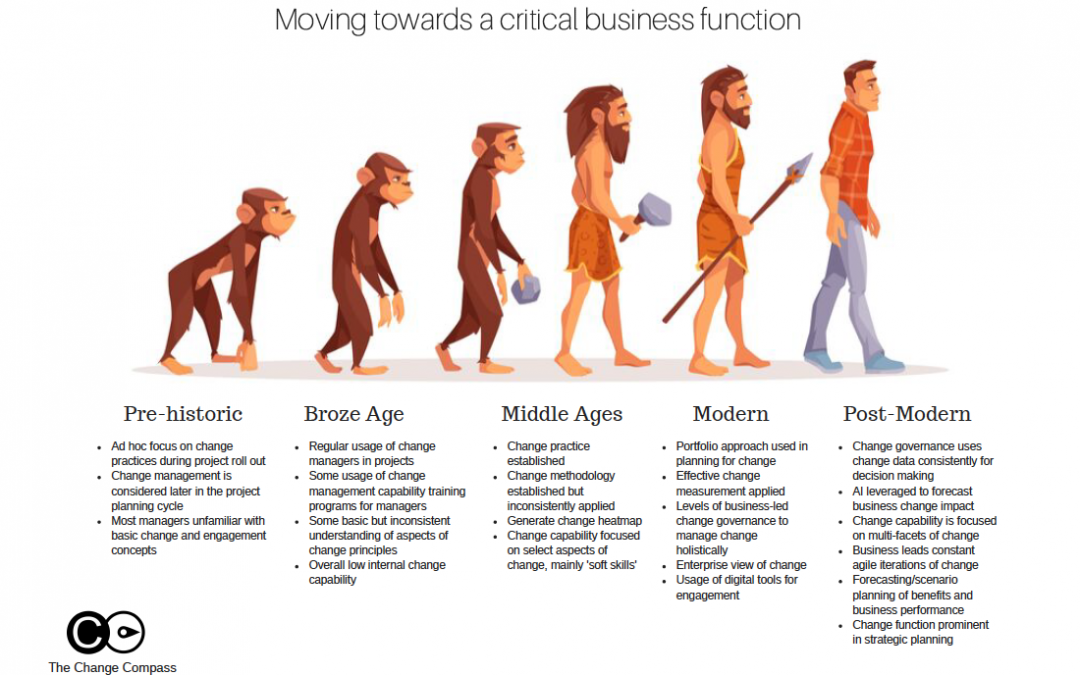
Change management has transformed dramatically over decades, evolving from reactive crisis responses to sophisticated, data-driven strategies that predict and shape organizational transformation. Understanding this evolution equips practitioners with insights to navigate modern complexities like digital acceleration, regulatory pressures, and workforce expectations.
This guide traces key milestones in change management development, examines the shift toward strategic data integration, and explores emerging AI-driven capabilities that redefine practitioner roles. Practitioners gain practical frameworks to apply these insights in today’s fast-paced environments.
How Has Change Management Evolved Over Time?
Change management began as structured responses to organizational disruption but matured into proactive disciplines leveraging data and technology. Early approaches focused on resistance management; modern practices emphasize prediction, measurement, and continuous adaptation.
Key evolutionary phases include:
1950s-1970s: Foundations in Behavioural Science Kurt Lewin’s three-stage model (unfreeze-change-refreeze) established foundational principles. Focus remained on human psychology and overcoming resistance through communication.
1980s-1990s: Structured Frameworks Emerge John Kotter’s 8-step process and Prosci’s ADKAR model provided systematic approaches. Emphasis shifted to leadership alignment and stakeholder engagement.
2000s: Enterprise Integration Change management embedded within project management methodologies like PMI and Agile. Organizations recognized change as a distinct discipline requiring dedicated resources.
2010s-Present: Data and Analytics Integration Rise of change portfolio management and adoption metrics tracking. Practitioners began measuring outcomes beyond activities, using dashboards for real-time insights.
This progression reflects growing recognition that successful change requires both human-centered approaches and rigorous measurement.
What Drove the Shift to Strategic Change Management?
Several forces accelerated change management’s maturation:
Digital Transformation Pressures
Rapid technology adoption created simultaneous change waves across organizations. Traditional sequential change approaches proved inadequate for multi-project environments.
Regulatory and Compliance Demands
Increasing scrutiny required demonstrable evidence of change adoption and risk mitigation, pushing practitioners toward measurable outcomes.
Workforce Expectations
Millennial and Gen Z entrants demanded transparency, purpose alignment, and visible progress tracking in change initiatives.
Portfolio Complexity
Organizations managing 10+ concurrent changes needed centralized oversight, leading to change portfolio management practices.
Measurement Maturity
Advancements in HR analytics and adoption metrics enabled practitioners to demonstrate ROI and secure executive support.
These pressures transformed change management from a support function to a strategic capability directly influencing business outcomes.
The Rise of Data-Driven Change Management
Modern change management integrates operational data, adoption metrics, and predictive analytics to guide decision-making.
Strategic Change Data Management
Organizations now maintain centralized repositories tracking change saturation, adoption rates, and portfolio capacity. This enables executives to balance change demands against organizational readiness.
Data reveals change overlaps, capacity constraints, and high-risk initiatives. Practitioners allocate resources strategically rather than reactively.
Predictive Capacity Planning
Analytics forecast change bandwidth by department and role, preventing saturation and burnout during transformation waves.
This data foundation positions change management as a value-creating function rather than cost centre.
Implementation Frameworks and Best Practices in Modern Change Management
With the evolution of change management into a data-driven discipline, implementation frameworks have also advanced to incorporate strategic alignment, measurement, and agility.
Established Frameworks Adapted for Today’s Environment
Kotter’s 8-Step Process
This enduring framework continues to provide a roadmap for leading change, emphasising urgency creation, coalition building, vision communication, and consolidation of gains. Modern adaptations integrate data points at each step to monitor engagement and effectiveness.
Prosci ADKAR Model
The ADKAR model—Awareness, Desire, Knowledge, Ability, Reinforcement—remains influential for individual change adoption. Data from assessments aligned to each dimension now inform targeted interventions.
Agile Change Management
Agile methodologies bring iterative feedback loops and rapid adaptation, suited for fluid business environments. Incorporating continuous data collection and analytics allows agile teams to pivot change strategies responsively.
Emerging Best Practices
Integrate Change Management Early in Project Lifecycles: Position change activities alongside project planning for seamless alignment and impact maximisation.
Embed Data Streams for Real-Time Insights: Utilise adoption metrics, sentiment analysis, and feedback channels to guide decision-making dynamically.
Foster Cross-Functional Collaboration: Engage stakeholders and change agents across departments to build collective ownership.
Leverage Technology for Automation: Automate repetitive change management tasks such as communications, survey distribution, and reporting, freeing capacity for strategic priorities.
Prioritise Employee Experience: Tailor change approaches to diverse workforce needs, using data-driven personas and segmentation.
The Role of AI and Automation in Advancing Change Management
Artificial intelligence and automation are set to redefine how change practitioners operate, transforming strategic decision-making, engagement, and measurement.
AI-Powered Predictive Analytics
By analysing historic change data combined with organisational variables, AI models predict likely resistance points, adoption rates, and saturation thresholds. These insights enable pre-emptive strategies designed to smooth transitions.
Automated Change Interventions
Chatbots and virtual assistants can deliver personalised communications, FAQs, and training modules at scale, maintaining consistent messaging and freeing practitioners’ time for higher-value activities.
Natural Language Processing (NLP) for Sentiment and Feedback Analysis
AI-driven sentiment analysis of employee feedback, surveys, and collaboration platforms identifies emerging issues and morale trends faster than traditional methods.
Intelligent Dashboarding
AI enhances dashboards by correlating disparate data, highlighting risks, and recommending intervention actions. Customisable alerts notify change leaders of critical deviations in real time.
Augmented Decision Support
Machine learning integrates diverse inputs—financial, operational, human factors—to support scenario planning and optimise change portfolios, particularly in complex environments.
Preparing Change Practitioners for the Future
The evolving change landscape requires practitioners to blend traditional soft skills with digital and analytical capabilities. Key skill enhancements include:
Continuous learning mindsets to adapt as technologies evolve.
Institutions and organisations should invest in upskilling programs and knowledge hubs supporting these competencies.
Key Takeaways for Change Practitioners
The evolution of change management offers clear guidance for practitioners navigating today’s complex landscape:
Embrace Data as a Strategic Asset
Shift from activity tracking to outcome measurement. Implement real-time adoption dashboards that correlate behaviours with business results, enabling proactive interventions.
Master Portfolio Management Discipline
Treat change as a finite resource. Establish governance processes to assess saturation, prioritise initiatives, and sequence delivery for maximum organisational capacity.
Build Cross-Functional Change Capabilities
Move beyond siloed project support. Embed change expertise within strategy, digital transformation, and HR functions for integrated execution.
Cultivate Continuous Learning Cultures
Position change practitioners as organisational learning facilitators. Use post-initiative reviews and trend analysis to build institutional knowledge.
Emerging Capabilities for Practitioners
AI-Augmented Decision Making
Leverage predictive models to forecast adoption risks and capacity constraints. Use sentiment analysis across communication channels to detect resistance patterns early.
Automation of Change Operations
Streamline repetitive tasks—status reporting, stakeholder mapping, communication scheduling—freeing capacity for strategic advisory roles.
Advanced Measurement Frameworks
Combine traditional metrics with micro-behaviour tracking and network analysis to understand influence patterns and adoption cascades.
Implementation Roadmap for Practitioners
Phase 1: Assessment and Foundation (0-3 Months)
Conduct change maturity assessment across frameworks and capabilities
Establish baseline adoption metrics for current portfolio
Map organisational change capacity by department and role
Build cross-functional change governance council
Phase 2: Data Integration and Optimisation (3-6 Months)
Deploy centralised change portfolio tracking system
Implement real-time dashboards with automated alerts
Launch pilot AI sentiment analysis on feedback channels
Standardise post-change review processes
Phase 3: Strategic Evolution (6-12 Months)
Embed predictive capacity planning in annual cycles
Scale successful automation across enterprise initiatives
Develop practitioner upskilling academy
Establish external benchmarking partnerships
Frequently Asked Questions (FAQ)
How has change management fundamentally evolved? From reactive resistance management to proactive, data-driven portfolio disciplines that predict capacity and measure sustainable adoption.
What are the most important data capabilities for change practitioners? Real-time adoption tracking, portfolio saturation analysis, predictive capacity modelling, and cross-initiative impact correlation.
How should organisations structure change governance? Cross-functional councils with executive sponsorship, portfolio prioritisation processes, and dedicated measurement functions.
What skills will define future change practitioners? Data analytics proficiency, AI tool fluency, portfolio strategy, systems thinking, and continuous learning facilitation.
Why is change portfolio management mission-critical now? Concurrent digital, regulatory, and cultural transformations overwhelm traditional approaches. Portfolio discipline prevents saturation and maximises ROI.
How do AI capabilities enhance change effectiveness? Predictive risk modelling, automated stakeholder engagement, real-time sentiment tracking, and intelligent resource allocation recommendations.
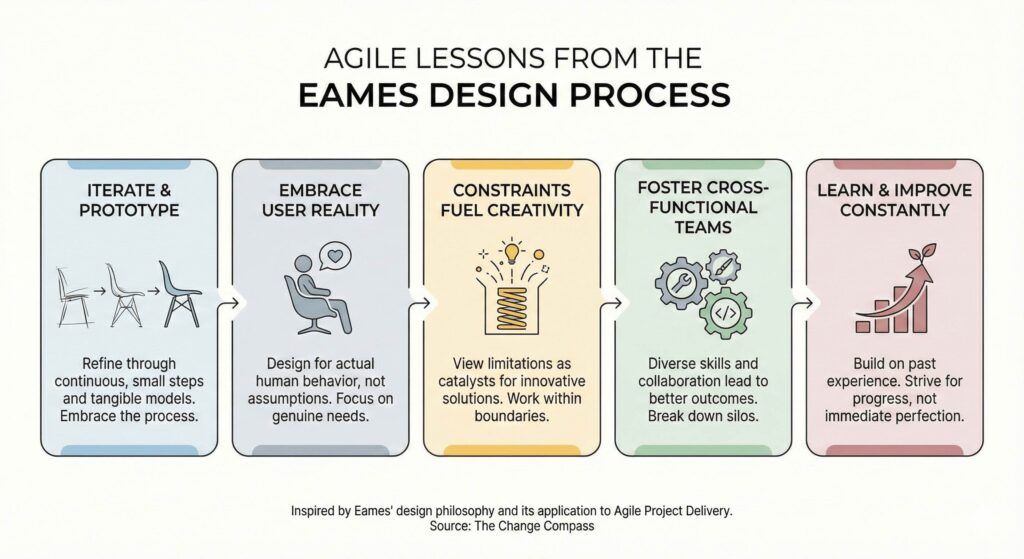
Ray and Charles Eames, legendary mid-century designers, developed creative processes remarkably aligned with modern agile methodologies. Their approach emphasised iteration, resource respect, and systems thinking, offering valuable lessons for today’s project teams facing complex delivery challenges.
This guide explores five key Eames principles and their direct application to agile project delivery. Change practitioners and project leaders gain practical insights to enhance iteration, stakeholder engagement, and systemic success.
What Agile Principles Did Eames Champion?
The Eames duo’s design philosophy prefigured agile concepts by decades. Their methods focused on practical experimentation, collective wisdom, and holistic systems. These are core tenets of contemporary agile delivery.
These principles translate directly to project environments, improving outcomes across technology rollouts, process changes, and organisational transformations.
1. Not Reinventing the Wheel: Leverage Collective Experience
Eames avoided starting from scratch, instead building on proven materials and techniques. Agile teams benefit similarly by tapping organisational knowledge rather than isolated innovation.
Practical Applications in Agile Delivery
Previous rollout lessons: Review past implementations of similar products or services to anticipate adoption challenges and success factors.
Stakeholder group insights: Consult colleagues experienced with specific audience dynamics and communication preferences.
Solution design patterns: Adapt approaches proven effective in prior technical or process solutions.
Timeline strategies: Apply scheduling techniques refined through previous deadline pressures.
Learning intervention successes: Reuse effective training content, delivery methods, and evaluation frameworks.
This principle prevents redundant effort while accelerating delivery through proven foundations.
2. Continuous Testing and Learning: Iterative Refinement
The Eames process featured constant prototyping and feedback, mirroring agile’s iterative cycles. Every team member, not just designers, contributes to this learning loop.
Change Management Testing Examples
Message validation: A/B test communications with target audiences to measure resonance and engagement.
Learning content trials: Pilot training modules with sample groups, gathering feedback on structure, clarity, and delivery medium.
Impact assessment accuracy: Validate change impact analysis directly with end users rather than proxies alone.
3. Respecting the Materials at Hand: Understand Your Resources
Eames emphasised the importance of recognising the capabilities and limitations of available resources. In agile project delivery, this means deeply understanding people, systems, processes, and stakeholder capacities.
Applying Resource Respect in Agile Projects
Assess team skills and system maturity before designing interventions.
Adapt project plans based on stakeholder readiness and local constraints.
Support change leads in gauging the ability levels of different groups to absorb new processes.
Tailor communication and training to maximise relevance and effectiveness given resource realities.
This approach builds realistic, sustainable change strategies aligned with organisational strengths and challenges.
4. Generating New Perspectives and Ideas Through Play and Fun
The Eames valued play as a creative catalyst, fostering new ideas and fresh perspectives. Agile teams benefit from incorporating elements of play, fun, and experimentation into their work.
Practical Ways to Embed Play in Agile Delivery
Run hackathons or innovation sprints encouraging out-of-the-box thinking.
Design team-building activities that mix fun with purposeful reflection on project goals.
Use gamification techniques to increase engagement in learning and adoption tasks.
Foster a psychologically safe environment where experimentation and mistakes are accepted as learning opportunities.
Play enhances creativity, collaboration, and morale, supporting higher-quality outcomes.
5. Eventually Everything Connects: Embrace Systems Thinking
The Eames stressed seeing the broader picture and understanding how various elements interlink to form a larger system. This mindset is vital in agile delivery, where dependencies and impacts extend beyond single teams or projects.
Systems Thinking in Agile Projects
Map connections among processes, systems, communications, training, and branding to ensure cohesive delivery.
Identify how multiple change initiatives intersect and impact shared stakeholders or resources.
Help stakeholders understand how different initiatives support broader organisational strategies.
Use system maps and visualisations to support planning, risk assessment, and communication.
This holistic awareness prevents siloed work and promotes integrated, effective change.
Implementation Roadmap for Eames-Inspired Agile Delivery
Applying These Principles in Modern Projects
Quick-Start Actions for Teams
Conduct knowledge audits to capture previous rollout experiences across the organisation.
Schedule regular testing cycles for communications, training, and impact assessments.
Map resource capabilities and limitations during project kickoff planning.
Plan quarterly innovation sessions incorporating play and experimentation elements.
Create visual system maps showing project interconnections and dependencies.
Building Organisational Support
Train change leads in resource assessment and systems thinking techniques.
Establish cross-project knowledge sharing forums.
Integrate Eames principles into agile training and certification programs.
Use success stories to demonstrate ROI from iterative testing and collective learning.
These steps embed timeless design wisdom into contemporary delivery practices.
Cultural Considerations for Success
Overcoming Common Barriers
Success requires psychological safety for experimentation and leadership support for non-traditional approaches. Traditional organisations may resist play-based innovation, requiring champions to demonstrate tangible benefits first.
Scaling Across Teams
Start with pilot projects showcasing measurable improvements in delivery speed, stakeholder satisfaction, and adoption rates. Use these case studies to expand practice organisation-wide.
Measuring Impact
Track metrics like iteration cycle time reduction, stakeholder engagement scores, knowledge reuse rates, and cross-project collaboration frequency to validate principle effectiveness.
Frequently Asked Questions (FAQ)
What makes Eames principles relevant to modern agile delivery? Their focus on iteration, collective wisdom, resource respect, creativity through play, and systems thinking directly addresses contemporary project complexity and delivery challenges.
How do you implement continuous testing in change management? Use A/B testing for messages, pilot training modules with user groups, and validate impact assessments directly with end users to refine approaches iteratively.
Why is systems thinking essential in agile projects? Modern initiatives rarely operate in isolation. Understanding interconnections prevents siloed work and ensures cohesive delivery across multiple changes.
How can teams incorporate play into serious projects? Run hackathons, gamify learning tasks, and design team activities blending fun with purposeful project reflection to boost creativity and morale.
What is the first step in applying ‘not reinventing the wheel’? Conduct knowledge audits capturing previous rollout lessons, stakeholder insights, and proven solution patterns across the organisation.