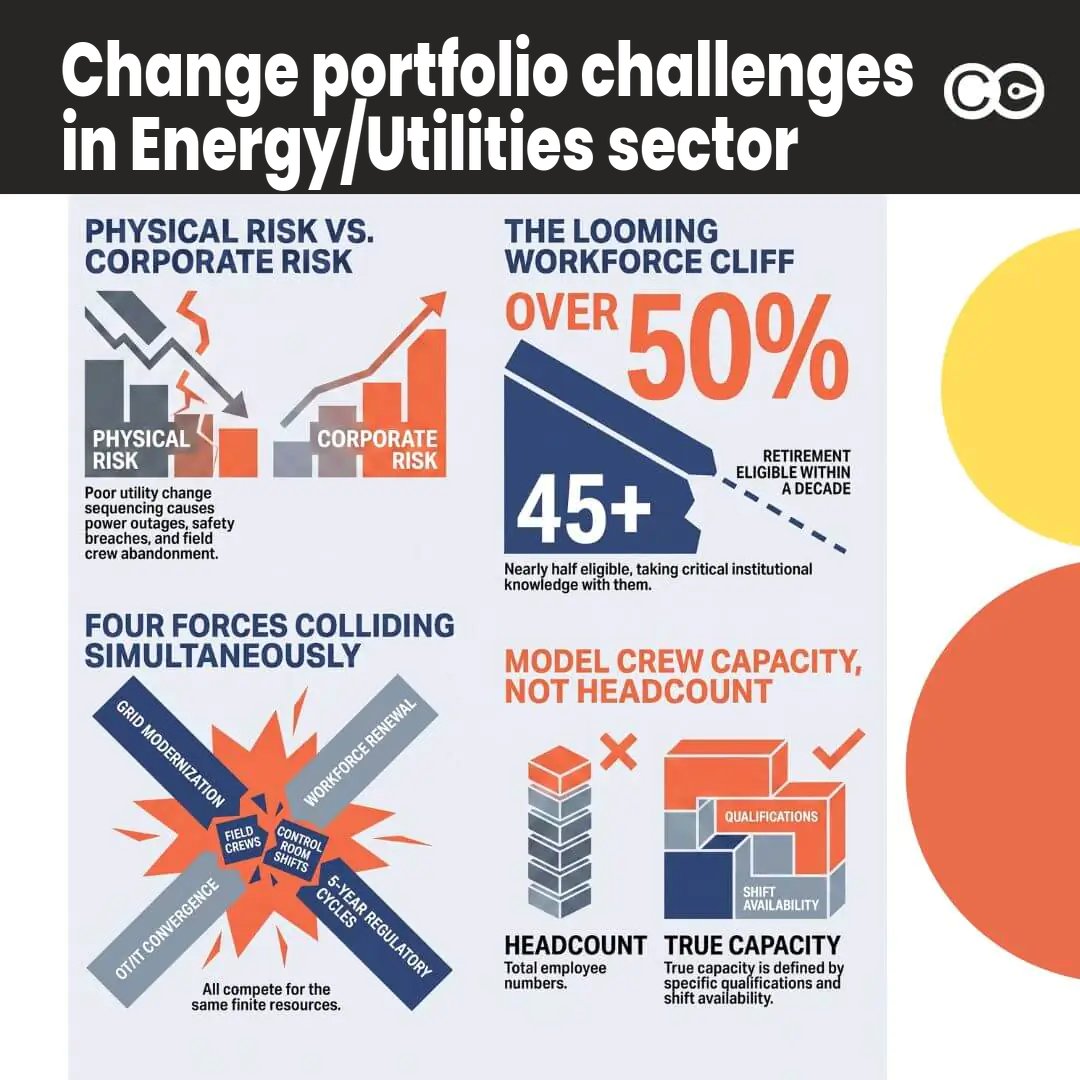


Deloitte’s 2026 industry outlook puts a number on what every utility executive already feels: peak electricity demand is projected to grow roughly 26% by 2035, driven by data centre buildout, transport electrification and industrial reshoring, while more than 2 terawatts of new capacity sit stuck in interconnection queues waiting to connect.
At the same moment, more than half the utility workforce is 45 or older, with between a third and a half of that group eligible to retire within five to ten years. Demand is accelerating. The people who know how to run the grid are leaving.
Neither of those facts is a change management problem on its own. What turns them into one is that utilities are trying to solve both simultaneously, in the same control rooms and field crews, alongside a five-year regulatory reset cycle that was never designed with digital or AI transformation in mind. A grid modernisation programme, a workforce renewal effort, an OT/IT convergence project and a regulator-mandated capital works schedule do not queue up politely. They compete for the same linemen and the same control room shifts, often without anyone holding a single view of the collision.
This is the structural reason generic change management frameworks under-serve energy and utilities. They were built for corporate reorganisations where the main risk is disengagement. In a utility, the main risk is physical: a badly sequenced rollout that pulls a control room operator into training during storm season, or a digital tool a field crew abandons because it was never tested against a rural coverage blackspot. This article sets out what actually differentiates change management for energy and utilities, the four forces colliding in transformation portfolios right now, and a practical framework for sequencing regulated and discretionary change without breaking the people who deliver both.
What makes change management for energy and utilities structurally different
Compare the failure mode. In financial services, the change management conversation centres on regulatory compliance and conduct risk: did the change get documented, evidenced and signed off in a way a regulator would accept. In healthcare, it centres on clinical risk: did the change protect patient safety during the transition.
In energy and utilities, the primary risk is physical and operational. A poorly managed change to switching procedures, outage scheduling or field dispatch does not just create rework or a compliance finding. It can put a lineworker in the wrong place during a live fault, or leave a community without power longer than it should have been.
That single distinction reshapes almost everything about how change should be planned and sequenced in this sector:
- Safety-critical operational change cannot be rolled out on a marketing-style go-live date. It has to work around shift patterns, storm season and mandatory safety stand-downs.
- Field-workforce logistics are a constraint, not an afterthought. A change that assumes reliable connectivity and a desk does not survive contact with a crew working from a ute in a coverage blackspot.
- Long-cycle regulated infrastructure programmes run for years, not months, and have to coexist with faster-moving digital transformation happening in parallel.
- Asset-heavy, unionised, multi-generational workforces bring a different change psychology than a corporate head office does: tenure and safety culture carry more weight than in a typical office reorganisation.
None of this means change management matters less in utilities. If anything, the stakes are higher, because the artefact you are changing is the thing that keeps the lights on. It also means the unit of analysis has to shift: a financial services change function can often reason initiative by initiative and still catch most of its risk through governance and sign-off, but a utility change function that reasons the same way will keep missing the risk that only shows up when several long-cycle programmes land on the same crew in the same month.
Four forces colliding in utility transformation portfolios right now
Ask most utility transformation leaders to name their single biggest change risk and they will usually point to one initiative. The real risk sits in how four separate forces are converging on the same finite pool of people, capital and attention at the same time, against a backdrop of capital investment that is itself accelerating: Deloitte puts the US electric power sector’s capital needs at more than $1.4 trillion through 2030. That scale of capital deployment does not translate cleanly into scale of delivery capacity on the ground.
Grid modernisation and the interconnection backlog
More than 2 terawatts of renewable, storage and large-load capacity are currently stuck in interconnection queues globally, nearly double what is currently installed. Clearing that backlog means new planning processes and new ways of working between engineering, regulatory affairs and commercial teams that have historically operated in separate lanes. That is a change programme in its own right, running on a timeline utilities do not fully control.
The workforce cliff
More than half of utility employees are 45 or older, and a meaningful share of that cohort is retirement-eligible within the decade. When an experienced switching operator or protection engineer leaves, they take undocumented judgement with them, not just a job title. Any transformation programme that assumes stable institutional knowledge as a constant is planning against a workforce that will look materially different in five years.
OT/IT convergence and the cybersecurity change nobody scheduled
As operational technology and IT systems converge, utilities gain real operational benefits, but the attack surface expands with every new connected device. Power grids and water systems are high-value targets, and disruption does not stay local. Regulators increasingly expect continuous monitoring and rapid incident response as a baseline, not an aspiration, which means cybersecurity uplift has become a recurring, unscheduled change event competing for the same control room and engineering time as planned modernisation work.
Five-year regulatory reset cycles
In markets like Australia, network businesses submit a regulatory proposal to the Australian Energy Regulator every five years to determine how much revenue they can recover for safe, reliable service. That cycle dictates a large share of capital works, tariff structures and depreciation schedules for the following five years, so digital and AI initiatives not built into the current determination often have to be justified and sequenced around a regulatory calendar the transformation team does not set.
Individually, each of these forces has an established playbook. Together, they draw on the same finite pool of field crews, control room operators and engineering capacity, and almost no utility change function has a single, portfolio-level view of how they overlap.
Why field-workforce rollout logistics break generic change plans
Most change management templates assume a workforce that sits at a desk, has reliable internet, and can attend a one-hour training session between meetings. None of that describes a field crew. Rollout logistics in utilities have to account for shift-based scheduling, low-connectivity work sites, safety-critical windows that cannot be interrupted, and a workforce that is frequently mobile between depots.
The common mistakes are predictable once you see the pattern:
- Scheduling training and go-live during storm season, when field crews are stretched thinnest and least able to absorb new process.
- Assuming desktop-style connectivity and device access, when much of the workforce works from vehicles, substations or rural sites with patchy coverage.
- Treating union and safety consultation as a compliance checkbox rather than genuine input into sequencing, which slows adoption and erodes trust for the next change.
- Rolling out one initiative at a time without checking what else is already landing on the same crew, which is how a well-designed programme still produces change fatigue.
- Measuring adoption through system logins rather than field behaviour, which hides the gap between “the tool was deployed” and “the crew actually changed how they work.”
EY’s research into utility digital transformation makes the same point from the workforce side: skills and technology readiness are inseparable from a low-carbon energy future, and EY explicitly frames change management and experience programmes as core to closing that gap, not an add-on to the technology rollout. Design the change around the shift pattern, not the other way around.
A change portfolio management framework for regulated infrastructure programmes
Sequencing a single change well is a project management problem. Sequencing grid modernisation, workforce renewal, OT/IT convergence and a regulatory capital programme against each other is a portfolio problem, and it needs a different discipline: change portfolio management, treated as its own capability rather than a by-product of individual project plans.
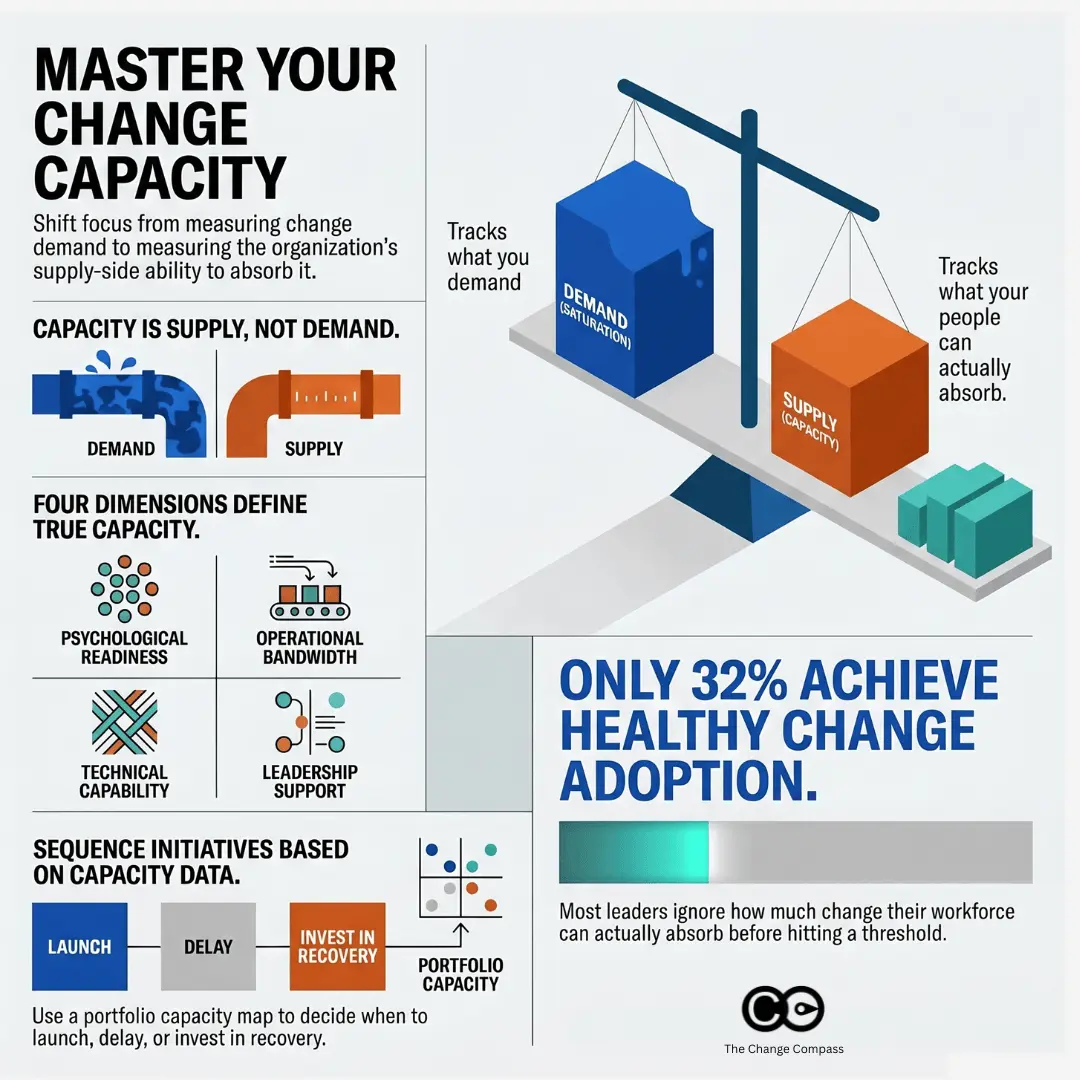
Build a capacity model that spans crews, not headcount
A capacity ceiling in a utility is not “how many people we have.” It is how many people with the right qualification, clearance and shift availability can absorb change in a given week, in a given depot or control room, without compromising safety margins. A model built at that level, cross-referenced against every initiative in flight, is what turns “we think Q3 is busy” into “the Overhead Lines crew in the northern region is carrying three concurrent changes in the same fortnight, and one of them can safely move.”
Give portfolio sequencing a single owner with authority to say no
The point of a capacity model is wasted if no one has the mandate to act on it. A practical framework needs four elements:
- A single register of regulated and discretionary change, so capital works tied to the current AER (or equivalent) determination sit in the same view as voluntary digital and AI initiatives, not in separate spreadsheets.
- A capacity ceiling by crew, shift and control room, not by headcount, so overlap shows up before go-live, not after.
- Sequencing rules that protect safety-critical windows first, then fit discretionary change around outage seasons and mandatory safety stand-downs.
- A named portfolio owner with the authority to re-sequence, rather than leaving that call to whichever project manager shouts loudest.
Picture how that plays out. A distribution business is midway through a five-year AER determination period, delivering a mandated pole and wire replacement programme. In the same quarter, the digital team wants to pilot an AI-based outage prediction tool with the same control room shift, and the workforce team wants to run a knowledge-transfer programme pairing retiring linesmen with apprentices before three senior crew members leave within eighteen months.
Run in isolation, each initiative looks manageable on its own project plan. Mapped against the same capacity model, the overlap is obvious: all three want meaningful time from the same twelve-person crew in the same six-week window, right before storm season. A single portfolio owner with visibility across all three can push the AI pilot six weeks, run the knowledge-transfer sessions in shorter blocks, and leave the regulated pole replacement programme untouched, because that one carries the least flexibility. None of the three plans would have surfaced that decision alone.
This is a direct extension of change conflict detection applied to infrastructure: the goal is to make the collisions visible early enough that sequencing becomes a choice instead of an accident.
Where AI is actually helping in utilities, and where it is creating new change risk
AI is not a single change in a utility transformation portfolio. It is dozens of smaller ones, arriving on different timelines, into a workforce already carrying grid modernisation, workforce renewal and a regulatory reset cycle.
What is working
Deloitte expects nearly 40% of utility control rooms to be using AI by 2027, largely for grid balancing, demand forecasting and outage prediction. Kyndryl’s research points to concrete wins: AI-driven distributed energy resource management systems orchestrating real-time power flow from renewables, and digital twins that let engineers simulate grid behaviour and anticipate failures before they happen. Where AI is scoped narrowly, against a specific operational problem, it is genuinely reducing outage time and easing pressure on a stretched engineering workforce.
What is not
Only around half of utilities report a positive return from autonomous agentic AI systems, and 70% of sector leaders say they feel unprepared for external business risk, well above the cross-industry average. The research’s own framing is the sharpest summary of the problem: the biggest grid risk over the next decade is not weather or cyberattack, it is organisational inertia. AI initiatives treated as a procurement decision rather than a change programme are the ones most likely to fail, particularly when stacked on top of a workforce already absorbing grid modernisation and OT/IT cybersecurity uplift without anyone checking capacity first.
The practical implication for transformation leaders is to treat every AI initiative as a line item in the same capacity model as everything else, not as a separate, faster-moving track that gets to skip the queue because it is strategically important. Strategic importance is exactly why it needs to be sequenced properly.
Using AI for the change management function itself, not just the grid
Almost all of the AI conversation in utilities happens on the operations side: grid balancing, predictive maintenance, outage prediction. That is only half the opportunity. The change management function carries its own administrative load and its own blind spot, and applying AI there is a distinct, complementary problem.
Cutting the administrative load
A distribution business running a capital programme alongside a digital transformation portfolio generates significant manual overhead: drafting impact statements for every crew a change touches, summarising updates from a dozen project managers, building first-cut readiness assessments, and translating rollout detail into plain-language communications a field crew will actually read. A capable AI layer, grounded in the organisation’s own change data rather than operating as a generic assistant, can absorb a meaningful share of that drafting work without removing the change manager from the decision.
Surfacing what a spreadsheet can’t
The higher-value use of AI is insight, not drafting. Applied to a utility’s own portfolio data, an AI layer can flag that three initiatives are landing on the same crew in the same fortnight, or that a discretionary AI pilot and a regulated capital milestone are converging on the same window before anyone has manually cross-referenced the schedules. This is the same class of insight covered in the capacity-model framework above, surfaced continuously instead of waiting for the next planning cycle.
It is also why general-purpose tools such as ChatGPT or Copilot cannot do this work alone. They can draft a competent impact statement, but they have no access to a utility’s crew rosters, safety windows or regulatory calendar, so they cannot tell a transformation leader that a crew is already at 90 per cent of safe load before a fourth initiative lands on it. The insight only exists if the AI is grounded in the organisation’s own structured change and capacity data, not a generic wrapper bolted onto a chat interface.
Building the infrastructure to see the whole portfolio
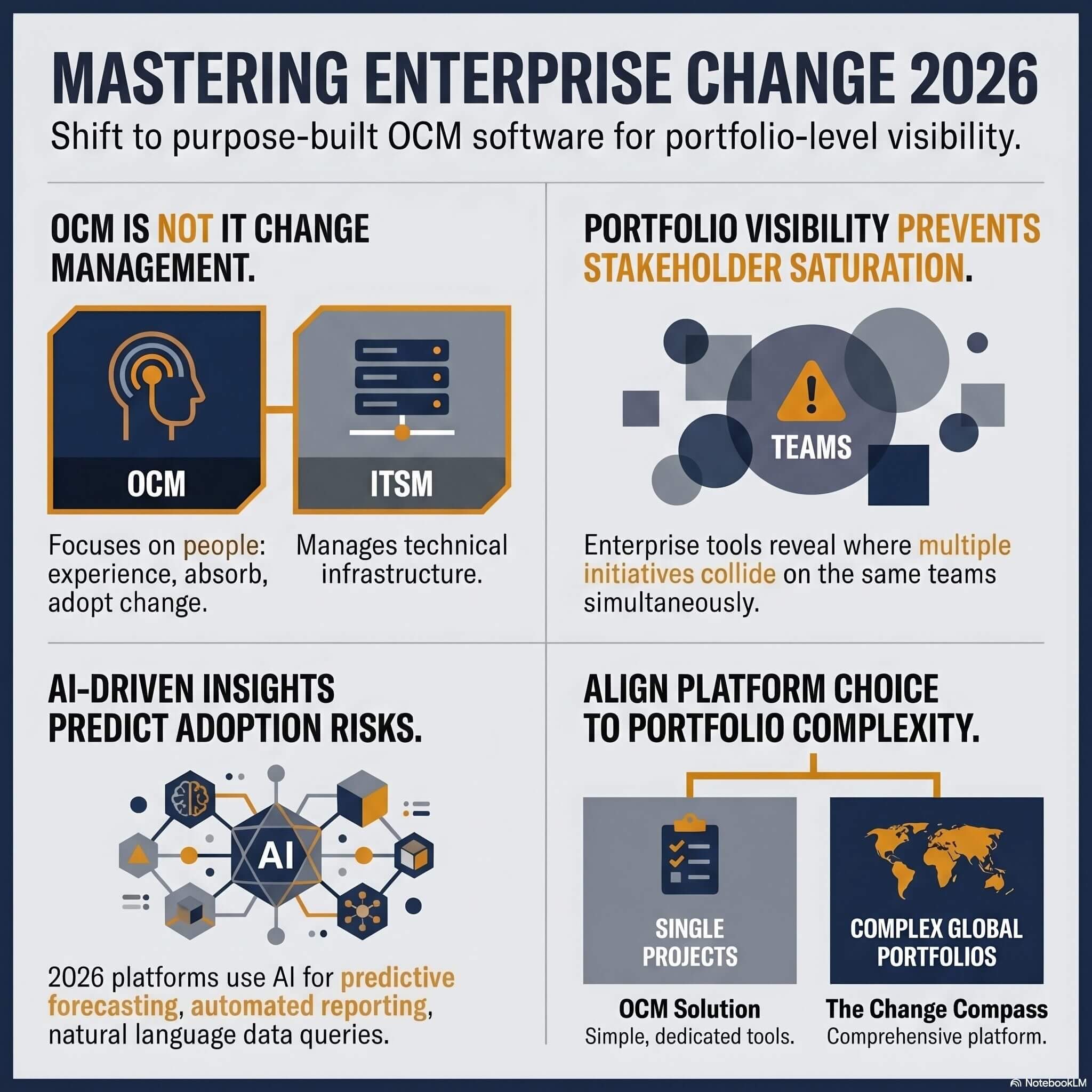
Most of what breaks utility transformation portfolios is not a single bad decision. It is the absence of a shared, current view of what is landing where, held by anyone with the authority to act on it. A change intelligence platform gives transformation leaders that view: a live register of regulated and discretionary change, cross-referenced against real crew and control room capacity, so conflicts surface as a planning input rather than a post-incident finding.
This is the same structural argument that has led PMO directors and transformation leaders at firms including NiSource, a regulated US gas and electricity utility, to treat change data as infrastructure in its own right, not a spreadsheet rebuilt every quarter. The Change Compass is built for exactly this problem: a single, live view of capacity, conflict and sequencing, with AI grounded in that same data, so portfolio decisions get made with evidence instead of guesswork.
The portfolio is the unit of risk, not the project
Every individual change programme in an energy or utilities transformation portfolio can be well planned, well resourced and well executed, and the portfolio can still fail, because the risk was never in any single initiative. It was in the collision between grid modernisation, workforce renewal, OT/IT convergence and a regulatory reset cycle that none of the project plans were built to see. Change management for energy and utilities has to operate at the level where that collision is visible: a shared capacity model, a single register of regulated and discretionary change, and someone with the authority to re-sequence when the plan and the calendar disagree.
Start smaller than a full portfolio rebuild if you need to. Pick the one crew or control room carrying the heaviest concurrent load right now, map every initiative landing on it over the next two quarters, and see what the collision actually looks like on paper. Most leaders who do that exercise once do not go back to planning change one project at a time.
Frequently asked questions
What is change management for energy and utilities?
The discipline of planning, sequencing and embedding organisational change within the constraints of safety-critical operations, field-based workforces, long-cycle infrastructure programmes and five-year regulatory reset cycles. It differs from generic corporate change management because the primary risk is physical and operational, not purely compliance-based.
Why can’t utilities use the same change management approach as other regulated industries?
Financial services centres on regulatory and conduct risk, and healthcare centres on clinical risk. In energy and utilities, the primary risk is physical and operational safety, and a large share of the workforce is field-based and shift-based, which requires different rollout logistics entirely.
What is change portfolio management, and why does it matter for utilities?
Managing the combined load, sequencing and conflicts of every change initiative across an organisation at once, rather than each in isolation. For utilities, grid modernisation, workforce renewal, OT/IT convergence and regulatory capital programmes routinely draw on the same finite pool of crews and control room staff, and only a portfolio-level view catches that overlap before it causes an operational problem.
How should utilities sequence AI rollouts against other transformation programmes?
AI initiatives should sit in the same capacity model as every other change, mapped against real crew and control room availability, and sequenced around safety-critical windows and regulated capital works. Treating AI as a separate track that bypasses portfolio sequencing is a common reason AI programmes underdeliver.
How can utilities address the ageing workforce and skills gap through change management?
By capturing undocumented operational judgement before experienced staff retire, designing rollouts around shift patterns rather than desk-based assumptions, and building genuine frontline and union consultation into sequencing decisions rather than a late-stage compliance step.
How can AI support the change management function, not just grid operations?
It can reduce the drafting load (impact statements, stakeholder communications, first-cut readiness assessments) and, more valuably, surface portfolio-level insight, such as flagging that a crew is approaching its safe capacity load before a human would have cross-referenced every initiative manually. This only works if the AI is grounded in the organisation’s own change data, not a generic assistant with no visibility into rosters or the regulatory calendar.
References
- Deloitte Insights. “2026 Power and Utilities Industry Outlook.” October 2025.
- T&D World. “Addressing the Utility Workforce Crisis: Strategies for Modernization and Resilience.”
- Australian Energy Regulator. “Better resets handbook.”
- International Security Journal. “IT/OT Security Convergence in 2026: Complete Enterprise Guide.” May 2026.
- EY. “Utility digital transformation and the workforce.”
- Kyndryl. “How AI is reshaping utilities and the power grid.” February 2026.