When a change manager joins an agile delivery team for the first time, the experience is often disorienting. Sprints end before the change plan is written. Stakeholder engagement gets squeezed between retrospectives and backlog refinement. The carefully structured approach that worked for waterfall programmes suddenly feels like it belongs to a different era. Most of the time, nobody has told the change manager what to do differently. They are just expected to adapt.
This article is about what that adaptation actually looks like. Agile is not just a project delivery methodology — it represents a fundamentally different rhythm for change, with different assumptions about how requirements evolve, how teams are organised, and how frequently stakeholders need to be engaged. Change managers who understand these differences do better work and have more influence. Those who try to map their traditional toolkit onto an agile context spend most of their time in friction.
The five principles below are grounded in how agile change management actually works in practice, not in how it is theorised in certification programmes. They are drawn from the most common challenges practitioners encounter when making the shift from waterfall to agile delivery environments.
Why traditional change management struggles in agile environments
Traditional change management is designed around certainty. You conduct a change impact assessment at the beginning of the project, define the stakeholder engagement plan, sequence the communications calendar, and execute against it. The implicit assumption is that the shape of the change is knowable early enough to plan for it properly.
Agile delivery rejects this assumption. Features are discovered through iteration. Scope evolves with each sprint. A requirement that seemed clear at the start of the programme may look completely different by sprint 10. This is a feature of agile, not a bug — but it creates a fundamental problem for change managers who are trying to communicate with stakeholders about “what is changing” when the answer shifts every two weeks.
Research from the Project Management Institute on agile change management found that change functions struggle most with the timing and specificity of stakeholder engagement in agile contexts. The challenge is not willingness to adapt but the absence of a clear model for how change management activities map onto sprint cadences. The five principles below provide that model.
Principle 1: Iterative change instead of big-bang adoption
In traditional delivery, the change management effort builds toward a single go-live moment: the day everything changes and users adopt the new system or process. Communication, training, and engagement all converge on that point. In agile delivery, there is no single go-live. There are increments: features that go live in sprint releases, with users adopting new capabilities progressively across months.
This shifts the change manager’s role from managing a transition event to managing a continuous adoption curve. Instead of a one-off training programme delivered two weeks before go-live, you need a series of shorter, more frequent touchpoints aligned to sprint releases. Instead of a single readiness assessment, you need rolling readiness checks that track adoption of each increment as it lands.
What this looks like in practice
A practical implication: your communication planning needs to operate on a sprint-by-sprint cycle rather than a project timeline. At the beginning of each sprint, ask the delivery team what will be released at the end of the sprint and who will be affected. Design a targeted, lightweight communication or engagement activity for that audience. At the end of the sprint, measure adoption of that increment before the next sprint planning begins. This gives you a closed feedback loop that is responsive to the actual pace of delivery, rather than a communication plan that was written six months ago and is increasingly disconnected from what is actually being built.
MIT Sloan Management Review research on agile transformation found that organisations using iterative adoption approaches achieved significantly higher sustained adoption rates compared to those using single-event go-lives, particularly for complex technology implementations. The reason is simple: users have more time to adapt, and issues are identified and resolved before the next increment builds on them.
Principle 2: Multi-disciplinary team membership
In traditional project delivery, the change manager operates alongside the project team: attending steering committees, reviewing deliverables, and running parallel workstreams. In well-functioning agile delivery, the change manager is embedded within the team — attending daily standups, participating in sprint reviews, and contributing to retrospectives alongside developers, business analysts, and product owners.
This distinction matters enormously. A change manager who attends steering committees learns about sprint outcomes weeks after they happen. A change manager embedded in the team learns about changes to scope, design decisions, and technical constraints in real time, which is the only way to keep stakeholder engagement current in a fast-moving delivery environment.
The practical implication is that change managers working in agile environments need to be fluent in agile ceremonies and vocabulary. Knowing what a sprint review is, what a retrospective is for, and how the product backlog is prioritised is not optional knowledge — it is the baseline for participating in the team effectively. Atlassian’s research on agile at scale consistently identifies the absence of change management capability within delivery teams — rather than alongside them — as a primary factor in transformation failures.
Principle 3: Early and continuous stakeholder engagement
Agile shifts stakeholder engagement from a scheduled event (a town hall, a training session, a change impact workshop) to a continuous process. In a sprint-based environment, end users and business stakeholders should be involved in sprint reviews — they should see what has been built, provide feedback, and have that feedback incorporated into subsequent sprints. This is stakeholder engagement in the most direct sense: users shaping the design of the change as it happens, rather than being informed about it after the design is locked.
The change manager’s role here is to facilitate this engagement, not just to plan communications about it. This means helping the product owner understand which stakeholders need to be involved in which sprint reviews, ensuring that business representatives are available and briefed before sprint reviews, and capturing the feedback from those sessions in a form that the delivery team can act on.
Managing stakeholder fatigue in continuous engagement
One practical challenge is preventing stakeholder fatigue when engagement is continuous rather than episodic. The solution is to be selective and purposeful: not every stakeholder needs to attend every sprint review. The change manager should map which stakeholder groups are most affected by upcoming sprint releases and prioritise their involvement accordingly. Less relevant stakeholders can receive lightweight updates rather than attending in person.
Research from Prosci on agile change management found that organisations with active stakeholder participation in sprint reviews experienced 35% higher adoption rates for agile-delivered changes compared to those using traditional post-delivery engagement models. The reason is that stakeholders who have been involved in shaping the design arrive at go-live with a much stronger understanding of what is changing and why, which directly reduces resistance and accelerates adoption.
How Scrum and Kanban change your planning cadence
Agile delivery teams typically operate using one of two frameworks: Scrum or Kanban. Understanding the difference matters for change management, because each creates a different planning environment.
Change management in Scrum teams
Scrum organises delivery into fixed-length sprints, typically two weeks. At the start of each sprint, the team commits to a defined set of deliverables from the product backlog. At the end of each sprint, the team holds a sprint review (demonstrating what was built) and a retrospective (reflecting on how the team worked). For change managers, the sprint structure creates a natural planning cadence:
Sprint planning: Understand what will be built and identify which stakeholders will be affected when it is released
During the sprint: Prepare communication, engagement, or training assets targeted at the upcoming release
Sprint review: Bring relevant stakeholders to see what has been built and gather their feedback
Sprint retrospective: Raise any change management concerns about adoption readiness or stakeholder reactions
Change management in Kanban teams
Kanban does not use fixed sprints. Work flows continuously from backlog to in-progress to done, with release happening when items are completed rather than at the end of a sprint cycle. This creates a more fluid environment for change management, where the focus shifts from sprint-level planning to flow management: ensuring that the rate at which changes are released to users does not exceed their capacity to absorb them. In Kanban environments, change managers often work most effectively by collaborating with the product owner to manage the release cadence deliberately, using capacity data to inform decisions about when to hold back completed features versus releasing them continuously.
Digital tools that support agile change management
Managing the cumulative adoption load across multiple agile delivery teams requires more than intuition. As organisations scale agile delivery across dozens of concurrent product teams, each releasing increments continuously, the aggregate change burden on affected business areas can become significant. Platforms like The Change Compass enable change managers to track and visualise the cumulative impact of agile releases across the portfolio, providing the portfolio-level visibility that individual team-level change management cannot deliver. This is particularly valuable for organisations running multiple agile programmes simultaneously, where the risk is not any single team’s release cadence but the combined load hitting the same business areas at the same time.
Adapting your practice without losing what works
The five principles above do not require abandoning change management fundamentals. Stakeholder analysis, impact assessment, readiness measurement, and communication planning all remain relevant in agile contexts. What changes is the frequency, granularity, and integration of these activities with the delivery rhythm. The change manager who understands this distinction, and can articulate it clearly to delivery leads and project sponsors, becomes a genuine asset to agile teams rather than a friction point in their way.
Start by attending the next sprint review for a programme you are supporting. Observe how decisions are made, who is in the room, and what happens to the feedback that is given. That single step will teach you more about what agile change management requires than any number of certification courses.
Frequently asked questions
What is agile change management?
Agile change management is the practice of integrating change management activities — stakeholder engagement, impact assessment, communication, and adoption support — into agile delivery frameworks like Scrum and Kanban. It differs from traditional change management by operating in shorter cycles aligned to sprint releases, with continuous rather than episodic stakeholder engagement.
What is the role of a change manager in a Scrum team?
A change manager embedded in a Scrum team attends daily standups, sprint planning sessions, sprint reviews, and retrospectives. Their primary contribution is ensuring that business stakeholders are engaged in sprint reviews, that the adoption readiness of each increment is tracked, and that communication activities are aligned to sprint release cycles rather than to a single project go-live date.
How is agile change management different from traditional change management?
Traditional change management assumes a defined scope delivered at a single point in time, with change activities building toward a go-live event. Agile change management operates in continuous cycles, with scope evolving through iterations. The key practical differences are that engagement activities are much more frequent, stakeholders are involved in shaping the design (not just receiving it), and adoption is measured incrementally rather than at a single post-implementation point.
How do you measure adoption in an agile change management context?
Adoption measurement in agile contexts should be sprint-by-sprint rather than a single post-implementation survey. After each sprint release, measure whether affected users have adopted the specific features released in that sprint. This allows you to identify adoption issues early, understand which user groups are struggling, and feed this information back into sprint planning so the delivery team can prioritise support or adjustments in subsequent sprints.
Can you use Prosci ADKAR in an agile environment?
Yes, the ADKAR model (Awareness, Desire, Knowledge, Ability, Reinforcement) applies in agile contexts, but the activities that build each element need to be distributed across sprint cycles rather than concentrated before a single go-live. Awareness and Desire activities happen early in the programme and are reinforced with each sprint review. Knowledge and Ability are built incrementally as each sprint release is adopted. Reinforcement is ongoing throughout the delivery lifecycle.
References
Project Management Institute, “Agile Change Management: Bridging the Gap”
It all begins with an idea. Maybe you want to launch a business. Maybe you want to turn a hobby into something more. Or maybe you have a creative project to share with the world. Whatever it is, the way you tell your story online can make all the difference.
Don’t worry about sounding professional. Sound like you. There are over 1.5 billion websites out there, but your story is what’s going to separate this one from the rest. If you read the words back and don’t hear your own voice in your head, that’s a good sign you still have more work to do.
Be clear, be confident and don’t overthink it. The beauty of your story is that it’s going to continue to evolve and your site can evolve with it. Your goal should be to make it feel right for right now. Later will take care of itself. It always does.
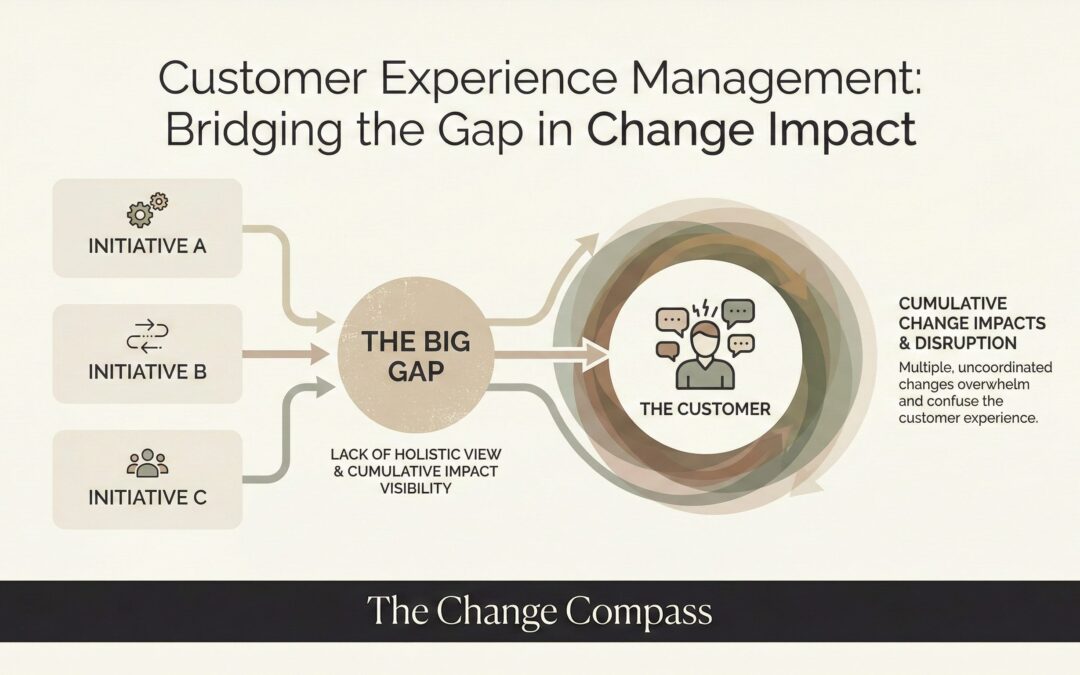
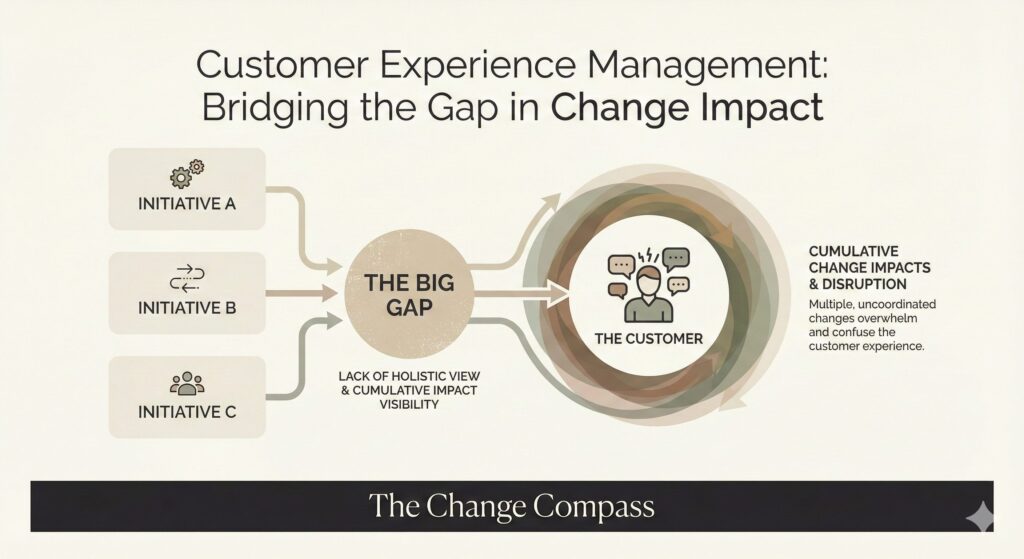
Customer experience management dominates strategic conversations across banking, utilities, telecoms, and retail. Companies invest heavily in CRM systems, digital channels, and customer journey mapping. Yet a fundamental gap persists: the lack of integrated visibility into how company-wide change initiatives shape customer perceptions.
This guide reveals why traditional approaches fall short, quantifies the risks of disconnected change efforts, and provides a practical roadmap for creating a true single view of the customer through change impact integration.
What Prevents Companies from Achieving a Single View of the Customer?
Recent research confirms persistent challenges in customer experience management. A 2024 Forrester study found 48% of enterprises still struggle with unified customer data across channels and departments. Similarly, Gartner reports 52% cite building cohesive new experiences as their top barrier.
The core issue lies beyond siloed CRM data. Companies lack visibility into the cumulative impact of concurrent initiatives—product changes, pricing adjustments, IT rollouts, regulatory communications—that collectively define customer reality.
Why Traditional CRM Approaches Fall Short
CRM systems excel at marketing automation, sales tracking, and contact centre efficiency. However, they capture only transactional interactions, missing the broader context of organisational change.
Traditional CRM Focus Limitations
Marketing campaign data
Sales conversion metrics
Service interaction logs
Customer segmentation profiles
These systems overlook how product updates, pricing shifts, or compliance communications alter customer perceptions between tracked touchpoints.
The Missing Piece: Change Impact Tracking
The critical gap involves mapping all customer-impacting initiatives into a unified view. This includes marketing campaigns plus operational changes affecting service delivery.
Change Initiatives Shaping Customer Experience
Product lifecycle changes (end-of-life, new features)
Pricing and billing adjustments
IT system rollouts impacting service access
Regulatory compliance communications
Employee training initiatives influencing service quality
Partner or supplier changes affecting delivery
Without this integrated picture, companies cannot anticipate cumulative customer confusion or frustration.
Traditional CRM vs Change Impact Data vs Integrated CX View
Data Source
Focus
Customer Insight
Strategic Value
CRM Systems
Marketing, sales, service transactions
Individual touchpoints
Tactical optimisation
Change Impact Data
Company initiatives affecting customers
Planned experience shifts
Risk anticipation
Integrated View
Combined datasets
Holistic customer reality
Strategic CX orchestration
This table illustrates why isolated CRM investments yield incomplete results.
Risks of Disconnected Change Initiatives
Without integrated change visibility, companies create conflicting customer signals that erode trust and satisfaction. Real-world examples illustrate the consequences.
Common Customer Confusion Scenarios
One department ends a credit card product while sales teams push aggressive uptake targets
IT rollout disrupts online banking while marketing promotes digital-first convenience
Pricing changes coincide with loyalty program promotions, confusing value messaging
Regulatory communications clash with personalised marketing campaigns
These disconnects compound across multiple initiatives, overwhelming customers.
Financial Impact of Poor CX Coordination
The stakes are substantial. Recent studies quantify the cost:
Forrester 2024: Companies lose $1,200+ per negative customer experience
Gartner 2025: 42% of telecom households report negative experiences from conflicting communications
McKinsey: Utilities face 28% churn risk from uncoordinated service disruptions
Cumulative impact across customer bases represents millions in lost revenue annually.
The Solution: Integrated Customer Change Impact Management
Create a unified view combining CRM data with change impact analytics for holistic CX orchestration.
Core Components of Integrated CX Visibility
Centralised Change Repository: Track all customer-impacting initiatives across departments
Customer Segmentation Mapping: Align change impacts with specific personas and journeys
Timing & Volume Analysis: Visualise change saturation by customer segment over time
Impact Correlation Engine: Link initiatives to expected CX outcomes and risks
Strategy Alignment Dashboard: Compare planned changes against customer experience goals
5 Strategic Benefits
Anticipate cumulative customer confusion before rollout
Optimise change sequencing to minimise disruption peaks
Align departmental initiatives with unified CX strategy
Quantify ROI from coordinated vs siloed change efforts
Enable proactive service recovery planning
Customer Change Impact Matrix Example
Customer Segment
Product Change
Pricing Shift
IT Rollout
Regulatory Comm.
Total Impact Score
Premium Banking
Medium
High
Low
Medium
High
Mass Market
Low
High
High
Low
High
Digital Native
High
Low
High
Low
High
This matrix reveals saturation risks by segment.
Implementation Roadmap for Integrated CX Change Management
Phase 1: Foundation (0-3 Months)
Inventory all customer-impacting initiatives across departments
Map initiatives to customer segments and journey touchpoints
Establish cross-functional CX governance council
Build baseline change impact repository
Phase 2: Integration (3-6 Months)
Connect change data with existing CRM/customer systems
Deploy change saturation dashboards by segment
Implement automated conflict detection alerts
Launch pilot optimisation for high-risk periods
Phase 3: Optimisation (6-12 Months)
Embed CX alignment reviews in initiative approval processes
Scale predictive impact modelling across portfolio
Establish continuous improvement feedback loops
Benchmark against industry CX leaders
Governance and Success Factors
Essential Governance Elements
Executive sponsorship with direct profit/loss accountability
Cross-departmental representation in change review forums
Standardised change impact assessment templates
Monthly portfolio saturation reporting to leadership
Critical Success Metrics
Reduction in customer confusion complaints (25% target)
Improved Net Promoter Score during change periods
30% faster issue resolution through proactive planning
Higher departmental collaboration scores
Frequently Asked Questions (FAQ)
What is the biggest gap in customer experience management? Lack of integrated visibility into how company-wide change initiatives collectively shape customer perceptions and experiences.
Why do CRM systems alone fail to deliver unified CX? CRM captures transactions but misses operational changes like product updates, pricing shifts, and IT rollouts that define customer reality.
How much do poor CX experiences cost companies? Recent studies show $1,200+ lost per negative experience, with millions annually across customer bases in banking and utilities.
What does integrated CX change management look like? Centralised change repositories, customer segmentation mapping, saturation dashboards, and strategy alignment analytics working together.
How do you identify customer change saturation risks? Use impact matrices showing concurrent initiatives by segment, highlighting high-risk periods needing sequencing adjustments.
What is the first step toward CX change integration? Conduct an inventory of all customer-impacting initiatives across departments to establish baseline visibility.
Change management measurement remains one of the most underdeveloped capabilities in the field. Many organisations track change activities diligently — who attended what, which communications went out, whether training was completed — but struggle to demonstrate the connection between those activities and the business outcomes the change was designed to produce. The result is a discipline that is frequently undervalued by executives, precisely because it cannot show its own impact in the language that executives care about.
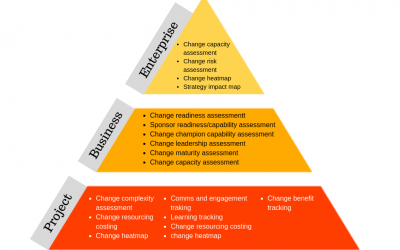
The fundamental problem is that most change measurement frameworks operate at a single level — typically the project level — and focus on activities rather than outcomes. A more useful framework operates across three distinct levels: enterprise, business unit, and project. Each level asks different questions, uses different data, and serves different decision-makers. Together, they provide the complete picture that neither programme-level nor portfolio-level measurement alone can deliver.
Why most change measurement falls short
The most common change measurement approach is to track the activities of a specific change programme: how many people were trained, how many communications were sent, what the survey results showed at go-live. This is not without value. Programme-level activity data provides accountability for change delivery and allows teams to identify when specific components — training, communication, stakeholder engagement — are underperforming relative to plan.
But activity measurement has a fundamental limitation: it measures what the change programme did, not whether what it did worked. A programme can achieve 95 percent training completion and still fail to produce the behaviour change the business needs. Prosci’s research on change management ROI consistently finds that programmes with excellent activity metrics but poor adoption outcomes are common — and that the gap between activity and adoption is the primary measurement failure in the field.
The second limitation is that programme-level measurement is blind to the portfolio effect. A team absorbing three major changes simultaneously may show adequate readiness on each programme’s assessment, while its actual adaptive capacity is severely depleted. No programme-level measurement system can detect this, because each programme sees only its own impact on the team. Portfolio-level measurement — the enterprise and business unit levels of the framework — is required to make the cumulative picture visible.
The three levels of change management measurement
A comprehensive change measurement framework operates simultaneously across three levels. Each level has its own measurement purpose, its own data requirements, and its own primary audience. Building measurement capability at all three levels is what distinguishes organisations that can genuinely manage their change portfolio from those that can only report on individual programme activities.
Enterprise level
Enterprise-level change measurement answers the question: how well is our organisation managing change as a strategic capability? It is concerned with the aggregate picture — the total change load being absorbed across the organisation, the distribution of that load across different parts of the business, and the organisation’s overall change capacity and maturity. The primary audience for enterprise-level metrics is the executive team and board, for whom change management is a risk and capability question rather than a delivery question.
Key enterprise-level measures include the total volume of change programmes in flight across the portfolio, the concentration of change load in specific divisions or role groups, trend data on change saturation and fatigue indicators (attrition rates during high-change periods, engagement score movements, absenteeism), and overall adoption rates across major transformation programmes. Enterprise-level measurement also includes benchmarking: how does the organisation’s change capacity compare to research-derived standards or to prior periods?
The enterprise-level view is what enables the most consequential change governance decisions: whether to defer a programme because specific teams are already at or beyond their absorption capacity, whether to invest in additional change resources because the portfolio is systematically under-resourced, or whether specific divisions require targeted capability development to handle the rate of change expected of them.
Business unit level
Business unit-level measurement answers the question: how well is change landing in this part of the organisation? It operates at the level of a division, department, or significant team, and is primarily concerned with the change experience of a defined employee group across all the changes affecting them simultaneously — not just the changes coming from a single programme.
Business unit-level measures include the aggregate change impact score for the group — a composite measure of how many changes are affecting the group, how significant those changes are, and how they are distributed across the year. They include readiness assessments that capture the group’s preparedness for their current change load, not just for individual programmes. They include adoption indicators aggregated across the changes the group has been through in the past 12 months, providing a baseline against which new changes can be assessed. And they include the qualitative picture: what are managers and employees in this group experiencing, and what does that tell us about the group’s current adaptive capacity?
Business unit-level measurement is most valuable to the leaders who are accountable for the performance of those groups — general managers, division heads, and the people leaders who sit one or two levels below them. It gives them data they cannot obtain from programme-level reporting, because programme-level reporting does not aggregate across programmes and does not show the cumulative picture.
Project level
Project-level measurement is the most familiar tier and the most developed in most organisations. It answers the question: how well is this specific change programme delivering its intended outcomes? The primary audience is the programme sponsor, the change management team, and the project governance board.
Best-practice project-level change measurement tracks through three phases: plan, execute, and realise. In the planning phase, measurement focuses on impact assessment quality — how thoroughly the change’s impacts on specific roles and teams have been identified and documented. In the execution phase, it covers the full range of change activity metrics (stakeholder engagement, communication reach, training completion) alongside early readiness and comprehension indicators. In the realisation phase, it shifts to adoption and benefit metrics: are employees performing in the new way? Are the business benefits the change was designed to produce materialising?
Prosci’s ADKAR model provides a useful framework for structuring project-level measurement across the individual adoption journey: awareness, desire, knowledge, ability, and reinforcement. Measuring at each stage of the ADKAR sequence helps change teams identify where in the adoption journey the programme is losing traction, rather than receiving undifferentiated feedback that “the change isn’t landing.”
Connecting the three levels: the measurement flow
The three measurement levels are not independent. They form a connected system in which data flows upward from project to business unit to enterprise, and governance decisions flow downward in the opposite direction. Understanding how this flow works is essential to building a measurement framework that actually influences decisions rather than simply producing reports.
The upward flow begins with structured impact assessment at the project level. Each programme systematically identifies which teams and role groups are affected, what types of impacts they are experiencing, and how significant those impacts are. This data is aggregated at the business unit level to produce a picture of the cumulative change load on each group. That business unit data is then aggregated at the enterprise level to produce the portfolio-wide picture that executives need to make strategic resource and sequencing decisions.
The downward flow of governance decisions takes the enterprise and business unit data and translates it into constraints and guidance for individual programmes. If the enterprise-level data shows that a specific division is at capacity, the governance decision might be to defer a planned programme affecting that division by one quarter. If the business unit data shows that a team’s adoption of a recently completed change is low, the governance decision might be to provide additional stabilisation support before launching the next wave of change on that team.
This connected measurement system is what platforms like The Change Compass are designed to support. By providing a shared data layer across all three measurement levels — with structured impact data collected at the project level and automatically aggregated to business unit and enterprise views — these platforms make the full measurement framework operationally viable rather than theoretically sound but practically unworkable.
Making measurement actionable
The purpose of change measurement is not to produce reports. It is to enable better decisions. A measurement framework that generates data that no one acts on has failed its purpose, regardless of how sophisticated the metrics are. Making measurement actionable requires three things: the right data at the right time, a clear governance process for acting on it, and decision-makers who have both the authority and the appetite to make difficult calls based on what the data shows.
The right data at the right time means measurement that is aligned to decision windows. Enterprise-level data needs to be available when portfolio investment decisions are being made — typically quarterly, in alignment with financial planning cycles. Business unit-level data needs to be available to division leaders when they are making decisions about programme timing and resourcing. Project-level data needs to be available to programme teams on a continuous basis, so that course corrections can be made during implementation rather than identified in a post-implementation review when it is too late to act.
The governance process for acting on measurement data is frequently the weakest link. Many organisations collect reasonable change data but have no clear process for what happens when the data shows a problem. McKinsey research on change programme failures consistently finds that the most common cause of poor change outcomes is not the quality of the change design but the quality of the in-flight decision-making when early signals indicate the programme is not landing as expected. A measurement framework without a governance process for acting on what it reveals is a reporting system, not a management tool.
Frequently asked questions
What are the three levels of change management measurement?
A comprehensive change management measurement framework operates at enterprise, business unit, and project levels. The enterprise level measures the organisation’s overall change portfolio, capacity, and management maturity. The business unit level measures the aggregate change load and adoption experience of specific employee groups across all concurrent changes affecting them. The project level measures the delivery and adoption outcomes of individual change programmes. Each level serves different decision-makers and requires different data.
Why is measuring training completion not enough?
Training completion is an activity measure — it tells you someone participated in a training programme, not whether they understood the content, can apply it, or have adopted the new process or behaviour. Outcome measures — adoption rates, error rates in new processes, productivity recovery — are what demonstrate whether a change programme has achieved its purpose. Organisations that rely primarily on activity measures consistently overestimate their change effectiveness and underestimate their adoption gaps.
How does change measurement support portfolio governance?
Portfolio-level change measurement makes visible the aggregate change load on specific employee groups across all concurrent programmes — information that is invisible to programme-level measurement systems. This data enables portfolio governance decisions about sequencing, pacing, and resourcing that cannot be made without it. When enterprise and business unit-level measurement shows that specific teams are at or beyond their absorption capacity, the governance body has the evidence it needs to defer or descope programmes affecting those teams rather than proceeding and generating resistance and attrition.
What does effective change measurement look like in practice?
Effective change measurement is structured, consistent, and connected to decision processes. It uses a shared taxonomy for impact types across all programmes, so that data can be aggregated across the portfolio. It is timed to decision windows rather than reporting cycles. It covers all three measurement levels — not just project-level activity. And it has a clear governance process for what happens when the data shows a problem, so that measurement informs action rather than just generating reports.
It all begins with an idea. Maybe you want to launch a business. Maybe you want to turn a hobby into something more.
Maybe you have a creative project to share with the world. Whatever it is, the way you tell your story online can make all the difference.
Don’t worry about sounding professional. Sound like you. There are over 1.5 billion websites out there, but your story is what’s going to separate this one from the rest. If you read the words back and don’t hear your own voice in your head, that’s a good sign you still have more work to do.
Be clear, be confident and don’t overthink it. The beauty of your story is that it’s going to continue to evolve and your site can evolve with it. Your goal should be to make it feel right for right now. Later will take care of itself. It always does.
We use cookies to improve your experience and understand site use. Marketing cookies stay off until you accept, and in the EU, UK and Switzerland analytics does too. Cookie Policy.
Strictly necessary
Required for the site to work: security, load balancing, and remembering your choices. These cannot be switched off.
Always active
Analytics
Google Analytics and similar, so we can see which pages are useful and where visitors get stuck. Aggregated, never sold.
Marketing
Used to measure campaigns and show relevant content on other platforms such as LinkedIn.