So agile is all the rage at the moment. Most organisations are implementing some form of agile methodology in how they manage initiatives, anywhere from the waterfall project methodology on one extreme end through to the pure agile project methodology on the other end. Yes, we know that agile may not be for every organization. Projects where the output of the change is known clearly upfront and where requirements won’t change much throughout the project may not benefit from an agile approach. On the other hand, those projects where the end design is not known, where innovation would be valued, would definitely benefit from an agile approach.
There are plenty of resources available for project managers on the mechanics of agile methodology. However, the same cannot be said for change managers. Many even comment that the role of change management has ‘disappeared’ within the agile approach. There are lots of examples of projects where there is significant change impact on employees and customers, where there is no change manager on the project.
What is the role of change managers in an agile project? How will change work be modified to suit agile methodology? How does the change manager create value in an agile environment? This guide aims to answer these questions and provide a simple and practical guide to aid the work of change managers in an agile environment. While the guide will not aim to cover anything and everything to do with agile, it will aim to call out aspects the change manager needs to consider in carrying out change work in an agile environment.
Let’s start with the basics of agile – the Agile Manifesto principles
When the agile ‘godfathers’ got together to come up with agile change principles all those years ago, they were quite certain that they wanted to focus more on principles than ‘methodology’ per se. Since then the intent may have changed in how organisations have adopted this. Nevertheless, it is important to visit the core of what agile stands for.
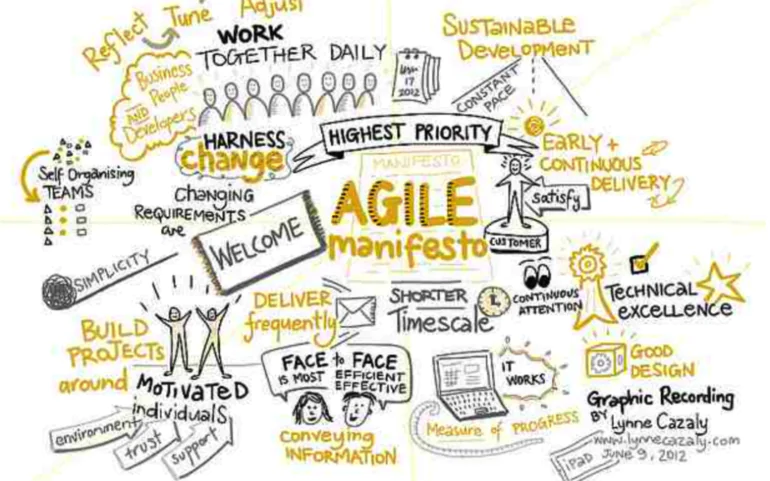
These are the 12 principles of the Agile Manifesto (from agilemanifesto.org)
Our highest priority is to satisfy the customer through early and continuous delivery of valuable software.
Welcome changing requirements, even late in development. Agile processes harness change for the customer’s competitive advantage.
Deliver working software frequently, from a couple of weeks to a couple of months, with a preference to the shorter timescale.
Business people and developers must work together daily throughout the project.
Build projects around motivated individuals. Give them the environment and support they need, and trust them to get the job done.
The most efficient and effective method of conveying information to and within a development team is face-to-face conversation.
Working software is the primary measure of progress. Agile processes promote sustainable development. The sponsors, developers, and users should be able to maintain a constant pace indefinitely.
Continuous attention to technical excellence and good design enhances agility.
Simplicity–the art of maximizing the amount of work not done–is essential.
The best architectures, requirements, and designs emerge from self-organizing teams.
At regular intervals, the team reflects on how to become more effective, then tunes and adjusts its behaviour accordingly.
Here are some key takeaways that the change manager should note about the agile manifesto, the core of what agile is trying to achieve:
Iterative change
Iterative change is more effective than big bang change. This is because it reduces the risk of failure and increases the chances of success. This is also how designers work – making incremental changes to ultimately come up with the right outcome. This is because with these techniques the project team is getting feedback throughout the process. Therefore, the ‘test and learn’ and prototypes in design thinking are critical as a part of an agile approach. The emphasis on constant change is the core of agile.
Multi-disciplinary team
The power of the smallish and multi-disciplinary team. Business, technical and specialists from other disciplines are encouraged to work together to come up with innovative solutions to address the problem. Each discipline may approach the same problem differently, and therefore when we put people with different approaches together we start to get innovative ideas. Smallish teams also tend to perform better in getting traction and delivering without getting bogged down by hierarchy. Most agile experts agree that the right size for agile teams would be 6-7 people.
Early and continuous engagement
Another part of what is essential to agile is designing early and continuous engagement. Business representatives are included in the project from the beginning and continue to have strong involvement throughout the process. This is particularly important as the solution being developed by the project team continues to evolve and change throughout a short period of time.
Key agile methodology terms and approaches
There are two main agile approaches that are popular in project management, scrum and kanban. A lot of organisations also use a combination of both scrum and Kanban. Let’s go through these to get a better understanding of what they are and how change fits into these methodologies.
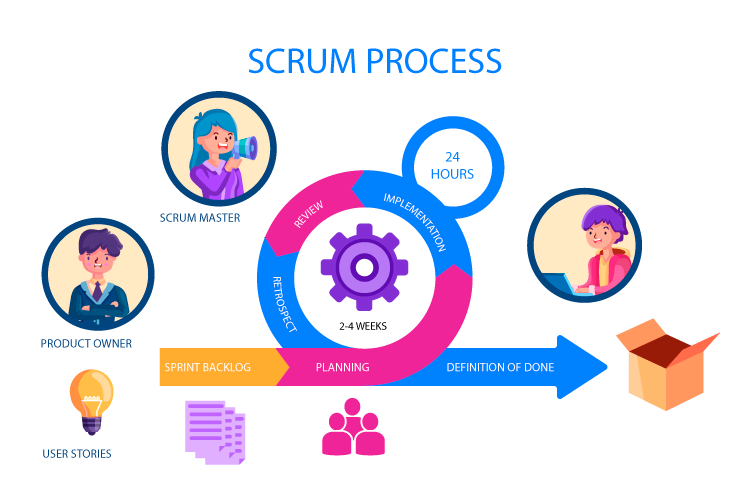
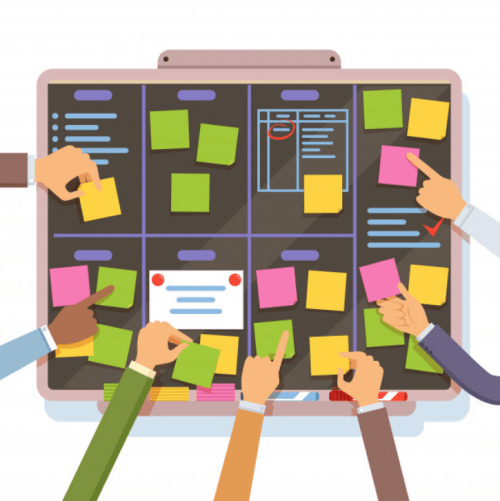
Scrum is probably the most popular agile methodology used by project teams that are implementing agile. It starts with feedback or input from end users or customers on what the need is and the business requirements. These are then captured, analysed and defined into clear features. They can also be in the form of ‘user stories’ that outline what the user goes through in the entire process. User stories are simple descriptions of a feature told from the perspective of the person who desires the capability. User stories are usually captured in post-it notes on a board (or digitally) to allow visualization of the journey/process.
The project team then goes through a series of ‘sprints’ where iterative work outputs are created under each sprint. Each sprint is aimed to produce a discrete piece of work output that is tangible and can be used or tested in some form. Each sprint goes for 1-4 weeks and is managed by the scrum master who’s role is to do anything that optimises the team’s performance. This is not a manager role who is tasked to ‘approve’ or ‘sign off’ on the work of the team, but more of an enabler and facilitator. In an agile team, the team is self-managed and empowered to come up with unique ideas to form the ultimate solution to address the user/customer needs.
So what is the role of the change manager in scrum? The role of a change manager does not really change significantly in an agile setting. Yes, the change manager needs to understand the why and how an agile team works. However, the fundamentals of the value of change management stay the same. If a project is creating change impacts on the user or the customer, then this is where the change manager steps in. This is not dissimilar to other non-agile project settings.
Let’s dissect the work of the change manager to better understand his/her role in a greater level of detail:
Initial scoping
When we have a high level of understanding of what the project is and what it is trying to accomplish, the change manager would help to scope and size the amount of change impact in concern, the level of complexity involved, and come up with a high level estimation of how much change management support would be needed on this project. This does not change in an agile project, compared to waterfall projects.
High-level change approach
After the features have been identified and the product owner has a clear idea of what the change is and what it involves then it is time to start on devising the high-level change approach. At this stage, we still do not know exactly what the solution is, though we have a few likely options to consider. Through taking a few assumptions we can devise a high-level view of what change approach would work. A key part of this approach would involve understanding which stakeholders will be impacted.
Agile projects are focused on producing output and solutions and there is significantly less focus on documentation. However, this is not to say that documentation is not required. Instead, documentation tends to be more summarised and slimmed down versus the significant longer documentation required under waterfall methodology. In this phase, the two key documents are the high-level change approach and high-level change impact assessment document. Some even use a ‘change on a page’ similar to a ‘plan on a page’. The high-level change impact assessment could also be a one-pager that calls out key stakeholder groups impacted and the nature of the impacts.
Design and planning phase
When we get to the design and planning phase of the project the key focus starts to shift into detailed articulation of what the change is. In this phase, the approach in change work is again no different than under waterfall. However, the difference is that there may be more unknowns as the solution is being developed and shaped iteratively and continues to evolve over each iteration or sprint.
The change manager needs to determine when there is sufficient information to start to work on the detailed change impact assessment. And this impact assessment will undoubtedly need to be reviewed and potentially updated as the solution changes. Other key deliverables such as stakeholder matrix, engagement and communication plan, change plan (including measurement) and risk assessment should also be captured, depending on the level of change complexity.
The role of the change manager is to partner closely with the team to flesh out and define what the change is and what the change approach is throughout each sprint. Some may call out that this may sound quite messy since with each iteration the change approach could change. In practice, a lot of the impacts and change approach are fleshed out and captured before or during the sprint planning. With each scrum and iteration, the solution becomes more and more defined, and only tweaking would be needed on the change approach.
Early and continuous engagement is a key agile principle and therefore the change manager has a critical role to play in engaging the various stakeholder groups. Depending on the nature of the change, business and stakeholder engagement may need to occur prior and during each iteration.
For example, business stakeholders may need to engaged on what the new system is, and how/what it will do for them, and how they will be impacted. Then, when we are closer to having developed a full solution with system screens being defined, we can show our frontline employees what the system looks like. Throughout the iteration process, subject matter experts and business representations, and even change champions groups have critical roles to play in providing valuable business feedback.
Another key agile principle is focused on getting end user or end customer feedback early, and continuously throughout the development process. The change manager needs to work with the business to carefully the right end users to provide feedback (versus managers who may not know the intimate details of business requirements). The change manager also needs to balance the needs to the business in being engaged on the what/why/how of the change early on, and incorporate more details of the solution throughout the iterative process.
Implementation and post-implementation
Since agile produces change at a faster pace than waterfall approaches, there are a few things that the change manager needs to adapt to. One of the key challenges for the change manager within an agile team is not to lose sight of the fundamentals of managing change. Within the series of iterations, keeping the business engaged and involved is key.
On top of this, understanding and agreeing with the business the most optimal go-live and implementation period would is critical. Just because the change is ready technically, it does not mean this is the right time for the business to accept the change. On the other hand, there could be complexity or technical challenges that delay the anticipated go-live (like most projects, in any methodology). This needs to be managed effectively and there needs to be clear identification of the next ‘window for change’ from the business perspective from the perspective of the business having the capacity to digest the change.
Some propose that the change manager should ‘adopt’ agile way of implementing ‘test and learn’ in implementing change. Whilst this is valid there are a few considerations. Implementing agile does not mean that how our employees respond to change will suddenly change.
From previous experiences in implementing changes, the change manager should leverage what has or has not worked and not start from zero. For example, how was the reception from a particular business unit to online learning of new products? What has worked well in terms of how this group was engaged previously? If there is little experience in change within a particular part of the organization, then it makes sense to conduct pilots to test. However, again, leverage from previous experiences where possible before starting ‘new’ tests.
Post implementation and benefit realisation are still applicable from the perspective of the change manager. Planning for effective embedment and measurement of change and that the benefits are realized through the users adopting the right behaviours are still valid under agile.
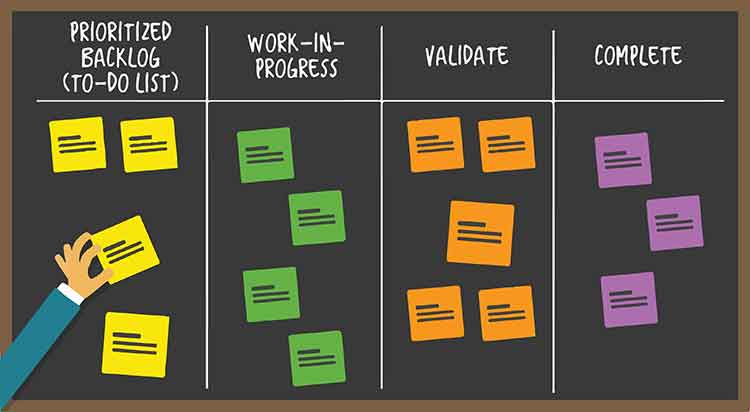
Kanban is a simple agile methodology that was developed from a manufacturing background (i.e. Toyota). It is not time-based, unlike Scrum. Instead, it is based on ordering a set of prioritised activities through the funnel of ‘To do’, ‘Doing’ through to ‘Done’. The list of activities is prioritised meaning that after one task is completed and moved to ‘Done’ the next activity on the list may be undertaken. This overall list of activities can be seen as a ‘backlog’ where a set of activities have been determined to be necessary to complete the project.
This kanban board needs to be real time and constantly updated so that the team members can easily visualize the progress they are making and how much work is outstanding. This is a great way of understanding the pace of execution and output achieved. The cycle time of measuring how long it takes tasks to move from ‘To Do’ to ‘Done’ helps to forecast the delivery of future work. The kanban board acts as the single source of truth for the agile team.
All of the previous comments regarding scrum and implications on the work of the change manager apply to kanban as well. The change manager, working along-side other agile team members, would also need to adapt to the faster pace of change, and work within the team to identify any obstacles to the overall workflow. Change management work activities would also contribute to the overall kanban board and flow through this process.
Building the change environment for agile
There are significant opportunities for the change manager to add value in creating the right change environment for agile initiatives to land successfully. Some of these include:
Helping business leaders, including sponsors and business owners to understand their role in leading change within an agile setting
Support the design and dynamics of the agile team to really flourish, to generate innovative ideas and to leverage diversity of thought
Work with business stakeholders to prepare them for iterative agile changes where the end state is not always clear from the beginning. The challenge of crafting a clear vision of change without the necessary details
Helping to build the overall culture of the organization in adopting agile principles, itself a separate cultural change exercise. For organisations that are risk-averse the challenge may be to instill the value of ‘safe to fail’
The ultimate dilemma for the change manager
One of the ultimate challenges of preparing the organization for an agile environment is to understand the environment itself. When there are numerous agile projects going on in organisations, each with continuous iterative change, there lies the challenge. How does the business get visibility of all of these chunk-sized changes and be able to prepare for them collectively? Without a clear oversight of a collection of changes that are constantly moving it is almost impossible to effectively lead and embed changes effectively.
The solution is to adopt agile principles in preparing the organization for multiple agile changes. Think – visualization, measurement, reporting, collaboration, flow, and continuous delivery. The change manager needs to support the view of change by working with agile teams to make visible the changes being planned for at any given time. One set of changes from one project may seem simple enough to articulate. With multiple projects, this starts to become complex and difficult to make clear to business stakeholders. Without clarity and understanding, it is hard to be ready for change.
With the right data on what is changing, when, to what parts of the organization, the change manager or business leader can better plan for change. This insight can be utilised to better empower the business to understand their own change capability at a given point in time. On the other hand, this also helps the agile project teams to better understand what other changes are being released into the business. This collaborative sharing of information helps with planning across projects. For example, if a project is going to be delayed in its release, a clear visualization of the change slate within the business can help with identifying other time slots where the runway is clearer for the business to better digest the change.
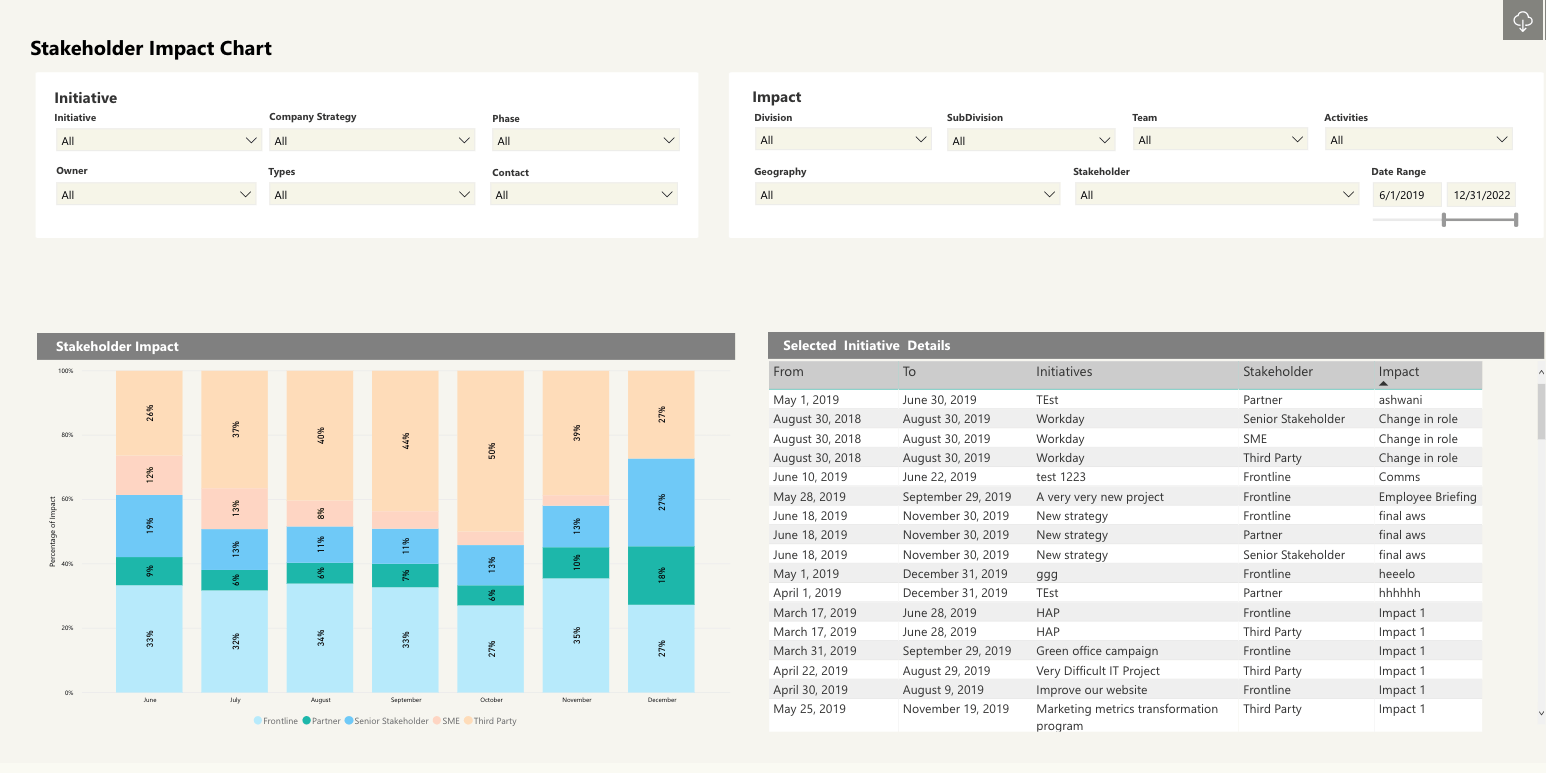
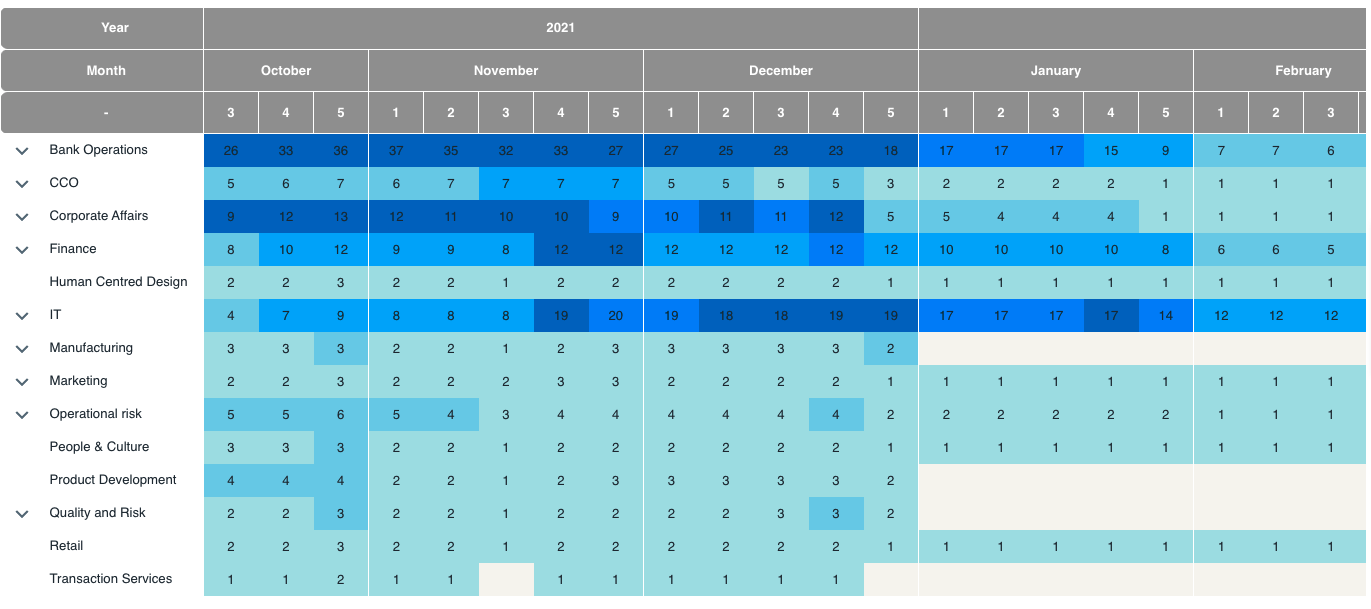
Examples of visualization of change impact data from The Change Compass:
In the new and exciting world of agile there are those who trumpet the end of change management as change roles are not specifically called out in agile methodologies. However, it is quite the contrary as outlined in this guide. The challenge for the change manager is not only to understand agile and find his/her place in this approach but also to add additional value by helping the organization to deal with all the various impacts of agile. These include cultural, leadership, ways of working, roles and responsibilities, process and operational planning perspectives. This could be lead to the next phase of development for change management.
If you like this post please share it with your contacts 🙂
AI and Agile Change Management
The intersection of artificial intelligence and agile change management is one of the fastest-evolving areas of practice. Where traditional agile change management focused on shorter sprint cycles and faster feedback loops, AI-enabled change management adds a new dimension: the ability to detect adoption signals, predict resistance patterns, and surface capacity risks in near real time.
In practice, this means change teams using digital platforms can run shorter feedback cycles not just in theory but with data. Rather than waiting for a 30-day survey to understand how a sprint has landed, AI-assisted tools can analyse system usage patterns, support ticket trends, and sentiment data to provide adoption signals within days of a change going live. This compresses the PDCA (Plan-Do-Check-Act) cycle that lies at the heart of agile practice.
For change managers, the practical implication is that the agile principle of inspecting and adapting is becoming much more evidence-based. The teams that will benefit most from this shift are those that have already built the measurement habits that make feedback loops meaningful – which is precisely why combining agile practice with a structured adoption measurement approach is increasingly the gold standard for change delivery.
Frequently Asked Questions
What is agile change management?
Agile change management applies agile principles – iterative delivery, rapid feedback cycles, and continuous adaptation – to the practice of managing organisational change. Rather than building a complete change plan upfront and executing it linearly, agile change management works in sprints, checking adoption signals regularly and adjusting the approach based on what the data shows. It is particularly well-suited to technology implementations, transformation programmes, and any change where the design is likely to evolve during delivery.
How is agile change management different from traditional change management?
Traditional change management follows a sequential process: assess, plan, design, deliver, measure. Agile change management replaces this with iterative cycles, where each sprint includes a mini version of planning, delivery, feedback, and adaptation. The key practical difference is speed of learning: agile teams discover adoption problems earlier, when they are still cheap to fix, rather than at 90-day post-go-live reviews when reversion has already set in.
Can ADKAR be used with agile change management?
Yes, and the combination is increasingly common. Prosci’s ADKAR model provides a framework for diagnosing where individuals are in their adoption journey. This individual-level diagnostic integrates naturally with agile sprint retrospectives: teams can track ADKAR progress per cohort sprint by sprint, using data rather than intuition to decide where to focus reinforcement in the next cycle.
Which agile methodology works best for change management – Scrum or Kanban?
It depends on the nature of the change. Scrum suits time-boxed transformations with clear phases and defined go-live milestones – the sprint structure maps well to readiness phases. Kanban is better for ongoing change activity, such as a continuous improvement programme or a change CoE managing a steady flow of smaller initiatives. Many change teams use a hybrid: Scrum structure for programme-level planning, Kanban for day-to-day change activity management.
Tell me about the state of play at IAG and your role in addressing this.
IAG was at the forefront of rolling out large transformational change programs over a relatively short space of time. For our leaders, the impact on our people and customers was very clear.
Within this environment, there was a genuine need to understand the accumulative effects of change, audience impacts, and timings. This information would enable leaders to prepare for and effectively deliver and embed change.
We began investigating platforms to efficiently capture change impact data that was easy to use and relatively inexpensive, with automated reporting. The Change Compass met these requirements.
How did you introduce this to the organisation?
In the context of the change environment at IAG, we wanted to capture a true reflection of the volume and complexity of change impacting each business area to enable meaningful dialogue with leaders about how to effectively deliver and lead through the change.
By appointing heatmap coordinators within each business unit, we drove accountability for input and maintenance within business units. This underpinned the notion that each team was responsible for leading their change while maintaining the quality of the data.
This enabled teams to present a holistic change view to key leadership groups within governance forums.
What has been your journey so far?
We’ve been using the Change Compass for over a year and we’re constantly evolving how we use and manage the tool to drive decisions and actionable insights.
We’ve worked hard over the last year to demonstrate the value to the business when it may have easily been perceived as adding more work to reporting cycles.
With data now enabling leaders to show a heatmap for both employees and customers; leverage insights; and drive governance conversations between Business Performance, HR, Communications, Change and Program Delivery teams we are building great momentum.
These conversations help guide decision making and build a network of key teams who are clear on how this work contributes to IAG strategy while driving change management, engagement, communications, and initiative sequencing.
What value have you seen so far?
While we are still at the front-end of how to utilise the Change Compass fully, we’re starting to see benefits.
There are many conversations focused on how we can keep the data current and relevant. This enables Business Units to start using the information to improve how they are delivering change, not just at the initiative level but at a wider business portfolio level.
The Compass is starting to form a useful proxy to bring together professional disciplines in governance conversations and decisions.
One of the emerging themes across IAG is the need for us to be much more effective at how we deliver change into the business in a way that recognises the capacity of the people to accept change – the Change Compass helps guide this thinking.
What’s next?
Having established the rhythms and routines, we are now focused on how governance sessions and key groups leverage data and insights beyond the heatmap.
We want to enable leaders to use the Change Compass to help inform how they lead their team through change – by using the data to implement specific mitigations and ultimately deliver more effective and sustainable change.
Most seasoned executives will agree that implementing a strategy can be a lot more complex and challenging than the formulation of the strategy. If you read articles on strategy implementation you will find a myriad of factors to keep focused on including resourcing, prioritisation, tracking, program management, etc.
However, the one discipline that is under-leveraged in strategy execution is change management. You may ask why? A lot of change managers are hired to focus on one specific projects, whether it be rolling out a new system or introducing a new product. Many understand the skill set of change managers as focusing on developing communication and training plans.
When we look deeper into what is needed to successfully implement a strategy and the work approach of a change manager, you will see that there is significant synergy. Change management is also concerned with planning and managing not just one but a multiple of changes. In fact, best practice companies use a portfolio approach to manage a suite of changes.
Here are some of the ways in which change management naturally complements strategy implementation:
Change vision
One of the most critical parts of implementing a strategy is how we bring stakeholders along the journey. Typically, senior managers will ‘dream up’ the strategy in a closed room, and then try to roll this out to the rest of the organization. Alternatively, a consulting firm may be hired to design a strategy that may stay on the shelf and never becomes implemented.
The change manager’s approach is to design the strategy formulation process by bringing concerned stakeholder groups together to build consensus and buy-in. The classic change commitment curve shows that the more you involve someone throughout the process, the more they will develop a sense of ownership and feel that it is in their interest to make the change successful.
A typical change management approach would also encompass clarifying the ‘what’ and the ‘why’ of the strategy in a way that makes sense to the audience. Is the end state clear? What is the role of each stakeholder in making this a success? How do we position the end state so that it arouses the ‘head’ as well as the ‘heart’ so that people can connect to it? Connecting to people emotionally is key to engagement.
Understanding the impacts of the change
A strategy usually involves a set of initiatives or changes that the business would like to focus on to achieve their goals. A lot of organizations jump straight into planning and implementing the various initiatives before understanding what the total impact is on the various parts of the business, and the impacts on the customer.
Having an integrated view of what the impacts will mean to each part of the organization is key. This integrated picture can be leveraged to provide a clear, cohesive and integrated set of messages and expectations to that part of the organization that will guide their change process. And depending on the change, what the Marketing department will focus on may be completely different compared to the Human Resource department. Having an integrated picture means that we are able to help employee join the dots around what the strategy and the various initiatives mean to them, versus just a set of independent projects. In this way, creating meaning for the overall change helps with engagement.
The change manager’s approach would be to focus on mapping on the various impacts on stakeholder groups, including the customer. The impacts would consist of people and organization impacts, process impacts, and technology impacts. In this way, we are able to understand and architect what changes we are making across the board before we begin the journey. This will also ensure effective sequencing, prioritization and alignment before jumping into initiative delivery.
Capabilities required to support the strategy
A typical change approach would involve looking at the capabilities required to support the strategy. A big part of change management work is analysing the requirements of implementing the change (in this case a set of initiatives to support the strategy), and formulating key capabilities required. Capabilities may be developed using a range of approaches, including hiring functional specialists, conducting learning sessions, or coaching. The Change Manager will formulate learning needs analysis, and then formulate appropriate learning interventions. For significant capability development programs, competencies frameworks may need to be set up.
Capabilities may need to be acquired rather than developed. In this case the change manager would look at how to ensure that the talent acquired can fit in smoothly in the current culture of the organization. Team development sessions may need to be conducted. This includes whether the capability is acquired through acquisition, or key talents were hired into the organization.
Engagement and communication
Ineffective engagement and communication can make or break a strategy. A significant portion of strategy implementation needs to be spent on engagement with every layer of the stakeholder impacted. Change impacts conducted will help to inform what kind of engagement is required with what stakeholder group. This includes the severity of the impact, the duration of the impact, why the stakeholders may be concerned, and how critical they are to the success of the strategy, etc.
The change manager will then design the right governance processes to ensure that key stakeholders are in the loop and embedded within the decision-making process. In addition to this, the change manager will craft a communications plan to target various stakeholder groups, with targeted messages, and using a mix of communication channels to get the message across. An effective communication approach would also include designing the right feedback mechanisms to ensure employee feedback is proactively incorporated.
Measurement
A key success criterion for implementing a strategy is measuring the progress of implementation to understand where the organization is at. It is common for change managers to devise change readiness assessments to measure and test where each part of the business is at. These assessments are conducted throughout the implementation period to understand any changes in readiness and track overall progress. The assessment can in the form of interviews, surveys or ratings by selected stakeholders. Other measurements include training attendance, competency attainment, and communication effectiveness of various channels utilised.
The most important part of charting the implementation of the strategy is measuring the impact of the change. Best practice calls for detailed capturing of change impacts on each part of the organization in a visual way to aid understanding. This includes heatmaps and reports on what the implementation roadmap will mean to the business. The change impact based heatmaps are critical to allow effective planning to balance the need to drive the strategy forward, and balance the business-as-usual activities so that the business is still able to perform.
Effective reporting should call out resourcing impacts, whether there is too much going on from a rollout perspective, potential re-sequencing opportunities, and the overall pace of change within the implementation roadmap. The data should enable effective conversations in terms of how effective the planned roadmap is in reaching strategy objectives and whether the right pace and velocity of change are being planned.
Change leadership
Last but not least driving an effective strategy requires effective leadership skills. The work of the change manager involves assessing existing leadership qualities, including understanding any gaps and challenges. These may be addressed by capability programs.
The change manager also normally takes in working with the sponsor of the change, in this case it could be a member of the c-suite on his or her change leadership skills. Some examples of effective skills include the ability to articulate the end state in a way that the audience can relate to and be enthusiastic about, ability t listen and empathise with employee groups, ability to identify and resolve any change obstacles, the ability sense check and pivot as needed (agility), and the ability to delegate and hold others accountable for achieving prescribed targets.
– Analyse change impacts to the whole system: people, process, technology.
– Map out the impacts of current and planned strategies to better sequence and plan the change
– Look at the capabilities required in the business
– Engagement and communications, involving key players in developing the strategy
– Measurement – business readiness and indicator tracking
– Change leadership is driving traction and behaviour change
– A strategy contains a set of initiatives – the key is to formulate a picture of what will be changing and be able to sequence and prioritise things to design the roadmap effectively
———————–
If you like this article please share this with your network.
A lot of organizations think of change management as something that can be outsourced to change managers or project managers. In this view, a piece of change can be managed as a project so that the rest of the business can focus on its business-as-usual activities.
What a lot of organizations do not realize is that managing change is an ethical obligation. How a company manages change can fundamentally impact its human rights record and its adherence to ethical practice standards. This includes the impact of its decisions or the way it engages with its employees, partners, suppliers, and customers.
This is especially important for a lot of financial services firms that have been under close scrutiny by regulators for ethical business conduct. In Australia, the banking royal commission has been focused closely on the ethical practices of banks and insurers. The Australian Securities and Investments Commission (ASIC) which is the law enforcement body, has been investigating unethical practices of various financial services organizations. This commission has unleashed a deluge of fresh complaints and admissions about misconduct in the finance sector. Most of these are centered around impacts on customers.
Ethics and change
Let’s explore more about ethical practices during change. Let’s take one example – Ethical practices during re-structuring. A typical process goes like this. The senior managers meet to discuss and come up with the organizational structure changes required. Sometimes, a few of the middle managers may provide some input into this process. However, overall the process is kept secret to ensure that none of the details are disclosed to employees. The Human Resources function will be involved throughout the process.
Eventually, when all the details are finished and finalized, the organization would typically conduct a town hall, a call, or a meeting to go through these changes with employees. A short 2-3 week period will usually be given as a ‘consultation period’ to obtain employee feedback. However, in most cases, these changes are already a done deal irrespective of employee feedback.
In this very common case facing nearly all organizations, the employee as a stakeholder group is designed to be disadvantaged in that it lacks the power of information and it lacks the power over the ability to actually participate in decision making. It is also no surprise that most employees in this situation will experience stress and anxiety. Some will even choose to leave. Others may have their roles made redundant.
Yes – in this scenario, the organization needs to take into account a broad range of considerations including what is good for the shareholders of the company, what is good for the business, and what is good for customers. However, organizations often overlook the fact that both employees and customers are stakeholder groups that need to be consulted when there is a significant change being planned.
Involving these stakeholder groups makes sense from a change management perspective because this engagement enhances buy-in and ownership in terms of what is changing. It also makes sense in terms of the organization’s ethical obligation to involve stakeholder groups so that the process does not negatively disadvantage them.
This does not mean giving away the decision-making accountability. However, it does mean a more inclusive decision-making process that is collaborative and achieves better engagement and understanding, and therefore a more ethical approach.
Organizational standards
Many organizations have called out ethical principles in leading change. In a document titled “Achieving structural change” 2007 the Queensland state government of Australia defined social inclusion as an approach that is inclusive so that people do not feel ‘shut out’. Social inclusion is “people wanting to participate as valued, appreciated equals in the social, economic, political and cultural life of the community”.
The Coca-cola European Headquarters very recently published a ‘Human Rights Restructuring Guidelines’ in June 2018. Under ‘Structural changes and mitigation of adverse effects on employees’ some of the points include:
“As early as possible, initiate a process of identifying the potential impact of business restructuring activity on employees, including human rights impacts”
“In general, we should be committed to using available means, as appropriate, to ensure meaningful cooperation with employees …..in order to mitigate adverse effects of restructuring decisions on employees”
So far we have been using the example of organizational restructuring. However, the same ethical principle of social inclusion and engagement also applies to other changes that may have less quantum of impact. Change initiatives include anything from implementing a new technology system, changing a process, introducing a new product, changing a customer policy, or a new marketing campaign.
We need to apply the same ethical principle to any of these changes. Change Managers will already call out that these are basic change principles they already use. For many organizations, this may be a wake-up call that identifying the change impacts and engaging with those impacted is not a nice to have, but an ethical obligation for any ethical organization.
Multiple changes
Most organizations are not experiencing just one change initiative, but a series of changes that overlap one another. The obligation and challenge for larger organizations are how to assess the change impacts on employees and customers across the board, versus initiative by initiative. From this view and understanding of the collective impacts, the organization can then form a better plan on how to effectively engage, involve, and inform the impacted employee and customer groups. Using an online tool to form a visual of the impacts of multiple changes on these stakeholder groups is a great way to use data to plan effectively. The Change Compass is one example.
To conclude, organizations need to think hard about their ethical practices, not just those impacts on the customers but also on employees. When we think of human rights and social inclusion we usually think of disadvantaged groups such as minorities. However, the principles are just as applicable in a change context. How do we ensure that organizations are accountable for their ethical practices toward employees? Many forward-thinking organizations are already starting to take note and have committed to formal standards and practices to adhere to.
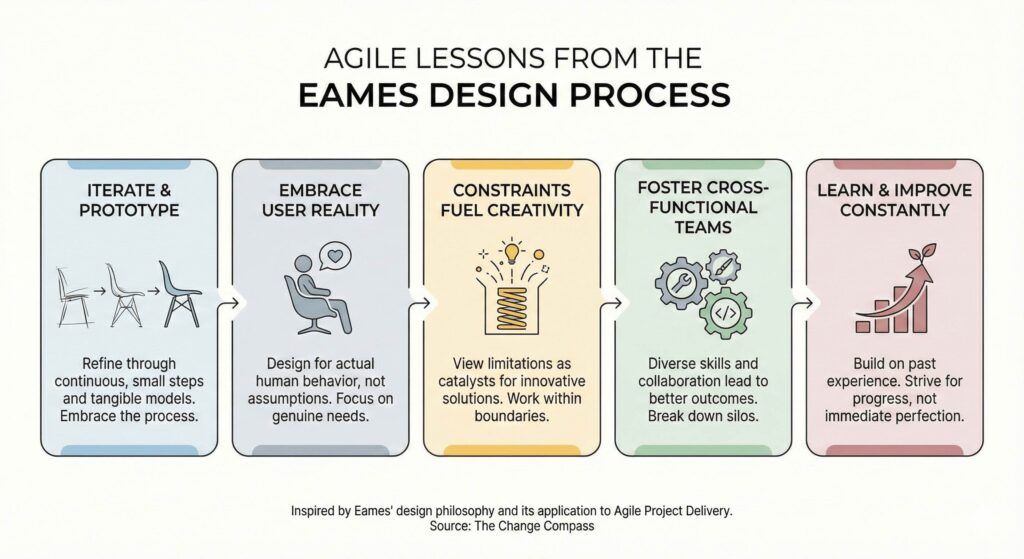
Ray and Charles Eames, legendary mid-century designers, developed creative processes remarkably aligned with modern agile methodologies. Their approach emphasised iteration, resource respect, and systems thinking, offering valuable lessons for today’s project teams facing complex delivery challenges.
This guide explores five key Eames principles and their direct application to agile project delivery. Change practitioners and project leaders gain practical insights to enhance iteration, stakeholder engagement, and systemic success.
What Agile Principles Did Eames Champion?
The Eames duo’s design philosophy prefigured agile concepts by decades. Their methods focused on practical experimentation, collective wisdom, and holistic systems. These are core tenets of contemporary agile delivery.
These principles translate directly to project environments, improving outcomes across technology rollouts, process changes, and organisational transformations.
1. Not Reinventing the Wheel: Leverage Collective Experience
Eames avoided starting from scratch, instead building on proven materials and techniques. Agile teams benefit similarly by tapping organisational knowledge rather than isolated innovation.
Practical Applications in Agile Delivery
Previous rollout lessons: Review past implementations of similar products or services to anticipate adoption challenges and success factors.
Stakeholder group insights: Consult colleagues experienced with specific audience dynamics and communication preferences.
Solution design patterns: Adapt approaches proven effective in prior technical or process solutions.
Timeline strategies: Apply scheduling techniques refined through previous deadline pressures.
Learning intervention successes: Reuse effective training content, delivery methods, and evaluation frameworks.
This principle prevents redundant effort while accelerating delivery through proven foundations.
2. Continuous Testing and Learning: Iterative Refinement
The Eames process featured constant prototyping and feedback, mirroring agile’s iterative cycles. Every team member, not just designers, contributes to this learning loop.
Change Management Testing Examples
Message validation: A/B test communications with target audiences to measure resonance and engagement.
Learning content trials: Pilot training modules with sample groups, gathering feedback on structure, clarity, and delivery medium.
Impact assessment accuracy: Validate change impact analysis directly with end users rather than proxies alone.
3. Respecting the Materials at Hand: Understand Your Resources
Eames emphasised the importance of recognising the capabilities and limitations of available resources. In agile project delivery, this means deeply understanding people, systems, processes, and stakeholder capacities.
Applying Resource Respect in Agile Projects
Assess team skills and system maturity before designing interventions.
Adapt project plans based on stakeholder readiness and local constraints.
Support change leads in gauging the ability levels of different groups to absorb new processes.
Tailor communication and training to maximise relevance and effectiveness given resource realities.
This approach builds realistic, sustainable change strategies aligned with organisational strengths and challenges.
4. Generating New Perspectives and Ideas Through Play and Fun
The Eames valued play as a creative catalyst, fostering new ideas and fresh perspectives. Agile teams benefit from incorporating elements of play, fun, and experimentation into their work.
Practical Ways to Embed Play in Agile Delivery
Run hackathons or innovation sprints encouraging out-of-the-box thinking.
Design team-building activities that mix fun with purposeful reflection on project goals.
Use gamification techniques to increase engagement in learning and adoption tasks.
Foster a psychologically safe environment where experimentation and mistakes are accepted as learning opportunities.
Play enhances creativity, collaboration, and morale, supporting higher-quality outcomes.
5. Eventually Everything Connects: Embrace Systems Thinking
The Eames stressed seeing the broader picture and understanding how various elements interlink to form a larger system. This mindset is vital in agile delivery, where dependencies and impacts extend beyond single teams or projects.
Systems Thinking in Agile Projects
Map connections among processes, systems, communications, training, and branding to ensure cohesive delivery.
Identify how multiple change initiatives intersect and impact shared stakeholders or resources.
Help stakeholders understand how different initiatives support broader organisational strategies.
Use system maps and visualisations to support planning, risk assessment, and communication.
This holistic awareness prevents siloed work and promotes integrated, effective change.
Implementation Roadmap for Eames-Inspired Agile Delivery
Applying These Principles in Modern Projects
Quick-Start Actions for Teams
Conduct knowledge audits to capture previous rollout experiences across the organisation.
Schedule regular testing cycles for communications, training, and impact assessments.
Map resource capabilities and limitations during project kickoff planning.
Plan quarterly innovation sessions incorporating play and experimentation elements.
Create visual system maps showing project interconnections and dependencies.
Building Organisational Support
Train change leads in resource assessment and systems thinking techniques.
Establish cross-project knowledge sharing forums.
Integrate Eames principles into agile training and certification programs.
Use success stories to demonstrate ROI from iterative testing and collective learning.
These steps embed timeless design wisdom into contemporary delivery practices.
Cultural Considerations for Success
Overcoming Common Barriers
Success requires psychological safety for experimentation and leadership support for non-traditional approaches. Traditional organisations may resist play-based innovation, requiring champions to demonstrate tangible benefits first.
Scaling Across Teams
Start with pilot projects showcasing measurable improvements in delivery speed, stakeholder satisfaction, and adoption rates. Use these case studies to expand practice organisation-wide.
Measuring Impact
Track metrics like iteration cycle time reduction, stakeholder engagement scores, knowledge reuse rates, and cross-project collaboration frequency to validate principle effectiveness.
Frequently Asked Questions (FAQ)
What makes Eames principles relevant to modern agile delivery? Their focus on iteration, collective wisdom, resource respect, creativity through play, and systems thinking directly addresses contemporary project complexity and delivery challenges.
How do you implement continuous testing in change management? Use A/B testing for messages, pilot training modules with user groups, and validate impact assessments directly with end users to refine approaches iteratively.
Why is systems thinking essential in agile projects? Modern initiatives rarely operate in isolation. Understanding interconnections prevents siloed work and ensures cohesive delivery across multiple changes.
How can teams incorporate play into serious projects? Run hackathons, gamify learning tasks, and design team activities blending fun with purposeful project reflection to boost creativity and morale.
What is the first step in applying ‘not reinventing the wheel’? Conduct knowledge audits capturing previous rollout lessons, stakeholder insights, and proven solution patterns across the organisation.
We use cookies to improve your experience and understand site use. Marketing cookies stay off until you accept, and in the EU, UK and Switzerland analytics does too. Cookie Policy.
Strictly necessary
Required for the site to work: security, load balancing, and remembering your choices. These cannot be switched off.
Always active
Analytics
Google Analytics and similar, so we can see which pages are useful and where visitors get stuck. Aggregated, never sold.
Marketing
Used to measure campaigns and show relevant content on other platforms such as LinkedIn.