Managing a portfolio of organisational change is a fundamentally different challenge from managing any individual change programme. A single programme can be governed with a clear scope, a dedicated team, a defined methodology, and a project plan that tracks progress from initiation to close. A change portfolio cannot. It is dynamic, multi-authored, unevenly resourced, and perpetually incomplete – with new programmes entering as others are closing, competing for the attention of the same people, and landing on the same employee groups in ways that no single programme team can see.
Most organisations have developed reasonably mature capability for managing individual change programmes. The same organisations frequently have almost no systematic capability for managing the aggregate. They know which programmes are in flight. They rarely know what those programmes add up to for specific teams, what the cumulative demand is on the employees absorbing multiple simultaneous changes, or whether the sequencing of their portfolio is coherent in any meaningful sense. This gap between programme management maturity and portfolio management maturity is one of the most consequential and underaddressed issues in organisational change.
A change portfolio is the complete set of change programmes and initiatives an organisation is running at any given time, viewed as an aggregate whole rather than as a collection of independent workstreams. It encompasses technology implementations, structural reorganisations, process redesigns, cultural transformation programmes, regulatory compliance initiatives, and any other structured effort to shift how the organisation operates. In a large enterprise, this portfolio is typically substantial – often dozens of concurrent programmes of varying scale, all competing for the finite adaptive capacity of the workforce.
The portfolio perspective is important because it reveals dimensions of the change landscape that are invisible at the programme level. Individual programmes see their own impacts on specific teams and roles. They do not see – and cannot see – the cumulative impact of all programmes on those same teams and roles. The team that is simultaneously implementing a new ERP system, absorbing a structural reorganisation, and preparing for a new regulatory compliance regime is experiencing a very different change reality from what any single programme’s readiness assessment will capture. The portfolio view makes this cumulative reality visible.
What distinguishes effective portfolio management from a simple aggregation of programme management is the introduction of cross-programme decision-making: the ability to sequence, prioritise, defer, or descope programmes based on their combined impact on the organisation’s people, rather than evaluating each programme solely on its individual business case and delivery timeline.
The most common failures in change portfolio management
Organisations that struggle with change portfolio management typically exhibit a recognisable set of failure patterns. Understanding these patterns is the starting point for building more effective capability.
The first and most pervasive failure is the absence of a shared portfolio view. Programme teams work in silos, each with visibility into their own change and limited awareness of what else is happening to the same employee groups. This creates a situation where each programme independently assesses its change impact and independently plans its stakeholder engagement, without anyone aggregating those assessments to see what the combined picture looks like. The result is predictable: employees experience a collision of simultaneous changes that no one designed and no one can see coming.
The second failure is impact assessment inconsistency. When different programmes use different methodologies and taxonomies to assess their change impacts, the resulting data cannot be aggregated. A heatmap that shows which teams are affected by which programmes tells you something useful. But if the underlying impact ratings are based on incompatible definitions across programmes, the aggregate picture is misleading – teams with genuinely high impact loads may appear comparable to those with moderate loads because the ratings were calibrated differently. Consistent, shared impact taxonomies are a prerequisite for meaningful portfolio-level analysis.
The third failure is the absence of portfolio governance with real authority. Many organisations have change governance committees that review individual programmes for compliance with methodology and that receive programme status reports. Far fewer have governance structures that make portfolio-level decisions: adjusting programme sequencing based on employee capacity data, deferring a programme because another programme has depleted the adaptive capacity of the same workforce, or descoping a programme to protect the stabilisation time that a recently completed change requires. Without authority to make these cross-programme decisions, portfolio governance is administrative rather than strategic.
Prosci’s longitudinal research on change management best practices identifies portfolio-level change governance as one of the clearest differentiators between high-maturity change organisations and those at the lower end of the maturity spectrum. The presence of a cross-portfolio view, consistently applied methodology, and governance authority that extends beyond individual programmes is a hallmark of the organisations that consistently deliver better change adoption outcomes.
Building a structured portfolio view
The foundation of effective change portfolio management is a reliable, structured view of what the portfolio contains and what it is doing to the people who have to absorb it. This requires three things: a complete inventory of change programmes, structured impact data from each programme, and an aggregation mechanism that combines that data into a cross-portfolio picture organised by employee group and time period.
The complete inventory sounds straightforward but is frequently elusive in large organisations. Change programmes are initiated through multiple channels – business unit initiatives, central project offices, IT delivery teams, HR and OD functions – and there is often no single register that captures them all. Building this complete picture requires deliberate effort across organisational boundaries and a sponsorship level high enough to compel participation from all parts of the organisation. An incomplete portfolio inventory produces a misleading view – one that makes the total change load appear more manageable than it actually is.
Structured impact data is the second requirement. For portfolio aggregation to be meaningful, each programme needs to assess its impacts using a consistent taxonomy that allows comparison across programmes. This means agreeing, at the portfolio level, on how impact types are defined and rated – what counts as a high-intensity versus moderate-intensity impact, what dimensions of change (process, technology, structure, capability, behaviour) are captured, and which employee groups are the unit of analysis. Without this consistency, the aggregated data is an average of apples and oranges.
The aggregation mechanism is the third requirement, and it is where technology plays a critical enabling role. Aggregating impact data across a portfolio of a dozen or more concurrent programmes is not a spreadsheet task that human analysts can maintain reliably alongside their programme responsibilities. It requires a shared data infrastructure that each programme populates and that produces the portfolio view automatically as the underlying programme data is updated.
Sequencing and prioritisation in the change portfolio
Once the portfolio view is established, the most consequential management decisions concern sequencing: in what order, and at what pace, should changes be delivered to specific employee groups? Sequencing decisions that ignore the portfolio view produce collision patterns – multiple significant changes landing on the same teams simultaneously – that are entirely preventable with better information. Sequencing decisions informed by portfolio data can protect stabilisation time between major changes, distribute the change load more evenly across the year, and target high-intensity periods of change at teams with the greatest remaining adaptive capacity.
Prioritisation within the portfolio is a related but distinct decision. When the total change load on a specific employee group exceeds what can be managed sustainably, something has to give. Prioritisation means making explicit choices about which changes proceed on their current timeline and which are deferred – and it requires a governance authority that can make those choices based on the portfolio data rather than allowing each programme sponsor to advocate for their own programme’s priority independently.
McKinsey’s research on organisational transformations consistently finds that sequencing and prioritisation failures – specifically, attempting to run too many significant changes simultaneously – are among the most common causes of transformation underperformance. The programmes that fail in these portfolios are rarely poorly designed. They fail because the organisation’s adaptive capacity was already depleted by the time they arrived, and even a well-supported change cannot overcome the fatigue and cynicism that accumulate when the pace of change has been unsustainable for an extended period.
Change capacity as a portfolio management discipline
Effective change portfolio management treats employee adaptive capacity as a finite and measurable resource – one that needs to be managed as deliberately as financial resources or technology infrastructure. This means establishing baselines for what constitutes sustainable change load for different employee groups, monitoring actual change load against those baselines in real time, and building the governance mechanisms to act when specific groups approach or exceed their capacity thresholds.
Adaptive capacity is not uniform across the organisation. Teams that have recently absorbed major changes are typically operating with depleted capacity, regardless of whether the previous changes have technically been completed. Teams in high-pressure operational roles – where the daily baseline workload is itself demanding – have less spare capacity to absorb transformation activity. Teams undergoing significant structural change simultaneously with major technology or process changes face a compounding challenge that requires specific attention and support.
Gartner research on change fatigue identified a clear relationship between the number of concurrent changes affecting an employee group and their willingness to engage effectively with any individual change. When the cumulative change demand exceeds a critical threshold – which varies by context but is reliably real – employees shift from active engagement to passive compliance or active resistance, and even the best change management support cannot compensate for the capacity deficit.
Using data to manage the portfolio
The transition from intuitive to data-informed change portfolio management is one of the most significant capability improvements available to large organisations. The data required is not exotic – it is the structured impact data that each programme should be collecting for its own change management purposes, aggregated across the portfolio and connected to workforce demographic data that allows the analysis to be sliced by business unit, role type, geography, or whatever dimensions are most decision-relevant.
With this data in place, portfolio managers can answer questions that are currently unanswerable in most organisations: which employee groups are experiencing the highest current change load? Which parts of the organisation have the most capacity to absorb a new change initiative? What would happen to the cumulative load on specific teams if the proposed start date for a particular programme were deferred by two quarters? What are the adoption trend lines across recently completed changes, and do they indicate that specific teams have stabilised sufficiently to absorb the next wave?
Platforms like The Change Compass are designed specifically to make this kind of data-informed portfolio management operationally viable. By providing a shared platform where all programme teams capture their structured impact data and where that data is automatically aggregated into portfolio views by employee group, business unit, and time period, the platform eliminates the manual aggregation burden that makes portfolio-level change management impractical in most organisations. The result is portfolio managers who can see the full picture and make evidence-informed decisions about sequencing, capacity allocation, and programme prioritisation in real time.
Frequently asked questions
What is a change portfolio and how is it different from a project portfolio?
A change portfolio is the complete set of change programmes and initiatives an organisation is running at a given time, viewed in terms of their combined human impact on the workforce rather than solely their delivery timelines and costs. A project portfolio focuses on the delivery of outputs – on time, on budget, within scope. A change portfolio focuses on the absorption capacity of the people who have to adopt those outputs. Both views are necessary, but most organisations invest heavily in project portfolio management and very little in change portfolio management, which is why they frequently deliver projects successfully while failing to achieve the behaviour change and adoption that determines actual business value.
What data do you need to manage a change portfolio effectively?
Effective change portfolio management requires three types of data: a complete inventory of all change programmes currently in flight or planned, structured impact data from each programme that captures the nature, timing, and intensity of impacts on specific employee groups, and an aggregation mechanism that combines programme-level impact data into a cross-portfolio view organised by team or role group. Without consistent impact taxonomy across programmes, the aggregated data is unreliable. Without an aggregation mechanism, the portfolio view requires unsustainable manual effort to maintain.
How should change portfolio governance work?
Effective change portfolio governance requires a body with authority that extends across individual programmes – the authority to adjust sequencing, defer programmes, and reallocate change support resources based on portfolio-level data rather than programme-by-programme advocacy. This governance body needs access to current portfolio-level change load data by employee group, and it needs to meet with a cadence aligned to the decision windows that matter: typically quarterly for strategic portfolio decisions and more frequently for operational sequencing and resourcing decisions. Governance that can only review individual programmes without adjusting the portfolio as a whole is administrative, not strategic.
How do you know when the change portfolio is overloaded?
The clearest indicators of an overloaded change portfolio are declining adoption rates for new changes even where design and support are strong, regression in previously completed changes as employees struggle to sustain new behaviours alongside additional change demands, rising attrition among the groups carrying the heaviest change load, and anecdotal fatigue and cynicism that managers report from their teams. Leading indicators – visible before these outcomes materialise – include cumulative change load data showing specific groups at or above their capacity threshold, and pulse survey data showing declining readiness despite adequate training completion. Organisations with portfolio-level measurement infrastructure can detect overload before it becomes a crisis.
A typical scenario for a lot of program meetings goes something like this. The program spends the bulk of the time discussing program cost, delivery progress, technical risks and resourcing challenges. And when it comes to Change Management reporting, we are often left with a few anecdotes from stakeholder interviews, and often the only real quantitative reporting comes in the forms of training completion, readiness surveys, and email communications hit rates.
One wonders why Change Management is often glossed over as fluffy and soft vs. strategic and quantitative. Even for those who intuitively believe that managing change ought to be important, most lack quantitative data that demonstrate clearly how change progress directly impacts business outcomes.
How does a business manager, program or a change practitioner demonstrate the true strategic value of tracking change initiatives in order to highlight any risks and achievements? In particular with a group of initiatives.
Here are a few ways in which change impacts may be captured and reported in a quantitative way to support strategic decision making, starting with a birds-eye-view and sequentially drill down deeper to understand the scenario to aid strategic decisions:
1. Customer Experience Impact
One of the most profound ways in which change progress may be reported at a strategic level is by the extent to which initiative change impacts are shaping customer experiences. How are customer experiences shaped as a result of the suite of changes taking place?
Do initiatives result in a positive or negative impact on customer experience? E.g. does it improve or worsen a service delivery speed, functionality, quality, etc. Legislative initiatives for example may result in negative experiences depending on the nature of the change. Is there too much change going on at the same time? Does the customer give a damn about the change?
2. Change Impact dashboard
A good high-level view of various change impact data for an executive dashboard may include:
Initiative quantity and type (technology, product, policy, etc.) throughout the calendar year Impact level and type (go-live, training, customer, etc.) At-a-glance pie charts and bar graphs are ideal for summarizing multiple axes of data within a 1-pager
3. Change impact heat map
A good heatmap can be one of the most visually memorable reports on change impact with options to drill down into colour-coded divisional and sub-divisional impacts across the timeline indicating both the number of initiatives as well as the levels of impact.
4. Detailed initiative schedule
A detailed initiative schedule is helpful as we start to drill down to analyze which initiatives are contributing to business and delivery risks. Data may include initiative names, impact level, impact type, and impact dates across the calendar year. One starts to get a detailed understanding of which initiatives are high impact, contributing to change fatigue or could be better communicated and in synchronisation with other initiatives to reduce complexity for the audience.
5. Initiative report
After we have a clear understanding of the initiatives that we need to work on aligning to improve the overall execution and delivery effectiveness we then move to clarify the details of each initiative. At this level, the reporting contains a description of the initiative, contact persons, delivery timeline and business impact data. The report, therefore, should contain sufficient details to allow very actionable steps to connect, discuss, and plan for change alignment between initiative, portfolio and business owners.
To read more about change analytics follow these links:
Instead of a myriad of project-based governance bodies, establish a divisional business body focused on managing change impacts on people and customers. This may be embedded into an existing monthly divisional leadership meeting. In this governance meeting, the focus is on:
Reviewing the data and trends of change impacts (linking with other initiative data such as benefits and scheduling)
Identifying any risks regarding the pace and the ‘amount’ of change
Identifying opportunities to link change activities with key strategic themes so that it is easier for people to digest and absorb the change
Identify opportunities to integrate roll-out activities such as training and workshops as appropriate
Decision-making on the prioritization of change releases
Monitor the feedback from impacted groups on the effectiveness of change delivery
This is not to say that project-based governance is not required. Business involvement is critical in project governance. However, a key focus should be placed on understanding the overall picture first and what the business is going to go through. From this clarity, it will then be easier to see how each initiative fits into the overall picture and if there are rollout considerations.
With clear change impact data, discussions will also be more swift, focused on more strategic conversations vs. gut feel and individual preferences. In this way, change is also being positioned as much more rigorous, data-driven, and scientific, versus fluffy, undefined, or worse, unimportant.
Embed change impact management into the operating rhythm
One way to improve change capability in an organization is to focus operations on change and implementation, versus viewing change management as a separate piece of work done by Change Managers. This involves:
Build the framework for initiative drivers to define and articulate change impacts, and own the update of initiative data in a central repository. When all initiative owners regularly update the data on change impacts, all stakeholders benefit. Initiative drivers are able to see what else is impacting the business and how to avoid any implementation bottlenecks. On the other hand, the business is able to better see the total picture.
Build agreement within the organization to create one integrated picture of change impacts, irrespective of whether a change initiative is deemed as a project, program, or a business-as-usual activity. To do this, we need to adopt the perspective of the user impacted. Changes for them could include everything ranging from policy changes, technology changes, process changes, restructuring, marketing campaigns, and product changes.
Build the management of change impacts into the roles and responsibilities of Operations. This includes a) considering change impacts in the process of resource planning, b) the ‘air traffic control’ of landing initiatives and their impacts, c) ensuring the impacted groups are ready and engaged) that the business has demonstrated the ownership and capability to adopt the change, e) managers accountable of driving the behavior embedment and monitoring of performance are clear.
The change impact data should be open for anyone to access and understand. This would then put the onus on everyone to own and drive change. The frontline should also be able to look at the plan and understand the nature of the impacts on them. This will add significant value within an environment of concurrent multiple changes.
Organizations should start with one division to test this model. Eventually, roll this out to other divisions. Once the whole organization has adopted this, an enterprise-level governance body may then be formed to promote cross-functional conversations in managing the ‘air traffic control’ and landing of initiatives. The quality of this conversation will also then be a key precursor to maximizing the benefit realization of initiatives
One of the core problems faced by companies is how to quantify change impacts and make them more tangible, easier to visualize, measure and manage.
Change impacts may be quantified in the following way:
The level of change. This denotes the intensity of the change impact. A Likert scale may be used to define and illustrate the different levels. For example, Level 1 could be minimal impacts, requiring the user only to attend a few meetings and read a few emails. However, at the highest level, the impact could be defined as significant, requiring role changes, in-depth training, and a new way of operating.
The type of change. Different categories of change may be listed, including technology changes, policy changes, marketing changes, product changes, etc.
Timing of change. This refers to the timing at which a change impact will occur. The impact may be different for different groups of stakeholders.
The scale of the impact. This denotes the number of employees impacted as an estimate.
Parts of the business impact. This refers to which parts of the business are impacted by this particular change impact.
Change activity. This includes various change activities associated with the change impact, including training, workshops, formal communications, etc.
From the information provided, the analysis may then be undertaken, looking at the loading of change, whether there is any potential change clash from a timing perspective, whether there is behavior consistency across initiatives rolled out, and whether the initiatives overall are driving the organization’s strategy forward.
Moreover, with sufficient historical data, the company may then be able to correlate the impact of the ‘amount’ of change on business performance. From this, the change impact data may then be used to even ‘predict’ future business performance. Such is the power of quantifying change impact.
Clarify customer impacts to manage customer experience
A significant number of companies are now jumping on the bandwagon of focusing on customer experience. This is because other value levers such as cost and efficiency are almost maxed out and there are few additional efficiencies that can be achieved there.
To truly manage customer experience one needs to start by understanding the total picture of what the company is planning to change for a particular group of customers. This includes:
Customer change impact data, such as change type, timing, scale, and level of change (similar to those for employees)
Customer type – this could be customer segments or other categorizations of customer groups
A positive or negative change from the customer’s perspective
Does the customer care about this change? How important is this change for the customer? It is critical to assess this from the customer’s lens, vs. the company’s lens?
After collecting these data, a customer’s experience may then be mapped out from the perspective of change impacts on their experience. Is there a number of legislative initiatives that will create a negative customer experience? Is there too much change planned? What would be the optimal ‘change loading’ for customers? The customer impact data enables valuable discussions and decisions
For smaller organizations managing change initiatives, spreadsheets may suffice. However, for large organizations managing a large portfolio of changes, spreadsheets may not be sufficient.
Technology solutions now enable both drivers and receivers of the change to access impact information any time and anywhere. This promotes collaboration and effective conversations. Companies will not need to rely on an army of analysts to constantly collect and verify the data, since the data is coming straight from ‘the source’. Reporting efforts are also optmized by having standard, automated reporting, generated at any time required.
Technology solutions are also great for agile-focused organizations where there is always a series of constant and iterative changes, and where change impact information could change rapidly from week to week. Access to accurate and timely data is even more critical.
Stakeholders across the company are also able to see, in real-time, the change impacts being planned. From this, meaningful conversations may be had in terms of the level and nature of change impacts from different stakeholder perspectives. For example, does the business share the same agreement of change impact as the program? This creates transparency and shared accountability in the ownership of change outcomes.
Use data-based feedback to improve change capability
In implementing a data-based model of managing change impacts organizations will experience an uplift in change capability. How?
After a division reviews the feedback from stakeholders after initiatives get rolled out, referencing indicated ‘amount’ of change planned, this reference ‘amount’ then becomes a yardstick for answering ‘how much is too much change’.
Moreover, with regular routines and reviews over time, the yardstick of change loading can then aid future decision making on 1) the optimal change impact loading for the business, 2) readiness activities required to better manage across changes, 3) prioritization required, and 4) potential for synchronization across initiatives (e.g. communication or training efforts).
In this way, the business division learns to determine how best to utilize change impact data to prepare for changes, avoid change fatigue, and to maximize adoption. The outcome of this is testing with ‘tactics’ of managing the changing load, and improved business performance. With open data sharing, there is also an opportunity for cross-divisional learning to pick up tips from each other on how to manage multiple changes and still deliver operational performance.
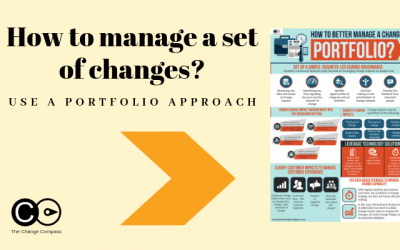
Click here to download our infographic on How to Better Manage a Change Portfolio.
Agile is all the rage at the moment in driving change and transformation. Many call out the importance of stakeholder management, communicating regularly, ensuring strong sponsorship, and clarity of business requirements. Others emphasize the need to have continual people interactions versus documentation and processes. For the uninitiated all of these seem to make sense, but yet not that different compared to using other methodologies in other projects. Agile methodologies have emerged as the catalysts for change and transformation. Anchored by principles such as stakeholder engagement, transparent communication, and robust sponsorship, Agile’s true essence lies in its unique approach – the rapid release of incremental changes, fostering a culture of continual learning and adaptability.
One of the key tenets of agile involves releasing a series of smaller changes rapidly, learning and adjusting from each release, rather than spending a longer time to work on a much bigger release that may or may not be successful.
However, releasing a series of changes can be unsettling, disruptive, and hard to keep up for employees. This is especially the case for larger programs when the timeline could go for more than 1 year. Combining several programs, you can imagine the unsettling rather of these changes on employees and the business.
How do we resolve this? The key is to provide a strong picture of the end state and how things will look like and set the expectation that there will be a series of changes, providing examples of these as well as explaining why this is an effective way to drive change. Yes, We may not know exactly the details of the end state, but the business should be clear in the overall outcomes and key works to get there.
To do this effectively we need to be able to connect the dots and tell the story of the journey of change and how the different changes connect to lead us to the end state. Sounds simple? Yet lots of companies are not able to reach this outcome due to a big pipeline of changes.
Illustrating the Power of Digital Connectivity
Agile in Software Development: Consider a software development project embracing Agile principles. Instead of the traditional monolithic release after months of development, Agile allows teams to deliver functional components regularly. Users gain hands-on experience early, providing invaluable feedback for immediate adjustments.
Navigating Business Transformation: In a complex business transformation, Agile’s iterative approach proves invaluable. Imagine a company implementing a new customer relationship management (CRM) system. Agile permits incremental updates based on user feedback, ensuring the CRM aligns seamlessly with evolving business needs.
Strategic Resource Allocation: A company grappling with a pipeline of diverse changes faces challenges in maintaining clarity. Digital tools, like ‘The Change Compass,’ offer a panoramic view, enabling leaders to visualize the interconnectedness of initiatives. This facilitates strategic decision-making and precise resource allocation.
Employee-Centric Transformations: Consider an organization rolling out changes to internal workflows. Agile, supported by digital tools, empowers leaders to communicate phased changes effectively. This ensures employees not only understand the bigger picture but also feel more engaged in the transformation process.
The solution? Use digital means to connect the dots and not rely on personal interpretation. Use a digital tool to examine what is coming down the pipeline, and therefore create meaning and better prioritize initiatives to move the business forward. By seamlessly weaving Agile methodologies into their fabric and harnessing the power of tools such as ‘The Change Compass,’ organizations adeptly steer through the ever-evolving landscape of perpetual change. Serving as a strategic guide, ‘The Change Compass’ leverages analytics and machine learning to streamline change orchestration, prioritize initiatives, and guide organizations with precision and confidence toward their transformation targets. This approach cultivates a work environment characterized by transparency, adaptability, and active engagement. As a result, the journey toward the end state transforms into a seamlessly connected narrative of continual progress and sustainable growth.
In 2015, the Change Management Institute published its Employment and Salary Survey for the Australian market. Buried in the data was a figure that should have sparked genuine debate in the profession: 77 per cent of change management roles in Australia were held by contractors. Not permanent employees. Not internal capability. Contractors brought in for a project, then gone. A decade later, that structural reality has barely shifted, and it raises a question that the Australian change management community has been reluctant to ask directly: does the way we resource change management actually undermine our ability to get better at it?
This is not a critique of individual contractors, many of whom are highly skilled and deeply experienced. It is a critique of the model. When three out of four change management practitioners are hired on a transactional basis, it tells you something important about how organisations perceive the discipline. Not as a core competency to be developed and retained, but as a specialist service to be procured when needed and released when the project closes. The implications of that perception are more significant than they might first appear.
Compare that posture with companies consistently ranked among the world’s most admired: Intel, Apple, Microsoft, Johnson and Johnson. These organisations do not treat change capability as something you rent. They build it into the operating rhythm of the business, into the expectations of line managers, into leadership development frameworks that persist across years and cycles. The gap between how Australian organisations approach change and how these companies approach it is not a gap in methodology. It is a gap in philosophy. And until we examine that gap honestly, we will keep importing contractors, running projects, and wondering why organisational resilience to change remains stubbornly low.
What the 77% contractor figure reveals
Numbers like this are easy to read as a simple market dynamic: change management is project work, so it attracts project-based resourcing. That explanation is not wrong, but it is incomplete. The more revealing question is why Australian organisations have not followed the same trajectory as, say, project management or business analysis, disciplines that began in a similar place and have steadily moved toward embedded internal capability. Most large Australian organisations now carry permanent project managers and business analysts on their payroll as a matter of course. Change management has not made that transition at the same rate, and the reason is not purely structural.
The underlying issue is that change management in Australia has largely been positioned as a deliverable, not a discipline. A contractor arrives with their change management plan, their stakeholder map, their communications calendar. They execute. They leave. The outputs exist but the learning does not transfer. The next project starts from scratch because the person who holds the knowledge is no longer there. This is not a failure of individual practitioners. It is a systemic failure of how organisations think about the relationship between change and capability.
McKinsey’s 2023 research on perpetual organisational upheaval surveyed 2,500 business leaders across Asia, Europe and North America and found that only about half said their organisations were well prepared for the change needed. In Australia, where the dominant model essentially resets change capability at the end of every project cycle, that readiness problem is structural, not incidental. You cannot build preparedness for an era of continuous change by repeatedly starting from zero.
The transactional model and its limitations
The contractor model offers genuine advantages that are worth acknowledging. It provides flexibility in a labour market where demand for change capability is uneven. It gives organisations access to specialists who have worked across multiple industries and can bring cross-pollinated insights. For a one-off, time-bounded transformation with a clear end date, it can be entirely appropriate. The problem arises when this model becomes the default rather than the exception, when it is applied not because it is the right tool for the situation but because the organisation has never seriously considered building the alternative.
The deeper limitation of the transactional model is what it does to learning. Every major change initiative generates knowledge, what worked in this organisation, what the stakeholder landscape looks like, which leaders are genuine sponsors and which are performative ones, where the cultural fault lines sit. In an embedded model, that knowledge accumulates. It becomes organisational memory. In a contractor model, it walks out the door. The next programme begins without the benefit of what the last one taught, and the organisation pays the same learning costs repeatedly without ever banking the returns.
There is also a question of accountability. A contractor’s primary obligation is to deliver the defined scope of work within the engagement period. That is not a moral failing; it is the nature of the contract. But genuine change capability requires something more than scope delivery. It requires ownership of outcomes that extend beyond the project close date, the willingness to be held accountable for whether change actually landed in the organisation, not just whether the plan was executed. That kind of accountability is structurally difficult when the person responsible for change has already moved on to their next engagement.
Gartner’s 2026 research on change management trends for CHROs found that organisations that continuously or regularly adapt change plans based on employee responses are four times more likely to achieve change success. Continuous adaptation requires continuity of presence. You cannot adapt intelligently to what you are no longer around to observe.
How globally admired companies approach change capability
Intel’s approach to change management has been studied extensively in organisational behaviour literature, and what makes it distinctive is precisely what makes it unfamiliar to most Australian practitioners. Rather than deploying specialist change resources on a project-by-project basis, Intel invested heavily in building change capability into the management layer itself. Line managers were trained and held accountable for managing the people-side of change as part of their standard operating responsibilities. Change was not something that happened to the business while the managers watched from the side. It was something managers were expected to lead, with support from a smaller internal centre of excellence that provided tools, coaching and frameworks.
This model is harder to stand up. It requires patient investment in manager capability, clear accountability frameworks, and the organisational will to hold leaders to behavioural standards that are harder to measure than project delivery. But the return is compounding. Each change cycle builds on the last, managers become more skilled, resistance patterns become better understood, and the organisation develops a genuine immune response to the failure modes that derail most transformations.
Microsoft’s cultural transformation under Satya Nadella is another instructive case. The shift from a “know it all” to a “learn it all” culture was not delivered by a fleet of external change contractors. It was driven through a sustained internal effort to change how leaders led, embedding a growth mindset into performance management, development conversations and the day-to-day operating model. Johnson and Johnson similarly integrates change thinking into its leadership development architecture, treating the ability to lead people through change as a core leadership competency rather than a specialist skill reserved for a separate function.
Apple’s approach is characteristically opaque, but its structural signature is visible: extraordinarily tight integration between product, operations and people strategy, with change absorbed into the operating model rather than managed as a separate workstream. The common thread across all of these companies is a refusal to treat change as an episodic challenge requiring episodic resourcing. They treat it as a permanent condition requiring permanent capability.
The case for the embedded change model
The embedded model does not mean eliminating external expertise. It means changing its role. In a mature embedded model, external practitioners might be brought in to support particularly complex or novel transformations, to provide specialist coaching, or to help build internal capability during a transition period. What they are not doing is substituting for internal capability that should exist but does not. The centre of gravity sits inside the organisation, not outside it.
Prosci’s Change Management Maturity Model, which assesses organisations across five levels from ad hoc practice to organisational competency, makes the distinction clearly. At the higher maturity levels, change management is not a project function but an organisational one. It is integrated into governance, into leadership expectations, into the way programmes are structured from the outset. Crucially, Prosci’s Best Practices in Change Management research (12th edition) found that projects with excellent change management are up to seven times more likely to achieve their objectives. The question is not whether embedded capability is worth building. The question is why more Australian organisations have not built it.
Part of the answer is short-termism. The contractor model is visible and immediate: you need change support, you hire a contractor, the invoice is paid, the project closes. The costs of not building internal capability are diffuse and deferred. You see them in transformation fatigue, in repeated change failures, in the organisation’s growing resistance to the next initiative, in the senior leaders who have stopped believing that large-scale change is achievable. Those costs are real but they rarely appear on a project budget. They appear in culture surveys, in engagement scores, in strategy execution data, and in the quiet exodus of talented people who simply cannot sustain another poorly managed transition.
What the shift from contractor to embedded capability requires
Moving from a predominantly contractor model to a genuinely embedded one is not a quick transition, and it would be misleading to suggest it is simply a matter of converting contract headcount to permanent headcount. The structural shift is necessary but not sufficient. Alongside it, organisations need to make four interconnected moves.
The first is leadership commitment that goes beyond rhetoric. Embedding change capability means holding line managers accountable for people outcomes during transitions, not just delivery milestones. That requires executive sponsors who are willing to tie performance expectations to change leadership behaviours and to maintain that accountability when the pressure to deliver is highest.
The second is investment in change literacy across the management population. This is not about turning every manager into a certified change practitioner. It is about giving managers enough understanding of how people respond to change, what resistance signals, and what effective sponsorship looks like that they can play their role intelligently. McKinsey research on successful transformations found that among initiatives that failed to engage line managers, only 3 per cent of respondents reported success. The management layer is not peripheral to change. It is the primary mechanism through which change either takes hold or fails.
The third move is building a smaller but highly skilled internal change function that acts as a centre of excellence, setting standards, coaching managers, maintaining tools and frameworks, and keeping organisational learning alive between initiatives. This function is not a delivery team. It is a capability infrastructure.
The fourth, and perhaps most overlooked, is establishing the organisational processes that allow change capability to compound over time. That means after-action reviews that are genuinely analytical rather than performative, change impact lessons that are captured and reused, and a structured way of passing organisational knowledge from one initiative to the next. None of this happens automatically. It requires deliberate design and consistent commitment from leadership.
The role of data and measurement in enabling embedded capability
One of the less obvious reasons the contractor model persists is that organisations lack the data infrastructure to make the embedded model credible. When you cannot measure your organisation’s current change load, you cannot make a coherent case for why permanent change capability is needed. When you cannot track adoption rates across initiatives, you cannot demonstrate the value of the capability you are building. When each project operates in its own data silo, you cannot learn systematically from what has come before. Data poverty makes the case for embedded capability invisible.
The organisations that have successfully built embedded change capability share a common characteristic: they invest seriously in measurement. They track not just delivery outputs, which are the traditional domain of project management, but people outcomes. How many employees are aware of the change? How many understand what it means for their role? How many are actively adopting the new ways of working? How does the current change load compare to what this part of the organisation has absorbed before, and is it approaching a saturation point that will cause the next initiative to fail regardless of how well it is managed?
These are not exotic questions. They are basic questions that any organisation genuinely invested in change capability should be able to answer. But without the measurement infrastructure to surface the answers, they remain rhetorical. And when the answers are rhetorical, the conversation about change management defaults to anecdote and instinct, which is precisely the environment in which the contractor model thrives, because anecdote cannot distinguish between a capable contractor and a capable internal function.
How The Change Compass supports organisation-owned change maturity
The Change Compass is built on the premise that organisations cannot manage what they cannot see. Its core function is to give internal change teams and senior leaders a real-time view of the change portfolio across the organisation: what is happening, where, at what pace, and with what cumulative impact on the people being asked to absorb it. This kind of portfolio visibility is foundational to the embedded model, because it makes the case for change capability in a language that senior leaders and finance functions understand. It turns a qualitative argument about organisational resilience into a quantitative picture of change load, adoption progress and risk.
For organisations making the transition from a contractor-heavy model to a more embedded one, The Change Compass provides the data layer that internal capability needs to function credibly. It allows change practitioners within the organisation to track adoption across initiatives, identify where employee capacity is being exceeded before failure becomes visible, and demonstrate the cumulative value of sustained investment in people-led change. It also creates the institutional memory that the contractor model destroys: because data lives in the platform rather than in an individual’s head, the knowledge does not leave when the project closes. That is not a minor feature. It is the difference between an organisation that learns from change and one that keeps relearning the same lessons at the same cost.
Frequently asked questions
Is it ever appropriate to use contractors for change management?
Yes, and this article is not arguing otherwise. External contractors bring genuine value in specific circumstances: highly complex or novel transformations where specialist expertise is scarce internally, surge periods where the volume of change exceeds internal capacity, or capability-building engagements where an external practitioner is helping to develop internal skills. The problem arises when the contractor model is the default rather than a deliberate choice, particularly when it substitutes for internal capability that the organisation should be building and retaining over time.
What does “embedded change capability” actually mean in practice?
It means that the knowledge, skills and accountability for managing the people-side of change are distributed across the organisation rather than concentrated in external specialists brought in on a project basis. In practice, this includes line managers who understand how to lead their teams through transitions, a small internal centre of excellence that maintains standards and tools, leadership behaviours that model and reinforce change management as a core competency, and measurement systems that allow the organisation to learn across initiative cycles rather than starting from scratch each time.
How long does it take to build genuine internal change capability?
There is no universal answer, but organisations that have made this transition successfully tend to describe a multi-year journey rather than a programme with a defined end date. Early stages typically focus on establishing a small internal team, introducing measurement infrastructure, and building change literacy into the management population. Maturity develops as the discipline becomes integrated into governance processes, leadership expectations and programme design from the outset. Prosci’s maturity model research suggests that reaching the higher levels of organisational competency typically requires sustained commitment over three to five years, with visible returns beginning to accumulate well before that milestone.
Why has Australia been slower than other markets to adopt embedded change models?
Several factors are likely at play. Australia’s relatively small population and geographically dispersed business environment have historically made it easier to access a deep pool of contract practitioners than to build internal pipelines. Short-term budget cycles and a strong project management culture that separates delivery from ongoing operations have also reinforced the transactional model. There is also a cultural dimension: Australian organisations have tended to be pragmatic and risk-averse in their investment decisions, which makes the long-term, compounding return of embedded capability harder to justify against the immediate, visible cost of a contractor engagement. Changing this will require leaders who are willing to make the case for long-term capability investment in a business environment that more readily rewards short-term delivery.
We use cookies to improve your experience and understand site use. Marketing cookies stay off until you accept, and in the EU, UK and Switzerland analytics does too. Cookie Policy.
Strictly necessary
Required for the site to work: security, load balancing, and remembering your choices. These cannot be switched off.
Always active
Analytics
Google Analytics and similar, so we can see which pages are useful and where visitors get stuck. Aggregated, never sold.
Marketing
Used to measure campaigns and show relevant content on other platforms such as LinkedIn.