Clearing the runway for change: A sales function success story
Managing change is not just about launching new projects, but also about fitting those changes into the day-to-day operations of the business, especially in high-pressure environments like sales. This was never clearer than when the sales function of a major insurer faced a month with thirteen different change initiatives on the horizon. With looming sales targets and the end of the financial year approaching, the team realized two of these changes were particularly major and urgent, each coming from different parts of the organisation.
The business knew that, based on past data, periods of concentrated change nearly always led to missed targets and extra work. But initially, it looked as if there was no way around the situation. Both major initiatives were tied to compliance deadlines and benefit realization, and pressure was mounting from all directions to deliver everything as soon as possible.
A turning point with clear, consolidated data
Unlike previous years, the team had a new advantage. Using The Change Compass, they could finally see, in a quantified and visual way, just how much change was heading toward the sales function. The full impact across all thirteen initiatives became impossible to ignore. Instead of relying on intuition or guesswork, leaders responded to real numbers and trends that told a clear story: trying to land all thirteen changes would stretch teams thin and likely reduce the benefits of each initiative.
With this understanding, the operations team joined with senior managers and the leads of the two major projects to re-evaluate priorities. Conversations became more productive and focused on what was truly essential during a high-demand period.
Refocus on value, not volume
Decisions were not easy. Stakeholders were keen to meet compliance obligations as fast as possible, but the data showed the risk of overwhelming the sales team and jeopardising both business performance and initiative success. Ultimately, the team decided to deprioritise less urgent projects, trimming the schedule from thirteen initiatives to just six.
This approach ensured the sales function had the capacity and energy to implement the most important changes successfully. The adjustment gave everyone involved a greater sense of control and provided confidence that compliance and business objectives could be met without excessive strain on staff.
Measurable impact for both sales and project outcomes
The result was powerful. The business avoided the exhaustion and confusion that comes with too much simultaneous change, and the two key projects received the attention and resources needed to succeed. Sales performance did not suffer, targets were not sacrificed, and the combined value of managing change in this way was estimated to be more than half a million dollars in avoided additional work.
This experience moved the conversation from how much we can do to what we should do now for the greatest impact. These are decisions that support not just short-term success, but also build long-term resilience and reputation for the sales function.
Here are some estimated figures of the value created during this one incident through Change Compass:
A total of half a million dollars saved in initiative benefit reductions across initiatives
More than $100,000 saved in terms of frontline staffing disruptions
Avoiding customer satisfaction level (CSAT) drop of 10-20%
Protecting the risk of decreased adoption rates from lower than 50% to 75-85%
A new way forward with The Change Compass
The real story here is the shift in mindset that The Change Compass enabled. With reliable and actionable information, teams did not have to rely on last-minute adjustments or gut feel. Senior managers could see the road ahead, make informed trade-offs, and ultimately protect both their people and their goals.
If you have faced times when your organisation juggled more change than your teams could bear, you know how valuable this kind of clarity can be. The Change Compass offers a way to navigate these challenges confidently, support the right conversations, and ensure every change effort delivers its intended value.
Imagine giving your business the tools to see the whole picture, act on what matters most, and achieve meaningful outcomes without compromising performance. With The Change Compass, that possibility is within reach. Take the first step to better change management and stronger business performance by putting insight at the heart of your decision-making.
Designing a change journey is a design process. Like in any design processes, you need to know intimately the impacted people you are working with, the world they are in and their expectations and behaviours. In this way, design is about anticipating and shaping the experience of people.
What are the elements of a 5 star change experience?
What is the role of data in design?
How does branding and communications shape the experience?
How do we anticipate people needs?
For a comprehensive guide on how to undergo this design process to come up with a 5 star change journey, check out our guide.
A single view of change: How a bank protected customers and unlocked new value
Managing change in the financial sector is always a complex task, but the lessons from one leading bank stand as a powerful example of how clarity, collaboration, and customer-centric thinking can turn potential problems into value creation. In this case, one proactive step—leveraging an integrated view of change—became the catalyst for protecting both customer relationships and business performance.
The hidden challenge: Overlapping changes with a high-value customer segment
Every large bank is engaged in a continual cycle of transformation. New products launch. Systems are upgraded. Regulatory and compliance requirements evolve. Yet, as the pace of change accelerates, the risks of unintended consequences also grow. That risk isn’t always technological. Sometimes, it’s about the customer.
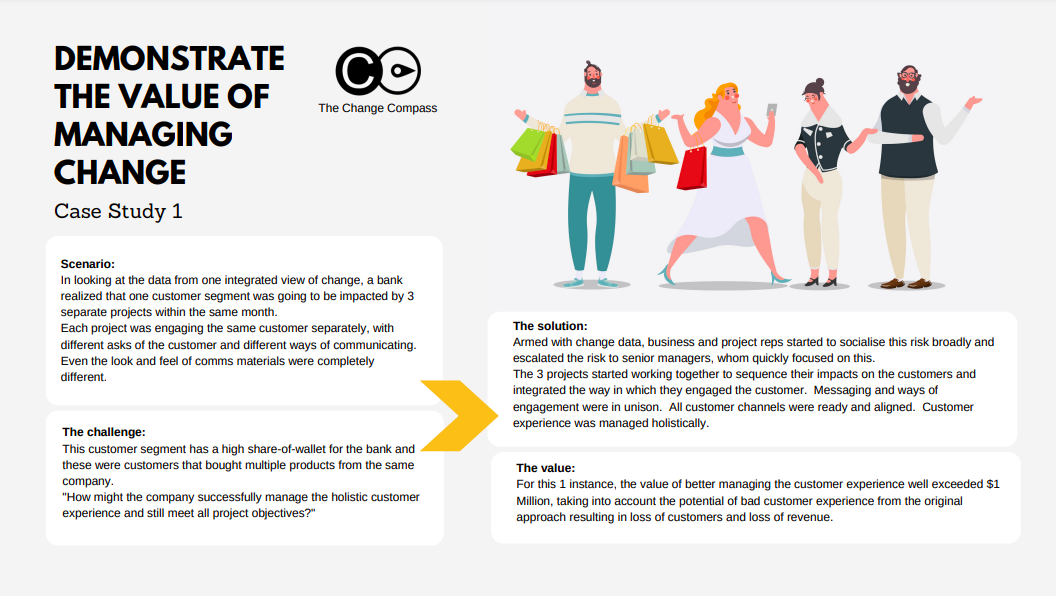
The story began when the bank reviewed its change data using The Change Compass, a platform designed to give leaders a holistic, quantitative view across all active and upcoming initiatives. It quickly became apparent that one valuable customer segment would be impacted not once, but three times in the space of a single month. Each encounter was driven by a different project team. Each project was planning separate communications and customer asks, with little alignment or coordination.
At first glance, these projects appeared to be unrelated. Yet, all three were targeting customers with the highest share-of-wallet, meaning they owned multiple products and had longstanding loyalty to the company. These were not just any customers—these were the “crown jewel” group whose satisfaction and retention were critical to the bank’s revenue and brand.
Why customer experience is so easily overlooked in transformation
When large organisations manage dozens or even hundreds of projects, it is common for teams to operate in functional silos. Each project has its own objectives, stakeholders, and deadlines. While project teams may conduct their own customer research, they might not have real-time awareness of what other groups are doing at the same time.
In this case, the data revealed a classic example of accidental customer overload:
Three projects, each reaching out separately to the same customer group
Different communication styles, messaging, and even visual branding
Conflicting asks of the customer within a short window
High risk that customers would receive mixed messages through multiple channels
The cumulative risk was clear. When customers are bombarded with uncoordinated service changes, requests, or notifications, confusion and frustration grow. Worse still is the potential for customers to feel undervalued, as though their loyalty is being taken for granted. For a segment with high share-of-wallet, this can lead to disengagement, product attrition, and ultimately significant loss in revenue.
Using change data to drive immediate management focus
Recognizing the risk, project and business representatives did not keep the issue at a working team level. Armed with hard data from The Change Compass, they were able to socialise and escalate the issue quickly to senior leaders. The evidence showed not just that there would be customer overlap, but exactly who would be affected and when. Visualizations made the potential for negative experience tangible and urgent.
The result was swift. Senior managers prioritised this risk and asked the three project teams to connect, align, and rethink their plans with the customer at the centre.
Turning competing projects into a single customer journey
The solution the teams developed together was both pragmatic and creative. Instead of three siloed interventions, the projects worked collaboratively to:
Sequence the timing of their customer impacts so that communications and asks happen in a coordinated, logical order
Integrate and harmonise their messaging so that customers would see one brand, one bank, regardless of which internal team was driving the change
Create unified communication which was consistent across all channels, ensuring readiness among staff as well as consistency in digital and direct outreach
All relevant customer channels were engaged. Contact centers were readied to provide clear and timely information for the anticipated queries. Branch staff received integrated briefing materials. Online resources were updated so that customer queries could be addressed seamlessly, regardless of which change had prompted the interaction.
Managing the customer experience for maximum value
The most important shift, however, was psychological. The three separate project teams stopped thinking only about their project outcomes and focused instead on the holistic customer experience. Their collaboration ensured that every customer’s journey through these parallel changes felt seamless and considered, not piecemeal or haphazard.
The data-driven approach did more than avoid complaints. It delivered quantifiable business value. The potential cost of poor experience was significant: for this high-value customer segment, confusion could have led to attrition and a loss of cross-sell opportunities. Through better management, the estimated value preserved for the business exceeded one million dollars, mainly by protecting loyalty, retention, and associated revenue.
Keys to success: Visibility, collaboration, and leadership engagement
There are several important lessons from this case that any change leader can apply:
An integrated view of change is essential. Only by adopting a platform that provides a holistic perspective can you spot issues that cut across project and functional boundaries.
Data is the great enabler for smart escalation and storytelling. When you can visualise and quantify the risk, you arm frontline teams with what they need to secure executive focus and intervention.
Silos are broken down when the customer is placed at the centre. Teams that are used to working independently quickly find common purpose when they are guided by a shared commitment to customer experience.
Solutions are not always complex. Sometimes coordinating timing and messaging, and making sure every channel is informed and ready, produces remarkable value with existing resources.
Key benefits achieved through using Change Compass
Protection of NPS (net promoter score) and CSAT (customer satisfaction) by 10-20+ points for affected segments
Improved customer experience that reduces churn by 2-5% in the months following a change-heavy period (equating to $1Mil+ annually)
Protection of revenue leakage of 5-10% from lost cross sell/upsell opportunities (from fragmented project delivery impacts) equating to $1-2Mil per annum
Through unified and sequenced activities change adoption is shown to increase by 60-80% (according to Deloitte study)
Creating a culture of proactive change management
Importantly, this was not a one-off intervention. By practicing this cross-project alignment, the bank reinforced a culture of proactive, customer-driven change management. Teams learned to ask new questions. Who else is communicating with this customer segment? What is the experience like from their perspective, not just ours? Where could joint planning enhance value for both customer and company?
The executive team also gained confidence that they were not missing hidden risks by focusing only on vertical project updates. Instead, they built strength in horizontal oversight, preventing accidental overload or misalignment for their most important clients.
Looking forward: Embedding these practices for lasting advantage
The value of these lessons goes well beyond any one episode. As the pace and scale of transformation accelerate in the banking sector and beyond, organisations must move from reactive to proactive change management. A single, data-driven view across all initiatives is no longer “nice to have”—it is a competitive necessity.
With The Change Compass, this bank gained the ability not just to detect emerging risks, but to act on them collaboratively, protect revenue, and continually strengthen the trust of its best customers.
Protecting what matters most in a changing world
Change is inevitable, but negative consequences do not have to be. The experience of this bank highlights how the right tools and mindset can help any company deliver more value through transformation. By seeing the whole picture, collaborating across boundaries, and acting in the interests of their customers, leaders set themselves up not just for project success, but for enduring business growth.
If your organisation is ready to manage the complexities of change with confidence, while ensuring the customer always comes first, discover what The Change Compass makes possible. With data-powered insight, alignment, and a relentless commitment to experience, your next change story could be your most successful yet.
How the sea inspires a different way of managing change
In taking my vacations in Hawaii I thought I would start a series of Change Management articles inspired by my trip to Hawaii. For those who have not been to Hawaii or have only stayed around Waikiki, the Islands of Hawaii is quite astoundingly beautiful. There is something magical about Hawaii that inspires the mind and soothes the soul. It’s welcoming people, amazingly jagged mountains, fantastic beaches, and sensational food is enough to bewitch any visitor.
As change or project managers we usually plan our approach in managing change from a top down perspective. We look at what senior executives would like employees to change, how much change is required, what benefits would be achieved through change, and which parts of the organization would need to change.
There is the usual focus that change leadership is critical and that without strong senior sponsorship that the initiative will fail. The senior leader is expected to have all the answers, to know exactly how to steer the employees towards an end state and be able to convince them the ‘what’ and the ‘why’ of the change. On top of this, if there is any resistance, the leader needs to identify these and overcome them in order to successfully drive the change successfully.
This all sounds like the standard recipe for change success does it not? So what is wrong with this?
Hawaii and leading change
When I was snorkelling in the North Shore of Oahu Island I was amazed at how much tropical fish I could see literally just metres from the beach. In fact, as soon as I had put my head down I could see the various sizes of amazing tropical fish. And the farther I go the more I notice at the abundance and variety of fish and coral around me.
When we surround ourselves purely with the top down approach of change, we start to develop a fixed mindset of how change should be done. Most of change literature resolves around adopting a top down approach. However, when we start to adopt a user mindset, an employee lense of change, we start to see things very differently.
The diversity of the ocean and the diversity of employees
Similar to the fish in the sea, there isn’t one type of employee. There are many types of employees with varying interests, backgrounds and preferences. It is easy for us to interview employees through conducting surveys and declare that we are intimate with employee concerns. However, in most situations there isn’t just one set of employee beliefs and concerns. Different employees have different concerns, just like in the ocean there is star fish, tetra, gold fish, carp, etc.
Whilst we cannot cater for every type of individual employee concerns and interests, it is also important to be able to see through impacted employees and what they are seeing. I became amazed at the wonderful world under the sea and how colourful and stunning it really is. If we really start to see through the different groups of employees, sense what they are sensing, we can really harness their power to drive change.
How do we leverage different employee groups in driving change
For example:
For employees who are change champions and early adopters – How do we harness their influence and positivity to quickly spread the word, and advocate for the change?
For those who have had bad change experiences in the past and are cynical and critical – How do we involve them closely to design the change process, so as to avoid any past mistakes and leverage to enhance success?
For those who were agnostic and did not either support or resist the change – How do we give them accountabilities to progress and promote the change
For those who strongly resist the change and actively counter against the change – How do we listen to them and address this head on. And leverage the influence of other employee groups such as the change champions?
For those who tend to be overly cautious and do not feel confident when there is change – How do we actively identify them and spend more time to nurture their confidence, or leverage change champions to hand-hold them?
Dipping below the surface of what various senior stakeholder groups are looking for in change, we start to see a different picture of what employees see. Let’s open our eyes to the various colours, shapes, and sizes of the attitudes, preferences and feedback of employees. When we start to see the diversity of different types of employees and where they are at, we can then leverage them to better drive and position the change for success.
I recently went to a concert to see some of the super soul bands of the 70s and 80s including The Jacksons, Sister Sledge, The Village People, and Pointer Sisters. In addition to funk and soul, there was a big component of disco music as well. I started becoming more interested in the history of disco music and how it came about. According to Wikipedia, disco music emerged in the late 60s and 70s and started as a mixture of music from venues popular with African Americans, Hispanic and Latino Americans, Italian Americans, and the LGBT. “Disco can be seen as a reaction to both the dominance of rock music and the stigmatisation of dance music by the counterculture during this period”.
This led me to think more about the dominance of one idealism or concept over others and how limiting it is to only be able to operate with one concept, whether it be dancing or a way of working. I often hear in organizations that we should aim for ‘one-way, same-way to simplify things for people. Do we really think that one way of approaching something is the best for developing that particular capability? And do we really believe that people can only ever handle one way of doing something? Yes, in the beginning, taking a step-by-step process and not introducing multiple concepts may make sense. But in the longer term would we not benefit from different concepts, different methodologies, and different ways of working? (I.e. more diversity vs. no diversity).
Most large organizations are focused on ‘diversity’ within the organization. Diversity can be in the form of gender, sexual orientation, cultural background, age, etc. Having diversity in the organization is premised to provide a richer set of perspectives and points of view and therefore an important part of building talent. Diversity is also critical from a PR and public perception perspective as it paints an image of the type of organization and the types of people in it. For example, a company with a low percentage of women in senior leadership roles or management roles could be seen as one where women may have equal opportunities. The same can also be said for other diverse areas such as age, sexual orientation, and ethnic background.
Why do we need diversity in change management?
Change management, like other disciplines, such as IT management, HR, or Project Management is an area that cannot be fully covered with one singular framework or perspective. Just as there are countless frameworks, concepts, and methodologies in HR so is the case in change management. Models include Kubler-Ross, Lewin, ADKAR, Bridges, Kotter, etc. Different models may suit different types of changes. Please read our article ‘Diagnosing for change‘ on how different change management models may be better for certain types of changes.
By using just one singular model we could be restricting our organization’s change management capability. At university, we study different theories and concepts with the goal that by understanding different approaches, we start to build our understanding of the whole discipline. This allows us to pick and chose one or a combination of different approaches based on the situation. The same applies to change management. It is by understanding different change management approaches that we start to be able to tailor our approaches given any change situation.
For leaders across an organization, many would argue that it is best to provide only one framework or concept for all of change management. If it is really the case that all leaders have never been exposed to any change management frameworks at all (which is unlikely to be the case for large organizations) then starting with one framework may be a good idea.
However, a business leader may need to understand:
leading people from an engagement and emotional connection perspective
How initiatives are implemented and their role in it to make it a success
How to coach others through the change process
How to track, measure, analyse and report on change and embedment progress
The art of how to communicate in a verbal and written way using the right words and tone
All of these could have different concepts and frameworks to provide the richness of building understanding and skills. Yes, it is possible to simplify different frameworks and connect them. However, as leaders continue to grow, they will need to be exposed to different concepts and approaches. In the past, projects used a waterfall methodology where tasks were planned in detail and there was little room for plan changes. Now, most organizations utilise some form of agile methodology for many of their projects. For some projects, waterfall methodology may be more appropriate and for others agile. Having diversity helps organizations achieve more successful initiative outcomes.
How do we achieve diversity in change management?
Here are some areas in which to build diversity of thinking and approaches to enrich your organization’s change management capability.
1.Change management frameworks
As mentioned before, having several change management frameworks build a richness of understanding of different approaches
2.Change analytics
Collecting a range of change management data is incredibly valuable. Data on the impact of change across the organization enables leaders to make effective planning, sequencing, and prioritisation decisions on how initiatives should be rolled out. This includes impacts on stakeholder groups such as employees, third parties, partners, and customers. Other data such as change readiness levels for initiatives, initiative benefits, and business performance indicators are critical to ensure initiatives will land effectively.
3.Change leadership
Managing change is a part of leadership. Therefore, just as there is a big range of leadership frameworks so is the case in change leadership. For example, Daniel Goleman’s emotional intelligence, Situational Leadership, Kotter, etc.
4.Change service offering
Providing a rich set of change services can also help build change capability. Change services may include such as:
Initiative change management
Portfolio change management
Change leadership capability development
Change analytics and decision-making support
Change coaching for leaders
Business-as-usual initiative coaching/support
Change communications support
5.Project delivery methodology
Change management should also be geared to support a range of project methodologies that the organization is using to implement its projects. The richness of being able to flex between different project methodologies means greater value and overall Organizational capability in managing change. Different project methodologies could include: