A change management centre of excellence is usually busy, well-liked, and quietly vulnerable. It runs the methodology, maintains the templates, trains the practitioners, and deploys change managers onto whichever projects shout loudest. Everyone who works with it says good things. And then a new CFO arrives, asks what measurable difference the function makes to the outcomes the board cares about, and the honest answer turns out to be a list of activities rather than a line of evidence. Within two budget cycles the centre is reframed as a cost, its people are redistributed into the business, and the organisation goes back to doing change one project at a time.
This is a common occurance of a change management centre of excellence built on the wrong premise. Most are built as one of two things: a methodology/learning team to improve ‘capability’, or a body shop of change managers. The library version owns standards, templates, and training, and measures itself by adoption of the method. The body-shop version is a pool of change practitioners deployed to projects, measured by utilisation. Both are operationally useful. Neither is strategic, and neither survives serious scrutiny, because both answer the question “are we doing change management well?” when the question executives are actually asking is “will the things we are betting the company on actually land, and can we see the risk in time to act?”
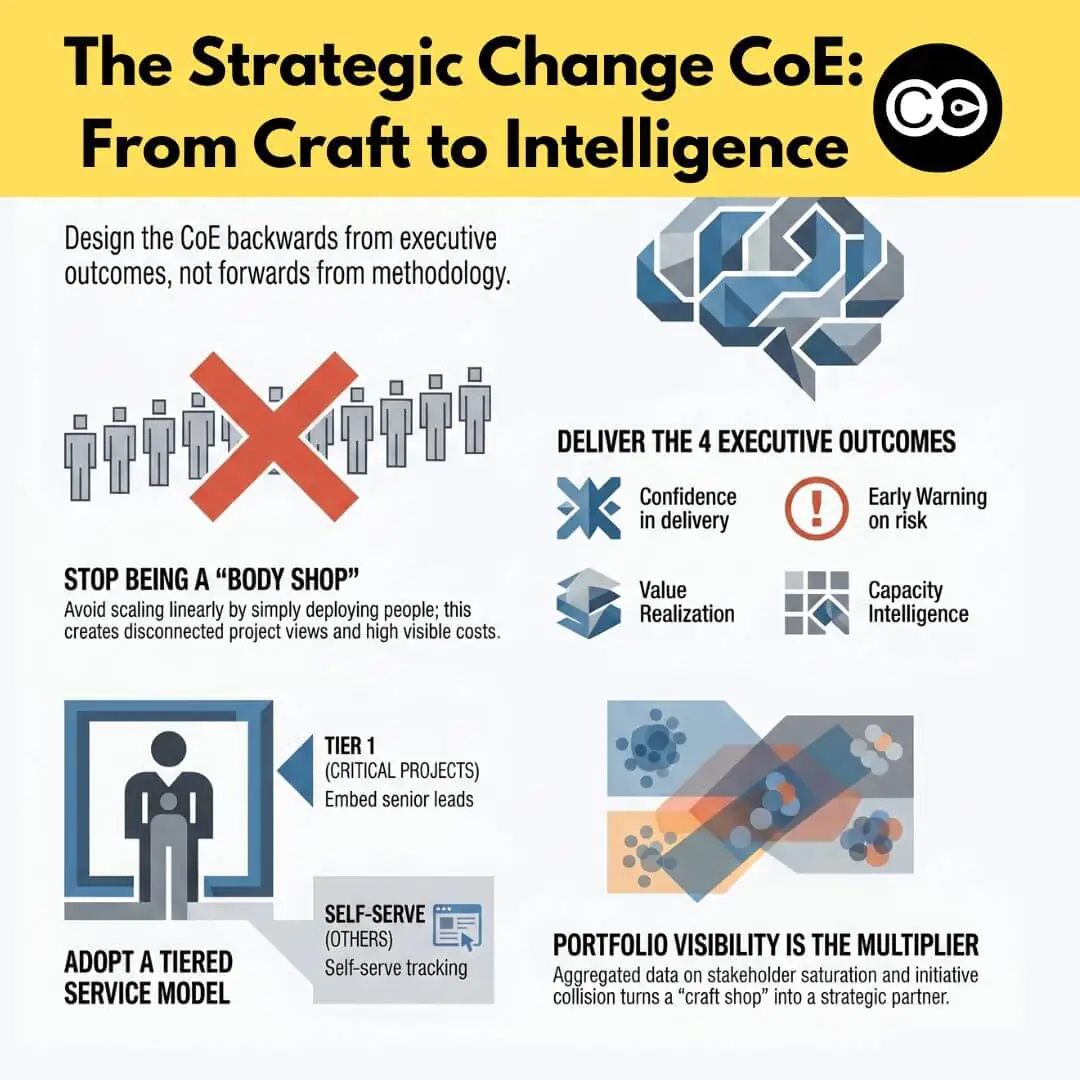
The centres that endure are designed backwards from that second question. They are aligned to executive outcomes, they allocate their scarce resources by strategic importance rather than by who asked first, and they offer differentiated levels of service rather than spreading a thin layer of support evenly across every initiative. Most importantly, they sit on an intelligence layer that lets them see the whole portfolio, which is what separates a strategic capability from a craft shop. This article lays out what that actually requires.
What a change management centre of excellence is actually for
The purpose of a change management centre of excellence is not to do change management well in the ‘theory’. It is to increase the probability that the organisation’s portfolio of change lands, and to give leadership visibility of the risk to that portfolio while there is still time to act. Everything else, the standards, the tooling, the coaching, is in service of that outcome, not an end in itself. When a centre forgets this, it optimises its craft and loses its mandate.
The two default models and why they plateau
The methodology-capability model treats the centre as the custodian of “how we do change here”. It standardises the approach, builds templates, accredits practitioners, and runs a community of practice. This is genuinely valuable, and it is where most centres should start. But it plateaus, because a library is a fixed asset that depreciates. Once the method is published and people are trained, the marginal value of the library falls, while its visible cost stays the same. A library or a distributed change capability improvement at some level cannot tell an executive anything about whether the portfolio is at risk.
The body-shop model treats the centre as a resourcing pool. It hires change managers centrally and deploys them to projects on demand, billing time and measuring utilisation. This feels strategic because it is operationally indispensable, but it is the more dangerous trap of the two. A body shop scales linearly: more change requires more people, costs rise in lockstep with demand, and the function is permanently one efficiency drive away from being outsourced. Worse, because each practitioner is embedded in a single project, no one in the body shop sees across the portfolio. The function that should hold the enterprise view instead holds dozens of disconnected project views.
The strategic reframe: design backwards from outcomes
The reframe that escapes both traps is to design the centre from executive outcomes backwards. Instead of asking “what does good change management look like and how do we deliver it everywhere”, ask “what do our executives need to be confident about to run successful change and transformation, and what would the centre have to see, know, and do to give them that confidence”. The answer reorganises the whole function. It makes portfolio visibility a core capability rather than an afterthought. It makes prioritisation a deliberate act rather than a queue. And it makes the centre a source of intelligence about enterprise risk, not just a supplier of change-management labour.
Start with the outcomes executives actually want
Executives do not want better change management … necessarily. They want a small number of outcomes, and a change management centre of excellence earns its mandate by being demonstrably the function that improves them. In practice, senior leaders are looking for four things from the change portfolio:
Confidence that the critical initiatives will land. Not activity reports, but a credible read on whether the changes the strategy depends on will actually be adopted.
Early warning on risk. The ability to see an adoption problem, a capacity breach, or a conflict between initiatives early enough to do something about it, rather than in a post-implementation review.
Value realisation. Evidence that the benefits in the business case are being captured, and a clear account of where they are leaking. This is the territory of the return on investment of change management, and it is the language that wins executive sponsorship.
Capacity/adoption intelligence for decisions. A defensible answer to “can the organisation absorb this on top of everything else and how are we on track to fully adopt the changes”, so that portfolio and investment decisions are made against real capacity/adoption rather than optimism.
Notice what is not on that list: methodology adoption, template usage, practitioner accreditation, utilisation. Those are means, and a centre that reports them to executives is answering a question no one asked. Design the centre so that its core reporting speaks directly to the four outcomes above, and the conversation about its value changes entirely.
The capabilities a strategic change CoE needs
A strategic centre needs five core capabilities. The first three are what most centres already have or aspire to. The last two are what separate a strategic capability from a methodology library, and they are the ones most often missing.
Capability
What it delivers
Executive outcome it serves
Maturity signal
Standards and method
A consistent, fit-for-purpose change approach
Confidence in delivery quality
The method is used because it helps, not mandated
Tools and templates
Reusable artefacts that lower the cost of good practice
Efficiency and consistency
Practitioners reach for them by default
Coaching and capability building
Skilled change practitioners and change-capable leaders
Confidence the critical initiatives will land
Business leaders run change competently with light support
Portfolio visibility and intelligence
A live, aggregated view of change load, risk, and conflict across the enterprise
Early warning on risk; capacity intelligence
Leadership consults the centre before approving new initiatives
Governance and prioritisation
Disciplined allocation of scarce change resource to what matters most
Value realisation; capacity intelligence
The centre can say no, or not yet, with evidence
The capability that does the most to make a centre strategic is portfolio visibility. A centre that can see across every active initiative, where the load is concentrated, where initiatives collide, which stakeholder groups are saturated, is a centre that can answer the executive’s real questions. Without it, even a well-run centre is, in effect, a methodology library with a coaching service attached. This is also the capability that benefits most from AI-supported change automation, because aggregating and interpreting portfolio data at scale is precisely the kind of work that is impractical to do manually across dozens of initiatives.
Prioritise by strategic importance, not by who asks first (or is more influential)
The defining constraint of every change centre is that change resource is scarce and demand is effectively unlimited. Every initiative wants a change manager. The body-shop response is to ration by availability and seniority, which means resource flows to the loudest sponsors rather than the most important initiatives. The strategic response is to allocate deliberately, by strategic importance.
This requires the centre to hold an explicit view of which initiatives matter most to the enterprise, and to be willing to differentiate. Not every initiative deserves a dedicated change lead, and pretending otherwise is how centres spread themselves so thin that they add little anywhere. The uncomfortable truth is that a centre trying to support everything equally is implicitly deprioritising the initiatives that matter most, by denying them the depth of support their importance warrants. Prioritisation is not bureaucracy. It is the mechanism by which a scarce resource is pointed at the highest-value work, and it is impossible to do credibly without the portfolio visibility described above.
The shift is easier to see with a concrete picture. Consider a centre with six change practitioners facing a portfolio of thirty initiatives. The body-shop instinct is to spread those six across as many initiatives as possible, giving each a fraction of a change manager and none of them enough. Every initiative gets a name against it, and almost none get real support. The strategic alternative is to look at the thirty through the lens of strategic importance, identify the three that the corporate strategy genuinely depends on, and place a dedicated senior lead on each. The remaining three practitioners then run a coaching model across the next tier of important initiatives, while the rest are served by self-serve enablement and portfolio tracking. The same six people now create disproportionate value on the initiatives that matter, instead of uniform mediocrity across all thirty. The only thing that changed was the willingness to differentiate, backed by a clear view of which initiatives sit where.
A tiered service model for limited change resources
The practical expression of prioritisation is a tiered service model. Rather than offering one undifferentiated service (a change manager on your project) to whoever secures one, a strategic centre offers different levels of service matched to the strategic importance and complexity of each initiative. This is the single most effective move a centre can make to escape the body-shop trap, because it breaks the assumption that the centre’s only product is one-to-one practitioner deployment.
A workable four-tier model looks like this:
Tier
Who it is for
What the centre provides
Resource intensity
Tier 1: Embedded
The handful of enterprise-critical, high-complexity initiatives
A dedicated, senior change lead working full-time on the initiative
High
Tier 2: Guided
Important initiatives with a business-side change owner
A centre consultant who coaches the embedded owner, reviews artefacts, and assures quality on a regular cadence
Medium
Tier 3: Enabled
Standard initiatives run by capable business teams
Self-serve toolkit, templates, training, and scheduled office hours; the business runs its own change
Low
Tier 4: Tracked
Everything else with a change footprint
No direct support, but the initiative is captured in the portfolio view for load, conflict, and saturation monitoring
Minimal
Three things make this model work. First, the tier is assigned by strategic importance and complexity, not by who asks, which is what enforces the prioritisation discipline. Second, every initiative gets something, even if it is only Tier 4 portfolio tracking, which means the centre retains enterprise-wide visibility rather than only seeing the projects it staffs. That visibility is what lets the centre answer portfolio-level questions no body shop can. Third, the model scales without scaling headcount linearly, because most initiatives sit in the lighter tiers, and the centre’s scarce senior practitioners are concentrated where they create the most value.
The tiered model also reframes the centre’s identity. It is no longer “the place you get a change manager”. It is the function that decides, on evidence, how much and what kind of change support each initiative warrants, and that holds the only complete view of change across the enterprise. That is a strategic position. A body shop can never occupy it.
The intelligence layer that makes a centre strategic
Every capability above depends on one thing the traditional centre lacks: a live, aggregated view of change across the whole portfolio. Without it, prioritisation is guesswork, the tiered model cannot see what sits in Tier 4, and the executive outcomes about risk and capacity cannot be answered at all. This is why a change management centre of excellence without portfolio data is, in the end, a methodology library with good intentions.
This is the role a change intelligence platform plays for the centre. Change Compass aggregates impact, load, and risk data across every initiative in the portfolio, giving the centre the enterprise-wide view that turns it from a craft function into a strategic one. It is what lets the centre tell an executive, with evidence, that a stakeholder group is saturated, that two initiatives are about to collide, or that the portfolio is carrying more change than it can absorb. The platform does not replace the centre’s people or method. It gives them the intelligence layer that makes their judgement visible and credible at the enterprise level. For centres evaluating how to build this, the criteria are the same ones covered in any serious assessment of change portfolio management tools.
The maturity journey from informal to embedded
No centre arrives fully formed, and trying to stand up all five capabilities at once is a common way to fail. The journey runs through three broad stages.
Informal
Change is done project by project, with no shared method and no central function. Some practitioners are good, some are not, and there is no enterprise view. The first move is to establish standards and a small core team: the methodology-library foundation, which is a legitimate and necessary starting point.
Functional
The centre exists, owns the method, builds capability, and deploys or coaches practitioners. This is where most centres stall, because it is comfortable and visibly useful. The risk is mistaking this stage for the destination. A functional centre is still answering “are we doing change well”, not “will the portfolio land”.
Strategic and embedded
The centre operates the tiered service model, allocates by strategic importance, holds the portfolio intelligence, and reports to executives in the language of risk, capacity, and value. At this stage the centre is consulted before initiatives are approved, not just after they are funded. It has moved from supporting change to shaping the change agenda, and its mandate is secure because its value is visible in the outcomes leaders care about.
Where to start
If your centre today is a library, a body shop, or both, the highest-value first move is not to add people. It is to build the portfolio view and reframe what the centre reports. Start tracking every initiative with a change footprint, even the ones you do not staff, so you can see the enterprise picture. Then introduce the tiered service model, so your scarce senior practitioners are concentrated on the initiatives that matter most rather than spread evenly across all of them. Finally, change what you report to executives, from activity and utilisation to portfolio risk, capacity, and value realisation. A change management centre of excellence becomes strategic the moment it can answer the question executives actually ask, which is not whether change is being managed, but whether the things the organisation is betting on will land, and whether anyone can see the risk in time. Build the centre that answers that, and it will not be the function that gets cut in the next review. It will be the one the board asks for more of.
Frequently asked questions
What is a change management centre of excellence? A change management centre of excellence is a central function that raises the probability the organisation’s change portfolio succeeds, by owning the change method, building capability, allocating scarce change resource, and holding an enterprise-wide view of change risk and capacity. The strongest centres are defined by their portfolio intelligence and executive alignment, not just by the methodology and templates they maintain.
What does a change COE actually do? At maturity, a change COE does five things: it sets standards and method, provides tools and templates, builds change capability through coaching, maintains portfolio visibility across all initiatives, and runs the governance and prioritisation that directs limited change resource to the most important work. The first three are common; the last two are what make a COE genuinely strategic rather than a methodology library.
How do you structure a change COE with limited resources? Use a tiered service model that matches the level of support to each initiative’s strategic importance and complexity. A typical model has four tiers: a dedicated change lead for enterprise-critical initiatives, a coaching and assurance model for important ones, a self-serve toolkit for standard ones, and portfolio tracking only for the rest. This concentrates scarce senior practitioners where they add the most value and keeps every initiative visible.
How is a change COE different from a project management office? A PMO is generally concerned with delivery of projects: scope, schedule, budget, and dependencies. A change COE is concerned with adoption of the changes those projects create, and with the cumulative impact of change on the workforce. The two are complementary, but a change COE answers questions a PMO cannot, particularly about stakeholder load, change saturation, and whether the organisation can absorb what it is delivering.
How do you measure the value of a change COE? Measure it in the language executives use: confidence that critical initiatives will land, early warning on portfolio risk, value realisation against business cases, and capacity intelligence for investment decisions. Avoid reporting only activity metrics such as methodology adoption or practitioner utilisation, because they describe effort rather than the outcomes leadership actually cares about.
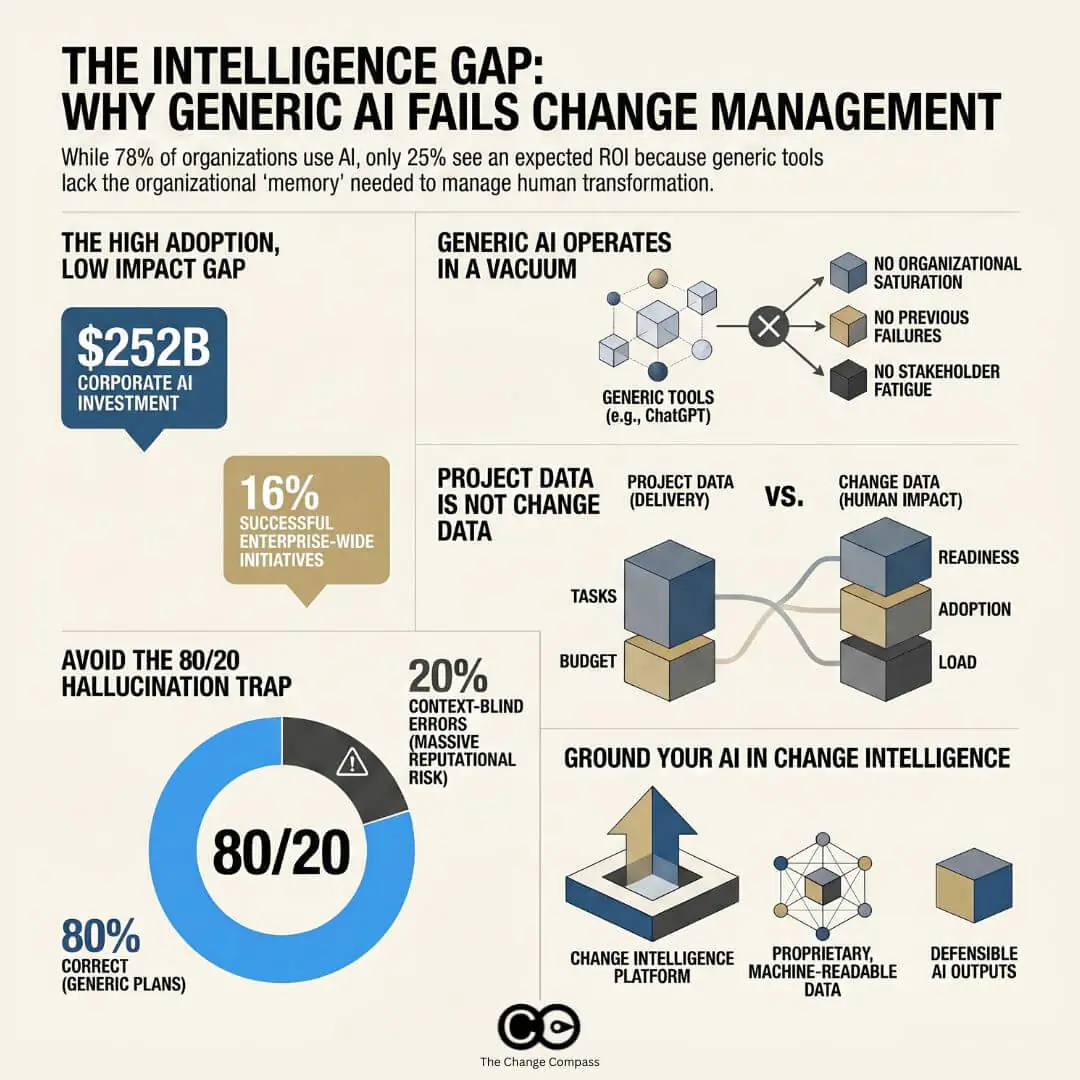
Corporate AI investment hit $252.3 billion in 2024 according to the Stanford HAI AI Index 2025, and 78% of organisations now use AI in at least one business function, up from 55% a year earlier. Yet a May 2025 IBM Institute for Business Value survey of 2,000 CEOs found that only 25% of AI initiatives have delivered the expected return, and just 16% have scaled enterprise-wide. The gap is widest in the disciplines where AI was supposed to help most, and AI for change management is among the clearest examples.
For change leaders, the symptom is familiar. Practitioners draft impact statements in ChatGPT. Project managers ask Microsoft Copilot to summarise stakeholder feedback. Sponsors paste a comms plan into Claude and ask for an executive version. The outputs look fluent, but anyone close to the work sees the same pattern: generic AI cannot reason about an organisation it does not know. It cannot weigh a new initiative against the five already in flight for the same audience. It cannot recall what happened the last time the operations team was asked to absorb a major systems change.
The conclusion most leaders are drawing is the wrong one. The constraint is not the AI model. The constraint is the absence of a system of record for change that the AI can actually reason against. An enterprise change intelligence platform is what fills that gap, and once it does, the relationship between change management and strategic outcomes shifts in a way that no productivity tool can replicate.
The AI productivity trap in change management
The first wave of AI adoption in change management has been characterised by individual practitioners using generic tools to accelerate familiar tasks. This is sensible, and at small scale it works. Drafting a stakeholder email, structuring a training outline, generating five variants of a comms message: these are bounded, low-risk uses where the cost of an inaccurate output is low.
The problem starts when leaders extrapolate from these wins. A practitioner who saves an hour drafting an email assumes the same tool will help them assess saturation across a $40 million transformation portfolio. It will not. The hour saved is a productivity gain. The portfolio question is a data problem. A separate companion guide on what AI can and cannot do in change management sets out the boundary in more detail, but the headline is straightforward: AI is strong on language tasks bounded by the prompt, and weak on reasoning that requires organisation-specific context the model has never been given.
Research by McKinsey on scaling agentic AI puts the structural issue in stark terms: eight in ten companies cite data limitations as the principal roadblock to scaling AI, and the value of large and small language models comes from the ability to train and ground them on the organisation’s own proprietary data. The same study notes that competitive advantage now flows from a small set of well-curated data products, treated as reusable, business-ready assets with clear ownership, semantics, and quality standards.
For change management, the implication is direct. If your organisation has no structured record of what initiatives are in flight, who is affected, what training has been delivered, what readiness scored, and how previous change has landed, no AI tool can reason about it. The model produces a plausible-sounding answer, drawn from generic training data, that may be confidently wrong about your specific context. The Stanford AI Index documented a 56.4% surge in AI incidents in 2024, and public trust in AI companies’ handling of personal data fell from 50% to 47% over the same period. In change management, where decisions hinge on the trust of frontline employees and the credibility of leadership messaging, an AI hallucination is not a quirky output. It is a reputational risk to the entire change function.
The project blinker: why project data is not change data
A predictable objection arises whenever change leaders raise the case for a dedicated change intelligence platform. Senior PMO leaders and programme directors push back with a version of: “we already have all of this. It is in our PPM tool, our project plans, our RAID logs, our portfolio dashboard.” The objection is sincere, and it is wrong. What looks like change data from inside a project office is project data viewed through a project planning and execution lens. The two data sets answer fundamentally different questions, and conflating them is the most common reason organisations under-invest in genuine change infrastructure.
A project plan records what the delivery team will do, by when, with what resources, and against which risks. A RAID log records the issues the project team is managing. A portfolio dashboard records the status, spend, and milestone position of each programme. All of this is necessary, and none of it tells you what is landing on a regional operations manager on the third Tuesday of November, when four systems change at once, on top of the new code of conduct module she completed two months ago, and the two leadership changes her function absorbed in the previous quarter.
Two different unit-of-analysis lenses
Project data is captured from the perspective of the delivery team. Its unit of analysis is the initiative. Its core dimensions are scope, schedule, budget, dependencies, and risks. Change data is captured from the perspective of the impacted business employee. Its unit of analysis is the human being on the receiving end of the entire portfolio. Its core dimensions are stakeholder group, impact type and severity, calendar phasing, training and engagement received, behavioural shift required, and adoption signal. Both are valid, both are needed, and one cannot substitute for the other. A perfectly green portfolio dashboard is entirely compatible with a workforce that is overloaded, disengaged, and quietly failing to adopt.
Why this matters for AI
The project blinker has a direct AI consequence. When AI is layered on top of project data and asked to reason about employee experience, capacity, or adoption risk, the answers it produces are confidently inaccurate. The model is not at fault. The data was never designed to answer those questions. Companion analysis on stakeholder impact analysis sets out the resulting blind spot in more detail, but the principle is straightforward: an AI grounded in project data will tell you a story about projects. It will not tell you a story about people, because the people-side data simply is not there.
This is why a purpose-built change intelligence platform is required even in organisations with mature PMO function and best-in-class PPM tooling. The platform exists to capture the data set the PMO was never set up to collect, and to make that data set available to grounded AI on equal footing with the project data the organisation already has.
The 80/20 trap: why partially-wrong AI recommendations are the real danger
The most commonly discussed AI risk in change management is hallucination, where a model invents a fact, a citation, or a stakeholder group that does not exist. This is the visible failure mode, and it is usually caught quickly by anyone with domain knowledge. The harder failure mode, and the one that actually derails change outcomes, is the partially-wrong recommendation.
A typical generic-AI change plan looks credible. Eighty per cent of it draws on widely accepted best practice and reads as logical advice any senior practitioner would recognise. It is the remaining ten to twenty per cent that creates the risk. Common examples drawn from change plans drafted using generic AI include:
The wrong sequencing for a specific business unit, because the model does not know what else is landing on that unit at the same time
The wrong intensity rating for a stakeholder group that has just absorbed three other initiatives in the same quarter
The wrong assumption about who the actual sponsors are, drawn from public org charts rather than the organisation’s real decision rights
The wrong training cadence for a workforce whose annual learning capacity has been fully booked since March
The wrong communication channel mix, recommended from generic best practice that does not match how this organisation’s frontline actually consumes information
These are not hallucinations. They are reasoned-looking outputs that happen to be wrong for this specific organisation, and they do not announce themselves. The 80% of the plan that is sound creates a halo of credibility around the 20% that is not. A reviewer scanning a plausible-looking document is unlikely to challenge it in a time-pressured governance forum. By the time the misstep is visible in adoption or engagement data, the plan is months into delivery and the cost of intervention has multiplied.
This is the precise problem that organisation-specific data is built to solve. When AI is grounded in the actual portfolio, the actual stakeholder load profile, the actual decision-rights register, and the actual historical adoption pattern, the partially-wrong 20% has nowhere to hide. The platform catches the inconsistency at the point of recommendation, not three months later in the engagement survey.
What an enterprise change intelligence platform actually does that ChatGPT cannot
A change intelligence platform is not a better version of ChatGPT. It is a category of enterprise software that exists upstream of any AI assistant, and it does three structural things that no generic AI tool can replicate.
A single source of truth for change
Every initiative in flight, every stakeholder group affected, every milestone date, every readiness assessment, every training record, captured against a consistent taxonomy. This is the system of record layer, and it is what allows any subsequent analysis, human or AI, to compare like with like across the portfolio rather than across spreadsheets.
Machine-readable structured data
Free-text descriptions of impact, embedded in a slide deck, are unusable to any system. Impact captured against defined categories (process, system, role, organisational structure, behaviour) and scored against a consistent scale becomes the substrate for portfolio analysis. This is the structured-data layer.
Aggregation and visualisation across the portfolio
A heatmap of cumulative change load across business units, a stakeholder fatigue index per audience group, a saturation score per division: these only exist when the system of record and the structured data are in place. They cannot be retrofitted by asking ChatGPT to summarise twelve project plans, because the underlying inputs are not comparable.
This is the foundation that The Change Compass calls a change intelligence platform, and the category exists precisely because the underlying data problem is not solvable with a chatbot. The platform is the data infrastructure that makes AI in change management actually work.
Once that foundation is in place, AI becomes useful in ways it cannot be when used in isolation. A practitioner asking the platform to generate a stakeholder impact summary is no longer relying on the model’s general knowledge. The model is grounded in the organisation’s actual impact data, its actual stakeholder taxonomy, its actual portfolio of initiatives, and its actual historical adoption outcomes. The output stops being plausible-sounding generic prose and starts being a specific, defensible synthesis of the organisation’s own data.
Why proprietary data is the missing piece for AI in change management
This pattern is not unique to change management. It is the same pattern that every enterprise function is now learning the hard way. In their five trends in AI and data science for 2025, MIT Sloan Management Review’s Thomas Davenport and Randy Bean identify retrieval-augmented generation, where an AI model is given access to proprietary documents and data to ground its responses, as the dominant pattern for enterprise AI value creation. They cite Colgate-Palmolive applying RAG to a corpus of proprietary consumer research and third-party data, allowing employees to query the entire knowledge base rather than work from individual reports.
The mechanics matter. A general-purpose language model is trained on publicly available text, which means it knows nothing about your portfolio, your stakeholder groups, your governance structures, your industry-specific compliance rules, or your historical change outcomes. Grounding the model in proprietary data is what closes that gap, and Databricks’ 2025 State of AI analysis reports that the use of vector databases supporting retrieval-augmented generation grew 377% year-on-year as enterprises caught up to this reality.
The IBM CEO Study reinforces the strategic implication. Seventy-two percent of CEOs surveyed said their organisation’s proprietary data is the key to unlocking the value of generative AI, and 68% identified an integrated enterprise-wide data architecture as critical for cross-functional collaboration. These findings are not about the change function in particular, but they apply with unusual force in change management, because the discipline depends on a richer and more diverse data set than almost any other corporate function. It needs initiative data, impact data, capacity data, adoption data, readiness data, and historical context, and it needs them in a shape that supports portfolio-level reasoning, not project-level reporting.
A change intelligence platform is the operational answer to that requirement. It is the data architecture that the IBM and McKinsey research describe, applied specifically to change. Without it, the AI tools your practitioners use are working blind. With it, the same tools can produce outputs that are specific to your organisation, grounded in your actual context, and defensible to the executives reviewing them.
From a pair of hands to a strategic enabler
The shift this unlocks is the one that matters most. For two decades, the change management function has been positioned, internally and externally, as a delivery muscle. Projects spin up, the change team is engaged late, a stakeholder analysis is produced, a comms plan is built, training is delivered, and the team is redeployed. This is the “pair of hands” model, and it is the model that most enterprise change management practices still operate under.
The combination of a change intelligence platform and grounded AI changes the operating model in four ways.
From project-level reporting to portfolio-level intelligence. When every initiative feeds the same data layer, the change function can answer questions no project team can answer. Where is cumulative load highest? Which divisions are approaching saturation? Which stakeholder groups are absorbing change from four directions at once?
From retrospective reviews to predictive analysis. Once historical adoption data, impact data, and readiness data are captured against a consistent taxonomy, the AI can identify patterns in what predicted past outcomes and forecast the trajectory of current initiatives. This is the use case McKinsey describes as competitive advantage moving to those who package data into reusable products.
From reactive sequencing to deliberate scheduling. A grounded AI can model what happens if a new initiative goes live in Q3 vs Q4 against the existing portfolio, and surface the stakeholder groups most likely to be overloaded. The change function moves from being asked to “make this work” to advising governance on what to prioritise.
From advisory voice to evidence-based authority. A recommendation backed by portfolio data, historical evidence, and stakeholder load modelling carries different weight in an executive committee than a recommendation backed by practitioner judgement alone. Strategic projects you might previously have lost the argument on become defensible on the data.
This is what research by the Project Management Institute, in its 2025 Pulse of the Profession report, describes as the shift from operational delivery to strategic value creation. PMI found that organisations whose project professionals demonstrate high business acumen achieve a 72% success rate in meeting business goals, compared with 65% for those who do not, and that the top performers consistently invested in benefits realisation management maturity and adaptability to changing conditions. The change function, properly equipped, sits squarely in this same value creation space. Without the data layer to support it, the function will continue to be positioned as a delivery cost. With it, the function becomes one of the organisation’s primary strategic levers.
How this de-risks the business and protects performance
The strategic case for an enterprise change intelligence platform is also a risk argument. Most large organisations now run between fifteen and forty concurrent change initiatives at any given time, and a meaningful proportion of those initiatives target the same stakeholder groups. When initiatives compete for the same audience without coordination, the consequences are predictable and measurable. Adoption drops. Productivity sags during the transition. Engagement scores fall. Discretionary effort declines. Attrition rises in the most affected teams. The combined effect is a meaningful drag on the business case for every initiative in the cluster.
Trust as the foundation of AI-enabled change
Accenture’s Technology Vision 2025 frames the broader risk picture in a useful way. The report argues that enterprises are building what it calls “cognitive digital brains” by hard-coding workflows, institutional knowledge, value chains, and social interactions into systems that can reason and act with autonomy. The report notes that 77% of executives believe the true benefits of AI can only be unlocked when systems are built on a foundation of trust, and that trust is now the most important measure of an AI system’s viability.
In change management, the foundation of trust is the data layer. An enterprise change intelligence platform makes the underlying assumptions visible, the impact data auditable, and the adoption outcomes traceable. When AI is added on top of that foundation, its recommendations are explainable. When AI is bolted onto an organisation with no system of record, its recommendations are guesses, and the change function carries the reputational risk for every one that turns out to be wrong.
Early warning, not post-mortem
The downstream effect on strategic outcomes is direct. Strategic initiatives are typically the ones with the highest stakes, the most ambitious benefits cases, and the tightest interdependencies. They are also the ones most exposed to the risk of cumulative change load. An organisation that cannot see, in advance, that its top three strategic initiatives all land on the same audience in the same quarter has no early warning system. The first signal arrives in the adoption numbers, by which point the cost of intervention is materially higher than the cost of resequencing.
A change intelligence platform with grounded AI gives leadership that early warning. It is the difference between learning your operating model transformation failed because the relationship managers were drowning, and learning, three months earlier, that the relationship managers were going to be drowning unless something gave. The first is a post-mortem. The second is a governance decision.
Where Change Compass fits
Change Compass is the enterprise change intelligence platform built specifically for this use case. The platform captures every initiative in flight against a consistent change taxonomy, structures impact and stakeholder data so it is machine-readable, and aggregates the result into portfolio-level views including saturation heatmaps, stakeholder fatigue indices, and adoption forecasts. Its AI capabilities are grounded in the customer’s own data and benchmark data from across the platform’s enterprise client base, which means the recommendations a practitioner receives are specific to their organisation’s situation rather than drawn from generic training data. For organisations evaluating whether to invest in a change platform, the companion guide on enterprise change management software walks through the features that distinguish an enterprise-grade platform from a project tool.
For change leaders who have already begun experimenting with generic AI tools, the more useful framing is that the platform is what makes those experiments worth running at scale. Without it, even the best AI is operating on guesswork. With it, the same AI becomes a strategic instrument for the function.
Making the shift
The practical starting point is not a procurement exercise. It is a diagnostic. The questions worth answering, before any tool decision is made, are these.
Can you produce, today, a single view of every change initiative in flight across the organisation, with consistent impact data and stakeholder mapping?
Can you tell the executive sponsor of a new initiative which other initiatives are landing on the same audience, in the same quarter, at what cumulative load?
Do you have a record of how previous change has landed in each business unit that an AI tool, or a human analyst, could reason against?
Do your AI experiments in change management currently produce outputs that are specific to your organisation, or generic outputs that have been lightly contextualised?
If the answer to any of these is no, the gap is the data layer, not the AI model. An enterprise change intelligence platform is the structural fix. The first wave of AI in change management was about productivity. The second wave, and the one that distinguishes organisations that achieve their strategic goals from those that do not, will be about intelligence. And intelligence requires a system of record, structured data, and an architecture that allows AI to do what generic tools can never do alone: reason about the specific organisation it is operating in.
The change function that gets this right stops being a delivery cost and starts being a strategic enabler. That is the shift the next five years of transformation work will reward.
What is an enterprise change intelligence platform?
An enterprise change intelligence platform is a system of record for organisational change that captures every initiative, stakeholder group, impact assessment, and adoption metric against a consistent taxonomy, then uses that structured data to provide portfolio-level intelligence. It is distinct from a project-level change tool because it operates across the entire transformation portfolio, and it is the data foundation that makes AI in change management produce defensible, organisation-specific outputs rather than generic ones.
Why is generic AI like ChatGPT or Microsoft Copilot insufficient for enterprise change management?
Generic AI tools are trained on publicly available data and have no access to an organisation’s specific initiatives, stakeholder groups, historical change outcomes, or cumulative load profile. They can produce plausible-sounding generic text, but they cannot reason about a specific portfolio. For tasks where the value depends on organisation-specific context, such as saturation analysis, stakeholder load modelling, and adoption forecasting, the outputs are unreliable without a grounding data layer.
How does an enterprise change platform improve strategic outcomes?
It does so by giving leadership early visibility of portfolio-level risk before that risk turns up in the adoption numbers. When every initiative is captured against the same taxonomy, the platform can surface cumulative impact on stakeholder groups, model the effect of sequencing decisions, and forecast adoption outcomes. That early warning capability is what allows governance to resequence, pause, or resource initiatives before they fail rather than after.
What is the role of AI in a change intelligence platform?
AI in a properly architected change intelligence platform is grounded in the organisation’s own data, not in generic training corpora. It can summarise stakeholder load, surface convergence patterns across initiatives, draft initiative-specific impact narratives, and forecast adoption based on the organisation’s own historical outcomes. The grounding is what makes the AI usable as a strategic instrument rather than a productivity gadget.
How is this different from just using an AI tool with a custom prompt?
A custom prompt is a thin layer on top of a generic model. It can shape tone and structure, but it cannot give the model access to the organisation’s data. A change intelligence platform provides the structured data layer that an AI model can reason against in real time, using retrieval-augmented generation or equivalent techniques. The difference is the difference between a model that sounds informed and a model that is informed.
A change intelligence platform is the persistent, portfolio-level system that captures every change initiative, every stakeholder impact, every adoption signal and every governance decision in a single connected data layer for an organisation. Unlike generic project management tools, which track tasks and timelines, or spreadsheets, which capture one initiative at a time, a change intelligence platform measures cumulative load across the portfolio, detects conflicts between concurrent initiatives, produces audit-defensible adoption evidence and supports continuous readiness monitoring. It is the supply-side intelligence layer that makes enterprise change measurable, comparable across initiatives, and decisionable at executive timeframes.
Most transformation programmes are run on information that arrives too late to act on. Adoption surveys land weeks after go-live. Portfolio reports capture what is in flight, but not what it is costing the people absorbing it. Readiness data sits in project folders that close when the project does. Leaders make decisions about launching new initiatives based on delivery schedules and gut feel, not on real signals about whether their organisation has the capacity to absorb what they are about to add.
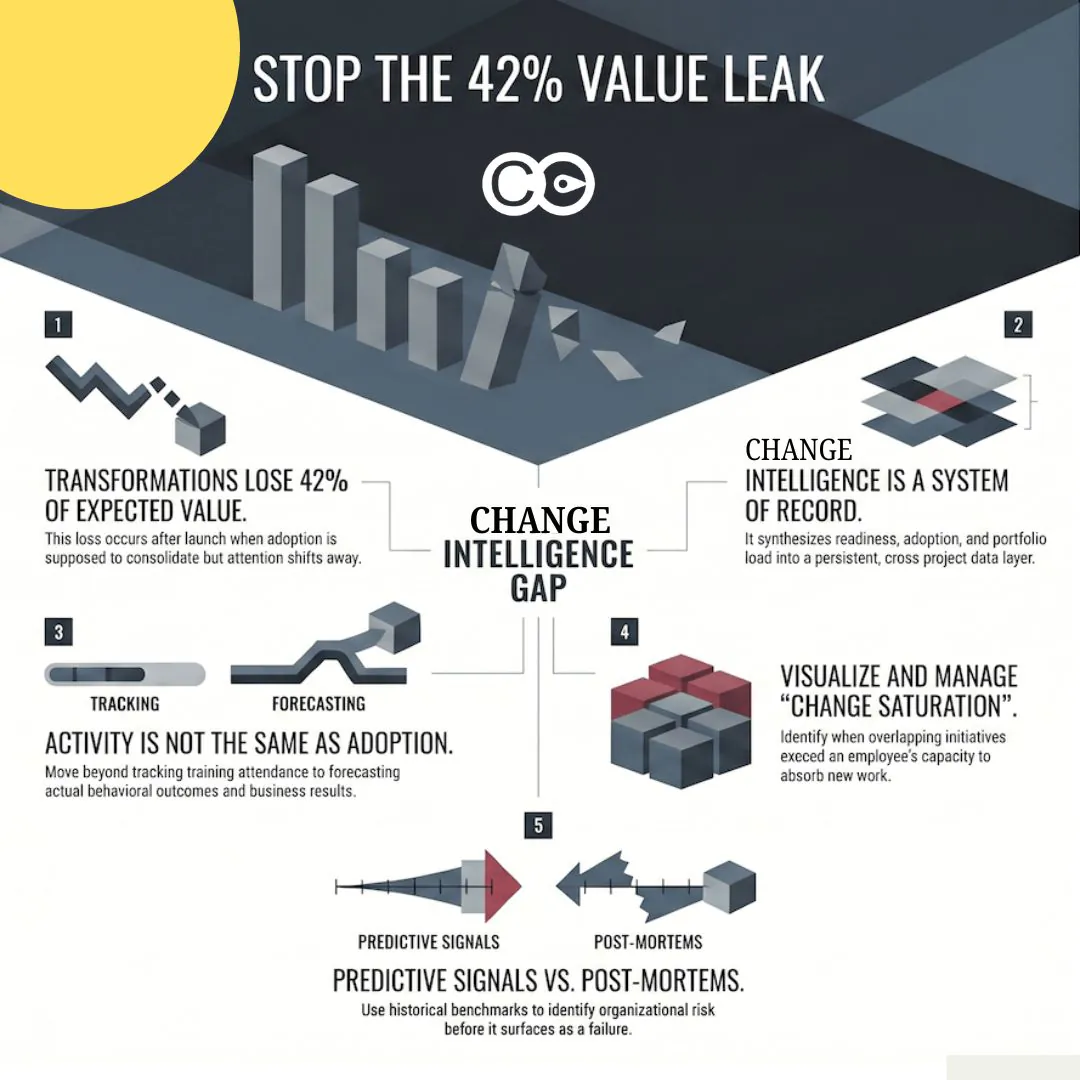
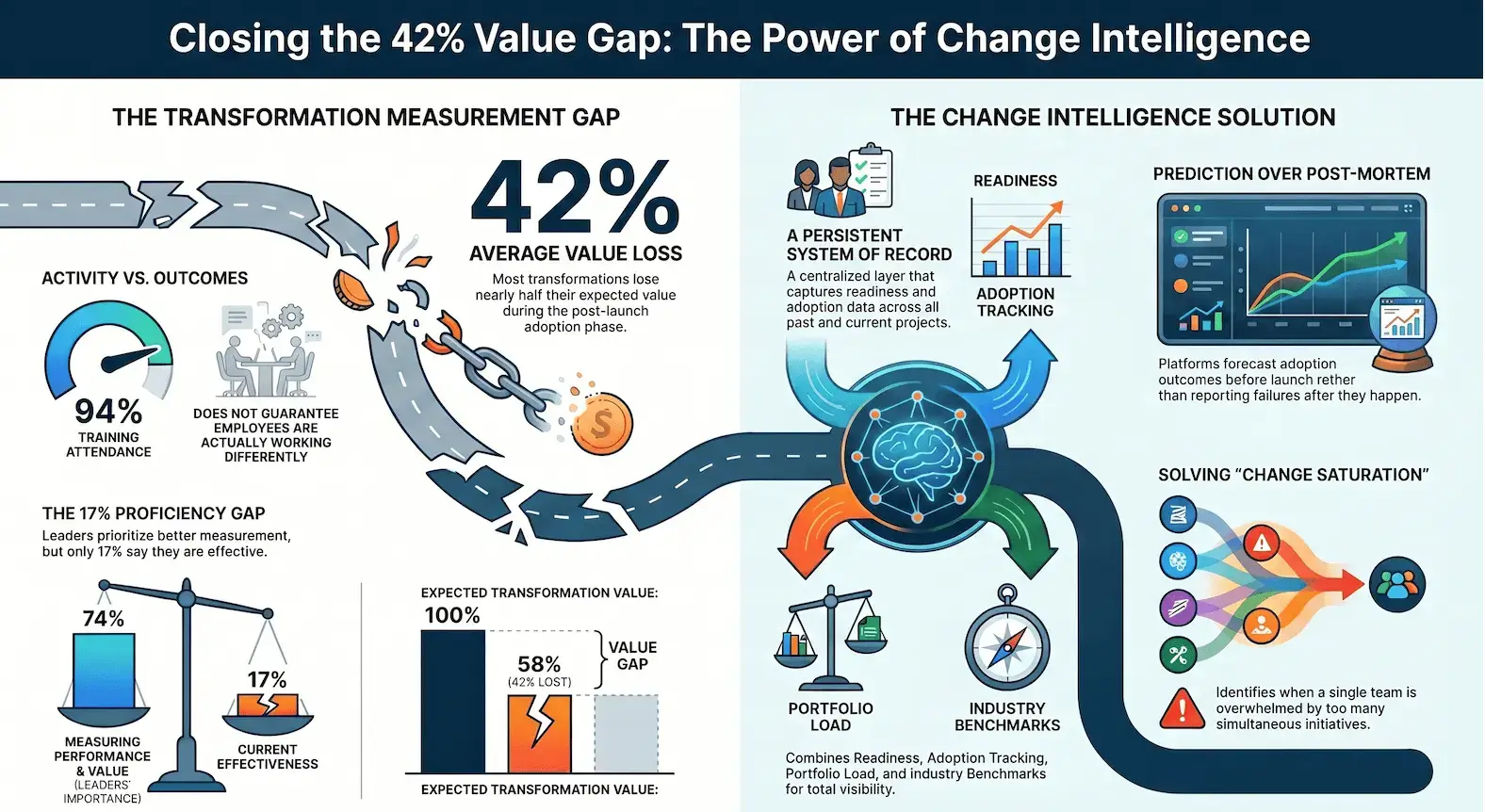
McKinsey’s research on transformation practice puts it plainly: “the tool kit for managing change is outdated”, and organisations need new tools, skills, and methods to navigate the reality of running multiple transformations simultaneously. The same research found that large-scale transformations lose, on average, 42% of their expected value in their later phases. Not at the point of design. After launch, during the period when adoption is supposed to be consolidating, and when most organisations have already stopped paying close attention.
That 42% is not a design problem. It is an intelligence problem.
A change intelligence platform is a category of software that solves it. It synthesises readiness data, adoption tracking, portfolio load, and benchmark comparisons into a persistent, cross-portfolio intelligence layer that forecasts outcomes, identifies organisational and business risk before it surfaces, and automates the analytical work that currently consumes a practitioner’s week. This article explains what that means in practice, what separates it from every other tool in a transformation team’s stack, and how to assess whether your organisation is ready to make the shift.
The measurement gap that silently erodes transformation value
Deloitte’s 2024 Global Human Capital Trends survey, drawing on responses from 14,000 business and HR leaders across 95 countries, found that 74% of respondents rated finding better ways to measure worker performance and value as very or critically important. Only 17% said their organisation was actually effective at evaluating that value beyond tracking activities and outputs.
Read that again: three in four leaders consider better performance measurement a critical priority, and fewer than one in five have any real capability to do it.
This measurement gap sits at the heart of why transformations lose value in the phases after launch. Organisations track what they are delivering. They rarely track whether the people on the receiving end are genuinely adopting what has been built. McKinsey has identified a consistent pattern across failing transformations: teams focus on activity-based plans that show progress, but rarely on the business outcomes those plans are meant to produce. Programme leaders can tell you that training attendance hit 94%. They struggle to tell you whether the target population is actually working differently.
A change intelligence platform is, at its core, the answer to that gap. It moves the measurement frame from activity to outcomes, and it does so continuously, across the entire portfolio, not just for the initiative currently in the spotlight.
What a change intelligence platform actually is
A change intelligence platform is software built on a persistent, cross-portfolio data model that draws on multiple data streams to forecast outcomes, identify risk, and generate intelligence across the full change portfolio.
It combines two capabilities that currently exist separately in most organisations: a system of record for change (centralised, persistent, shared across projects and functions) and an intelligence engine (capable of producing forecasts, risk signals, and recommendations from that data, rather than just reporting what is already known).
The system of record dimension means every change initiative, past and current, contributes to a common organisational data layer. The intelligence dimension means that data is not just stored and reported, it is continuously synthesised to produce forward-looking signals. The outputs are not dashboard summaries of what happened last quarter. They are predictions about what is likely to happen next, and recommendations for what to do about it.
This is what separates a change intelligence platform from a more sophisticated spreadsheet, a project management tool, or a standalone AI assistant. The intelligence it produces is grounded in your organisation’s own data. It knows your history.
The four data streams that power genuine change intelligence
The quality of intelligence a platform can produce depends entirely on the quality and breadth of the data it draws on. Platforms in this category pull from four distinct inputs.
Readiness data
Readiness assessments measure how prepared a population is for a specific change at a specific point in time. Within a change intelligence platform, that data is not siloed per project and archived at go-live. It accumulates across time and across initiatives, building a readiness history that becomes a forecasting asset.
When you have readiness data from twelve previous system implementations, you can answer questions that are currently unanswerable: which functions consistently lag readiness targets for technology change? How long does it typically take the operations business unit to reach the threshold needed for confident go-live? What interventions, at what point in the cycle, have historically moved readiness scores most effectively in this organisation?
Each data point adds predictive value to every subsequent programme.
Adoption tracking
Adoption data, whether people have actually changed their behaviour rather than just attended training, is one of the most underinvested dimensions in change management. Most programmes measure activity (completions, attendance, survey responses) and treat that as a proxy for adoption. It is not.
When adoption is tracked as a distinct data stream, at a portfolio level and over time, the patterns that emerge are genuinely actionable. Which initiative types achieve sustained adoption in this organisation? Which populations show strong initial adoption that degrades without reinforcement? At what point in the change cycle do adoption curves typically plateau, and what has historically re-accelerated them? A platform that holds this history can turn a new programme’s adoption forecast from a hopeful estimate into a data-grounded projection.
Portfolio load and change saturation
This is the data type most organisations are entirely blind to, and it is the one that causes the most silent damage.
When multiple programmes are running simultaneously and targeting overlapping populations, the individual project view gives no signal that anything is wrong. Every programme looks healthy in its own RAG report. The portfolio view tells a completely different story. The same functional team can be simultaneously absorbing a new technology platform, a restructure, a new performance management process, and a compliance training rollout, with each project team confident their initiative is being well-managed, and no one with visibility over what the combination is doing to that team’s capacity to absorb any of it.
Benchmark data is what transforms internal measurements from descriptive to diagnostic. A readiness score of 61% means something very different if the benchmark for this initiative type at this programme stage is 72% than if it is 54%.
Access to benchmark comparisons, whether from the organisation’s own historical data or from industry-comparable programmes, gives practitioners the ability to calibrate their situation accurately. It also makes the case for action credible: it is much easier to persuade a senior sponsor to resource an intervention when the data shows your readiness score is 13 points below where comparable organisations sit at the same milestone, than when you are reporting an internal number with no reference point.
From data to intelligence: forecasting, prediction, and risk identification
When these four data streams are held in a persistent, cross-portfolio system, the intelligence they produce goes well beyond reporting. Three specific capabilities become possible that are genuinely difficult or impossible to replicate without the data layer.
Forecasting adoption outcomes. Rather than waiting to see whether adoption takes hold after go-live, a change intelligence platform generates forecasts before launch: given current readiness trajectory, portfolio load on the target group, and historical adoption curves for comparable programmes, what is the probability of meeting the adoption target by week eight? That is not a guess. It is a data-driven forecast that programme leaders can act on.
Predicting and surfacing organisational risk. Risk in transformation is usually identified retrospectively: adoption was lower than expected, the benefit realisation review shows the programme did not deliver. A change intelligence platform surfaces risk signals in advance: a group whose readiness score is below the threshold for a planned go-live date, a population whose combined change load is approaching the saturation point where adoption failure becomes likely, an initiative whose adoption curve is tracking significantly below historical patterns for this initiative type. These are predictive signals, not post-mortems.
Benchmark intelligence. Knowing how your organisation’s change performance compares with relevant benchmarks changes the quality of decisions made at every level. Programme teams calibrate their interventions against evidence rather than instinct. Portfolio leaders can identify which parts of the organisation are consistently strong at absorbing change and which are chronically under-resourced for it. Executives can see, in terms they recognise, whether the organisation is building genuine change capability over time.
The following are examples of questions a change intelligence platform can answer that no other tool in the typical change practitioner’s stack can reliably address:
Given current readiness and adoption data, what is the forecast adoption rate at week twelve for this initiative?
Which populations are currently at or approaching change saturation across the portfolio?
How does our typical readiness trajectory for technology change compare with our benchmark, and where do we habitually fall behind?
Based on our portfolio history, which planned Q3 launch carries the higher adoption risk if launched simultaneously with the current programme?
What pattern of reinforcement activities has historically been most effective in re-accelerating adoption in this functional group?
Why AI in silo cannot answer these questions
There is a version of AI in change management that is genuinely productive: using a large language model to draft communications, build change plans, summarise stakeholder notes, generate impact assessment frameworks. Prosci’s 2024 research found that more than half of change professionals were already using AI tools regularly. That adoption is not the problem.
The problem is treating general-purpose AI as a substitute for a data-grounded intelligence layer, when the two are doing fundamentally different things.
When a change practitioner prompts a general-purpose AI tool, they are asking it to reason about a situation it does not actually know. The model has no access to your readiness survey history. It does not know that the operations function in your organisation has historically required seven weeks longer than planned to reach technology readiness thresholds. It does not know that the current portfolio has three major programmes all targeting the same 400-person business unit in Q3. It cannot see that your adoption curves for mandatory compliance change consistently plateau at 69% without a specific type of reinforcement in weeks five to seven.
Your organisational data knows all of that. A change intelligence platform is what makes it possible for AI to reason from that data rather than from generic patterns, and that distinction is the difference between advice that sounds reasonable and intelligence that is actually specific to your situation.
Automation: from analytical grind to decision-making
A change intelligence platform does not only produce better intelligence. It removes the manual analytical work required to produce any portfolio-level view at all.
Senior change practitioners regularly spend significant time on tasks that are fundamentally data processing: consolidating stakeholder registers from multiple project spreadsheets, aggregating impact data across programmes into a portfolio view, pulling readiness reports from separate survey exports, tracking adoption metrics across a dozen workstreams. This work is important. It is also time-consuming, error-prone when done manually, and a poor use of people who were hired for their judgement, not their spreadsheet skills.
Automation in a change intelligence platform shifts where that time goes. Impact assessments generate automatically as new initiatives are added. Readiness reporting is produced from live data on demand. Portfolio-level capacity calculations update in real time as timelines shift. Risk flags surface without anyone running a manual cross-initiative analysis.
The practical effect is a fundamental shift in how change teams work: less time on data compilation, more time on interpretation, advocacy, and the high-judgement work that actually moves the needle on adoption.
Using digital tools to build change portfolio intelligence
Change Compass is one of the most established platforms in the change intelligence category. It provides the persistent cross-portfolio data model, multi-stream data inputs spanning readiness, adoption, and portfolio load, benchmark intelligence, AI-assisted forecasting and risk identification, and the automation that eliminates manual analytical grind. For transformation leaders and PMOs managing complex, high-volume change portfolios, it is the infrastructure layer that makes the shift from activity reporting to intelligence-led decision-making operationally viable.
Where the shift actually starts
The case for a change intelligence platform is ultimately a business case. Transformation programmes fail to realise their intended value not because they were poorly designed, but because the people dimension of change is managed on incomplete, delayed, and fragmented data. McKinsey’s research showing that large-scale transformations lose an average of 42% of expected value in the phases after launch is a direct description of what happens when the intelligence gap is not closed.
The shift starts with a decision to treat change data as an organisational asset rather than a project artefact: something that should be captured consistently, held persistently, and used to make decisions across the portfolio rather than discarded when each project closes.
From that decision, the rest follows: a shared data model, consistent measurement of readiness and adoption, portfolio-level visibility, and eventually, the forecasting and prediction capabilities that transform change management from a reactive discipline into a proactive one. That is what a change intelligence platform makes possible. And for any organisation running significant transformation at scale, it is the capability gap that matters most.
A change intelligence platform is software that synthesises readiness data, adoption tracking, portfolio change load, and benchmark comparisons into a persistent, cross-portfolio intelligence layer. It forecasts adoption outcomes, identifies organisational and business risk before it surfaces, and automates the analytical work that currently consumes change practitioners’ time. Unlike project management tools or standalone AI assistants, it operates on your organisation’s own historical data to produce intelligence specific to your context.
How is a change intelligence platform different from a project management tool?
Project management tools track the delivery of work: tasks, milestones, budgets, and timelines. A change intelligence platform tracks the impact of that work on the people who must adopt it, and forecasts whether adoption is likely to succeed based on readiness data, current portfolio load, and historical performance patterns. The two are complementary: project management manages what is being built; change intelligence manages whether it will land.
What data does a change intelligence platform draw on?
The most capable platforms draw on four data types: readiness assessment data, adoption tracking data, portfolio load data (the cumulative change burden across all concurrent initiatives), and benchmark data for comparison against historical or industry-relevant reference points. Together, these inputs make forecasting and predictive risk identification possible in ways no single-initiative tool can replicate.
How is a change intelligence platform different from using AI for change management?
General-purpose AI tools can accelerate many tasks but operate without access to your organisational data. When prompted, they reason from generic patterns, not from your organisation’s change history, readiness trends, or adoption benchmarks. A change intelligence platform uses AI that is grounded in your actual portfolio data: the forecasts and risk signals it produces are specific to your organisation, not derived from generalised models.
Which organisations benefit most from a change intelligence platform?
Organisations running ten or more significant concurrent change initiatives, or those with a history of post-go-live adoption failure, missed benefit realisation targets, or high change fatigue, are typically the strongest candidates. PMOs leading enterprise transformation programmes, and HR functions managing large-scale workforce transitions, see the most immediate value from the move to intelligence-led change portfolio management.
We use cookies to improve your experience and understand site use. Marketing cookies stay off until you accept, and in the EU, UK and Switzerland analytics does too. Cookie Policy.
Strictly necessary
Required for the site to work: security, load balancing, and remembering your choices. These cannot be switched off.
Always active
Analytics
Google Analytics and similar, so we can see which pages are useful and where visitors get stuck. Aggregated, never sold.
Marketing
Used to measure campaigns and show relevant content on other platforms such as LinkedIn.