Measuring change is no longer a nice to have. It’s a must-have for a lot of organisations. A lot of stakeholders are now demanding to see and understand what is happening in the world of change. With the enhanced volume of change and therefore the increased investment made by the organisations, it’s no wonder.
Why are stakeholders demanding to see change data?
When we look across the room amongst the various disciplines, data forms an integral part of any function. Finance – tick. HR – tick, yes pretty much all aspects of people are tracked and reported. Operations – tick, as we have all types of performance KPIs and efficiency indicators. Technology – tick, since every part of technology can easily be measured and reported. Marketing – tick, as marketing outcomes are tied to revenue and customer sentiments.
With Covid it is even more the case that data is integral. We can no longer ‘walk the factory’ to sense what is happening. To see what is happening and what is going to happen stakeholders revert to data. In our virtual working environment, stakeholders require a constant dashboard of data to track how things are progressing.
Why is measuring change not an activity?
In the past it used to be that measuring change is only something you do in a project when you want to see if stakeholders are ready for the change. No more. Most organisations have a multitude of changes running concurrently. There is no choice to select 1 or 2 changes to roll out. With significant business challenges, most organisations are finding that running with multiple changes is the norm.
With multiple changes, increased stakeholder demands and appetite, measuring change is no longer just an activity. Measuring change takes a set of structured routines. It requires effective governance design. It takes experience and analytical expertise. Most of all, it is not a once-off event, it is a continual building of organisational muscle and capability. We are heading into the world of change analytics capability.
What is change analytics capability and how do I attain this?
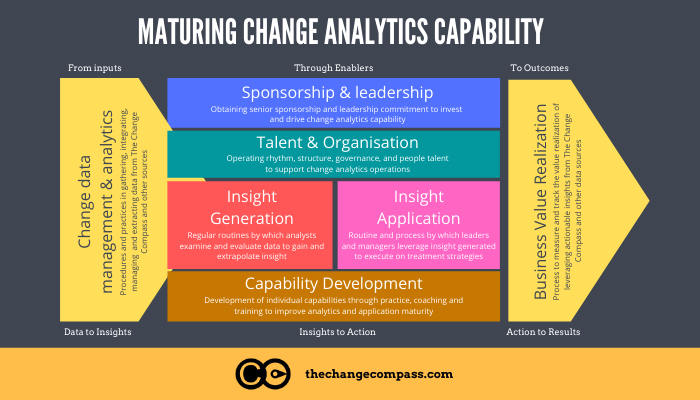
Here are 7 core components of building and maturing change analytics capability:
1. Establishing change data management procedures and practices
This is about setting up the right steps in place so that change data can be identified, collected, and documented. This includes identifying the types of change data you would like to collect and how to go about collecting them. It will be easier to start with the core set of data required and then build from these as needed. This will reduce the risk of overwhelming your stakeholders.
After the right metrics and collection channels have been identified then it’s about building the regular routines to collect and document the metrics.
2. Sponsorship and leadership of change analytics
To really reap the value of change analytics you will need to gain the blessing and sponsorship of your leaders. Well, at least in time. In the beginning, you may need some time to come up with compelling data that tell the story that you want them to before you show your leaders. Eventually, without strong leadership buy-in, change data will not be effectively leveraged to make business decisions.
Getting your leaders’ blessing isn’t just a verbal exercise. It means that they are signing-up to regularly review, discuss and utilise change data to realise business value.
3. Build talent and organisation to support change analytics
Think about the various stakeholders and what you need them to understand in terms of change data. The way you educate stakeholders will be different to how you educate operations managers or the PMO. Plot out how you plan to help them get familiar with change data. Do you need particular roles to support data analysis? Is it a Change Analyst who is focused on the regular upkeep and consolidation of change data? What roles do you need other team members to play?
4. Insight generation
With a full set of change data infront of you, it’s now time to dive into them to generate insights. What is the data telling you? How do they support other data sources to form a clear picture of what is happening in the workforce? Is the data accurate and updated? Generating insights from the data takes skills and experience. It takes the ability to integrate different sources of data outside of change data themselves.
5. Insight application
This is about setting up the right routines and processes so that any insights generated may be discussed and applied. It could be through various governance forums, leadership or planning meetings that insights are shared and socialised. An integral part of this step is applying the insight by making business decisions. For example, do we delay the initiative roll out or invest more to support leaders? Are there reasons for us to speed up roll out to support the workforce?
6. Change analytics capability development
Change analytics is a capability.
With good change data emerging, you also need to have the right people with the right skills to collect, process and interpret the data. You may also want to think about which teams need what analytical skills. Do you have people in the team who are sufficiently analytical and data-oriented? Do they know how to interpret the data to form trends and predictions?
You may want to think about organising capability sessions or training to strengthen data analysis skills. Are there members in the different governance bodies that need support to be more confident in using change data?
7. Realising business value through change analytics
The last part of the equation is realising business value through change analytics. This is about tracking and documenting the value realised through using change analytics. It could include incidents where the business decision made has lead to significant risk reduction or operations protection. It could be enhanced leadership confidence mitigating risks in negative customer experience. Tracking value generated is critical to make clear to stakeholders the value of the overall investment.
If you found this article useful please share.
Do you have questions on measuring change for your organisation? Ping us on our chat.
Change Management outcome is the holy grail, and virtually all organisations are undergoing change. Now more than ever, companies are challenged with multiple layers of driving change simultaneously. What is applicable in this situation is not about a particular methodology of implementing a change program. It is all about implementing simultaneous changes, at the same time. There is no luxury of just focusing on one change at a time, the result of competitive, industry, and environmental challenges.
As change practitioners we work closely with our colleagues in Operations to get ready for, implement, and fully embed changes. So how do our colleagues in operations view and manage change initiatives?
Operations as a function is focused on managing performance and delivery to ensure that the business runs smoothly, with little disruptions, and that performance measures are achieved. Operations is focused on resource management, efficiency, and achieving the various operational indicators whether it’s customer satisfaction, turn-around time, average handling time, or cost target.
When times are hectic and a lot is going on with multiple change initiatives, the key focus for Operations is on managing people’s capacity. Key questions would be “Do we have sufficient time to cater for the various changes?”, and “Will we exceed our change saturation level?”. This is a critical question to answer since the business still needs to run and deliver services without negative change disruptions.
From an Operations planning perspective ‘change capacity‘ is often reduced to the time element, especially those impacting frontline staff.
For example:
What are the times required to reschedule the call centre consultants off the phone to attend training?
How much time is required in the team meeting agenda to outline the changes that are being rolled out?
What is the time involvement of change champions?
Though these are all critical questions clear answers will help Operations plan better to face multiple changes. However, this is not adequate. There is more to planning for multiple changes than just focusing on the time element.
Using the lego analogy to manage multiple changes
We all know LEGO as kids. To build a car we start one brick at a time and see how we go. We experiment with different colours, shapes, and sizes. We make do with the bricks we have and use our imagination to come up with what a car would look like. Sometimes we get stuck and we may need to tweak our bricks a little, or sometimes start from scratch.
It is the same as implementing change initiatives. In order to take people along the journey, we implement a series of activities and interventions so that our impacted stakeholders are aware, ready, committed, and embed the change. The design on the change journey is the process of determining what LEGO bricks to choose. There is no shortcut. It is not possible to build a building without each necessary brick to raise the building up. In implementing change, we also need to lay out each step in engaging our stakeholders.
McKinsey studies over decades have told us that one of the most critical factors to focus on in ensuring change outcome success is clear organisation-wide ownership and commitment to change across all levels. This means that when we design each change brick we need to ensure we target every level of impacted stakeholders.
For example:
Team Leaders: How often do we want Team Leaders to talk about the changes to their teams before the rollout? What content do we want them to use? Do they know how to translate the message in a way that resonates? Do we want them to tell compelling stories that talk to the what, why, and how of the change?
Managers: How are managers made accountable? What metrics are they accountable for? What mediums do we want them to use to engage their teams? What are the consequences of not achieving the outcomes?
Senior Managers: Through what mediums do we expect senior managers to engage their teams about the changes? How do we ensure that they are personally accountable for the success of the change? How are they involved to ensure they own the change?
Looking at the above you can see that for complex change there may need to be a lot of bricks in place to ensure the change outcome is successful!
Going back to the issue of facing into multiple changes, how do we play around with the bricks to ensure that multiple changes are successful? The same way that we play with LEGO bricks!
Look at the colours of the bricks. Do certain colours belong together? When we look across different initiatives, are there similar or common behaviours that can be better linked together to tell a compelling story? Do they support the same strategy? Can there be a joint campaign for these changes?
Is the overall LEGO structure going to be intact? What are the impacts of the various changes happening at the same time in terms of focus, performance and change outcome? Have we exceeded the likely ‘mental capacity’ for people to stay focused on a core set of changes at any one time? Will the pieced-together structure collapse due to having too many elements?
Look at the sizes of the LEGO structures. During implementation when we have both larger and smaller initiatives being executed at the same time, will the larger ones overshadow the smaller ones? If so what are the risks if any?
Re-jig or re-build parts of the LEGO structure as needed to see what it looks like. In a situation where we want to see what the changes look like before we action it, it makes sense to visualise what would happen if we move timelines or change implementation tactics
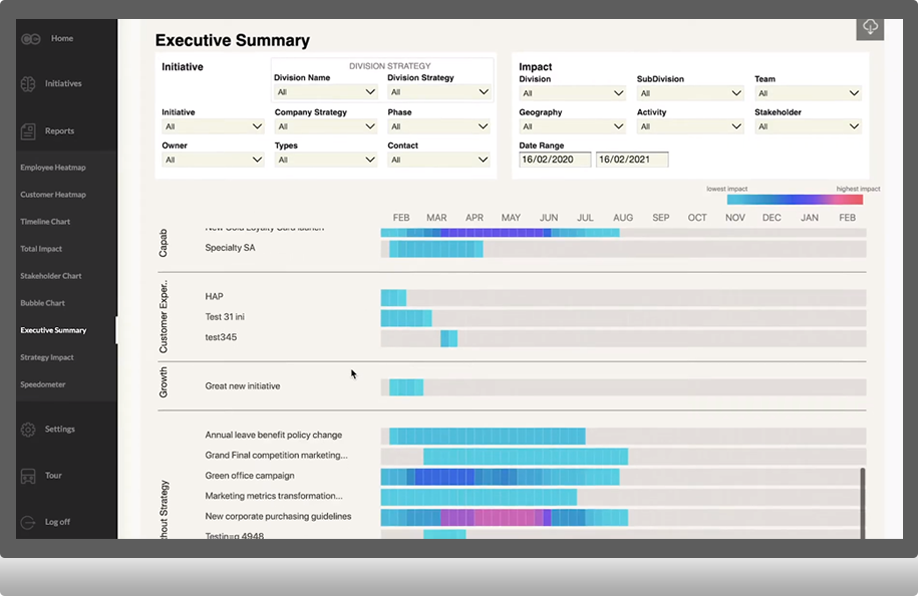
Example of data visualisation of ‘re-jigging’ change implementation timeline with The Change Compass using different scenarios.
Just like in building LEGO, for change initiatives we need to be agile and be flexible enough to play with and visualise what the change outcome could look like before pulling the trigger. We also need to be able to tweak as we go and adjust our change approaches as needed. In facing the multitude of changes that the organisation needs to be successful, we also need to be able to play with different implementation scenarios to picture how things will look like. Each brick needs to be carefully laid to reach the overall outcome.
Careful consideration also needs to be how all the bricks connect together – the analogy that the change outcomes across initiatives can be determined by how we’ve pieced together various pieces of LEGO for them to make sense, and result in the ownership and commitment of stakeholders.
Turning change chaos into competitive advantage: How a leading insurer mastered peak change with The Change Compass
In today’s fast-paced business environment, change is the only constant – especially in highly regulated, customer-facing sectors like insurance. But what if, instead of being a source of risk, organisational change could become your greatest lever for business performance? That’s the journey one major insurer embarked on, and the results are a blueprint for transformation-driven success.
The perfect storm: Why peak change periods are so challenging
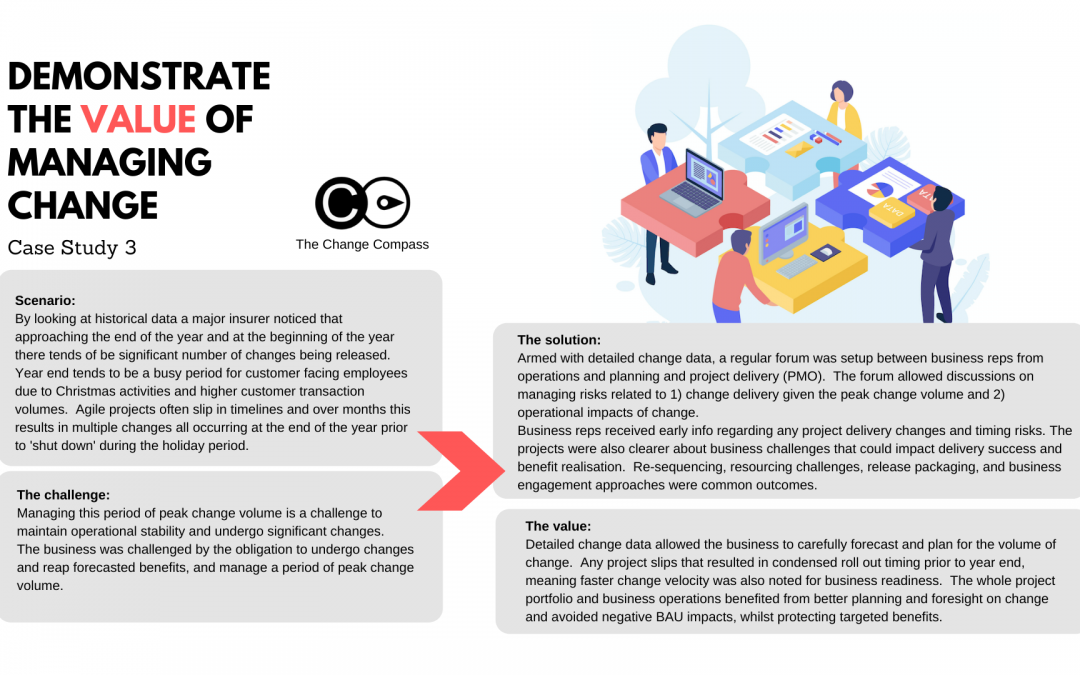
Every year, as the calendar ticks towards the December-January holiday season, this insurer encountered a familiar scenario:
Customer-facing employees were under pressure, fielding increased transactions and supporting customers through holidays.
Multiple agile projects, each designed to drive innovation and process improvement, were slipping in timelines – as often happens in complex transformation portfolios.
The result? A flood of change “went live” simultaneously just before the company-wide shutdown.
For business leaders, this created a daunting balancing act: realising the benefits of innovation, while not overwhelming frontline teams or sacrificing operational stability. Missed deadlines or last-minute rollouts could lead to service disruptions, employee burnout, lost revenue, and eroded customer trust.
The breakthrough: Data-powered collaboration
So how did this insurer escape the costly cycle of end-of-year chaos? With The Change Compass, they turned data into their superpower.
The organisation established a regular, cross-functional forum that brought together operations, planning, and project delivery (PMO). But this wasn’t just another meeting – this was a command centre built around live, detailed change data.
Key transformations in approach:
Shared Early Warning System:
Project delays, resource bottlenecks, and clustered change activity were visible weeks or months in advance, not discovered at the last minute.
Intelligent Risk Management:
The team could scenario-plan, not just react, to delivery risks and operational pinch points.
Business-Driven Dialogue:
Operations leaders voiced customer realities and BAU needs, shaping project timelines for true business readiness.
Real-world results: From fire-fighting to future-proofing
Thanks to this new level of insight and collaboration, the insurer fundamentally changed how it managed periods of peak change. Here’s what set them apart:
1. Proactive Forecasting and Portfolio Planning
The company moved from “gut feel” to data-backed change forecasts, mapping exactly when and where change would impact operations.
No more scrambling: resource plans, communications, and business readiness activities were optimised for actual risks and opportunities.
2. Collaborative Course Correction
Instead of viewing project slippage as a crisis, the PMO could re-sequence initiatives, redesign release packages, or reallocate teams before risks materialised.
The forum fostered joint problem-solving – turning silos into a unified change-fighting force.
3. Protecting Business Value
With fewer surprises and less disruption, business units delivered on promised benefits even during high-change windows.
Change velocity was matched by business readiness, preserving customer experience and employee morale – even during intense periods.
Key value metrics achieved
Savings from BAU cost spike of $1+Mil per annum from change peak periods
Protection from productivity dips of 30-45% from change disruptions
Prevention of customer churn of $1+Mil per annum from frontline operations disruptions
Additional 30-50% gain in change benefits realised through well-coordinated portfolio deployment
Why this matters: Making change your strategic weapon
The lesson is clear: Change doesn’t have to feel risky, unpredictable, or exhausting. With The Change Compass:
You gain clarity – see the full picture of what’s changing, when, and how it affects your people and customers.
You empower teams – from PMO to frontline operations, everyone acts with foresight and confidence, not crisis mode.
You realise more value – initiatives deliver lasting outcomes, not headaches or half-finished results.
This is more than a software platform – it’s a new operating model for change-centric businesses.
Going Beyond “Surviving Change” to Leading Your Market
Imagine if your organisation could:
Anticipate and neutralise risks long before they disrupt business
Execute more strategic projects, faster – without burning out staff or diluting customer experience
Align every level of the business around a shared, data-driven roadmap for change
That’s what The Change Compass unlocks. It’s already helping leading insurers and other organisations turn the “messiness” of change into disciplined, high-impact action – and giving them a real edge on competitors still stuck in fire-fighting mode.
Ready to step into change leadership using data?
If you’re tired of peak periods bringing more anxiety than opportunity, it’s time to see what’s possible when you combine collaboration, smart forums, and powerful change analytics.
Try The Change Compass and:
Put yourself in the driver’s seat for every change, no matter how complex.
Rally your teams around a data-powered playbook for business performance.
Experience smoother, smarter transformation—365 days a year.
Don’t just survive the next wave of change – lead it with data-backed confidence, outperform your industry, and empower your teams. The Change Compass is ready to help you turn every challenge into achievement.
Change management has transformed dramatically over decades, evolving from reactive crisis responses to sophisticated, data-driven strategies that predict and shape organizational transformation. Understanding this evolution equips practitioners with insights to navigate modern complexities like digital acceleration, regulatory pressures, and workforce expectations.
This guide traces key milestones in change management development, examines the shift toward strategic data integration, and explores emerging AI-driven capabilities that redefine practitioner roles. Practitioners gain practical frameworks to apply these insights in today’s fast-paced environments.
How Has Change Management Evolved Over Time?
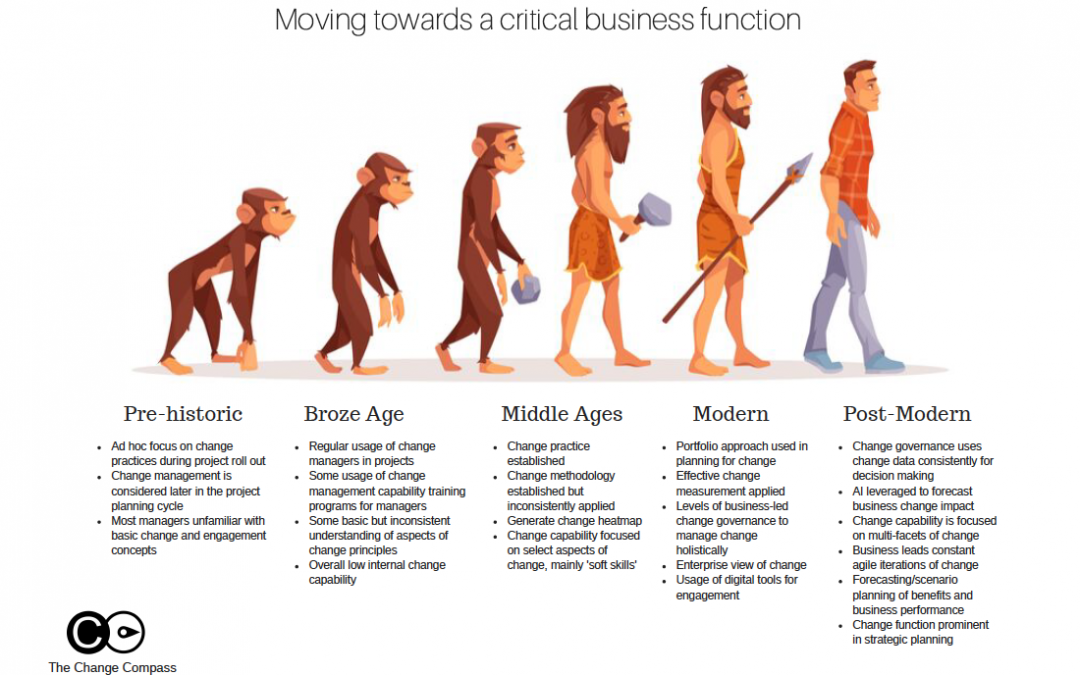
Change management began as structured responses to organizational disruption but matured into proactive disciplines leveraging data and technology. Early approaches focused on resistance management; modern practices emphasize prediction, measurement, and continuous adaptation.
Key evolutionary phases include:
1950s-1970s: Foundations in Behavioural Science Kurt Lewin’s three-stage model (unfreeze-change-refreeze) established foundational principles. Focus remained on human psychology and overcoming resistance through communication.
1980s-1990s: Structured Frameworks Emerge John Kotter’s 8-step process and Prosci’s ADKAR model provided systematic approaches. Emphasis shifted to leadership alignment and stakeholder engagement.
2000s: Enterprise Integration Change management embedded within project management methodologies like PMI and Agile. Organizations recognized change as a distinct discipline requiring dedicated resources.
2010s-Present: Data and Analytics Integration Rise of change portfolio management and adoption metrics tracking. Practitioners began measuring outcomes beyond activities, using dashboards for real-time insights.
This progression reflects growing recognition that successful change requires both human-centered approaches and rigorous measurement.
What Drove the Shift to Strategic Change Management?
Several forces accelerated change management’s maturation:
Digital Transformation Pressures
Rapid technology adoption created simultaneous change waves across organizations. Traditional sequential change approaches proved inadequate for multi-project environments.
Regulatory and Compliance Demands
Increasing scrutiny required demonstrable evidence of change adoption and risk mitigation, pushing practitioners toward measurable outcomes.
Workforce Expectations
Millennial and Gen Z entrants demanded transparency, purpose alignment, and visible progress tracking in change initiatives.
Portfolio Complexity
Organizations managing 10+ concurrent changes needed centralized oversight, leading to change portfolio management practices.
Measurement Maturity
Advancements in HR analytics and adoption metrics enabled practitioners to demonstrate ROI and secure executive support.
These pressures transformed change management from a support function to a strategic capability directly influencing business outcomes.
The Rise of Data-Driven Change Management
Modern change management integrates operational data, adoption metrics, and predictive analytics to guide decision-making.
Strategic Change Data Management
Organizations now maintain centralized repositories tracking change saturation, adoption rates, and portfolio capacity. This enables executives to balance change demands against organizational readiness.
Data reveals change overlaps, capacity constraints, and high-risk initiatives. Practitioners allocate resources strategically rather than reactively.
Predictive Capacity Planning
Analytics forecast change bandwidth by department and role, preventing saturation and burnout during transformation waves.
This data foundation positions change management as a value-creating function rather than cost centre.
Implementation Frameworks and Best Practices in Modern Change Management
With the evolution of change management into a data-driven discipline, implementation frameworks have also advanced to incorporate strategic alignment, measurement, and agility.
Established Frameworks Adapted for Today’s Environment
Kotter’s 8-Step Process
This enduring framework continues to provide a roadmap for leading change, emphasising urgency creation, coalition building, vision communication, and consolidation of gains. Modern adaptations integrate data points at each step to monitor engagement and effectiveness.
Prosci ADKAR Model
The ADKAR model—Awareness, Desire, Knowledge, Ability, Reinforcement—remains influential for individual change adoption. Data from assessments aligned to each dimension now inform targeted interventions.
Agile Change Management
Agile methodologies bring iterative feedback loops and rapid adaptation, suited for fluid business environments. Incorporating continuous data collection and analytics allows agile teams to pivot change strategies responsively.
Emerging Best Practices
Integrate Change Management Early in Project Lifecycles: Position change activities alongside project planning for seamless alignment and impact maximisation.
Embed Data Streams for Real-Time Insights: Utilise adoption metrics, sentiment analysis, and feedback channels to guide decision-making dynamically.
Foster Cross-Functional Collaboration: Engage stakeholders and change agents across departments to build collective ownership.
Leverage Technology for Automation: Automate repetitive change management tasks such as communications, survey distribution, and reporting, freeing capacity for strategic priorities.
Prioritise Employee Experience: Tailor change approaches to diverse workforce needs, using data-driven personas and segmentation.
The Role of AI and Automation in Advancing Change Management
Artificial intelligence and automation are set to redefine how change practitioners operate, transforming strategic decision-making, engagement, and measurement.
AI-Powered Predictive Analytics
By analysing historic change data combined with organisational variables, AI models predict likely resistance points, adoption rates, and saturation thresholds. These insights enable pre-emptive strategies designed to smooth transitions.
Automated Change Interventions
Chatbots and virtual assistants can deliver personalised communications, FAQs, and training modules at scale, maintaining consistent messaging and freeing practitioners’ time for higher-value activities.
Natural Language Processing (NLP) for Sentiment and Feedback Analysis
AI-driven sentiment analysis of employee feedback, surveys, and collaboration platforms identifies emerging issues and morale trends faster than traditional methods.
Intelligent Dashboarding
AI enhances dashboards by correlating disparate data, highlighting risks, and recommending intervention actions. Customisable alerts notify change leaders of critical deviations in real time.
Augmented Decision Support
Machine learning integrates diverse inputs—financial, operational, human factors—to support scenario planning and optimise change portfolios, particularly in complex environments.
Preparing Change Practitioners for the Future
The evolving change landscape requires practitioners to blend traditional soft skills with digital and analytical capabilities. Key skill enhancements include:
Continuous learning mindsets to adapt as technologies evolve.
Institutions and organisations should invest in upskilling programs and knowledge hubs supporting these competencies.
Key Takeaways for Change Practitioners
The evolution of change management offers clear guidance for practitioners navigating today’s complex landscape:
Embrace Data as a Strategic Asset
Shift from activity tracking to outcome measurement. Implement real-time adoption dashboards that correlate behaviours with business results, enabling proactive interventions.
Master Portfolio Management Discipline
Treat change as a finite resource. Establish governance processes to assess saturation, prioritise initiatives, and sequence delivery for maximum organisational capacity.
Build Cross-Functional Change Capabilities
Move beyond siloed project support. Embed change expertise within strategy, digital transformation, and HR functions for integrated execution.
Cultivate Continuous Learning Cultures
Position change practitioners as organisational learning facilitators. Use post-initiative reviews and trend analysis to build institutional knowledge.
Emerging Capabilities for Practitioners
AI-Augmented Decision Making
Leverage predictive models to forecast adoption risks and capacity constraints. Use sentiment analysis across communication channels to detect resistance patterns early.
Automation of Change Operations
Streamline repetitive tasks—status reporting, stakeholder mapping, communication scheduling—freeing capacity for strategic advisory roles.
Advanced Measurement Frameworks
Combine traditional metrics with micro-behaviour tracking and network analysis to understand influence patterns and adoption cascades.
Implementation Roadmap for Practitioners
Phase 1: Assessment and Foundation (0-3 Months)
Conduct change maturity assessment across frameworks and capabilities
Establish baseline adoption metrics for current portfolio
Map organisational change capacity by department and role
Build cross-functional change governance council
Phase 2: Data Integration and Optimisation (3-6 Months)
Deploy centralised change portfolio tracking system
Implement real-time dashboards with automated alerts
Launch pilot AI sentiment analysis on feedback channels
Standardise post-change review processes
Phase 3: Strategic Evolution (6-12 Months)
Embed predictive capacity planning in annual cycles
Scale successful automation across enterprise initiatives
Develop practitioner upskilling academy
Establish external benchmarking partnerships
Frequently Asked Questions (FAQ)
How has change management fundamentally evolved? From reactive resistance management to proactive, data-driven portfolio disciplines that predict capacity and measure sustainable adoption.
What are the most important data capabilities for change practitioners? Real-time adoption tracking, portfolio saturation analysis, predictive capacity modelling, and cross-initiative impact correlation.
How should organisations structure change governance? Cross-functional councils with executive sponsorship, portfolio prioritisation processes, and dedicated measurement functions.
What skills will define future change practitioners? Data analytics proficiency, AI tool fluency, portfolio strategy, systems thinking, and continuous learning facilitation.
Why is change portfolio management mission-critical now? Concurrent digital, regulatory, and cultural transformations overwhelm traditional approaches. Portfolio discipline prevents saturation and maximises ROI.
How do AI capabilities enhance change effectiveness? Predictive risk modelling, automated stakeholder engagement, real-time sentiment tracking, and intelligent resource allocation recommendations.
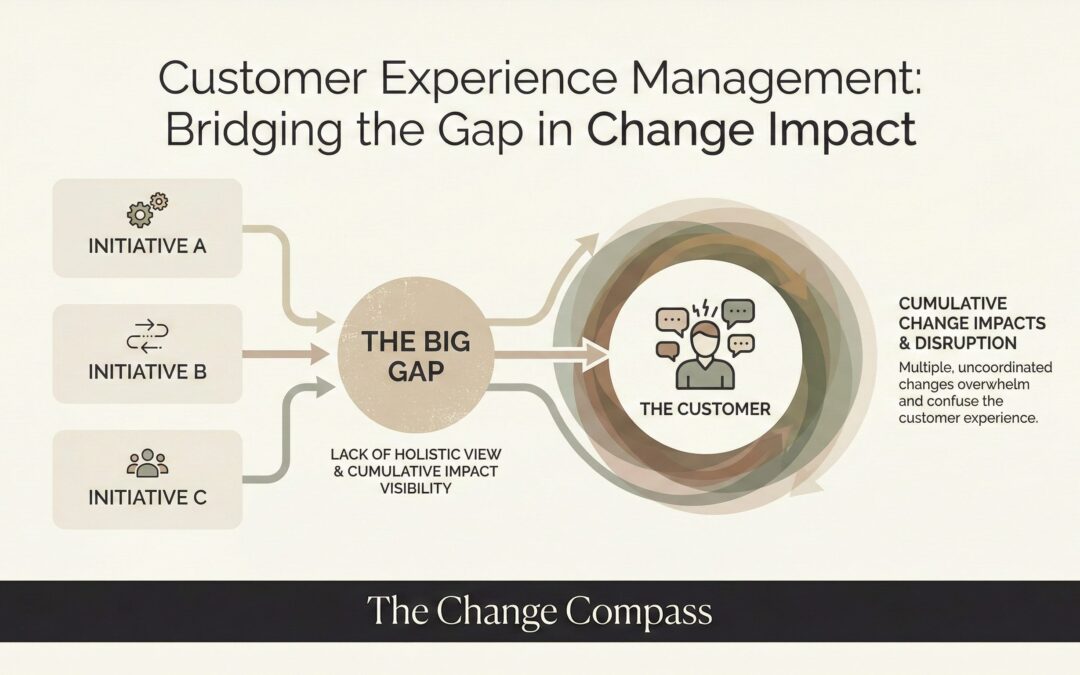
Customer experience management dominates strategic conversations across banking, utilities, telecoms, and retail. Companies invest heavily in CRM systems, digital channels, and customer journey mapping. Yet a fundamental gap persists: the lack of integrated visibility into how company-wide change initiatives shape customer perceptions.
This guide reveals why traditional approaches fall short, quantifies the risks of disconnected change efforts, and provides a practical roadmap for creating a true single view of the customer through change impact integration.
What Prevents Companies from Achieving a Single View of the Customer?
Recent research confirms persistent challenges in customer experience management. A 2024 Forrester study found 48% of enterprises still struggle with unified customer data across channels and departments. Similarly, Gartner reports 52% cite building cohesive new experiences as their top barrier.
The core issue lies beyond siloed CRM data. Companies lack visibility into the cumulative impact of concurrent initiatives—product changes, pricing adjustments, IT rollouts, regulatory communications—that collectively define customer reality.
Why Traditional CRM Approaches Fall Short
CRM systems excel at marketing automation, sales tracking, and contact centre efficiency. However, they capture only transactional interactions, missing the broader context of organisational change.
Traditional CRM Focus Limitations
Marketing campaign data
Sales conversion metrics
Service interaction logs
Customer segmentation profiles
These systems overlook how product updates, pricing shifts, or compliance communications alter customer perceptions between tracked touchpoints.
The Missing Piece: Change Impact Tracking
The critical gap involves mapping all customer-impacting initiatives into a unified view. This includes marketing campaigns plus operational changes affecting service delivery.
Change Initiatives Shaping Customer Experience
Product lifecycle changes (end-of-life, new features)
Pricing and billing adjustments
IT system rollouts impacting service access
Regulatory compliance communications
Employee training initiatives influencing service quality
Partner or supplier changes affecting delivery
Without this integrated picture, companies cannot anticipate cumulative customer confusion or frustration.
Traditional CRM vs Change Impact Data vs Integrated CX View
Data Source
Focus
Customer Insight
Strategic Value
CRM Systems
Marketing, sales, service transactions
Individual touchpoints
Tactical optimisation
Change Impact Data
Company initiatives affecting customers
Planned experience shifts
Risk anticipation
Integrated View
Combined datasets
Holistic customer reality
Strategic CX orchestration
This table illustrates why isolated CRM investments yield incomplete results.
Risks of Disconnected Change Initiatives
Without integrated change visibility, companies create conflicting customer signals that erode trust and satisfaction. Real-world examples illustrate the consequences.
Common Customer Confusion Scenarios
One department ends a credit card product while sales teams push aggressive uptake targets
IT rollout disrupts online banking while marketing promotes digital-first convenience
Pricing changes coincide with loyalty program promotions, confusing value messaging
Regulatory communications clash with personalised marketing campaigns
These disconnects compound across multiple initiatives, overwhelming customers.
Financial Impact of Poor CX Coordination
The stakes are substantial. Recent studies quantify the cost:
Forrester 2024: Companies lose $1,200+ per negative customer experience
Gartner 2025: 42% of telecom households report negative experiences from conflicting communications
McKinsey: Utilities face 28% churn risk from uncoordinated service disruptions
Cumulative impact across customer bases represents millions in lost revenue annually.
The Solution: Integrated Customer Change Impact Management
Create a unified view combining CRM data with change impact analytics for holistic CX orchestration.
Core Components of Integrated CX Visibility
Centralised Change Repository: Track all customer-impacting initiatives across departments
Customer Segmentation Mapping: Align change impacts with specific personas and journeys
Timing & Volume Analysis: Visualise change saturation by customer segment over time
Impact Correlation Engine: Link initiatives to expected CX outcomes and risks
Strategy Alignment Dashboard: Compare planned changes against customer experience goals
5 Strategic Benefits
Anticipate cumulative customer confusion before rollout
Optimise change sequencing to minimise disruption peaks
Align departmental initiatives with unified CX strategy
Quantify ROI from coordinated vs siloed change efforts
Enable proactive service recovery planning
Customer Change Impact Matrix Example
Customer Segment
Product Change
Pricing Shift
IT Rollout
Regulatory Comm.
Total Impact Score
Premium Banking
Medium
High
Low
Medium
High
Mass Market
Low
High
High
Low
High
Digital Native
High
Low
High
Low
High
This matrix reveals saturation risks by segment.
Implementation Roadmap for Integrated CX Change Management
Phase 1: Foundation (0-3 Months)
Inventory all customer-impacting initiatives across departments
Map initiatives to customer segments and journey touchpoints
Establish cross-functional CX governance council
Build baseline change impact repository
Phase 2: Integration (3-6 Months)
Connect change data with existing CRM/customer systems
Deploy change saturation dashboards by segment
Implement automated conflict detection alerts
Launch pilot optimisation for high-risk periods
Phase 3: Optimisation (6-12 Months)
Embed CX alignment reviews in initiative approval processes
Scale predictive impact modelling across portfolio
Establish continuous improvement feedback loops
Benchmark against industry CX leaders
Governance and Success Factors
Essential Governance Elements
Executive sponsorship with direct profit/loss accountability
Cross-departmental representation in change review forums
Standardised change impact assessment templates
Monthly portfolio saturation reporting to leadership
Critical Success Metrics
Reduction in customer confusion complaints (25% target)
Improved Net Promoter Score during change periods
30% faster issue resolution through proactive planning
Higher departmental collaboration scores
Frequently Asked Questions (FAQ)
What is the biggest gap in customer experience management? Lack of integrated visibility into how company-wide change initiatives collectively shape customer perceptions and experiences.
Why do CRM systems alone fail to deliver unified CX? CRM captures transactions but misses operational changes like product updates, pricing shifts, and IT rollouts that define customer reality.
How much do poor CX experiences cost companies? Recent studies show $1,200+ lost per negative experience, with millions annually across customer bases in banking and utilities.
What does integrated CX change management look like? Centralised change repositories, customer segmentation mapping, saturation dashboards, and strategy alignment analytics working together.
How do you identify customer change saturation risks? Use impact matrices showing concurrent initiatives by segment, highlighting high-risk periods needing sequencing adjustments.
What is the first step toward CX change integration? Conduct an inventory of all customer-impacting initiatives across departments to establish baseline visibility.