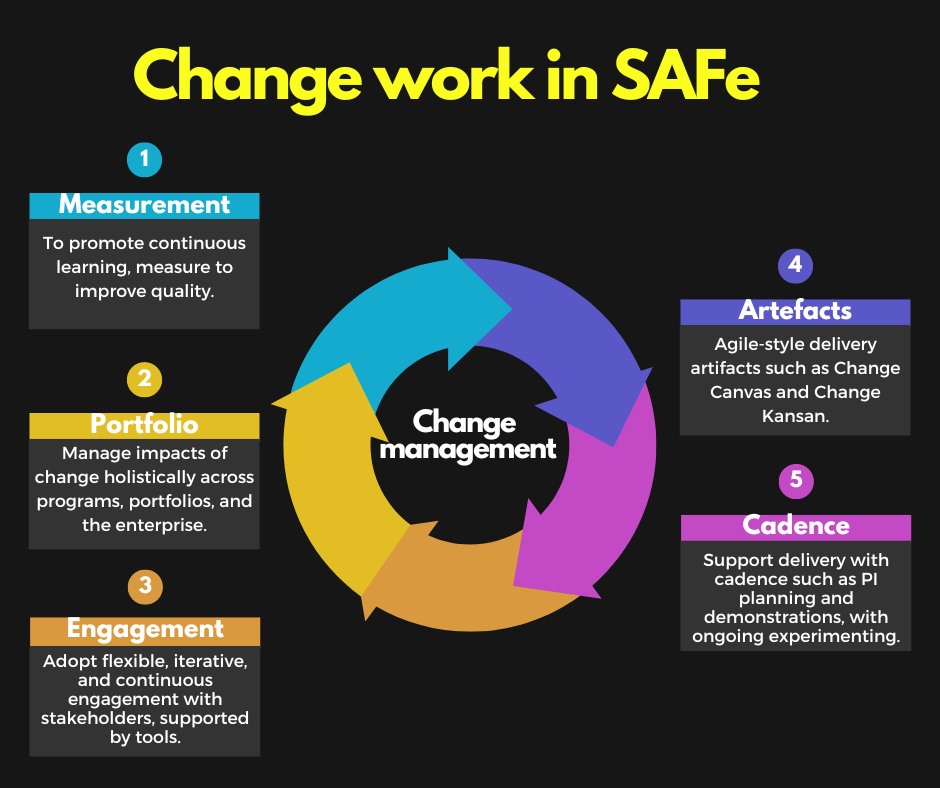
The need for organizations to remain flexible and responsive to market demands has never been more critical, and scaled agile (SAFe) provide the framework to achieve this. Integrating change management work with SAFe is essential for seamless product delivery but yet is not clearly articulated in literature. However, for agile product delivery to be successful, it must be supported by robust change management work steps. Those that not ensures that all stakeholders are aligned and engaged throughout the process and also that the consecutive changes delivered are adopted. Let’s explore how change managers can effectively integrate their approaches with scaled agile methodologies to enhance product delivery.
Understanding the Intersection of Change Management and Agile
Change management and agile methodologies both aim to facilitate successful project outcomes, but they approach this goal from different angles. Change management focuses on the people side of change, ensuring that stakeholders are prepared, equipped, and supported throughout the transition through to benefit realisation. Agile methodologies, on the other hand, emphasize iterative development, continuous feedback, and rapid adaptation to change.
Whilst SAFe acknowledges the importance of managing the people side of change and leading the change, it does not spell out how exactly this work should be integrated with the methodology in a detailed manner. References to change tends to be at a high level and focuses on communication and readiness activities.
What are key call outs of the SAFe methodology:
1) Lean-Agile Principles: SAFe is grounded in Lean-Agile principles such as building incrementally with fast, integrated learning cycles, basing milestones on objective evaluation, and making value flow without interruptions. These principles help ensure continuous improvement and adaptability
2) Organizational Agility: To remain competitive, enterprises must be agile. SAFe enhances organizational agility by fostering Lean-thinking people and Agile teams, promoting strategic agility, and implementing Lean business operations
3) Lean Portfolio Management: Aligns strategy and execution by applying Lean and systems thinking. It includes strategy and investment funding, Agile portfolio operations, and Lean governance to ensure that the portfolio is aligned and funded to meet business goals
4) Continuous Learning Culture: Encourages a set of values and practices that promote ongoing learning and improvement. This culture is crucial for adapting to changes and fostering innovation within the organization
5) Agile Teams: Agile teams in SAFe operate using methods like SAFe Scrum or SAFe Team Kanban. These teams are responsible for understanding customer needs, planning their work, and delivering value continuously through iterative processes
6) Built-in Quality: Emphasizes the importance of quality at all stages of development. Practices include shift-left testing, peer reviews, and automation to ensure high standards and reduce defects early in the process
7) Value Stream Management (VSM): Focuses on optimizing the flow of value across the entire portfolio. VSM helps organizations improve their value delivery processes by managing and monitoring value streams effectively (Scaled Agile Framework).
8) Lean-Agile Leadership: Leaders play a critical role in fostering a Lean-Agile mindset. They must model the values and principles of SAFe, provide guidance, and create an environment that supports Agile teams and continuous improvement
9) Decentralized Decision-Making: Promotes faster value delivery by empowering teams to make decisions locally. This reduces delays, enhances product development flow, and fosters innovation
10) Customer-Centric Approach: Agile teams are encouraged to maintain close collaboration with customers to understand their needs better and ensure that solutions deliver real value. Techniques like direct customer interaction and feedback loops are essential
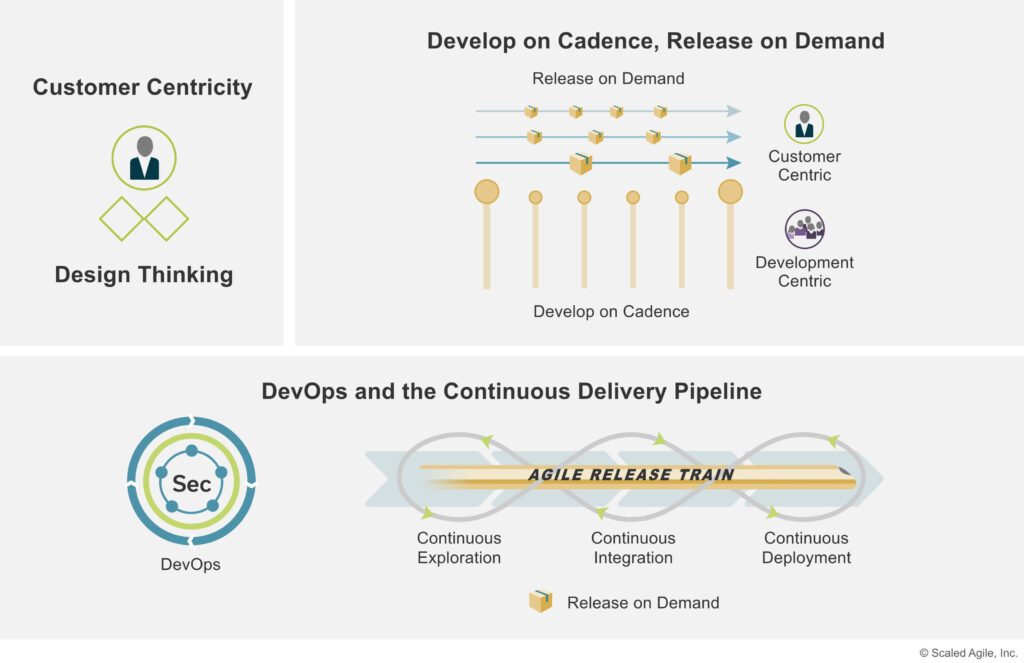
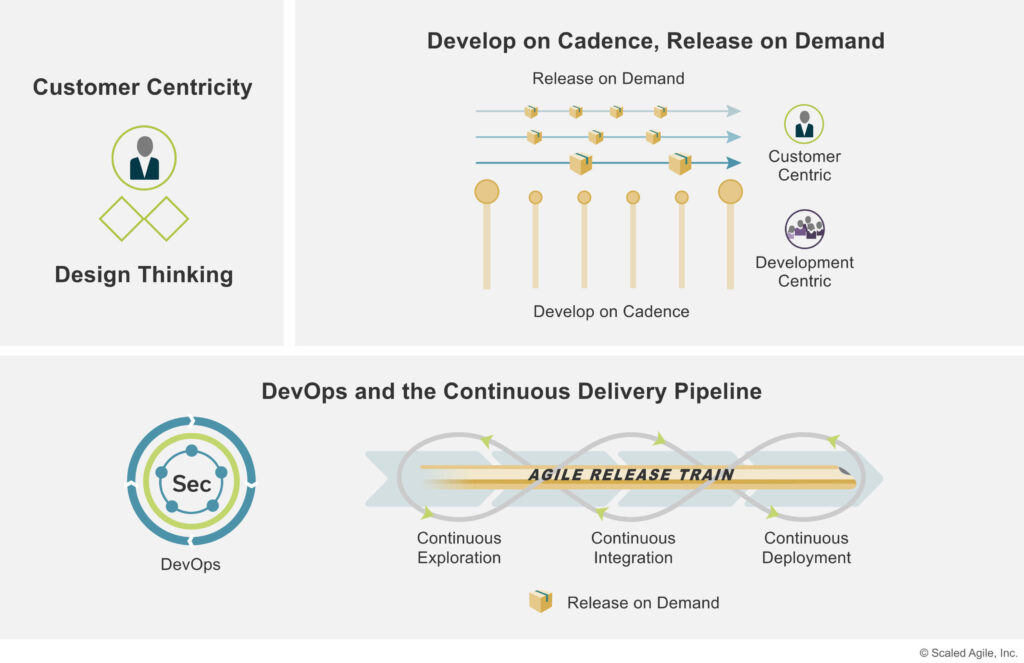
Below is a diagram from Scaled Agile Frameworks on key elements of a scaled agile product delivery framework.
Agile-Style Deliverable Artefacts
To support agile product delivery, change managers need to create agile-style deliverable artefacts early in the product delivery cycle. These artefacts serve as essential tools for aligning the team, stakeholders, and the overall change initiative with agile principles. They are significantly ‘lighter’ in volume and more succinct in focusing on key analysis points that determine approaches and actions required to plan and implement the change.
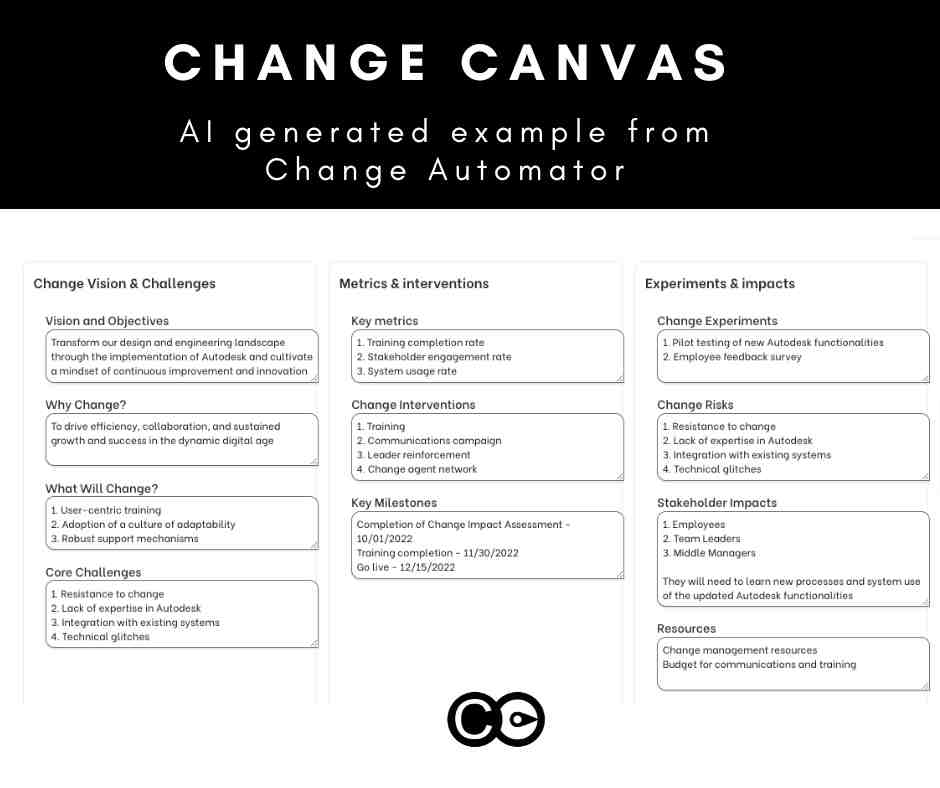
Change artefact 1: Change Canvas
An Agile Change Canvas is a strategic tool designed to plan, manage, and communicate change initiatives effectively within an organization. It begins with basic identification details such as the Project Name, Business Owner, and Author. This section ensures clear accountability and ownership from the outset.
The Change Vision & Objectives outlines the overarching project objectives and intended outcomes of the project. This architecture vision acts as a guiding star, ensuring all actions align with the desired future state of the organization. Following this, Core Challenges are identified to highlight potential obstacles that could impede progress. Recognizing these challenges early allows for proactive mitigation strategies.
Stakeholder Impacts analyses how different stakeholders will be affected by the change. This includes assessing both the positive and negative impacts on employees, customers, and shareholders, ensuring that their concerns are addressed and their needs met.
The Key Milestones section, presented in a table format, outlines significant checkpoints in the project timeline, often represented in Gantt charts. Each milestone is associated with a particular function, ensuring that progress is measurable and trackable. Similarly, the Resources section details the necessary financial, human, and technological resources required to implement the change, ensuring that the project scope statement is adequately supported.
Why Change section provides the rationale behind the need for change, which could include market demands, competitive pressures, or internal inefficiencies. This section justifies the project’s existence and urgency. Complementarily, What Will Change (WWC) describes the specific changes to be implemented, including processes, technologies, behaviours, and structures, offering a clear picture of the project’s scope.
Key Metrics are identified to measure the success of the change initiative. These metrics are both quantitative and qualitative, providing a comprehensive view of the project’s impact. Change Interventions listed in a table format, detail specific actions or initiatives designed to facilitate the change, ensuring a structured approach to implementation.
To foster a culture of innovation and adaptation, Change Experiments are proposed. These pilot programs test aspects of the change in a controlled environment before full-scale implementation. Finally, Change Risks identifies potential risks associated with the change and outlines strategies for mitigating these risks, ensuring that the project can navigate potential pitfalls effectively.
By incorporating these elements, the Agile Change Canvas provides a comprehensive framework for managing change initiatives, ensuring that all critical aspects are considered, planned for, and communicated effectively to stakeholders.
Using a Kanban board for change management activities provides a visual and dynamic method for tracking, prioritizing, and managing the flow of work while implementing changes. A Kanban board typically consists of columns that represent different stages of work, such as “To Do,” “In Progress,” and “Done.” For change management, additional columns might include “Proposed Changes,” “Under Review,” “Implementation Planning,” and “Monitoring.”
Whilst most change practitioners are used to kanban boards In working with various change management activities, there is opportunity to use kanban to plan and prioritise a series of agile-style changes and the associated change activities with each change. These ‘change cards’ within the kanban board presents a clear way to visualise a series of changes across the ‘delivery train’ where the project team continuously delivers pieces of change.
Prioritizing Change Management Activities
Visualizing Workflow:
Proposed Changes: This column lists all suggested changes, each represented by a card detailing the change’s purpose, impacted areas, and expected benefits.
Under Review: Changes move here once they are being evaluated for feasibility, risks, and alignment with project goals.
Implementation Planning: Approved changes are further detailed, including resource allocation, timelines, and specific tasks needed for implementation.
In Progress: Changes that are actively being worked on are tracked here, showing current status and any blockers encountered.
Monitoring: Recently implemented changes are monitored to ensure they are delivering the expected outcomes and to identify any issues early.
Done: Fully implemented and stabilized changes are moved here, marking their successful completion.
Setting Priorities:
Value and Impact: In conjunction with the project team prioritize changes based on their potential value and impact. High-value changes that significantly improve project outcomes or stakeholder satisfaction should be addressed first. From a change perspective, the input here is about the readiness of the stakeholder to receive the change, and what timing and work is required to get there.
Urgency and Dependencies: Changes that unblock other work or are time-sensitive should be prioritized. Dependencies between changes must be mapped to ensure logical sequencing. For example, work required to lift capability/leadership or readiness may be critical dependencies, without which the change cannot be delivered successfully.
Feasibility and Risk: Assess the feasibility and risks associated with each change. High-risk assessment of changes might require more careful planning and monitoring but should not necessarily be deprioritized if their impact is critical. The change input here is the people impact for the impacted stakeholders with other changes not just within this project/program, but with the overall portfolio or even outside the portfolio (including business-driven changes).
Proposed Changes: This column lists all suggested changes, each represented by a card detailing the change’s purpose, impacted areas, and expected benefits.
Under Review: Changes move here once they are being evaluated for feasibility, risks, and alignment with project goals.
Implementation Planning: Approved changes are further detailed, including resource allocation, timelines, and specific tasks needed for implementation.
In Progress: Changes that are actively being worked on are tracked here, showing current status and any blockers encountered.
Monitoring: Recently implemented changes are monitored to ensure they are delivering the expected outcomes and to identify any issues early.
Done: Fully implemented and stabilized changes are moved here, marking their successful completion.
Value and Impact: In conjunction with the project team prioritize changes based on their potential value and impact. High-value changes that significantly improve project outcomes or stakeholder satisfaction should be addressed first. From a change perspective, the input here is about the readiness of the stakeholder to receive the change, and what timing and work is required to get there.
Urgency and Dependencies: Changes that unblock other work or are time-sensitive should be prioritized. Dependencies between changes must be mapped to ensure logical sequencing. For example, work required to lift capability/leadership or readiness may be critical dependencies, without which the change cannot be delivered successfully.
Feasibility and Risk: Assess the feasibility and risks associated with each change. High-risk changes might require more careful planning and monitoring but should not necessarily be deprioritized if their impact is critical. The change input here is the people impact for the impacted stakeholders with other changes not just within this project/program, but with the overall portfolio or even outside the portfolio (including business-driven changes).
Ordering Change Planning and Implementation
Collaborative Planning:
Engage stakeholders and team members in planning sessions to discuss and agree on the priority of changes. This collaborative approach ensures that all perspectives are considered and that there is buy-in from those affected by the changes. This includes change champions.
Regular Review and Adaptation:
The Kanban board should be regularly reviewed and updated, within the change team and within the project team. During these reviews, re-prioritize changes based on new information, shifting project needs, and feedback from implemented changes. This iterative approach aligns with Agile principles of flexibility and continuous improvement.
Limit Work in Progress (WIP):
To avoid overloading the change team and ensure focus, limit the number of changes in progress at any given time. This constraint encourages the team to complete current tasks before taking on new ones, promoting a steady and manageable workflow.
Use Metrics and Feedback:
Utilize metrics such as cycle time (how long a change takes to move from start to finish, from awareness to engagement to eventual adoption) and work with the project team on the throughput (how many changes are completed in a specific timeframe) to assess the efficiency of the change management process. For example, based on the size and complexity of each discrete piece of change delivered, how long did this take and what was the deviance from actual time period planned? Feedback from these metrics should inform decisions about prioritization and process adjustments.
Engage stakeholders and team members in planning sessions to discuss and agree on the priority of changes. This collaborative approach ensures that all perspectives are considered and that there is buy-in from those affected by the changes. This includes change champions.
The Kanban board should be regularly reviewed and updated, within the change team and within the project team. During these reviews, re-prioritize changes based on new information, shifting project needs, and feedback from implemented changes. This iterative approach aligns with Agile principles of flexibility and continuous improvement.
To avoid overloading the change team and ensure focus, limit the number of changes in progress at any given time. This constraint encourages the team to complete current tasks before taking on new ones, promoting a steady and manageable workflow.
Utilize metrics such as cycle time (how long a change takes to move from start to finish, from awareness to engagement to eventual adoption) and work with the project team on the throughput (how many changes are completed in a specific timeframe) to assess the efficiency of the change management process. For example, based on the size and complexity of each discrete piece of change delivered, how long did this take and what was the deviance from actual time period planned? Feedback from these metrics should inform decisions about prioritization and process adjustments.
Benefits of Using Kanban for Change Management
Implementing a Kanban board for change management in Agile projects offers several benefits:
Transparency: Everyone involved can see the status of change activities, leading to better communication and coordination.
Flexibility: The board can be easily adjusted to reflect changing priorities and project dynamics.
Focus: Limiting WIP helps the team maintain focus and reduces the risk of burnout and task switching.
Continuous Improvement: Regular reviews and adaptations promote a culture of continuous improvement, ensuring that change management processes evolve and improve over time.
Change artefact example 3: Change Impact Assessment
A Change Impact Assessment (CIA) is an essential component in managing organizational change, particularly in agile projects where the focus is on iterative and incremental improvements. The assessment helps to understand the scope and magnitude of the change, identify affected stakeholders, and plan interventions to manage impacts effectively. An agile-friendly CIA is more summarised, and gets to the heart of what the impact is, who is impacted, how, to what extent, and when.
Below are the core elements of a change impact assessment, with a comparison to traditional methods:
1. Identifying the Impacts
Agile Approach: In scaled agile projects, the impact identification is ongoing and iterative. Each sprint or iteration is reviewed to assess the impacts of delivered changes. This dynamic approach ensures that emerging impacts are quickly recognized and addressed.
Traditional Approach: Impact identification is typically conducted at the beginning of the project, with periodic reviews. This method can be less responsive to new impacts discovered during the project lifecycle.
2. Stakeholder Identification and Analysis
Agile Approach: Continuous stakeholder engagement is crucial. Stakeholders are regularly consulted, and their feedback is integrated into the process. Agile methods ensure that stakeholders’ changing needs and concerns are promptly addressed.
Traditional Approach: Stakeholder analysis is often conducted early in the project, with limited ongoing engagement. This can result in less adaptability to stakeholders’ evolving requirements.
3. Extent and Nature of Impacts
Agile Approach: The extent of impacts is assessed incrementally, considering the cumulative effect of changes over multiple iterations. This allows for a nuanced understanding of how impacts evolve over time.
Traditional Approach: Typically focuses on a comprehensive initial assessment, with less emphasis on the evolution of impacts throughout the project.
4. Timing of Impacts
Agile Approach: Timing is aligned with the iterative delivery schedule. The impacts are mapped to specific iterations or sprints, allowing for precise planning and mitigation.
Traditional Approach: Timing is generally assessed at the project level, which can make it harder to pinpoint when specific impacts will occur during the project lifecycle.
Typical Sections of an Agile Change Impact Assessment
Impact Overview:
Explanation: Summarizes the nature and scope of the change, providing a high-level view of the anticipated impacts.
Agile Twist: Updated regularly with each iteration to reflect new findings and emerging impacts.
Stakeholder Impact Analysis:
Explanation: Identifies who will be affected by the change and how. It details the extent of the impact on different stakeholder groups.
Agile Twist: Involves continuous stakeholder feedback and updates to capture evolving impacts.
Impact Extent and Nature:
Explanation: Describes the extent (e.g., minor, moderate, significant) and nature (e.g., process, technology, cultural) of the impacts.
Agile Twist: Assessed incrementally, considering both immediate and long-term impacts across iterations.
Impact Timing:
Explanation: Specifies when the impacts are expected to occur, mapped to the project timeline.
Agile Twist: Aligned with sprint or iteration schedules, allowing for detailed timing predictions.
Mitigation Strategies:
Explanation: Outlines plans to manage and mitigate identified impacts.
Agile Twist: Adaptive strategies that are refined continuously based on iteration reviews and stakeholder feedback.
Monitoring and Review:
Explanation: Describes how the impacts will be monitored and reviewed throughout the project.
Agile Twist: Continuous monitoring with iteration-end reviews to ensure timely identification and management of impacts.
Explanation: Summarizes the nature and scope of the change, providing a high-level view of the anticipated impacts.
Agile Twist: Updated regularly with each iteration to reflect new findings and emerging impacts.
Explanation: Identifies who will be affected by the change and how. It details the extent of the impact on different stakeholder groups.
Agile Twist: Involves continuous stakeholder feedback and updates to capture evolving impacts.
Explanation: Describes the extent (e.g., minor, moderate, significant) and nature (e.g., process, technology, cultural) of the impacts.
Agile Twist: Assessed incrementally, considering both immediate and long-term impacts across iterations.
Explanation: Specifies when the impacts are expected to occur, mapped to the project timeline.
Agile Twist: Aligned with sprint or iteration schedules, allowing for detailed timing predictions.
Explanation: Outlines plans to manage and mitigate identified impacts.
Agile Twist: Adaptive strategies that are refined continuously based on iteration reviews and stakeholder feedback.
Explanation: Describes how the impacts will be monitored and reviewed throughout the project.
Agile Twist: Continuous monitoring with iteration-end reviews to ensure timely identification and management of impacts.
Stakeholder Engagement in a Scaled Agile Environment
Planning and designing stakeholder engagement activities in a scaled agile environment requires a dynamic, iterative approach that contrasts significantly with traditional, non-agile methods. In SAFe, the focus is on continuous collaboration, transparency, and adaptability, ensuring that stakeholders are actively involved throughout the project lifecycle.
Iterative and Continuous Engagement
Scaled Agile Approach: Stakeholder engagement is an ongoing process. Agile frameworks emphasize regular touchpoints, such as sprint reviews, planning meetings, and daily stand-ups, where stakeholders can provide feedback and stay informed about progress. These frequent interactions ensure that stakeholder input is continuously integrated, enabling swift adjustments and alignment with evolving needs. This iterative approach fosters a collaborative environment where stakeholders feel valued and engaged throughout the project. Engagement rhythms and processes should also be established not just at a project, but program, portfolio and enterprise levels as required.
Non-Agile Approach: Traditional methodologies often involve stakeholder engagement at fixed points in the project timeline, such as during initial requirements gathering, major milestone reviews, and final project delivery. This approach can lead to periods of limited communication and delayed feedback, which may result in misaligned expectations and missed opportunities for timely course corrections.
Flexibility and Adaptation
Scaled Agile Approach: Agile projects embrace change, allowing stakeholder engagement activities to be flexible and adaptive. As project requirements evolve, the engagement strategy can be adjusted to address new priorities or challenges. This flexibility ensures that stakeholder needs are consistently met, and any concerns are promptly addressed. Agile frameworks encourage a culture of openness and continuous improvement, where stakeholder feedback directly influences the direction of the project. Change managers need to ensure that stakeholder understand this fully, and have the skills to work within this context, not just with the project team but in leading their teams through change, when ‘the change’ may be constantly shifting.
Non-Agile Approach: In contrast, traditional approaches tend to follow a rigid engagement plan that is set at the project’s outset. While this provides a clear structure, it can be less responsive to changing stakeholder needs or external conditions. Adjusting the engagement strategy mid-project can be challenging and may require significant effort, leading to delays and potential dissatisfaction among stakeholders.
Collaborative Tools and Techniques
Scaled Agile Approach: Agile environments leverage a variety of collaborative tools and techniques to enhance stakeholder engagement. Digital platforms such as Jira, Confluence, and Miro facilitate real-time collaboration, transparency, and documentation. Agile ceremonies, such as retrospectives and demos, provide structured opportunities for stakeholders to participate and contribute. These tools and techniques help maintain a high level of engagement and ensure that stakeholders have a clear view of project progress and challenges.
Non-Agile Approach: Traditional methods might rely more heavily on formal documentation and periodic reports for stakeholder communication. While these methods ensure thorough documentation, they can sometimes create barriers to real-time collaboration and immediate feedback. Meetings and reviews are often scheduled infrequently, which can lead to less dynamic interaction compared to agile practices.
Planning Stakeholder Engagement Activities
Regular Touchpoints: Schedule frequent meetings and reviews to ensure continuous stakeholder involvement. Examples include sprint reviews, iteration planning meetings, and daily stand-ups. Business-led rhythm that enable the dissemination and engagement of updates to teams is also critical.
Flexible Engagement Plans: Develop engagement strategies that can be easily adapted based on stakeholder feedback and changing project requirements.
Use of Collaborative Tools: Implement digital tools that facilitate real-time collaboration and transparency. Tools like Jira and Confluence can help keep stakeholders informed and involved. Non-digital engagement tools may also be leveraged to fully engage with stakeholders, beyond one-way push communication. Assessment needs to be made of the openness and ability to engage regarding the change through the chosen channels.
Active Feedback Loops: Establish mechanisms for collecting and integrating stakeholder feedback continuously. This can be done through retrospectives, surveys, and informal check-ins.
Clear Communication Channels: Maintain open and clear communication channels to ensure that stakeholders can easily provide input and receive updates on project progress.
As mentioned previously, the change approach, including engagement approaches, need to take into account the broader organisational context of program, portfolio and enterprise levels. This may mean mapping out the various channels and how they can be used for different changes, stakeholders and organisational levels.
Supporting Agile Delivery Cadence
To align change management activities with agile delivery cadence, it’s essential to integrate them into the core agile events, such as PI (Program Increment) planning and demos. Here’s how:
PI Planning
PI planning, or program increment planning, is a critical event in the agile framework, where teams come together in the PI planning process to plan and commit to a set of objectives for the next increment. During PI planning sessions or PI planning events (including team breakouts), ensure that change management considerations are part of the discussion. This involves:
– Including Change Management Objectives within PI objectives and program vision: Ensure that change management objectives and organizational readiness are included in the PI planning agenda as a critical part of project management. This helps align the change activities with the overall delivery goals.
– Identifying Change Risks and Dependencies: Identify any dependencies related to the change initiative that may impact the delivery schedule and the overall agile release train. This ensures that potential risks are addressed early and do not disrupt the delivery process. Common considerations include the various people change impacts across the program and how they intersect or overlap
– Engaging Stakeholders: Involve key stakeholders in the PI planning sessions. This ensures that not just product managers but business stakeholders understand the change objectives and are committed to supporting the change initiative during the implementation process. PI planning is also a great opportunity to assess and see in action the level of engagement, support and potential leadership skills of key stakeholders to reach the common goals and business benefits.
Demos
Demos are an opportunity to showcase the progress of the agile teams and gather feedback from stakeholders as a part of the iteration plans and sprint planning. Use demos to communicate the benefits and progress of change initiatives within the entire agile release train. Engaging stakeholders in these demos can help them see the value and stay committed to the implementation plan. Here’s how:
– Highlighting Change Benefits: During demos, highlight the benefits of the change initiative and how it supports the overall product delivery goals. This helps stakeholders understand the value of the change and its impact on the project.
– Gathering Feedback: Use demos as an opportunity to gather feedback and user stories from stakeholders. This helps identify any concerns or areas for improvement and ensures that the change initiative remains aligned with stakeholder needs.
– Showcasing Progress: Showcase the progress of the change initiative during demos. This provides stakeholders with a clear understanding of how the change is evolving and the positive impact it is having on the project.
By embedding change management activities into these agile ceremonies, change managers can ensure that change initiatives are aligned with the delivery schedule and maintain stakeholder buy-in.
Implementing Change Activities as Small Experiments
One of the key principles of agile is to work in small increments and learn quickly. Change management activities can adopt this approach by implementing small experiments, such as:
Messaging
Test different communication messages to see which resonates best with stakeholders. Gather feedback and refine the messaging based on reactions. This iterative approach ensures that the communication strategy is effective and supports the change initiative. Consider the following:
– A/B Testing: Use A/B testing to evaluate different messages. This involves sending two variations of a message to different stakeholder groups and comparing the responses to determine which one is more effective.
– Feedback Collection: Collect feedback from stakeholders on the messaging. This can be done through surveys, focus groups, or informal conversations.
– Message Refinement: Refine the messaging based on the feedback received. This ensures that the communication remains relevant and impactful.
Stakeholder Involvement
Experiment with various levels of stakeholder involvement to determine the most effective way to engage them. Use these insights to inform future engagement and risk management strategies and your overall implementation strategy. Here’s how:
– Pilot Programs: Implement pilot programs with small groups of stakeholders to test different involvement strategies. This provides valuable insights into what works best and helps refine the engagement approach.
– Engagement Metrics: Track engagement metrics to evaluate the effectiveness of different involvement strategies. This includes participation rates, feedback quality, and overall stakeholder satisfaction.
– Iterative Adjustments: Make iterative adjustments to the involvement strategies based on the insights gained. This ensures that stakeholder engagement remains effective and aligned with the change initiative.
By treating change activities as experiments, change managers can adapt quickly to what works best, ensuring a smoother integration with the agile delivery process.
Best Practices for Integrating Change Management with Agile
Successfully integrating change management with agile methodologies requires a strategic approach. Here are some best practices to consider:
Foster Collaboration
Encourage collaboration between change managers and agile teams, as well as key business stakeholders within the business context. This helps ensure that different disciplines and functions are aligned and working towards the same goals. Consider the following strategies:
– Joint Planning Sessions: Conduct joint planning sessions to align change management activities with agile delivery approaches and schedules. This ensures that both disciplines are working towards the same objectives.
– Regular Communication: Establish regular communication channels between change managers and agile teams. This helps keep everyone informed and ensures that any issues or concerns are addressed promptly. Specifically focus on various agile roles such as UX (user experience), business analysis, testing, and portfolio management. There are key intersections of change work and each of these disciplines, beyond general project planning and coordination.
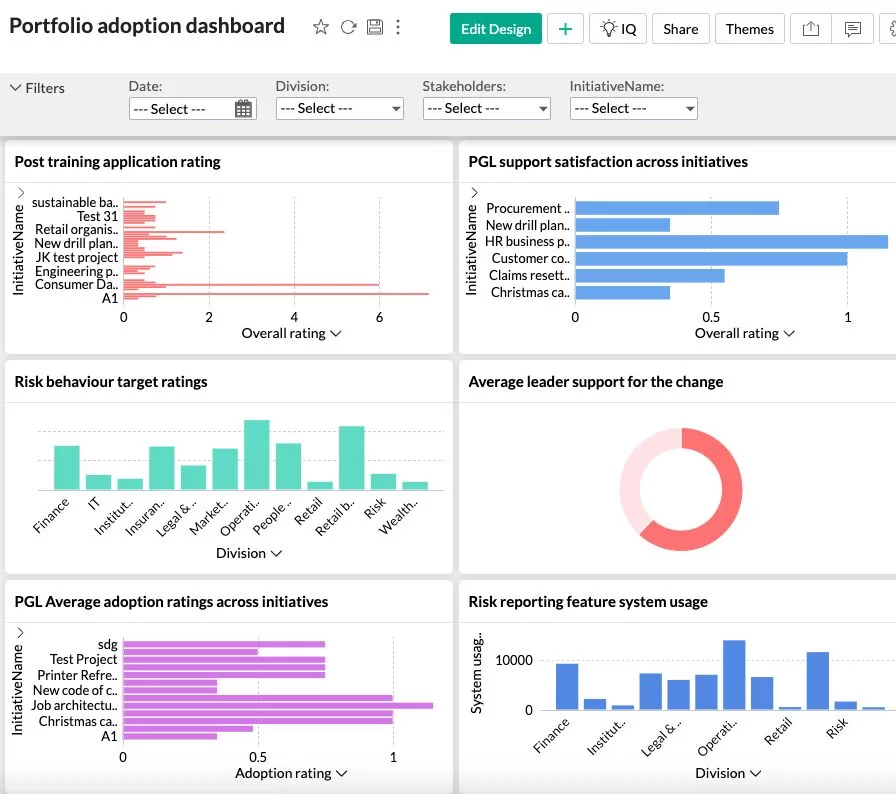
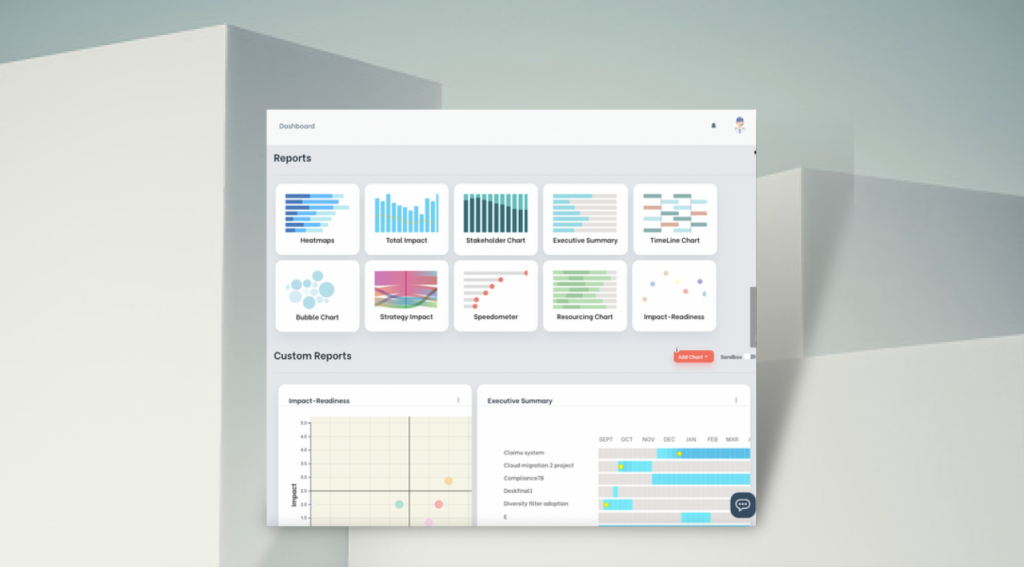
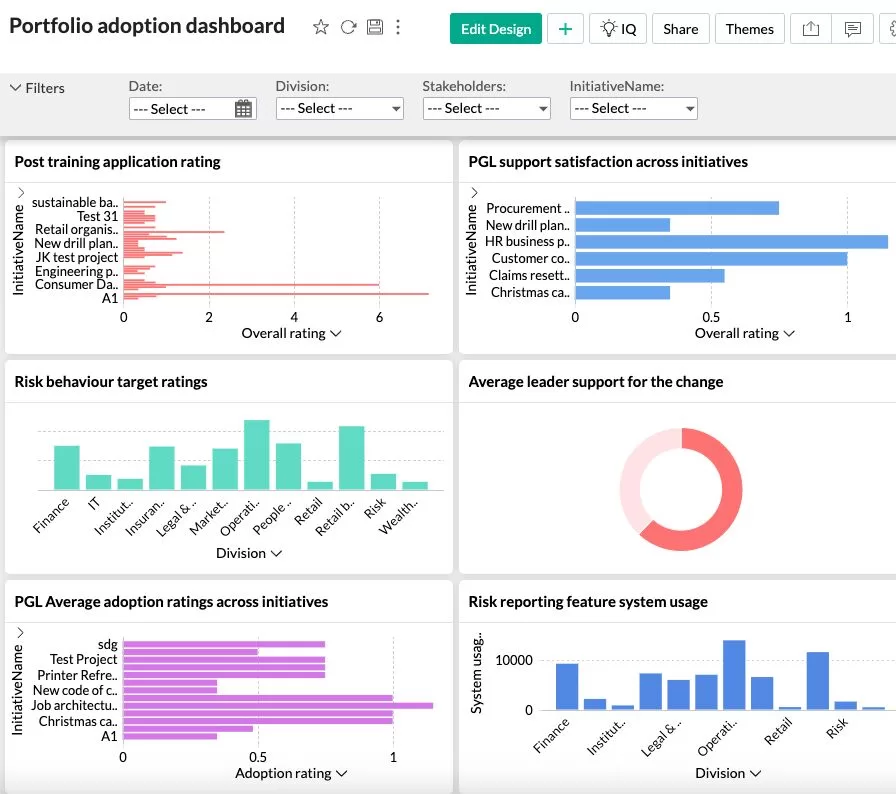
The below is an example of a portfolio level adoption dashboard from The Change Compass.
Change Data-Driven Insights is absolutely a Must-have for SAFe
In SAFe, change management driven by data insights is critical to ensure that changes are not only effective but also efficient and sustainable. Data-driven change management leverages quantitative and qualitative data to guide decisions, optimize processes, and align strategic goals across the organization. By incorporating metrics and analytics, organizations can gain a comprehensive understanding of the impact and progress of change initiatives, allowing for timely adjustments and informed decision-making.
At the portfolio level within a SAFe setting, data-driven insights are essential for prioritizing initiatives and allocating resources effectively. More than this, change data including stakeholder capability, readiness and impact levels can be critical to determine when releases should happen, the priority of releases, and the sequencing of releases.
Ill-prepared or insufficiently skilled stakeholders may require longer time to adapt to the change. Also, looking beyond the project itself, by understanding the overall change landscape for the impacted stakeholders, change releases may need to be chunked and packaged accordingly to maximise adoption success.
Key attention should also be paid to the impact on business performance of impacted stakeholders, not just from a change volume perspective, but also from a strategy perspective in terms of how best to reduce risk of performance disruptions. Is it through exemplary middle leadership? Or frontline engagement? Or the power of change champions embedded across the business?
At the enterprise level, data-driven change management enables organizations to scale agile practices consistently and coherently across the entire team across multiple portfolios. This involves the use of enterprise-level dashboards and analytics tools that provide a holistic view of the organization’s agile transformation. Key performance indicators (KPIs) such as employee impact data, adoption rates, readiness metrics and productivity metrics help leaders assess the effectiveness of change initiatives and identify areas that require additional support or intervention. For instance, tracking the adoption rate of agile practices across different departments can highlight areas where additional training or coaching is needed to ensure consistent implementation.
Integrating change management with scaled agile methodologies is essential for seamless product delivery in today’s dynamic business environment. By creating agile-style deliverable artefacts early, continuously adapting engagement activities, supporting agile delivery cadence, and implementing change activities as small experiments, measure change progress and outcomes, change managers can effectively support agile product delivery. This integration not only enhances the success of change initiatives but also ensures that product delivery is seamless and aligned with organizational goals and the strategic plan.
By fostering collaboration, embracing agile principles, and using data-driven insights, change managers can create a cohesive strategy that maximizes the benefits of both change management and agile methodologies. This holistic approach ensures that change initiatives are successful, stakeholders are engaged, and product delivery is efficient and effective.
Chat to us to find out more about how to leverage the power of a change measurement platform to sustain your single source of truth to support your scaled agile organisation.
Organisational change management professionals are increasingly requested to provide measurement, data, and insights to various stakeholder groups. Not only does this include tracking various change management outcomes such as business readiness or adoption, but stakeholder concerns also include such as change saturation and visibility of incoming initiative impacts.
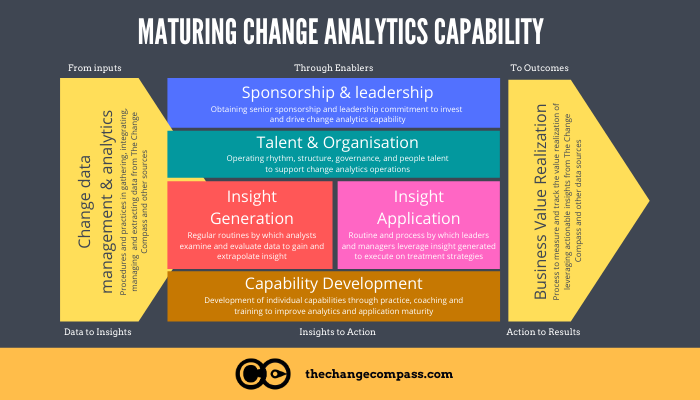
To become better at working with data there is much that change managers can learn best practices from data scientists (without becoming one of course). Let’s explore how change management can benefit from the practices and methodologies employed by data scientists, focusing on time allocation, digital tools, system building, hypothesis-led approaches, and the growing need for data and analytical capabilities.
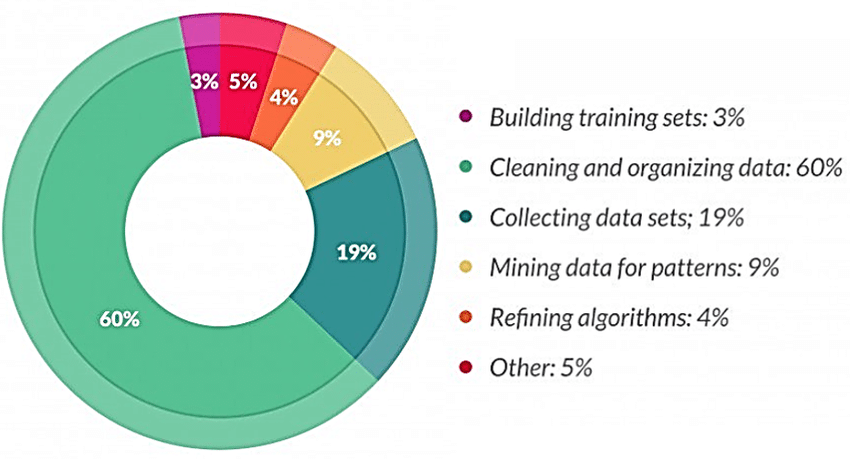
Data scientists spend a substantial portion of their time on data collection and cleansing from data sources. According to industry estimates, about 60-80% of a data scientist’s time is dedicated to these tasks. This meticulous process ensures that the data used for analysis is accurate, complete, and reliable.
In the below diagram from researchgate.net you can see that for data scientists the vast majority of the time is spent on collecting, cleansing and organising data.
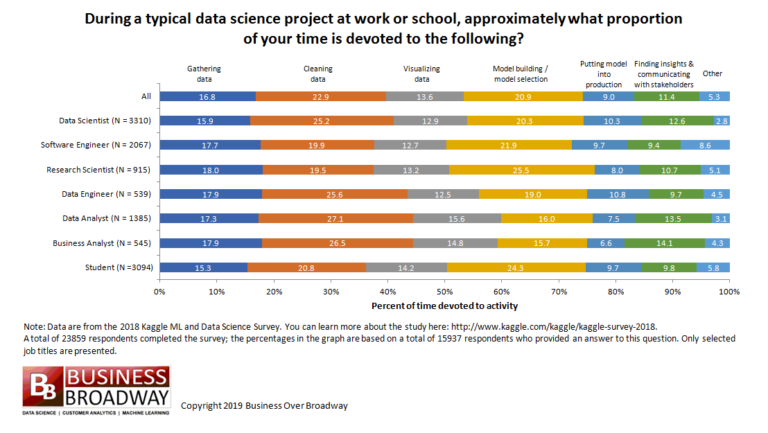
You might say that change managers are not data scientists because the work nature is different, and therefore should not need to carve out time for these activities? Well, it turns out that the type of activities and proportions of time spent is similar across a range of data professionals, including business analysts.
Below is the survey results published by Business Broadway, showing that even business analysts and data analysts spend significant time in data collection, cleansing, and preparation.
Lessons for Change Management
a. Emphasize Data Collection and Cleansing: For change managers, this translates to prioritizing the collection of reliable data related to change initiatives as a part of a structured approach. This might include stakeholder feedback, performance metrics, impact data and other relevant data points. Clean data is essential for accurate analysis and insightful decision-making. Data projects undertaken by change managers are not going to be as large or as complex as data scientists, however the key takeaway is that this part of the work is critical and sufficient time should be allocated and not skipped.
What is data change management and why is it important?
Data change management involves overseeing and controlling changes in data systems to ensure accuracy and consistency. It’s crucial for minimizing errors, maintaining data integrity, and enhancing decision-making processes. Effective management safeguards against potential risks associated with data alterations, ensuring organizations can adapt to shifts in information seamlessly.
b. Allocate Time Wisely: Just as data scientists allocate significant time to data preparation, change managers should also dedicate sufficient time to gathering and cleaning data before diving into analysis. This ensures that the insights derived are based on accurate and reliable information.
It also depends on the data topic and your audience. If you are presenting comparative data, for example, change volume across different business units. You may be able to do spot checks on the data and not verify every data line. However, if you are presenting to operations business units like call centres where they are very sensitive to time and capacity challenges, you may need to go quite granular in terms of exactly what the time impost is across initiatives.
c. Training and Awareness: Ensuring that the change management team understands the importance of data quality and is trained in basic data cleansing techniques can go a long way in improving the overall effectiveness of change initiatives in the desired future state. Think of scheduling regular data sessions/workshops to review and present data observations and findings to enhance the team’s ability to capture accurate data as well as the ability to interpret and apply insights. The more capable the team is in understanding data, the more value they can add to their stakeholders leveraging data insights.
2. Leveraging Digital Tools: Enhancing Efficiency and Accuracy
Data scientists rely on a variety of digital tools to streamline their work. These tools assist in data collection, auditing, visualization, and insight generation. AI and machine learning technologies are increasingly being used to automate and enhance these processes.
Data scientists rely on various programming, machine learning and data visualisation such as SQL, Python, Jupyter, R as well as various charting tools.
a. Adopt Digital Tools: Change managers should leverage digital tools to support each phase of their data work. There are plenty of digital tools out there for various tasks such as surveys, data analysis and reporting tools.
For example, Change Compass has built-in data analysis, data interpretation, data audit, AI and other tools to help streamline and reduce manual efforts across various data work steps. However, once again even with automation and AI the work of data checking and cleansing does not go away. It becomes even more important.
b. Utilize AI and Machine Learning: AI can play a crucial role in automating repetitive tasks, identifying patterns, data outliers, and generating insights. For example, AI-driven analytics tools can help predict potential change saturation, level of employee adoption or identify areas needing additional support during various phases of change initiatives.
With Change Compass for example, AI may be leverage to summarise data, call out key risks, generate data, and forecast future trends.
c. Continuous Learning: Continuous learning is essential for ensuring that change management teams stay adept at handling data and generating valuable insights. With greater stakeholder expectations and demands, regular training sessions on the latest data management practices and techniques can be helpful. These sessions can cover a wide range of topics, including data collection methodologies, data cleansing techniques, data visualisation techniques and the use of AI and machine learning for predictive analytics. By fostering a culture of continuous learning, organizations can ensure that their change management teams remain proficient in leveraging data for driving effective change.
In addition to formal training, creating opportunities for hands-on experience with real-world data can significantly enhance the learning process. For instance, change teams can work on pilot projects where they apply new data analysis techniques to solve specific challenges within the organization. Regular knowledge-sharing sessions, where team members present case studies and share insights from their experiences, can also promote collective learning and continuous improvement.
Furthermore, fostering collaboration between change managers and data scientists or data analysts can provide invaluable mentorship and cross-functional learning opportunities. By investing in continuous learning and development, organizations can build a change management function that is not only skilled in data management but also adept at generating actionable insights that drive successful change initiatives.
3. Building the Right System: Ensuring Sustainable Insight Generation
It is not just about individuals or teams working on data. A robust system is vital for ongoing insight generation. This involves creating processes for data collection, auditing, cleansing, and establishing data governance and governance bodies to manage and report on data.
Governance structures play a vital role in managing and reporting data. Establishing governance bodies ensures that there is accountability and oversight in data management practices. These bodies can develop and enforce data policies, and oversee data quality initiatives. They can also be responsible for supporting the management of a central data repository where all relevant data is stored and managed.
a. Establish Clear Processes: Develop and document processes for collecting and managing data related to change initiatives and document any new processes. This ensures consistency and reliability in data handling. There should also be effective communication of these processes using designated communication channels to ensure smooth transition and adherence.
b. Implement Governance Structures: Set up governance bodies to oversee data governance practices as a part of data governance efforts. This includes ensuring compliance with data privacy regulations and maintaining data integrity. The governance can sponsor the investment and usage of the change data platform. This repository should be accessible to stakeholders involved in the change management process, promoting transparency and collaboration. Note that a governance group can simply be a leadership team regular team meeting and does not need to be necessarily creating a special committee. Data governance group members (potentially representative business owners) foster a sense of ownership and can be empowered to resolve potential issues with data and usage. Key performance indicators and key change indicators may be setup as goals.
c. Invest in system Infrastructure: Build the necessary system infrastructure to support data management and analysis that is easy to use and provides the features to support insight generation and application for the change team.
Data scientists and data teams often use a hypothesis-led approach, where they test, reject, or confirm hypotheses using data. This method goes beyond simply reporting what the data shows to understanding the underlying causes and implications.
a. Define Hypotheses: Before analyzing data, clearly define the hypotheses you want to test. For instance, if there is a hypothesis that there is a risk of too much change in Department A, specify the data needed to test this hypothesis.
b. Use Data to Confirm or Reject Hypotheses: Collect and analyze data to confirm or reject your hypotheses. This approach helps in making informed decisions rather than relying on assumptions or certain stakeholder opinions.
c. Focus on Actionable Insights: Hypothesis-led analysis often leads to more actionable insights. It is also easier to use this approach to dispel any myths of false perceptions.
For example: Resolving Lack of Adoption
Hypothesis: The lack of adoption of a new software tool in the organization is due to insufficient coaching and support for employees.
Data Collection:
Gather data on the presence of managerial coaching and perceived quality. Also gather data on post go live user support.
Collect feedback from employees through surveys regarding the adequacy and clarity of coaching and support.
Analyse usage data of the new software to identify adoption rates across different departments.
Analysis:
Compare adoption rates between employees who received sufficient coaching and support versus those who did not.
Correlate feedback scores on training effectiveness with usage data to see if those who found the training useful are more likely to adopt the tool.
Segment data by department to identify if certain teams have lower adoption rates and investigate their specific training experiences.
Actionable Insights:
If data shows a positive correlation between coaching and support, and software adoption, this supports the hypothesis that enhancing coaching and support programs can improve adoption rates.
If certain departments show lower adoption despite completing coaching sessions, investigate further into department-specific issues such as workload or differing processes that may affect adoption.
Implement targeted interventions such as additional training sessions, one-on-one support, or improved training materials for departments with low adoption rates.
5. Building Data and Analytical Capabilities: A Core Need for Change Management
As data and analytical capabilities become increasingly crucial, change management functions must build the necessary people and process capabilities to leverage data-based insights effectively.
a. Invest in Training: Equip change management teams with the skills needed to manage data and generate insights. This includes training in data analysis, visualization, and interpretation.
b. Foster a Data-Driven Culture: A lot of organisations are already on the bandwagon to encourage a culture where data is valued and used for decision-making from current state to future state. The change process needs to promote this equally within the change management function. This involves promoting the use of data in everyday tasks and ensuring that all team members understand its importance. Think of incorporating data-led discussions into routine meeting meetings.
c. Develop Analytical Frameworks: Create frameworks and methodologies for analyzing change management data. This includes defining common key metrics, setting benchmarks, and establishing protocols for data collection and analysis for change data. Data and visual templates may be easier to follow for those with lower capabilities in data analytics.
Practical Steps to Implement Data-Driven Change Management
To integrate these lessons effectively, senior change practitioners can follow these practical steps:
Develop a Data Strategy: Create a comprehensive data strategy that outlines the processes, tools, and governance structures needed to manage change management data effectively.
Conduct a Data Audit: Begin by auditing the existing data related to change management. Identify gaps and areas for improvement.
Adopt a Hypothesis-Led Approach: Encourage the use of hypothesis-led approaches to move beyond descriptive analytics and derive more meaningful insights.
Invest in Technology: Invest in the necessary digital tools and technologies to support data collection, cleansing, visualization, and analysis.
Train the Team: Provide training and development opportunities for the change management team to build their data and analytical capabilities.
Collaborate Across Functions: Foster collaboration between change management and data science teams to leverage their expertise and insights.
Implement Governance Structures: Establish governance bodies to oversee data management practices and ensure compliance with regulations and standards.
By learning from the practices and methodologies of data scientists, change management functions can significantly enhance their effectiveness. Prioritizing data collection and cleansing, leveraging digital tools, building robust systems, adopting hypothesis-led approaches, and developing data and analytical capabilities are key strategies that change management teams can implement. By doing so, they can ensure that their change initiatives are data-driven, insightful, and impactful, ultimately leading to better business outcomes.
Managing multiple change initiatives is not a new concept nor is it new to organizations. What is perhaps ‘newer’ is how change practitioners are using data to manage multiple changes. Change practitioners that manage a portfolio of initiatives used to focus on building capability in various arenas from employee capability, leadership capability, through to the effectiveness of engagement and learning channels. However, using business and change management data to help companies is just as critical.
Is change management becoming more important?
Yes, change management is increasingly vital in today’s fast-paced business environment. Organizations face constant shifts in technology, market demands, and workforce dynamics, which impact their business processes. Effectively managing these changes helps minimize resistance, enhances employee engagement, and ensures smoother transitions, ultimately leading to improved performance and sustainability in a competitive landscape.
In this article, we will explore the top five challenges associated with the current approaches to managing multiple change initiatives, including the implementation of the change due to lack of resources and insufficient resources. We explore these common approaches and critique key challenges, along with alternatives.
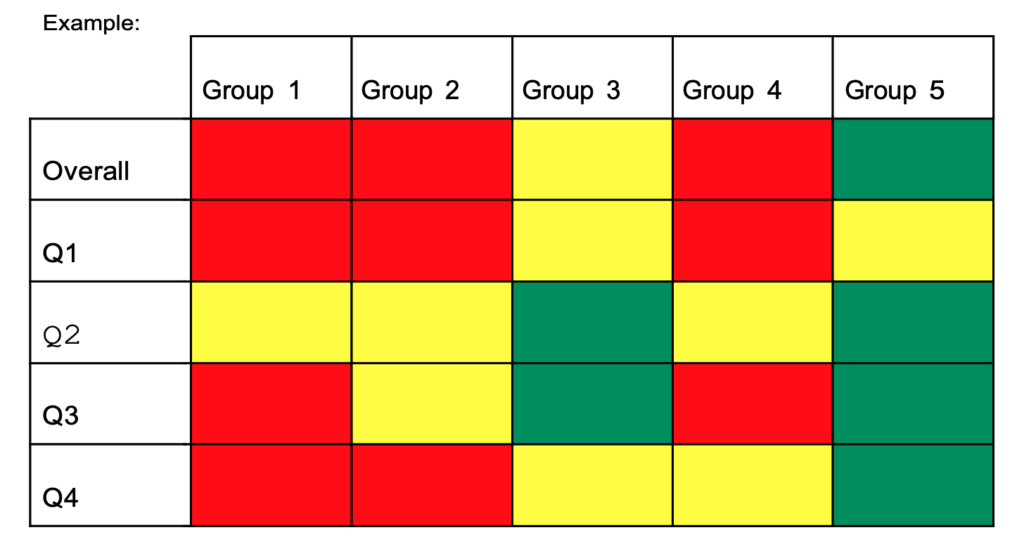
Change heatmaps have become a popular tool for classifying departments based on the impact of a change initiative. However, two key issues often arise with this approach: the oversimplification of the traffic light classification system and the lack of granularity at the department level.
One of the most common ways to visually depict the impact of multiple changes is to use the heatmap. This is normally using a 3-point rating system (high, medium, low) to determine the level of impact across the various departments across the organisation. Whilst the rating process is an easy exercise, there are some very serious challenges:
Even for the 3 level rating system the change practitioner may be challenged with how this rating is determined and what it is based on. Not every team within the same department may be equally impacted
There may be different impacts for different roles within the same team and department
The impact may be different depending on whether the focus is on employees, customers, process, system or partner
Typically most use a monthly rating scale. However, for busy organisations with lots of changes, the change volume may go up and down within the same month. With one rating it oversimplifies what actually happens throughout the month
With only 3 levels of ratings, a lot of departments end up having the same rating level for months, meaning there is not much they can do with this data.
In Summary, the summarised monthly rating for one department indicates medium-level change. But at what time of the month, for what role, for what team, and for what type of impact?
The below is an example of a change heatmap from the University of California, Berkeley.
a. Traffic Light Classification Too Simplistic:
The traditional red, yellow, and green traffic light system used in change heatmaps is a simple way to communicate the status of a department’s readiness for change. However, this simplicity can be misleading. Red may indicate a problem, but it does not provide insights into the nature or severity of the issue. Likewise, green may suggest readiness, but it might hide underlying complexities or dependencies.
Even for the 3 level rating system the change practitioner may be challenged with how this rating is determined and what fact it is based on. Also, the impact may be different depending on whether the focus is on employees, customers, process, system or partner. Typically most use a monthly rating scale. However, for busy organisations with lots of changes, the change volume may go up and down within the same month. With one rating it oversimplifies what actually happens throughout the month. Even if the singular departmental rating is split into rating by initiative, this does not provide an aggregate department-level rating that is aggregated based on logic.
To overcome this challenge, organizations need a more nuanced classification system that takes into account the specific issues within each category. This could involve incorporating additional colours or using a numerical scale to better represent the diversity and complexity of challenges within each department.
b. Department Level Not Granular Enough:
While change heatmaps provide a high-level overview, they often lack the granularity required to understand the specific challenges within each department. Different teams within a department may be impacted differently, and a broad classification may not capture these variations.
To address this issue, organizations should consider adopting a more detailed classification system that breaks down each department into its constituent parts. This granular approach allows for a more targeted and effective change management strategy, addressing specific issues at the team and role levels.
In Summary, the singular monthly rating for one department indicates medium-level change. But at what time of the month, for what role, for what team, and for what type of impact?
2) Using Project Milestone Roadmap to Sequence Impacts
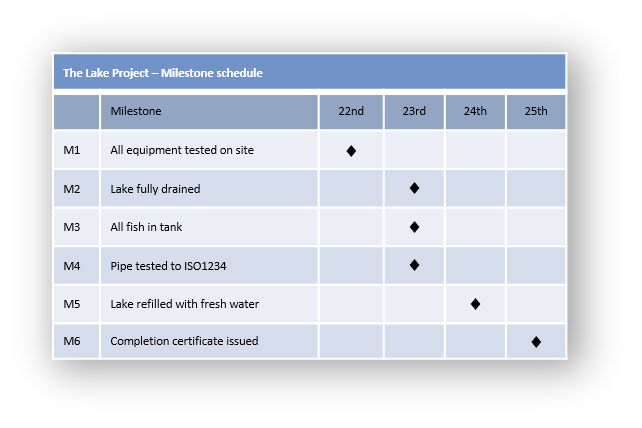
Project milestone roadmaps are commonly used to sequence the impacts of change initiatives. However, this approach faces challenges in terms of the sufficiency of milestones and the difficulty of overlaying multiple capacity considerations.
Below is an example from Praxis Framework.
a. Milestones Are Not Sufficient vs Overall Aggregate Impact Levels:
While project milestones provide a structured timeline for change initiatives, they may not capture the full scope of the impact on the organization. Engaging key stakeholders is essential during this process, as milestones often focus on project-specific tasks and may overlook broader organizational changes that occur concurrently. For example, adoption may require months and is not a single point-in-time milestone per se.
To overcome this limitation, organizations should supplement milestone roadmaps with an overall aggregate impact assessment. This holistic view ensures that the sequence of milestones aligns with the broader organizational objectives and minimizes conflicts between concurrent initiatives.
b. Difficulty of Overlaying Multiple Capacity Considerations:
Managing multiple change initiatives requires a delicate balance of resources, and overlaying capacity considerations can be challenging due to the scope of the change. Project milestone roadmaps may not adequately address the interdependencies and additional resources needed due to the resource constraints that arise when multiple initiatives are in progress simultaneously.
To enhance capacity planning, organizations should invest in advanced project management tools that allow for the dynamic adjustment of timelines based on resource availability. This ensures a realistic and achievable sequencing of impacts, taking into account the organization’s overall capacity.
3) Relying Purely on Excel and PowerPoint to Manage Multiple Change Initiatives
While Excel and PowerPoint are ubiquitous tools in the business world, relying solely on them to manage multiple change initiatives presents challenges related to the agile nature of changes and the difficulty of having interactive data-based conversations. This is especially the case that most change initiatives are digital changes, and yet they are been managed using non-digital means? How can change practitioners ‘be the change’ when they are using dated ways of driving digital change?
a. Agile Nature of Changes Means Ongoing Updates Are Required:
Change initiatives are inherently dynamic, and their requirements can evolve rapidly, especially in response to market shifts. Excel and PowerPoint, while useful for static reporting, lack the real-time collaborative capabilities needed to accommodate the agile nature of changes while maintaining the status quo.
To address this challenge, organizations should consider adopting change management and collaboration tools that enable real-time updates and collaboration. Cloud-based platforms provide the flexibility to make ongoing adjustments, ensuring that stakeholders are always working with the latest information.
b. Difficulty of Having Interactive Data-Based Conversations and Federated Model of Change Data:
Excel and PowerPoint may struggle to facilitate interactive discussions around change data. As organizations increasingly operate in a federated model, with dispersed teams working on different aspects of change initiatives, a more collaborative and integrated approach is essential.
Implementing dedicated change management platforms that support interactive data-based discussions can enhance collaboration and provide a centralized repository for change-related information. This ensures that all stakeholders have access to the latest data, fostering a more transparent and collaborative change management process.
4) Preparing Business Operations Readiness for the Amount of Change
Preparing business operations for a significant amount of change requires a strategic approach that incorporates capacity and time considerations while maintaining granularity in data.
a. Using Business Operations Speak: Capacity, resources, time.
Business operations readiness is often discussed in terms of capacity and time. However, the challenge lies in translating these concepts into actionable plans. Capacity planning involves understanding the organization’s ability to absorb change without compromising existing operations, while time considerations are crucial for ensuring a smooth transition without disruptions.
Change practitioners need to distill the ‘ask of the business’ in business speak. Business stakeholders may not be interested in the various classifications of change or the varying degrees of cultural changes involved. What they are interested in is what you want from my team, how much time you need them to dedicate, and for what team members, so that they can plan accordingly.
b. Granularity of Data:
The granularity of data is essential for effective business operations readiness. Generic metrics may not capture the specific needs and challenges of individual departments or teams, leading to oversights that can impact the success of change initiatives.
Implementing a comprehensive data collection and analysis strategy that considers the unique requirements of each business unit ensures a more accurate understanding of operational readiness. This granularity allows organizations to tailor change management strategies to specific needs, enhancing the likelihood of successful implementation.
5) Getting Executive Engagement and Decision Making
Ensuring executive engagement and decision-making is critical for the success of change initiatives. However, achieving this engagement poses its own set of challenges.
To overcome this challenge, organizations should:
Establish Clear Governance and Engagement Channels:
Ensure that there is in place a clear governance bodies making decisions on the overall control of successful change initiatives across the organisation, focusing on the success of the change. A robust communication strategy ensures that communication channels between change management teams and executives are also well-defined and effective. Regular updates and transparent reporting on the progress and challenges of change initiatives build trust and encourage executive engagement.
Align Change Initiatives with Strategic Objectives:
Demonstrate the alignment of change initiatives with key performance indicators related to the organization’s strategic goals and objectives. Executives are more likely to engage when they see how a particular change contributes to the overall success of the organization and its growth.
Provide Decision-Making Frameworks:
Equip executives with decision-making frameworks that guide them through the complexities of change initiatives. Clearly defined criteria for evaluating the success of a change, along with potential risks and mitigation strategies, empower executives to make informed decisions.
Highlight the Business Impact:
Clearly articulate the business impact of change initiatives. Executives are more likely to engage when they understand the tangible benefits and potential risks associated with a particular change. Use data and analytics to support the business case for change.
Offer Ongoing Support and Education:
Ensure that executives have the necessary support and training to navigate the complexities of change management at all levels of the organization. This includes providing relevant information, resources, and sufficient time to help them make informed decisions and actively participate in the change process, especially regarding new processes. Creating ‘bite-sized’ and summarised insights is key for executives.
Effectively managing multiple change initiatives is a complex task that requires a holistic and adaptive approach. By addressing the challenges of change management, including change management obstacles associated with classification, sequencing, tool reliance, business operations readiness, and executive engagement, organizations can enhance their change management strategies and increase the likelihood of successful outcomes, ultimately maintaining a competitive edge. Embracing innovative tools, fostering collaboration, and maintaining a strategic focus on organizational goals are key elements in overcoming these challenges and navigating the ever-evolving landscape of change.
In this article, we’ve stressed the importance of data. You may wonder about the amount of time and effort required to establish all the various points mentioned in the article and if this is even doable. Well, using Excel and other static non-digital ways of managing change data will mean a significant volume of work, and even then it may not provide a clear picture that gives you the various cuts of data required to drive meaningful conversations. Resort to automation provided by change management software such as The Change Compass to assist in data capture, data analysis, and dashboard generation.
Enterprise change management reporting is changing. In today’s dynamic business environment, it no longer consists of general updates on organisational change management efforts, change leaders, streams of project progress, or updates on various change capability training session volumes and satisfaction rates. Executives are demanding more value from enterprise change functions that incorporate change management practices and digital transformation, leveraging new tools. The pace of change since Covid has not slowed down. For many, it has increased in pace and volume. To gain better insight into how the change management function is supporting the success of organisations, reports and dashboards have often become a visible linchpin of what value enterprise change management delivers.
What is enterprise change management and why is it important?
Enterprise change management refers to the structured approach organizations use to manage the people side of change in organizational change management, including the types of organizational change in processes, systems, and personnel across an entire organization, while integrating risk management principles. It’s crucial for minimizing disruption, ensuring smooth transitions, and enhancing employee engagement. Effective change management fosters resilience, boosts productivity, and aligns teams with organizational goals for sustained success.
What is enterprise change management and why is it important?
Enterprise change management refers to the structured approach organizations use to manage changes in processes, technologies, and organizational structures, including various type of change efforts that relate to the levels of change management. It’s crucial for minimizing resistance and ensuring smooth transitions. Effective change management enhances employee engagement, drives project success, and fosters a culture of adaptability within the organization.
Having the right content and format for your enterprise reports can make or break your reputation in the realm of information technology. Do it right and you could start a ripple of high-impact and strategic conversations across senior stakeholders that drive focus on improving change. You can be in the spotlight in influencing change leadership and the achievement of change and transformation goals. Do it wrong and you may never have another opportunity to have the room to talk about change management to senior leaders. You may be associated with not providing much value and too ‘operational’.
At its core, enterprise change management reporting goes beyond merely tracking progress. It encompasses a holistic approach that considers various factors crucial to the success of organizational initiatives. While monitoring progress, readiness, and the amount of work done may be interesting components, true impact comes from focusing on impacts, adoption and predictors for benefit realization.
Executives and stakeholders are not just interested in receiving progress updates; they seek insights into the likelihood of initiative success and the potential risks that may impede desired outcomes. These risks extend beyond project timelines and budget constraints to encompass broader business implications such as performance impacts, capacity constraints, prioritization effectiveness, and the sustainability of behavioural change.
Impacts of change:
Quantifying and visualising impacts are not new to change practitioners. The key is how the data is presented over time. A lot of change practitioners would settle with a standard heatmap based on personal ratings. This does not deliver much value as the data cannot be easily substantiated by evidence (since it is more of a finger in the air estimation). Standard heatmaps also are too high level and does not really support key decision making.
Decision making requires specific data points such as:
Change saturation or change tolerance levels (these levels need to be substantiated based on business indicator reference to justify the levels, and not be someone’s personal opinion)
What division, team, role and which week the saturation points are forecasted
Corresponding data on what initiatives, and their respective impact activities that contribute to the saturation risk, and therefore proposed options
A key part of representing change impacts should not just be at an operational level, which is more concerned about capacity and bandwidth. Impact should also be tied to strategic levers, portfolio types, benefit types and readiness.
Predictive Indicators for Success:
To create impactful change management reports, organizations must incorporate predictive indicators that go beyond change volume and risk assessment. These indicators should provide insights into business performance, strategy achievement, and the realization of intended benefits.
These are some of the ways you can incorporate predictive indicators:
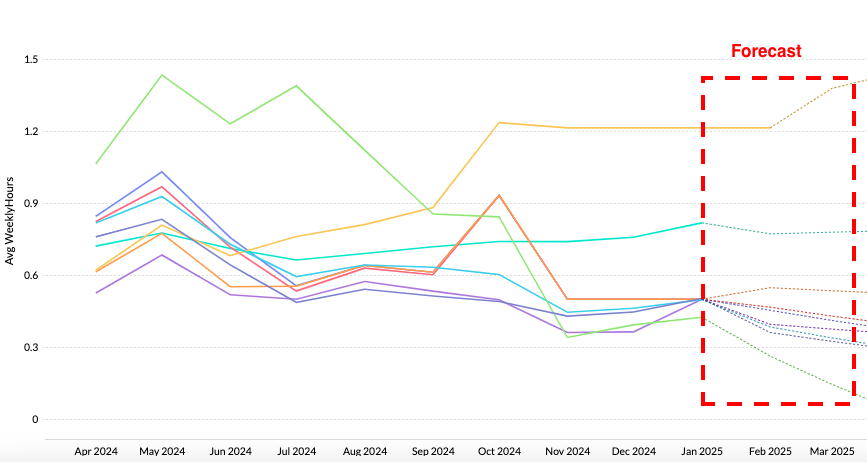
Forecast lines. With sufficient data you can forecast such as impact or capacity levels (which may be seasonal), or even readiness levels across the initiative lifecycle historically across initiatives.
The types of factors that can be included as predictive indicators can include readiness. It could be that readiness levels only get lifted just before go live or at go live. Adoption levels can also be forecasted if you have trend data across initiatives
Change tolerance levels across different parts of the business can also be seen as a predictive way of forecasting how much capacity there is for change beyond which saturation may be a key risk
Adoption and Behaviour Tracking:
Central to successful change management is the adoption and sustained implementation of new processes or technologies. Tracking adoption rates, user engagement, and behavioural changes are crucial indicators of initiative success. However, it’s essential to strike a balance between capturing relevant metrics and overwhelming stakeholders with unnecessary data.
Capturing behaviour change data can be key for larger initiatives or transformations. Behavioural change can be central in a range of changes such as customer centricity, efficiency, team collaboration or effectiveness. Measuring key behaviour changes that drive the initiative outcome the most is critical. For example, having effective conversations with customers to improve customer experience is a behaviour that can be rated, tracked and reported. Depending on the change, there may also be system features that can aid the tracking of these behaviours.
Effective change management goes hand in hand with strategic alignment, strategic goals, and necessary resources for strategic objectives. Reports should assess how initiatives contribute to overarching business objectives and whether they align with the rest of the organization’s strategic direction in the first place. Business leaders can utilize metrics related to revenue growth, cost savings, customer satisfaction, and employee productivity to provide valuable insights into the impact of change initiatives on business performance.
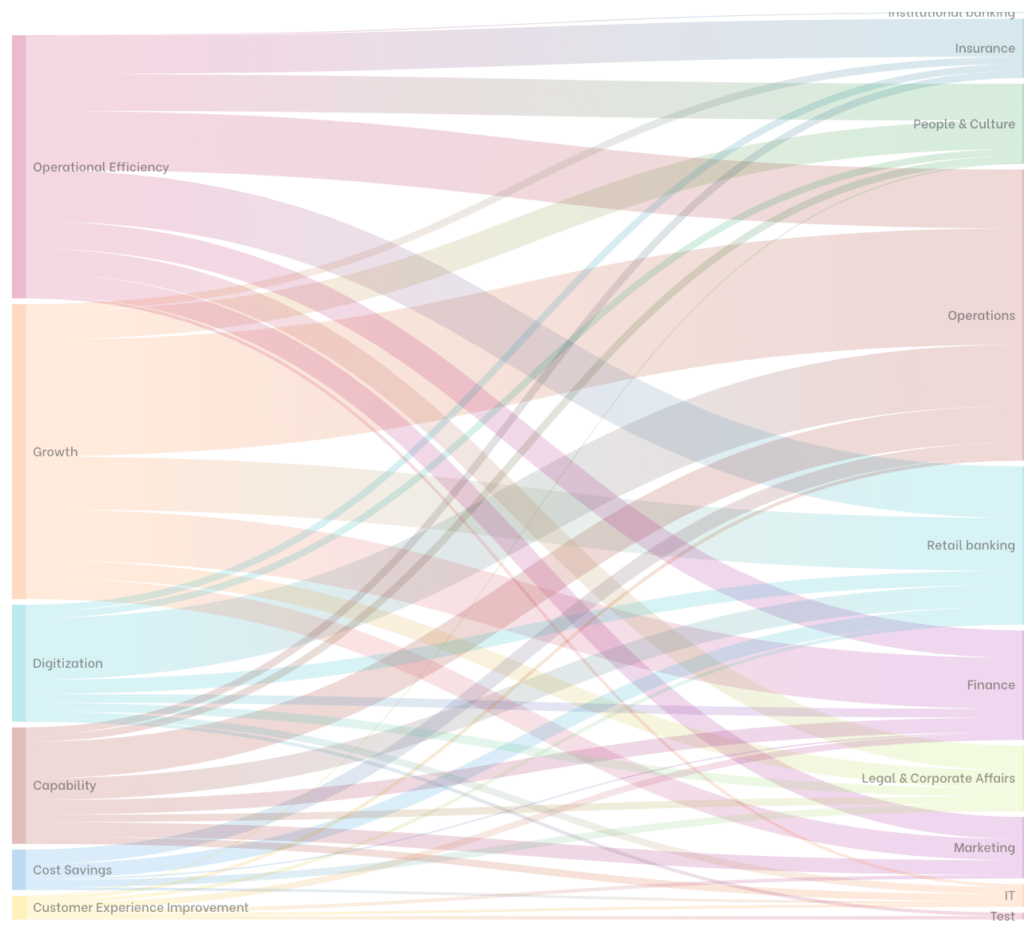
You can also link your change impacts to each strategic lever. In this way you can visually show the size of the impact per strategic lever. This will give your executives a way to examine whether the right level of impacts in the right areas of business are planned as a part of the course of each strategic lever.
The other angle is to visually show the pace of change against the strategic levers. Are certain key initiatives being driven at the right pace at the right time? Will the velocity of change exceed the ability of the business to absorb the changes? Or is the velocity not sufficiently meeting leadership expectations?
Benefit Realization:
Ultimately, the success of change initiatives is measured by their ability to deliver tangible benefits and assess the impact of the change. Change management reports should include key performance indicators (KPIs) and metrics that track the progress of change initiatives and the realization of expected benefits, whether they are financial gains, process efficiencies, or competitive advantages. By monitoring benefit realization, organizations can course-correct as needed and ensure that investments in change deliver the intended outcomes.
A key responsibility for change is to focus on those foreward looking measures that predict eventual benefit realisation, including readiness, adoption, engagement and behaviour change. Be sure to link these specifically to high benefit initiatives to provide strategic oversight.
Balancing Complexity and Clarity:
While incorporating a diverse range of metrics is essential for comprehensive reporting, it’s equally important to maintain clarity and focus. Reports should be structured in a way that highlights key insights and trends without overwhelming stakeholders with excessive detail. Visualizations such as charts, graphs, and dashboards can help distill complex data into actionable insights, facilitating informed decision-making at all levels of the organization.
All aspects of chart and dashboard designs are critical. These range from colour scheme chosen, number of charts, commentary, titles, legends, sequencing of charts, and type of charts chosen all act to either contribute to simplicity and clarity or complexity and confusion. Your narrative as you talk through the charts also plays a key role in building the story-line, and simplifying the key messages and actions you would like to impart to the audience.
Charts and dashboards tell a story and in presenting them you should always incorporate any actions required from the audience. If this is not done then it will always remain a FYI. FYI content will be deemed lower in the value curve over time and your stakeholders will lose interest. Instead, you should work on crafting a continual story that ebbs and flows. The following are key questions you should be asking when crafting you ongoing charts and dashboards:
Is there an emerging risk or opportunity that warrants specific focus for this month?
How are we tracking the effectiveness of stakeholder actions through data? This feedback loop is critical and gives your stakeholders a reference point for their own effectiveness
Is your data-based story uni-dimensional? Are there other dimensions beyond what you have been presenting that stakeholder should be aware of?
Are you giving stakeholders what they are most interested in? Whether it be strategic success progress, or benefit realisation?
Are you presenting change data in a holistic way in terms of how the business is run? Vs. just focused on standard change management function-specific metrics such as training sessions, or number of workshops completed?
Enterprise change management reporting is a critical tool for navigating the complexities of organizational change. By focusing on predictive indicators, including adoption and behavior tracking, business performance alignment, and benefit realization, organizations can unlock the full potential of their change management initiatives. However, achieving impactful reporting requires a careful balance between complexity and clarity, ensuring that stakeholders receive actionable insights without being inundated with unnecessary information. Ultimately, by harnessing the power of enterprise change management reporting, organizations can drive successful outcomes and thrive in an ever-evolving business landscape.
To find out more about enterprise change management reporting leveraging digital automation and analytics chat to us here.
Enterprise change management reporting refers to the systematic reporting of change management data across an organisation’s full portfolio of change initiatives – not just individual programme updates. It provides leadership with visibility of the total volume and complexity of change the organisation is absorbing, the adoption performance across all major programmes, and the change capacity available to absorb further change. Enterprise reporting is the foundation of a mature, data-driven approach to change governance.
How does enterprise change reporting differ from programme-level change reporting?
Programme-level change reports focus on the readiness, adoption, and risk status of a single change initiative. Enterprise change reports aggregate data across all programmes to show the full picture of change load, resource deployment, and adoption performance at the organisational level. Enterprise reporting answers questions that programme-level reporting cannot: which employee groups are over-saturated with change? Which programmes are competing for the same people’s attention? Is the organisation’s change capacity sufficient for the current and planned change portfolio?
What data do you need for enterprise change management reporting?
Enterprise change reporting requires three types of data: change portfolio data (what changes are being delivered, to whom, and on what timeline), change impact data (the level of disruption each change creates for each affected employee group), and adoption data (the rate at which changes are being adopted across the organisation). Collecting and aggregating this data manually is extremely difficult at enterprise scale – a purpose-built change management platform is typically required to make enterprise reporting sustainable and credible.
How to measure change saturation: a practical methodology for enterprise change functions
Most organisations can feel change saturation before they can prove it. Leaders sense that employees are struggling, change managers notice adoption slipping, and business partners start raising concerns about “too much at once.” But when it comes to quantifying the problem, securing executive attention, or making a credible case for adjusting programme sequencing, feeling is not enough.
Measurement changes that dynamic entirely. An organisation that can measure change saturation can demonstrate it, act on it, and prevent it from quietly undermining transformation outcomes. An organisation that cannot measure it is stuck responding to symptoms rather than causes.
This article sets out a practical methodology for measuring change saturation in enterprise environments: what to measure, how to score it, what the data tells you, and how to turn the output into decisions that protect adoption and reduce change fatigue.
Why change saturation is so difficult to measure
The challenge with measuring change saturation is that it is not a single variable. It is an emergent condition that arises from the interaction between several variables: the volume of concurrent changes landing on a group, the intensity of each change, and the capacity of the group to absorb them. None of these is directly observable in isolation.
Volume is relatively straightforward to count: how many programmes are actively affecting this group right now? But volume without intensity gives you an incomplete picture. A group managing two major system replacements simultaneously is more saturated than a group managing ten minor policy updates. And both assessments are useless unless they are calibrated against capacity: a high-performing change champion network in a well-managed business unit with experienced managers can absorb more than a stretched team in the middle of a restructure.
Prosci’s Best Practices in Change Management research found that 73% of organisations surveyed were near, at, or beyond the saturation point. The reason that number is so high is not that organisations are careless. It is that most organisations have no systematic way to see saturation building before it becomes critical.
The three dimensions of a change saturation measurement model
A rigorous methodology for measuring change saturation needs to address all three dimensions: load, intensity, and capacity.
Dimension 1: Change load
Change load is the quantitative foundation of saturation measurement. It answers the question: how much change is being asked of this group, across all programmes, right now?
Calculating change load requires a portfolio-level view. For each group of employees, you need to know:
How many programmes are currently in active delivery (preparation, go-live, or post-go-live embedding)
The size of the group and the proportion affected by each programme
The timeline of each programme’s peak demand periods
A simple change load index can be constructed by assigning each programme a weight (based on the size and duration of its demand on the group) and summing those weights for each group across the current period. The output is a comparative score: Group A has a load index of 4.2, Group B has a load index of 1.8. High-load groups are immediate candidates for deeper investigation.
Dimension 2: Change intensity
Not all changes demand the same cognitive and behavioural adjustment. Change intensity measures how disruptive each individual programme is to the employees it affects. A robust intensity assessment covers the following dimensions:
Process change: Are employees being asked to follow materially different processes or procedures?
System change: Are new technologies being introduced that require new skills and habits?
Role change: Are roles being restructured, responsibilities shifting, or reporting lines changing?
Behavioural change: Are fundamental ways of working or cultural norms being challenged?
Location and environment: Are physical working arrangements changing?
Each dimension is typically scored on a scale of one to five: one meaning minimal adjustment required, five meaning radical shift. The total intensity score for a programme across all dimensions provides a standardised basis for comparison that goes well beyond “major” and “minor” labels.
When intensity scores are multiplied by the number of people affected, you get a weighted impact figure that can be aggregated across all programmes to give a cumulative impact score for any stakeholder group.
Dimension 3: Absorption capacity
Absorption capacity is the most subjective of the three dimensions, but it is also the most important for calibrating risk. Two groups facing identical change load and intensity may have very different actual saturation risk depending on their current capacity to absorb change.
Factors that increase absorption capacity include: a recent track record of successful change adoption, strong and engaged line managers who actively support transitions, low current business workload, a stable team structure, and access to dedicated change support resources.
Factors that reduce absorption capacity include: recent history of poorly managed change, a restructure or leadership transition in the past twelve months, high current business workload or seasonal pressure, high attrition in the period, and limited manager availability.
Capacity can be assessed using a structured scoring approach: assign each factor a weight and a score, sum the results, and produce a capacity index. When capacity is low and load is high, the saturation risk calculation shifts dramatically.
Combining the three dimensions: the saturation risk score
Once you have load, intensity, and capacity scores for each stakeholder group, you can combine them into a single saturation risk score. The formula is straightforward in principle:
Saturation Risk = (Change Load x Average Intensity) / Absorption Capacity
Groups with a high numerator (high load and high intensity) and a low denominator (low capacity) are at the greatest risk of saturation. Groups with moderate load, moderate intensity, and high capacity may be managing comfortably.
The specific weighting and calibration of this formula will vary by organisation. The important thing is that the formula is applied consistently across all groups and time periods so that comparisons are meaningful. An organisation that calculates saturation risk scores every quarter develops a trend view: is this group’s score rising, stable, or declining? That trend view is often more actionable than any single data point.
Gartner’s research on change fatigue identifies the cascading effects of high saturation: employee intent to stay declines by up to 42% and individual performance can fall by up to 27%. Having a risk score that flags these conditions before they materialise is what gives organisations time to intervene.
Leading indicators: what to watch before saturation becomes critical
Quantitative load, intensity, and capacity scores are the analytical foundation. But they are only as useful as the data that feeds them. Leading indicators provide an early warning layer that flags emerging saturation risk in real time.
The most reliable leading indicators for change saturation include:
Readiness assessment scores: If stakeholder readiness surveys are showing declining confidence in the same groups across multiple programmes, that is a strong signal of emerging saturation even before adoption data confirms it.
Support ticket volume and type: A spike in “how do I” tickets, process queries, or errors in a group that has recently gone through multiple changes indicates that new ways of working are not yet embedded.
Manager-reported concerns: Direct reports from line managers about team overload, confusion about priorities, or declining morale are a ground-level signal that formal data often misses.
Participation rates in change activities: Declining attendance at training sessions, communications open rates falling, or drop-off in workshop participation are early indicators that employees are starting to disengage from change processes.
Pulse survey sentiment: Structured short-cycle surveys asking employees specifically about their change experience, not just general engagement, can surface saturation signals weeks before adoption metrics deteriorate.
The value of these indicators is in their combination. Any single signal can have alternative explanations. When multiple leading indicators are moving in the same direction for the same group, the probability of saturation risk is high.
Lagging indicators: confirming what the leading indicators predicted
If saturation goes undetected or unmanaged, it will eventually show up in lagging indicators. These are retrospective: they confirm that saturation has already occurred, rather than giving you time to prevent it.
Key lagging indicators include:
Adoption rates below threshold: If post-go-live adoption data shows that target behaviours are not being sustained at expected levels, saturation is one of the most common root causes.
Benefits realisation shortfalls: When programmes that expected to deliver financial or operational outcomes within a defined period consistently fall short, compounded change load is often a contributing factor.
Attrition spikes in high-change groups: Research from Prosci identifies that 54% of employees experiencing change fatigue actively look for a new role. Voluntary attrition data disaggregated by group and correlated with change load data can confirm saturation impact after the fact.
Quality or error rate increases: In operational groups going through system or process changes, a measurable increase in errors or rework can indicate that employees are not yet proficient in the new ways of working.
Tracking lagging indicators matters for two reasons. First, they close the loop on the saturation risk methodology: if your risk scores correctly predicted the groups that experienced adoption failure, your model is calibrated well. Second, they provide the evidence base for executive conversations about saturation impact, which is often necessary before organisations will invest in prevention.
Building a change saturation dashboard
Measurement only creates value when it is visible to the people who can act on it. A change saturation dashboard serves as the primary communication tool for the enterprise change function, translating complex multi-variable analysis into a format that programme sponsors, business unit leaders, and transformation executives can consume quickly.
An effective saturation dashboard includes:
Portfolio heat map by group: A matrix showing which stakeholder groups are carrying the highest change load in the current quarter, with colour coding indicating saturation risk levels.
Trend lines for high-risk groups: For groups flagged as high-risk, a rolling view of their saturation score over the past two to four quarters.
Programme convergence view: A calendar-based visualisation showing where multiple programmes are landing on the same groups in the same window.
Leading indicator summary: A consolidated view of the current readings on key leading indicators, with flagging for any that are trending in a concerning direction.
Intervention log: A record of what saturation management interventions have been initiated, by whom, and for which groups.
This kind of visibility transforms saturation management from a reactive exercise into a governance function. When the dashboard is presented regularly to the portfolio governance committee, saturation risk becomes a standing agenda item alongside cost, schedule, and scope.
Practical tools for saturation measurement at scale
For enterprise change functions managing ten or more concurrent programmes, the practical challenge of measuring saturation is significant. The data collection, aggregation, and analysis required to maintain a current, accurate view of saturation risk across a complex portfolio cannot be managed sustainably in spreadsheets.
Change Compass is built specifically for this challenge. The platform provides enterprise change functions with a centralised data infrastructure for capturing change impact and load across the portfolio, automated aggregation of cumulative change demand by stakeholder group, and real-time visualisation of saturation risk. Rather than manually compiling data from twelve different programme SharePoint sites, change managers can work from a single source of truth that surfaces portfolio-level risk automatically.
For change teams in the early stages of building measurement capability, starting with the Change Compass weekly demo is a practical way to see what portfolio-level saturation measurement looks like in practice before committing to a platform investment.
Making measurement actionable: from scores to decisions
The ultimate purpose of measuring change saturation is not to produce scores. It is to produce better decisions about how the change portfolio is managed. A saturation risk score that sits in a report and is never acted on has no value.
The decisions that saturation measurement should be driving include:
Sequencing decisions: When high-risk groups are identified, programme governance should have a mechanism to delay or phase go-live dates for lower-priority programmes to reduce peak load.
Resourcing decisions: Groups identified as high-risk may require additional change support capacity, including dedicated practitioners, enhanced manager coaching, or intensified communication.
Scope decisions: When sequencing is not possible, MVP thinking applied to change scope can reduce the intensity of individual programmes landing on high-risk groups.
Reporting decisions: High-risk groups should be on the executive sponsor radar, with regular updates on saturation indicators and intervention progress.
Prosci’s research on change management metrics consistently identifies that organisations that actively measure and act on change data are significantly more likely to meet or exceed their project objectives. The measurement methodology matters, but the governance mechanism that turns measurement into action matters just as much.
Where to start: a phased approach to building saturation measurement capability
Most enterprise change functions cannot build a full saturation measurement system overnight. The most practical approach is phased.
Phase 1: Establish the data foundation. Standardise the change impact assessment template across all programmes so that group-level impact data is collected in a consistent, comparable format. Without this, aggregation is impossible.
Phase 2: Build the portfolio view. Map all active and upcoming programmes against the employee population in a shared register. Identify which groups are affected by more than two significant changes in the next quarter.
Phase 3: Add the intensity layer. For the highest-load groups identified in Phase 2, conduct structured intensity assessments for each programme affecting them. Calculate cumulative intensity scores.
Phase 4: Introduce capacity assessment. Develop a structured capacity scoring instrument for the highest-risk groups. Combine load, intensity, and capacity scores into a risk index.
Phase 5: Automate and sustain. Move from manual calculation to platform-supported aggregation and visualisation, so that saturation risk is maintained as a live view rather than a quarterly exercise.
The organisations that manage change saturation most effectively are those that started this journey early enough to have meaningful data before the next major convergence point. The methodology above is scalable from small beginnings, but the longer measurement is deferred, the less lead time there is to act.
Frequently asked questions
What is the best way to measure change saturation?
The most robust approach combines three dimensions: change load (the volume of concurrent programmes affecting a group), change intensity (how disruptive each programme is across process, system, role, and behavioural dimensions), and absorption capacity (the group’s current ability to take on change). Combining these into a saturation risk score, tracked over time, provides a meaningful basis for governance and intervention decisions.
How do you know when an organisation has reached change saturation?
Saturation is typically confirmed by a combination of leading and lagging indicators. Leading indicators include declining readiness scores across multiple programmes for the same groups, rising support ticket volumes, and falling participation in change activities. Lagging indicators include below-target adoption rates, benefits realisation shortfalls, and voluntary attrition spikes in high-change groups. When multiple signals align, saturation is almost certainly a factor.
What data do you need to measure change saturation?
The minimum data set includes: the change portfolio (all active programmes and their timelines), impact assessment data (which groups are affected, how significantly), readiness and adoption metrics from each programme, and capacity indicators for the highest-risk groups. Ideally this data is maintained in a centralised platform rather than distributed across programme-level documents.
Can change saturation be measured at the team level?
Yes, and team-level measurement is often the most actionable. While portfolio-level heat maps identify which business units or functions are carrying the highest load, team-level analysis identifies where the risk is most acute and allows targeted support to be directed precisely. Line manager input is essential for accurate capacity assessment at the team level.
How often should change saturation be measured?
At a minimum, quarterly. For organisations running fast-moving transformation portfolios, monthly or rolling measurement is more appropriate. The goal is to have enough lead time to act on risk signals before they translate into adoption failure. A retrospective saturation assessment after go-live confirms what happened but does not allow intervention.