There is now a lot of attention and focus on data. However, is the same applied to change management data? With the substantial financial investments companies make in change efforts, there’s a growing recognition of the need to leverage change management data strategically. Senior managers and executives are increasingly demanding data-driven insights to make informed business decisions. Here, we explore the challenges associated with change data, the strategic approaches to managing it effectively, and how incorporating it into the decision-making process can drive organizational success.
Common Challenges in Working with Change Data
Ad hoc and Tactical Approaches One common challenge in working with change data is the ad hoc and tactical nature of its collection. Often, data is gathered as needed, primarily at the project level. This can result in a fragmented view of change initiatives, making it challenging to derive meaningful insights. For instance, progress data may be limited to generic metrics such as the number of change impact sessions or completed training sessions, lacking depth and context.
Data Insufficiently Fact-Based Another prevalent issue is the creation of data that lacks a solid factual foundation. Change practitioners sometimes rely on gut-feel ratings or broad categories that are difficult to defend or substantiate infront of stakeholders. Heatmaps, a popular visualization tool, may be based on subjective assessments rather than objective, quantifiable measures, hindering the data’s credibility and utility.
Ineffective Data Visualizations Data visualizations play a crucial role in conveying information effectively. Unfortunately, some visualizations fall short of making a significant impact. Whether they are overly colorful, fail to use the right chart to highlight key points, or present data in a way that obscures the primary message, ineffective visualizations can impede the decision-making processes.
Seeking Easy Fixes Many change practitioners view working with data as a chore and opt for quick fixes. They may collect just enough data to generate a report or dashboard, neglecting the importance of a thorough understanding and management of the data. This short-sighted approach can compromise the quality and reliability of the insights derived from the data.
Strategic Approaches in Working with Change Data
Strategic approaches to manage change data can result in significant value for the organisation. Imagine the power of a range of change management data that highlights anything from impact levels, saturation risks, sentiments, adoption risks and benefit realization progress. Such is the power of change data, if managed effectively. What are some of these strategic approaches?
Managing Data as a Core Routine To address the challenges associated with ad hoc and tactical data collection, organizations must establish routines for managing change data. Monthly data reviews, updates, and audits create a disciplined approach to ensure the data remains accurate, relevant, and valuable. By making data management a core routine, organizations foster a culture of accountability and accuracy. This can be applied across a large program, a business unit, a portfolio of initiatives or across the enterprise.
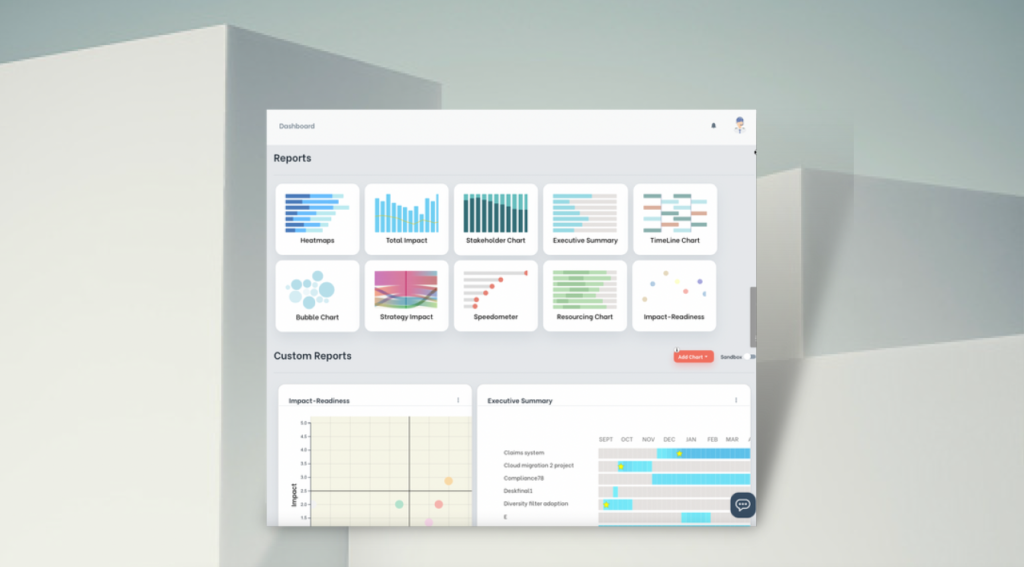
Leveraging AI for Data Auditing and Cleansing Artificial Intelligence (AI) can play a pivotal role in auditing and cleansing change data. Platforms like The Change Compass offer features that automate these processes, reducing the likelihood of errors and ensuring data integrity. AI-driven tools can identify inconsistencies, outliers, and inaccuracies, providing a more reliable foundation for decision-making.
Linking Change Data with Other Business Sources The true power of change data emerges when it is connected with other relevant business data sources. By integrating change management data with project data, HR data, risk data, and operations data, organizations gain a holistic view of their business landscape. This interconnected approach allows for a comprehensive understanding of key business risks and opportunities, facilitating more informed decision-making.
Incorporating Data into Decision-Making Bodies Change data should not exist in isolation; it should be integrated into key decision-making forums and processes. From executive leadership forums and strategic planning sessions to portfolio planning and operational meetings, incorporating change data into these discussions ensures that insights derived from the data inform critical business decisions. This alignment helps organizations proactively address challenges and capitalize on opportunities.
While recognizing the strategic importance of change data is a significant step forward, change practitioners must actively implement practical measures to enhance their approach to change data management. Here are some recommendations to help change practitioners become more strategic in their utilization of change data:
Standardize/Routinize Data Collection Processes: o Develop standardized processes for collecting change data across different projects and initiatives. o Implement consistent data collection templates and methodologies to ensure uniformity and comparability of data across initiatives and business units
Invest in Training and Skill Development: o Provide training for change practitioners on data management best practices, including data collection, analysis, audit and interpretation. This is critical to drive data capability and maturity. o Foster a data-driven culture within the organization by equipping practitioners with the necessary skills to leverage data effectively.
Utilize Technology and Automation: o Embrace technological solutions, such as data analytics tools and AI-driven platforms, to automate data auditing, cleansing, and visualization processes. o Leverage technology to streamline data collection and reporting, reducing manual effort and minimizing the risk of errors.
Encourage Cross-Functional Collaboration: o Facilitate collaboration between change management teams and other departments, encouraging the sharing of data and insights. o Establish cross-functional teams to integrate change data with project data, HR data, and other relevant business sources.
Implement Data Governance Frameworks: o Develop and implement robust data governance frameworks to ensure the accuracy, security, and compliance of change data. o Define roles and responsibilities for data management within change initiatives, promoting accountability and ownership.
Enhance Data Visualization and Reporting: o Invest in training or hiring professionals with expertise in data visualization to create compelling and impactful reports. o Tailor visualizations to the audience, ensuring that key messages are communicated clearly and effectively.
Conduct Regular Data Reviews and Audits: o Establish a routine for regular data reviews, updates, and audits to maintain the accuracy and relevance of change data. o Use audits as an opportunity to identify and rectify data discrepancies or inconsistencies.
Integrate Change Data into Decision-Making Processes: o Actively participate in executive leadership forums, strategic planning sessions, and other decision-making bodies. o Present change data alongside other relevant business data to contribute to well-informed decision-making.
Measure and Communicate Value: o Develop metrics to measure the value generated by change initiatives and communicate these metrics to key stakeholders. o Regularly assess the impact of change data on decision-making processes and adjust strategies accordingly.
Seek Continuous Improvement: o Foster a culture of continuous improvement within the change management function. o Encourage practitioners to reflect on past experiences, learn from challenges, and refine their approach to change data management over time.
The strategic management of change data is not just a necessity but a critical component of achieving business success in today’s dynamic environment. By addressing common challenges and adopting strategic approaches, organizations can unlock the true potential of change data. As the business landscape continues to evolve, leveraging data-driven insights becomes a strategic imperative for navigating change, mitigating risks, and capitalizing on opportunities. Embracing change data as a strategic exercise positions organizations to not only survive but thrive in an ever-changing marketplace.
Change management professionals often struggle with proving the worth of their services and why they are needed. There are certainly plenty of reasons why change management professionals are required and most experienced project managers and senior leaders would acknowledge this. However, for the less mature organisations that may not have had effective change management experts leading initiatives, the rationale on the additional value of change management may be less clear.
When we look across different project members and project teams, it is easy to argue that without developers, the technical project cannot progress. Without business analysts, we cannot understand and flesh out the core business steps required in the initiative. And of course, we definitely need a project manager for a project. But, what’s the justification for a change manager? Many projects have other project or business representatives do the change work instead.
As an attempt to justify in a very direct way, the value of change management, many resort to ROI calculations and aim toward higher ROI. This ROI of change management may seem like a great way to convey and show in a very direct and financial way, the value of change management towards project success. After all, we use ROI for calculating projects, why not use the same for change management as well to value the people side of change?
There are plenty of articles on how to best calculate change management ROI. Here are a couple:
1. PROSCI
Prosci has a good, clear way of calculating change management ROI within a project (though it doesn’t take into account speed of adoption). You simply evaluate to what extent employee adoption is important to the project. Then you take the overall expected project benefits and deduct the part of the expected benefits if there was no adoption. This is termed “people side benefit contribution”.
People Side Benefit Contribution = Expected Project Benefits – Expected Project Benefits (if adoption and usage = 0)
People Side Benefit Coefficient = People Side Benefit Contribution / Expected Project Benefits
2. Rightpoint
Rightpoint has a variation to this calculation. They have added ELV (Employee Lifetime Value) to the calculation.
Using ROI may be useful when the cost of the initiative is the critical focus for the organisation for its strategic investment. However, it is not the only way to convey the overall value of successful change management. In addition, the ROI method limits the value of change management to focus on the cost invested versus the value created. Also, this type of calculation limits the value of change to a project by project perspective.
So, how else do we show the direct financial value of change management? Let’s look to research. It turns out there are plenty of research examples. Here are some:
McKinsey & Company. (2016). The people power of transformations. This study found that transformation initiatives are 5.8 times more successful if CEOs communicate a compelling change story, and 6.3 times more successful when leaders share messages about change efforts with the rest of the organization. Link here.
Korn Ferry. (2018). Engaging hearts and minds: Preparing for a changing world. This study found that calls out change as a key trend found that companies with high levels of employee engagement had 4.5 times higher revenue growth compared to companies with low levels of engagement, noting that all companies are undergoing change. Link here.
IBM. (2016). Making change work … while the world keeps changing. This study found that 76% of successful projects include change management activities at the beginning of their overall project plans, which is 33% more than less successful projects. Link here.
IBM. (2015) Why a business case for change management. The article references a survey carried out in 2010 where companies that apply a value (benefit) realization approach (of which change management is a core component) complete projects at least twice as quickly and under budget by a factor of at least 1.9 times, Compared to those that don’t. Link here.
Towers Watson. (2013). Change and communication ROI. Organizations with highly effective communication and change management practices are more than twice as likely to significantly outperform their peers in total shareholder returns, versus organizations that are not highly effective in either of these areas. Link here.
Prosci. (2020). Best Practices in Change Management 11th Edition. The paper referred to a Prosci study that found that projects with excellent change management practices 6 times more likelihood of meeting project objectives than those that are poor. Link here.
So the value the importance of change management, let’s take a comparison to see the difference in using a ROI calculation of the value of change management versus using findings from the above research findings to demonstrate the derived value.
Let’s take a typical project example. Company A has ….
Annual revenue of $1 billion with 5% profitability
The revenue growth is 1%
Project A costs $1Million and is targeted for $3 million in benefits.
If the expected project benefits without adoption would be $1Million, then, the people-side contribution is …
$2Million / $3Million = $667K.
Let’s contrast this to other calculations using research.
Research findings | Calculation
Korn Ferry study where companies with high levels of employee engagement had 4.5 times higher revenue growth compared to companies with low levels of engagement. Taking a very conservative approach of portioning on 1/3 of employee engagement linked to change, this means 1.5 times higher revenue growth. | Taking a very conservative approach of portioning 1/3 of employee engagement as linked to change, this means 1.5 times higher revenue growth. This means if the revenue growth is 1%, then the additional revenue is $15 Million per year.
You can see that $15 million in value is much higher than the $667K in initiative ROI. From these examples, you can see that the financial value dwarfs that from the ROI calculation. On top of this, these are from research findings, which may have a stronger perceived validity and be easier to be trusted by stakeholders than the ROI calculation.
To point out, it is not an apple-to-apple comparison between the change management ROI from one initiative to the organisational value of change management across initiatives. However, the call out is that:
The financial value of change management does not need to be limited to individual initiatives
The sum may be greater than its parts. Rather than measuring at initiative levels, research findings are looking at organisational-level value
The value of change management may be more than cost, but also other value drivers such as revenue
As change management practitioners we should not shy away from calling out and citing the value of change management. Cost may be one value, but the true benefit of change management is both the top line as well as the bottom line. Directly referring to the research-backed findings also helps to highlight its value size and importance.
To do this, we should also work to deliver organisational value in managing change and not limit ourselves to one initiative. Focus on uplifting change management capability in the forms of leadership styles, change governance, change analytics, and change champion network capability, just to name a few.
Change management is often seen as a ‘soft’ discipline that is more an ‘art’ than science. However, successful change management, like managing a business, relies on having the right data to understand if the journey is going in the right direction toward change adoption. The data can inform whether the objectives will be achieved or not.
Data science has emerged to be one of the most sought-after skills in the marketplace at the moment. This is not a surprise because data is what powers and drives our digital economy. Data has the power to make or break companies. Companies that leverages data can significant improve customer experiences, improve efficiency, improve revenue, etc. In fact all facets of how a company is run can benefit from data science. In this article, we explore practical data science techniques that organizations can use to improve change outcomes and achieve their goals more effectively.
Improved decision making
One of the significant benefits of using data science in change management is the ability to make informed decisions. Data science techniques, such as predictive analytics and statistical analysis, allow organizations to extract insights from data that would be almost impossible to detect or analyse manually. This enables organizations to make data-driven decisions that are supported by empirical evidence rather than intuition or guesswork.
Increased Efficiency
Data science can help streamline the change management process and make it more efficient. By automating repetitive tasks, such as data collection, cleaning, and analysis, organizations can free up resources and focus on more critical aspects of change management. Moreover, data science can provide real-time updates and feedback, making it easier for organizations to track progress, identify bottlenecks, and adjust the change management plan accordingly.
Improved Accuracy
Data science techniques can improve the accuracy of change management efforts by removing bias and subjectivity from decision-making processes. By relying on empirical evidence, data science enables organizations to make decisions based on objective facts rather than personal opinions or biases. This can help reduce the risk of errors and ensure that change management efforts are based on the most accurate and reliable data available.
Better Risk Management
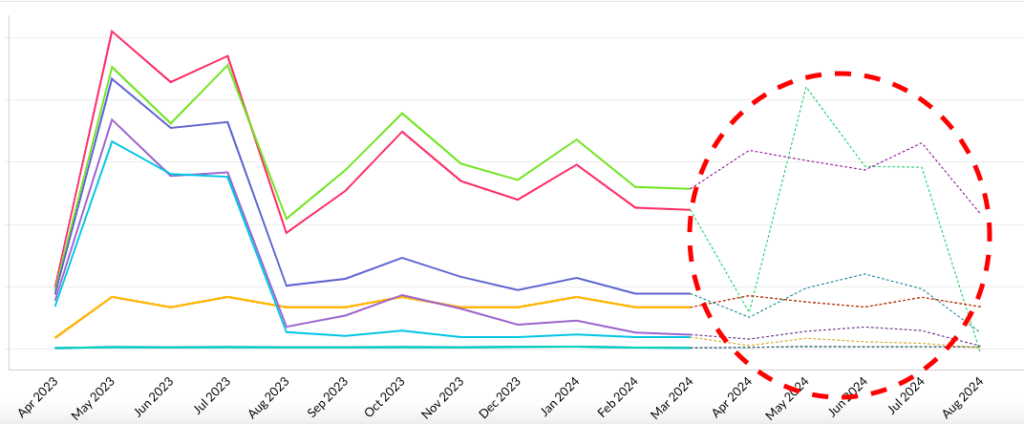
Data science can help organizations identify potential risks and develop contingency plans to mitigate those risks. Predictive analytics can be used to forecast the impact of change management efforts and identify potential risks that may arise during the transition. For example, change impacts across multiple initiatives against seasonal operations workload peaks and troughs.
Enhanced Communication
Data science can help facilitate better communication and collaboration between stakeholders involved in the change management process. By presenting data in a visual format, such as graphs, charts, and maps, data science can make complex information more accessible and understandable to all stakeholders. This can help ensure that everyone involved in the change management process has a clear understanding of the goals, objectives, and progress of the transition.
Key data science approaches in change management
Conduct a Data Audit
Before embarking on any change management initiative, it’s essential to conduct a data audit to ensure that the data being used is accurate, complete, and consistent. For example, data related to the current status or the baseline, before change takes place. A data audit involves identifying data sources, reviewing data quality, and creating a data inventory. This can help organizations identify gaps in data and ensure that data is available to support the change management process. This includes any impacted stakeholder status or operational data.
During a data audit, change managers should ask themselves the following questions:
What data sources from change leaders and key stakeholders do we need to support the change management process?
Is the data we are using accurate and reliable?
Are there any gaps in our data inventory?
What data do we need to collect to support our change management initiatives, including measurable impact data?
Using Predictive Analytics
Predictive analytics is a valuable data science technique that can be used to forecast the impact of change management initiatives. Predictive analytics involves using historical data to build models that can predict the future impact of change management initiatives. This can help organizations identify potential risks and develop proactive strategies to mitigate those risks.
Change managers can use predictive analytics to answer the following questions:
What is the expected impact of our change management initiatives?
What are the potential risks associated with our change management initiatives?
What proactive strategies can we implement to mitigate those risks?
How can we use predictive analytics to optimize the change management process?
Leveraging Business Intelligence
Business intelligence is a data science technique that involves using tools and techniques to transform raw data into actionable insights. Business intelligence tools can help organizations identify trends, patterns, and insights that can inform the change management process. This can help organizations make informed decisions, improve communication, and increase the efficiency of change management initiatives.
Change managers can use business intelligence to answer the following questions:
What insights can we gain from our data?
What trends and patterns are emerging from our data?
How can we use business intelligence to improve communication and collaboration among stakeholders?
How can we use business intelligence to increase the efficiency of change management initiatives?
Using Data Visualization
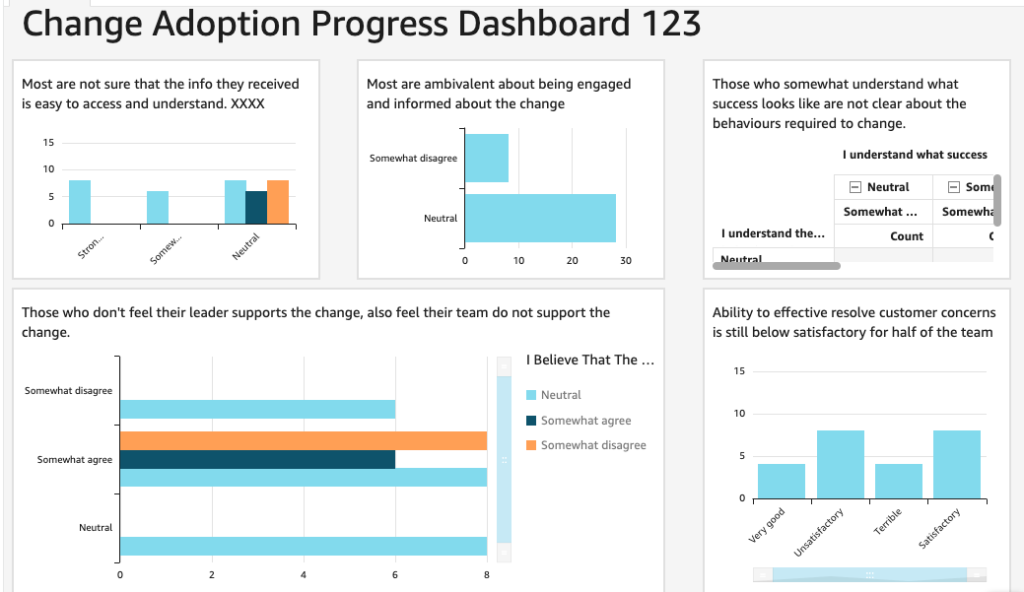
Data visualization is a valuable data science technique that involves presenting data in a visual format such as graphs, charts, and maps. Data visualization can help organizations communicate complex information more effectively and make it easier for stakeholders to understand the goals, objectives, and progress of change management initiatives. This can improve communication and increase stakeholder engagement in the change management process.
Change managers can use data visualization to answer the following questions:
How can we present our data in a way that is easy to understand?
How can we use data visualization to communicate progress and results to stakeholders?
How can we use data visualization to identify trends and patterns in our data?
How can we use data visualization to increase stakeholder engagement in the change management process?
Monitoring and Evaluating Progress
Monitoring and evaluating progress is a critical part of the change management process. Data science techniques, such as statistical analysis and data mining, can be used to monitor progress and evaluate the effectiveness of change management initiatives. This can help organizations identify areas for improvement, adjust the change management plan, and ensure that change management initiatives are achieving the desired outcomes.
Change managers can use monitoring and evaluation techniques to answer the following questions:
How can we measure the effectiveness of our change management initiatives? (e.g. employee engagement, customer satisfaction, business outcomes, etc.) And what method do we use to collect the data? E.g. surveys or focus groups?
What data do we need to collect to evaluate the change initiative progress?
How can we use statistical analysis and data mining to identify areas for improvement?
How can we use monitoring of ongoing support or continuous improvement?
The outlined approaches are some of the key ways in which we can use data science to manage the change process. Change practitioners should invest in their data science capability and adopt data science techniques to drive effective change management success. Stakeholders will take more notice of change management status and they may also better understand the value of managing change. Most importantly, data helps to achieve change objectives.
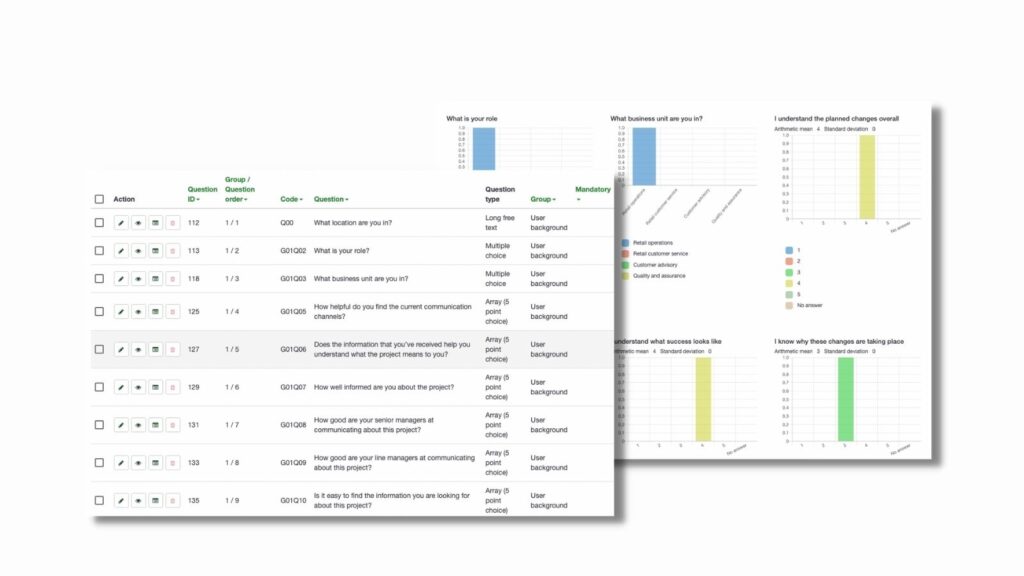
An important part of measuring meaningful change is to be able to design effective communication effectiveness change management surveys that measure the purpose of the survey it has set out to measure the level of understanding of the change. Designing and rolling out change management surveys is a core part of what a change practitioner’s role is. However, there is often little attention paid to how valid and how well designed the survey is. A survey that is not well-designed can be meaningless, or worse, misleading. Without the right understanding from survey results, a project can easily go down the wrong path. This is how this survey can be a powerful tool to ensure smooth transition for the change initiative.
Why do change management surveys need to be valid?
A survey’s validity is the extent to which it measures what it is supposed to measure. Validity is an assessment of its accuracy. This applies whether we are talking about a change readiness survey, a change adoption survey, employee engagement, employee sentiment pulse survey, or a stakeholder opinion survey.
What are the different ways to ensure that a organizational change management survey can maximise its validity and greater success?
Face validity. The first way in which a survey’s validity can be assessed is its face validity. Having good face validity is that in the view of your targeted respondents the questions measure what they aimed to measure. If your survey is measuring stakeholder readiness, then it’s about these stakeholders agreeing that your survey questions measure what they are intended to measure.
Predictive validity. If you really want to ensure that your survey questions are scientifically proven to have high validity, then you may want to search and leverage survey questionnaires that have gone through statistical validation. Predictive validity means that your survey is correlated with those surveys that have high statistical validity. This may not be the most practical for most change management professionals.
Construct validity. This is about to what extent your change survey measures the underlying attitudes and behaviours it is intended to measure. Again, this may require statistical analysis to ensure there is construct validity.
At the most basic level, it is recommended that face validity is tested prior to finalising the survey design.
How do we do this? A simple way to test the face validity is to run your survey by a select number of ‘friendly’ respondents (potentially your change champions) and ask them to rate this, followed by a meeting to review how they interpreted the meaning of the survey questions.
Alternatively, you can also design a smaller pilot group of respondents before rolling the survey out to a larger group. In any case, the outcome is to test that your survey is coming across with the same intent as to how your respondents interpret them.
Techniques to increase survey validity
1. Clarity of question-wording.
This is the most important part of designing an effective and valid survey. This is a critical part of the change management strategy. The question wording should be that any person in your target audience can read it and interpret the question in exactly the same way.
Use simple words that anyone can understand, and avoid jargon where possible unless the term is commonly used by all of your target respondents
Use short questions where possible to avoid any interpretation complexities, and also to avoid the typical short attention spans of respondents. This is also particularly important if your respondents will be completing the survey on mobile phones
Avoid using double-negatives, such as “If the project sponsor can’t improve how she engages with the team, what should she avoid doing?”
2. Avoiding question biases
A common mistake in writing survey questions is to word them in a way that is biased toward one particular opinion which may lead to biased employee feedback. This assumes that the respondents already have a particular point of view and therefore the question may not allow them to select answers that they would like to select.
Some examples of potentially biased survey questions (if these are not follow-on questions from previous questions):
Is the information you received helping you to communicate effectively to your team members through appropriate communication channels?
How do you adequately support the objectives of the project
From what communication mediums do your employees give you feedback about the project
3. Providing all available answer options
Writing an effective employee survey question means thinking through all the options that the respondent may come up with regarding the upcoming change. After doing this, incorporate these options into the answer design. Avoid answer options that are overly simple and may not meet respondent needs in terms of choice options.
4. Ensure your chosen response options are appropriate for the question.
Choosing appropriate response options may not always be straightforward. There are often several considerations, including:
What is the easiest response format for the respondents?
What is the fastest way for respondents to answer, and therefore increase my response rate?
Does the response format make sense for every question in the survey?
For example, if you choose a Likert scale, choosing the number of points in the Likert scale to use is critical.
If you use a 10-point Likert scale, is this going to make it too complicated for the respondent to interpret between 7 and 8 for example?
If you use a 5-point Likert scale, will respondents likely resort to the middle, i.e. 3 out of 5, out of laziness or not wanting to be too controversial? Is it better to use a 6-point scale and force the user not to sit in the middle of the fence with their responses?
If you are using a 3-point Likert scale, for example, High/Medium/Low, is this going to provide sufficient granularity that is required in case there are too many items where users are rating medium, therefore making it hard for you to extract answer comparisons across items?
5. If in doubt leave it out
There is a tendency to cram as many questions in the survey as possible because change practitioners would like to find out as much as possible from the respondents. However, this typically leads to poor outcomes including poor completion rates. So, when in doubt leave the question out and only focus on those questions that are absolutely critical to measure what you are aiming to measure.
6.Open-ended vs close-ended questions
To increase the response rate of change readiness survey questions, it is common practice to use closed-ended questions where the user selects from a prescribed set of answers. This is particularly the case when you are conducting quick pulse surveys to sense-check the sentiments of key stakeholder groups. Whilst this is great to ensure a quick, and painless survey experience for users, relying purely on closed-ended questions may not always give us what we need.
It is always good practice to have at least one open-ended question to allow the respondent to provide other feedback outside of the answer options that are predetermined. This gives your stakeholders the opportunity to provide qualitative feedback in ways you may not have thought of. This may include items that indicate employee resistance, opinions regarding the work environment, new ways of working, or requiring additional support.
Writing an effective and valid change management survey best practices for a specific change initiative is often glanced over as a critical skill. Being aware of the above 6 points will get you a long way in ensuring that your survey addresses areas of concern in a way that aligns with your change management process and strategy and will measure what it is intended to measure. As a result, the survey results will be more bullet-proof to potential criticisms and ensure the results are valid, providing information that can be trusted by your stakeholders.
Change saturation is one of the popular search items when it comes to measuring change management. How do we effectively measure change saturation without resorting to personal opinions? And how might we formulate effective recommendations that are logical and that stakeholders can action immediately?
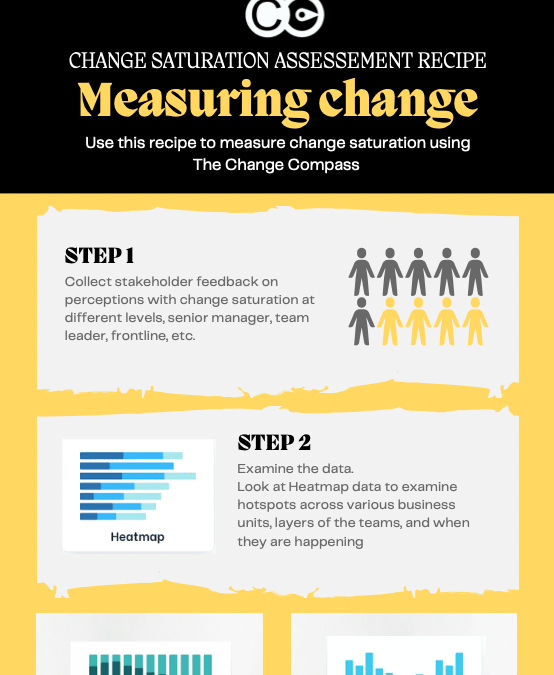
Use this recipe to measure change saturation using The Change Compass.