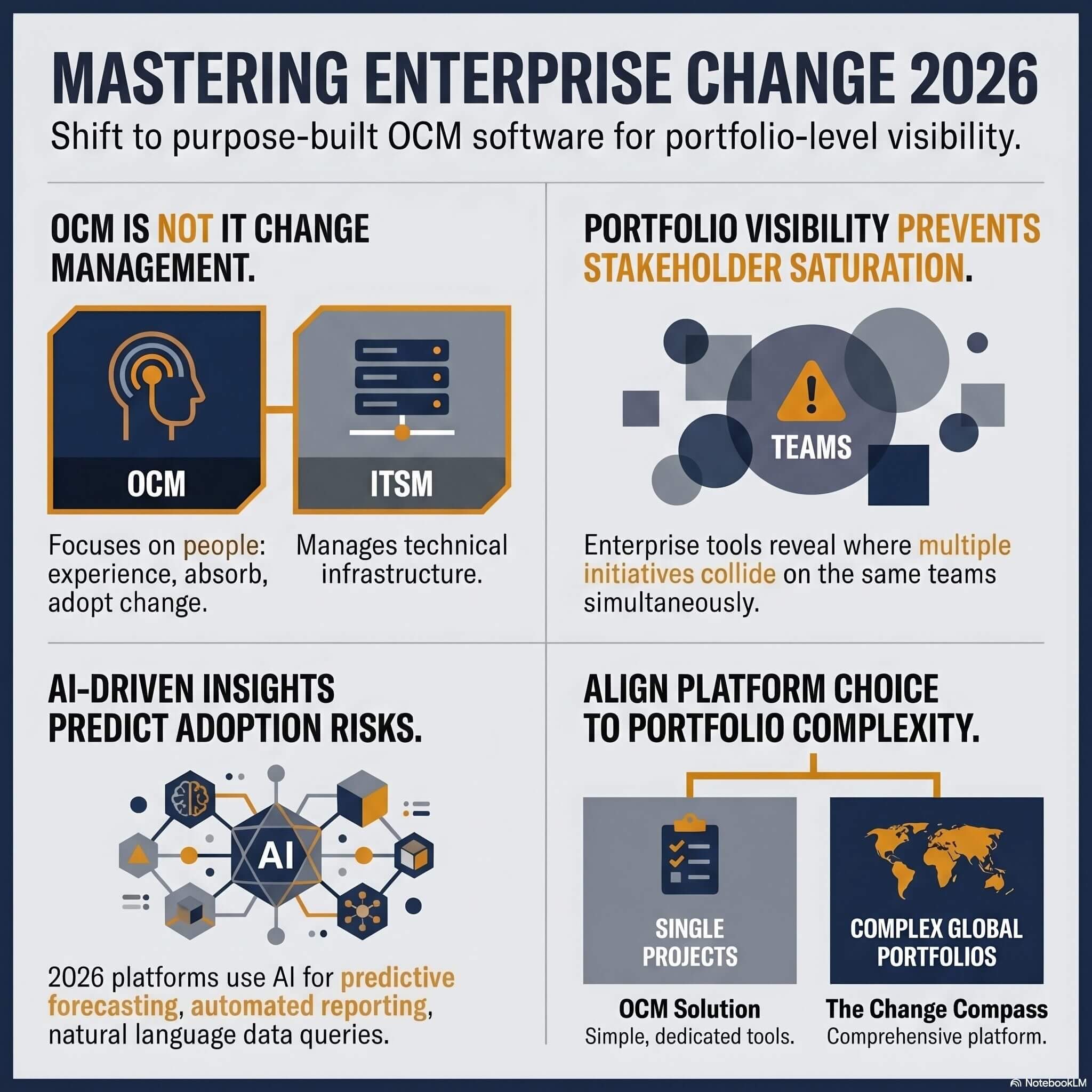
AI-enabled change management software is the new generation of platform that combines persistent portfolio data with applied artificial intelligence to surface insights about change impact, adoption risk and stakeholder load that previously required hours of analyst work to produce. The shift from form-filling change management to intelligent change management means software now reads the portfolio, identifies conflicts between concurrent initiatives, generates first-cut artefacts such as impact lists and stakeholder maps, and answers natural-language questions about change health. It does not replace change practitioners. It removes the manual data work that previously absorbed most of their capacity.
The change management software landscape is experiencing a fundamental transformation. With the increasing adoption of AI, change practitioners have relied on disparate tools, ChatGPT for communications, back to spreadsheets for impact assessments, project management platforms for tracking, and separate reporting systems for dashboards. This fragmented approach creates an exhausting cycle of copying, pasting, reformatting, and manually recreating content across different documents and systems.
The emergence of artificial intelligence is changing the game entirely. But not all AI applications are created equal. The real power lies not in individual AI tools used in isolation, but in integrated systems where AI has access to comprehensive change data, organisational context, and structured workflows. This is where change management software transitions from being merely a data repository to becoming an intelligent transformation partner.
The current reality: Disparate tools and manual workarounds
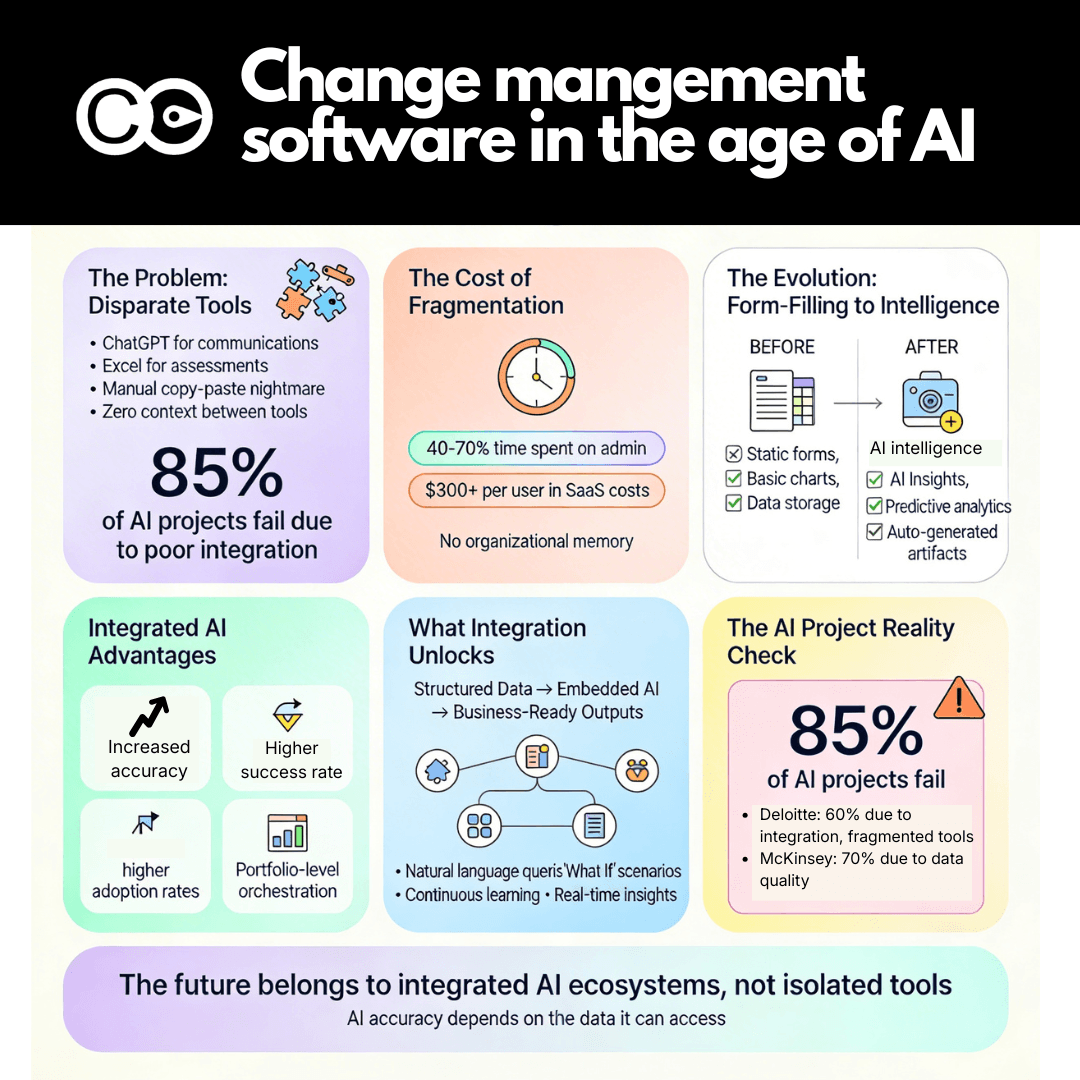
Walk into most change management teams today and you’ll find practitioners juggling multiple tools simultaneously. Research shows that nearly 50% of companies use disconnected AI tools, significantly cutting productivity and ROI. The typical workflow looks like this:
Morning: Use ChatGPT to draft stakeholder communications. Copy the output into Word, reformat to match organisational templates, adjust tone based on feedback, save multiple versions.
Midday: Build an impact assessment in Excel. Manually populate stakeholder names, roles, and impact levels. Create pivot tables to summarise by department. Copy charts into PowerPoint for steering committee presentation.
Afternoon: Generate infographics using Canva or another design tool. Download, resize, embed into emails and presentations. Hope the formatting stays intact when others open the files.
End of day: Update project trackers, populate status reports, consolidate feedback from multiple sources into a single document.
The cognitive load is substantial. The risk of error is high. Version control becomes a nightmare. And most critically, the AI tools being used have little or limited context about your specific change initiative, your organisational structure, your previous decisions, or the interconnections between different change activities.
This matters profoundly because AI accuracy and usefulness are determined by the data it has access to. When you use disparate tools with isolated prompts, each interaction starts from zero. The AI doesn’t know that Marketing is already managing three concurrent changes. It can’t reference that Finance has low readiness scores. It won’t flag that your proposed communication conflicts with another initiative’s messaging.
Research confirms this challenge: Gartner reports that 85% of AI projects fail to deliver on their promises, with poor integration being a primary culprit. Deloitte’s 2026 research shows that 40% of agentic AI projects will be cancelled by 2027 due to unanticipated cost, complexity, or risk—not because the technology failed, but because the foundation wasn’t properly integrated. The problem isn’t AI capability, it’s AI isolation.
The Evolution of Change Management Software: From Forms to Intelligence
Traditional change management software emerged primarily as structured data capture systems. They helped practitioners move beyond spreadsheets by providing:
- Standardised templates for stakeholder analysis, impact assessments, and communication plans
- Basic workflow for review and approval processes
- Simple visualisations like bar charts and tables showing readiness scores or training completion rates
- Central repositories where change artefacts could be stored and accessed
These capabilities represented progress. Having change data in a single system beat having it scattered across file shares, email attachments, and individual laptops. But most remained fundamentally passive, a place to record information, not a system that actively helped practitioners make better decisions or work more efficiently.
The emergence of AI is changing this paradigm entirely. Modern change management platforms are embedding intelligence throughout the entire change lifecycle, transforming from data capture tools into active transformation partners.
The Power of Integrated AI: Context, Structure, and Intelligence
Here’s where the story gets interesting. The most significant AI advancement in change management software isn’t about having AI features, it’s about having AI that operates within an integrated change management environment.
Consider The Change Compass as an example. Because the platform already structures change data – initiatives, stakeholders, impacts, readiness scores, communications, training plans, adoption metrics, as well as other details about your organisation such as your industry and department structure – the embedded AI has rich context for every interaction.
The ‘Insights’ Feature: AI That Reads Your Change Portfolio
Rather than asking practitioners to manually analyse their change portfolio, The Change Compass Insights feature continuously reads the data and surfaces recommendations and observations automatically. It might flag:
- “Three initiatives are targeting the Customer Service team simultaneously in Q2. Consider sequencing Initiative B to start in Q3 to avoid saturation.”
- “Readiness scores for Finance have dropped 15% since last assessment. Resistance themes suggest concerns about process complexity.”
- “Training completion rates are 40% below target for the Operations group. Current go-live date may be at risk.”
This isn’t generic advice from a chatbot. It’s specific, actionable intelligence derived from your actual change data. Research shows that organisations using continuous measurement achieve 25-35% higher adoption rates than those conducting periodic manual reviews.
Data Visualisation with Intelligence
Traditional change software provide limited data visualisation and required practitioners to build charts manually, select data fields, choose chart types, format axes, add labels. The Change Compass allows users to generate a wide range of data visualisations with a few clicks, then ask for AI analysis of either a specific chart or an entire dashboard.
Imagine viewing a heatmap showing change saturation across departments. Instead of interpreting it yourself, you can ask: “What are the highest-risk areas in this view?” The AI responds with analysis specific to your data: “Operations and IT are experiencing the highest saturation levels, each managing 4-5 concurrent initiatives. Both departments show declining readiness scores and increasing resistance indicators. Recommendation: defer Initiative X or reallocate change support resources.”
This dramatically reduces the time from data to insight to decision. Research from McKinsey indicates that AI-enabled workflows have grown 8x in just two years, from 3% to 25% of organisational processes – precisely because integrated AI accelerates decision-making.
Natural Language Data Queries
One of the most powerful capabilities emerging in modern change management software is the ability to ask questions using everyday language and receive immediate data-driven answers.
Instead of building complex Excel formulas or custom reports, practitioners can ask:
- “Which initiatives are affecting the Sales team?”
- “Show me readiness trends for the Finance transformation over the past three months.”
- “What percentage of stakeholders have completed training for Initiative A?”
The system queries the structured change data and returns precise answers instantly. This capability is transforming change management from a discipline that requires technical data skills to one where business insight and change expertise drive analysis.
‘What If’ Scenarios and Forecasting
Advanced change management platforms now enable scenario planning and predictive analytics. Users can set up “What If” scenarios:
- “What happens to team saturation if we move Initiative B’s go-live from March to May?”
- “If current adoption trends continue, when will we reach 80% proficiency?”
- “What’s the projected impact on operational performance if we launch these three initiatives concurrently?”
The AI generates forecasts based on historical patterns, current data, and configurable assumptions. Research shows that predictive analytics in change management can identify at-risk populations before issues escalate, enabling proactive rather than reactive intervention.
This shifts change management from reactive problem-solving to strategic planning. Leaders can test different sequencing options, resource allocations, and timing decisions before committing, dramatically reducing the risk of change saturation and adoption failure.
Generating Business-Ready Artefacts: Structure Plus Intelligence
Perhaps the most transformative capability of AI-integrated change management software is the ability to generate common change artefacts – stakeholder analysis, impact assessments, learning needs analysis, communication plans- automatically from structured data.
Here’s why this matters:
The Traditional Manual Approach
A practitioner using disparate AI tools might:
- Use ChatGPT to generate a stakeholder analysis template
- Copy the output into Word
- Manually populate stakeholder names from an Excel list
- Adjust impact levels based on notes from workshop sessions
- Reformat to match organisational templates
- Share draft for review
- Consolidate feedback from multiple reviewers
- Repeat reformatting and repopulation when stakeholder list changes
This process takes hours or days. Version control is manual. Updates require rework. And the AI tool generating the template has no knowledge of your actual stakeholders, their roles, their previous engagement levels, or their readiness scores.
The Integrated AI Approach
In The Change Compass, because stakeholder data is already structured – roles, departments, influence levels, impact scores, readiness assessments, communication preferences, training schedule – the system can generate a comprehensive stakeholder analysis with a few clicks.
The output isn’t a generic template. It’s a business-ready document pre-populated with:
- Actual stakeholder names and roles from your change initiative
- Influence and impact levels calculated from assessment data
- Engagement strategies tailored to each stakeholder segment
- Current readiness status showing where gaps exist
- Historical context if stakeholders were involved in previous initiatives
Most critically, when stakeholder data updates – someone joins the team, readiness scores change, feedback is captured, the artefact can be refreshed instantly. No manual copying, pasting, or reformatting. The structure and data are integrated.
The same principle applies to impact assessments, learning needs analyses, communication plans, and adoption dashboards. The combination of structured data and embedded AI creates efficiency gains that isolated AI tools simply cannot match.
AI Learning from Your Updates: Continuous Improvement
One of the most underappreciated aspects of AI-integrated change software is that the system learns from your corrections and amendments over time.
When you generate a stakeholder analysis and then adjust impact levels based on additional context, the AI notes those patterns. When you modify communication messaging to better match your organisational tone, the system adapts. When you sequence initiatives differently than initial recommendations, the AI updates its understanding of your priorities.
This creates a virtuous cycle. The more you use the system, the more accurate and aligned its outputs become. It’s not just executing tasks – it’s learning your organisation’s specific context, culture, and constraints.
A lot of organisations are treating AI as an augmentation tool, enhancing human capabilities rather than replacing them, experience higher productivity and employee satisfaction. Integrated change management software exemplifies this principle – AI handles data processing, pattern recognition, and initial drafting, while practitioners apply business judgment, stakeholder insight, and strategic direction.

The Competitive Advantage: Speed, Accuracy, and Strategic Focus
Organisations using integrated AI-enabled change management software gain several measurable advantages:
1. Time Reclamation
Research from Stanford shows that knowledge workers using AI assistants achieve significantly greater productivity by completing tasks more efficiently. In change management specifically, our users report:
- Significant reduction in time spent on documentation and reporting
- Significantly faster generation of change artefacts
- Significant reduction of manual data consolidation tasks
This isn’t about working less, it’s about redirecting effort from administrative tasks to strategic value. Practitioners spend more time engaging stakeholders, designing interventions, and analysing resistance, and less time copying data between systems.
2. Data-Driven Decision Making
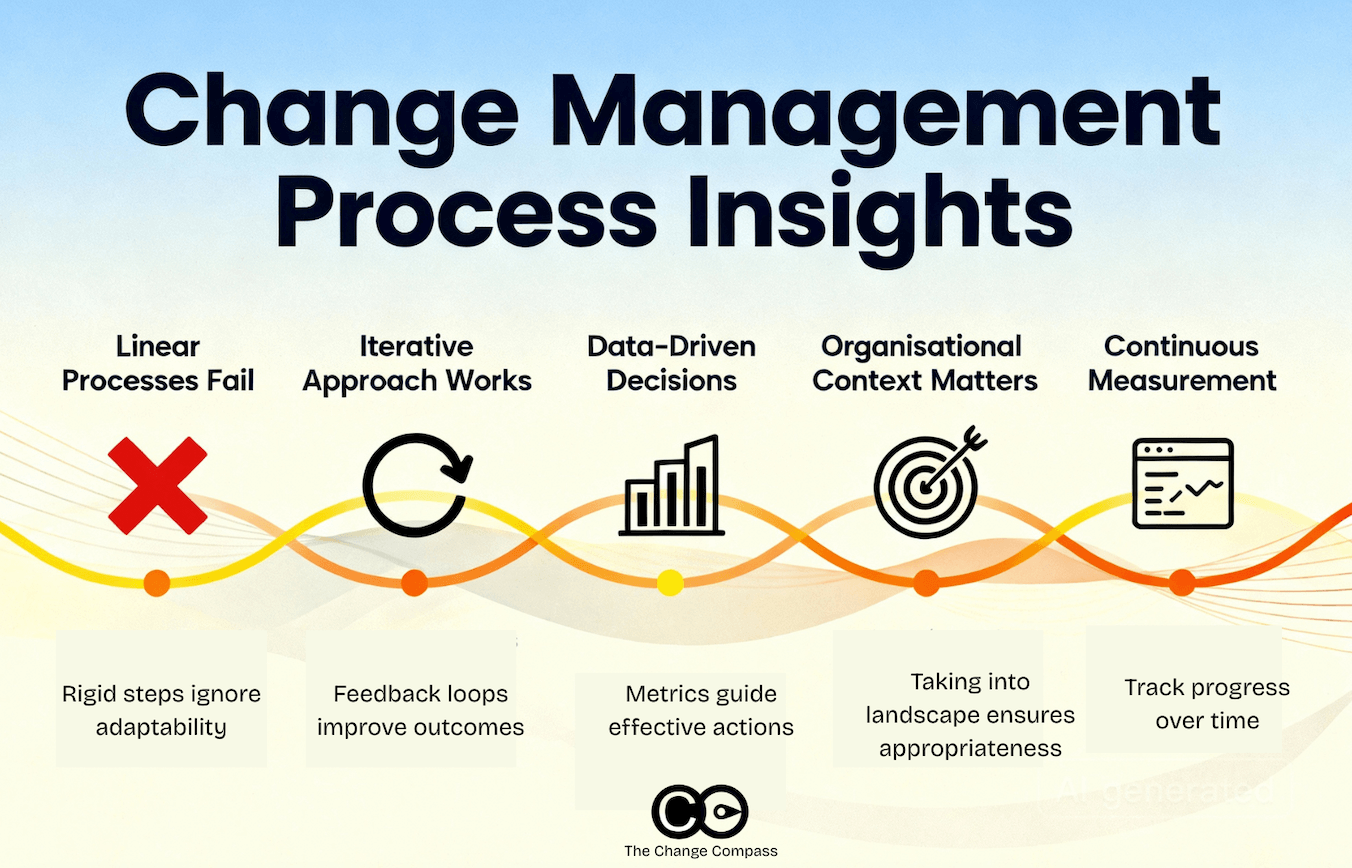
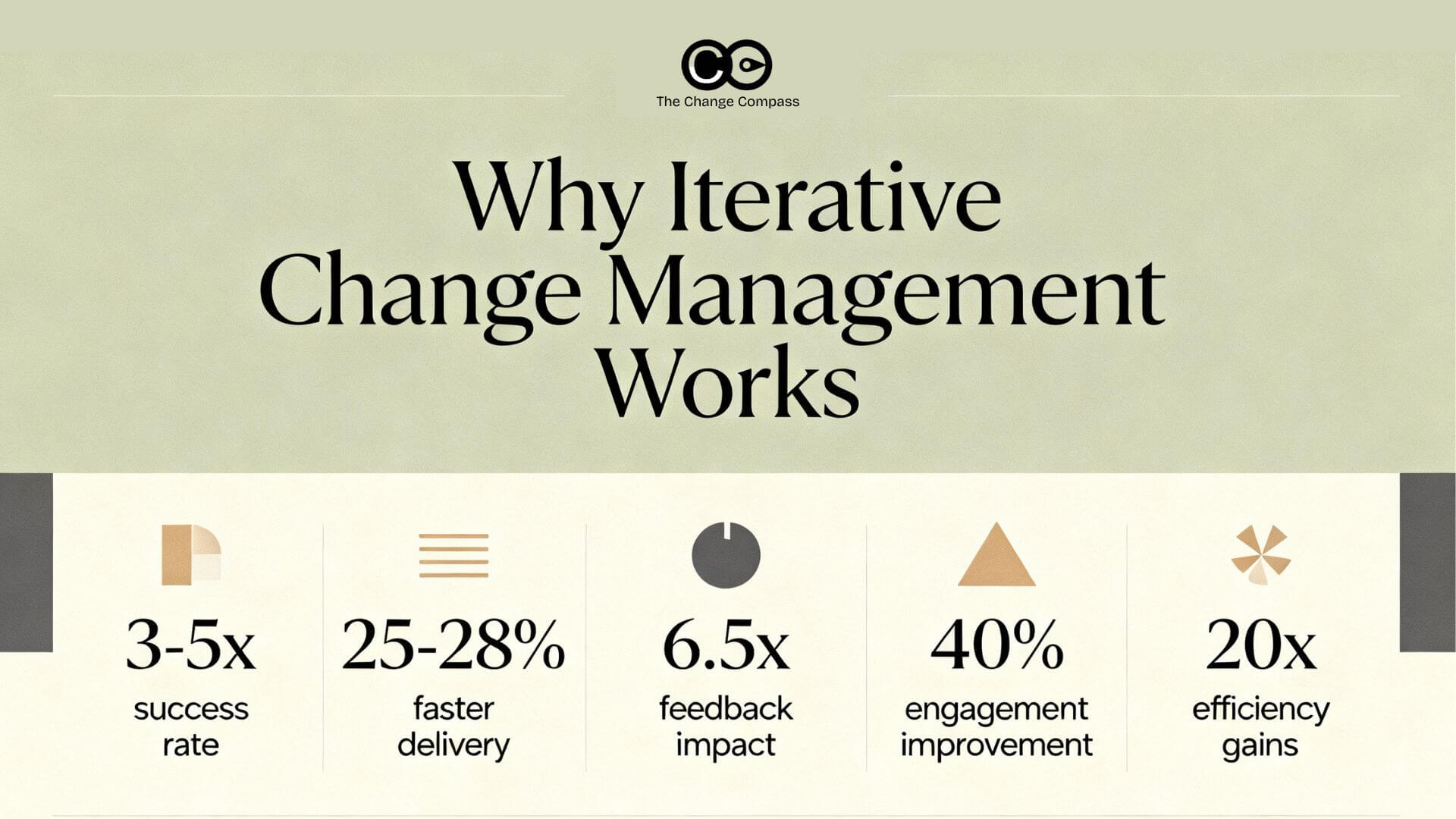
Integrated systems enable evidence-based change management at scale. Research shows that organisations measuring change performance continuously achieve 6.5x higher initiative success rates than those using periodic manual assessments.
When AI has access to comprehensive change data, it can identify patterns practitioners might miss:
- Correlation between training completion timing and adoption success
- Early warning signals that predict resistance escalation
- Optimal sequencing patterns based on historical outcomes
This transforms change management from an art based on experience to a discipline informed by both experience and data.
3. Portfolio-Level Orchestration
Perhaps most critically, integrated AI systems enable portfolio-level change management that disparate tools cannot support. Research shows that 78% of employees report feeling saturated by change, and 48% experiencing change fatigue report increased stress.
Integrated platforms provide visibility into:
- How many concurrent initiatives affect each team
- Where saturation thresholds are being exceeded
- Which changes should be sequenced vs. run in parallel
- Where change support resources are most needed
This portfolio intelligence is impossible when change data is fragmented across multiple systems. The ability to manage change at enterprise scale while protecting employee capacity represents a genuine competitive advantage.
The Future: Self-Optimising Change Ecosystems
The trajectory is clear. Change management software is evolving from passive data repositories to active intelligence systems that:
- Predict adoption challenges before they emerge based on readiness signals, saturation indicators, and historical patterns
- Recommend intervention strategies tailored to specific resistance themes and stakeholder segments
- Generate scenario plans showing the likely outcomes of different sequencing, resourcing, and timing decisions
- Automate routine tasks like status reporting, dashboard updates, and artefact generation, freeing practitioners for strategic work
- Continuously learn from each change initiative, building organisational change intelligence over time
Research from McKinsey indicates that by 2027, AI-augmented change management will be the norm rather than the exception. Organisations still relying on disconnected tools and manual workflows will find themselves at a significant disadvantage.
The winners will be those that recognise AI’s value lies not in isolated applications but in integrated ecosystems where intelligence, data, and workflows connect seamlessly.
Practical Steps for Practitioners
If you’re currently using disparate AI tools and feeling the pain of manual consolidation, consider these steps:
1. Audit your current AI usage. How much time do you spend copying, pasting, and reformatting AI outputs? What data is siloed in different systems? Where do version control issues occur?
2. Evaluate integrated platforms. Look for change management software with embedded AI that operates on your actual change data, not just generic prompts.
3. Prioritise structure. AI is only as good as the data it accesses. Platforms that structure change data – initiatives, stakeholders, impacts, readiness, communications – enable far more powerful AI applications.
4. Test specific use cases. Start with artefact generation (stakeholder analysis, communication plans) where the time savings are immediately visible.
5. Build the business case. Research shows integrated AI systems reduce processing time by up to 70% and cut SaaS spend significantly. Quantify the hours spent on manual data work and present the ROI of an integrated approach.
The future of change management belongs to practitioners who harness AI not as a collection of isolated tools, but as an integrated intelligence layer that amplifies their strategic impact. Platforms like The Change Compass demonstrate what’s possible when structure, data, and intelligence converge – and the gap between organisations using integrated systems and those relying on disparate tools will only widen.
The question isn’t whether AI will transform change management. It’s whether your organisation will lead that transformation or struggle to catch up.
Frequently Asked Questions
How is AI transforming change management software?
AI is transforming change management software from passive data repositories into active intelligence systems that generate insights, predict risks, recommend interventions, and create business-ready artefacts. Modern platforms embed AI throughout the change lifecycle, using structured data to provide context-aware recommendations rather than generic advice.
What’s the difference between using ChatGPT for change management vs. integrated AI in change software?
ChatGPT and similar tools operate in isolation without access to your specific change data, stakeholder information, or organisational context. Each interaction starts from zero. Integrated AI in platforms like The Change Compass has access to your entire change portfolio, enabling specific, actionable intelligence based on your actual initiatives, readiness scores, and historical patterns.
Can AI in change management software learn from my organisation over time?
Yes. Advanced platforms learn from your corrections, amendments, and decisions. When you adjust AI-generated outputs to match your organisational tone, priorities, or specific context, the system adapts. Over time, outputs become increasingly accurate and aligned with your organisation’s unique requirements.
What are the key AI features in modern change management software?
Key features include automated insights that flag risks and recommendations, natural language data queries allowing practitioners to ask questions in everyday language, data visualisation with AI analysis, “What If” scenario planning, predictive forecasting, and automated generation of business-ready artefacts like stakeholder analyses and communication plans.
How much time can AI-integrated change management software save?
Research shows practitioners experience 40-70% reductions in documentation and reporting time, 50% faster generation of change artefacts, and near-elimination of manual data consolidation. One case study showed a 70% reduction in processing time after moving from disparate tools to an integrated AI system.
Why do 60% of AI projects fail despite good technology?
Deloitte research shows most AI project failures stem from poor integration, not weak technology. When AI tools operate in isolation without access to comprehensive data and organisational context, they cannot deliver meaningful business value. Success requires integrated systems where AI, data, and workflows connect seamlessly.
What should I look for when evaluating AI-enabled change management software?
Prioritise platforms with structured data frameworks (initiatives, stakeholders, impacts, readiness), embedded AI that operates on your actual change data, ability to generate business-ready artefacts automatically, portfolio-level visibility and analytics, and systems that learn from your updates over time. Avoid platforms that simply add ChatGPT-style interfaces to basic form-filling systems.