

Your calendar already tells the story. The daily stand-up. Sprint planning on Monday. The retrospective at the end of the sprint. A program increment planning offsite pencilled in for next month. Over the past decade, change managers have moved into agile teams and taken on their rituals, and for many practitioners the sprint, not the phase gate, is now the real unit of work. That shift has barely bedded in, and AI is already changing what those rituals are for.
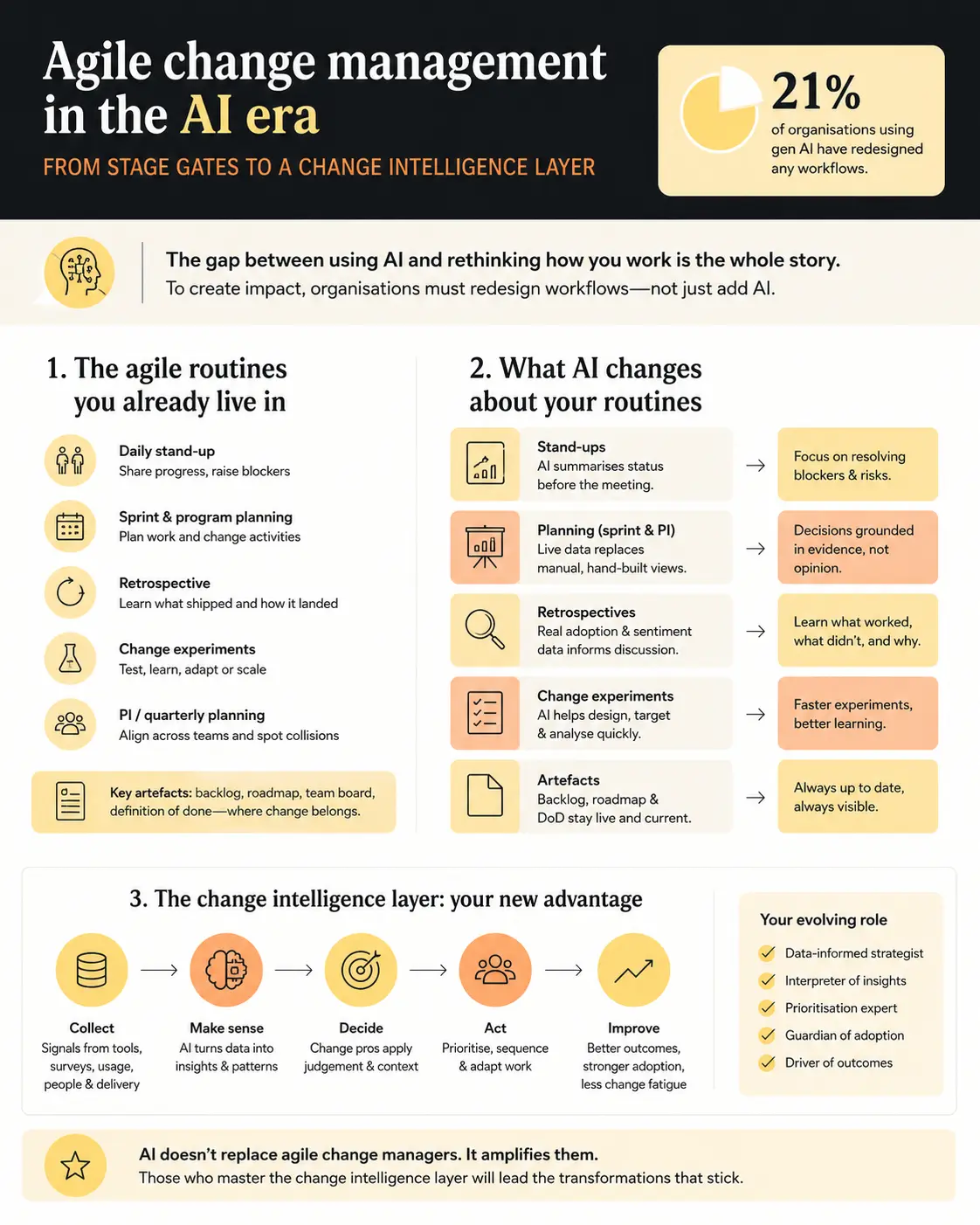
The gap between using AI and rethinking how you work is the whole story here. McKinsey’s 2025 research found that of all the organisational changes linked to gen-AI success, fundamental workflow redesign correlates most strongly with financial impact, yet only 21% of organisations using gen AI have redesigned any workflows at all. Nearly eighty per cent are layering AI on top of processes they have not touched. For change managers, the processes about to be layered on are the agile routines and artefacts you run every week: the stand-ups, the backlogs, the roadmaps, the retrospectives.
This article is about what actually happens to those routines, and about the skill that decides whether you thrive as they change. The interesting question is not whether AI replaces change managers. It is how your agile ways of working are reshaped when AI is in the loop, and why the practitioners who come out ahead are the ones who become stewards and strategists of a change intelligence layer.
The agile routines and artefacts you already live in
Before looking at what changes, it is worth naming what is actually on the table, because the transformation is specific rather than vague. If you work in or alongside an agile delivery team, your week already runs on a familiar set of ceremonies and artefacts.
The routines are the recurring events that give agile its cadence. The ones a change manager is genuinely part of include:
- The daily stand-up, where the team shares progress and raises blockers.
- Sprint planning, where the team agrees the next short cycle of work, including the change activities that go with it.
- The retrospective, where the team looks back at what shipped and how well it landed with the people it affected.
- Change experiments, which some teams run as a core agile habit: test an approach with a small group or pilot, see how it lands, and let the result decide whether to adjust, scale, or drop it.
- Program increment or quarterly planning, where several teams align on the bigger picture and spot where their work collides.
The artefacts are the objects those events produce and use: the product backlog, the roadmap, the team board, and the definition of done. For a change manager, these are not someone else’s furniture. Change activities increasingly sit as items on the backlog. Adoption criteria increasingly belong in the definition of done. Stakeholder impacts increasingly need to be visible on the same board as the delivery work. The standalone change plan has been folding into the team’s shared backlog for years.
This is the current state that AI now acts on. Not a blank page, but a mature set of routines and artefacts that change managers have spent a decade learning to work within.
What AI changes about your agile routines and artefacts
AI does not abolish the ceremonies. It changes what each one is for, by taking over the manual assembly of information and pushing the human contribution up towards judgement. The pattern is consistent across every routine: the part of the ritual that was about gathering and reconciling status gets automated, and the part that was about deciding what to do gets more important.
The ceremonies
Stand-ups stop being status round-robins. Tooling that reads commits, tickets, and adoption signals can already summarise where work stands before anyone speaks, which means the fifteen minutes shifts from reporting progress to resolving the blockers and risks the summary surfaced. For a change manager, that is a promotion: less time chasing “where are we”, more time on “this initiative is about to land on a team that is already at capacity, and here is the evidence”.
Sprint and program increment planning change most of all. Historically, a change manager walked into planning with a hand-built picture assembled over days: how much change each group was already carrying, where initiatives clashed, how ready each stakeholder group was, and how earlier changes were being adopted. When that picture is generated live from a shared data layer, planning stops being a negotiation between confident opinions and becomes a conversation grounded in evidence: these two initiatives hit the same population in the same window, this group is not yet ready on the measures that predict adoption, and adoption of the last change here has stalled. The change manager’s job in the room moves from bringing the data to interpreting it and deciding what to do about it.
Retrospectives get an honest evidence base. Instead of debating from memory whether a change stuck, the retro can look at real adoption data: usage that rose or stalled, sentiment that moved, the support tickets that spiked. The conversation about what to do differently improves because it starts from what actually happened, not from the loudest recollection in the room.
Change experiments get faster and sharper. When you pilot an approach with one group, AI can help read the result quickly, comparing adoption and sentiment against a group that did not get the new approach, so you can see which version worked and decide whether to adjust, scale it, or drop it. The experiment stays a human decision; the evidence behind it arrives sooner and cleaner.
The artefacts
The artefacts change too, and mostly by absorbing data they never used to carry:
- The backlog stops being a plain list of tasks and becomes a list of changes with real impact data attached: who each item affects, how heavily, and when.
- The definition of done extends past “the feature works” to “the change is adopted”, so a piece of work is not finished until there is evidence people are actually using it, not just that it launched.
- The roadmap stops being a static twelve-month picture and becomes a living view that reflects current load and readiness, and it updates when the plan changes instead of going out of date on the wall.
- The team board gains a change dimension, showing not just the work remaining but how much change each group is carrying across everything landing at once.
Notice what every one of these shifts has in common. The ceremony or artefact only improves if the data feeding it is accurate, consistent, and current. An AI-assisted stand-up built on messy, inconsistent change data will still produce a confident summary, it will just be wrong. That dependency is the core of this article, and it is where the change manager’s most valuable work now sits.
The deeper pattern: From ceremony to continuous sensing
Agile itself came from software, and it is worth seeing where the software world took it next, because that is the direction AI is now pushing change work. The best engineering teams no longer rely on ceremonies alone to know what is happening. They run on continuous telemetry: live dashboards of adoption, error rates, and usage that update by the minute, plus dependency maps and release calendars that let one team see, before it ships, that another is about to hit the same service or the same customers.
Three of those habits translate straight into change work. Ship change in small, reversible increments rather than big-bang go-lives, because small changes are easier to absorb and reverse. Sense continuously through behavioural telemetry rather than lagged surveys, so you can act while the signal still matters. And maintain systemic visibility so you can catch two initiatives colliding on the same people before they land, which is change conflict detection by another name. For a number of technology companies, this is already how they work day to day. The methods are proven, and most change teams have adopted the language of agile but not yet this continuous, data-driven way of working.
Why the point-in-time change operating model breaks under AI
Layer AI onto that picture and the reason the old operating model fails becomes specific. AI compresses the build-and-deploy cycle for the changes themselves, so process redesigns that took two quarters now move in weeks. It is also, in the form of AI adoption itself, a rolling wave of change landing on the same people: McKinsey found 88% of organisations now use AI in at least one function but only about a third have scaled it, which means most organisations are in the continuous middle of AI change, not past it. Its work on AI in the workplace adds a twist change managers should sit up for: employees are already adopting AI faster than their leaders realise, so the change is landing on the workforce whether or not a programme is managing it.
Against that cadence, a quarterly, document-driven rhythm fails in diagnosable ways:
- The point-in-time impact assessment is stale on arrival. By the time it is signed off, the initiative has moved.
- Survey lag hides the moment you needed to see. Sentiment that arrives three weeks late describes a problem you can no longer prevent.
- One rating per initiative averages away the truth. A single status for a whole programme conceals that one business unit is drowning while another is idle.
- Manual consolidation cannot keep pace. Reconciling a dozen teams’ spreadsheets by hand takes longer than the interval between meaningful changes.
- The annual roadmap goes out of date quickly. A fixed twelve-month sequence cannot keep up when AI keeps changing the plan underneath it.
McKinsey’s work on the agentic organisation reaches the same conclusion from the governance side: as work moves continuously, governance “cannot remain a periodic, paper-heavy exercise” and must become real time, data driven, and embedded, with humans holding final accountability. Periodic and paper-heavy is exactly what most change governance still is. The direction of travel is a continuous, data-driven layer with humans in charge of the judgement, and that layer needs an owner.
The change intelligence layer: What replaces the stage gate
If the stage gate is the artefact of the old model, the change intelligence layer is the artefact of the new one, and it is worth defining precisely because the term is easy to wave at and hard to build.
A change intelligence layer is the continuously updated, organisation-specific data foundation that shows, at any moment, how much change each part of the business is carrying, how ready it is, where initiatives collide, and how adoption is tracking, and that feeds this picture to both human decision-makers and AI systems. It is the difference between a folder of assessments and a live nervous system for the portfolio. It is best understood as core infrastructure rather than a reporting nicety, which is the whole case for treating it as a change intelligence platform rather than another dashboard.
What sits in the layer:
- Impact data: which roles, teams, and business units each initiative touches, at what depth, and when.
- Saturation and load: the cumulative weight of all concurrent change on any given population.
- Readiness signals: leadership alignment, capability, and structural readiness, refreshed as conditions move.
- Adoption telemetry: behavioural evidence that a change is actually being used, not just launched.
- Conflict and overlap: where two or more initiatives hit the same people in the same window.
Here is why this matters specifically in the AI era. Generic AI tools are confidently generic. Ask a general-purpose model to sequence your transformation portfolio and it will give a plausible, well-written answer that knows nothing about your organisation, because it has none of the data above. The AI you are already using becomes genuinely useful for change only when it can read your organisation’s real load, readiness, and conflict data. The layer is what turns a generic assistant into an adviser grounded in your context, the point developed further in what AI can and cannot do without your organisation’s data. Without the layer the AI has no context, and without context it cannot give useful change advice. That is why the layer needs a human owner who understands both the change discipline and the data.
Change managers as data stewards
Data stewardship is the least glamorous phrase in this article and the most important. A data steward owns the definition, quality, consistency, and governance of a class of data. For the change intelligence layer to produce trustworthy signal rather than confident noise, someone has to own change data the way a finance team owns the general ledger. That someone is the change manager.
Consider what happens without stewardship. One team rates impact on a five-point scale, another uses high/medium/low, a third invents its own. “Go-live” means the deployment date to one initiative and the end of hypercare to another. Stakeholder groups are named inconsistently, so the system cannot tell that “Branch Staff” and “Retail Frontline” are the same three thousand people carrying two changes at once. Feed that into an AI model and it will average incompatible scales, miscount overlaps, and generate recommendations that are wrong with total fluency. The problem is not the model. The problem is ungoverned data.
Gartner’s research shows how common and how costly this gap is. In its 2024 survey, poor data literacy sat among the top barriers to data and analytics success, and the sharpest failure points were organisational, not technical: a lack of clear ownership over data initiatives was cited by 69% of respondents, poor results from training by 52%, and more than a quarter said their organisation had no shared understanding of what data literacy even meant. Ownership is the number one gap. For change data, that owner can and should be the change manager.
A change data steward, in practice, owns:
- Definitions: a single agreed meaning for impact severity, readiness, go-live, stakeholder group, and every other term the layer depends on.
- Quality: the completeness and accuracy of what teams enter, with the standards and follow-up to keep it honest.
- Consistency: the same taxonomy across every initiative, so aggregation is valid rather than misleading.
- Governance: who can change definitions, how history is preserved, and how the layer stays trustworthy as it grows.
This is unglamorous, and it is decisive. An AI-enabled change function with excellent tools and ungoverned data will simply make faster mistakes. The steward is what makes the intelligence layer worth trusting.
Change managers as data strategists
Stewardship keeps the data clean. Strategy decides what the data should be in the first place, and that is the higher-value half of the role.
A data strategist for change asks a different set of questions. What must this layer be able to answer for our executives, and are we capturing the right data to answer it? Which signals actually predict adoption in our organisation, and are we capturing them or just the ones that are easy to collect? What context does our AI need to give advice we would actually act on, and how do we feed it that context deliberately rather than hoping? These are design questions, and they determine whether the layer drives decisions or just accumulates records.
The strategic payoff is a change in how the portfolio gets governed. Today, prioritisation and sequencing are too often settled by whoever is most senior in the room. A well-designed intelligence layer replaces that with evidence: this population is at saturation, these two initiatives collide in October, this unit is not ready on the dimensions that predict adoption. The strategist’s job is to make the layer answer the questions executives care about, in the language and at the altitude they decide at, the same discipline as presenting a single view of change in executive language rather than practitioner detail.
That reframe, from custodian of a methodology to strategist of a data asset, is the through-line of where the profession is heading. It is why the future of change management in the AI era rewards practitioners who can think in data and systems, not only in stakeholder maps and comms plans. The craft skills still matter. They are now table stakes rather than the differentiator.
How to make the shift: A practical sequence
You do not become a data-led, AI-ready change function by buying a tool and hoping. The move is a sequence, and it can start inside the agile routines you already run. Here is a five-step path a change lead can begin this quarter.
- Record each change as structured data, not prose. For every active change, capture who it affects by role and business unit, the timing, and the adoption signals you expect to see, in fields on your backlog or tool rather than buried in a document. If it lives only in a document, the layer cannot read it, which is why teams eventually outgrow the spreadsheet that cannot add up impact across initiatives.
- Standardise the definitions. Agree one taxonomy for impact severity, readiness, stakeholder groups, and lifecycle stages, and write it down. This is the steward’s founding act. Without it, every later step compounds inconsistency.
- Move sensing into the cadence you already have. You do not need a new meeting. Feed a continuously updated load-and-readiness view into your existing sprint planning, PI planning, and retrospectives, so those ceremonies interrogate live data instead of hand-built decks.
- Name the steward explicitly. Decide who owns change data quality and governance, even if it is part of an existing role at first. Gartner’s evidence is blunt: unowned data initiatives fail. Do not leave it implicit.
- Put the layer in front of executives, and let AI work on top of it. Once the data is structured, governed, and current, connect it to AI for the analytical lift, surfacing conflicts, forecasting adoption risk, drafting the narrative, and put the resulting picture where decisions get made. The humans keep the judgement.
A common failure worth naming: skipping straight to step five. Bolting AI onto ungoverned, unstructured change data reproduces the McKinsey finding at team level, adding intelligence on top of a broken process rather than fixing the process. Steps one and two are boring and load-bearing. Do them first.
Where a change intelligence platform fits
Everything above can be started in a spreadsheet and a disciplined taxonomy, and for a small portfolio that is a reasonable place to begin. It stops scaling quickly. Once you are aggregating load across dozens of initiatives, detecting conflicts across overlapping populations, and feeding governed data to AI for analysis, the manual version consumes more time than it saves. This is the point of a purpose-built change intelligence platform such as Change Compass: it provides the structured capture, the shared taxonomy, the real-time aggregation, and the portfolio-level view that turn scattered change data into a genuine intelligence layer, and it gives AI the organisation-specific context it needs to move from generic advice to grounded recommendation. The platform is the infrastructure. The steward and strategist are the roles that make it produce something worth acting on.
Where to start
If you take one thing from this, make it the direction, not the destination. Your agile routines are not being abolished; they are being rewired to run on live data, and AI is doing the assembly work that used to fill your week. The change function is moving from a quarterly, document-driven model to a continuous, data-driven one, because AI has raised the cadence of change past the point a periodic rhythm can track. The skill that decides who thrives is not AI fluency in the abstract. It is the ability to steward change data so it can be trusted, and to strategise about what that data should answer.
Start this week with one concrete act inside a ceremony you already run: at your next planning session, agree a single shared definition of impact severity and stakeholder group across all your active initiatives. That is step two of the sequence, it costs nothing but a conversation, and it is the foundation the entire intelligence layer is built on. Get the definitions right and every later step, the automation, the forecasting, the executive reporting, becomes possible. Skip them and even the best AI will only give you fast, confident answers that are wrong.
Frequently asked questions
What happens to agile ceremonies like stand-ups and sprint planning when AI is involved?
AI does not remove the ceremonies; it changes what they are for. The manual work of gathering and reconciling status gets automated, so stand-ups shift from reporting progress to resolving blockers, and planning shifts from bringing hand-built data to interpreting live evidence. Human facilitation, discussion, and judgement remain essential, and arguably become the whole point of the meeting.
What is a change intelligence layer?
A change intelligence layer is a continuously updated, organisation-specific data foundation that shows how much change each part of the business is carrying, how ready it is, where initiatives collide, and how adoption is tracking. It replaces point-in-time assessments with a live view and gives AI systems the real context they need to produce useful, grounded advice rather than generic recommendations.
Why do change managers need to become data stewards?
Because an AI-enabled change function is only as good as the data it runs on. A data steward owns the definitions, quality, consistency, and governance of change data, so that when it is aggregated across initiatives or fed to AI, the result is trustworthy rather than confidently wrong. Gartner consistently finds that unowned data initiatives are among the most likely to fail, which makes explicit stewardship decisive rather than optional.
How is agile change management different from traditional change management?
Traditional change management works in large, sequential phases governed by periodic stage gates and point-in-time assessments. Agile change management works in small increments with continuous sensing of load, readiness, and adoption, steering the portfolio in a rolling cadence rather than a quarterly one. The AI era pushes change towards the agile model because it raises the rate at which change arrives.
Does AI replace change managers?
No, but it changes what the role is for. AI handles the analytical assembly, surfacing conflicts, forecasting adoption risk, drafting narratives, while humans hold the judgement and accountability. The change manager’s centre of gravity shifts from producing documents to designing and governing the data layer that AI, executives, and agile teams all draw on, which is a higher-value role than the one it replaces.
References
- McKinsey, The state of AI: how organisations are rewiring to capture value (2025)
- McKinsey, The agentic organisation: a new operating model for the AI era (2025)
- McKinsey, Superagency in the workplace: empowering people to unlock AI’s full potential at work (2025)
- Gartner, Data Literacy: A Guide to Building a Data-Literate Organisation (2024)