

From late 2025, several of the world’s largest banks quietly cut their junior analyst intake by up to two-thirds while accelerating AI across their operations. In the UK, the major professional services firms pared back graduate hiring, and across the US economy, postings for entry-level roles fell by around 35% between early 2023 and mid-2025, a decline CNBC reports is driven in large part by AI. The people most exposed were not the seasoned experts. They were the juniors doing the drafting, the data cleaning, and the first-pass analysis.
Change management is not immune to this pattern, and pretending otherwise helps no one. A large share of what change practitioners do day to day, drafting communications, building training content, assembling stakeholder lists, summarising feedback, is exactly the kind of structured, language-heavy work that generative AI now does in seconds. The uncomfortable question for the profession is not whether AI will change the job. It is which practitioners remain valuable once the routine layer is automated, and what they need to become. This article sets out the specific capabilities that will define the future of change management in the AI era, and why the practitioners who develop them will be the ones organisations still fight to keep.
The work AI is genuinely absorbing
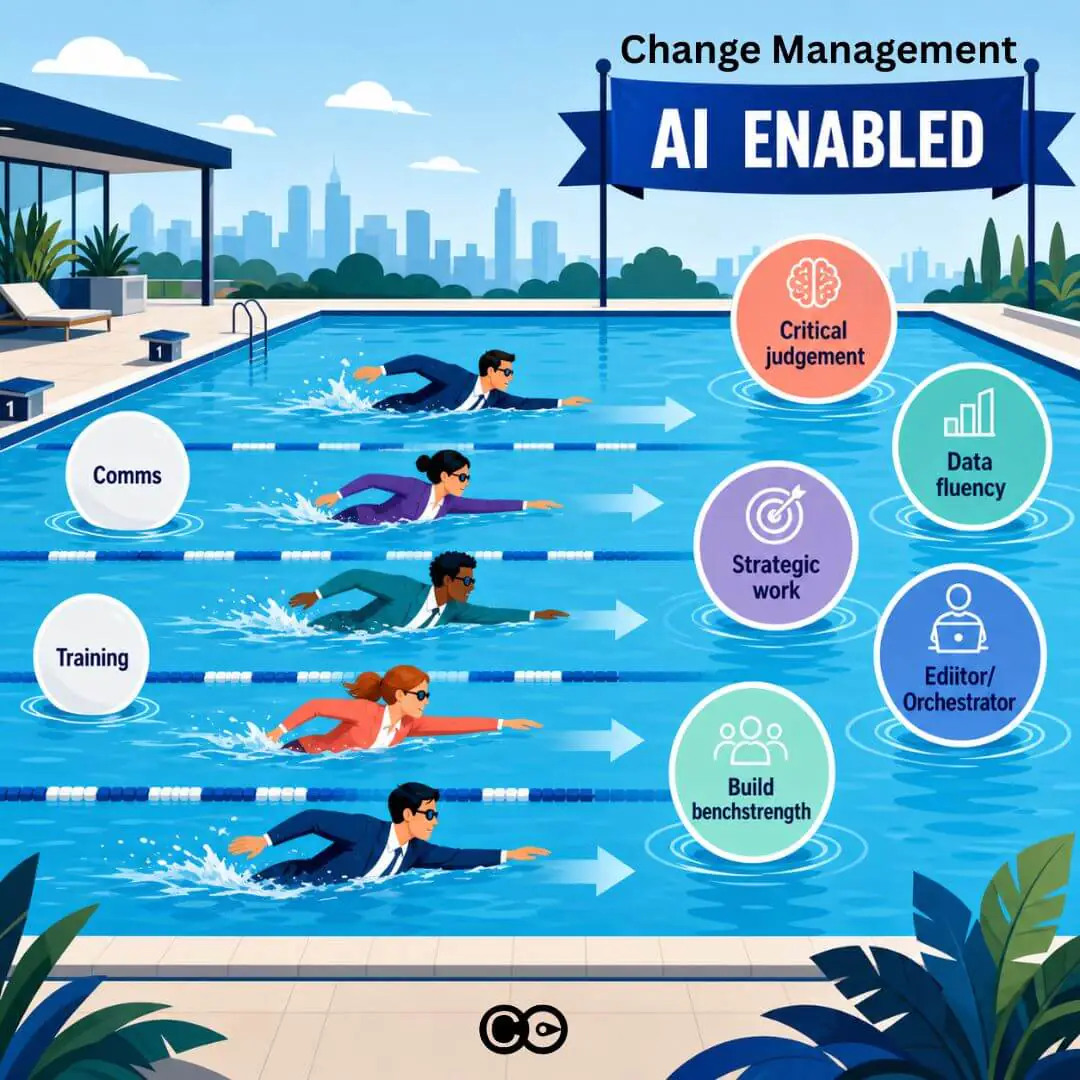
Let us be honest about where the automation is real rather than hypothetical. The bulk of comms and training production, the volume work that has historically filled a change practitioner’s week, is now well within the capability of general-purpose AI tools.
Ask a competent model to draft a go-live email, a manager talking-points pack, a set of FAQs, a quick-reference guide, or a first-cut training module outline, and it will produce something serviceable almost instantly. It will match a tone, respect a word limit, and generate five variations on request. For the mechanical, high-volume end of change communications and enablement, the productivity gain is not marginal. It is the difference between a day of work and a coffee break.
This matters because comms and training have long been the visible, billable, staffable core of change delivery. When that core compresses, the roles built around producing it compress too. McKinsey’s State of AI research found that around 65% of organisations were already regularly using generative AI, with marketing, sales, and content-heavy functions among the earliest adopters. Change teams sit squarely in that content-heavy category.
The tasks most exposed to automation tend to share a few features:
- High volume and repetition, such as producing the same artefact for many audiences with small variations
- A clear, well-understood output format, such as an email, an FAQ, or a slide narrative
- Low dependence on organisation-specific context that is not written down anywhere
- Language generation rather than judgement as the core activity
If a large part of your value is producing that kind of output faster than the next person, AI has already caught up. The practitioners who treated speed of production as their edge are the ones most at risk. The good news is that production was never the hard part of change. Knowing what is worth producing, and whether the output is actually right, always was.
Why judgement becomes the scarcest skill in change management in the AI era
Here is the shift that most commentary misses. AI does not remove the need for expertise. It relocates it. When a machine produces a plausible first draft in seconds, the scarce, valuable skill is no longer generation. It is critical evaluation: the ability to look at confident, well-formatted output and know, quickly, what is wrong with it.
The World Economic Forum’s Future of Jobs Report 2025 makes this concrete. Even as AI and big data top the list of fastest-growing skills, analytical thinking remains the single most sought-after core skill among employers, cited as essential by seven in ten companies. The tools change. The demand for people who can think critically about what the tools produce grows rather than shrinks.
The 80/20 problem no one flags
The most dangerous property of AI-generated change content is not that it is wrong. It is that it is mostly right. A generic AI change plan is typically around 80% sound, because it draws on widely accepted best practice, and around 20% wrong for your specific organisation. The problem is that the wrong 20% does not announce itself. It sits inside a credible, professional-looking document, and the surrounding 80% creates a halo that carries the whole thing through governance unchallenged.
Consider the failure modes an experienced practitioner learns to smell:
- A sequencing recommendation that ignores the fact two of these initiatives hit the same frontline team in the same fortnight
- An impact rating pitched at “medium” when local history says this exact team has already absorbed three system changes this year
- A sponsor assumption that names the wrong leader as the credible voice for a sceptical audience
- A training cadence that looks textbook but collides with the operational peak for that division
- A channel mix optimised for an office workforce when half the audience works in the field
None of these errors are visible to someone reading the document cold. They are only visible to someone with the experience to know what the right answer looks like for this organisation. This is a different failure mode from a hallucination, which at least tends to look odd. This is the invisible 20%, and catching it is now the job. The practitioners who can reliably separate the sound 80% from the flawed 20% are worth more in the AI era, not less. For a deeper treatment of why organisation-specific data is what catches these errors at the point of recommendation, our article on why generic AI tools fall short of a change intelligence platform works through the data infrastructure behind it.
Spotting the generic approach
There is a second, related discipline: recognising when an approach is technically defensible but strategically hollow. AI is trained on the average of everything published about change management, which means it reliably produces the average approach. It will recommend a stakeholder matrix, a comms calendar, a training needs analysis, and a resistance-management plan, because that is what the literature says. All of it is generic best practice. Some of it will be exactly what your situation does not need.
An experienced practitioner reads a proposed approach and asks harder questions. Does this organisation actually have a resistance problem, or an attention problem? Is the real risk adoption, or is it capacity? Is a full training programme the right response, or is the change small enough that a well-designed job aid would land better and cost a fraction as much? This is the eye for detail that separates a change professional from a change administrator, and it is precisely the layer AI cannot supply, because it does not know which 20% of the standard playbook is wrong for you. The same experienced eye is what catches the initiative clashes that AI misses when it plans one change without seeing the rest of the portfolio.
The research backs the caution. The Harvard Business School and BCG study Navigating the Jagged Technological Frontier, which tested 758 consultants on realistic tasks, found that AI sharply improved performance on tasks inside its capability frontier, lifting quality by around 40%, but actively degraded performance on tasks that fell outside that frontier. The people who did best were not those who used AI most. They were those who knew which tasks to trust it with and which to override. That discernment is the skill.
The practitioner as data engineer
If judgement is the first pillar of the future practitioner, data fluency is the second, and it is the one the profession is least prepared for.
Here is the principle that will quietly separate high performers from everyone else: the right data structure is the true enabler of AI, not the model itself. The quality, accuracy, relevance, and precision of what AI produces is a direct function of what you feed it. The more you plug the right, well-structured organisational data into AI, the more accurate and specific the outputs become. Feed it thin, messy, or generic inputs, and you get thin, messy, or generic outputs dressed up in confident language. This is the “garbage in, garbage out” law, and it has not been repealed by better models.
The scale of the underlying problem is large. Salesforce’s State of Data and Analytics research, drawing on more than 10,000 leaders, found that data and analytics leaders estimate over a quarter of their organisational data is untrustworthy, and that 42% lack full confidence in the accuracy and relevance of their AI outputs. If the people closest to the data do not trust it, the change practitioner casually pasting a prompt into a chatbot has no reason to trust what comes back.
What data-savvy actually means now
Being data-savvy in change management is no longer about being comfortable with a spreadsheet. It is a genuine, if lightweight, engineering mindset. In practice it means being able to:
- Troubleshoot AI mistakes by tracing a wrong output back to the input that caused it, rather than accepting or rejecting the answer wholesale
- Identify and fix data errors, such as duplicated stakeholder records, inconsistent initiative names, mislabelled impact severities, or dates in three different formats
- Prepare and structure data channels that feed AI, so that impact data, stakeholder data, and change calendar data are captured consistently enough to be usable
- Understand how AI actually uses data, including why a model that has no record of your change calendar cannot possibly warn you about a saturation clash
This last point deserves emphasis. Much of what makes change advice valuable, the awareness that a team is already carrying too much, comes from data most organisations never capture in a structured form. If your change impact and capacity information lives in a hundred disconnected slide decks, no AI can reason about it. The practitioner who understands this, and who takes responsibility for building clean, structured data channels, becomes the person who makes AI useful rather than the person disappointed by it. Our guide to tracking change load across multiple initiatives shows what that structured capture looks like in practice.
A data-readiness checklist
Before trusting AI with anything consequential, an AI-era practitioner runs a quick mental audit of the inputs:
- Is the data current, or am I feeding the model a snapshot from six months ago?
- Is it consistent, using the same names, categories, and severity scales across sources?
- Is it complete enough for the question, or is the model filling gaps with generic assumptions?
- Is it specific to this organisation, or am I effectively asking for the industry average?
- Can I trace any given output back to a source I can check?
Practitioners who cannot answer these questions are not using AI. They are gambling with it.
The benchstrength problem: A slow-burning risk for the profession
The fifth shift is the one the profession is not talking about, and it is the most strategically serious. It mirrors what is happening inside organisations more broadly.
Inside companies, AI is reducing the need for analysts and junior roles, because the model now does the first-pass analysis, the drafting, and the summarising that used to be a junior’s apprenticeship. That looks like an efficiency win in the current quarter. Over a longer horizon it creates a supply problem. Senior practitioners are not born senior. They become senior by spending years doing the junior work: sitting in the room, cleaning the data, drafting the comms, getting the impact assessment wrong and learning why. If AI removes the junior rung, the ladder to experienced practitioner loses its lower steps.
This is the benchstrength issue. The evidence outside change management is already stark, with entry-level postings down around 35% and the traditional apprenticeship path narrowing. The same logic will play out in change functions that decide they can run leaner because AI covers the production layer. The immediate effect is a smaller team. The delayed effect, felt three to five years later, is a shortage of experienced practitioners who came up through that work, because the roles that used to grow them no longer exist.
For the profession, this creates a set of second-order risks worth naming:
- A thinning pipeline of practitioners with genuine hands-on experience, as junior roles are automated away
- A widening gap between a small group of highly experienced practitioners and a large group who have only ever supervised AI outputs without building underlying judgement
- Rising scarcity value, and cost, for the experienced practitioners who can do the evaluation and data work AI cannot
- A real question about how the next generation develops the pattern recognition that only comes from repetition, when the repetitive work is gone
There is no clean answer to this yet, and anyone claiming one is overreaching. But individual practitioners can respond to it directly. If experience is becoming scarcer and more valuable, the rational move is to deliberately accumulate the judgement-heavy, data-heavy, strategic experience that AI is making rare, rather than competing on the production work AI is making cheap.
How to future-proof your practice
Pulling the threads together, the practitioner who thrives in the future of change management does not resist AI and does not defer to it. They supervise it, and they move up the value chain to the work it cannot do. Here is a practical agenda for getting there.
- Reposition from producer to editor-in-chief. Let AI generate the first draft of comms, training, and assessments. Spend the time you save on evaluating, correcting, and tailoring the output to your specific context. Your value is now in the red pen, not the blank page.
- Build a real critical-evaluation habit. For every AI output, actively hunt for the wrong 20% before you accept the right 80%. Ask what this recommendation assumes about your organisation, and whether those assumptions actually hold.
- Develop genuine data fluency. Learn how your change data is structured, where it is dirty, and how to clean it. Treat data preparation as core change work, not an IT problem. The practitioner who owns clean data owns the quality of the AI output.
- Move towards strategic and advisory work. As production commoditises, the durable value is in advising sponsors, shaping portfolio decisions, navigating politics, and making judgement calls under ambiguity. Deepen the skills that require presence, trust, and organisational read.
- Protect your own experience curve. Seek out the hard, judgement-heavy assignments precisely because they are becoming scarce. In a world short on experienced practitioners, being demonstrably one of them is the strongest career position available.
The common thread is that every item moves you away from what AI does well and towards what it structurally cannot do: understand your specific organisation, exercise judgement, and take accountability for a decision.
Where digital change tools fit
Individual skill only goes so far without the right data foundation, and this is where purpose-built digital change tools earn their place. General-purpose AI can only reason about what it can see, and most change context, impact load, capacity, stakeholder saturation, and initiative timing, is never captured in a structured, connected form. A dedicated change platform such as Change Compass exists to solve that input problem: it captures change impact and analyses capacity data consistently across the portfolio, so that both practitioners and any AI layered on top are reasoning from an accurate, organisation-specific picture rather than a generic guess. In an era where the quality of AI output depends entirely on the quality of the data behind it, the structured data layer is not a nice-to-have. It is the enabler.
The shift that matters most
The future of change management in the AI era is not a story about practitioners being replaced. It is a story about the job changing shape. The production layer, the comms and training volume work, is being automated, and the roles built purely on that work will shrink. What grows in its place is demand for judgement: the ability to spot the flawed 20% inside a plausible document, to tell a generic approach from a fitted one, and to build the clean, structured data that makes AI accurate in the first place. The practitioners who lean into critical evaluation, data fluency, and strategic advisory work will not be competing with AI. They will be the reason it produces anything worth acting on. Start by picking one AI output this week and interrogating it properly, not as a user, but as the expert accountable for whether it is right.
Frequently asked questions
Will AI replace change managers?
AI is unlikely to replace skilled change managers, but it is already replacing a large share of the routine production work, such as drafting communications and training content, that many change roles were built around. The practitioners at risk are those whose main value is producing that output quickly. Those who move into critical evaluation, data preparation, and strategic advisory work become more valuable, not less.
What skills do change practitioners need in the AI era?
The three that matter most are critical judgement (spotting what is wrong in confident AI output), data fluency (structuring, cleaning, and troubleshooting the data that feeds AI), and strategic advisory capability (advising sponsors and making judgement calls under ambiguity). The World Economic Forum’s 2025 research confirms that analytical thinking remains the most in-demand core skill even as AI adoption accelerates.
Why does data quality matter so much for AI in change management?
AI output is only as good as its input. If a model is fed thin, inconsistent, or generic data, it produces confident but generic recommendations that miss organisation-specific realities like saturation and capacity. Structured, accurate change data is what allows AI to produce precise, relevant advice rather than textbook averages.
What is the “80/20 problem” with AI change plans?
A generic AI change plan is usually around 80% sound, drawn from accepted best practice, and around 20% wrong for your specific organisation, covering things like sequencing, impact ratings, and sponsor assumptions. The danger is that the wrong 20% is invisible inside a credible document, so it needs an experienced practitioner to catch it before it reaches governance.
Could AI create a shortage of experienced change practitioners?
Potentially, yes. As AI automates the junior, entry-level work that practitioners traditionally used to build experience, the pipeline that produces senior practitioners narrows. Over several years this can create a benchstrength problem, where experienced practitioners become scarce and more valuable precisely because fewer people are coming up through the hands-on work.
References
- World Economic Forum, Future of Jobs Report 2025
- McKinsey & Company, The State of AI
- Harvard Business School and Boston Consulting Group, Navigating the Jagged Technological Frontier
- Salesforce, State of Data and Analytics
- CNBC, Why AI may kill career advancement for many young workers