Data-driven change management: why methodology alone is no longer enough
For the first twenty years of change management as a discipline, the primary question practitioners wrestled with was methodological: how do you follow the right sequence of steps to prepare people for change? The frameworks that emerged from that era, Kotter’s eight steps, Prosci’s ADKAR model, McKinsey’s influence model, were responses to a genuine gap. Most organisations had no structured approach to the people side of transformation at all.
That gap has largely closed. Most large organisations now have a change methodology. Many have multiple. The question that is keeping enterprise change leaders up at night in 2026 is not whether they have a methodology. It is whether they have the data to apply it intelligently.
Data-driven change management is not a rejection of methodology. It is the layer above it: the capability to determine where to focus the methodology, at what intensity, for which groups, and at what point in the change journey. Without that data layer, even the most sophisticated change methodology is applied with the same rough instrument to every situation, a guaranteed recipe for wasted effort and missed risk.
What methodology-only change management gets wrong
A methodology gives change practitioners a process to follow. It tells them what to do. Data tells them where, when, and how much. Without data, practitioners are making three critical assumptions that are rarely examined:
Assumption 1: All affected groups are equally at risk. Most change management plans allocate support resources proportionally to the number of people affected by a programme, rather than to the groups where adoption risk is highest. Without data on which groups face the steepest behaviour change, the most significant system transition, or the highest concurrent change load, this is the only allocation logic available.
Assumption 2: Readiness can be assessed by activity completion. The dominant measure of readiness in methodology-driven change management is whether change activities have been completed: training sessions delivered, communications sent, awareness workshops run. This tells you what the change team has done. It does not tell you whether the people receiving those activities are actually ready to perform differently.
Assumption 3: Problems will become visible quickly enough to respond. In a methodology-only model, problems typically surface when adoption starts to fail: after go-live, when the business begins to notice that new processes are not being followed or systems are not being used as designed. By that point, the cost of intervention is substantially higher than if the risk had been visible three months earlier.
A 2024 analysis of change management outcomes published by Deloitte found that organisations using data to guide their change strategy consistently outperform those relying on methodology alone, particularly on adoption speed and sustained behaviour change. The differential is not because data-driven organisations use better methodologies. It is because they apply their methodology more precisely.
What data-driven change management actually means
Data-driven change management is the practice of using systematically collected and analysed data to inform change strategy, prioritise change management effort, and monitor change outcomes in real time.
The phrase is widely used and frequently misunderstood. Having a stakeholder assessment spreadsheet is not data-driven change management. Sending a post-training survey with a satisfaction score is not data-driven change management. What distinguishes genuinely data-driven practice from these activities is the following:
The data is collected consistently using standardised instruments, not ad hoc
The data is aggregated across the portfolio, not siloed at the programme level
The data is used to make decisions, not just to report on activity
The data is analysed to surface patterns and risks, not just compiled into summaries
This distinction matters because many change functions believe they are data-driven because they produce reports. Reports are an output of data collection. Data-driven change management is about whether those reports change what happens next: whether they shift priorities, redirect resources, or trigger governance conversations about sequencing and scope.
The data types that matter most in change management
Not all change data is equally valuable. Understanding the data types that most reliably predict change outcomes helps change functions invest their measurement effort where it counts.
Impact and load data
The starting point of data-driven change management is an accurate, up-to-date picture of the change landscape: which groups are affected by which programmes, how significantly, and across which dimensions of change (process, system, role, behaviour, environment). This impact data is the raw material for everything else.
When impact data is aggregated across the portfolio, it becomes load data: the cumulative change demand on each stakeholder group at any point in time. Load data is the single most important predictor of saturation risk and the foundation of intelligent resource allocation. Without it, programme teams operate in isolation, each unaware of what other programmes are simultaneously asking of the same people.
Readiness data
Readiness data measures whether affected groups are prepared to perform differently when change lands. Useful readiness data goes beyond satisfaction with training. It assesses role-specific confidence in performing new tasks, manager preparedness to support their teams through the transition, and leadership alignment on the purpose and expectations of the change.
Readiness data is most valuable when it is collected early enough to act on. Readiness surveys completed two weeks before go-live are informational. Readiness data collected eight weeks before go-live, with a clear threshold below which intervention is triggered, is operational.
Adoption data
Adoption data measures whether change is actually sticking after go-live. For system changes, this typically includes usage metrics from the technology platform. For process changes, it includes adherence rates and quality indicators. For behaviour and cultural changes, it includes manager observations and pulse survey data.
McKinsey’s research on organisational agility identifies sustained adoption as the point at which change value is actually realised. Programmes that achieve technical go-live but fail to embed new behaviours do not deliver their projected benefits, regardless of how well the methodology was executed.
Sentiment and leading indicator data
Sentiment data fills the gap between structured survey cycles: real-time signals from employee feedback, manager escalations, support ticket categories, and participation rates in change activities. These leading indicators flag emerging problems before they show up in adoption metrics.
The value of sentiment data is in its speed. A spike in employee queries about a particular new process can indicate confusion that, if addressed within days, can be resolved before it becomes a pattern of non-adoption.
The difference data makes to change decisions
The practical impact of data-driven change management shows up in specific decisions that cannot be made well without it.
Resource allocation decisions. Without data, change management resources are typically allocated by programme size or budget. With load and readiness data, they can be directed to the groups where the risk is highest: the teams facing two major system transitions simultaneously, the business unit whose readiness scores have fallen three survey cycles in a row, the manager cohort that has not yet engaged with the change process at all.
Sequencing and timing decisions. Programme go-live dates are typically set by technology readiness, budget cycles, and executive preferences. Data on cumulative change load gives portfolio governance the evidence to make sequencing decisions on behalf of employee capacity, not just delivery convenience. This is the intervention that most directly prevents saturation.
Scope decisions. When data shows that a particular group is already at high saturation risk, the case for phasing the scope of a change landing on them, releasing essential changes first and adding complexity in subsequent phases, becomes objectively demonstrable rather than a judgement call that programme teams can dismiss.
Intervention targeting. Adoption data disaggregated by group, role, and geography identifies not just whether adoption is below target but exactly where. A targeted intervention for a specific team in a specific site is far more efficient than a blanket reinforcement campaign rolled out across the entire programme population.
Executive conversations. Change management has historically struggled to hold its ground in governance conversations with executives who are focused on schedule and cost. Data changes this. A change leader who can show a saturation risk score for a business unit, supported by load analysis and readiness trend data, is having a fundamentally different conversation than one who is making a subjective argument about “too much change.”
Building the data infrastructure for data-driven change management
The shift to data-driven change management requires more than a new mindset. It requires an infrastructure that makes consistent data collection and aggregation practical at scale.
The three components of that infrastructure are:
Standardised data collection tools. Every programme change impact assessment, readiness survey, and adoption tracking instrument needs to collect data in a consistent format. Without standardisation, aggregation is impossible. This is a foundational investment that pays dividends every time a new programme is launched.
A centralised data platform. Change data that lives in individual programme folders cannot be aggregated or analysed at the portfolio level. A shared platform where programme-level data flows into a portfolio view is the difference between a change function that can see the whole system and one that is working in the dark.
Analytical capacity within the change function. Data is only valuable when someone can analyse it and translate the analysis into recommendations. Dedicated change analyst roles, separate from programme delivery, are the emerging solution in enterprise change functions that have reached this level of maturity.
Research on data-driven enterprise capability from McKinsey finds that organisations with genuine data-driven capability in their operational functions are 23 times more likely to acquire customers and six times more likely to retain them than their peers. The same underlying capability differential applies within the change function: data-driven change management does not just produce better reports. It produces better outcomes.
Why data-driven change management is a competitive differentiator
The organisations that have invested in data-driven change management are building a capability that compounds over time. Each programme generates data that improves the accuracy of future impact assessments. Each adoption cycle produces evidence that refines the relationship between change load, intervention intensity, and outcome. Each saturation risk assessment that leads to a sequencing decision builds the political capital to make the next one.
This is the compounding advantage that methodology alone cannot replicate. A change methodology is a static set of steps. A data-driven change function is a learning system that becomes more precise with every programme it runs.
The implications for enterprise change functions are significant. Organisations investing in data-driven change capability now will be able to manage increasingly complex transformation portfolios with more confidence, less waste, and better outcomes than organisations that are still relying on methodological frameworks as their primary instrument.
For change leaders making the case for this investment to CFOs and CHROs, the business argument is straightforward. Prosci research on the correlation between change management and project success consistently shows that projects with excellent change management are six times more likely to meet objectives than those with poor change management. Data-driven change management is what makes the difference between good change management intentions and excellent change management outcomes.
How The Change Compass supports data-driven change management
Purpose-built platforms are what make data-driven change management practical at enterprise scale. Change Compass provides the data infrastructure that enterprise change functions need to aggregate impact data across the portfolio, visualise cumulative change load by stakeholder group, track readiness and adoption metrics in real time, and generate the executive reporting that keeps saturation risk visible to governance.
The platform is designed specifically for the challenge that methodology-only change management cannot address: seeing the whole portfolio at once, across all programmes, for all affected groups, in a format that drives decisions rather than just documents activity. The Change Automator extends this with workflow automation that reduces the manual overhead of keeping portfolio data current.
For change functions at the beginning of the data-driven journey, the weekly demo provides a practical demonstration of what portfolio-level change analytics looks like in a live environment.
The shift that actually changes outcomes
Methodology got the change management discipline to where it is. Data will take it where it needs to go.
The organisations that will manage the increasing pace and complexity of enterprise transformation over the next decade are those that have built the capability to use data to direct their change effort with precision: to see where risk is building before it becomes a crisis, to allocate resources based on evidence rather than assumption, and to demonstrate outcomes in the language that boards and executive teams can act on.
The shift from methodology-driven to data-driven change management is not a replacement. It is an evolution. The methodology still matters. But without data to guide its application, it will continue to produce the uneven, unpredictable outcomes that have made change management a challenging discipline to resource and justify.
Frequently asked questions
What is data-driven change management?
Data-driven change management is the practice of using systematically collected and analysed data to direct change strategy, allocate change management resources, and monitor change outcomes in real time. It goes beyond activity completion tracking to measure where adoption risk is highest, which groups are approaching saturation, and where readiness is falling short of the threshold needed for successful go-live.
How is data-driven change management different from traditional change management?
Traditional or methodology-driven change management follows a defined process regardless of the specific risk profile of the change and the affected groups. Data-driven change management uses impact, readiness, and adoption data to apply the methodology precisely: directing resources to the highest-risk groups, timing interventions based on leading indicator signals, and making sequencing and scope decisions based on evidence of employee capacity.
What data should change management functions be collecting?
The most valuable data types are: change impact and load data (which groups are affected, how significantly, across how many concurrent programmes), readiness data (whether groups are prepared to perform differently before go-live), adoption data (whether changes are sticking after go-live), and sentiment and leading indicator data (real-time signals of emerging risk between formal survey cycles).
What tools do you need for data-driven change management?
The foundational tools are standardised data collection templates applied consistently across all programmes, a shared data platform that enables portfolio-level aggregation, and visualisation tools that present cumulative change load and adoption trends in an executive-ready format. Purpose-built platforms like Change Compass are designed specifically to provide this infrastructure without requiring change functions to build it from scratch.
How does data-driven change management improve adoption outcomes?
By identifying where adoption risk is highest before go-live, data-driven change management enables earlier, more targeted intervention. Rather than deploying a uniform support programme across all affected employees, change resources are directed to the groups that data shows are least ready, most saturated, or falling furthest behind on adoption trajectory. This precision reduces both waste and missed risk.
Most organisations today would not dream of running a marketing function without dashboards, attribution models, and conversion analytics. They would not manage a supply chain without real-time inventory data, nor run an HR function without workforce metrics tracking attrition, engagement, and capability gaps. Yet change management, a discipline that directly shapes whether major investments deliver their intended outcomes, has largely remained opinion-driven, practitioner-intuition-based, and dangerously under-measured.
This is not a minor oversight. Prosci’s research on change management maturity consistently finds that organisations at the lowest maturity levels rely almost entirely on anecdotal judgement to make change decisions, whilst those at the highest levels treat change data as a strategic asset. The gap between these two groups is not just a matter of methodology. It translates directly into project success rates, employee adoption speed, and the return on transformation investment.
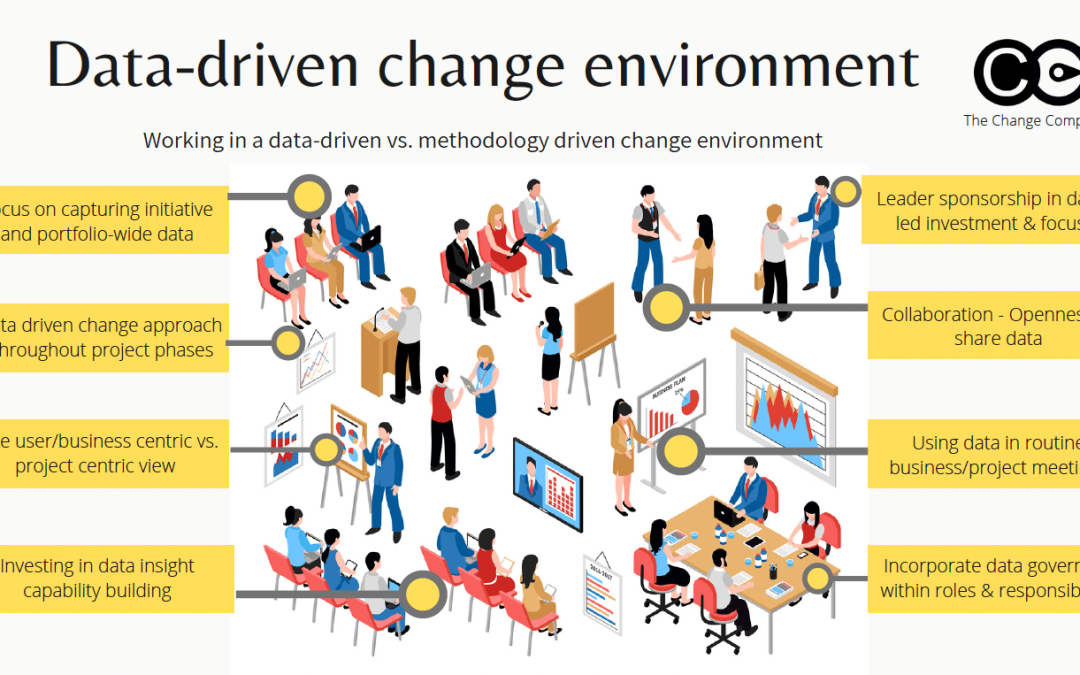
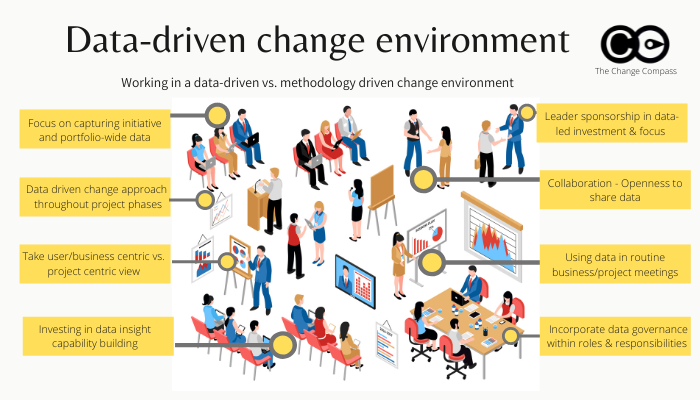
Building a data-driven change management environment is not about adding a few pulse surveys or tracking training completion rates. It requires a fundamental shift in how change is designed, measured, and governed across an organisation. This article outlines what that environment looks like across eight core components, and how leaders and practitioners can begin building it intentionally rather than by accident.
Download the framework overview below and keep reading for a detailed breakdown of each component.
Why change management must become data-driven
The argument for data-driven change management is not primarily about technology or efficiency. It is about credibility and accountability. When a CFO asks a change lead to demonstrate the impact of their work, or when a programme board needs to decide whether to accelerate, pause, or redesign an initiative, gut-feel and experience alone are not sufficient. Other business disciplines have moved well past this point.
McKinsey research on data-driven organisations has consistently shown that companies making decisions anchored in data and analytics outperform their peers on profitability, productivity, and agility. The same logic applies within change management. When practitioners can demonstrate, through data, that a particular stakeholder group is under-supported, that change saturation is spiking in a specific business unit, or that adoption of a new system has plateaued despite training completion, they are in a fundamentally stronger position to influence decision-making and resource allocation.
The opportunity is also significant from a risk management perspective. Gartner has identified that organisations which systematically measure change adoption and resistance are better placed to detect early warning signals before they become programme-threatening issues. Without data, change teams are essentially navigating blind, responding to crises after they have already formed rather than anticipating and mitigating them in advance.
Components 1 and 2: Portfolio data capture and a data-driven approach through all project phases
The first and most foundational component of a data-driven change environment is the systematic capture of data across both individual initiatives and the full change portfolio. This distinction matters enormously. Many organisations collect some change data at the project level, such as survey results for a single rollout, but almost none aggregate and analyse that data at the portfolio level to understand cumulative impact, change load, and cross-initiative dependencies.
Portfolio-wide data allows change leaders to answer questions that project-level data simply cannot. Which business units are carrying the highest volume of change concurrently? Which employee segments are being asked to adopt multiple new systems, processes, or ways of working simultaneously? Where is change fatigue most likely to undermine adoption? Without this aggregated view, organisations routinely overload their most critical teams while leaving others underutilised, and they only discover the problem when attrition spikes or project benefits fail to materialise.
The second component is ensuring that data collection is not a one-off activity conducted at project close, but rather a discipline embedded throughout every phase of a project. From the initial scoping of an initiative through to post-implementation review, data should be informing decisions at each gate. During the design phase, this means capturing baseline data on current-state capability and readiness. During implementation, it means tracking adoption indicators in near real-time. During stabilisation, it means measuring the sustainability of change rather than simply declaring victory at go-live.
Organisations that do this well treat their change data with the same rigour as financial data. They define what will be measured before the project starts, assign accountability for data collection, and build reporting cycles into the project governance rhythm rather than bolting them on as an afterthought.
Components 3 and 4: User-centric perspectives and building insight capability
The third component requires a fundamental reorientation in how change data is framed and interpreted. Most project teams collect data from a project-centric vantage point, asking questions like “how well is our project being received?” or “what percentage of users have completed training?” These are useful metrics, but they are centred on the project’s needs rather than the employee’s experience.
A user-centric or business-centric approach asks different questions. It asks what the total change experience looks like from an individual employee’s perspective. It asks how many initiatives are simultaneously demanding their attention and behavioural adaptation. It considers the emotional and cognitive load being placed on people, not just the logistical progress of a project. Harvard Business Review research on digital transformation has found that employee experience during change is one of the strongest predictors of whether new capabilities are actually embedded or quickly abandoned once the change team moves on.
This shift from project-centric to user-centric data collection requires both a change in mindset and a change in measurement design. It means segmenting data by employee group, role, and location rather than by project milestone. It means tracking the cumulative volume of change hitting specific teams and correlating that with engagement and performance indicators. And it means building feedback loops that give employees a genuine voice in how change is being managed, not just a satisfaction score collected after the fact.
The fourth component is the investment required to build genuine insight capability within change teams and across the organisation more broadly. Collecting data and generating insight from it are two entirely different things. Many organisations have more change data than they realise, sitting in pulse survey results, help desk tickets, training completion systems, and performance dashboards. The challenge is synthesising that data into actionable intelligence.
Building this capability means investing in the analytical skills of change practitioners, providing them with the tools to visualise and interrogate data, and creating the time and space to reflect on what the data is telling them. It also means establishing clear processes for translating insights into recommendations and ensuring those recommendations reach the people with authority to act on them. Without this investment, data collection becomes an administrative exercise rather than a strategic advantage.
Components 5 and 6: Leadership sponsorship and a culture of data sharing
Data-driven change management will not take hold without visible and sustained leadership sponsorship. This is the fifth component, and it is often the most underestimated. Leaders who publicly champion data-led decision-making in change create permission for their teams to invest the time and resources required. Leaders who default to intuition and experience, regardless of what the data shows, effectively signal that the data exercise is performative.
Sponsorship in this context is not just about approving a budget line for analytics tools. It is about leaders actively using change data in their own decision-making. When a senior executive asks the change team to present data-informed insights at a programme board rather than a traffic-light status report, they are modelling the behaviour they want to see. When a CEO references change readiness data in a town hall, they signal to the organisation that this information is taken seriously at the highest levels.
Prosci’s longitudinal research on change sponsorship has repeatedly found that active and visible executive sponsorship is the single most important contributor to change success. When that sponsorship is explicitly directed at data-led investment and focus, it accelerates the maturation of the entire change capability.
The sixth component addresses one of the most culturally challenging aspects of data-driven change: the willingness to share data openly across project teams, business units, and functions. In many organisations, change data is treated as proprietary to the team that collected it, hoarded because it is seen as a source of competitive advantage internally, or withheld because it reveals uncomfortable truths about how a project is tracking.
A genuinely data-driven change environment requires a culture of openness and collaboration around data. This means that a project team running an ERP rollout shares its adoption and readiness data with the team managing a concurrent process redesign, so that both teams can coordinate their demands on shared employee groups. It means that lessons learned from one initiative are captured in a structured and accessible format and drawn upon by the next. And it means that underperformance revealed by data is treated as a prompt for problem-solving rather than a source of blame.
Components 7 and 8: Embedding data in meetings and governance structures
Even when an organisation has invested in data collection, analytical capability, and leadership sponsorship, it is surprisingly common for that data to live in reports and dashboards that nobody regularly reads. The seventh component of a data-driven change environment is the deliberate embedding of change data into the routine meeting cadences of the business. Data that is not discussed is not used.
In practice, this means that change readiness and adoption data appears as a standing agenda item in programme steering committees, leadership team meetings, and operational forums. It means that when a business unit leader reviews their team’s performance in a monthly operations meeting, change capacity and load data is part of that conversation alongside financial and operational metrics. It means that the language of data-driven change becomes normalised in everyday business discourse rather than confined to specialist change team conversations.
This requires a degree of simplification in how change data is presented. Complex analytical outputs need to be distilled into formats that are genuinely accessible to busy senior leaders. The most effective organisations develop one-page change dashboards that surface the three or four metrics that matter most at any given point in the programme lifecycle, rather than overwhelming decision-makers with every data point collected. The goal is to make it easier to use the data than to ignore it.
The eighth and final component is the formalisation of data governance within change management roles and responsibilities. This is where data-driven practice becomes institutionalised rather than dependent on the enthusiasm of individual practitioners. Data governance in a change context means clearly defining who is responsible for collecting which data, at what intervals, using what methodology, and for what audience. It means establishing quality standards for change data, including consistency of definitions across projects so that portfolio-level analysis is meaningful. And it means building accountability into role descriptions and performance conversations, so that data stewardship is treated as a professional responsibility rather than an optional extra.
Organisations that have formalized this governance typically assign data responsibilities within change roles at different levels. Senior change leaders own the portfolio data framework and reporting to executive audiences. Project-level change managers own data collection and insight generation for their initiative. Change champions and business-side partners carry responsibility for ground-level data quality and feedback loop management. Without this clarity, data governance defaults to whoever happens to be most interested, which means it often falls away under delivery pressure.
The barriers to building a data-driven change environment
Understanding the eight components is considerably easier than implementing them, and it is worth being honest about the barriers that most organisations will encounter.
The most pervasive barrier is cultural. Change management has historically been positioned as a “soft” discipline, grounded in psychology, communication, and human relationships. Some practitioners actively resist data-driven approaches on the grounds that human experience cannot be reduced to metrics. This tension is real, but it is also a false dichotomy. Data does not replace human judgment. It informs it. The most effective change practitioners are those who can hold both the quantitative and qualitative dimensions of change simultaneously, using data to identify where to focus their human-centred attention.
The second barrier is structural. Change management in many organisations sits at the project level, with no central function, no shared data infrastructure, and no mandate to aggregate information across initiatives. Building a portfolio-level data capability requires either a centralised change function with the authority to set standards and collect cross-project data, or a federated model with strong governance and coordination mechanisms. Neither is trivial to establish, particularly in organisations where change management is resourced ad hoc through consulting arrangements.
The third barrier is technical. Many organisations lack the tools to collect, consolidate, and visualise change data at scale. Pulse surveys run through different platforms, training data sits in an LMS, adoption metrics are buried in IT service desk records, and change assessments are locked in PowerPoint presentations. Without a common platform or at least a clear data integration approach, the burden of assembling a coherent picture falls on individual practitioners who are already stretched.
Finally, there is the time and investment barrier. Building a data-driven change environment is not a project with a start and end date. It is a capability development journey that requires sustained investment in tools, skills, processes, and cultural change. Organisations that treat it as a quick win or a one-time technology implementation invariably find that the change does not stick. The same principles that apply to any complex organisational change apply here: clear sponsorship, sustained focus, and a realistic timeline.
How The Change Compass supports the data-driven change model
For organisations working to move from intuition-driven to evidence-driven change practice, The Change Compass provides a purpose-built platform designed around exactly the eight components outlined above. It enables change teams to capture initiative and portfolio-level data in a consistent format, visualise cumulative change load by business unit and employee segment, and track adoption and readiness across the programme lifecycle. Critically, it presents this data in formats designed for both change practitioners and senior leaders, making it practical to embed change metrics into the governance and meeting structures that drive organisational decisions. For teams building or maturing their data-driven change capability, it removes the burden of building bespoke data infrastructure from scratch, so practitioners can focus on generating insight and influencing decisions rather than managing spreadsheets.
Frequently asked questions
What does a data-driven change management environment mean in practice? A data-driven change management environment is one where decisions about how to design, resource, and adjust change programmes are grounded in evidence rather than practitioner intuition alone. It encompasses the systematic collection of data across individual initiatives and the full change portfolio, the development of analytical capability to generate insight from that data, and the embedding of change metrics into routine governance and leadership conversations.
What are the most important metrics to track in change management? The most critical metrics vary by phase, but typically include change load and saturation by employee group, stakeholder readiness scores, adoption indicators such as system usage or process adherence rates, and sentiment measures captured through pulse surveys. Portfolio-level metrics that aggregate these data points across concurrent initiatives are particularly valuable because they reveal cumulative impacts that project-level reporting misses entirely.
How do you build a change management data capability without a large team? Start with consistency rather than comprehensiveness. Define a small set of standard metrics that every change initiative will collect, establish a shared reporting template, and create a simple mechanism for aggregating data at the portfolio level. Even a modest capability built on common definitions and shared tools will generate far more insight than a sophisticated approach that is inconsistently applied across projects.
Why is leadership sponsorship critical for data-driven change? Leadership sponsorship shapes what is taken seriously in an organisation. When senior leaders actively request and use change data in their decision-making, they signal to the rest of the organisation that this information has strategic value. Without that signal, data collection efforts are often deprioritised under delivery pressure, and the insights generated by change teams fail to reach the people with authority to act on them.
The past 1.5 years has been super challenging for most organisations. The constant stop and start interruptions of Covid has taken a toll on most employees. One minute we are going back to work the next minute we are not. One minute we have Covid cases under control, the next minute infection rates are out of control.
However, corporate initiatives are not in any way slowed down by Covid. If anything there is more organisational change resulting from Covid. Covid has not only resulted in ways of working changes, but also deep industry, economy, consumer and technology changes.
Now that most economies are starting to come out of lockdowns and opening up, what does this mean for initiatives? Well, amidst the atmosphere of the emotional and psycho-social turmoil that has been the journey for most employees as a result of COVID, the most important change approach can be summarised by one word ….
OPTIMISM
Why is it important to incorporate a sense of optimism within every change initiative?
After more than a year of being isolated and experiencing the various disruptions of not being able to have a normal life of shopping, visiting friends and travelling, we need to acknowledge and reset the mood. How we approach work is indeed affected by the overall mood around us. Resetting the mood and instilling a sense of positivity and optimism is absolutely critical.
Without optimism, employees may still be harbouring the lingering mood of dealing with Covid. Negativity will never help to transition people during the change process. It is hope and optimism that will carry energy and excitement which will then drive action.
Think of the last time you were feeling down and weary. What were some of your behaviours? Typical behaviours when you’re feeling down in the dumps include not connecting with family and friends, being socially withdrawn, disruptions in sleep, being less physically active, etc. You were also more likely to think negatively, such as “things won’t get better”, “there’s no point trying”, “might as well not try”. These are definitely not the thoughts and behaviours that will help people transition during the change process.
So how do we instil a sense of optimism within our change initiatives?
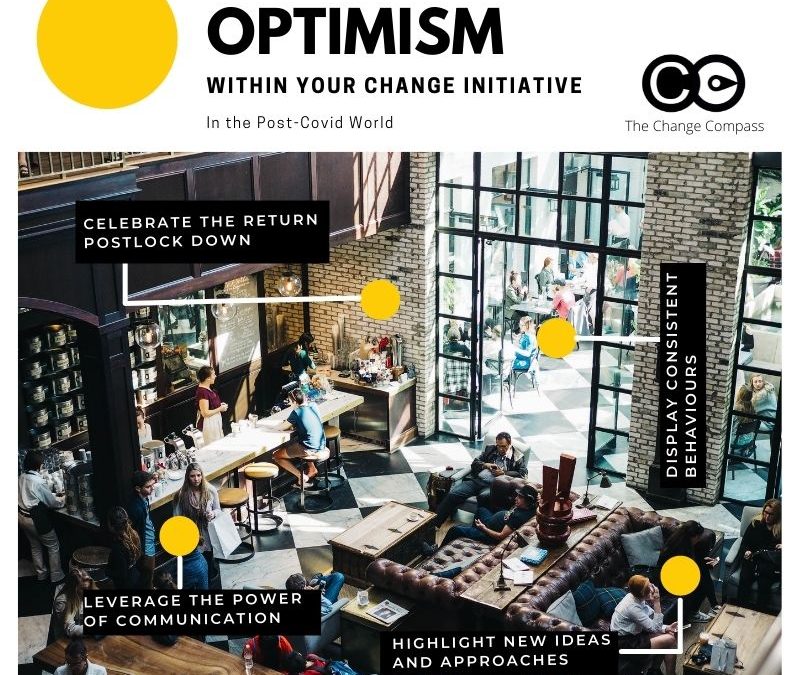
1. Celebrate the ‘return to normal’ (whatever normal looks like!). As companies start to gradually have employees return to work, initiatives must also support this by creating a sense of excitement and positivity. Think of approaches such as:
Uplifting speeches by leaders
Gift objects such as cupcakes and drinks as a part of the celebration theme
Online events promoting positive discussions and sharing
Social events fostering activity and excitement
2. Highlight new ideas and approaches to the initiative. To demonstrate that things are no longer just ‘ho-hum’ as was the case during Covid, adopt new engagement and communication approaches to liven up the initiative. Even better, ask impacted stakeholders to come up with bright ideas of how to generate a renewed sense of optimism
3. Leverage the power of communication to impart excitement and positivity. Incorporate bright and colourful images, quotes and graphic themes to instil positive energy.
4. Display consistent behaviour. There is nothing worse than having positive themes throughout, only to have initiative leads speak with monotone voice supplemented by lethargic behaviour. We are social animals. We can ‘smell’ low energy. You may need to proactive coach your leaders to ensure that they are displaying the right behaviours across all modalities …. The tone of voice, gestures, responses, reactions, etc. All aspects of behaviour can impart mood. And your job is to design and shape them to be one that is more positive.
Adopting a behavioural science approach to managing behaviour change means leveraging scientific research about human behaviours and using this to better manage employee behaviour and change. A lot of the common practices in change management are not always based on scientific research. What is assumed as common change approaches may in fact not be substantiated by research and data.
A behavioural science approach to managing change recognizes that successful change initiatives require more than just new processes or training programs—they hinge on shifting employee behaviour and embedding new behaviours across the organization. By drawing on evidence-based insights, such as the transtheoretical model, change practitioners can better understand how individuals move through stages of personal growth and adopt new ways of working. This approach underscores the crucial role of leadership, with the executive team and direct reports acting as role models who demonstrate and reinforce desired behaviors. Engaging small groups and the wider workforce in the process ensures that behavioural change is not only top-down but also authentic and sustainable, addressing the way people perceive and respond to organizational change over the long term.
Moreover, involving employees in both the design and reporting of change efforts fosters ownership and helps weave multiple changes into the fabric of the organization. Performance reviews and ongoing reinforcement are essential for sustaining new behaviors and achieving better outcomes. By prioritizing human-centric design and leveraging the power of relationships—such as the nature of leadership relationships and the influence of peer networks—organizations can create an environment where behavioural change is not just a one-off initiative but a continuous process aimed at long-term success.
How to create a behavioral and cultural shift?
To create a behavioural and cultural shift, engage stakeholders through open communication, set clear objectives, and model desired behaviours. Encourage feedback and recognize progress to reinforce the change. Additionally, provide training and resources to support individuals as they adapt, ensuring a cohesive transition towards the new culture.
We talk to an industry veteran of behavioural science, Tony Salvador. Tony has 30+ years of research background behind him and a long-time ex-Inteller and Senior Fellow. At Intel, Tony travelled around the globe researching human factors and how people behave with technology.
There are many valuable takeaways for the change practitioner.
Some of these include:
Engineering psychology and human centric design
Analogy of pickaxe and the change approach
Principle of aversion to loss
People involvement and transactional change
Determining the nature of leadership relationship with employees
Story telling and insight into change culture
Example of Brazilian translator and people’s stories
Power of observation and listening
The nature of relationships and how they determine change
Change rationale in weaving in multiple changes
Involving people in reporting to achieve authenticity
Building the case and involving employees to derive case for change
Research on aversion to loss can explain why people don’t want to change. I spoke with Senior Fellow, anthropologist and ex-Inteller Tony Salvador.
It sounds completely illogical but true ….
This plays out in various facets of how people make decisions about choices … including in a change transformations context.
This is just one of the many things I spoke with Tony Salvador about.
Change aversion is a powerful psychological concept rooted in loss aversion, where individuals tend to fear losing what they have more than they value gaining something of equal magnitude. This phenomenon plays a significant role in why many people resist new changes, whether in their personal lives or within organizations, and particularly affects how product managers, leaders, and customer-facing teams approach change initiatives. It impacts their decision-making processes heavily, especially when they perceive potential losses that could overshadow a gain of equal magnitude.
At the individual level, the degree of change aversion varies depending on personal circumstances and perceptions. Original research grounded in Prospect Theory explains that people evaluate potential changes not just by the prospective benefits but by the risks of losing familiar routines, status, or comfort. For example, individuals are often more concerned about losing $2 than they are motivated by the prospect of gaining $5, because the psychological impact of loss outweighs that of an equivalent gain. This loss aversion creates an emotional barrier that can prevent even well-intentioned changes from being embraced.
The effects of change aversion can be observed in many contexts, including business transformations and customer satisfaction. For product managers, understanding this aversion is crucial when introducing new features or product updates. Despite best intentions customers might resist changes that disrupt their habitual usage or create uncertainty – even when these changes offer clear improvements or potential benefits. This reluctance can negatively impact customer feedback and satisfaction because the change is perceived as a threat rather than an opportunity, despite significant change efforts.
One helpful point of reference for managing change aversion is recognizing that the degree of aversion is not uniform. Organizational change studies show that people feel more averse to changes imposed upon them (such as being assigned new tasks) than to changes they self-initiate (like managing their own time differently). This highlights the importance of agency in the change process. When employees or customers feel involved or have some control, their resistance diminishes.
The potential benefits of understanding and addressing change aversion are profound. Company leaders who communicate transparently about what changes mean, acknowledge possible losses, and provide support and resources can create an environment where people feel safer to engage with change. This approach can be extended to personal lives, for example, in maintaining new year’s resolutions where individuals face their own internal resistance rooted in loss aversion to giving up old habits or comforts.
Moreover, energetic speeches or inspirational messaging via emails can sometimes fail to overcome change aversion if they neglect the underlying psychological resistance. Instead, effective change management embraces empathy and addresses the emotional loss individuals perceive. This understanding is particularly vital for product managers relying on customer feedback to refine changes, as they must balance the introduction of innovation with the human tendency to resist disruption.
In summary, loss aversion explains why change feels threatening and why resistance often arises despite good intentions and clear advantages of the new change. By acknowledging the psychological concept of change aversion and its individual variability, organizations and individuals can better design, communicate, and implement changes that minimize resistance and maximize acceptance and satisfaction.
This nuanced understanding provides a valuable toolkit for navigating change in both organizational settings and personal lives, helping transform resistance into openness and enabling progress despite the natural human tendency toward aversion to loss.
Lots of golden nuggets of wisdom takeaways for change practitioners from the man who spent 30+ years working for Intel researching about people behaviour and how they operate in social and technological environments.
Stay tuned for the full recording.
Why do people oppose change?
People often oppose change due to change aversion, a psychological tendency where individuals fear losing what they already possess. This resistance is rooted in the discomfort of uncertainty and potential negative outcomes. Understanding this can help leaders implement strategies to ease transitions and foster acceptance within teams.