Most change teams are about to get very good at producing work that is confidently wrong. Generative AI can now draft a stakeholder impact assessment, a comms plan, or a readiness narrative in minutes, and the output looks polished enough to send. But polish is not correctness. An AI-drafted impact assessment can merge two stakeholder groups that experience a change very differently, understate the load on a team already carrying two other go-lives, and invent a training assumption no one ever agreed, all inside fluent prose that signals “this is fine”. Catching that takes a specific set of skills, and they are not the ones most teams are building.
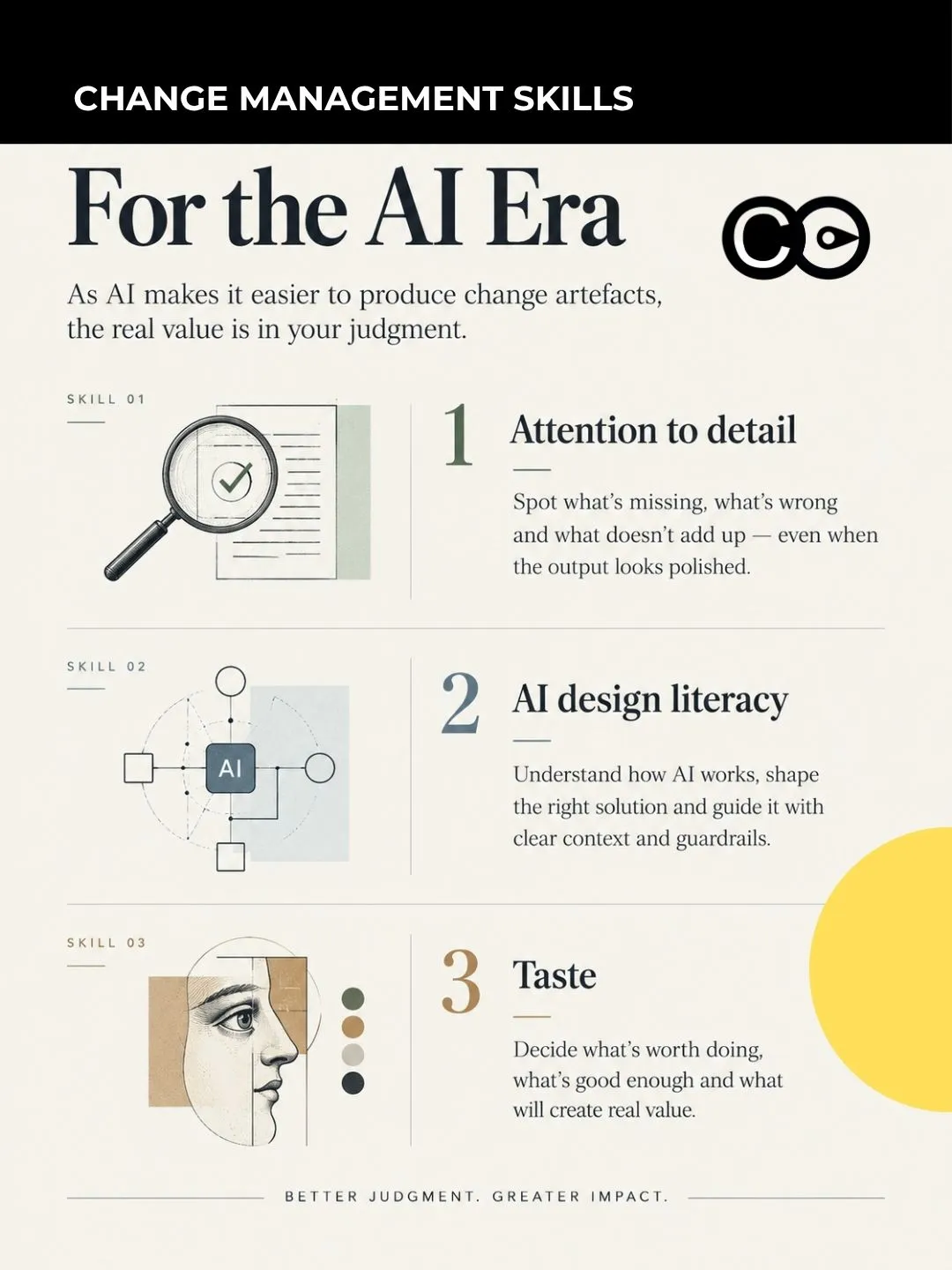
This article is for the leaders deciding which capabilities to develop across their change teams, and for practitioners deciding what to get better at themselves. The argument is straightforward: as AI drives the cost of producing change artefacts toward zero, value moves to the judgment that decides what to produce, whether it is right, and whether it is good enough to use. Three skills carry that judgment, and none of them is prompt engineering. They are attention to detail, the ability to read and shape how an AI solution is designed, and taste. Much of the commentary on AI and change work focuses on whether the job survives or on the operating model shifting from stage gates to a continuous flow of data, and we have covered both elsewhere. This piece is about the concrete skills to prepare your team around, and what to do to build each one.
Why the AI era rewards different change management skills
For most of the history of the profession, a large part of a change manager’s value came from production. Someone had to write the impact assessment, build the stakeholder map, draft the comms, assemble the training plan, and pull the readiness survey together. Those artefacts took real time, and the people who produced them well were valued for it. Generative AI has collapsed the cost of that production. A first draft of almost any change artefact is now minutes away.
When the cost of producing something falls to near zero, the value moves elsewhere. It moves to the judgment about what to produce, whether the output is actually correct, and whether it is good enough to put in front of the project team and stakeholders who will rely on it. The scarce skills are no longer the ones that fill a blank page. They are the ones that decide what belongs on the page and catch what does not.
The evidence that this shift is real, and that most organisations are handling it badly, is now hard to ignore. An MIT report on the state of AI in business in 2025 found that 95 per cent of enterprise generative AI pilots delivered no measurable impact on profit or loss, a gap the authors called the “GenAI divide”. Their explanation is instructive for change professionals: generic tools work for individuals because they are flexible, but they stall inside organisations because they do not learn from or adapt to the way the work is actually done. The failure is rarely the model. It is the design around the model, and the human judgment applied to its output.
There is a second, less obvious warning in the research. A randomised controlled trial by METR in 2025 had experienced developers complete real tasks with and without AI assistance. The developers believed AI made them roughly 20 per cent faster. Measured against the clock, AI made them 19 per cent slower. The gap between how productive people feel with AI and how productive they actually are is one of the defining risks of this period, and it is exactly the kind of gap that the three skills below are built to close.
Skill one: Attention to detail
Attention to detail has always mattered in change work. A wrong go-live date in a comms pack, a stakeholder left off a map, a training cohort double-counted: these have always caused real damage. What is new is that AI both raises the stakes and removes the natural friction that used to catch these errors.
It raises the stakes because AI produces errors that look nothing like human errors. A tired analyst produces work that is visibly rough, and the roughness signals “check this”. AI produces work that is uniformly polished, which signals “this is fine” even when it is not. The confident tone is not evidence of correctness. It is a property of the tool.
It removes the friction because the effort of producing the artefact used to force a slow read. When you wrote the impact assessment yourself, you engaged with every line. When you accept a draft, you can skim. This is where the research on automation bias becomes directly relevant. A 2025 review of automation bias in human and AI collaboration describes the well-documented tendency to over-rely on automated output and discount information that contradicts it, and notes that this tendency weakens the very reasoning and verification habits that catch mistakes. The same review points to a practical finding that should shape how you work: deliberately increasing the effort you put into verification measurably reduces the chance of accepting a wrong recommendation. Passive review does not protect you. Active checking does.
Where AI output tends to go wrong in change work
Knowing the general failure modes lets you check the right things rather than re-reading everything with equal suspicion. In change artefacts specifically, AI-generated content tends to fail in recognisable ways:
It flattens groups that should be kept distinct, merging stakeholders who actually experience a change very differently.
It underweights cumulative load, treating each initiative in isolation and missing the fact that a team is already saturated.
It invents plausible specifics, such as a training duration, an adoption target, or a milestone date, that no one ever agreed.
It reproduces generic best practice that is technically true but disconnected from your organisation’s real constraints.
It states correlations and assumptions with the same confidence as verified facts.
How to build the habit
Attention to detail in the AI era is not a personality trait you either have or lack. It is a discipline you can install:
Read AI output against a source of truth, not on its own terms. Keep the actual stakeholder register, the portfolio load view, and the agreed plan open beside the draft.
Check the specifics first. Dates, numbers, named groups, and commitments are where invented detail hides.
Ask what the draft is assuming without saying so. If an assumption is load-bearing and unstated, surface it and confirm it.
Treat fluency as neutral. A well-written paragraph is neither more nor less likely to be correct than a clumsy one.
This is also where the state of your data decides how far the skill can take you. Verification is far faster and far more rigorous when your change data lives in structured form, because the AI’s claims can be tested against real fields rather than your memory of them. But structured is only half of it. The data also has to be integrated. If impact severity sits in one team’s spreadsheet, stakeholder groups in another’s slide deck, capacity in a third’s project plan, and adoption in a survey tool no one has opened in a month, then neither you nor any AI has a single reliable picture to check against. What a change team needs is structured and integrated change data across the whole portfolio, held in a form an AI can actually ingest and reason over: consistent fields, shared definitions, and one place where impact, capacity, stakeholder load, and adoption live together. That foundation is what makes fast verification possible, and it is also the precondition for the second skill, because you cannot design or judge an AI capability well if the data underneath it is scattered and inconsistent.
Skill two: Reading and shaping how the AI solution is designed
Here is the skill that is least discussed and, over the next few years, probably the most valuable. Change managers do not need to become engineers. They do need enough literacy in how AI solutions are designed to reason about them, ask sharp questions, and shape the adoption approach around the design rather than around a vendor’s marketing. When an AI capability is introduced into a change function or a wider transformation, the practitioner who understands its architecture will make far better decisions than the one who treats it as a magic box.
A handful of design concepts do most of the work. You do not need to implement any of them. You need to be able to hold a competent conversation about each.
Agent design. Increasingly, AI does not just answer a question. It takes a sequence of steps toward a goal: reading data, drafting, checking, and acting. Understanding that an “agent” is a designed sequence, with defined inputs, permitted actions, and stopping points, lets you ask where the human sits in that sequence and what happens when a step goes wrong.
Gating. A gate is a checkpoint where the system pauses for a human decision before it proceeds, or where it refuses to act unless its confidence is high enough. Good AI design in a high-stakes area like change puts gates in the right places. The practitioner’s job is to know which decisions should never be fully automated and to insist a gate sits there.
Continuous learning loops. A system that captures outcomes and corrections and feeds them back improves over time. A system that does not stays generic. The MIT finding above is a learning-loop failure at heart: the tools that failed were the ones that never adapted to the organisation. When you evaluate an AI capability, ask how it learns from what actually happened, and whether anyone is responsible for closing that loop.
Data structure and AI access. An AI is only as useful as the data it can read and the permissions it is given. Structured data, where impact severity, stakeholder groups, and adoption are captured as consistent fields, is something an AI can reason over. Prose buried in slide decks and inboxes is not. Equally, what the AI is allowed to see, and what it must not, is a design decision with real privacy and governance consequences.
None of this requires you to write code. It requires you to ask better questions than “does it use AI?” Questions like: what data does this read, and is that data structured enough to be reliable? Where are the human gates, and are they in the right places? How does this improve, and who owns that? What is this system allowed to access, and what should it never touch? These are change and governance questions dressed in technical language, and they are squarely the practitioner’s territory.
This is also where generic tools reveal their limits. As we argued in why generic AI tools fall short of an enterprise change intelligence platform, an AI with no access to your organisation’s structured change data can only give you faster generic summaries. The upgrade is not a cleverer model. It is the structured foundation underneath it. The companion argument, that the change manager increasingly becomes the steward and strategist of that data foundation, is developed in our piece on agile change management and the change intelligence layer; rather than repeat it here, the point for this article is simpler. You cannot steward or shape something you cannot reason about, which is why this design literacy is now a core skill rather than a nice-to-have.
Prosci’s own research reflects the same gap from the adoption side. In its early findings on AI in change management, it reports that a lack of AI literacy is a leading barrier to adoption, and that organisations increasingly expect adoption and value to be measured with real-time data throughout the life cycle rather than at the end. Both of those expectations land on the practitioner who understands how the system is built.
Skill three: Taste
The third skill is the hardest to name and the easiest to underrate. Call it taste. It is the judgment that decides, among many possible outputs that are all technically acceptable, which one is actually right for this audience, this moment, and this organisation. It shows up in design, and it shows up just as much in expression.
Taste has become a serious topic precisely because AI has made production abundant. When anyone can generate a hundred versions of a comms plan, a stakeholder deck, or a readiness narrative, the constraint is no longer making them. It is choosing well. A 2026 Forbes piece by Marcus Collins argued that when AI can make almost anything, taste becomes the last defensible advantage, a view echoed across a growing body of writing describing a shift from a creation economy to a “taste economy”, where value comes from editing and selection rather than raw output. For change professionals, this is not abstract. Taste is what separates a change story that lands from one that is accurate but inert.
Taste in design
In design terms, taste is the ability to look at three AI-generated options for a stakeholder heatmap, a change roadmap, or an adoption dashboard and know which one communicates and which one merely decorates. AI will happily produce a visually busy chart that technically contains the right data and completely fails to make the point. Taste is knowing that a single clear view beats a dense one, that the severity of an impact should be visible at a glance, and that a stakeholder skimming between meetings has thirty seconds, not thirty minutes. It is the editorial instinct for structure, hierarchy, and emphasis applied to the artefacts change managers actually use.
Taste in expression
Expression is where taste matters most and where AI most often falls short. The default register of generative AI is fluent, even, and generic. It has no ear for your organisation’s language, no sense of what will reassure a nervous middle manager versus what will convince a hard-nosed executive, and no instinct for what to leave unsaid. A change practitioner with taste knows when to cut three paragraphs to one sentence, when a plain declarative line will do more than a polished one, and when the AI’s confident phrasing needs to be softened because the reality on the ground is genuinely uncertain.
This connects to something we have written about at length. Change teams often present data at an awareness level when it needs to be decision-forcing, and they speak in their own idiom rather than the language of the business. Our article on why change teams need to speak executive language makes the case in full. Taste is the faculty that does this translation well. AI can draft the words. Only judgment tells you whether they are the right words for this reader.
The uncomfortable truth about taste is that it cannot be prompted into existence. It is built the slow way, through repeated exposure, deliberate attention, and genuine engagement with the craft over years. That is precisely why it is defensible. A practitioner who has run twenty transformations has a calibrated sense of what good looks like that no one can shortcut, and in an era of infinite cheap production, that calibration is worth more, not less.
How the three skills reinforce each other
These are not three separate competencies to develop in parallel. They form a chain. Design literacy tells you where an AI system is likely to be weak and where its output needs the hardest scrutiny. Attention to detail is how you apply that scrutiny, checking specifics against a real source of truth rather than trusting fluent prose. Taste is the final judgment that turns a corrected, verified draft into something genuinely fit to put in front of the project team, the stakeholders it affects, and, when it needs to go up, a sponsor.
Consider the impact assessment from the opening. Design literacy tells you the AI has no reliable access to cross-initiative load data, so its view of capacity is probably shallow. Attention to detail catches the merged stakeholder group and the invented training assumption. Taste decides that the corrected assessment, while accurate, buries its most important finding on page four, and moves it to the front where the project team and stakeholders will actually see it. Remove any one of the three and the artefact fails in a different way: unexamined, uncorrected, or accurate but ignored.
This is also why the old debate about whether AI replaces change managers misses the point. As we explored in what practitioners need to know about the future of the profession, the work does not disappear. It moves up a level, from producing artefacts to designing, verifying, and exercising judgment over them. The three skills here are the concrete content of that move.
How digital change tools support these skills
Two of the three skills depend heavily on your underlying data. Attention to detail is far faster when an AI’s claims can be checked against structured fields rather than your memory, and design literacy only translates into value when there is a real, structured data foundation for AI to read. This is where a dedicated change platform earns its place. Tools such as Change Compass capture impact, capacity, stakeholder load, and adoption as consistent, structured, and integrated data across the whole portfolio, which gives both you and any AI a single reliable source of truth to reason from rather than a scatter of disconnected files. The point is not that the tool replaces judgment. It is that good structured data makes your judgment faster and your checking more rigorous.
Where to start
If you want to build these skills, do not begin with a course on prompting. Begin with the habits that compound. Pick your next AI-assisted change artefact and read it against a real source of truth, checking every date, number, and named group before you trust a word of it. The next time an AI capability is proposed for your function, ask the four design questions: what data does it read, where are the human gates, how does it learn, and what can it access. And treat every artefact you send as a judgment call, not a transfer: decide what to cut, what to emphasise, and what to say plainly.
Attention to detail, design literacy, and taste are not the skills the AI era makes obsolete. They are the skills it makes decisive. Production has become cheap, and in a world of cheap production, the practitioners who thrive will be the ones who can tell the difference between output that looks right and work that is right.
Frequently asked questions
What change management skills matter most in the AI era?
The skills that separate valuable practitioners from fast producers of low-quality work are attention to detail, the ability to reason about how AI solutions are designed, and taste in both design and expression. These matter because AI has made producing change artefacts cheap, which moves value to judgment, verification, and selection rather than raw output.
Do change managers need technical AI skills?
Not in the sense of building or coding AI. Practitioners do need enough literacy to reason about how an AI solution is designed, including where human approval gates sit, how the system learns from real outcomes, what structured data it can read, and what it is allowed to access. These are governance and change questions expressed in technical language.
Why is attention to detail more important with AI, not less?
Because AI produces errors that look polished and confident, which removes the natural signals that used to prompt a careful review. Research on automation bias shows people tend to over-trust automated output and skim rather than verify. Deliberately increasing verification effort is one of the few things proven to reduce the chance of accepting a wrong answer.
What does “taste” mean for a change practitioner?
Taste is the judgment that chooses the right output among many acceptable ones. In design it is knowing which chart communicates rather than decorates. In expression it is knowing what to cut, what to emphasise, and how to speak in language that lands with a specific audience. AI can generate options, but taste decides which one is fit to use.
Can these AI-era skills be learned quickly?
Attention to detail and design literacy can be built through deliberate habits and asking better questions, and they improve relatively fast. Taste is slower, built through years of exposure and reflection, which is exactly why it is a durable advantage that AI cannot replicate for you.
Your calendar already tells the story. The daily stand-up. Sprint planning on Monday. The retrospective at the end of the sprint. A program increment planning offsite pencilled in for next month. Over the past decade, change managers have moved into agile teams and taken on their rituals, and for many practitioners the sprint, not the phase gate, is now the real unit of work. That shift has barely bedded in, and AI is already changing what those rituals are for.
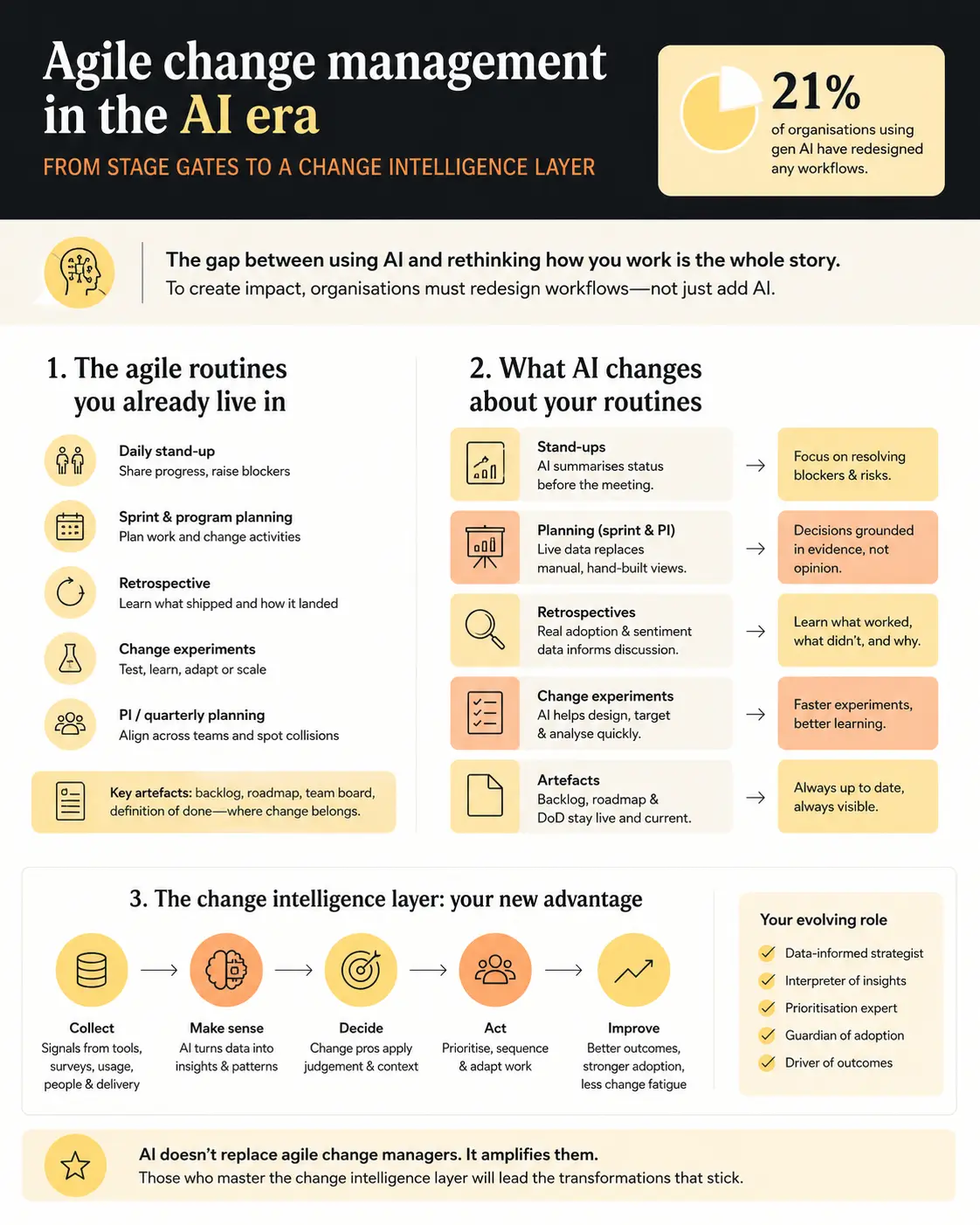
The gap between using AI and rethinking how you work is the whole story here. McKinsey’s 2025 research found that of all the organisational changes linked to gen-AI success, fundamental workflow redesign correlates most strongly with financial impact, yet only 21% of organisations using gen AI have redesigned any workflows at all. Nearly eighty per cent are layering AI on top of processes they have not touched. For change managers, the processes about to be layered on are the agile routines and artefacts you run every week: the stand-ups, the backlogs, the roadmaps, the retrospectives.
This article is about what actually happens to those routines, and about the skill that decides whether you thrive as they change. The interesting question is not whether AI replaces change managers. It is how your agile ways of working are reshaped when AI is in the loop, and why the practitioners who come out ahead are the ones who become stewards and strategists of a change intelligence layer.
The agile routines and artefacts you already live in
Before looking at what changes, it is worth naming what is actually on the table, because the transformation is specific rather than vague. If you work in or alongside an agile delivery team, your week already runs on a familiar set of ceremonies and artefacts.
The routines are the recurring events that give agile its cadence. The ones a change manager is genuinely part of include:
The daily stand-up, where the team shares progress and raises blockers.
Sprint planning, where the team agrees the next short cycle of work, including the change activities that go with it.
The retrospective, where the team looks back at what shipped and how well it landed with the people it affected.
Change experiments, which some teams run as a core agile habit: test an approach with a small group or pilot, see how it lands, and let the result decide whether to adjust, scale, or drop it.
Program increment or quarterly planning, where several teams align on the bigger picture and spot where their work collides.
The artefacts are the objects those events produce and use: the product backlog, the roadmap, the team board, and the definition of done. For a change manager, these are not someone else’s furniture. Change activities increasingly sit as items on the backlog. Adoption criteria increasingly belong in the definition of done. Stakeholder impacts increasingly need to be visible on the same board as the delivery work. The standalone change plan has been folding into the team’s shared backlog for years.
This is the current state that AI now acts on. Not a blank page, but a mature set of routines and artefacts that change managers have spent a decade learning to work within.
What AI changes about your agile routines and artefacts
AI does not abolish the ceremonies. It changes what each one is for, by taking over the manual assembly of information and pushing the human contribution up towards judgement. The pattern is consistent across every routine: the part of the ritual that was about gathering and reconciling status gets automated, and the part that was about deciding what to do gets more important.
The ceremonies
Stand-ups stop being status round-robins. Tooling that reads commits, tickets, and adoption signals can already summarise where work stands before anyone speaks, which means the fifteen minutes shifts from reporting progress to resolving the blockers and risks the summary surfaced. For a change manager, that is a promotion: less time chasing “where are we”, more time on “this initiative is about to land on a team that is already at capacity, and here is the evidence”.
Sprint and program increment planning change most of all. Historically, a change manager walked into planning with a hand-built picture assembled over days: how much change each group was already carrying, where initiatives clashed, how ready each stakeholder group was, and how earlier changes were being adopted. When that picture is generated live from a shared data layer, planning stops being a negotiation between confident opinions and becomes a conversation grounded in evidence: these two initiatives hit the same population in the same window, this group is not yet ready on the measures that predict adoption, and adoption of the last change here has stalled. The change manager’s job in the room moves from bringing the data to interpreting it and deciding what to do about it.
Retrospectives get an honest evidence base. Instead of debating from memory whether a change stuck, the retro can look at real adoption data: usage that rose or stalled, sentiment that moved, the support tickets that spiked. The conversation about what to do differently improves because it starts from what actually happened, not from the loudest recollection in the room.
Change experiments get faster and sharper. When you pilot an approach with one group, AI can help read the result quickly, comparing adoption and sentiment against a group that did not get the new approach, so you can see which version worked and decide whether to adjust, scale it, or drop it. The experiment stays a human decision; the evidence behind it arrives sooner and cleaner.
The artefacts
The artefacts change too, and mostly by absorbing data they never used to carry:
The backlog stops being a plain list of tasks and becomes a list of changes with real impact data attached: who each item affects, how heavily, and when.
The definition of done extends past “the feature works” to “the change is adopted”, so a piece of work is not finished until there is evidence people are actually using it, not just that it launched.
The roadmap stops being a static twelve-month picture and becomes a living view that reflects current load and readiness, and it updates when the plan changes instead of going out of date on the wall.
The team board gains a change dimension, showing not just the work remaining but how much change each group is carrying across everything landing at once.
Notice what every one of these shifts has in common. The ceremony or artefact only improves if the data feeding it is accurate, consistent, and current. An AI-assisted stand-up built on messy, inconsistent change data will still produce a confident summary, it will just be wrong. That dependency is the core of this article, and it is where the change manager’s most valuable work now sits.
The deeper pattern: From ceremony to continuous sensing
Agile itself came from software, and it is worth seeing where the software world took it next, because that is the direction AI is now pushing change work. The best engineering teams no longer rely on ceremonies alone to know what is happening. They run on continuous telemetry: live dashboards of adoption, error rates, and usage that update by the minute, plus dependency maps and release calendars that let one team see, before it ships, that another is about to hit the same service or the same customers.
Three of those habits translate straight into change work. Ship change in small, reversible increments rather than big-bang go-lives, because small changes are easier to absorb and reverse. Sense continuously through behavioural telemetry rather than lagged surveys, so you can act while the signal still matters. And maintain systemic visibility so you can catch two initiatives colliding on the same people before they land, which is change conflict detection by another name. For a number of technology companies, this is already how they work day to day. The methods are proven, and most change teams have adopted the language of agile but not yet this continuous, data-driven way of working.
Why the point-in-time change operating model breaks under AI
Layer AI onto that picture and the reason the old operating model fails becomes specific. AI compresses the build-and-deploy cycle for the changes themselves, so process redesigns that took two quarters now move in weeks. It is also, in the form of AI adoption itself, a rolling wave of change landing on the same people: McKinsey found 88% of organisations now use AI in at least one function but only about a third have scaled it, which means most organisations are in the continuous middle of AI change, not past it. Its work on AI in the workplace adds a twist change managers should sit up for: employees are already adopting AI faster than their leaders realise, so the change is landing on the workforce whether or not a programme is managing it.
Against that cadence, a quarterly, document-driven rhythm fails in diagnosable ways:
The point-in-time impact assessment is stale on arrival. By the time it is signed off, the initiative has moved.
Survey lag hides the moment you needed to see. Sentiment that arrives three weeks late describes a problem you can no longer prevent.
One rating per initiative averages away the truth. A single status for a whole programme conceals that one business unit is drowning while another is idle.
Manual consolidation cannot keep pace. Reconciling a dozen teams’ spreadsheets by hand takes longer than the interval between meaningful changes.
The annual roadmap goes out of date quickly. A fixed twelve-month sequence cannot keep up when AI keeps changing the plan underneath it.
McKinsey’s work on the agentic organisation reaches the same conclusion from the governance side: as work moves continuously, governance “cannot remain a periodic, paper-heavy exercise” and must become real time, data driven, and embedded, with humans holding final accountability. Periodic and paper-heavy is exactly what most change governance still is. The direction of travel is a continuous, data-driven layer with humans in charge of the judgement, and that layer needs an owner.
The change intelligence layer: What replaces the stage gate
If the stage gate is the artefact of the old model, the change intelligence layer is the artefact of the new one, and it is worth defining precisely because the term is easy to wave at and hard to build.
A change intelligence layer is the continuously updated, organisation-specific data foundation that shows, at any moment, how much change each part of the business is carrying, how ready it is, where initiatives collide, and how adoption is tracking, and that feeds this picture to both human decision-makers and AI systems. It is the difference between a folder of assessments and a live nervous system for the portfolio. It is best understood as core infrastructure rather than a reporting nicety, which is the whole case for treating it as a change intelligence platform rather than another dashboard.
What sits in the layer:
Impact data: which roles, teams, and business units each initiative touches, at what depth, and when.
Saturation and load: the cumulative weight of all concurrent change on any given population.
Readiness signals: leadership alignment, capability, and structural readiness, refreshed as conditions move.
Adoption telemetry: behavioural evidence that a change is actually being used, not just launched.
Conflict and overlap: where two or more initiatives hit the same people in the same window.
Here is why this matters specifically in the AI era. Generic AI tools are confidently generic. Ask a general-purpose model to sequence your transformation portfolio and it will give a plausible, well-written answer that knows nothing about your organisation, because it has none of the data above. The AI you are already using becomes genuinely useful for change only when it can read your organisation’s real load, readiness, and conflict data. The layer is what turns a generic assistant into an adviser grounded in your context, the point developed further in what AI can and cannot do without your organisation’s data. Without the layer the AI has no context, and without context it cannot give useful change advice. That is why the layer needs a human owner who understands both the change discipline and the data.
Change managers as data stewards
Data stewardship is the least glamorous phrase in this article and the most important. A data steward owns the definition, quality, consistency, and governance of a class of data. For the change intelligence layer to produce trustworthy signal rather than confident noise, someone has to own change data the way a finance team owns the general ledger. That someone is the change manager.
Consider what happens without stewardship. One team rates impact on a five-point scale, another uses high/medium/low, a third invents its own. “Go-live” means the deployment date to one initiative and the end of hypercare to another. Stakeholder groups are named inconsistently, so the system cannot tell that “Branch Staff” and “Retail Frontline” are the same three thousand people carrying two changes at once. Feed that into an AI model and it will average incompatible scales, miscount overlaps, and generate recommendations that are wrong with total fluency. The problem is not the model. The problem is ungoverned data.
Gartner’s research shows how common and how costly this gap is. In its 2024 survey, poor data literacy sat among the top barriers to data and analytics success, and the sharpest failure points were organisational, not technical: a lack of clear ownership over data initiatives was cited by 69% of respondents, poor results from training by 52%, and more than a quarter said their organisation had no shared understanding of what data literacy even meant. Ownership is the number one gap. For change data, that owner can and should be the change manager.
A change data steward, in practice, owns:
Definitions: a single agreed meaning for impact severity, readiness, go-live, stakeholder group, and every other term the layer depends on.
Quality: the completeness and accuracy of what teams enter, with the standards and follow-up to keep it honest.
Consistency: the same taxonomy across every initiative, so aggregation is valid rather than misleading.
Governance: who can change definitions, how history is preserved, and how the layer stays trustworthy as it grows.
This is unglamorous, and it is decisive. An AI-enabled change function with excellent tools and ungoverned data will simply make faster mistakes. The steward is what makes the intelligence layer worth trusting.
Change managers as data strategists
Stewardship keeps the data clean. Strategy decides what the data should be in the first place, and that is the higher-value half of the role.
A data strategist for change asks a different set of questions. What must this layer be able to answer for our executives, and are we capturing the right data to answer it? Which signals actually predict adoption in our organisation, and are we capturing them or just the ones that are easy to collect? What context does our AI need to give advice we would actually act on, and how do we feed it that context deliberately rather than hoping? These are design questions, and they determine whether the layer drives decisions or just accumulates records.
The strategic payoff is a change in how the portfolio gets governed. Today, prioritisation and sequencing are too often settled by whoever is most senior in the room. A well-designed intelligence layer replaces that with evidence: this population is at saturation, these two initiatives collide in October, this unit is not ready on the dimensions that predict adoption. The strategist’s job is to make the layer answer the questions executives care about, in the language and at the altitude they decide at, the same discipline as presenting a single view of change in executive language rather than practitioner detail.
That reframe, from custodian of a methodology to strategist of a data asset, is the through-line of where the profession is heading. It is why the future of change management in the AI era rewards practitioners who can think in data and systems, not only in stakeholder maps and comms plans. The craft skills still matter. They are now table stakes rather than the differentiator.
How to make the shift: A practical sequence
You do not become a data-led, AI-ready change function by buying a tool and hoping. The move is a sequence, and it can start inside the agile routines you already run. Here is a five-step path a change lead can begin this quarter.
Record each change as structured data, not prose. For every active change, capture who it affects by role and business unit, the timing, and the adoption signals you expect to see, in fields on your backlog or tool rather than buried in a document. If it lives only in a document, the layer cannot read it, which is why teams eventually outgrow the spreadsheet that cannot add up impact across initiatives.
Standardise the definitions. Agree one taxonomy for impact severity, readiness, stakeholder groups, and lifecycle stages, and write it down. This is the steward’s founding act. Without it, every later step compounds inconsistency.
Move sensing into the cadence you already have. You do not need a new meeting. Feed a continuously updated load-and-readiness view into your existing sprint planning, PI planning, and retrospectives, so those ceremonies interrogate live data instead of hand-built decks.
Name the steward explicitly. Decide who owns change data quality and governance, even if it is part of an existing role at first. Gartner’s evidence is blunt: unowned data initiatives fail. Do not leave it implicit.
Put the layer in front of executives, and let AI work on top of it. Once the data is structured, governed, and current, connect it to AI for the analytical lift, surfacing conflicts, forecasting adoption risk, drafting the narrative, and put the resulting picture where decisions get made. The humans keep the judgement.
A common failure worth naming: skipping straight to step five. Bolting AI onto ungoverned, unstructured change data reproduces the McKinsey finding at team level, adding intelligence on top of a broken process rather than fixing the process. Steps one and two are boring and load-bearing. Do them first.
Where a change intelligence platform fits
Everything above can be started in a spreadsheet and a disciplined taxonomy, and for a small portfolio that is a reasonable place to begin. It stops scaling quickly. Once you are aggregating load across dozens of initiatives, detecting conflicts across overlapping populations, and feeding governed data to AI for analysis, the manual version consumes more time than it saves. This is the point of a purpose-built change intelligence platform such as Change Compass: it provides the structured capture, the shared taxonomy, the real-time aggregation, and the portfolio-level view that turn scattered change data into a genuine intelligence layer, and it gives AI the organisation-specific context it needs to move from generic advice to grounded recommendation. The platform is the infrastructure. The steward and strategist are the roles that make it produce something worth acting on.
Where to start
If you take one thing from this, make it the direction, not the destination. Your agile routines are not being abolished; they are being rewired to run on live data, and AI is doing the assembly work that used to fill your week. The change function is moving from a quarterly, document-driven model to a continuous, data-driven one, because AI has raised the cadence of change past the point a periodic rhythm can track. The skill that decides who thrives is not AI fluency in the abstract. It is the ability to steward change data so it can be trusted, and to strategise about what that data should answer.
Start this week with one concrete act inside a ceremony you already run: at your next planning session, agree a single shared definition of impact severity and stakeholder group across all your active initiatives. That is step two of the sequence, it costs nothing but a conversation, and it is the foundation the entire intelligence layer is built on. Get the definitions right and every later step, the automation, the forecasting, the executive reporting, becomes possible. Skip them and even the best AI will only give you fast, confident answers that are wrong.
Frequently asked questions
What happens to agile ceremonies like stand-ups and sprint planning when AI is involved?
AI does not remove the ceremonies; it changes what they are for. The manual work of gathering and reconciling status gets automated, so stand-ups shift from reporting progress to resolving blockers, and planning shifts from bringing hand-built data to interpreting live evidence. Human facilitation, discussion, and judgement remain essential, and arguably become the whole point of the meeting.
What is a change intelligence layer?
A change intelligence layer is a continuously updated, organisation-specific data foundation that shows how much change each part of the business is carrying, how ready it is, where initiatives collide, and how adoption is tracking. It replaces point-in-time assessments with a live view and gives AI systems the real context they need to produce useful, grounded advice rather than generic recommendations.
Why do change managers need to become data stewards?
Because an AI-enabled change function is only as good as the data it runs on. A data steward owns the definitions, quality, consistency, and governance of change data, so that when it is aggregated across initiatives or fed to AI, the result is trustworthy rather than confidently wrong. Gartner consistently finds that unowned data initiatives are among the most likely to fail, which makes explicit stewardship decisive rather than optional.
How is agile change management different from traditional change management?
Traditional change management works in large, sequential phases governed by periodic stage gates and point-in-time assessments. Agile change management works in small increments with continuous sensing of load, readiness, and adoption, steering the portfolio in a rolling cadence rather than a quarterly one. The AI era pushes change towards the agile model because it raises the rate at which change arrives.
Does AI replace change managers?
No, but it changes what the role is for. AI handles the analytical assembly, surfacing conflicts, forecasting adoption risk, drafting narratives, while humans hold the judgement and accountability. The change manager’s centre of gravity shifts from producing documents to designing and governing the data layer that AI, executives, and agile teams all draw on, which is a higher-value role than the one it replaces.
From late 2025, several of the world’s largest banks quietly cut their junior analyst intake by up to two-thirds while accelerating AI across their operations. In the UK, the major professional services firms pared back graduate hiring, and across the US economy, postings for entry-level roles fell by around 35% between early 2023 and mid-2025, a decline CNBC reports is driven in large part by AI. The people most exposed were not the seasoned experts. They were the juniors doing the drafting, the data cleaning, and the first-pass analysis.
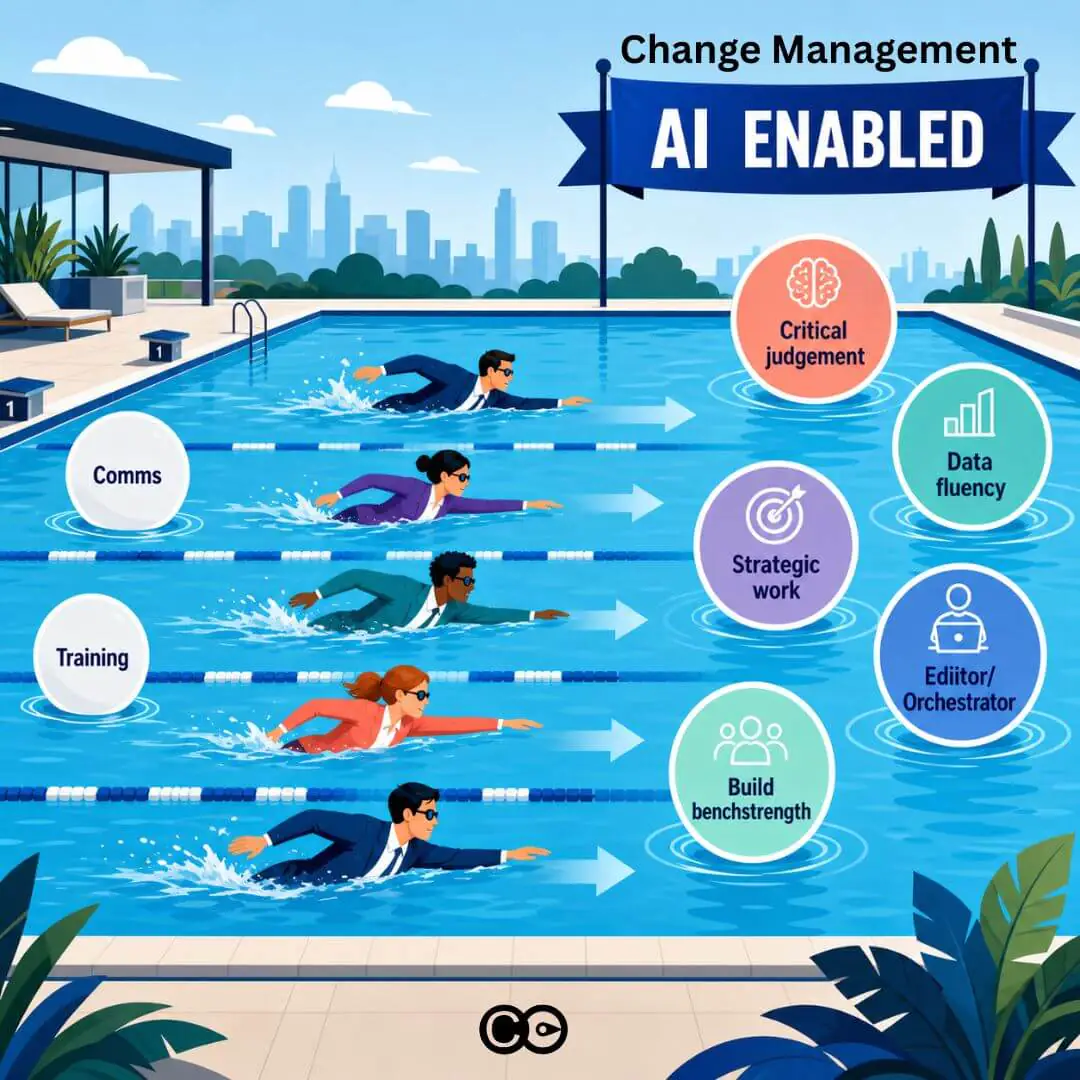
Change management is not immune to this pattern, and pretending otherwise helps no one. A large share of what change practitioners do day to day, drafting communications, building training content, assembling stakeholder lists, summarising feedback, is exactly the kind of structured, language-heavy work that generative AI now does in seconds. The uncomfortable question for the profession is not whether AI will change the job. It is which practitioners remain valuable once the routine layer is automated, and what they need to become. This article sets out the specific capabilities that will define the future of change management in the AI era, and why the practitioners who develop them will be the ones organisations still fight to keep.
The work AI is genuinely absorbing
Let us be honest about where the automation is real rather than hypothetical. The bulk of comms and training production, the volume work that has historically filled a change practitioner’s week, is now well within the capability of general-purpose AI tools.
Ask a competent model to draft a go-live email, a manager talking-points pack, a set of FAQs, a quick-reference guide, or a first-cut training module outline, and it will produce something serviceable almost instantly. It will match a tone, respect a word limit, and generate five variations on request. For the mechanical, high-volume end of change communications and enablement, the productivity gain is not marginal. It is the difference between a day of work and a coffee break.
This matters because comms and training have long been the visible, billable, staffable core of change delivery. When that core compresses, the roles built around producing it compress too. McKinsey’s State of AI research found that around 65% of organisations were already regularly using generative AI, with marketing, sales, and content-heavy functions among the earliest adopters. Change teams sit squarely in that content-heavy category.
The tasks most exposed to automation tend to share a few features:
High volume and repetition, such as producing the same artefact for many audiences with small variations
A clear, well-understood output format, such as an email, an FAQ, or a slide narrative
Low dependence on organisation-specific context that is not written down anywhere
Language generation rather than judgement as the core activity
If a large part of your value is producing that kind of output faster than the next person, AI has already caught up. The practitioners who treated speed of production as their edge are the ones most at risk. The good news is that production was never the hard part of change. Knowing what is worth producing, and whether the output is actually right, always was.
Why judgement becomes the scarcest skill in change management in the AI era
Here is the shift that most commentary misses. AI does not remove the need for expertise. It relocates it. When a machine produces a plausible first draft in seconds, the scarce, valuable skill is no longer generation. It is critical evaluation: the ability to look at confident, well-formatted output and know, quickly, what is wrong with it.
The World Economic Forum’s Future of Jobs Report 2025 makes this concrete. Even as AI and big data top the list of fastest-growing skills, analytical thinking remains the single most sought-after core skill among employers, cited as essential by seven in ten companies. The tools change. The demand for people who can think critically about what the tools produce grows rather than shrinks.
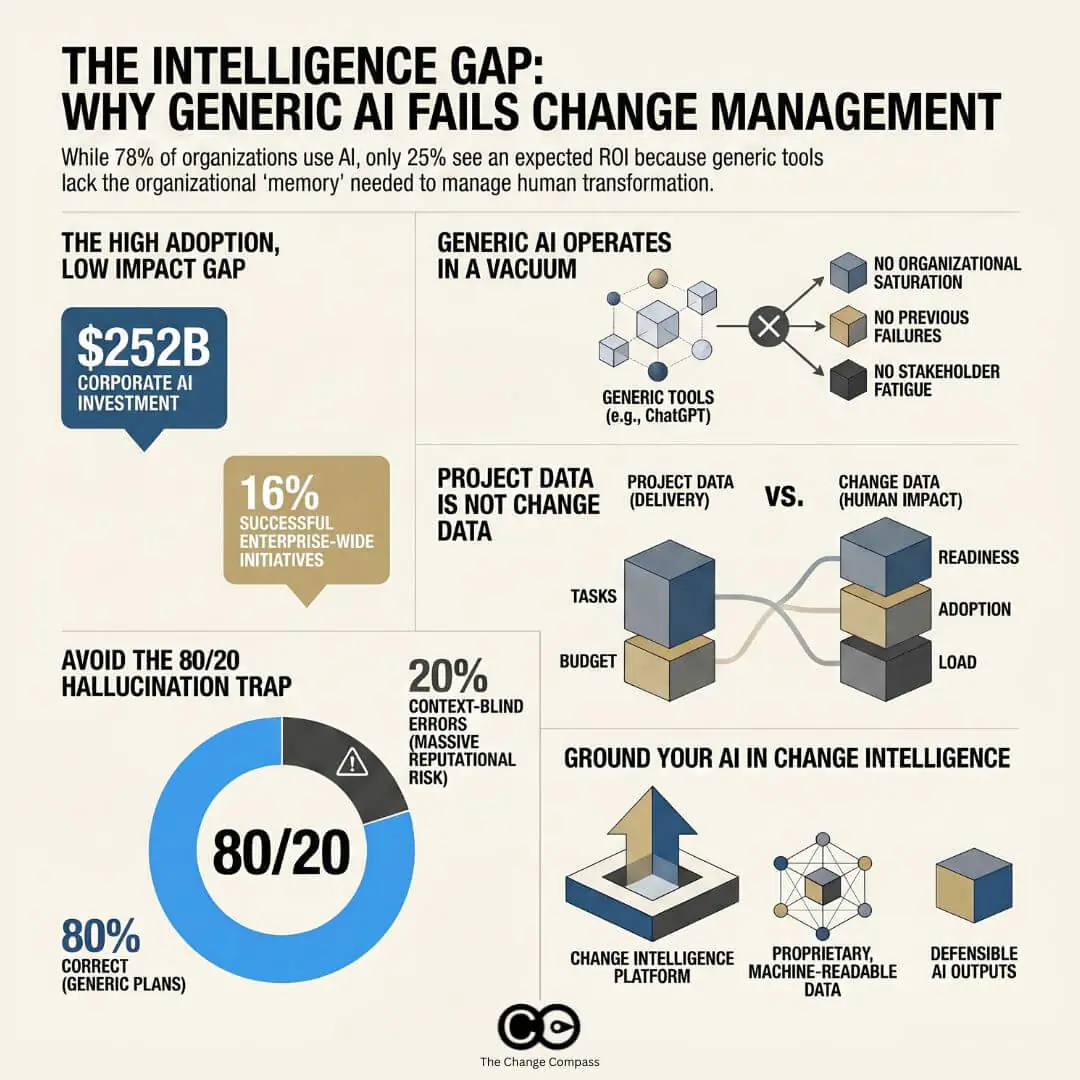
The 80/20 problem no one flags
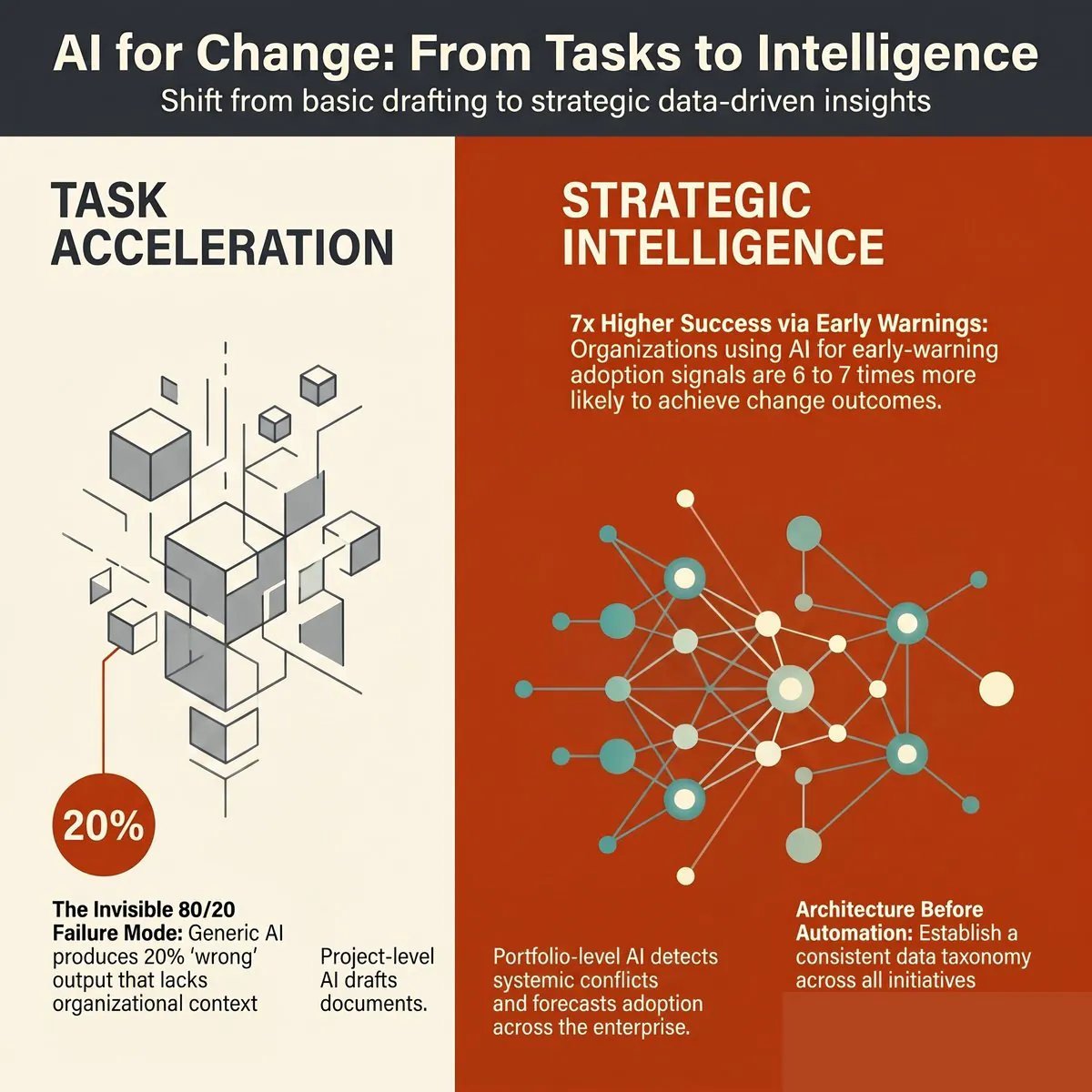
The most dangerous property of AI-generated change content is not that it is wrong. It is that it is mostly right. A generic AI change plan is typically around 80% sound, because it draws on widely accepted best practice, and around 20% wrong for your specific organisation. The problem is that the wrong 20% does not announce itself. It sits inside a credible, professional-looking document, and the surrounding 80% creates a halo that carries the whole thing through governance unchallenged.
Consider the failure modes an experienced practitioner learns to smell:
A sequencing recommendation that ignores the fact two of these initiatives hit the same frontline team in the same fortnight
An impact rating pitched at “medium” when local history says this exact team has already absorbed three system changes this year
A sponsor assumption that names the wrong leader as the credible voice for a sceptical audience
A training cadence that looks textbook but collides with the operational peak for that division
A channel mix optimised for an office workforce when half the audience works in the field
None of these errors are visible to someone reading the document cold. They are only visible to someone with the experience to know what the right answer looks like for this organisation. This is a different failure mode from a hallucination, which at least tends to look odd. This is the invisible 20%, and catching it is now the job. The practitioners who can reliably separate the sound 80% from the flawed 20% are worth more in the AI era, not less. For a deeper treatment of why organisation-specific data is what catches these errors at the point of recommendation, our article on why generic AI tools fall short of a change intelligence platform works through the data infrastructure behind it.
Spotting the generic approach
There is a second, related discipline: recognising when an approach is technically defensible but strategically hollow. AI is trained on the average of everything published about change management, which means it reliably produces the average approach. It will recommend a stakeholder matrix, a comms calendar, a training needs analysis, and a resistance-management plan, because that is what the literature says. All of it is generic best practice. Some of it will be exactly what your situation does not need.
An experienced practitioner reads a proposed approach and asks harder questions. Does this organisation actually have a resistance problem, or an attention problem? Is the real risk adoption, or is it capacity? Is a full training programme the right response, or is the change small enough that a well-designed job aid would land better and cost a fraction as much? This is the eye for detail that separates a change professional from a change administrator, and it is precisely the layer AI cannot supply, because it does not know which 20% of the standard playbook is wrong for you. The same experienced eye is what catches the initiative clashes that AI misses when it plans one change without seeing the rest of the portfolio.
The research backs the caution. The Harvard Business School and BCG study Navigating the Jagged Technological Frontier, which tested 758 consultants on realistic tasks, found that AI sharply improved performance on tasks inside its capability frontier, lifting quality by around 40%, but actively degraded performance on tasks that fell outside that frontier. The people who did best were not those who used AI most. They were those who knew which tasks to trust it with and which to override. That discernment is the skill.
The practitioner as data engineer
If judgement is the first pillar of the future practitioner, data fluency is the second, and it is the one the profession is least prepared for.
Here is the principle that will quietly separate high performers from everyone else: the right data structure is the true enabler of AI, not the model itself. The quality, accuracy, relevance, and precision of what AI produces is a direct function of what you feed it. The more you plug the right, well-structured organisational data into AI, the more accurate and specific the outputs become. Feed it thin, messy, or generic inputs, and you get thin, messy, or generic outputs dressed up in confident language. This is the “garbage in, garbage out” law, and it has not been repealed by better models.
The scale of the underlying problem is large. Salesforce’s State of Data and Analytics research, drawing on more than 10,000 leaders, found that data and analytics leaders estimate over a quarter of their organisational data is untrustworthy, and that 42% lack full confidence in the accuracy and relevance of their AI outputs. If the people closest to the data do not trust it, the change practitioner casually pasting a prompt into a chatbot has no reason to trust what comes back.
What data-savvy actually means now
Being data-savvy in change management is no longer about being comfortable with a spreadsheet. It is a genuine, if lightweight, engineering mindset. In practice it means being able to:
Troubleshoot AI mistakes by tracing a wrong output back to the input that caused it, rather than accepting or rejecting the answer wholesale
Identify and fix data errors, such as duplicated stakeholder records, inconsistent initiative names, mislabelled impact severities, or dates in three different formats
Prepare and structure data channels that feed AI, so that impact data, stakeholder data, and change calendar data are captured consistently enough to be usable
Understand how AI actually uses data, including why a model that has no record of your change calendar cannot possibly warn you about a saturation clash
This last point deserves emphasis. Much of what makes change advice valuable, the awareness that a team is already carrying too much, comes from data most organisations never capture in a structured form. If your change impact and capacity information lives in a hundred disconnected slide decks, no AI can reason about it. The practitioner who understands this, and who takes responsibility for building clean, structured data channels, becomes the person who makes AI useful rather than the person disappointed by it. Our guide to tracking change load across multiple initiatives shows what that structured capture looks like in practice.
A data-readiness checklist
Before trusting AI with anything consequential, an AI-era practitioner runs a quick mental audit of the inputs:
Is the data current, or am I feeding the model a snapshot from six months ago?
Is it consistent, using the same names, categories, and severity scales across sources?
Is it complete enough for the question, or is the model filling gaps with generic assumptions?
Is it specific to this organisation, or am I effectively asking for the industry average?
Can I trace any given output back to a source I can check?
Practitioners who cannot answer these questions are not using AI. They are gambling with it.
The benchstrength problem: A slow-burning risk for the profession
The fifth shift is the one the profession is not talking about, and it is the most strategically serious. It mirrors what is happening inside organisations more broadly.
Inside companies, AI is reducing the need for analysts and junior roles, because the model now does the first-pass analysis, the drafting, and the summarising that used to be a junior’s apprenticeship. That looks like an efficiency win in the current quarter. Over a longer horizon it creates a supply problem. Senior practitioners are not born senior. They become senior by spending years doing the junior work: sitting in the room, cleaning the data, drafting the comms, getting the impact assessment wrong and learning why. If AI removes the junior rung, the ladder to experienced practitioner loses its lower steps.
This is the benchstrength issue. The evidence outside change management is already stark, with entry-level postings down around 35% and the traditional apprenticeship path narrowing. The same logic will play out in change functions that decide they can run leaner because AI covers the production layer. The immediate effect is a smaller team. The delayed effect, felt three to five years later, is a shortage of experienced practitioners who came up through that work, because the roles that used to grow them no longer exist.
For the profession, this creates a set of second-order risks worth naming:
A thinning pipeline of practitioners with genuine hands-on experience, as junior roles are automated away
A widening gap between a small group of highly experienced practitioners and a large group who have only ever supervised AI outputs without building underlying judgement
Rising scarcity value, and cost, for the experienced practitioners who can do the evaluation and data work AI cannot
A real question about how the next generation develops the pattern recognition that only comes from repetition, when the repetitive work is gone
There is no clean answer to this yet, and anyone claiming one is overreaching. But individual practitioners can respond to it directly. If experience is becoming scarcer and more valuable, the rational move is to deliberately accumulate the judgement-heavy, data-heavy, strategic experience that AI is making rare, rather than competing on the production work AI is making cheap.
How to future-proof your practice
Pulling the threads together, the practitioner who thrives in the future of change management does not resist AI and does not defer to it. They supervise it, and they move up the value chain to the work it cannot do. Here is a practical agenda for getting there.
Reposition from producer to editor-in-chief. Let AI generate the first draft of comms, training, and assessments. Spend the time you save on evaluating, correcting, and tailoring the output to your specific context. Your value is now in the red pen, not the blank page.
Build a real critical-evaluation habit. For every AI output, actively hunt for the wrong 20% before you accept the right 80%. Ask what this recommendation assumes about your organisation, and whether those assumptions actually hold.
Develop genuine data fluency. Learn how your change data is structured, where it is dirty, and how to clean it. Treat data preparation as core change work, not an IT problem. The practitioner who owns clean data owns the quality of the AI output.
Move towards strategic and advisory work. As production commoditises, the durable value is in advising sponsors, shaping portfolio decisions, navigating politics, and making judgement calls under ambiguity. Deepen the skills that require presence, trust, and organisational read.
Protect your own experience curve. Seek out the hard, judgement-heavy assignments precisely because they are becoming scarce. In a world short on experienced practitioners, being demonstrably one of them is the strongest career position available.
The common thread is that every item moves you away from what AI does well and towards what it structurally cannot do: understand your specific organisation, exercise judgement, and take accountability for a decision.
Where digital change tools fit
Individual skill only goes so far without the right data foundation, and this is where purpose-built digital change tools earn their place. General-purpose AI can only reason about what it can see, and most change context, impact load, capacity, stakeholder saturation, and initiative timing, is never captured in a structured, connected form. A dedicated change platform such as Change Compass exists to solve that input problem: it captures change impact and analyses capacity data consistently across the portfolio, so that both practitioners and any AI layered on top are reasoning from an accurate, organisation-specific picture rather than a generic guess. In an era where the quality of AI output depends entirely on the quality of the data behind it, the structured data layer is not a nice-to-have. It is the enabler.
The shift that matters most
The future of change management in the AI era is not a story about practitioners being replaced. It is a story about the job changing shape. The production layer, the comms and training volume work, is being automated, and the roles built purely on that work will shrink. What grows in its place is demand for judgement: the ability to spot the flawed 20% inside a plausible document, to tell a generic approach from a fitted one, and to build the clean, structured data that makes AI accurate in the first place. The practitioners who lean into critical evaluation, data fluency, and strategic advisory work will not be competing with AI. They will be the reason it produces anything worth acting on. Start by picking one AI output this week and interrogating it properly, not as a user, but as the expert accountable for whether it is right.
Frequently asked questions
Will AI replace change managers?
AI is unlikely to replace skilled change managers, but it is already replacing a large share of the routine production work, such as drafting communications and training content, that many change roles were built around. The practitioners at risk are those whose main value is producing that output quickly. Those who move into critical evaluation, data preparation, and strategic advisory work become more valuable, not less.
What skills do change practitioners need in the AI era?
The three that matter most are critical judgement (spotting what is wrong in confident AI output), data fluency (structuring, cleaning, and troubleshooting the data that feeds AI), and strategic advisory capability (advising sponsors and making judgement calls under ambiguity). The World Economic Forum’s 2025 research confirms that analytical thinking remains the most in-demand core skill even as AI adoption accelerates.
Why does data quality matter so much for AI in change management?
AI output is only as good as its input. If a model is fed thin, inconsistent, or generic data, it produces confident but generic recommendations that miss organisation-specific realities like saturation and capacity. Structured, accurate change data is what allows AI to produce precise, relevant advice rather than textbook averages.
What is the “80/20 problem” with AI change plans?
A generic AI change plan is usually around 80% sound, drawn from accepted best practice, and around 20% wrong for your specific organisation, covering things like sequencing, impact ratings, and sponsor assumptions. The danger is that the wrong 20% is invisible inside a credible document, so it needs an experienced practitioner to catch it before it reaches governance.
Could AI create a shortage of experienced change practitioners?
Potentially, yes. As AI automates the junior, entry-level work that practitioners traditionally used to build experience, the pipeline that produces senior practitioners narrows. Over several years this can create a benchstrength problem, where experienced practitioners become scarce and more valuable precisely because fewer people are coming up through the hands-on work.
Most change managers have tried using AI for something in the past twelve months. Drafting a stakeholder communication. Generating a change impact summary. Running a change plan through ChatGPT. And most have found that the output was adequate, occasionally impressive, but rarely transformative.
That experience has left the profession in an ambiguous position: aware that AI matters, unclear on what it should actually do, and uncertain whether the tools available today are fit for serious change work or are just productivity shortcuts dressed up as something more important.
This guide cuts through that ambiguity. It explains what AI in change management actually means, where it genuinely adds value, where it does not, and what it takes to move from ad hoc AI experimentation to a structured capability that improves outcomes. It maps the full landscape of AI applications in the field, from basic generative tools through to purpose-built change intelligence platforms, so you can make an informed decision about where to invest and in what sequence.
The two ways AI shows up in change management
Before evaluating any AI application, it helps to be precise about what we are talking about. AI appears in change management in two structurally different forms, and conflating them is the source of most of the confusion and disappointment organisations experience.
Generative AI for task acceleration
The first form is generative AI: large language model tools like ChatGPT, Microsoft Copilot, and Google Gemini applied to the drafting and synthesis tasks change managers do every day. This includes generating first drafts of stakeholder communications, producing change impact summaries from meeting notes, synthesising training content, drafting executive briefings, and producing change plans from a brief.
These tools are capable at this work when the inputs are specific, the task is well-defined, and someone experienced reviews and edits the output. They reduce the blank-page friction that slows down delivery teams and can meaningfully accelerate the documentation-heavy early stages of a change programme.
They are not, by themselves, a change management capability. Output quality depends entirely on the quality of the inputs, and those inputs are only as good as the person providing them.
Purpose-built AI embedded in change platforms
The second form is purpose-built AI: algorithms and analytical models embedded in change management platforms designed specifically for the data and decision types that change managers face at portfolio level. This includes saturation forecasting (predicting when aggregate change load will breach absorption capacity), adoption likelihood scoring (identifying which stakeholder groups are at risk of non-adoption), fatigue indexing (tracking cumulative exposure per group across all concurrent initiatives), and narrative generation grounded in your organisation’s actual change data.
This form of AI is structurally different from a general-purpose language model. It is grounded in your organisation’s change data, which is what makes it capable of producing recommendations that are specific rather than generic.
Understanding this distinction is the starting point for making sound decisions about AI adoption in change management. For a detailed analysis of where each type delivers and where it falls short, our article on what AI can and can’t do in change management works through the specifics across each use case.
What AI genuinely delivers for change managers
Setting aside the hype, there are three categories where AI creates real and measurable value for change practitioners today.
Drafting speed and cognitive offload
The most straightforward and proven benefit is acceleration of drafting work. Research from Asana’s State of AI at Work 2025 found that knowledge worker AI usage doubled from 36% to 70% between 2023 and 2025, with workers delegating approximately 27% of their workload to AI-assisted tools. For change managers, the highest-value delegation targets are the time-consuming mid-complexity tasks: stakeholder communication first drafts, change plan outlines, training needs summaries, and status report synthesis.
The key word is “drafting.” These outputs require domain review and context-specific editing before they are usable. But the productivity gain from a 70% complete, structurally sound first draft is real, especially on high-volume programmes with multiple concurrent workstreams and limited resourcing.
The discipline required is not adopting AI. It is building a review process that catches what AI gets wrong, which is always something.
Cross-initiative pattern recognition at portfolio scale
The second benefit is harder to achieve with generic tools but significant where it is available: the ability to detect patterns across multiple initiatives simultaneously. No human change manager can hold the full picture of a 30-initiative portfolio in their head, cross-referenced by impacted stakeholder group, timing, and impact type. Purpose-built AI can.
This matters because the failure modes in large portfolios are systemic, not project-level. A scheduling conflict between two initiatives landing on the same business unit in the same fortnight is invisible from inside either initiative. Behavioural contradictions, where two changes ask the same group to adopt incompatible working patterns, are nearly impossible to spot without aggregated data.
AI-powered conflict detection, as described in detail in our article on change conflict detection, surfaces these patterns before they reach the delivery phase, when they are still sequenceable rather than crisis-manageable.
Adoption forecasting and early warning
The third capability is predictive: using historical engagement, survey, and impact data to generate early-warning signals on adoption risk. Adoption forecasts at the initiative level are useful for sequencing decisions and sponsor attention. At the portfolio level, they become a governance instrument, identifying which clusters of change activity are likely to generate systemic resistance before the rollout is committed.
Prosci’s 12th Edition Best Practices in Change Management, drawing on data from over 10,800 change practitioners, identifies early-warning capability as one of the most significant differentiators between high-performing and low-performing change functions. Organisations that can identify adoption risk before deployment are 6 to 7 times more likely to achieve their intended change outcomes than those responding reactively.
Where AI misleads change managers (and why)
The same capabilities that make AI appealing also make it dangerous when used without the right foundations.
The 80/20 problem
Generic AI tools trained on change management best practice produce output that is typically 80% sound and 20% wrong for the specific organisation. The problem is that the wrong 20% does not announce itself. The credible 80% creates a halo effect that carries the whole output through governance.
Common manifestations include: change plans that assume sponsorship structures the organisation does not have, sequencing that does not account for the organisation’s change history, training approaches that do not match the workforce’s capability profile, and communication channels that bypass the organisation’s actual influence networks. None of these failures are obvious to anyone without deep contextual knowledge, which is precisely the knowledge that generic AI lacks.
This is distinct from hallucination, which is visible and correctable. The 80/20 failure mode is invisible at the point of output and becomes apparent only when the change reaches the impacted population. By then, the cost of correction is significantly higher than it would have been at the planning stage.
The project data trap
A related problem is the confusion between project data and change data. Most organisations have extensive project data: scope documents, risk registers, milestone trackers, budget reports. Almost none of this data describes what the change looks like from the perspective of the impacted employee.
AI grounded only in project data produces recommendations about projects. It cannot describe how 47 employees in the Melbourne operations team will experience a systems migration stacked on top of a restructure and a performance review cycle change, because that information does not exist in any project management tool.
The structural distinction between project data and change data is the most important issue to resolve before investing in any AI tool for change management. It determines whether your AI investment will produce portfolio-level intelligence or just faster versions of the same project-level documents you already had.
The two-tier model: Project-level and portfolio-level AI
The clearest framework for understanding where AI adds value in change management is the two-tier model.
Project-level AI operates within a single initiative. It accelerates task execution: generating change plans, impact assessments, stakeholder matrices, communications, and status reports from project-specific inputs. The Change Compass’s Change Automator is a purpose-built example of this, using your organisation’s structured change data as context to produce artefacts that are organisation-specific rather than generic.
Portfolio-level AI operates across all active initiatives simultaneously. It aggregates stakeholder impact, calculates saturation scores, detects scheduling and behavioural conflicts, forecasts adoption likelihood by stakeholder group, and generates executive narratives grounded in real portfolio data. This is the layer that generic AI cannot reach, because it requires a cross-initiative data architecture that no project management tool or general language model maintains.
The two tiers are complementary, not competitive. Project-level AI reduces the time change managers spend on documentation. Portfolio-level AI improves the quality of strategic decisions made by transformation leaders and executives. Together, they constitute a change management AI automation model that shifts the operating rhythm of a mature change function from reactive and document-heavy to predictive and intelligence-driven.
The most common mistake in AI adoption for change management is using only the project-level tier. This is understandable because project-level tools are more immediately tangible, but it misses the most significant value: the strategic intelligence that only a cross-portfolio view can generate.
The case for purpose-built platforms over generic AI
The logical implication of the two-tier model is that AI in change management becomes most valuable when it is grounded in structured, organisation-specific change data. This is not achievable through prompt engineering alone. It requires a data architecture designed specifically for change.
A Change Intelligence Platform is purpose-built for this requirement. It creates and maintains the system of record for change data across all initiatives, with a consistent taxonomy, structured impact fields, and aggregation capabilities that make portfolio-level AI feasible. The AI in a change intelligence platform is not a general-purpose language model with a change management persona. It is grounded in your organisation’s actual change data.
Why the data question is decisive
A 2025 IBM CEO Study, drawing on responses from 2,000 CEOs globally, found that only 25% of AI initiatives had delivered their expected ROI, and just 16% had successfully scaled. The most commonly cited obstacle was data readiness: 72% of CEOs identified proprietary data as the key to GenAI value, and 68% named integrated enterprise-wide data architecture as critical to success.
In change management terms, the bottleneck is identical. Generic AI cannot deliver portfolio-level value because the data it needs, organised change impact data aggregated across initiatives with a consistent taxonomy, does not exist in a general-purpose tool. Building that data layer is the prerequisite for the AI to do anything strategically useful.
What this means for AI adoption
The progression from “we are experimenting with ChatGPT” to “AI is improving our change outcomes” is not primarily a technology question. It is a data architecture question. Organisations that skip the data foundation step and invest directly in AI tooling find that the tools produce output that is faster but not better. The quality ceiling is set by the data, not the algorithm.
This is why early AI experimentation in change management so often disappoints: practitioners are running sophisticated tools on inadequate data, and no amount of prompt refinement resolves a structural data gap.
How to evaluate AI tools for change management
Given the two-tier model and the data architecture requirements, evaluating AI tools for change management requires a different lens than most technology evaluations. The relevant questions are not about the AI’s features in isolation but about whether the AI can access the data it needs to produce useful output.
The key evaluation criteria are:
Data grounding: Does the AI use your organisation’s actual change data as context, or does it produce generic output from training data alone?
Portfolio scope: Does the tool operate across all initiatives simultaneously, or only within individual projects?
Taxonomy consistency: Does the platform enforce a consistent classification of impact types, stakeholder groups, and change phases across all initiatives? Without this, aggregation is unreliable.
Output specificity: Can the AI produce recommendations that reference specific stakeholder groups, business units, and initiatives from your portfolio, or does it produce change management advice that could apply to any organisation anywhere?
Integration: Does the platform connect to your HRIS, project management tools, and survey platforms to enrich the change data layer with real organisational signals?
Our detailed enterprise change management software buyer’s guide covers these criteria in depth, including the compliance, security, and integration requirements that enterprise procurement and IT teams will need to address.
The most important red flag when evaluating AI tools for change management is confident specificity without data grounding. If a tool produces highly specific recommendations about your organisation’s change programme without access to your organisation’s data, it is either applying generic best practice with a superficial wrapper of specificity or generating plausible-sounding output that has not been validated against your actual context. Both produce the 80/20 problem at scale.
How Change Compass implements AI in change management
Change Compass implements the two-tier model through two connected capabilities.
At the project level, the Change Automator generates change management artefacts from your organisation’s structured change data. Change plans, stakeholder matrices, communications plans, training needs analyses, and status reports are produced using the organisation’s taxonomy, change history, and stakeholder data as context. The output is organisation-specific, which means the editing required before it is usable is significantly less than for generic AI output.
At the portfolio level, Change Compass aggregates impact data across all active initiatives to generate saturation heatmaps, per-group fatigue indices, adoption likelihood scores, and portfolio-wide conflict alerts. The AI layer operates on top of this structured data, enabling capabilities that are not achievable with a standalone language model: forecasting saturation risk before a new initiative is launched, detecting when two initiatives are creating behavioural contradictions for the same stakeholder group, and generating executive narrative that is grounded in real portfolio data.
The data flywheel between the two tiers compounds over time. Every project-level artefact a change manager creates in the platform enriches the portfolio-level data that the AI uses to generate insights and forecasts. The more consistently teams use the platform, the more specific and accurate the portfolio intelligence becomes.
Where to start: a practical adoption roadmap
For change teams at the beginning of their AI journey, a sequenced approach is significantly more reliable than attempting to adopt both tiers simultaneously or investing in tooling before the data foundation exists.
Standardise your change data model. Before AI can add portfolio-level value, you need consistent data across initiatives. Agree on a taxonomy for impact types, a classification system for stakeholder groups, and a common format for impact severity and timing. This can begin in a spreadsheet, but the goal is to move toward a platform that enforces consistency at data entry rather than relying on manual conventions.
Adopt project-level AI for acceleration. Introduce generative AI at the project level for task acceleration: communications drafting, change plan generation, and status synthesis. Establish a clear editing discipline, recognising that AI output requires domain review before it is usable. Track the time saved per task to build the internal case for further investment.
Aggregate into a portfolio view. Once you have consistent data across initiatives, aggregate it into a portfolio view. Even a static quarterly view of impacted stakeholder groups by initiative and timing provides significant value for sequencing decisions. This is the foundation on which portfolio-level AI can later operate.
Deploy portfolio-level AI for strategic decisions. With consistent data and a portfolio view established, purpose-built portfolio AI becomes feasible. Start with saturation forecasting and conflict detection, as these produce the clearest and most immediately actionable signals for senior leaders.
This progression takes most change functions 12 to 24 months to complete, depending on the starting maturity of their data practices. The investment is front-loaded in steps 1 and 3, but the strategic value compounds significantly in step 4 and beyond.
Making AI work in practice
AI in change management is not primarily a technology adoption challenge. The change managers and functions that get the most from AI are those that have already invested in the data practices that give AI something useful to work with: structured impact data, consistent stakeholder taxonomy, and cross-initiative visibility maintained in a single system of record.
The organisations that will be genuinely differentiated by AI over the next three years are not those that adopted the most tools earliest. They are those that built the data foundation that makes AI output specific, accurate, and grounded in real organisational context.
That foundation is worth building whether or not AI is the primary motivation. The visibility and strategic intelligence it creates are valuable in their own right. AI acceleration is an additional return on the same investment, and a significant one as the tools mature.
Frequently asked questions
What is AI in change management? AI in change management refers to the application of artificial intelligence, including generative AI tools and purpose-built analytics platforms, to improve the speed, quality, and strategic value of change management work. It encompasses task-level applications such as drafting communications and generating change plans, and portfolio-level applications including saturation forecasting, adoption risk scoring, and conflict detection across concurrent initiatives.
Can AI replace a change manager? No. AI tools accelerate documentation and surface portfolio-level patterns, but they cannot substitute for the stakeholder relationships, political navigation, and adaptive judgement that define effective change management. Research from Workday found that while 75% of workers are comfortable working alongside AI agents, only 30% are comfortable being managed by one. The human role in change management shifts from document production to sense-making, relationship management, and strategic counsel, which AI cannot replace.
What data does AI need to be useful in change management? AI in change management needs structured, organisation-specific change data: standardised impact classifications, stakeholder group definitions, change history, and timing data across all concurrent initiatives. Without this data, AI tools produce generic output that may be technically sound but contextually wrong for the specific organisation, producing the 80/20 problem described above.
What is the difference between a change management AI tool and a Change Intelligence Platform? A change management AI tool typically applies generative AI to individual change tasks within a single project. A Change Intelligence Platform is a purpose-built system that maintains a cross-initiative data architecture, enabling portfolio-level AI applications including saturation forecasting, conflict detection, and adoption risk scoring. The platform provides the data layer that makes AI recommendations organisation-specific rather than generic.
How long does it take to see real value from AI in change management? Project-level benefits such as drafting acceleration and time savings on documentation are typically visible within weeks of adoption. Portfolio-level benefits require consistent data collection across initiatives, which takes most organisations 12 to 24 months to establish. The strategic payoff, including predictive adoption forecasting and portfolio conflict detection, compounds significantly after the data foundation is in place.
Corporate AI investment hit $252.3 billion in 2024 according to the Stanford HAI AI Index 2025, and 78% of organisations now use AI in at least one business function, up from 55% a year earlier. Yet a May 2025 IBM Institute for Business Value survey of 2,000 CEOs found that only 25% of AI initiatives have delivered the expected return, and just 16% have scaled enterprise-wide. The gap is widest in the disciplines where AI was supposed to help most, and AI for change management is among the clearest examples.
For change leaders, the symptom is familiar. Practitioners draft impact statements in ChatGPT. Project managers ask Microsoft Copilot to summarise stakeholder feedback. Sponsors paste a comms plan into Claude and ask for an executive version. The outputs look fluent, but anyone close to the work sees the same pattern: generic AI cannot reason about an organisation it does not know. It cannot weigh a new initiative against the five already in flight for the same audience. It cannot recall what happened the last time the operations team was asked to absorb a major systems change.
The conclusion most leaders are drawing is the wrong one. The constraint is not the AI model. The constraint is the absence of a system of record for change that the AI can actually reason against. An enterprise change intelligence platform is what fills that gap, and once it does, the relationship between change management and strategic outcomes shifts in a way that no productivity tool can replicate.
The AI productivity trap in change management
The first wave of AI adoption in change management has been characterised by individual practitioners using generic tools to accelerate familiar tasks. This is sensible, and at small scale it works. Drafting a stakeholder email, structuring a training outline, generating five variants of a comms message: these are bounded, low-risk uses where the cost of an inaccurate output is low.
The problem starts when leaders extrapolate from these wins. A practitioner who saves an hour drafting an email assumes the same tool will help them assess saturation across a $40 million transformation portfolio. It will not. The hour saved is a productivity gain. The portfolio question is a data problem. A separate companion guide on what AI can and cannot do in change management sets out the boundary in more detail, but the headline is straightforward: AI is strong on language tasks bounded by the prompt, and weak on reasoning that requires organisation-specific context the model has never been given.
Research by McKinsey on scaling agentic AI puts the structural issue in stark terms: eight in ten companies cite data limitations as the principal roadblock to scaling AI, and the value of large and small language models comes from the ability to train and ground them on the organisation’s own proprietary data. The same study notes that competitive advantage now flows from a small set of well-curated data products, treated as reusable, business-ready assets with clear ownership, semantics, and quality standards.
For change management, the implication is direct. If your organisation has no structured record of what initiatives are in flight, who is affected, what training has been delivered, what readiness scored, and how previous change has landed, no AI tool can reason about it. The model produces a plausible-sounding answer, drawn from generic training data, that may be confidently wrong about your specific context. The Stanford AI Index documented a 56.4% surge in AI incidents in 2024, and public trust in AI companies’ handling of personal data fell from 50% to 47% over the same period. In change management, where decisions hinge on the trust of frontline employees and the credibility of leadership messaging, an AI hallucination is not a quirky output. It is a reputational risk to the entire change function.
The project blinker: why project data is not change data
A predictable objection arises whenever change leaders raise the case for a dedicated change intelligence platform. Senior PMO leaders and programme directors push back with a version of: “we already have all of this. It is in our PPM tool, our project plans, our RAID logs, our portfolio dashboard.” The objection is sincere, and it is wrong. What looks like change data from inside a project office is project data viewed through a project planning and execution lens. The two data sets answer fundamentally different questions, and conflating them is the most common reason organisations under-invest in genuine change infrastructure.
A project plan records what the delivery team will do, by when, with what resources, and against which risks. A RAID log records the issues the project team is managing. A portfolio dashboard records the status, spend, and milestone position of each programme. All of this is necessary, and none of it tells you what is landing on a regional operations manager on the third Tuesday of November, when four systems change at once, on top of the new code of conduct module she completed two months ago, and the two leadership changes her function absorbed in the previous quarter.
Two different unit-of-analysis lenses
Project data is captured from the perspective of the delivery team. Its unit of analysis is the initiative. Its core dimensions are scope, schedule, budget, dependencies, and risks. Change data is captured from the perspective of the impacted business employee. Its unit of analysis is the human being on the receiving end of the entire portfolio. Its core dimensions are stakeholder group, impact type and severity, calendar phasing, training and engagement received, behavioural shift required, and adoption signal. Both are valid, both are needed, and one cannot substitute for the other. A perfectly green portfolio dashboard is entirely compatible with a workforce that is overloaded, disengaged, and quietly failing to adopt.
Why this matters for AI
The project blinker has a direct AI consequence. When AI is layered on top of project data and asked to reason about employee experience, capacity, or adoption risk, the answers it produces are confidently inaccurate. The model is not at fault. The data was never designed to answer those questions. Companion analysis on stakeholder impact analysis sets out the resulting blind spot in more detail, but the principle is straightforward: an AI grounded in project data will tell you a story about projects. It will not tell you a story about people, because the people-side data simply is not there.
This is why a purpose-built change intelligence platform is required even in organisations with mature PMO function and best-in-class PPM tooling. The platform exists to capture the data set the PMO was never set up to collect, and to make that data set available to grounded AI on equal footing with the project data the organisation already has.
The 80/20 trap: why partially-wrong AI recommendations are the real danger
The most commonly discussed AI risk in change management is hallucination, where a model invents a fact, a citation, or a stakeholder group that does not exist. This is the visible failure mode, and it is usually caught quickly by anyone with domain knowledge. The harder failure mode, and the one that actually derails change outcomes, is the partially-wrong recommendation.
A typical generic-AI change plan looks credible. Eighty per cent of it draws on widely accepted best practice and reads as logical advice any senior practitioner would recognise. It is the remaining ten to twenty per cent that creates the risk. Common examples drawn from change plans drafted using generic AI include:
The wrong sequencing for a specific business unit, because the model does not know what else is landing on that unit at the same time
The wrong intensity rating for a stakeholder group that has just absorbed three other initiatives in the same quarter
The wrong assumption about who the actual sponsors are, drawn from public org charts rather than the organisation’s real decision rights
The wrong training cadence for a workforce whose annual learning capacity has been fully booked since March
The wrong communication channel mix, recommended from generic best practice that does not match how this organisation’s frontline actually consumes information
These are not hallucinations. They are reasoned-looking outputs that happen to be wrong for this specific organisation, and they do not announce themselves. The 80% of the plan that is sound creates a halo of credibility around the 20% that is not. A reviewer scanning a plausible-looking document is unlikely to challenge it in a time-pressured governance forum. By the time the misstep is visible in adoption or engagement data, the plan is months into delivery and the cost of intervention has multiplied.
This is the precise problem that organisation-specific data is built to solve. When AI is grounded in the actual portfolio, the actual stakeholder load profile, the actual decision-rights register, and the actual historical adoption pattern, the partially-wrong 20% has nowhere to hide. The platform catches the inconsistency at the point of recommendation, not three months later in the engagement survey.
What an enterprise change intelligence platform actually does that ChatGPT cannot
A change intelligence platform is not a better version of ChatGPT. It is a category of enterprise software that exists upstream of any AI assistant, and it does three structural things that no generic AI tool can replicate.
A single source of truth for change
Every initiative in flight, every stakeholder group affected, every milestone date, every readiness assessment, every training record, captured against a consistent taxonomy. This is the system of record layer, and it is what allows any subsequent analysis, human or AI, to compare like with like across the portfolio rather than across spreadsheets.
Machine-readable structured data
Free-text descriptions of impact, embedded in a slide deck, are unusable to any system. Impact captured against defined categories (process, system, role, organisational structure, behaviour) and scored against a consistent scale becomes the substrate for portfolio analysis. This is the structured-data layer.
Aggregation and visualisation across the portfolio
A heatmap of cumulative change load across business units, a stakeholder fatigue index per audience group, a saturation score per division: these only exist when the system of record and the structured data are in place. They cannot be retrofitted by asking ChatGPT to summarise twelve project plans, because the underlying inputs are not comparable.
This is the foundation that The Change Compass calls a change intelligence platform, and the category exists precisely because the underlying data problem is not solvable with a chatbot. The platform is the data infrastructure that makes AI in change management actually work.
Once that foundation is in place, AI becomes useful in ways it cannot be when used in isolation. A practitioner asking the platform to generate a stakeholder impact summary is no longer relying on the model’s general knowledge. The model is grounded in the organisation’s actual impact data, its actual stakeholder taxonomy, its actual portfolio of initiatives, and its actual historical adoption outcomes. The output stops being plausible-sounding generic prose and starts being a specific, defensible synthesis of the organisation’s own data.
Why proprietary data is the missing piece for AI in change management
This pattern is not unique to change management. It is the same pattern that every enterprise function is now learning the hard way. In their five trends in AI and data science for 2025, MIT Sloan Management Review’s Thomas Davenport and Randy Bean identify retrieval-augmented generation, where an AI model is given access to proprietary documents and data to ground its responses, as the dominant pattern for enterprise AI value creation. They cite Colgate-Palmolive applying RAG to a corpus of proprietary consumer research and third-party data, allowing employees to query the entire knowledge base rather than work from individual reports.
The mechanics matter. A general-purpose language model is trained on publicly available text, which means it knows nothing about your portfolio, your stakeholder groups, your governance structures, your industry-specific compliance rules, or your historical change outcomes. Grounding the model in proprietary data is what closes that gap, and Databricks’ 2025 State of AI analysis reports that the use of vector databases supporting retrieval-augmented generation grew 377% year-on-year as enterprises caught up to this reality.
The IBM CEO Study reinforces the strategic implication. Seventy-two percent of CEOs surveyed said their organisation’s proprietary data is the key to unlocking the value of generative AI, and 68% identified an integrated enterprise-wide data architecture as critical for cross-functional collaboration. These findings are not about the change function in particular, but they apply with unusual force in change management, because the discipline depends on a richer and more diverse data set than almost any other corporate function. It needs initiative data, impact data, capacity data, adoption data, readiness data, and historical context, and it needs them in a shape that supports portfolio-level reasoning, not project-level reporting.
A change intelligence platform is the operational answer to that requirement. It is the data architecture that the IBM and McKinsey research describe, applied specifically to change. Without it, the AI tools your practitioners use are working blind. With it, the same tools can produce outputs that are specific to your organisation, grounded in your actual context, and defensible to the executives reviewing them.
From a pair of hands to a strategic enabler
The shift this unlocks is the one that matters most. For two decades, the change management function has been positioned, internally and externally, as a delivery muscle. Projects spin up, the change team is engaged late, a stakeholder analysis is produced, a comms plan is built, training is delivered, and the team is redeployed. This is the “pair of hands” model, and it is the model that most enterprise change management practices still operate under.
The combination of a change intelligence platform and grounded AI changes the operating model in four ways.
From project-level reporting to portfolio-level intelligence. When every initiative feeds the same data layer, the change function can answer questions no project team can answer. Where is cumulative load highest? Which divisions are approaching saturation? Which stakeholder groups are absorbing change from four directions at once?
From retrospective reviews to predictive analysis. Once historical adoption data, impact data, and readiness data are captured against a consistent taxonomy, the AI can identify patterns in what predicted past outcomes and forecast the trajectory of current initiatives. This is the use case McKinsey describes as competitive advantage moving to those who package data into reusable products.
From reactive sequencing to deliberate scheduling. A grounded AI can model what happens if a new initiative goes live in Q3 vs Q4 against the existing portfolio, and surface the stakeholder groups most likely to be overloaded. The change function moves from being asked to “make this work” to advising governance on what to prioritise.
From advisory voice to evidence-based authority. A recommendation backed by portfolio data, historical evidence, and stakeholder load modelling carries different weight in an executive committee than a recommendation backed by practitioner judgement alone. Strategic projects you might previously have lost the argument on become defensible on the data.
This is what research by the Project Management Institute, in its 2025 Pulse of the Profession report, describes as the shift from operational delivery to strategic value creation. PMI found that organisations whose project professionals demonstrate high business acumen achieve a 72% success rate in meeting business goals, compared with 65% for those who do not, and that the top performers consistently invested in benefits realisation management maturity and adaptability to changing conditions. The change function, properly equipped, sits squarely in this same value creation space. Without the data layer to support it, the function will continue to be positioned as a delivery cost. With it, the function becomes one of the organisation’s primary strategic levers.
How this de-risks the business and protects performance
The strategic case for an enterprise change intelligence platform is also a risk argument. Most large organisations now run between fifteen and forty concurrent change initiatives at any given time, and a meaningful proportion of those initiatives target the same stakeholder groups. When initiatives compete for the same audience without coordination, the consequences are predictable and measurable. Adoption drops. Productivity sags during the transition. Engagement scores fall. Discretionary effort declines. Attrition rises in the most affected teams. The combined effect is a meaningful drag on the business case for every initiative in the cluster.
Trust as the foundation of AI-enabled change
Accenture’s Technology Vision 2025 frames the broader risk picture in a useful way. The report argues that enterprises are building what it calls “cognitive digital brains” by hard-coding workflows, institutional knowledge, value chains, and social interactions into systems that can reason and act with autonomy. The report notes that 77% of executives believe the true benefits of AI can only be unlocked when systems are built on a foundation of trust, and that trust is now the most important measure of an AI system’s viability.
In change management, the foundation of trust is the data layer. An enterprise change intelligence platform makes the underlying assumptions visible, the impact data auditable, and the adoption outcomes traceable. When AI is added on top of that foundation, its recommendations are explainable. When AI is bolted onto an organisation with no system of record, its recommendations are guesses, and the change function carries the reputational risk for every one that turns out to be wrong.
Early warning, not post-mortem
The downstream effect on strategic outcomes is direct. Strategic initiatives are typically the ones with the highest stakes, the most ambitious benefits cases, and the tightest interdependencies. They are also the ones most exposed to the risk of cumulative change load. An organisation that cannot see, in advance, that its top three strategic initiatives all land on the same audience in the same quarter has no early warning system. The first signal arrives in the adoption numbers, by which point the cost of intervention is materially higher than the cost of resequencing.
A change intelligence platform with grounded AI gives leadership that early warning. It is the difference between learning your operating model transformation failed because the relationship managers were drowning, and learning, three months earlier, that the relationship managers were going to be drowning unless something gave. The first is a post-mortem. The second is a governance decision.
Where Change Compass fits
Change Compass is the enterprise change intelligence platform built specifically for this use case. The platform captures every initiative in flight against a consistent change taxonomy, structures impact and stakeholder data so it is machine-readable, and aggregates the result into portfolio-level views including saturation heatmaps, stakeholder fatigue indices, and adoption forecasts. Its AI capabilities are grounded in the customer’s own data and benchmark data from across the platform’s enterprise client base, which means the recommendations a practitioner receives are specific to their organisation’s situation rather than drawn from generic training data. For organisations evaluating whether to invest in a change platform, the companion guide on enterprise change management software walks through the features that distinguish an enterprise-grade platform from a project tool.
For change leaders who have already begun experimenting with generic AI tools, the more useful framing is that the platform is what makes those experiments worth running at scale. Without it, even the best AI is operating on guesswork. With it, the same AI becomes a strategic instrument for the function.
Making the shift
The practical starting point is not a procurement exercise. It is a diagnostic. The questions worth answering, before any tool decision is made, are these.
Can you produce, today, a single view of every change initiative in flight across the organisation, with consistent impact data and stakeholder mapping?
Can you tell the executive sponsor of a new initiative which other initiatives are landing on the same audience, in the same quarter, at what cumulative load?
Do you have a record of how previous change has landed in each business unit that an AI tool, or a human analyst, could reason against?
Do your AI experiments in change management currently produce outputs that are specific to your organisation, or generic outputs that have been lightly contextualised?
If the answer to any of these is no, the gap is the data layer, not the AI model. An enterprise change intelligence platform is the structural fix. The first wave of AI in change management was about productivity. The second wave, and the one that distinguishes organisations that achieve their strategic goals from those that do not, will be about intelligence. And intelligence requires a system of record, structured data, and an architecture that allows AI to do what generic tools can never do alone: reason about the specific organisation it is operating in.
The change function that gets this right stops being a delivery cost and starts being a strategic enabler. That is the shift the next five years of transformation work will reward.
What is an enterprise change intelligence platform?
An enterprise change intelligence platform is a system of record for organisational change that captures every initiative, stakeholder group, impact assessment, and adoption metric against a consistent taxonomy, then uses that structured data to provide portfolio-level intelligence. It is distinct from a project-level change tool because it operates across the entire transformation portfolio, and it is the data foundation that makes AI in change management produce defensible, organisation-specific outputs rather than generic ones.
Why is generic AI like ChatGPT or Microsoft Copilot insufficient for enterprise change management?
Generic AI tools are trained on publicly available data and have no access to an organisation’s specific initiatives, stakeholder groups, historical change outcomes, or cumulative load profile. They can produce plausible-sounding generic text, but they cannot reason about a specific portfolio. For tasks where the value depends on organisation-specific context, such as saturation analysis, stakeholder load modelling, and adoption forecasting, the outputs are unreliable without a grounding data layer.
How does an enterprise change platform improve strategic outcomes?
It does so by giving leadership early visibility of portfolio-level risk before that risk turns up in the adoption numbers. When every initiative is captured against the same taxonomy, the platform can surface cumulative impact on stakeholder groups, model the effect of sequencing decisions, and forecast adoption outcomes. That early warning capability is what allows governance to resequence, pause, or resource initiatives before they fail rather than after.
What is the role of AI in a change intelligence platform?
AI in a properly architected change intelligence platform is grounded in the organisation’s own data, not in generic training corpora. It can summarise stakeholder load, surface convergence patterns across initiatives, draft initiative-specific impact narratives, and forecast adoption based on the organisation’s own historical outcomes. The grounding is what makes the AI usable as a strategic instrument rather than a productivity gadget.
How is this different from just using an AI tool with a custom prompt?
A custom prompt is a thin layer on top of a generic model. It can shape tone and structure, but it cannot give the model access to the organisation’s data. A change intelligence platform provides the structured data layer that an AI model can reason against in real time, using retrieval-augmented generation or equivalent techniques. The difference is the difference between a model that sounds informed and a model that is informed.
We use cookies to improve your experience and understand site use. Marketing cookies stay off until you accept, and in the EU, UK and Switzerland analytics does too. Cookie Policy.
Strictly necessary
Required for the site to work: security, load balancing, and remembering your choices. These cannot be switched off.
Always active
Analytics
Google Analytics and similar, so we can see which pages are useful and where visitors get stuck. Aggregated, never sold.
Marketing
Used to measure campaigns and show relevant content on other platforms such as LinkedIn.