A change management assessment is a structured diagnostic that tells you what is changing, who is affected, whether they are ready, and whether the change is sticking, so that leaders can decide where to act.
Most organisations run assessments and then do nothing differently. A readiness survey lands in a steering committee pack, the average score is amber, and the programme proceeds on the original plan. The assessment has been completed; the decision it was meant to inform has not been made. For senior change, HR and transformation leaders, that is the real failure point, and it is the focus of this guide. It covers the assessments that matter (impact, readiness, stakeholder, cultural, learning needs, adoption, compliance and risk, and change saturation), what each one should be used to decide, and how to read the data together rather than one report at a time. You will finish with a practical way to choose the right assessments, set decision rules before data arrives, and present findings that executives act on. The argument is simple: assessments without data are opinions, and data without a decision attached is just a report.
What change management assessments are and which ones you need
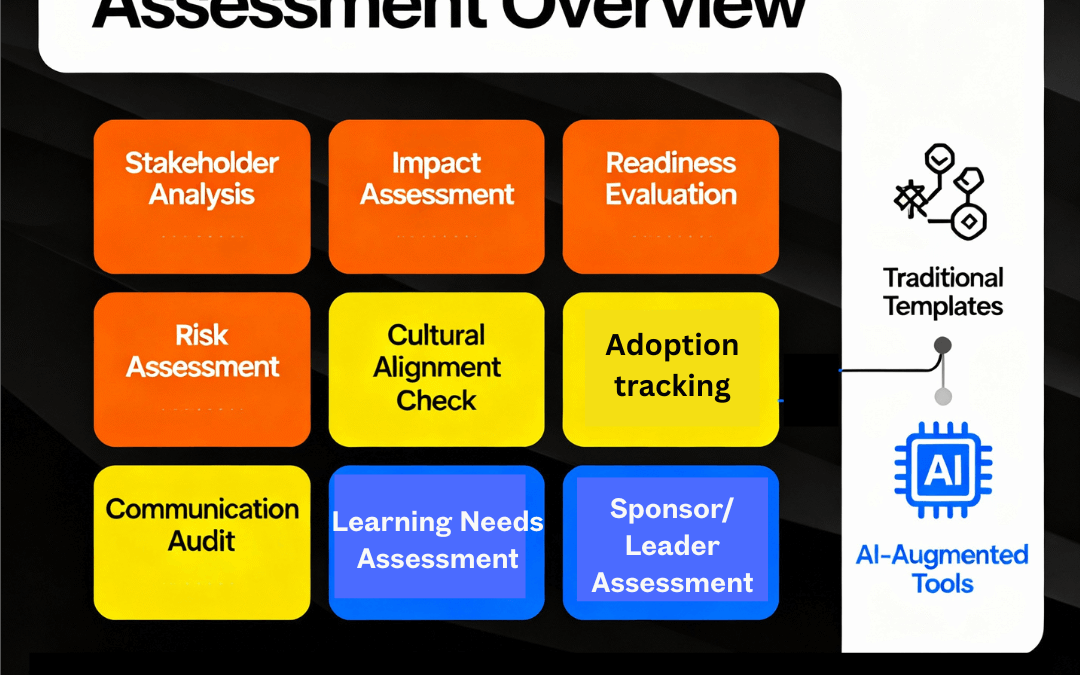
Change management assessments fall into three core types and several supporting ones: impact assessment (what changes, for whom, by how much), readiness assessment (whether people and the organisation can absorb it) and adoption assessment (whether new ways of working are being used after go-live). Supporting assessments cover culture, stakeholders, learning needs, compliance and risk, and saturation. The evidence that this discipline pays off is consistent: Prosci’s Best Practices research found that 88% of projects with excellent change management met or exceeded objectives, against 13% of those with poor change management.
Most practitioners use several assessment types across a single initiative, layering them to build a picture of readiness, impact, risk and opportunity. The most common mistake is relying on one type and assuming it tells the whole story. A readiness survey shows whether people feel ready but not which skills they lack. A cultural assessment surfaces values but does not map who will resist. A stakeholder analysis shows who matters but not what each person is worried about. A learning needs assessment identifies training gaps but does not connect them to adoption barriers. Only layered assessments, read together, describe the real landscape.
The table below links each assessment to the question it answers and the decision it should drive. If you cannot name the decision, you probably do not need the assessment yet.
Assessment
Question it answers
Decision it should drive
Typical timing
Impact
What changes, for whom, and how much?
Scope, sequencing, training and change effort by group
Design, then refresh at each release
Readiness
Are the organisation and people prepared?
Go, delay or add preparation before launch
Pre-project and pre-go-live
Stakeholder
Who can enable or block this, and why?
Engagement plan and sponsor asks
Initiation, then quarterly
Cultural
What norms will help or hinder?
Where to work with culture, and where to counter it
Design phase
Learning needs
Which knowledge, skill and confidence gaps exist?
Training design, timing and emphasis
Pre-build and pre-go-live
Compliance and risk
Do controls hold during transition?
Mitigations, parallel runs, extra sign-offs
Design and cutover
Saturation and capacity
Can this group absorb another change now?
Re-sequence or defer initiatives
Portfolio planning, ongoing
Adoption
Is the change actually being used correctly?
Reinforce, redesign or escalate
30, 60, 90 days post-release
The three core assessments: Impact, readiness and stakeholder
Impact, readiness and stakeholder assessments together answer the three questions every steering committee asks first: how big is this, are we ready, and who do we need on side? They should be completed in that order because each depends on the one before it. Impact sets the scope, readiness tests the gap against that scope, and stakeholder analysis decides who is engaged to close it. The people dimension is where the evidence is clearest: in Prosci’s 12th Edition study, 79% of respondents with extremely effective sponsors met their objectives, compared with 27% of those with extremely ineffective sponsors.
Impact assessment: What is really changing
An impact assessment identifies every function, process, system, role and team affected by a change, and measures how large each impact is: a minor tweak, or a fundamental reshaping of work and behaviour. It is the starting point because everything downstream depends on it. Without clarity on impact you cannot scope training, segment stakeholders or build a realistic change budget, and many programmes discover halfway through that they misjudged the scale.
A thorough impact assessment examines:
Process changes (which activities will be different)
System changes (which technology or tools will change)
Organisational changes (reporting lines, structures and roles)
Role changes (what responsibilities each person will hold)
Skill requirement changes (which new competencies are needed)
Culture changes (which new behaviours or mindsets are required)
Operational changes (which performance metrics will shift)
Experienced practitioners go beyond the list to the ripple effects. A new system needs training, but it may also change workflow sequencing (so dependent teams need to understand the shift), approval permissions (so decision rights need clarifying) and performance metrics (so success criteria need resetting). Mapping those cascades early prevents surprises during implementation. For a full method, see our practitioner guide to conducting a change impact assessment.
Sample impact assessment (illustrative)
Function
Staff
Impact level
Process changes
System changes
Skill requirements
Behaviour shifts
Loan Operations
95
High
85% of workflow affected
Complete system replacement
12 new technical competencies
Approval-based to data-driven decisions
Credit Risk
32
Medium
Approval steps remain, timing shifts
Integration with new system
5 new risk analysis capabilities
Faster decision cycles
Customer Service
120
Low
Interface improves, core duties unchanged
New CRM interface
3 new system features
Proactive customer communication
Finance and Reporting
15
Medium
New metrics and reporting
New reporting module
4 new reporting skills
Real-time vs monthly reporting
Compliance
8
Medium
New verification steps
Audit trail enhancements
2 new compliance processes
Continuous monitoring vs spot checks
IT Support
12
High
Support model changes fundamentally
New ticketing system
8 new technical support skills
Reactive to proactive support
Readiness assessment: Preparation before launch
A readiness assessment measures whether the organisation and the affected people are prepared for a change, and it comes in two forms that experienced practitioners use together. Prosci recommends running one at the start of a project so the findings can shape the change strategy rather than describe it afterwards.
Organisational readiness happens before the project formally starts. It tests whether the structural and cultural foundations exist: A committed sponsor, change governance, allocated resources, a clear objective and aligned leadership. It answers whether you should attempt this now or fix foundations first.
Adoption readiness happens just before go-live. It tests whether people are prepared: Training completed, role changes understood, managers ready to support, support structures in place and confidence high. It answers whether to launch or add final preparation.
Readiness typically examines seven dimensions:
Awareness: Do people understand what is changing and why?
Desire: Do they believe the change is necessary and beneficial?
Knowledge: Do they have the information and skills needed?
Ability: Do systems, processes and infrastructure allow them to act?
Support: Is leadership visibly committed and removing barriers?
Culture and communication: Is there trust, openness and honest dialogue?
Commitment: Will people sustain the change over time?
The data separates readiness that exists from readiness that is assumed. Many organisations treat training completion as readiness, but the two correlate rather than coincide: people can finish training and remain unconfident or unconvinced. Surveys alone also have limits. They show that a gap exists but rarely why, which is why we recommend going beyond the survey to strategic insight and following our readiness assessment method. If you are designing the survey itself, write one that is valid first.
Sample readiness scorecard (illustrative): Organisational readiness for a customer data platform
Dimension
Score
Status
Comment
Sponsorship commitment
8/10
Strong
CEO personally championing; budget allocated
Leadership alignment
6/10
Caution
Finance and Operations aligned; Technology concerned about timeline
Change infrastructure
5/10
At risk
No dedicated change function; relying on project team
Resource availability
7/10
Good
Core team allocated; limited surge capacity
Clarity of vision
8/10
Strong
Compelling business case; clear success metrics
Cultural readiness
5/10
At risk
Risk-averse; past project failures causing hesitation
Stakeholder buy-in
6/10
Caution
Early adopters engaged; middle management unconvinced
Stakeholder assessment: Influence, interest and engagement
A stakeholder assessment identifies everyone affected by a change and classifies them by influence and interest, which determines who needs sponsorship, who needs information and who is likely to resist or advocate. The classic matrix gives four quadrants:
High influence, high interest: Manage closely; these are the key players.
High influence, low interest: Keep satisfied; they can block progress if dissatisfied.
Low influence, high interest: Keep informed; they advocate but do not decide.
Low influence, low interest: Monitor; they are not critical but should not be ignored.
Sophisticated analysis goes further and profiles individual motivations: what each person cares about, what they stand to gain or lose, and which language will land. The value compounds when you layer it. Combined with a cultural assessment, stakeholder influence mapping predicts where resistance will come from and who has the power to amplify or neutralise it. Combined with learning needs, it shows what support each group requires. Different groups also need different plans, as we show in why not all stakeholder groups need the same change plan.
Supporting assessments: Culture, learning needs, compliance and saturation
Supporting assessments explain why the core results look the way they do and flag risks the core three miss. Culture explains resistance, learning needs explain capability gaps, compliance and risk protect the control environment, and saturation shows whether the audience has room to take on the change at all. The people side deserves particular weight right now: Gallup’s 2026 State of the Global Workplace reports global employee engagement at 20% in 2025, its lowest level since 2020, with manager engagement at 22%, and estimates the cost of disengagement at roughly US$10 trillion in lost productivity. Managers carry most change on the ground, so their engagement is a variable to assess, not assume.
Cultural assessment
A cultural assessment evaluates the values, beliefs and unwritten rules that shape how people respond to change. Dimensions that affect outcomes include:
Risk orientation: Risk-averse or entrepreneurial, which determines whether people embrace or resist change.
Trust in leadership: Whether employees believe leaders have good intentions and sound judgement.
Pace of decision-making: Deliberate or fast-moving, which shapes whether timelines feel realistic.
Accountability clarity: Comfort with clear ownership versus preference for ambiguity.
Learning orientation: Whether experimentation is encouraged or mistakes are punished.
Collaboration norms: Whether people work across silos naturally or protect functions.
Surveys, interviews and focus groups gather the data. The insight is often counterintuitive: a strong, unified culture can impede change if it is change-resistant, while a more fluid culture often adopts faster. Experienced practitioners do not judge culture as good or bad. They assess it realistically and build mitigation that works with it rather than against it.
Learning needs assessment
A learning needs assessment identifies the knowledge, skills and behaviours people need in the new state and the gaps that exist today. A complete one examines knowledge gaps, skill gaps, behaviour gaps, confidence gaps and role-specific needs. The insight comes from patterns: which teams have the largest gaps, which roles feel least certain, whether gaps cluster around particular systems or topics, and whether they are concentrated or spread. Those patterns shape training strategy, timing and emphasis.
The assessment also connects directly to adoption barriers. Groups with large capability gaps will struggle to adopt, topics that generate high uncertainty need more support, and roles that feel unprepared become adoption blockers. Spotting these links early lets you target interventions rather than run uniform training.
Compliance and risk assessment
A compliance and risk assessment evaluates whether transformation activity maintains regulatory compliance, control adherence and operational risk management. It examines control effectiveness during and after transition, regulatory compliance, data security, process integrity and any new operational risks. The finding is often stark: system transitions can leave windows where controls are weaker, new processes can have unintended compliance implications and data migration can create security exposure. Identifying these early allows mitigation planning rather than remediation.
Sample compliance and risk output (illustrative): Control environment during an ERP transition
Control
Pre-migration status
Migration risk
Post-migration status
Mitigation
Segregation of duties (purchasing)
Operating
High
Design verified
Dual sign-off during transition
Inventory cycle counts
Operating
Medium
Design verified
Weekly counts during transition
Financial reconciliation
Operating
High
Design verified
30-day parallel run
Approval authorities
Operating
Medium
Reconfigured
Training on new authority matrix
Audit trail
Not available
Medium
Enhanced
Data retention policy reviewed
Change saturation and capacity assessment
A saturation assessment measures how much change a group is absorbing relative to its capacity, which tells you whether to proceed, re-sequence or defer. It is the portfolio-level counterpart to impact assessment: impact tells you the size of one change for one group, saturation adds up everything landing on that group in the same window. Without it, a well-run readiness assessment can still be overturned by three other initiatives going live the same fortnight. The method for building one is covered in our guides to building a change capacity model and measuring change saturation.
Adoption assessment: Measuring behaviour after go-live
Adoption assessment goes beyond logins and training completion. It examines:
System usage: Which features are used and which ignored.
Workflow adherence: Whether people follow new processes or revert.
Proficiency progression: Whether skill keeps growing or plateaus.
Workarounds: Where people bypass the new system or process.
Behavioural change: Whether desired behaviours are becoming embedded.
Compliance: Whether required controls and governance are followed.
The patterns reveal what is working. High adoption in some areas and resistance in others suggests the change fits some contexts and conflicts with others. Rapid adoption followed by a plateau suggests enthusiasm that is hard to sustain. Widespread workarounds suggest design gaps or conflicts with real operational needs.
Sample behavioural change tracking (illustrative)
Behaviour
Adoption rate
Trend
Submitting expenses via the system
72%
Increasing
Using digital receipts instead of paper
48%
Increasing, slowly
Submitting on time rather than overdue
61%
Slight decline
Approving expenses in the system
85%
Strong
This is where data and human interpretation diverge most sharply. The data shows what is happening; interpretation decides why. Low adoption could be a change management failure (people do not understand or want the change), an adoption support failure (they want to but lack resources or capability), a design failure (the system does not work in their context) or a business case failure (the change does not deliver the promised benefit). Each cause needs a different response, and data alone cannot tell them apart. For metric choices and dashboards, see our guide on how to measure change adoption.
From assessment data to decisions
The step that separates practitioners from template-followers is analysis: finding patterns across assessments and turning them into a decision someone owns. Leaders’ intuition is often wrong about their own workforce, which is the case for measuring in the first place. McKinsey’s survey of 3,613 employees and 238 C-suite leaders found that employees are about three times more likely than leaders estimate to be using generative AI for a third or more of their work. Assumptions about readiness and adoption deserve the same suspicion.
Ask harder questions of the data
Template approaches gather data, tick boxes and move to a predetermined next step. Analytical approaches ask:
What patterns appear across assessments? Low awareness with high desire needs communication; low desire with high awareness needs benefits clarity.
Where do assessments conflict? A risk-averse culture paired with an impact assessment that requires risk-taking behaviour is a critical tension needing a specific mitigation.
Which findings are unexpected? Surprises often reveal what templates miss.
Is this a root cause or a symptom? Surface resistance can stem from awareness gaps, capability gaps, cultural misalignment or stakeholder concerns, each with a different fix.
How do findings cascade? Low readiness in one function can cause adoption failures in dependent ones.
This work needs comfort with ambiguity. Assessment data rarely tells one clean story, so synthesise across sources, form hypotheses about what is happening, and design interventions that test them.
Set decision rules before the data arrives
Agree, before collecting data, a threshold, an owner and a default response for each assessment. This is what turns findings into decisions, and it removes the argument about whether an amber score matters. Examples:
Finding
Decision
Owner
Awareness below threshold in any impacted group
Increase communication intensity for that group before go-live
Change lead
Readiness below threshold in a high-impact group
Delay go-live for that group or add targeted preparation
Programme sponsor
Middle managers unconvinced
Brief and equip managers before wider rollout
Business leader
Workarounds rising after release
Review process or system design
Process owner
Group saturated in the go-live window
Re-sequence the competing initiative
Portfolio governance
Present results as decisions required, not scores received. A one-page readout with the finding, the evidence, the decision and the owner is more likely to be acted on than a deck of charts. Always report by stakeholder group rather than as an overall average: a 65% readiness average can hide a critical group at 30%.
Build rigour into the approach
Six principles improve quality regardless of assessment type:
Use multiple data sources. Surveys show what people think, interviews show what they believe, and project history shows what actually happens.
Segment your data. Breaking results by function, location, seniority and role shows where challenges concentrate.
Look for patterns and contradictions. Consistent findings are solid ground; conflicts are tensions to investigate.
Question unexpected findings. Dig deeper before dismissing results that contradict assumptions.
Connect findings to strategy. Low awareness changes the communication plan; cultural misalignment calls for specific culture work; concentrated resistance needs targeted engagement.
Reassess throughout. Conditions change between phases, and reassessment at milestones shows whether mitigations are working.
Keep it practical
Comprehensive guidance can sound overwhelming, so start small. Choose the assessments that address your biggest uncertainty rather than running all of them. Test specific hypotheses (for example, “do you understand how your role will change?”) instead of asking generic readiness questions. Use standard templates for consistent, comparable data, then drill into unexpected patterns with interviews and focus groups. Most importantly, invest time in interpretation: data collection is the easy part, and the valuable work is asking what the results mean for your strategy.
Where AI and digital tools fit in assessment
Assessment practice has moved through three phases, and the third is where the opportunity and the risk sit. AI can collect and pattern-match at scale, but it cannot yet reliably explain why a pattern exists, so the strongest approach pairs digital tools with experienced human judgement.
Phase 1, template-based assessment: Standard questionnaires and checkbox completion. This brought consistency, but templates assume one size fits all and rarely surface the unexpected.
Phase 2, data-driven assessment: Multiple sources (surveys, interviews, historical project data, performance metrics, sentiment) reveal patterns templates miss. The limit is human capacity to synthesise across them.
Phase 3, digital and AI-augmented assessment: Platforms collect data at a scale and speed people cannot, and machine learning surfaces anomalies and correlations.
The caution is interpretation. AI can tell you adoption is lower in one division than another. It cannot reliably tell you whether the cause is a change-resistant culture, a conflict with that division’s business model, absent local leadership or poor system integration. Prosci’s research on AI implementation points the same way: 63% of AI implementation challenges stem from human factors rather than technical limitations, based on 1,107 professionals. The same is true of assessment tooling. Technology handles collection and pattern recognition; practitioners supply context, causation and strategy.
Digital tools also change how often you can assess. Where a point-in-time survey gives you one snapshot, a platform such as Change Compass can combine impact, saturation and adoption data in one place, so assessments update as initiatives move and decision rules can be checked continuously rather than quarterly. That replaces the spreadsheet-and-slide-deck cycle that makes most assessments stale before the steering committee sees them.
What to do with your next assessment
The organisations that excel at transformation treat assessment as analysis with an owner attached, not as a compliance exercise. Before your next assessment, do three things: name the decision it should inform, set the threshold and the owner for that decision, and decide when you will reassess. Pair technology that gathers data at scale with practitioners who interpret it, and layer assessment types rather than relying on one. Run impact first, readiness and stakeholder analysis second, adoption last, and keep the supporting assessments for the specific uncertainties that matter. If the assessment does not change a decision, change the assessment.
Frequently asked questions about change management assessments
What is the difference between a readiness assessment and an adoption assessment?
A readiness assessment looks forward: it tests whether the organisation (before the project starts) or the affected people (just before go-live) are prepared to absorb the change. An adoption assessment looks backward: after release, it measures whether people are using the new system or process correctly and consistently. Readiness predicts the risk; adoption confirms whether the risk materialised.
Why do transformations fail even after passing a readiness assessment?
Readiness surveys capture perceived readiness, not demonstrated capability or commitment. People can report feeling ready while lacking the skills, and leaders can sound committed while competing priorities pull their time away. The more common cause is that findings are recorded but nobody owns the decision they should trigger, so the gap is still open at go-live.
How do I connect assessment findings to change strategy?
Agree a decision rule before you collect data: for each assessment, a threshold, an owner and a default response. Low awareness triggers more communication, a risk-averse culture paired with risk-taking behaviours triggers explicit leadership and reinforcement work, and workarounds in adoption data trigger a process or system design review. Report findings as decisions required, not as scores.
Which change management assessment matters most?
No single assessment tells the whole story, but the impact assessment comes first because it defines who is affected and by how much, and every other assessment depends on that scope. Readiness is the best predictor of adoption, and adoption is the only assessment that measures actual outcomes. Start with the assessment that addresses your biggest uncertainty.
How often should change assessments be repeated?
Repeat them at each major milestone rather than on a fixed calendar: after design, before go-live, and at 30, 60 and 90 days after release. Conditions shift as a programme moves between phases, so early findings go stale. Reassessment also shows whether your interventions worked.
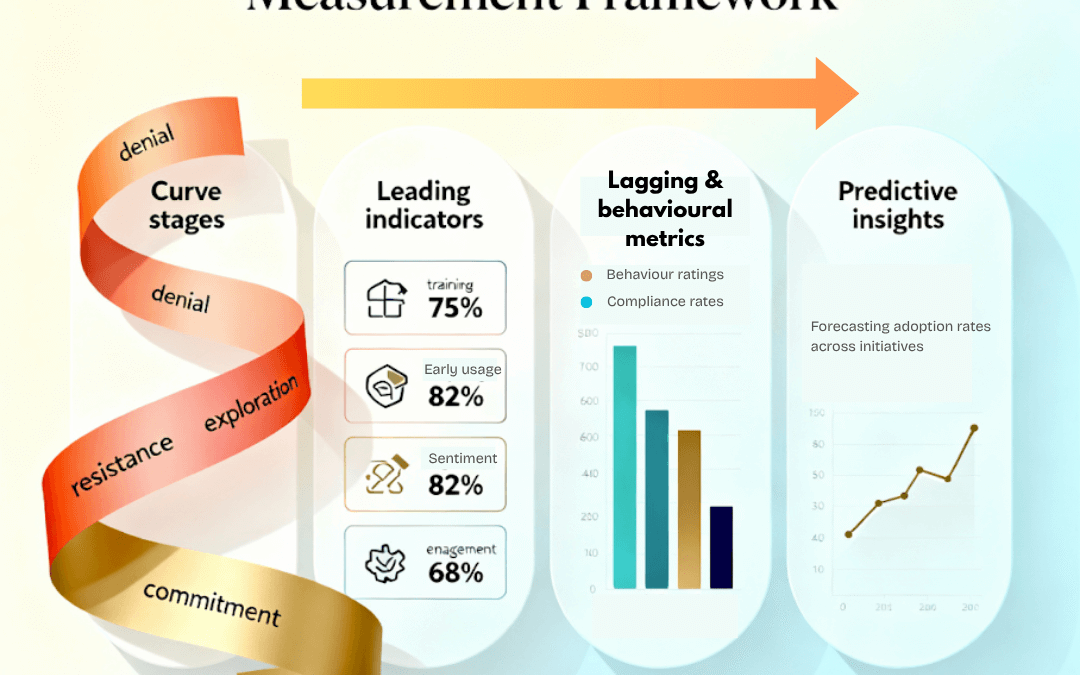
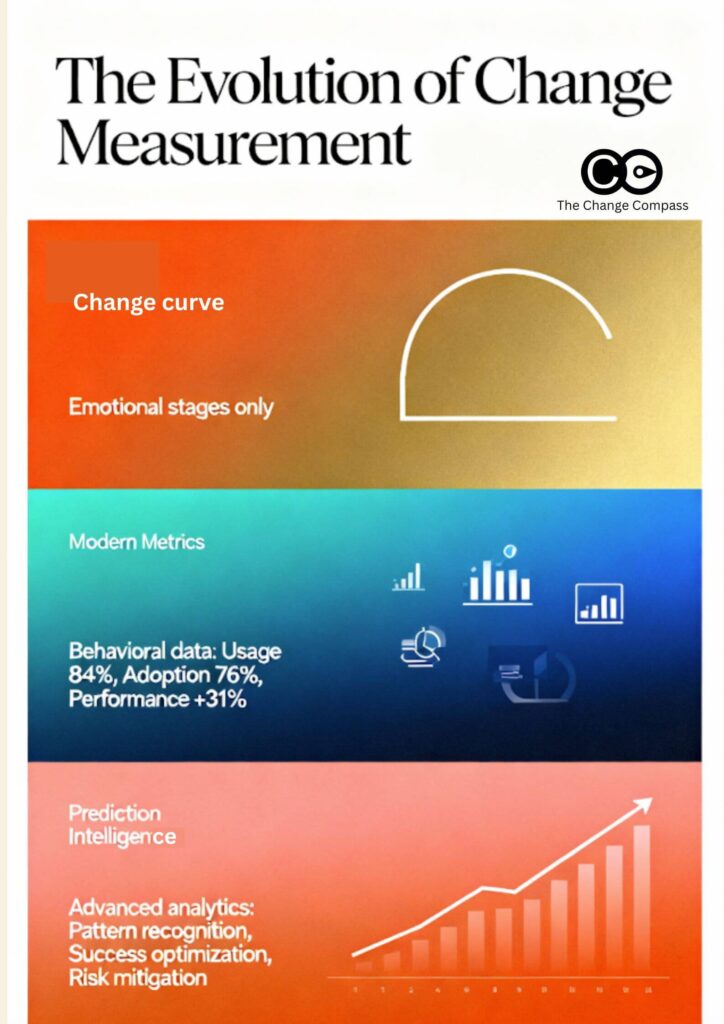
Understanding how people navigate through organisational change has been a cornerstone of effective change management for decades. The change management curve, adapted from Elisabeth Kübler-Ross’s work on grief, provides valuable insights into the emotional journey individuals can experience during transformation. However, measuring change adoption requires more than simply mapping people’s positions on this curve – it demands a sophisticated understanding of behavioural indicators, performance metrics, and the complex realities of modern organisational change in organisations.
The relationship between the emotional stages of change and measurable adoption outcomes is both nuanced and critical to transformation success. While the change curve offers a framework for understanding emotional responses within your change management framework, measuring change management effectiveness requires concrete, observable indicators that demonstrate whether people are actually embracing new ways of working rather than merely progressing through emotional stages.
This guide explores how to measure change adoption effectively within the change management curve. We’ll examine when the curve provides valuable guidance, when it may mislead practitioners, and how to build robust measurement frameworks that capture the true indicators of change management success in complex organisational environments.
Understanding the change management curve
Origins and validation of the model
The change management curve emerged from Dr. Elisabeth Kübler-Ross’s 1969 work “On Death and Dying,” which outlined five stages of grief experienced by terminally ill patients. Change management practitioners adapted this psychological model to explain how individuals respond emotionally to organisational transformations as part of change management theory.
Recent research by Hagemann and Cechlovsky (2024) provides empirical validation of these stages in business environments, demonstrating that “individuals manifest akin responses within their respective phases of the change curve, amenable to effective facilitation through judicious interventions”. The study identified four validated phases that consistently appear across different project contexts: Unawareness & Denial, Discomfort & Resistance, Exploration & Discovery, and Integration & Commitment.
Multiple studies have validated the existence of the change curve in organisational contexts, including research from The University of Alabama (1999), “The Death Valley of Change” study (2002), and Finnish-American research (2010). However, the research also reveals important limitations. The curve is not universally applicable, and individual experiences vary significantly. Some people adapt faster than others, and some may not even go through all the stages.
When the change curve is useful for understanding adoption
Appropriate contexts for curve application
The change management curve proves most valuable in specific organisational contexts where emotional processing plays a central role in adoption success within your change management approach. Research indicates that the curve is particularly effective when changes require significant behavioural change management, involve loss or disruption of familiar systems, affect deeply held values or practices, or create uncertainty about job security or role changes.
Complex system implementations, organisational restructuring, cultural transformations, and compliance initiatives that alter fundamental work practices represent ideal applications for change curve analysis as part of your change management methodology.
Individual-level emotional support and resistance prediction
The change curve excels at providing frameworks for individual emotional support during transformation. Understanding where individuals are positioned on the curve enables “effective facilitation through judicious interventions” as part of comprehensive change management techniques. Someone in the denial phase requires different support than someone in the exploration phase.
When the change curve should not be used
Linear progression and high-performing environments
Recent research reveals that the characteristic “dip” in the change curve may not occur in environments with the right conditions. As noted by Leopold and Kaltenecker (2015), the performance dip primarily occurs “when the change necessitates that people in the organisation have to unlearn old behaviours, processes and systems and learn new ways of doing things”.
In organisations with strong change management capabilities, high psychological safety, clear communication, and adequate support systems, individuals may transition through change without experiencing significant emotional disruption. High-performing teams with previous positive change experiences may demonstrate change readiness that bypasses traditional curve patterns entirely.
Complex organisational and technology-driven changes
The change curve focuses on individual emotional responses but fails to address the systemic complexities of modern organisational change. Large-scale transformations involving multiple interdependent systems, cross-functional teams, and varied stakeholder groups require change analysis beyond individual emotional processing.
Contemporary changes often involve agile change management approaches, iterative implementations, and continuous adaptation that don’t align with the discrete stages suggested by the curve model. Additionally, not all organisational changes trigger the emotional responses that the change curve addresses. Technology upgrades with minimal workflow impact or process optimisations may not generate significant emotional responses, and attempting to apply curve-based interventions to these situations may misdirect resources away from practical adoption barriers.
Key elements of measuring change adoption
Behavioural indicators vs emotional stages
Effective change adoption measurement requires distinguishing between emotional processing and actual behavioural change. While the change curve tracks emotional responses, adoption measurement must focus on observable actions that indicate genuine integration of new ways of working.
Behavioural indicators provide concrete evidence of adoption success:
• System usage frequency and feature utilisation patterns
• Knowledge sharing and collaborative behaviours using new tools or processes
These indicators offer more reliable adoption insights than emotional assessments because they reflect actual implementation of change rather than feelings about change.
Leading vs lagging adoption metrics
Comprehensive change adoption measurement requires understanding the distinction between leading and lagging indicators as part of change management KPI frameworks.
Leading indicators include training completion rates and competency assessments, early system usage patterns, stakeholder engagement in change management activities, feedback sentiment and change champion activity.
Lagging indicators encompass sustained performance improvements, full workflow integration, business outcome achievement, long-term retention of new behaviours, and customer satisfaction improvements.
Quantitative and qualitative approaches
Quantitative metrics provide objective, measurable data about change adoption progress using change management analytics. Essential metrics include adoption rate (percentage of target users actively using new systems), time-to-adoption, usage frequency, feature utilisation, compliance rates, and performance measures showing productivity and quality improvements.
While quantitative metrics provide measurable outcomes, qualitative assessment offers crucial context about adoption barriers, user experience, and sustainability factors through stakeholder interviews, change management surveys, observational studies, feedback sessions, and case studies. These approaches reveal the “why” behind quantitative patterns and inform targeted interventions.
Building comprehensive adoption measurement frameworks
Multi-dimensional measurement approach
Effective change adoption measurement requires frameworks that capture multiple dimensions of change simultaneously. Comprehensive measurement examines adoption across people, process, and business dimensions.
People metrics focus on individual and team change readiness, capability development, and engagement levels. Process metrics examine how well new workflows and systems are being integrated into daily operations. Business metrics demonstrate the ultimate value delivery of change initiatives through improved outcomes, cost savings, and strategic objective achievement.
Technology-enabled measurement platforms
Modern change adoption measurement benefits significantly from technology platforms that automate data collection, provide real-time insights, and enable sophisticated analysis as part of change management tools and techniques.
Technology advantages include real-time data collection from system usage and user interactions, automated reporting that reduces manual effort, predictive analytics that identify adoption risks, change management metrics dashboard visualisation, and integration capabilities that combine data from multiple sources.
Change adoption measurement must be ongoing rather than episodic to capture the dynamic nature of adoption processes through effective change monitoring. Continuous monitoring approaches include weekly usage analytics, monthly adoption reviews, quarterly deep-dive analyses, and real-time alert systems flagging significant adoption issues.
This approach transforms measurement from a retrospective assessment tool into a proactive management capability that drives ongoing change management success.
Integration of change curve insights with adoption metrics
Combining emotional and behavioural indicators
The most effective change adoption measurement approaches combine insights from the change management curve with concrete behavioural metrics. This integration provides both emotional intelligence about stakeholder experience and objective data about adoption progress as part of comprehensive change management best practices.
Integrated measurement frameworks track emotional indicators showing curve progression alongside behavioural metrics demonstrating actual adoption, satisfaction and confidence measures correlated with performance and usage data, and resistance patterns identified through curve analysis combined with compliance and engagement metrics.
Using curve insights to interpret adoption data
Change curve insights provide valuable context for interpreting adoption metrics. Understanding emotional progression helps explain adoption patterns and guides appropriate responses to measurement findings.
For example, decreased system usage during early implementation phases may reflect curve-predicted resistance rather than system problems, requiring different interventions than technical issues would warrant. Similarly, rapid adoption by some users may indicate curve bypass rather than universal success, suggesting need for continued support of others still processing emotional aspects of change.
The Change Compass approach to predictive adoption intelligence
Beyond measurement to predictive insights
The Change Compass platform represents the next evolution in change adoption measurement, moving beyond traditional tracking to provide predictive and prescriptive intelligence that transforms how organisations approach change management. Rather than simply reporting what has happened, The Change Compass uses sophisticated analytics to forecast adoption trajectories and identify the factors that drive successful adoption across different contexts.
This predictive capability addresses one of the fundamental limitations of traditional change management tracking: the reactive nature of insights that arrive too late to inform proactive intervention. The Change Compass enables organisations to identify adoption risks weeks or months before they manifest, providing the lead time necessary for effective mitigation strategies.
Data-driven adoption forecasting
The Change Compass leverages historical change management data combined with current adoption indicators to generate accurate forecasts of adoption rates across different stakeholder groups, timeframes, and change contexts.
Forecasting capabilities include:
• Adoption rate predictions by stakeholder group, showing expected adoption curves over time
• Risk identification highlighting specific individuals, teams, or business units likely to struggle with adoption
• Timeline accuracy providing realistic estimates for achieving adoption milestones
• Resource requirement forecasting predicting support needs throughout the adoption journey
• Outcome probability estimating likelihood of achieving intended business results
These predictions enable change managers to allocate resources proactively, adjust timelines realistically, and design interventions that address predictable challenges before they impact outcomes.
Pattern recognition for adoption success factors
Beyond forecasting adoption trajectories, The Change Compass identifies the specific factors that enhance or inhibit adoption success within your organisational context. Through analysis of multiple change initiatives over time, the platform recognises patterns that distinguish successful adoption from failures.
Pattern analysis can reveal:
• Stakeholder characteristics associated with rapid adoption (previous change experience, role types, team dynamics)
• Intervention effectiveness showing which change management techniques produce the best outcomes in different contexts
• Environmental factors that accelerate or impede adoption (organisational culture, leadership support, resource availability)
• Optimal timing patterns for training, communication, and support activities
• Threshold indicators signalling when adoption has achieved sustainability
This intelligence transforms change management from an art based on intuition to a science informed by evidence. Instead of relying on generic best practices, organisations can implement strategies proven effective within their specific environment.
Contextual intelligence for targeted interventions
The Change Compass provides contextual intelligence that enables precisely targeted interventions rather than generic approaches. By understanding how to measure change management success factors specific to different stakeholder groups, the platform recommends interventions tailored to the unique characteristics of each adoption challenge.
Contextual recommendations address individual learning preferences, team dynamics, role-specific barriers, geographic variations, and timing optimisation to schedule interventions when stakeholders are most receptive. This level of precision dramatically improves intervention effectiveness while optimising resource allocation to areas of greatest need.
Delivering strategic value through integrated intelligence
The Change Compass is an example of a digital platform that transforms change management from a tactical support function into a strategic capability that drives measurable organisational value. By integrating adoption measurement with broader business intelligence systems, the platform provides executives and transformation leaders with the insights needed to make confident, data-informed decisions about their change portfolio.
This integration enables organisations to understand the true impact of their change initiatives on business performance, moving beyond activity reporting to demonstrate concrete value delivery. When adoption metrics connect directly to revenue growth, cost reduction, customer satisfaction improvements, and strategic objective achievement, change management becomes demonstrably essential to organisational success.
Strategic benefits include:
• Portfolio optimisation through clear visibility of which change initiatives deliver the greatest value, enabling smarter resource allocation across the transformation portfolio
• Risk mitigation by identifying struggling initiatives early enough to course-correct, protecting strategic investments from failure
• Capability building as pattern recognition reveals which change management approaches work best in your specific organisational context, building institutional knowledge that improves with each transformation
• Executive confidence in transformation investments backed by predictive analytics showing expected returns and realistic timelines
• Competitive advantage through faster, more successful change execution that enables rapid response to market opportunities
The change management curve provides valuable insights into emotional processing during organisational transformation, but effective change adoption measurement requires comprehensive frameworks that capture behavioural change, performance improvement, and sustained implementation success. Modern change adoption measurement benefits from technology-enabled data collection, analytics-driven insights, and continuous change monitoring approaches that transform measurement from retrospective assessment to proactive management capability.
The future of change adoption measurement lies in predictive, and technology-enhanced approaches that recognise individual differences while maintaining organisational coherence. The ability to not only track but forecast and optimise adoption through pattern recognition represents the next frontier in enterprise change management, enabling organisations to approach transformation with unprecedented confidence and precision in achieving change management success.
References
Hagemann, M., & Cechlovsky, S. (2024). Revisiting the change curve: A rigorous examination and three case studies prompting a re-evaluation of a timeless concept. Journal of Health Services Management. Retrieved from https://journals.sagepub.com/doi/10.3233/HSM-240051
Leopold, K., & Kaltenecker, S. (2015). Organizational and Personal Change. Kanban Change Leadership: Creating a Culture of Continuous Improvement, 110-121.
Nikula, U., Jurvanen, C., Gotel, O., & Gause, D. C. (2010). Empirical validation of the Classic Change Curve on a software technology change project. Information and Software Technology, 52(6), 680-696.
FAQ: Measuring Change Adoption Within the Change Management Curve
Q: What is the change management curve and why does it matter for measuring change adoption?
A: The change management curve (adapted from Elisabeth Kübler‑Ross’s model) describes how individuals emotionally progress through stages during organisational change. It matters for measuring change adoption because it provides context for emotional responses that may influence users’ behaviours—though actual adoption must be measured via behavioural and performance indicators.
Q: What are the limitations of using the change management curve for adoption measurement?
A: The curve assumes a linear, sequential progression through emotional stages, but in real organisational settings individuals may skip or revisit stages, or show minimal emotional disruption. Also, the curve focuses on emotional states, whereas adoption measurement must capture observable behaviour and business outcomes.
Q: What are the most effective metrics to measure change adoption?
A: Effective metrics include behavioural indicators (e.g., system usage frequency, feature utilisation, process compliance, knowledge-sharing) and a combination of leading indicators (training completion, early usage patterns, stakeholder engagement) and lagging indicators (sustained performance improvements, workflow integration, business results).
Q: How can organisations build a comprehensive adoption measurement framework?
A: A robust framework covers multiple dimensions — people (capability, engagement), process (workflow integration, compliance), and business (outcomes, value delivery) — and uses both quantitative (adoption rate, time-to-adoption, usage metrics) and qualitative (surveys, interviews, feedback) methods. It should include continuous monitoring, not just one-off assessments.
Q: How can insights from the change curve be integrated with adoption metrics?
A: By combining emotional insights from the change curve (such as where stakeholders might be in their emotional journey) with behavioural and performance data, organisations can interpret adoption patterns more accurately. For example, a drop in usage might reflect a resistance phase rather than a technical fault.
Q: What role does technology play in measuring change adoption?
A: Technology enables automated data collection (e.g., system logs, usage analytics), real-time dashboards, predictive analytics, and integration across systems. This allows transformation teams to move from retrospective measurement to proactive, predictive adoption management.
Q: When should the change management curve be used—and when should it not?
A: Use the change curve when changes involve significant emotional or behavioural disruption (e.g., major system replacements, role re-definitions) because emotional processing is likely a key factor. Avoid relying on it when changes are incremental, low-impact on roles or processes, or in high-performing teams with strong change readiness where the classic “dip” may not occur.
Latest findings from academic studies reveal the real drivers behind successful organisational transformation
If you’re leading organisational change, you’ve probably wondered why some change initiatives take off while others crash and burn despite having similar resources and executive support. The good news is that decades of academic research have cracked the code on what actually drives change adoption success. And the findings might surprise you.
Recent meta-analyses tracking thousands of change initiatives across industries have identified six psychological factors that predict up to 88% of the variance in whether people will embrace or resist organisational change. This isn’t theoretical fluff – these are measurable, actionable insights that can transform your change management approach.
The traditional change management process isn’t enough
Most change management frameworks focus heavily on communication plans, training schedules, and governance structures. While these do matter, research shows they’re not the primary drivers of adoption success. A longitudinal study published in the Journal of Applied Social Psychology found that traditional change management activities only explained about 30% of adoption outcomes.
The real game-changers happen at the psychological level – how people feel about the change, whether they believe they can succeed with it, and if it aligns with their sense of identity and purpose.
What the research reveals about change readiness
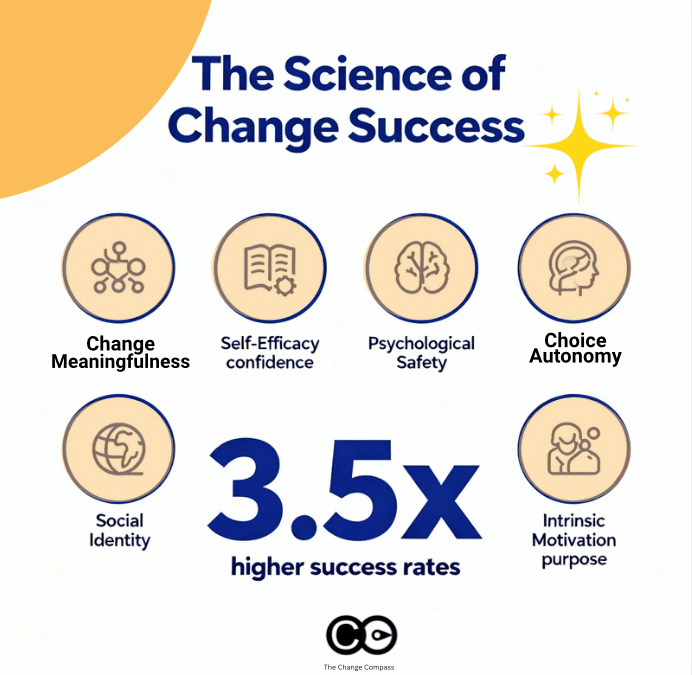
The strongest predictor of change adoption isn’t how well you communicate the business case or how comprehensive your training programme is. According to research from Albrecht and colleagues published in Frontiers in Psychology, three psychological conditions together explain 88% of the variance in employee change engagement:
Change-related meaningfulness: Do people understand how this change helps them make a meaningful contribution? When employees see clear connections between the change and their deeper sense of purpose, intrinsic motivation kicks in. This isn’t about vague mission statements – it’s about helping people see tangible ways the change enhances their ability to do work that matters.
Change-related self-efficacy: Do people believe they can successfully navigate and master the change? Confidence in one’s ability to adapt is a powerful predictor of proactive change behaviour. Teams with higher change self-efficacy don’t just comply – they innovate and find better ways to implement changes.
Change-related psychological safety: Can people express concerns, ask questions, and make mistakes without fear? When psychological safety is high, resistance transforms into constructive dialogue. People move from defending against change to collaborating on making it work better.
These three factors work together. You can’t just focus on one and expect miraculous results. But when all three are present, the research shows dramatic improvements in both adoption speed and sustainability.
The autonomy factor that changes everything
Self-determination theory research, with effect sizes sustained over 13-month periods, reveals three autonomy-supportive conditions that dramatically improve change adoption:
• Providing clear rationale: People need to understand not just what’s changing, but why it’s necessary. This goes beyond business cases to help individuals connect the change to broader organisational or societal purposes.
• Offering choices in implementation: Even limited choice in how to implement changes preserves people’s sense of agency. Teams with input into change processes show 65% higher engagement levels.
• Acknowledging feelings and concerns: Counter-intuitively, acknowledging negative emotions about change actually facilitates acceptance. When concerns are heard and addressed, psychological reactance decreases.
This research challenges the traditional “tell and sell” approach to change management. Instead of trying to overcome resistance, successful change leaders create conditions where people can choose to embrace change because it serves their psychological needs.
Social identity: the hidden driver of change success
One of the most overlooked aspects of change management is how changes affect people’s sense of identity and group belonging. Social identity theory research identifies two distinct pathways for successful change adoption:
Identity maintenance pathway: People more readily adopt change when they can preserve core aspects of their existing identity while adapting to new circumstances. This works through continuity mechanisms – maintaining connection to valued aspects of organisational culture and relationships while evolving others.
Identity gain pathway: Alternatively, individuals embrace change when they perceive it will enhance their social identity or provide access to more valued group memberships. This operates through aspiration mechanisms – change becomes attractive when it offers opportunities for growth or alignment with desired characteristics.
The practical implication? Before launching your change initiative, map out how the change affects different groups’ identities (I,e, your change impacts). Then design your approach to either preserve valued identities or provide compelling identity gains.
Rogers’ innovation characteristics still matter
Diffusion of innovation theory, validated across thousands of studies, identifies five characteristics that predict adoption rates and collectively explain 50-90% of adoption variance:
• Relative advantage: The degree to which change is perceived as better than existing approaches • Compatibility: How well change aligns with existing values and experiences • Simplicity: The perceived ease of understanding and implementing change • Trialability: The ability to experiment before full commitment • Observability: The visibility of change results to others
These factors operate through different psychological mechanisms. Relative advantage works through comparison processes, compatibility through cognitive consonance, and observability through social proof. Smart change leaders deliberately design their initiatives to optimise these characteristics.
Measuring what matters: change adoption metrics that predict success
Traditional change management metrics often miss the mark. Tracking training completion rates or communication reach tells you about activities, not outcomes. Research-based change assessment focuses on measuring the psychological conditions that predict adoption:
Early indicators of success: • Meaningfulness ratings: Do people see how the change connects to their purpose? • Self-efficacy scores: How confident are teams about succeeding with the change? • Psychological safety levels: Can people express concerns without fear? • Autonomy support perception: Were rationale, choice, and concerns adequately addressed?
Behavioural indicators: • Proactive change behaviour: Are people finding ways to improve implementation? • Help-seeking behaviour: Are teams asking questions and sharing challenges? • Innovation around the change: Are people adapting the change to work better in their context?
These metrics give you leading indicators of adoption success, allowing you to intervene before problems become entrenched.
The intrinsic motivation advantage
Research consistently shows that intrinsic motivation produces more sustainable change adoption than external incentives. Studies on intrinsic motivation in workplace change show it operates through three fundamental psychological needs:
Autonomy: The need to feel self-directed rather than controlled. Changes that preserve or enhance autonomy see higher sustained adoption rates.
Mastery: The desire to develop competence and skill. Changes that provide growth opportunities tap into learning motivation, making adaptation engaging rather than threatening.
Purpose: The need to contribute to something meaningful. Changes that enhance sense of purpose leverage powerful intrinsic motivators.
Organisations that cultivate intrinsic motivation during change see 83% higher likelihood of innovation, improved retention, and more positive cultures that become self-reinforcing for future changes.
Loss aversion: People psychologically weight potential losses twice as heavily as equivalent gains. This means change communications focusing only on benefits may be insufficient to overcome perceived risks.
Status quo bias: The tendency to prefer current conditions even when alternatives might be superior. This operates through familiarity preferences and psychological comfort with predictability.
Confirmation bias: Selective processing of information that confirms existing beliefs while dismissing contradictory evidence. This particularly affects how people interpret change communications and early experiences.
Successful change initiatives address these barriers directly rather than trying to overpower them with rational arguments. Research shows that change programmes acknowledging and working with psychological barriers have significantly higher success rates.
• Create psychological safety through their own vulnerability and openness to feedback • Provide clear rationale that connects to employees’ values and sense of purpose • Offer genuine choices in how changes are implemented at the team level • Acknowledge the emotional impact of change rather than dismissing concerns • Model the mindset and behaviours they want to see in others
Putting it all together: a psychological systems approach
The most significant finding from this research is that these psychological mechanisms aren’t individual preferences – they represent universal human needs. When addressed systematically, they can dramatically improve change outcomes. Organisations that invest in understanding and supporting these psychological processes see 3.5 times higher success rates in change initiatives.
This research fundamentally challenges traditional change management practice. Instead of an engineering mindset focused on processes and structures, successful change requires a psychological science approach that prioritises human motivation, meaning, and social dynamics.
Practical steps for change leaders:
• Start with meaningfulness: Help people understand how the change enhances their ability to contribute meaningfully • Build confidence: Provide skills, support, and early wins to develop change self-efficacy • Create safety: Establish norms where concerns can be expressed and mistakes are learning opportunities • Preserve autonomy: Provide rationale, offer choices, and acknowledge feelings throughout the process • Consider identity: Map how the change affects group identities and design accordingly • Optimise innovation characteristics: Make changes obviously beneficial, compatible, simple, testable, and visible
The future of change management
Recent studies on the evolution of change management suggest we’re moving toward more psychologically informed approaches. Organisations that integrate these research findings into their change management frameworks are seeing:
• 40% faster adoption rates • 60% higher employee satisfaction during change • 50% lower resistance and turnover • More sustainable behaviour change that persists beyond formal change programmes
The evidence is clear: successful change is fundamentally a human psychological phenomenon. When we address the underlying needs for autonomy, meaning, competence, and social connection, people don’t just comply with change – they embrace it, improve it, and become advocates for future transformation.
As you plan your next change initiative, remember that the most sophisticated project plans and communication strategies won’t overcome basic psychological resistance. But when you create conditions that support human psychological needs, change adoption becomes not just possible, but inevitable.
Understanding what research shows about predicting change adoption isn’t just about improving success rates – it’s about creating more humane, engaging, and sustainable approaches to organisational transformation. And in today’s rapidly changing business environment, that might be the most important competitive advantage you can develop.
If you are looking for a way to easily track change readiness and eventual change adoption leveraging the science of what works through a digital platform, reach out and get in touch.
Performance metrics are the compass that guides change practitioners through complex transformation initiatives. Yet despite their critical importance, many organisations unknowingly employ flawed metrics that provide misleading insights and potentially sabotage their change efforts. A closer look reveals some of the danger of conventional change management performance metrics and offers a strategic approach to measurement that truly drives success.
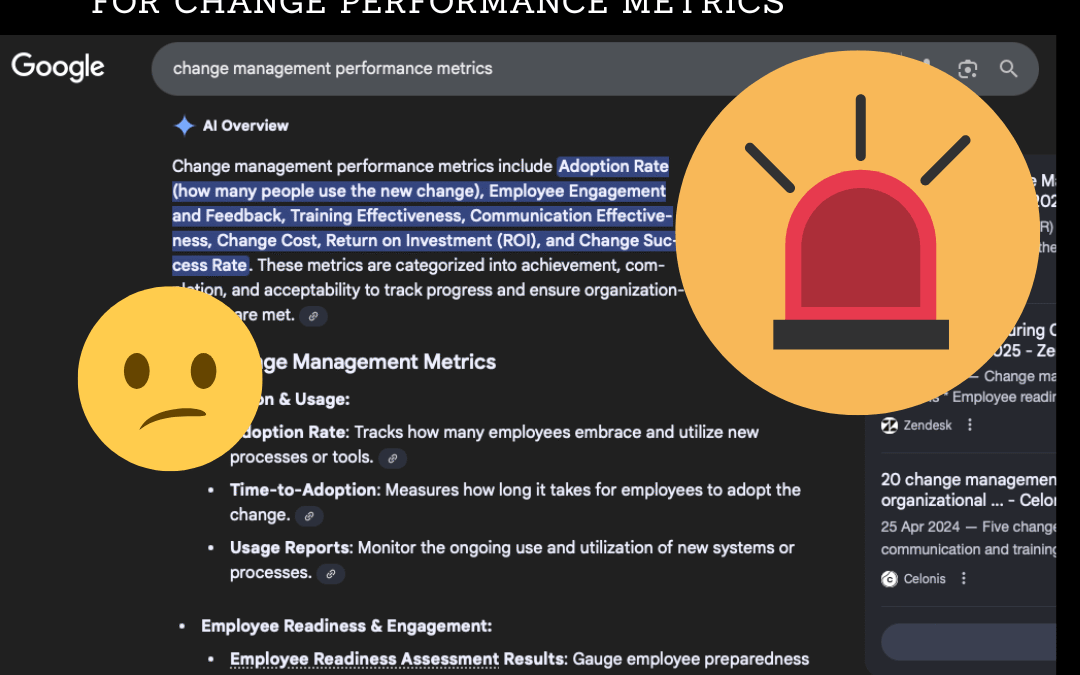
In fact, a quick Google search revealed a list of recommended change management performance metrics. However, some of these are potentially dangerous to incorporate without a closer understanding of the type of change being implemented, the change environment, stakeholder needs and overall change approach required. Let’s go through some of these ‘hidden dangers’ in this article.
The Measurement Imperative in Change Management
Change management has long been criticised as being too “soft” to measure effectively. This perception persists despite overwhelming evidence that data-driven approaches significantly enhance change outcomes. Research consistently demonstrates that organisations measuring change management performance are more likely to meet or exceed project objectives.
The resistance to measurement often stems from change practitioners’ preference for people-focused approaches over numerical analysis. In today’s data-rich environment, where artificial intelligence and predictive analytics are reshaping business operations, change management must embrace measurement to remain relevant and demonstrate value.
Modern organisations rely on data across all functions – from finance and operations to risk management and procurement. Without data, these departments cannot function effectively or determine whether they are achieving their targets. The same principle applies to change management: effective measurement enables practitioners to track progress, identify issues early, and make informed adjustments to their strategies.
The Problem with Traditional Adoption and Usage Metrics
Adoption and usage represent the ultimate goal of any change initiative, yet this seemingly straightforward metric harbours significant complexities. Most organisations measure adoption superficially—tracking whether people are using new systems or processes without examining the quality or effectiveness of that usage.
True adoption requires achieving full benefit realisation, which depends on several interconnected outcomes:
• Accurate impact assessment that understands how change affects specific stakeholder groups • Effective engagement strategies tailored to different audiences • Continuous tracking and reinforcement mechanisms • Clear definition of required behaviours for success
Generic change approaches might achieve some adoption at best, but to get full adoption there is a series of outcomes you need to have achieved. The behaviours need to be clear, specific and actionable, yet many organisations fail to establish these precise behavioural indicators.
Furthermore, adoption measurements often ignore the temporal dimension. Early adoption rates may appear promising, but without sustained reinforcement and measurement, initial enthusiasm frequently wanes. Effective adoption metrics must track behaviour change over extended periods and identify the specific interventions needed to maintain momentum.
Employee Readiness and Engagement: Beyond Surface-Level Satisfaction
Employee readiness and engagement form the cornerstone of successful change initiatives, yet these areas suffer from widespread measurement inadequacies. Most change practitioners focus extensively on these metrics, but their approaches often lack the sophistication required for meaningful insights.
The Critical Role of Impact Assessment
Accurate impact assessment serves as the foundation for effective readiness and engagement measurement. Any inaccuracy in understanding how change affects specific stakeholder groups inevitably leads to insufficient preparation and engagement strategies. This fundamental flaw cascades through the entire change process, undermining subsequent measurement efforts.
Impact assessment requires deep analysis of how change affects different roles, departments, and individual circumstances. Generic assessments fail to capture these nuances, leading to one-size-fits-all engagement strategies that satisfy no one effectively.
Participation Versus Meaningful Involvement
Employee participation metrics suffer from significant limitations related to change type and context. The key lies in measuring relevant participation rather than absolute participation rates:
For compliance-driven changes: • Focus on communication effectiveness and readiness preparation • Track understanding levels and procedure adherence • Monitor feedback on implementation challenges
For transformational changes: • Emphasise co-creation opportunities and stakeholder input • Measure feedback integration and stakeholder influence on change design • Track collaborative problem-solving activities
Maximum participation might seem desirable, but the nature of the change determines appropriate participation levels. Significant restructuring initiatives or regulatory compliance changes naturally limit meaningful participation opportunities compared to voluntary improvement projects.
The Satisfaction Survey Trap
Employee satisfaction surveys present particular challenges for change measurement. The purpose of satisfaction surveys requires careful definition:
• Are you seeking feedback on training content quality? • Is the focus on communication channels effectiveness? • Are you measuring leadership session impact? • Do you want to assess overall transformation experience?
Without specific focus, satisfaction surveys generate ambiguous data that provides limited actionable insight. More problematically, satisfaction may not align with change necessity. Employees might express dissatisfaction with change approaches that are nonetheless essential for regulatory compliance or competitive survival. In these situations, satisfaction becomes irrelevant, and measurement should focus on understanding effectiveness and identifying improvement opportunities within necessary constraints.
Training and Communication: Moving Beyond Binary Effectiveness
Training and communication effectiveness represent the most commonly measured aspects of change management, yet this narrow focus creates dangerous blind spots. Whilst these elements are undoubtedly important delivery vehicles, they represent only partial components of comprehensive change strategies.
The Capability Development Ecosystem
Training effectiveness measurement often conflates learning with capability development. Effective capability building requires diverse interventions beyond traditional training:
• Coaching and personalised support sessions • Structured feedback mechanisms • Sandbox practice environments for skill development • Team discussions and peer learning opportunities • Mentoring relationships and knowledge transfer
Modern capability development leverages technology-enhanced approaches that traditional training metrics fail to capture:
• Gamified content delivery and interactive learning modules • Micro-learning sequences and just-in-time training • Multimedia integration with videos, simulations, and virtual reality • Avatar-based instruction and AI-powered tutoring systems • Adaptive learning pathways that personalise content delivery
Measuring effectiveness in these environments requires sophisticated metrics that track engagement, retention, application, and long-term behaviour change across multiple learning modalities.
Communication Beyond Hit Rates
Communication effectiveness measurement typically focuses on reach metrics—how many people viewed content or attended sessions. These “hit rate” measurements provide limited insight into actual communication effectiveness, which depends on:
• Comprehension levels and message clarity • Information retention and recall accuracy • Perceived relevance to individual roles • Action generation and behaviour change
Advanced communication measurement utilises sophisticated analytics available through modern platforms:
Microsoft Viva Engage and Teams Analytics: • User engagement patterns and interaction frequency • Device usage behaviours across different communication channels • Community reach statistics and network analysis • Conversation quality indicators and response rates
A/B Testing Methodologies: • Test different messages or formats with smaller audience segments • Identify the most effective approaches before broader deployment • Transform communication from educated guesswork into data-driven optimisation • Measure conversion rates and action completion across message variants
Financial Performance: Beyond Cost-Focused ROI
Financial metrics in change management suffer from fundamental conceptual limitations that undermine their utility for strategic decision-making. The predominant focus on return on investment (ROI) and cost management treats change as an expense rather than a value creation opportunity.
Traditional ROI calculations examine financial benefits of change management spending against change outcomes. Whilst this approach provides some insight, it fundamentally limits change management to a cost-minimisation function rather than recognising its potential for:
• Enhanced organisational agility and adaptability • Improved employee engagement and retention rates • Reduced future change resistance and implementation time • Accelerated innovation adoption and competitive positioning • Strengthened stakeholder relationships and trust building
More sophisticated financial measurement approaches assess change management’s contribution to organisational capability building, risk mitigation, and strategic option creation. These broader value considerations provide more accurate assessment of change management’s true organisational impact.
The Resistance Metrics Minefield
Resistance metrics represent perhaps the most problematic area in change management measurement. The conventional approach of monitoring resistance levels and aiming for minimal resistance creates dangerous dynamics that undermine change effectiveness.
Resistance monitoring often leads to labelling stakeholders as “resistant” and focusing efforts on reducing negative feedback. This approach fundamentally misunderstands resistance as a natural and potentially valuable component of change processes.
Transforming Resistance into Feedback
Rather than minimising resistance, effective change management should encourage comprehensive feedback from all stakeholder groups. The goal shifts from resistance reduction to feedback optimisation:
Feedback Quality Indicators: • Specificity of concerns raised and solutions suggested • Constructive nature of criticism and improvement ideas • Stakeholder willingness to engage in problem-solving discussions • Implementation feasibility of suggested modifications
Implementation Tracking: • Percentage of feedback items addressed in change plans • Time from feedback receipt to response or action • Stakeholder perception of influence on change processes • Communication quality regarding feedback disposition
Effective resistance can highlight legitimate concerns, identify implementation risks, and strengthen final solutions through stakeholder input. The question becomes: What specific aspects of change generate concern, and how can legitimate resistance improve change outcomes?
Compliance and Adherence: The Missing Reinforcement Link
Compliance and adherence metrics represent critical but often overlooked components of change measurement. These metrics assess how effectively employees follow new policies and procedures—the ultimate test of change success.
The challenge lies in measurement timing and responsibility allocation:
Common Gaps: • Change teams fail to design compliance measurement into their change processes • Assessment is left for post-implementation periods when project teams have moved on • Timing gaps create measurement blind spots precisely when reinforcement is most critical • Lack of clear ownership for ongoing compliance monitoring
Effective Measurement Approaches: • Digital systems providing automated compliance tracking • Leadership follow-up protocols and structured audit processes • Operational integration rather than separate evaluation activities • Real-time dashboards showing compliance trends and exceptions
The key is embedding measurement into operational processes rather than treating it as a separate evaluation activity. This integration ensures continuous monitoring and rapid identification of compliance issues before they become systemic problems.
Establishing Effective Change Management Metrics
Developing effective change management metrics requires systematic approach that addresses the limitations of traditional measurement while leveraging modern technological capabilities.
The Three-Level Performance Framework
Leading organisations utilise comprehensive measurement frameworks that address multiple performance levels simultaneously:
Change Management Performance: • Completion of change management plans and milestone delivery • Activation of core roles like sponsors and change champions • Progress against planned activities and timeline adherence • Quality of change management deliverables and stakeholder feedback
Individual Performance (using frameworks like ADKAR): • Awareness levels and understanding of change rationale • Desire for change and motivation to participate • Knowledge acquisition through training and communication • Ability to implement required behaviours and skills • Reinforcement mechanisms and behaviour sustainability
Organisational Performance: • Achievement of intended business outcomes and strategic objectives • Financial performance improvements and cost reductions • Operational efficiency gains and process improvements • Customer satisfaction improvements and market position
This approach recognises the interdependent nature of change success across organisational, individual, and change management performance dimensions.
Leveraging Modern Technology for Enhanced Measurement
Contemporary change management measurement can exploit advanced technologies that were unavailable to previous generations of practitioners:
AI-Powered Analytics: • Sentiment analysis processing large volumes of text feedback • Pattern detection identifying predictive indicators of change success • Automated insights generation from multiple data sources • Real-time risk assessment and early warning systems
Predictive Capabilities: • Forecasting change outcomes based on early indicators • Proactive intervention before problems become critical • Historical pattern analysis for correlation identification • Capacity planning and resource optimisation
Real-Time Monitoring: • Continuous dashboards and automated reporting systems • Immediate identification of emerging issues • Rapid response to developing challenges • Data-driven optimisation throughout change processes
Building Measurement Into Change Strategy
Effective change measurement requires integration into change strategy from the earliest planning stages rather than being added as an afterthought. This integration ensures measurement serves strategic purposes rather than merely satisfying reporting requirements.
Defining Success Before Beginning
Successful change measurement begins with clear definition of desired outcomes and success criteria:
Primary Sponsor Requirements: • Articulate specific, measurable objectives aligned with organisational benefits • Connect change outcomes to strategic goals and performance indicators • Define acceptable risk levels and tolerance thresholds • Establish timeline expectations and milestone definitions
Stakeholder Engagement: • Include leaders, subject matter experts, and project managers in success definition • Ensure shared understanding across all stakeholder groups • Align measurement focus on outcomes that matter to everyone • Avoid narrow technical achievements without business relevance
Selecting Appropriate Metrics for Context
Different types of change require different measurement approaches:
Regulatory Compliance Changes: • Focus on adherence rates and audit readiness • Track training completion and competency verification • Monitor risk mitigation and control effectiveness • Measure timeline compliance and regulatory approval
Cultural Transformation Initiatives: • Emphasise behaviour change and value demonstration • Track engagement levels and participation quality • Monitor leadership modelling and reinforcement • Measure employee sentiment and satisfaction trends
Technology Implementation Projects: • Focus on system usage rates and functionality adoption • Track user proficiency and support requirement reduction • Monitor performance improvements and efficiency gains • Measure integration success and data quality
Measurement complexity should align with change complexity and organisational capability. Simple changes in mature organisations might require only basic metrics, whilst complex transformations in change-inexperienced organisations demand comprehensive measurement frameworks.
Future Directions in Change Management Measurement
The future of change management measurement lies in sophisticated integration of human insight with technological capability. Several key trends are reshaping measurement approaches:
Predictive Change Management: • Historical data enables forecasting of change outcomes • Proactive optimisation of change approaches before issues arise • Real-time adjustment based on predictive indicators • Continuous learning from measurement data across initiatives
Integrated Organisational Systems: • Connection to broader business performance metrics • Direct demonstration of change impact on customer satisfaction • Integration with financial and operational reporting systems • Holistic view of organisational health and capability
Continuous Change Capability: • Measurement of organisational change capacity and resilience • Tracking of adaptation speed and learning effectiveness • Building change capability as core organisational competency • Supporting ongoing transformation rather than discrete projects
The evolution toward continuous change requires measurement systems that support ongoing transformation rather than discrete project evaluation. These systems must track organisational change capability, adaptation speed, and resilience development as essential business capabilities.
Measuring What Matters
Change management performance metrics represent both opportunity and risk for organisations pursuing transformation. Traditional measurement approaches harbour significant limitations that can mislead practitioners and undermine change success. However, sophisticated measurement systems that leverage modern technology and address these limitations can dramatically enhance change effectiveness.
The path forward requires abandoning simplistic metrics that provide false comfort in favour of comprehensive measurement frameworks that capture the complexity of organisational change. Key principles for effective measurement include:
Strategic Focus: • Serve genuine business purposes rather than administrative requirements • Enable better decisions and drive continuous improvement • Demonstrate measurable value of professional change management • Connect change outcomes to organisational success metrics
Technological Integration: • Leverage AI and machine learning for enhanced analytical precision • Utilise real-time monitoring and predictive capabilities • Integrate with broader organisational data systems • Automate routine measurement while preserving human insight
Comprehensive Approach: • Address multiple performance levels simultaneously • Balance quantitative metrics with qualitative insights • Include temporal dimensions and sustainability factors • Measure capability building alongside immediate outcomes
Most importantly, effective change measurement must serve strategic purposes rather than administrative requirements. Metrics should enable better decisions, drive continuous improvement, and demonstrate the value that professional change management brings to organisational success.
The organisations that master sophisticated change measurement will possess significant competitive advantages in an era of accelerating change. They will anticipate challenges before they emerge, optimise interventions in real-time, and build organisational capabilities that enable sustained transformation success. The question is not whether to measure change management performance, but whether to measure it effectively enough to create lasting competitive advantage.
The topic of change is often inundated with literature stressing that it is about people, feeling, attitudes and behaviour. While these are important, lot of articles centred about the human-nature of change often ignore the importance of data during the change and transformation process. This is no different for the topic of employee readiness for change. People’s attitudes and behaviour need to be observed, measured and tracked during change.
Employee readiness for change is a critical factor that determines the outcome of organisational transformations. By leveraging data-driven insights, companies can proactively assess and enhance their employees’ preparedness, paving the way for smoother transitions and improved business results.
Let’s explore the concept of employee readiness for change and delve into strategies for using data to optimise readiness during transformations. We will discuss key metrics, change readiness assessments, employee engagement techniques, and real-time monitoring to help organisations navigate change effectively.
What is Employee Readiness for Change?
Employee readiness for change refers to the extent to which individuals within an organisation are prepared, willing, and capable of embracing and implementing change. It encompasses their understanding of the change, their motivation to support it, and their ability to adapt and perform effectively in the new environment.
Assessing employee readiness involves evaluating three key elements:
Organisational readiness: This aspect focuses on the company’s overall preparedness for change, including factors such as leadership commitment, resource availability, and clear objectives.
Open attitudes toward change: Gauging employees’ understanding and willingness to embrace change is crucial. Positive attitudes contribute to successful resistance management and building change readiness.
Individual readiness: On a personal level, assessing each employee’s readiness, willingness, and ability to adapt to change is essential. This involves considering their skills, knowledge, and emotional preparedness.
Note that individual readiness is only one component of the overall readiness. A lot of people only focus on this to the detriment of truly assessing the overall readiness.
By conducting a comprehensive assessment of these elements, organisations can gain valuable insights into their employees’ readiness for change. This information serves as a foundation for developing targeted strategies to enhance readiness and facilitate successful transformations.
How to Use Data to Improve Employee Readiness During Transformations
Harnessing the power of data analytics is essential for enhancing workforce preparedness during organisational transformations. By systematically gathering and interpreting relevant data, organisations can uncover potential obstacles and craft bespoke strategies to bolster readiness and ensure seamless transitions.
Determining Critical Metrics for Change Preparedness
To effectively utilize data, organisations must first establish the critical metrics that will serve as indicators of readiness. These metrics provide a foundation for assessing the current state and tracking future progress:
Engagement indices: Measure the degree to which employees are actively involved and invested in organisational activities. High engagement suggests a supportive environment for change initiatives.
Flexibility indicators: Evaluate employees’ capacity to adjust to new roles and technologies. This metric identifies those who may benefit from targeted support.
Completion rates of developmental programs: Monitor the percentage of the workforce completing essential training. This figure highlights areas where skill enhancement is necessary.
Executing a Holistic Change Preparedness Evaluation
With metrics in place, conduct a thorough evaluation of change preparedness at both organisational and individual levels. Utilize surveys, interviews, and focus groups to gather rich data. This comprehensive approach reveals resistance points and directs attention to intervention opportunities:
Cultural assessment: Analyse underlying cultural traits that influence how change is perceived and implemented. Insights into assertiveness and hierarchy can guide communication strategies.
Leadership analysis: Assess the readiness and skillset of leaders to champion change. Effective leadership is pivotal for the success of transformation efforts.
Enhancing Workforce Involvement Through Data Insights
Data-driven insights can significantly enhance employee involvement during periods of change. By examining workforce data, organisations can tailor communication and training to better resonate with their employees:
Customized messaging: Develop communication that speaks directly to the needs and concerns of various employee segments. This ensures messages are impactful and engaging.
Focused learning initiatives: Identify specific knowledge gaps and create targeted training programs. Customized learning enhances employees’ ability to adapt to change confidently.
Continuous Strategy Adaptation via Real-Time Data
Ongoing monitoring of strategy effectiveness through real-time analytics is vital. This continuous process allows organisations to refine their approaches based on evolving data patterns, maintaining high levels of readiness:
Regular data collection: Actively seek feedback from employees regarding their transition experiences. This input is crucial for identifying areas needing adjustment.
Dynamic decision-making: Leverage real-time (or least recent) data to inform strategic decisions and optimize change management initiatives, ensuring they remain aligned with organisational goals.
1. Identify Key Metrics for Change Readiness
Establishing a robust framework of metrics is fundamental to accurately gauge change readiness within an organisation. These metrics function as critical indicators, allowing leaders to monitor the pulse of their workforce during transformation initiatives. A well-defined set of metrics provides a structured approach to assessing readiness and identifying areas requiring attention.
Engagement Indicators
Evaluating employee engagement is crucial for understanding the workforce’s readiness for change. This involves gathering insights into how employees perceive their roles and the organisation’s objectives. A workforce that demonstrates high levels of commitment and enthusiasm tends to be more agile and supportive of change efforts. Methods such as employee sentiment analysis and engagement surveys can help capture these dynamics, offering a nuanced view of organisational health.
Flexibility Metrics
Flexibility metrics provide a window into the ease with which employees can transition to new processes and systems. This involves examining historical data on change adaptability and using tools like behavioural assessments to gauge employees’ readiness for new challenges. Understanding the flexibility of employees can guide targeted support and interventions, ensuring smoother transitions during organisational shifts.
Completion Rates of Educational Programs
Monitoring the completion rates of educational initiatives is essential to assess how prepared employees are for impending changes. This metric reflects the organisation’s dedication to equipping its workforce with the skills needed for transformation. Analysing completion data, alongside post-training assessments, can offer insights into the effectiveness of learning interventions and highlight areas for development.
Together, these metrics form a comprehensive picture of an organisation’s change readiness. By establishing a baseline for these indicators, organisations can track progress over time, adjusting strategies as necessary to enhance readiness and facilitate successful transformations.
2. Conduct a Comprehensive Change Readiness Assessment
To pave the way for a successful transformation, conducting a comprehensive change readiness assessment becomes imperative. This systematic evaluation delves into the organisation’s preparedness at both the macro and micro levels, providing insights that are critical for shaping effective change strategies. Utilizing a blend of qualitative and quantitative methods, the assessment illuminates the landscape of readiness, offering a strategic foundation for decision-making.
Strategic Evaluation Components
A multifaceted readiness assessment encompasses several strategic components, each designed to gather a holistic understanding of the organisational climate:
Cultural Insight Analysis: Delve into the organisational culture to uncover factors that may affect acceptance of change. This involves exploring existing communication styles, shared values, and prevalent behaviours that could influence the transformation journey. Gaining a clear picture of these cultural dynamics aids in crafting initiatives that resonate with the workforce’s inherent beliefs.
Leadership Capacity Evaluation: Determine the readiness and effectiveness of leadership in spearheading change efforts. Examine their ability to inspire and motivate, as well as their capacity to navigate the complexities of organisational transformation. Strong leadership commitment is essential for instilling confidence and guiding the organisation through change.
Resource Readiness Check: Evaluate the sufficiency and distribution of resources critical for supporting change initiatives. Consider the existing technological capabilities, financial support, and human resources available to drive the transformation. Addressing resource gaps early ensures that the organisation is well-prepared to meet the demands of change.
Analysing Data for Targeted Interventions
Upon gathering data through the readiness assessment, a thorough analysis is essential to uncover insights that inform strategic interventions. This analysis should focus on identifying potential resistance points and areas ripe for development:
Resistance Identification: Detect and chart areas where reluctance to change may manifest. Utilize employee feedback, trends from past projects, and current mood assessments to pinpoint these zones. Understanding these resistance factors allows for proactive measures to encourage acceptance and reduce pushback.
Opportunity Leveraging: Spot areas with high readiness levels that can be used to propel change efforts forward. Recognize organisational strengths and existing competencies that can be harnessed to support the transition. By leveraging these opportunities, organisations can accelerate progress and cultivate a culture of continuous growth.
Conducting a comprehensive change readiness assessment provides a strategic lens through which organisations can navigate the complexities of transformation. By systematically evaluating readiness and leveraging data-driven insights, organisations can craft tailored strategies that enhance employee preparedness and drive successful change outcomes.
3. Utilise Data Analytics to Foster Employee Engagement
Employing data analytics is essential to deepening employee involvement during change processes. By utilizing advanced analytical tools, organisations can uncover key drivers of motivation and engagement within their workforce. This enables the development of strategies that are not only data-informed but also tailored to enhance a culture of commitment and adaptability.
Strategic Communication Approaches
Data analytics offer organisations the ability to refine communication strategies in a way that aligns with the diverse preferences and needs of employees. By examining patterns in communication effectiveness and gathering feedback, companies can create messaging frameworks that are clear and meaningful. This strategic approach ensures that communication is not just disseminated but absorbed, fostering a sense of inclusion and understanding across the organisation.
Customised Development Pathways
Insights from analytics enable the design of development pathways that cater to the specific learning and growth needs of employees. Analysing performance metrics and capability assessments allows organisations to pinpoint where support is most needed, leading to bespoke development initiatives. These pathways not only address skill gaps but also promote a learning culture that equips employees for future challenges.
Ongoing Engagement Assessment
Real-time analytics provide a robust mechanism for continuously assessing employee engagement throughout the transformation journey. Establishing metrics that reflect engagement sentiment and participation levels helps organisations react swiftly to shifts in morale. This proactive engagement assessment ensures that initiatives remain aligned with employee expectations and organisational objectives, fostering a sustained commitment to change.
4. Monitor and Adapt Strategies Using Real-Time Data
Leveraging real-time data analytics is crucial for dynamically guiding change initiatives. This approach enables organisations to continuously evaluate the effectiveness of their strategies, ensuring they remain aligned with shifting business needs and employee expectations. By integrating adaptive feedback mechanisms, companies can refine their tactics, promoting an environment of agility and responsiveness.
Dynamic Data Acquisition
Establishing a robust system for dynamic data acquisition is essential to maintain an accurate understanding of organisational and employee dynamics. Real-time analytics platforms and dashboards provide comprehensive insights into change progress, such as engagement indices, performance metrics, and sentiment analysis. Regularly capturing this data allows organisations to proactively identify patterns and shifts that may influence the success of change initiatives.
Strategic Insights-Driven Adjustments
The insights obtained from real-time data empower organisations to make calculated adjustments to their strategies. This adaptive approach ensures that interventions remain pertinent and effective, addressing emerging challenges and capitalizing on new opportunities:
Incorporating Employee Perspectives: Integrate direct insights from employees into strategic refinements. Understanding their experiences and perceptions offers a nuanced perspective of the change process, allowing for precise enhancements.
Pattern Recognition: Use data patterns to recognize trends that may require strategic shifts. For example, a downward trend in engagement metrics could indicate the need for improved communication or support mechanisms.
Efficient Resource Deployment: Employ data insights to enhance resource deployment, ensuring that efforts are concentrated where they are most impactful. This targeted approach enhances the effectiveness of change initiatives and maximizes results.
Proactive Decision-Making
Real-time data analytics enable proactive decision-making, empowering leaders to swiftly adjust to evolving conditions. This capability is vital for sustaining momentum and ensuring that change efforts remain aligned with organisational objectives. By adopting a data-informed mindset, organisations can navigate the complexities of transformation with confidence and precision.
By harnessing the power of data analytics, organisations can proactively assess and enhance employee readiness during transformations, paving the way for smoother transitions and improved business outcomes. Embracing a data-driven approach to change management is no longer optional; it is a strategic imperative for organisations seeking to thrive in an ever-evolving landscape. If you’re ready to transform your change management processes and unlock the full potential of your workforce, chat to us to explore how we can help you leverage data and insights to navigate change with confidence and precision.