Change management maturity is the degree to which an organisation has built repeatable capability for delivering change, separate from the success of any individual initiative. A mature organisation has consistent methodology applied across initiatives, trained practitioners embedded in delivery, clear governance and decision rights for the change portfolio, integrated measurement of adoption and outcomes, and leadership behaviour that models change. Most maturity frameworks use five stages, ranging from ad hoc (no consistent approach) through to optimised (capability is a competitive advantage). The bulk of organisations sit at stage two, where some structure exists but execution still depends on individual heroics rather than embedded systems.
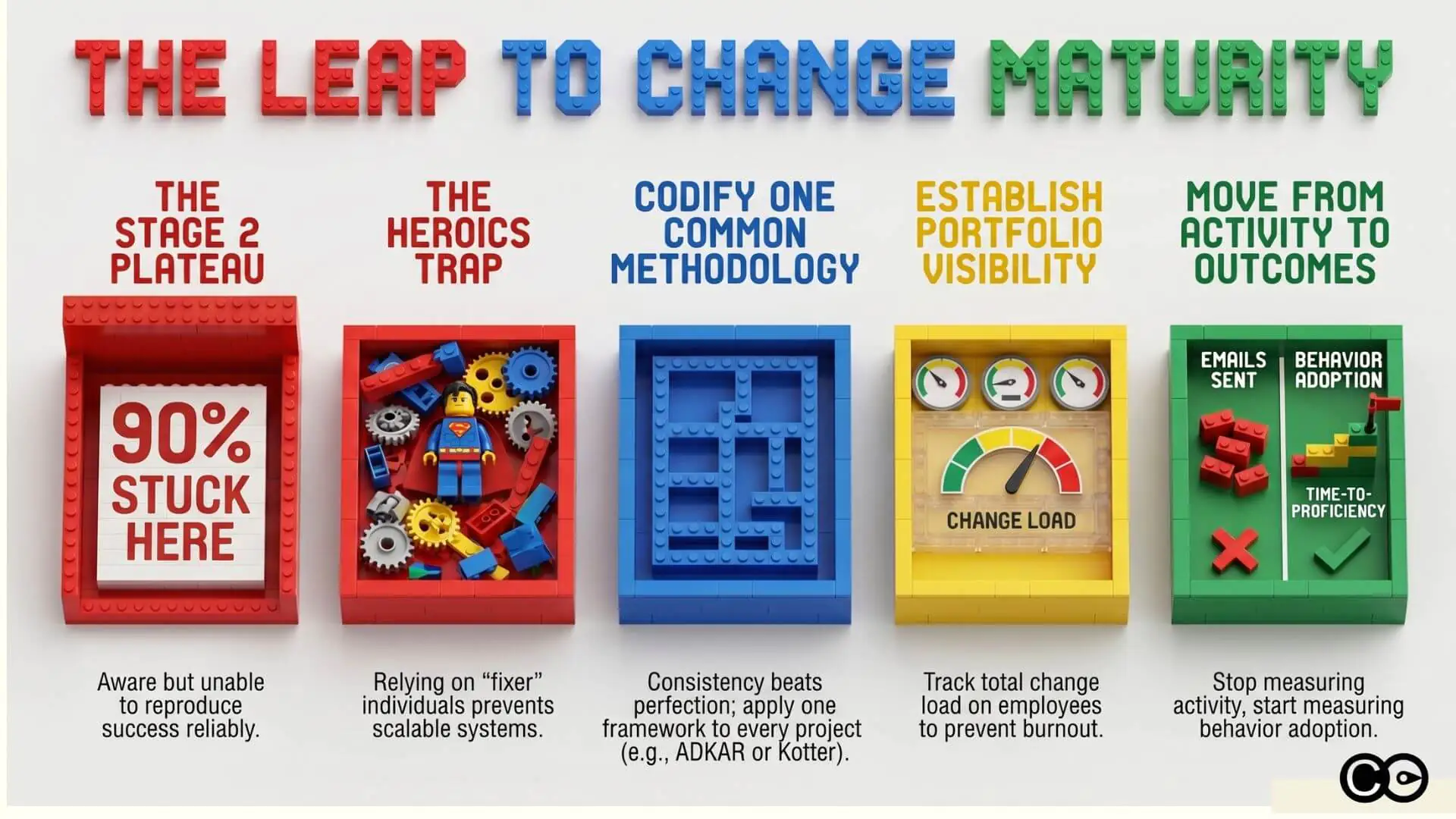
In 2024, Prosci surveyed more than 2,000 change professionals across 85 countries and asked them to place their organisation on a five-stage maturity scale. Only around one in ten reported reaching the top two stages. The overwhelming majority sat at stage 2 or below: aware that change management matters, but unable to deliver it consistently across the portfolio. That finding is not an industry embarrassment. It is a diagnostic. It tells us that awareness of change management is now widespread, but the capability to practise it at scale remains rare.
If your organisation has a handful of trained practitioners, a change framework on SharePoint that nobody fully follows, and a recurring sense that each big transformation is a fresh battle, you are probably at stage 2. That is more common than uncommon. It is also the most frustrating place to be stuck, because you can see the horizon but cannot yet walk toward it. This article maps out the five stages of change management maturity, explains why the jump from stage 2 to stage 3 is the hardest in the model, and gives you a practical playbook for closing the gap.
The five stages of change management maturity
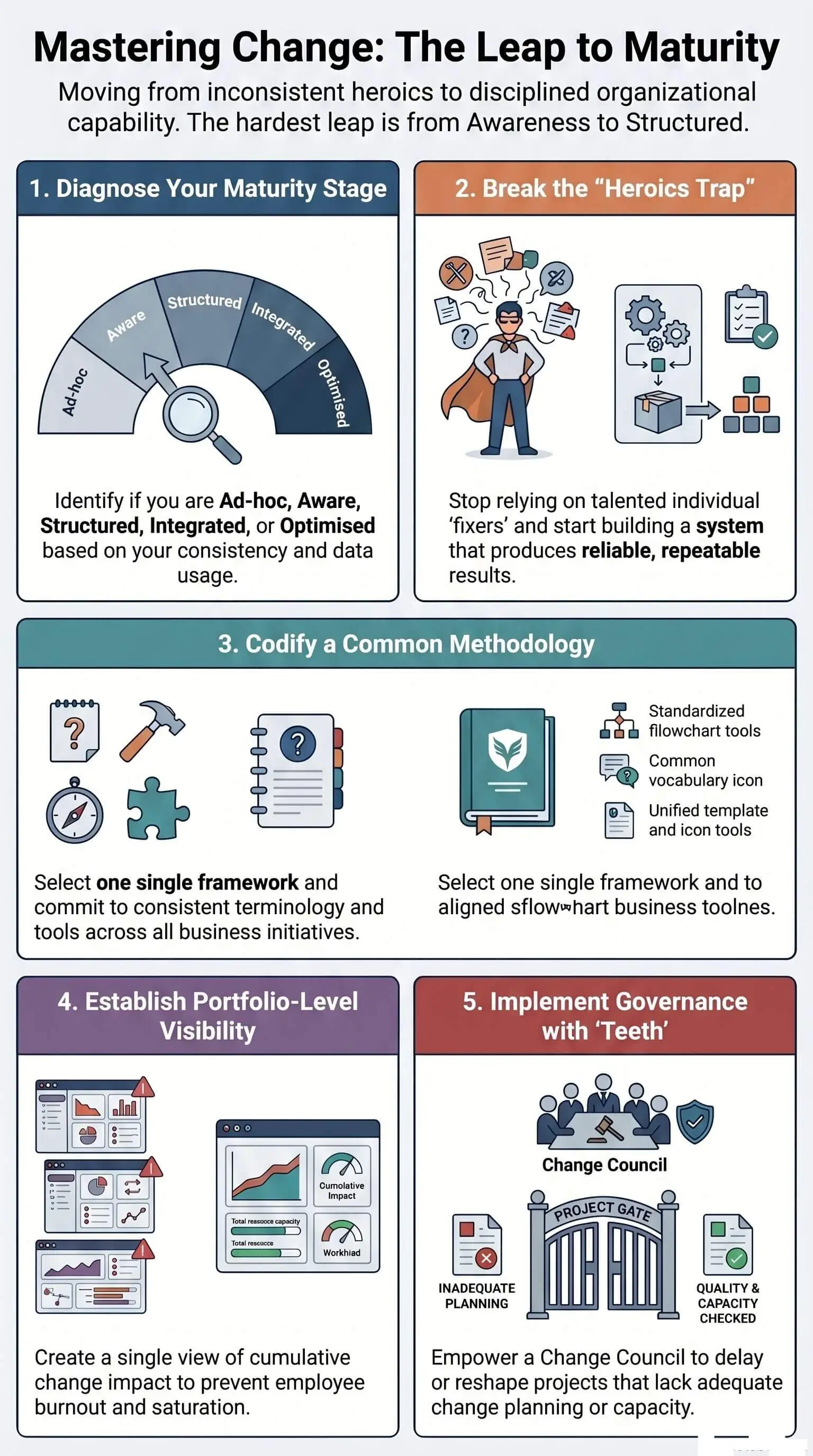
Maturity models for organisational change have been in circulation since the mid-2000s. The Change Management Institute’s Organisational Change Maturity Model and Prosci’s Change Management Maturity Model both describe five stages of evolution, from an ad-hoc, reactive starting point to a fully optimised, continuously improving capability. The terminology varies across frameworks, but the underlying progression is consistent. What matters for practitioners is less the label and more the recognisable symptoms at each stage.
Stage 1: Ad-hoc
At this stage, change management is not a recognised discipline inside the organisation. Projects launch without change plans. Communications are drafted by whoever is free. Training is scheduled the week before go-live, if at all. When a transformation fails, the post-mortem blames “resistance” or “culture” rather than the absence of a deliberate method.
Recognisable symptoms include no dedicated change resources, change activities treated as a side-of-desk workstream of the project manager, no shared vocabulary for change, and executives who use “change management” and “communications” interchangeably. The question “who owns change on this project?” is usually met with a shrug.
Stage 2: Aware
This is where most organisations sit. Leaders recognise that change management is a thing, and a small community of practitioners has emerged, often clustered in HR or the transformation office. Some methodologies are in use, though not consistently. Training is available but rarely mandatory. Individual practitioners deliver strong outcomes on the projects they lead, yet the experience from one programme to the next depends heavily on who happens to be running it.
Recognisable symptoms include pockets of excellence alongside pockets of chaos, debate about which methodology is “best” rather than which one will be adopted, change budgets negotiated project-by-project, and an inability to answer simple questions like “how much change is happening across the business right now?” Stage 2 organisations produce wins, but they cannot reliably reproduce them.
Stage 3: Structured
The organisation has committed to a single methodology, or a small, integrated set, adopts it across most significant initiatives, and invests in a practitioner community that applies it with discipline. Standards exist for stakeholder analysis, impact assessment, communications, training, and readiness. A central function, typically a Change Centre of Excellence, owns the methodology and supports practitioners across the business.
Recognisable symptoms include a defined and taught change methodology, consistent artefacts across initiatives, funded change roles on most major projects, and governance that reviews change plans at key gates rather than waving them through.
Stage 4: Integrated
Change management is embedded in how the organisation runs projects, manages portfolios, and develops its people. Executives expect a change impact assessment alongside a business case. Leaders are held accountable for sponsorship behaviours. A portfolio view of cumulative change impact exists and is actively used to sequence initiatives. Change capability is a line item in leadership development, not an optional extra.
Recognisable symptoms include change language used in the boardroom, change capacity considered during annual planning, leaders coached on sponsorship, and measurable links between change activities and business outcomes.
Stage 5: Optimised
The organisation treats change as a strategic capability and continuously improves how it is delivered. Data is collected across initiatives, benchmarks are tracked over time, and lessons are fed back into the methodology. The organisation is not just good at executing change. It is getting better at it every year, and that improvement is visible in delivery performance and employee experience.
Recognisable symptoms include documented change benchmarks by initiative type, post-implementation reviews that feed back into standards, regular change maturity assessments, and change capability positioned explicitly as a competitive advantage.
How to recognise your current stage
A useful diagnostic is to ask three questions of your most senior business leader, without warning. First, how much change is currently being absorbed by our frontline teams? Second, what method do we use to plan change, and is it the same across all of our major programmes? Third, which initiative that launched in the last twelve months delivered its adoption targets, and how do we know?
If the answers are vague, anecdotal, or contradictory, you are at stage 1 or 2. If the leader can point to a dashboard or methodology document, you are likely at stage 3. If they can describe how the portfolio view shaped a recent sequencing decision, you are at stage 4. If they mention how last year’s benchmarks informed this year’s approach, you are at stage 5.
Change saturation is another reliable tell. Gartner research on employee trust and change fatigue has consistently found that employees in change-saturated organisations are far more likely to report burnout and far less likely to trust their employer. That is a stage 1 or 2 failure mode. Higher-maturity organisations actively manage change load; lower-maturity ones do not realise they can.
Why stage 2 is where most organisations get stuck
Every stage transition in the maturity model has its own difficulty, but moving from stage 2 (aware) to stage 3 (structured) is the hardest leap in the model. It is the transition where the largest number of organisations stall, often for years. Understanding why is the first step to escaping it.
The shift from stage 2 to stage 3 is not really about adding more practitioners or buying more training. It is a shift from individual craft to organisational discipline. Stage 2 rewards talented individuals who deliver change through personal skill, relationships, and force of will. Stage 3 requires a system that produces reliable outcomes regardless of who is running the project. That shift is cultural, structural, and political all at once.
The heroics trap
Stage 2 organisations are often staffed with highly capable change practitioners who have built reputations as fixers. When a programme is in trouble, these individuals are parachuted in. They deliver, usually. That delivery reinforces the belief that the organisation does not need a system, because the system is the person.
The trap is that heroics do not scale, and they do not produce a predictable baseline. A 2023 McKinsey study on transformation performance found that the single strongest predictor of transformation success was not the presence of a brilliant change leader, but the disciplined application of specific practices across the full change lifecycle. Organisations that rely on heroics may succeed more often than they fail, but they cannot explain why. Without that explanation, they cannot teach it, and without teaching it, they cannot move past stage 2.
The investment paradox
The second barrier is financial. Moving from stage 2 to stage 3 requires visible investment: a Change Centre of Excellence, a licensed methodology, tooling, training at scale, and governance forums that consume executive time. The return on that investment is real but indirect. It shows up as fewer botched launches, less rework, faster adoption curves, and higher employee engagement, none of which appears directly on a quarterly earnings slide.
Stage 2 organisations are typically running lean change teams inside larger transformation or HR budgets. Asking for a step change in investment requires a business case, and the evidence for that business case is exactly the kind of structured outcome data that a stage 2 organisation does not yet collect. It is a chicken-and-egg problem that many organisations never resolve.
The middle management wall
The third barrier is cultural. Stage 2 to stage 3 requires middle managers to accept that change work is not optional, not a nice-to-have, and not something that can be delegated downward at the last minute. It requires them to sponsor change actively, to hold their own people accountable for adopting new ways of working, and to accept scrutiny of the change plans on their initiatives.
Deloitte’s ongoing Global Human Capital Trends research has repeatedly found that while most executives rate their organisation’s change capability as “adequate” or better, a much smaller share of middle managers agree. The gap between the executive view and the middle manager experience is widest at stage 2, and it is in that gap that stage 3 reforms either take root or wither.
The reason the stage 2 to stage 3 leap is so hard is that these three barriers are mutually reinforcing. Heroics prevent the data collection needed to justify investment. Lack of investment prevents the governance needed to hold middle managers to account. Unsupported middle managers default to heroics. Breaking the cycle requires a deliberate, coordinated push on all three fronts at once.
Making the leap from aware to structured: a practical playbook
If you have read this far and recognised your organisation, the question becomes what to do about it. The leap from stage 2 to stage 3 is hard, but it is not mysterious. Organisations that have made the transition have done so deliberately, with a small number of focused moves. What follows is a playbook drawn from those patterns.
Codify a common methodology
The first move is the least glamorous and the most important: pick one methodology and commit to it. It does not matter as much as people think whether you choose Prosci’s ADKAR, Kotter’s 8-Step, the Change Management Institute’s Body of Knowledge, or a blended internal approach. It matters enormously that you pick one and apply it consistently.
A useful test: ask five of your change practitioners, independently, how they define “readiness” for a change. If you get five different answers, you do not yet have a methodology. You have five practitioners.
When codifying, include:
A shared vocabulary for core concepts (stakeholder, impact, readiness, adoption, sustainment)
A minimum set of artefacts expected on every significant initiative (stakeholder map, impact assessment, change plan, readiness measure)
Clear handover points between change, project, and business-as-usual teams
A training pathway for practitioners, managers, and executive sponsors
A lightweight exception process for smaller initiatives, so the standard does not become a bureaucracy
Establish portfolio-level visibility
Stage 2 organisations think about change one initiative at a time. Stage 3 organisations start to think at the portfolio level. The single most valuable artefact to introduce during this transition is a view of cumulative change impact on each major business unit or employee group, updated at least monthly.
This view answers the question that stage 2 organisations cannot answer: how much change is landing on this team, from all sources, over the next quarter? Once that question is visible, decisions about sequencing, go-live timing, and realistic adoption expectations become dramatically better. Research published in MIT Sloan Management Review on adaptive organisations found that organisations with portfolio-level change visibility were significantly more likely to hit adoption targets and significantly less likely to report transformation fatigue in employee surveys.
Build governance that holds
Methodology and visibility are necessary but not sufficient. Stage 3 requires governance that actually uses them. In practical terms, this means a Change Council, or equivalent body, that meets monthly, reviews the portfolio view, and has the authority to push back on initiatives that would overload a business unit or launch without adequate change planning.
Governance fails at stage 2 because it is advisory. It works at stage 3 because it has teeth. A concrete test: in the last six months, has any significant initiative been delayed, resequenced, or reshaped because of a change-capacity concern raised through governance? If the answer is no, your governance is not yet doing what it needs to do.
Effective stage 3 governance usually includes:
A senior business owner chairing, not the head of change
Standing membership from each major business unit
A simple, repeatable pack driven by the portfolio view
Explicit decision rights, including the right to delay or reshape initiatives
A feedback loop back to the sponsoring executive of each initiative reviewed
Measure outcomes, not activity
Stage 2 change teams report on activity: communications sent, training sessions run, stakeholders consulted. Stage 3 teams report on outcomes: proportion of employees demonstrating the new behaviour, time-to-proficiency, adoption curves against plan, and business benefits delivered through adoption.
The shift is uncomfortable because outcomes are harder to measure and often reveal uncomfortable truths. But it is the shift that unlocks the investment case. Once you can show the business what adoption is worth, you can have a different conversation about what change capability is worth.
A pragmatic starting point:
Define two or three adoption metrics per major initiative, agreed before launch
Measure readiness before go-live using a consistent instrument across initiatives
Run a post-implementation review that assesses adoption sustainment at the 90-day mark
Feed every post-implementation review into the next methodology iteration
How digital tools accelerate the stage 2 to 3 transition
One of the reasons stage 2 organisations stall is practical, not strategic. The work of maintaining portfolio visibility, tracking change impacts across initiatives, and reporting on readiness across a large organisation is enormously labour-intensive when done in spreadsheets. Many change teams who understand what needs to happen simply cannot sustain the administrative load alongside their delivery commitments.
This is where purpose-built digital change tools make the difference. Platforms like Change Compass provide a single source of truth for change impacts across the portfolio, surface capacity conflicts automatically, and produce the governance artefacts that Change Councils need in order to make real decisions. They do not replace methodology or capability, but they make both of those things visible and operable at scale. For organisations making the leap from stage 2 to stage 3, the right tooling is often the difference between a compelling vision and a working reality.
Where to start this quarter
The leap from aware to structured is a year or two of disciplined work, not a weekend. But you do not need to boil the ocean to start. Pick three moves for the next quarter. Agree on a single methodology for all initiatives launched in the next ninety days. Stand up a basic portfolio view of cumulative change impact, even if the first version is manual. Convene your first Change Council meeting and give it a real decision to make, not a briefing to sit through.
The organisations that break through stage 2 do so because they stop treating change management as a collection of skilled individuals and start treating it as a capability the business owns. That shift is hard, but it is the shift that separates the organisations stuck at stage 2 from the small number who have built something that compounds over time. The work starts with picking one thing, doing it consistently, and refusing to let the heroics model quietly reassert itself the first time delivery pressure rises.
Frequently asked questions
What is a change management maturity model? A change management maturity model is a framework that describes how an organisation’s change capability evolves over time, typically through five stages from ad-hoc to optimised. It is used to diagnose current capability, set improvement targets, and plan the investments required to move between stages. Common examples include the Prosci Change Management Maturity Model and the Change Management Institute’s Organisational Change Maturity Model.
What are the five stages of change management maturity? The five stages are ad-hoc (no recognised discipline), aware (pockets of practice and shared vocabulary), structured (consistent methodology and governance), integrated (change embedded in portfolio and leadership) and optimised (continuous improvement backed by data). Most maturity models align with this progression even when they use different labels for the individual stages.
Why do so many organisations stall at stage 2? Stage 2 organisations recognise the value of change management but have not yet built the systems, governance, and investment required to deliver it consistently. The leap to stage 3 requires moving from individual craft to organisational discipline, which faces three mutually reinforcing barriers: dependence on heroic individuals, difficulty justifying the investment without existing outcome data, and middle management resistance to new accountability.
How long does it take to move from stage 2 to stage 3? Most organisations that successfully make the transition do so over 18 to 24 months of deliberate, sustained effort. The timeline depends on executive sponsorship, the size and complexity of the organisation, and the maturity of adjacent disciplines such as project management and portfolio governance. Attempts to complete the transition in under twelve months rarely stick.
What should a Change Centre of Excellence do? A Change Centre of Excellence owns the methodology, maintains the practitioner community, produces portfolio-level visibility of change impact, and supports governance forums with the data and analysis they need to make decisions. It does not deliver every change initiative directly. It equips the organisation to deliver them consistently.
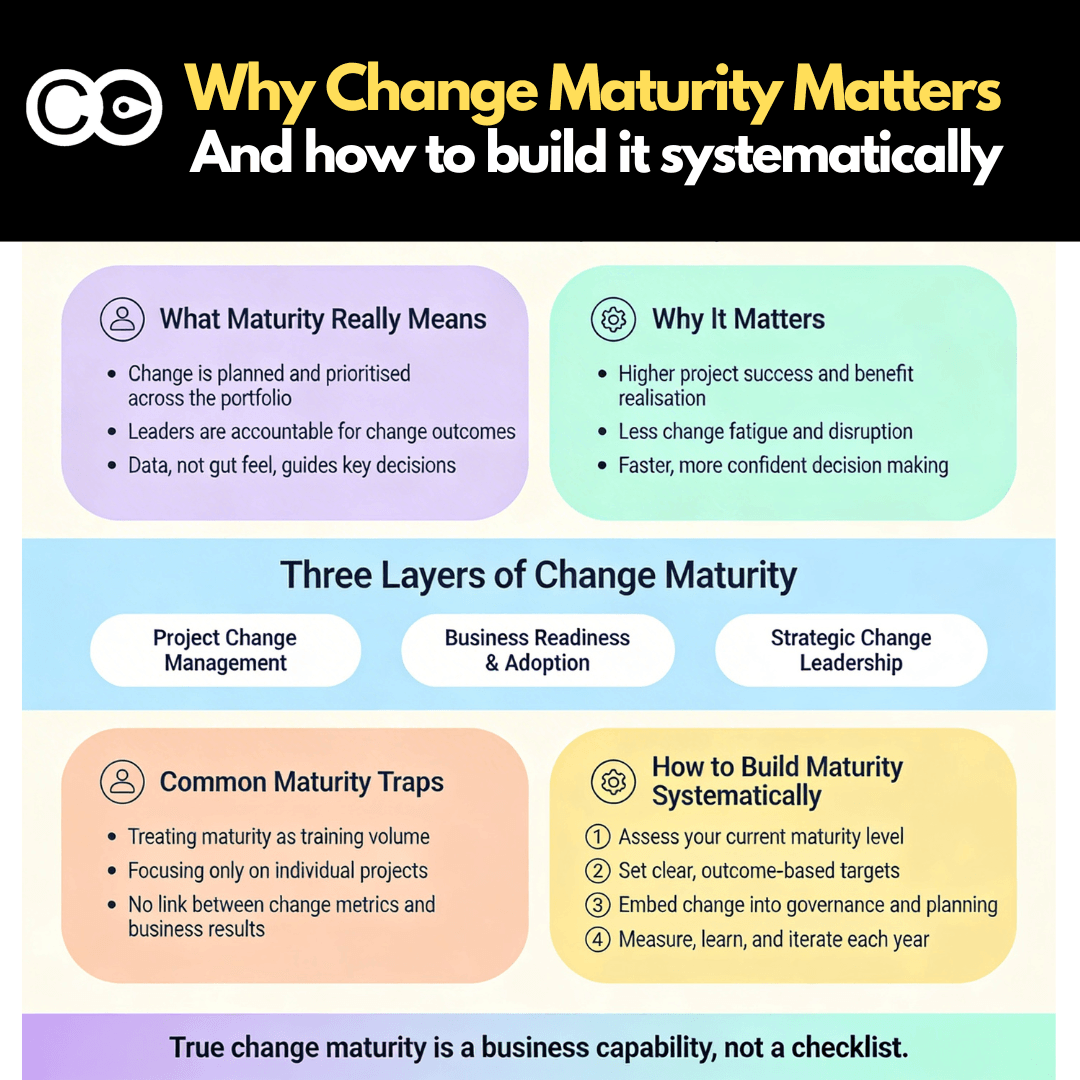
Change management maturity is the degree to which an organisation has institutionalised change capability so it is repeatable, consistent and improving over time, rather than dependent on individual practitioners or isolated programmes. A mature change function has a defined methodology applied across initiatives, embedded practitioners across business units, governance that connects change activity to portfolio decisions, measurement infrastructure that tracks adoption and benefit realisation, and leaders who model the behaviour change required of others. Maturity matters because it is the difference between an organisation that succeeds at change because of who is in role, and one that succeeds because of how it operates.
Most organisations approach change maturity the same way they approach most capability gaps: they send people on training courses, roll out a methodology, and distribute a set of templates. It is a reasonable instinct. But after working with organisations across industries and geographies, a consistent pattern emerges that challenges this assumption. The teams that made the biggest leaps in change maturity were not the ones with the most comprehensive training programmes or the most elaborately designed toolkits. They were the ones who first learned to see the change happening around them.
That distinction matters enormously. Visibility and measurement do something that training alone rarely achieves: they create intrinsic motivation. When a business leader can look at a dashboard and see that their team is absorbing seven concurrent initiatives, the conversation about change management stops being abstract. It becomes urgent, personal, and practical. And organisations that reach that point of urgency tend to improve their change capability faster than any classroom intervention could achieve.
This article makes the case that building genuine change management maturity requires three things working in concert: meaningful visibility of change across the organisation, robust governance structures that bring discipline to how change is planned and sequenced, and a portfolio-level view that treats change capacity as a finite resource to be managed. Training has a role, but it is further down the list than most organisations assume.
The training-and-templates assumption
Ask a senior HR or transformation leader how their organisation is building change capability, and the answer is usually some version of the same story. A cohort of change practitioners has been trained in a recognised methodology, perhaps Prosci’s ADKAR model or Kotter’s eight-step framework. A standard set of templates has been created and made available on an intranet. Sponsor briefings are scheduled. A change network has been formed.
These are not bad things. But they share a common limitation: they treat change management as a skill to be acquired by specialists, rather than as a discipline to be embedded across the business. The result is that change management remains something that happens to business teams rather than something they actively participate in. Leaders nod along to change plans prepared by dedicated practitioners, but rarely feel enough ownership of the data to ask hard questions or push back on the change load being placed on their people.
Prosci’s research across more than 2,600 organisations reveals the cost of this gap. Projects with excellent change management are 88% likely to meet or exceed their objectives. Projects with poor change management: 13%. That is a nearly seven-fold difference in outcomes, driven largely by the quality of how the people side of change is managed. And yet the majority of organisations still treat the methodology as the destination, rather than as a starting point.
The deeper problem is that training programmes and templates are, by design, disconnected from real-time data. They equip people with frameworks for thinking about change. What they do not do is give business teams a clear, current picture of what is actually being asked of their people, how ready those people are for upcoming changes, or whether adoption is actually occurring once changes go live.
What actually accelerates change maturity
Visibility as the first catalyst
The most reliable accelerant for change maturity is the moment a business leader first sees their team’s change load visualised in a meaningful way. Not a list of projects. Not a status report. A genuine picture of cumulative change impact: how many initiatives are hitting which business units, in which timeframes, and what that means for the people doing the day-to-day work.
Something shifts when that visibility arrives. Leaders who previously treated change management as a compliance exercise start asking different questions. How does this new initiative land on top of what my team is already absorbing? Are we sequencing this sensibly? Who is most at risk of overload? What does our readiness data actually show? These are exactly the right questions, and they rarely get asked without data to prompt them.
This matters because sustainable change capability is built on habit and ownership, not on awareness. A business unit leader who has seen the visual representation of their team’s change load, and who has experienced the relief of better sequencing or the cost of poor planning, will prioritise change management in ways that no training course can instil. The motivation is intrinsic, grounded in something they have directly witnessed.
When business teams can see the data, behaviour shifts
The pattern repeats across organisations of different sizes and sectors. Business teams that engage regularly with change impact data, readiness assessments, and adoption tracking begin to mature much faster than teams where change management remains the exclusive domain of the change team. They start using the language. They ask for assessments before agreeing to new project timelines. They flag risks earlier, because the data gives them the language and the evidence to do so.
Readiness data is particularly powerful in this regard. When business leaders can see that their team’s readiness scores are lagging behind the go-live date of a major system change, the conversation about additional support shifts from a change practitioner’s recommendation to a business leader’s decision. That shift in ownership is the difference between change management as a service and change management as a capability.
Adoption metrics complete the picture. Tracking whether people are actually using new systems, following new processes, or behaving differently after a change goes live tells the organisation something that no impact assessment or readiness survey can: whether the change has truly landed. Mature change organisations do not close out initiatives when they go live. They close them out when adoption targets are met.
This is not simply a technology observation. It is a behavioural one. Data creates accountability. When change impact, readiness, and adoption are all visible, the full lifecycle of change becomes manageable rather than aspirational.
What research tells us about mature change organisations
The performance gap is significant
The case for investing in change maturity is not just philosophical. The performance differential between mature and immature change organisations is measurable, and it is substantial.
Prosci’s maturity model research found that more than half of organisations (54%) operate at Level 1 or Level 2 on the five-level maturity scale, meaning change management is either absent, ad hoc, or applied only on isolated projects. Only 11% had reached Level 4 or Level 5, where change management is embedded into organisational standards and has become a genuine organisational competency. The gap between these groups is not marginal: at higher maturity levels, change management occurs across more initiatives, is applied more consistently, and produces significantly better outcomes in terms of benefits realisation and achievement of strategic goals.
McKinsey’s research reinforces this picture. Organisations with excellent change management practices are six times more likely to meet or exceed their performance expectations. The research also found that putting equal emphasis on performance and organisational health during transformations is what separates the 30% success rate from a 79% success rate.
More recently, Deloitte’s research on organisational agility found that organisations leading the way in agility are approximately twice as likely as their peers to report better financial results. Change maturity and organisational agility are not the same thing, but they are deeply connected: an organisation that has built genuine change capability can move faster, absorb more change with less disruption, and recover more quickly when things do not go to plan.
The ability to undergo more rapid change without burning out the workforce is precisely what high-maturity organisations develop. They are not necessarily running more changes. They are running changes better, sequencing them more carefully, tracking readiness more rigorously, and building the organisational muscle to do it repeatedly.
The saturation problem most organisations overlook
One of the most consistent findings in change management research is how severely most organisations underestimate the cumulative burden of change on their people. Prosci’s research found that more than 73% of respondents reported their organisations were near, at, or beyond the saturation point. Yet most change governance conversations focus on individual initiative delivery, not on the total change load being absorbed by any given team or role group.
Change saturation is not simply a question of too many changes happening at once. It is a question of whether the organisation has the structures to see the problem coming, and the authority to do something about it. Without visibility and governance, saturation is invisible until it becomes a crisis. By the time leaders notice the symptoms, including rising resistance, disengagement and initiative stalling, the damage is already done. Readiness scores that were adequate six months earlier have deteriorated. Adoption rates have plateaued. And the change team is firefighting rather than building capability.
The structural foundations of change maturity
Visibility alone is necessary but not sufficient. Organisations that sustain high levels of change maturity over time tend to have three structural elements in place that give their change capability a backbone.
Change governance
Change governance refers to the formal structures, decision rights, and accountability mechanisms that determine how change is planned, approved, and overseen at an organisational level. Without governance, change management remains advisory. Individual practitioners can produce excellent assessments and plans, but if there is no mechanism for those assessments to influence decisions about timelines, sequencing, resourcing, or priority, they sit in folders and gather dust.
Effective change governance typically includes:
An executive-level sponsor or committee with explicit accountability for the change portfolio
A defined escalation path for change conflicts and capacity constraints
Regular rhythms for reviewing the cumulative change load across business units
Clear criteria for what triggers a change impact assessment, a readiness review, or an adoption audit
Governance checkpoints that require adoption evidence before an initiative can be formally closed
Governance does not need to be bureaucratic. But it does need to be real. The organisations that build genuine change maturity are the ones where change governance carries actual weight in project and portfolio decisions.
Business change processes
Alongside governance structures, mature change organisations embed change management into their core business processes rather than treating it as a parallel activity. This means change impact assessment is a standard part of the project initiation process. It means change readiness data is a standing item on portfolio review agendas, not a one-time survey conducted in the final weeks before go-live. It means adoption measurement is built into the benefit realisation framework from the outset, not bolted on after the fact. And it means business unit leaders have a defined role in the change process, not just as recipients of communications but as active participants in planning, readiness tracking, and adoption accountability.
The practical effect of this integration is significant. When business change processes are built into how the organisation already works, change management becomes part of the operating rhythm rather than an add-on. The cognitive load on individual practitioners reduces. Consistency improves. And the organisation begins to build a shared vocabulary around change impact, readiness, and adoption that reaches well beyond the change team.
Change portfolio management as air traffic control
Perhaps the most critical structural element for organisations managing high volumes of concurrent change is the practice of change portfolio management, sometimes described using the air traffic control metaphor. Just as an air traffic control tower tracks all flights in the air and on the ground, managing runway capacity and issuing ground stops when necessary, an effective change portfolio function tracks all active and planned initiatives, assesses their cumulative impact on affected populations, monitors readiness and adoption status across the portfolio, and has the authority to sequence, defer, or prioritise accordingly.
Protiviti’s analysis of change saturation describes this function well: a change management centre of excellence operating like an air traffic control tower, monitoring what is planned, assessing capacity, and implementing “ground stops” on lower-priority projects when the organisation cannot absorb more change. Without this function, competing projects land on the same business units simultaneously, readiness is assumed rather than measured, and adoption rates become a post-project surprise rather than an in-flight metric.
The air traffic control metaphor is useful precisely because it frames change capacity as a finite resource. Runways have limits. So do people. An organisation that treats change capacity as effectively unlimited will consistently over-commit, under-deliver, and wonder why its change programmes keep stalling.
A practical roadmap for building change maturity
Building change maturity is not a linear process, but there is a practical sequence that tends to produce the fastest results. Organisations that skip directly to governance structures without first establishing data visibility often find that governance lacks teeth, because there is nothing concrete for it to act on. Conversely, organisations that invest in visualisation without governance tend to produce interesting data that does not translate into changed behaviour.
A sequenced approach looks like this:
Start with change impact data. Before investing in methodology training or governance frameworks, get a clear picture of the change currently hitting your business. Which teams are most affected? What is the cumulative load across key role groups? This baseline is the foundation for everything that follows.
Add readiness and adoption tracking. Impact data tells you what is coming. Readiness data tells you whether your people are prepared for it. Adoption data tells you whether it has actually taken hold. Building all three into your measurement framework early means you are managing the full change lifecycle, not just the delivery phase.
Make the data visible to business leaders. Do not present change load, readiness, or adoption data only to the change team. Bring it into the room with general managers, operational leaders, and executives. The goal is to create the shared awareness that makes governance conversations real rather than theoretical.
Establish lightweight governance. Once leaders can see the data, the case for governance is self-evident. Start with a simple portfolio review rhythm and clear decision rights for managing conflicts and sequencing. Governance does not need to be complex to be effective.
Embed change into business processes. Identify two or three core business processes, such as project initiation, business case approval, or benefit realisation reviews, and integrate change impact assessment, readiness gates, and adoption milestones into them. This is where change management moves from advisory to mandatory.
Build capability where it is needed most. Only at this point does targeted training become highly effective, because it is being delivered to people who already understand why it matters. Training disconnected from real change context rarely sticks. Training delivered to leaders who are already engaged with impact, readiness, and adoption data lands differently.
Measure and improve. Use your baseline data to track maturity progress over time. Mature organisations treat change capability as a measured outcome, not an aspiration.
How digital tools support the journey
Building the kind of change visibility that accelerates maturity requires more than spreadsheets. Platforms like Change Compass are designed specifically to help organisations aggregate change impact data across initiatives, visualise the cumulative load on business units and role groups, and track readiness and adoption in a single portfolio view. When business leaders can see a real-time picture of what their teams are absorbing, how prepared they are, and whether previous changes have genuinely been adopted, the conversations about sequencing, prioritisation, and capacity shift from abstract to concrete. That shift, from gut feel to governed data, is often the turning point in an organisation’s maturity journey.
Where the journey actually starts
The organisations that build genuine change management maturity are not necessarily the ones with the most comprehensive training programmes or the most sophisticated methodologies. They are the ones that first make change visible across its full lifecycle, from impact through to readiness and adoption, then put governance structures in place to act on what they see, and then build the portfolio management discipline to treat change capacity as something to be managed deliberately rather than consumed carelessly.
The research is clear: mature change organisations outperform their peers significantly, can absorb more change with less disruption, and are far more likely to achieve the outcomes their transformation programmes set out to deliver. The path to that level of maturity is more practical than most organisations expect. It starts not with a training calendar, but with a dashboard.
What is change management maturity? Change management maturity refers to how consistently and effectively an organisation applies change management principles, processes, and governance across its initiatives. Prosci’s five-level maturity model ranges from Level 1 (absent or ad hoc) to Level 5 (organisational competency), where change management is a strategic capability embedded across the enterprise. Mature organisations apply change management systematically across impact, readiness, and adoption, not just on high-profile projects and not just during the delivery phase.
How does change management maturity affect business performance? The performance evidence is significant. Prosci’s research shows that projects with excellent change management are nearly seven times more likely to meet their objectives than those with poor change management. McKinsey’s research found that organisations with strong change capabilities are six times more likely to outperform their peers. At an organisational level, greater maturity translates directly into higher transformation success rates, better adoption outcomes, and faster realisation of strategic benefits.
What is change portfolio management and why does it matter? Change portfolio management is the practice of tracking and coordinating all active and planned change initiatives across an organisation, assessing their cumulative impact on affected teams, monitoring readiness and adoption across the portfolio, and sequencing them to prevent saturation and conflict. It is sometimes described using the air traffic control metaphor: like managing runway capacity, it ensures initiatives land without collision. More than 73% of organisations are operating at or near change saturation, which makes portfolio management one of the highest-leverage investments a mature change function can make.
What is the difference between change readiness and change adoption? Readiness measures whether people have the awareness, knowledge, and capability to change before a go-live event. Adoption measures whether they are actually using new ways of working after it. Both matter, and both are frequently under-measured. Organisations that track only readiness often mistake pre-launch preparation for sustained behaviour change. Organisations that track only adoption often find that poor readiness caused the low adoption rates they are now scrambling to fix. Mature change organisations track both, sequentially and in relation to each other.
What is the fastest way to build change management maturity? Based on observed patterns and available research, the fastest path to maturity begins with making change visible to business leaders across its full lifecycle, covering impact, readiness, and adoption, rather than starting with training. When leaders can see concrete data on what their teams are absorbing and whether change is actually sticking, they develop an intrinsic motivation to manage it better. Governance structures and embedded business processes then give that motivation a formal channel. Targeted capability building is more effective once leaders already understand why it matters.
Diagnosing change resistance is the practice of working past the most visible symptoms to identify the actual structural, behavioural or environmental cause that is blocking adoption. Surface-level blockers, such as low attendance at training or complaints in town halls, are usually downstream effects of deeper causes: unclear sponsorship, competing operational pressures, undisclosed scepticism about the business case, or a previous change that left scar tissue. A layer-by-layer diagnostic method asks “what is causing this” repeatedly until the answer points to something the change team can actually act on. Without this discipline, change interventions end up addressing symptoms while the root cause continues to derail adoption.
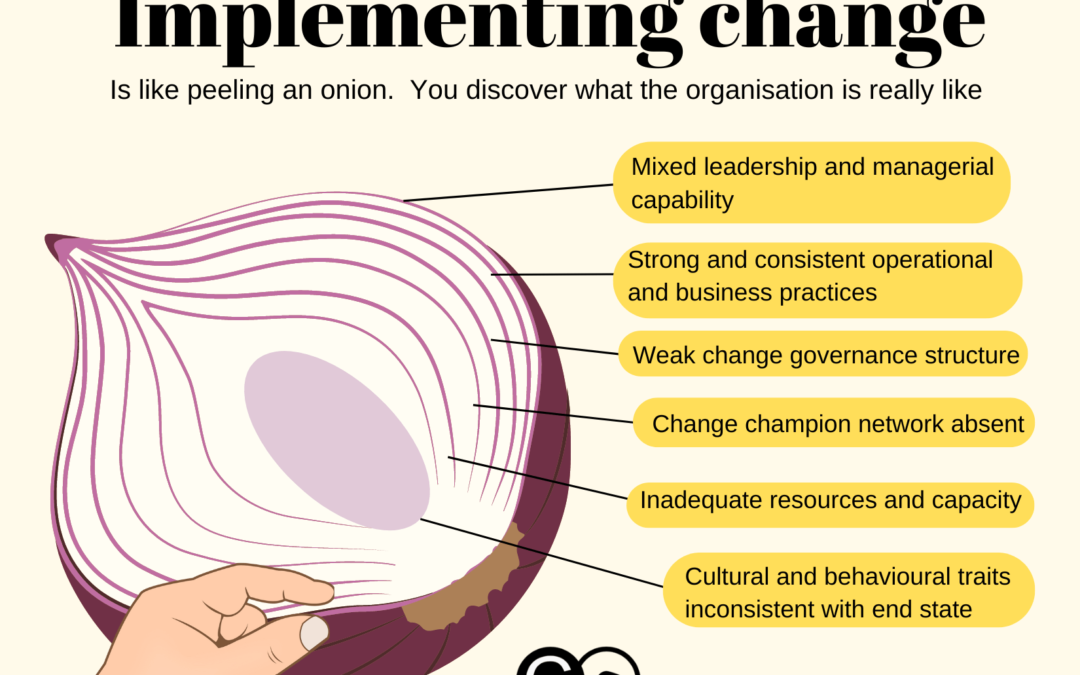
Change management, much like peeling an onion, involves uncovering multiple layers before reaching the core. Each layer peeled back in the journey of planning and implementing change reveals new insights about the organization and the stakeholders impacted by the change. This process is essential to understanding the full scope of the change, adapting strategies accordingly, and ensuring successful implementation. By examining the various facets of an organization, such as leadership capability, operational practices, and cultural traits, we can better navigate the complexities of change management. Let’s explore the analogy of peeling an onion in change management and some practical insights for transforming change outcomes.
What is the peeling the onion protocol and how does it work?
The Peeling the Onion Protocol is a change management strategy that involves gradually uncovering layers of resistance within an organization. By systematically addressing concerns and facilitating open dialogue, this protocol fosters understanding and acceptance of change, ultimately leading to smoother transitions and enhanced collaboration among team members.
Peeling the layers – each layer reveals a different facet of the organisation and how they may or may not be conducive to supporting the change. Here are some ‘layers’ you may want to examine.
Leadership and Managerial Capability in Managing Change
Effective change management begins with strong leadership. Leaders and managers play a crucial role in guiding the organization through the transition. Peeling back this layer reveals whether leaders are equipped with the necessary skills, knowledge, and attitudes to drive change. It also highlights their ability to inspire and mobilize their teams, communicate the vision effectively, and manage resistance. Assessing leadership capability is fundamental, as inadequate leadership can hinder the entire change process.
Operational and Business Practices
The next layer involves examining the organization’s operational and business practices. This includes evaluating current workflows, processes, and systems to identify areas that may need adjustment or improvement. Understanding how daily operations align with the proposed changes helps in anticipating potential disruptions and devising strategies to minimize them. Are existing practices consistent with the end state of the change? Are existing practices consistent? (or NA?) Why or why not? This layer also involves identifying key performance indicators (KPIs) that can measure the success of the change initiatives (https://thechangecompass.com/how-to-manage-a-multitude-of-change-initiatives-including-enterprise-wide/).
Change Governance Practices and Structure
Change governance refers to the frameworks and structures in place to manage and oversee change initiatives. Having the right governance structure ensures that the right oversight and decision making is setup to steer the change to success. Peeling back this layer involves assessing the effectiveness of existing governance mechanisms, such as steering committees, decision-making protocols, and accountability structures. Strong change governance ensures that change initiatives are well-coordinated, resources are allocated appropriately, and progress is monitored consistently. Weak governance, on the other hand, can lead to confusion, misalignment, and failure to achieve desired outcomes.
Key questions to ask here include such as:
Is there sufficient governance bodies in place at different levels of the organisation to support change?
Are there too many governance bodies?
Are decision-making processes clear and effective?
Are the right stakeholders involved in the relevant decision-making areas?
Engagement Channels
Effective engagement is critical in change management. This is more than just communication. This layer focuses on the channels and methods used to engage with stakeholders throughout the change process. Evaluating engagement channels helps in understanding how information is disseminated, feedback is collected, and concerns are addressed. It also highlights the effectiveness of internal communications and the role of external communications in managing stakeholder expectations and perceptions. What channels are most effective for what audience groups? Are there any gaps for engaging with all groups of stakeholders? (beyond just blasting emails or messages).
Change Champion Network
Change champions are resignated individuals within the organization who advocate for and support the change initiatives. Peeling back this layer involves identifying and empowering these champions. It also includes assessing their influence, credibility, and ability to motivate others. A strong network of change champions can facilitate smoother transitions by promoting buy-in, addressing resistance, and reinforcing positive behaviors. With the right nurturing and experience, an organisation-wide changechampion network can act to support a myriad of change initiatives.
System and Process Maturity
The maturity of systems and processes within an organization significantly impacts the success of change initiatives. This layer involves evaluating the current state of technological systems, process automation, and data management practices. Mature systems and processes provide a solid foundation for implementing changes efficiently and effectively. Conversely, immature systems may require significant upgrades or overhauls to support the desired changes.
Change Management Maturity
Change management maturity refers to the organization’s overall capability to manage change. Peeling back this layer involves assessing the maturity of change management practices, methodologies, and tools. Organizations with mature change management capabilities have established frameworks, experienced practitioners, and a culture that embraces change. In contrast, organizations with low maturity may struggle with inconsistencies, resistance, and a lack of structured approaches.
This layer examines the availability of resources and capacity to support change initiatives. It includes assessing the organization’s financial resources, human capital, and physical infrastructure. Adequate resources and capacity are essential for executing change plans, overcoming obstacles, and sustaining momentum. Insufficient resources can lead to delays, reduced quality, and increased stress on employees. This does not just include the resources required within the project itself, it points more to the impacted stakeholders and if they have the resources and capacity required to undergo the change.
Culture and Behavioral Traits
Organizational culture and behavioral traits play a significant role in how change is perceived and adopted. Peeling back this layer involves understanding the underlying values, beliefs, and behaviors that influence how employees respond to change. It also includes identifying cultural strengths that can be leveraged and cultural barriers that need to be addressed. A supportive culture fosters resilience, adaptability, and a positive attitude towards change.
Specifically:
Do existing behaviours and practices support the change end state?
Are there potentially inconsistent behaviours comparing the end state and the current state?
Beyond the specific behaviours required in the change initiative itself, how are these in alignment with broader cultural practices?
Key Takeaways from the Onion Analogy in Change Management
1. Each Layer Needs to Be Peeled Before Another Layer Can Be Peeled
The process of discovering and understanding the complexities of change cannot be rushed. Each layer provides valuable insights and learning opportunities that prepare the organization for the next layer of discovery. Skipping layers or rushing through the process can lead to incomplete assessments, overlooked challenges, and ineffective solutions. Patience and persistence are crucial for a thorough and successful change management journey.
Assessing and understanding each layer can take time. Data, both quantitative and qualitative, may be required to truly understand what each layer means and how it implicates the change.
2. How the Onion Appears May Not Be What It Is at Its Core
Initial perceptions of the organization may not reflect its true state. It takes time and effort to uncover the deeper issues, strengths, and opportunities. This requires a willingness to look beyond surface-level indicators and delve into the core aspects of the organization. Attention to detail and a commitment to uncovering the truth are essential for developing accurate and effective change strategies.
For example:
Are publically communicated and reinforced messages acted on?
Do leaders practice what they preach?
Do stakeholders commit to decisions already made? Or do they ignore it?
Is there clear alignment between different layers of the organisation? How is this done?
3. You May Discover Rotten Parts That Need to Be Replaced
During the process of peeling back layers, you may encounter parts of the organization that are severely inadequate or dysfunctional. These “rotten” parts may need to be replaced or significantly improved before the change can proceed. This could involve overhauling critical capabilities, restructuring teams, or implementing new systems. Recognizing and addressing these issues promptly is essential for ensuring the overall health and success of the organization.
You may find, for example:
Stakeholders that are adamant to block the change for various reasons
Teams that simply do not have the right skills or attitude to transition to the required state
Processes that are simply outdated or convoluted, so much that end state targets cannot be achieved
Systems that are outdated and do not provide the right insights to support the end state
4. Different Types of Onions and Organizations
Just as there are different types of onions, organizations vary in size, complexity, and nature. Assessing the complexity of the change at the outset helps in determining the time, effort, and resources required to peel back the layers. A comprehensive understanding of the organization’s unique characteristics allows for tailored change management strategies that address specific needs and challenges.
Practical Steps for Applying the Onion Analogy in Change Management
Step 1: Initial Assessment and Planning
Begin by conducting a thorough initial assessment of the organization. This involves gathering data, engaging with key stakeholders, and understanding the current state of affairs. Develop a comprehensive change management plan that outlines the objectives, scope, and timelines for each layer of the onion. This plan should also identify key metrics for measuring success and mechanisms for tracking progress.
Step 2: Assess Leadership and Managerial Capability
Evaluate the capability of leaders and managers to drive change. This includes assessing their skills, experience, and attitudes towards change. Provide training and support where needed to enhance their ability to lead effectively. Strong leadership is foundational to the success of any change initiative.
Step 3: Examine Operational and Business Practices
Analyze current workflows, processes, and systems to identify areas that may require adjustment. Engage with employees at all levels to gather insights and understand potential bottlenecks. Develop strategies to streamline operations and ensure alignment with the change objectives.
Step 4: Review Change Governance Practices
Assess the existing governance structures and practices in place to manage change initiatives. Ensure that there are clear decision-making protocols, accountability mechanisms, and regular progress reviews. Strengthen governance frameworks as needed to support effective change management.
Step 5: Evaluate Engagement Channels
Review the channels and methods used to communicate with stakeholders. Ensure that there are effective mechanisms for disseminating information, collecting feedback, and addressing concerns. Enhance engagement strategies to foster transparency, trust, and collaboration.
Step 6: Identify and Empower Change Champions
Identify individuals within the organization who can serve as change champions. Empower them with the necessary tools, resources, and support to advocate for the change initiatives. Leverage their influence and credibility to promote buy-in and address resistance.
Step 7: Assess System and Process Maturity
Evaluate the maturity of technological systems and processes. Identify areas that require upgrades or improvements to support the change. Invest in the necessary infrastructure and tools to ensure seamless implementation.
Step 8: Assess Change Management Maturity
Conduct a maturity assessment of the organization’s change management capabilities. Identify gaps and areas for improvement. Develop and implement strategies to enhance change management practices, methodologies, and tools.
Step 9: Review Resources and Capacity
Evaluate the availability of resources and capacity to support the change initiatives. Ensure that there are adequate financial, human, and physical resources to execute the change plans. Address any resource constraints proactively to prevent delays and disruptions.
Step 10: Understand Culture and Behavioral Traits
Conduct a cultural assessment to understand the underlying values, beliefs, and behaviors that influence how employees respond to change. Identify cultural strengths that can be leveraged and barriers that need to be addressed. Develop strategies to foster a supportive culture that embraces change.
The analogy of peeling an onion provides a powerful framework for understanding and managing change within an organization. Each layer peeled back reveals new insights and learning opportunities that are essential for successful change management. By carefully examining the various facets of the organization, such as leadership capability, operational practices, and cultural traits, organizations can navigate the complexities of change more effectively.
Patience, persistence, and attention to detail are key to uncovering the true state of the organization and developing tailored strategies that address specific needs and challenges. Ultimately, the journey of peeling the onion in change management leads to a deeper understanding, better preparation, and more successful change outcomes.