We sat down with change whiz Ben Szonyi to understand his journey in deriving one view of change.
Ben is a senior change leader with extensive business improvement experience across the globe. Ben has also held program change lead roles, most recently at Bupa, where he was accountable for designing and delivering large scale, operating model change programs, which included introducing an enterprise view of change to enable strategic planning and decision-making.
Ben, tell us about what started the journey to derive the one view of change at Bupa? What was the pain you were trying to solve?
The main trigger for requiring an enterprise view of change was that the anecdotal evidence was suggesting our people were feeling change fatigue due to a large number of disassociated projects in train or on the roadmap, yet the impact on our people wasn’t a key criteria in the decision making process. To solve this we initially tried simple techniques like graphically displaying the projects we were running centrally from a program office on a Gannt style plan, however this didn’t enable us to see the change programs the business were doing to themselves. This meant at no point in time did we understood the current or future collective impact our people were facing, meaning we were at risk of overloading and ultimately failing to deliver the expected outcomes.
What process did you guys go through?
The first key step was gaining buy-in from our executive committees for the need to change.
Next, once we diagnosed the challenge outlined above, we went about investigating internal and external options for providing an enterprise view of change that also aligned to ur new change management framework.Our ideal solution was to include not only change impacts but also our peoples’ change readiness and not duplicate what was presented in existing PMO reports. Unfortunately we were not able to find this solution at the time and as a result put our focus into a pragmatic and viable internal solution that leveraged existing tools, i.e. SharePoint and MS Power BI.The idea was that once we had an internal solution made and the right operating model to support it, we would investigate more robust external solutions.
What worked well and met the business needs?
The part that worked best from an internal solution was leveraging existing tools meant people were familiar with them and they were cost effective.This also meant we had the ability to continually improve after each iteration based on the feedback of the users.
The other success was the buy-in from our business partners who were very responsive when it came to providing their data points and utilization of the reports.
What didn’t go so well?
The biggest challenge was gaining buy-in from the internal change team when it came to entering the baseline data (e.g. initiative, impact level by business area and key dates) from their detail change impact assessments as they didn’t see the benefit to them. Once they understood the benefit was for their business stakeholders, they started to get onboard.
Was there anything personally challenging from your perspective?
The most challenging aspect was the time and effort each month to run it, mainly the chasing of data and the manual effort to generate the extracts, load, analyse and report.
If you had to advise others who are about to take a similar journey what would you recommend?
With more developed products in the market now like The Change Compass, if I had my time again I would partner with one of these companies to not only get an off the shelf solution but also one that has learnt from other organisations’ mistakes. This would also mean that you could have a more automated solution.Also, don’t underestimate the time and effort required to gain buy-in from not only your stakeholders, but also your change managers/ agents by ensuring you have a clear WIIFM story.
Based on your experience, what do you see to be the next phase of development for change management?
After working in Marketing more recently, I feel that the key for change management is to treat change initiatives like marketing campaigns where you are clear about the target audience, their needs and measurable outcomes by use of data and a continuous improvement approach.The more we can make change a science and not just an art, we will gain more respect from our stakeholders by demonstrable positive impact.
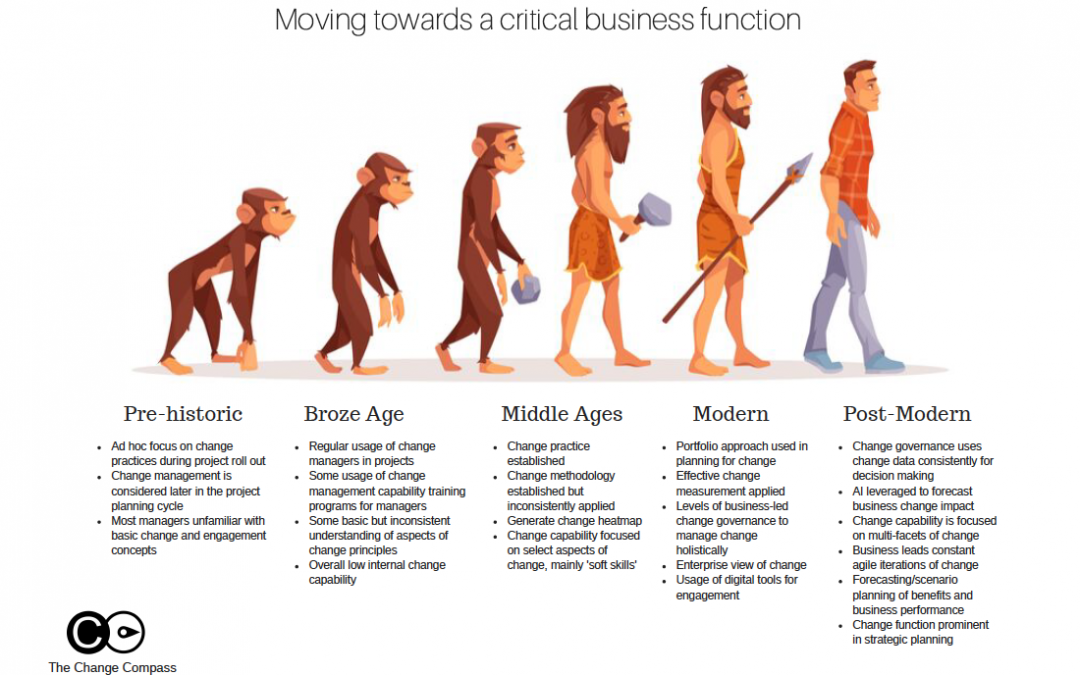
Change management has transformed dramatically over decades, evolving from reactive crisis responses to sophisticated, data-driven strategies that predict and shape organizational transformation. Understanding this evolution equips practitioners with insights to navigate modern complexities like digital acceleration, regulatory pressures, and workforce expectations.
This guide traces key milestones in change management development, examines the shift toward strategic data integration, and explores emerging AI-driven capabilities that redefine practitioner roles. Practitioners gain practical frameworks to apply these insights in today’s fast-paced environments.
How Has Change Management Evolved Over Time?
Change management began as structured responses to organizational disruption but matured into proactive disciplines leveraging data and technology. Early approaches focused on resistance management; modern practices emphasize prediction, measurement, and continuous adaptation.
Key evolutionary phases include:
1950s-1970s: Foundations in Behavioural Science Kurt Lewin’s three-stage model (unfreeze-change-refreeze) established foundational principles. Focus remained on human psychology and overcoming resistance through communication.
1980s-1990s: Structured Frameworks Emerge John Kotter’s 8-step process and Prosci’s ADKAR model provided systematic approaches. Emphasis shifted to leadership alignment and stakeholder engagement.
2000s: Enterprise Integration Change management embedded within project management methodologies like PMI and Agile. Organizations recognized change as a distinct discipline requiring dedicated resources.
2010s-Present: Data and Analytics Integration Rise of change portfolio management and adoption metrics tracking. Practitioners began measuring outcomes beyond activities, using dashboards for real-time insights.
This progression reflects growing recognition that successful change requires both human-centered approaches and rigorous measurement.
What Drove the Shift to Strategic Change Management?
Several forces accelerated change management’s maturation:
Digital Transformation Pressures
Rapid technology adoption created simultaneous change waves across organizations. Traditional sequential change approaches proved inadequate for multi-project environments.
Regulatory and Compliance Demands
Increasing scrutiny required demonstrable evidence of change adoption and risk mitigation, pushing practitioners toward measurable outcomes.
Workforce Expectations
Millennial and Gen Z entrants demanded transparency, purpose alignment, and visible progress tracking in change initiatives.
Portfolio Complexity
Organizations managing 10+ concurrent changes needed centralized oversight, leading to change portfolio management practices.
Measurement Maturity
Advancements in HR analytics and adoption metrics enabled practitioners to demonstrate ROI and secure executive support.
These pressures transformed change management from a support function to a strategic capability directly influencing business outcomes.
The Rise of Data-Driven Change Management
Modern change management integrates operational data, adoption metrics, and predictive analytics to guide decision-making.
Strategic Change Data Management
Organizations now maintain centralized repositories tracking change saturation, adoption rates, and portfolio capacity. This enables executives to balance change demands against organizational readiness.
Data reveals change overlaps, capacity constraints, and high-risk initiatives. Practitioners allocate resources strategically rather than reactively.
Predictive Capacity Planning
Analytics forecast change bandwidth by department and role, preventing saturation and burnout during transformation waves.
This data foundation positions change management as a value-creating function rather than cost centre.
Implementation Frameworks and Best Practices in Modern Change Management
With the evolution of change management into a data-driven discipline, implementation frameworks have also advanced to incorporate strategic alignment, measurement, and agility.
Established Frameworks Adapted for Today’s Environment
Kotter’s 8-Step Process
This enduring framework continues to provide a roadmap for leading change, emphasising urgency creation, coalition building, vision communication, and consolidation of gains. Modern adaptations integrate data points at each step to monitor engagement and effectiveness.
Prosci ADKAR Model
The ADKAR model—Awareness, Desire, Knowledge, Ability, Reinforcement—remains influential for individual change adoption. Data from assessments aligned to each dimension now inform targeted interventions.
Agile Change Management
Agile methodologies bring iterative feedback loops and rapid adaptation, suited for fluid business environments. Incorporating continuous data collection and analytics allows agile teams to pivot change strategies responsively.
Emerging Best Practices
Integrate Change Management Early in Project Lifecycles: Position change activities alongside project planning for seamless alignment and impact maximisation.
Embed Data Streams for Real-Time Insights: Utilise adoption metrics, sentiment analysis, and feedback channels to guide decision-making dynamically.
Foster Cross-Functional Collaboration: Engage stakeholders and change agents across departments to build collective ownership.
Leverage Technology for Automation: Automate repetitive change management tasks such as communications, survey distribution, and reporting, freeing capacity for strategic priorities.
Prioritise Employee Experience: Tailor change approaches to diverse workforce needs, using data-driven personas and segmentation.
The Role of AI and Automation in Advancing Change Management
Artificial intelligence and automation are set to redefine how change practitioners operate, transforming strategic decision-making, engagement, and measurement.
AI-Powered Predictive Analytics
By analysing historic change data combined with organisational variables, AI models predict likely resistance points, adoption rates, and saturation thresholds. These insights enable pre-emptive strategies designed to smooth transitions.
Automated Change Interventions
Chatbots and virtual assistants can deliver personalised communications, FAQs, and training modules at scale, maintaining consistent messaging and freeing practitioners’ time for higher-value activities.
Natural Language Processing (NLP) for Sentiment and Feedback Analysis
AI-driven sentiment analysis of employee feedback, surveys, and collaboration platforms identifies emerging issues and morale trends faster than traditional methods.
Intelligent Dashboarding
AI enhances dashboards by correlating disparate data, highlighting risks, and recommending intervention actions. Customisable alerts notify change leaders of critical deviations in real time.
Augmented Decision Support
Machine learning integrates diverse inputs—financial, operational, human factors—to support scenario planning and optimise change portfolios, particularly in complex environments.
Preparing Change Practitioners for the Future
The evolving change landscape requires practitioners to blend traditional soft skills with digital and analytical capabilities. Key skill enhancements include:
Continuous learning mindsets to adapt as technologies evolve.
Institutions and organisations should invest in upskilling programs and knowledge hubs supporting these competencies.
Key Takeaways for Change Practitioners
The evolution of change management offers clear guidance for practitioners navigating today’s complex landscape:
Embrace Data as a Strategic Asset
Shift from activity tracking to outcome measurement. Implement real-time adoption dashboards that correlate behaviours with business results, enabling proactive interventions.
Master Portfolio Management Discipline
Treat change as a finite resource. Establish governance processes to assess saturation, prioritise initiatives, and sequence delivery for maximum organisational capacity.
Build Cross-Functional Change Capabilities
Move beyond siloed project support. Embed change expertise within strategy, digital transformation, and HR functions for integrated execution.
Cultivate Continuous Learning Cultures
Position change practitioners as organisational learning facilitators. Use post-initiative reviews and trend analysis to build institutional knowledge.
Emerging Capabilities for Practitioners
AI-Augmented Decision Making
Leverage predictive models to forecast adoption risks and capacity constraints. Use sentiment analysis across communication channels to detect resistance patterns early.
Automation of Change Operations
Streamline repetitive tasks—status reporting, stakeholder mapping, communication scheduling—freeing capacity for strategic advisory roles.
Advanced Measurement Frameworks
Combine traditional metrics with micro-behaviour tracking and network analysis to understand influence patterns and adoption cascades.
Implementation Roadmap for Practitioners
Phase 1: Assessment and Foundation (0-3 Months)
Conduct change maturity assessment across frameworks and capabilities
Establish baseline adoption metrics for current portfolio
Map organisational change capacity by department and role
Build cross-functional change governance council
Phase 2: Data Integration and Optimisation (3-6 Months)
Deploy centralised change portfolio tracking system
Implement real-time dashboards with automated alerts
Launch pilot AI sentiment analysis on feedback channels
Standardise post-change review processes
Phase 3: Strategic Evolution (6-12 Months)
Embed predictive capacity planning in annual cycles
Scale successful automation across enterprise initiatives
Develop practitioner upskilling academy
Establish external benchmarking partnerships
Frequently Asked Questions (FAQ)
How has change management fundamentally evolved? From reactive resistance management to proactive, data-driven portfolio disciplines that predict capacity and measure sustainable adoption.
What are the most important data capabilities for change practitioners? Real-time adoption tracking, portfolio saturation analysis, predictive capacity modelling, and cross-initiative impact correlation.
How should organisations structure change governance? Cross-functional councils with executive sponsorship, portfolio prioritisation processes, and dedicated measurement functions.
What skills will define future change practitioners? Data analytics proficiency, AI tool fluency, portfolio strategy, systems thinking, and continuous learning facilitation.
Why is change portfolio management mission-critical now? Concurrent digital, regulatory, and cultural transformations overwhelm traditional approaches. Portfolio discipline prevents saturation and maximises ROI.
How do AI capabilities enhance change effectiveness? Predictive risk modelling, automated stakeholder engagement, real-time sentiment tracking, and intelligent resource allocation recommendations.
Organisational change has never been more relentless. Mergers, digital transformations, regulatory shifts, workforce restructuring and the ongoing pressure to do more with less mean that most large organisations are managing multiple significant changes simultaneously at any given time. Yet despite this reality, many organisations still treat change management as a project-level activity – something mobilised when a specific initiative demands it and wound down once the go-live milestone passes. The result is a cycle of reactive change management that exhausts people, produces inconsistent outcomes and fails to build lasting capability.
Change maturity describes the degree to which an organisation has embedded disciplined, data-informed change practices into its operating model. Mature organisations do not simply respond to change – they anticipate it, sequence it intelligently, resource it appropriately and learn from it systematically. Research from Prosci consistently shows that organisations at higher levels of change maturity achieve significantly better project outcomes, including higher adoption rates, lower rates of employee resistance and stronger return on investment from transformation programmes.
The gap between reactive and mature change management is not primarily a gap in methodology knowledge – most organisations have access to frameworks like ADKAR or Kotter’s 8 Steps. The real gap is in data, visibility and organisational infrastructure. Without a clear picture of the volume, timing and cumulative impact of change across the enterprise, even the best methodology cannot be applied effectively. This is precisely where The Change Compass operates as a strategic enabler.
Change maturity is not a single capability – it is a multi-dimensional state that spans leadership, governance, planning, execution and learning. A mature change organisation has clarity on what changes are in flight across the enterprise at any given time, how those changes interact and compete for the same people and the same attention. It has leaders who understand their role in sponsoring change, not just approving it. It has project teams that apply change management with rigour, not as an afterthought. And it has a mechanism for continuously improving its approach based on evidence, not anecdote.
Gartner research has highlighted that a majority of change initiatives fail to achieve their intended outcomes not because of technical failure but because of people-related factors – insufficient preparation, poor communication and inadequate leadership alignment. These are precisely the factors that an organisation with genuine change maturity addresses proactively. McKinsey analysis similarly finds that organisations with strong change management capabilities are 3.5 times more likely to outperform their peers in major transformation programmes (McKinsey, 2018).
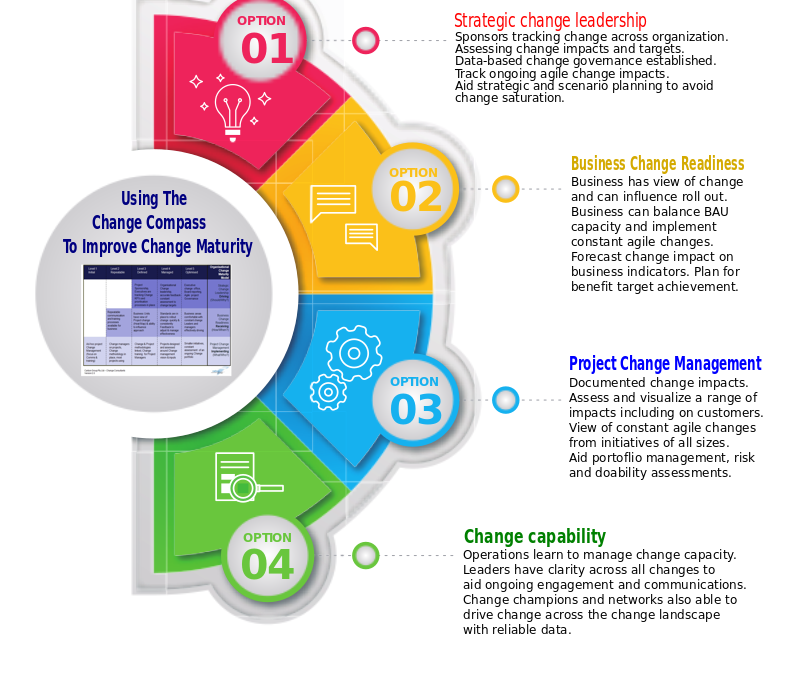
The Change Compass supports maturity development across five interconnected focus areas: strategic change leadership, business change readiness, project change management, building organisation-wide change capability, and continuous improvement and learning from change. Each area represents a distinct dimension of maturity, and progress in one area reinforces progress in the others.
Focus area 1 – Strategic change leadership
Strategic change leadership is the foundation of change maturity. When senior leaders understand and accept their role as active sponsors of change – not just initiators of it – the entire organisation responds differently. Sponsors who stay visibly engaged throughout a change initiative, who communicate the “why” with conviction and who hold their teams accountable for adoption are consistently linked to better outcomes. The challenge is that most senior leaders do not have the information they need to play this role well.
The Change Compass directly addresses this gap by providing executives and senior leadership teams with a real-time, portfolio-level view of all change activity across the organisation. Rather than relying on project status reports that focus on milestones and budgets, leaders using The Change Compass can see the cumulative change load facing different business units, identify where their people are being asked to absorb too much change at once and make informed decisions about sequencing, prioritisation and resourcing. This shifts leadership engagement from reactive troubleshooting to proactive stewardship.
Strategic change leadership also requires alignment – across the executive team and down through the layers of management. The Change Compass creates a shared language and a shared data set that enables leadership teams to have more productive conversations about change portfolio governance. When everyone is looking at the same data, debates about whether a particular business unit is overloaded with change move from opinion-based to evidence-based. This is a meaningful shift in the quality of leadership decision-making and a clear indicator of improving maturity.
Focus area 2 – Business change readiness
Change readiness is the state of preparedness that individuals, teams and business units have to successfully absorb and adopt a particular change. Readiness is not a binary condition – it varies by person, by role, by the nature of the change and by the concurrent demands placed on a group at any given time. Organisations that treat readiness as a checkbox activity – a survey conducted a few weeks before go-live – are managing at a low level of maturity. Truly mature organisations assess and monitor readiness continuously and use that intelligence to adapt their change approach.
The Change Compass provides the data infrastructure needed to assess readiness at a systemic level. By mapping the volume and timing of changes across specific business units, The Change Compass enables change practitioners and business leaders to identify where readiness risks are highest before they become adoption failures. If a particular business unit is simultaneously absorbing a technology implementation, a restructure and a new compliance requirement, the platform makes that confluence visible and allows proactive decisions about how to sequence communications, training and support.
Readiness also depends on the capacity of managers to lead change at the local level. Middle managers are consistently identified in change management research – including by Harvard Business Review – as the single most important factor in whether employees adopt a change or revert to old behaviours. The Change Compass supports managers by giving them a view of the change demands on their team, enabling them to have honest conversations with their people about what is coming, when and why. This is a practical contribution to readiness that goes beyond any single initiative.
Focus area 3 – Project change management
Project change management is the most familiar dimension of maturity for most organisations – it is the application of structured change management practices within individual projects and programmes. At lower levels of maturity, this is ad hoc and dependent on the awareness of individual project managers. At higher levels, it is systematic, consistently applied and integrated into project governance from the earliest stages of planning.
The Change Compass strengthens project-level change management by connecting individual project planning to a broader organisational context. When a change manager working on a specific initiative can see how that initiative sits within the wider portfolio – which other changes are affecting the same groups, what the communication cadence looks like across all initiatives, where training timelines overlap – they can design a more realistic and effective change plan. This contextual awareness is something most project change managers currently lack, not because they do not want it but because no mechanism exists to provide it.
Beyond planning, The Change Compass supports the tracking and reporting of change activities at the project level in a way that feeds into portfolio-level insights. Change managers can record activities, track progress against plans and capture data that feeds into organisation-wide views of change health. This integration between project-level execution and portfolio-level visibility is a hallmark of higher-maturity change organisations. It ensures that the work done at the project level contributes to a broader organisational understanding of how change is being managed – and how it can be improved.
Focus area 4 – Building organisation-wide change capability
Individual change practitioners and project teams cannot carry an organisation’s change burden alone. As change volumes increase, the ability to embed change capability more broadly – in line managers, in human resources teams, in business leaders at all levels – becomes a critical maturity requirement. Building this distributed capability means shifting change management from a specialist function to a broader organisational competency.
The Change Compass contributes to capability building in a practical way: by making change management concepts and data accessible to people who are not change specialists. When a business leader can log into The Change Compass and see the change load on their business unit presented in clear visual terms, they develop an intuitive understanding of why change management matters and what “too much change at once” actually looks like in practice. This experiential learning is far more powerful than a workshop or a framework document.
The platform also enables change teams to identify where capability gaps are most acute. If certain business units consistently show lower engagement with change activities, higher rates of late adoption or more frequent change fatigue signals, that data can inform targeted capability development efforts. Rather than delivering generic change management training across the organisation, practitioners can use The Change Compass to pinpoint where investment in capability will have the greatest impact. This is a more mature, evidence-based approach to capability development – one that respects the reality that organisations have limited learning and development budgets and must deploy them strategically.
Focus area 5 – Continuous improvement and learning from change
The most advanced dimension of change maturity is the ability to learn systematically from change experiences and apply those lessons to improve future change performance. Organisations at this level do not simply complete a post-implementation review and file it away – they treat each change initiative as a source of data and insight that informs how change is designed, resourced and executed across the portfolio going forward.
The Change Compass is uniquely positioned to support this dimension because of its nature as a persistent change data platform. Over time, the platform accumulates data about change patterns, adoption rates, capacity pressures and the correlation between change management effort and outcomes. This longitudinal data enables organisations to move from qualitative reflection to quantitative analysis when asking questions like: which types of changes consistently create the most disruption for particular groups? What is the optimal change load for a business unit in a given quarter? How does the timing of manager engagement activities correlate with adoption outcomes?
Prosci’s research into change management effectiveness consistently highlights that organisations which measure and learn from their change outcomes outperform those that do not (Prosci, Best Practices in Change Management). The Change Compass provides the data infrastructure to make this kind of systematic learning possible at scale. By maintaining a running record of all change activity across the enterprise, it enables change leaders to identify patterns, test hypotheses and make data-informed adjustments to their approach – the hallmarks of a genuinely mature change organisation.
The maturity journey and how to sequence improvement
Improving change maturity is itself a change programme, and it requires the same thoughtful sequencing and prioritisation that any good change initiative demands. Organisations rarely need to tackle all five focus areas simultaneously – in fact, attempting to do so is one of the most common ways that maturity improvement efforts stall. A more effective approach is to assess current maturity across each dimension, identify the highest-leverage improvement areas and build momentum through early wins.
For most organisations, strategic change leadership is the most powerful starting point. When senior leaders have visibility into the change portfolio and are actively engaged in governance decisions, every other dimension of maturity is easier to develop. The Change Compass is a catalyst for this shift because it gives leaders data they have never had before – and data, more than any framework or training programme, tends to change executive behaviour. Once leaders are engaged, business change readiness and project change management improvements follow more naturally because there is sponsorship and infrastructure to support them.
Building organisation-wide capability and establishing continuous improvement practices tend to be later-stage maturity activities, not because they are less important but because they require the foundations of leadership engagement, consistent project practices and readiness assessment to be in place first. The Change Compass supports all stages of the journey – from the earliest conversations about change portfolio visibility through to the sophisticated analysis of change patterns that characterises a truly mature change organisation. The path is not linear, and progress is not always smooth, but organisations that commit to it consistently report stronger change outcomes, less change fatigue and greater confidence in their ability to absorb and capitalise on the changes that matter most.
Frequently asked questions
What is the difference between change management maturity and change management capability?
Change management capability refers to the skills, knowledge and tools that individuals and teams bring to change work. Change management maturity is broader – it describes the degree to which those capabilities are embedded consistently across the organisation, supported by governance structures, data infrastructure and leadership commitment. An organisation can have highly skilled change practitioners and still operate at a low level of maturity if those practitioners work in isolation, without portfolio visibility or leadership support.
How long does it typically take to improve change maturity?
Meaningful improvement in one or two focus areas can often be achieved within six to twelve months, particularly when there is strong executive sponsorship and a clear data platform like The Change Compass to anchor the effort. Organisation-wide maturity development is typically a two-to-four year journey, involving iterative improvement cycles rather than a single transformation. The key is to sequence improvements logically, build on early wins and maintain momentum through consistent measurement and communication of progress.
How does The Change Compass help with change saturation and change fatigue?
The Change Compass addresses change saturation by making the cumulative volume and timing of change across the enterprise visible to leaders and practitioners. When change load is invisible, decisions about adding new initiatives to an already-stretched business unit are made without full information – and the result is change fatigue. The Change Compass makes these trade-offs explicit, enabling leaders to make informed decisions about sequencing and prioritisation. Over time, this discipline reduces the incidence of change saturation and builds organisational resilience.
Can The Change Compass be used in organisations that are just beginning their change maturity journey?
Absolutely. The Change Compass is valuable at every stage of the maturity journey, but it is particularly impactful for organisations in the early stages because it provides immediate, tangible evidence of the change management challenges they face. Seeing the volume and overlap of changes across the enterprise in a clear visual format is often a catalyst for executive engagement and investment in change management – the essential first step in any maturity improvement effort. The platform scales with the organisation’s growing sophistication, supporting increasingly advanced analysis as maturity develops.
McKinsey & Company. (2018). The People Power of Transformations. Retrieved from https://www.mckinsey.com/capabilities/people-and-organizational-performance/our-insights/the-people-power-of-transformations
Ask most senior leaders how they decide to proceed with a major transformation programme, and you will hear words like “gut feel”, “experience”, and “strategic judgement”. Rarely will you hear “the data told us”. A Prosci benchmarking study found that fewer than one in five organisations consistently use quantitative change data to inform portfolio decisions. The remaining four-fifths are making consequential choices about people, timelines, and resources based on professional instinct and political negotiation.
This is not because the data does not exist. Most organisations have the raw ingredients: employee engagement surveys, project status reports, HR attrition numbers, training completion rates. The problem is that these data points are rarely synthesised into something a leader can actually use at a decision point. They live in separate systems, owned by separate teams, and are pulled together — if at all — after the fact.
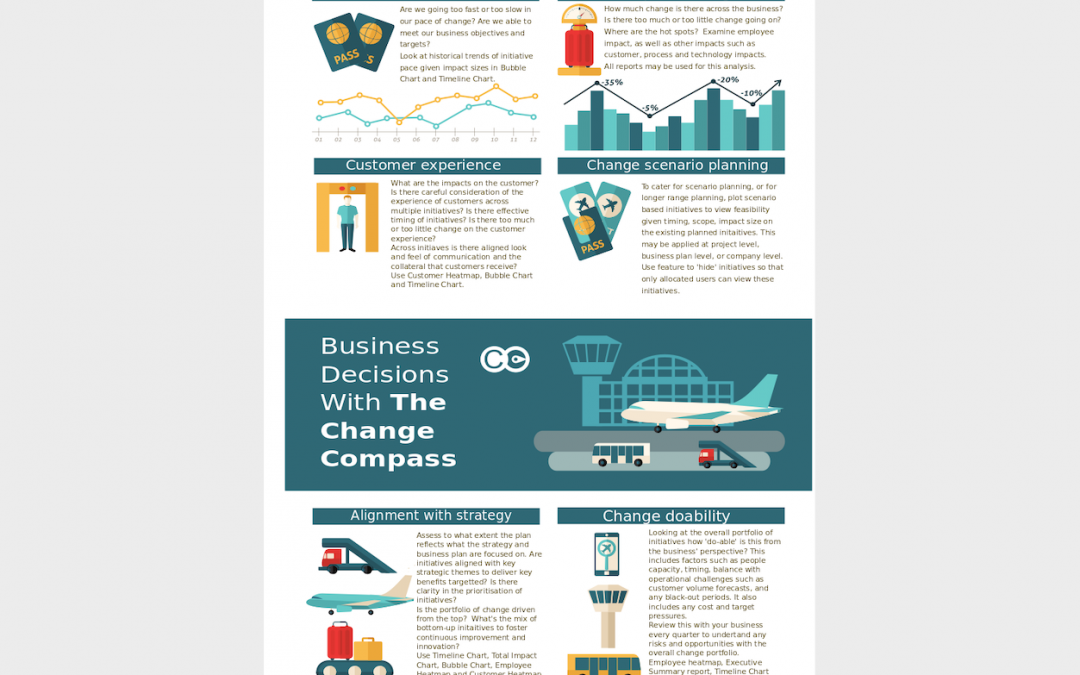
There are four categories of decisions in change management where switching from instinct to evidence makes a consistent, measurable difference. None of them require a data science team. They require the right framing and, increasingly, the right tools. This article covers each one in practical terms.
Why most change decisions are still made without data
Before getting to the four decisions, it is worth understanding why data-driven change management is still the exception rather than the norm. A McKinsey analysis of people analytics maturity found that most organisations collect people data but rarely act on it. The gap is not measurement — it is interpretation and application at the moment decisions are actually made.
In change management specifically, the decision-making environment makes data harder to use. Timelines are political. Sponsors have competing agendas. Business cases are written to justify decisions that have already been made. In this environment, data that contradicts the preferred narrative tends to be acknowledged and then politely ignored.
The organisations that break this pattern share a common characteristic: they have defined, in advance, which data points will trigger which decisions. They have established thresholds — not as guidelines to consider, but as commitments to act on. Data without a decision framework is just a report. Data embedded in a governance framework is a tool.
Decision 1: The pace of change
The most common question in any transformation governance forum is some version of: “Are we moving too fast?” Without data, this question is answered by whoever speaks most confidently or has the most senior title. With data, it becomes an empirical question with a defensible answer.
Pace-of-change decisions are fundamentally about the rate at which new demands are being placed on employees relative to their capacity to absorb them. This requires two inputs: a measure of current change load (how many initiatives are landing, and how intensely) and a measure of current adoption quality (are previous changes actually sticking before the next wave arrives).
What the data tells you about timing
When you track change impact by role and time period across your portfolio, patterns emerge that are invisible at the individual initiative level. A team that looks manageable when you assess each project separately may be absorbing change impacts equivalent to three or four additional weeks of disruption per quarter when you aggregate across all concurrent initiatives. Gartner research on change fatigue found that only 43% of employees with high change fatigue plan to stay with their employer, compared to 74% of those with low fatigue — a 31-percentage-point gap that represents a direct financial exposure in any high-change environment.
The actionable version of this insight is a threshold: a defined point at which the data triggers a mandatory review of sequencing rather than a discretionary conversation. Organisations that set these thresholds in advance find it significantly easier to have difficult conversations with programme sponsors, because the trigger is the data, not a change manager’s judgement call.
Decision 2: Where to focus resources based on total impact
One of the most persistent problems in multi-initiative portfolios is that change resources — consultants, business partners, communications capacity — are allocated to initiatives based on political weight rather than actual impact. The biggest project gets the most support. The loudest sponsor gets the most attention. The teams that are quietly drowning in a combination of mid-sized changes get almost none.
Total impact analysis flips this logic. Instead of starting with initiatives and asking “which ones need support?”, you start with stakeholder groups and ask “which groups are absorbing the most change?” The answer frequently surprises leadership teams.
How to build a total impact picture
Effective total impact analysis requires three things working together:
A common impact taxonomy across all initiatives — so that “medium impact” means the same thing whether it comes from an IT system change or a restructure
A consistent view of which roles and teams are affected by each initiative — tracked at a granular enough level to identify hotspots
An aggregation mechanism — a way to sum the impacts across initiatives for each group, by time period, so you can see cumulative load rather than individual project burden
When this data exists, resource allocation decisions become much more defensible. A Deloitte human capital trends study found that organisations with strong workforce data capabilities were 2.3 times more likely to consistently make good people decisions compared to those without. The same principle applies to change: better impact data produces better resourcing decisions, which produces better adoption outcomes.
In practice, total impact analysis often reveals that the teams carrying the highest cumulative change load are mid-level operational groups — the people who run the business day-to-day. They absorb system upgrades, process changes, organisational restructures, and regulatory compliance updates simultaneously, while also being the groups with the least dedicated change management support. Data makes this visible. Without it, it stays invisible until it manifests as attrition, errors, or adoption failure.
Decision 3: Protecting the customer experience during transformation
Most transformation programmes are designed to improve customer outcomes eventually. Many of them degrade customer outcomes in the short to medium term, because the employees who serve customers are too absorbed in change to deliver reliably. This is one of the most under-examined costs of poorly managed portfolios, and it is almost entirely preventable with the right data.
The connection between internal change load and external service quality follows a predictable pattern. When frontline employees are absorbing significant change impacts — learning new systems, changing processes, adapting to restructures — their cognitive bandwidth for complex customer interactions decreases. Response times slow. Error rates increase. Escalations rise. For organisations in competitive markets, this quality dip can have revenue and retention consequences that dwarf the cost of the transformation itself.
Using change data to protect service quality
The data-driven approach to this decision links change impact data (which customer-facing roles are absorbing the most change, and when) to operational performance data (service quality metrics, customer satisfaction scores, complaints). Organisations that do this proactively can make two types of protective decisions:
Sequencing decisions: Delaying or staggering the rollout of initiatives affecting customer-facing teams during peak service periods or periods of already-high change load
Resourcing decisions: Temporarily increasing support capacity for customer-facing teams during high-impact change periods — additional coaching, reduced targets, extended hypercare — to buffer the performance dip
Research published in Harvard Business Review on employee experience and customer outcomes found consistent evidence that employee capacity directly predicts customer satisfaction. Organisations that managed employee workload actively during transformation periods saw significantly smaller dips in customer metrics than those that did not. The data does not eliminate the trade-off, but it makes the trade-off visible and manageable rather than invisible until the damage is done.
Decision 4: Choosing between change scenarios before committing
The most strategically valuable use of change data is one that most organisations never attempt: scenario planning before a major programme is approved or a portfolio decision is made. Instead of asking “how do we manage this change?”, the question becomes “which version of this change is most achievable given our current portfolio and capacity?”
Scenario planning with change data allows you to model the impact of different implementation choices before anyone has committed resources or announced timelines. Should we roll this out nationally in Q1, or stagger by region across Q1 and Q2? Should we sequence this after the ERP go-live, or run them in parallel? Should we descope the training component this quarter and invest more in operational support instead?
Without data, these questions are answered by whoever has the strongest view. With a portfolio impact model, each scenario can be assessed against existing capacity, allowing the governance forum to choose the option that delivers the best outcome given real constraints rather than theoretical ones.
The business case for scenario planning
A Prosci study on the value of change management found that initiatives with excellent change management were six times more likely to meet objectives than those with poor change management. The single biggest differentiator in “excellent” change management was proactive planning — making decisions earlier in the initiative lifecycle when options are still open. Scenario planning with portfolio data is the mechanism that makes this possible. It moves change management from a delivery function to a planning function, which is where the real value sits.
Organisations that regularly use scenario data in portfolio governance report a shift in how the change function is perceived at executive level. When change managers can quantify the capacity implications of different initiative timing options, they become contributors to strategic decisions rather than recipients of them. That shift in positioning is not a soft outcome — it directly affects which decisions get made and how well they land.
How digital change management platforms enable these decisions
The four decisions described above share a common requirement: portfolio-level data that is current, comparable, and accessible at the moment decisions are being made. Maintaining this manually, in spreadsheets owned by different project teams, is possible at small scale but unsustainable across a complex portfolio. Purpose-built platforms like The Change Compass are designed specifically to aggregate change impact data across initiatives, visualise cumulative load by team and time period, and enable scenario modelling in real time. They shift the data infrastructure from a reporting exercise to a decision support system, which is the context in which these four decisions actually change.
Making the shift from instinct to evidence
The organisations that consistently make better change decisions are not those with the most sophisticated analytics functions. They are those that have agreed, in advance, on which data points matter for which decisions, and have built those commitments into their governance processes. The four decisions covered in this article — pace, total impact, customer experience, and scenario choice — represent the highest-value opportunities for most organisations. Start with one. Build the measurement capability for pace-of-change decisions, establish a threshold, and commit to acting on it at your next portfolio governance review. That single shift will demonstrate more value than any number of change management frameworks that stay in a document and never reach a governance forum.
Frequently asked questions
What is data-driven change management?
Data-driven change management means using quantitative evidence — such as change impact assessments, adoption rates, capacity utilisation, and stakeholder sentiment scores — to inform decisions about how change is planned, sequenced, resourced, and monitored. It contrasts with the more common practice of relying on professional judgement and political negotiation to make the same decisions.
How do you measure the pace of change in an organisation?
Pace of change can be measured by tracking the number and intensity of change initiatives affecting each stakeholder group across a defined time period. Expressing impact in terms of hours of disruption per week per role group provides a quantifiable measure that can be compared against a capacity threshold. When the aggregated impact crosses that threshold, it signals that the pace of change exceeds the organisation’s absorption capacity.
What is total impact analysis in change management?
Total impact analysis aggregates the change impacts from all concurrent initiatives to show the cumulative burden on specific stakeholder groups. Unlike assessing each initiative in isolation, total impact analysis reveals which teams are absorbing the most change overall — which is often different from which teams are involved in the largest individual projects. This enables more rational resourcing decisions across the portfolio.
How does change scenario planning work?
Change scenario planning involves modelling the portfolio impact of different implementation choices before committing to a specific approach. For example, you might model the cumulative change load on affected teams under a Q1 full rollout versus a Q1-Q2 phased rollout, and choose the scenario that is most achievable given current capacity. This moves change management from a delivery function to a strategic planning input.
Why do most organisations still make change decisions without data?
The primary barriers are not technical but cultural and structural. Change data often sits in separate systems owned by separate teams and is never synthesised into a form that is useful at a decision point. Additionally, in politically charged transformation environments, data that contradicts preferred narratives tends to be acknowledged and then disregarded. Organisations that overcome this typically do so by embedding data thresholds into governance commitments rather than leaving data as an optional input.
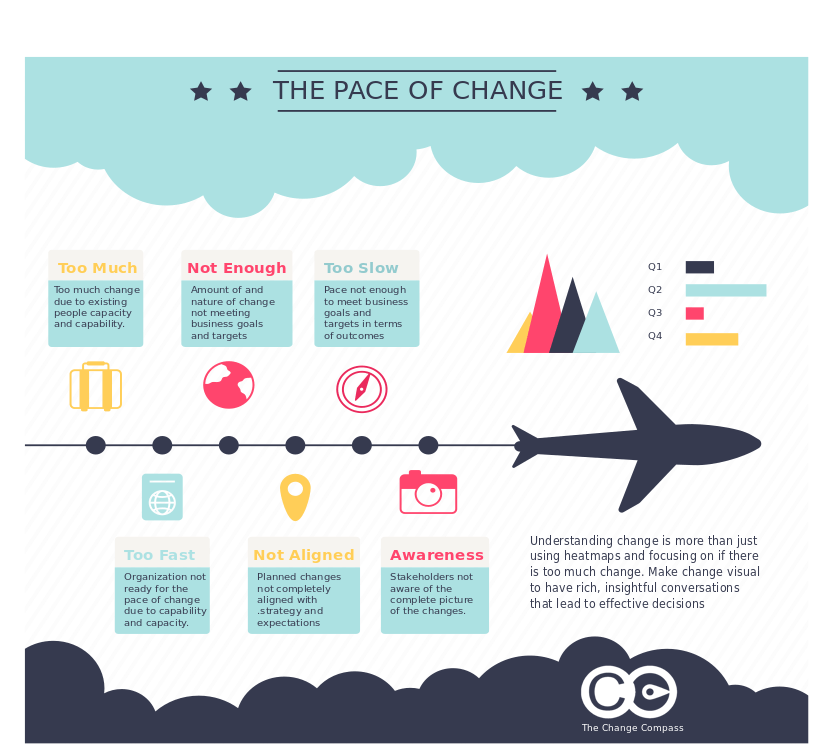
Change heatmaps have become the default visualisation tool for organisations trying to understand the scale of transformation activity hitting their workforce. They are useful – they make the volume of concurrent change visible in a way that project lists and programme registers do not. But they represent only one dimension of a more complex picture. Organisations that manage change using heatmaps alone are navigating with an incomplete instrument panel, and the dimensions they are missing are among the most consequential for predicting change outcomes and managing employee wellbeing through periods of intense transformation.
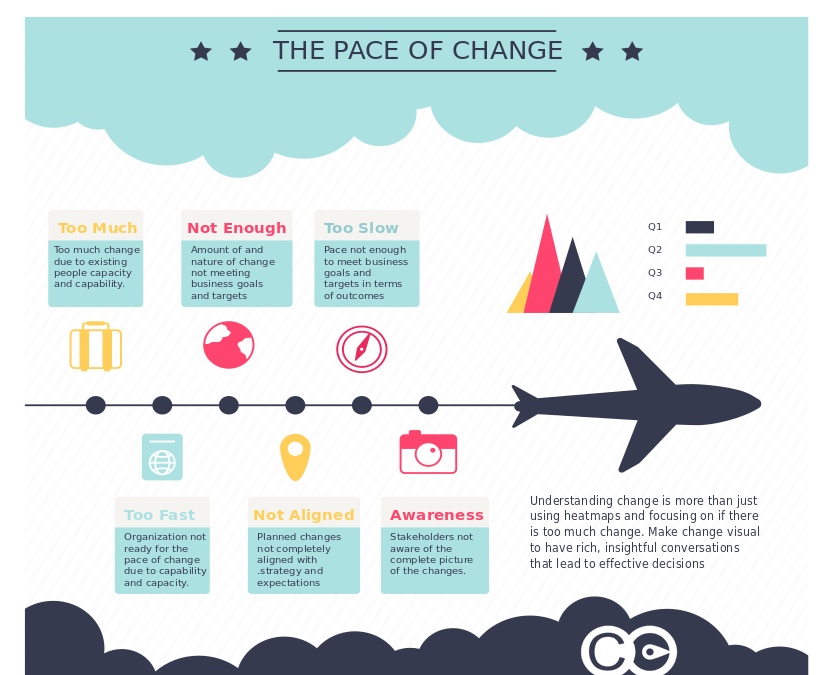
The pace of change is a distinct concept from the volume of change, and conflating them leads to systematic miscalculations in how change portfolios are managed. A single major change sustained over two years imposes a very different kind of demand on employees than twelve months of rapid, sequential changes even if the cumulative disruption is equivalent. Similarly, a surge of changes concentrated in a single quarter creates a different organisational stress pattern than the same number of changes spread across eighteen months. Understanding pace – not just volume – is what separates organisations that manage change as a strategic capability from those that merely count it.
Pace of change refers to the rate at which change demands are introduced to a given group of employees over a defined period of time. It encompasses both the frequency of new changes being initiated and the velocity at which those changes require employees to shift from their current way of working. High pace does not necessarily mean high volume in aggregate – it means that the interval between significant change demands is short, leaving employees insufficient time to stabilise in a new state before the next wave of change arrives.
This distinction matters because the human psychology of adaptation is fundamentally a sequential process. When a person adopts a new way of working – learns a new system, internalises a new process, builds capability in a new skill – they go through a predictable arc from initial disruption through experimentation, competence building, and eventual proficiency. This arc takes time, and it cannot be substantially compressed regardless of how well the change is designed or communicated. Introducing a new significant change before this arc is complete does not simply add to the load – it interrupts the adaptation process itself, resetting the person’s progress and compounding the psychological cost of the transition.
Prosci’s ADKAR model describes the individual change journey across five dimensions: awareness, desire, knowledge, ability, and reinforcement. The reinforcement phase – embedding the new behaviour until it becomes the default – is the one most frequently truncated by high pace of change. When a new change is introduced before reinforcement of the previous one is complete, the organisation is effectively asking employees to build on an unstable foundation. The result is not just slow adoption of the new change. It is regression in the previous one.
Why heatmaps alone are insufficient
Change heatmaps typically visualise which teams or roles are affected by which programmes at which points in time. They answer the question of coverage: who is touched by change, and when. What they typically do not answer is the question of pace: how rapidly are change demands arriving for specific employee groups, and how much stabilisation time is available between them?
The limitation becomes acute when a heatmap shows that a team is affected by multiple programmes across a twelve-month period. The heatmap may show this as a continuous band of change impact – useful for identifying overall load – but it does not distinguish between a pattern where changes are sequenced with meaningful recovery time between them and a pattern where changes are simultaneous or closely stacked. These two patterns impose very different demands on employees, and they require very different management responses. The first is manageable with strong communication and targeted support. The second creates the conditions for change fatigue regardless of how well any individual change is managed.
A related limitation of heatmaps is their tendency to treat all change impacts as equivalent in terms of the adaptation effort they require. A process change that affects how an employee fills in a form is captured the same way as an organisational restructure that changes their reporting line, their team composition, and the fundamental nature of their role. Effective pace measurement needs to account for the depth of change – the degree of behavioural shift required – not just its presence or absence.
The organisational consequences of unsustainable pace
When the pace of change consistently exceeds employees’ adaptive capacity, the consequences are well documented and significant. The most visible is change fatigue – a state of exhaustion, cynicism, and disengagement that develops when employees are asked to sustain high levels of change-related effort over extended periods without adequate recovery time. Change fatigue is not simply tiredness. It is a fundamental reduction in an individual’s willingness and ability to engage with further change, even changes they might otherwise have supported.
Gartner research on change fatigue found that employees experiencing high fatigue are significantly more likely to consider leaving the organisation and substantially less likely to adopt changes successfully. The performance implications extend beyond individual wellbeing: teams in a state of change fatigue show reduced productivity, increased error rates, higher absenteeism, and degraded customer outcomes during peak change periods. These costs are almost never attributed to the pace of change in standard business reporting, because organisations lack the measurement frameworks to make the causal connection.
The consequence at the portfolio level is equally significant. When change programmes are sequenced without regard to pace, the organisation effectively subsidises its most ambitious change initiatives with the adaptive capacity of its employees – a resource that is finite and that does not regenerate quickly once depleted. Senior leaders who approve programme portfolios without visibility into the pace implications for specific employee groups are making resource allocation decisions with an incomplete picture of what those decisions cost.
Measuring pace: what good looks like
Effective pace measurement requires data that goes beyond the change calendar. It needs to capture the intensity of impact by employee group across time, not just the presence or absence of change. This means collecting structured information about each change programme’s impacts on specific roles and teams – the nature of the change, its depth, the degree of behavioural shift required, and the timeline over which those shifts are expected to occur. This data, aggregated across the portfolio, allows organisations to construct a picture of change pace that heatmaps alone cannot provide.
Several dimensions are useful in assessing pace. The first is interval analysis: how much time exists between significant change demands on a given employee group, and is that interval sufficient for stabilisation? Research from organisational psychology suggests that meaningful stabilisation – the point at which employees have returned to baseline productivity in the previous change – typically requires between three and six months following a major change, depending on its depth and the support provided. Portfolios that do not build these stabilisation windows into their sequencing are likely to generate compounding adaptation costs.
The second dimension is depth weighting: treating impacts that require significant behavioural shift as more demanding than those requiring minor adjustment. A system upgrade that changes how employees log information is a different order of adaptation challenge from a role redesign that changes what they do, who they report to, and what skills they need. Effective pace measurement accounts for this difference rather than treating all change impacts as equivalent.
The third dimension is cumulative load tracking: monitoring the aggregate pace of change on specific employee groups across all concurrent programmes, not just within individual programme boundaries. This is the dimension that is most frequently absent from change measurement frameworks because it requires cross-portfolio data infrastructure that no single programme team can produce. It is also the dimension most likely to reveal the patterns that drive change fatigue before they become crises.
Managing pace as a strategic decision
Once pace is visible, it becomes manageable. The governance decisions that follow from pace data are among the highest-value decisions available to senior change leaders: whether to defer a programme because a specific team is approaching or exceeding its sustainable pace threshold, whether to sequence changes so that stabilisation time is protected, whether to invest additional change support resources in teams carrying the heaviest pace burden, and whether to restructure a programme’s delivery timeline to create recovery space.
These decisions are qualitatively different from the programme-level decisions that most change governance structures are designed to make. Programme governance focuses on whether an individual change is on track. Portfolio governance focuses on whether the aggregate change load is manageable and whether the sequencing of programmes is optimised for sustainable adoption. McKinsey research on transformation outcomes consistently finds that portfolio-level change governance – including explicit management of change pace and sequencing – is a significant predictor of transformation success at the enterprise level.
Platforms like The Change Compass are designed specifically to make pace visible and actionable at the portfolio level. By collecting structured impact data from each programme and aggregating it across employee groups, the platform allows change leaders and executives to see cumulative pace of change in real time – and to model the pace implications of proposed portfolio adjustments before making governance decisions. This turns pace management from an intuitive judgement call into a data-informed discipline.
Building pace awareness into change planning
The most effective point at which to address pace is before a change programme enters execution – in the planning phase, when sequencing decisions are still malleable and when the portfolio governance structure has the most flexibility to respond. Organisations that wait until pace becomes a visible problem – until change fatigue is measurable in engagement surveys and attrition data – have already paid a significant cost that better planning could have avoided.
Building pace awareness into change planning means incorporating pace impact assessment as a standard component of programme initiation. Before a programme is approved and resourced, the change team should be able to answer: which employee groups are most affected by this programme, what is the current pace of change on those groups from existing programmes, and what is the projected pace implication of adding this programme to the portfolio? If the honest answer is that certain groups are already at or near their sustainable pace threshold, that finding should inform the programme’s sequencing and delivery design – not be noted and set aside.
Research on organisational decision quality consistently finds that access to comprehensive, timely data is the primary differentiator between organisations that make sound portfolio decisions and those that default to optimism. Pace data is not complex to collect, but it requires a consistent approach across programmes and a shared infrastructure for aggregation. Organisations that invest in this infrastructure gain a systematic advantage in managing one of the most significant and underappreciated determinants of change programme success.
Frequently asked questions
What is the pace of change and why does it matter?
The pace of change refers to the rate at which change demands are introduced to employees over time – how frequently new changes arrive and how little stabilisation time exists between them. It matters because human adaptation to change is a sequential process that requires time to complete. When changes arrive faster than employees can stabilise in each new state, adaptive capacity depletes, change fatigue develops, and adoption outcomes deteriorate even for well-designed changes. Managing pace is therefore as important as managing volume when structuring a change portfolio.
Why aren’t change heatmaps enough?
Change heatmaps show which teams are affected by which programmes at which points in time, but they do not distinguish between changes that are well-sequenced with recovery time between them and changes that are stacked so closely together that stabilisation is impossible. They also typically treat all change impacts as equivalent regardless of depth, and they operate within individual programme boundaries rather than aggregating across the portfolio. Effective pace management requires data that addresses all three of these limitations.
What are the signs that the pace of change is unsustainable?
The most common indicators of unsustainable change pace include declining engagement scores during change-heavy periods, rising attrition among the employee groups most heavily affected by concurrent changes, low adoption rates for new changes even where the design and communication have been strong, regression to old ways of working in recently completed changes, and anecdotal reports of change fatigue and cynicism from managers and employees. By the time these indicators are visible in standard business reporting, the adaptive capacity depletion has usually been developing for months.
How can organisations better manage the pace of change?
Effective pace management requires portfolio-level visibility into the cumulative rate of change on specific employee groups – data that no single programme team can produce alone. It requires incorporating pace impact assessment into programme planning and approval processes, so that sequencing decisions are informed by evidence about current pace rather than made optimistically. It requires governance structures with the authority to defer or descope programmes when pace data shows that specific groups are at or near their absorption limit. And it benefits significantly from purpose-built platforms that aggregate change impact data across the portfolio and make pace trends visible to decision-makers in real time.
We use cookies to improve your experience and understand site use. Marketing cookies stay off until you accept, and in the EU, UK and Switzerland analytics does too. Cookie Policy.
Strictly necessary
Required for the site to work: security, load balancing, and remembering your choices. These cannot be switched off.
Always active
Analytics
Google Analytics and similar, so we can see which pages are useful and where visitors get stuck. Aggregated, never sold.
Marketing
Used to measure campaigns and show relevant content on other platforms such as LinkedIn.