As a first step in understand the change, change management practitioners usually classify different change impacts into people, process, technology, and customer. There is a great effort and focus placed on describing exactly what the impact of change is from a project or program perspective as a part of the change management plan. The impact analysis can include the processes changes, critical behaviours, as well as how different the new technology and new process is going to be compared to the current process.
However, adopting a user-centric view of change impact (versus a project team’s view) is critical in driving successful change.
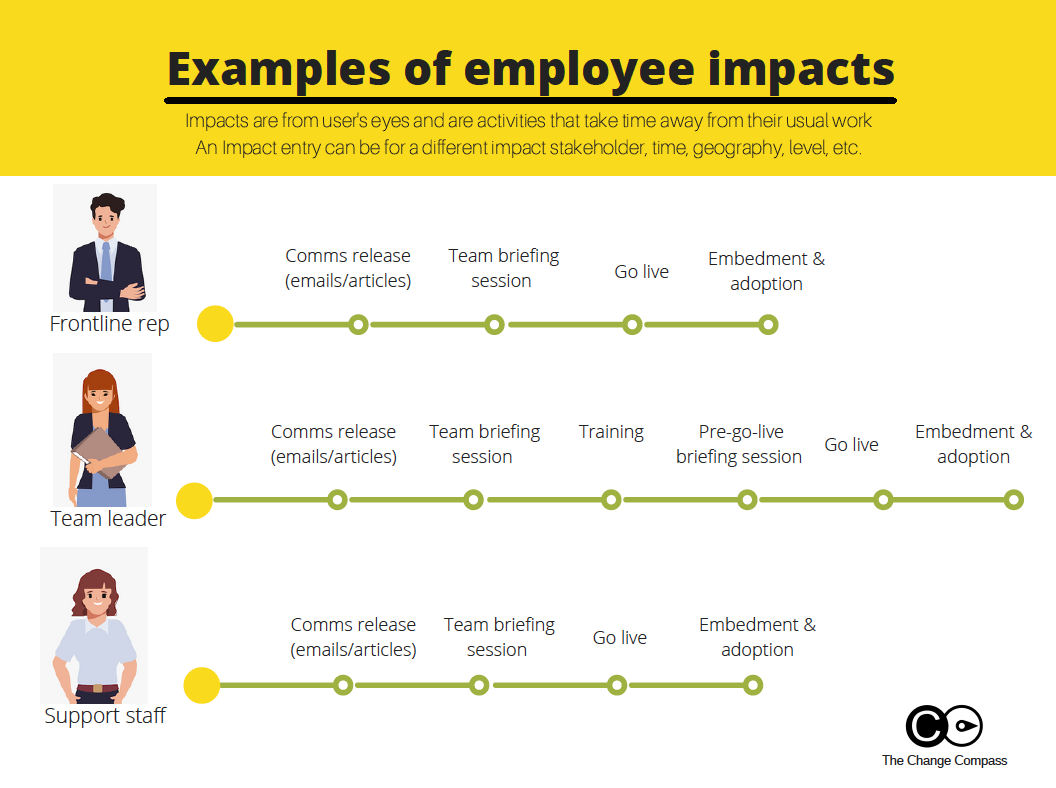
Often what is seen as impact as felt by various job roles can be very very different from what is experienced by the end-user as a part of the current state. In order to drive towards the benefits of the change, we need to take into consideration any negative thoughts, support system, employee morale, mindset, and performance review processes for those stakeholders impacted by the change. Let’s take a few examples.
When a project is ‘rolled out’. There are can be a lot of different impacted audience factors to consider. These can include:
Location
Role
Gender
Digital fluency
Age
Length of service
Team size
Availability of support staff
Availability of effective 2-way communication platforms
Effective learning and development processes in place
Functional skill sets
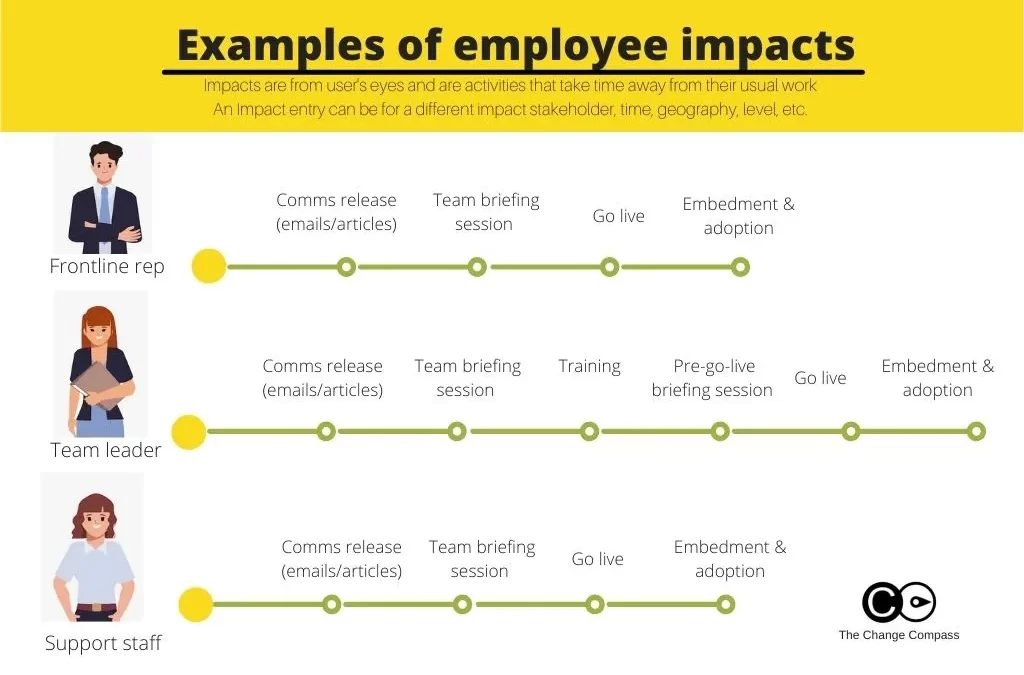
So depending on how these organizational change factors determine the impact of the change initiative on groups of individuals, identified specific impacts can be different. In the change impact assessment process, these should be carefully teased out and identified explicitly. Even how we express the names of the impacts should consider how the changes are perceived.
For example, is an impact ‘Team Leader briefing team members about the new process’ or ‘Weekly team meeting to discuss new process changes’? The initial wording is more focused on the new process, whereas the latter one illustrates that there can be various changes discussed in the meeting. So as a result, practitioners need to be open to the environment in which their messages will be delivered and through this better position and clarify the meaning of the change from the team’s perspective. E.g. can this change be delivered as a bundle with other process changes?
In a recent example, a person is understood by the organisation to be undergoing 6 separate initiatives each with their various impacts. Each initiative has fleshed out the various project impacts and these are listed and planned explicitly. However, this is from the organisation’s perspective. In fact, what the individual is undergoing is quite different.
There are changes that the team or division is undergoing that are not always taken into consideration such as people or team changes. On top of this there are also seasonal workload impacts from the likes of end of financial year, audits or pre-holiday season workload. On top of this, there are also various Covid considerations to take into account – the mother of all changes at the moment. Lockdown and social distancing have profound impacts on individuals leading to physical and psychological health impacts.
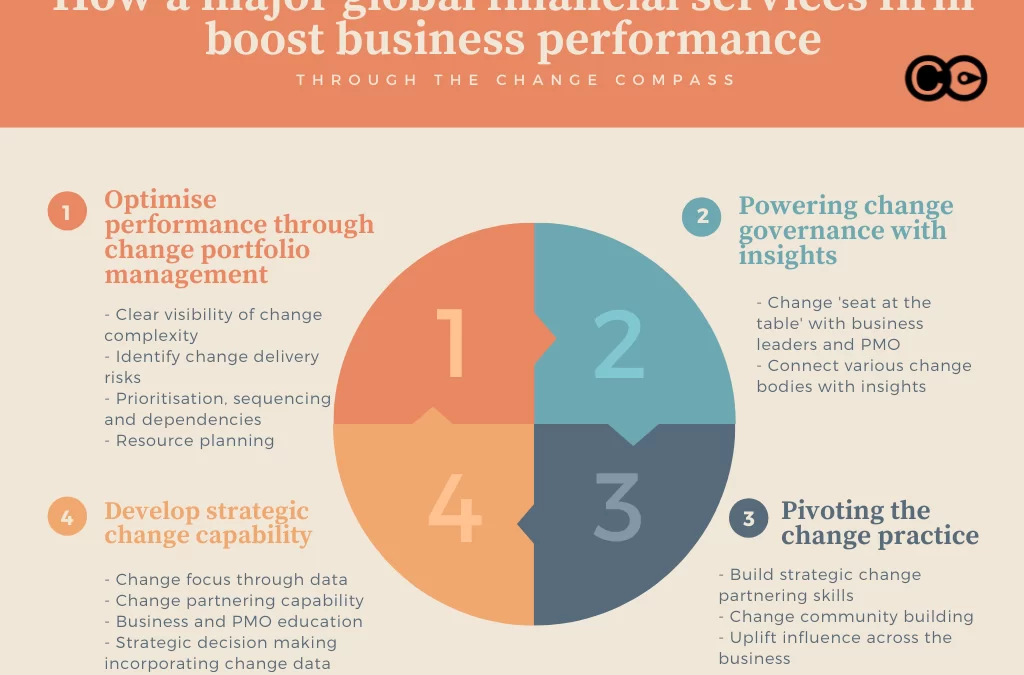
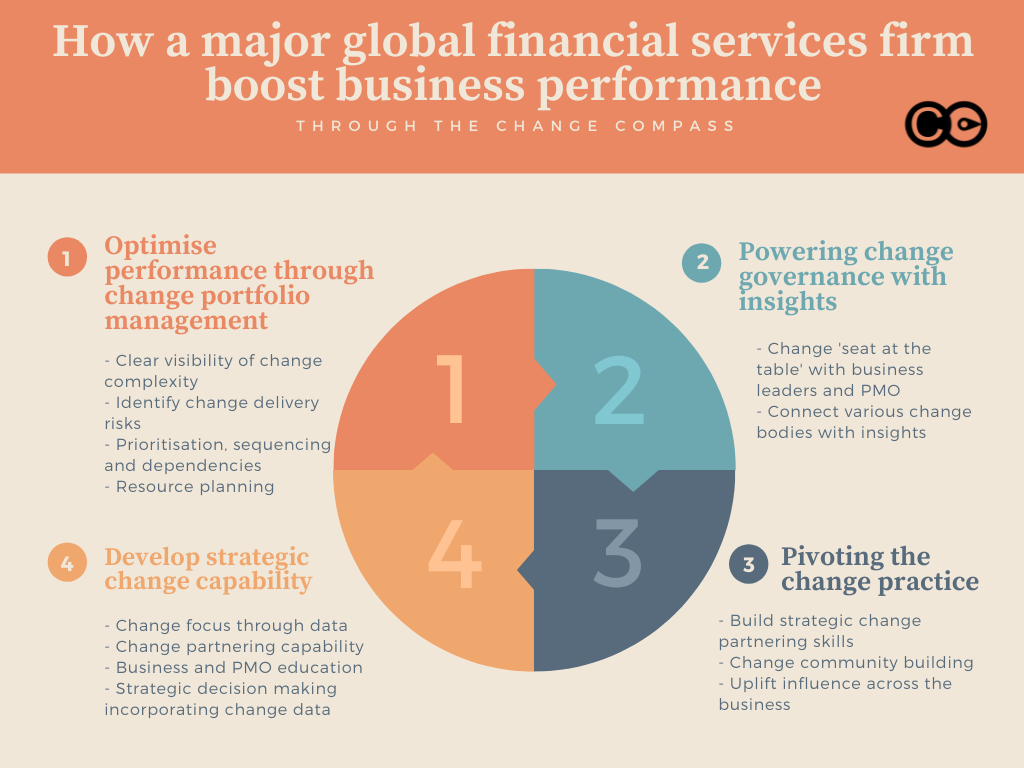
How a Major Global Financial Services Firm Boosted Business Performance Through The Change Compass
When organisations embark on a change program, the conversation typically starts with data — data to help understand change, inform decisions, and track progress. But as illustrated by the journey of a major global financial services firm, real business value is achieved when that data becomes the catalyst for a fundamental shift in how change is managed, governed, and embedded into daily business.
Within just one year of using The Change Compass, this firm elevated its change management practice to become a critical driver of strategic decision-making, operational excellence, and business performance improvement.
Let’s explore the four areas where the greatest value was realised — and how your organisation can benefit from a similarly holistic approach.
1. Optimising performance through change portfolio management
Many organisations struggle with visibility: too often, change initiatives happen in silos, leading to undetected risks, duplicative efforts, and suboptimal resource usage. The Change Compass changed that paradigm by allowing leaders to visualise the full spectrum and complexity of ongoing and upcoming changes across the business.
Key outcomes included:
Clear visibility of change complexity: Leaders understood not just the number of initiatives but also their interactions, overlaps, capacity required, and cumulative impacts.
Real-time risk identification: Delivery risks became evident early, enabling proactive mitigation and adjustments.
Strategic prioritisation and sequencing: With improved transparency, change teams could optimise the order of initiatives, manage dependencies, and ensure critical projects were staffed and resourced.
Informed resource planning: Accurate data replaced gut feel, driving more precise allocations of people and budget.
Insight: For many organisations, these benefits translate into fewer unexpected disruptions, smoother implementations, less “change fatigue” for staff, and higher project success rates.
2. Powering change governance with actionable insights
Historically, change teams often struggled to earn a “seat at the table” when major business decisions were made. With The Change Compass, this financial services firm embedded change management as a strategic partner, not an afterthought.
Tangible improvements included:
Change team at decision-making forums: The change team now contributed concrete, data-driven insights alongside the PMO and executive/business leadership.
Integrated insights across functions: Data from The Change Compass connected the dots between initiatives, allowing different teams to align efforts and avoid costly missteps.
Value delivered: This meant better-aligned priorities, more robust business cases for investment, and consistent progress reporting to executives, instilling greater confidence at all levels of the business.
3. Pivoting the Change Practice
True change maturity is not just about delivering projects; it’s about growing the organisation’s ability to manage change as an ongoing capability. Using The Change Compass, the firm shifted from a reactive, project-by-project approach to building a strong, influential change culture.
Results included:
Strategic partnering skills: Change leaders became trusted advisors to the business, not just project facilitators.
Community building: A sense of shared mission and ownership emerged among those involved in change, breaking down silos and fostering peer support.
Influence and credibility: The change function established itself as a go-to resource for insight, guidance, and innovation.
Broader benefit: Over time, this led to more consistent adoption of new ways of working, higher engagement, and accelerated pace of transformation.
4. Developing strategic change capability
Finally, the journey was not just about fixing today’s pain points – it was about future-proofing the organisation. By centring decisions on solid data, The Change Compass helped this firm systematically level up its change maturity.
Major advances included:
Data-driven prioritisation: Clarity on what matters most, reducing wasteful activity and focusing on business-critical shifts.
Partnership between business and PMO: Rather than working in isolation, both functions now collaborated with a common understanding of priorities, impacts, and trade-offs.
Foundation for continuous improvement: Ongoing education, supported by real-world analytics, equipped leaders at every level to steer change strategically.
Enduring value: Through this approach, change management became an integral part of the business’s DNA, enabling smarter, faster responses to both market opportunities and challenges.
Why The Change Compass Delivers Real Results
The experience of this global financial services firm illustrates why The Change Compass is not just a tool – it’s a transformational enabler. Organisations using The Change Compass typically report:
Reduced business performance disruptions
Greater alignment between change, operations, and strategy
Improved staff engagement and reduced change fatigue
Faster realisation of business value from new initiatives
By illuminating the complex web of change, reducing uncertainty, and embedding data-driven insights into everyday business, The Change Compass doesn’t just help organisations “manage change” – it helps them excel through change.
Are you ready to turn change from a headache into a competitive advantage? Discover how The Change Compass can help your business unlock its full potential.
If you’d like to explore these outcomes in detail or get a tailored consultation, contact us today. Let’s accelerate your change journey together.
On Google,, the 2nd most searched term in change management is ‘change management process’. Users are keen to understand a standard formula that they can apply to manage any change. Most users are looking for something simple, and clear, and lay out a step-by-step process that describes what they need to do to manage change.
Managing change is no longer the arena for change practitioners. The field of change management has grown in such leaps and bounds in the past 20 years that most leadership concepts now have a section on change management. Nearly all large 1st and 2nd tier consulting firms have a change management practice, even the likes of McKinsey, BCG,, and Bain.
Around us, we frequently see change management being mentioned. Change is even a visible tagline for the marketing campaign for lots of organizations. Accenture’s marketing tagline in 2021 is “Let there be change”. The Motto for The University of Technology Sydney is “Think. Change. Do”.
What are the common change management processes?
Prosci is one of the most known change processes, especially for those located in the United States. Change First has a ‘PCI’ (People-Centered Implementation) model. Then there is John Kotter’s 8 steps for leading change. What all the models have in common is the initial engagement and planning, followed by change implementation, ending with a transition and sustaining phase.
Companies like having one change process to follow.
Most organizations with a change management practice will have, as part of their offering, one change management process for all practitioners/managers to follow.
Why is that?
A common language to talk about managing change so that different stakeholders can refer to the same language, especially those who are not changing practitioners. Creating terms that are easily understood by stakeholders within the company makes sense.
Ensure new change contractors adhere to “the way of doing things” in managing change within the organization. This is often a big complaint, that a new contractor will bring with him/her new ways of doing things, many of which may not gel well within the particular organization.
Create a minimum level of expected quality in managing change so that at least the ‘minimum’ is carried out and that there isn’t anything obvious that is left out. This is especially important for project teams who may not know what change managers do and what outputs they should be working on.
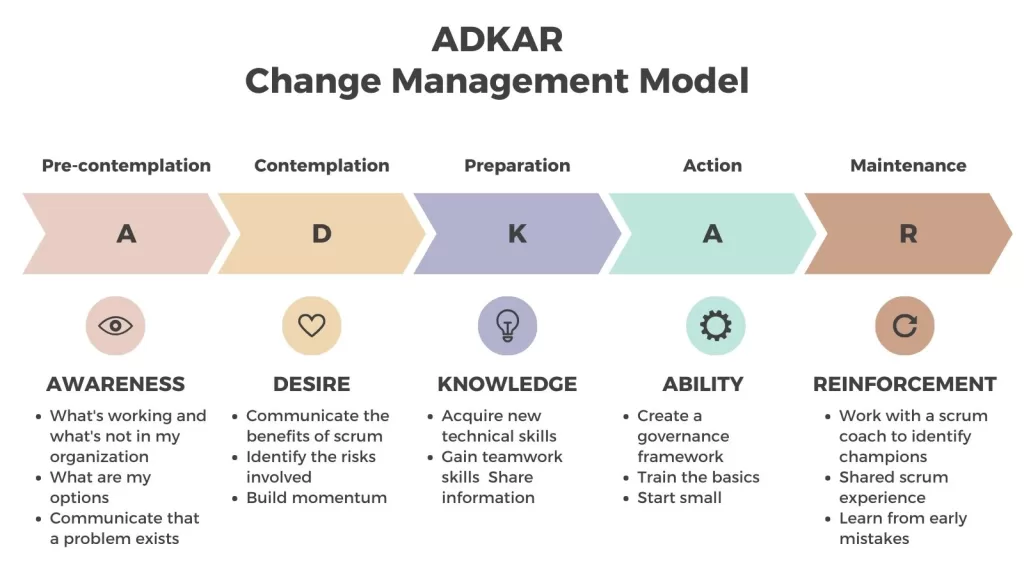
Prosci’s ADKAR model, a framework focusing on five key elements—Awareness, Desire, Knowledge, Ability, and Reinforcement—that individuals need to successfully navigate change.
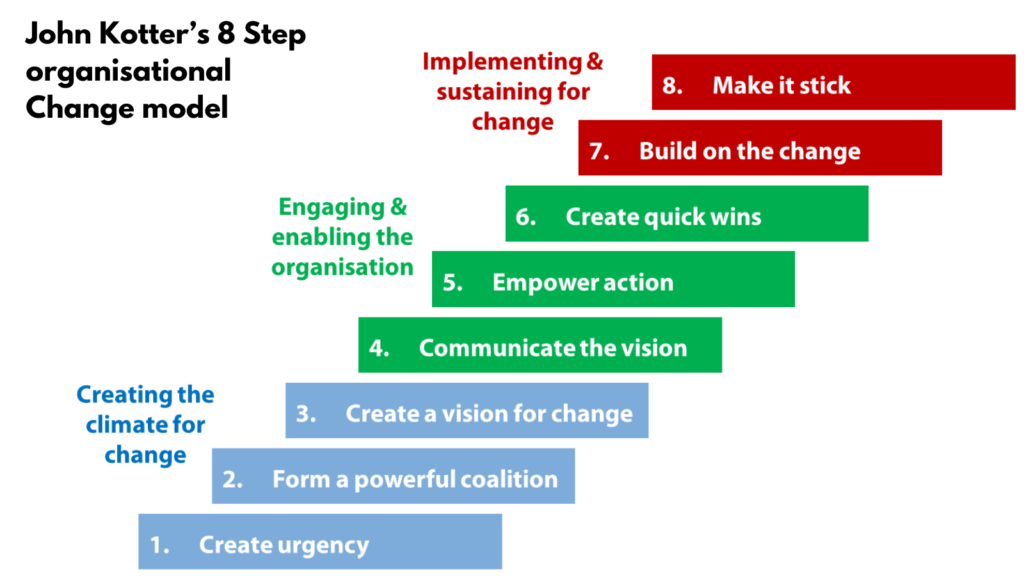
John Kotter’s 8 steps model for leading change, providing a roadmap for organizations to effectively manage change, from creating a sense of urgency to anchoring changes in the company culture.
So what is wrong with using a change management process?
Not one change process may be relevant for all cases Change management processes and concepts are good as general references to guide the change practitioner in baselining and learning the key steps that are critical in establishing a good change outcome. No change management process can suit every company and every type of change. This is why it is a good idea to leverage a diverse range of change processes for change managers who are starting out in the industry. Different change processes may cover different areas, therefore provide a synergistic range of references.
For example, John Kotter’s 8 steps of leading change are great for all levels of leaders and team managers as the model is focused on managers leading groups of people through change. On the other hand, Prosci’s ADKAR model is more suitable for a project context where there are a series of activities over several project phases to lead impacted stakeholders through the change.
Also, some change processes may not be applicable for all change scenarios. For example, the famous ‘change curve’ or the Kubler-Ross model of grief and loss. For some reason, this model has been applied so much within a change context that a lot of business people expect that the ‘change curve’ will always occur.
This is absolutely false. In the change curve, there is a prescribed process of shock, denial, frustration, and depression. There are not many change scenarios in which large groups of people go through these emotions. Examples include large-scale restructuring involving retrenchments. However, for standard process changes, technology upgrades, or new product launches, it is very rare that you will see this process being applicable at all.
Blindly following the process One of the biggest dangers and risks of following a change process is not to know when to deviate from the process. This may especially be the case for less experienced change practitioners. The outcome of blindly following the process can mean that the change actually does not happen and the change dial is not moved at the end.
What I often see from change managers who blindly follow the process is a change plan that contains a series of generic activities such as stakeholder engagement, communication, and then launch. Often in these cases, there isn’t a deep understanding of what the change involves from the perspectives of impacted employees. What it means to them may be more than just meeting informational needs. There could be subconscious attachments or preferences/habits that are hard to break.
An analysis of the perceptions and history of changes experienced by those impacted by change is critical. What you may uncover is potential anxieties, expectations, habits, and misunderstanding of what the change involves. This may be ignored by popular change processes.
Change processes may not be linear Experienced change practitioners have seen this. Often what is planned on paper does not actually pan out to be the case. Most change processes follow a scenario where everything goes well. But for complex changes, there are often mishaps or obstacles.
For example:
Key stakeholder groups were not identified upfront and the delay in engaging with them causes overall project delays and stakeholder complications.
Feedback from stakeholders is that the initial messaging was not clear enough and did not reach all groups. Another round of communications and engagement campaign is required to reset expectations.
Learning content was too long and did not sufficiently match employee expectations, thereby resulting in lower completion rates.
After the project rollout, as soon as resources were pulled out of the project team after go-live, adoption rates dived, resulting in little benefits achieved.
In many of these cases described above, the change practitioner needs to repeat certain processes, go back to previous steps, or even split stakeholders with some progressing further in the change process than others.
Following a process may inhibit experimentation One of the core aspects of agile ways of working in implementing change is experimentation. We see teams from development and marketing constantly experiment and learn to evolve into a solution that meets business objectives. In change management, there is little practice in experimentation, even though this is such a core part of agile.
Blindly following the process
One of the reasons could be that change practitioners are used to following a prescribed change process and not used to experimenting with their change approach. Instead, most rely on previous experience or what others have done in other change initiatives. Despite this, there are many good reasons for experimenting change approaches, especially for large/complex change initiatives.
Potential experiments can include:
Communication positioning
Leader storyline for the rationale of the change
Training content
Change measurement
Impact assessment design
Townhall design
Behavior reinforcement and incentives
Not sufficiently emphasizing the importance of measurement Measurement is one of the most important aspects of managing change. Without knowing exactly the outcome of each of the activities we are executing how do we know that we are in the right trajectory? Also, measuring our change intervention ensures that we have the exact gauge on how effective the interventions are, and also where the stakeholders are along the journey. If we’ve not had any complaints or ‘noise’ does not mean that all is well and that the change will take place.
How are you measuring your changes so that you understand where your stakeholders are transitioning to?
Future Trends: Discuss emerging trends and innovations in the field of change management, such as the integration of artificial intelligence, agile methodologies, or digital transformation initiatives. Providing insights into future directions can help readers stay ahead of the curve and adapt their change management strategies accordingly.
In addition to established methodologies, the future of change management is being shaped by cutting-edge technologies and innovative approaches that are revolutionizing how organizations navigate transitions. One of the most exciting developments is the integration of artificial intelligence (AI) into change management processes. AI-powered analytics can provide deep insights into organizational dynamics, predicting potential challenges and offering personalized interventions to drive successful change outcomes.
Furthermore, the rise of agile methodologies is transforming traditional change management practices. Agile principles emphasize adaptability, collaboration, and iterative progress, enabling organizations to respond rapidly to evolving market conditions and stakeholder needs. By embracing agile frameworks, change leaders can foster a culture of continuous improvement and empower teams to embrace change as a catalyst for innovation.
Moreover, digital transformation initiatives are reshaping the landscape of change management. As businesses undergo digital transformations to stay competitive in today’s rapidly evolving digital economy, change management becomes increasingly intertwined with technology adoption and organizational agility. Leaders must navigate complex ecosystems of interconnected systems, processes, and stakeholders, leveraging digital tools and platforms to drive seamless transitions and sustainable change.
Incorporating these emerging trends into their change management strategies, organizations can position themselves at the forefront of innovation, driving successful transformations that propel them toward future growth and success.
Ever since the epidemic began people have started to suffer mental health issues. In fact, according to Harvard Business Review, recent studies have shown that 42% of employees globally have experienced a decline in mental health since the commencement of Covid. This is not a surprise given that governments have routinely locked-down populations to ensure safety and contain the spread of the virus. For change practitioners driving change initiatives within this context, it is hard to ignore these facts.
However, a lot of change practitioners are advised to steer clear of any mental health issues since they are not health practitioners and not qualified to deal with mental health issues. This may be true. However, just because change practitioners cannot advise on dealing with individuals with mental health issues, this does not mean that their approaches cannot take mental health into consideration. In fact, if a significant portion of the employee population have experienced reduced mental health, this needs to be taken into account and not ignored. Ignoring the facts can mean unsuccessful change outcomes.
So how can change practitioners take into account mental health issues affecting employees so that they are still able to drive successful initiatives?
Common mental health issues
Firstly, let’s look closer at common mental health issues impacting employees during the pandemic.
Anxiety and Depression
A recent report found that a quarter of 10-24-year-olds in the United States (Centers for Disease Control and Prevention) said that they had seriously considered suicide. Other surveys consistently show significant increases in anxiety and depressive disorders and correspond with pandemic trends.
Symptoms of anxiety can range from insomnia, panic attacks, feeling of apprehension, or impending doom, and breathlessness. Anxiety symptoms can also be less physically pronounced such as sweating, dry mouth, dizziness, nausea, difficulty concentrating, and irritability. Symptoms of depression can include difficulty finding joy and difficulty in engaging in normal activities, low energy, declined appetite, hopelessness, and that everything seems an effort.
Languishing
For a section of the population, it may be that they are not feeling severe enough to be diagnosed as being depressed or anxious in a clinical sense. However, it does not mean that their mental health states are optimal. The New York Times labelled this ‘feeling blah’ as ‘languishing’ and that it could be the dominant emotion of 2021. Languishing is the in-between level of the optimal level of mental health and suffering from mental health illness.
People were not feeling burnt out of depressed per se. However, there’s less of the usual excitement, hope and joy in their usual daily lives. Recently I visited my medical practitioner and he commented that of his patients most are suffering various medical conditions and that there are definitely a lot more reports of mental health concerns. People who experience this may not even report it nor even notice it. First comes fewer social interactions, then comes increasing solitude and even isolation.
Incorporating mental health concerns in change delivery tactics
Acknowledgement
The first step to take in incorporating people’s mental health concerns in change delivery is to openly acknowledge this. A lot of corporate communications functions would much prefer to not touch anything that is even remotely negative. However, acknowledging what people are going through builds trust and connection. Ignoring the elephant in the room will not help to engage employees. It is not that this needs to be the front-and-centre of the communication messaging. However, mentioning that there may be employees suffering from mental health issues can be the first step in building improved connections and confront the stigma.
This is especially important if you are driving an initiative that will have a significant impact on employees. If you are requiring employees to undergo significant impact whilst they may be battling with mental health issues, then addressing it head-on is critical.
Role model and sharing of experiences
The initiative sponsor and various change champions can be leveraged to share their personal experiences in dealing with mental health concerns. This helps to de-stigmatize mental health in the workplace and open up the discussion of people’s challenges. During forums, town halls, or even in articles or newsletters, the sponsor can share his/her own experiences in dealing with mental health issues. The trick is to be candid and open. This helps to foster trust with the employees.
Picking up on cues when engaging with individual stakeholders
When working with various stakeholders it helps to establish routine of ‘checking-in’ to sense-check the mental status of everyone prior to starting the meeting. This helps to level-set everyone’s mental status prior to diving into work discussions and helps everyone to understand how others are doing, thereby creating connectivity and inclusiveness.
If you pick up particular cues that the stakeholder may be suffering from mental health issues check-in individually with them to see if they are doing ok. Then, connect them to any company resources available such as employee assistance programs.
Map out the initiatives that impact them – prioritise and sequence.
Mapping out the various initiatives that impact the stakeholder group is one of the most strategic tactics in this list. It means taking an end-user perspective and plotting out all the various initiatives and changes that impact them. Taking this end-user, and design thinking approach, we are not just concerned about the particular initiative that we are driving, but all the various initiatives that the person is/will be experiencing.
During times of change fatigue, it may be that proactive intervention may be required to better prioritise and sequence the change rollout to manage the capacity of the impacted stakeholders. To read up on how to do this refer to the following article:
Different employee groups may be experiencing different needs and challenges. Those with children and that are dealing with childcare challenges during the working day may be experiencing different mental health challenges than those who are singles. Singles may be more inclined to feel isolated and disconnected with limited social support.
By creating different segments, you can position communication messages to better target those audience groups. These are some ideas of potential change tactics for different employee groups:
Employees with children and/or dependents – Offering flexibility in selecting time slots for training sessions, or record any town hall sessions in case they were interrupted during the session
Fully remote workers – Scheduling engagement sessions that involve facilitated discussions on personal experiences in the broader sense beyond just the initiative itself
Non-remote workers – Organising virtual sessions for non-remote workers to connect with remote workers to foster greater connection
Managers – Organise engagement sessions with managers that include content on dealing with employees on mental health issues as a part of the overall manager engagement session content
Measure
As a part of the overall change tactic of successfully implementing the initiative, it makes sense to measure and track employee sentiments. A typical change readiness assessment survey may be supplemented by items on employee mental health. This will help to proactively assess the extent of the mental health challenge for employees and how they may impact the extent to which the initiative could be successful. Survey findings may be socialised with leaders to derive subsequent strategies to tackle the issues.
Surveys do not need to be long and exhaustive. A common digital practice for applications is short, and sharp pulse ratings that only have a few items. Having frequent pulse surveys also helps to assess the development of the issues at hand and to what extent employee sentiments are as anticipated.
You know the drill …. having been around the blocks and worked on many projects you’ve seen these many times over. Change managers often go through similar experiences as we progress through each phase of the project.
What has been your experiences across the various project that you’ve worked on? What are some of these typical ‘defining moments’ for change managers?
These are 10 signs that you’ve been around long enough to see as a change manager 🙂
1. The project brings you in after the project approach has already been set and you are supposed to ‘fix’ bad stakeholder engagement
2. Your project team and/or stakeholders give you funny looks when you start talking about change activities other than comms and training
3. You constantly feel like you’re the go-between with the project and the difficult stakeholders
4. You dread having to manually fill in rows and rows of xls data about who’s who in your stakeholder matrix and detailed change impact assessment
5. Corporate comms persistently changes most of the messages you’ve written for project comms and you just want to tear your hair out because the content becomes incorrect
6. You sit in project update meetings where everyone goes through data points such as defects and performance updates, and you feel inadequate not using hard data all the time, or you get skipped entirely in the round-robin
7. You feel that you’re often the ‘dumming down’ translator who needs to constantly translate project messages for 5-year-olds otherwise you get confused responses
8. You find it a struggle to get time with your project sponsor, and he/she ends up delegating meeting attendance most of the time. You wonder why they’re the sponsor in the first place
9. You suddenly find out that there are other project changes that impact your stakeholders very late in the picture and it’s a scramble to ensure your project remains the key focus
10. You have nightmares about dealing with a difficult stakeholder who is showing all the signs of resistance and is blocking everything you’ve planned
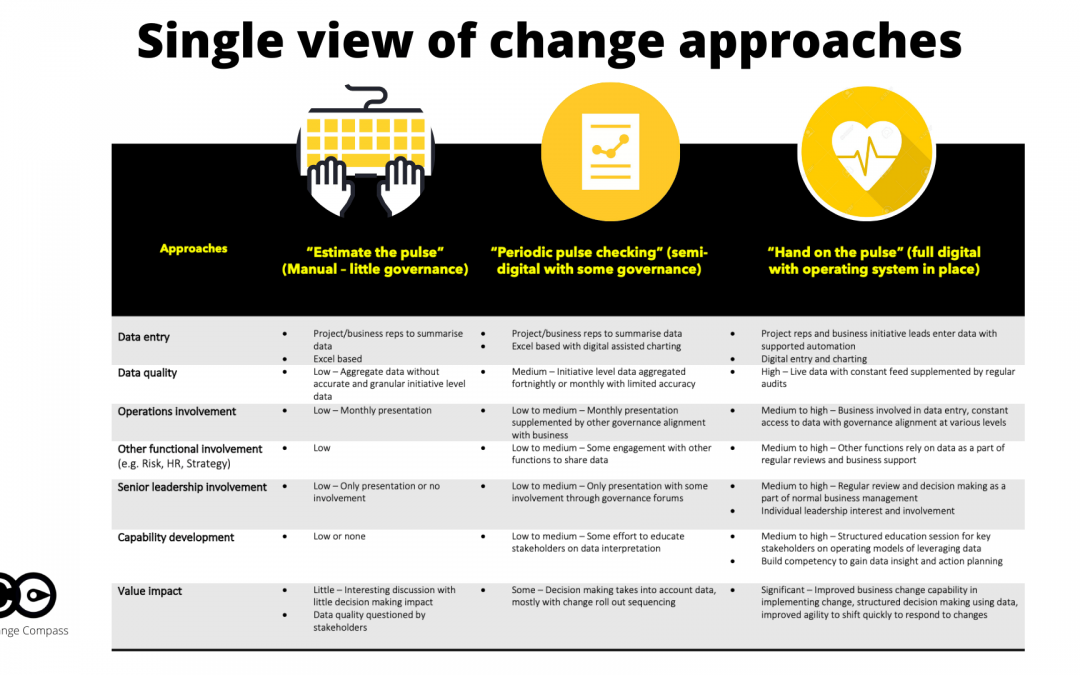
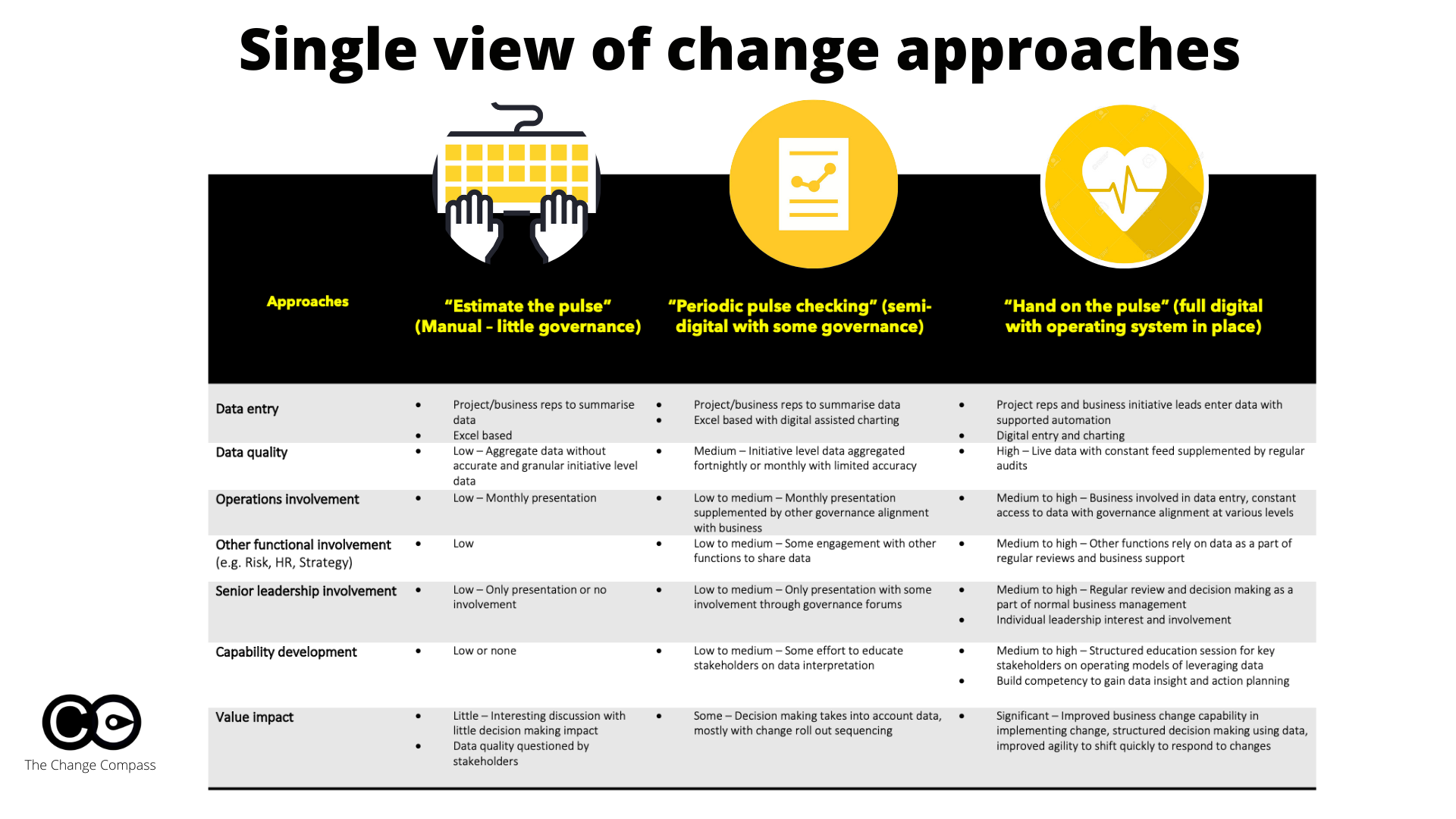
What are the different approaches in deriving a single view of change? And what business impact do they have?
A single view of change is often mentioned as the ‘nirvana’ for change practitioners. Having a clear view of all changes impacting people helps to better plan and execute on the changes.
In our experience there are 3 key approaches:
1) ‘Estimate the pulse’ – A quick and easy way of coming up with a simple heatmap or chart where impacts are estimated overall.
2) ”Periodic pulse checking’ – Periodic work, usually monthly, in documenting change impacts. Some governance and reporting operating rhythms setup. Some element of charting tools used.
3) ‘Hand on the pulse’ – An operating system where the data capture and analysis is embedded within regular business process. Data is utilised by various parts of governance and business planning routines. Fully digital in sustaining data maturity and insight generation.
Organisations may start out in the first or second approach in building on their change maturity and ability to generate change-related insights.
However, to reap the required business impact and to support an agile organisation where change is fast and constant, the first approach is best.
Effective communication is the lifeblood of any successful change endeavour within an organization. It serves as the conduit through which ideas are conveyed, strategies are articulated, and employees are engaged. However, the delicate balance between providing sufficient information and avoiding overload is often difficult to strike. Moreover, how communication is crafted can significantly impact its effectiveness in driving change.
Exploring the Elements of Failure
Delving into the nuances of change communication reveals several common pitfalls that can impede its effectiveness:
Maintaining a Positive or Neutral Tone: In many corporate settings, there is a pervasive tendency to maintain a positive or neutral tone in communication. While this may seem prudent to foster optimism and prevent undue concern, it can inadvertently obscure the gravity of the situation necessitating change. Employees may fail to grasp the urgency or magnitude of the challenges at hand if they are shielded from the realities driving the need for change. Striking the right balance requires a nuanced approach that acknowledges both the imperative for change and the potential benefits it offers. By providing a candid assessment of the current state while articulating a compelling vision for the future, organizations can inspire action and commitment among their workforce.
Impersonal Corporate Speak: The language employed in corporate communications often reflects a detached, impersonal demeanor. This formality, while intended to convey professionalism, can alienate employees and hinder their ability to connect with the message. Particularly in the context of change initiatives, where emotions and uncertainties abound, a more humanized approach is essential.Leaders must endeavor to communicate in a manner that resonates with their audience, conveying authenticity and empathy. By infusing their messages with personal anecdotes, genuine concerns, and relatable language, they can establish rapport and engender trust among employees.
Focus on Reason Over Emotions: Traditional corporate communication tends to prioritize logic and reason over emotional appeal. While facts and figures are undoubtedly important, they often fail to evoke the deeper emotional responses necessary to galvanize action. Employees are more likely to embrace change when they are emotionally invested in its success.Leaders should not shy away from tapping into the emotional dimension of change, sharing personal stories, aspirations, and concerns. By fostering a sense of shared purpose and rallying around common values, organizations can cultivate a culture of resilience and adaptability.
I hear you nod. So what is wrong with these practices if they have been the norm for decades and is adopted as common practice by most organisations?
OK let’s go through these one by one.
Illustrating the Importance of Emotional Engagement:
Drawing from personal experiences underscores the profound impact that emotional engagement can have on driving change: Recalling my tenure at Intel, a pivotal moment arose when rival AMD posed a significant threat to our market dominance. Leaders initiated candid discussions, rallying employees around the emotional stakes of the challenge. This emotional appeal galvanized teams across functions, leading to a remarkable turnaround in our fortunes.
Reimagining Change Communications
In light of the evolving organizational landscape, characterized by rapid technological advancements and shifting cultural norms, there is a pressing need to reimagine change communications: John Kotter, in his book “Change: How Organizations Achieve Hard-to-Imagine Results in Uncertain and Volatile Times,” highlights the imperative for organizations to adapt their communication strategies to meet the demands of the modern era. This entails embracing a more dynamic, inclusive approach that values authenticity, transparency, and emotional resonance.
Change communication is not a static endeavor but rather an ongoing evolution that must adapt to the ever-changing needs and expectations of employees. By challenging conventional norms and embracing innovative approaches, organizations can foster a culture of open dialogue, trust, and collaboration that fuels meaningful change and sustainable growth.
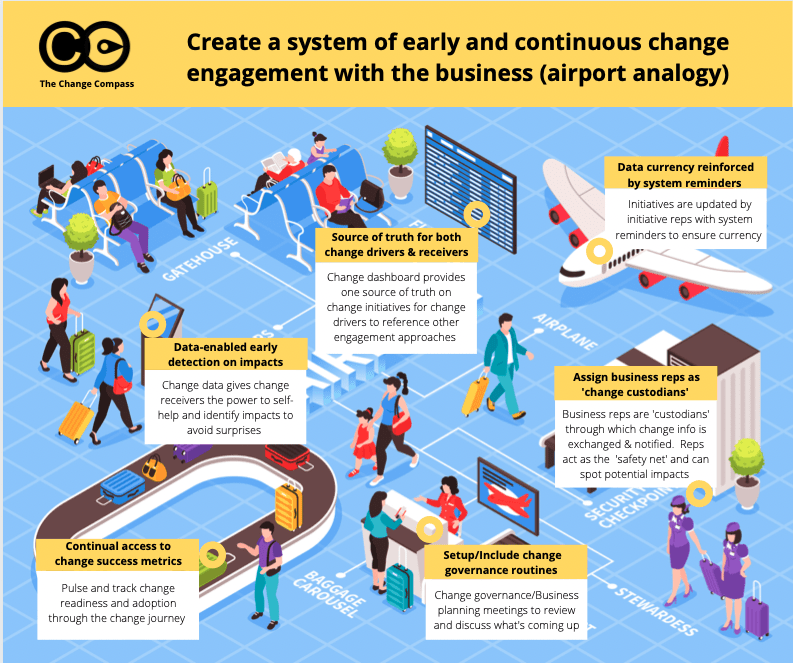
Change is akin to navigating through the skies; it requires careful planning, clear communication, and the ability to adapt to shifting conditions. In the same way that a well-orchestrated airport ensures the safe and efficient movement of passengers and cargo, organizations must design a robust system for change management to achieve success in today’s dynamic business environment. As we explore the intricacies of designing such a system, we’ll draw parallels to the meticulous planning and execution required in airport operations.
Data Currency: Reinforced by System Reminders
Imagine an airport where flight schedules are constantly updated to reflect changes in departure times, gate assignments, and weather conditions. Similarly, our change management system employs reminders to ensure that change initiatives are regularly updated by initiative representatives. This emphasis on data currency mirrors the real-time updates necessary for smooth operations in an airport, enhancing agility and equipping stakeholders with the latest insights to drive informed decision-making.
Source of Truth for Both Change Drivers & Receivers
Just as an air traffic control tower serves as the central hub for coordinating flight information, our change dashboard serves as a centralized source of truth for all stakeholders. This dashboard provides change drivers and receivers with comprehensive insights into ongoing initiatives, fostering transparency and alignment across the organization. Much like how clear communication among air traffic controllers, pilots, and ground staff is essential to avoid chaos in an airport, our centralized repository facilitates collaboration and empowers stakeholders to navigate the change journey with confidence.
Data-Enabled Early Detection on Impacts
Modern aircraft are equipped with advanced sensors to detect potential issues early and prevent disruptions during flights. Similarly, our change management system leverages data to anticipate and mitigate impacts before they escalate. By providing stakeholders with the tools to self-assess and identify potential disruptions, surprises are minimized, and proactive measures can be taken to ensure a seamless transition. This proactive approach mirrors the preventive measures taken in aviation to maintain safety and efficiency in flight operations.
Assigning Business Reps as “Change Custodians”
In an airport, ground staff play a crucial role in ensuring the smooth flow of operations and addressing potential issues as they arise. Similarly, designating business representatives as change custodians facilitates the exchange of critical information and ensures that potential impacts are identified and addressed in a timely manner. By acting as the frontline support for change initiatives, these representatives serve as the linchpin of change maturity, fostering a culture of accountability and ownership throughout the organization.
Continual Access to Change Success Metrics
Much like pilots rely on instruments to gauge their progress and make informed decisions during flights, stakeholders require access to real-time metrics to assess change readiness and adoption. Pulse checks and regular tracking throughout the change journey provide stakeholders with the insights needed to course-correct and adapt as necessary. Additionally, change governance routines, akin to strategic planning meetings in aviation, provide a forum for reviewing upcoming changes and fostering alignment with organizational goals.
Designing a system for change maturity requires careful planning, clear communication, and a commitment to continuous improvement, much like orchestrating the intricate operations of an airport. By embracing the airport analogy and drawing inspiration from its principles, organizations can navigate the complexities of change with confidence and achieve sustainable success in today’s ever-evolving business landscape.
Please click the below to download the infographic.
Measuring change is no longer a nice to have. It’s a must-have for a lot of organisations. A lot of stakeholders are now demanding to see and understand what is happening in the world of change. With the enhanced volume of change and therefore the increased investment made by the organisations, it’s no wonder.
Why are stakeholders demanding to see change data?
When we look across the room amongst the various disciplines, data forms an integral part of any function. Finance – tick. HR – tick, yes pretty much all aspects of people are tracked and reported. Operations – tick, as we have all types of performance KPIs and efficiency indicators. Technology – tick, since every part of technology can easily be measured and reported. Marketing – tick, as marketing outcomes are tied to revenue and customer sentiments.
With Covid it is even more the case that data is integral. We can no longer ‘walk the factory’ to sense what is happening. To see what is happening and what is going to happen stakeholders revert to data. In our virtual working environment, stakeholders require a constant dashboard of data to track how things are progressing.
Why is measuring change not an activity?
In the past it used to be that measuring change is only something you do in a project when you want to see if stakeholders are ready for the change. No more. Most organisations have a multitude of changes running concurrently. There is no choice to select 1 or 2 changes to roll out. With significant business challenges, most organisations are finding that running with multiple changes is the norm.
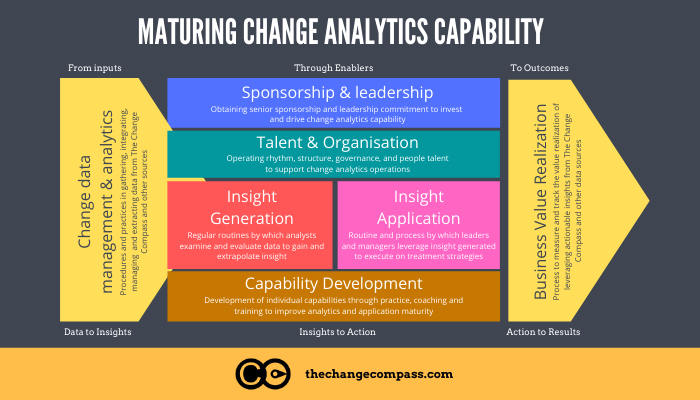
With multiple changes, increased stakeholder demands and appetite, measuring change is no longer just an activity. Measuring change takes a set of structured routines. It requires effective governance design. It takes experience and analytical expertise. Most of all, it is not a once-off event, it is a continual building of organisational muscle and capability. We are heading into the world of change analytics capability.
What is change analytics capability and how do I attain this?
Here are 7 core components of building and maturing change analytics capability:
1. Establishing change data management procedures and practices
This is about setting up the right steps in place so that change data can be identified, collected, and documented. This includes identifying the types of change data you would like to collect and how to go about collecting them. It will be easier to start with the core set of data required and then build from these as needed. This will reduce the risk of overwhelming your stakeholders.
After the right metrics and collection channels have been identified then it’s about building the regular routines to collect and document the metrics.
2. Sponsorship and leadership of change analytics
To really reap the value of change analytics you will need to gain the blessing and sponsorship of your leaders. Well, at least in time. In the beginning, you may need some time to come up with compelling data that tell the story that you want them to before you show your leaders. Eventually, without strong leadership buy-in, change data will not be effectively leveraged to make business decisions.
Getting your leaders’ blessing isn’t just a verbal exercise. It means that they are signing-up to regularly review, discuss and utilise change data to realise business value.
3. Build talent and organisation to support change analytics
Think about the various stakeholders and what you need them to understand in terms of change data. The way you educate stakeholders will be different to how you educate operations managers or the PMO. Plot out how you plan to help them get familiar with change data. Do you need particular roles to support data analysis? Is it a Change Analyst who is focused on the regular upkeep and consolidation of change data? What roles do you need other team members to play?
4. Insight generation
With a full set of change data infront of you, it’s now time to dive into them to generate insights. What is the data telling you? How do they support other data sources to form a clear picture of what is happening in the workforce? Is the data accurate and updated? Generating insights from the data takes skills and experience. It takes the ability to integrate different sources of data outside of change data themselves.
5. Insight application
This is about setting up the right routines and processes so that any insights generated may be discussed and applied. It could be through various governance forums, leadership or planning meetings that insights are shared and socialised. An integral part of this step is applying the insight by making business decisions. For example, do we delay the initiative roll out or invest more to support leaders? Are there reasons for us to speed up roll out to support the workforce?
6. Change analytics capability development
Change analytics is a capability.
With good change data emerging, you also need to have the right people with the right skills to collect, process and interpret the data. You may also want to think about which teams need what analytical skills. Do you have people in the team who are sufficiently analytical and data-oriented? Do they know how to interpret the data to form trends and predictions?
You may want to think about organising capability sessions or training to strengthen data analysis skills. Are there members in the different governance bodies that need support to be more confident in using change data?
7. Realising business value through change analytics
The last part of the equation is realising business value through change analytics. This is about tracking and documenting the value realised through using change analytics. It could include incidents where the business decision made has lead to significant risk reduction or operations protection. It could be enhanced leadership confidence mitigating risks in negative customer experience. Tracking value generated is critical to make clear to stakeholders the value of the overall investment.
If you found this article useful please share.
Do you have questions on measuring change for your organisation? Ping us on our chat.
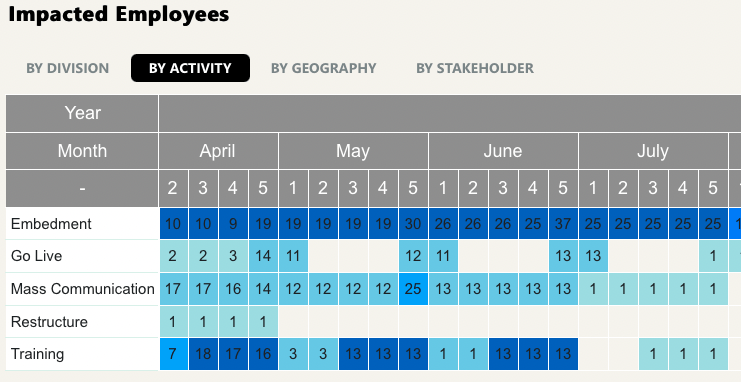
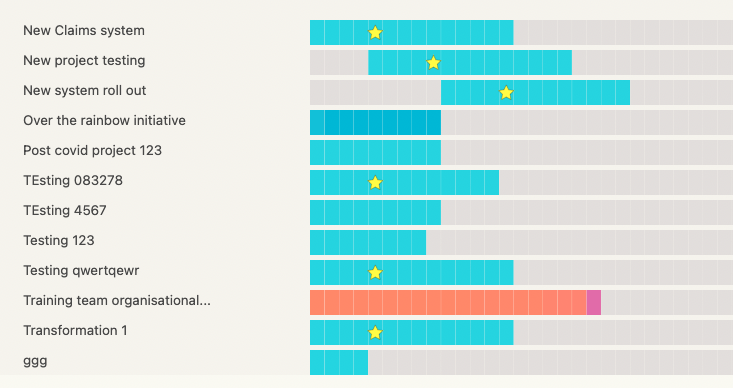
The term “single view of change” is starting to gain more popularity and organisations are starting to understand why they need this and what it looks like. The term refers to an artifact that shows the different change initiatives being mapped together. This is usually presented in a calendar format that shows when the initiatives will impact the organisation over time. In this article, we will look closely at what the single view of change is, what stakeholders are looking for in this artifact and how to use it.
Typical formats for single view of change
Red, amber and green cells for each project across time
Business unit based heatmap across time
Here are some examples from The Change Compass as reference.
Different views may be selected for the HeatmapThe data may be grouped/ordered by different fields (Go-Live is shown as a star)
In the past year there has been increasing interest from organisations talking about single view of change (SVOC) and wanting to derive this view. What we’ve observed at The Change Compass are the following trends:
Senior managers or executives are often the ones who are requesting the SVOC.
This usually arises as the number of change initiatives starts to increase and there is feedback that there could be too much change for employees to handle or change fatigue. This is not a surprise given the companies are already struggling to keep up with competitive, technology, and regulatory changes. Covid has added to these changes and compounded the overall change load.
Senior managers are after data to make decisions on. And managing change is no exception. Gone are the days when managers can make decisions based on opinions and hunches. With Covid, there are employees working remotely and so performance needs to be managed based on data – there is simply no other way. In a similar vein, change data is integral to making business decisions.
An example of stakeholders requesting SVOC
When I was the Head of Change at National Australia Bank there was a strong focus on deriving a single view of change. This was not always the case. There were constant complaints from employees that there was too much change. On the other hand, senior managers often responded with “we’re still able to run the business and the business has not broken, so let’s keep going”.
One of the key reasons that senior managers were requesting SVOC was that initiatives are by design in silos. Each initiative team designs the initiative independent of other initiatives. From a technical perspective, there are various architects who are accountable for advising on what the technology stack should look like and what is in the best interest of the organisation across initiatives. However, from a people change perspective there were no practices in which changes across the board are harmonised and sequenced.
Eventually, at National Australia Bank we built a clunky way of capturing change impact data that did meet stakeholder needs. My realisation was that stakeholders that request SVOC were not after the artifacts per se. In fact what they were after most were:
Determining when there would be too much change saturation leading to change fatigue
Ability to determine what needs to be moved and how/when initiatives can be moved if there is contention
Understanding key risks that could arise in executing on a range of change initiatives that could disrupt the business or impact initiative benefit realisation
Understanding what change activities are organised and how they are impacting business-as-usual operations so that effective resourcing can be in place
What this means is that stakeholders are asking for SVOC, when they are really asking for a way to manage the change portfolio in a way that reduces risk for the organisation and maximise benefits targeted. Managing change at a portfolio level is a new concept and discipline for most organisations.
Over the years in working with organisations through The Change Compass, I’ve noticed the following trends across different organisations when it comes to creating and using SVOC.
Change saturation can mean different things to different stakeholders. This reflects on the different parts of change management focus areas for organisations. Some focus on the humanistic aspects of change for individuals. This includes the personal experience and stress of change fatigue. Others focus on the impacts of business performance and resourcing.
Some of the presented reasons for change saturation
“Our employees tell us there is too much change”. This needs to be carefully considered when providing feedback to senior managers. Some could be skeptical of the feedback and respond with comments such as “there are always complaints about too much change”. A balanced view including employee feedback as well as other business indicators would be advised. For example, efficiency levels or absenteeism.
Not adopting a change portfolio approach – Just seeing the risks and business problems with SVOC will not necessarily resolve the issues. It is about making business decisions with the information that will create impact.
Poor portfolio management – If this is the reason then most companies have poor portfolio management because change portfolio management is still in its infancy for most organisations.
Responses of execs determine the outcomes – some still insist on persisting with change in the face of change saturation. From what we have seen a lot of senior managers usually learn from the aftermath of change saturation before they will make decisions to avoid it in the first place. Help your senior managers to understand the consequences and what it means to business data. Of course, the more detailed data you can provide the more convincing your argument is going to be.
Because companies haven’t invested in people capability – Having better change capability can impact the way employees perceive and undergo the change journey. More change mature teams tends to be able to absorb more and faster changes than those who are less mature. However, change maturity takes time and investment to build and is not a lever that can be pulled overnight.
Not effectively setting expectations and agenda for what is coming. Setting clear expectations is the first step. Without knowing what changes to expect the change outcome could be impacted. However, this is only one part of the change equation. Having achieved clarity of expectation is just the first step. There are lots of other steps to take to create an effective change journey.
External factors affecting the load of change may not be easily filtered by the organisation. Lots of organisations are facing multiple impacts of change from different arenas, technology, regulations, competition, and other industry changes. In many cases, the changes piled on top of each other creating a significant change load that cannot be easily moved out. In this case, organisations need to be realistic about what can be achieved given this load of change. Would investing in capability help to lift the ability to undergo a heightened change volume? Can we package changes so that they are more streamlined and integrated, and thereby reducing cognitive load for impacted employees?
The role of change practitioners
Through using a SVOC change practitioners can play different roles in adding value to the organisation.
Change portfolio management: Managing a portfolio from a change impact perspective is a role that can add significant value. The benefits of adopting a portfolio approach can result in initiatives being harmonised. From the user perspective, changes are better linked and grouped versus being isolated from each other.
Architecting and designing delivery: With better alignment and synchronisation, initiative rollout can be better designed as a whole, with a convincing set of strategies and themes that make sense for impacted employees.
Executive consultation and influencing: Armed with data it is much easier to influence senior executives. The trick is to select the few data visualisations that tell the story of key risks to the organisation, and the size of the problems involved. This also needs to be paired with recommended solutions.
Business change capability building – With SVOC change capability building is not just about rolling out generic skills, but targeted content delivered at the right junctures to equip the business with the right skills to be better equipped for a targeted set of changes
Next steps
Are you working on a SVOC? Do you have questions? If you would like to talk to us to understand how others have fared in their SVOC journeys click the following button to book time. We’re happy to share with you some of the tips and tricks in deriving SVOC.