Organisational transformations are essential for staying competitive in today’s fast-paced world, but they often come with challenges that can derail progress. One of the most pressing issues is change overload—when employees and stakeholders are overwhelmed by the sheer volume or pace of changes being implemented. This can lead to burnout, disengagement, resistance, and ultimately, failure to achieve transformation goals.
Artificial intelligence (AI) offers a powerful solution to combat change overload. By leveraging AI tools and strategies, organisations can streamline processes, personalise communication, optimise workflows, and make data-driven decisions that reduce stress and improve adoption rates. This guide provides actionable steps to harness AI effectively in managing large-scale transformations while preventing change fatigue.
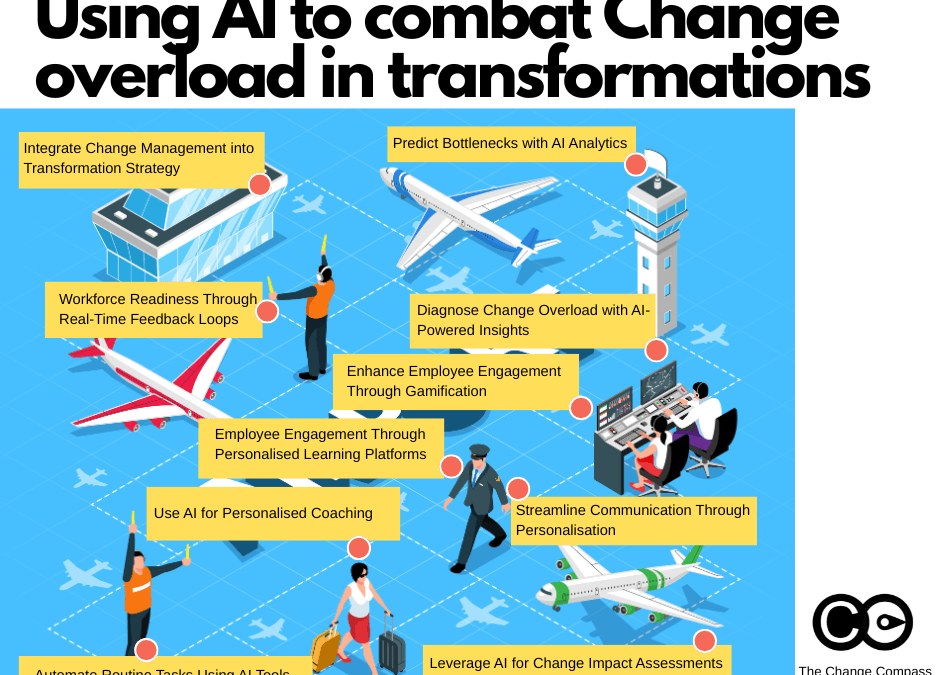
1. Diagnose Change Overload with AI-Powered Insights
Before addressing change overload, you need to identify where it exists and how it impacts your organisation. AI-powered analytics tools can provide real-time data on employee sentiment, workload distribution, and engagement levels—helping you pinpoint areas of concern before they escalate.
How to Apply This:
Use Sentiment Analysis Tools: Platforms like Microsoft Viva Insights or Qualtrics EmployeeXM can analyse employee feedback from surveys, emails, or chat platforms to detect patterns of stress or disengagement. For example:
If sentiment analysis reveals a spike in negative feedback during a specific project phase, it may indicate that employees are overwhelmed by unclear communication or unrealistic deadlines.
Monitor Workload Distribution: Tools such as Workday or Asana’s workload management feature can highlight individuals or teams carrying disproportionate workloads. This allows leaders to redistribute tasks more equitably.
Track Change Saturation Metrics: Use metrics like the number of concurrent projects per team or the average time spent on change-related activities per week may be a start. AI dashboards can automatically calculate these metrics and flag when thresholds are exceeded.
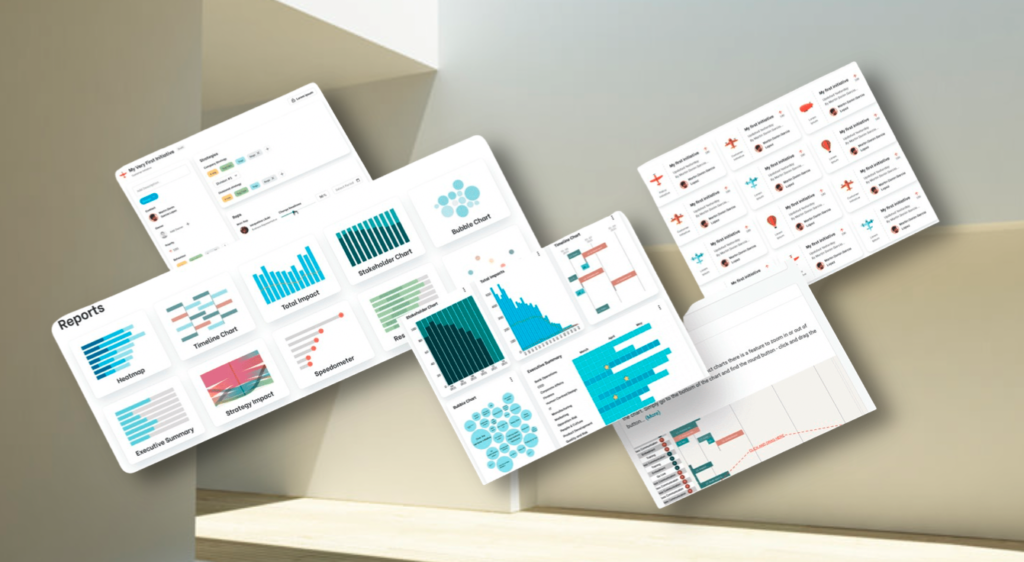
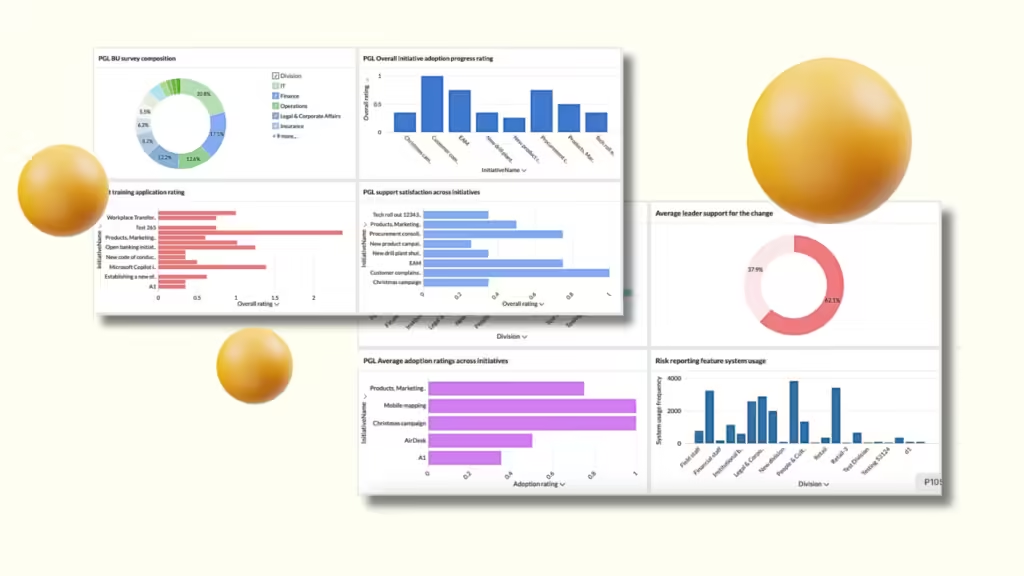
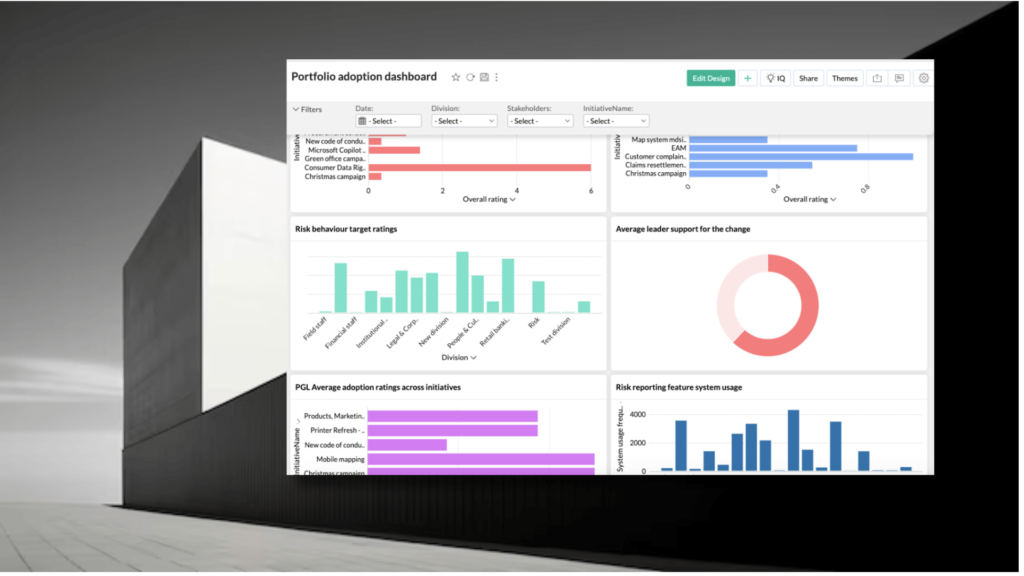
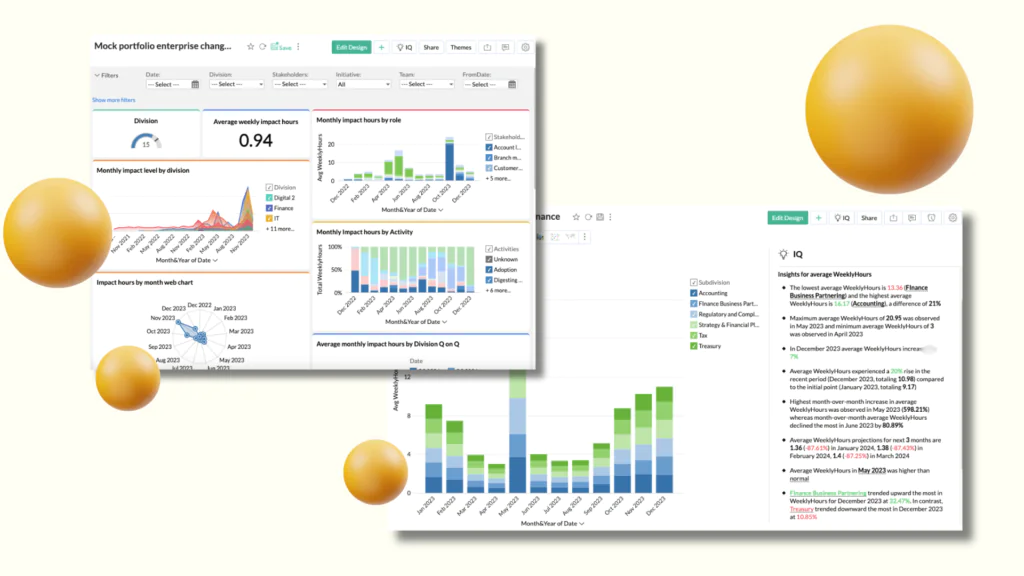
Visualise Change Saturation: Tools such as The Change Compass can help to easily capture change impacts across initiatives and turn these into data visualisation to support decision making. Embedded AI tools help to interpret the data and call out key risk areas and recommendations.
🔍 Example: A retail organisation undergoing digital transformation used AI sentiment analysis to discover that frontline employees felt excluded from decision-making processes. Leaders adjusted their communication approach to involve key frontline change champions which improved morale and reduced resistance.
2. Streamline Communication Through Personalisation
One-size-fits-all communication often adds to change fatigue by overwhelming employees with ineffective or irrelevant information. AI can help tailor messages based on individual roles, preferences, and needs—ensuring that employees only receive what’s most relevant to them.
How to Apply This:
Leverage Natural Language Processing (NLP): Tools like IBM Watson can analyse employee communication styles and suggest tone adjustments for clearer messaging.
Segment Audiences Automatically: Use platforms like Poppulo or Dynamic Signal to categorise employees by role, department, or location and deliver targeted updates accordingly. For instance:
IT teams might receive detailed technical updates about new systems being implemented, while frontline staff get simplified instructions on how the changes will impact their day-to-day tasks.
Automate Feedback Loops: Chatbots powered by AI (e.g., Tidio or Drift) can collect ongoing feedback from employees about the clarity and usefulness of communications during transformation initiatives.
💡 Pro Tip: Combine AI-driven personalisation with human oversight to ensure messages remain empathetic and aligned with organisational culture.
3. Predict Bottlenecks with AI Analytics
One of AI’s greatest strengths is its ability to analyse historical data and predict future outcomes—a capability that’s invaluable for managing change timelines and resource allocation effectively. Predictive analytics can help you anticipate bottlenecks before they occur and adjust your strategy in real time. For example, there could be cyclical periods of the year where the change volume tends to be higher. From our research at The Change Compass, we’ve seen that across different industries, October-November, and February-March tend to be high change volume periods.
How to Apply This:
Forecast Employee Capacity: If you already have the data you can use tools like Tableau or Power BI to predict when teams will be overstretched based on upcoming project timelines and historical workload data. Alternatively, utilise The Change Compass’ forecasting capabilities to predict trends.
Identify High-Risk Areas: Predictive models can flag departments or teams likely to experience resistance based on past behaviours or current engagement levels.
Scenario Planning: Use AI simulations (such as those offered by AnyLogic) to test different implementation strategies for your transformation initiative. The Change Compass also has a scenario planning feature to help you model changes before making the decision.
📊 Example: A financial services firm used predictive analytics during its digital transformation to identify that Q4 was historically the busiest period for its customer service team. By rescheduling non-critical training sessions for later Q1, they reduced employee stress and maintained service quality.
4. Enhance Employee Engagement Through Personalised Learning Platforms
Engaged employees are more likely to embrace change rather than resist it. AI-powered learning platforms offer personalised training pathways that equip employees with the skills they need for new roles or technologies introduced during transformation.
How to Apply This:
Create Adaptive Learning Journeys: Platforms like Degreed or EdCast use AI algorithms to recommend training modules based on an employee’s current skill set and career aspirations.
Gamify Learning Experiences: Incorporate gamification elements such as badges or leaderboards into your training programs using tools like Kahoot! or Quizizz.
Monitor Training Effectiveness: Use analytics within learning management systems (LMS) like Cornerstone OnDemand to track completion rates, quiz scores, and time spent on modules.
🎯 Action Step: Pair training initiatives with clear career progression opportunities tied directly to the transformation goals—for example, offering certifications for mastering new software systems being implemented.
5. Automate Routine Tasks Using AI Tools
Repetitive tasks drain employees’ energy and time—resources that could be better spent on strategic initiatives during transformations. Automation powered by AI can alleviate this burden by handling routine tasks efficiently. This not only reduces workload but also empowers employees to focus on higher-value activities that drive transformation success.
Note that this approach is assuming the organisation has the appetite to leverage AI and automation to reduce workload.
How to Apply This:
Automate Administrative Tasks: Tools like UiPath or Zapier can automate workflows such as data entry, meeting scheduling, or report generation. For example:
Automating the creation of weekly project status reports allows project managers to spend more time addressing risks and engaging with stakeholders.
Streamline Onboarding Processes: Implement chatbots like Leena AI or Talla that guide employees through onboarding steps during organisational changes. These tools can answer FAQs, provide training schedules, and even send reminders for task completion.
Enable Self-Service Options: Deploy virtual assistants (e.g., Google Dialogflow) that allow employees to access FAQs about new policies, systems, or procedures without waiting for human support.
💡 Pro Tip: When automating tasks, ensure transparency with employees about what is being automated and why. This helps build trust and prevents fears about job security.
6. Foster Workforce Readiness Through Real-Time Feedback Loops
Continuous feedback is essential during transformations—it helps leaders course-correct quickly while keeping employees informed and engaged. However, traditional feedback mechanisms like annual surveys are often too slow to capture real-time issues. AI tools enable organisations to collect and analyse feedback at scale in real time, creating a more agile approach to managing change fatigue.
How to Apply This:
Deploy Pulse Surveys: Platforms like Culture Amp or Peakon use AI algorithms to analyse survey responses instantly and provide actionable insights. For example:
If a pulse survey reveals low morale in a specific department, leaders can intervene immediately with targeted support or communication efforts.
Monitor Collaboration Metrics: Tools such as Slack Insights or Microsoft Teams Analytics track engagement levels within collaboration platforms. If metrics show a drop in activity or participation, it could indicate disengagement or confusion about transformation goals.
Close Feedback Loops Quickly: Use automated workflows triggered by feedback results. For instance:
If employees flag a lack of clarity about a new system rollout, an automated workflow can schedule additional training sessions or send out simplified guides.
📌 Key Insight: Real-time feedback not only identifies issues early but also demonstrates that leadership values employee input—a critical factor in building trust during change.
7. Leverage AI for Change Impact Assessments
One of the most overlooked aspects of managing change is understanding its cumulative impact across the organisation. Many organisations fail to consider how multiple simultaneous changes affect employee capacity and morale. AI tools can help conduct comprehensive change impact assessments by analysing data across projects, teams, and timelines.
How to Apply This:
Map Change Dependencies: Use AI-powered tools like The Change Compass to visualise how different initiatives overlap and interact. For example:
If two major IT upgrades are scheduled for the same quarter, the tool can flag potential conflicts and recommend rescheduling one of them as well as locating the right timing.
It could also be a series of smaller initiatives all being executed at the same time, again leading to the risk that key messages may not be absorbed by impacted employees
Analyse Historical Data: Predict how similar changes have impacted the organisation in the past using predictive analytics tools mentioned previously.
Simulate Scenarios: Run simulations to test different implementation strategies (e.g., phased vs big-bang rollouts) and predict their impact on employee workload and engagement.
🔍 Example: A global logistics company used AI-driven impact assessments to identify that rolling out a new CRM system during peak holiday season would overwhelm its sales team. By postponing the rollout until after the busy period, they avoided unnecessary stress and ensured smoother adoption.
8. Enhance Employee Engagement Through Gamification
AI can make transformation initiatives more engaging by incorporating gamification elements into training programs, communication strategies, and performance tracking systems. Gamification taps into employees’ intrinsic motivation by rewarding participation and progress—making change feel less daunting and more rewarding.
How to Apply This:
Gamify Training Programs: Use platforms like Kahoot! or Quizizz to create interactive quizzes and challenges related to new systems or processes being introduced.
Incentivise Participation: Offer digital badges, points, or leaderboards for completing key milestones in transformation initiatives (e.g., attending training sessions or adopting new tools).
Track Progress Automatically: AI-powered LMS platforms like Degreed can track employee progress in real time and provide personalised recommendations for next steps.
🎯 Action Step: Pair gamification efforts with tangible rewards such as gift cards or extra leave days for top performers.
💡 Pro Tip: Ensure gamification efforts are inclusive—design challenges that appeal to all personality types, not just competitive individuals.
9. Use AI for Personalised Coaching
AI-powered coaching platforms are revolutionising how organisations support their employees during transformations. These tools provide personalised guidance tailored to each employee’s role, skills, and career aspirations—helping them navigate change more effectively while feeling supported.
How to Apply This:
Deploy Virtual Coaches: Platforms like BetterUp or CoachHub use AI algorithms to match employees with virtual coaches who provide tailored advice on navigating change.
Provide Role-Specific Guidance: Use AI tools that offer customised recommendations based on an employee’s role within the organisation. For instance:
A sales representative might receive tips on leveraging new CRM features, while a manager gets guidance on leading their team through uncertainty.
Monitor Coaching Effectiveness: Track metrics such as employee satisfaction scores or performance improvements after coaching sessions.
🔍 Example: A tech company implementing agile methodologies used an AI coaching platform to train managers on fostering collaboration within cross-functional teams. The result was a smoother transition with fewer bottlenecks.
10. Integrate Change Management into Your Digital Transformation Strategy
AI should not operate in isolation; it must be embedded into your broader change management framework for maximum impact. This includes aligning AI initiatives with existing change management methodologies.
How to Apply This:
Centralise Data Sources: Use platforms like The Change Compass to consolidate insights from various data sources into a single dashboard, think data sources such as system usage, performance KPIs and employee survey results. It also enables you to capture your change data and deliverables according to your preferred methodology and populate data with generative AI.
Align Metrics Across Teams: Ensure KPIs related to change readiness (e.g., adoption rates) are consistent across departments.
Train Leaders on AI Capabilities: Equip managers with basic knowledge of how AI works so they can champion its use within their teams.
🌟 Final Thought: The integration of AI into change management isn’t just about technology—it’s about creating a culture of adaptability where data-driven decisions empower people at every level of the organisation.
Call-to-Action: Start Your Journey Towards Smarter Change Management
The challenges of large-scale transformations don’t have to result in burnout or disengagement when you harness the power of artificial intelligence effectively. Begin by assessing your current change portfolio environment—what tools are you already using? Where are the gaps? Then explore how AI solutions can fill those gaps while aligning with your organisational goals.
Ready to take the next step? Dive deeper into strategies for agile change portfolio management here and discover how data-driven insights can revolutionise your approach today!
Air traffic control is one of the most sophisticated and high-stakes management systems in the world. Ensuring the safety of thousands of flights daily requires rigorous coordination, precise timing, and a structured yet adaptable approach. When failures occur, they often result in catastrophic consequences, as seen in the tragic January 2025 midair collision between an army helicopter and a passenger jet in Washington, D.C. airspace.
Think about the last time you took a flight. You probably didn’t worry about how the pilot knew where to go, how to land safely, or how to avoid other planes in the sky. That’s because air traffic control is a well-oiled machine, built on a foundation of real-time data, clear protocols, and experienced professionals making split-second decisions. Now, imagine if air traffic controllers had to work with outdated information, or if pilots had to rely on intuition rather than hard facts. Chaos, right?
The same principles that apply to managing air traffic also hold valuable lessons for change and transformation management within organisations. Large-scale transformations involve multiple initiatives running in parallel, conflicting priorities, and significant risks. Without a structured, centralised approach, organisations risk failure, reduced value realisation, and employee fatigue.
The same logic applies to organisational change and transformation. Leaders are often trying to land multiple initiatives at once, each with its own trajectory, speed, and impact. Without real-time, accurate data, it’s all too easy for change initiatives to collide, stall, or overwhelm employees. Just as the aviation industry depends on continuous data updates to prevent disasters, businesses must embrace data-driven decision-making to ensure their transformation efforts succeed.
Here we’ll explore what air traffic control can teach us about using data effectively in change management. If you’ve ever felt like your organisation’s transformation efforts are flying blind, chaotic and uncoordinated, this one’s for you.
Lesson 1: The Danger of Overloading Critical Roles
The D.C. Midair Collision: A Case of Role Overload
In January 2025, a tragic midair collision occurred in Washington, D.C. airspace between an army helicopter and a passenger jet, claiming 67 lives. Investigations revealed multiple contributing factors, including inadequate pilot training, fatigue, insufficient maintenance, and ignored safety protocols. This incident underscored the dangers of overstretched resources, outdated processes, and poor data visibility—lessons that extend beyond aviation and into how organisations manage complex, high-stakes operations like change and transformation.
Additionally, the air traffic controller on duty was handling both helicopter and airplane traffic simultaneously, leading to a critical lapse in coordination. This split focus contributed to poor coordination and a lack of real-time situational awareness, ultimately leading to disaster. This is aligned with findings from various research that providing adequate resources is important in driving change and transformation.
Parallels in Change and Transformation Management
Organisations often suffer from similar overload issues when managing change. Many initiatives—ranging from business-as-usual (BAU) efforts to large-scale transformations—compete for attention, resources, and stakeholder engagement. Without a structured approach, teams end up working in silos, unaware of competing priorities or overlapping impacts.
There are some who argue that change is the new norm, so employees just need to get on the program and learn to adapt. It may be easy to say this, but successful organisations have learnt how to do this, versus ignoring the issue. After all, managing capacity and resources is a normal part of any effective operations management and strategy execution. Within a change context, the effects are just more pronounced given the timelines and the need to balance both business-as-usual and changes.
Key Takeaways:
Centralised Oversight: Organisations need a structured governance model—whether through a Transformation Office, PMO, or Change Centre of Excellence—to track all initiatives and prevent “collisions.”
Clear Role Definition: Initiative owners and sponsors should have a clear understanding of their responsibilities, engagement processes, and decision-making frameworks.
Avoiding Initiative Overload: Employees experience “change fatigue” when multiple transformations run concurrently without proper coordination. Leaders must balance initiative rollout to ensure sustainable adoption.
Lesson 2: Providing Initiative Owners with Data-Driven Decision Autonomy
The UPS ‘Continuous Descent Arrivals’ System
UPS has been testing a data-driven approach to landings called ‘Continuous Descent Arrivals’ (source: Wall Street Journal article: Managing Air Traffic Control). Instead of relying solely on air traffic controllers to direct landing schedules, pilots have access to a full dashboard of real-time data, allowing them to determine their optimal landing times while still following a structured governance protocol. While CDA is effective during light traffic conditions, implementing it during heavy traffic poses technical challenges. Air traffic controllers must ensure safe separation between aircraft while optimising descent paths.
Applying This to Agile Change Management
In agile organisations, multiple initiatives are constantly iterating, requiring a balance between flexibility and coordination. Rather than centralised bottleneck approvals, initiative owners should be empowered to make informed, autonomous decisions—provided they follow structured governance (and when there is less risk of multiple releases and impacts on the business).
Key Takeaways:
Real-Time Data Sharing: Just as pilots rely on up-to-date flight data, organisations must have a transparent system where initiative owners can see enterprise-wide transformation impacts and adjust accordingly.
Governance Without Bureaucracy: Pre-set governance protocols should allow for self-service decision-making without stifling agility.
Last-Minute Adjustments with Predictability: Agile initiatives should have the flexibility to adjust their release schedules as long as they adhere to predefined impact management processes.
Lesson 3: Resourcing Air Traffic Control for Organisational Change
Lack of Air Traffic Controllers: A Root Cause of the D.C. Accident
The D.C. accident highlighted that understaffing was a critical factor. Insufficient air traffic controllers led to delayed decision-making and unsafe airspace conditions.
The Importance of Resource Allocation in Change and Transformation
Many organisations lack a dedicated team overseeing enterprise-wide change. Instead, initiatives operate independently, often leading to inefficiencies, redundancies, and conflicts. According to McKinsey, companies that effectively prioritise and allocate resources to transformation initiatives can generate 40% more value compared to their peers.
Key Takeaways:
Dedicated Transformation Governance Teams: Whether in the form of a PMO, Transformation Office, or Change Centre of Excellence, a central function should be responsible for initiative alignment.
Prioritisation Frameworks: Not all initiatives should receive equal attention. Organisations must establish structured prioritisation mechanisms based on value, risk, and strategic alignment.
Investment in Change Capacity: Just as air traffic controllers are indispensable to aviation safety, organisations must invest in skilled change professionals to ensure seamless initiative execution.
Lesson 4: Proactive Risk Management to Prevent Initiative Collisions
The Risk of Unchecked Initiative Timelines
Just as midair collisions can occur due to inadequate tracking of aircraft positions, organisational change initiatives can “crash” when timelines and impacts are not actively managed. Without a real-time view of concurrent changes, organisations risk:
Conflicting Business Priorities: Competing transformations may pull resources in different directions, leading to delays and reduced impact.
Change Saturation: Employees struggle to absorb too many changes at once, leading to disengagement and lower adoption.
Operational Disruptions: Poorly sequenced initiatives can create unintended consequences, disrupting critical business functions.
Establishing a Proactive “Air Traffic Control” for Change
Enterprise Change Heatmaps: Organisations should maintain a real-time dashboard of ongoing and upcoming changes to anticipate and mitigate risks.
Stakeholder Impact Assessments: Before launching initiatives, leaders must assess cumulative impacts on employees and customers.
Strategic Sequencing: Similar to how air traffic controllers ensure safe landing schedules, organisations must deliberately pace their change initiatives.
The Role of Data in Change and Transformation: Lessons from Air Traffic Control
You Need a Single Source of Truth—No More Guesswork
Aviation Example: The Power of Integrated Data Systems
In aviation, pilots and controllers don’t work off scattered spreadsheets or conflicting reports. They use a unified system that integrates radar, satellite tracking, and aircraft GPS, providing a single, comprehensive view of air traffic. With this system, pilots and controllers can see exactly where each aircraft is and make informed decisions to keep everyone safe.
Application in Change Management: Why Fragmented Data is a Recipe for Disaster
Now, compare this to how many organisations manage change. Different business units track initiatives in separate spreadsheets, using inconsistent reporting standards. Transformation offices, HR, finance, and IT often operate in silos, each with their own version of the truth. When leaders don’t have a clear, real-time picture of what’s happening across the organisation, it’s like trying to land a plane in thick fog—without instruments.
Key Takeaways:
Create a Centralised Change Management Platform: Just like air traffic control relies on a single system, organisations need a centralised platform where all change initiatives are tracked in real time.
Standardise Data Collection and Reporting: Everyone involved in change initiatives should follow the same data standards to ensure consistency and accuracy.
Increase Visibility Across Business Units: Leaders need an enterprise-wide view of all change efforts to avoid conflicts and align priorities.
Real-Time Data Enables Agile, Confident Decision-Making
UPS has a fascinating system for managing landings, known as ‘Continuous Descent Arrivals.’ Instead of waiting for air traffic controllers to dictate their landing time, pilots receive real-time data about their approach, runway conditions, and surrounding traffic. This allows them to determine the best landing time themselves—within a structured framework. The result? More efficient landings, less fuel waste, and greater overall safety.
Application in Change Management: The Danger of Outdated Reports
Too often, business leaders make transformation decisions based on data that’s weeks—or even months—old. By the time they realise a problem, the initiative has already veered off course. When leaders lack real-time data, they either act too late or overcorrect, causing further disruptions.
Key Takeaways:
Use Live Dashboards for Initiative Management: Just as pilots rely on real-time flight data, change leaders should have constantly updated dashboards showing initiative progress, risks, and dependencies.
Empower Initiative Owners with Data-Driven Autonomy: When given up-to-date information, initiative owners can make faster, smarter adjustments—without waiting for top-down approvals.
Leverage Predictive Analytics to Anticipate Challenges: AI-driven insights can flag potential risks, such as change saturation or conflicting priorities, before they become full-blown issues.
Modern aircraft are equipped with automatic dependent surveillance-broadcast (ADS-B) systems, which allow them to communicate real-time flight data with each other. If two planes are on a collision course, these systems warn pilots, giving them time to adjust. It’s a proactive approach to risk management—problems are detected and resolved before they escalate.
Application in Change Management: Avoiding Crashes Between Initiatives
In organisations, multiple change initiatives often roll out simultaneously, each demanding employee attention, resources, and operational bandwidth. Without real-time risk monitoring, it’s easy to overwhelm employees or create operational bottlenecks. Many organisations don’t realise there’s an issue until productivity starts dropping or employees push back against the sheer volume of change.
Key Takeaways:
Invest in Impact Assessment Tools: Before launching an initiative, leaders should evaluate its potential impact on employees and the business.
Run Scenario Planning Exercises: Like pilots in flight simulators, organisations should model different change scenarios to prepare for potential challenges.
Set Up Early Warning Systems: AI-driven analytics can detect overlapping initiatives, allowing leaders to intervene before issues arise.
The High Cost of Inaccurate or Delayed Data
Aviation Example: The D.C. Midair Collision
The tragic January 2025 midair collision in Washington, D.C. was, in part, the result of outdated and incomplete data. A single air traffic controller was responsible for both helicopter and airplane traffic, leading to a dangerous lapse in coordination. Miscommunication about airspace restrictions only made matters worse, resulting in an avoidable catastrophe.
Poor Data Leads to Costly Mistakes
The corporate equivalent of this is when transformation teams work with old or incomplete data. Decisions based on last quarter’s reports can lead to wasted resources, poorly sequenced initiatives, and employee burnout. The consequences might not be as immediately tragic as an aviation disaster, but the financial, momentum and cultural costs can be devastating.
Key Takeaways:
Prioritise Frequent Data Updates: Change leaders must ensure initiative data is refreshed regularly to reflect real-time realities.
Collaborate Across Functions to Maintain Accuracy: Transformation leaders, HR, finance, and IT should work together to ensure all change impact data is reliable.
Automate Reporting Where Possible: AI and automation can reduce human error and provide real-time insights without manual effort.
Balancing Automation with Human Judgment
Aviation Example: Autopilot vs. Pilot Oversight
While modern planes rely heavily on autopilot, pilots are still in control. They use automation as a support system, but ultimately, human judgment is the final safeguard. It’s the perfect balance—automation enhances efficiency, while human oversight ensures safety.
Some leaders may find the process of collecting and analyzing data cumbersome, time-consuming, and even unnecessary—especially when they’re focused on quick execution. Gathering accurate, real-time data requires investment in tools, training, and disciplined processes, which can feel like an administrative burden rather than a value driver.
However, the benefits far outweigh the effort. A well-structured data system provides clarity on initiative progress, prevents conflicting priorities, enhances decision-making, and ensures resources are allocated effectively. Without it, organisations risk initiative overload, employee burnout, wasted budgets, and ultimately, failed transformations. Just like in aviation, where poor data can lead to fatal accidents, a lack of real-time insights in change management can result in costly missteps that derail business success.
Moreover, having an integrated process whereby data regularly feeds into decision making, as a normal business-as-usual process, builds the overall capability of the organisation to be a lot more agile and be able to change with confidence.
Navigating Change with Data-Driven Precision
Aviation has shown us what happens when decision-makers lack real-time, accurate data—mistakes happen, and consequences can be severe. In organisational change, the same principles apply. By embracing real-time data, predictive analytics, and structured governance, companies can navigate change more effectively, preventing initiative overload, reducing resistance, and maximising impact.
Ultimately, the goal is simple: Ensure your change initiatives don’t crash and burn. And just like in aviation, data is the key to a smooth landing.
If you would like to chat more about how to utilise a digital/AI solution that will equip you will insightful data to make critical business decisions in your air traffic control of your changes, reach out to us here.
Successful transformation is not just about having a clear strategy, the right technology, or a strong leadership team—it is about managing organisational energy effectively. Like a marathon, transformation requires a well-paced approach, allowing for the right breathing space at key milestones. Without careful attention to energy levels, organisations risk burnout, disengagement, and failure to sustain long-term change.
Understanding Organisational Energy
Organisational energy is the collective capacity of employees to take action, drive change, and sustain momentum. It encompasses physical, emotional, and cognitive dimensions, each playing a critical role in how teams navigate transformation. Unlike resources such as time and budget, energy is dynamic—it can be depleted through excessive demands or replenished through strategic interventions.
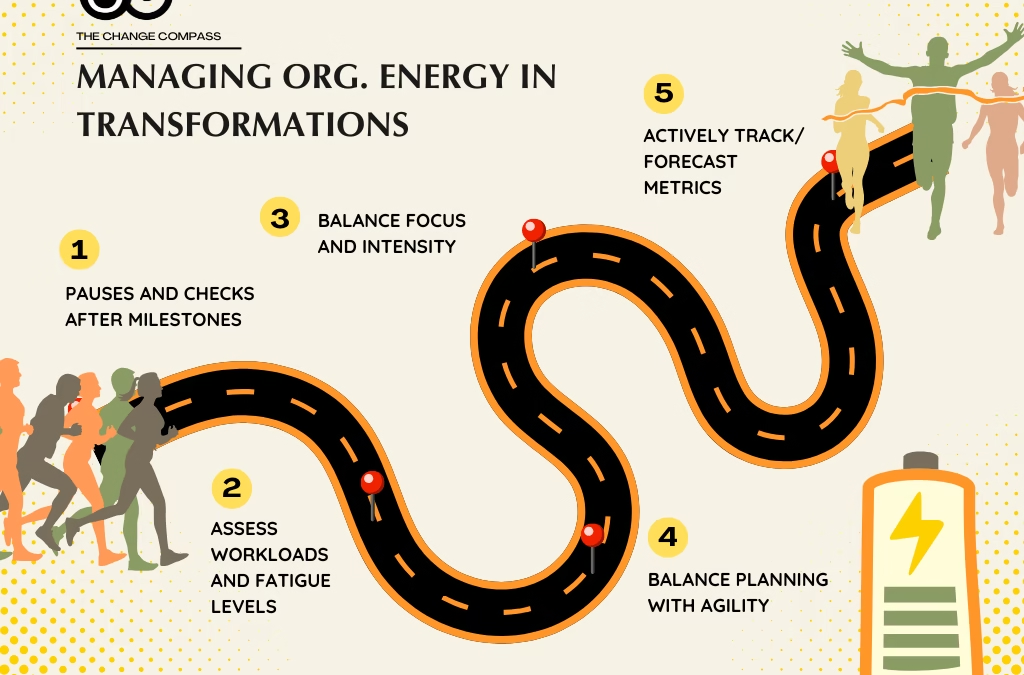
The Marathon Mindset: Pacing and Breathing Spaces
Transformation is a long journey, not a sprint. Like seasoned marathon runners, organisations must be intentional about pacing and ensuring adequate recovery points along the way. Leaders often push for rapid results, but sustained transformation requires:
Phased Implementation: Breaking down transformation into manageable phases with defined milestones.
Strategic Pauses: Allowing teams to absorb changes, reflect on progress, and recalibrate before moving to the next stage.
Energy Checks: Regularly assessing engagement levels, stress indicators, and feedback to adjust the pace accordingly.
Neglecting these aspects leads to fatigue, resistance, and disengagement—ultimately derailing transformation efforts.
Awareness of Existing Capabilities and Change History
Before embarking on a transformation journey, organisations must understand their baseline. Awareness of existing capabilities, ways of working, and historical transformation experiences provides predictive indicators of how change should be approached.
Key Considerations:
Past Change Successes and Failures: What has worked and what hasn’t? Understanding past patterns helps anticipate potential resistance or enablers.
Current Workload and Fatigue Levels: Are employees already stretched with existing initiatives? Overloading teams will compromise focus and execution quality.
Organisational Culture: Some cultures thrive on rapid change, while others require gradual adoption. Aligning transformation efforts with cultural realities is critical.
By assessing these factors, leaders can tailor transformation strategies to fit the organisation’s energy levels and capacity.
Building Organisational Stamina: Start Small, Scale Up
Just as athletes build endurance through progressive training, organisations must strengthen their transformation muscle over time. This means introducing smaller changes first to test resilience and capability before scaling up to more complex shifts.
How to Build Organisational Stamina:
Start with Pilot Initiatives: Test new ways of working in controlled environments before expanding.
Gradually Increase Complexity: Move from small process improvements to larger-scale changes, ensuring teams adapt successfully at each stage.
Celebrate Early Wins: Recognising progress builds confidence and motivation to tackle bigger challenges.
Provide Learning Opportunities: Equip teams with skills and tools that enhance adaptability and readiness for change.
Leaders who adopt this progressive approach foster a resilient workforce that can sustain transformation efforts over time.
Teams with good change leaders or those teams with significant experience with change tend to be more able to work with greater volumes of change as well as greater complexity of change. With each change initiative, with the right structure, routines (including retro), the team’s capability can be built to be ready for larger, more complex transformations.
Balancing Focus and Intensity
Attention is a finite resource. When teams are bombarded with multiple initiatives, priorities become diluted, and execution suffers. Managing focus effectively is essential to maintaining high performance during transformation.
Strategies for Maintaining Focus:
Limit Concurrent Initiatives: Prioritise the most critical changes and sequence others to avoid overload.
Establish Clear Priorities: Ensure alignment across leadership to prevent conflicting demands on teams.
Monitor Workload and Stress Levels: Pay close attention to employee well-being and adjust intensity as needed.
Encourage Deep Work: Create space for teams to focus without constant distractions or shifting priorities.
When focus is scattered, transformation efforts lose momentum. By managing cognitive load, leaders enable employees to fully engage with and execute changes effectively.
The Importance of a Clear Plan
While agile methodologies emphasise adaptability, having a structured plan provides essential clarity for employees navigating complex change. Transformation without a roadmap leads to uncertainty, anxiety, and resistance. This does not necessarily mean that plans are locked in stone and cannot be changed. In contrast to this, having a plan provides a frame of reference, and expectations can be set that details including timeline may shift but that the high level approach remains the same.
Why a Clear Plan Matters:
Provides Direction: Employees need to know where the organisation is headed and how they fit into the journey.
Reduces Uncertainty: Even if adjustments are made, a baseline plan offers reassurance and stability.
Enhances Engagement: When people understand the “why” and “how” of transformation, they are more likely to commit.
Prepares for Change: Last-minute changes create confusion and stress—early planning allows for smoother transitions.
Balancing Planning with Agility
While plans must be flexible, abandoning structure altogether creates chaos. Leaders should:
Communicate a High-Level Roadmap: Outline key phases and milestones without overloading with unnecessary detail.
Adapt Plans Responsively: Incorporate feedback and lessons learned, adjusting course without losing sight of long-term goals.
Engage Employees in Planning: Co-creation fosters ownership and reduces resistance.
A well-structured transformation plan provides clarity and confidence, making it easier for teams to adapt and sustain change.
To ensure the optimal management of organisational energy, measurement is essential. Organisations need clear yardsticks to assess energy levels, performance, and transformation progress, allowing leaders to make informed adjustments when needed. Without measurement, it is impossible to determine whether teams are operating at an optimal pace or experiencing fatigue and disengagement.
Key Metrics to Track:
Change Impact Data: Understanding the magnitude of transformation on various teams helps adjust implementation approaches.
Balance Energy Demand and Supply: Leaders should prioritize work strategically, focusing on high-impact initiatives while minimizing unnecessary demands. Simultaneously, they should inspire teams by articulating a compelling vision that connects the various dots across changes
Change Readiness Assessments: Gauging employees’ preparedness for change ensures the right support mechanisms are in place.
Sentiment Analysis: Regular pulse surveys and feedback loops help identify resistance, concerns, and engagement levels.
Performance Metrics: Tracking productivity, efficiency, and key deliverables helps align transformation with business outcomes.
Adoption Rates: Measuring how well new processes, tools, or ways of working are being integrated ensures long-term sustainability.
By continuously monitoring these indicators, leaders can fine-tune transformation efforts, ensuring that momentum is sustained while preventing burnout and resistance.
Leading with Energy Management
The success of any transformation effort hinges on how well organisational energy is managed. Leaders must act as stewards of energy—pacing initiatives appropriately, building stamina, maintaining focus, and providing clear direction.
By treating transformation like a marathon—strategically balancing intensity with recovery, testing capabilities before scaling, and ensuring clarity—organisations can sustain momentum and achieve lasting success. Managing organisational energy is not just a leadership responsibility; it is the foundation for thriving in an ever-evolving business landscape.
Do We Really Need a View of Changes Across the Organisation?
As the pace of change accelerates, senior leaders are increasingly asking for a comprehensive view of changes happening across the organisation. However, not everyone sees the need for this. Some change practitioners focus solely on project-level implementation, while others concentrate on developing change capability or leadership. So, is a broad organisational view of change necessary? The short answer is yes—and here’s why.
Why is a View of Changes Important?
1. Understanding Change is Key to Improving It
Managing change effectively requires a clear understanding of what is changing. Without visibility into the scope and nature of changes, how can we improve them? Imagine if Finance attempted to manage an organisation’s finances without access to financial data. The same principle applies to change management—without insights into ongoing changes, making informed improvements to how change is managed becomes impossible or at least ineffective.
A holistic view also helps identify patterns and systemic issues that may not be visible when looking at changes in isolation. For example, if multiple teams are experiencing resistance to similar types of change, it may indicate an underlying cultural or structural issue rather than a problem with individual initiatives.
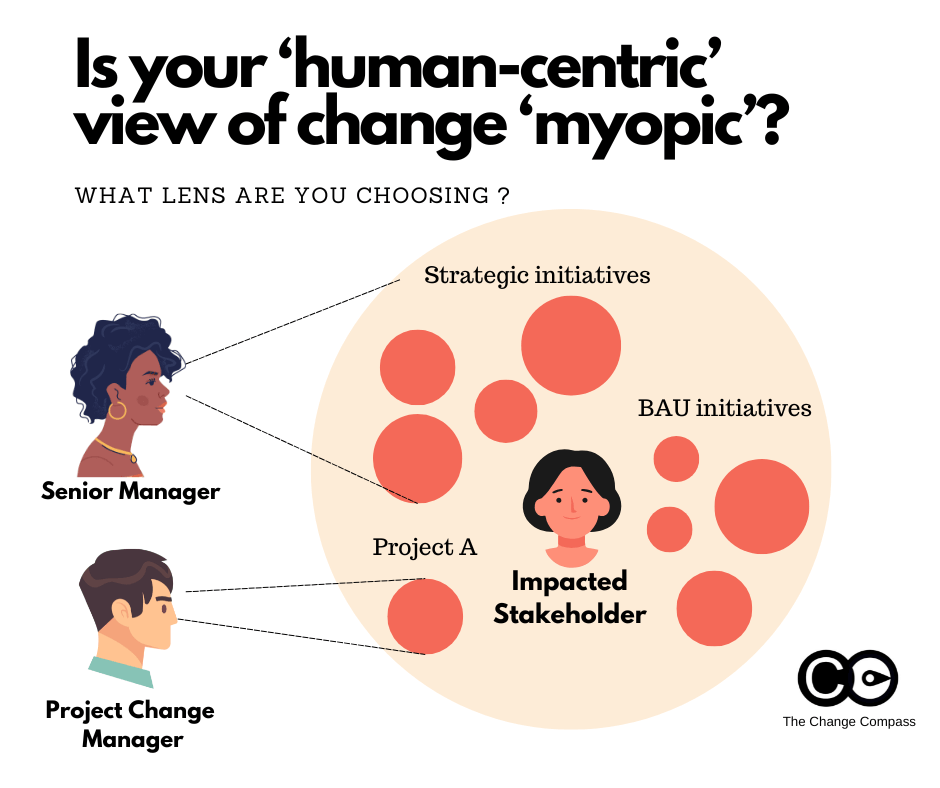
2. Avoiding a Myopic View
Many change practitioners operate at the project level, focusing on the change they are driving without visibility into other initiatives. This narrow focus can lead to conflicting priorities, resource constraints, and stakeholder fatigue. A fragmented approach often results in duplication of effort, where multiple teams work on similar initiatives without coordination, wasting time and resources.
A lack of visibility can also cause bottlenecks. For instance, two major transformation projects requiring input from the same group of employees may create undue pressure, leading to burnout and decreased productivity. With an organisational view, leaders can identify these risks in advance and implement measures to mitigate them, such as staggering implementation timelines or providing additional support.
3. Taking a Human-Centred Approach
A human-centred approach to change means viewing change from the perspective of impacted stakeholders rather than just from a project lens. Employees and customers experience multiple changes together, not in isolated silos. To design change experiences that work, we must understand the overall change landscape and how it affects people’s daily work and interactions.
Without a consolidated view, employees may feel overwhelmed by frequent, disconnected changes. This often leads to change fatigue, disengagement, and resistance. By considering how multiple changes intersect, organisations can design more coherent and supportive transition experiences for their people, improving adoption rates and overall satisfaction.
There are some who would rather not use the term ‘change fatigue’. Sure. Other labels may be used instead. However, not acknowledging its existence does not mean that it does not exists. We can choose to not label and not address the impacts of multiple changes. By doing this it will not magically go away. This is not going to help the business perform better and reach its targets.
4. Supporting Leadership in Managing Business Performance
Leaders are concerned about how changes impact business performance. Without a consolidated view of what is changing, how those changes interact, and their organisational impact, it is difficult to provide meaningful insights. A structured view of change enables leaders to make informed decisions, mitigate risks, and optimise the overall change portfolio to support business objectives.
For example, if an organisation is rolling out a new customer relationship management (CRM) system while simultaneously restructuring its sales teams, leaders need to assess whether these initiatives will complement or hinder each other. Without this awareness, they may inadvertently introduce inefficiencies, such as duplicate training efforts or conflicting performance expectations.
5. Enhancing Organisational Readiness for Change
A key benefit of having a comprehensive view of change is improving organisational readiness. Readiness is not just about preparing individuals for a specific change but ensuring the organisation as a whole is capable of absorbing and adapting to continuous transformation.
An organisation that understands its change landscape can proactively assess its capacity for change at any given time. If several major initiatives are running concurrently, leaders can evaluate whether the organisation has the resources, cultural maturity, and leadership alignment to support them. Without this visibility, companies risk overloading employees and creating resistance due to excessive, poorly timed changes.
Furthermore, readiness assessments can identify gaps in capability, such as the need for additional training, clearer communication, or adjustments in leadership support. When organisations have a clear view of upcoming changes, they can put proactive measures in place, such as phased rollouts, targeted engagement efforts, or reinforcement mechanisms, to ensure smoother transitions and greater adoption success.
6. How an Integrated View of Change Supports Business Readiness
An integrated view of change enables organisations to move beyond reactive change management and embrace proactive change readiness. By mapping all significant transformations across the business, leaders can anticipate challenges, synchronise efforts, and prepare employees more effectively.
For example, if a company is implementing a new enterprise resource planning (ERP) system while also shifting to a hybrid work model, an integrated change view allows decision-makers to assess whether these changes will create conflicting demands on employees. Instead of overwhelming teams with simultaneous process and technology shifts, adjustments can be made to stagger rollouts, align training programs, and provide tailored support.
Additionally, when businesses have a comprehensive perspective on change, they can implement readiness initiatives such as leadership coaching, employee engagement strategies, and resilience-building programs well in advance. This ensures that by the time changes take effect, the organisation is not just aware of them but fully prepared to embrace and sustain them. An integrated approach fosters a culture of adaptability, making the business more resilient in the face of continuous transformation.
Addressing Common Concerns: “It’s Too Complicated”
A frequent argument against establishing an organisation-wide change view is that it is too complex and resource-intensive. However, this does not need to be the case.
1. Start Small and Scale Gradually
Instead of attempting a whole-organisation approach from the outset, begin with a stakeholder lens. Understand how changes impact specific stakeholder groups, then expand to teams, departments, and eventually the entire organisation. This phased approach ensures manageable progress without overwhelming stakeholders.
One way to do this is by focusing on a single high-impact function, such as IT or HR, and mapping their change landscape before expanding outward. By demonstrating value in a contained environment, it becomes easier to gain buy-in for broader adoption.
2. Begin with Basic Data
There is no need to start with an elaborate data set. A simple list of initiatives is enough to begin forming a picture. Over time, additional data points—such as timelines, affected stakeholders, and interdependencies—can be added to enhance visibility and analysis.
Many organisations already have elements of this data scattered across different departments. Consolidating this information in a central repository can be a quick win that provides immediate value without requiring extensive new processes.
3. Take an Agile, Iterative Approach
Building a change view incrementally allows for continuous refinement and adaptation. By adopting an agile mindset, practitioners can deliver immediate value while progressively enhancing the data set. This approach ensures that the effort remains practical and sustainable while demonstrating benefits to stakeholders at each stage.
Using lightweight collaboration tools, such as shared spreadsheets or simple dashboard software, can help kickstart the process without significant investment in complex change management platforms.
Once you progress to a more sophisticated level where you need AI support and advanced dashboarding, check out Change Compass.
The Benefits of an Organisational View of Change
1. Improved Stakeholder Experience
By understanding the cumulative impact of multiple changes, organisations can better manage stakeholder experiences. Employees are often subject to change saturation when faced with numerous uncoordinated initiatives. A holistic view enables better sequencing and pacing of change to ensure smoother transitions.
2. Enhanced Risk Management
Without an overarching view, risks associated with overlapping initiatives may go unnoticed until issues arise. Identifying potential bottlenecks and conflicts early helps in designing mitigating strategies before problems escalate. Risks may include program delivery risk, operational risk, benefit realisation risk and various people risks.
3. Better Resource Allocation
Organisations often face resource constraints, whether in terms of budget, personnel, or time. A consolidated view helps leaders prioritise initiatives effectively, ensuring that resources are allocated to high-impact changes while minimising inefficiencies.
4. Strengthened Leadership Decision-Making
Leaders require data-driven insights to make informed strategic decisions. A comprehensive change landscape provides clarity on what is happening across the organisation, empowering leaders to align transformation efforts with business objectives.
Practical Steps to Establish an Organisation-Wide Change View
Step 1: Identify Key Stakeholders
Begin by engaging stakeholders across the organisation to understand their concerns and expectations. These may include senior executives, department heads, project managers, and frontline employees.
Step 2: Map Current and Upcoming Changes
Compile a list of all ongoing and planned initiatives. Categorise them by business function, timeline, impacted teams, and strategic priority. This will create an initial snapshot of the change landscape.
Step 3: Identify Interdependencies
Assess how different initiatives interact with each other. Are there overlapping resource requirements? Do changes in one area impact another? Recognising these dependencies enables better coordination and minimises disruption.
Step 4: Develop a Change Portfolio View
Use visualisation tools to represent the collected data in a meaningful way. Heatmaps, Gantt charts, and stakeholder impact matrices can help illustrate the overall change picture.
Step 5: Implement Governance Structures
Establish governance mechanisms to continuously update and refine the change portfolio. This may involve periodic reviews, a centralised change coordination team, or designated change champions within each department.
Step 6: Communicate Insights Effectively
Share findings with stakeholders in a digestible format. Providing clarity on how changes align with organisational priorities fosters engagement and encourages proactive collaboration.
Future Trends in Organisational Change Visibility
1. Increased Use of Digital Tools
Advanced analytics, AI-driven insights, and dashboard visualisation tools are making it easier to track and analyse change across an organisation in real-time.
2. Integration with Business Strategy
Change management is increasingly being embedded within broader business strategy execution and performance metrics tracking, ensuring alignment with long-term goals.
3. Greater Focus on Employee Experience
Organisations are recognising the importance of measuring change from an employee perspective. This includes sentiment analysis, real-time feedback loops, and adaptive communication strategies.
A comprehensive view of change across an organisation is not just a ‘nice-to-have’—it is essential for effective change management. It enables better decision-making, reduces unintended consequences, and enhances the overall employee experience. While establishing such a view may seem complex, taking a pragmatic, step-by-step approach makes it achievable and valuable.
For experienced change and transformation professionals, this shift in perspective is not just about managing change—it’s about leading it effectively in an increasingly dynamic world.
Change saturation has become one of the most searched concepts in change management practice – and one of the most inconsistently understood. In its simplest definition, change saturation occurs when the cumulative demand of concurrent change programmes on a specific employee group exceeds that group’s adaptive capacity. The employees in question do not simply slow down in their adoption of any individual change. They enter a qualitatively different state in which their willingness and ability to engage with any further change demand is fundamentally reduced. This state – characterised by fatigue, cynicism, and disengagement – is what distinguishes change saturation from ordinary change challenge, and it is why measuring it accurately matters for how organisations manage their change portfolios.
The problem is that most organisations measure change saturation using subjective methods – asking managers or employees whether they feel “overloaded,” collecting anecdotal feedback in town halls, or relying on pulse survey questions that do not produce data comparable across teams or time periods. These approaches are better than nothing, but they produce results that are difficult to act on because they cannot be disaggregated by programme, by employee group, or by change type. They tell an organisation that saturation is a problem. They do not tell it where, why, or what to do about it.
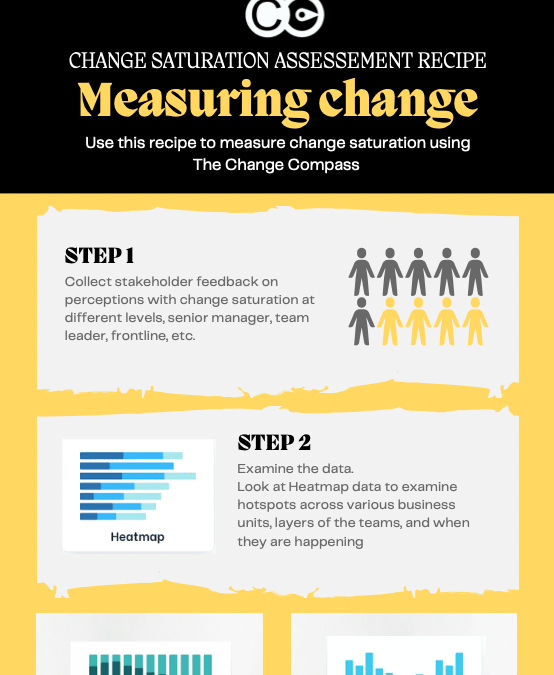
A more structured approach – a measurement recipe that produces actionable, comparable data – is what effective change saturation management requires. Download the Change Saturation Assessment Recipe for a step-by-step guide to measuring change saturation using The Change Compass.
Why personal opinion is an unreliable saturation measure
The instinct to measure change saturation through personal opinion – asking people whether they feel overwhelmed – has an obvious appeal. People experiencing saturation know it. Their self-report seems like direct access to the phenomenon being measured. The problem is that self-reported saturation is systematically biased in ways that make it unreliable for portfolio management decisions.
The first bias is social desirability. Employees who are experiencing genuine saturation may not report it accurately in formal measurement contexts if they believe reporting saturation will reflect negatively on their resilience or capability, or if they believe the organisation is not genuinely open to reducing the change load. In cultures where maintaining a positive front through adversity is valued, saturation is consistently underreported through self-report mechanisms.
The second bias is anchoring. Employees’ assessment of their saturation is relative to their recent experience. A team that has been operating at high saturation for an extended period may rate their current state as normal – because it is normal for them – even though it would be rated as high saturation by an objective measure. Conversely, a team that has recently experienced a significant increase in change load may rate themselves as highly saturated even if their objective load is within a manageable range, simply because the change from their recent baseline feels dramatic.
The third bias is aggregation. Even when individual self-reports are reasonably accurate, aggregating them across teams produces a misleading picture because the teams most likely to underreport saturation – those with the most competitive cultures, the most pressure to appear capable – are also those most likely to be genuinely saturated. The aggregate measure therefore understates saturation precisely where it is most severe.
The components of a structured saturation measurement approach
An effective change saturation measurement recipe builds the saturation assessment from objective components rather than deriving it from subjective opinion. The core components are: the volume of change programmes affecting a specific employee group, the intensity of those impacts (how much behavioural shift each change requires), the timing concentration of those impacts (how many significant changes are happening simultaneously versus sequenced), and a capacity baseline against which the aggregate load can be assessed.
Volume is the most commonly measured dimension – it is what heatmaps capture. But volume alone is insufficient, for the reasons described in change measurement literature. A single high-intensity change requiring employees to completely redesign their workflows is a fundamentally different saturation driver than five low-intensity changes requiring minor process adjustments. A measurement approach that counts changes without weighting them by intensity will misclassify teams’ saturation risk: overestimating the saturation of teams with many minor changes and underestimating it for teams with fewer but more transformative ones.
Prosci’s ADKAR model provides a useful framework for thinking about impact intensity – the degree to which a change requires employees to develop new knowledge, new capability, and new habitual behaviours, as distinct from simply being aware that something has changed. Changes that require new knowledge and capability development impose a substantially higher saturation load than those that require awareness and comprehension only. Structuring impact assessment around these ADKAR dimensions allows intensity to be captured in a way that reflects the actual cognitive and behavioural demand on employees.
Establishing capacity baselines and thresholds
Saturation is a relative concept – it describes the relationship between demand and capacity, not demand alone. Measuring demand without reference to capacity produces a number with no meaning. The second essential component of a structured saturation measurement recipe is a capacity baseline: an estimate of how much change demand a specific employee group can absorb sustainably over a defined period.
Capacity baselines can be established from multiple sources. Research-derived benchmarks – the published estimates of sustainable change load from organisations like Gartner and Prosci – provide starting points that can be calibrated to the specific context. Historical data – the correlation between past change load levels and subsequent adoption rates, attrition data, and engagement score movements – provides an empirical basis for establishing what level of change demand has historically been sustainable for specific employee groups in this organisation. And contextual factors – the current operational pressure on a team, their recent change history, their access to change support resources – adjust the baseline upward or downward based on factors the generic benchmarks do not capture.
Gartner research on change fatigue provides one of the most widely referenced frameworks for understanding capacity thresholds – specifically the finding that the average employee can effectively absorb a limited number of concurrent major changes before saturation occurs. Using this research as a calibration reference, combined with organisational-specific data, allows change leaders to establish saturation thresholds that are both research-grounded and contextually valid.
From measurement to actionable recommendations
The purpose of change saturation measurement is not to produce a number. It is to produce recommendations that stakeholders can act on. The measurement recipe therefore needs to specify not just how to assess saturation but how to translate the assessment into specific governance decisions and operational interventions.
At the governance level, saturation data should inform three types of decision: sequencing decisions (should this programme’s implementation be deferred because the affected teams are currently at or near their saturation threshold?), descoping decisions (can this programme be redesigned to reduce its saturation impact on the most overloaded employee groups without materially compromising its intended outcomes?), and resourcing decisions (does this programme require additional change support investment because the teams it is landing on have limited remaining adaptive capacity?).
At the programme level, saturation data should inform stakeholder engagement prioritisation (which teams need the most intensive support?), communication design (what communication approach is appropriate for teams in a high-saturation state versus those with ample capacity?), and the structure of transition support (what is the right blend of training, peer support, manager coaching, and post-go-live stabilisation for teams at different saturation levels?).
Platforms like The Change Compass support the full saturation measurement recipe by providing the data infrastructure – structured impact collection, portfolio aggregation by employee group, and visualisation of saturation against capacity thresholds – that makes this analysis operationally viable. Rather than assembling the measurement manually from programme-level spreadsheets, change leaders can access the saturation picture in real time and model the saturation implications of proposed portfolio decisions before committing to them.
Common mistakes in change saturation measurement
Several recurring errors undermine change saturation measurement efforts even in organisations that have invested in structured approaches. The first is measuring saturation at the wrong level of granularity. A division-level saturation score conceals the variation between teams within that division – a team experiencing extreme saturation may be averaged out by adjacent teams with much lighter loads, producing a comfortable aggregate that masks a genuine crisis at the team level. Effective saturation measurement requires the resolution to be at the team or role group level, not the business unit level.
The second mistake is measuring saturation at a single point in time rather than tracking it over a rolling period. A team that appears to be within its capacity threshold today may be accumulating load from changes that are about to peak simultaneously in the next quarter. Saturation measurement that shows only the current state rather than the projected trend line provides insufficient warning for the governance decisions that require lead time to implement.
The third mistake is treating the saturation assessment as separate from the portfolio governance process. Saturation data that is produced and then not connected to a decision-making process – where the data sits in a report that no governance body is empowered to act on – is not a management tool. It is a documentation exercise. McKinsey research on change programme failure consistently identifies the absence of in-flight decision authority as a primary cause of poor change outcomes – the data exists but no one has the authority or the process to act on what it shows. Connecting saturation measurement to governance structures with real authority to defer, descope, or resource programmes accordingly is what converts measurement from a reporting activity into a management capability.
Frequently asked questions
What is change saturation and how is it measured?
Change saturation occurs when the cumulative demand of concurrent change programmes on a specific employee group exceeds that group’s adaptive capacity. It is measured by combining three components: the volume of changes affecting the group, the intensity of those changes (the degree of behavioural shift each requires), and the timing concentration (how many significant changes overlap simultaneously). This demand measure is then compared against a capacity baseline to determine whether the group is operating within, at, or above its saturation threshold. Subjective self-report alone is insufficient as a saturation measure due to systematic biases in how saturation is perceived and reported.
How do you establish a capacity baseline for change saturation measurement?
Capacity baselines can be established from published research benchmarks (such as Gartner’s research on change fatigue and sustainable change load), from historical organisational data showing the relationship between past change load levels and adoption outcomes, and from contextual calibration factors such as the current operational pressure on the team, their recent change history, and their access to change support. The most reliable baselines combine all three sources, using the research as a starting point and calibrating it to the specific organisational context.
What decisions should change saturation data inform?
At the portfolio governance level, saturation data should inform decisions about programme sequencing (deferring changes to groups at or near saturation), descoping (reducing impact intensity for overloaded groups), and resourcing (allocating additional change support to high-saturation teams). At the programme level, it should inform stakeholder engagement prioritisation, communication design, and the structure of transition support. Saturation measurement that is not connected to a governance process with authority to act on its findings is a reporting activity rather than a management tool.
Why is team-level granularity important in change saturation measurement?
Business unit or division-level saturation scores conceal the variation between teams within those units. A team experiencing extreme saturation may be averaged out by adjacent teams with much lighter loads, producing an apparently comfortable aggregate score that masks a genuine crisis at the team level. Effective saturation measurement requires team or role group-level granularity to surface the concentrated saturation patterns that require targeted management responses and that business unit aggregates systematically obscure.