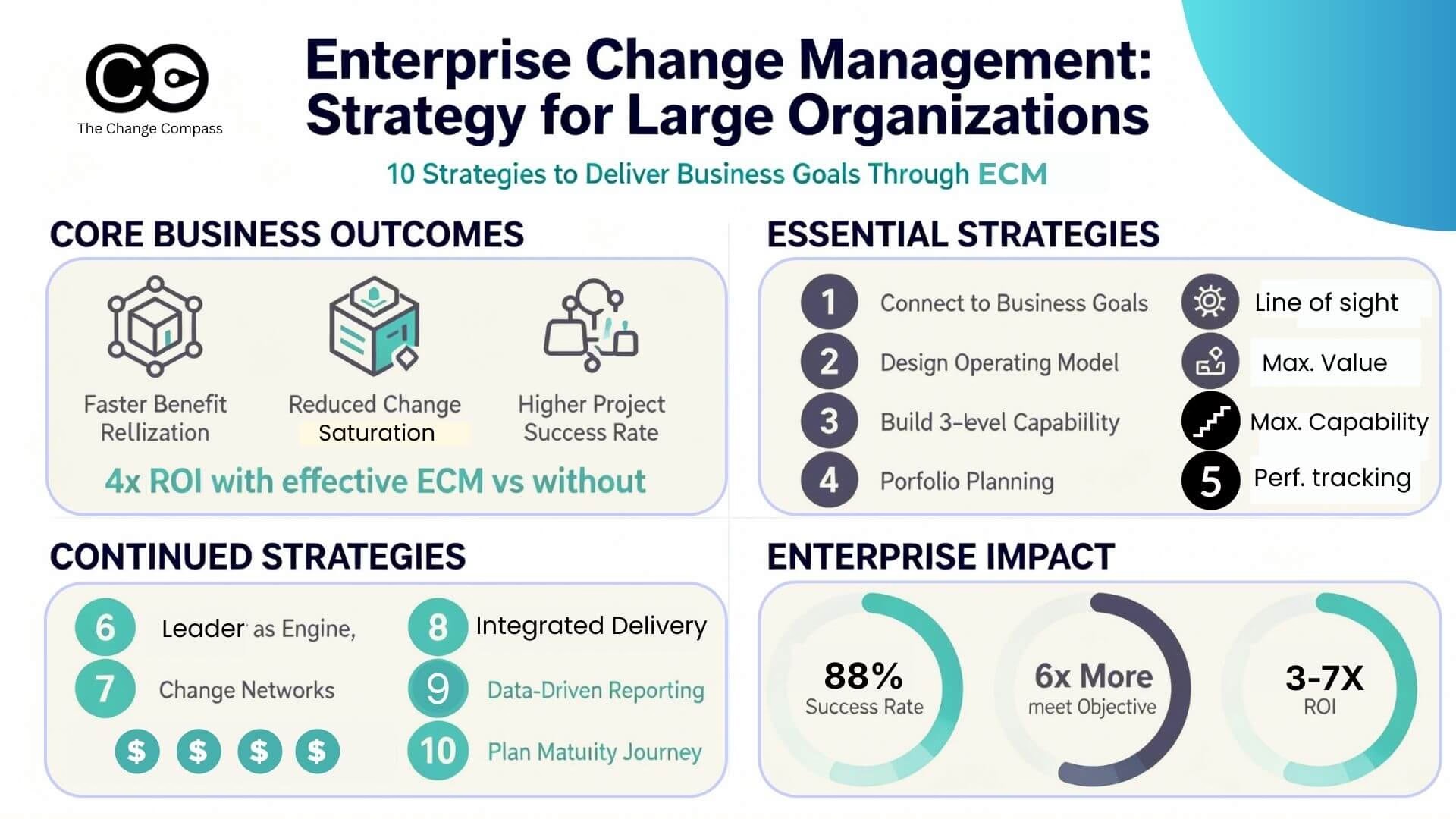


An enterprise change management strategy is the deliberate, multi-year plan that decides how an organisation builds and applies change capability at scale across every business unit, programme and transformation initiative.
Large organisations fund change one programme at a time, yet every programme draws on the same pool of people. A finance team can be asked to adopt a new ERP release, a restructure, a compliance uplift and an AI assistant in a single quarter, and each of those programmes will report green. BCG’s 2025 work on transformation puts the cost of that arithmetic plainly: only about a quarter of transformations successfully create value. This guide is for the change, HR and transformation leaders who carry that problem across a whole enterprise. It sets out ten strategies for treating change capability as a strategic asset, shows what 2024 to 2026 research says about each, and ends with a practical sequence for getting started.
An enterprise strategy covers the operating model (centralised, federated or hybrid), the methodology and tooling that will be used consistently, the capability-building approach for change practitioners and leaders, the governance structures that connect change to portfolio decisions, and the measurement framework that proves adoption and benefit realisation. It distinguishes itself from individual project plans by treating change capability as a strategic asset rather than a delivery activity.
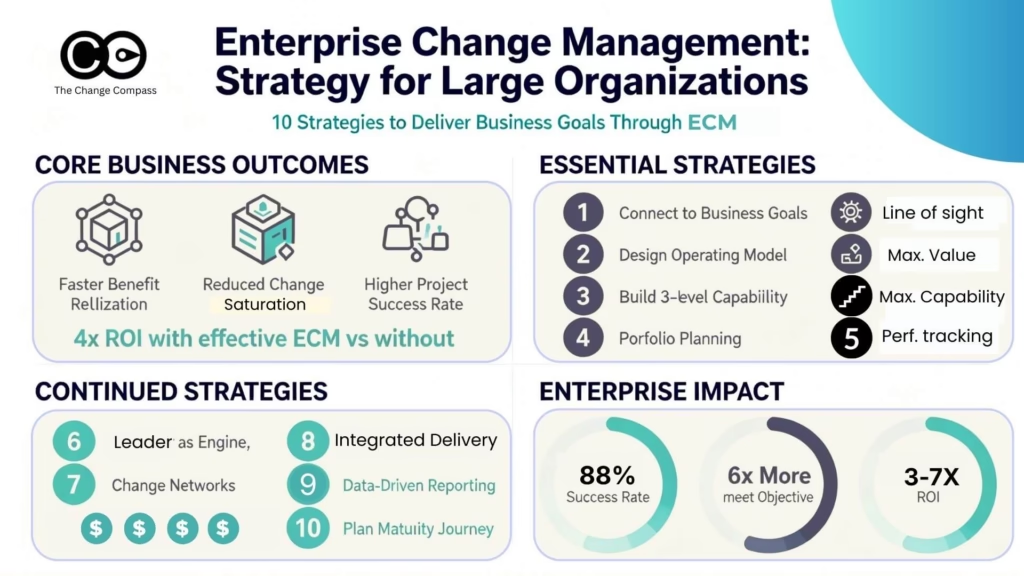
Enterprise change management (ECM) has evolved from a tactical support function into a strategic discipline that directly determines whether large organisations execute complex transformations and realise value from major investments. Rather than focusing narrowly on training and communications for individual projects, effective ECM operates as an integrated business partner aligned with organisational strategy, optimises across the portfolio of concurrent initiatives, and builds the organisation’s capability to navigate change as a core competency. The ten strategies below give large organisations a practical roadmap to run ECM as a value driver that speeds benefit realisation, prevents change saturation and lifts the odds that projects succeed.
Understanding enterprise change management in modern organisations
Enterprise change management is the practice of coordinating every change initiative in an organisation as one portfolio, so that strategy, project delivery and day-to-day operations pull in the same direction.
ECM differs from project-level change management in both scope and strategic integration. Project-level change management helps the teams inside a specific initiative move to new tools and processes. ECM operates at the enterprise level to coordinate and optimise multiple concurrent initiatives across the entire organisation. That distinction is critical: ECM aligns all change initiatives with strategic goals, manages the cumulative organisational capacity to absorb change, and builds a sustainable change competency that compounds over time. For a deeper look at the contrast, see our piece on the difference between change management and enterprise change management.
In large organisations running several strategic initiatives at once, ECM provides the connective tissue between strategy, projects and day-to-day operations. Rather than treating each initiative in isolation, it looks across the enterprise to understand who is impacted, when, and by what level of change, and then shapes how the organisation responds to maximise value and minimise disruption. Prosci’s enterprise change management overview and the Forrest Advisors guide to ECM describe the same shift from project support to an organisation-wide capability.
The three levels of capability
The scope of ECM covers three interconnected levels of capability development:
- Individual level: Building practical skills in leaders and employees to navigate change, explain strategy, support teams and use new ways of working.
- Project level: Applying consistent change processes across major initiatives, integrating change activities into delivery plans and measuring adoption.
- Enterprise level: Establishing standards, templates, governance structures and metrics so change is approached consistently across the portfolio.
Organisations that invest in only one level get uneven results. Training alone does not fix a missing governance forum, and a strong methodology does not help if nobody senior reads the output. Strategy 3 below returns to how the three levels are built in sequence.
The business case for enterprise change management
Enterprise change management pays back through faster adoption, fewer failed projects, lower disruption to productivity and protected organisational capacity.
Before examining the strategies, it is worth understanding the business rationale for the investment. Organisations with effective change management capabilities achieve substantially different outcomes from those without structured approaches, and the evidence has been getting more specific. The sub-sections below take the four outcomes executives ask about most: return on investment, project success, productivity during transitions and change saturation.
Return on investment
Return on investment is the most significant financial differentiator. Prosci’s ROI of change management model breaks the return into three human factors that determine whether a project’s expected value is actually captured: the speed of adoption (how quickly people make the change), the ultimate utilisation (how many of them make it) and proficiency (how effective they are afterwards). Each of these can be estimated before a project starts and measured after go-live, which is what turns “change management” from a cost into a line of the business case. Those returns show up as faster benefit realisation, higher adoption rates, fewer failed projects and lower implementation costs.
Project success rates
Project success is strongly influenced by change management capability, and structure is a large part of the story. Prosci’s Best Practices research (12th edition, more than 10,800 responses from 101 countries) found that 59% of participants using a structured approach reported good or excellent change management effectiveness, against 26% of those without one. Measurement matters as much as method: 63% of participants measured compliance and overall performance, and of those, 76% met or exceeded project objectives, against only 24% of those who did not. Consistency and measurement are decisions someone has to make and fund, not accidents of good practitioners.
Productivity during transitions
Every change causes a dip in productivity while people learn the new way of working. The size and length of the dip depends on how well the transition is supported. Organisations with effective change management shorten the time to proficiency, because people know what is changing, why, and what is expected of them, so the revenue and service impact of implementation periods is smaller. Organisations without structured change management often carry the dip for much longer, and sometimes never fully recover the planned benefit. This is why proficiency sits in the ROI model above: it is the measurable end of the same curve.
Change saturation
Prevention of change saturation protects organisational capacity. When an organisation exceeds its capacity threshold without portfolio-level coordination, the consequences cascade across multiple performance dimensions: slower adoption, rising attrition, lost discretionary effort and failing initiatives. Prosci has benchmarked saturation since 2007 and reports that in its research 73% of respondents were near, at or past the point of saturation. The business case for portfolio-level coordination is therefore not only the benefit of a single project, but the capacity that every other project depends on. Our guide to managing change saturation and initiative fatigue covers this in more depth.
Understanding this business case provides the context for why the strategies below matter. ECM is not a discretionary function but an investment that demonstrably improves organisational performance.
Ten strategies for enterprise change management: Delivering business goals in large organisations
The ten strategies work as one system: the first three set the foundation, strategies four and five turn it into business outcomes, and strategies six to ten make it stick across the enterprise.
Strategy 1: Connect enterprise change management directly to business goals
A strong ECM strategy starts by explicitly linking change work to the organisation’s strategic objectives. Rather than launching generic capability initiatives or responding only to project requests, the ECM function prioritises its effort around where change will most influence revenue growth, cost efficiency, risk reduction, customer experience or regulatory compliance outcomes.
This alignment serves several purposes. It focuses limited ECM resources on the initiatives that matter most to the business. It demonstrates a clear line of sight from change investment to corporate goals, which supports executive sponsorship and funding. It ensures that ECM advice on sequencing, timing and investment is grounded in business priorities rather than in change management principles alone. BCG’s 2025 research adds an important caution against one-size-fits-all playbooks: it found that what works depends on organisational structure, the density of social networks, the scale of the change and the certainty of its impact, so a strategy has to begin with context, not a template.
Practical implementation steps include:
- Map each strategic objective to a set of initiatives, key impacted groups, required behaviour shifts and services provided.
- Define three to five “enterprise outcomes” for ECM (such as faster benefit realisation, fewer change-related incidents, higher adoption scores) and track them year on year.
- Use strategy language in ECM artefacts, roadmaps, reports and dashboards so executives see a clear line of sight from ECM work to corporate goals.
- Present ECM’s annual plan in the same forums and language as other strategic functions, positioning it as a strategic enabler rather than a project support service.
Strategy 2: Design an operating model that fits your context
How ECM is structured makes a significant difference to its impact and scalability. Research and practice show that large organisations typically succeed with one of three core operating models: centralised, federated or hybrid. Each solves a different problem and creates a different risk.
| Model | How it works | Best fit | Main risk |
|---|---|---|---|
| Centralised | One enterprise change team sets standards, runs portfolio oversight and supplies practitioners into priority initiatives | Strategy and funding tightly controlled at the centre; need for consistency across geographies or business units | Inflexibility in local contexts and bottlenecks if the central team is stretched |
| Federated | Business-unit change teams work to a common framework but tailor approaches locally | Diversified organisations or those with strong regional autonomy | Inconsistency and difficulty keeping enterprise-wide visibility and standards |
| Hybrid | A small central team owns methods, tools, governance and enterprise analytics; embedded practitioners sit in key portfolios or divisions | Complex, matrixed enterprises managing several concurrent transformations | Complexity in defining roles and decision-making authority |
Centralised ECM offers strong governance and a consistent methodology, which works well where the organisation requires consistency across geographies. Federated ECM offers local responsiveness and cultural fit, which suits diversified organisations. Hybrid ECM offers both consistency and responsiveness, at the cost of needing clear role definitions. Our guide to the best organisational structure for enterprise change management walks through how to test each model against your own governance.
When designing the operating model, clarify:
- Who owns ECM strategy, standards and governance.
- How change practitioners are allocated and funded across the portfolio.
- Where key decisions are made on priorities, sequencing and risk mitigation.
- How the ECM function interfaces with PMOs, strategy and business operations.
Strategy 3: Build capability across individual, project and enterprise levels
Sustainable ECM capability rests on deliberate development across all three levels. Too many organisations invest only in individual capability (training) or only at project level (methodologies) without embedding organisational standards and governance. The result is uneven capability, a lack of consistency and difficulty scaling.
Individual capability building ensures leaders and employees have practical skills to navigate change. This includes explaining why change is happening and how it connects to strategy, supporting teams through transition periods, and using new tools and processes effectively. Effective approaches include targeted coaching, practical playbooks and self-help resources that let leaders act without always needing a specialist.
Project-level capability applies a consistent change process across major initiatives. Prosci’s three-phase process (Prepare, Manage, Sustain) and similar frameworks give structure that improves predictability and effectiveness. Panorama Consulting’s playbook for scaling change management takes a similar view of repeatable, scalable practice. Integration with delivery planning is essential, so change activities (communications, training, resistance management, adoption measurement) are built into delivery schedules rather than running separately.
Enterprise-level capability establishes standards, templates, tools and governance so change is approached consistently across the portfolio. This level includes maturity assessments using frameworks such as the CMI or Prosci models, which define the current state and the desired progression. With strong enterprise capability, standards and support are consistent no matter which business unit or initiative is delivering the change. For teams, our guide to building and leading high-performance change management teams is a useful companion.
A practical capability roadmap typically moves through five stages:
- Stage 1 (ad hoc): Establish the basics with a common language, a simple framework and a small central team supporting priority programmes.
- Stage 2 (repeatable): Build consistency through standard tools, regular reporting and PMO integration.
- Stage 3 (defined): Scale through business-unit change teams, champion networks and clear metrics.
- Stage 4 (managed): Embed through organisational integration and leadership expectations, with predictive use of change load and adoption data.
- Stage 5 (optimised): Achieve full integration with strategy and performance management.
Strategy 4: Use portfolio-level planning to avoid change collisions and saturation
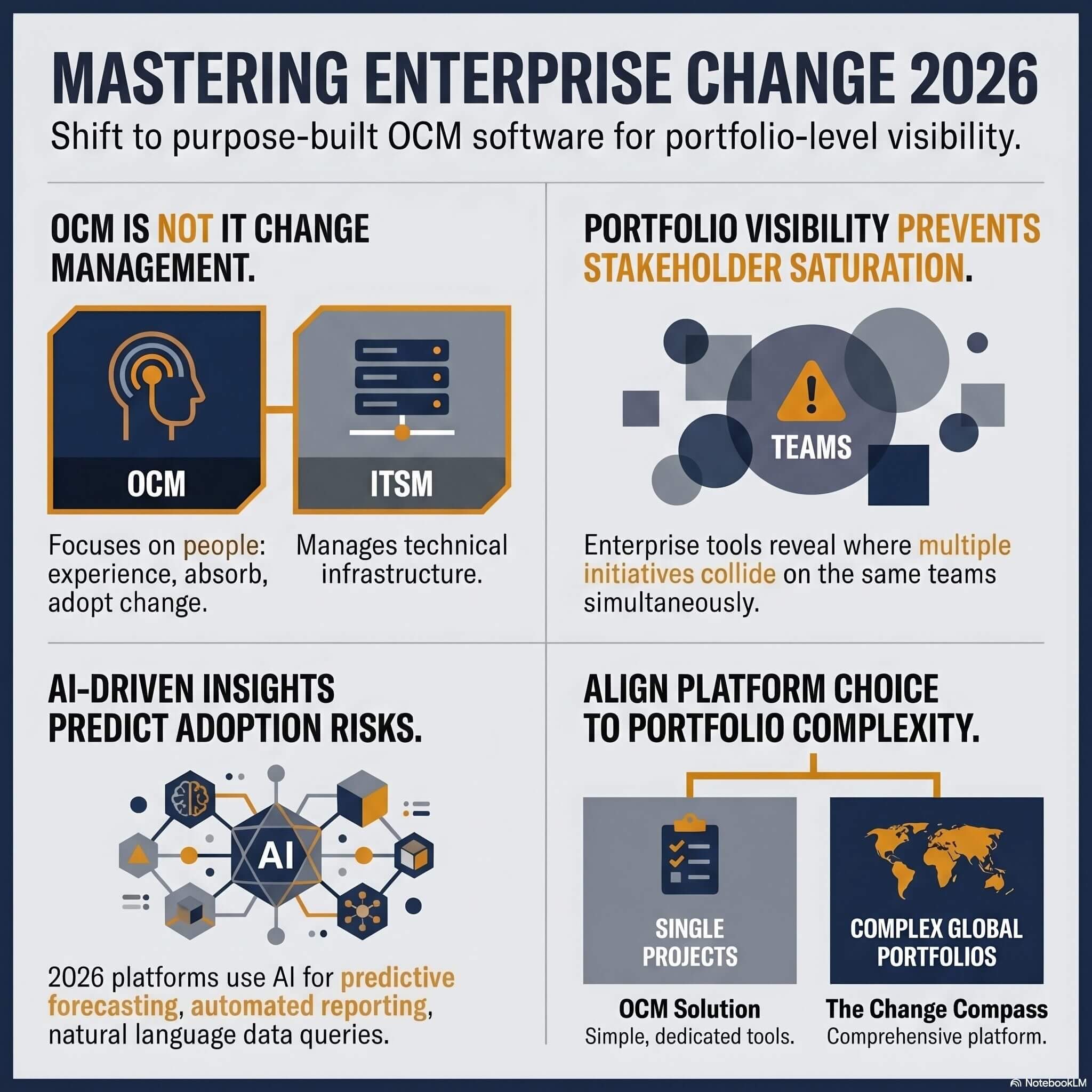
One of the highest-value strategies for large organisations is introducing portfolio-level visibility of all in-flight and upcoming changes. Portfolio change planning differs fundamentally from project change planning: rather than optimising one project at a time, ECM helps the organisation optimise the entire portfolio against capacity, risk and benefit outcomes.
The impact is substantial. Organisations with effective portfolio management reduce the likelihood of saturation, avoid costly collisions where several initiatives hit the same teams simultaneously, and increase the odds that high-priority initiatives land and stick. The human cost of getting this wrong is visible in a 2025 survey of 751 large-company executives by Emergn: 50% reported transformation fatigue and 45% had suffered burnout from ongoing changes. Portfolio visibility also informs critical business decisions about the sequencing and timing of major initiatives.
Practical implementation steps include:
- Create a single view of change across the enterprise showing initiative name, impacted audiences, timing and impact level, using simple heatmaps or dashboards.
- Identify “hot spots” where multiple changes hit the same teams or customers in the same period, and work with portfolio and PMO partners to reschedule or reduce load. Our guide to building a change capacity model shows how to set a capacity assumption for each team.
- Establish portfolio governance forums where investment and sequencing decisions explicitly consider both financial and people-side capacity constraints.
- Use portfolio data to advise on optimal sequencing, typically spacing major changes so adoption and benefits can be realised between waves.
Portfolio-level change planning transforms ECM from a project support service into a strategic adviser on organisational capacity and risk. For the wider discipline, see our guide to change portfolio management and the practical approach to managing a multitude of change initiatives.
Strategy 5: Anchor ECM in benefits realisation and performance tracking
Enterprise change strategy should be framed as a way to protect and accelerate benefits, not simply as a mechanism to support adoption. Benefits realisation management improves the alignment of projects with strategic objectives and produces data that drives future portfolio decisions. The PMIS Consulting overview of benefits realisation and Transformation Success on organisational change and benefits realisation are useful companions.
Benefit realisation management operates in stages. Before change, organisations establish clear baselines for the metrics they expect to improve (cycle time, cost, error rates, customer satisfaction, revenue and so on). During change, teams track adoption and intermediate indicators. After go-live, systematic measurement determines whether the organisation actually achieved the promised benefits. Prosci’s research also shows the value of finishing the job: 81% of people who planned for reinforcement and sustainment activities met or exceeded project objectives.
The discipline of benefits management delivers three strategic advantages. First, it forces clarity about what success means for each initiative, moving beyond “adoption” to genuine business impact. Second, it lets organisations calculate true ROI and demonstrate value to stakeholders. Third, it provides feedback for continuous improvement: when benefits fall short, measurement shows whether the issue was weak adoption, flawed design or external factors. Our piece on aligning multiple initiatives for maximum benefit realisation takes this further.
Practical implementation includes:
- For each major initiative, define three to five measurable business benefits (for example cost to serve, error reduction, revenue per customer, service time) and link them to specific behaviour and process changes.
- Assign owners for each benefit on the business side and clarify how and when benefits will be measured after go-live.
- Establish a simple benefits and adoption dashboard that surfaces progress across initiatives and highlights where ECM focus is needed to close gaps.
- Report on benefits progress in regular forums so benefit realisation becomes a standing topic in performance discussions.
When ECM consistently reports in business-outcome terms (for example “this change is at 80 percent of targeted benefit because of low usage in one function”), it becomes a natural partner in performance discussions and strategic planning.
Strategy 6: Make leaders and sponsorship the engine of enterprise change
Leadership behaviour is one of the strongest predictors of successful change. An effective ECM strategy treats leaders as both the primary audience and the primary channel through which change cascades through the organisation. Prosci’s research ranks active and visible sponsorship as the top contributor to success, and found that projects with extremely effective sponsors were 79% likely to meet objectives, against 27% with extremely ineffective ones. Fewer than half of participants (48%) reported having an effective or very effective sponsor, which is the gap a strategy should close deliberately.
Executive sponsors set the tone for how the organisation approaches change through the signals they send about priority, urgency and their own willingness to adapt. Line leaders translate strategic intent into local action and model new behaviours for their teams. Middle managers often become the critical influencers who determine whether change lands at the front line, and they are under strain: Gallup’s 2026 State of the Global Workplace reports that manager engagement fell to 22% in 2025, a nine-point drop since 2022. A strategy that assumes managers will absorb every cascade without support relies on the least engaged layer of the organisation.
An enterprise strategy focused on leadership excellence includes:
- Clear expectations of sponsors and line leaders (setting direction, modelling change, communicating consistently, removing barriers to adoption) integrated into leadership frameworks and performance conversations.
- Practical, brief, role-specific resources: talking points for key milestones, stakeholder maps, coaching guides and short “how to lead this change” sessions.
- Use of data on adoption, sentiment and performance to give leaders concrete feedback on how their areas are responding and where they need to lean in.
- Development programmes for emerging change leaders, so the organisation builds internal bench strength for future transformations.
This focus supports organisational goals by improving alignment, speeding decision-making, maintaining trust and engagement during transformation, and building an internal change leadership capability that compounds over time.
Strategy 7: Build scalable change networks and communities
To execute change at enterprise scale, ECM needs leverage beyond the central team. Change champion networks and communities of practice are proven mechanisms to extend reach, build local ownership and create feedback loops that surface emerging issues. The Prosci guide to the seven success factors for building a community of practice is a good practical reference.
Change champions are practitioners embedded in business units who interpret change locally, provide peer support and serve as feedback channels to the centre. Communities of practice bring together change practitioners across the organisation to share approaches, lessons learned and tools. Done well, these networks help the organisation adapt more quickly while reducing reliance on a small central change team. Our piece on the enterprise change champion model covers how to build capability and talent at the same time, and the forest, fungi and the secret power of change networks explains why informal networks matter.
Practical elements of a scalable network model include:
- Identify and train champions with clear role definitions, and provide them with resources, community and feedback.
- Create a change community of practice that meets regularly to share approaches, tools, lessons and data.
- Use networks not only for communications but as insight channels to capture emerging risks, adoption blockers and improvement ideas from the front line.
- Document and share best practices so successful approaches from one part of the organisation can be adapted by others.
Effective change networks create organisational resilience and reduce the bottlenecks that occur when all change leadership is concentrated in a small central team.
Strategy 8: Integrate ECM with project, product and agile delivery
Change strategy should be tightly aligned with how the organisation actually delivers work: traditional waterfall projects, product-based development, agile teams or hybrid approaches. When ECM is bolted on as an afterthought late in delivery, it slows progress and creates rework. When integrated from the start, it accelerates delivery while reducing adoption risk.
Integration practices that work across delivery models include:
- Include change leads in portfolio shaping and discovery so people-side impacts inform scope, design and release planning.
- Use lightweight, iterative change approaches that match agile and product ways of working, including frequent stakeholder touchpoints, short feedback cycles and gradual feature rollouts.
- Align artefacts so business cases, delivery plans and release schedules carry clear sections on change impacts, adoption plans and success measures.
- Make adoption and benefits realisation criteria part of the project definition of done, not separate activities that happen after deployment.
This integration helps the organisation deliver strategic initiatives faster while maintaining adoption and risk control.
AI as a permanent source of change load
AI is now one of the largest sources of unplanned change in most enterprises, and a strategy written before 2023 will not have a place for it. Gartner’s survey of 110 CHROs found that 78% agree workflows and roles will need to change to get the most from AI investment, and its March 2026 analysis notes that change management and workforce resiliency climbed to third place on the CHRO agenda. The Emergn survey cited above found that 55% of respondents said AI-driven projects had accelerated fatigue. That matters because the usual defence, sequencing projects by calendar, does not work when AI releases arrive continuously and outside the formal portfolio.
Three adjustments follow for the enterprise strategy. Put AI releases and tool rollouts into the same change register as projects, including those owned by IT or individual functions. Build adoption criteria into the delivery cadence, with short feedback cycles replacing a single end-of-project training event. Treat role and workflow redesign as part of the change, not a separate HR exercise that follows it. An organisation that already has a shared change register, a capacity assumption per team and named benefit owners can absorb an AI programme as one more item to sequence; one without them will meet it as a fresh round of fatigue.
Strategy 9: Use data and reporting as a core ECM product
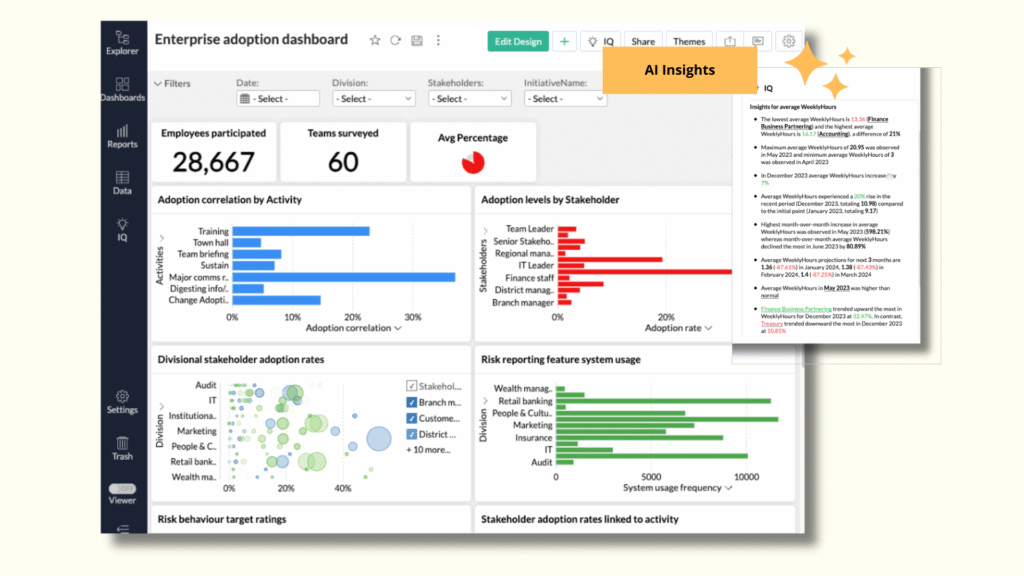
For large organisations, one of the most powerful strategies is making “change intelligence” a standard management product. Rather than only delivering plans and training, ECM produces regular, simple, visual reports that show how change is landing across the enterprise. When ECM operates as an intelligence function, it changes how executives perceive and use change management: instead of seeing a cost, they see a source of insight into organisational performance and capacity.
Examples of high-value ECM reporting include:
- Heatmaps showing change load by function, geography or customer segment, with flagging of saturation risk.
- Adoption, sentiment and readiness trends for key initiatives, with early warning of adoption gaps.
- Links between change activity and operational KPIs (incident volumes, processing time, customer satisfaction and so on), demonstrating ECM’s contribution to business outcomes.
- Portfolio status showing which initiatives are on track for benefit realisation and which require intervention.
Research shows that organisations that measure and act on change-related metrics have much higher rates of project success and benefit realisation, as the Prosci finding above (76% versus 24% meeting objectives) illustrates. For executives, this positions ECM as a source of management insight, not just delivery support. A heatmap that only the change team reads changes nothing; the reporting executives use is produced on a regular cadence and tied to decisions. Our guide to measuring change management success sets out the metrics worth tracking.
Strategy 10: Plan ECM maturity as a progressive journey
Effective ECM strategy treats capability building as a staged journey rather than a one-off rollout. Both CMI and Prosci maturity models describe five levels, from ad hoc to fully embedded organisational competency. Understanding these levels and planning progression provides essential context for resource investment and expectation setting. Prosci’s maturity model research found that 54% of participants sat at Level 1 or 2, and only 11% at Level 4 or 5, so most organisations have a long way to run. The five levels of change management maturity are summarised below, and our guide to improving change management maturity goes further.
- Level 1 (ad hoc): The organisation has no formal change management approach. Changes are managed reactively without a structured methodology, and no dedicated change resources exist.
- Level 2 (repeatable): Senior leadership sponsors some changes but no formal company-wide programme exists to train leaders. Some projects apply structured change approaches, but the methodology is not standardised.
- Level 3 (defined): A standardised change management methodology is defined and applied across projects. Training and tools become available to project leaders. Managers develop coaching capability for frontline employees.
- Level 4 (managed): Change management competencies are actively built at every organisational level. Formalised practices ensure consistency, and organisational awareness of the significance of change management increases substantially.
- Level 5 (optimised): Change management is fully embedded in organisational culture and strategy. The organisation operates with agility, with continuous improvement in change capability.
The practical roadmap in Strategy 3 maps onto these levels: build the basics, add consistency, scale and embed, then optimise through data-driven planning and predictive analytics about change load and adoption, with ECM fully integrated into strategy and performance management cycles. This staged approach lets the organisation grow ECM in line with its strategy, resources and appetite, always anchored on supporting business goals rather than pursuing capability for its own sake. Most organisations need two to five years to move across the levels, and each stage should be judged by what executives can now decide that they could not before.
Your first 90 days
Enterprise change strategies stall when they begin as a large design project. Start by making the existing load visible, then decide from evidence.
- Days 1 to 30: List every in-flight and planned initiative that touches your five largest employee groups, with timing and a rough impact rating. Agree the three to five enterprise outcomes with a senior executive.
- Days 31 to 60: Set provisional capacity ceilings for those groups, run the first portfolio review with the PMO and finance partner, and settle the operating model question using the four governance tests in Strategy 2.
- Days 61 to 90: Publish the first one-page report to the executive team, define sponsor and manager expectations, and agree the 12-month maturity targets and how you will evidence them.
By the end of the quarter, the executive team should be making at least one sequencing decision differently because of what the change data showed. If that has happened, the strategy is working and the rest is scaling it.
How traditional ECM functions support the strategic framework
The functions mature ECM teams already run (communities of practice, leadership training, methodology, self-help resources and portfolio dashboards) deliver most value when each is tied to a specific strategy rather than run as a standalone initiative.
These established functions remain important, but they are most effective when explicitly connected to the strategies above.
Community of practice
A community of practice supports Strategy 7 (building scalable networks) and Strategy 10 (progressing maturity). When designed well, communities become vehicles for sharing lessons, building peer support and creating organisational learning that compounds over time.
Change leadership training and coaching
Leadership training and coaching form the core of Strategy 6 (leaders as the engine). Rather than generic training, effective programmes are specific to the role, focused on practical skill development and connected to organisational strategy.
Change methodology and framework
A methodology underpins Strategy 3 (building three-level capability) and provides consistency across Strategy 4 (portfolio planning) and Strategy 8 (agile integration). A clear methodology helps teams understand expected activities and gives the organisation a common language.
Intranet self-help resources for leaders
Self-help resources expand the reach of Strategy 6 and support day-to-day execution. Rather than requiring leaders to attend training, they provide just-in-time support that fits busy schedules.
A single view of change with traffic light indicators
A single view of change becomes a key artefact for Strategy 4 (portfolio planning) and Strategy 9 (data and reporting). Portfolio dashboards give the visibility that enables both operational decision-making and strategic advice.
When these elements are designed and governed as part of an integrated enterprise strategy, ECM clearly supports the organisation’s business goals instead of sitting on the margins as supplementary project support. Our piece on making enterprise change management a strategic powerhouse develops this argument further.
Demonstrating and sustaining ECM value
For an ECM function to survive cost-cutting and secure sustained investment, executives must experience its value on an ongoing basis, which means repositioning it as a strategic partner rather than a support service.
Over the years we have observed that even supposedly mature ECM teams have ended up on the chopping block when resources are tight and cost efficiency is the focus. This is not necessarily because the work is not valuable, but because executives do not see it as essential and high value. Executives and decision makers need to experience the value continuously, and see that the ECM team’s work is crucial to business decision-making, planning and overall organisational performance. Five practices make that value visible:
- Anchor value in measurement. Move beyond anecdotal feedback and isolated project metrics to disciplined, data-driven approaches that capture the full spectrum of change activity, impact and readiness. Organisations that measure change effectiveness systematically demonstrate value that executives recognise and fund.
- Focus on business outcomes, not activities. The most compelling business cases emphasise what change management contributes to organisational performance, benefit realisation and competitive position, rather than counting communication sessions delivered or people trained.
- Integrate with strategic planning. ECM functions involved early in strategic and operational planning cycles can model change implications, forecast resource requirements and assess organisational readiness. This integration makes change management indispensable to strategic decision-making.
- Develop advisory expertise. Build the capability to advise on which sequencing of changes will succeed, which pose the highest risk and where organisational capacity constraints exist. This elevates ECM from implementation support to strategic partnership.
- Report continuously on impact. Establish regular reporting cadences that update senior leadership on change portfolio performance, adoption progress, benefit realisation against targets and operational impact. Sustained visibility of ECM’s contribution maintains stakeholder awareness and support.
Where digital tools fit
Spreadsheets and slide packs can run a single programme, but a portfolio that spans hundreds of initiatives and dozens of teams needs a shared, live view of change.
At portfolio scale the data is stale by the time it is assembled, and nobody can compare load across divisions. Purpose-built change intelligence software such as Change Compass gives a single view of change by audience, time and impact level, flags where capacity is exceeded, and reports adoption and benefits in a form executives can use. It is a way to make Strategies 4, 5 and 9 routine rather than heroic, not a substitute for them. Our guide on how to manage multiple change initiatives shows what the practice looks like before any tool is chosen.
Connecting the strategies into one system
The most effective ECM strategies operate as an integrated system rather than as disconnected initiatives. Connecting ECM to business goals (Strategy 1), designing a sustainable operating model (Strategy 2) and building capability at all three levels (Strategy 3) provide the foundation. Portfolio planning (Strategy 4) and benefits realisation tracking (Strategy 5) ensure that ECM focus translates into business outcomes. Leadership engagement (Strategy 6), scalable networks (Strategy 7) and integration with delivery (Strategy 8) make change capability permeate the organisation. Data-driven reporting (Strategy 9) demonstrates continuing value, and maturity planning (Strategy 10) lets capability grow in line with strategy and resources.
Large organisations that implement these strategies gain a measurable advantage through higher project success rates, faster benefit realisation, less change saturation and more engaged employees. For organisations managing increasingly complex transformation portfolios, ECM is not a discretionary function but a core strategic capability, and the best first step is the least glamorous one: make the load on your people visible, then decide from evidence.
FAQ
What is enterprise change management?
Enterprise change management coordinates all change initiatives across an organisation, aligning them with strategic goals, managing the cumulative load on people so that no team is saturated, and building change capability that compounds over time. It sits above individual project change plans and applies standards, governance and measurement to the whole portfolio.
How does enterprise change management differ from project change management?
Project change management helps one initiative land with the people it affects. Enterprise change management looks across every initiative at once, deciding standards, sequencing, capacity limits and reporting so that the combined load on any team stays workable. A project can succeed on its own terms while the enterprise still fails, which is why both levels are needed.
Which operating model works best for enterprise change management?
Most large, matrixed organisations land on a hybrid model: a small central team owns methods, tools, governance and portfolio analytics while practitioners embedded in divisions deliver the work. Centralised models suit tightly controlled organisations and federated models suit highly autonomous business units. The right choice depends on how decisions and funding actually flow.
How do you prevent change saturation in a large organisation?
Build a single view of every in-flight and planned change by audience, time and impact level, agree a capacity ceiling per team, and review it in the same forum that approves investment. When a team reaches its ceiling, sequence, resize or pause an initiative before it launches. Prosci reports that 73% of respondents in its research were near, at or past saturation.
How long does it take to build enterprise change management maturity?
Most organisations need two to five years to move from ad hoc practice to a consistent, measured enterprise capability. Year one usually establishes a common language, a small central team and a single view of change. Later years add standard tools, divisional practitioners, champion networks and benefit reporting that executives use in decisions.
References
- Boston Consulting Group (2025). From Change Management to Change Strategy.
- Prosci. Best Practices in Change Management (12th edition findings).
- Prosci. Metrics for Measuring Change Management.
- Prosci. Change Management Maturity Model.
- Prosci. The Case for Change Management (ROI of change management).
- Prosci. Enough is Enough: Tips for Avoiding Change Saturation.
- Prosci. Enterprise Change Management.
- Prosci. Seven Success Factors to Building a Community of Practice.
- Gallup (2026). State of the Global Workplace.
- CFOtech (2025). Transformation efforts fuel burnout and uncertainty for employees (reporting an Emergn survey of 751 organisations).
- Gartner (16 March 2026). Gartner Identifies the Top Change Management Trends for CHROs in the Age of AI.
- Forrest Advisors. Complete Guide to Enterprise Change Management.
- Panorama Consulting. A Playbook for Scaling Change Management Strategies.
- PMIS Consulting. Benefits Realisation.
- Transformation Success. Organisational Change and Benefits Realisation.
- Change Management Insight. 5 Levels of Change Management Maturity Model.