Digitisation, competition and changing industry conditions have amongst other things brought on an accelerated change agenda for a lot of organisations. What were previously thought to be 1 to 5 year horizons of change suddenly became an immediate change. Not only is working from home a norm for a lot of organisations but the struggle for enterprises to survive and stay relevant in the new norm means more changes. The normal equilibrium for a lot of these organisations is one that consumes a smaller number of changes at any one time. Suddenly, with the increased number of changes this leads to change saturation.
In change management, think of change saturation as a cup that fills up. The size of the cup is the change capacity. With limited capacity, there is only so much volume that is inherent. As the amount of change or the pace of change increases and the cup overflows the changes don’t stick and simply fall by the waist side and may result in change fatigue. This is when the negative impact of changes can occur.
What impacts an organisation’s change capacity?
1.Change leadership
Leaders can have significant influence on the organisation. Also, change leadership is a significant part of how change is managed and delivered. Effective change leadership can build on the capability of teams to be more agile and capable of absorbing more changes. Effective change leadership can also help to maximise how optimal the change is socialised and implemented, and therefore how it lands.
2. Change capability
The organisation’s change capability is one of the most important factors in determining their change capacity. Think of agile startup organisations that are constantly pivoting, introducing new operating models, products and services. This is part of their cultural norm. Other organisations that maybe less agile can also develop some of these capabilities through experience and development.
3. Nature of change
Not all types of changes are the same. Typically, a lot of the changes driven by senior leaders are about improving the bottom line or top line, improving customer experience or improving efficiency. Some are more complex changes requiring significant change journeys. Others may even be inherently ‘negatively perceived’ such as organisational restructuring and layoffs. However, there are also changes that are inherently seen as benefiting the work of employees (such as process improvement leading to less red tape).
4. Number of changes
The number of changes also impact the change capacity. Obviously more changes mean more capacity consumed, within an extent.
5. Impact of each change
The impact level of each change is also critical. Some initiatives have significant impact that requires a long period of time to embed the changes, e.g. culture change and complex system and process changes. On the other hand, simple process changes may not require much capacity and simple communication is all that is needed.
6. Overall change landscape
The overall change landscape of the organisation also affects perception and therefore in some ways the capacity for change. If competitors within the industry are all undergoing significant transformations then it sets the tone for what’s to come. In the same way, if all our friends are used to virtual ways of working then we become more open to it.
What’s the benefits of measuring change saturation?
Measuring change saturation can be significantly beneficial for the organisation. Understanding the tipping point means that PMO and change teams can work to avoid this from a planning perspective. Finding out during or after the releases that there is too much change saturation is an expensive exercise that diminishes the planned initiative benefits. It also leads to loss of productivity and operational disruptions. Moreover, employees lose faith in the ability of the organisation to manage change.
With greater clarity of the change saturation points organisations can work to monitor, track and manage the risk of over saturation. Measures can then be put in place to ensure minimal business disruption and protection of initiative benefits. This should be a key focus for risk in change.
How to measure change saturation?
Firstly, there is not one change saturation point for the whole organisation. Each department or even team may have different change saturation points. This is because they have different leaders, different cultural norms and different change capabilities.
So how do we measure the change saturation at a department or division level? Look historically at how changes have been received, starting with the past few months.
1. Monitor operational indicators
Depending on what the department is in charge of, understanding the change saturation point means closely monitoring the operational indicators. During change saturation operational indicators are usually also negatively impacted, depending on the nature of the changes.
For a call centre this could be average handling time, customer satisfaction rate, absenteeism, etc. For a back office department it could be efficiency or effectiveness measures, case completion rate, case quality rating, etc. You don’t need to be the expert in all the various operational measures of each department as you can tap on the operations representatives of these departments.
2. Get feedback from leaders
Interview or conduct surveys with departmental leaders to understand their perception of how changes have been implemented and any potential disruptions on the business. Understand how their teams have experienced change. Ask them whether it has been challenging to balance operational needs with change-induced activities. For example, were there challenges in employees attending initiative training sessions, and completing their role delivery obligations?
3. Be aware of potential biases
Be careful of opinions and feedback from leaders and employees. There may be a tendency to over-state and complain that there is constantly too much change. This happens because some over-state the risk of change saturation hoping that this may lead to less change and therefore easier to manage the operations of a business. Take care to avoid this bias.
4. Identify points of change saturation
If the department has undergone periods with multiple change initiatives that has resulted in negative impact on operational indicators and leaders have also provided feedback of similar change disruptions then measure this level of change. Record this specifically.
This requires a portfolio-level view of all the changes that have occurred and the various impacts of each initiative. With this change portfolio measurement you are able to then identify this level as perhaps just exceeding the change saturation point for that department. With this identified you can then plot this change saturation line. You should also closely monitor this level and adjust as needed.
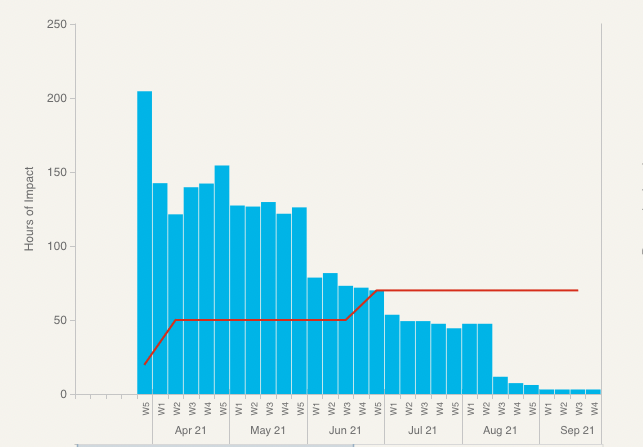
Using The Change Compass change impact can be expressed in terms of hours of impact per week. The change saturation line can the plotted against the change impact levels. From this, you’re able to easily visualise to what extent there could be risk in exceeding the change saturation line.
It is important to note that measuring change impacts and therefore change saturation should ideally be at a weekly level. Measuring change impact at a monthly level may not be sufficiently detailed enough since there could be changes in impact levels within each month. For example, for Finance the quarter-end consolidation cycle could start mid-month and therefore the change impact indication may show up as less than it actually should be simply because the data is rolled-up by month.
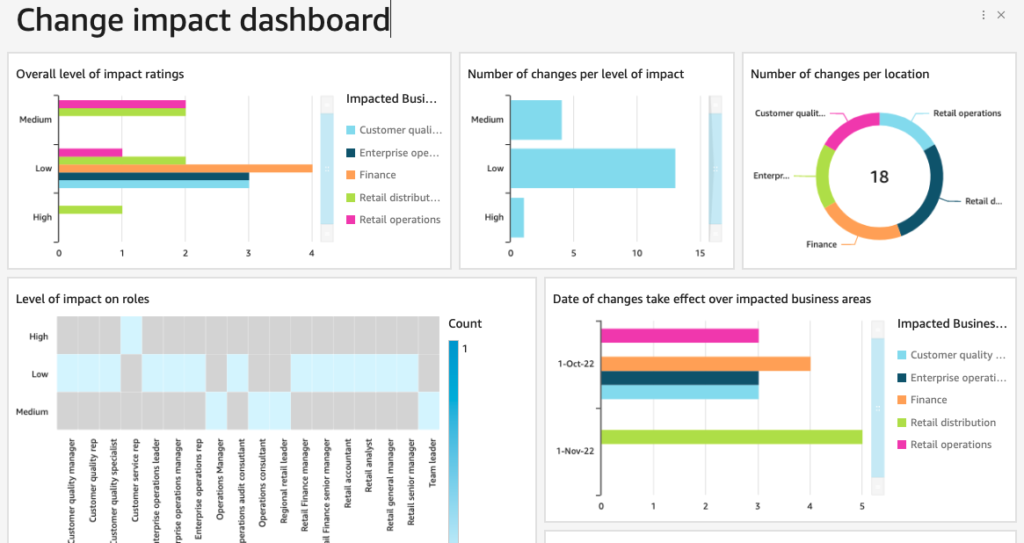
Deriving a monthly dashboard in which to inform not just the change volume, but types of changes, risks, and impacted areas will do wonders to provide clear visibility for the business to get ready for and to track changes.
Other disciplines such as HR, Marketing or Operations rely on data to make critical business decisions. The Change function and change leaders should also follow best practices. Being armed with the right change impact data means that you can help the business to precisely pin-point change saturation points. This can provide tremendous value to the business in terms of business, initiative and risk protection.
If you’re keen to chat more about how you are managing change saturation and to find out more about our solutions feel free to contact us here to organise a chat.
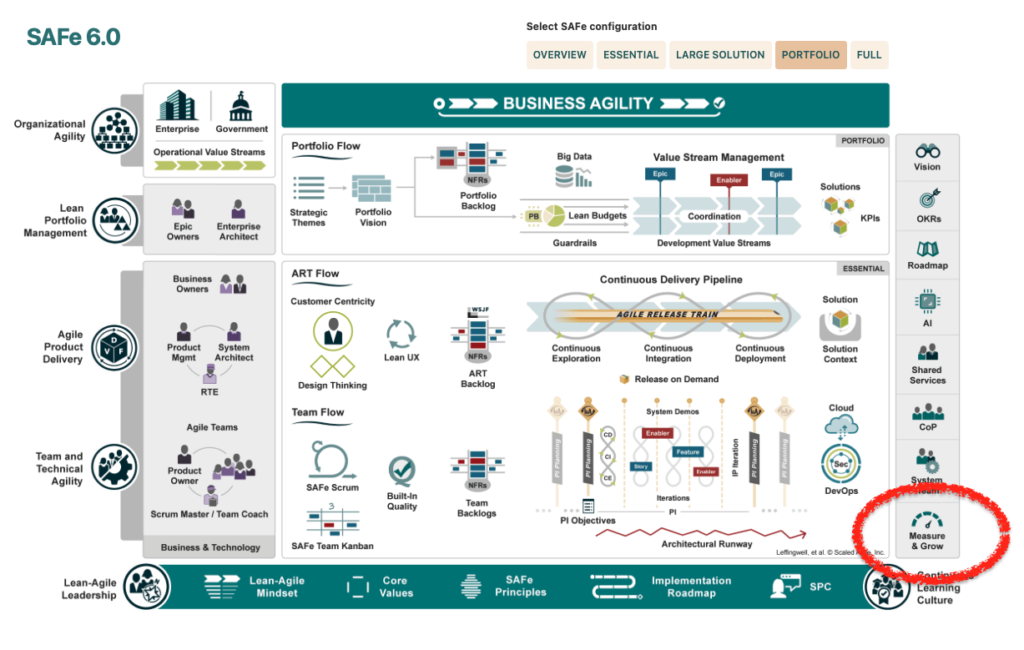
Scaled Agile Framework (SAFe) has emerged as a leading methodology to address the organisational change demands of fostering flexibility, collaboration, and continuous improvement. A cornerstone of SAFe is the principle of ‘Measure and Grow,’ which emphasizes using data and fact-based decisions to enhance change outcomes over time, including predictability. Despite its centrality, SAFe does not explicitly detail the change management components essential for its success, including its deep understanding of SAFe’s measurement model that enables the design of a tailored metrics strategy for ensuring strategic alignment. Here we outline how change management practitioners can effectively apply the ‘Measure and Grow’ principle within an Agile Release Train (ART) to lead change and improve outcomes to support the Scaled Agile environment.
What does it mean to “measure and grow” in a business context?
In a business context, “measure and grow” refers to the process of evaluating performance metrics to identify how our work drives business value and areas for improvement, aligning with strategic business goals. By analyzing data, companies can implement strategies that foster growth, enhance productivity, and improve overall outcomes. This approach ensures continuous development aligned with organizational goals.
The “Measure and Grow” Principle in Scaled Agile
What does it mean to “measure and grow” in a business context?
“Measure and grow” in a business context refers to the process of assessing performance metrics and outcomes to identify areas for improvement. By analyzing data, businesses can implement strategies that foster growth, enhance customer satisfaction, and optimize resource allocation, ultimately driving sustainable success and competitive advantage.
“Measure and Grow” is integral to SAFe, focusing on systematic measurement and continuous improvement for overall business agility within the value stream. By leveraging data and analytics, organizations can quickly respond to market changes, make informed decisions that meet the needs of our customers, identify areas needing attention, uncover improvement opportunities, and iteratively enhance meaningful change in performance. For change management professionals, this principle translates into a structured approach to evaluate the effectiveness of change initiatives, pinpoint areas for improvement, and implement necessary adjustments.
In a Scaled Agile environment, “Measure and Grow” is a core tenant or principle that applies in all types of agile environments. By continuously assessing and refining change efforts, organizations can align their initiatives with strategic objectives, mitigate risks, and ensure sustained success.
In practice, a lot of organisations have not pinpointed exactly how change management measures can make or break the outcome of the change, and in a SAFe environment, across the program, portfolio as well as enterprise.
The ‘Measure and Grow’ principle as a core part of SAFe (From Scaled Agile Framework)
To operationalize the “Measure and Grow” principle in change management, it is crucial to establish a set of metrics and assessment frameworks. Here are some broad categories of different types of change measurements that are relevant. Note that since we are talking about SAFe, it is not just at the initiative level that we are talking about metrics. More importantly, it is about establishing a system to promote change improvement across the organisation.
Change Management KPIs and OKRs
Key Performance Indicators (KPIs) and Objectives and Key Results (OKRs) are essential tools for tracking the success of change management initiatives. KPIs provide quantitative measures of performance, while OKRs align change efforts with broader organizational goals. A change management stream or function should focus on establishing KPIs or OKRs to achieve laser focus on achieving change outcomes.
Examples of Initiative-Level Change Management KPIs that may roll out to form portfolio views
Employee Engagement Levels: This KPI assesses how change impacts employee morale and engagement, providing insight into the overall acceptance and support of the change initiative.
Learning Achievement Rates: This can include tracking the percentage of employees who have completed necessary training programs, as well as achieving the target level of competence to ensure that the workforce is adequately prepared for the change.
Feedback Scores: Collecting feedback from stakeholders through surveys or feedback forms helps gauge perception and identify areas needing improvement. It is important to note that depending on the change context, stakeholders may not be happy with the content of the change. However, understanding and tracking this perception is still important.
Change Adoption Rate: This KPI measures the percentage of stakeholders who have adopted the change. High adoption rates are the ultimate goal for initiatives.
Issue Resolution Time: Measuring the time taken to resolve user-related issues related to the change highlights the efficiency of support mechanisms and the responsiveness of the change management team. This is especially important during an agile environment where there may be constant changes.
Change Readiness and Stakeholder Engagement Metrics
Evaluating change readiness and stakeholder engagement is crucial to the success of any change initiative. These metrics help assess the organization’s preparedness for change and the level of involvement and support from key stakeholders. Readiness and engagement rates can also roll up at a portfolio level to provide oversight.
Change Readiness Metrics
Readiness Assessments: Conduct surveys or interviews to gauge the organization’s preparedness for the impending change. This can include evaluating awareness, understanding, and acceptance of the change.
Resource Availability: Measure the availability of necessary resources, such as budget, personnel, and tools, to support the change initiative.
Communication Effectiveness: Assess the clarity, frequency, and effectiveness of communication regarding the change to ensure stakeholders are well-informed and engaged.
Stakeholder Engagement Metrics
Engagement Scores: Use surveys or feedback forms to measure the engagement levels of stakeholders, indicating their commitment and support for the change.
Participation Rates: Track stakeholder participation in change-related activities, such as workshops, meetings, and training sessions, to gauge their involvement.
Influence and Support: Assess the influence and support of key stakeholders in driving the change, ensuring that influential figures are actively endorsing the initiative.
By monitoring these metrics, change management professionals can identify potential barriers to change and take proactive steps to enhance readiness and engagement.
Stakeholder Competency Assessment
Successful change initiatives rely on the competence and readiness of key stakeholders. Assessing stakeholder competency involves evaluating the capability of sponsors and change champions to support and drive the change.
Sponsor Readiness/Capability Assessment
Sponsor Engagement: Measure the level of engagement and commitment from sponsors, ensuring they are actively involved and supportive of the change.
Decision-Making Effectiveness: Assess the ability of sponsors to make timely and effective decisions that facilitate the change process.
Resource Allocation: Evaluate the sponsor’s ability to allocate necessary resources, such as budget and personnel, to support the change initiative.
Change Champion Capability Assessment
Training and Knowledge: Measure the knowledge and training levels of change champions to ensure they are well-equipped to support the change.
Communication Skills: Assess the ability of change champions to effectively communicate the change message and address stakeholder concerns.
Influence and Leadership: Evaluate the influence and leadership capabilities of change champions, ensuring they can effectively drive and sustain the change.
By conducting these assessments, change management professionals can ensure that key stakeholders are prepared and capable of supporting the change initiative.
Change Adoption Metrics
Change adoption metrics provide insight into how well the change has been accepted and integrated into the organization. These metrics help assess the effectiveness of the change initiative and identify areas for improvement. At a portfolio level, there may be different levels of change adoption set for different initiatives depending on priority and complexity.
Key Change Adoption Metrics
Adoption Rate: Measure the percentage of stakeholders who have adopted the change, indicating the overall acceptance and integration of the new processes or systems.
Usage Metrics: Track the usage of new tools, processes, or systems introduced by the change to ensure they are being utilized as intended.
Performance Metrics: Assess the impact of the change on key performance indicators, such as productivity, efficiency, and quality, to determine the overall success of the change initiative.
By monitoring these metrics, change management professionals can gauge the success of the change initiative and identify opportunities for further improvement. To read more about change adoption metrics check out The Comprehensive Guide to Change Management Metrics for Adoption.
Change Impact and Capacity Metrics
Understanding the impact of change and the organization’s capacity to manage it is crucial for successful change management. Change impact metrics assess the effects of the change on the organization, while capacity metrics evaluate the organization’s ability to manage and sustain the change.
Change Impact Metrics
Aggregate impacts: Aggregate impacts across initiatives to form a view of how various teams and roles are impacted by various changes.
Risk Assessments: Identify potential risks associated with the change and evaluate their impact, ensuring that mitigation strategies are in place. A particular focus should be placed on business performance during change, across initiatives.
Capacity Metrics
Resource Capacity: Assess the availability of resources, such as personnel, budget, and tools, to support the change initiative and optimize flow time, enhance flow velocity, and improve flow efficiency while monitoring Flow Load.
Change Fatigue: Measure the risk for potential fatigue within the organization and its impact on stakeholders, ensuring that change initiatives are paced and driven appropriately.
Support Structures: Evaluate the effectiveness of support structures, such as training programs, information hubs, and help desks, in facilitating the change. Support structures may also include change champion networks.
By assessing change impact and capacity, change management practitioners can ensure that the organization is well-equipped to manage and sustain the change initiative.
Change Maturity Assessment
Change maturity assessments provide a comprehensive evaluation of the organization’s capability to manage change effectively. These assessments help identify strengths and weaknesses in the organization’s change management practices and provide a roadmap for improvement.
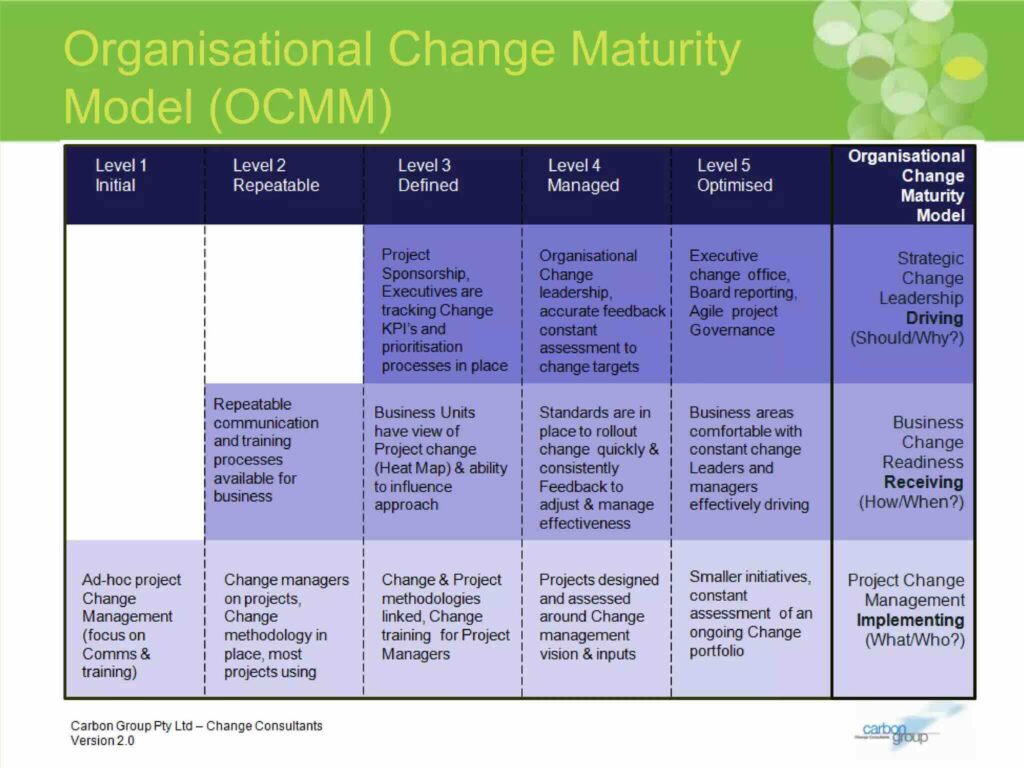
The Change Management Institute (CMI) Change Maturity Model is a comprehensive framework that takes a holistic approach to enhancing an organization’s change management maturity. It’s divided into three core functional domains, each playing a vital role in the overall journey toward maturity:
Project Change Management
Business Change Readiness
Strategic Change Leadership.
These domains serve as the foundation for achieving higher levels of maturity within the organization.
Within each of these domains, the CMI model outlines a structured path, consisting of five distinct maturity levels. These levels represent a continuum, starting at Level 1, which serves as the foundational stage, and progressing all the way to Level 5, the zenith of maturity and effectiveness. This multi-tiered approach offers organizations a clear roadmap for growth and development, ensuring that they have the tools and insights necessary to navigate the complexities of change management.
By conducting regular change maturity assessments, change management professionals can identify areas for improvement and develop targeted strategies to enhance the organization’s change management capability.
The “Measure and Grow” principle is a powerful tool for improving change outcomes in a Scaled Agile environment. By leveraging data and fact-based decision-making, change management professionals can ensure that change initiatives are effective, aligned with strategic objectives, and continuously improving. Establishing robust metrics and assessment frameworks, such as KPIs, OKRs, change readiness and stakeholder engagement metrics, stakeholder competency assessments, change adoption metrics, change impact and capacity metrics, and change maturity assessments, is essential to applying the “Measure and Grow” principle effectively.
Incorporating these metrics and assessments into change management practices enables organizations to identify areas for improvement, make informed decisions, and drive continuous improvement. By doing so, change management professionals can enhance the effectiveness of change initiatives, ensure successful adoption, and ultimately achieve better business outcomes.
Successful change management relies on having the right metrics to measure progress, gauge impact, and communicate with stakeholders. Moreover, the right metrics can drive continuous improvement and help directly achieve change outcomes. However, not all metrics are beneficial, and some can mislead or fail to meet stakeholder needs, especially when managing change projects. Let’s check out the top change management metrics to avoid and go through examples to take note.
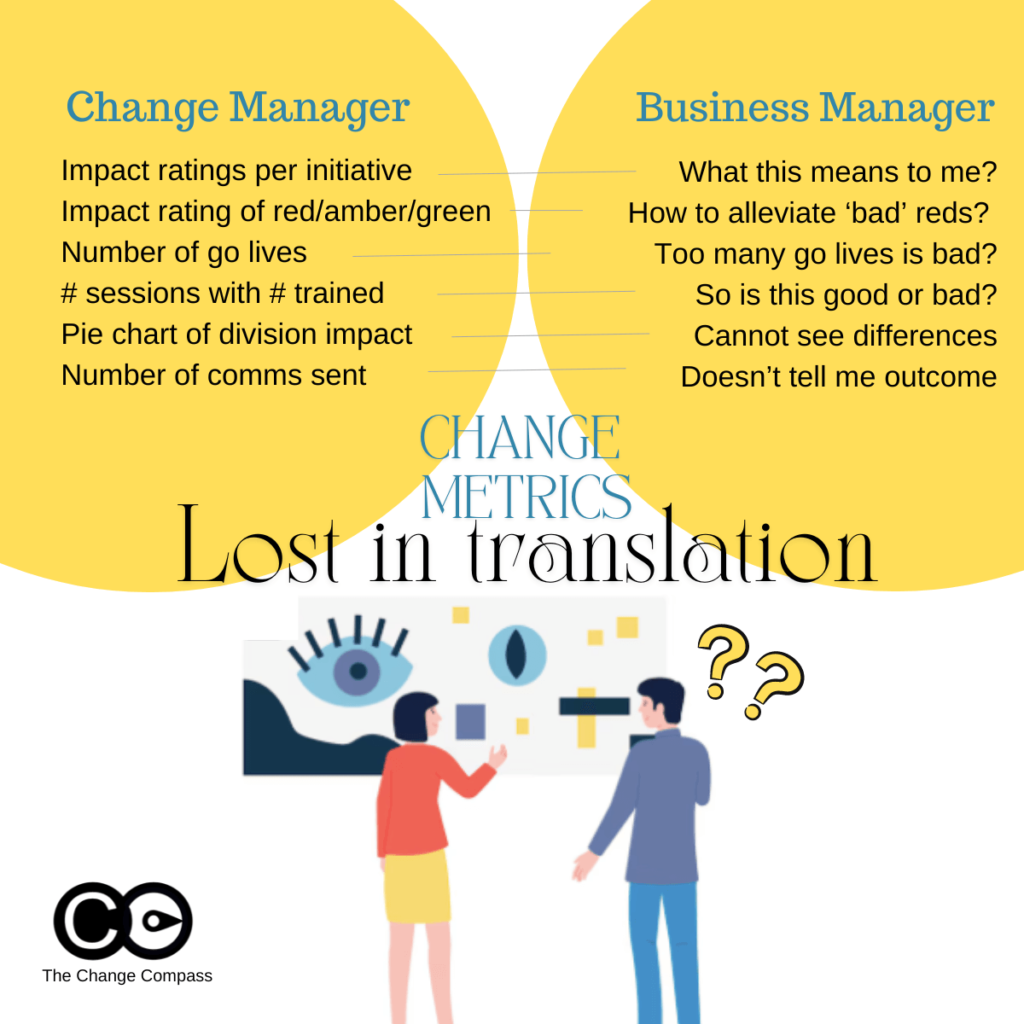
Understanding the Disconnect: Change Managers vs. Business Stakeholders
A significant reason certain change management metrics fall short is the differing perspectives between change managers and business stakeholders. Change managers and change practitioners are trained to view metrics through the lens of change management frameworks and methodologies, focusing on detailed assessments and structured approaches as a part of the change management strategy. These include applying ratings and judgments on aspects such as impact levels indicating levels and areas of impact.
In contrast, business stakeholders prioritize business operations, strategic outcomes, and practical implications. The busy business stakeholder is often looking for practical implications from metrics that can be used to directly drive decision making, meaning “what do I do with this data to improve the ultimate business outcome”.
Of course, different stakeholders have different data needs, and you need to show the right metric to the right type of stakeholder. For example, operations-focused stakeholders expect fairly detailed metrics and internal historical data to understand what that means in terms of organisation, coordination, capacity, and performance perspectives. Senior managers may prefer higher-level data with a focus on strategic impacts, overall progress, and adoption indicators of change success rate.
This disconnect can lead to the use of metrics that do not resonate with or are misunderstood by stakeholders that disrupt change success.
Change managers may leverage metrics that are derived from the various change management documents such impact assessments, training plan or communications plan. Metrics are also often chosen for ease of use and ideally are not overly complicated to execute.
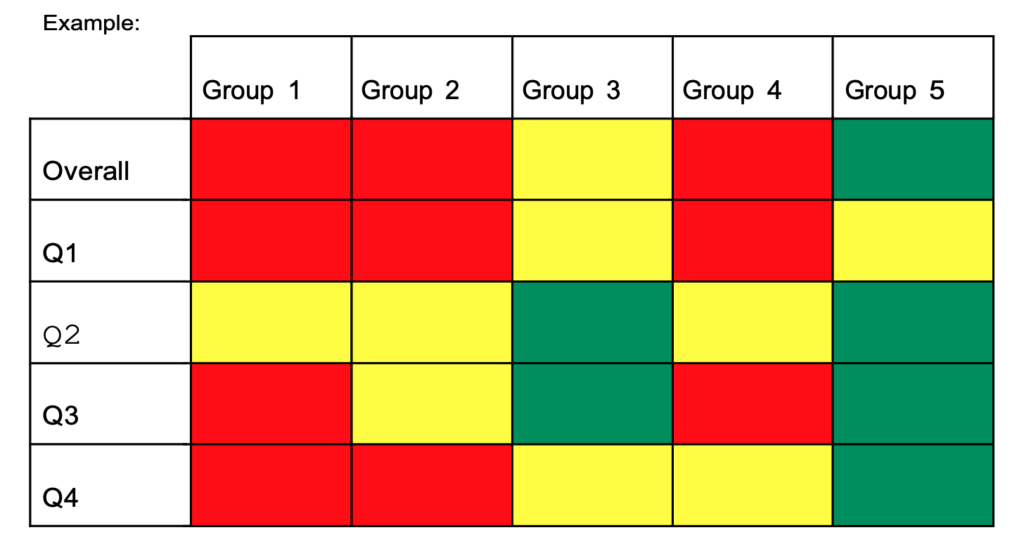
For example, impact assessments typically involve rating stakeholder groups and initiatives on a traffic light system (red, amber, green) based on their impact. While this approach is systematic, it can be problematic for several reasons:
Lack of Sufficient Stakeholder Context: Business stakeholders might not understand the practical implications of these ratings. For instance, an “impact rating per initiative” may not clearly convey what the rating means for day-to-day operations or strategic goals. For example, if an initiative has a red impact rating, stakeholders might not grasp the specific operational changes or strategic adjustments needed, in essence, “what do I do with this?”. So, incorrect usage of data could result in lack of stakeholder engagement.
Misinterpretation of Traffic Light Ratings: The red, amber, green system can be misleading. Stakeholders might interpret red as an indicator of alarm or imminent risk, while green may be seen as a sign that no action is needed. This is because stakeholders are trained to interpret traffic light ratings this way (from the various project/business updates they’ve attended). In reality, red might simply mean high impact, requiring focused attention, and green might indicate a low impact but still require monitoring. For instance, a red rating might indicate significant process changes that need careful management, not necessarily a negative outcome.
Hard to defend ratings if prompted: Business stakeholders may also want to drill into how the ratings are determined, and based on what basis. They may expect a logical data-backed reasoning of how each colour scheme is determined. If a rating is based on an overall ‘personal judgment’ this may be hard to defend infront of a group of stakeholders.
Examples of Potentially Misleading Metrics
Certain metrics, although straightforward, can be easily misinterpreted and fail to provide a realistic picture of change impacts as a part of effective change management. Often these are selected because they are easy to report on. However, easy, make not give you the outcome you are looking for.
Number of Go-Lives: Tracking the number of Go-Lives over time might seem like an effective way to represent change volume. However, the most significant impacts on people given time often occur before or after the Go-Live date. For example, the preparation and training phase before Go-Live and the adoption phase afterward are critical periods that this metric overlooks. A Go-Live date might indicate a milestone but not the challenges, progress or impacts faced during the implementation phase.
Number of Activities Implemented: Similar to Go-Lives, this metric focuses on quantity rather than quality. Simply counting the number of activities does not account for their effectiveness or the actual change they drive within the organisation. For example, reporting that 50 training sessions were conducted does not reveal whether employees found them helpful or if they led to improved performance.
Number of impacts or stakeholders impacted: Again, using a numerical way to indicate progress can be very misleading, or unmeaningful. This is because it may be ‘interesting’ but with no real action for your stakeholder to take in order to somehow lead to a better overall change outcome. If metrics do not result in some kind of action, then over time it will not shape your change(s) toward the targeted outcomes. Or worse, your stakeholders may lose interest and lose confidence in the strategic impact of these metrics.
Another common way to report change metrics is to use the number of impacts or number of stakeholders impacted by the organizational change. This can be in terms of the following:
Number of divisions impacted
Number of stakeholder groups impacted
Number of employees impacted
Number of initiatives per division/stakeholder
Metrics That May Be Too Operational
Metrics that are overly operational can fail to capture meaningful progress or adoption. Perhaps if the metric are for reporting within the Change Management team that may be OK. However, when you are showing metrics to stakeholders, a different set of expectations should be cast.
If you are presenting metrics to senior managers, you need to ensure that they hit the mark for that audience group. If the group is more interested in strategic impact, and higher level progress outcomes, you need to tailor accordingly.
Examples of metrics that may be too operational include:
Number of Communications Sent: This metric measures activity but not effectiveness. Sending numerous emails or messages does not guarantee that the message is received, understood, or acted upon by stakeholders. For instance, stakeholders might receive 100 emails, but if the content is unclear, the communication effort is wasted. Or worse, the emails may not even have been read.
Number of Training Sessions Attended: This one is a classic. While training is crucial, the number of sessions attended does not necessarily reflect the attendees’ understanding, engagement, or the practical application of the training. For example, employees might attend training but not apply the new skills if the training is not relevant to their roles for various reasons.
Number of workshops/meetings: Another way of articulating the change management progress in terms of activities is the number of workshops or meetings conducted with stakeholders including focus groups to indicate employee engagement. Again, this may be good to track within the change management team. However, presenting this metric to stakeholders may not be appropriate as it may not meet their needs nor indicate change management success.
Number of changes: This may be a common way to report on changes planned, but it doesn’t really inform the extent of the change. One change can be significantly impactful whilst another does not have major stakeholder impacts and are more system impacts. Listing number of changes may be deceiving or misleading. This kind of data may not get you the level of acceptance targeted.
The way metrics are presented is just as important as the metrics themselves. Poor visualization can lead to misinterpretation, confusion, and misguided decisions. Here are some common pitfalls to avoid:
Ineffective Use of Pie Charts
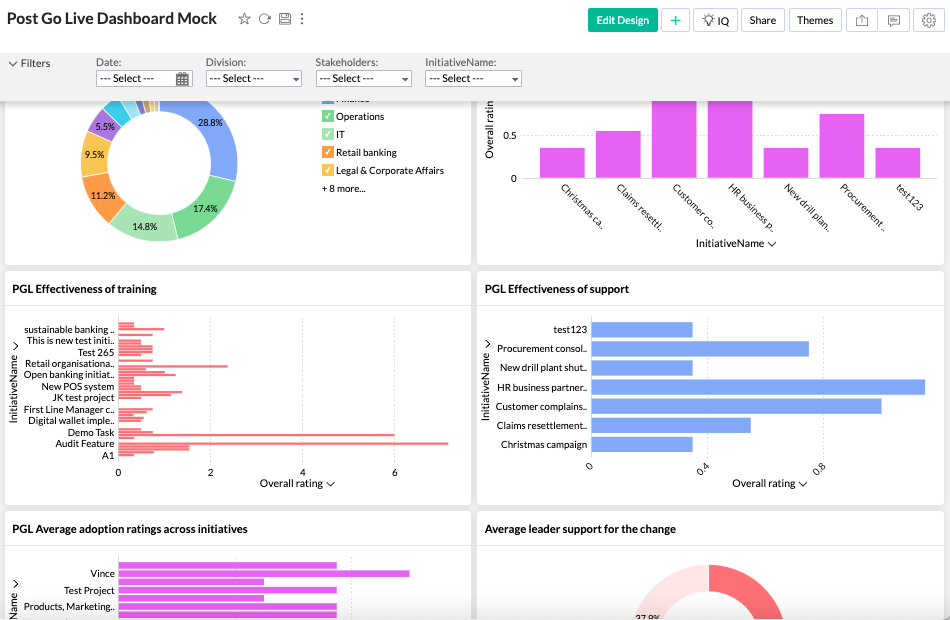
Pie charts can be misleading when used to show data points that are not significantly different. For example, using a pie chart to represent the percentage of divisions impacted by a change might not effectively communicate the nuances of the impact if the differences between the divisions are minimal. A pie chart showing 45%, 30%, and 25% might not convey the critical differences in impact levels among divisions.
Misleading Traffic Light Ratings
Using red, amber, and green to indicate high, medium, and low impacts can send the wrong message. Stakeholders might associate these colours with good and bad outcomes rather than understanding the actual levels of impact. Stakeholder may be used to interpreting these in the context of their usual project or business updates where red indicated alarm and ‘bad’. This can lead to unnecessary alarm or complacency. For instance, a green rating might suggest no need for action, while in reality, it might require ongoing monitoring.
Overuse of Colours
Using too many colours in charts and graphs can overwhelm stakeholders, making it difficult to discern the key message. Using colours in data visualisation can be two-edged sword. Colour can effectively point your stakeholders are the area where you want them to focus on. But, too many colours can lose your audience. A cluttered visual can obscure the critical data points and lead to misinterpretation. For example, a graph with ten different colours can confuse stakeholders about which data points are most important.
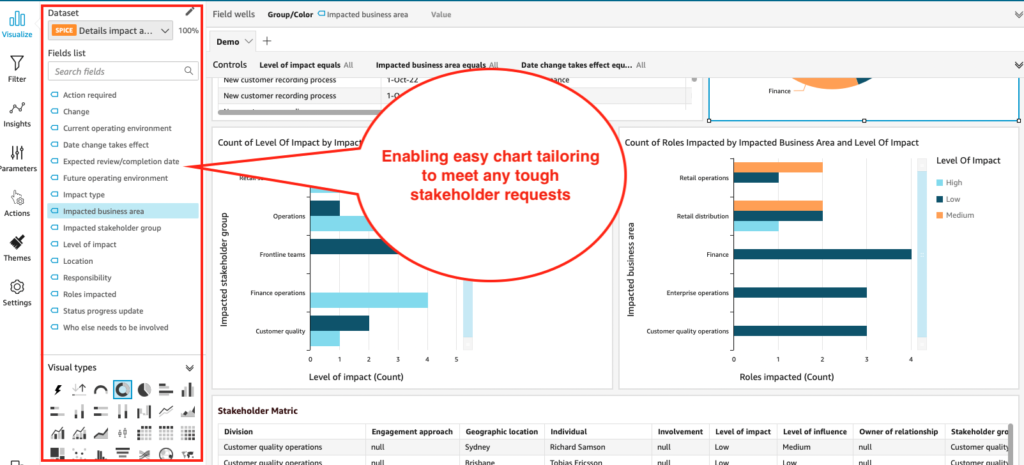
Data visualisation tools are also important. A lot of people use Power BI which works for a foundational level of charts. For tailored charts, specifically designed to to influence stakeholders to clearly see certain angles of risks and opportunities leverage tools such as Change Compass.
Practical Takeaways for Senior Change Managers
To ensure that change management metrics are effective and take into account best practices practices, consider the following practical takeaways:
Align Metrics with Key Stakeholder Perspectives
Understand Stakeholder Priorities: Engage with stakeholders to understand their business goals, priorities and concerns. Tailor your metrics to address these aspects directly. For example, if stakeholders are concerned about operational efficiency, focus on metrics that reflect improvements in this area.
Use Business Language: Frame your metrics in a way that resonates with business stakeholders. Avoid change management jargon and reference, and ensure that the implications of the metrics are clear and actionable. For example, instead of using technical terms, explain how the metrics impact business outcomes. Think in terms of business activities, milestones, busy periods, and capacity challenges.
Focus on Meaningful Metrics
Measure Outcomes, Not Just Activities: Change leaders should prioritize metrics that reflect the outcomes and impacts of change indicate level of knowledge, rather than just the activities performed as a part of change management KPIs. For example, instead of counting the total number of employees attending change management training sessions, measure the improvement in employee performance or knowledge retention post-training.
Example: Instead of reporting that 100 employees attended training sessions, report that 85% of attendees showed improved performance in their roles after training, or that certain level of competencies were gained. Note that quantifiable metrics have more impact on the audience.
Track Engagement and Adoption: Monitor metrics that indicate the level of engagement and adoption among stakeholders or their perception of the change. This could include surveys, feedback forms, or direct measures of behaviour change and the overall success rate of the change.
Example: Use post-training surveys to measure employee confidence in applying new skills or managerial rating of application of learnt skills rather than employee satisfaction of the training sessions using satisfaction scores. Track the percentage of employees who actively use new tools or processes introduced during the change.
Example: Instead of reporting that 100 employees attended training sessions, report that 85% of attendees showed improved performance in their roles after training, or that certain level of competencies were gained.
Example: Use post-training surveys to measure employee confidence in applying new skills or managerial rating of application of learnt skills. Track the percentage of employees who actively use new tools or processes introduced during the change.
Improve Metric Visualization
Simplify Visuals: Use clear, simple visuals that highlight the key messages. Avoid clutter and ensure that the most important data points stand out.
Example: Use bar charts or line graphs to show trends over time rather than pie charts that can be harder to interpret.
Contextualize Data: Provide context for the data to help stakeholders understand the significance. For example, instead of just showing the number of Go-Lives, explain what each Go-Live entails and its expected impact on operations. Or better, focus on showing the varying levels of impact on different stakeholders across time within the initiative.
Example: Accompany a Go-Live count with a visual showing the varying impact level of various implementation activities of the changes.
Example: Use bar charts or line graphs to show trends over time rather than pie charts that can be harder to interpret.
Example: Accompany a Go-Live count with a visual showing the varying impact level of various implementation activities of the changes.
Narrative Approach: Combine metrics with a narrative that explains the story behind the numbers as a part of the change management process. This can help stakeholders understand the broader context and implications.
Example: Instead of presenting raw data, provide a summary that explains key trends, successes, and areas needing attention.
Educate your stakeholders: Depending on stakeholder needs you may need to take them on a phased approach to gradually educate them on change management metrics and how you ultimately want them to drive the outcomes.
Example: You may start the education process to focus on more simplistic and easy-to-understand measures, and as your stakeholders are more change-mature, move to drill into more detailed metrics that explain the ‘why’ and ‘how’ to drive outcome success.
Continuously improvement: Provide regular updates on key metrics and adjust them based on feedback from stakeholders. Continuous communication ensures that everyone remains aligned and informed.
Example: Hold monthly review meetings with stakeholders to discuss the latest metrics, address concerns, and adjust strategies as needed.
Example: Instead of presenting raw data, provide a summary that explains key trends, successes, and areas needing attention.
Example: You may start the education process to focus on more simplistic and easy-to-understand measures, and as your stakeholders are more change-mature, move to drill into more detailed metrics that explain the ‘why’ and ‘how’ to drive outcome success.
Example: Hold monthly review meetings with stakeholders to discuss the latest metrics, address concerns, and adjust strategies as needed.
Examples of Effective Metrics
Employee Adoption and Engagement
Percentage of Employees Adopting New Process/System: This metric measures the rate at which employees are using new processes or systems introduced during the change. High adoption rates indicate successful integration.
Implementation: Use software usage analytics or surveys to track tool adoption rates.
Visualization: A graph showing adoption rates over time.
Employee Feedback Scores: Collect feedback on change initiatives through surveys or stakeholder ratings to measure sentiment/feedback and identify areas for improvement.
Implementation: Conduct regular surveys asking employees about their experience with the change process. Do note that depending on the change you may expect negative feedback due to the nature of the change itself (vs the way it was implemented).
Visualization: Bar/Line charts comparing feedback scores across different departments or time periods. Bar/Line charts are the standard go-to for data visualisation. They are easy to understand and interpret.
Implementation: Use software usage analytics or surveys to track tool adoption rates.
Visualization: A graph showing adoption rates over time.
Implementation: Conduct regular surveys asking employees about their experience with the change implementation process. Do note that depending on the change you may expect negative feedback due to the nature of the change itself (vs the way it was implemented).
Visualization: Bar/Line charts comparing feedback scores across different departments or time periods. Bar/Line charts are the standard go-to for data visualisation. They are easy to understand and interpret.
Impact on Business Outcomes
Improvement in Key Performance Indicators (KPIs): Track changes in KPIs that are directly impacted by the change initiatives, such as productivity, customer satisfaction, customer experience, improvement in process inconsistencies or financial performance.
Implementation: Identify relevant KPIs and measure their performance before and after change initiatives.
Visualization: Use line/bar graphs to show trends in KPI performance over time.
Operational Efficiency Metrics: Measure improvements in operational processes, such as reduced cycle times, error rates, or cost savings.
Implementation: Track specific operational metrics relevant to the change initiatives.
Visualization: Bar charts or heatmaps showing improvements in efficiency metrics across different operational areas.
Implementation: Identify relevant KPIs and measure their performance before and after change initiatives.
Visualization: Use line/bar graphs to show trends in KPI performance over time.
Implementation: Track specific operational metrics relevant to the change initiatives.
Visualization: Bar charts or heatmaps showing improvements in efficiency metrics across different operational areas.
Change management effectiveness requires metrics that not only measure progress but also resonate with business stakeholders and accurately reflect the impact of change initiatives. They should provide valuable insights. Avoiding common pitfalls such as relying on easily misinterpreted or overly operational metrics is crucial. By aligning metrics with stakeholder perspectives, focusing on meaningful outcomes, improving visualization, and communicating effectively, senior change and transformation professionals can ensure that their metrics truly support the success of their change initiatives.
The top change management metrics to avoid are those that fail to provide clear, actionable insights to business stakeholders. By understanding and addressing the disconnect between change managers and business stakeholders, and by prioritizing metrics that truly reflect the impact and progress of change, you can drive more effective and successful change management efforts by influencing your stakeholders in your organisation.
As a next step, Chat with us if you would like to discuss more about leveraging AI and technology to generate high-impact change management metrics and data for your stakeholders, both at project and portfolio levels, using data visualisation tools.
Prosci’s 12th Edition Best Practices in Change Management research found that 76% of change practitioners who measure adoption met or exceeded their project objectives. Among those who did not measure, only 24% achieved the same result, a three-to-one difference in outcomes driven not by strategy or budget, but by whether a team tracked what was happening with adoption.
Yet only 63% of change practitioners measure adoption consistently. Roughly one in three change teams is managing a transformation without knowing whether people are actually changing.
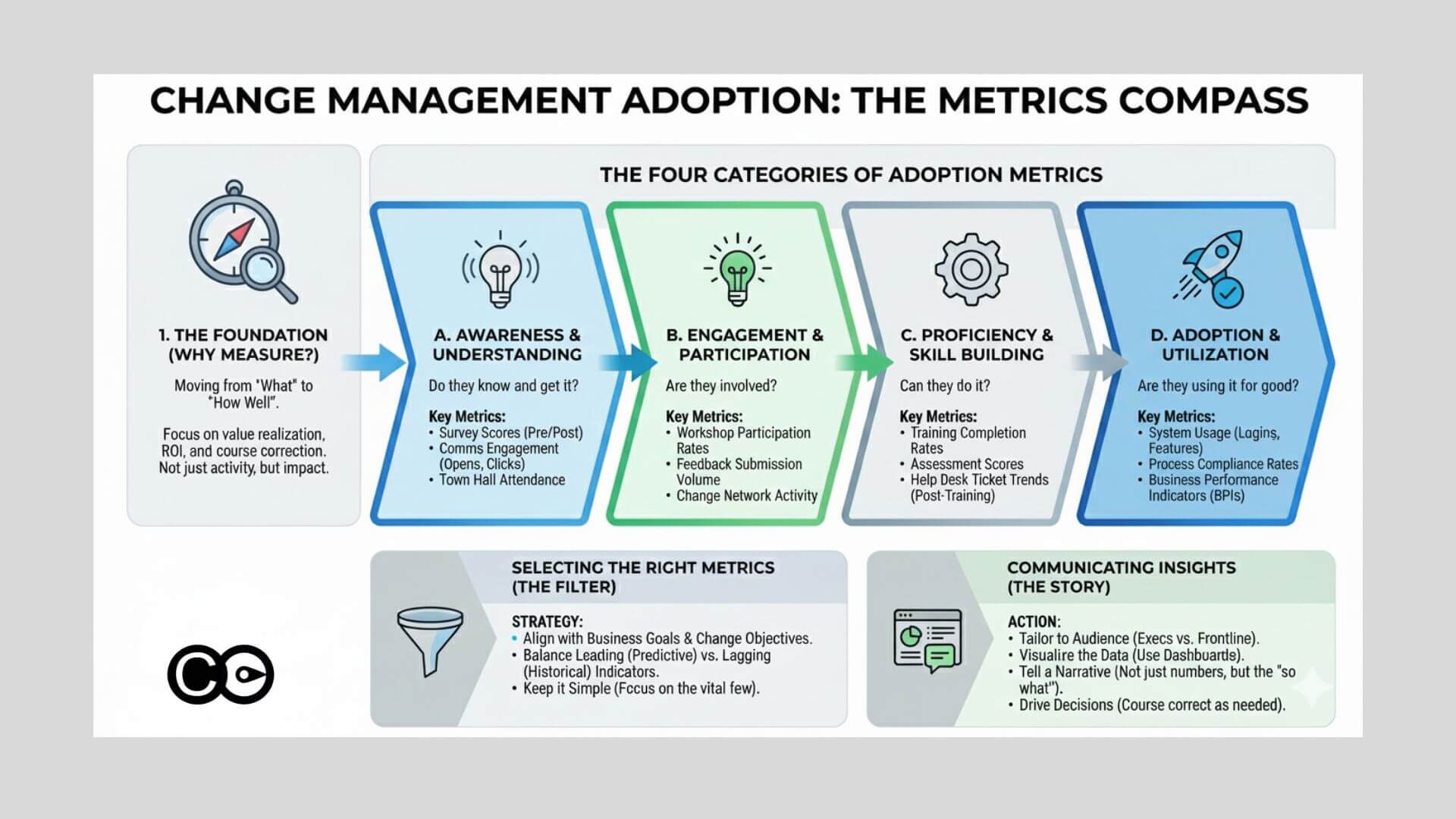
Adoption metrics close this gap. They track how well individuals are embracing change, how behaviours are evolving, and whether change initiatives are delivering the outcomes that justified them. This guide covers the essential metrics, measurement principles, and dashboard structures that high-performing change functions use across system implementations, compliance rollouts, and restructuring programmes.
What Are Change Management Adoption Metrics?
Change management adoption metrics are quantifiable indicators that help organisations track the extent to which employees, teams, and other stakeholders successfully embrace and sustain changes introduced by transformation initiatives.
These metrics go beyond superficial indicators like training attendance or initial rollout success. Instead, they focus on meaningful outcomes that show real adoption, including:
User engagement rates: How actively users interact with new systems or processes.
Feature usage: Frequency and depth at which specific tools or functions are utilized.
Retention rates: Sustained use over time, indicating lasting adoption.
Behavioural compliance: Adherence to new workflows, policies, or regulatory behaviours.
Customer feedback: External perceptions of service or product improvements due to change.
Tracking these metrics allows organisations to understand adoption success, spotlight issues early, and continuously refine change strategies to drive greater impact.
Fundamental Principles of Measuring Adoption
Context Matters
Every change initiative is unique. Different organisational cultures, leadership styles, industries, and change scopes mean no two adoption measurement approaches are identical. Tailoring metrics to align with your initiative’s objectives, stakeholder dynamics, and organisational readiness ensures relevance and maximizes insights.
Focus on Outcomes
Effective adoption metrics focus on measuring outcomes and impact rather than just tracking inputs or activities. For example, instead of simply counting training session attendance, measure whether the training led to proficiency improvements, behaviour changes, or feature activations.
Continuous Monitoring
Adoption isn’t a one-time milestone but an ongoing process. Continuously monitoring adoption metrics over the lifecycle of the change initiative helps detect drops or resistance early, allowing course corrections before issues become entrenched.
Use Multiple Data Sources
Triangulate data across system logs, surveys, interviews, observations, and feedback channels. Combining quantitative system metrics with qualitative insights from stakeholders gives a holistic view of adoption progress.
Measure at Multiple Levels
Track adoption metrics at individual, team, process, and organisational levels to understand how change permeates through various layers and identify bottlenecks or champions.
Key Adoption Metrics for System Implementations
System implementation projects, such as rolling out a new CRM, ERP, or productivity tool, often represent significant organisational investments. Measuring adoption effectively is vital to ensure these investments deliver value.
Below are the most impactful metrics to track:
System Feature Usage Frequency
This metric measures how often different features of the new system are used by employees. High usage of core functionalities indicates engagement and proficiency, while low usage signals training or usability gaps.
Example: Track daily active users (DAU) leveraging key features and compare to expected adoption benchmarks.
Process Efficiency Gains
Measure improvements in process cycle times, throughput rates, and resource utilization resulting from system adoption. Efficiency gains indicate that new workflows powered by the system are being embedded effectively.
Example: Average time to complete a sales order before and after system launch.
Customer Conversation Audit
For systems impacting customer interactions (e.g., customer service platforms), auditing conversations for quality and completeness helps track whether adoption translates to better client experiences.
Example: Percentage of calls with complete data logged, sentiment improvement metrics.
Sales Volume Changes
Tracking changes in sales or revenue post-implementation demonstrates the monetary impact of system adoption. Correlate with feature usage and process compliance data for deeper insights.
Example: Monthly sales growth percentage compared to prior periods.
Information Completeness
Quantify how well the system captures comprehensive and accurate data. High data quality supports better decisions and downstream workflows.
Example: Percent of customer records with complete contact and interaction histories.
Customer Satisfaction Scores
Survey customers on their experience after the system adoption to assess satisfaction gains linked to the change.
Example: Net Promoter Score (NPS) or customer satisfaction index before and after rollout.
Pro Tips for System Implementation Metrics
Segment metrics by user roles and departments to identify adoption disparities.
Focus on the critical few features driving business outcomes rather than every system capability.
Use adoption trend charts over time rather than static snapshots for better story-telling with data.
Key Adoption Metrics for Compliance Initiatives
Compliance initiatives are critical for organisations to meet regulatory standards, industry certifications, or internal policies. Measuring adoption here ensures risks are minimized and consistent behaviours are embraced.
Process Compliance
This metric tracks adherence to defined regulatory processes and standards. High compliance levels reflect successful adoption of mandatory behaviours.
Example: Percent of audit checklist items fully completed within prescribed timelines.
Rated Compliance of Targeted Behaviours
Evaluate employee compliance with specific prescribed behaviours affected by regulatory changes. This can be measured through self-assessments, manager evaluations, or external audits.
Example: Percentage of staff consistently applying new data privacy protocols.
Frequency of Team Leader Coaching
Track how often supervisors provide coaching and reinforcement of compliance behaviours. Regular coaching boosts awareness and accountability.
Example: Number of coaching sessions conducted per month per team.
Customer Feedback on Compliance
Collect feedback from customers or clients regarding their experiences with the organisation’s compliance posture post-change.
Example: Customer ratings on service adherence to privacy and security standards.
Number of Incidents
Monitoring incidents related to non-compliance serves as an early warning system to detect gaps before they escalate.
Example: Incident count reduction trend over quarters after policy rollout.
Key Adoption Metrics for Restructuring Initiatives
Restructuring initiatives, such as mergers, realignments, or downsizing, profoundly impact employee morale and organisational performance. Analytics here help assess adoption and foster alignment with new structures.
Employee Engagement and Morale
Measure changes in engagement and morale through surveys, interviews, and focus groups pre- and post-restructuring.
Example: Employee Net Promoter Score (eNPS) variations over the restructuring timeline.
Organisational Alignment
Evaluate how well the restructuring aligns with strategic objectives by tracking KPIs like revenue growth, market share, and customer satisfaction.
Example: Changes in strategic goal attainment percentages post-merger integration.
Communication Effectiveness
Assess clarity, frequency, and impact of communication during restructuring via employee feedback.
Example: Percent of employees rating communication as clear and timely.
Employee Productivity and Performance
Monitor turnover rates, absenteeism, and performance evaluations over time to understand restructuring impact on workforce productivity.
Example: Decrease in voluntary turnover six months post-restructuring.
Leadership Effectiveness
Gather employee ratings of leadership communication, decisiveness, and supportiveness during change.
Example: Improvement in leadership trust scores in post-restructuring surveys.
Team Dynamics and Collaboration
Evaluate collaboration metrics and cross-functional cooperation to identify strengths and weaknesses impacting adoption.
Example: Frequency of cross-team projects and collaboration tool usage statistics.
Implementing and Measuring Adoption Metrics
Successfully measuring adoption requires a disciplined approach:
Define Clear and Measurable Objectives: Identify behaviour changes and outcomes critical for the initiative’s success. Set quantifiable goals aligned with these objectives.
Select Relevant Metrics: Choose metrics that are actionable, observable, and tied directly to desired behaviours or outcomes.
Utilize Multiple Data Sources: Collect data from system logs, surveys, interviews, observations, and feedback to get a comprehensive picture.
Monitor Progress Continuously: Establish real-time dashboards or regular reporting cadences to track trends and detect issues.
Provide Timely Feedback and Support: Deliver actionable insights to managers and change agents to reinforce positive behaviours or address gaps.
Iterate and Adapt: Use ongoing insights to refine measurement approaches and adoption strategies dynamically.
Measuring Micro-Behaviours in System Implementations
Micro-behaviours are the small, observable actions employees take that directly influence successful adoption at the operational level. Measuring these gives deeper insight than high-level outcomes alone.
User Interface Navigation
Track how proficiently employees navigate new software, including time taken to complete tasks and error rates. Frequent help requests indicate areas of friction.
Example Metric: Average clicks to complete a key transaction; number of help desk tickets per task.
Data Entry Accuracy
Measure precision and completeness of data input, reflecting adherence to new standards and training effectiveness.
Example Metric: Percent of customer records flagged for errors or omissions.
Workflow Integration
Assess usage of new tools in daily work routines compared to legacy processes.
Example Metric: Ratio of transactions processed via new system vs. manual methods.
Collaboration and Knowledge Sharing
Monitor participation in collaborative platforms, document sharing, and informal knowledge networks.
Example Metric: Number of active contributors to shared knowledge bases.
Adoption of Best Practices
Track compliance with recommended workflows and procedures designed to optimize new systems.
Example Metric: Rate of adherence to standardized templates or checklists.
Change Agent Engagement
Measure the involvement of designated change champions in driving adoption through training, communications, and peer support.
Example Metric: Frequency of training sessions led; engagement survey ratings for champions’ effectiveness.
Pro Tips for Micro-Behaviour Metrics
Combine quantitative data with qualitative input (e.g., feedback from change champions) to contextualize numbers.
Use micro-behaviour metrics to diagnose root causes of adoption issues quickly.
Highlight micro-behaviours as actionable areas rather than abstract outcomes for clearer communication with teams.
Adoption metrics by change type
The specific metrics that matter most vary by the type of change you are managing. The table below maps the highest-priority indicators to the three most common change categories, helping you build the right measurement mix for each initiative.
Metric
System implementations
Compliance changes
Restructuring
Active user rate / login frequency
High priority
Moderate
Low
Feature utilisation depth
High priority
Low
Low
Process compliance rate
Moderate
High priority
Moderate
Incident or error rate
Moderate
High priority
Low
Manager observation or coaching score
Moderate
High priority
High priority
Employee engagement score
Low
Moderate
High priority
Reversion rate
High priority
Moderate
Moderate
Proficiency or competency assessment
Moderate
High priority
Moderate
Productivity vs pre-change baseline
High priority
Moderate
High priority
How Many Adoption Metrics Should You Track?
When it comes to measuring behaviour change in change initiatives, the old adage “less is more” is especially true. While it’s tempting to track a multitude of metrics to capture every nuance, focusing on the critical few behaviours that drive the greatest impact is essential for clarity and actionable insights.
Focus on Key Objectives
Start by identifying the core outcomes your change initiative aims to achieve — whether increased system usage, improved compliance, enhanced morale, or customer satisfaction. Align your metric selection tightly to these objectives.
Prioritize High-Impact Behaviours
Narrow down to a manageable set of metrics that capture the behaviours most likely to influence success. Typically, 8 to 15 core metrics, carefully grouped by outcome area, strike a good balance.
Consider Manageability and Data Availability
Avoid overwhelming your teams or diluting focus by tracking too many metrics. Ensure selected metrics are feasible to collect accurately and regularly.
Use Both Quantitative and Qualitative Metrics
Combine objective data (completion rates, error counts, usage stats) with qualitative insights (surveys, interviews) for a rich, holistic measurement approach.
Account for Interdependencies
Recognize that behaviours are interconnected; changes in one area may affect others. Select metrics that capture key interactions or cascading effects when possible.
Change adoption dashboard
Now that you have determined exactly what you want to measure to drive adoption, you may want to create a dashboard. Check out our article on ‘Designing a Change Adoption Dashboard’.
What Is a Change Adoption Dashboard?
It’s a visual tool combining key adoption metrics, trends, and warnings into a single pane of glass, allowing leaders and change agents to monitor progress in real time.
Change adoption is the ultimate goal of any change initiative, and effective measurement of adoption metrics is key to integrating change into daily lives and achieving a product’s success. By understanding the dynamics of change adoption and the user journey, selecting the right metrics, and implementing them effectively, change practitioners and product managers can navigate the complexities of change and drive meaningful outcomes for their organisations. Remember, adoption is not a destination but a journey, and with the right metrics and strategies in place, sustainable change is within reach.
To find out more about leveraging a digital platform to create a change adoption dashboard click the below to chat to us.
Change management is an intricate dance between vision, strategy, execution, and perhaps most importantly, adoption. The ultimate goal of any change initiative is not merely to implement new systems, processes, or regulations, but rather to embed these changes into the very fabric of the organisation, ensuring widespread adoption and long-term sustainability.
However, achieving full adoption is no small feat. Many change initiatives falter along the way, failing to garner the buy-in and commitment necessary for success. Even when adoption is initially achieved, sustaining it over time presents its own set of challenges.
Frequently Asked Questions (FAQ)
1. What are the most important adoption metrics in change management?
The most important metrics vary by initiative but generally include user engagement, behavioural compliance, feature usage, retention rates, and customer satisfaction.
2. How do you measure user adoption of a new system?
Measure system feature usage frequency, process efficiency improvements, support ticket trends, and user satisfaction surveys.
3. How do you track behaviour change in employees?
Use a combination of observational data, manager assessments, compliance audits, and micro-behaviour tracking such as task completion accuracy.
4. How many change adoption metrics should organisations track?
Focus on 8 to 15 core metrics aligned with your primary objectives to avoid overwhelm and maximize impact.
5. What tools can I use to build a change adoption dashboard?
Platforms like The Change Compass provide integrated solutions for automated data collection, visualization, and alerting tailored to adoption measurement.
6. How does continuous monitoring improve change adoption?
It allows early detection of issues and timely interventions, preventing small problems from undermining overall adoption success.
What are the most important change management metrics?
The most important change management metrics fall into three categories. Adoption metrics measure whether people have changed their behaviour – system usage rates, process compliance, and workaround rates are the strongest indicators. Readiness metrics measure whether people are prepared to change – readiness survey scores by stakeholder group, training completion with assessed comprehension, and manager confidence ratings. Change load metrics measure whether the volume of simultaneous change is sustainable – the number of concurrent initiatives affecting each employee group and the intensity of change impact at the team level.
How do you measure change management adoption?
Change adoption is best measured through a combination of behavioural data (system usage logs, process audit data) and perception data (pulse surveys, focus group insights). Behavioural data tells you what people are actually doing; perception data tells you why. The most effective measurement approaches combine both: tracking usage data in real time while running regular short pulse surveys to understand the barriers preventing full adoption. A change management platform can automate much of this data collection and reporting.
What change management metrics should you report to executives?
Executives typically want three things from change management reporting: confidence that the change is on track (overall adoption rate and trend), early warning of risk (readiness scores and lagging groups identified), and evidence of value (adoption rate multiplied by the business value attributed to the change). Avoid reporting activity metrics (communications sent, training sessions held) as primary measures – these describe inputs, not outcomes.
How many change management metrics should you track?
For most change programmes, tracking five to eight metrics across the three categories (adoption, readiness, change load) is sufficient. Tracking too many metrics creates reporting overhead without improving decision-making. The most common mistake is tracking metrics that are easy to collect (like training attendance) rather than metrics that are most predictive of adoption outcomes (like manager capability and behavioural compliance in the first 30 days after go-live).
Change management teams have long prided themselves on enabling organisations to adapt, evolve, and thrive in the face of constant disruption. Yet, a curious irony persists: many change management teams themselves are reluctant to change. They are trapped in a cycle of executing individual projects, refining legacy methodologies, and building capabilities through workshops and sessions-year after year, with little evolution in their own practice. This phenomenon can be described as “Change Management Teams’ Stockholm Syndrome”-where practitioners defend the very systems and routines that may be limiting their impact, just as employees in transformation-fatigued organisations do.
This syndrome is not just about comfort; it is also about fear. Changing the way change is managed is risky. There is a real concern that if things do not go well, the change team may be blamed. The prevailing attitude is often: “If everyone else is doing it this way, why should we change?” This mindset is a significant barrier to progress and innovation.
And this is not to specifically single-out change management teams. In the corporate world, process and methodology helps to create certainty and clarity. Without it, there could be chaos. As a result, organisations as a whole and its teams, tend to stick to the convention to run the business.
The Legacy Methodology Trap
Most change management teams remain wedded to legacy methodologies-structured, linear frameworks that were designed for a pre-digital era. These approaches often emphasise process over people, form over function, and documentation over data. While these methods have served organisations well in the past, they are increasingly mismatched with the realities of today’s digital and AI-driven world.
The result? Change management teams risk becoming irrelevant, unable to provide the strategic value that modern organisations demand. They are seen as facilitators rather than strategists, focused on executing rather than shaping change. This legacy focus also means that teams miss out on the benefits of agile, data-based approaches that are now commonplace in other disciplines such as marketing, operations, human resources and customer experience.
The Cost of Standing Still
The consequences of this stagnation are profound:
No Innovation: Without evolving their own practices, change management teams cannot credibly advocate for innovation elsewhere in the organisation.
Legacy vs. Agile: Teams remain focused on rigid, legacy methodologies, missing opportunities to leverage agile, iterative, and data-driven approaches that are better suited to today’s fast-moving environment.
No Data-Based Insights: Historical data is often ignored, meaning teams cannot learn from past successes or failures, nor can they provide predictive insights to guide future change initiatives.
Inability to Influence Strategically: Without data and digital fluency, change teams struggle to influence at a strategic level, limiting their ability to shape the direction of the organisation.
Credibility Challenges: Project teams and leaders may increasingly question the value of change management, seeing it as a bureaucratic function rather than a strategic partner. On the other hand, change managers spend significant time on arguing/positioning their worth, versus delivering value.
The New Digital and AI Reality
The world has changed. Digital transformation is no longer a buzzword-it is a reality. AI is reshaping how work gets done, automating routine tasks, and providing deep insights that were previously unimaginable. Other disciplines have already embraced these trends, using data to inform decisions, automate low-value work, and focus on high-value strategic activities.
Yet, many change management teams are still operating in a pre-digital mindset. They are not leveraging the power of automation, AI, or data analytics to transform their own work. This is not just a missed opportunity-it is a threat to the relevance and impact of the discipline.
The Comfort of the Familiar
Why do so many change management teams resist changing their own ways of working? The answer lies in what we as change practitioners already know about human psychology. Change is hard, even for those who advocate for it. The status quo is comfortable, and the risks of trying something new are real. Teams may fear failure, blame, or simply the unknown. They may also suffer from “Organisational Stockholm Syndrome,” defending the very systems that exhaust them and limit their potential.
Looking Ahead
The solution is clear: change management teams must catch up with industry trends that other disciplines have already embraced. They must leverage data to inform their work, automate lower-value tasks, and leapfrog to higher-value strategic roles-advising on change strategy, adoption, and benefit optimisation across the organisation. Only by transforming themselves can they credibly support the transformation of others.
Barriers and Breakthroughs in Digital Change Management
Facing the Realities of Digital and Data-Driven Transformation
As change management teams recognise the need to evolve, they encounter a complex array of barriers that are both technical and cultural. The journey toward digital and data-driven change management is not simply about adopting new tools or methodologies; it is about transforming mindsets, processes, and organisational structures. The following barriers are among the most persistent and impactful.
Key Barriers to Digital and Data-Driven Change Management
Resistance to Change
Even within change management teams, resistance is a formidable obstacle. Many practitioners are comfortable with established processes and fear the disruption that comes with new digital tools or methodologies. This resistance is compounded by concerns over job security (e.g. the result of AI and automation), the risk of failure, and the potential for blame if initiatives do not succeed.
Integration with Legacy Systems
Many organisations rely on outdated systems that are not designed to work with modern digital solutions. Integrating new technologies-such as AI-powered analytics or automation platforms – with legacy processes such as spreadsheets and templates that are often complex, time-consuming, and costly. This challenge can stall progress and limit the ability to leverage data-driven insights.
Lack of Digital Expertise
There is a significant skills gap in many change management teams. Digital transformation requires a blend of technical, analytical, critical and strategic competencies that are not always present. Without the right expertise, teams struggle to implement and sustain new digital initiatives.
Poor Data Quality and Access
Effective data-driven change management relies on accurate, timely, and accessible data. However, many organisations struggle with fragmented data sources, inconsistent data quality, and limited access to meaningful insights. Only a minority of companies report having access to accurate data that can inform decision-making.
Failure to Link Strategy to Execution
Even with a clear digital or data-driven strategy, many change management teams struggle to translate this into daily practice. There is often a disconnect between strategic intent and operational execution, leading to missed opportunities and diminished impact.
Inadequate Leadership and Communication
Successful digital transformation requires strong leadership and effective communication. When leaders fail to articulate a compelling vision, provide adequate support, or foster a culture of transparency and trust, change initiatives are more likely to falter.
Cultural Inertia and Lack of Experimentation
Organisational culture plays a critical role in enabling or hindering change. A culture that resists experimentation, learning, and adaptation will struggle to embrace digital and data-driven approaches. Without the ability to experiment and learn from failures, progress is slow and innovation is stifled.
Overcoming the Barriers: Practical Breakthroughs
Despite these challenges, there are proven strategies that change management teams can adopt to overcome barriers and accelerate their digital and data-driven transformation.
Embrace Agile and Data-Driven Methodologies
Shift from rigid, legacy frameworks to agile, iterative approaches that prioritise learning, adaptation, and data-driven decision-making. This allows teams to respond more quickly to changing circumstances and to leverage real-time insights.
Invest in Digital Upskilling
Build digital literacy and analytical skills within the change management team. This can be achieved through targeted training, partnerships with digital experts, and the recruitment of data-savvy professionals.
Improve Data Quality and Accessibility
Implement robust data governance practices to ensure data accuracy, consistency, and accessibility. Invest in tools and platforms that enable seamless data integration and analysis across the organisation.
Strengthen Leadership and Communication
Develop a clear, compelling vision for digital change management and communicate it consistently across the organisation. Engage leaders at all levels to champion the change and provide ongoing support to teams.
Foster a Culture of Experimentation and Learning
Encourage teams to experiment with new tools, methodologies, and approaches. Create a safe environment where failure is seen as an opportunity for learning and improvement.
Align Strategy with Execution
Ensure that digital and data-driven strategies are translated into actionable plans and daily practices. Regularly review progress, gather feedback, and adjust course as needed to maintain alignment and drive results.
The Path Forward
The barriers to digital and data-driven change management are significant, but they are not insurmountable. By addressing resistance, building digital expertise, improving data quality, strengthening leadership, and fostering a culture of experimentation, change management teams can break free from legacy mindsets and unlock new levels of impact and credibility.
Leapfrogging to Strategic Impact
From Execution to Strategic Influence
For too long, change management teams have been seen as facilitators of change rather than architects. Their work has been largely transactional-running workshops, refining methodologies, and supporting project delivery. The digital and AI-driven world, however, demands a fundamental shift in how change is managed and led. The opportunity now is for change management to become a true strategic partner, leveraging data, automation, and AI to shape the direction and success of organisational transformation.
Leveraging Data for Deeper Insights and Predictive Power
The most forward-thinking organisations are already using real-time and historical data to inform every aspect of change. This means moving beyond gut feeling and anecdotal evidence to a world where decision-making is driven by robust analytics. Change management teams can now:
Predict Adoption and Resistance: By analysing readiness, engagement, and adoption metrics, teams can anticipate where resistance will emerge and intervene proactively.
Measure Impact in Real Time: Digital tools and platforms enable continuous monitoring of change initiatives, allowing for rapid course correction and more responsive leadership.
Optimise Communication and Support: Data-driven insights help tailor communication strategies to different stakeholder groups, ensuring messages resonate and support is targeted where it is most needed.
Automating the Routine, Elevating the Strategic
Automation and AI are transforming the landscape of change management by taking over repetitive, low-value tasks. Chatbots, virtual assistants, and automated workflows can handle routine communications, answer common questions, and even deliver personalised training modules. This frees up change practitioners to focus on higher-value activities, such as:
Advising on Change Strategy: With more time and better data, change teams can provide strategic counsel to senior leaders, helping shape transformation agendas and ensure alignment with business goals.
Driving Adoption and Benefit Realisation: By leveraging real-time analytics, teams can identify barriers to adoption early, design targeted interventions, and track the realisation of benefits across the organisation.
Leading Culture Change: Change management is increasingly recognised as a driver of organisational culture. Teams that embrace open, data-driven, and agile approaches can foster a culture of continuous improvement and innovation.
Building Credibility and Influence
As change management teams embrace digital and data-driven approaches, they also build credibility with project teams and leaders. By providing clear, evidence-based recommendations and demonstrating measurable impact, change practitioners can move from being seen as process administrators to trusted advisors. This shift is critical for influencing at a strategic level and ensuring that change management is embedded in the organisation’s DNA.
The Future of Change Management
The future belongs to organisations that treat change as a continuous, strategic process rather than a series of isolated projects. Change management teams that harness the power of data, automation, and AI will be at the heart of this transformation. They will drive not only the adoption of new technologies but also the cultural and behavioural shifts needed for sustainable success.
A Call to Action
For senior change and transformation practitioners, the message is clear: the time to leapfrog is now. By embracing digital tools, data-driven decision-making, and agile, open approaches, change management can move from the back office to the boardroom. The result will be a profession that is more innovative, influential, and indispensable than ever before.
The organisations that succeed in the digital age will be those that empower their change teams to lead, not just facilitate/deliver, transformation-shaping the future of work, culture, and performance for years to come.