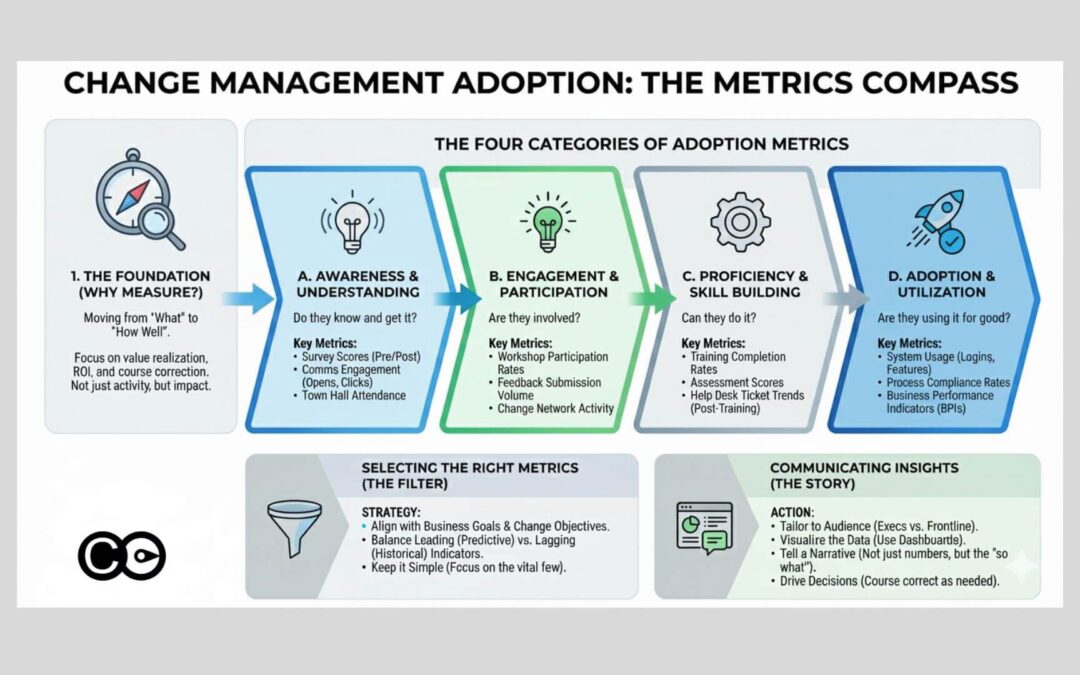
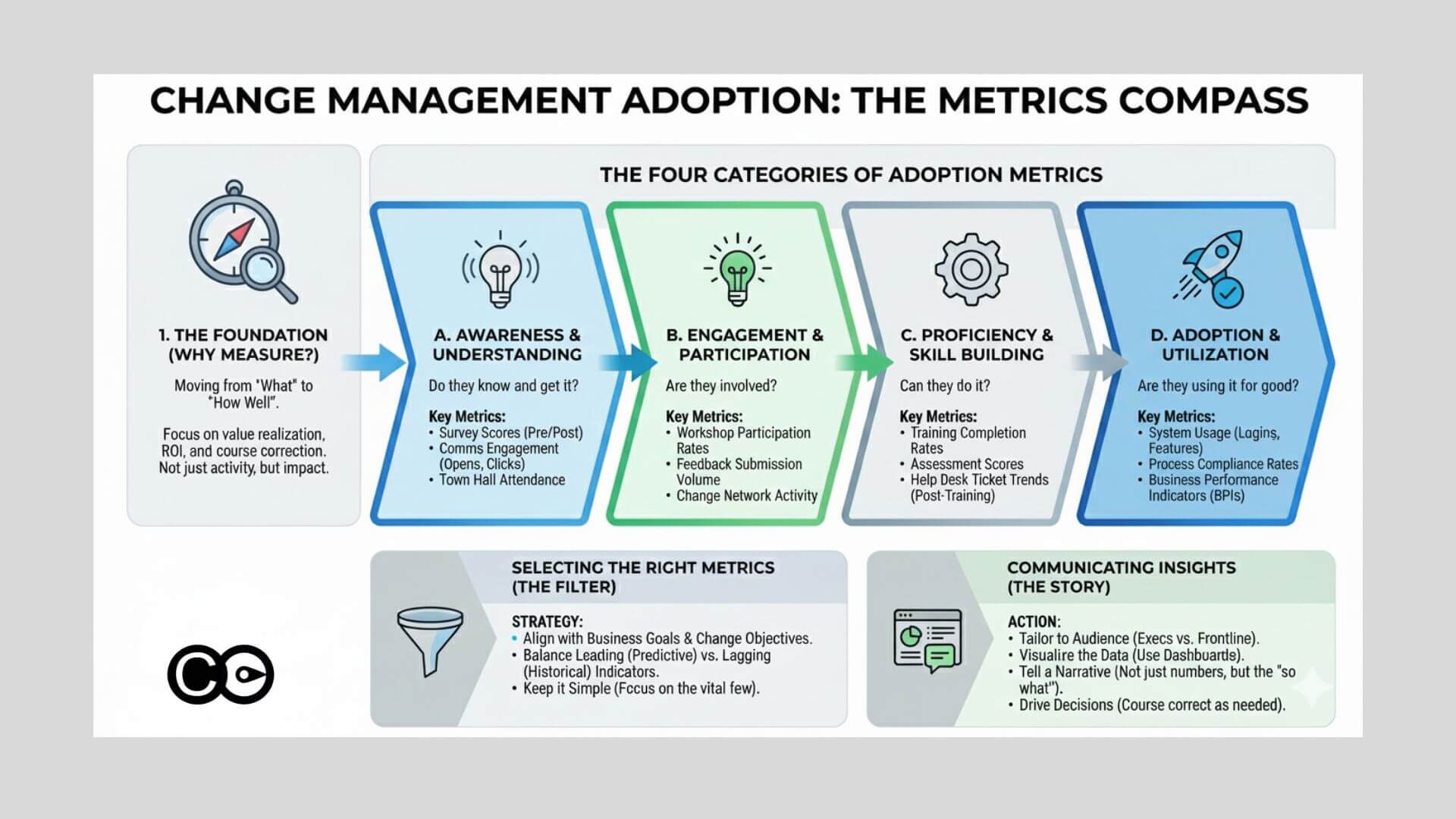
How to measure change saturation: a practical methodology for enterprise change functions
Most organisations can feel change saturation before they can prove it. Leaders sense that employees are struggling, change managers notice adoption slipping, and business partners start raising concerns about “too much at once.” But when it comes to quantifying the problem, securing executive attention, or making a credible case for adjusting programme sequencing, feeling is not enough.
Measurement changes that dynamic entirely. An organisation that can measure change saturation can demonstrate it, act on it, and prevent it from quietly undermining transformation outcomes. An organisation that cannot measure it is stuck responding to symptoms rather than causes.
This article sets out a practical methodology for measuring change saturation in enterprise environments: what to measure, how to score it, what the data tells you, and how to turn the output into decisions that protect adoption and reduce change fatigue.
Why change saturation is so difficult to measure
The challenge with measuring change saturation is that it is not a single variable. It is an emergent condition that arises from the interaction between several variables: the volume of concurrent changes landing on a group, the intensity of each change, and the capacity of the group to absorb them. None of these is directly observable in isolation.
Volume is relatively straightforward to count: how many programmes are actively affecting this group right now? But volume without intensity gives you an incomplete picture. A group managing two major system replacements simultaneously is more saturated than a group managing ten minor policy updates. And both assessments are useless unless they are calibrated against capacity: a high-performing change champion network in a well-managed business unit with experienced managers can absorb more than a stretched team in the middle of a restructure.
Prosci’s Best Practices in Change Management research found that 73% of organisations surveyed were near, at, or beyond the saturation point. The reason that number is so high is not that organisations are careless. It is that most organisations have no systematic way to see saturation building before it becomes critical.
The three dimensions of a change saturation measurement model
A rigorous methodology for measuring change saturation needs to address all three dimensions: load, intensity, and capacity.
Dimension 1: Change load
Change load is the quantitative foundation of saturation measurement. It answers the question: how much change is being asked of this group, across all programmes, right now?
Calculating change load requires a portfolio-level view. For each group of employees, you need to know:
How many programmes are currently in active delivery (preparation, go-live, or post-go-live embedding)
The size of the group and the proportion affected by each programme
The timeline of each programme’s peak demand periods
A simple change load index can be constructed by assigning each programme a weight (based on the size and duration of its demand on the group) and summing those weights for each group across the current period. The output is a comparative score: Group A has a load index of 4.2, Group B has a load index of 1.8. High-load groups are immediate candidates for deeper investigation.
Dimension 2: Change intensity
Not all changes demand the same cognitive and behavioural adjustment. Change intensity measures how disruptive each individual programme is to the employees it affects. A robust intensity assessment covers the following dimensions:
Process change: Are employees being asked to follow materially different processes or procedures?
System change: Are new technologies being introduced that require new skills and habits?
Role change: Are roles being restructured, responsibilities shifting, or reporting lines changing?
Behavioural change: Are fundamental ways of working or cultural norms being challenged?
Location and environment: Are physical working arrangements changing?
Each dimension is typically scored on a scale of one to five: one meaning minimal adjustment required, five meaning radical shift. The total intensity score for a programme across all dimensions provides a standardised basis for comparison that goes well beyond “major” and “minor” labels.
When intensity scores are multiplied by the number of people affected, you get a weighted impact figure that can be aggregated across all programmes to give a cumulative impact score for any stakeholder group.
Dimension 3: Absorption capacity
Absorption capacity is the most subjective of the three dimensions, but it is also the most important for calibrating risk. Two groups facing identical change load and intensity may have very different actual saturation risk depending on their current capacity to absorb change.
Factors that increase absorption capacity include: a recent track record of successful change adoption, strong and engaged line managers who actively support transitions, low current business workload, a stable team structure, and access to dedicated change support resources.
Factors that reduce absorption capacity include: recent history of poorly managed change, a restructure or leadership transition in the past twelve months, high current business workload or seasonal pressure, high attrition in the period, and limited manager availability.
Capacity can be assessed using a structured scoring approach: assign each factor a weight and a score, sum the results, and produce a capacity index. When capacity is low and load is high, the saturation risk calculation shifts dramatically.
Combining the three dimensions: the saturation risk score
Once you have load, intensity, and capacity scores for each stakeholder group, you can combine them into a single saturation risk score. The formula is straightforward in principle:
Saturation Risk = (Change Load x Average Intensity) / Absorption Capacity
Groups with a high numerator (high load and high intensity) and a low denominator (low capacity) are at the greatest risk of saturation. Groups with moderate load, moderate intensity, and high capacity may be managing comfortably.
The specific weighting and calibration of this formula will vary by organisation. The important thing is that the formula is applied consistently across all groups and time periods so that comparisons are meaningful. An organisation that calculates saturation risk scores every quarter develops a trend view: is this group’s score rising, stable, or declining? That trend view is often more actionable than any single data point.
Gartner’s research on change fatigue identifies the cascading effects of high saturation: employee intent to stay declines by up to 42% and individual performance can fall by up to 27%. Having a risk score that flags these conditions before they materialise is what gives organisations time to intervene.
Leading indicators: what to watch before saturation becomes critical
Quantitative load, intensity, and capacity scores are the analytical foundation. But they are only as useful as the data that feeds them. Leading indicators provide an early warning layer that flags emerging saturation risk in real time.
The most reliable leading indicators for change saturation include:
Readiness assessment scores: If stakeholder readiness surveys are showing declining confidence in the same groups across multiple programmes, that is a strong signal of emerging saturation even before adoption data confirms it.
Support ticket volume and type: A spike in “how do I” tickets, process queries, or errors in a group that has recently gone through multiple changes indicates that new ways of working are not yet embedded.
Manager-reported concerns: Direct reports from line managers about team overload, confusion about priorities, or declining morale are a ground-level signal that formal data often misses.
Participation rates in change activities: Declining attendance at training sessions, communications open rates falling, or drop-off in workshop participation are early indicators that employees are starting to disengage from change processes.
Pulse survey sentiment: Structured short-cycle surveys asking employees specifically about their change experience, not just general engagement, can surface saturation signals weeks before adoption metrics deteriorate.
The value of these indicators is in their combination. Any single signal can have alternative explanations. When multiple leading indicators are moving in the same direction for the same group, the probability of saturation risk is high.
Lagging indicators: confirming what the leading indicators predicted
If saturation goes undetected or unmanaged, it will eventually show up in lagging indicators. These are retrospective: they confirm that saturation has already occurred, rather than giving you time to prevent it.
Key lagging indicators include:
Adoption rates below threshold: If post-go-live adoption data shows that target behaviours are not being sustained at expected levels, saturation is one of the most common root causes.
Benefits realisation shortfalls: When programmes that expected to deliver financial or operational outcomes within a defined period consistently fall short, compounded change load is often a contributing factor.
Attrition spikes in high-change groups: Research from Prosci identifies that 54% of employees experiencing change fatigue actively look for a new role. Voluntary attrition data disaggregated by group and correlated with change load data can confirm saturation impact after the fact.
Quality or error rate increases: In operational groups going through system or process changes, a measurable increase in errors or rework can indicate that employees are not yet proficient in the new ways of working.
Tracking lagging indicators matters for two reasons. First, they close the loop on the saturation risk methodology: if your risk scores correctly predicted the groups that experienced adoption failure, your model is calibrated well. Second, they provide the evidence base for executive conversations about saturation impact, which is often necessary before organisations will invest in prevention.
Building a change saturation dashboard
Measurement only creates value when it is visible to the people who can act on it. A change saturation dashboard serves as the primary communication tool for the enterprise change function, translating complex multi-variable analysis into a format that programme sponsors, business unit leaders, and transformation executives can consume quickly.
An effective saturation dashboard includes:
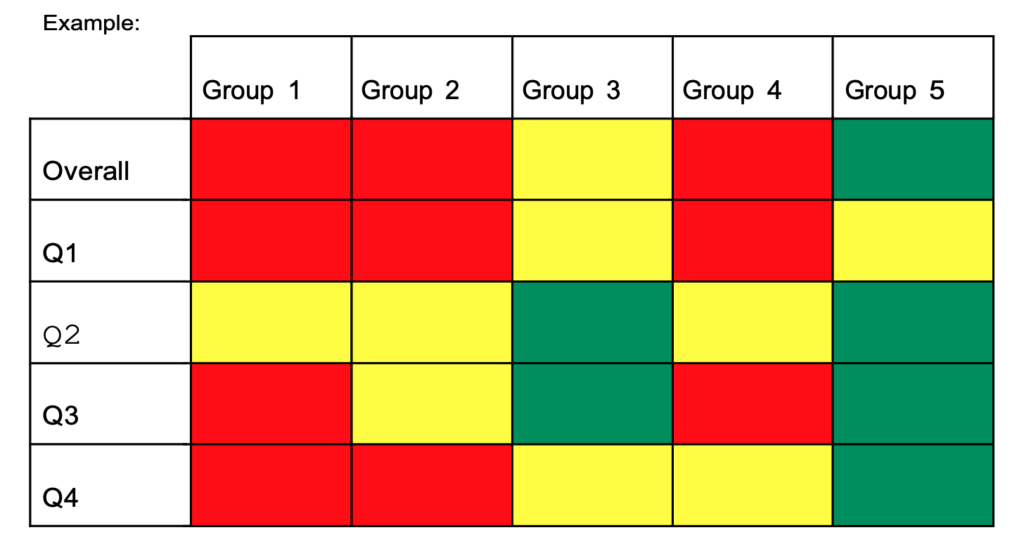
Portfolio heat map by group: A matrix showing which stakeholder groups are carrying the highest change load in the current quarter, with colour coding indicating saturation risk levels.
Trend lines for high-risk groups: For groups flagged as high-risk, a rolling view of their saturation score over the past two to four quarters.
Programme convergence view: A calendar-based visualisation showing where multiple programmes are landing on the same groups in the same window.
Leading indicator summary: A consolidated view of the current readings on key leading indicators, with flagging for any that are trending in a concerning direction.
Intervention log: A record of what saturation management interventions have been initiated, by whom, and for which groups.
This kind of visibility transforms saturation management from a reactive exercise into a governance function. When the dashboard is presented regularly to the portfolio governance committee, saturation risk becomes a standing agenda item alongside cost, schedule, and scope.
Practical tools for saturation measurement at scale
For enterprise change functions managing ten or more concurrent programmes, the practical challenge of measuring saturation is significant. The data collection, aggregation, and analysis required to maintain a current, accurate view of saturation risk across a complex portfolio cannot be managed sustainably in spreadsheets.
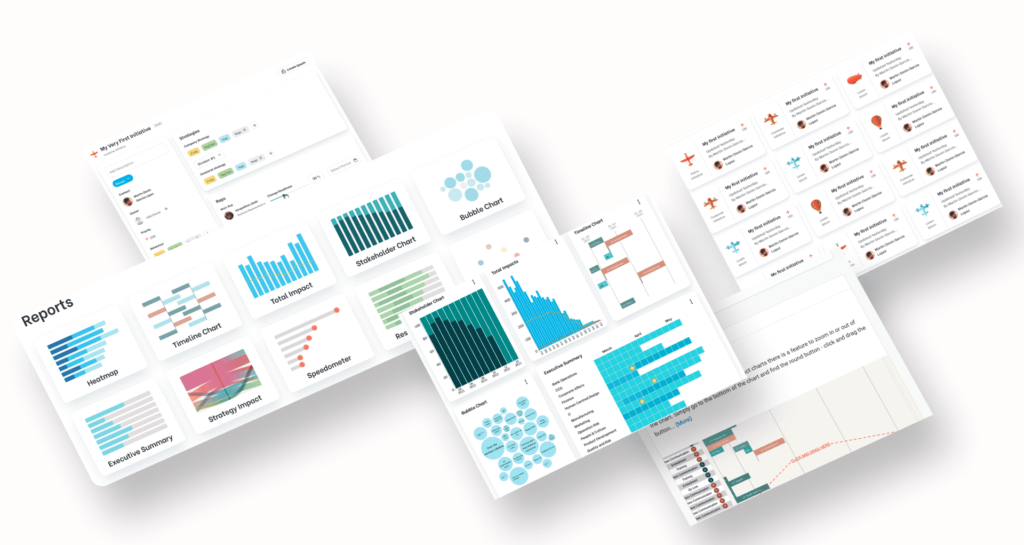
Change Compass is built specifically for this challenge. The platform provides enterprise change functions with a centralised data infrastructure for capturing change impact and load across the portfolio, automated aggregation of cumulative change demand by stakeholder group, and real-time visualisation of saturation risk. Rather than manually compiling data from twelve different programme SharePoint sites, change managers can work from a single source of truth that surfaces portfolio-level risk automatically.
For change teams in the early stages of building measurement capability, starting with the Change Compass weekly demo is a practical way to see what portfolio-level saturation measurement looks like in practice before committing to a platform investment.
Making measurement actionable: from scores to decisions
The ultimate purpose of measuring change saturation is not to produce scores. It is to produce better decisions about how the change portfolio is managed. A saturation risk score that sits in a report and is never acted on has no value.
The decisions that saturation measurement should be driving include:
Sequencing decisions: When high-risk groups are identified, programme governance should have a mechanism to delay or phase go-live dates for lower-priority programmes to reduce peak load.
Resourcing decisions: Groups identified as high-risk may require additional change support capacity, including dedicated practitioners, enhanced manager coaching, or intensified communication.
Scope decisions: When sequencing is not possible, MVP thinking applied to change scope can reduce the intensity of individual programmes landing on high-risk groups.
Reporting decisions: High-risk groups should be on the executive sponsor radar, with regular updates on saturation indicators and intervention progress.
Prosci’s research on change management metrics consistently identifies that organisations that actively measure and act on change data are significantly more likely to meet or exceed their project objectives. The measurement methodology matters, but the governance mechanism that turns measurement into action matters just as much.
Where to start: a phased approach to building saturation measurement capability
Most enterprise change functions cannot build a full saturation measurement system overnight. The most practical approach is phased.
Phase 1: Establish the data foundation. Standardise the change impact assessment template across all programmes so that group-level impact data is collected in a consistent, comparable format. Without this, aggregation is impossible.
Phase 2: Build the portfolio view. Map all active and upcoming programmes against the employee population in a shared register. Identify which groups are affected by more than two significant changes in the next quarter.
Phase 3: Add the intensity layer. For the highest-load groups identified in Phase 2, conduct structured intensity assessments for each programme affecting them. Calculate cumulative intensity scores.
Phase 4: Introduce capacity assessment. Develop a structured capacity scoring instrument for the highest-risk groups. Combine load, intensity, and capacity scores into a risk index.
Phase 5: Automate and sustain. Move from manual calculation to platform-supported aggregation and visualisation, so that saturation risk is maintained as a live view rather than a quarterly exercise.
The organisations that manage change saturation most effectively are those that started this journey early enough to have meaningful data before the next major convergence point. The methodology above is scalable from small beginnings, but the longer measurement is deferred, the less lead time there is to act.
Frequently asked questions
What is the best way to measure change saturation?
The most robust approach combines three dimensions: change load (the volume of concurrent programmes affecting a group), change intensity (how disruptive each programme is across process, system, role, and behavioural dimensions), and absorption capacity (the group’s current ability to take on change). Combining these into a saturation risk score, tracked over time, provides a meaningful basis for governance and intervention decisions.
How do you know when an organisation has reached change saturation?
Saturation is typically confirmed by a combination of leading and lagging indicators. Leading indicators include declining readiness scores across multiple programmes for the same groups, rising support ticket volumes, and falling participation in change activities. Lagging indicators include below-target adoption rates, benefits realisation shortfalls, and voluntary attrition spikes in high-change groups. When multiple signals align, saturation is almost certainly a factor.
What data do you need to measure change saturation?
The minimum data set includes: the change portfolio (all active programmes and their timelines), impact assessment data (which groups are affected, how significantly), readiness and adoption metrics from each programme, and capacity indicators for the highest-risk groups. Ideally this data is maintained in a centralised platform rather than distributed across programme-level documents.
Can change saturation be measured at the team level?
Yes, and team-level measurement is often the most actionable. While portfolio-level heat maps identify which business units or functions are carrying the highest load, team-level analysis identifies where the risk is most acute and allows targeted support to be directed precisely. Line manager input is essential for accurate capacity assessment at the team level.
How often should change saturation be measured?
At a minimum, quarterly. For organisations running fast-moving transformation portfolios, monthly or rolling measurement is more appropriate. The goal is to have enough lead time to act on risk signals before they translate into adoption failure. A retrospective saturation assessment after go-live confirms what happened but does not allow intervention.
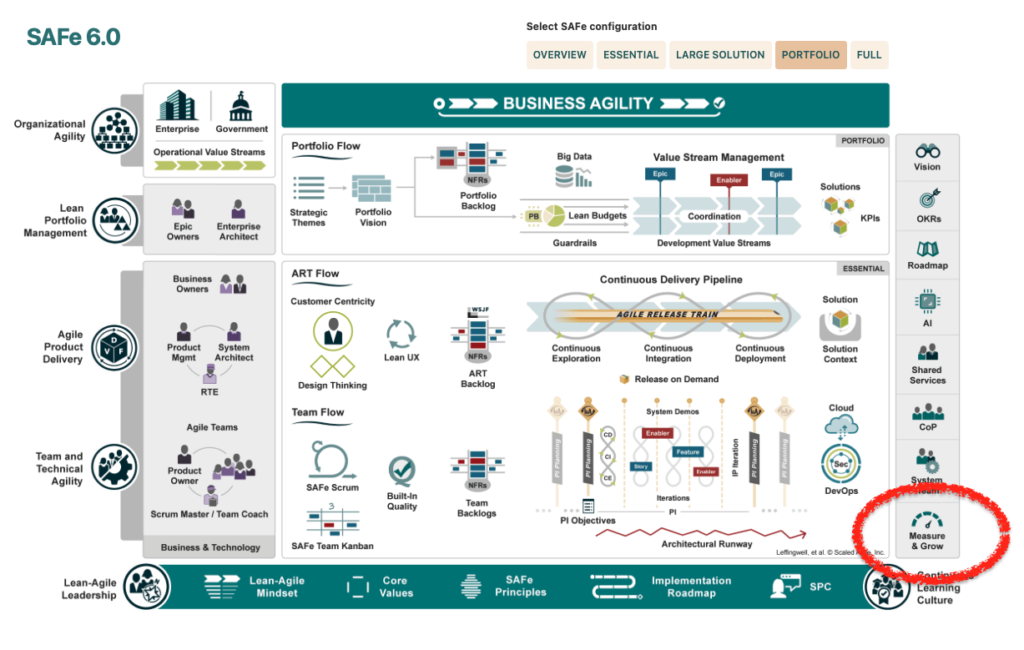
Scaled Agile Framework (SAFe) has emerged as a leading methodology to address the organisational change demands of fostering flexibility, collaboration, and continuous improvement. A cornerstone of SAFe is the principle of ‘Measure and Grow,’ which emphasizes using data and fact-based decisions to enhance change outcomes over time, including predictability. Despite its centrality, SAFe does not explicitly detail the change management components essential for its success, including its deep understanding of SAFe’s measurement model that enables the design of a tailored metrics strategy for ensuring strategic alignment. Here we outline how change management practitioners can effectively apply the ‘Measure and Grow’ principle within an Agile Release Train (ART) to lead change and improve outcomes to support the Scaled Agile environment.
What does it mean to “measure and grow” in a business context?
In a business context, “measure and grow” refers to the process of evaluating performance metrics to identify how our work drives business value and areas for improvement, aligning with strategic business goals. By analyzing data, companies can implement strategies that foster growth, enhance productivity, and improve overall outcomes. This approach ensures continuous development aligned with organizational goals.
The “Measure and Grow” Principle in Scaled Agile
What does it mean to “measure and grow” in a business context?
“Measure and grow” in a business context refers to the process of assessing performance metrics and outcomes to identify areas for improvement. By analyzing data, businesses can implement strategies that foster growth, enhance customer satisfaction, and optimize resource allocation, ultimately driving sustainable success and competitive advantage.
“Measure and Grow” is integral to SAFe, focusing on systematic measurement and continuous improvement for overall business agility within the value stream. By leveraging data and analytics, organizations can quickly respond to market changes, make informed decisions that meet the needs of our customers, identify areas needing attention, uncover improvement opportunities, and iteratively enhance meaningful change in performance. For change management professionals, this principle translates into a structured approach to evaluate the effectiveness of change initiatives, pinpoint areas for improvement, and implement necessary adjustments.
In a Scaled Agile environment, “Measure and Grow” is a core tenant or principle that applies in all types of agile environments. By continuously assessing and refining change efforts, organizations can align their initiatives with strategic objectives, mitigate risks, and ensure sustained success.
In practice, a lot of organisations have not pinpointed exactly how change management measures can make or break the outcome of the change, and in a SAFe environment, across the program, portfolio as well as enterprise.
The ‘Measure and Grow’ principle as a core part of SAFe (From Scaled Agile Framework)
To operationalize the “Measure and Grow” principle in change management, it is crucial to establish a set of metrics and assessment frameworks. Here are some broad categories of different types of change measurements that are relevant. Note that since we are talking about SAFe, it is not just at the initiative level that we are talking about metrics. More importantly, it is about establishing a system to promote change improvement across the organisation.
Change Management KPIs and OKRs
Key Performance Indicators (KPIs) and Objectives and Key Results (OKRs) are essential tools for tracking the success of change management initiatives. KPIs provide quantitative measures of performance, while OKRs align change efforts with broader organizational goals. A change management stream or function should focus on establishing KPIs or OKRs to achieve laser focus on achieving change outcomes.
Examples of Initiative-Level Change Management KPIs that may roll out to form portfolio views
Employee Engagement Levels: This KPI assesses how change impacts employee morale and engagement, providing insight into the overall acceptance and support of the change initiative.
Learning Achievement Rates: This can include tracking the percentage of employees who have completed necessary training programs, as well as achieving the target level of competence to ensure that the workforce is adequately prepared for the change.
Feedback Scores: Collecting feedback from stakeholders through surveys or feedback forms helps gauge perception and identify areas needing improvement. It is important to note that depending on the change context, stakeholders may not be happy with the content of the change. However, understanding and tracking this perception is still important.
Change Adoption Rate: This KPI measures the percentage of stakeholders who have adopted the change. High adoption rates are the ultimate goal for initiatives.
Issue Resolution Time: Measuring the time taken to resolve user-related issues related to the change highlights the efficiency of support mechanisms and the responsiveness of the change management team. This is especially important during an agile environment where there may be constant changes.
Change Readiness and Stakeholder Engagement Metrics
Evaluating change readiness and stakeholder engagement is crucial to the success of any change initiative. These metrics help assess the organization’s preparedness for change and the level of involvement and support from key stakeholders. Readiness and engagement rates can also roll up at a portfolio level to provide oversight.
Change Readiness Metrics
Readiness Assessments: Conduct surveys or interviews to gauge the organization’s preparedness for the impending change. This can include evaluating awareness, understanding, and acceptance of the change.
Resource Availability: Measure the availability of necessary resources, such as budget, personnel, and tools, to support the change initiative.
Communication Effectiveness: Assess the clarity, frequency, and effectiveness of communication regarding the change to ensure stakeholders are well-informed and engaged.
Stakeholder Engagement Metrics
Engagement Scores: Use surveys or feedback forms to measure the engagement levels of stakeholders, indicating their commitment and support for the change.
Participation Rates: Track stakeholder participation in change-related activities, such as workshops, meetings, and training sessions, to gauge their involvement.
Influence and Support: Assess the influence and support of key stakeholders in driving the change, ensuring that influential figures are actively endorsing the initiative.
By monitoring these metrics, change management professionals can identify potential barriers to change and take proactive steps to enhance readiness and engagement.
Stakeholder Competency Assessment
Successful change initiatives rely on the competence and readiness of key stakeholders. Assessing stakeholder competency involves evaluating the capability of sponsors and change champions to support and drive the change.
Sponsor Readiness/Capability Assessment
Sponsor Engagement: Measure the level of engagement and commitment from sponsors, ensuring they are actively involved and supportive of the change.
Decision-Making Effectiveness: Assess the ability of sponsors to make timely and effective decisions that facilitate the change process.
Resource Allocation: Evaluate the sponsor’s ability to allocate necessary resources, such as budget and personnel, to support the change initiative.
Change Champion Capability Assessment
Training and Knowledge: Measure the knowledge and training levels of change champions to ensure they are well-equipped to support the change.
Communication Skills: Assess the ability of change champions to effectively communicate the change message and address stakeholder concerns.
Influence and Leadership: Evaluate the influence and leadership capabilities of change champions, ensuring they can effectively drive and sustain the change.
By conducting these assessments, change management professionals can ensure that key stakeholders are prepared and capable of supporting the change initiative.
Change Adoption Metrics
Change adoption metrics provide insight into how well the change has been accepted and integrated into the organization. These metrics help assess the effectiveness of the change initiative and identify areas for improvement. At a portfolio level, there may be different levels of change adoption set for different initiatives depending on priority and complexity.
Key Change Adoption Metrics
Adoption Rate: Measure the percentage of stakeholders who have adopted the change, indicating the overall acceptance and integration of the new processes or systems.
Usage Metrics: Track the usage of new tools, processes, or systems introduced by the change to ensure they are being utilized as intended.
Performance Metrics: Assess the impact of the change on key performance indicators, such as productivity, efficiency, and quality, to determine the overall success of the change initiative.
By monitoring these metrics, change management professionals can gauge the success of the change initiative and identify opportunities for further improvement. To read more about change adoption metrics check out The Comprehensive Guide to Change Management Metrics for Adoption.
Change Impact and Capacity Metrics
Understanding the impact of change and the organization’s capacity to manage it is crucial for successful change management. Change impact metrics assess the effects of the change on the organization, while capacity metrics evaluate the organization’s ability to manage and sustain the change.
Change Impact Metrics
Aggregate impacts: Aggregate impacts across initiatives to form a view of how various teams and roles are impacted by various changes.
Risk Assessments: Identify potential risks associated with the change and evaluate their impact, ensuring that mitigation strategies are in place. A particular focus should be placed on business performance during change, across initiatives.
Capacity Metrics
Resource Capacity: Assess the availability of resources, such as personnel, budget, and tools, to support the change initiative and optimize flow time, enhance flow velocity, and improve flow efficiency while monitoring Flow Load.
Change Fatigue: Measure the risk for potential fatigue within the organization and its impact on stakeholders, ensuring that change initiatives are paced and driven appropriately.
Support Structures: Evaluate the effectiveness of support structures, such as training programs, information hubs, and help desks, in facilitating the change. Support structures may also include change champion networks.
By assessing change impact and capacity, change management practitioners can ensure that the organization is well-equipped to manage and sustain the change initiative.
Change Maturity Assessment
Change maturity assessments provide a comprehensive evaluation of the organization’s capability to manage change effectively. These assessments help identify strengths and weaknesses in the organization’s change management practices and provide a roadmap for improvement.
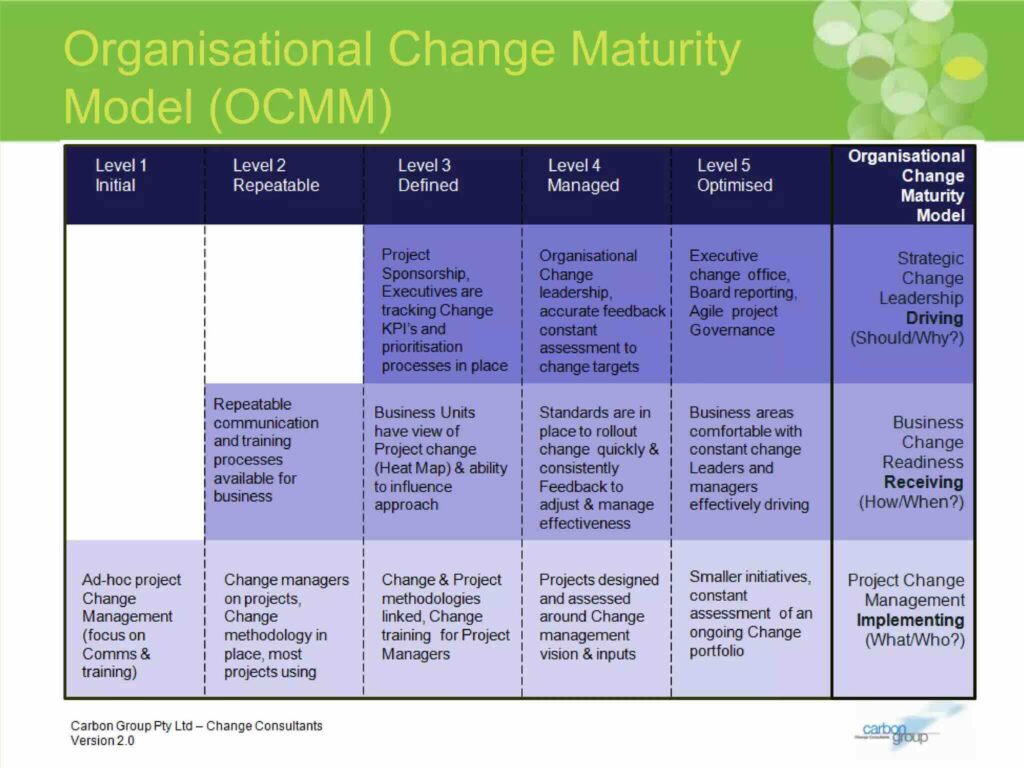
The Change Management Institute (CMI) Change Maturity Model is a comprehensive framework that takes a holistic approach to enhancing an organization’s change management maturity. It’s divided into three core functional domains, each playing a vital role in the overall journey toward maturity:
Project Change Management
Business Change Readiness
Strategic Change Leadership.
These domains serve as the foundation for achieving higher levels of maturity within the organization.
Within each of these domains, the CMI model outlines a structured path, consisting of five distinct maturity levels. These levels represent a continuum, starting at Level 1, which serves as the foundational stage, and progressing all the way to Level 5, the zenith of maturity and effectiveness. This multi-tiered approach offers organizations a clear roadmap for growth and development, ensuring that they have the tools and insights necessary to navigate the complexities of change management.
By conducting regular change maturity assessments, change management professionals can identify areas for improvement and develop targeted strategies to enhance the organization’s change management capability.
The “Measure and Grow” principle is a powerful tool for improving change outcomes in a Scaled Agile environment. By leveraging data and fact-based decision-making, change management professionals can ensure that change initiatives are effective, aligned with strategic objectives, and continuously improving. Establishing robust metrics and assessment frameworks, such as KPIs, OKRs, change readiness and stakeholder engagement metrics, stakeholder competency assessments, change adoption metrics, change impact and capacity metrics, and change maturity assessments, is essential to applying the “Measure and Grow” principle effectively.
Incorporating these metrics and assessments into change management practices enables organizations to identify areas for improvement, make informed decisions, and drive continuous improvement. By doing so, change management professionals can enhance the effectiveness of change initiatives, ensure successful adoption, and ultimately achieve better business outcomes.
Successful change management relies on having the right metrics to measure progress, gauge impact, and communicate with stakeholders. Moreover, the right metrics can drive continuous improvement and help directly achieve change outcomes. However, not all metrics are beneficial, and some can mislead or fail to meet stakeholder needs, especially when managing change projects. Let’s check out the top change management metrics to avoid and go through examples to take note.
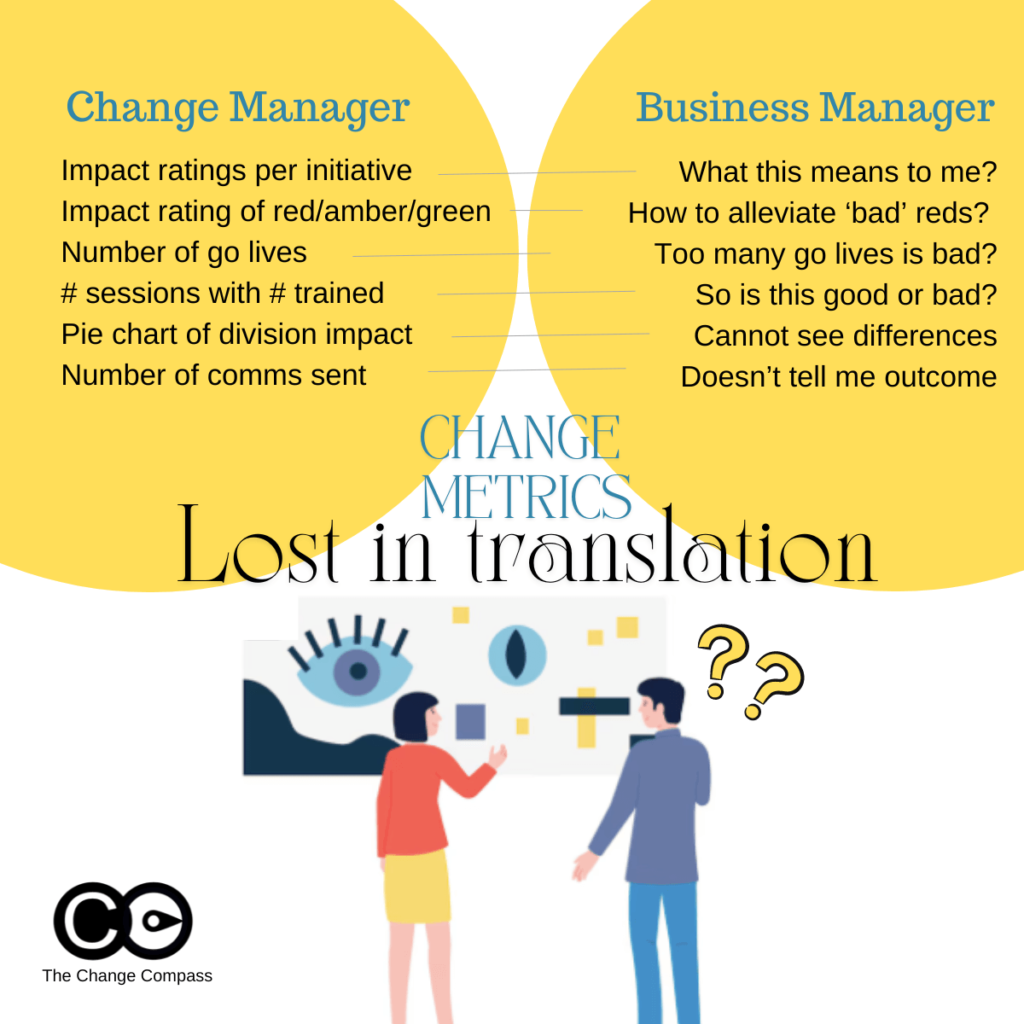
Understanding the Disconnect: Change Managers vs. Business Stakeholders
A significant reason certain change management metrics fall short is the differing perspectives between change managers and business stakeholders. Change managers and change practitioners are trained to view metrics through the lens of change management frameworks and methodologies, focusing on detailed assessments and structured approaches as a part of the change management strategy. These include applying ratings and judgments on aspects such as impact levels indicating levels and areas of impact.
In contrast, business stakeholders prioritize business operations, strategic outcomes, and practical implications. The busy business stakeholder is often looking for practical implications from metrics that can be used to directly drive decision making, meaning “what do I do with this data to improve the ultimate business outcome”.
Of course, different stakeholders have different data needs, and you need to show the right metric to the right type of stakeholder. For example, operations-focused stakeholders expect fairly detailed metrics and internal historical data to understand what that means in terms of organisation, coordination, capacity, and performance perspectives. Senior managers may prefer higher-level data with a focus on strategic impacts, overall progress, and adoption indicators of change success rate.
This disconnect can lead to the use of metrics that do not resonate with or are misunderstood by stakeholders that disrupt change success.
Change managers may leverage metrics that are derived from the various change management documents such impact assessments, training plan or communications plan. Metrics are also often chosen for ease of use and ideally are not overly complicated to execute.
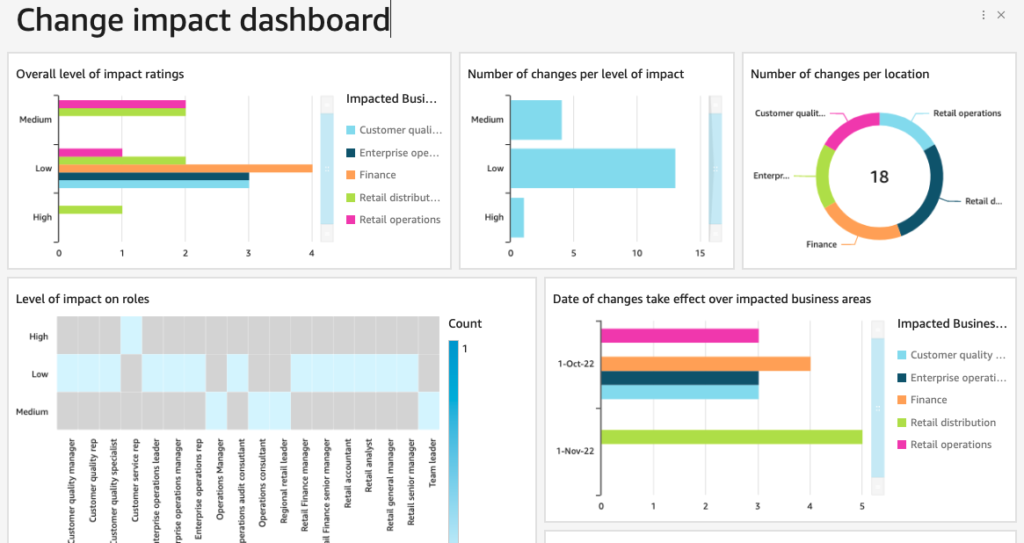
For example, impact assessments typically involve rating stakeholder groups and initiatives on a traffic light system (red, amber, green) based on their impact. While this approach is systematic, it can be problematic for several reasons:
Lack of Sufficient Stakeholder Context: Business stakeholders might not understand the practical implications of these ratings. For instance, an “impact rating per initiative” may not clearly convey what the rating means for day-to-day operations or strategic goals. For example, if an initiative has a red impact rating, stakeholders might not grasp the specific operational changes or strategic adjustments needed, in essence, “what do I do with this?”. So, incorrect usage of data could result in lack of stakeholder engagement.
Misinterpretation of Traffic Light Ratings: The red, amber, green system can be misleading. Stakeholders might interpret red as an indicator of alarm or imminent risk, while green may be seen as a sign that no action is needed. This is because stakeholders are trained to interpret traffic light ratings this way (from the various project/business updates they’ve attended). In reality, red might simply mean high impact, requiring focused attention, and green might indicate a low impact but still require monitoring. For instance, a red rating might indicate significant process changes that need careful management, not necessarily a negative outcome.
Hard to defend ratings if prompted: Business stakeholders may also want to drill into how the ratings are determined, and based on what basis. They may expect a logical data-backed reasoning of how each colour scheme is determined. If a rating is based on an overall ‘personal judgment’ this may be hard to defend infront of a group of stakeholders.
Examples of Potentially Misleading Metrics
Certain metrics, although straightforward, can be easily misinterpreted and fail to provide a realistic picture of change impacts as a part of effective change management. Often these are selected because they are easy to report on. However, easy, make not give you the outcome you are looking for.
Number of Go-Lives: Tracking the number of Go-Lives over time might seem like an effective way to represent change volume. However, the most significant impacts on people given time often occur before or after the Go-Live date. For example, the preparation and training phase before Go-Live and the adoption phase afterward are critical periods that this metric overlooks. A Go-Live date might indicate a milestone but not the challenges, progress or impacts faced during the implementation phase.
Number of Activities Implemented: Similar to Go-Lives, this metric focuses on quantity rather than quality. Simply counting the number of activities does not account for their effectiveness or the actual change they drive within the organisation. For example, reporting that 50 training sessions were conducted does not reveal whether employees found them helpful or if they led to improved performance.
Number of impacts or stakeholders impacted: Again, using a numerical way to indicate progress can be very misleading, or unmeaningful. This is because it may be ‘interesting’ but with no real action for your stakeholder to take in order to somehow lead to a better overall change outcome. If metrics do not result in some kind of action, then over time it will not shape your change(s) toward the targeted outcomes. Or worse, your stakeholders may lose interest and lose confidence in the strategic impact of these metrics.
Another common way to report change metrics is to use the number of impacts or number of stakeholders impacted by the organizational change. This can be in terms of the following:
Number of divisions impacted
Number of stakeholder groups impacted
Number of employees impacted
Number of initiatives per division/stakeholder
Metrics That May Be Too Operational
Metrics that are overly operational can fail to capture meaningful progress or adoption. Perhaps if the metric are for reporting within the Change Management team that may be OK. However, when you are showing metrics to stakeholders, a different set of expectations should be cast.
If you are presenting metrics to senior managers, you need to ensure that they hit the mark for that audience group. If the group is more interested in strategic impact, and higher level progress outcomes, you need to tailor accordingly.
Examples of metrics that may be too operational include:
Number of Communications Sent: This metric measures activity but not effectiveness. Sending numerous emails or messages does not guarantee that the message is received, understood, or acted upon by stakeholders. For instance, stakeholders might receive 100 emails, but if the content is unclear, the communication effort is wasted. Or worse, the emails may not even have been read.
Number of Training Sessions Attended: This one is a classic. While training is crucial, the number of sessions attended does not necessarily reflect the attendees’ understanding, engagement, or the practical application of the training. For example, employees might attend training but not apply the new skills if the training is not relevant to their roles for various reasons.
Number of workshops/meetings: Another way of articulating the change management progress in terms of activities is the number of workshops or meetings conducted with stakeholders including focus groups to indicate employee engagement. Again, this may be good to track within the change management team. However, presenting this metric to stakeholders may not be appropriate as it may not meet their needs nor indicate change management success.
Number of changes: This may be a common way to report on changes planned, but it doesn’t really inform the extent of the change. One change can be significantly impactful whilst another does not have major stakeholder impacts and are more system impacts. Listing number of changes may be deceiving or misleading. This kind of data may not get you the level of acceptance targeted.
The way metrics are presented is just as important as the metrics themselves. Poor visualization can lead to misinterpretation, confusion, and misguided decisions. Here are some common pitfalls to avoid:
Ineffective Use of Pie Charts
Pie charts can be misleading when used to show data points that are not significantly different. For example, using a pie chart to represent the percentage of divisions impacted by a change might not effectively communicate the nuances of the impact if the differences between the divisions are minimal. A pie chart showing 45%, 30%, and 25% might not convey the critical differences in impact levels among divisions.
Misleading Traffic Light Ratings
Using red, amber, and green to indicate high, medium, and low impacts can send the wrong message. Stakeholders might associate these colours with good and bad outcomes rather than understanding the actual levels of impact. Stakeholder may be used to interpreting these in the context of their usual project or business updates where red indicated alarm and ‘bad’. This can lead to unnecessary alarm or complacency. For instance, a green rating might suggest no need for action, while in reality, it might require ongoing monitoring.
Overuse of Colours
Using too many colours in charts and graphs can overwhelm stakeholders, making it difficult to discern the key message. Using colours in data visualisation can be two-edged sword. Colour can effectively point your stakeholders are the area where you want them to focus on. But, too many colours can lose your audience. A cluttered visual can obscure the critical data points and lead to misinterpretation. For example, a graph with ten different colours can confuse stakeholders about which data points are most important.
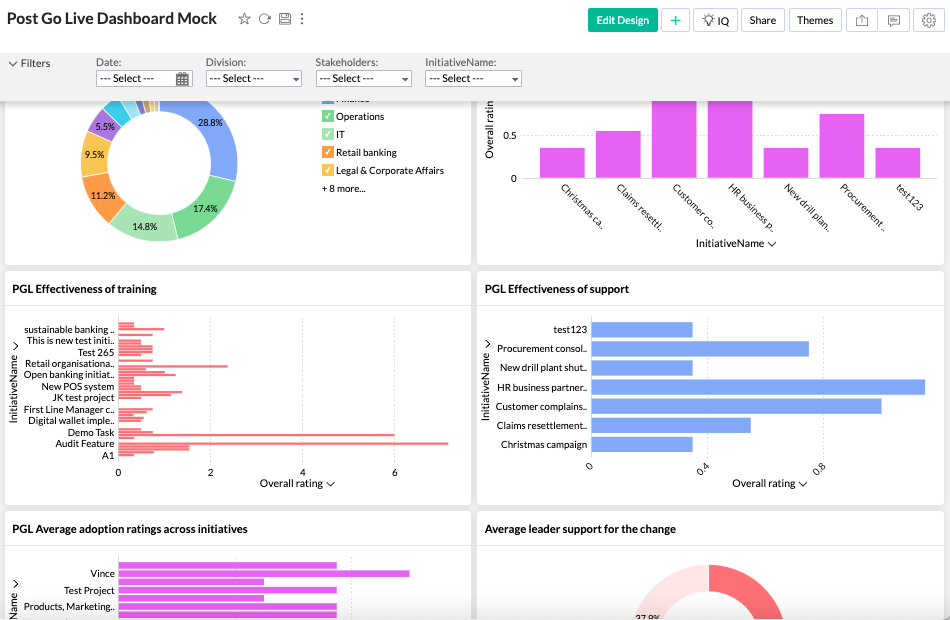
Data visualisation tools are also important. A lot of people use Power BI which works for a foundational level of charts. For tailored charts, specifically designed to to influence stakeholders to clearly see certain angles of risks and opportunities leverage tools such as Change Compass.
Practical Takeaways for Senior Change Managers
To ensure that change management metrics are effective and take into account best practices practices, consider the following practical takeaways:
Align Metrics with Key Stakeholder Perspectives
Understand Stakeholder Priorities: Engage with stakeholders to understand their business goals, priorities and concerns. Tailor your metrics to address these aspects directly. For example, if stakeholders are concerned about operational efficiency, focus on metrics that reflect improvements in this area.
Use Business Language: Frame your metrics in a way that resonates with business stakeholders. Avoid change management jargon and reference, and ensure that the implications of the metrics are clear and actionable. For example, instead of using technical terms, explain how the metrics impact business outcomes. Think in terms of business activities, milestones, busy periods, and capacity challenges.
Focus on Meaningful Metrics
Measure Outcomes, Not Just Activities: Change leaders should prioritize metrics that reflect the outcomes and impacts of change indicate level of knowledge, rather than just the activities performed as a part of change management KPIs. For example, instead of counting the total number of employees attending change management training sessions, measure the improvement in employee performance or knowledge retention post-training.
Example: Instead of reporting that 100 employees attended training sessions, report that 85% of attendees showed improved performance in their roles after training, or that certain level of competencies were gained. Note that quantifiable metrics have more impact on the audience.
Track Engagement and Adoption: Monitor metrics that indicate the level of engagement and adoption among stakeholders or their perception of the change. This could include surveys, feedback forms, or direct measures of behaviour change and the overall success rate of the change.
Example: Use post-training surveys to measure employee confidence in applying new skills or managerial rating of application of learnt skills rather than employee satisfaction of the training sessions using satisfaction scores. Track the percentage of employees who actively use new tools or processes introduced during the change.
Example: Instead of reporting that 100 employees attended training sessions, report that 85% of attendees showed improved performance in their roles after training, or that certain level of competencies were gained.
Example: Use post-training surveys to measure employee confidence in applying new skills or managerial rating of application of learnt skills. Track the percentage of employees who actively use new tools or processes introduced during the change.
Improve Metric Visualization
Simplify Visuals: Use clear, simple visuals that highlight the key messages. Avoid clutter and ensure that the most important data points stand out.
Example: Use bar charts or line graphs to show trends over time rather than pie charts that can be harder to interpret.
Contextualize Data: Provide context for the data to help stakeholders understand the significance. For example, instead of just showing the number of Go-Lives, explain what each Go-Live entails and its expected impact on operations. Or better, focus on showing the varying levels of impact on different stakeholders across time within the initiative.
Example: Accompany a Go-Live count with a visual showing the varying impact level of various implementation activities of the changes.
Example: Use bar charts or line graphs to show trends over time rather than pie charts that can be harder to interpret.
Example: Accompany a Go-Live count with a visual showing the varying impact level of various implementation activities of the changes.
Narrative Approach: Combine metrics with a narrative that explains the story behind the numbers as a part of the change management process. This can help stakeholders understand the broader context and implications.
Example: Instead of presenting raw data, provide a summary that explains key trends, successes, and areas needing attention.
Educate your stakeholders: Depending on stakeholder needs you may need to take them on a phased approach to gradually educate them on change management metrics and how you ultimately want them to drive the outcomes.
Example: You may start the education process to focus on more simplistic and easy-to-understand measures, and as your stakeholders are more change-mature, move to drill into more detailed metrics that explain the ‘why’ and ‘how’ to drive outcome success.
Continuously improvement: Provide regular updates on key metrics and adjust them based on feedback from stakeholders. Continuous communication ensures that everyone remains aligned and informed.
Example: Hold monthly review meetings with stakeholders to discuss the latest metrics, address concerns, and adjust strategies as needed.
Example: Instead of presenting raw data, provide a summary that explains key trends, successes, and areas needing attention.
Example: You may start the education process to focus on more simplistic and easy-to-understand measures, and as your stakeholders are more change-mature, move to drill into more detailed metrics that explain the ‘why’ and ‘how’ to drive outcome success.
Example: Hold monthly review meetings with stakeholders to discuss the latest metrics, address concerns, and adjust strategies as needed.
Examples of Effective Metrics
Employee Adoption and Engagement
Percentage of Employees Adopting New Process/System: This metric measures the rate at which employees are using new processes or systems introduced during the change. High adoption rates indicate successful integration.
Implementation: Use software usage analytics or surveys to track tool adoption rates.
Visualization: A graph showing adoption rates over time.
Employee Feedback Scores: Collect feedback on change initiatives through surveys or stakeholder ratings to measure sentiment/feedback and identify areas for improvement.
Implementation: Conduct regular surveys asking employees about their experience with the change process. Do note that depending on the change you may expect negative feedback due to the nature of the change itself (vs the way it was implemented).
Visualization: Bar/Line charts comparing feedback scores across different departments or time periods. Bar/Line charts are the standard go-to for data visualisation. They are easy to understand and interpret.
Implementation: Use software usage analytics or surveys to track tool adoption rates.
Visualization: A graph showing adoption rates over time.
Implementation: Conduct regular surveys asking employees about their experience with the change implementation process. Do note that depending on the change you may expect negative feedback due to the nature of the change itself (vs the way it was implemented).
Visualization: Bar/Line charts comparing feedback scores across different departments or time periods. Bar/Line charts are the standard go-to for data visualisation. They are easy to understand and interpret.
Impact on Business Outcomes
Improvement in Key Performance Indicators (KPIs): Track changes in KPIs that are directly impacted by the change initiatives, such as productivity, customer satisfaction, customer experience, improvement in process inconsistencies or financial performance.
Implementation: Identify relevant KPIs and measure their performance before and after change initiatives.
Visualization: Use line/bar graphs to show trends in KPI performance over time.
Operational Efficiency Metrics: Measure improvements in operational processes, such as reduced cycle times, error rates, or cost savings.
Implementation: Track specific operational metrics relevant to the change initiatives.
Visualization: Bar charts or heatmaps showing improvements in efficiency metrics across different operational areas.
Implementation: Identify relevant KPIs and measure their performance before and after change initiatives.
Visualization: Use line/bar graphs to show trends in KPI performance over time.
Implementation: Track specific operational metrics relevant to the change initiatives.
Visualization: Bar charts or heatmaps showing improvements in efficiency metrics across different operational areas.
Change management effectiveness requires metrics that not only measure progress but also resonate with business stakeholders and accurately reflect the impact of change initiatives. They should provide valuable insights. Avoiding common pitfalls such as relying on easily misinterpreted or overly operational metrics is crucial. By aligning metrics with stakeholder perspectives, focusing on meaningful outcomes, improving visualization, and communicating effectively, senior change and transformation professionals can ensure that their metrics truly support the success of their change initiatives.
The top change management metrics to avoid are those that fail to provide clear, actionable insights to business stakeholders. By understanding and addressing the disconnect between change managers and business stakeholders, and by prioritizing metrics that truly reflect the impact and progress of change, you can drive more effective and successful change management efforts by influencing your stakeholders in your organisation.
As a next step, Chat with us if you would like to discuss more about leveraging AI and technology to generate high-impact change management metrics and data for your stakeholders, both at project and portfolio levels, using data visualisation tools.
Change adoption metrics are the usage, proficiency, sustainment and outcome indicators that show whether people are working differently after a change, not merely that the change was delivered to them.
The average organisation uses only 54% of the software licences it pays for, according to Zylo’s 2026 SaaS Management Index, which is the adoption problem in one number: Access is not use. The same gap runs through change programmes. A project can report full training attendance, every account provisioned and a green status, while the new process is used for the easy cases and bypassed for the hard ones.
This article is for change, HR and transformation leaders who already know they should measure adoption and need to decide what, exactly, to put on the page. It argues that credible adoption evidence rests on four families of metric (usage, proficiency, sustainment and outcome), that each family fails in a predictable way when read alone, and that the skill is in reading them together. By the end you will be able to choose a short, defensible metric set for a given initiative and interpret it without overclaiming. If you need the method for collecting this data, see our guide to how to measure change adoption; for the wider framework, start with the ultimate guide to measuring change.
An adoption metric is any measure of what people do after the change that can be tied to a specific behaviour the change requires, and the strongest sets combine usage, proficiency, sustainment and outcome measures.
Prosci’s research gives practitioners a useful starting taxonomy. It describes speed of adoption, ultimate utilisation and proficiency as the core measures once people have reached the ability stage: How quickly people begin to use the change, how many are using it, and how well they apply it. We add two more families, because a programme that stops at those three cannot answer the questions executives actually ask later.
Usage: Are the intended people using the change, how often, and how fully? (Speed of adoption and ultimate utilisation.)
Proficiency and behaviour: Are they doing it correctly, in the way the benefit depends on?
Sustainment: Does use hold after launch support is withdrawn, or does work drift back?
Outcome: Is the business result the change was funded for visibly moving?
Each family answers a different question, and each has a blind spot. Usage can be high while proficiency is poor. Proficiency can be strong in the pilot team and absent elsewhere. Sustainment is invisible if you stop measuring at go-live. Outcomes move for many reasons other than adoption. The rest of this article takes each family in turn and then shows how to read them together.
Usage metrics: Reach, frequency and depth
Usage metrics tell you whether the intended population is using the change, how often and how deeply, and the most common error is treating login counts as evidence of any of these.
Gallup’s May 2026 indicator shows how misleading access data can be. Nearly half of US employees (47%) say their organisation has integrated AI tools, yet only 30% use them a few times a week or more and 15% use them daily. Implementation, in Gallup’s words, does not guarantee use. Any programme that reported adoption from provisioning or first-login data would have overstated it by roughly half.
Split usage into three measures, because each exposes a different failure:
Reach: The share of the intended population who have used the new process or tool at all, by role and by team. This is your speed-of-adoption view when plotted weekly from go-live.
Frequency: How often the people who use it do so, compared with how often the work requires it. A tool needed daily and used monthly is not adopted.
Depth: The share of use that happens in the core workflow, measured on the two or three features or steps the benefit depends on, not on every feature.
The depth measure matters most. For a system implementation it might be the percentage of orders created in the new system rather than raised by spreadsheet, or the share of customer records completed to the required standard at first save. For a process change it is the proportion of cases that follow the new sequence end to end. Choose the critical few and ignore the long tail of features.
Read usage by segment, not by average
An enterprise average hides the teams that matter. Report usage by role, location and manager, then look for the lowest quartile. A 78% overall rate that conceals one division at 35% describes a rollout that has succeeded in some places and not started in others, and the response to each is different.
Proficiency and behaviour metrics: Are people doing it right?
Proficiency metrics show whether people perform the new way correctly and consistently, and they are the family most often missing from adoption reports because they require more than system data.
Proficiency is measured through observable behaviours (sometimes called micro-behaviours): The small, specific actions that show the change is embedded. Useful examples:
Error and rework rate: The share of transactions returned, corrected or escalated because the new process was not followed.
Time to complete a key task against a pre-change baseline, once the learning curve has passed.
Workaround rate: The proportion of work still routed through the legacy spreadsheet, email or manual step.
Assessed competency: A short practical check or manager sign-off, rather than a quiz on course content.
Manager coaching frequency: How often team leaders observe and reinforce the new behaviour. Gallup finds that employees whose managers actively support their team’s AI use are 1.7 times as likely to use it a few times a week or more, and only 36% of employees in AI-integrating organisations strongly agree their manager does.
Behaviour data is cheaper to collect than it sounds if you decide in advance which three or four behaviours the benefit depends on. For a deeper treatment of how behaviours form and hold, see our guide to behaviour change in the workplace.
Sustainment and outcome metrics: Does it last, and does it pay?
Sustainment metrics test whether adoption survives after launch support ends, and outcome metrics test whether the benefit the change was funded for has actually arrived; reporting neither leaves the programme unable to prove its value.
Most of the value in a change is realised, or lost, after the programme team has moved on. BCG’s 2025 analysis of transformation concluded that only about a quarter of transformations successfully create value, which is a reminder that delivery and realisation are different events. Go-live is the start of the measurement window, not the end.
Sustainment indicators
Re-measure the same usage and proficiency indicators at fixed intervals after support ends (30, 90 and 180 days is a workable pattern) and add one specific measure:
Reversion rate: The share of work, by team, that has returned to the old process or an unapproved workaround.
Stability of use: Whether each team’s usage is flat or rising without fresh intervention. A decline that begins when champions or project staff withdraw points to a reinforcement gap, not a design flaw.
Support demand: The trend in help requests per user. A fall followed by a rise often signals a second wave of problems as edge cases appear.
Outcome indicators
Outcome metrics connect adoption to the business case: Cycle time, cost to serve, error cost, compliance incidents, customer satisfaction, or revenue per seller, depending on the change. Their discipline is attribution. Where possible compare adopting teams with lagging ones, or a team before and after it reached a stable usage level, rather than reading a portfolio-wide trend that moves for many reasons. Where you cannot isolate the effect, say so in the report. Our guide on the problem with change management metrics covers the most common ways outcome claims overreach.
Choosing metrics by change type
The right adoption metrics depend on what the change asks people to do, so start from the target behaviour and pick the two or three metrics in each family that evidence it.
A system implementation turns on depth of use in the core workflow. A compliance change turns on observed behaviour and incident trends, because logins say nothing about whether the rule is followed. A restructure has few clean usage measures, so engagement, role clarity and collaboration patterns carry more weight, though these are better described as readiness and outcome indicators than adoption in the strict sense.
Metric
System implementation
Compliance change
Restructure
Reach and active-use rate
High priority
Moderate
Low
Feature or workflow depth
High priority
Low
Low
Process compliance rate
Moderate
High priority
Moderate
Incident or error rate
Moderate
High priority
Low
Manager observation or coaching
Moderate
High priority
High priority
Assessed proficiency
Moderate
High priority
Moderate
Engagement or clarity pulse
Low
Moderate
High priority
Reversion rate
High priority
Moderate
Moderate
Productivity vs pre-change baseline
High priority
Moderate
High priority
How many metrics is enough?
Aim for a core set of 8 to 15 metrics per initiative, grouped under the four families, with only the handful that answer the sponsor’s question reported upward. Include a metric only if you can name the decision it would change and you can collect it reliably at the cadence you need. Mix system data with at least some observation or survey data, because system logs cannot tell you why a team is lagging.
How to read the numbers together
Adoption is established when usage, proficiency and sustainment point the same way, and every divergence between them is a diagnosis waiting to be made.
Read the families as a set and look for the patterns below.
What you see
Likely meaning
Where to look
High reach, low depth
People log in but bypass the core workflow
Process design, training on the critical steps
High usage, low proficiency
Use without the intended behaviour
Coaching, job aids, manager reinforcement
Strong pilot, weak elsewhere
Local conditions, not a general result
Team-level segmentation, champion coverage
Good at go-live, decline at 90 days
Reinforcement withdrawn too early
Sustainment plan, manager accountability
Good adoption, no outcome movement
Wrong behaviour targeted, or benefit case flawed
Revisit the benefit logic
Leading and lagging indicators
Treat reach, frequency and early proficiency as leading indicators: They move first and can still be acted on. Treat reversion, incident rates and outcome measures as lagging: They confirm or contradict the story weeks later. Report both, and set thresholds in advance (for example, 70% reach in the target population by week six) so that a number triggers a decision rather than a discussion about whether it is good.
Make the data visible where decisions happen
A metric set earns its keep when managers and sponsors see it regularly. Spreadsheets and BI tools work for a single programme, but they struggle once an organisation runs many changes at once and needs a consistent view by team. Digital change platforms such as Change Compass bring adoption and impact data for multiple initiatives into one view, so leaders can see where adoption is lagging by team without rebuilding the report each month. For the layout of such a view, see our guide to designing a change adoption dashboard.
Where to start next week
Pick one live initiative and write down the two or three behaviours its benefit depends on. For each, name one usage metric, one proficiency metric and a sustainment check at 90 days, then agree with the sponsor what level would count as adopted. That small set will tell you more than a dashboard of twenty indicators, because every number on it is tied to a behaviour and a decision. Retire any existing metric that nobody acts on, and add the outcome measure only once you can say how you will separate the effect of adoption from everything else that moved. Revisit the set after the first reporting cycle: If two metrics always move together, keep the cheaper one. The aim is not a complete picture of the organisation but a trustworthy answer to one question, whether people are working differently and whether it is lasting.
Frequently asked questions
What are the most important change adoption metrics?
The most useful set covers four things: Usage (reach, frequency and depth of use), proficiency (whether people perform the new way correctly), sustainment (whether use holds after launch support ends) and outcome (whether the intended benefit is showing up). Prosci frames the first three as speed of adoption, ultimate utilisation and proficiency. No single metric is enough, because each can look healthy while another is failing.
What is the difference between adoption, utilisation and proficiency?
Adoption is the point at which people start using the change, utilisation is how many of the intended people keep using it and how fully, and proficiency is how well they perform with it. A team can show 95% utilisation and low proficiency if people use the new system but work around its intended process. Measure all three separately.
How many adoption metrics should we track for one initiative?
Most initiatives are well served by a core set of 8 to 15 metrics, grouped under usage, proficiency, sustainment and outcome, with only a handful reported to executives. More than that dilutes attention and turns data collection into a burden. Choose metrics tied to the specific behaviour the change needs, and drop any you cannot act on.
Are system logins a good measure of adoption?
Logins show access, not adoption. Gallup’s May 2026 data shows 47% of US employees say their organisation has integrated AI tools, yet only 30% use them weekly or more. Track feature use in the core workflow, the share of work processed the new way, and proficiency, and treat logins only as a first signal.
How do you know whether adoption has been sustained?
Check the same usage and proficiency measures at 30, 90 and 180 days after launch support ends, and watch the reversion rate: The share of work that returns to the old process or a workaround. Sustained adoption shows as stable or rising use in each team without extra intervention. A drop after support ends usually points to a manager reinforcement or process design gap.
This guide focuses on tracking adoption, what people are actually doing with the change. Three closely related guides on this site each cover a distinct angle, pick the one that matches what you need now:
The numbers tell a story that most change leaders already sense. IBM’s 2025 CEO study, surveying 2,000 executives globally, found that only around 25% of AI initiatives deliver expected ROI, and just 16% have scaled enterprise-wide. Investment in AI is accelerating at double-digit rates. The returns are not keeping pace. The gap is not technical. It is human. And it will not be closed by change management practices designed for a different era.
Change management in the digital age faces a challenge that goes beyond scale or speed. The tools, assumptions, and governance models that served change functions well through the ERP rollouts and restructures of the 2000s and 2010s were designed for discrete, definable transformations with identifiable endpoints. Digital transformation, AI adoption, and the automation of work do not have endpoints. They are ongoing conditions. Managing them as projects produces predictable results: partial adoption, underrealised value, and change fatigue that compounds with each successive initiative.
The organisations navigating digital transformation most effectively are not those with the biggest change budgets. They are those that have genuinely updated their change management model for the digital context, treating change capability itself as a strategic asset rather than a delivery function.
The digital transformation gap that change management must close
The scale of underperformance in digital transformation is well documented. Deloitte’s research on digital transformation value identifies three failure patterns that recur across industries: technology deployed without corresponding work redesign, adoption treated as a training problem rather than a behaviour change problem, and benefits realisation measured at go-live rather than at the point where new ways of working are actually embedded.
All three failure patterns are change management failures, not technology failures.
The IBM CEO data reinforces this. In 2026, twice as many workers across age groups say they would embrace greater AI use by their employers rather than resist it. Employee sentiment toward AI is broadly positive. The adoption gap is not about resistance. It is about the absence of the structural, managerial, and environmental conditions that convert positive sentiment into actual behaviour change. This is precisely the domain of change management. And precisely the area where traditional change management approaches are most underpowered.
What makes change management in the digital age different
Three structural characteristics distinguish digital transformation from the changes that traditional change management frameworks were built for.
There is no go-live
Classic change management models, whether ADKAR, Kotter’s 8 steps, or the Prosci methodology, are structured around a transition: a defined current state, a defined future state, and a change journey between them. Digital transformation does not conform to this structure. AI capabilities in use today are materially different from those available 18 months ago, and will be different again 18 months from now. The “future state” keeps moving.
This means that what organisations actually need to build is not a capacity to manage a specific digital change, but an adaptive organisational capability to absorb continuous digital evolution. That is a fundamentally different capability to develop and a fundamentally different change management challenge to address.
The impact is highly fragmented by role
A major ERP implementation affects large groups of employees in broadly similar ways: new system, new processes, new reporting lines. Digital transformation and AI adoption affect different roles in radically different ways. A finance analyst’s experience of AI adoption has almost nothing in common with a customer service representative’s. A supply chain planner and a legal counsel may both be in the same AI transformation programme but need entirely different support.
Generic change communications and enterprise-wide training programmes do not work well in this environment. Effective change management in the digital age requires function-level and role-level customisation at a depth that most change functions have not previously needed to operate at.
Middle management is both the opportunity and the obstacle
Gartner’s 2025 CHRO research found that 78% of CHROs agree workflows and roles will need to change to realise the value of AI investments. The people who must actually make those workflow and role changes happen are middle managers. They translate digital strategy into day-to-day practice. They also face the most immediate personal disruption from the changes they are asked to enable.
Change management approaches that treat managers primarily as a communication channel, rather than as a group with their own adoption challenge and their own need for specific support, consistently underperform. The manager layer is where digital transformation succeeds or stalls.
Data and measurement in the digital age
One of the defining features of digital transformation is the availability of adoption data. Most digital platforms generate detailed usage data. Organisations now have, or can have, precise information about which employees are using new systems and tools, how frequently, in what ways, and with what outcomes.
Traditional change management largely operated without this data. Communications were sent, training was attended, and surveys were occasionally administered. Whether behaviour had actually changed in meaningful ways was often a matter of judgement rather than evidence.
The digital age removes this ambiguity for organisations willing to use the data available. Key metrics that effective change functions track in digital transformation include:
Active usage rates by role group and function (not just platform access)
Time savings realised in specific processes, compared against baseline
Quality or output measures for AI-assisted work versus previous work
Support ticket and workaround patterns, which indicate where adoption is failing
Manager-reported team behaviour change, gathered through structured check-ins
The risk with digital adoption data is conflating access with adoption. A person who logs into a platform once a week is not the same as a person who has genuinely changed how they work. Effective measurement tracks the second thing, not the first.
Automation and what it means for the change management function itself
The digital age is also changing how change management work is done, not just what it is managing. Change functions are beginning to automate significant portions of the administrative and analytical work that previously consumed change practitioner time: impact assessment compilation, status reporting, communication scheduling, data aggregation across programmes.
This shift has two implications worth examining.
The first is a productivity gain. Change practitioners who are no longer spending days compiling portfolio heat maps in spreadsheets have time to do the work that requires human judgment: stakeholder conversations, resistance diagnosis, sponsor coaching, and the nuanced facilitation that data analysis cannot replace.
The second is a capability shift. The change practitioner of the digital age needs to be comfortable working with data and platforms in ways that were optional for practitioners in earlier generations. Interpreting adoption dashboards, working with automated workflow tools, and communicating findings in data-fluent ways are becoming baseline expectations rather than specialist skills.
Building a digital-age change management capability
For change leaders building or rebuilding their function’s capability for the digital context, the practical work happens in four areas.
Updating the impact methodology. Traditional impact assessment categories, such as process, role, technology, and structure, need to be extended to capture AI-specific dimensions: the degree to which a role’s core tasks are being automated or augmented, the learning curve associated with AI-enabled ways of working, and the interaction effects when multiple digital changes land simultaneously on the same employee group.
Investing in role-level differentiation. The days of enterprise-wide change communications being the primary engagement mechanism are over for major digital transformations. Effective change functions in the digital age develop function-specific change plans, with tailored messaging, use-case-specific training, and peer champion networks built around specific communities of practice rather than the whole organisation.
Building adaptive governance. Digital transformation moves faster than traditional programme governance. Change plans written at programme initiation will be outdated within months as capabilities evolve and adoption data comes in. The governance model needs to support continuous plan adaptation: regular portfolio reviews, rolling 90-day action planning, and the authority to reallocate resources based on adoption evidence rather than original project plans.
Using digital platforms for portfolio visibility. Managing the cumulative digital change burden on employee groups requires portfolio-level visibility that manual approaches cannot reliably provide. Platforms such as The Change Compass aggregate impact data across programmes, track adoption by function and role group, and enable the continuous monitoring that adaptive change governance requires. This is not a luxury for large change functions. It is the infrastructure that makes portfolio-level decision-making possible.
Where to start
For change leaders whose organisations are in the middle of active digital transformation programmes with traditional change management in place, the most useful first step is a diagnostic of the current approach against the digital age requirements.
The diagnostic questions are practical:
Are you measuring actual behaviour change or platform access?
Do you have function-specific change plans, or enterprise-wide plans applied uniformly?
How are you managing the cumulative digital change load on specific employee groups?
What is your process for adapting the change approach as adoption data comes in?
Are your managers being supported as a group with their own adoption challenge, or managed primarily as a change communication channel?
Most change functions running traditional approaches through digital programmes will find significant gaps in these areas. The gap that typically generates the fastest improvement when closed is measurement: moving from activity metrics to adoption metrics creates the feedback loop that enables everything else to improve.
Frequently asked questions
What is change management in the digital age?
Change management in the digital age refers to applying change management principles and practices to the specific challenges of digital transformation, AI adoption, and the automation of work. It extends traditional change management to address the absence of a fixed endpoint, the highly fragmented role-level impact of digital change, and the availability of adoption data that enables evidence-based course correction throughout the change journey.
Why do digital transformation programmes fail to deliver expected value?
The primary causes are change-related, not technical. Workflows are not redesigned to take advantage of new digital capabilities, middle managers are not supported as a group with their own adoption challenge, measurement focuses on system access rather than behaviour change, and change plans are not adapted as adoption evidence accumulates. IBM research found that only around 25% of AI initiatives deliver expected ROI, largely for these reasons.
How is digital transformation different from managing a standard technology change?
Digital transformation differs in three important ways: there is no defined future state because digital capabilities evolve continuously; the impact on different roles is highly fragmented, requiring function-level rather than enterprise-wide approaches; and the adoption data available through digital platforms enables a measurement-led approach that traditional change management rarely applied.
What metrics should you track in digital transformation change management?
The most informative metrics go beyond platform access to measure actual behaviour change: active usage rates by role group, time savings realised in specific processes, quality of AI-assisted output versus previous output, support ticket patterns indicating where adoption is failing, and manager-reported team behaviour change. These give a more honest picture of adoption progress than usage statistics alone.
How do you manage the cumulative digital change load on employees?
Managing cumulative load requires portfolio visibility: knowing what digital changes are landing on which employee groups at what time, and aggregating impact to identify when load is approaching the point where adoption quality begins to deteriorate. Portfolio change management platforms enable this aggregation and provide the early warning signals that allow sequencing adjustments before saturation becomes visible in adoption data.
References
IBM. CEO Study: CEOs Double Down on AI While Navigating Enterprise Hurdles (2025). https://newsroom.ibm.com/2025-05-06-ibm-study-ceos-double-down-on-ai-while-navigating-enterprise-hurdles
IBM Institute for Business Value. 5 Trends for 2026. https://www.ibm.com/downloads/documents/us-en/1443d5df79cf4c92
Deloitte Insights. Unleashing Value from Digital Transformation: Paths and Pitfalls. https://www.deloitte.com/us/en/insights/topics/digital-transformation/digital-transformation-value-roi.html
Gartner. Gartner Says CHROs’ Top Priorities for 2026 Center Around Realising AI Value and Driving Performance (October 2025). https://www.gartner.com/en/newsroom/press-releases/2025-10-02-gartner-says-chros-top-priorities-for-2026-center-around-realizing-ai-value-and-driving-performance-amid-uncertainty
AIHR. 15 Important Change Management Metrics To Track in 2026. https://www.aihr.com/blog/change-management-metrics/