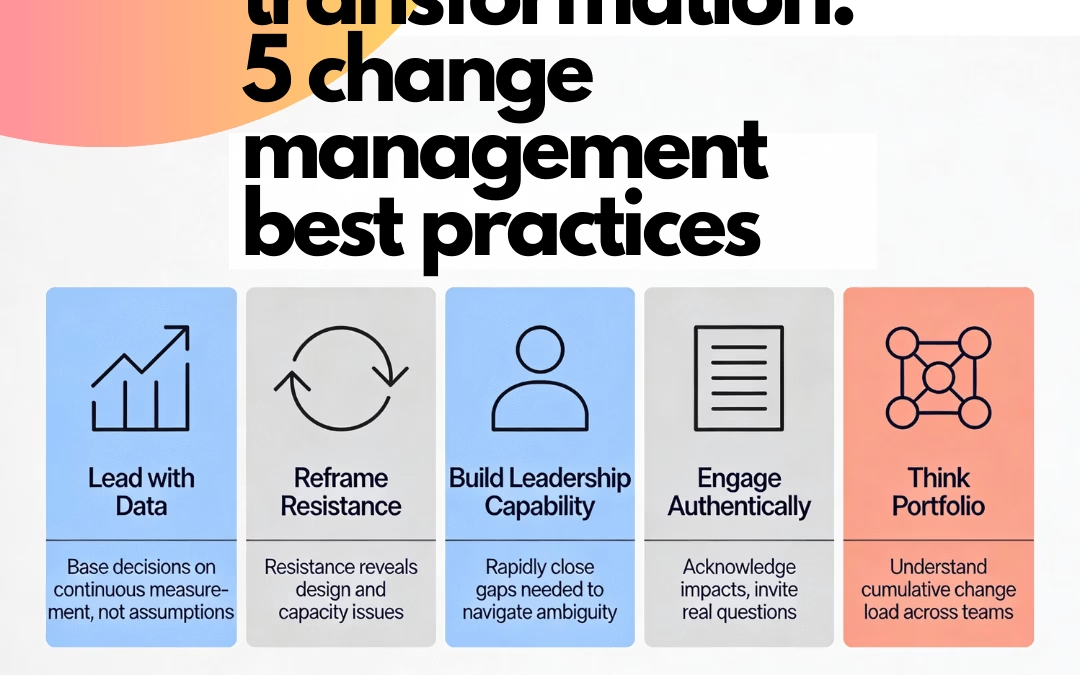
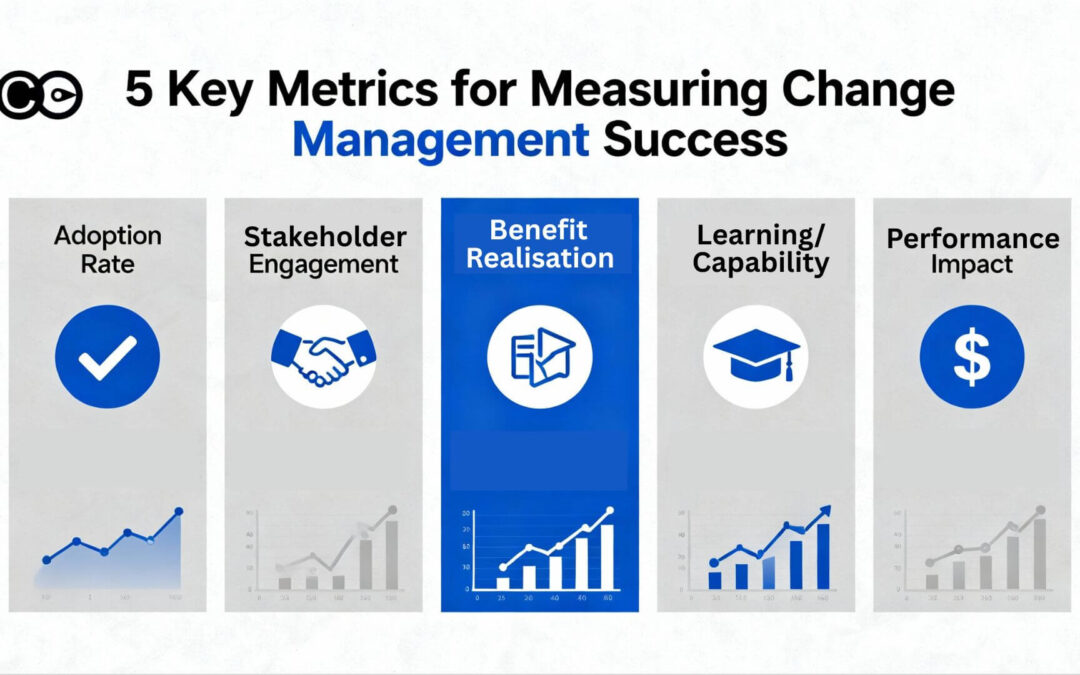
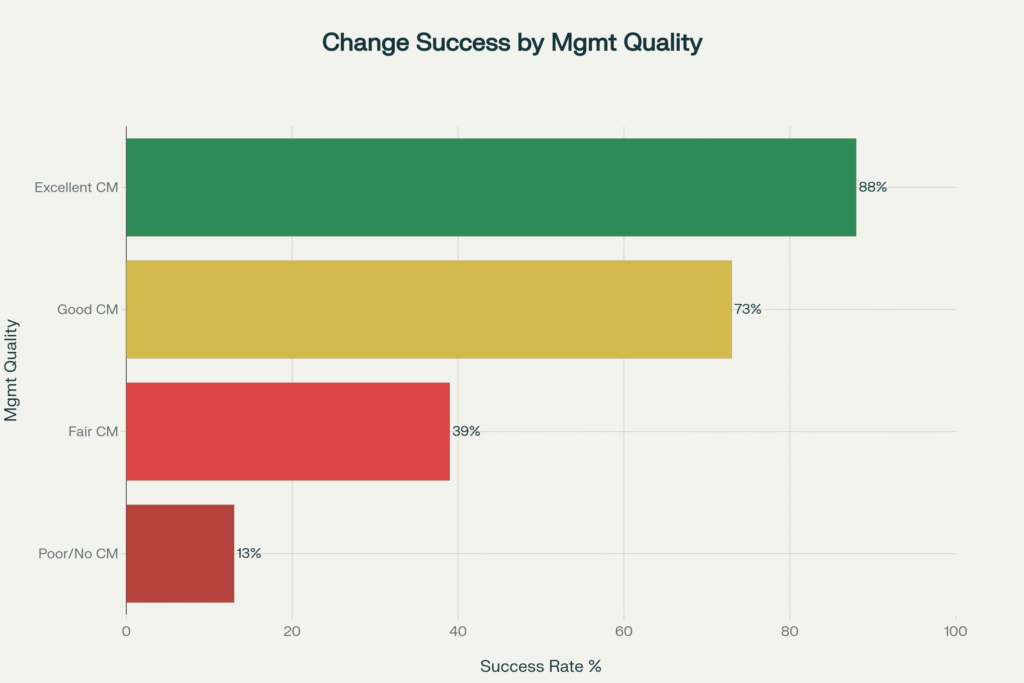
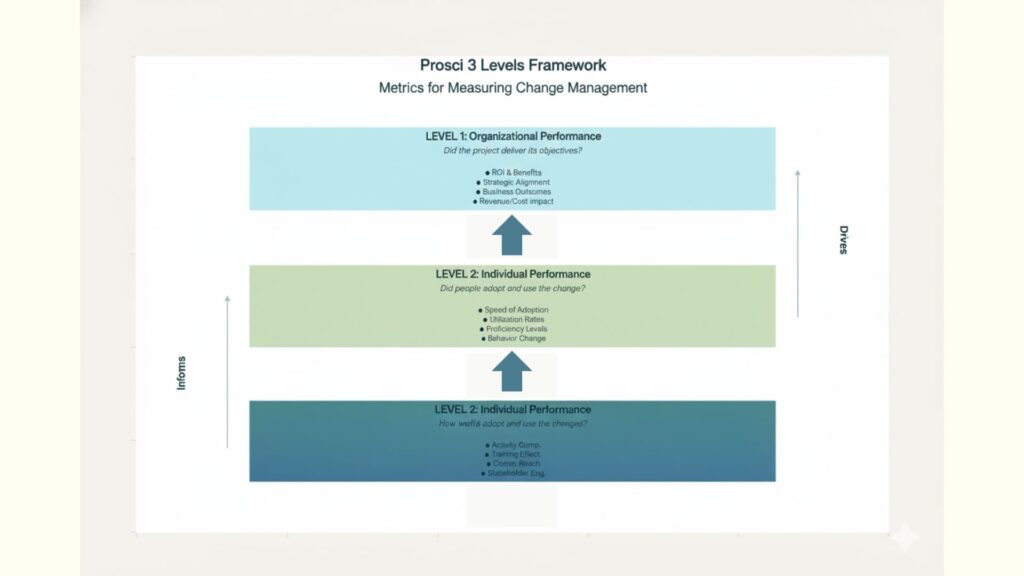
Managing organisational change at scale is the systematic application of methodology, leadership behaviour and operational discipline to take large groups of people from current ways of working through to new, embedded ways of working. The best practices that consistently differentiate high-performing change functions include treating change as a portfolio rather than a sequence of projects, equipping line managers as the primary change agents rather than relying on central communications, measuring adoption and saturation continuously rather than at point-in-time, integrating change governance into executive decision rhythms, and building organisational change capability deliberately rather than hiring it in for each programme.
The way you lead change at scale reveals everything about your organisation’s real capabilities. It exposes leadership gaps you didn’t know existed, illuminates cultural assumptions that have been invisible, and forces you to confront the hard truth about whether your people actually have capacity to transform. Most organisations aren’t prepared for what that mirror shows them.
But here’s what the research tells us: organisations that navigate this successfully share a specific set of practices – and they’re not what you’d expect from traditional change management playbooks.
The data imperative: Why gut feel doesn’t scale
Let’s start with a hard truth.
Leading change at scale without data is leadership theatre, not leadership.
When you’re managing a single, relatively contained change initiative, you might get away with staying close to the action, holding regular conversations with leaders, and making decisions based on what people tell you. But once you cross into transformation territory – where multiple initiatives run concurrently, impact ripples across departments, and competing priorities fragment focus – relying on conversation alone becomes a liability.
Large‑scale reviews of change and implementation outcomes show that organisations with robust, continuous feedback loops and structured measurement achieve significantly higher adoption and effectiveness than those relying on infrequent or informal feedback alone. The problem isn’t what people say in meetings. It’s that without data context, you’re only hearing from the loudest voices, the most available people, and those comfortable speaking up.
Consider a real scenario: a large financial services firm launched three major initiatives simultaneously. Line leaders reported strong engagement. Senior leaders felt confident about adoption trajectories. Yet underlying data revealed a very different picture – store managers were involved in seven out of eight change initiatives across the portfolio, with competing time demands creating unrealistic workload conditions. This saturation was driving resistance, but because no one was measuring change portfolio impact holistically, the signal was invisible until adoption rates collapsed three months post-go-live.
Data-driven change leadership serves a critical function: it provides the whole-system visibility that conversations alone cannot deliver. It enables leaders to move beyond intuition and opinion to evidence-based decisions about resourcing, timing, and change intensity.
What this means practically:
Establish clear metrics before change launches. Don’t wait until mid-implementation to decide what you’re measuring. Define adoption targets, readiness baselines, engagement thresholds, and business impact indicators upfront. This removes bias from after-the-fact analysis.
Use continuous feedback loops, not annual reviews.Research shows organisations using continuous measurement achieve 25-35% higher adoption rates than those conducting single-point assessments. Monthly or quarterly pulse checks on readiness, adoption, and engagement allow you to identify emerging issues and adjust course in real time.
Democratise change data across your leadership team. When only change professionals have visibility into change metrics, leaders lack the context to make informed decisions. Share adoption dashboards, readiness scores, and sentiment data with line leaders and executives. Help them understand what the data means and where to intervene.
Test hypotheses, don’t rely on assumptions. Before committing resources to particular change strategies or interventions, form testable hypotheses. For example: “We hypothesise that readiness is low in Department A because of communication gaps, not capability gaps.” Then design minimal data collection to confirm or reject that hypothesis. This moves you from reactive problem-solving to strategic targeting.
The shift from gut-feel to data-driven change is neither simple nor quick, but the business case is overwhelming. Organisations with robust feedback loops embedded throughout transformation are 6.5 times more likely to experience effective change than those without.
Reframing Resistance: From Obstacle to Intelligence
Here’s where many transformation efforts stumble: they treat resistance as a problem to eliminate rather than a signal to decode.
The traditional view positions resistance as obstruction – employees who don’t want to change, who are attached to the status quo, who need to be overcome or worked around. This framing creates an adversarial dynamic that actually increases resistance and reduces the quality of your final solution.
Emerging research takes a fundamentally different approach. When resistance is examined through a diagnostic lens, rather than a moral one, it frequently reveals legitimate concerns about change design, timing, or implementation strategy. Employees resisting a system implementation might not be resisting the system. They might be flagging that the proposed workflow doesn’t actually fit how work gets done, or that training timelines are unrealistic given current workload.
This distinction matters enormously. When you treat resistance as feedback, you create the psychological safety required for people to surface concerns early, when you can actually address them. When you treat it as defiance to be overcome, you drive concerns underground, where they manifest as passive non-adoption, workarounds, and sustained disengagement.
In one organisation undergoing significant operating model change, initial resistance from middle managers was substantial. Rather than pushing through, change leaders conducted structured interviews to understand the resistance. What they discovered: managers weren’t rejecting the new model conceptually. They were pointing out that the proposed changes would eliminate their ability to mentor direct reports – a core part of how they defined their role. This insight, treated as valuable feedback rather than insubordination, led to redesign of the operating model that preserved mentoring relationships whilst achieving transformation objectives. Adoption accelerated dramatically once this concern was addressed.
This doesn’t mean all resistance should be accommodated. In some cases, resistance does reflect genuine attachment to the past and reluctance to embrace necessary change. The discipline lies in differentiating between valid feedback and status quo bias.
How to operationalise this:
Establish structured feedback channels specifically designed for change concerns. These shouldn’t be the normal communication cascade. Create forums, focus groups, anonymous feedback tools, skip-level conversations – where people can surface concerns about change design without fear of retaliation.
Analyse resistance patterns for themes and root causes. When multiple people resist in similar ways, it’s rarely about personalities. Aggregate anonymous feedback, code for themes, and investigate systematically. Are concerns about training? Timing? Fairness? Feasibility? Resource constraints? Different root causes require different responses.
Close the loop visibly. When someone raises a concern, respond to it, either by explaining why you’ve decided to proceed as planned, or by describing how feedback has shaped your approach. This signals that resistance was genuinely heard, even if not always accommodated.
Use resistance reduction as a leading indicator of implementation quality.Research shows organisations applying appropriate resistance management techniques increase adoption by 72% and decrease employee turnover by almost 10%. This isn’t about eliminating resistance – it’s about responding to it in ways that increase trust and improve change quality.
Leading Transformation Exposes Your Leadership Gaps
Here’s what change initiatives reliably do: they force your existing leadership capability into sharp focus.
A director who’s excellent at managing steady-state operations often struggles when asked to lead across ambiguity and incomplete information. A manager skilled at optimising existing processes may lack the imaginative thinking required to design new ways of working. An executive effective at building consensus in stable environments might not have the decisiveness needed to make trade-off decisions under transformation pressure.
Transformation is unforgiving feedback. It exposes capability gaps faster and more visibly than traditional performance management ever could. The research is clear: organisations that succeed at transformation don’t pretend capability gaps don’t exist. They address them quickly and deliberately.
The default approach: Training programmes, capability workshops, external coaching, often fails because it assumes the gap is simply knowledge or skill. Sometimes it is. But frequently, capability gaps in transformation contexts reflect deeper factors: mindset constraints, emotional responses to change, discomfort with uncertainty, or different values about what leadership should look like.
Organisations achieving substantial transformation success take a markedly different approach. They conduct rapid capability assessments at the outset, identify the specific behaviours and mindsets required for transformation leadership, and then deploy layered interventions. These combine traditional training with experiential learning (assigning leaders to actually manage real change challenges, supported by coaching), peer learning networks where leaders grapple with similar issues, and visible role modelling by senior leaders who demonstrate the required behaviours consistently.
Critically, they also make hard personnel decisions. Some leaders simply cannot make the shift required. Rather than letting them continue in roles where they’ll block progress, high-performing organisations move them – sometimes into different roles within the organisation, sometimes out. This sends a powerful signal about how seriously transformation is being taken.
Making this operational:
Conduct a leadership capability audit at transformation kickoff. Map the leadership capabilities you’ll need across your transformation – things like “comfort with ambiguity,” “ability to engage authentically,” “capacity for decisive decision-making,” “skills in difficult conversations,” “comfort with iterative approaches.” Then assess your current leadership against these requirements. Where are the gaps?
Design layered development interventions targeting actual capability gaps, not generic leadership development. If your gap is discomfort with uncertainty, a workshop on change methodology won’t help. You need supported experience managing real ambiguity, plus coaching to help process the emotional content. If your gap is authentic engagement, you need to understand what’s preventing transparency, fear? Different values? Habit? And address the root cause.
Use transformation experience as primary development currency.Research on leadership development shows that leaders develop most effectively through supported challenging assignments rather than classroom training. Assign high-potential leaders to lead specific transformation workstreams, with clear sponsorship, regular feedback, and peer learning opportunities. This builds capability whilst ensuring transformation gets skilled leadership.
Make role model behaviour a deliberate leadership strategy. Senior leaders should visibly demonstrate the behaviours required for successful transformation. If you’re asking for greater transparency, senior leaders need to model transparency – including about uncertainties and setbacks. If you’re asking for iterative decision-making, senior leaders need to show themselves making decisions with incomplete information and adjusting based on feedback.
Have uncomfortable conversations about fit. If someone in a critical leadership role consistently struggles with required transformation capabilities and shows limited willingness to develop, you need to address it. This doesn’t necessarily mean termination – it might mean moving to a different role where their strengths are better deployed, but it cannot be avoided if transformation is truly important.
Authentic Engagement: The Alternative to Corporate Speak
There’s a particular type of communication that emerges in most organisational transformations. Leaders craft carefully worded change narratives, develop consistent messaging, ensure everyone delivers the same talking points. The goal is alignment and consistency.
The problem is that people smell inauthenticity from across the room. When leaders are “spinning” change into positive language that doesn’t match lived experience, employees notice. Trust erodes. Cynicism increases. Adoption drops.
Research on authentic leadership in change contexts is striking: authentic leaders generate significantly higher organisational commitment, engagement, and openness to change. But authenticity isn’t about lowering guardrails or disclosing everything. It’s about honest communication that acknowledges complexity, uncertainty, and impact.
Compare two change communications:
Version 1 (inauthentic): “This transformation is an exciting opportunity that will energise our company and create amazing new possibilities for everyone. We’re confident this will be seamless and everyone will benefit.”
Version 2 (authentic): “This transformation is necessary because our current operating model won’t sustain us competitively. It will create new possibilities and some losses, for some roles and teams, the impact will be significant. I don’t fully know how it will unfold, and we’re likely to encounter obstacles I can’t predict. What I can promise is that we’ll make decisions as transparently as we can, we’ll listen to what you’re experiencing, and we’ll adjust our approach based on what we learn.”
Which builds trust? Which is more likely to generate genuine commitment rather than compliant buy-in?
Employees experiencing transformation are already managing significant ambiguity, loss, and stress. They don’t need corporate-speak that dismisses their experience. They need leaders willing to acknowledge what’s hard, be honest about uncertainties, and demonstrate genuine interest in their concerns.
Practising authentic engagement:
Before you communicate, get clear on what you actually believe. Are you genuinely confident about aspects of this transformation, or are you performing confidence? Which parts feel uncertain to you personally? What concerns do you have? Authentic communication starts with honesty about your own experience.
Acknowledge both benefits and costs. Don’t pretend that transformation will be wholly positive. Be specific about what people will gain and what they’ll lose. For some roles, responsibilities will expand in ways many will find energising. For others, familiar aspects of work will disappear. Both things are true.
Create regular forums for two-way conversation, not just broadcasts. One-directional communication breeds cynicism. Create structured opportunities, skip-level conversations, focus groups, open forums, where people can ask genuine questions and get genuine answers. If you don’t know an answer, say so and commit to finding out.
Acknowledge what you don’t know and what might change. Transformation rarely unfolds exactly as planned. The timeline will shift. Some approaches won’t work and will need redesign. Some impacts you predicted won’t materialise; others will surprise you. Saying this upfront sets realistic expectations and makes you more credible when things do need to change.
Demonstrate consistency between your words and actions. If you’re asking people to embrace ambiguity but you’re communicating false certainty, the inconsistency speaks louder than your words. If you’re asking people to focus on customer impact but your decisions prioritise financial metrics, that inconsistency is visible. Authenticity is built through alignment between what you say and what you do.
One of the most practical yet consistently neglected practices in transformation is a clear mapping of what’s changing, how it’s changing, and to what extent.
In organisations managing multiple changes simultaneously, this mapping is essential for a basic reason: people need to understand the shape of their changed experience. Will their team structure change? Will their workflow change? Will their career trajectory change? Will their reporting relationship change? Most transformation communications address these questions implicitly, if at all.
Research on change readiness assessments shows that clarity about scope, timing, and personal impact is one of the strongest predictors of readiness. Conversely, ambiguity about what’s changing drives anxiety, rumour, and resistance.
The best transformations make change mapping explicit and available. They’re clear about:
What is changing (structure, processes, systems, roles, location, working arrangements)
What is not changing (this is often as important as clarity about what is)
How extent of change varies across the organisation (some roles will be substantially transformed; others minimally affected; some will experience change in specific dimensions but stability in others)
Timeline of change (when different elements are scheduled to shift)
Implications for specific groups (how a particular role, team, or function will experience the change)
This might sound straightforward, but in practice, most organisations communicate change narratives without this specificity. They describe the strategic intent without translating it into concrete impacts.
Creating effective change mapping:
Start with a change impact matrix. Create a simple framework mapping roles/teams against change dimensions (structure, process, systems, location, reporting, scope of role, etc.). For each intersection, rate the extent of change: Significant, Moderate, Minimal, No change. This becomes the backbone of change communication.
Translate this into role-specific change narratives. Take the matrix and develop specific descriptions for different role categories. A customer-facing role might experience process changes and system changes but minimal structural change. A support function might experience structural redesign but minimal customer-facing process impact. Be specific.
Communicate extent and sequencing. Be clear about timing. Not everything changes immediately. Some changes are sequential; some are parallel. Some land in Phase 1; others in Phase 2. This clarity reduces anxiety because people can mentally organise the transformation rather than experiencing it as amorphous and unpredictable.
Make space for questions about implications. Once people understand what’s changing, they’ll have questions about what it means for them. Create structured opportunities to explore these – guidance documents, Q&A sessions, role-specific workshops. The goal is to move from conceptual understanding to practical clarity.
Update the mapping as change evolves. Your initial change map won’t be perfect. As implementation proceeds and you learn more, update it. Share updates with the organisation. This demonstrates that clarity is an ongoing commitment, not a one-time exercise.
Iterative Leadership: Why Linear Approaches Underperform
Traditional change methodologies are largely linear: plan, design, build, test, launch, embed. Each phase has defined gates and decision points. This approach works well for changes with clear definition, stable requirements, and predictable implementation.
But transformation, by definition, involves substantial ambiguity. You’re asking your organisation to operate differently, often in ways that haven’t been fully specified upfront. Linear approaches to highly ambiguous change create friction: they generate extensive planning documentation to address uncertainties that can’t be fully resolved until you’re actually in implementation, they create fixed timelines that often become unrealistic once you encounter real-world complexity, and they limit your ability to adjust course based on what you learn.
The research is striking on this point. Organisations using iterative, feedback-driven change approaches achieve 6.5 times higher success rates than those using linear approaches. The mechanisms are clear: iterative approaches enable real-time course correction based on implementation learning, they surface issues early when they’re easier to address, and they build confidence through early wins rather than betting everything on a big go-live moment.
Iterative change leadership means several specific things:
Working in short cycles with clear feedback loops. Rather than designing everything upfront, you design enough to move forward, implement, gather feedback, learn, and adjust. This might mean launching a pilot with a subset of users, gathering feedback intensively, redesigning based on learning, and then rolling forward. Each cycle is 4-8 weeks, not 12-18 months.
Building in reflection and adaptation as deliberate process. After each cycle, create space to debrief: What did we learn? What worked? What needs to be different? What surprised us? Use this learning to shape the next cycle. This is fundamentally different from having a fixed plan and simply executing it.
Treating resistance and issues as valuable navigation signals. When something doesn’t work in an iterative approach, it’s not a failure, it’s data. What’s not working? Why? What does this tell us about our assumptions? This learning shapes the next iteration.
Empowering local adaptation within a clear strategic frame. You set the strategic intent clearly – here’s what we’re trying to achieve – but you allow significant flexibility in how different parts of the organisation get there. This is the opposite of “rollout consistency,” but it’s far more effective because it allows you to account for local context and differences in readiness.
Practically, this looks like:
Move away from detailed future-state designs. Instead, define clear strategic intent and outcomes. Describe the principles guiding change. Then allow implementation to unfold more flexibly.
Work in 4-8 week cycles with explicit feedback points. Don’t try to sustain a project for 18 months without meaningful checkpoints. Create structured points where you pause, assess what’s working and what isn’t, and decide what to do next.
Create cross-functional teams that stay together across cycles. This creates continuity of learning. These teams develop intimate understanding of what’s working and where issues lie. They become navigators rather than order-takers.
Establish feedback mechanisms specifically designed to surface early issues. Don’t rely on adoption data that only appears 3 months post-launch. Create weekly or bi-weekly pulse checks on specific dimensions: Is training working? Are systems stable? Are processes as designed actually workable? Are people finding new role clarity?
Build adaptation explicitly into governance. Rather than fixed steering committees that monitor against plan, create governance that actively discusses early signals and makes real decisions about adaptation.
Change Portfolio Perspective: The Essential Systems View
Most transformation efforts pay lip service to change portfolio management but approach it as an administrative exercise. They track which initiatives are underway, their status, their resourcing. But they don’t grapple with the most important question: What is the aggregate impact of all these changes on our people and our ability to execute business-as-usual?
This is where change saturation becomes a critical business risk.
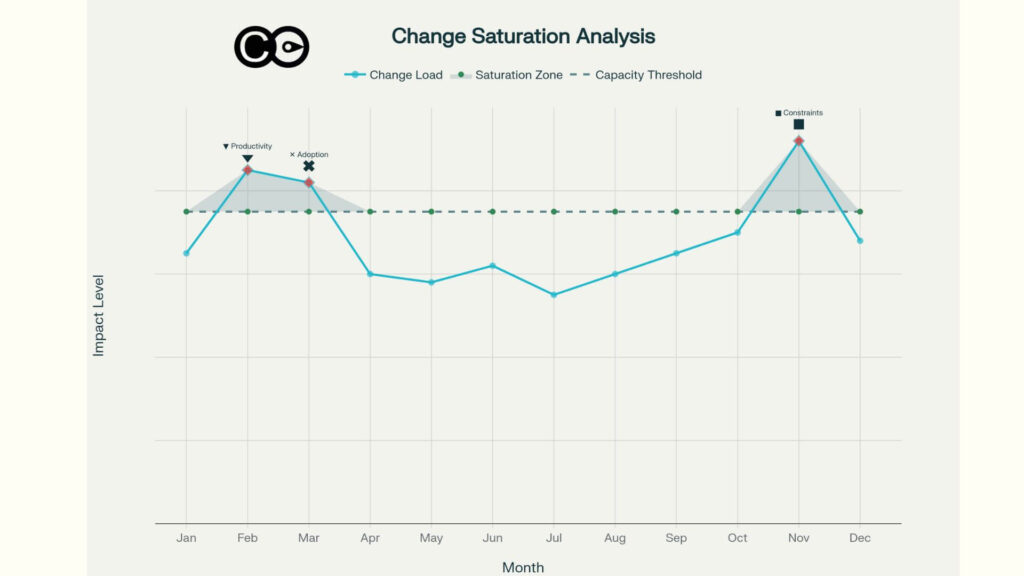
Research on organisations managing multiple concurrent changes reveals a sobering pattern: 78% of employees report feeling saturated by change. More concerning: when saturation thresholds are crossed, productivity experiences sharp declines. People struggle to maintain focus across competing priorities. Change fatigue manifests in measurable outcomes: 54% of change-fatigued employees actively look for new roles, compared to just 26% experiencing low fatigue.
The research demonstrates that capacity constraints are not personality issues or individual limitations – they reflect organisational capacity dynamics. When the volume and intensity of change exceeds organisational capacity, even high-quality individual leadership can’t overcome systemic constraints.
This means treating change as a portfolio question, not a collection of individual initiatives, becomes non-negotiable in transformation contexts.
Operationalising portfolio perspective:
Create a change inventory that captures the complete change landscape. This means including not just major transformation initiatives, but BAU improvement projects, system implementations, restructures, and process changes. Ask teams: What changes are you managing? Map these comprehensively. Most organisations discover they’re asking people to absorb far more change than they realised.
Assess change impact holistically across the organisation. Using the change inventory, create a heat map showing change impact by team or role. Are certain teams carrying disproportionate change load? Are some roles involved in 5+ concurrent initiatives while others are relatively unaffected? This visibility itself drives change.
Make deliberate trade-off decisions based on capacity. Rather than asking “Can we do all of these initiatives?” ask “If we do all of these, what’s the realistic probability of success and what’s the cost to business-as-usual?” Sometimes the answer is “We need to defer initiatives.” Sometimes it’s “We need to sequence differently.” But these decisions should be explicit, made by leadership with clear line of sight to change impact.
Use saturation assessment as part of initiative governance. Before approving a new initiative, require assessment: How does this fit in our overall change portfolio? What’s the cumulative impact if we do this along with what’s already planned? Is that load sustainable?
Create buffers and white space deliberately. Some of the most effective organisations build “change free” periods into their calendar. Not everything changes simultaneously. Some quarters are lighter on new change initiation to allow embedding of recent changes.
The Change Compass Approach: Technology Enabling Better Change Leadership
As organisations scale their transformation capability, the manual systems that worked for single initiatives or small portfolios break down. Spreadsheets don’t provide real-time visibility. Email-based feedback isn’t systematic. Adoption tracking conducted through surveys happens too infrequently to be actionable.
This is where structured change management technology like The Change Compass becomes valuable. Rather than replacing leadership judgment, effective digital tools enable better leadership by:
Providing real-time visibility into change metrics. Rather than waiting for monthly reports, leaders have weekly visibility into adoption rates, readiness scores, engagement levels, and emerging issues across their change portfolio.
Systematising feedback collection and analysis. Tools like pulse surveys can be deployed continuously, allowing you to track sentiment, identify emerging concerns, and respond in real time rather than discovering problems months after they’ve taken root.
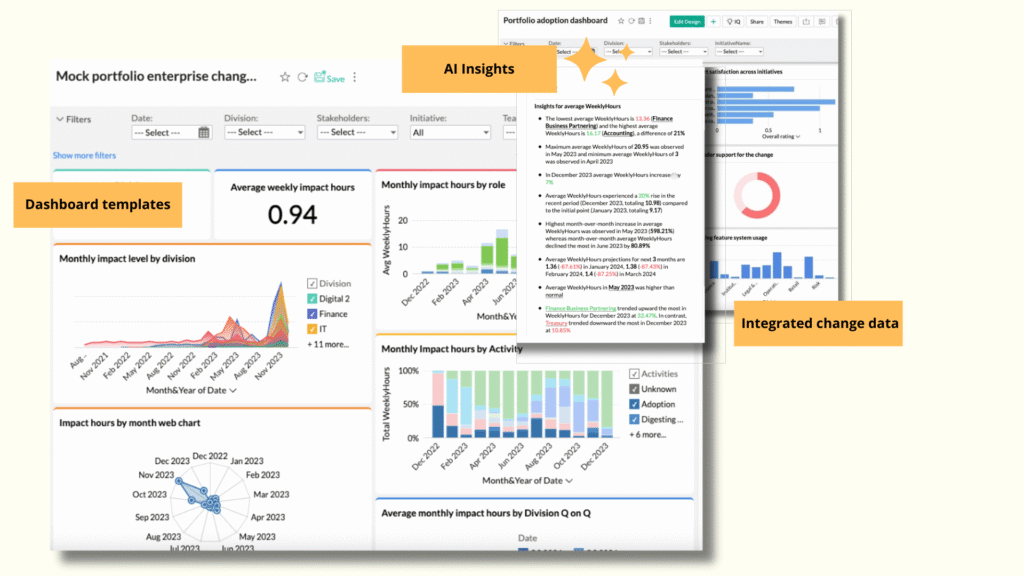
Aggregating change data across the portfolio. You can see not just how individual initiatives are performing, but how aggregate change load is affecting specific teams, roles, or functions.
Democratising data visibility across leadership layers. Rather than keeping change metrics confined to change professionals, you can make data accessible to line leaders, executives, and business leaders, helping them understand change dynamics and take appropriate action.
Supporting hypothesis-driven decision-making. Rather than collecting data and hoping it’s relevant, tools enable you to design specific data collection around hypotheses you’re testing.
The critical point is that technology is enabling, not substituting. The human leadership decisions—about change strategy, pace, approach, resource allocation, and adaptation—remain with leaders. But they can make these decisions with better information and clearer visibility.
Bringing It Together: The Practical Next Steps
The practices described above aren’t marginal improvements to how you currently approach transformation. They represent a fundamental shift from traditional change management toward strategic change leadership.
Here’s how to begin moving in this direction:
Phase 1: Assess current state (4 weeks)
Map your current change portfolio. What’s actually underway?
Assess leadership capability against transformation requirements. Where are the gaps?
Evaluate your current measurement approach. What are you actually seeing?
Understand your change saturation levels. How much change are people managing?
Phase 2: Design transformation leadership model (4-6 weeks)
Define the leadership behaviours and capabilities required for your specific transformation.
Identify your measurement framework—what will you measure, how frequently, through what mechanisms?
Clarify your iterative approach—how will you work in cycles rather than linear phases?
Design your engagement strategy—how will you create authentic dialogue around change?
Phase 3: Implement with intensity (ongoing)
Address identified leadership capability gaps deliberately and immediately.
Launch your feedback mechanisms and establish regular cadence of learning and adaptation.
Begin your first change cycle with deliberate reflection and adaptation built in.
Share change mapping and clear impact communication with your organisation.
The organisations that succeed at transformation – that emerge with sustained new capability rather than exhausted people and stalled initiatives – do so because they treat change leadership as a strategic competency, not an administrative function. They build their approach on evidence about what actually works, they create structures for honest dialogue about what’s hard, and they remain relentlessly focused on whether their organisation actually has capacity for what they’re asking of it.
That clarity, grounded in data and lived experience, is what separates transformation that transforms from change initiatives that create fatigue without progress.
Frequently Asked Questions (FAQ)
What are the research-proven best practices for leading organisational transformation?
Research-backed practices include using continuous data for decision-making rather than intuition alone, treating resistance as diagnostic feedback, developing transformation-specific leadership capabilities, communicating authentically about impacts and uncertainties, mapping change impacts explicitly for different groups, and managing change as an integrated portfolio to avoid saturation. These principles emerge consistently from studies of transformational leadership, change readiness and implementation effectiveness.
How does data-driven change leadership differ from relying on conversations?
Data-driven leadership uses structured metrics on adoption, readiness and capacity to identify issues at scale, while conversations provide qualitative context and verification. Studies show organisations with continuous feedback loops achieve 25-35% higher adoption rates and are 6.5 times more likely to succeed than those depending primarily on informal discussions. The combination works best for complex transformations.
Should resistance to change be treated as feedback or an obstacle?
Resistance often signals legitimate concerns about design, timing, fairness or capacity, functioning as valuable diagnostic information when analysed systematically. Research recommends structured feedback channels to distinguish adaptive resistance (design issues) from non-adaptive attachment to the status quo, enabling targeted responses that improve outcomes rather than adversarial overcoming.
How can leaders engage authentically during transformation?
Authentic engagement involves honest communication about benefits, costs, uncertainties and decision criteria, avoiding overly polished messaging that erodes trust. Empirical studies link authentic and transformational leadership behaviours to higher commitment and lower resistance through perceived fairness and consistency between words and actions. Leaders should acknowledge trade-offs explicitly and invite genuine questions.
What leadership capabilities are most critical for transformation success?
Research identifies articulating a credible case for change, involving others in solutions, showing individual consideration, maintaining consistency under ambiguity, and modelling required behaviours as key. Capability gaps in these areas become visible during transformation and require rapid assessment, targeted development through challenging assignments, and sometimes personnel decisions.
How do organisations avoid change saturation across multiple initiatives?
Effective organisations maintain an integrated portfolio view, map cumulative impact by team and role, assess capacity constraints regularly, and make explicit trade-offs about sequencing, delaying or stopping initiatives. Studies show change saturation drives fatigue, turnover intentions and performance drops, with 78% of employees reporting overload when managing concurrent changes.
Why is mapping specific change impacts important?
Clarity about what will change (and what will not), for whom, and when reduces uncertainty and improves readiness. Research on change readiness finds explicit impact mapping predicts higher constructive engagement and smoother adoption, while ambiguity about personal implications increases anxiety and resistance.
Can generic leadership development prepare leaders for transformation?
Generic training shows limited impact. Studies emphasise development through supported challenging assignments, real-time feedback, peer learning and coaching targeted at transformation-specific behaviours like navigating ambiguity and authentic engagement. Leader identity and willingness to own change outcomes predict effectiveness more than formal programmes.
What role does organisational context play in transformation success?
Meta-analyses confirm no single “best practice” applies universally. Outcomes depend on culture, change maturity, leadership capability and pace. Effective organisations adapt evidence-based principles to their context using internal data on capacity, readiness and leadership behaviours.
How can transformation leaders measure progress effectively?
Combine continuous quantitative metrics (adoption rates, readiness scores, capacity utilisation) with qualitative feedback analysis. Research shows this integrated approach enables early issue detection and course correction, significantly outperforming periodic or anecdotal assessment. Focus measurement on leading indicators of future success alongside lagging outcome confirmation.
An enterprise change management strategy is the deliberate, multi-year plan that decides how an organisation builds and applies change capability at scale across every business unit, programme and transformation initiative.
Large organisations fund change one programme at a time, yet every programme draws on the same pool of people. A finance team can be asked to adopt a new ERP release, a restructure, a compliance uplift and an AI assistant in a single quarter, and each of those programmes will report green. BCG’s 2025 work on transformation puts the cost of that arithmetic plainly: only about a quarter of transformations successfully create value. This guide is for the change, HR and transformation leaders who carry that problem across a whole enterprise. It sets out ten strategies for treating change capability as a strategic asset, shows what 2024 to 2026 research says about each, and ends with a practical sequence for getting started.
An enterprise strategy covers the operating model (centralised, federated or hybrid), the methodology and tooling that will be used consistently, the capability-building approach for change practitioners and leaders, the governance structures that connect change to portfolio decisions, and the measurement framework that proves adoption and benefit realisation. It distinguishes itself from individual project plans by treating change capability as a strategic asset rather than a delivery activity.
Enterprise change management (ECM) has evolved from a tactical support function into a strategic discipline that directly determines whether large organisations execute complex transformations and realise value from major investments. Rather than focusing narrowly on training and communications for individual projects, effective ECM operates as an integrated business partner aligned with organisational strategy, optimises across the portfolio of concurrent initiatives, and builds the organisation’s capability to navigate change as a core competency. The ten strategies below give large organisations a practical roadmap to run ECM as a value driver that speeds benefit realisation, prevents change saturation and lifts the odds that projects succeed.
Understanding enterprise change management in modern organisations
Enterprise change management is the practice of coordinating every change initiative in an organisation as one portfolio, so that strategy, project delivery and day-to-day operations pull in the same direction.
ECM differs from project-level change management in both scope and strategic integration. Project-level change management helps the teams inside a specific initiative move to new tools and processes. ECM operates at the enterprise level to coordinate and optimise multiple concurrent initiatives across the entire organisation. That distinction is critical: ECM aligns all change initiatives with strategic goals, manages the cumulative organisational capacity to absorb change, and builds a sustainable change competency that compounds over time. For a deeper look at the contrast, see our piece on the difference between change management and enterprise change management.
In large organisations running several strategic initiatives at once, ECM provides the connective tissue between strategy, projects and day-to-day operations. Rather than treating each initiative in isolation, it looks across the enterprise to understand who is impacted, when, and by what level of change, and then shapes how the organisation responds to maximise value and minimise disruption. Prosci’s enterprise change management overview and the Forrest Advisors guide to ECM describe the same shift from project support to an organisation-wide capability.
The three levels of capability
The scope of ECM covers three interconnected levels of capability development:
Individual level: Building practical skills in leaders and employees to navigate change, explain strategy, support teams and use new ways of working.
Project level: Applying consistent change processes across major initiatives, integrating change activities into delivery plans and measuring adoption.
Enterprise level: Establishing standards, templates, governance structures and metrics so change is approached consistently across the portfolio.
Organisations that invest in only one level get uneven results. Training alone does not fix a missing governance forum, and a strong methodology does not help if nobody senior reads the output. Strategy 3 below returns to how the three levels are built in sequence.
The business case for enterprise change management
Enterprise change management pays back through faster adoption, fewer failed projects, lower disruption to productivity and protected organisational capacity.
Before examining the strategies, it is worth understanding the business rationale for the investment. Organisations with effective change management capabilities achieve substantially different outcomes from those without structured approaches, and the evidence has been getting more specific. The sub-sections below take the four outcomes executives ask about most: return on investment, project success, productivity during transitions and change saturation.
Return on investment
Return on investment is the most significant financial differentiator. Prosci’s ROI of change management model breaks the return into three human factors that determine whether a project’s expected value is actually captured: the speed of adoption (how quickly people make the change), the ultimate utilisation (how many of them make it) and proficiency (how effective they are afterwards). Each of these can be estimated before a project starts and measured after go-live, which is what turns “change management” from a cost into a line of the business case. Those returns show up as faster benefit realisation, higher adoption rates, fewer failed projects and lower implementation costs.
Every change causes a dip in productivity while people learn the new way of working. The size and length of the dip depends on how well the transition is supported. Organisations with effective change management shorten the time to proficiency, because people know what is changing, why, and what is expected of them, so the revenue and service impact of implementation periods is smaller. Organisations without structured change management often carry the dip for much longer, and sometimes never fully recover the planned benefit. This is why proficiency sits in the ROI model above: it is the measurable end of the same curve.
Change saturation
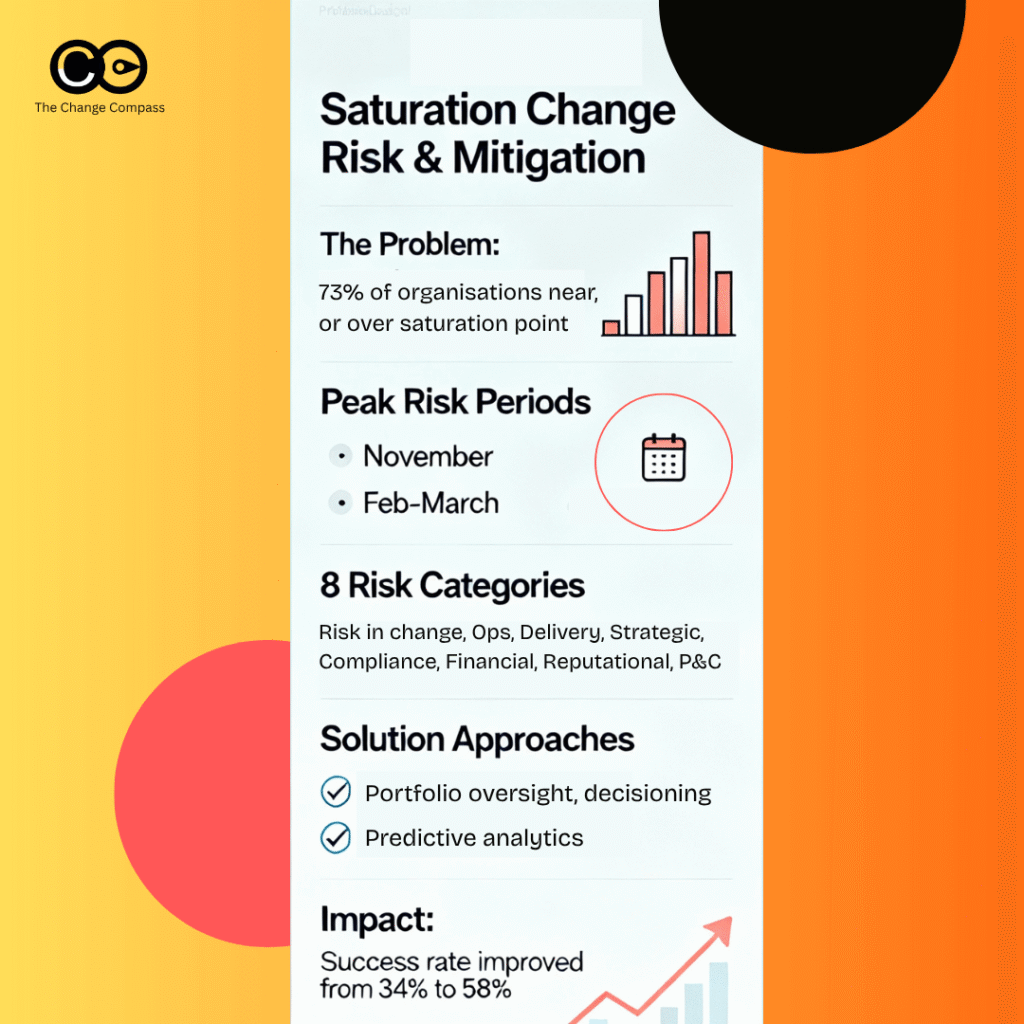
Prevention of change saturation protects organisational capacity. When an organisation exceeds its capacity threshold without portfolio-level coordination, the consequences cascade across multiple performance dimensions: slower adoption, rising attrition, lost discretionary effort and failing initiatives. Prosci has benchmarked saturation since 2007 and reports that in its research 73% of respondents were near, at or past the point of saturation. The business case for portfolio-level coordination is therefore not only the benefit of a single project, but the capacity that every other project depends on. Our guide to managing change saturation and initiative fatigue covers this in more depth.
Understanding this business case provides the context for why the strategies below matter. ECM is not a discretionary function but an investment that demonstrably improves organisational performance.
Ten strategies for enterprise change management: Delivering business goals in large organisations
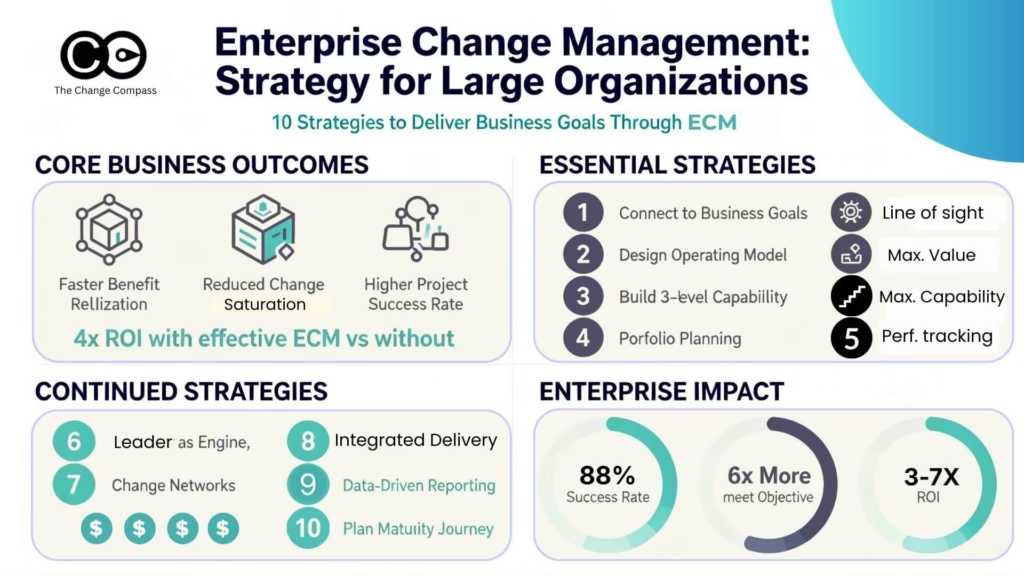
The ten strategies work as one system: the first three set the foundation, strategies four and five turn it into business outcomes, and strategies six to ten make it stick across the enterprise.
Strategy 1: Connect enterprise change management directly to business goals
A strong ECM strategy starts by explicitly linking change work to the organisation’s strategic objectives. Rather than launching generic capability initiatives or responding only to project requests, the ECM function prioritises its effort around where change will most influence revenue growth, cost efficiency, risk reduction, customer experience or regulatory compliance outcomes.
This alignment serves several purposes. It focuses limited ECM resources on the initiatives that matter most to the business. It demonstrates a clear line of sight from change investment to corporate goals, which supports executive sponsorship and funding. It ensures that ECM advice on sequencing, timing and investment is grounded in business priorities rather than in change management principles alone. BCG’s 2025 research adds an important caution against one-size-fits-all playbooks: it found that what works depends on organisational structure, the density of social networks, the scale of the change and the certainty of its impact, so a strategy has to begin with context, not a template.
Practical implementation steps include:
Map each strategic objective to a set of initiatives, key impacted groups, required behaviour shifts and services provided.
Define three to five “enterprise outcomes” for ECM (such as faster benefit realisation, fewer change-related incidents, higher adoption scores) and track them year on year.
Use strategy language in ECM artefacts, roadmaps, reports and dashboards so executives see a clear line of sight from ECM work to corporate goals.
Present ECM’s annual plan in the same forums and language as other strategic functions, positioning it as a strategic enabler rather than a project support service.
Strategy 2: Design an operating model that fits your context
How ECM is structured makes a significant difference to its impact and scalability. Research and practice show that large organisations typically succeed with one of three core operating models: centralised, federated or hybrid. Each solves a different problem and creates a different risk.
Model
How it works
Best fit
Main risk
Centralised
One enterprise change team sets standards, runs portfolio oversight and supplies practitioners into priority initiatives
Strategy and funding tightly controlled at the centre; need for consistency across geographies or business units
Inflexibility in local contexts and bottlenecks if the central team is stretched
Federated
Business-unit change teams work to a common framework but tailor approaches locally
Diversified organisations or those with strong regional autonomy
Inconsistency and difficulty keeping enterprise-wide visibility and standards
Hybrid
A small central team owns methods, tools, governance and enterprise analytics; embedded practitioners sit in key portfolios or divisions
Complex, matrixed enterprises managing several concurrent transformations
Complexity in defining roles and decision-making authority
Centralised ECM offers strong governance and a consistent methodology, which works well where the organisation requires consistency across geographies. Federated ECM offers local responsiveness and cultural fit, which suits diversified organisations. Hybrid ECM offers both consistency and responsiveness, at the cost of needing clear role definitions. Our guide to the best organisational structure for enterprise change management walks through how to test each model against your own governance.
When designing the operating model, clarify:
Who owns ECM strategy, standards and governance.
How change practitioners are allocated and funded across the portfolio.
Where key decisions are made on priorities, sequencing and risk mitigation.
How the ECM function interfaces with PMOs, strategy and business operations.
Strategy 3: Build capability across individual, project and enterprise levels
Sustainable ECM capability rests on deliberate development across all three levels. Too many organisations invest only in individual capability (training) or only at project level (methodologies) without embedding organisational standards and governance. The result is uneven capability, a lack of consistency and difficulty scaling.
Individual capability building ensures leaders and employees have practical skills to navigate change. This includes explaining why change is happening and how it connects to strategy, supporting teams through transition periods, and using new tools and processes effectively. Effective approaches include targeted coaching, practical playbooks and self-help resources that let leaders act without always needing a specialist.
Project-level capability applies a consistent change process across major initiatives. Prosci’s three-phase process (Prepare, Manage, Sustain) and similar frameworks give structure that improves predictability and effectiveness. Panorama Consulting’s playbook for scaling change management takes a similar view of repeatable, scalable practice. Integration with delivery planning is essential, so change activities (communications, training, resistance management, adoption measurement) are built into delivery schedules rather than running separately.
Enterprise-level capability establishes standards, templates, tools and governance so change is approached consistently across the portfolio. This level includes maturity assessments using frameworks such as the CMI or Prosci models, which define the current state and the desired progression. With strong enterprise capability, standards and support are consistent no matter which business unit or initiative is delivering the change. For teams, our guide to building and leading high-performance change management teams is a useful companion.
A practical capability roadmap typically moves through five stages:
Stage 1 (ad hoc): Establish the basics with a common language, a simple framework and a small central team supporting priority programmes.
Stage 2 (repeatable): Build consistency through standard tools, regular reporting and PMO integration.
Stage 3 (defined): Scale through business-unit change teams, champion networks and clear metrics.
Stage 4 (managed): Embed through organisational integration and leadership expectations, with predictive use of change load and adoption data.
Stage 5 (optimised): Achieve full integration with strategy and performance management.
Strategy 4: Use portfolio-level planning to avoid change collisions and saturation
One of the highest-value strategies for large organisations is introducing portfolio-level visibility of all in-flight and upcoming changes. Portfolio change planning differs fundamentally from project change planning: rather than optimising one project at a time, ECM helps the organisation optimise the entire portfolio against capacity, risk and benefit outcomes.
The impact is substantial. Organisations with effective portfolio management reduce the likelihood of saturation, avoid costly collisions where several initiatives hit the same teams simultaneously, and increase the odds that high-priority initiatives land and stick. The human cost of getting this wrong is visible in a 2025 survey of 751 large-company executives by Emergn: 50% reported transformation fatigue and 45% had suffered burnout from ongoing changes. Portfolio visibility also informs critical business decisions about the sequencing and timing of major initiatives.
Practical implementation steps include:
Create a single view of change across the enterprise showing initiative name, impacted audiences, timing and impact level, using simple heatmaps or dashboards.
Identify “hot spots” where multiple changes hit the same teams or customers in the same period, and work with portfolio and PMO partners to reschedule or reduce load. Our guide to building a change capacity model shows how to set a capacity assumption for each team.
Establish portfolio governance forums where investment and sequencing decisions explicitly consider both financial and people-side capacity constraints.
Use portfolio data to advise on optimal sequencing, typically spacing major changes so adoption and benefits can be realised between waves.
Benefit realisation management operates in stages. Before change, organisations establish clear baselines for the metrics they expect to improve (cycle time, cost, error rates, customer satisfaction, revenue and so on). During change, teams track adoption and intermediate indicators. After go-live, systematic measurement determines whether the organisation actually achieved the promised benefits. Prosci’s research also shows the value of finishing the job: 81% of people who planned for reinforcement and sustainment activities met or exceeded project objectives.
The discipline of benefits management delivers three strategic advantages. First, it forces clarity about what success means for each initiative, moving beyond “adoption” to genuine business impact. Second, it lets organisations calculate true ROI and demonstrate value to stakeholders. Third, it provides feedback for continuous improvement: when benefits fall short, measurement shows whether the issue was weak adoption, flawed design or external factors. Our piece on aligning multiple initiatives for maximum benefit realisation takes this further.
Practical implementation includes:
For each major initiative, define three to five measurable business benefits (for example cost to serve, error reduction, revenue per customer, service time) and link them to specific behaviour and process changes.
Assign owners for each benefit on the business side and clarify how and when benefits will be measured after go-live.
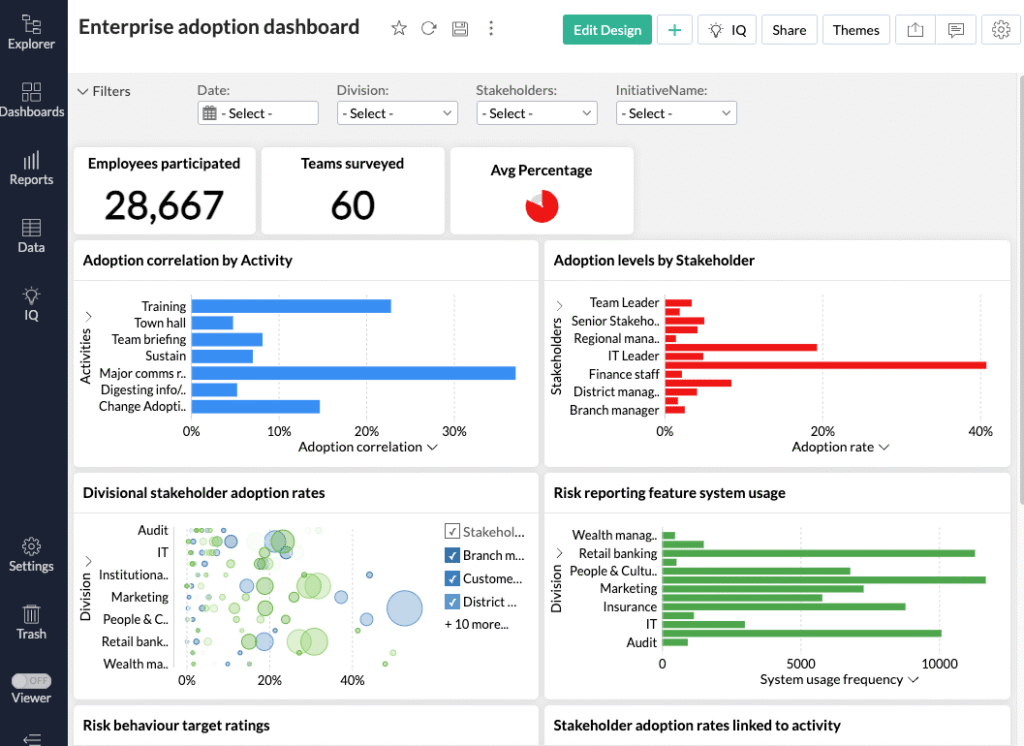
Establish a simple benefits and adoption dashboard that surfaces progress across initiatives and highlights where ECM focus is needed to close gaps.
Report on benefits progress in regular forums so benefit realisation becomes a standing topic in performance discussions.
When ECM consistently reports in business-outcome terms (for example “this change is at 80 percent of targeted benefit because of low usage in one function”), it becomes a natural partner in performance discussions and strategic planning.
Strategy 6: Make leaders and sponsorship the engine of enterprise change
Leadership behaviour is one of the strongest predictors of successful change. An effective ECM strategy treats leaders as both the primary audience and the primary channel through which change cascades through the organisation. Prosci’s research ranks active and visible sponsorship as the top contributor to success, and found that projects with extremely effective sponsors were 79% likely to meet objectives, against 27% with extremely ineffective ones. Fewer than half of participants (48%) reported having an effective or very effective sponsor, which is the gap a strategy should close deliberately.
Executive sponsors set the tone for how the organisation approaches change through the signals they send about priority, urgency and their own willingness to adapt. Line leaders translate strategic intent into local action and model new behaviours for their teams. Middle managers often become the critical influencers who determine whether change lands at the front line, and they are under strain: Gallup’s 2026 State of the Global Workplace reports that manager engagement fell to 22% in 2025, a nine-point drop since 2022. A strategy that assumes managers will absorb every cascade without support relies on the least engaged layer of the organisation.
An enterprise strategy focused on leadership excellence includes:
Clear expectations of sponsors and line leaders (setting direction, modelling change, communicating consistently, removing barriers to adoption) integrated into leadership frameworks and performance conversations.
Practical, brief, role-specific resources: talking points for key milestones, stakeholder maps, coaching guides and short “how to lead this change” sessions.
Use of data on adoption, sentiment and performance to give leaders concrete feedback on how their areas are responding and where they need to lean in.
Development programmes for emerging change leaders, so the organisation builds internal bench strength for future transformations.
This focus supports organisational goals by improving alignment, speeding decision-making, maintaining trust and engagement during transformation, and building an internal change leadership capability that compounds over time.
Strategy 7: Build scalable change networks and communities
To execute change at enterprise scale, ECM needs leverage beyond the central team. Change champion networks and communities of practice are proven mechanisms to extend reach, build local ownership and create feedback loops that surface emerging issues. The Prosci guide to the seven success factors for building a community of practice is a good practical reference.
Change champions are practitioners embedded in business units who interpret change locally, provide peer support and serve as feedback channels to the centre. Communities of practice bring together change practitioners across the organisation to share approaches, lessons learned and tools. Done well, these networks help the organisation adapt more quickly while reducing reliance on a small central change team. Our piece on the enterprise change champion model covers how to build capability and talent at the same time, and the forest, fungi and the secret power of change networks explains why informal networks matter.
Practical elements of a scalable network model include:
Identify and train champions with clear role definitions, and provide them with resources, community and feedback.
Create a change community of practice that meets regularly to share approaches, tools, lessons and data.
Use networks not only for communications but as insight channels to capture emerging risks, adoption blockers and improvement ideas from the front line.
Document and share best practices so successful approaches from one part of the organisation can be adapted by others.
Effective change networks create organisational resilience and reduce the bottlenecks that occur when all change leadership is concentrated in a small central team.
Strategy 8: Integrate ECM with project, product and agile delivery
Change strategy should be tightly aligned with how the organisation actually delivers work: traditional waterfall projects, product-based development, agile teams or hybrid approaches. When ECM is bolted on as an afterthought late in delivery, it slows progress and creates rework. When integrated from the start, it accelerates delivery while reducing adoption risk.
Integration practices that work across delivery models include:
Include change leads in portfolio shaping and discovery so people-side impacts inform scope, design and release planning.
Use lightweight, iterative change approaches that match agile and product ways of working, including frequent stakeholder touchpoints, short feedback cycles and gradual feature rollouts.
Align artefacts so business cases, delivery plans and release schedules carry clear sections on change impacts, adoption plans and success measures.
Make adoption and benefits realisation criteria part of the project definition of done, not separate activities that happen after deployment.
This integration helps the organisation deliver strategic initiatives faster while maintaining adoption and risk control.
AI as a permanent source of change load
AI is now one of the largest sources of unplanned change in most enterprises, and a strategy written before 2023 will not have a place for it. Gartner’s survey of 110 CHROs found that 78% agree workflows and roles will need to change to get the most from AI investment, and its March 2026 analysis notes that change management and workforce resiliency climbed to third place on the CHRO agenda. The Emergn survey cited above found that 55% of respondents said AI-driven projects had accelerated fatigue. That matters because the usual defence, sequencing projects by calendar, does not work when AI releases arrive continuously and outside the formal portfolio.
Three adjustments follow for the enterprise strategy. Put AI releases and tool rollouts into the same change register as projects, including those owned by IT or individual functions. Build adoption criteria into the delivery cadence, with short feedback cycles replacing a single end-of-project training event. Treat role and workflow redesign as part of the change, not a separate HR exercise that follows it. An organisation that already has a shared change register, a capacity assumption per team and named benefit owners can absorb an AI programme as one more item to sequence; one without them will meet it as a fresh round of fatigue.
Strategy 9: Use data and reporting as a core ECM product
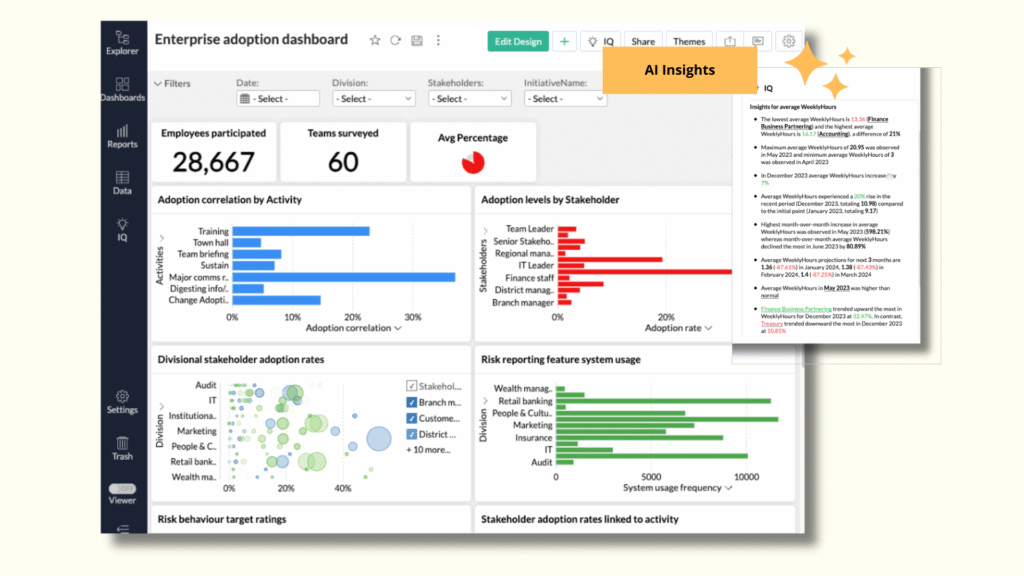
For large organisations, one of the most powerful strategies is making “change intelligence” a standard management product. Rather than only delivering plans and training, ECM produces regular, simple, visual reports that show how change is landing across the enterprise. When ECM operates as an intelligence function, it changes how executives perceive and use change management: instead of seeing a cost, they see a source of insight into organisational performance and capacity.
Examples of high-value ECM reporting include:
Heatmaps showing change load by function, geography or customer segment, with flagging of saturation risk.
Adoption, sentiment and readiness trends for key initiatives, with early warning of adoption gaps.
Links between change activity and operational KPIs (incident volumes, processing time, customer satisfaction and so on), demonstrating ECM’s contribution to business outcomes.
Portfolio status showing which initiatives are on track for benefit realisation and which require intervention.
Research shows that organisations that measure and act on change-related metrics have much higher rates of project success and benefit realisation, as the Prosci finding above (76% versus 24% meeting objectives) illustrates. For executives, this positions ECM as a source of management insight, not just delivery support. A heatmap that only the change team reads changes nothing; the reporting executives use is produced on a regular cadence and tied to decisions. Our guide to measuring change management success sets out the metrics worth tracking.
Strategy 10: Plan ECM maturity as a progressive journey
Effective ECM strategy treats capability building as a staged journey rather than a one-off rollout. Both CMI and Prosci maturity models describe five levels, from ad hoc to fully embedded organisational competency. Understanding these levels and planning progression provides essential context for resource investment and expectation setting. Prosci’s maturity model research found that 54% of participants sat at Level 1 or 2, and only 11% at Level 4 or 5, so most organisations have a long way to run. The five levels of change management maturity are summarised below, and our guide to improving change management maturity goes further.
Level 1 (ad hoc): The organisation has no formal change management approach. Changes are managed reactively without a structured methodology, and no dedicated change resources exist.
Level 2 (repeatable): Senior leadership sponsors some changes but no formal company-wide programme exists to train leaders. Some projects apply structured change approaches, but the methodology is not standardised.
Level 3 (defined): A standardised change management methodology is defined and applied across projects. Training and tools become available to project leaders. Managers develop coaching capability for frontline employees.
Level 4 (managed): Change management competencies are actively built at every organisational level. Formalised practices ensure consistency, and organisational awareness of the significance of change management increases substantially.
Level 5 (optimised): Change management is fully embedded in organisational culture and strategy. The organisation operates with agility, with continuous improvement in change capability.
The practical roadmap in Strategy 3 maps onto these levels: build the basics, add consistency, scale and embed, then optimise through data-driven planning and predictive analytics about change load and adoption, with ECM fully integrated into strategy and performance management cycles. This staged approach lets the organisation grow ECM in line with its strategy, resources and appetite, always anchored on supporting business goals rather than pursuing capability for its own sake. Most organisations need two to five years to move across the levels, and each stage should be judged by what executives can now decide that they could not before.
Your first 90 days
Enterprise change strategies stall when they begin as a large design project. Start by making the existing load visible, then decide from evidence.
Days 1 to 30: List every in-flight and planned initiative that touches your five largest employee groups, with timing and a rough impact rating. Agree the three to five enterprise outcomes with a senior executive.
Days 31 to 60: Set provisional capacity ceilings for those groups, run the first portfolio review with the PMO and finance partner, and settle the operating model question using the four governance tests in Strategy 2.
Days 61 to 90: Publish the first one-page report to the executive team, define sponsor and manager expectations, and agree the 12-month maturity targets and how you will evidence them.
By the end of the quarter, the executive team should be making at least one sequencing decision differently because of what the change data showed. If that has happened, the strategy is working and the rest is scaling it.
How traditional ECM functions support the strategic framework
The functions mature ECM teams already run (communities of practice, leadership training, methodology, self-help resources and portfolio dashboards) deliver most value when each is tied to a specific strategy rather than run as a standalone initiative.
These established functions remain important, but they are most effective when explicitly connected to the strategies above.
Community of practice
A community of practice supports Strategy 7 (building scalable networks) and Strategy 10 (progressing maturity). When designed well, communities become vehicles for sharing lessons, building peer support and creating organisational learning that compounds over time.
Change leadership training and coaching
Leadership training and coaching form the core of Strategy 6 (leaders as the engine). Rather than generic training, effective programmes are specific to the role, focused on practical skill development and connected to organisational strategy.
Change methodology and framework
A methodology underpins Strategy 3 (building three-level capability) and provides consistency across Strategy 4 (portfolio planning) and Strategy 8 (agile integration). A clear methodology helps teams understand expected activities and gives the organisation a common language.
Intranet self-help resources for leaders
Self-help resources expand the reach of Strategy 6 and support day-to-day execution. Rather than requiring leaders to attend training, they provide just-in-time support that fits busy schedules.
A single view of change with traffic light indicators
A single view of change becomes a key artefact for Strategy 4 (portfolio planning) and Strategy 9 (data and reporting). Portfolio dashboards give the visibility that enables both operational decision-making and strategic advice.
When these elements are designed and governed as part of an integrated enterprise strategy, ECM clearly supports the organisation’s business goals instead of sitting on the margins as supplementary project support. Our piece on making enterprise change management a strategic powerhouse develops this argument further.
Demonstrating and sustaining ECM value
For an ECM function to survive cost-cutting and secure sustained investment, executives must experience its value on an ongoing basis, which means repositioning it as a strategic partner rather than a support service.
Over the years we have observed that even supposedly mature ECM teams have ended up on the chopping block when resources are tight and cost efficiency is the focus. This is not necessarily because the work is not valuable, but because executives do not see it as essential and high value. Executives and decision makers need to experience the value continuously, and see that the ECM team’s work is crucial to business decision-making, planning and overall organisational performance. Five practices make that value visible:
Anchor value in measurement. Move beyond anecdotal feedback and isolated project metrics to disciplined, data-driven approaches that capture the full spectrum of change activity, impact and readiness. Organisations that measure change effectiveness systematically demonstrate value that executives recognise and fund.
Focus on business outcomes, not activities. The most compelling business cases emphasise what change management contributes to organisational performance, benefit realisation and competitive position, rather than counting communication sessions delivered or people trained.
Integrate with strategic planning. ECM functions involved early in strategic and operational planning cycles can model change implications, forecast resource requirements and assess organisational readiness. This integration makes change management indispensable to strategic decision-making.
Develop advisory expertise. Build the capability to advise on which sequencing of changes will succeed, which pose the highest risk and where organisational capacity constraints exist. This elevates ECM from implementation support to strategic partnership.
Report continuously on impact. Establish regular reporting cadences that update senior leadership on change portfolio performance, adoption progress, benefit realisation against targets and operational impact. Sustained visibility of ECM’s contribution maintains stakeholder awareness and support.
Where digital tools fit
Spreadsheets and slide packs can run a single programme, but a portfolio that spans hundreds of initiatives and dozens of teams needs a shared, live view of change.
At portfolio scale the data is stale by the time it is assembled, and nobody can compare load across divisions. Purpose-built change intelligence software such as Change Compass gives a single view of change by audience, time and impact level, flags where capacity is exceeded, and reports adoption and benefits in a form executives can use. It is a way to make Strategies 4, 5 and 9 routine rather than heroic, not a substitute for them. Our guide on how to manage multiple change initiatives shows what the practice looks like before any tool is chosen.
Connecting the strategies into one system
The most effective ECM strategies operate as an integrated system rather than as disconnected initiatives. Connecting ECM to business goals (Strategy 1), designing a sustainable operating model (Strategy 2) and building capability at all three levels (Strategy 3) provide the foundation. Portfolio planning (Strategy 4) and benefits realisation tracking (Strategy 5) ensure that ECM focus translates into business outcomes. Leadership engagement (Strategy 6), scalable networks (Strategy 7) and integration with delivery (Strategy 8) make change capability permeate the organisation. Data-driven reporting (Strategy 9) demonstrates continuing value, and maturity planning (Strategy 10) lets capability grow in line with strategy and resources.
Large organisations that implement these strategies gain a measurable advantage through higher project success rates, faster benefit realisation, less change saturation and more engaged employees. For organisations managing increasingly complex transformation portfolios, ECM is not a discretionary function but a core strategic capability, and the best first step is the least glamorous one: make the load on your people visible, then decide from evidence.
FAQ
What is enterprise change management?
Enterprise change management coordinates all change initiatives across an organisation, aligning them with strategic goals, managing the cumulative load on people so that no team is saturated, and building change capability that compounds over time. It sits above individual project change plans and applies standards, governance and measurement to the whole portfolio.
How does enterprise change management differ from project change management?
Project change management helps one initiative land with the people it affects. Enterprise change management looks across every initiative at once, deciding standards, sequencing, capacity limits and reporting so that the combined load on any team stays workable. A project can succeed on its own terms while the enterprise still fails, which is why both levels are needed.
Which operating model works best for enterprise change management?
Most large, matrixed organisations land on a hybrid model: a small central team owns methods, tools, governance and portfolio analytics while practitioners embedded in divisions deliver the work. Centralised models suit tightly controlled organisations and federated models suit highly autonomous business units. The right choice depends on how decisions and funding actually flow.
How do you prevent change saturation in a large organisation?
Build a single view of every in-flight and planned change by audience, time and impact level, agree a capacity ceiling per team, and review it in the same forum that approves investment. When a team reaches its ceiling, sequence, resize or pause an initiative before it launches. Prosci reports that 73% of respondents in its research were near, at or past saturation.
How long does it take to build enterprise change management maturity?
Most organisations need two to five years to move from ad hoc practice to a consistent, measured enterprise capability. Year one usually establishes a common language, a small central team and a single view of change. Later years add standard tools, divisional practitioners, champion networks and benefit reporting that executives use in decisions.
There’s a moment in Wicked the Movie when the main character Elphaba stands on the ramparts of Shiz University, green skin and all, and realises that the world has been lying to her. Glinda, her unlikely friend and mirror image, is learning something different: that comfort and popularity sometimes require staying silent. Both characters embark on profoundly internal journeys, discovering their values, questioning their assumptions, and eventually choosing paths that fundamentally reshape who they are and how they lead. One defies gravity. The other chooses the easier road, only to live with the cost of that choice.
This is not just a story about friendship or redemption. It’s a masterclass in ethical transformation, where internal struggle, conflict, and resistance become the very catalysts for meaningful change. And whilst Elphaba and Glinda’s story unfolds on stage, business leaders and organisations undergoing significant change experience remarkably similar journeys.
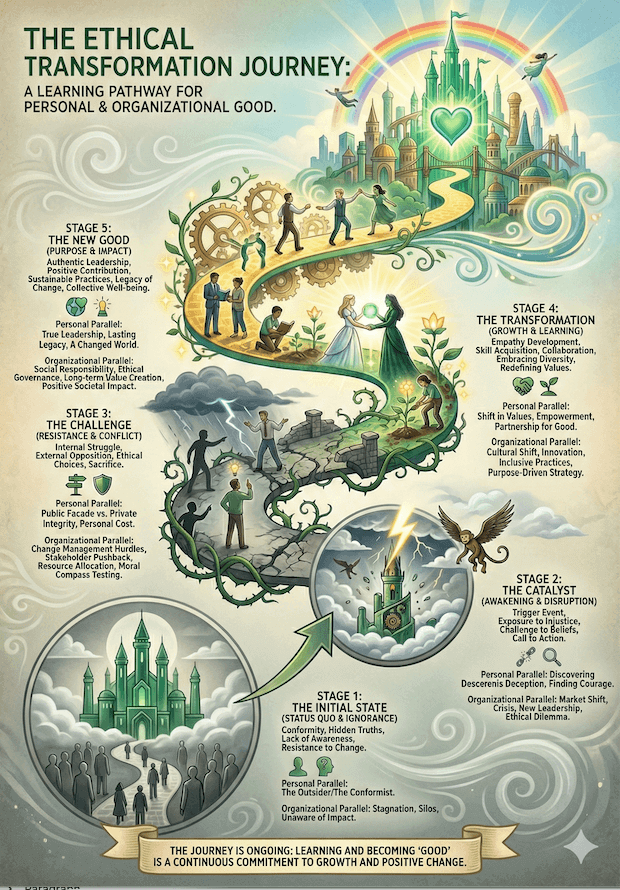
The infographic that inspired this content explores five distinct stages of ethical transformation. What’s fascinating is that this framework mirrors something referenced in Wicked: transformation is rarely linear, comfortable, or solitary. Internal struggle, moral questioning, and resistance to the easy path are not obstacles to transformation. They are its fuel.
Why Organisations Are Linking Ethical Leadership With Change Management
For decades, change management has focused on processes, systems, and adoption metrics. The evolution of change management as a discipline has largely centred on structured methodologies and linear implementation frameworks. But recent research on ethical leadership in organisational transformation reveals something more fundamental: ethics is not a nice-to-have alongside transformation. It is foundational to whether change actually sticks and whether employees genuinely embrace new ways of working.
A 2024 study on ethical leadership and organisational change found that organisations embedding ethical frameworks into their change initiatives saw significantly higher rates of employee readiness and affective commitment to transformation. When employees understand not just what is changing, but why it matters and whether the change aligns with shared values, they move from reluctant compliance to genuine engagement.
Research from the CIPD (Chartered Institute of Personnel and Development) highlights a troubling gap: many current organisational change management programmes are not managed ethically in a way that pays attention to the social and human environment of the workplace. This oversight creates what researchers call “ethics placebos” – surface-level initiatives that look good on paper but leave organisations vulnerable when real pressures hit. The contrast is striking: organisations with mature ethical transformation practices see significantly better outcomes than those treating change as purely operational or technical.
Check our other article discussing managing change as an ethical obligation, rather than simply as an operational initiative, is what separates organisations that deliver lasting transformation from those where changes fade after the initial implementation phase. How an organisation manages change fundamentally impacts its human rights record, its employee wellbeing, whether it builds or erodes trust across stakeholder groups, and ultimately whether employees see the organisation as worthy of their commitment and effort.
Understanding the Five Stages of Ethical Transformation: A Roadmap for Change Leadership
The ethical transformation journey moves through five interconnected stages, each building on the previous one. Each stage has both a personal dimension (how individuals evolve) and an organisational dimension (how systems and cultures shift). This five-stage model is increasingly recognised by transformation leadership experts as essential to understanding how sustainable change actually occurs.
Stage 1: The Initial State (Status Quo and Ignorance).
This is where most organisations and individuals sit. Conformity, hidden truths, lack of awareness, and resistance to change are the default conditions. Like Glinda in the early scenes of Wicked, everything appears fine. The system is working. There’s no pressing reason to question the status quo. Organisationally, this manifests as stagnation, siloed working, and a general lack of awareness about the impact of current practices. Individuals may operate with unexamined assumptions. Teams work in isolated units. Leadership decisions are made without full visibility of downstream effects.
Stage 2: The Catalyst (Awakening and Disruption).
Something disrupts the comfortable narrative. A trigger event, such as exposure to injustice, a market crisis, or evidence that current practices are causing harm, creates what Kurt Lewin’s change model called the “unfreeze” moment. Suddenly, the old way of operating feels unsafe or unjustifiable. This catalyst phase in change leadership is critical because it is when people first recognise the need for change. Elphaba’s moment comes when she learns about the plight of the animals and realises the Wizard is complicit in their subjugation. In organisational transformation, catalysts might include a stakeholder crisis, new regulatory requirements, or internal discovery of unethical practices.
Stage 3: The Challenge (Resistance and Conflict).
This is where resistance gets real. Internally, individuals face conflict between their emerging values and their comfort with the old ways. Externally, organisations face significant pushback from stakeholders invested in the status quo. Research on change resistance and conflict in organisations shows this phase is critical: how organisations and leaders handle it determines whether people move forward or retreat. Managing change resistance effectively requires understanding that resistance is not a problem to eliminate – it is information. Elphaba faces both the Wizard’s power and her own fear. Glinda faces social pressure to dismiss Elphaba’s concerns. In the workplace, this stage manifests as change management hurdles, stakeholder pushback, resource allocation tensions, and moral compass testing.
Stage 4: The Transformation (Growth and Learning).
Through the turmoil, new skills emerge. Empathy grows. Collaboration deepens. Values clarify. Individuals and organisations begin to experiment with new ways of working that align with their emerging ethical commitments. This is where people learn, practise, and gradually embed new behaviours. Skill acquisition happens here, as does cultural shift and innovation in inclusive practices. This phase requires leaders to coach, support, and reinforce new ways of thinking.
Stage 5: The New Good (Purpose and Impact).
Here, the transformation is not an initiative anymore. It is embedded in how the organisation operates, the decisions it makes, and the leaders it develops. Authentic leadership, purpose-driven strategy, and genuine collective wellbeing become the baseline. The personal and organisational parallels converge: individuals have become the leaders they needed to be, and organisations have become the ones they aspired to be. At this stage, the focus is on sustainable value creation and lasting social impact.
Why These Stages Matter for Change Leaders
Understanding these stages of ethical transformation is essential for anyone leading organisational change or serving in a change management office. Why? Because each stage contains its own form of resistance, its own internal struggle, and its own opportunity for meaningful growth. Traditional change management frameworks often treat resistance as an obstacle to overcome. But when you understand the ethical transformation journey, you see resistance differently. It becomes a sign that people are genuinely grappling with values, meaning, and purpose. That is precisely where transformation happens.
The Personal and Organisational Parallels
One of the most powerful aspects of this framework is that it recognises two parallel journeys occurring simultaneously:
The Personal Parallel. At Stage 1, individuals are conformists, operating on autopilot. By Stage 5, they have become authentically courageous leaders with a sense of legacy and the desire to create positive change. In between, they move from discovering dissonance and finding courage, through shifting values and empowerment, to partnership for the greater good.
The Organisational Parallel. Organisations move from stagnation and lack of awareness, through crisis and market shift, into the depths of change management hurdles and ethical dilemmas. They then gradually shift their culture, embrace innovation, adopt inclusive practices, and ultimately develop purpose-driven strategy and positive social impact. At the organisational level, governance, decision-making, and leadership capability all shift along the journey.
This dual perspective means that ethical transformation is not something imposed on people from above. It is something that unfolds through genuine struggle, learning, and growing alignment between personal values and organisational purpose.
Let’s now explore each stage in detail.
Stage 1: The Initial State (Status Quo and Ignorance)
Stage 1, the Initial State, is where most organisations quietly sit before ethical transformation begins. Conformity to existing processes, siloed teams, and a lack of visibility into stakeholder impact create a sense of comfort that masks hidden risks and ethical blind spots. Research on status quo bias shows people naturally prefer familiar systems because they have invested time and identity into them, which makes change feel like a personal loss even when the new approach is clearly better.
For change leaders, this means resistance at Stage 1 is usually self‑protection, not sabotage. Employees are often defending their competence, routines, and sense of control, so early change activity should focus on raising awareness of impact, surfacing “hidden truths”, and acknowledging the real emotional cost of leaving the familiar behind.
Stage 2: The Catalyst (Awakening and Disruption)
Every meaningful transformation begins with a disruption to the comfortable narrative that “everything is fine.” This catalyst moment is what separates organisations that evolve from those that stagnate indefinitely.
The catalyst can take many forms: exposure to injustice, a market crisis, new regulatory requirements, internal discovery of unethical practices, or increasing stakeholder pressure on environmental, social, and governance issues. In Wicked, Elphaba’s catalyst moment comes when she learns about the plight of the animals and realises the Wizard is complicit in their oppression. In organisational settings, the catalyst is equally concrete: discovering that a product or practice is causing harm, receiving whistleblower complaints, facing public criticism, or recognising that top talent is leaving because they do not see ethical alignment between their personal values and the organisation’s practices.
Kurt Lewin’s classic change management model describes this as the “unfreeze” phase. When the status quo is challenged by evidence or experience that contradicts the comfortable narrative, people become psychologically ready to consider alternatives. This is not a comfortable state, but it is a necessary precondition for genuine transformation.
Research on organisational change catalysts shows that trigger events create cognitive dissonance – employees must hold two contradictory beliefs simultaneously: “I work for a good organisation” and “this practice is harmful.” The discomfort of that contradiction creates psychological pressure to resolve it, either by dismissing the evidence or by reimagining their understanding of the organisation.
How Leaders Frame the Catalyst
The way a catalyst is communicated shapes whether it becomes a catalyst for real transformation or a crisis that leaders attempt to manage away. Research on crisis communication shows that transparency and authenticity matter enormously. When senior leaders acknowledge the problem directly, explain what went wrong, and articulate clearly what will change as a result, employees are significantly more likely to move toward genuine commitment rather than resignation or cynicism.
For change leaders engaged in enterprise change management, the catalyst phase presents both opportunity and risk. Done well, it mobilises genuine commitment. Done poorly, it triggers defensive responses and entrenches resistance.
Stage 3: The Challenge (Resistance and Conflict)
This is where many transformation initiatives falter. It is also precisely where understanding ethical transformation as a natural, necessary process becomes essential.
Stage 3 is characterised by genuine internal struggle and external resistance. Internally, individuals face conflict between emerging values and comfort with the familiar. Externally, organisations encounter pushback from stakeholders invested in the status quo. Resources become tight. Decision-making becomes political. Moral dilemmas emerge that do not have clean solutions.
Research on resistance to change reveals a critical insight: resistance is not the opposite of change. It is part of change. In fact, organisations experiencing no resistance during transformation initiatives should be concerned, because it suggests the change is not being authentically integrated. Real transformation always involves letting go of something, and people’s resistance signals what they value and what they fear losing.
Sources of Resistance and the Role of Change Leadership
Research identifies multiple sources of resistance during this challenging stage:
Psychological loss, where people have invested identity and competence in current ways of working
Uncertainty about the future state and whether individuals will succeed in it
Lack of trust in leadership or contradiction between leaders’ words and past actions
Competing values and logics, where new directions conflict with existing professional identity
Practical barriers around resources, time, or capability
For Elphaba, Stage 3 involves struggle against institutional power, growing isolation as others distance themselves, and internal conflict about the personal cost of standing for her beliefs. Glinda faces a different but equally real form of Stage 3 resistance: social pressure, desire to belong, and the seductive appeal of the comfortable path.
Managing Resistance as Strategic Information
One of the most powerful reframes in modern change leadership and enterprise transformation is treating resistance not as an enemy, but as strategic information. When people resist, they signal what they value, what they fear, and what barriers they perceive.
Research on resistance management demonstrates that organisations applying appropriate techniques increase adoption by 72% and decrease employee turnover by almost 10%. But “appropriate” does not mean suppressing resistance. It means understanding it, acknowledging real concerns, and co-creating solutions that address both practical and emotional dimensions.
Research on organisational justice shows that procedural fairness – the sense that the change process itself is fair, transparent, and inclusive – significantly reduces resistance even when people do not fully like the direction. When people feel heard, when their concerns are genuinely considered, and when they have agency in how transformation unfolds, they move more readily through the discomfort of change.
Stage 3 frequently brings ethical dilemmas to the surface. How far do you push change when stakeholders are suffering? Do you prioritise transformation speed or people’s adjustment pace? When you discover current systems have caused harm, do you prioritise fixing that harm or moving forward? These are not rhetorical questions. They are live dilemmas that challenge leaders and organisations to clarify what they actually value. The moral compass testing that happens at Stage 3 is not a distraction from transformation. It is the essence of ethical transformation.
Stage 4: The Transformation (Growth and Learning)
Through the turmoil of Stage 3, something fundamental shifts. New skills emerge. Empathy grows. Collaboration deepens. Values clarify. Individuals and organisations begin experimenting with new ways of working that align with emerging ethical commitments.
This is the “change” phase in Lewin’s model – where people learn, practise, and gradually embed new behaviours. Organisational capability shifts. Cultural norms begin to reorient. What felt uncomfortable becomes normalised through repetition, social reinforcement, and visible success.
Research on empathetic leadership shows that leaders cultivating empathy as a core competency during transformation see significantly higher rates of employee engagement, innovation, and adoption of new ways of working. Empathy at this stage is not merely emotional sentiment. It is a strategic capability that enables leaders to understand diverse stakeholder needs, anticipate resistance, and co-design solutions that work across different contexts and perspectives.
Skill Acquisition and Cultural Shift
Stage 4 requires deliberate investment in capability building. Training programs, coaching support, and peer learning networks become essential. The Change Management Institute’s research emphasises that sustainable change capability requires structured competency development rather than relying on enthusiasm and goodwill.
Organisations embedding inclusive practices during Stage 4 see measurable improvements in innovation, collaboration, and long-term sustainability. Diversity is not treated as a compliance box but as a legitimate accelerator of ethical transformation – different perspectives identify ethical blind spots and generate more robust solutions.
Benefit realisation processes become critical at this stage. Organisations that actively track and reinforce benefit realisation see significantly higher success rates in translating change initiatives into sustained operational performance. This involves clear metrics, regular monitoring, and leadership discussions about obstacles and support required to drive realisation forward.
Research shows that organisations implementing continuous change with frequent measurement achieve remarkable results – a twenty-fold reduction in manufacturing cycle time whilst maintaining adaptive capacity. The pattern is clear: measurement and learning during Stage 4 accelerate the pace and depth of transformation.
Leadership Behaviour During Stage 4
Authentic leadership becomes increasingly critical during Stage 4. Research demonstrates that authentic leaders – those embodying transparency, integrity, and commitment to core values – generate significantly higher levels of organisational commitment, engagement, and openness to change. Employees perceive authentic leaders as genuine and reliable, which boosts mutual respect, openness, and willingness to experiment with new approaches.
Organisations with authentic leadership experience 21% higher profitability, 17% greater productivity, and 20% higher employee engagement compared to organisations where leaders prioritise image management. These outcomes highlight authenticity as a driver of both organisational performance and sustainable competitive advantage.
Stage 5: The New Good (Purpose and Impact)
Here, transformation is no longer an initiative. It is embedded in how the organisation operates, the decisions it makes, and the leaders it develops. Authentic leadership, purpose-driven strategy, and genuine collective wellbeing become the organisational baseline.
At this stage, personal and organisational parallels converge. Individuals have become the leaders they needed to be. Organisations have become the ones they aspired to be. The transformation is no longer external work. It is the organisation’s way of operating.
Embedding Sustainable Value Creation
The New Good is characterised by long-term value creation that extends beyond financial metrics to encompass social impact and environmental sustainability. Organisations at this stage embed ethical governance, inclusive decision-making, and accountability for stakeholder wellbeing into their operating model.
Research on social impact organisations shows they enjoy significantly higher levels of employee engagement and retention, with employees reporting greater sense of purpose and pride in their work. This engagement translates to lower recruitment costs, higher innovation, and enhanced workplace morale – creating a virtuous cycle where purpose drives performance, which reinforces purpose.
Building Organisational Legacy
Stage 5 organisations are intentional about the legacy they build. They ask not just “what value did we create this quarter?” but “what enduring positive change are we creating for communities, stakeholders, and future generations?” This forward-thinking approach reduces exposure to risks associated with climate change, resource scarcity, and social unrest, whilst enhancing ability to adapt to changing market conditions.
Research on sustainable leadership emphasises that organisations balancing profit with genuine commitment to social and environmental wellbeing are better positioned for long-term resilience and growth. They attract purpose-driven talent, access new markets, and build strong brand reputation amongst consumers and employees increasingly demanding authentic social responsibility.
Measuring Impact at Scale
Organisations at Stage 5 move beyond traditional change management metrics to measure impact comprehensively. They track benefit realisation rigorously, monitoring whether promised outcomes translate into sustained operational and social performance. They measure return on investment across financial, employee, and stakeholder dimensions.
But they also recognise that measurement serves purpose, not the reverse. The goal is not to measure everything, but to measure what matters – what signals whether the organisation is genuinely delivering on its purpose and creating positive change.
Why Transformation Is Never “Done”
The most critical insight from understanding these five stages is that ethical transformation is not a destination. It is a continuous journey. Organisations that reach Stage 5 do not stop. They deepen. They evolve. They face new ethical questions that yesterday’s answers do not resolve. They discover new stakeholders with needs they had not previously considered. They encounter new technologies and social changes that require reimagining what “the new good” means.
Research on organisational learning shows that organisations creating feedback loops, fostering experimentation, and building learning networks sustain their transformation far more effectively than those treating transformation as a one-time initiative. The learning culture embedded at Stage 4 becomes the operating system that enables continuous evolution at Stage 5.
The Personal and Organisational Parallels, Revisited
Understanding these parallels is what makes this framework particularly powerful for leaders and organisations.
The personal journey moves from conformity and hidden values, through discovery and disruption, into the depths of internal struggle and resistance. Then through genuine learning and growth, people emerge into authentic leadership – not always comfortable, but finally aligned with their values and capable of creating meaningful impact.
The organisational journey mirrors this precisely. From stagnation and siloed operating, through exposure and market pressure, into change management chaos and ethical dilemmas. Then through deliberate capability building and cultural shift, organisations emerge as purpose-driven, ethically grounded entities where decisions are made with genuine stakeholder consideration and long-term value creation.
What makes this journey authentic is that both personal and organisational transformation require passing through resistance, conflict, and moral complexity. There is no shortcut around Stage 3. The organisations and leaders who try to skip it or manage it away end up creating what researchers call “change theatre” – the appearance of transformation without the reality of it.
Applying This Framework: What Change Leaders Should Do Now
For change practitioners, transformation leaders, and those guiding enterprise change management, this framework offers several practical implications:
Diagnose where your organisation actually sits. Many organisations claim to be at Stage 4 or 5 when they are actually still in Stage 1 or 2 in disguise. Use this framework to assess honestly: what triggers resistance? What do people actually value? What ethical dilemmas remain unresolved?
Treat resistance and conflict as information, not obstacles. When you encounter pushback, pause and listen. What is the resistance telling you about values, concerns, or barriers? Often, the answer reveals where transformation needs to go deeper.
Embed authentic leadership practices. Research consistently shows that authentic leadership – characterised by transparency, integrity, and genuine stakeholder consideration – accelerates movement through the stages and enables sustainable change. Model this behaviour visibly, and develop it in your leadership pipeline.
Create feedback loops and learning networks. Organisations that create spaces for people to learn together, share insights, and solve problems collaboratively accelerate their transformation and build the capability to navigate future changes.
Measure what matters. Track not just activity completion, but benefit realisation, engagement, capability growth, and impact on stakeholders. Measurement should inform leadership decision-making and course correction, not become an end in itself.
Remember the journey is ongoing. Organisations at Stage 5 continue evolving, deepening, and extending their impact. The question is not “how do we finish?” but “how do we sustain, deepen, and continuously reimagine the good we are creating?”
Learning to Be Good
At the heart of Wicked is a deceptively simple truth: becoming “good” is not straightforward. It requires internal struggle, moral questioning, and willingness to pay a personal cost. It requires confronting uncomfortable truths about systems and oneself. It means choosing integrity even when comfort and social approval point elsewhere.
The ethical transformation journey for organisations and leaders is precisely this. It is not a neat change management process. It is a real journey, with real struggle, real learning, and real growth. And that is exactly what makes it meaningful.
For leaders navigating this journey, for organisations in the midst of transformation, and for teams building change capability across their enterprises: the path forward is not about avoiding the struggle. It is about understanding where you are in the journey, treating every stage – including the difficult ones – as essential, and maintaining authentic commitment to the values and impact you are trying to create.
Because sustainable change always requires becoming something more authentic, more awake, and more genuinely committed to the good you say you believe in. Just like Elphaba. Just like all of us.
Frequently Asked Questions: Ethical Transformation and Change Leadership
1. What is an ethical transformation journey in organisations?
An ethical transformation journey is a staged process where organisations move from unexamined status quo and hidden impacts to purpose-led, values-driven ways of working that prioritise stakeholder wellbeing, social impact and long-term value creation.
2. Why should change leaders care about ethics in change management?
Research shows ethical leadership and an ethical climate significantly increase employees’ readiness for change, commitment, and constructive behaviours such as organisational citizenship, which directly improve change outcomes.
3. How does resistance to change fit into ethical transformation?
Resistance is a natural, information‑rich part of transformation, often driven by status quo bias, fear of loss and concerns about fairness rather than simple stubbornness. Treating resistance as data about values and risks helps leaders design more humane and effective change strategies.
4. What leadership behaviours support ethical transformation?
Studies highlight authentic and ethical leadership – marked by transparency, integrity, empathy and consistency between words and actions – as critical for building trust, psychological safety and openness to change.
5. How can organisations measure the success of an ethical transformation?
Effective measurement goes beyond delivery milestones to track adoption, behaviour change, stakeholder trust, wellbeing and social or environmental impact using clear, agreed metrics and benefit realisation frameworks.
6. Can popular stories like Wicked be used to explain ethical leadership?
Using well-known stories as metaphors or case illustrations is a common practice in education and leadership development, as long as plots and characters are described briefly in original words and not copied from protected material.FAQ
The five change management metrics that matter are adoption, readiness and engagement, performance impact, capability, and benefits realised: together they answer whether people used the change, were ready for it, performed better because of it, kept the skills, and produced the value the business case promised.
This article is for change, transformation and HR leaders who need a short list of metrics they can defend in an executive meeting. It argues that five metrics, each with a baseline and a formula, are enough, and that the choice of metric matters less than whether you measure performance at all. By the end you will be able to calculate each metric, set a threshold for it, and recognise the failure mode that makes it misleading. For the full measurement framework, see the ultimate guide to measuring change.
Why measuring any performance beats measuring the right activity
Teams that measure change performance are far more likely to meet their objectives than teams that do not, regardless of which individual metric they pick.
The Three-Level Measurement Framework provides a comprehensive view of change success across organisational, individual, and process dimensions
Metric 1: Adoption (speed, utilisation and proficiency)
Adoption is the share of impacted people who are using the change correctly, and it should be reported as three numbers, not one: how fast, how widely and how well.
Prosci defines individual performance through speed of adoption, ultimate utilisation and proficiency. Use all three, because any single figure can flatter a weak result. A tool with 90% logins and 40% correct usage is not adopted.
How to calculate it
Utilisation rate = people actively using the new process or tool ÷ total impacted population × 100. Define “actively” before launch (for example, completed the new workflow at least weekly).
Speed of adoption = days from go-live to reaching your target utilisation threshold (commonly 80% of the impacted population, but set it with the business owner).
Proficiency rate = users meeting the agreed performance standard ÷ total users × 100, taken from quality, error or cycle-time data rather than self-report.
How to read it
Compare each cohort against the plan at go-live, day 30 and day 90. A cohort that is fast but shallow needs coaching. A cohort that is slow but proficient needs removal of barriers. A cohort that is neither needs a conversation with its manager. The gap between planned and actual is the number leaders should see.
Readiness and engagement scores are the leading indicators: they show, before go-live, which groups are likely to adopt and which are not.
Measure readiness by group, not in aggregate. An organisation-wide average of 3.8 out of 5 hides the one division scoring 2.1 that will determine the outcome.
How to calculate it
ADKAR score by element = average rating (1 to 5) from a short pulse survey for Awareness, Desire, Knowledge, Ability and Reinforcement, reported per impacted group. Because ADKAR scores each element separately, the lowest-scoring element points to the barrier: low Knowledge or Ability calls for training and practice, low Desire calls for a different conversation.
Readiness gap = target score − actual score, per group and per element.
Manager involvement rate = managers who held at least one structured team conversation about the change ÷ total managers in scope × 100.
How to read it
Treat any group with a readiness gap above one point, or manager involvement below your threshold, as a pre-launch risk. Manager involvement deserves particular weight. Gallup reports that global manager engagement fell from 31% in 2022 to 22% in 2025, which means the people you are relying on to carry the change are themselves less engaged than a few years ago. If your plan depends on manager-led conversations, measure whether they are happening rather than assume it.
Metric 3: Performance impact against a baseline
Performance impact is the movement in the business measure the change was meant to improve, compared with a baseline and, where possible, a comparison group.
This is the metric that earns attention from finance and operations, and the one most often undermined by missing baselines. The choice of measure comes from the business case: cycle time, error rate, first-contact resolution, sales conversion, or cost per transaction.
How to calculate it
Performance change = (post-change value − baseline value) ÷ baseline value × 100.
Attributable change (the more defensible version) = change in the impacted group − change in a comparable group not yet affected. This difference-in-differences approach strips out seasonal and market effects.
Support signal = help desk or support volume per user, tracked weekly after launch. Falling volume with rising proficiency indicates embedding. Falling volume with flat proficiency usually means people have stopped asking.
How to read it
Expect a dip before the lift. Productivity often falls in the first weeks as people learn, so agree the expected shape of the curve with leaders in advance. Engagement is a useful companion measure because it links to the outcomes that matter: Gallup’s meta-analysis found that business units in the top quartile of engagement achieved 23% higher profitability than those in the bottom quartile. It is correlation, not proof that your change caused the result, but it justifies tracking engagement alongside the operational measure.
Attribution is the discipline here. Report the number you can defend, state the comparison used, and resist adding every improvement in the period to the change’s account.
Metric 4: Capability and behaviour transfer
Capability is measured by whether trained behaviours appear in the work 30, 60 and 90 days later, not by whether the training took place.
Completion and satisfaction scores tell you the session ran and was liked. They say nothing about transfer. This is the metric where activity most often masquerades as outcome, so it earns its own place on the scorecard.
How to calculate it
Skill application rate = observed correct applications of the new behaviour ÷ observed opportunities to apply it × 100, sampled by managers or through system data at 30, 60 and 90 days.
Time to proficiency = average days for a newly transitioned employee to reach the agreed performance standard.
Learning-to-behaviour gap = percentage passing the post-training assessment − skill application rate at 30 days. A large gap points to a problem in the work environment, not the course.
How to read it
If knowledge is high and application is low, look to the manager, the workflow and the tooling before redesigning the training. Evidence on manager support is supportive but should be treated carefully. In a 2025 Training Industry case study of a change-training programme, participants with supportive managers who also attended both coaching sessions delivered three times the ROI. That is a single vendor-reported case, so use it as a prompt to test the manager effect in your own data rather than as a benchmark.
Metric 5: Benefits realised and return on investment
Benefits realised is the share of the business case’s promised value that has actually arrived, and change management ROI is the portion of that value attributable to the people side, net of its cost.
This is the metric that closes the loop, and the one that gets neglected after go-live. McKinsey’s global survey of 1,034 respondents found that those reporting a successful transformation captured on average 67% of the maximum financial benefit, and everyone else only 37%. Even the winners leave a third of the value behind, and most of the leakage happens when nobody is tracking.
How to calculate it
Benefit realisation rate = benefits realised to date ÷ benefits planned for the same period × 100, with each benefit owned by a business leader and not the project team.
People-side benefit coefficient = (expected benefits − expected benefits if adoption were zero) ÷ expected benefits. Prosci’s worked examples show how widely this varies: 12% for one project and 73% for another, which is why a single “typical” figure should never be assumed.
Change management ROI = (realised benefits × people-side benefit coefficient − cost of change management) ÷ cost of change management.
How to read it
Be conservative and show the working. A 73% coefficient on a $1.3 million benefit case, with $350,000 expected even if no one adopted, produces a people-side contribution of $950,000. Stating the baseline assumption is what makes the number survive a finance review. Continue tracking after project close, because many benefits mature over months.
One caution: a single ROI ratio understates the value of change work that creates capability across several initiatives. The argument for treating ROI as a floor rather than the full case is in why change management ROI calculations limit its value.
Putting the five metrics on one page
A usable scorecard carries one leading and one lagging measure per metric group, each with a baseline, a target and an owner, reviewed on a fixed cadence.
The five key metrics that matter for measuring change management success
A compact structure works better than a long one:
Metric group
Leading measure
Lagging measure
Owner
Adoption
Day-30 utilisation vs plan
Day-90 proficiency rate
Business unit lead
Readiness and engagement
ADKAR gap by group
Sustained manager involvement
Change lead
Performance impact
Support volume per user
Attributable change in core KPI
Process owner
Capability
Post-training assessment
90-day skill application rate
Line manager
Benefits
Benefit tracker vs plan
Realised benefits and ROI
Benefit owner
Review operational measures weekly, leadership measures monthly and benefits quarterly. When a number moves the wrong way, add detail for that metric only. Keep the page to five to seven measures per initiative; the rest belongs in a drill-down, not on the executive view.
Where several initiatives land on the same teams, the same five metrics can mislead if you read them in isolation, because one group’s low adoption may reflect overload from another programme rather than a failure of this one. That portfolio view is covered in the pillar guide.
Using digital tools to keep the five metrics current
Digital change platforms keep these metrics current by collecting usage, survey and impact data continuously, so the scorecard reflects this week and not last quarter.
Spreadsheets and survey exports can hold the five metrics for one initiative, and many teams start there. The strain appears when you run several initiatives across the same teams: baselines drift, definitions diverge, and the quarterly rebuild consumes the time that should go to interpretation. A platform such as Change Compass holds the baselines, readiness pulses, adoption data and impact across the portfolio in one place, so a practitioner can see which groups are behind plan and which initiatives are competing for the same people. The principle is unchanged whether you use a platform, a spreadsheet or a BI tool: define the metric, fix the baseline, name the owner, and look at it on a schedule.
Choosing the next metric to fix
Start with the metric you cannot currently calculate, because the first gap in your scorecard is usually the one hiding the biggest risk.
Most teams find that metrics 1 and 2 already exist in some form and that metrics 3 and 5 are missing a baseline. That is the place to begin: agree one business measure and one benefit owner before your next go-live, and capture the pre-change value this month. The remaining metrics can follow in order of how decision-relevant they are to your sponsor.
The aim is not a bigger dashboard. It is the ability to say, at any point in a change, how many people are using it, how well, what that is worth, and what you would do differently if the numbers moved. Five metrics, calculated the same way each time, are enough to say that with confidence.
Frequently asked questions
What are the five most important change management metrics?
The five metrics are adoption (speed, utilisation and proficiency), readiness and engagement, performance impact against a baseline, capability and behaviour transfer from training, and benefits realised against the business case. Together they cover whether people use the change, whether they were ready, whether work improved, whether skills stuck, and whether the value arrived.
How do you calculate change adoption rate?
Divide the number of impacted people actively using the new process or tool by the total impacted population, then multiply by 100. Measure it at fixed points such as go-live, day 30 and day 90, and report speed (days to reach your target threshold) and proficiency (the share of users meeting the performance standard) alongside it.
How do you measure the ROI of change management?
Estimate the share of project benefits that depend on people adopting the change, multiply it by the benefits actually realised, subtract the cost of change management, and divide by that cost. The credibility of the result depends on a documented baseline and an honest estimate of how much of the benefit is people-dependent.
What is the difference between leading and lagging change metrics?
Leading metrics, such as readiness scores, manager involvement and early usage, predict whether adoption will happen and leave time to intervene. Lagging metrics, such as sustained utilisation, performance improvement and realised benefits, confirm whether it did. A useful scorecard carries both, with at least one of each for every metric group.
How many metrics should a change programme track?
Track five to seven for any single initiative, one or two per metric group, each with a baseline, a target and a named owner. More than that dilutes leadership attention and hides the signal. Add detail only when a metric moves in the wrong direction and needs diagnosing.
Change saturation is the operational condition where the volume, pace and concurrency of initiatives demanded of an organisation’s workforce exceeds the capacity those teams have to absorb new ways of working. Symptoms include declining adoption rates, missed go-live milestones, rising attrition, and visible disengagement on initiatives that previously ran cleanly. It differs from change fatigue, which is the individual psychological response. Saturation is the portfolio-level structural cause. Once a business unit is saturated, even well-designed initiatives stall, because the receivers no longer have the bandwidth or psychological readiness to engage. Detection requires portfolio-level visibility, not just project-level tracking.
The statistics paint a sobering picture. Research indicates that 73% of organisations report being near, at or beyond their saturation point according to Prosci. For executives and boards tasked with driving transformation whilst maintaining operational excellence, understanding and managing change saturation has become a critical capability rather than an optional consideration.
The Reality of Change Saturation in Modern Organisations
Change saturation represents a fundamental mismatch between supply and demand. Organisations possess a finite change capacity determined by their culture, history, structure, and change management competency, yet they continuously face mounting pressure to transform faster, innovate quicker, and adapt more completely.
Why Change Saturation Is Accelerating
Several forces are driving the acceleration of change initiatives across industries. Digital transformation demands have compressed what were previously five-year horizons into immediate imperatives. Economic uncertainty and rapidly evolving industry conditions force companies to launch multiple strategic responses simultaneously rather than sequentially. Competition intensifies as organisations strive to maintain relevance, leading executives to greenlight numerous initiatives without fully considering cumulative impact.
Research by Mladenova highlights that multiple and overlapping change initiatives have become the norm rather than the exception, exerting additional pressure on organisations already struggling with increasing levels of unpredictability. The research found that the average organisation has undergone five major changes, creating an environment of continuous transformation that exceeds historical norms. Traditional linear change management models, designed for single initiatives, prove inadequate when organisations face simultaneous technological, structural, and cultural transformations.
Peak Saturation Periods: When Organisations Are Most Vulnerable
Analysis of Change Compass data reveals distinct seasonal patterns in change saturation levels. Organisations experience the most pronounced saturation during November, as teams rush to complete year-end initiatives whilst simultaneously planning for the following year’s portfolio. A secondary saturation peak emerges during the February and March period, when new strategic initiatives launch alongside ongoing projects that carried over from the previous year.
These predictable patterns create particular challenges for change practitioners and portfolio managers. November’s saturation stems from the convergence of multiple pressures, including financial year-end deadlines, budget utilisation requirements, and the desire to demonstrate progress before annual reviews. The February-March spike reflects the collision between enthusiasm for new strategic directions and the incomplete adoption of prior initiatives.
Change saturation patterns throughout the year, showing peak periods in November and February/March when change load exceeds organisational capacity
Understanding the Risks and Impacts of Change Saturation
When organisations exceed their change capacity threshold, the consequences cascade across multiple dimensions of performance. These impacts are neither abstract nor theoretical but manifest in measurable declines across operational, financial, and human capital metrics.
Productivity and Performance Impacts
The relationship between change saturation and productivity follows a predictable trajectory. Initially, as change initiatives increase, productivity may remain stable or even improve slightly. However, once saturation thresholds are crossed, productivity experiences sharp declines. Employees struggle to maintain focus across competing priorities, leading to task-switching costs that reduce overall efficiency.
Empirical research examining the phenomenon reveals that 48% of employees experiencing change fatigue report feeling more tired and stressed at work, whilst basic operational performance suffers as attention fragments across too many fronts. Research on role overload demonstrates the mechanism behind these productivity declines: a study of 250 employees found that enterprise digitalization significantly increased role overload, which in turn mediated the relationship between organizational change and employee burnout. The productivity dip manifests not just in individual output but in team coordination, decision quality, and the speed of execution across all initiatives.
Capacity Constraints and Resource Limitations
Change capacity represents a finite resource shaped by several critical factors:
Available time and attention of impacted employees
Leadership bandwidth to sponsor and support initiatives
Financial resources allocated to change activities
Technical and operational infrastructure to enable new ways of working
Organisational energy and willingness to embrace transformation
When organisations fail to account for these constraints in portfolio planning, capacity shortfalls emerge across the initiative landscape. Business functions find themselves overwhelmed with implementation demands beyond what is achievable, creating a vicious circle where incomplete adoption of one initiative reduces capacity for subsequent changes. Alarmingly, only 31% of employees report that their organisation effectively prevents them from becoming overloaded by change-related demands, indicating widespread capacity management failures.
Academic research confirms these dynamics. Studies of 313 middle managers found that organisational capacity for change mediates the influence of managerial capabilities on organisational performance, demonstrating that capacity constraints directly limit transformation outcomes regardless of individual leader quality. Research on middle managers’ role overload further reveals that workplace anxiety mediates the relationship between role overload and resistance to change, creating a reinforcing cycle that compounds capacity constraints.
Change Adoption Achievement Levels
Perhaps the most damaging consequence of saturation is the erosion of adoption quality. When organisations exceed capacity thresholds, changes simply do not stick. Employees may complete training and follow new processes initially, but without sufficient capacity to embed behaviours, they revert to previous methods once immediate oversight diminishes.
The adoption challenge intensifies when employees face simultaneous demands from multiple initiatives. From the employee perspective, the source of change matters less than the cumulative burden. Strategic transformations compete with business-as-usual improvements and regulatory compliance changes, all drawing from the same limited pool of attention and effort.
Prosci research provides compelling evidence of the adoption gap: whilst 76% of organisations that measured compliance with change met or exceeded project objectives, only 24% of those that did not measure compliance achieved their targets. This 52 percentage point difference underscores the critical link between saturation management, measurement discipline, and adoption outcomes. Studies examining change adoption demonstrate that organisations using structured portfolio approaches show significantly higher adoption rates compared to those managing initiatives in isolation, with improvements ranging from 25% to 35%.
Readiness Levels and Psychological Impact
Change saturation does not merely affect task completion but fundamentally undermines psychological readiness for transformation. When employees perceive themselves as drowning in initiatives, several concerning patterns emerge.
Change fatigue develops through constant exposure to transformation demands, manifesting as exhaustion and decreased agency. Research identifies that 54% of employees experiencing change fatigue actively look for new roles, representing a talent retention crisis that compounds capacity constraints. Among change-fatigued employees, only 43% plan to stay with their company, whereas 74% of those experiencing low fatigue intend to remain, revealing a 31 percentage point retention gap directly attributable to saturation. Employee satisfaction scores decline during sustained periods of high change load, creating resistance that undermines even well-designed initiatives.
The readiness dimension extends beyond individual psychology to encompass organisational culture and collective capacity. Organisations with limited change management competency experience saturation at lower initiative volumes compared to those with mature change capabilities. History matters as well. Teams that have experienced failed initiatives develop cynicism that reduces readiness for subsequent changes, regardless of the quality of planning.
Research on employee resistance reveals that 37% of employees resist organisational change, with the top drivers being lack of trust in leadership (41%), lack of awareness about why change is happening (39%), fear of the unknown (38%), insufficient information (28%), and changes to job roles (27%). These resistance patterns intensify under saturation conditions when communication resources are stretched thin and leadership attention is fragmented.
Comprehensive Risk Classification Framework
Change saturation creates a complex web of interconnected risks that extend across traditional risk management categories. Understanding these risk types enables organisations to develop targeted mitigation strategies and allocate appropriate governance attention.
Risk in Change
Risk in change represents threats directly attributable to the transformation initiatives themselves. These risks impact an organisation’s operations, culture, and bottom line throughout the change lifecycle. Change risk management requires a systematic framework that identifies potential obstacles early, enabling timely interventions that increase the likelihood of successful implementation.
Key change risks under saturation conditions include:
Adoption failure risk: the probability that intended changes will not be sustained beyond initial implementation
Readiness gap risk: insufficient stakeholder preparedness creating resistance and delayed adoption
Communication breakdown risk: message saturation and information overload preventing effective stakeholder engagement
Benefit realisation risk: failure to achieve anticipated returns due to incomplete implementation
Change management analytics provide data-based risk factors, including business readiness indicators and potential impact assessments, enabling risk professionals to make informed decisions about portfolio composition and sequencing.
Operational Risk
Operational risk in change saturation contexts stems from failures in internal processes, people, systems, or external events during transformation periods. The structured approach to operational risk management becomes particularly critical when organisations run multiple concurrent initiatives that strain existing control frameworks.
Saturation-amplified operational risks include:
Process integrity risk: critical processes failing or degrading as resources shift to change activities
Control effectiveness risk: required controls not operating correctly during transition periods
System stability risk: technology failures or performance degradation during implementation phases
Human error risk: mistakes increasing as employees navigate unfamiliar processes under time pressure
Data security risk: sensitive information exposed during system migrations or process changes
Operational risk management frameworks should incorporate formal change management processes to mitigate risks arising from modifications to operations, policies, procedures and controls. These frameworks must include mechanisms for preparing, approving, tracking, testing and implementing all changes to systems whilst maintaining an acceptable level of operational safety.
Research on change-oriented operational risk management in complex environments demonstrates that approximately 55% of total risk stems from human factors, followed by management, medium, and machine categories. This distribution underscores the importance of capacity-aware implementation that accounts for human limitations under saturation conditions.
Delivery Risk (Project)
Delivery risk encompasses threats to successful project execution, including timeline slippage, budget overruns, scope creep, and quality degradation. Under saturation conditions, delivery risks compound as resource contention, stakeholder fatigue, and competing priorities undermine traditional project management disciplines.
Project delivery risks intensified by saturation include:
Schedule risk: delays caused by resource availability constraints and stakeholder capacity limitations
Cost risk: budget overruns driven by extended timelines, rework, and unplanned resistance management
Scope risk: uncontrolled expansion or reduction of deliverables as stakeholders struggle to maintain focus
Quality risk: deliverable defects increasing as teams rush to meet deadlines across multiple initiatives
Resource risk: key personnel unavailable when needed due to competing project demands
Dependency risk: critical path delays when predecessor activities fail to complete due to capacity constraints
Project risk registers should identify risks that could arise during the project lifecycle through planning, design, procurement, construction, operations, maintenance and decommissioning. For each risk, teams must identify the consequences should risks eventuate, including impacts on timelines, costs and quality, as well as the likelihood of each consequence occurring.
Strategic Risk
Strategic risks emerge when saturation prevents organisations from achieving their intended strategic objectives or when transformation portfolios become misaligned with strategic priorities. These risks operate at a higher level than individual project failures, threatening competitive position and long-term viability.
Strategic risks manifesting through saturation include:
Competitive disadvantage risk: delayed capability development allowing competitors to capture market position
Strategic opportunity cost: resources locked in underperforming initiatives preventing investment in higher-value opportunities
Market timing risk: transformations completing too late to capture market windows or respond to threats
Strategic coherence risk: contradictory initiatives undermining overall strategic direction and confusing stakeholders
Research demonstrates that strategic business risks requiring different management approaches tend to be neglected compared to operational and compliance risks, despite operating in volatile, uncertain, complex and ambiguous environments where such neglect seems suboptimal. Portfolio-level risk assessment provides governance forums with visibility into where cumulative change creates strategic risk, enabling more informed decisions about sequencing, prioritisation and resource allocation.
Compliance and Regulatory Risk
Compliance risk under saturation arises when organisations struggle to maintain regulatory adherence and control effectiveness whilst implementing multiple concurrent changes. For regulated industries, this risk category carries particular severity as penalties for non-compliance can be substantial.
Saturation-driven compliance risks include:
Regulatory breach risk: failing to maintain compliance with relevant regulations during change processes
Control gap risk: required controls becoming ineffective or absent during transition periods
Audit finding risk: control weaknesses identified during periods of high change activity
Remediation timeline risk: insufficient capacity to address compliance gaps within required timeframes
Documentation risk: inadequate records of control operation and change decisions for regulatory review
In financial services specifically, operational leaders must consider regulatory risk exposure, processes remaining unaligned with regulatory requirements, remediation timelines, and forward-looking compliance risk as systems migrate and processes change. Continuous monitoring programmes that embed compliance checks at every step of delivery transform risk management from a gate to a guardrail, enabling pace whilst maintaining governance rigour.
Financial Risk
Financial risks extend beyond simple budget overruns to encompass broader economic impacts of saturation on organisational performance. These risks materialise through multiple channels, often in ways that exceed initial project cost estimates.
Financial risk categories under saturation include:
Sunk cost risk: wasted resources on failed initiatives that do not achieve adoption targets
Productivity cost risk: revenue losses from operational efficiency declines during change periods
Turnover cost risk: recruitment and training expenses driven by change-induced attrition
Benefit delay risk: postponed value realisation extending payback periods beyond planned horizons
Opportunity cost risk: capital and resources committed to underperforming changes rather than higher-return alternatives
Penalty cost risk: regulatory fines or contractual penalties from compliance failures during transformation
Reputational Risk
Reputational risk emerges when change saturation creates visible failures, stakeholder dissatisfaction, or public incidents that damage organisational standing. In an era of social media and instant communication, change-related problems can rapidly escalate into reputation crises.
Saturation-linked reputational risks include:
Customer experience risk: service disruptions or quality degradation noticed by external stakeholders
Employee reputation risk: public complaints from overworked staff or negative employer review ratings
Partner confidence risk: vendor or alliance partner concerns about organisational stability during transformation
Stakeholder trust risk: erosion of confidence among investors, regulators, or community stakeholders
Brand perception risk: market perception of organisational competence declining due to visible failures
Operational risk frameworks recognise that non-financial risks may have impacts harming the bottom line through reputation damage, making reputational risk assessment a critical component of comprehensive saturation management.
People and Culture Risk
People and culture risks represent threats to organisational capability, employee wellbeing, and cultural integrity during periods of intense transformation. These risks carry long-term consequences that extend beyond individual initiative success or failure.
Human capital risks amplified by saturation include:
Talent retention risk: loss of key personnel to competitors due to change fatigue and burnout
Capability degradation risk: skills erosion as development activities are postponed during intense change periods
Engagement risk: declining employee commitment and discretionary effort undermining performance
Health and wellbeing risk: stress-related illness and absenteeism increasing during sustained transformation
Cultural coherence risk: organisational values and norms fragmenting under contradictory change pressures
Leadership credibility risk: erosion of trust in management due to perceived mishandling of change demands
Research shows that 48% of change-fatigued employees feel more tired and stressed at work, whilst role overload significantly predicts job burnout through the mediating effect of workplace anxiety. These human impacts create reinforcing cycles that accelerate capability loss and reduce organisational resilience.
Financial and Strategic Consequences
The financial damage from poorly managed change saturation extends across six critical areas. Wasted resources and sunk project costs accumulate when initiatives fail to achieve adoption targets. Resistance-driven budget overruns occur as teams spend unplanned resources attempting to overcome saturation-induced obstacles. Operational efficiency declines as productivity dips reduce output across the business.
Revenue losses from delayed improvements compound when saturation prevents the realisation of anticipated benefits. Regulatory compliance penalties may arise if mandatory changes fail to achieve adoption within required timeframes. Supply chain relationship strain emerges when external partners experience the downstream effects of internal dysfunction.
Research quantifying these financial impacts demonstrates significant returns from effective saturation management. Studies show that organisations applying appropriate resistance management techniques increased adoption by 72% and decreased employee turnover by almost 10%, generating savings averaging USD $72,000 per company per year in training programmes alone. Conversely, 71% of employees in poorly managed change environments waste effort on the wrong activities due to leader-created change plans that are not directly relevant to their day-to-day work, representing massive productivity losses.
Perhaps most critically, organisations lose competitive position when transformation initiatives fail to deliver promised capabilities. In fast-moving markets, this strategic cost often exceeds the direct financial damage of failed projects. Research shows that successful change initiatives improve market competition by 40%, whilst companies with effective change management are 50% more likely to achieve long-term growth opportunities. The strategic opportunity cost of saturation-induced failure therefore dwarfs the immediate project-level losses.
Empirical Research on Change Saturation Levels
Academic and industry research provides robust evidence of the prevalence and impact of change saturation across different contexts and geographies. Understanding these research findings enables organisations to benchmark their own experiences and recognise early warning signs before saturation becomes critical.
Prevalence Across Industries
Prosci’s benchmarking data reveals that the percentage of organisations reaching change saturation has increased consistently over successive research cycles. This trend reflects the accelerating pace of business transformation combined with relatively static change capacity development. Research spanning multiple sectors demonstrates that saturation is not confined to specific industries but represents a universal challenge wherever organisations pursue concurrent improvement initiatives.
Analysis of transformation success rates reveals concerning patterns. The CEB Corporate Leadership Council found that whilst the average organisation has undergone five major changes, only one-third of those initiatives are successful. This 34% success rate reflects the cumulative burden of portfolio-level saturation rather than individual project deficiencies. When examined through a portfolio lens, the data suggests that many “failed” initiatives did not lack sound design or execution plans but were undermined by capacity constraints stemming from concurrent competing changes.
Impact on Change Success Probability
Research demonstrates clear correlations between saturation management practices and initiative success rates. Gartner research found that organisations applying open-source change management principles, which emphasise transparency and portfolio-level coordination, increased their probability of change success from 34% to 58%, representing a 24 percentage point improvement. This dramatic increase stems largely from better saturation management through coordinated planning and stakeholder engagement.
Prosci research provides additional granularity on the saturation-success relationship. Studies show that 76% of organisations encountering resistance managed to increase adoption by 72% when they applied appropriate resistance management techniques focused on capacity-aware implementation. This finding indicates that even when saturation creates resistance, targeted interventions can substantially improve outcomes if deployed proactively.
Measurement and Monitoring Research
Research on change measurement practices reveals significant gaps that exacerbate saturation challenges. Only 12% of organisations reported measuring change impact across their portfolio, meaning 88% lack the fundamental data needed to identify saturation before it undermines initiatives. This measurement gap prevents early intervention and forces organisations into reactive crisis management when saturation symptoms become severe.
Studies examining organisations that do implement robust measurement find substantial advantages. Research shows that organisations using continuous measurement and reassessment achieve 25% to 35% higher adoption rates than those conducting single-point readiness assessments. The improvement stems from the ability to detect emerging saturation patterns and adjust implementation pacing or resource allocation before capacity thresholds are breached.
MIT research on efficiency and adaptability challenges conventional assumptions about measurement overhead. Studies found that organisations implementing continuous change measurement with frequent assessment achieved 20-fold reductions in cycle time whilst maintaining adaptive capacity, contradicting the assumption that measurement slows transformation. This finding suggests that robust saturation monitoring actually accelerates change by preventing the costly delays associated with capacity-induced failures.
Employee Experience Research
Research examining employee perspectives provides critical insights into how saturation manifests at the individual level. Studies show that more than half of workplace leaders and staff report their organisations struggle to set well-defined measures of success for change initiatives, making progress tracking more difficult and intensifying the perception of endless transformation. This measurement ambiguity compounds saturation effects by preventing employees from recognising completion and moving forward.
Analysis of employee engagement during change reveals concerning trends. Only 37% of companies believe they are fully leveraging the employee experience during transformation efforts, meaning nearly two-thirds miss opportunities to understand and respond to saturation signals from frontline perspectives. Research demonstrates that employee engagement during change increases intent to stay by 46%, highlighting the strategic importance of saturation management for talent retention.
Studies on communication effectiveness underscore the challenge of maintaining clarity under saturation conditions. Communication leaders report that 45.6% struggle with information overload and 35.6% find it difficult to adapt to digital trends and new technologies. These challenges intensify when multiple initiatives compete for communication bandwidth, creating message saturation that parallels initiative overload.
Comparative Research on Change Approaches
Empirical research comparing different change management approaches reveals that methodology significantly influences saturation resilience. Studies examining iterative versus linear change found that 42% of iterative change projects succeeded whilst only 13% of linear ones did, representing a 29 percentage point success differential. The iterative advantage stems from continuous feedback mechanisms that enable early detection of capacity constraints and adaptive responses.
Research on change communication strategies demonstrates that companies with effective communication increase success by 38% compared to those with poor communication practices. This improvement reflects better stakeholder alignment and reduced confusion under saturation conditions when clear messaging becomes critical.
Studies examining purpose-driven change reveal that companies driven by purpose are three times more successful in fostering innovation and leading transformation compared to other organisations. These purpose-driven entities experience 30% greater innovation and 40% higher employee retention rates than industry peers, suggesting that clear strategic rationale helps buffer against saturation-induced resistance.
Measuring and Monitoring Change Saturation
Effective saturation management begins with accurate measurement. Organisations cannot manage what they do not measure, and change saturation requires portfolio-level visibility that transcends individual initiative tracking.
Establishing Baseline Capacity
The first step in saturation measurement involves determining organisational change capacity. Unlike fixed metrics, capacity varies by department, team, and even individual depending on several factors.
Capacity assessment should consider current workload, historical change absorption rates, skills and competencies of impacted groups, and leadership bandwidth to support transformation. Organisations should identify periods when multiple initiatives resulted in negative operational indicators or leader feedback about change disruption, recording these levels as exceeding the saturation point for specific departments.
A lot of change practitioners use a high level indication of High, Medium, Low in rating change impacts overall at a project level. The problem with this approach is that it is difficult for leaders to understand what this really means and how to make key decisions using such a high level indication. In this approach it is not clear exactly what role type, in what business unit, in what team, in what period of time is impacted and the types of impact. Using tools like The Change Compass, change impact can be expressed in terms of hours of impact per week, providing a quantifiable measure against which capacity thresholds can be plotted. This approach enables visualisation of saturation risk before initiatives launch rather than discovering capacity constraints during implementation.
Portfolio-Level Impact Assessment
Traditional change management often focuses on individual initiatives in isolation, missing the cumulative picture that employees actually experience. Portfolio-level assessment requires aggregating data across all concurrent changes to identify total burden on specific stakeholder groups.
Effective impact assessment frameworks should identify cumulative change impacts across projects, avoid change fatigue and capacity overload through proactive planning, and prioritise initiatives based on organisational capacity and readiness. By tracking concurrent and overlapping changes, leaders can identify where resistance may emerge and proactively address saturation before it derails initiatives.
Digital platforms make portfolio management more feasible by centralising change data, prompting initiative owners to update information regularly, and enabling instant report generation that provides portfolio visibility. These systems function as change portfolio air traffic control, helping organisations safely land multiple initiatives without collisions.
Leading and Lagging Indicators
Comprehensive saturation monitoring requires both leading indicators that predict emerging problems and lagging indicators that confirm outcomes.
Leading indicators for saturation risk include the number of concurrent initiatives per stakeholder group, total planned hours of change impact per department, stakeholder sentiment scores and engagement survey results, change readiness assessment scores, and training completion rates relative to timelines. These metrics enable early intervention before saturation creates irreversible damage.
Lagging indicators confirm the impact of saturation after it occurs. These include initiative adoption rates, productivity metrics for impacted groups, employee turnover and absenteeism, project timeline slippage, and benefit realisation against targets. Whilst lagging indicators cannot prevent saturation, they validate the accuracy of capacity models and inform adjustments for future planning.
Reporting Portfolio Health and Saturation Risks to Leadership
Translating complex change data into actionable executive insights represents a critical capability for change portfolio managers. Boards and senior leaders require clear, strategic-level information that enables rapid decision-making without overwhelming detail.
Principles for Executive Reporting
Executive change management reports must transcend departmental boundaries and speak to broader organisational impact. The focus should centre on portfolio-level insights and key strategic initiatives rather than individual project minutiae. Metrics should align with strategic goals, showcasing how change initiatives contribute to overarching business objectives.
Critically, executives require understanding of totality. What do all these changes collectively mean for the organisation? What employee experiences emerge across multiple initiatives? Reporting should also illuminate how the nature and volume of changes impact overall business performance, as executives remain focused on maintaining operational success during transformation with minimum disruption.
Avoiding certain reporting traps proves equally important. Vanity metrics that showcase activity without demonstrating impact undermine credibility. Activity-focused measurements such as training sessions conducted or newsletters distributed fail to answer whether changes are actually adopted. Overly cost-centric reporting that emphasises expenditure without linking to outcomes misses the strategic value equation.
Data Visualisation Techniques for Saturation Reporting
The choice of visualisation technique significantly impacts how effectively leaders grasp saturation dynamics. Different data types and insights require specific visual approaches.
Heat Maps excel at displaying saturation distribution across departments or time periods. By colour-coding change impact levels, heat maps instantly reveal which areas face the highest saturation risk and when peak periods occur. This visualisation enables rapid identification of imbalances where some departments are overwhelmed whilst others have spare capacity.
Portfolio Dashboard Tiles provide at-a-glance status indicators for key metrics. These data tiles can show current saturation levels relative to capacity, number of initiatives in various stages, adoption rates across the portfolio, and alerts for initiatives exceeding risk thresholds. Tile-based dashboards prevent information overload by summarising complex data into digestible insights.
Trend Line Charts effectively communicate changes in saturation levels over time. By plotting actual change load against capacity thresholds across months or quarters, these visualisations reveal patterns, predict future saturation points, and demonstrate the impact of portfolio decisions on capacity utilisation.
Bubble Charts can display multiple dimensions simultaneously, showing initiative size, impact level, timing, and risk status in a single view. This multidimensional perspective helps executives understand not just how many initiatives are running but their relative significance and saturation contribution.
Comparison Tables work well for presenting adoption metrics, readiness scores, or capacity utilisation across different business units. Tables enable precise numerical comparison whilst supporting quick scanning for outliers requiring attention.
Modern dashboards should incorporate a mixture of visualisation types to aid stakeholder understanding and avoid data saturation. Combining charts with key text descriptions and data tiles creates a balanced information environment that serves diverse executive preferences.
Content Types for Board-Level Reporting
Beyond visualisation techniques, the content structure of portfolio health reports should follow specific patterns that resonate with board priorities.
Strategic Alignment Summary demonstrates how the change portfolio connects to strategic objectives, showing which initiatives drive which goals and identifying gaps where strategic priorities lack supporting changes. This content type answers the fundamental question of whether the organisation is changing in the right directions.
Saturation Risk Assessment presents current capacity utilisation across the portfolio, highlights departments or periods approaching or exceeding thresholds, and identifies collision risks where multiple initiatives impact the same groups. This section should include clear risk ratings and recommended mitigation actions, with data illustrating fluctuations in the volume of change initiatives to help leaders understand whether the organisation is overburdened or maintaining appropriate flow.
Adoption Progress Tracking reports on how effectively changes are being embedded, comparing actual adoption rates against targets and identifying initiatives at risk of failing to achieve intended benefits. This content connects change activities to business outcomes, demonstrating return on transformation investment.
Capacity Outlook projects future saturation based on planned initiatives, enabling proactive decisions about sequencing, resource allocation, or portfolio adjustments. Forward-looking content prevents surprises by giving leaders visibility into emerging capacity constraints before they materialise, pinpointing potential capacity risks in various parts of the business so senior leaders can address looming challenges.
Decision Points highlight specific areas requiring executive intervention, whether approving additional resources, delaying lower-priority initiatives, or adjusting adoption expectations. Effective board reporting does not just inform but explicitly calls out what decisions leaders need to make.
Reporting Cadence and Governance
The frequency and forum for saturation reporting should match the pace of change in the organisation. Organisations managing high volumes of transformation typically require monthly portfolio reviews with leadership, using dashboards as the anchor for discussions on priorities, performance, and strategic fit.
Between formal reviews, dashboards should function as early-warning systems with automated alerts flagging delayed milestones, adoption shortfalls, or emerging saturation risks. Real-time dashboard updates eliminate the lag between problems emerging and leaders becoming aware, enabling faster response.
Portfolio governance bodies should include participation from programme management offices, senior business leaders, and portfolio change managers, with a focus on reporting change saturation indicators, risks identified, and critical decisions on sequencing, prioritisation, and capacity mitigation. This governance structure ensures saturation management receives ongoing executive attention rather than episodic crisis response.
Building Effective Reporting Capabilities
Developing robust portfolio reporting capabilities requires both technology and process. Digital platforms centralise change data, automate routine assessments, and allow fast recognition of leading and lagging indicators. However, technology serves as an enabler rather than a replacement for skilled analysis and strategic judgement.
Organisations should start with their current scale and goals, potentially beginning with structured spreadsheets before investing in dedicated portfolio management platforms. Integration with other business systems enables seamless reporting and reduces manual data entry burden.
Building team skills in data visualisation, stakeholder communication, and analytical interpretation proves equally critical. The most sophisticated dashboard delivers little value if change managers cannot translate data into compelling narratives that drive executive action.
Practical Strategies for Managing Change Saturation
Understanding saturation risks and reporting on portfolio health represents only the starting point. Organisations must implement practical strategies that prevent saturation from occurring and rapidly respond when capacity constraints emerge.
Portfolio Prioritisation and Sequencing
Not all initiatives deserve equal priority, yet organisations often treat them as if they do. Effective saturation management requires making hard choices about which changes proceed, which pause, and which are cancelled entirely.
Prioritisation frameworks should assess strategic value, urgency, resource requirements, and capacity impact of each initiative. Initiatives delivering high strategic value with manageable capacity consumption should proceed first, whilst lower-value, high-impact changes should be delayed until capacity becomes available.
Sequencing decisions must account for interdependencies between initiatives. Some changes create prerequisites for others, requiring thoughtful ordering rather than parallel implementation. Staggering rollouts for overloaded teams prevents collision risks and enables more focused adoption support.
Capacity Enhancement Approaches
Whilst capacity possesses inherent limits, organisations can expand these constraints through targeted interventions. Building change management competency across the organisation increases the efficiency with which teams absorb transformation.
Investing in leadership development ensures sponsors and managers provide consistent support that accelerates adoption. Providing temporary resources or relief for units under strain prevents burnout and maintains productivity during peak change periods.
Developing enterprise change management capabilities standardises approaches, establishes governance, and creates reporting mechanisms that improve efficiency across the portfolio. Organisations with mature change capabilities experience saturation at higher initiative volumes compared to those managing change in ad hoc ways.
Intervention Triggers and Adjustment
Monitoring data should drive action when warning signs emerge. Organisations need predefined trigger points that automatically prompt intervention. For instance, when adoption metrics fall 10% below targets or stakeholder sentiment scores drop into negative ranges, predetermined responses should activate.
Potential interventions include adjusting timelines to reduce pace pressure, providing additional support resources to struggling teams, modifying adoption expectations when capacity proves insufficient, and pausing lower-priority initiatives to free capacity for critical changes.
Speed of response matters critically. The lag between identifying saturation signals and implementing adjustments determines whether interventions succeed or merely slow inevitable failure. Real-time dashboards and automated alerts compress this response time, enabling proactive adjustment.
Building Sustainable Change Capability
Beyond managing immediate saturation risks, organisations must develop sustainable approaches that prevent chronic overload. This requires shifting from reactive crisis management to proactive portfolio governance and capacity planning.
Enterprise change management represents the strategic framework for sustainable transformation. Rather than treating each initiative in isolation, enterprise approaches embed change capability throughout the organisation through standardised methodologies, portfolio-level governance, continuous stakeholder engagement, and ongoing measurement and improvement.
Organisations implementing enterprise change management establish central governance boards, standardise change processes, introduce regular engagement forums, and build continuous feedback loops. These structural elements create the foundation for managing multiple concurrent changes without overwhelming the organisation.
Success requires balancing standardisation with flexibility. Whilst consistent frameworks improve efficiency, different initiatives require tailored approaches based on context, stakeholder needs, and change characteristics. The goal is not rigid uniformity but thoughtful adaptation within coherent systems.
——— —
Frequently Asked Questions
What is change saturation and how do I know if my organisation is experiencing it?
Change saturation occurs when your organisation implements more changes than employees can effectively adopt. Signs include declining productivity, increased employee turnover (particularly the 54% of change-fatigued employees who actively seek new roles), missed project deadlines, low adoption rates despite extensive training, and feedback from managers about overwhelming change demands. Research shows 73% of organisations are near, at, or beyond their saturation point.
How much change can an organisation handle at one time?
There is no universal answer, as change capacity varies by organisation based on culture, history, change management maturity, and current operational demands. The key is measuring your specific organisation’s capacity by tracking when negative impacts emerge, then setting thresholds below those levels. Research demonstrates that organisations with mature change capabilities experience saturation at higher initiative volumes than those with limited competency.
What is the difference between change saturation and change fatigue?
Change saturation describes an organisational state where initiative volume exceeds capacity. Change fatigue represents the individual psychological response to constant change, characterised by exhaustion, cynicism, and decreased willingness to engage with transformation. Saturation often causes fatigue, with research showing that change-fatigued employees are 54% more likely to consider finding new jobs and only 43% plan to stay with their company compared to 74% of those with low fatigue.
How can I measure change saturation in my organisation?
Measure saturation by assessing the number and impact of concurrent initiatives, calculating total change burden on specific stakeholder groups using hours of impact per week, tracking adoption rates and productivity metrics, monitoring employee sentiment and engagement scores, and comparing current change load against historical capacity thresholds. The Prosci Change Saturation Model provides a structured framework for this assessment.
What should I include in a change portfolio dashboard for executives?
Executive dashboards should include strategic alignment summaries, current saturation levels relative to capacity, adoption progress across key initiatives, risk alerts for programmes exceeding thresholds, capacity outlook for planned changes, and specific decision points requiring leadership action. Research shows that mixing visualisation types (heat maps, trend lines, data tiles) aids stakeholder understanding whilst avoiding data overload.
When are organisations most vulnerable to change saturation?
Based on Change Compass data, organisations experience peak saturation during November as year-end pressures converge, and during February and March when new strategic initiatives launch alongside incomplete prior-year changes. However, individual organisations may have different patterns based on their fiscal calendars and planning cycles.
Can we increase our change capacity or are we stuck with inherent limits?
Organisations can expand change capacity through several approaches, including building change management competency across the workforce, developing leadership capabilities in sponsorship and support, investing in tools and processes that improve efficiency, creating enterprise change management frameworks, and learning from previous initiatives to improve effectiveness. Research demonstrates that organisations applying appropriate resistance management techniques increased adoption by 72% and reduced turnover by almost 10%.
What is the first step in preventing change saturation?
Begin by establishing portfolio-level visibility of all current and planned initiatives. Research shows only 12% of organisations measure change impact across their portfolio, meaning 88% lack fundamental data to identify saturation risks. Without understanding the complete change landscape, you cannot identify saturation risks or make informed prioritisation decisions. Map all changes affecting each employee group to reveal overlaps and cumulative burden.
How do risk professionals classify change-related risks?
Risk professionals classify change-related risks across multiple dimensions: Risk in Change (adoption failure, readiness gaps, benefit realisation), Operational Risk (process integrity, control effectiveness, system stability), Delivery Risk (schedule, cost, scope, quality), Strategic Risk (competitive disadvantage, misalignment), Compliance Risk (regulatory breaches, control gaps), Financial Risk (sunk costs, productivity losses), Reputational Risk (stakeholder dissatisfaction), and People Risk (talent retention, burnout, cultural fragmentation). Each category requires specific mitigation strategies and governance attention to manage effectively under saturation conditions.
Measuring change saturation effectively requires moving beyond gut feel to structured, data-driven assessment. Use this practical recipe to measure change saturation using The Change Compass, including step-by-step analysis and formulating recommendations your stakeholders can act on immediately.