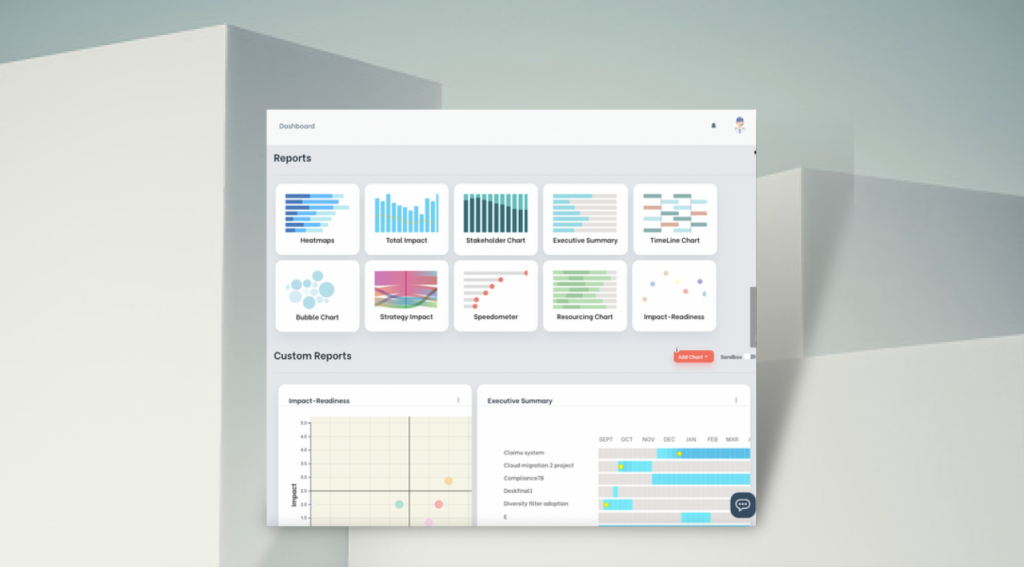
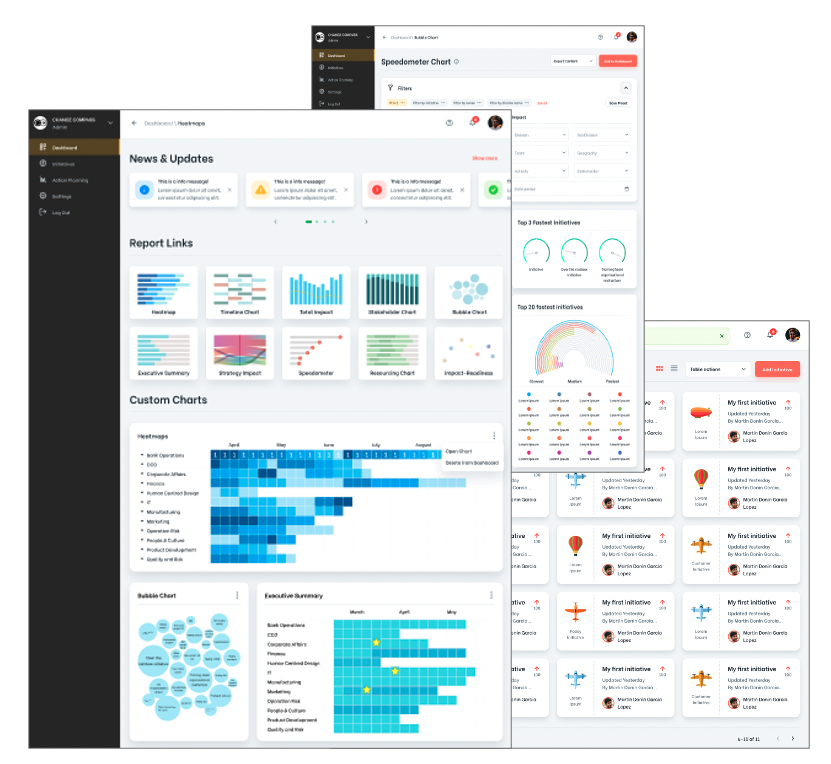
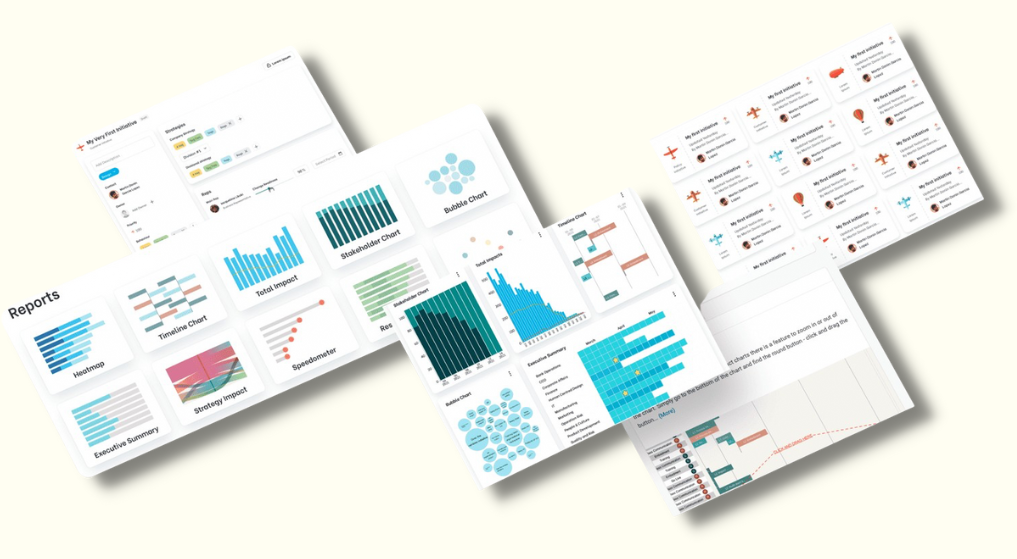
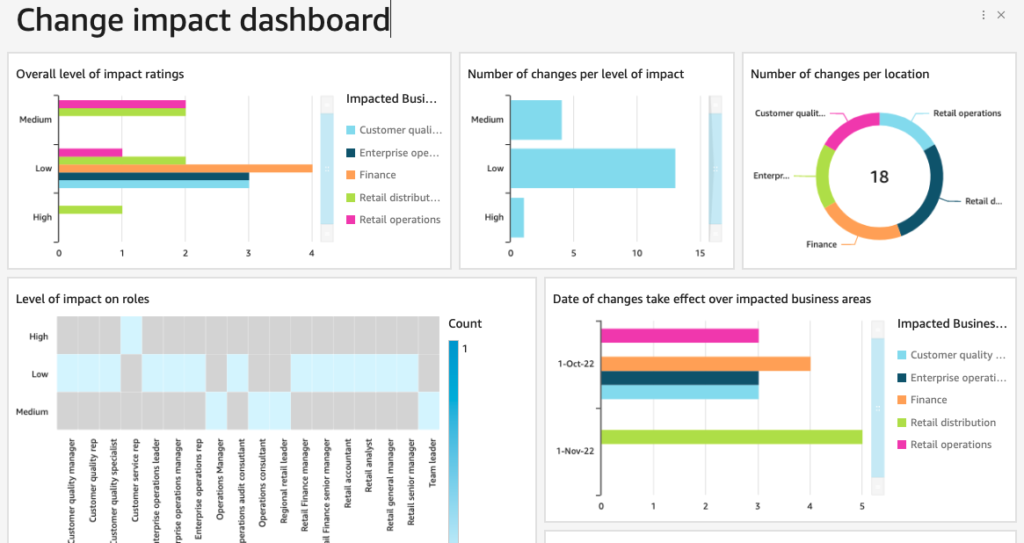
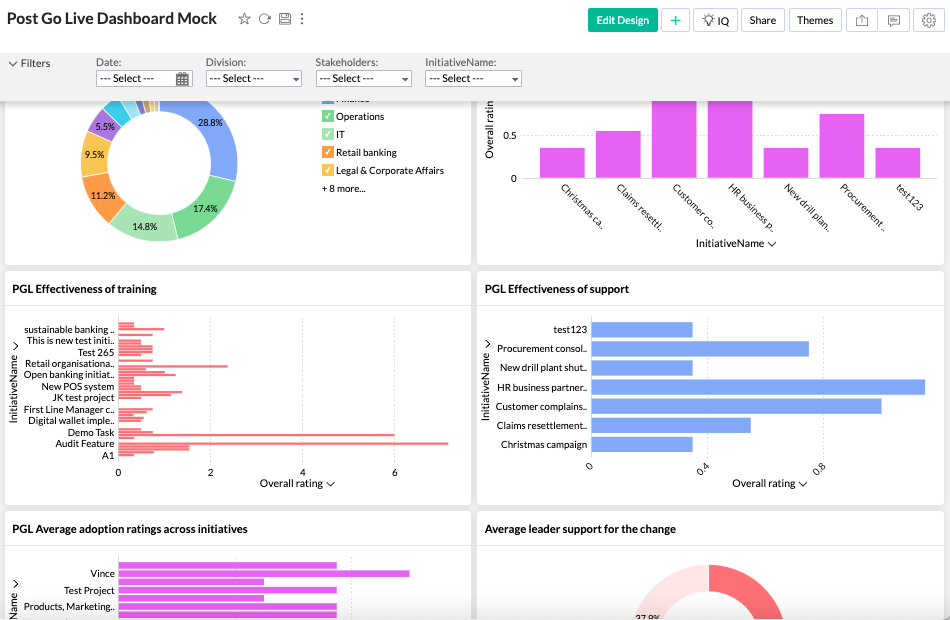
Enterprise change management reporting is changing. In today’s dynamic business environment, it no longer consists of general updates on organisational change management efforts, change leaders, streams of project progress, or updates on various change capability training session volumes and satisfaction rates. Executives are demanding more value from enterprise change functions that incorporate change management practices and digital transformation, leveraging new tools. The pace of change since Covid has not slowed down. For many, it has increased in pace and volume. To gain better insight into how the change management function is supporting the success of organisations, reports and dashboards have often become a visible linchpin of what value enterprise change management delivers.
What is enterprise change management and why is it important?
Enterprise change management refers to the structured approach organizations use to manage the people side of change in organizational change management, including the types of organizational change in processes, systems, and personnel across an entire organization, while integrating risk management principles. It’s crucial for minimizing disruption, ensuring smooth transitions, and enhancing employee engagement. Effective change management fosters resilience, boosts productivity, and aligns teams with organizational goals for sustained success.
What is enterprise change management and why is it important?
Enterprise change management refers to the structured approach organizations use to manage changes in processes, technologies, and organizational structures, including various type of change efforts that relate to the levels of change management. It’s crucial for minimizing resistance and ensuring smooth transitions. Effective change management enhances employee engagement, drives project success, and fosters a culture of adaptability within the organization.
Having the right content and format for your enterprise reports can make or break your reputation in the realm of information technology. Do it right and you could start a ripple of high-impact and strategic conversations across senior stakeholders that drive focus on improving change. You can be in the spotlight in influencing change leadership and the achievement of change and transformation goals. Do it wrong and you may never have another opportunity to have the room to talk about change management to senior leaders. You may be associated with not providing much value and too ‘operational’.
At its core, enterprise change management reporting goes beyond merely tracking progress. It encompasses a holistic approach that considers various factors crucial to the success of organizational initiatives. While monitoring progress, readiness, and the amount of work done may be interesting components, true impact comes from focusing on impacts, adoption and predictors for benefit realization.
Executives and stakeholders are not just interested in receiving progress updates; they seek insights into the likelihood of initiative success and the potential risks that may impede desired outcomes. These risks extend beyond project timelines and budget constraints to encompass broader business implications such as performance impacts, capacity constraints, prioritization effectiveness, and the sustainability of behavioural change.
Impacts of change:
Quantifying and visualising impacts are not new to change practitioners. The key is how the data is presented over time. A lot of change practitioners would settle with a standard heatmap based on personal ratings. This does not deliver much value as the data cannot be easily substantiated by evidence (since it is more of a finger in the air estimation). Standard heatmaps also are too high level and does not really support key decision making.
Decision making requires specific data points such as:
Change saturation or change tolerance levels (these levels need to be substantiated based on business indicator reference to justify the levels, and not be someone’s personal opinion)
What division, team, role and which week the saturation points are forecasted
Corresponding data on what initiatives, and their respective impact activities that contribute to the saturation risk, and therefore proposed options
A key part of representing change impacts should not just be at an operational level, which is more concerned about capacity and bandwidth. Impact should also be tied to strategic levers, portfolio types, benefit types and readiness.
Predictive Indicators for Success:
To create impactful change management reports, organizations must incorporate predictive indicators that go beyond change volume and risk assessment. These indicators should provide insights into business performance, strategy achievement, and the realization of intended benefits.
These are some of the ways you can incorporate predictive indicators:
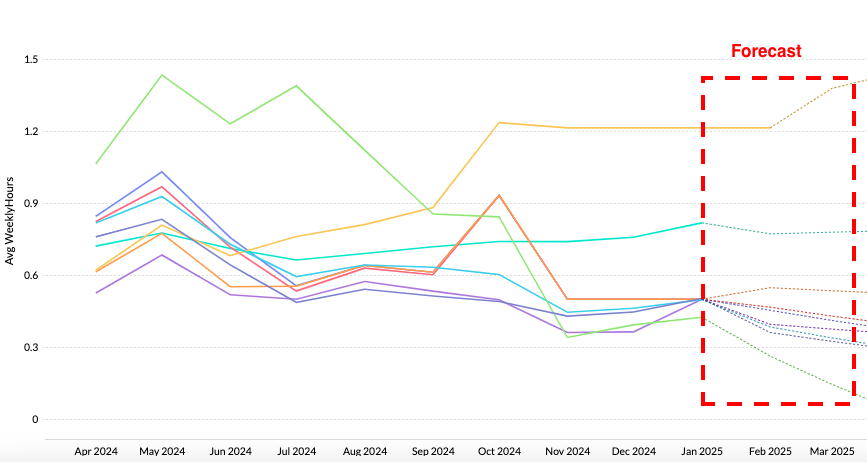
Forecast lines. With sufficient data you can forecast such as impact or capacity levels (which may be seasonal), or even readiness levels across the initiative lifecycle historically across initiatives.
The types of factors that can be included as predictive indicators can include readiness. It could be that readiness levels only get lifted just before go live or at go live. Adoption levels can also be forecasted if you have trend data across initiatives
Change tolerance levels across different parts of the business can also be seen as a predictive way of forecasting how much capacity there is for change beyond which saturation may be a key risk
Adoption and Behaviour Tracking:
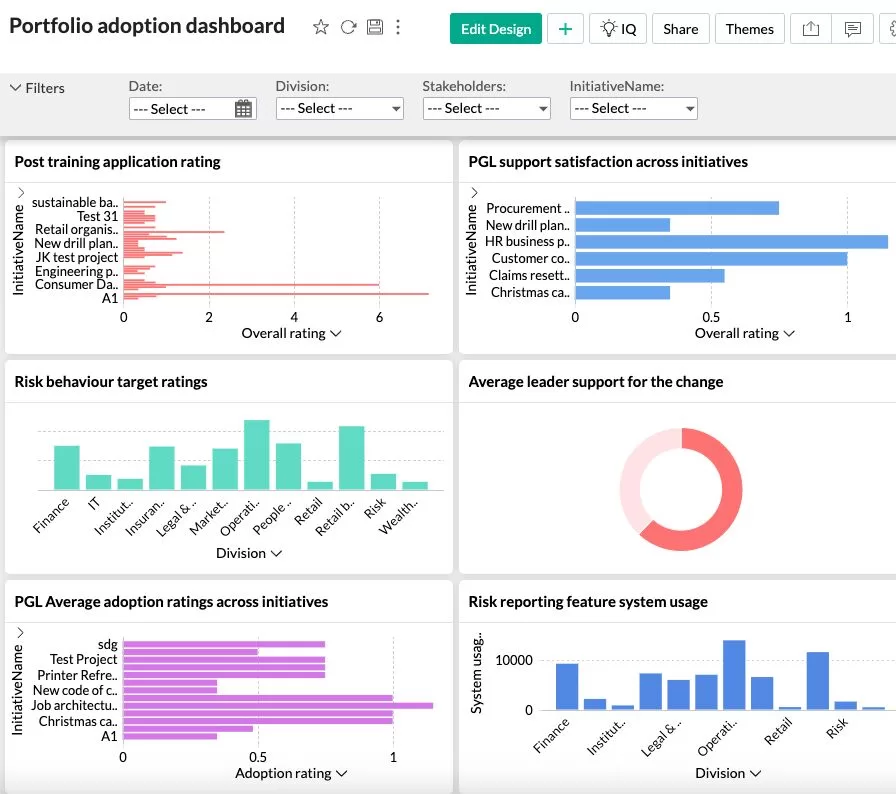
Central to successful change management is the adoption and sustained implementation of new processes or technologies. Tracking adoption rates, user engagement, and behavioural changes are crucial indicators of initiative success. However, it’s essential to strike a balance between capturing relevant metrics and overwhelming stakeholders with unnecessary data.
Capturing behaviour change data can be key for larger initiatives or transformations. Behavioural change can be central in a range of changes such as customer centricity, efficiency, team collaboration or effectiveness. Measuring key behaviour changes that drive the initiative outcome the most is critical. For example, having effective conversations with customers to improve customer experience is a behaviour that can be rated, tracked and reported. Depending on the change, there may also be system features that can aid the tracking of these behaviours.
Effective change management goes hand in hand with strategic alignment, strategic goals, and necessary resources for strategic objectives. Reports should assess how initiatives contribute to overarching business objectives and whether they align with the rest of the organization’s strategic direction in the first place. Business leaders can utilize metrics related to revenue growth, cost savings, customer satisfaction, and employee productivity to provide valuable insights into the impact of change initiatives on business performance.
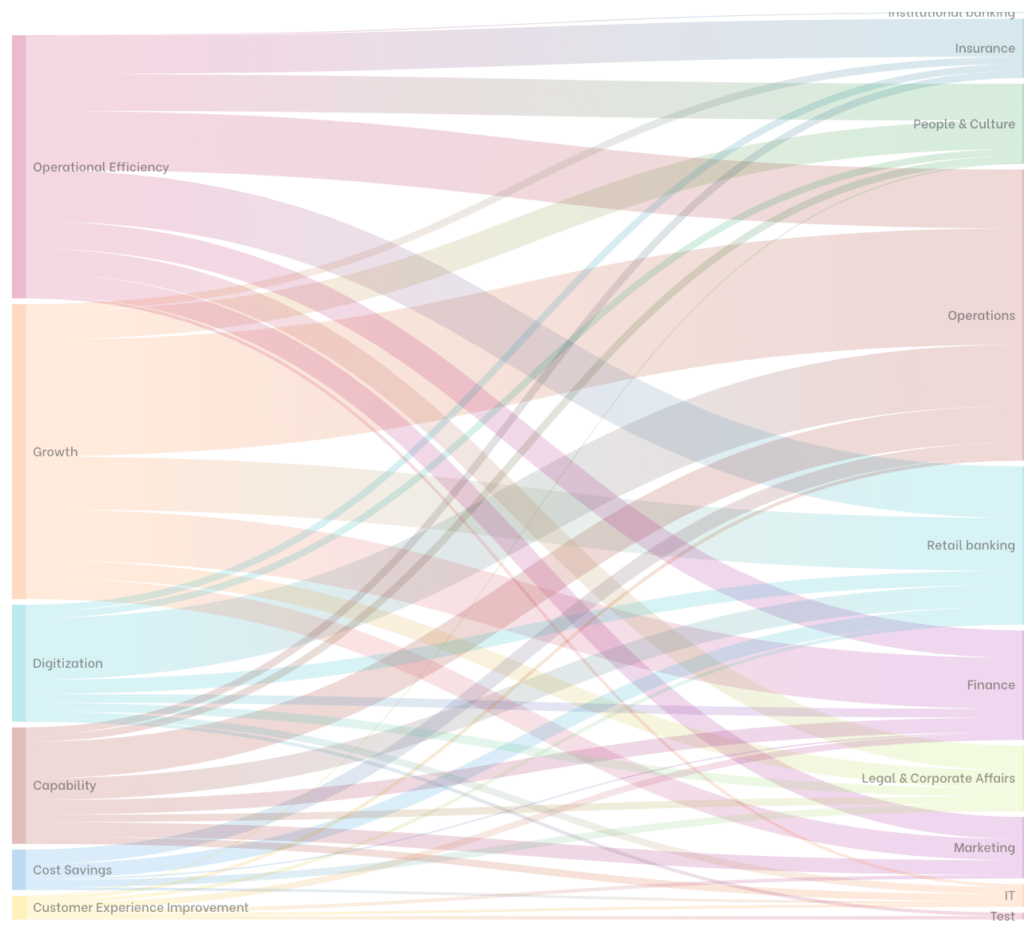
You can also link your change impacts to each strategic lever. In this way you can visually show the size of the impact per strategic lever. This will give your executives a way to examine whether the right level of impacts in the right areas of business are planned as a part of the course of each strategic lever.
The other angle is to visually show the pace of change against the strategic levers. Are certain key initiatives being driven at the right pace at the right time? Will the velocity of change exceed the ability of the business to absorb the changes? Or is the velocity not sufficiently meeting leadership expectations?
Benefit Realization:
Ultimately, the success of change initiatives is measured by their ability to deliver tangible benefits and assess the impact of the change. Change management reports should include key performance indicators (KPIs) and metrics that track the progress of change initiatives and the realization of expected benefits, whether they are financial gains, process efficiencies, or competitive advantages. By monitoring benefit realization, organizations can course-correct as needed and ensure that investments in change deliver the intended outcomes.
A key responsibility for change is to focus on those foreward looking measures that predict eventual benefit realisation, including readiness, adoption, engagement and behaviour change. Be sure to link these specifically to high benefit initiatives to provide strategic oversight.
Balancing Complexity and Clarity:
While incorporating a diverse range of metrics is essential for comprehensive reporting, it’s equally important to maintain clarity and focus. Reports should be structured in a way that highlights key insights and trends without overwhelming stakeholders with excessive detail. Visualizations such as charts, graphs, and dashboards can help distill complex data into actionable insights, facilitating informed decision-making at all levels of the organization.
All aspects of chart and dashboard designs are critical. These range from colour scheme chosen, number of charts, commentary, titles, legends, sequencing of charts, and type of charts chosen all act to either contribute to simplicity and clarity or complexity and confusion. Your narrative as you talk through the charts also plays a key role in building the story-line, and simplifying the key messages and actions you would like to impart to the audience.
Charts and dashboards tell a story and in presenting them you should always incorporate any actions required from the audience. If this is not done then it will always remain a FYI. FYI content will be deemed lower in the value curve over time and your stakeholders will lose interest. Instead, you should work on crafting a continual story that ebbs and flows. The following are key questions you should be asking when crafting you ongoing charts and dashboards:
Is there an emerging risk or opportunity that warrants specific focus for this month?
How are we tracking the effectiveness of stakeholder actions through data? This feedback loop is critical and gives your stakeholders a reference point for their own effectiveness
Is your data-based story uni-dimensional? Are there other dimensions beyond what you have been presenting that stakeholder should be aware of?
Are you giving stakeholders what they are most interested in? Whether it be strategic success progress, or benefit realisation?
Are you presenting change data in a holistic way in terms of how the business is run? Vs. just focused on standard change management function-specific metrics such as training sessions, or number of workshops completed?
Enterprise change management reporting is a critical tool for navigating the complexities of organizational change. By focusing on predictive indicators, including adoption and behavior tracking, business performance alignment, and benefit realization, organizations can unlock the full potential of their change management initiatives. However, achieving impactful reporting requires a careful balance between complexity and clarity, ensuring that stakeholders receive actionable insights without being inundated with unnecessary information. Ultimately, by harnessing the power of enterprise change management reporting, organizations can drive successful outcomes and thrive in an ever-evolving business landscape.
To find out more about enterprise change management reporting leveraging digital automation and analytics chat to us here.
Enterprise change management reporting refers to the systematic reporting of change management data across an organisation’s full portfolio of change initiatives – not just individual programme updates. It provides leadership with visibility of the total volume and complexity of change the organisation is absorbing, the adoption performance across all major programmes, and the change capacity available to absorb further change. Enterprise reporting is the foundation of a mature, data-driven approach to change governance.
How does enterprise change reporting differ from programme-level change reporting?
Programme-level change reports focus on the readiness, adoption, and risk status of a single change initiative. Enterprise change reports aggregate data across all programmes to show the full picture of change load, resource deployment, and adoption performance at the organisational level. Enterprise reporting answers questions that programme-level reporting cannot: which employee groups are over-saturated with change? Which programmes are competing for the same people’s attention? Is the organisation’s change capacity sufficient for the current and planned change portfolio?
What data do you need for enterprise change management reporting?
Enterprise change reporting requires three types of data: change portfolio data (what changes are being delivered, to whom, and on what timeline), change impact data (the level of disruption each change creates for each affected employee group), and adoption data (the rate at which changes are being adopted across the organisation). Collecting and aggregating this data manually is extremely difficult at enterprise scale – a purpose-built change management platform is typically required to make enterprise reporting sustainable and credible.
How to measure change saturation: a practical methodology for enterprise change functions
Most organisations can feel change saturation before they can prove it. Leaders sense that employees are struggling, change managers notice adoption slipping, and business partners start raising concerns about “too much at once.” But when it comes to quantifying the problem, securing executive attention, or making a credible case for adjusting programme sequencing, feeling is not enough.
Measurement changes that dynamic entirely. An organisation that can measure change saturation can demonstrate it, act on it, and prevent it from quietly undermining transformation outcomes. An organisation that cannot measure it is stuck responding to symptoms rather than causes.
This article sets out a practical methodology for measuring change saturation in enterprise environments: what to measure, how to score it, what the data tells you, and how to turn the output into decisions that protect adoption and reduce change fatigue.
Why change saturation is so difficult to measure
The challenge with measuring change saturation is that it is not a single variable. It is an emergent condition that arises from the interaction between several variables: the volume of concurrent changes landing on a group, the intensity of each change, and the capacity of the group to absorb them. None of these is directly observable in isolation.
Volume is relatively straightforward to count: how many programmes are actively affecting this group right now? But volume without intensity gives you an incomplete picture. A group managing two major system replacements simultaneously is more saturated than a group managing ten minor policy updates. And both assessments are useless unless they are calibrated against capacity: a high-performing change champion network in a well-managed business unit with experienced managers can absorb more than a stretched team in the middle of a restructure.
Prosci’s Best Practices in Change Management research found that 73% of organisations surveyed were near, at, or beyond the saturation point. The reason that number is so high is not that organisations are careless. It is that most organisations have no systematic way to see saturation building before it becomes critical.
The three dimensions of a change saturation measurement model
A rigorous methodology for measuring change saturation needs to address all three dimensions: load, intensity, and capacity.
Dimension 1: Change load
Change load is the quantitative foundation of saturation measurement. It answers the question: how much change is being asked of this group, across all programmes, right now?
Calculating change load requires a portfolio-level view. For each group of employees, you need to know:
How many programmes are currently in active delivery (preparation, go-live, or post-go-live embedding)
The size of the group and the proportion affected by each programme
The timeline of each programme’s peak demand periods
A simple change load index can be constructed by assigning each programme a weight (based on the size and duration of its demand on the group) and summing those weights for each group across the current period. The output is a comparative score: Group A has a load index of 4.2, Group B has a load index of 1.8. High-load groups are immediate candidates for deeper investigation.
Dimension 2: Change intensity
Not all changes demand the same cognitive and behavioural adjustment. Change intensity measures how disruptive each individual programme is to the employees it affects. A robust intensity assessment covers the following dimensions:
Process change: Are employees being asked to follow materially different processes or procedures?
System change: Are new technologies being introduced that require new skills and habits?
Role change: Are roles being restructured, responsibilities shifting, or reporting lines changing?
Behavioural change: Are fundamental ways of working or cultural norms being challenged?
Location and environment: Are physical working arrangements changing?
Each dimension is typically scored on a scale of one to five: one meaning minimal adjustment required, five meaning radical shift. The total intensity score for a programme across all dimensions provides a standardised basis for comparison that goes well beyond “major” and “minor” labels.
When intensity scores are multiplied by the number of people affected, you get a weighted impact figure that can be aggregated across all programmes to give a cumulative impact score for any stakeholder group.
Dimension 3: Absorption capacity
Absorption capacity is the most subjective of the three dimensions, but it is also the most important for calibrating risk. Two groups facing identical change load and intensity may have very different actual saturation risk depending on their current capacity to absorb change.
Factors that increase absorption capacity include: a recent track record of successful change adoption, strong and engaged line managers who actively support transitions, low current business workload, a stable team structure, and access to dedicated change support resources.
Factors that reduce absorption capacity include: recent history of poorly managed change, a restructure or leadership transition in the past twelve months, high current business workload or seasonal pressure, high attrition in the period, and limited manager availability.
Capacity can be assessed using a structured scoring approach: assign each factor a weight and a score, sum the results, and produce a capacity index. When capacity is low and load is high, the saturation risk calculation shifts dramatically.
Combining the three dimensions: the saturation risk score
Once you have load, intensity, and capacity scores for each stakeholder group, you can combine them into a single saturation risk score. The formula is straightforward in principle:
Saturation Risk = (Change Load x Average Intensity) / Absorption Capacity
Groups with a high numerator (high load and high intensity) and a low denominator (low capacity) are at the greatest risk of saturation. Groups with moderate load, moderate intensity, and high capacity may be managing comfortably.
The specific weighting and calibration of this formula will vary by organisation. The important thing is that the formula is applied consistently across all groups and time periods so that comparisons are meaningful. An organisation that calculates saturation risk scores every quarter develops a trend view: is this group’s score rising, stable, or declining? That trend view is often more actionable than any single data point.
Gartner’s research on change fatigue identifies the cascading effects of high saturation: employee intent to stay declines by up to 42% and individual performance can fall by up to 27%. Having a risk score that flags these conditions before they materialise is what gives organisations time to intervene.
Leading indicators: what to watch before saturation becomes critical
Quantitative load, intensity, and capacity scores are the analytical foundation. But they are only as useful as the data that feeds them. Leading indicators provide an early warning layer that flags emerging saturation risk in real time.
The most reliable leading indicators for change saturation include:
Readiness assessment scores: If stakeholder readiness surveys are showing declining confidence in the same groups across multiple programmes, that is a strong signal of emerging saturation even before adoption data confirms it.
Support ticket volume and type: A spike in “how do I” tickets, process queries, or errors in a group that has recently gone through multiple changes indicates that new ways of working are not yet embedded.
Manager-reported concerns: Direct reports from line managers about team overload, confusion about priorities, or declining morale are a ground-level signal that formal data often misses.
Participation rates in change activities: Declining attendance at training sessions, communications open rates falling, or drop-off in workshop participation are early indicators that employees are starting to disengage from change processes.
Pulse survey sentiment: Structured short-cycle surveys asking employees specifically about their change experience, not just general engagement, can surface saturation signals weeks before adoption metrics deteriorate.
The value of these indicators is in their combination. Any single signal can have alternative explanations. When multiple leading indicators are moving in the same direction for the same group, the probability of saturation risk is high.
Lagging indicators: confirming what the leading indicators predicted
If saturation goes undetected or unmanaged, it will eventually show up in lagging indicators. These are retrospective: they confirm that saturation has already occurred, rather than giving you time to prevent it.
Key lagging indicators include:
Adoption rates below threshold: If post-go-live adoption data shows that target behaviours are not being sustained at expected levels, saturation is one of the most common root causes.
Benefits realisation shortfalls: When programmes that expected to deliver financial or operational outcomes within a defined period consistently fall short, compounded change load is often a contributing factor.
Attrition spikes in high-change groups: Research from Prosci identifies that 54% of employees experiencing change fatigue actively look for a new role. Voluntary attrition data disaggregated by group and correlated with change load data can confirm saturation impact after the fact.
Quality or error rate increases: In operational groups going through system or process changes, a measurable increase in errors or rework can indicate that employees are not yet proficient in the new ways of working.
Tracking lagging indicators matters for two reasons. First, they close the loop on the saturation risk methodology: if your risk scores correctly predicted the groups that experienced adoption failure, your model is calibrated well. Second, they provide the evidence base for executive conversations about saturation impact, which is often necessary before organisations will invest in prevention.
Building a change saturation dashboard
Measurement only creates value when it is visible to the people who can act on it. A change saturation dashboard serves as the primary communication tool for the enterprise change function, translating complex multi-variable analysis into a format that programme sponsors, business unit leaders, and transformation executives can consume quickly.
An effective saturation dashboard includes:
Portfolio heat map by group: A matrix showing which stakeholder groups are carrying the highest change load in the current quarter, with colour coding indicating saturation risk levels.
Trend lines for high-risk groups: For groups flagged as high-risk, a rolling view of their saturation score over the past two to four quarters.
Programme convergence view: A calendar-based visualisation showing where multiple programmes are landing on the same groups in the same window.
Leading indicator summary: A consolidated view of the current readings on key leading indicators, with flagging for any that are trending in a concerning direction.
Intervention log: A record of what saturation management interventions have been initiated, by whom, and for which groups.
This kind of visibility transforms saturation management from a reactive exercise into a governance function. When the dashboard is presented regularly to the portfolio governance committee, saturation risk becomes a standing agenda item alongside cost, schedule, and scope.
Practical tools for saturation measurement at scale
For enterprise change functions managing ten or more concurrent programmes, the practical challenge of measuring saturation is significant. The data collection, aggregation, and analysis required to maintain a current, accurate view of saturation risk across a complex portfolio cannot be managed sustainably in spreadsheets.
Change Compass is built specifically for this challenge. The platform provides enterprise change functions with a centralised data infrastructure for capturing change impact and load across the portfolio, automated aggregation of cumulative change demand by stakeholder group, and real-time visualisation of saturation risk. Rather than manually compiling data from twelve different programme SharePoint sites, change managers can work from a single source of truth that surfaces portfolio-level risk automatically.
For change teams in the early stages of building measurement capability, starting with the Change Compass weekly demo is a practical way to see what portfolio-level saturation measurement looks like in practice before committing to a platform investment.
Making measurement actionable: from scores to decisions
The ultimate purpose of measuring change saturation is not to produce scores. It is to produce better decisions about how the change portfolio is managed. A saturation risk score that sits in a report and is never acted on has no value.
The decisions that saturation measurement should be driving include:
Sequencing decisions: When high-risk groups are identified, programme governance should have a mechanism to delay or phase go-live dates for lower-priority programmes to reduce peak load.
Resourcing decisions: Groups identified as high-risk may require additional change support capacity, including dedicated practitioners, enhanced manager coaching, or intensified communication.
Scope decisions: When sequencing is not possible, MVP thinking applied to change scope can reduce the intensity of individual programmes landing on high-risk groups.
Reporting decisions: High-risk groups should be on the executive sponsor radar, with regular updates on saturation indicators and intervention progress.
Prosci’s research on change management metrics consistently identifies that organisations that actively measure and act on change data are significantly more likely to meet or exceed their project objectives. The measurement methodology matters, but the governance mechanism that turns measurement into action matters just as much.
Where to start: a phased approach to building saturation measurement capability
Most enterprise change functions cannot build a full saturation measurement system overnight. The most practical approach is phased.
Phase 1: Establish the data foundation. Standardise the change impact assessment template across all programmes so that group-level impact data is collected in a consistent, comparable format. Without this, aggregation is impossible.
Phase 2: Build the portfolio view. Map all active and upcoming programmes against the employee population in a shared register. Identify which groups are affected by more than two significant changes in the next quarter.
Phase 3: Add the intensity layer. For the highest-load groups identified in Phase 2, conduct structured intensity assessments for each programme affecting them. Calculate cumulative intensity scores.
Phase 4: Introduce capacity assessment. Develop a structured capacity scoring instrument for the highest-risk groups. Combine load, intensity, and capacity scores into a risk index.
Phase 5: Automate and sustain. Move from manual calculation to platform-supported aggregation and visualisation, so that saturation risk is maintained as a live view rather than a quarterly exercise.
The organisations that manage change saturation most effectively are those that started this journey early enough to have meaningful data before the next major convergence point. The methodology above is scalable from small beginnings, but the longer measurement is deferred, the less lead time there is to act.
Frequently asked questions
What is the best way to measure change saturation?
The most robust approach combines three dimensions: change load (the volume of concurrent programmes affecting a group), change intensity (how disruptive each programme is across process, system, role, and behavioural dimensions), and absorption capacity (the group’s current ability to take on change). Combining these into a saturation risk score, tracked over time, provides a meaningful basis for governance and intervention decisions.
How do you know when an organisation has reached change saturation?
Saturation is typically confirmed by a combination of leading and lagging indicators. Leading indicators include declining readiness scores across multiple programmes for the same groups, rising support ticket volumes, and falling participation in change activities. Lagging indicators include below-target adoption rates, benefits realisation shortfalls, and voluntary attrition spikes in high-change groups. When multiple signals align, saturation is almost certainly a factor.
What data do you need to measure change saturation?
The minimum data set includes: the change portfolio (all active programmes and their timelines), impact assessment data (which groups are affected, how significantly), readiness and adoption metrics from each programme, and capacity indicators for the highest-risk groups. Ideally this data is maintained in a centralised platform rather than distributed across programme-level documents.
Can change saturation be measured at the team level?
Yes, and team-level measurement is often the most actionable. While portfolio-level heat maps identify which business units or functions are carrying the highest load, team-level analysis identifies where the risk is most acute and allows targeted support to be directed precisely. Line manager input is essential for accurate capacity assessment at the team level.
How often should change saturation be measured?
At a minimum, quarterly. For organisations running fast-moving transformation portfolios, monthly or rolling measurement is more appropriate. The goal is to have enough lead time to act on risk signals before they translate into adoption failure. A retrospective saturation assessment after go-live confirms what happened but does not allow intervention.
Change management reports are the structured outputs that translate portfolio-level change activity, adoption progress, readiness signals and operational impact into the language and timeframes that executive sponsors, programme boards and senior leaders need to make decisions. The strongest reports combine four data layers: portfolio view (what is in flight and when), impact view (which groups are absorbing what), adoption view (whether new ways of working are sticking) and risk view (where saturation, sponsorship or capacity gaps threaten outcomes). Effective reporting cadences are tied to decision rhythms (monthly executive meetings, quarterly portfolio reviews) rather than producing data for its own sake.
Why Nailing the Right Change Management Metrics is Critical and Can Make or Break Your Reputation
As organizations strive to adapt and thrive in dynamic environments, how the change management process is tracked has become a strategic imperative. However, the success of any change initiative hinges not only on effective planning and execution but also on the ability to measure and communicate its impact accurately. After all, without the right measures how do we know that we are moving in the right direction? In this article, we explore critical change management reports that executives value in shaping organizational understanding and decision-making. We delve into the metrics that may compromise your credibility and, more importantly, highlight the metrics that executives truly value, providing a roadmap to creating reports that resonate with leadership.
Reading your executives and where they are
Prior to designing the right change management reports and metrics it is absolutely essential that you understand where they are coming from. Understanding their key concerns and perspectives will help you design the right content to engage them. Key questions you may want to delve into include:
What issues are top of mind for executives when it comes to managing change?
What has worked or not worked well in the past for change (within what timeline) that should be taken into account?
How experienced are these executives in driving complex change?
Putting your strategic hat on, what are the key business performance challenges that executives are facing into? What are the people and change connections to these?
What are the top key organisational risks that executives are focused on? What are the people and change connections to these?
Vanity Metrics – Metrics That Don’t Connect to Business Outcomes
One of the pitfalls in change management reporting is the reliance on vanity metrics—superficial measures that may look impressive but lack a direct connection to tangible business outcomes. Metrics such as the number of training hours delivered, numbers of stakeholder groups who received communications or the volume of communication materials distributed might seem impressive and easy to measure, but they provide little insight into the real impact of the change on the organization.
Executives are not interested in surface-level data; they want to understand how the change contributes to the achievement of strategic objectives and positively influences key performance indicators. To enhance credibility, change management reports must move beyond vanity metrics and focus on indicators that align with broader business goals.
Activity Metrics – Counting Without Context
Measuring the sheer volume of activities related to a change initiative can be misleading, or worse, meaningless, if not accompanied by context and relevance. Activity metrics, such as the number of workshops conducted, numbers of impact assessment activities conducted, number of deliverables worked on, or emails sent, might create an illusion of progress. However, these metrics fail to provide insights into the quality of engagement, the depth of understanding among employees, or the actual impact on work behaviours. Operational managers may find these interesting, but less likely for executives.
Instead of focusing solely on activities, change management reports should emphasize the effectiveness of these activities in driving desired outcomes. Metrics should, instead, highlight the quality of engagement, the level of understanding, and the behavioural shifts observed within the organization.
Cost-Focused Metrics – Counting Dollars Without Value
While cost-related metrics are important for financial stewardship, solely focusing on cost without considering the value generated by the change can undermine the perceived success of the initiative. Metrics such as the budget spent or the cost per participant may provide financial insights but do not necessarily convey the broader impact on organizational performance.
Change management reports should focus more on value metrics than cost metrics. Focusing purely on cost is restricting the value of managing change as another cost to the business. However, focusing on the value created in maximising business performance and achieving greater adoption can significant extend the understanding of change management value. Executives are interested in understanding what business value is created through managing change. Value includes how the targeted benefits are better realised and how the business performance is protected or maximised during the implementation of change.
Intra-Practice Metrics – Metrics That Only Change Management Cares About
It’s a common misstep to develop metrics that only resonate within the change management function and key project milestones but fail to capture the attention of other business units or executives. Metrics that focus exclusively on communication buzz generated, training satisfaction rates, or employee satisfaction with change processes might be valuable for internal assessments but lack the relevance needed to engage executives.
Even the focus on change maturity, that is often the single most critical focus for change management functions, may or may not appeal to a lot of executives. Unless you have already taken the executives on the journey of why focusing on change maturity is critical and you have them fully onboard with this, treat carefully in reporting on change maturity metrics.
At executive level, change management reports should transcend departmental boundaries and speak to the broader organizational impact. This means that your focus should be on reporting at a portfolio level and key strategic initiatives as relevant. Focus on generating insights of what the totality of changes mean to the organisation, and what employee experiences are across multiple initiatives. Metrics should also align with strategic goals and showcase how the change initiatives contributes to overarching business objectives.
The Right Metrics
I. Change Readiness Metrics – Assessing the Pulse of the Organization
Change readiness metrics serve as a barometer for understanding how prepared an organization is for a change initiative. To provide meaningful insights, these metrics should delve into the engagement journey, capturing key elements such as awareness, involvement, and participation.
Awareness: Measure the level of understanding and awareness of the upcoming change across different employee segments.
Involvement: Assess the degree to which employees are actively engaged in the change process, seeking their input and involvement.
Participation: Evaluate the extent to which employees are actively participating in change-related activities and initiatives.
Data Collection Methodology
Utilize a mix of quantitative and qualitative methods to gather data, including surveys, focus groups, and feedback mechanisms.
Ensure a representative sample across different organizational levels and functions to capture a comprehensive view of readiness.
Change Readiness Topic Areas
1. Awareness Assessment:
This section evaluates the extent to which employees are aware of the impending changes across initiatives. It includes an analysis of communication effectiveness, the clarity of messaging, and the overall visibility of the change initiatives. Metrics may encompass the percentage of employees who understand the change purpose and the reach of communication channels.
2. Involvement Evaluation:
Involvement is a key factor in gauging how actively employees are participating in the change process. This explores the degree to which employees feel engaged and have opportunities to contribute to the planning and decision-making aspects of the change. Employees may not have the opportunities to contribute to all types of change initiatives but for those that are relevant this can be quite insightful. Metrics include participation rates in change-related workshops, the number of submitted suggestions, and levels of engagement in feedback sessions.
3. Perceived Impact:
This area delves into employees’ perceptions of how the changes will affect them personally and professionally. It includes an analysis of perceived benefits, risks, and the overall impact on day-to-day responsibilities. Metrics may encompass the percentage of employees who feel well-informed about the impact of the change and qualitative insights from open-ended survey questions.
4. Change Champions performance:
Identifying and nurturing change champions can be crucial for successful change implementation, especially across the change portfolio. The presence of key business change champions who actively support and advocate for the changes within their teams and business units can shed light on how the change is performing. Metrics include the presence of key change champions across business areas, their engagement levels, and the effectiveness of their engagement strategies within their respective departments.
5. Learning and Development Readiness:
Learning and development play a vital role in equipping employees with the skills necessary for the upcoming changes. This section evaluates the organization’s readiness to deliver learning programs effectively, including the availability of resources, the alignment of learning content with change objectives, and the accessibility of learning materials. This can be outlined not just at initiative levels, but from business unit perspectives. Different business units may have different processes and channels from which to deploy learning and development across initiatives. The readiness and maturity of these can make or break the adoption of changes.
6. Resource Allocation and Availability:
Change initiatives often require additional resources, and this section examines the organization’s capacity to allocate and provide the necessary resources for a smooth transition. Metrics include the allocation and availability of SME resources, business representatives, the availability of technology and tools, and the overall preparedness of support functions for the myriad of change initiatives. Is there adequate allocation of these resources? For example, for digital transformation is there still reliance on manual work processes that should be upgrade to drive efficiency and effectiveness?
7. Leadership Alignment:
Leadership alignment is a critical factor influencing change readiness. This section evaluates the extent to which various leaders are aligned with the change vision and actively communicate their support. Metrics encompass leadership messaging consistency, visibility, and the perceived commitment of leaders to the success of the change.
8. Employee Feedback Mechanisms:
Establishing effective feedback mechanisms is essential for continuous improvement during change initiatives. This section assesses the availability, content and effectiveness of channels through which employees can provide feedback, ask questions, and express concerns. Metrics include response rates to feedback requests, the variety of feedback channels used, and themes of responses from targeted employee groups.
Change Readiness Data Collection Methods
Collecting data on change readiness is a crucial step in understanding an organization’s preparedness for a change initiative. Various approaches can be employed to gather relevant information. Here’s a list of key approaches:
Surveys and Questionnaires
Focus Groups
Interviews
Observation
Benchmarking
Document Analysis
Readiness Workshops
Network Analysis
Online Platforms and Social Listening
Pulse Surveys
Interactive Assessments
II. Change Journey Analytics – Navigating the Transformation Landscape
Change journey analytics provide a view of what key employee change experience highlights are, including insights on any behavioural changes, attitudinal changes, the volume of changes and how changes are being driven against key business performance challenges.
Change Volume Risks – Change volume risk measures highlight key change impact volumes across the business over time, with key call outs on any risks on heightened change periods.
Change Activity Design – The totality of change management activities across initiatives from the lens of impacted employee groups should be analysed with potential risks highlighted.
Single View of Change of BAU and Strategic Initiatives – Provide a consolidated view of ongoing business-as-usual (BAU) changes alongside strategic initiatives.
Business Performance – Link change activities to business performance metrics. Demonstrate how the change initiative contributes to key performance indicators and strategic goals.
Nurturing Lasting Transformation: The Role of Adoption Analytics in Sustainable Change
When we discuss adoption analytics, we transcend the traditional boundaries of project management. While implementation marks the beginning of change, adoption analytics guide us through the more profound stages, measuring the extent to which the organization has embraced and embedded the change.
1. Business Performance Metrics: Gauging Impact on Organizational Vital Signs
To truly understand the success of change initiatives, one must look beyond the surface and delve into its impact on key business performance metrics. This involves a holistic examination of factors such as productivity, efficiency, and customer satisfaction.
Productivity: Assessing the changes’ effects on productivity involves measuring the organization’s output and efficiency post-implementation.
Efficiency: Changes often aim to streamline processes and enhance efficiency.
Customer Satisfaction: In many cases, change initiatives are driven by a desire to improve customer experience.
By examining these metrics, organizations can gauge the real impact of the change on their vital signs, ensuring that the intended improvements manifest in tangible and measurable ways.
2. Benefit Realization: From Anticipation to Tangible Outcomes
Anticipated benefits form the backbone of any change initiative, but true success lies in the tangible realization of these expected outcomes. Benefit realization assessment through adoption analytics involves tracking key performance indicators (KPIs) directly influenced by the change.
Tracking KPIs: Identify and monitor KPIs that are closely tied to the specific objectives of the change.
Tangible Outcomes: Work hand-in-hand with initiative benefit owners to ensure clear ownership and tracking of benefits.
Continuous Improvement: Benefit realization is an ongoing process. Regularly review and adjust strategies based on the data collected.
Collaboration with Initiative Benefit Owners: A Crucial Element
A vital aspect of successful adoption analytics is collaboration with initiative benefit owners. Establishing clear ownership ensures accountability and facilitates a more targeted and effective approach to tracking and optimizing outcomes.
Crafting Compelling Change Management Reports
In the fast-paced world of change management, the ability to convey the impact of initiatives through well-crafted reports is a skill that cannot be underestimated. Executives require more than superficial metrics; they demand a nuanced understanding of how change aligns with strategic goals and influences organizational performance.
By steering clear of vanity metrics, activity-focused measurements, and overly cost-centric reporting, change management professionals can elevate their credibility and influence within the organization. Instead, a focus on change readiness, journey analytics, and adoption metrics provides a holistic perspective that resonates with executives.
A change management report for executive audiences should include: overall change programme status (on track, at risk, or off track); adoption and readiness metrics with trend direction; the top three risks with recommended mitigation actions; decisions required from the executive; and a summary of the change portfolio load on the most affected employee groups.
How often should change management reports be produced?
Portfolio-level change management reports should be produced monthly, aligned to the organisation’s governance calendar. Reports for active, high-risk change programmes should be produced fortnightly.
How do you make change management reports credible to senior leaders?
Credibility comes from data, not opinion. Reports that include quantitative adoption rates, readiness scores, and specific risk assessments are significantly more credible than reports that describe activities or use subjective language.
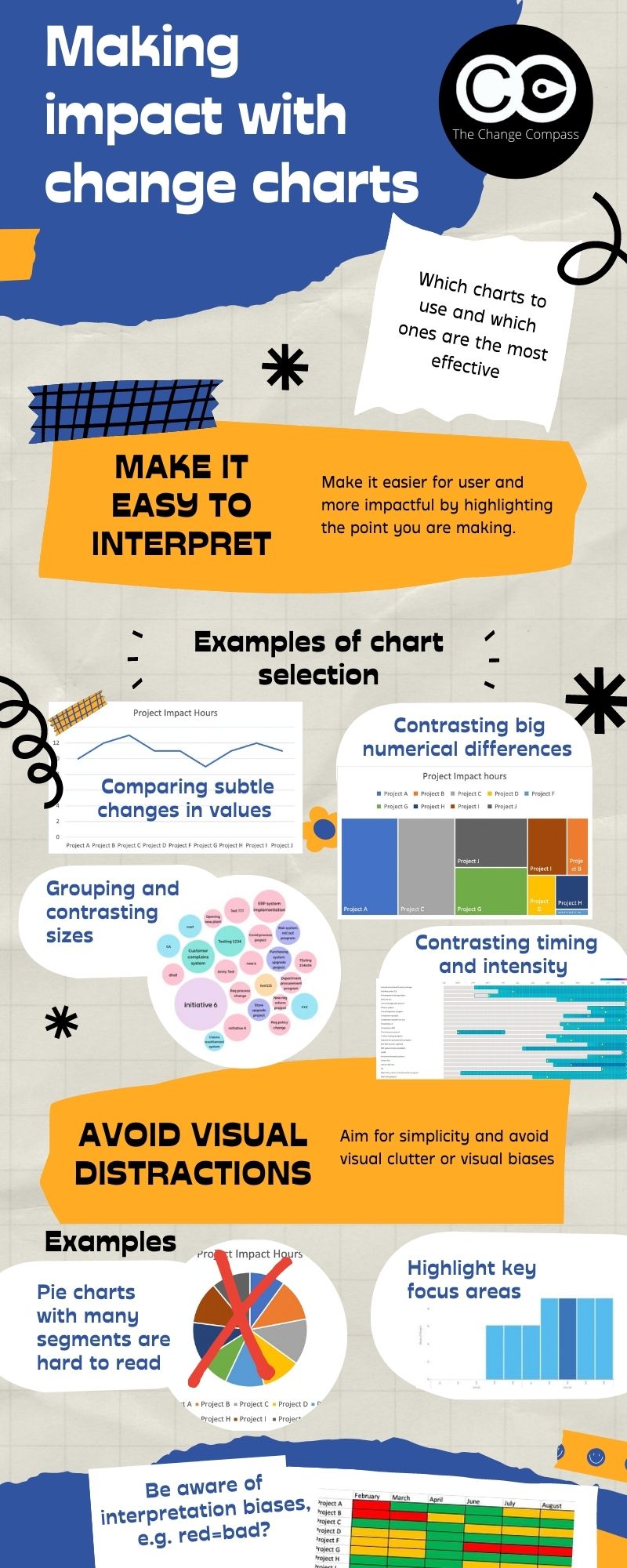
Infographic: Making impact with change management charts
Choosing the right chart type is as important as having the right data. This infographic summarises the key principles for selecting and designing change management charts that make an immediate impact with your audience.
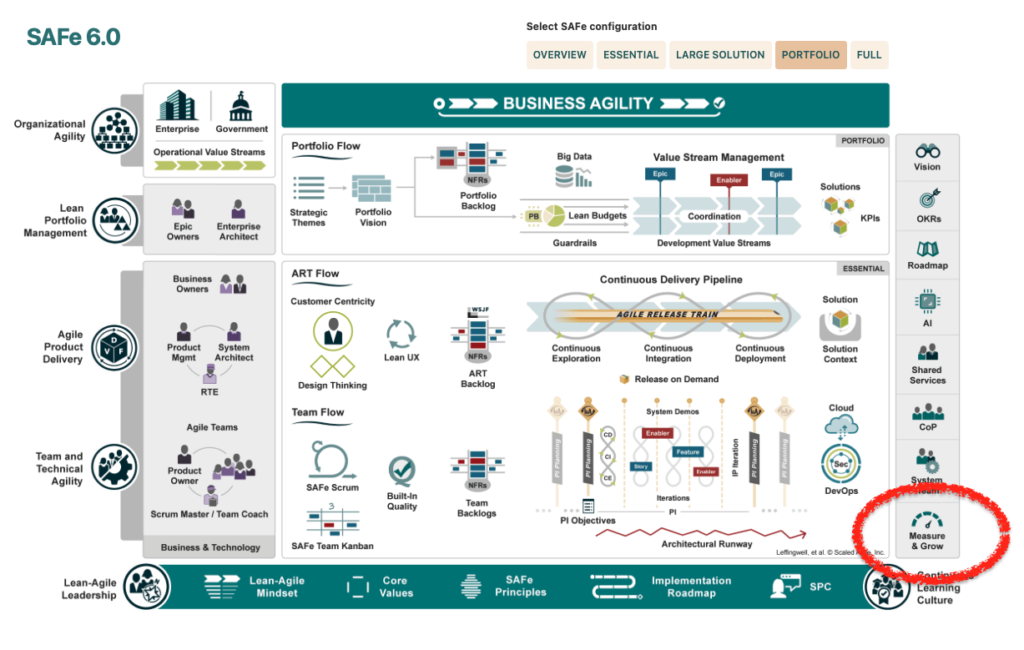
Scaled Agile Framework (SAFe) has emerged as a leading methodology to address the organisational change demands of fostering flexibility, collaboration, and continuous improvement. A cornerstone of SAFe is the principle of ‘Measure and Grow,’ which emphasizes using data and fact-based decisions to enhance change outcomes over time, including predictability. Despite its centrality, SAFe does not explicitly detail the change management components essential for its success, including its deep understanding of SAFe’s measurement model that enables the design of a tailored metrics strategy for ensuring strategic alignment. Here we outline how change management practitioners can effectively apply the ‘Measure and Grow’ principle within an Agile Release Train (ART) to lead change and improve outcomes to support the Scaled Agile environment.
What does it mean to “measure and grow” in a business context?
In a business context, “measure and grow” refers to the process of evaluating performance metrics to identify how our work drives business value and areas for improvement, aligning with strategic business goals. By analyzing data, companies can implement strategies that foster growth, enhance productivity, and improve overall outcomes. This approach ensures continuous development aligned with organizational goals.
The “Measure and Grow” Principle in Scaled Agile
What does it mean to “measure and grow” in a business context?
“Measure and grow” in a business context refers to the process of assessing performance metrics and outcomes to identify areas for improvement. By analyzing data, businesses can implement strategies that foster growth, enhance customer satisfaction, and optimize resource allocation, ultimately driving sustainable success and competitive advantage.
“Measure and Grow” is integral to SAFe, focusing on systematic measurement and continuous improvement for overall business agility within the value stream. By leveraging data and analytics, organizations can quickly respond to market changes, make informed decisions that meet the needs of our customers, identify areas needing attention, uncover improvement opportunities, and iteratively enhance meaningful change in performance. For change management professionals, this principle translates into a structured approach to evaluate the effectiveness of change initiatives, pinpoint areas for improvement, and implement necessary adjustments.
In a Scaled Agile environment, “Measure and Grow” is a core tenant or principle that applies in all types of agile environments. By continuously assessing and refining change efforts, organizations can align their initiatives with strategic objectives, mitigate risks, and ensure sustained success.
In practice, a lot of organisations have not pinpointed exactly how change management measures can make or break the outcome of the change, and in a SAFe environment, across the program, portfolio as well as enterprise.
The ‘Measure and Grow’ principle as a core part of SAFe (From Scaled Agile Framework)
To operationalize the “Measure and Grow” principle in change management, it is crucial to establish a set of metrics and assessment frameworks. Here are some broad categories of different types of change measurements that are relevant. Note that since we are talking about SAFe, it is not just at the initiative level that we are talking about metrics. More importantly, it is about establishing a system to promote change improvement across the organisation.
Change Management KPIs and OKRs
Key Performance Indicators (KPIs) and Objectives and Key Results (OKRs) are essential tools for tracking the success of change management initiatives. KPIs provide quantitative measures of performance, while OKRs align change efforts with broader organizational goals. A change management stream or function should focus on establishing KPIs or OKRs to achieve laser focus on achieving change outcomes.
Examples of Initiative-Level Change Management KPIs that may roll out to form portfolio views
Employee Engagement Levels: This KPI assesses how change impacts employee morale and engagement, providing insight into the overall acceptance and support of the change initiative.
Learning Achievement Rates: This can include tracking the percentage of employees who have completed necessary training programs, as well as achieving the target level of competence to ensure that the workforce is adequately prepared for the change.
Feedback Scores: Collecting feedback from stakeholders through surveys or feedback forms helps gauge perception and identify areas needing improvement. It is important to note that depending on the change context, stakeholders may not be happy with the content of the change. However, understanding and tracking this perception is still important.
Change Adoption Rate: This KPI measures the percentage of stakeholders who have adopted the change. High adoption rates are the ultimate goal for initiatives.
Issue Resolution Time: Measuring the time taken to resolve user-related issues related to the change highlights the efficiency of support mechanisms and the responsiveness of the change management team. This is especially important during an agile environment where there may be constant changes.
Change Readiness and Stakeholder Engagement Metrics
Evaluating change readiness and stakeholder engagement is crucial to the success of any change initiative. These metrics help assess the organization’s preparedness for change and the level of involvement and support from key stakeholders. Readiness and engagement rates can also roll up at a portfolio level to provide oversight.
Change Readiness Metrics
Readiness Assessments: Conduct surveys or interviews to gauge the organization’s preparedness for the impending change. This can include evaluating awareness, understanding, and acceptance of the change.
Resource Availability: Measure the availability of necessary resources, such as budget, personnel, and tools, to support the change initiative.
Communication Effectiveness: Assess the clarity, frequency, and effectiveness of communication regarding the change to ensure stakeholders are well-informed and engaged.
Stakeholder Engagement Metrics
Engagement Scores: Use surveys or feedback forms to measure the engagement levels of stakeholders, indicating their commitment and support for the change.
Participation Rates: Track stakeholder participation in change-related activities, such as workshops, meetings, and training sessions, to gauge their involvement.
Influence and Support: Assess the influence and support of key stakeholders in driving the change, ensuring that influential figures are actively endorsing the initiative.
By monitoring these metrics, change management professionals can identify potential barriers to change and take proactive steps to enhance readiness and engagement.
Stakeholder Competency Assessment
Successful change initiatives rely on the competence and readiness of key stakeholders. Assessing stakeholder competency involves evaluating the capability of sponsors and change champions to support and drive the change.
Sponsor Readiness/Capability Assessment
Sponsor Engagement: Measure the level of engagement and commitment from sponsors, ensuring they are actively involved and supportive of the change.
Decision-Making Effectiveness: Assess the ability of sponsors to make timely and effective decisions that facilitate the change process.
Resource Allocation: Evaluate the sponsor’s ability to allocate necessary resources, such as budget and personnel, to support the change initiative.
Change Champion Capability Assessment
Training and Knowledge: Measure the knowledge and training levels of change champions to ensure they are well-equipped to support the change.
Communication Skills: Assess the ability of change champions to effectively communicate the change message and address stakeholder concerns.
Influence and Leadership: Evaluate the influence and leadership capabilities of change champions, ensuring they can effectively drive and sustain the change.
By conducting these assessments, change management professionals can ensure that key stakeholders are prepared and capable of supporting the change initiative.
Change Adoption Metrics
Change adoption metrics provide insight into how well the change has been accepted and integrated into the organization. These metrics help assess the effectiveness of the change initiative and identify areas for improvement. At a portfolio level, there may be different levels of change adoption set for different initiatives depending on priority and complexity.
Key Change Adoption Metrics
Adoption Rate: Measure the percentage of stakeholders who have adopted the change, indicating the overall acceptance and integration of the new processes or systems.
Usage Metrics: Track the usage of new tools, processes, or systems introduced by the change to ensure they are being utilized as intended.
Performance Metrics: Assess the impact of the change on key performance indicators, such as productivity, efficiency, and quality, to determine the overall success of the change initiative.
By monitoring these metrics, change management professionals can gauge the success of the change initiative and identify opportunities for further improvement. To read more about change adoption metrics check out The Comprehensive Guide to Change Management Metrics for Adoption.
Change Impact and Capacity Metrics
Understanding the impact of change and the organization’s capacity to manage it is crucial for successful change management. Change impact metrics assess the effects of the change on the organization, while capacity metrics evaluate the organization’s ability to manage and sustain the change.
Change Impact Metrics
Aggregate impacts: Aggregate impacts across initiatives to form a view of how various teams and roles are impacted by various changes.
Risk Assessments: Identify potential risks associated with the change and evaluate their impact, ensuring that mitigation strategies are in place. A particular focus should be placed on business performance during change, across initiatives.
Capacity Metrics
Resource Capacity: Assess the availability of resources, such as personnel, budget, and tools, to support the change initiative and optimize flow time, enhance flow velocity, and improve flow efficiency while monitoring Flow Load.
Change Fatigue: Measure the risk for potential fatigue within the organization and its impact on stakeholders, ensuring that change initiatives are paced and driven appropriately.
Support Structures: Evaluate the effectiveness of support structures, such as training programs, information hubs, and help desks, in facilitating the change. Support structures may also include change champion networks.
By assessing change impact and capacity, change management practitioners can ensure that the organization is well-equipped to manage and sustain the change initiative.
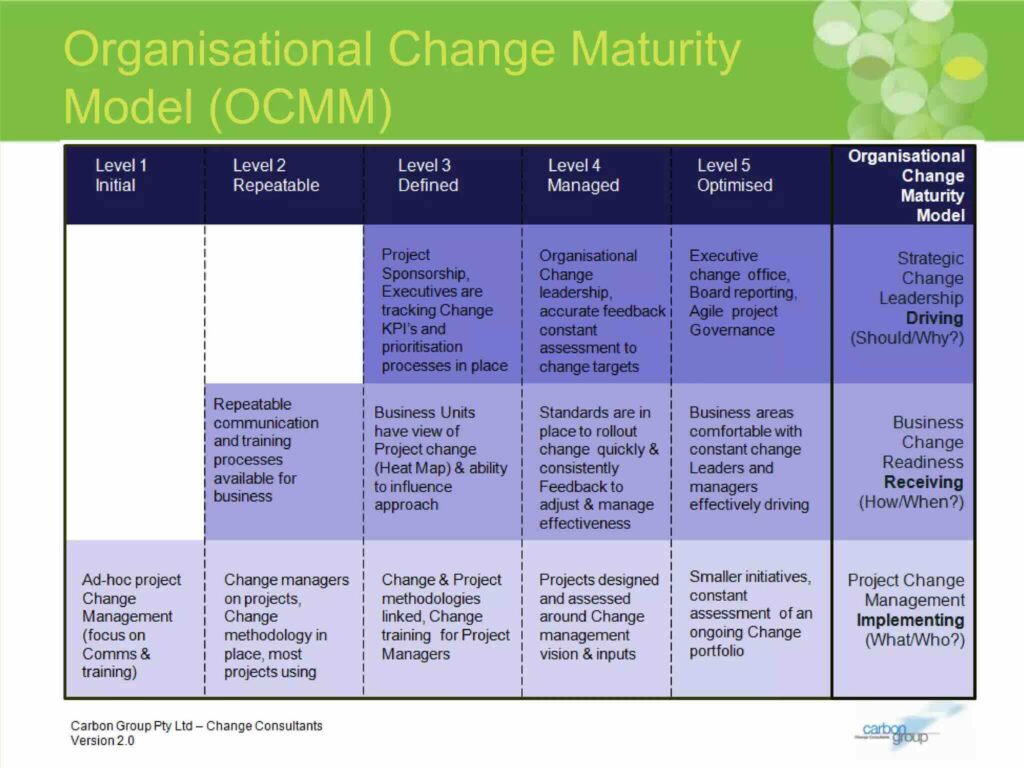
Change Maturity Assessment
Change maturity assessments provide a comprehensive evaluation of the organization’s capability to manage change effectively. These assessments help identify strengths and weaknesses in the organization’s change management practices and provide a roadmap for improvement.
The Change Management Institute (CMI) Change Maturity Model is a comprehensive framework that takes a holistic approach to enhancing an organization’s change management maturity. It’s divided into three core functional domains, each playing a vital role in the overall journey toward maturity:
Project Change Management
Business Change Readiness
Strategic Change Leadership.
These domains serve as the foundation for achieving higher levels of maturity within the organization.
Within each of these domains, the CMI model outlines a structured path, consisting of five distinct maturity levels. These levels represent a continuum, starting at Level 1, which serves as the foundational stage, and progressing all the way to Level 5, the zenith of maturity and effectiveness. This multi-tiered approach offers organizations a clear roadmap for growth and development, ensuring that they have the tools and insights necessary to navigate the complexities of change management.
By conducting regular change maturity assessments, change management professionals can identify areas for improvement and develop targeted strategies to enhance the organization’s change management capability.
The “Measure and Grow” principle is a powerful tool for improving change outcomes in a Scaled Agile environment. By leveraging data and fact-based decision-making, change management professionals can ensure that change initiatives are effective, aligned with strategic objectives, and continuously improving. Establishing robust metrics and assessment frameworks, such as KPIs, OKRs, change readiness and stakeholder engagement metrics, stakeholder competency assessments, change adoption metrics, change impact and capacity metrics, and change maturity assessments, is essential to applying the “Measure and Grow” principle effectively.
Incorporating these metrics and assessments into change management practices enables organizations to identify areas for improvement, make informed decisions, and drive continuous improvement. By doing so, change management professionals can enhance the effectiveness of change initiatives, ensure successful adoption, and ultimately achieve better business outcomes.
An enterprise change management organisational structure defines who owns change capability, who delivers individual change programmes, and how authority and resources flow between them. The three common models are centralised (a single enterprise team owns all change delivery and methodology), federated (a central centre of excellence sets standards while embedded practitioners deliver in each business unit) and hybrid (a small central team plus delivery partners and on-demand specialist resources). The right choice depends on portfolio scale, organisational maturity, and how much variation each business unit needs in how change is delivered. None is universally correct, but the wrong choice creates friction and slowed adoption.
Exploring Organisational Structures for Optimal Enterprise Change Management
Change is an inherent part of every organization’s journey towards growth and adaptability in an ever-evolving business landscape. In the realm of change management, one critical consideration is the organisational structure or design that best facilitates successful enterprise change management. There are plenty of different ways to structure change management practices. Like any type of organisational structures for organisations overall, there is not one way that is the most effective. It depends on the circumstances of the company in concern.
Centralised Change Management Structure
Centralised change management structures consolidate the authority, decision-making, and oversight of strategic change management initiatives within a single, dedicated team or department. In such a structure, the change management team sometimes reports directly to either Strategy or Office of the CEO. This approach provides the change practice significant influence due to its direct linkage with strategy.
Reporting Lines: HR, IT, Strategy, and More
In addition to the choice between centralised and federated structures, change management specialists (and the senior leaders that they report to) often grapple with determining the optimal reporting lines for their change teams. Several departments within an organisation are typically considered for hosting the change management function:
1. Human Resources (HR or People & Culture)
Reporting to HR aligns cultural change management with employee engagement and organisational development, which is essential for enhancing a company’s culture. This can be particularly effective when change initiatives heavily impact the workforce, as HR possesses expertise in people-related matters.
2. Information Technology (IT)
With the increasing digitalization of business processes, reporting to IT can ensure that complex technology-driven changes, including the introduction of new technology and digital transformation, as well as improvements in product offerings, are well led and managed across the enterprise. The remit for change practices reporting to IT can range from including just technology changes, to all strategic and funded initiatives, through to all of change management as a function.
3. Strategy or Transformation Office
Reporting to the strategy or transformation office closely ties change management to the organization’s overarching strategic goals. This alignment ensures that change initiatives are directly linked to long-term vision and objectives.
4. Operations
For a lot of organisations, the Operations function can determine a lot about how the organisation is run. This can include the change management function as well. The advantage of having the change practice reporting to Operation can mean that the operating rhythm of the organisation can be designed with the right change management approaches to support business goals. The way employees are engaged, how they’re involved, and how BAU processes are run, measured, and reported can be designed with change management interventions.
Key benefits of a centralised structure include:
Consistency: Centralised control ensures consistent change management practices across the organisation, reducing confusion and increasing effectiveness in terms of setting a common level of practice. Consistency in terms of language and concepts mean that it is easier for the business to adopt change management principles and practices.
Resource Allocation: Easier resource allocation, as the centralised team can prioritize and allocate resources based on organisational priorities. With better economy of scale for a larger centralised team, the change group has the opportunity to resource initiatives using different levels of involvement, from sessional, part-time to full-time.
Alignment: Enhanced alignment with the organization’s strategic objectives, as the change management team directly interfaces with top leadership. This means that effort and focus areas as more likely to be on that which is most strategic and can impact the organisation the most.
Change maturity. The change practice has the opportunity to focus on building organisation-wide change maturity due to its ability to interface and influence across the organisation. While other change management structures may also have the ability to focus on building business change maturity, a centralised function has the advantage of having a greater impact level due to its scale.
In contrast, federated change management structures distribute change management responsibilities throughout various business units or departments. Each business unit maintains its own change management team, and these teams collaborate to execute change initiatives. Typically, these teams report to their respective department heads. This means that there is no formal enterprise change management function.
The advantages of a federated structure include:
Local Expertise: Greater understanding of department-specific needs and challenges, leading to tailored change strategies and therefore better change outcomes. Different business units can have very different cultures and different business needs. Having change professionals who understand the various intricacies of the business unit means that they’re able to design change approaches that will better meet business requirements.
Ownership and relationship: There may be increased ownership and commitment among departmental staff, as the change teams sits in the same business unit and are ‘one of them’ versus someone sent from a centralised team. Others in the business unit may be more conducive to advice and support from a colleague in the same broader business unit. It is also easier to establish a closer working relationship if the change practitioner is always working with the same teams.
Flexibility: Greater adaptability to changes in individual departments, as they can independently address unique issues. Without any direction from a central team, the business-dedicated team can better flex their service offering to meet the business unit’s particular focus areas. Whilst, a central team may de-prioritise departmental-level initiatives to be less critical, for a departmental team it is much easier to flex toward their priorities.
Impact on Business Results
The choice of change management structure and reporting lines can significantly impact an organization’s overall business results. Here’s how different structures can yield varying outcomes:
Centralised Structure Outcomes
Efficiency: Centralised structures can excel in efficiency of delivery due to its scale of economy. Whereas small departmental change teams may structure to flex and resource projects efficiently, larger change practices can avoid this by leveraging its range of practitioners with different levels of skill sets and availability.
Consistency: They ensure a consistent approach to change management, reducing confusion among business stakeholders and employees. The consistency of standards also mean that there is less risk that initiatives may experienced a change intervention that is less effective due to the centralised capability standards reinforced.
Top-Down Control: Change initiatives are closely aligned with strategic objectives set by top leadership. This means that any ‘pet projects’ or less prioritised divisional initiatives may not be as likely to be granted change management support. This does not necessarily mean that those departments won’t focus on those initiatives, it just means that change management resources are more prioritised toward what top leadership deems to be most critical.
Federated Structure Outcomes
Local Engagement: Federated structures promote local ownership and engagement, fostering a sense of responsibility among departmental staff. Department-specific change practitioners will be more familiar with ‘what works’ at the department level. They are better able to leverage the right engagement channels and have the ability to access management and leadership roles at the department to garner support and drive overall initiative focus and success.
Adaptability: They allow for greater adaptability to unique departmental needs, which can be crucial in complex organisations. For example, the types of change management approaches and interventions that work for Sales organisations will be very different compared to that for call centres or processing centres, especially as employees transition into new roles. The ability for the change practitioner to adapt locally, supported by a strong company culture, can make or break an initiative’s success.
Innovation: Different units can experiment with various change approaches, leading to innovative solutions. This can be done without the confines of what is the overarching ‘standards and guidelines’ from the centralised change team.
Comparing the three structural models
The following table summarises the key characteristics, strengths, and watch-outs of each structural approach, to help guide your decision.
Characteristic
Centralised
Federated
Hybrid
Decision-making
Central change team leads all decisions
Business units lead locally
Shared between centre and BUs
Consistency of practice
High
Variable
Moderate to high
Responsiveness to local needs
Low
High
High
Resource efficiency
High (no duplication)
Lower (distributed resourcing)
Moderate
Best suited to
Regulated industries, enterprise-wide programmes
Diverse business units, decentralised orgs
Large complex organisations with varied change types
Key risk
Becomes a bottleneck; perceived as disconnected
Inconsistent quality; reinventing the wheel
Role clarity issues; governance complexity
Choosing the Right Structure
The decision regarding the optimal change management structure should be rooted in the organization’s specific context, culture, and the nature of the changes it is undergoing to establish a new status quo. Experienced change management specialists understand that a “one-size-fits-all” approach does not exist. Instead, they carefully consider the organization’s goals, resources, and capacity for change.
Also, it may not need to be either centralised or federated model. It can be a combination of both. For examples:
A federated model by reporting lines, however with a strong community of practice that is centralised and that promotes sharing of practices, standards, and even resources. This ensures that the overall group is connected to each other and new innovative approaches can be shared and proliferated
A centralised model by reporting lines, however with dedicated business-specific change partners that are focused on particular business units so that they are delivering business-focused change solutions. At the same time, the team still maintains a lot of the advantages of a centralised team.
The organisational structure and reporting lines for a change practice may influence various aspects of its work, however, this may not be the most critical part of how it creates value for the organisation. Other aspects in which a change practice should focus on in its development include:
Resourcing model. How to fund change management resources and the service delivery model to support a range of different projects with different needs for seniority, skill set, and even organisational tenure
Change methodology/framework. Organisations should work on at least a change management framework to set a minimum standard for change delivery. Using a generic off-the-shelf methodology may be OK, however they may not cater for the particular language and business needs of the organisation.
Change capability and leadership. Outside of project change delivery, the team should also work on gradually building change capability within the organisation to enhance the ability to drive and support change. This may not need to be in the form of training, it can also be done through structured development through real change projects.
Change portfolio/Enterprise change management. Beyond individual change delivery, the change team should also focus on how to deliver and land multiple initiatives at the same time. Most organisations need to drive change at a faster speed than previously and there is no luxury to only focus on one change at a time. How the team measures, tracks, and ‘traffic controls’ the multiple initiatives is crucial for its success.
To read more about managing a change portfolio visit our Change Portfolio Management section for a range of articles.
Change management structures and reporting lines are not just administrative choices; they can, in some ways, have a profound impact on an organization’s ability to achieve successful change outcomes. Experienced change management specialists must weigh the benefits and drawbacks of centralised and federated structures and align them with the specific needs of their organisation. By doing so, they can maximize their ability to navigate the complexities of change and drive the organisation toward a more agile, resilient, and adaptive future.
Frequently Asked Questions
What is the best organisational structure for a change management function?
There is no single best structure – the right model depends on the size of the organisation, the volume and complexity of its change portfolio, and the maturity of its change management capability. The four most common models are: centralised, federated, centre of excellence, and hybrid approaches combining elements of each.
How many change managers does an enterprise need?
A common rule of thumb for large organisations undergoing significant transformation is one dedicated change manager for every two to three major change initiatives running concurrently. A change portfolio management tool that tracks change impact and capacity can help quantify the actual demand on change management resources and build a more evidence-based staffing case.
Should change managers be embedded in project teams or centralised?
Both approaches have merit. Embedded change managers develop stronger stakeholder relationships. Centralised change managers develop broader organisational perspective and can manage cross-initiative dependencies more effectively. Many mature change functions use a hybrid model.